
About The School Of Evershade
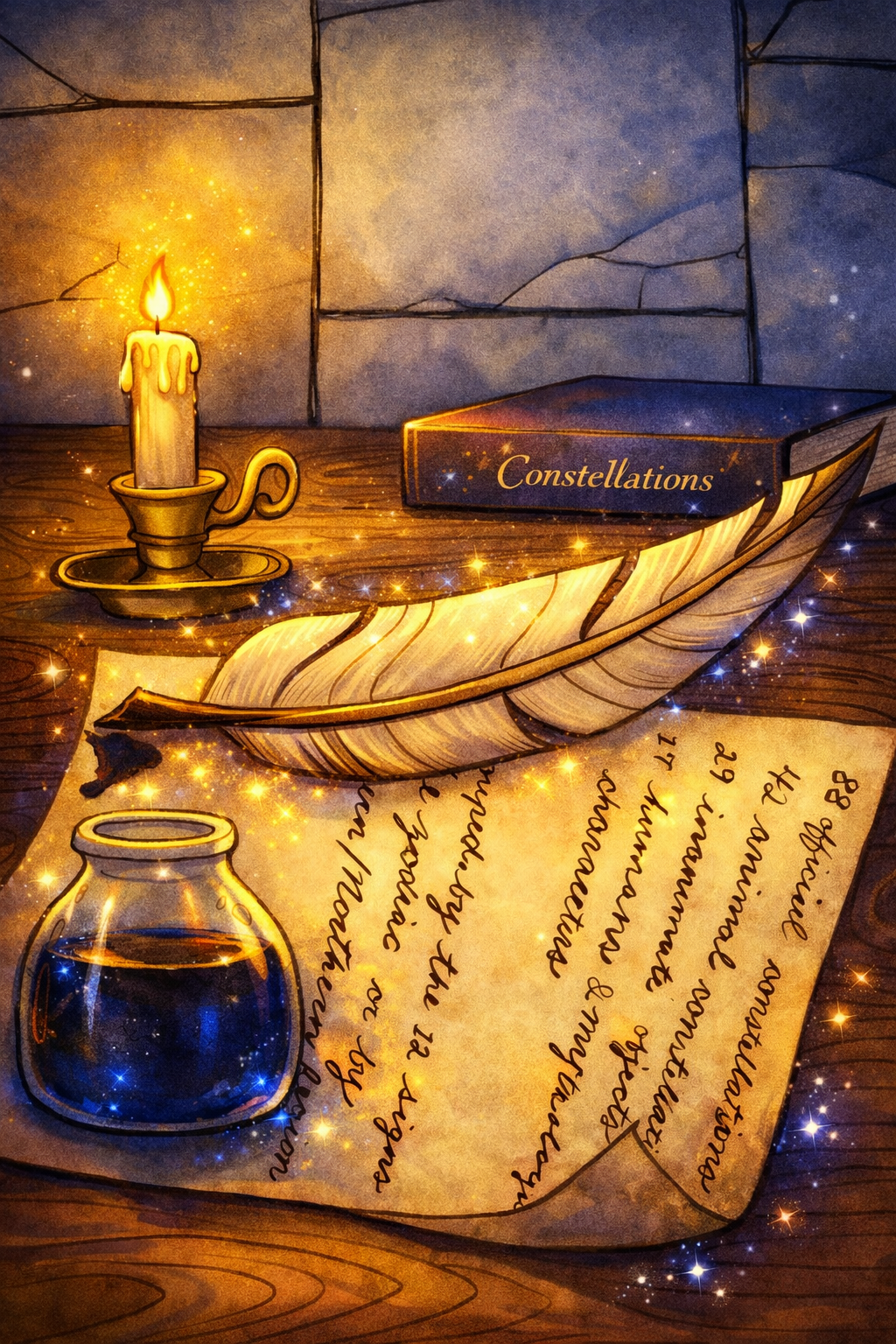
The School of Evershade is an imaginative educational world built around a simple idea:
Learning can be accurate without feeling ordinary.
Within the halls of an old castle reclaimed for learning, scholars explore real history, science, traditional knowledge, writing, art, craft, folklore, and material culture through lessons designed to encourage curiosity and hands-on discovery.
Evershade’s castle, animal professors, Houses, and school traditions are fictional.
The learning is not.
Why Evershade Exists
Evershade began with a love of the things that make old schools, libraries, workshops, apothecaries, observatories, and archives feel irresistible: leather journals and botanical specimens, quills and ink, old alphabets, handmade books, mysterious artifacts, star charts, workshop tools, shelves of strange ingredients, and the feeling that there is always something else waiting to be discovered.
But wonder and accuracy do not have to be opposites.
Evershade was created to bring that atmosphere to subjects that can actually be studied.
Instead of pretending to decipher an invented ancient language, scholars can investigate cuneiform, Egyptian hieroglyphs, Ogham, runes, and historical alphabets.
Instead of filling a fictional Herbology textbook with imaginary plants, scholars can grow, identify, observe, preserve, and study real ones.
Instead of simply pretending to be an old scribe, scholars can investigate historical inks, manuscripts, scripts, quills, parchment, illumination, and bookmaking—and then try some of those techniques for themselves.
A fantasy setting provides the atmosphere.
History, evidence, observation, and making provide the education.
The Castle Is Fictional. The Subjects Are Real.
Evershade is not intended to blur the line between history and fantasy.
The School itself—the castle, its professors, its Houses, and the stories surrounding them—provides an imaginative framework through which real subjects can be explored.
Lessons are intended to distinguish between documented history, scientific knowledge, historical belief, folklore, tradition, and Evershade’s own fictional world.
That distinction becomes especially important when studying subjects surrounded by legend.
A lesson might investigate why people once feared a particular plant without claiming that the fear was justified. It might examine historical divination as a cultural practice without presenting divination as scientifically predictive. It might explore when brooms, cauldrons, familiars, or particular animals became associated with witches without asking scholars to adopt those beliefs themselves.
Folklore can be studied as folklore.
Historical belief can be studied as historical belief.
And fantasy can remain fantasy.
Evershade is interested in why people believed, made, wrote, practiced, feared, celebrated, and imagined the things they did—and what surviving evidence can tell us about them.
Learning By Doing
Evershade is meant to be more than something you read.
Whenever a subject allows it, lessons invite scholars to interact with what they are studying.
You might press a botanical specimen, grow a plant over several weeks, form cuneiform wedges in clay, write with a quill, reproduce the structure of an ancient inscription, examine a museum artifact, prepare a historical material, bind a small book, keep an observation journal, create a star chart, or reconstruct a traditional craft.
These activities are not included simply to make the lessons feel more magical.
They are part of the learning.
Making something forces you to notice details that are easy to overlook on a page. Observation over time teaches something different from memorizing a definition. Reconstructing an object can raise questions that photographs alone may not.
Evershade therefore combines reading and research with observation, experimentation, creative work, practical assignments, written reflection, quizzes, and longer projects.
Immersive, But Not Roleplay
You do not need to create a character to study at Evershade.
You do not need to pretend that you live in the castle, speak in character, follow a storyline, or believe that its professors are real.
You can simply take a lesson.
The immersive elements are there for scholars who enjoy them: use a leather journal, take notes with a quill, print an assignment on parchment-colored paper, collect your work in a binder, follow your professor’s correspondence, participate in your House, or set up your workspace as though you really have taken a seat inside an old classroom.
Or don’t.
The educational material remains the same.
Evershade uses imagination to make learning more inviting—not to place another barrier between a curious person and something they would like to know.
Who Is Evershade For?
Evershade is for curious people.
It is for the person who stops to read the museum label.
The person who has always wanted an excuse to try writing with a quill.
The person who wonders why an alphabet changed, how an old remedy was prepared, what a medieval manuscript was made from, why a constellation has its name, how people colored cloth before synthetic dyes, or what an archaeological object was actually used for.
It is for people who enjoy history but also want to make something.
For people who love fantasy but still want to know what really happened.
For people who learn best when information is connected to an object, experiment, drawing, plant, place, story, or experience.
There is no required House, level of prior knowledge, or path through the castle.
Start at the beginning of a course. Choose one lesson. Follow an interesting link into another department. Spend three months on Herbology. Spend twenty minutes learning an ancient alphabet.
Curiosity is enough to begin.
Sources, Evidence & Historical Accuracy
Evershade aims to make learning imaginative without sacrificing accuracy.
As the school archives are developed and revised, lessons are researched and checked against reliable educational, scientific, historical, museum, library, archival, and scholarly sources.
Whenever possible, scholars are encouraged to encounter the evidence themselves: view an artifact in a museum collection, examine a digitized manuscript, read a historical source, compare botanical specimens, watch an educational demonstration, or explore the work of institutions and specialists who study the subject professionally.
Historical subjects are not always certain or simple. Scholars may disagree. Evidence can be incomplete. Practices vary across time and place. Older interpretations may be revised as new evidence appears.
When that happens, Evershade should say so.
The goal is not to make history tidier for the sake of the fantasy.
The goal is to make the real thing interesting enough that it doesn’t need to be.
Connected Classrooms
Knowledge rarely stays inside one room.
The departments of Evershade are designed to overlap when the real subjects overlap.
A plant first encountered in Herbology might later appear in a historical preparation studied in Potions.
A pigment investigated through plant history may eventually become part of a Scrollwork or Creative Arts project.
An inscription studied in Runes & Ancient Writing may require scholars to think about the material on which it was written, the tools used to make it, the language it records, and the culture that produced it.
A study of historical skywatching may intersect with navigation, calendars, mythology, writing, mathematics, or art.
These connections are intentional.
Evershade encourages scholars to see history, science, art, language, craft, and culture not as isolated school subjects, but as different ways of investigating the same human world.
The People Of Evershade
Evershade’s fictional faculty gives each classroom its own voice.
Professors introduce lessons, leave notes and observations, guide practical work, and give each department its own character. The Headmaster presides over the school, Heads of House help guide their Houses, and the Head Student represents Evershade’s scholars.
Behind the fictional institution are real people contributing research, artwork, demonstrations, ideas, and creative work as Evershade grows.
Built By Hand, And Still Growing
Evershade is an independent project, and the school continues to grow one lesson, illustration, worksheet, classroom, and strange little castle door at a time.
Some departments are further developed than others. Older lessons may be revised as research improves, new sources are added, practical assignments are refined, and the visual identity of the school develops.
New classrooms will open.
Old lessons will get better.
The castle will acquire new rooms, artwork, resources, and inhabitants.
And there will probably always be something under construction somewhere.
That isn’t because Evershade is waiting to become a school.
It is how Evershade grows as one.
Welcome To Evershade
There is no required path through the School of Evershade.
Follow a course. Wander through the archives. Visit the Commons. Choose a House. Try a practical. Open a book. Make something badly the first time and better the second.
Or simply look around.
There are many doors into Evershade.
Choose the one that interests you.
The School of Evershade is a free school for the love of learning. It is not accredited, and it grants no degrees or course credits — its certificates are keepsakes. What you take away is the knowledge itself.
From The Founder
I created Evershade because I wanted the kind of school I would want to wander into myself.
I wanted an excuse to open an old book and actually understand the writing inside it. To grow the plant instead of only reading its name. To use the quill. Make the ink. Shape the clay. Look through the archive. Try the craft. Ask why people believed something instead of simply being told that they did.
Most of all, I wanted learning to have some of the wonder that fantasy has always been very good at giving us, without needing to replace real history with invented facts to get there.
Evershade is my attempt to build that place.
If you find something here that makes you want to learn one more thing than you intended to when you arrived, then the castle is doing its job.
— Kali Howell
Founder, School of Evershade