RUNES CLASSROOM
Supplies for this course: everything this course asks you to gather, by level, lives on the Runes & Ancient Writing supplies page.
Course SuppliesVisit Professor Webblethorn's OfficeBookstore Shelf
Welcome to the web, scholars. I am Professor Thistleloom Webblethorn, and this is the history of writing itself.
You have enrolled, I suspect, expecting runes. Carved stones. Viking ships. Perhaps a hammer or two.
You will get them. In Unit IV. I promise: some things are worth waiting for.
We begin instead five thousand years before the Vikings, in a river valley where no one had yet invented the alphabet, the book, or, strictly speaking, writing itself. We begin with accountants. I know. It sounds unremarkable. That is precisely what makes it wonderful.
Every alphabet you have ever used, the letters on this very page included, descends from a chain of inventions that starts with Sumerian merchants pressing shaped clay tokens into wet clay to track sheep. This course follows that chain, link by link, across five thousand years: from Mesopotamian clay to Egyptian papyrus, from Sinai miners to Phoenician merchants, from Greek vowels to Roman stone, from northern carvers to medieval scribes. Each unit builds on the last. Each writing system solves a problem the previous one created.
A word about what this course is and is not. Runes & Ancient Writing is the history of writing systems: how they were invented, how they changed, what they reveal about the people who made them. If you want to learn the craft of beautiful writing, the cut of the quill and the flow of ink, that is Professor Nocturne's domain in Scrollwork, and he will welcome you warmly. Here, we are detectives and historians. We read the evidence. We follow the letters home.
A Note from Professor Webblethorn
A word about the notes you will meet in my lessons. Wherever you find a box like this one, parchment under my seal, the words inside it are mine: not the lesson's voice, but the teacher stepping out from behind it. I leave them where a warning, a wonder, or an old scribe's trick wants saying plainly.
Read the lesson for the history. Read my notes for the company.
PROFESSOR THISTLELOOM WEBBLETHORN
Runes & Ancient Writing
Epigrapher, Head of House Septentrio
What You Will Need
Keep at hand:
- Paper or a sketchbook
- Pencils and pens
- A fine-tipped pen or marker
- A ruler
- Air-dry clay or modeling dough
- A stylus (a chopstick cut flat works well)
- A flat work surface
This course follows the school's two levels of immersion. Level One uses household items only: air-dry clay or modeling dough, a stylus (a chopstick with a flat-cut end works beautifully), paper, and pencils. Every core exercise, pressing wedges, copying signs, reading inscriptions, is fully achievable at this level. Level Two uses historically closer materials for scholars who can gather them: natural earthenware clay, a cut reed stylus, and quality paper. Both levels teach the same history. Nothing in this course requires a purchased kit or specialty tools.
THE EPIGRAPHER'S BENCH
Professor Webblethorn's working bench stands open in this classroom. Choose a script — runes, Greek, Ogham, and eight more — write a name or a short line, and the Bench renders it as a carver would: letter by letter, every rule shown, every gap honestly admitted.
It prints a full-size template. Take the template to the Creative Arts Workshop, and the writing becomes carving.
Open the BenchPROFESSOR THISTLELOOM WEBBLETHORN · RUNES CLASSROOM
Course Learning Objectives
By the end of this course, scholars will be able to:
- Trace the chronological development of writing from Sumerian proto-cuneiform through medieval manuscript hands, explaining how each system emerged from and responded to the systems before it.
- Distinguish the major types of writing systems (logographic, syllabic, consonantal, fully alphabetic) and explain what problem each type was invented to solve.
- Read, at an introductory level, genuine inscriptions in cuneiform, hieroglyphs, Old Persian, the early alphabets, runes, and Ogham, using the course charts.
- Explain the great turning points: writing invented for accounting, the Rebus Principle, acrophony and the alphabetic principle, the Greek invention of vowel letters, and the carving-driven shapes of the runes.
- Evaluate popular myths about writing history (that the Phoenicians invented the alphabet, that Vikings invented runes, that quills are ancient) against the actual evidence.
- Describe how writing materials and tools, from clay and reed to parchment and quill, shaped the very forms of the letters.
- Connect writing systems to the cultures that made them: what a script reveals about trade, empire, religion, and daily life.
- Apply the course's central question to any script you meet: what did its makers leave out, and what did they keep, and why?
The Curriculum
Before any alphabet existed, three great systems taught the world what writing could be. Sumerian accountants pressed wedges into clay and invented writing to count sheep. Egyptian scribes drew birds that learned to spell sounds. Persian kings carved an engineered writing system into a living cliff. Three lessons on the deep roots.
Unit II: The Cradle of the Alphabet
In the mines of Sinai, Semitic-speaking workers looked at Egyptian pictures and stole the most powerful idea in writing history: one sign, one sound. Phoenician merchants standardized those signs into a 22-letter trading alphabet and put it on ships. Aramaic scribes then taught those letters to run an empire. Three lessons on the birth of the alphabet.
Unit III: The Mediterranean Masters
The Greeks took the Phoenician consonant alphabet and did the one thing that changed everything: they wrote the vowels down. The Etruscans carried those letters into Italy, adapting and discarding as they went. Rome gave them monumental stone form, the capitals we still use today, and a number system that counted an empire without zero. Four lessons on the classical world.
The alphabet goes north, into the cold, and learns to survive the knife. Germanic carvers stripped every curve from their letters and produced the Elder Futhark's twenty-four stark staves. The Vikings compressed them to sixteen; the Anglo-Saxons expanded them past thirty; the Irish turned the alphabet sideways and wrote along the edge of the stone. Five lessons, and the runes you came for.
Unit V: The Medieval Scriptorium
Writing comes indoors, onto the page. A bishop on the Danube builds an alphabet from three traditions. Roman scribes develop fast cursive and rounded book hands. Irish monks make the book beautiful. Charlemagne's reform gives the world lowercase letters. And medieval scribes invent the quietest technologies of all: the space between words, punctuation, and shorthand. Six lessons on the manuscript age.
A Final Word Before We Begin
Look closely at everything we study this year. It is all pressed, carved, or written, and it all connects. The wedge you press in Lesson 1 is the great-grandparent of the rune you will carve in Lesson 11 and the lowercase letter you will write in Lesson 19. Five thousand years, one continuous thread, and you are about to take it up in your own hand.
Come closer to the web, scholars. The letters are waiting.
PROFESSOR THISTLELOOM WEBBLETHORN
Runes & Ancient Writing
Epigrapher, Head of House Septentrio
From the Runes & Ancient Writing Bookshelf
Printed volumes from this classroom’s own shelf in the school Bookstore — bound editions to keep beside your lessons.
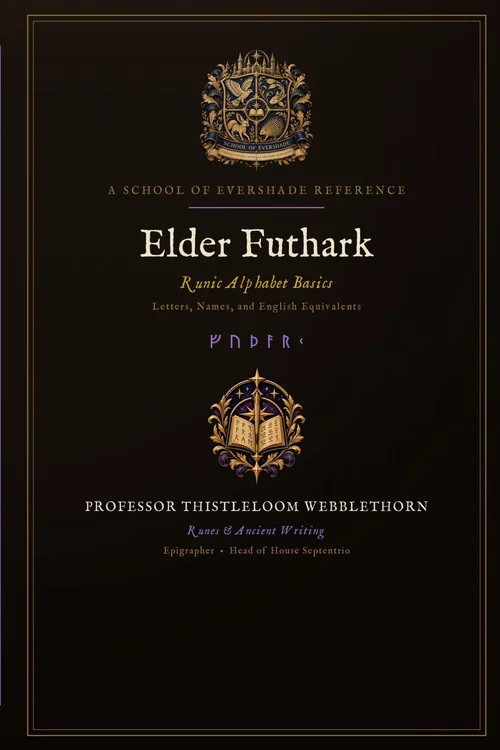
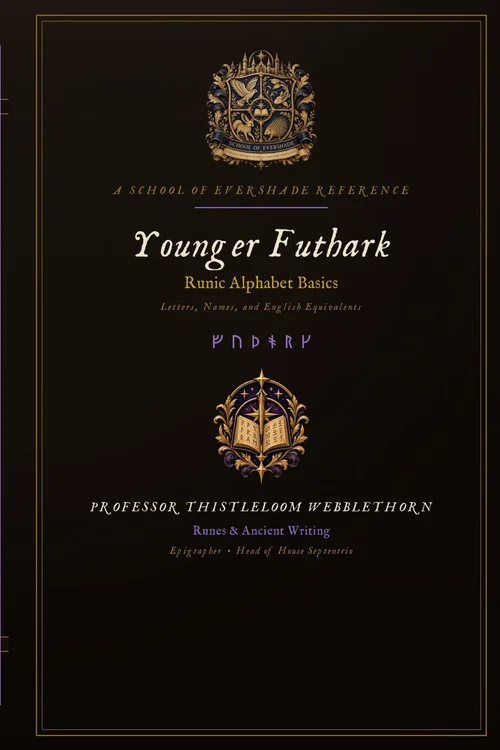
From the Runes Shelf
The printed companions to this classroom, from Professor Webblethorn’s shelf in the shop.