
 Image 1 of 2
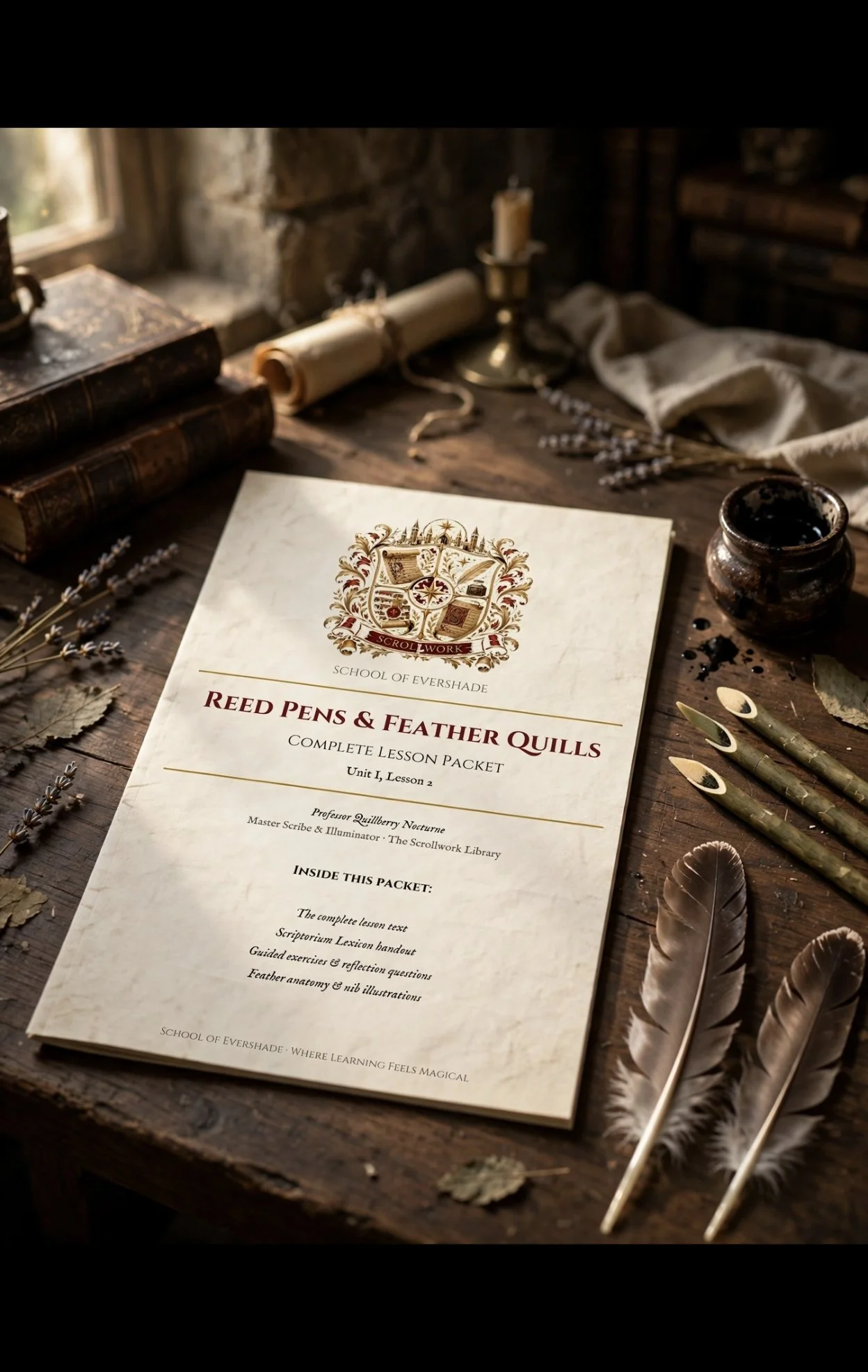 Image 2 of 2
The question before us is not which pen was better. It is why the scribe chose it.
This is the complete printable packet for Unit I, Lesson 2 of Scrollwork at the School of Evershade, "Reed Pens & Feather Quills," taught by Professor Quillberry Nocturne, Master Scribe & Illuminator.
Inside the 11-page packet:
The complete lesson text, illustrated, with real manuscript history grounded in museum sources
The Scriptorium Lexicon: 6 essential terms, from calamus to nib
A feather anatomy reference illustration with labeled diagram
Three guided exercises, including broad-edge stroke experiments you can do with a highlighter, no historical tools required
An optional practical extension: inspecting a feather barrel for future quill-making
Five reflection questions for your workbook
References & Further Reading from the Met, the British Museum, and the Getty
You will learn why reed pens endured for millennia across many traditions, including parchment Qur'an manuscripts, and why the feather quill became a principal instrument of medieval European manuscript culture. You will discover how nib width, shape, and angle shape the appearance of a script, and why different writing cultures chose different pens.
Details: Digital PDF download, US Letter size, 11 pages. Print at home or at your local print shop. Print as many copies as you need for your own household or classroom.
This is a digital item; no physical product will be shipped. Pairs with the free online lesson at the School of Evershade, where learning feels magical.