SCROLLWORK
Unit VIII · Lesson 26THE EVERSHADE MANUSCRIPT
Professor Quillberry Nocturne
Master Scribe & Illuminator
The Scrollwork Library • School of Evershade
Professor's Introduction
Last lesson, scholars. Sit down. Put your pens where you can see them.
Twenty-five lessons ago, you walked into this library with empty hands. Tonight you will walk out of it, if you walk out at all, as makers of books. That is not a small thing, and I will not pretend otherwise to spare your feelings.
This is our last lesson together. There is no new technique tonight, no new ink, no new pen. Everything you need, you already carry: in your hands, in your workbooks, and in the twenty-five lessons behind you. Tonight we do what the old guilds did when an apprentice had learned the trade. We ask for the masterpiece.
Long ago, in the craft guilds of Europe, an apprentice who wished to become a master could not simply declare himself one. He had to make a single work, a master piece, that proved he commanded every part of his trade, and lay it before the masters for judgment. If they accepted it, he joined their number. The word we now use for any great work of art began as that test: one object, holding everything the maker knew.
Your test is kinder than theirs, but it is a test all the same. Before this unit ends, you will assemble a complete manuscript portfolio — a curated set of pieces presented as one work: a designed page, an illuminated initial, a border, a sealed section, and an archive entry, all in your own practiced hand, with a hidden layer for those with the patience to look. Five elements, one object, everything you have learned.
I have been stern with you. I make no apology for it; the pen deserves stern teachers. But hear me now, and hear me clearly: I am proud of the scribes you have become. Let us finish well.
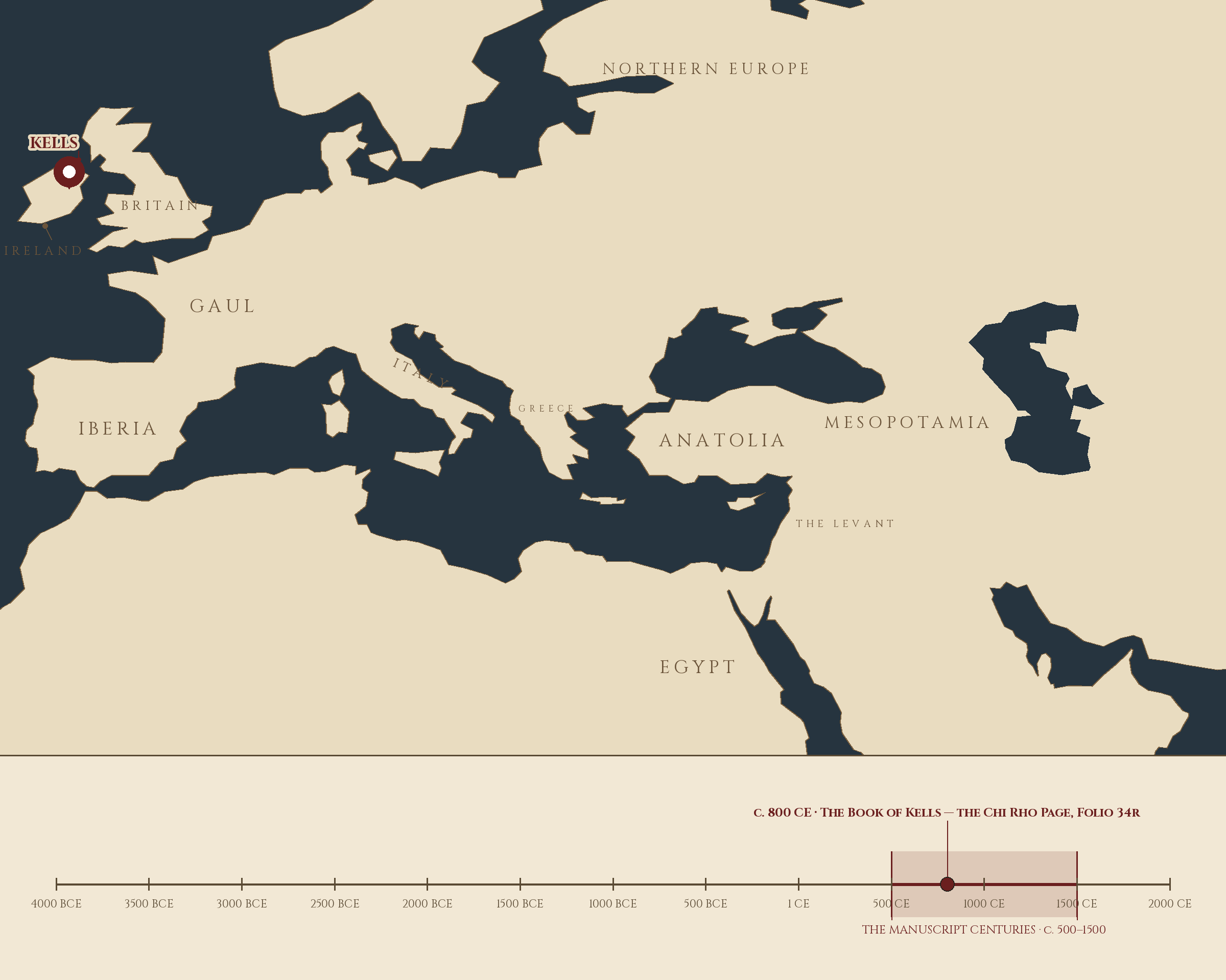
Where and when: Kells, County Meath, Ireland, c. 800 CE — The Book of Kells — the Chi Rho Page, Folio 34r. The pin is this lesson. The line beneath the map is our road: every stop a place where writing changed, every lesson a pin.
Lesson Objectives
By the end of this lesson, you will be able to:
- Define portfolio and masterpiece in their historical craft senses.
- Describe the guild masterpiece tradition and explain how this capstone follows it.
- Name all eight units of the Scrollwork course and the skill each one contributed.
- Plan a complete manuscript portfolio incorporating elements from Units I through VII.
- Execute a designed page with hierarchy, an illuminated initial, a border, a sealed section, and an archive entry.
- Add a hidden layer (invisible ink or cipher) drawing on Unit VII.
- Sign the finished work with an honest colophon, following the scribal tradition.
Reading this lesson: ★ marks the passages to remember. They return on the class test. Check in questions ask the material back as you go; answer them in your workbook when you meet them.
Working this lesson: Your assignment packet is the first download on this page. Keep it beside you as the lesson moves along: the capstone is built across sittings, and the packet carries its requirements, its stages, and its checklists in the order you will work them. Signposts in the reading tell you where each exercise belongs. Written answers are short answers in your own words; a few honest lines are worth more than a filled page.
Your Assignment Packet
This lesson's assignments live in its packet: the Lexicon Handout (every term, course terms marked ◆), Materials, Guided Practice, the Assignment Manual with its answer key for self-checking, the Reflection Questions, and the Workbook Checklist. Download the packet before you begin and keep it beside you as you read.
The Guild's Old Custom
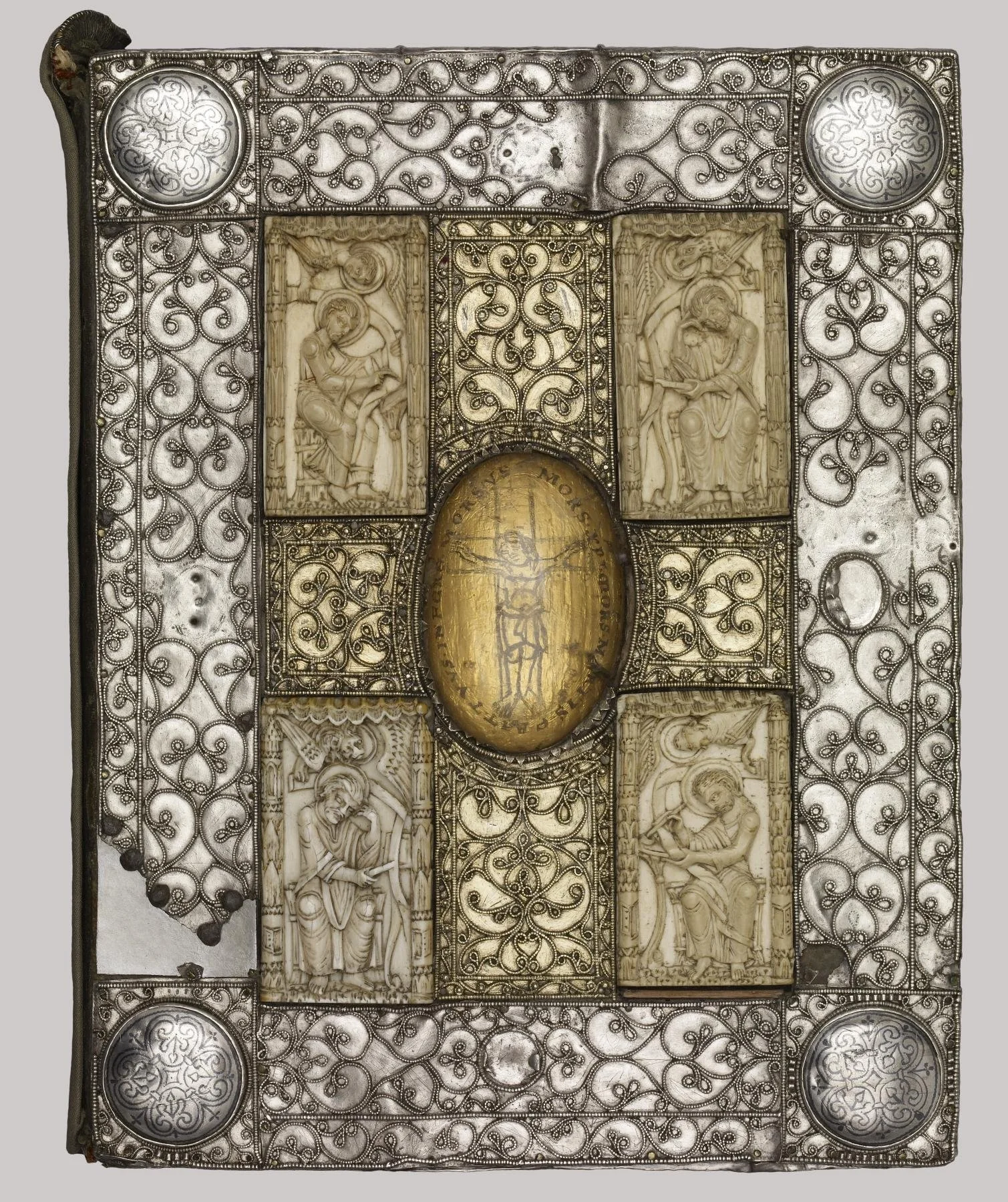
The finished book. The Mondsee Gospels in its treasure binding (Walters W.8): silver filigree, a gold medallion, and — look closely — the four Evangelists carved in ivory, every one of them shown as a scribe at his desk, pen in hand, in the act of writing the book he stands on. The binding was probably made in the eleventh or twelfth century and was heavily restored in the nineteenth; it has outlived its makers by nine hundred years anyway. This is what "finished" means in the scribe's world: one object, made whole, made to be kept.
The Walters Art Museum, Baltimore (W.8). Public domain (Walters Open Access).
Before we plan your portfolio, you should understand the custom you are following, because it is older than any of us and deserves its telling.
In the towns of medieval and early modern Europe, crafts were governed by guilds: associations of masters who controlled who could practice a trade, set standards of quality, and trained the next generation. A young worker entered as an apprentice, learned the trade over years of supervised work, and rose to journeyman. ★ But journeyman was not master. To become a master, and only masters could join the guild and run their own shops, the candidate had to produce a masterpiece: a single work demonstrating complete command of the craft, made to guidelines the guild provided, and submitted to the masters for judgment. If the masters accepted it, the candidate joined their ranks. If they did not, he remained a journeyman, sometimes for life.
The test was serious because the stakes were real. In the seventeenth century, the Worshipful Company of Goldsmiths in London required apprentices to produce their masterpiece under supervision at Goldsmiths' Hall, after the company grew concerned about falling standards. Successful masterpieces were often kept by the guild, which is why so many survive in collections today. The Smarthistory essay on the late medieval workshop notes that guilds in cities including Krakow, Hamburg, and Prague assigned demanding set themes for these test pieces, judging them through guild officials before any promotion was granted.
Our test follows the old custom in its shape, if not its severity. No one here will be barred from a trade if the border smudges. But the shape matters: one work, every skill, honest judgment. ★ The guild masters asked a single question of every masterpiece, and I ask it of your portfolio tonight. Does this object prove its maker commands the craft?
That is the standard. Meet it.
Check in: What did a journeyman have to make before the guild would call him master, and what happened to him if the masters said no?
❦ In your workbook: record the masterpiece custom in your own way — the apprentice's road, the one work, and the masters' single question — copy, sketch, or note what matters.
The Whole Course in One Page
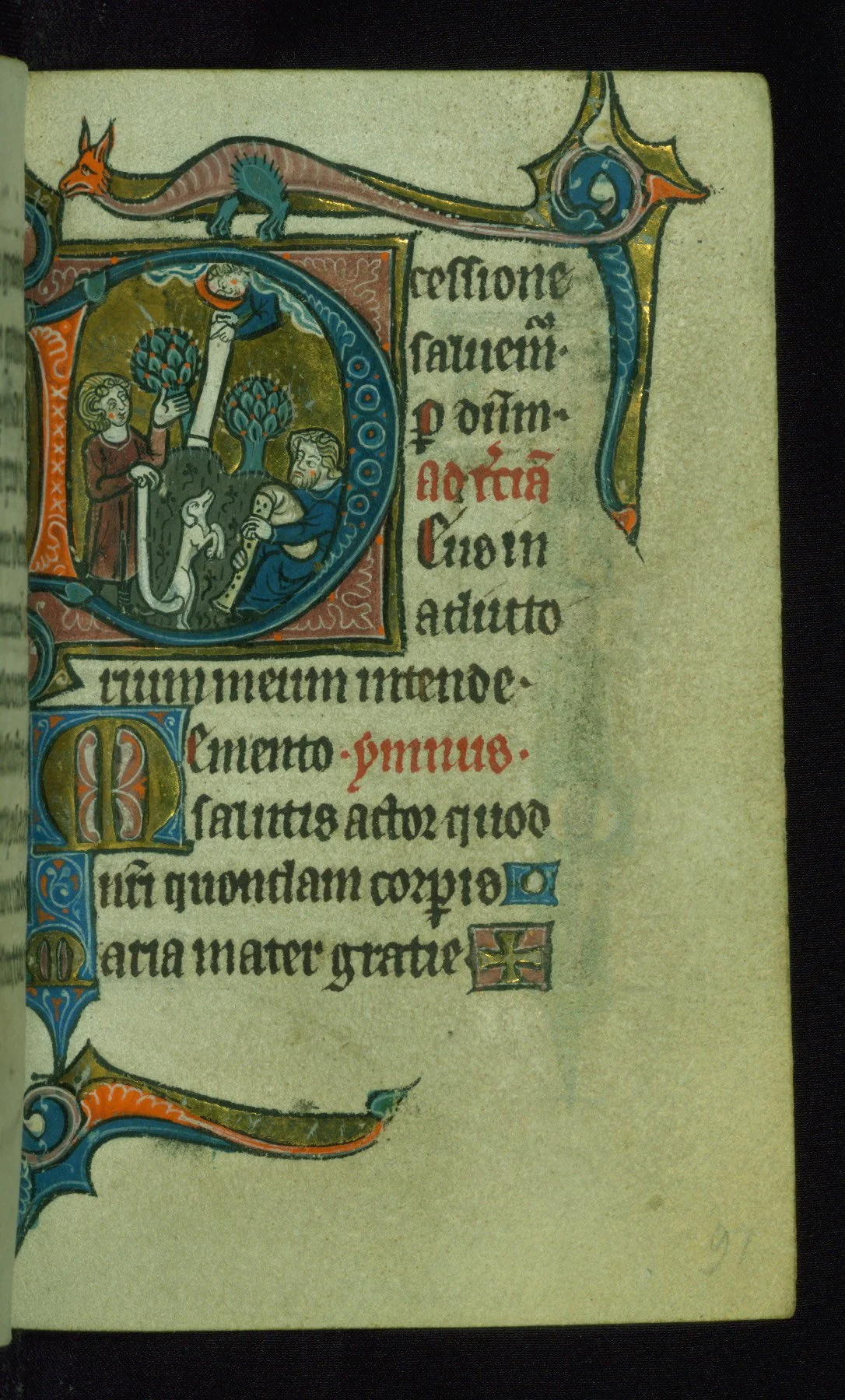
The whole course on one leaf. A page of a thirteenth-century Book of Hours (Walters W.39, fol. 91r): a historiated initial raised on gold, the rubric in red telling the reader where he is, the text in its ruled block, smaller initials flowering down the margin — and along the top border, a dragon, the illuminator's joke kept in its place at the edge. Hierarchy, gold, border, and marginalia, the whole of Unit V in a single page. Your portfolio asks for nothing this page does not already do.
The Walters Art Museum, Baltimore (W.39, fol. 91r). CC0 (Walters Open Access).
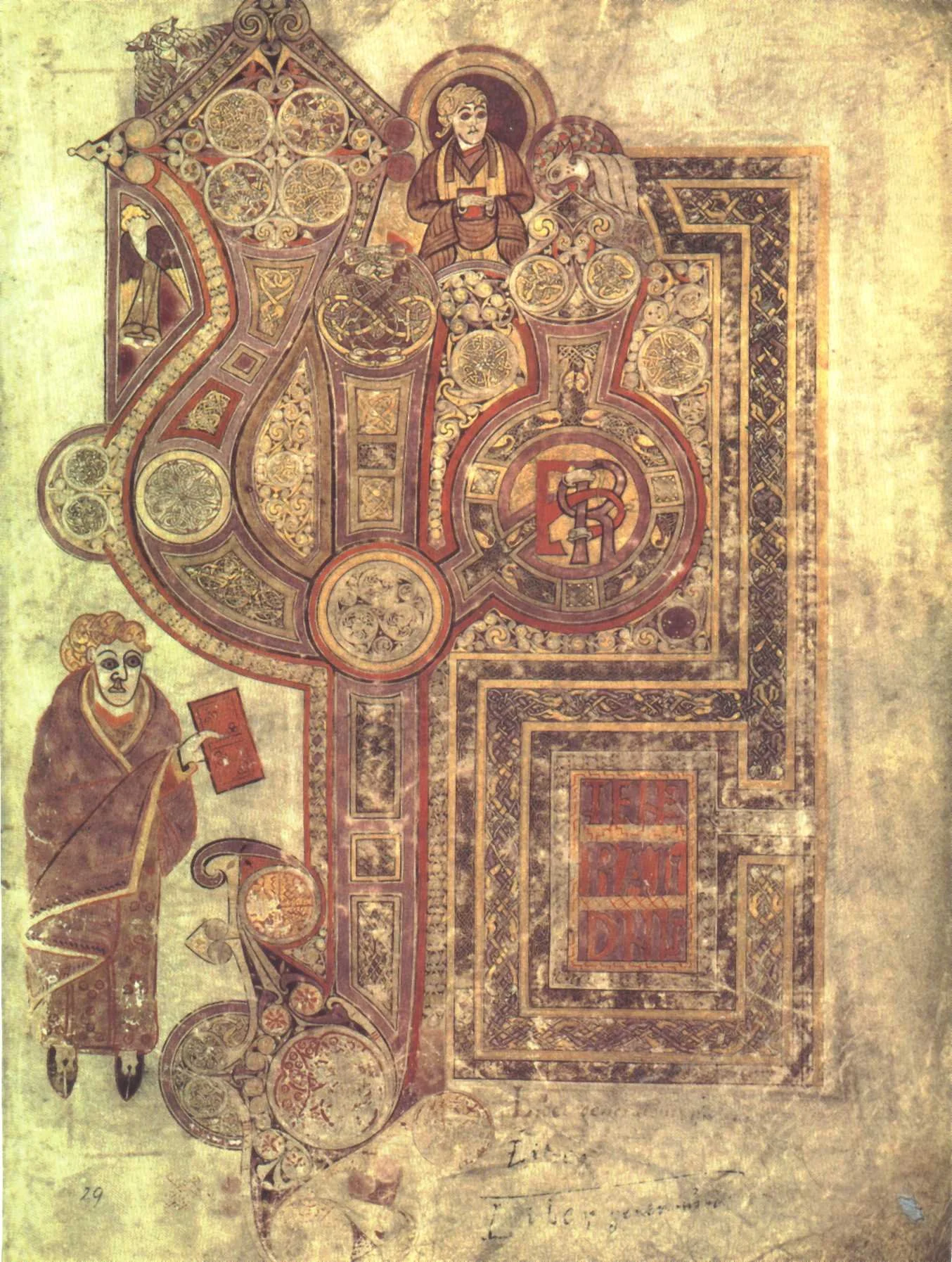
The designed page. Folio 29r of the Book of Kells: the opening of Matthew's Gospel, where a single initial — the L of Liber generationis, "the book of the generation" — is given an entire page, and the hierarchy could not be clearer if it were shouted. One letter matters most, and the page spends everything on it: interlace, figures, a frame within the frame. When your designed page decides what matters first, it is answering the same question this page answered twelve centuries ago.
The Book of Kells, Trinity College Dublin (MS 58, fol. 29r). Public domain.
Your portfolio must draw on every unit of this course. Here is the whole of it, the eight units, so you can see what you carry.
Unit I, The Scribe's Desk (Lessons 1 to 4). You surveyed the workspace, learned why the scribe chose this pen and this surface, and arranged the desk as a system where every tool answers a vulnerability of the work. Your portfolio begins here: with a prepared surface, arranged tools, and a pen you understand.
Unit II, Ink and Pigment (Lessons 5 to 8). You made and studied inks: carbon black from soot and charcoal, iron gall from oak galls and vitriol, reds from minium, vermilion, madder, and brazilwood, and you learned how ink flows, dries, and survives the centuries. Your portfolio's lines will be laid down in ink you chose with a scribe's judgment.
Unit III, Quills and Pencraft (Lessons 9 to 11). You studied the feather's structure, cured and cut quills, and learned the two great nib families: the broad edge, whose thick and thin come from pen angle, and the pointed nib, whose contrast comes from pressure. Your portfolio's hand will show which nib you chose and why.
Unit IV, Foundational Calligraphy (Lessons 12 to 16). You trained the hand itself: pen angle and stroke control, the spacing and rhythm that make a page readable, and three historical hands, Roman capitals, Uncial, and Insular script. Your portfolio's text will be written in a hand you have practiced, not one you are inventing tonight.
Unit V, Manuscript Decoration (Lessons 17 to 20). You learned hierarchy and page layout, gilding with gold leaf, botanical borders and ornament, and the marginalia tradition with its drolleries and manuscript creatures. Your portfolio's designed page, illuminated initial, and border come from this unit.
Unit VI, Scrolls and Archives (Lessons 21 to 23). You constructed scrolls, studied wax seals and authentication, and learned how archives label, shelve, and find their books. Your portfolio's sealed section and archive entry come from this unit.
Unit VII, Ciphers and Hidden Writing (Lessons 24 and 25). You learned invisible inks and the Caesar cipher with its code wheels: the scribe's secret layer. Your portfolio's hidden layer comes from this unit, for those with the patience to look.
Unit VIII, The Grand Manuscript (this lesson). No new technique. Synthesis, judgment, and farewell.
★ Twenty-five lessons. Eight units. One portfolio. You are ready.
Check in: Eight units stand behind this page, and every one of them contributes an element. Which unit supplies your sealed section, and which supplies your hidden layer?
❦ In your workbook: record the eight units and the skill each one contributes to your portfolio in your own way — copy, sketch, or note what matters.
Professor Nocturne
Steady, scholars, before we plan the work, and understand what tonight is not.
It is not an examination. I will not hover over your shoulder with a ruler, and there is no grade waiting at the end of it that can measure what your hands have learned. The guild masters judged with their eyes and their experience, and so will I: I will look at your portfolio, and I will know.
What tonight is, is a door. On one side of it, you are students who have taken lessons. On the other side, you are scribes who have made a book. Everything you have done for twenty-five lessons was preparation for walking through it.
Plan carefully. Work honestly. Sign your name. I will be here when you finish.
In your packet: Exercise I — The Course Review ◐ begins here. Work it now, or mark the place and take it when the planning begins — your choice.
The Portfolio Requirements
★ Your masterpiece consists of five required elements, presented as one complete manuscript object, plus a hidden layer for the patient. Every element must show technique learned in its unit. A portfolio missing an element is incomplete, the way a guild piece missing its proof of skill would have been.
Element One: The Designed Page (Unit V, Lesson 17). One full page of text in your practiced hand, laid out with deliberate hierarchy: a clear text block, ruled margins, headings or titles distinguished from the body, and consistent spacing. The page must be readable before it is beautiful. Choose your text: a passage you love, a text from another class, or words of your own. It should be long enough to show your hand across many lines.
Element Two: The Illuminated Initial (Unit V, Lesson 18). One decorated initial letter opening your text, raised with gold or its honest alternatives. Level One students may use gold paint, bronze powder in gum, or yellow ochre; Level Two students may use shell gold or genuine leaf according to the lesson. The initial must be drawn and painted, not printed or pasted.
Element Three: The Border (Unit V, Lesson 19). A border or ornament framing at least one side of your page: botanical rinceau, geometric interlace, or bar border in the traditions you studied. It must be your own design, drawn by your hand.
Element Four: The Sealed Section (Unit VI, Lesson 22). A sealed portion of your portfolio: a folded and sealed packet, a sealed envelope holding a portion of the text, or a seal impressed beside your colophon. Include a brief authentication note in the manner of the lesson, stating what the seal attests. Level One students may use sealing wax from a craft store or a drawn and colored seal; Level Two students may cut a simple matrix.
Element Five: The Archive Entry (Unit VI, Lesson 23). A complete archive label for your portfolio, in the titulus tradition: a title, your name as scribe, the date, a shelfmark of your own devising, and a one-line description of the contents. This label must be affixed to or written upon the portfolio itself, as a medieval book's label would be.
The Hidden Layer (Unit VII, Lessons 24 and 25). Somewhere in your portfolio, hide something: a message in invisible ink, revealed by heat, or a passage enciphered with a Caesar shift, with the key hidden elsewhere in the work. This element is not strictly required, but a portfolio with a well-made hidden layer will be remembered, and I confess I will look for it.
The Colophon. Close your portfolio the way the scribes did: with a colophon, a signed note naming yourself, dating the work, and saying honestly what it is. You may borrow the old formula if you wish. For a thousand years, tired scribes have written some version of these words: three fingers write, but the whole body labours. You have earned the right to them.
Check in: Five elements, one object. Name the five, and name the lesson each one proves.
❦ In your workbook: record the five required elements, the hidden layer, and the colophon in your own way — copy, sketch, or note what matters.
In your packet: Exercise II — The Evershade Manuscript (The Capstone Project) ⚒ begins here. Its six stages are taught next; work it across your sittings, and take Exercise III — The Hidden Layer ⚒ when your portfolio reaches its fifth stage.
Stages of the Work
Do not begin with the pen. The guild piece was planned before it was made, and so is yours.
First, the plan. Sketch your page on scrap: the text block, the position of the initial, the border's design, where the seal will fall, where the archive label will sit, and where the hidden layer will hide. Decide your hand, your ink, and your materials level. Show the plan to no one; it is between you and the work.
Second, the draft. Write your full text on scrap in your chosen hand. Find the awkward letters now, not on the final page. Test your inks and colors on the same surface you will use for the portfolio.
Third, the execution. Rule the final page. Write the text. Let it dry fully before any decoration touches it. Paint the initial. Draw the border. ★ Work in the order the medieval makers did: text first, decoration after, because decoration must serve the page, not swallow it.
Fourth, the seal and the label. Seal your sealed section. Write your archive entry. Affix the label.
Fifth, the hidden layer. Add your invisible message or cipher last, when the portfolio is otherwise complete, the way a scribe might add a secret to a finished book.
Sixth, the colophon. Sign it. Date it. Mean it.
Check in: The guild piece was planned before it was made, and so is yours. What are the six stages, in their order, and why does the decoration wait until the text is dry?
❦ In your workbook: record the six stages in their order in your own way — copy, sketch, or note what matters. This list is the working order of your sittings.
Guided Observation: Study a Master
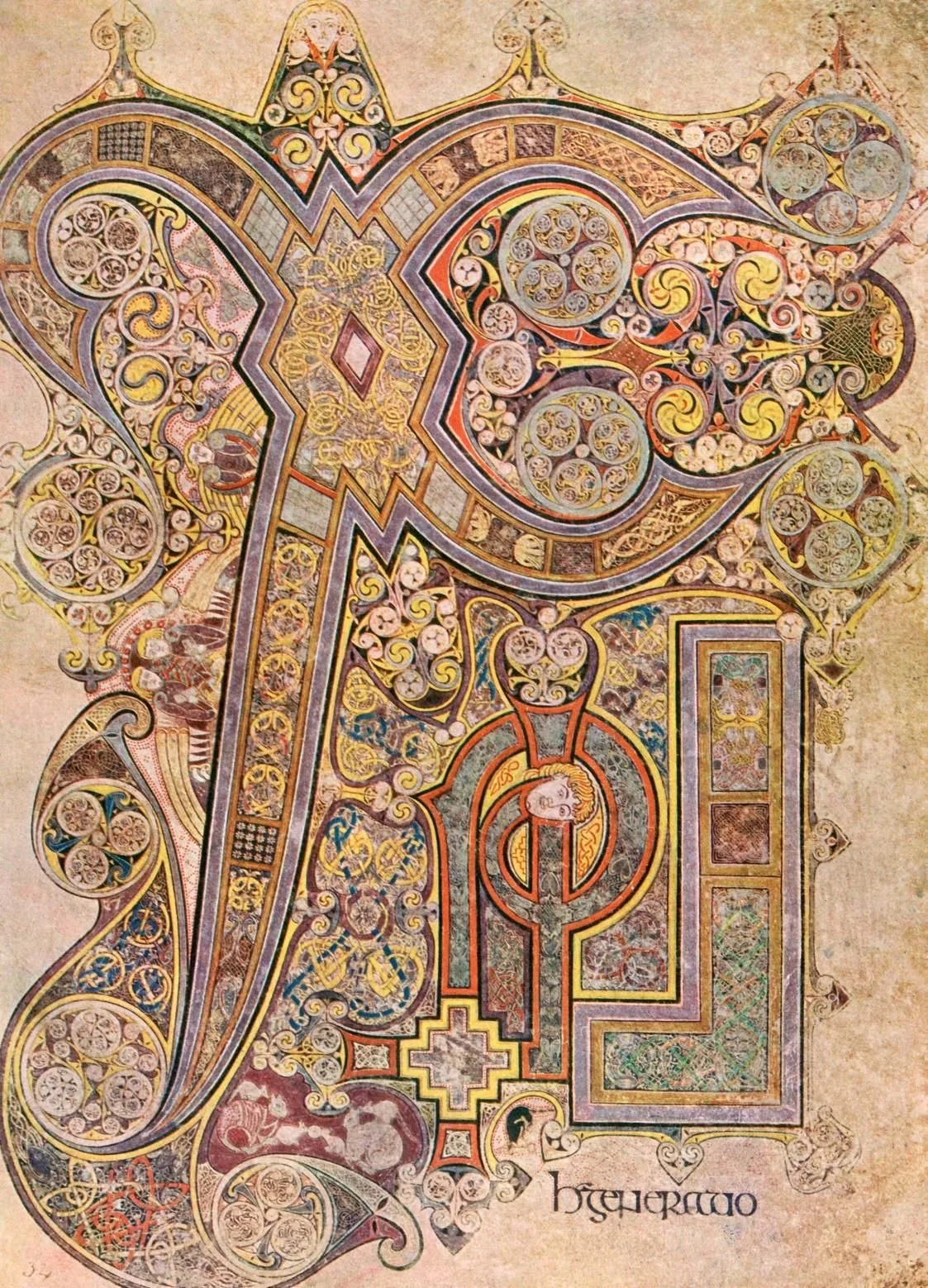
Study a master. Folio 34r of the Book of Kells (c. 800): the Chi Rho page, the most famous single page in medieval art. The scribe took the first two Greek letters of Christ's name and inflated them until they became the whole page — and then hid a world inside them: angels, beasts, an otter with a fish, cats with mice, moths under the great letter's arm. Trinity College Dublin invites you to look closely. So does your professor. This is the page to study before you plan your border.
The Book of Kells, Trinity College Dublin (MS 58, fol. 34r). Public domain.
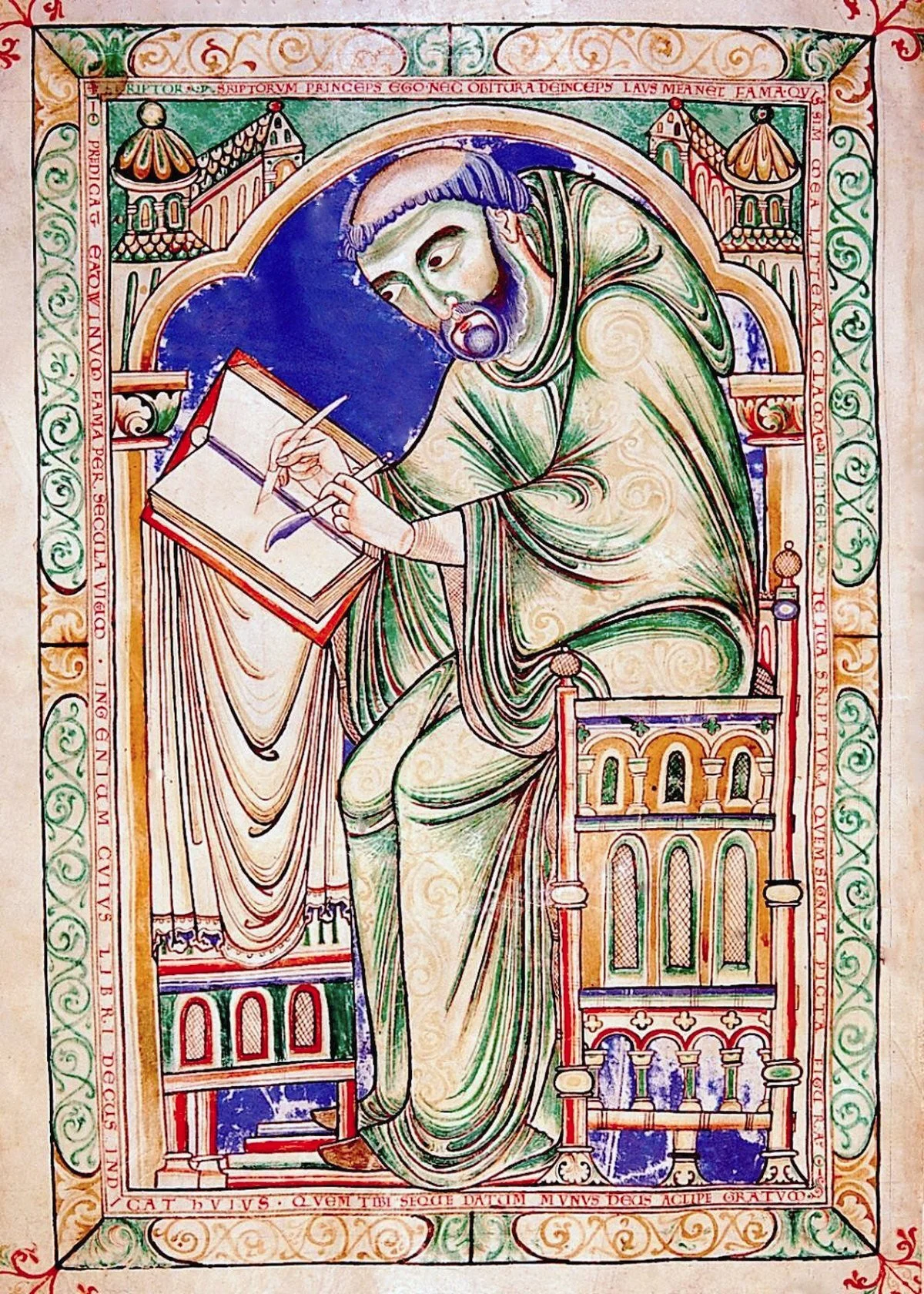
The scribe, signing his work. Eadwine of Canterbury, painted at the front of his own Psalter (c. 1160): quill in one hand, penknife in the other, his book open on the desk — every tool of this course in one portrait. The inscription running round the frame calls him prince of scribes, and boasts that the fame of his writing will live through the ages. A colophon with a picture: the maker, proud of his craft, exactly as your portfolio asks you to be.
The Eadwine Psalter, Trinity College, Cambridge (MS R.17.1). Public domain.
Before you plan, study what mastery looks like. Tonight's observation is the single most famous page in medieval art.
★ The Book of Kells is a Gospel book made around the year 800, probably begun on the island of Iona and completed at Kells in Ireland, written on vellum in a script called Insular majuscule. Its 680 pages hold some of the most intricate illumination ever made. Trinity College Dublin, which has kept the book since 1661, calls one page of it the single most famous page in medieval art: folio 34r, the Chi Rho page.
The page opens the story of Christ's birth in the Gospel of Matthew. The scribe took the first two Greek letters of Christ's name, chi and rho, and inflated them into a composition that fills the entire page: interlace, spirals, animals, and human figures packed into and around the letterforms. Trinity's visitor guide invites you to look closely: near the bottom an otter holds a fish, two cats sit with mice, moths hide under the arm of the great X, and angels attend its long stroke. Every page of the manuscript is now free to view in Trinity College Dublin's Digital Collections, and I expect you to spend real time with folio 34r before you plan your border.
Study it the way we have studied everything in this course: as a working scribe, not a tourist. Ask the craftsman's questions. How did the artist plan a page this dense? Where did the design begin, at the letterform or at the margin? How many colors, and in what order were they laid down? What does the page assume about its reader, that they will look once, or look for an hour?
Then ask the question this lesson exists to ask. What would your Chi Rho page be: the single page of your portfolio where you spend everything you have?
Record your observations in your workbook. They are your first planning notes.
Check in: Folio 34r is built from two Greek letters. Which two, whose name do they begin, and what small creatures does the visitor guide find hiding in the page?
❦ In your workbook: record your craftsman's questions — and your own answer to the Chi Rho question — in your own way: copy, sketch, or note what matters.
Demonstration: Planning Your Portfolio
Work on scrap paper with a pencil. This demonstration produces your plan, not your portfolio.
Map the page. Draw a rectangle representing your final page. Mark the margins you ruled in Unit V. Block in the text area, the illuminated initial's space (at least five lines tall), and the border's path along one or more sides. Note where the eye travels first, second, third.
Choose the hand. Write the alphabet in each hand you have practiced: Roman capitals, Uncial, Insular. Choose the one that serves your text best, and write one honest sentence about why. The script serves the page; the page does not serve the script.
Choose the inks. List every color your portfolio will use and the lesson each comes from: your text ink, your initial's colors, your border's palette. Note which are Level One and which are Level Two.
Place the seal and label. Mark where the sealed section will fall and draft your archive entry's wording: title, scribe, date, shelfmark, description.
Hide the secret. Decide your hidden layer's method and its message. Write the message on scrap, encipher or prepare it, and note where in the portfolio it will live and where its key or revelation method is recorded.
Write the colophon draft. Draft your closing note. Name yourself. Date the work. Say what it is, honestly, including what you attempted that was new.
When the plan is complete, set it aside for one full day before beginning execution. The guild piece was not rushed, and neither is yours.
Check in: Your plan is a map before it is a manuscript. What must the map decide before the final page is ruled — and why does the finished plan rest a full day before execution begins?
❦ In your workbook: record the plan's decisions in your own way — copy, sketch, or note what matters. The plan itself stays on its scrap; the workbook keeps its decisions.
Materials
Required (Level One — household items)
- Good paper: heavy drawing paper, watercolor paper, or cardstock for the final page. It must take ink and light paint without buckling.
- Pens: your practiced broad-edge pen (a cut marker or chisel-tip pen works), plus a fine pen or brush for detail work.
- Inks and colors: black ink for the text; red for rubrication-style headings if you wish; gold paint, bronze powder mixed in gum arabic, or yellow ochre for the illuminated initial; colored pencils, markers, or watercolors for the border.
- Ruling tools: a ruler and pencil for layout lines.
- Sealing materials: craft-store sealing wax with a stamp or coin, or paper, glue, and colors to make a drawn seal.
- Label materials: a small card or strip for the archive entry, affixed to the portfolio.
- Scrap paper: for the plan, drafts, ink tests, and the hidden layer's trial run.
- Lemon juice or milk: for a true invisible-ink hidden layer, per Unit VII, Lesson 24.
Suggested (Level Two — historically closer)
- Parchment paper or vellum-style paper: a closer ground for the final page.
- Handmade inks: carbon or iron gall ink from Unit II, or oak gall ink if you made it.
- A cut quill: your own nib from Unit III, for the text hand.
- Shell gold or genuine gold leaf: for the illuminated initial, with gum ammoniac or gesso raising per Unit V, Lesson 18.
- A cut seal matrix: linoleum or soft carving block for a personal seal, per Unit VI, Lesson 22.
No purchased kits are required. The core of the capstone (the designed page, the hand, the border, the seal, the label, the hidden layer) is fully achievable with paper, pens, paint, and wax.
Reflection Questions
Answer the following questions in your workbook.
- The guild masterpiece was judged by masters before membership was granted. Who judges your portfolio, and what does their judgment mean compared to the guild's?
- You have listed all eight units from memory. Which unit's skill surprised you most by how much you now rely on it?
- What does your portfolio's hidden layer assume about its reader?
- The old colophon says three fingers write but the whole body labours. After twenty-six lessons, what has your body learned that your fingers could not have learned alone?
- If you were to make a second portfolio, what would you change, and what does that answer tell you about what the first one taught?
- Nocturne has been stern with you for twenty-five lessons. In tonight's introduction, he said he was proud. Do you believe him, and what is your evidence?
Workbook Checklist — Lesson 26
In my workbook I have:
- ☐ defined portfolio and masterpiece in their historical craft senses
- ☐ described the guild masterpiece tradition and how this capstone follows it
- ☐ named all eight units of the Scrollwork course and the skill each one contributed (Exercise I)
- ☐ written one sentence for each of the twenty-five lessons and marked every gap honestly (Exercise I)
- ☐ studied folio 34r, the Chi Rho page, and recorded my observations and craftsman's questions (Guided Observation)
- ☐ planned the portfolio on scrap: page mapped, hand and inks chosen, seal and label placed, secret decided, colophon drafted — and let the plan rest a full day (Demonstration)
- ☐ written the designed page: text first, in my practiced hand, and let it dry fully before any decoration (Exercise II)
- ☐ drawn and painted the illuminated initial in gold or its honest alternatives (Exercise II)
- ☐ drawn the border, my own design, framing at least one side of the page (Exercise II)
- ☐ sealed the sealed section and written its authentication note (Exercise II)
- ☐ written the archive entry — title, scribe, date, shelfmark, one-line description — and affixed it to the portfolio (Exercise II)
- ☐ (optional, as the Requirements allow) added the hidden layer, its revelation tested on scrap first (Exercise III)
- ☐ closed the portfolio with an honest colophon, signed and dated (Exercise II)
☐ Lesson completed Date: ___ Signature: ___
Professor's Review
And so we come to the end, scholars, and I find I have less sternness left than I expected.
Look at what stands before you. Twenty-five lessons ago, you did not know a sander from a penknife. You had never cured a feather, never cut a nib, never mixed an ink from oak galls, never ruled a page, never raised a letter in gold, never sealed a packet, never shelved a book by its shelfmark, never hidden a message where only the patient would find it. Now you have done all of these things, and tonight you have bound them into one object with your name on it.
I have taught scribes for longer than you have been alive, and I will tell you something I do not say often. The sternness was never the point. The point was always this: that you would learn to do careful work, and then go on doing it when no one was watching. The portfolio on your desk is proof that you can. What you do with that proof is now yours, not mine.
Three fingers write, but the whole body labours. Your whole body has laboured, and it shows.
Keep your pens. Keep your workbooks. And when you make your next book, and the one after that, remember the desk, the ink, the nib, the hand, the gold, the seal, the shelf, and the secret. They are yours now.
It has been my honor to be your teacher.
PROFESSOR QUILLBERRY NOCTURNE
Scrollwork Library
Master Scribe & Illuminator
Cross-Class Connections

Creative Arts · Unit II, Lesson 11 — Case Binding & Archival Boxes
I teach the binding that gives a finished manuscript its final form: the gatherings cased, and an archival box to keep the whole safe. Your portfolio is loose pages until it is bound, scholars. When the colophon is dry, bring it to my workshop, and my lesson will make it a book.
PROFESSOR COGBRANCH TIMBERCLANK
Creative Arts Workshop
Runes · Lesson 18 — The Celtic Manuscript Tradition
I teach the Insular manuscripts and the world that made them, the tradition tonight's observation studied in the Book of Kells, and the deep history of the scripts your Unit IV hands were trained in. My scribes painted the Chi Rho page you have been studying. Read my lesson for the hands and the houses behind it, then go back and spend everything you have on your own one page.
PROFESSOR THISTLELOOM WEBBLETHORN
Runes & Ancient Writing
Potions · Unit VI, Lesson 49 — Fluid Color: Plant & Berry Stains
My plant and berry colorants are the scribe's palette grown in a garden: the reds and purples a manuscript initial can wear without a mine or a merchant. The initial's gold is Professor Nocturne's lesson to teach; its colors may be mine. Test every stain on scrap before it touches your page; a color that behaves in my cauldron still has to behave on your parchment. Come and test it at my bench first.
PROFESSOR CRIMBLEBREW MUDDLENOOK
Potions Laboratory • Master Apothecary • Head of House Meridies
Further Reading & Sources
For scholars whose appetite is whetted rather than satisfied, these are the places I send my own students.
*Christopher de Hamel. Meetings with Remarkable Manuscripts. Allen Lane, 2016.* Twelve manuscripts, twelve journeys: de Hamel travels to libraries across the world and describes the great books as physical objects made by human hands. The chapter on the Book of Kells walks you through the manuscript the way tonight's observation began. The finest single book on what manuscripts are.
*Bernard Meehan. The Book of Kells. Thames & Hudson, 2012.* The Keeper of Manuscripts at Trinity College Dublin introduces the most famous illuminated manuscript in the world, with more than eighty pages reproduced full size and in full color. Study the Chi Rho page here before you plan your border.
Trinity College Dublin, Digital Collections. The Book of Kells online. Every surviving page of the Book of Kells, free to view in high resolution: the next best thing to standing in the Old Library. Begin at folio 34r. The Book of Kells in Trinity College Dublin's Digital Collections
Thijs Porck. "Scribal complaints: Early medieval English copyists and their colophons." Porck: Scribal complaints The "three fingers write" colophon and its cousins, with photographs of the manuscripts: what tired scribes actually wrote at the ends of their books. Read this before you draft your own colophon.
Smarthistory. "The role of the workshop in late medieval and early modern northern Europe." Smarthistory: The workshop How workshops trained apprentices, how guilds judged masterpieces, and why St. George and the Dragon was a favorite test theme: the world your portfolio's guild custom comes from.
Browse the Scrollwork shelf in the school Library for readable editions of these works.
Sw-u8-l26 • Unit VIII, The Grand Manuscript • School of Evershade
Submit your work for this lesson using the form below.
THE CLASS TEST
SCROLLWORK LIBRARY · ALL EIGHT UNITS · LESSONS 1–26
The lessons are done, all twenty-six of them, and the hand that began at a bare desk now closes the course with a finished manuscript. This test covers the whole of the Scrollwork Library, and it measures retention: not what you can look up, but what has stayed with you now that the class is complete. Take it from memory, in one sitting if you can, before you consult your notes, and attempt every part before you turn to the answer key at the back of the packet.
The test packet is a single download. Its parts move from questions drawn across every unit, through the vocabulary of the whole course, to short written answers and applied work, including two cipher workings in the manner of Unit VII. When you have finished, score it honestly, note the result in your workbook, and let any question that went wrong point you back to the lesson worth rereading. Then the class is complete, and the craft is yours.
CONTINUE IN THE SCROLLWORK LIBRARY
← Previous · Lesson 25: Caesar Ciphers & Code Wheels
Unit VIII — The Grand Manuscript Scrollwork Library — All 26 Lessons
From the Scrollwork Shelf
The printed companions to this lesson, from Professor Nocturne’s shelf in the shop.