

SCROLLWORK
Unit VII · Lesson 25Ciphers & Hidden Writing
"What does the scribe do when the reader must not understand?"
Professor's Introduction
Scholars, you have spent this course learning to make writing legible, durable, and beautiful. You have cured quills, ground inks, ruled pages, and gilded initials, all so that a reader centuries hence might read your words with pleasure. This week I ask you to do the opposite.
There are messages that must travel but must not be read. A general's orders crossing hostile country. A prisoner's letter smuggled past the jailer. A diplomat's dispatch that would start a war if the wrong eyes found it. The scribe's art has always had a shadow side, and a good scribe knew both the light and the dark of the pen.
You will learn the oldest trick first, the one Julius Caesar himself is said to have used, and you will learn why it stopped working. You will build a wheel that does the shifting for you, and you will meet the Italian architect who built a better wheel four hundred years before anyone improved on the idea. And at the end, you will learn the codebreaker's answer, which is the reason every cipher in history has had a lifespan.
Do not mistake this lesson for permission. A cipher is a tool, and like the penknife, it cuts whoever holds it carelessly. We study these things so that you understand them, not so that you may hide what you ought to say plainly. Now. To work.
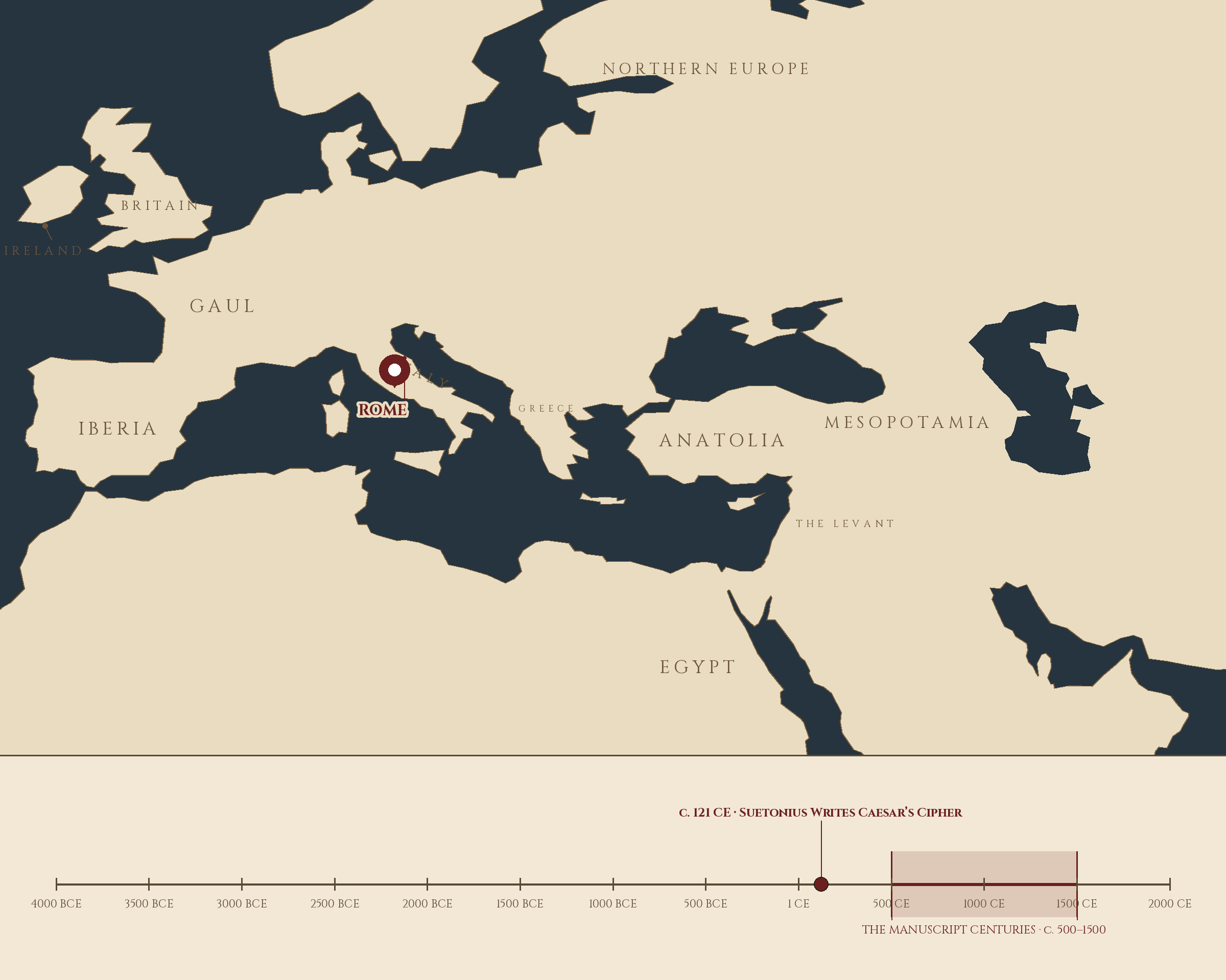
Where and when: Rome, Italy, c. 121 CE — Suetonius Writes Caesar's Cipher. The pin is this lesson. The line beneath the map is our road: every stop a place where writing changed, every lesson a pin.
Lesson Objectives
By the end of this lesson, you will be able to:
- Define cipher, Caesar cipher, plaintext, ciphertext, key, shift, substitution cipher, monoalphabetic substitution, polyalphabetic substitution, cipher wheel, Alberti cipher, Jefferson wheel cipher, transposition cipher, scytale, frequency analysis, cryptanalysis, nomenclator, and steganography
- Explain how a Caesar cipher works and demonstrate it on a short message
- Build a working cipher wheel from paper and use it to encipher and decipher messages
- Describe how Alberti's disk improved on the Caesar cipher, and explain why even improved ciphers eventually fall — first to frequency analysis, then to the finding of the repeating key
Reading this lesson: ★ marks the passages to remember. They return on the unit quiz and the class test. Check in questions ask the material back as you go; answer them in your workbook when you meet them.
Working this lesson: Your assignment packet is the first download on this page. Work in it as the lesson moves along, answering each assignment as its subject is taught — or read the lesson through for your notes and take the assignments as homework afterward. Both are proper ways to sit this class. Signposts in the reading tell you where each assignment belongs. Written answers are short answers in your own words; a few honest lines are worth more than a filled page.
Your Assignment Packet
This lesson's assignments live in its packet: the Lexicon Handout (every term, course terms marked ◆), Materials, Guided Practice, the Assignment Manual with its answer key for self-checking, the Reflection Questions, and the Workbook Checklist. Download the packet before you begin and keep it beside you as you read.
The General's Letters
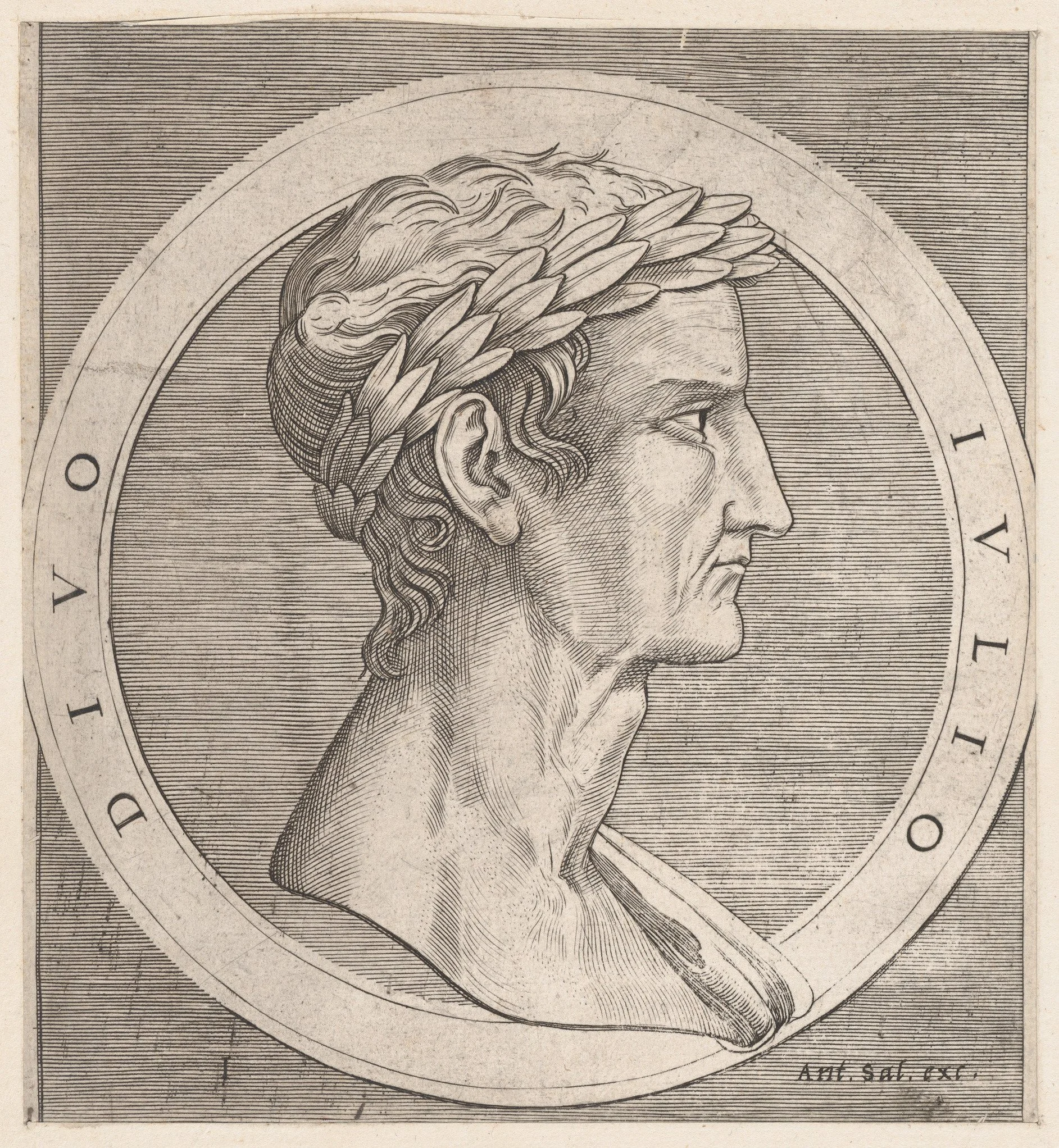
The general of the shift of three. Julius Caesar as the Renaissance imagined him, in an engraving from the Speculum Romanae Magnificentiae: the rim of his medallion names him DIVO IVLIO, "to the deified Julius." Suetonius, writing a century and a half after his death, preserved his cipher almost as gossip — when Caesar had anything confidential to send, he shifted every letter three places, and no word could be made out.
The Metropolitan Museum of Art, New York (DP870057); engraving after Marcantonio Raimondi, published by Antonio Salamanca. CC0 (Met Open Access).
In the early second century CE, about a hundred and fifty years after Julius Caesar's death, the Roman biographer Suetonius sat down to write the life of the deified Julius. He recorded Caesar's habits in the brisk, gossipy style of a man who loved a telling detail: what Caesar ate, how he dressed, whom he favored. And tucked among the personal habits, almost in passing, Suetonius recorded something extraordinary. When Caesar had anything confidential to send, he wrote it in cipher, changing the order of the letters of the alphabet so that no word could be made out. Anyone who wanted to read such a message had to substitute the fourth letter of the alphabet, D, for A, and do the same with all the rest.
★ This is the Caesar cipher, and its measure is the shift: the number of places every letter marches. Count in the Roman fashion, where you include the starting letter, and Caesar's shift is three. A becomes D. B becomes E. C becomes F. The whole alphabet marches three places forward, and a sentence that would betray a campaign becomes a string of nonsense to anyone without the rule.
★ Suetonius tells us something else, and it is the detail I love best. Caesar's grand-nephew and heir Augustus used a cipher of his own, but a lazier one. Augustus simply replaced each letter with the next one, A with B, B with C, and so on, and at the end of the alphabet he did not wrap around to the beginning but wrote two letters for one, AA for X. It is the cipher of a man too busy running an empire to bother with elegance, and Suetonius preserves it with what I can only read as gentle contempt.
There is a third witness worth naming. The writer Aulus Gellius, in his Attic Nights, mentions that the grammarian Probus wrote a treatise on the secret meaning of the letters in Caesar's correspondence. That treatise is lost. We know it only because Gellius mentioned it, which tells you two things: that Caesar's ciphers were famous enough to deserve scholarly commentary within a century of his death, and that we have lost more of this history than we have kept. The lost treatise is a small ghost that haunts this lesson. Remember it when you are tempted to think the surviving record is the whole story.
★ Was the Caesar cipher secure? Probably, in its day, reasonably so. Most of Caesar's enemies could not read at all, and those who could read would likely assume a ciphered dispatch was written in some unknown foreign tongue. There were no known techniques for breaking simple substitution ciphers in the Roman world. No one had yet thought to count how often each letter appears.
That would come later, from an unexpected quarter.
Check in: Suetonius says Caesar's reader had to substitute the fourth letter of the alphabet for A. Counted the Roman way, what shift is that — and what did Augustus do instead at the end of the alphabet?
❦ In your workbook: record Suetonius's testimony, Caesar's shift of three, Augustus's lazier shift of one with its AA for X, and Probus's lost treatise in your own way — copy, sketch, or note what matters.
How the Shift Works
Before we go further, you need the vocabulary, because cipher work without vocabulary is just confusion with extra steps.
★ The original message, the readable one, is the plaintext. The scrambled result is the ciphertext. The rule that turns one into the other, the number of places the alphabet shifts, is the key. A cipher is the whole system: the method plus the key. And the Caesar cipher belongs to a family called substitution ciphers, in which each letter is replaced by another letter according to a fixed rule.
★ The Caesar cipher specifically is a monoalphabetic substitution: one alphabet, one rule, applied the same way to every letter of the message. That last part is its weakness, but we will come to that.
Let us do it by hand, because a scribe learns with the pen. Take the key of three, Caesar's own key, and encipher his famous boast from the Battle of Zela: VENI VIDI VICI.
★ Write the alphabet. Beneath it, write the alphabet shifted three places forward. A sits above D. B above E. Now take each letter of the message and replace it with the letter below:
V becomes Y. E becomes H. N becomes Q. I becomes L.
VENI becomes YHQL. VIDI becomes YLGL. VICI becomes YLFL. The boast of a conqueror, reduced to YHQL YLGL YLFL, which looks like a scribe's sneeze and reads like nothing at all.
To decipher, reverse the process: shift three places back. This is why the tool matters more than the trick. Anyone who knows the key can read the message in moments. Anyone who does not know the key faces a small but real puzzle: there are only so many possible shifts, and a patient enemy can try them all. In a 26-letter alphabet, there are 25 possible Caesar shifts, and trying all 25 takes an afternoon, not a lifetime.
★ This is the first lesson of the cipher-maker's trade, and the one every beginner resists: a cipher is only as secret as its key, and a key with 25 possibilities is barely a secret at all.
So the cipher-maker reaches for a tool.
Check in: A friend hands you a ciphertext and tells you only that the key is three. What do you do to read it — and why can a patient enemy without the key still read it in an afternoon?
❦ In your workbook: record the working words — plaintext, ciphertext, key, cipher, substitution — and work the example yourself: VENI VIDI VICI under a shift of three, in your own way — copy, sketch, or note what matters.
The Wheel
A cipher wheel is two circles of paper and a brass fastener, and it will teach you more about secrecy than a shelf of treatises. Build it before you read on. I insist. The understanding lives in the fingers, not the eyes.
You will find the instructions in Assignment II. Two disks, one smaller than the other, the alphabet written around the rim of each, pinned at the center so the inner wheel turns. Set the inner A beneath the outer D, and you have built Caesar's cipher in paper and brass. Turn the inner wheel one more click, and you have a new key. Twenty-five keys, one tool, no arithmetic.
★ Notice what the wheel does to the work. Without it, enciphering a long message means consulting your shifted alphabet for every single letter, a slow and error-prone business. With it, you find the plaintext letter on the inner ring and read the ciphertext letter off the outer ring, letter after letter, as fast as your eye can move. The wheel does not make the cipher stronger. It makes the cipher usable. That distinction will matter more than you think.
Now turn the wheel to a new position and encipher your own name. Then hand the wheel to someone else, tell them only the key, and let them decipher it. You have just performed the entire ceremony of secret correspondence: the shared secret, the mechanical aid, the message that means nothing to the interceptor and everything to the friend. The Romans did this with stylus and wax. You have done it with paper and a paper fastener. The principle has not changed in two thousand years.
Check in: The wheel changes the cipher's work in one way and refuses to change it in another. What does it make the cipher — and what does it pointedly not make it?
❦ In your workbook: record what the wheel does and what it does not do, and the ceremony it performs — shared secret, mechanical aid, a message for the friend alone — in your own way — copy, sketch, or note what matters.
In your packet: Assignment II — Build the Cipher Wheel ◐ is this lesson's Guided Practice, further down this page. Professor Nocturne insists: build it before you read on.
The Disk That Moved
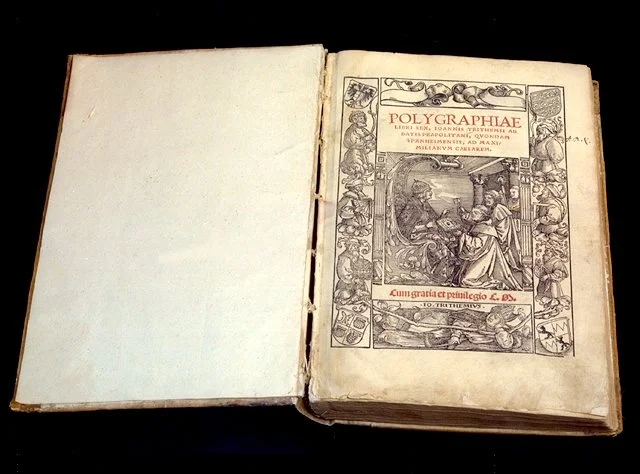
The first printed book of ciphers. The title page of Johannes Trithemius' Polygraphiae (1518), the work in which the tabula recta — his square table of shifted alphabets, a new alphabet for every letter of the message — reached print. Alberti's idea, that the substitution must not sit still, here becomes a book any scribe could buy: the arms race, published.
Photograph of the 1518 edition via Wikimedia Commons. Public domain.
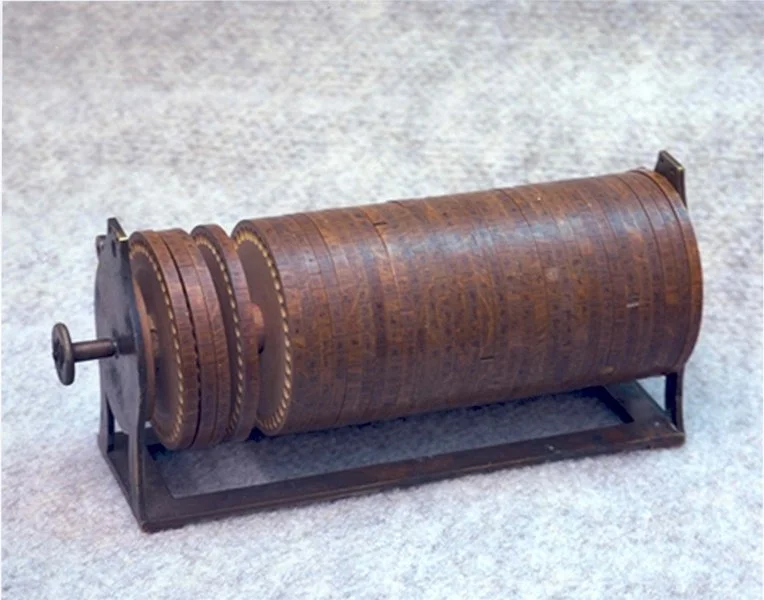
Jefferson's wheel, built at last. Thomas Jefferson designed this device in the early 1790s — thirty-six wooden disks on an iron spindle, each bearing the alphabet in a different scrambled order — and apparently never built it. This working example was made from his description long after; his manuscript slept in his papers until 1922, the very year the United States Army adopted the same idea for itself. Turn the disks until your message reads along one row; copy down any other row, and send that.
National Cryptologic Museum, National Security Agency. Public domain.
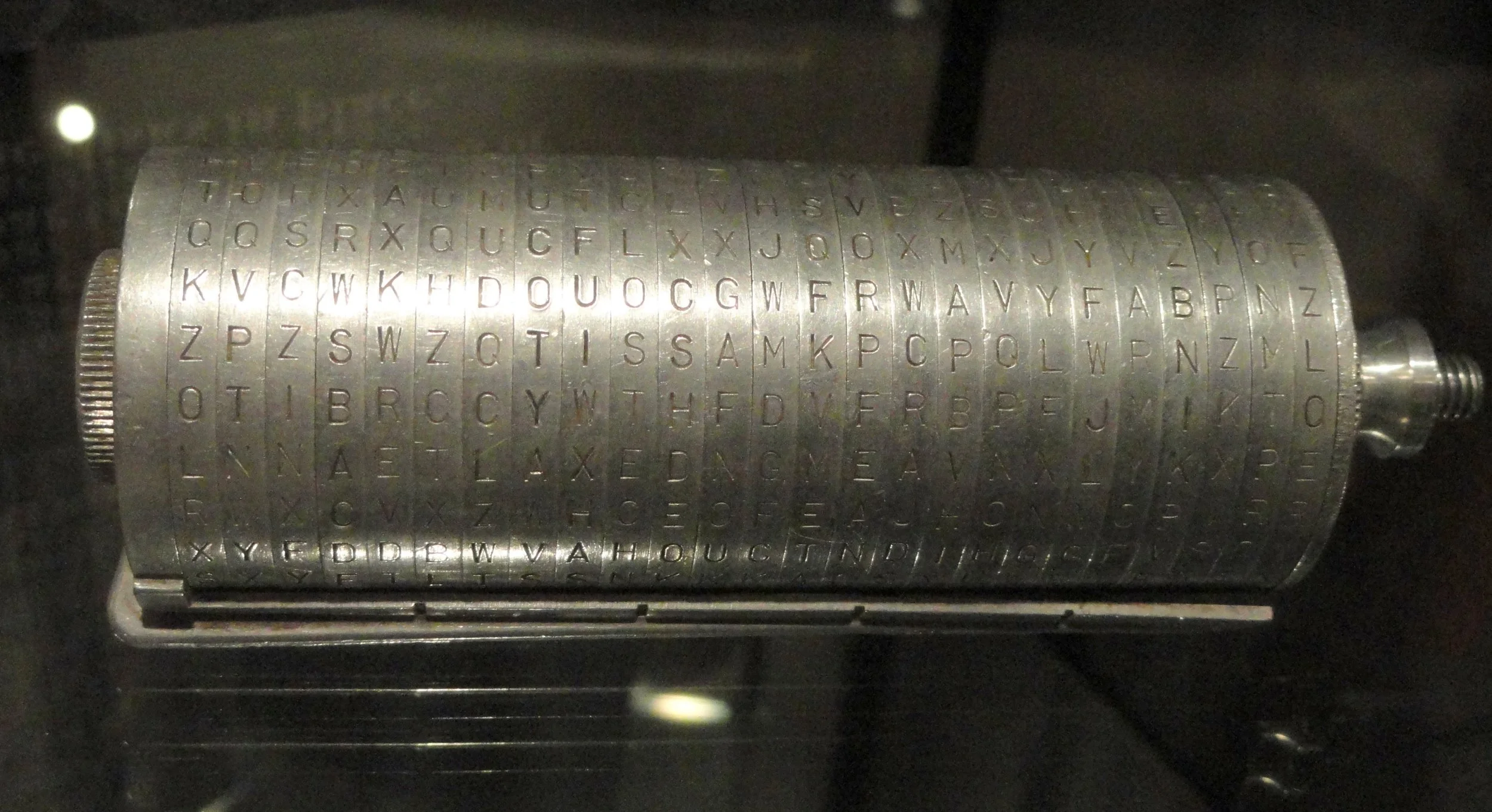
The wheel goes to war. The United States Army's M-94 cipher device (1921) at the National Cryptologic Museum: twenty-five steel disks on a spindle, each rim engraved with a scrambled alphabet. It is Jefferson's filed-away idea, reinvented from scratch a century and a half later, and it served the Army into the early 1940s. Set your message along one row; every other row is a ciphertext waiting to be chosen.
Photograph by Daderot, National Cryptologic Museum, Fort Meade. CC0.
For fourteen centuries after Caesar, the monoalphabetic substitution ruled secret writing, and codebreakers slowly learned to defeat it. Then, in 1467, an Italian architect changed the game.
★ Leon Battista Alberti was one of those Renaissance figures who refused to stay in one discipline: architect, linguist, poet, priest, mathematician, and, as it happened, cryptographer. In his treatise De componendis cifris, on composing ciphers, he described a device of two concentric disks pinned at the center, one slightly smaller than the other, each rim divided into equal cells. The larger disk, which he called the Stabilis, the stationary one, carried the plaintext alphabet in order. The smaller, the Mobilis, the movable one, carried a mixed, scrambled alphabet for the ciphertext. Alberti called the device his Formula; the system it embodies is the Alberti cipher.
★ Here is what made it revolutionary. With Caesar's cipher, or with the paper wheel you just built, the substitution never changes during a message. Every A becomes the same letter, every E becomes the same letter, all the way through. Alberti's disk could be turned in the middle of a message. The sender would encipher a few words, rotate the inner disk to a new position, and continue, marking the change with an agreed signal, an indicator letter or number written into the ciphertext itself. The outer ring even carried the numbers 1 through 4, which stood for entries in a codebook of 336 phrases, so common phrases could be replaced by numbers and the numbers then enciphered along with everything else.
This is polyalphabetic substitution: multiple alphabets, changing during the message. It defeats the codebreaker's favorite weapon, because the patterns the codebreaker hunts for keep moving. Alberti had invented, in 1467, the principle that would dominate serious cryptography for the next four hundred years.
The idea kept being reinvented, because good ideas do. Johannes Trithemius, in his Polygraphia, completed in manuscript in 1508 and published in 1518, devised a progressive system that changed the alphabet with every letter, using a square table of shifted alphabets called the tabula recta. In 1553, Giovan Battista Belaso added a repeating keyword to choose alphabets, the system later misattributed to Blaise de Vigenere in the nineteenth century. Each version was stronger than the last, and each one was, at bottom, Alberti's idea: do not let the substitution sit still.
★ And then there is the Jefferson wheel cipher, the wheel cipher of Thomas Jefferson. In the early 1790s, while serving as Secretary of State, Jefferson designed a device of thirty-six wooden disks threaded on an iron spindle, each disk bearing the alphabet in a different scrambled order around its edge. To encipher, you turned the disks until your message appeared along one row, then copied down any other row and sent that. The recipient, holding an identical set of disks in the same agreed order, aligned the ciphertext and looked for the one row that resolved into sense. The key was the order of the disks on the spindle: thirty-six factorial possible arrangements, a number with forty-two digits.
Jefferson apparently never built it. He set the manuscript aside, and it sat in his papers for 127 years until a historian found it at the Library of Congress in 1922, the very year the United States Army independently adopted essentially the same device as the M-94 cipher machine. The Army used it into the early 1940s. Jefferson had been a century and a half early, and had filed the idea away like a letter he meant to answer.
You will build a paper version of the cipher wheel in your assignments. You will not build Jefferson's thirty-six disks. Some ambitions are best admired from a distance.
Check in: Alberti's sender rotates the disk mid-message. What tells the recipient that the alphabet has changed — and what else could the outer ring's numbers stand in for?
❦ In your workbook: record Alberti's two disks by their names, the turn in the middle of the message and its indicator, the 336-phrase codebook, and Jefferson's thirty-six disks whose key was their order in your own way — copy, sketch, or note what matters.
The Other Kind of Hiding
Everything so far has been substitution: replacing letters with other letters. But there is a second great family of ciphers, and the Spartans invented its most famous tool.
★ The scytale was a wooden rod, and the message was written on a strip of papyrus or leather wound around it in a spiral. Write your message across the wrapped strip, unwind it, and the letters scatter into nonsense: a thin ribbon of meaningless characters. Wrap it around a rod of the same diameter, and the letters line up and the message returns. The Greek writer Plutarch describes it in his life of the Spartan commander Lysander: the ephors, Sparta's magistrates, kept one rod and gave its twin to the departing general, and secret orders traveled as innocent-looking strips of leather.
The scytale is a transposition cipher: the letters are not replaced, they are rearranged. Nothing is substituted; everything is shuffled. It is the other answer to the scribe's question, and it is worth knowing because it reminds you that secrecy has more than one geometry.
★ And there is a deeper distinction still. Everything in this lesson so far has been cryptography: the message is visibly scrambled, and its secrecy lies in the scrambling. But there is an older and sneakier art called steganography: hiding the very existence of the message. Invisible ink, which you studied in Lesson 24, is steganography. The message is there, but no one knows to look for it. Cryptography says: here is a puzzle you cannot solve. Steganography says: there is no puzzle here at all.
The two arts are cousins, and scribes practiced both. A prudent correspondent might encipher a message and hide it, belt and braces, because the history of secret writing is the history of each defense failing in turn.
Check in: The scytale substitutes nothing. Where does its secrecy live — and what is the one thing steganography hides that cryptography does not?
❦ In your workbook: record the scytale's geometry — letters kept, order scattered, a rod of the same diameter as its key — and the two arts' two claims: "a puzzle you cannot solve" against "no puzzle here at all," in your own way — copy, sketch, or note what matters.
The Codebreaker's Turn
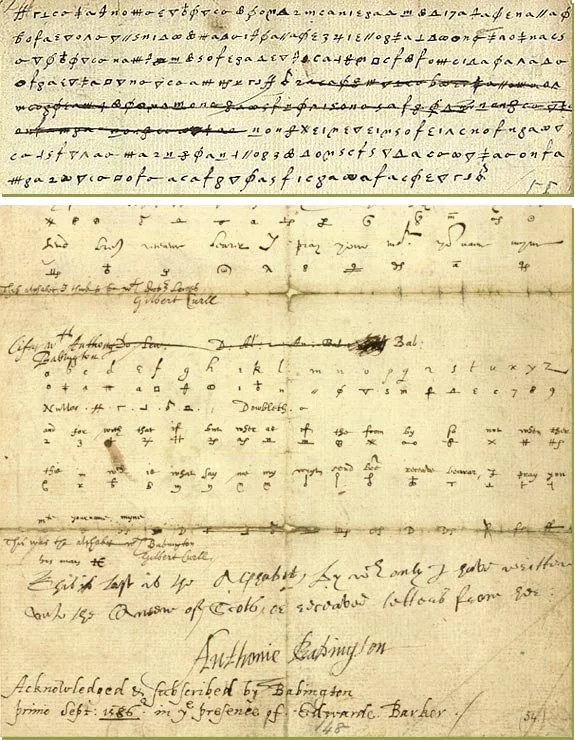
The cipher that hanged a queen. Above: Mary, Queen of Scots' letter to Anthony Babington in her nomenclator cipher — and the forged postscript Walsingham's men added to it, asking for the names of the conspirators. Below: Babington's own record of the cipher, its alphabet of symbols and word-signs, ending in his signed acknowledgment of September 1586. Phelippes broke the system, read her approval of the plot, and — the story Singh tells — sketched a little gallows on the deciphered copy. Look for it near the top of the lower sheet.
The National Archives, London (SP 12/193/54 and SP 53/18/55). Public domain.
Every cipher in this lesson has one thing in common: every one of them was broken.
★ The weapon that broke the monoalphabetic substitution is called frequency analysis, and it was first described in the ninth century by the Arab scholar al-Kindi. The insight is simple and devastating. In any language, some letters appear far more often than others. In English, E is the commonest letter by a wide margin, followed by T, A, O, I, N. If you intercept a long enough ciphertext and count the letters, the commonest ciphertext letter is probably E, the next probably T, and so on. The substitution rule reveals itself not by cleverness but by arithmetic. Al-Kindi's discovery predates Alberti by six hundred years, which means the codebreakers were waiting before the better ciphers were even invented.
★ The science of breaking ciphers is called cryptanalysis, and its history is a long duel. Consider Mary, Queen of Scots. Imprisoned in England, she corresponded with her supporters in cipher: a nomenclator, a hybrid system of 23 symbols standing in for alphabet letters, 35 symbols standing for whole words and phrases, four meaningless nulls to confuse interceptors, and a sign doubling the next letter. It was, by the standards of 1586, a serious system. It did not save her. Sir Francis Walsingham's codebreaker Thomas Phelippes broke it, read her approval of the Babington Plot to assassinate Elizabeth I, and Mary's own letters became the evidence at her trial. She was executed in February 1587. Her cipher had held for months. The codebreaker needed only one long message.
★ That is the arms race in miniature. The cipher-maker invents; the codebreaker counts; the cipher-maker complicates; the codebreaker finds a new way to count. Caesar's shift falls to trying all twenty-five possibilities. The monoalphabetic substitution falls to frequency analysis. Alberti's polyalphabetic system holds for centuries, until Kasiski and Babbage in the nineteenth century learn to find the repeating key. Jefferson's wheel holds until the mathematics of the twentieth century. Every cipher has a lifespan. The scribe's job is to know how long the one in hand is likely to live.
Which brings us back to the wheel on your desk.
Check in: Al-Kindi's counter assumes the commonest letter in a long ciphertext probably stands for one particular plaintext letter. Which letter — and what made Mary Queen of Scots' stronger system fall anyway?
❦ In your workbook: record al-Kindi's counting weapon and the order of common letters it hunts, Mary's nomenclator and its four nulls, and the arms race in one line — every cipher has a lifespan — in your own way — copy, sketch, or note what matters.
In your packet: Assignment III — Break the Code ◐ begins here. Work it now, or mark the place and take it as homework — your choice.
Unit VII Review: Two Ways to Hide
This unit has taught you the scribe's two answers to the watcher.
★ Lesson 24 taught you steganography: the inks that hide the message's existence. Lemon juice and heat, the organic compounds that darken when warmed, the message that is not there until you know how to look. The defense is invisibility.
Lesson 25 has taught you cryptography: the ciphers that hide the message's meaning. The Caesar shift, the wheel, Alberti's moving disk, the scytale's rearrangement. The defense is unreadability.
A wise correspondent uses both, because each covers the other's weakness. An invisible message, once found, reads plainly. A ciphered message, once suspected, invites the codebreaker's arithmetic. Together, they make the interceptor's work twice as hard, and in the game of secrets, twice as hard is often hard enough.
Keep your cipher wheel. You will want it again.
Check in: One defense is invisibility and the other is unreadability. Which belongs to which art — and what happens to each when it is discovered?
❦ In your workbook: record the unit's two answers — the ink that hides an existence, the cipher that hides a meaning — and why each covers the other's weakness in your own way — copy, sketch, or note what matters.
In your packet: Assignment IV — Unit VII Review: Two Ways to Hide ◐ begins here. Work it now, or mark the place and take it as homework — your choice.
Guided Practice
Assignment II — Build the Cipher Wheel ◐ ★
Objective: Construct a working cipher wheel and use it to encipher and decipher messages.
Instructions:
- Divide the rim of each disk into 26 even cells. Letter the outer wheel A through Z in order. Letter the inner wheel A through Z in order as well.
- Pin the smaller disk centered on the larger with the fastener, so the inner wheel turns freely.
- Set the key of three: turn the inner wheel until its A sits beneath the outer D. Encipher this message: MEET AT THE OLD BRIDGE. Write the ciphertext in your workbook.
- Turn the wheel to a new key of your choosing. Encipher a message of at least twenty letters to a classmate, and give them only the key number. Decipher the message they send back to you.
- In your workbook, answer: what does the wheel do for the scribe, and what does it not do? (The lesson's distinction: it makes the cipher usable, not stronger.)
To submit: Your wheel, your workbook encipherments with keys noted, and the paragraph. Neat lettering counts: a wheel you cannot read is a cipher against yourself.
Your keepsake: your cipher wheel — two disks, twenty-five keys, the tool this unit leaves on your desk. Keep it with your workbook; Professor Nocturne promises you will want it again.
❦ Workbook path: working in your workbook instead of on loose disks? The wheel itself must be built — it is the lesson's tool — but its work can live in the workbook: rule a page for your key log, record each key you set, and write every encipherment and decipherment there, with the ciphertext of step 3 first. Working alone? Encipher your message to an imaginary correspondent, note the key, and decipher their "reply" by enciphering one yourself under a second key.
Materials
Required (Level One — household items)
- Two paper plates or two circles of card: one slightly smaller than the other. These become the outer and inner wheels of your cipher wheel.
- A brass paper fastener (split pin): the pivot. A thumbtack pressed into cork works if no fastener is at hand, with adult help.
- A ruler and pen: for dividing the rims into 26 even cells and lettering the alphabets.
- Scrap paper and pencil: for working encipherments and keeping a key log.
- A dowel rod and a strip of paper: for the scytale exercise in Assignment IV. The rod's diameter is the key; the strip must wind with no gaps.
- Sealing wax or a sticker seal: to close your enciphered message as a dispatch, the way a courier would carry it.
Suggested (Level Two — historically closer)
- Wooden disks or heavy chipboard circles: closer to Alberti's device. Two disks, one smaller, pinned at the center with a small bolt.
No purchased kits or specialty tools are required. The core lesson (the wheel, the encipherments, the codebreaking) is fully achievable with paper plates, a fastener, and a pen.
Reflection Questions
Answer in your workbook.
- Why was the Caesar cipher reasonably secure in Caesar's day but trivially breakable now?
- What does the cipher wheel do for the scribe, and what does it not do?
- How does Alberti's disk defeat frequency analysis, and what is the cost of that defense?
- What is the difference between cryptography and steganography, and why might a prudent correspondent use both?
- Every cipher in this lesson was eventually broken. What does that tell you about the relationship between the cipher-maker and the codebreaker?
- You have studied hidden writing for two lessons. When, in your judgment, is secrecy the scribe's proper work, and when is it not?
Workbook Checklist — Lesson 25
In my workbook I have:
- ☐ defined cipher, Caesar cipher, plaintext, ciphertext, key, shift, substitution cipher, monoalphabetic substitution, polyalphabetic substitution, cipher wheel, Alberti cipher, Jefferson wheel cipher, transposition cipher, scytale, frequency analysis, cryptanalysis, nomenclator, and steganography
- ☐ explained how a Caesar cipher works and demonstrated it on a short message
- ☐ built a working cipher wheel from paper and used it to encipher and decipher messages (Guided Practice)
- ☐ enciphered MEET AT THE OLD BRIDGE under the key of three and exchanged a message under a key of my own choosing (Guided Practice)
- ☐ broken a Caesar ciphertext by frequency analysis and recorded the recovered key (Assignment III)
- ☐ built a scytale, enciphered the same message on my wheel, and written the two-paragraph comparison (Assignment IV)
- ☐ described how Alberti's disk improved on the Caesar cipher, and why even improved ciphers eventually fall — first to frequency analysis, then to the finding of the repeating key
- ☐ sealed my enciphered message as a dispatch, its key kept separately in my workbook (Assignment IV)
☐ Lesson completed Date: ___ Signature: ___
Cross-Class Connections

Runes · Lesson 21 — The Shorthand Abbreviation Matrix
My scribes shortened everything: the titulus, the sacred names, a whole matrix of suspensions and contractions that every medieval reader had to decode at sight. My shorthand is the everyday code of the scriptorium; the history and the system are mine to teach. Professor Nocturne's is the cipher you build with your hands. Read my matrix, then go back and turn his wheel.
Runes · Lesson 20 — Spacing & Punctuation
Mine is the lesson before the matrix: how the scribes who spaced the words prepared the page my abbreviations would crowd. The spaces made room for the eye; the abbreviations made room on the page. Meet the spaced page first, and my shorthand will read like what it is: the same scribes, economizing.
PROFESSOR THISTLELOOM WEBBLETHORN
Runes & Ancient Writing

Creative Arts · Studio Extension E1 — Precision Paper Instruments, Built to Last
My bench builds the durable version of tonight's tool: a wheel in the manner of Alberti that will outlast every correspondent who uses it, and my lesson names 'the cipher wheel from Professor Nocturne's library' outright. Build the paper wheel in his library and learn its principle in your fingers. When you want the one that lasts a decade, I am waiting with the heavier stock, and everything, as he will tell you too, hangs on the center.
PROFESSOR COGBRANCH TIMBERCLANK
Creative Arts Workshop

Celestial Studies · Unit III, Lesson 14 — Venus, the Morning Star
My astronomers practiced this lesson's art at the highest level: in December 1610 Galileo announced the phases of Venus, sure of his discovery and not ready to publish it, in cipher, claiming the priority while keeping the secret. My lesson tells it in full. Come and hear how a cipher once carried the heavens.
PROFESSOR VESPER GLIMMERWICK
Celestial Studies • Astronomer & Celestial Historian
Professor's Closing Note
You came to this school to learn to write beautifully, and I have spent two lessons teaching you to write invisibly and unreadably. If that seems like a contradiction, you have not been paying attention.
The scribe's art was never only about beauty. It was about control: control of the pen, control of the page, and, when necessary, control of who may read. The same hand that lettered a psalter in gold could encipher a warning in a shift of three. The skill is one skill. Only the audience changes.
You have now completed Unit VII, and with it the techniques of hidden writing. There is one lesson left in this course, and it is the one everything has been building toward: the Grand Manuscript, where every skill you have learned, every ink, every nib, every letterform, every ornament, comes together on the page. Bring your wheel. Bring your inks. Bring everything.
Class dismissed.
PROFESSOR QUILLBERRY NOCTURNE
Scrollwork Library
Master Scribe & Illuminator
Further Reading & Sources
*David Kahn. The Codebreakers: The Story of Secret Writing (1967).* The great history of cryptography, from ancient ciphers to the twentieth century. Kahn's account of Jefferson's wheel cipher and the long duel between codemakers and codebreakers is the foundation everything else stands on. Long, but readable, and the chapter on early ciphers will reward you.
*Simon Singh. The Code Book: The Science of Secrecy from Ancient Egypt to Quantum Cryptography (1999).* The friendlier introduction. Singh tells the Mary, Queen of Scots story in full, gallows doodle and all, and explains frequency analysis so clearly you will never forget it.
*Suetonius. Life of Julius Caesar, section 56, and Life of Augustus, section 88. The primary source for this entire lesson: two paragraphs, written fifteen hundred years ago, describing Caesar's shift of three and Augustus's shift of one. Read them and notice how casually Suetonius explains the cipher, as if it were already an antique in his own day. Background: the history and usage of the Caesar cipher.* History and usage of the Caesar cipher
The Alberti cipher disk. The 1467 device: Stabilis and Mobilis, the mixed alphabet, the indicator letters, and the codebook of 336 phrases. The first polyalphabetic cipher, explained with diagrams. Alberti Cipher Disk
Jefferson's wheel cipher, rediscovered. Thirty-six disks, forty-two digits of key space, filed away for 127 years and independently reinvented by the Army in 1922. The story of the invention the Army made twice. Jefferson's Wheel Cipher
Browse the Scrollwork shelf in the school Library for readable editions of these works.
Submit your work for this lesson using the form below.
THE UNIT VII QUIZ
SCROLLWORK LIBRARY · UNIT VII: CIPHERS & HIDDEN WRITING · LESSONS 24–25
Unit VII is complete: messages hidden in the page, and messages scrambled in plain sight. This quiz gathers the whole unit, both lessons, into one sitting. Take it from memory first, before you look back at your notes, because it measures what has stayed with you. If you completed the Exercises marked ★ in your lesson packets, you have already practiced most of what it asks.
The quiz packet is a single download. Part I gathers questions from every lesson in the unit, Part II matches the unit's vocabulary, and the answer key waits at the back for self-checking. When you have finished, score it honestly, note the result in your workbook, and revisit any lesson whose questions went wrong before you move on to Unit VIII and the Grand Manuscript.
Download the Unit VII Quiz packet
A commission may carry one secret: a final line in the Caesar shift, at the key you choose. The Desk records the key with the piece, because this lesson teaches what an unrecorded key costs — and what frequency analysis does to a shift, however carefully kept.
The Commission DeskPROFESSOR QUILLBERRY NOCTURNE · SCROLLWORK LIBRARY
CONTINUE IN THE SCROLLWORK LIBRARY
← Previous · Lesson 24: Invisible Inks Next · Lesson 26: The Evershade Manuscript →
Unit VII — Ciphers & Hidden Writing Scrollwork Library — All 26 Lessons
The rest of Unit VII: Lesson 24 · Invisible Inks