

SCROLLWORK
Unit VII · Lesson 24INVISIBLE INKS
How do you read what was never written?
Professor's Introduction
Every ink I have taught you was made to be seen. Carbon black, iron gall, vermilion red: each one was ground, mixed, and laid down so that a reader, a hundred years or a thousand years later, could find the words. This lesson is the exception. This lesson is about ink made to disappear.
Do not mistake this for a lesser art. Writing that hides is still writing. It still needs a pen, a surface, and a reader who knows the secret. The scribe who writes invisibly must understand his materials better than the scribe who writes plainly, because his ink has two jobs: to stay silent, and then, at the right moment, to speak. Pay attention. The quietest ink in this library has the most to teach you.
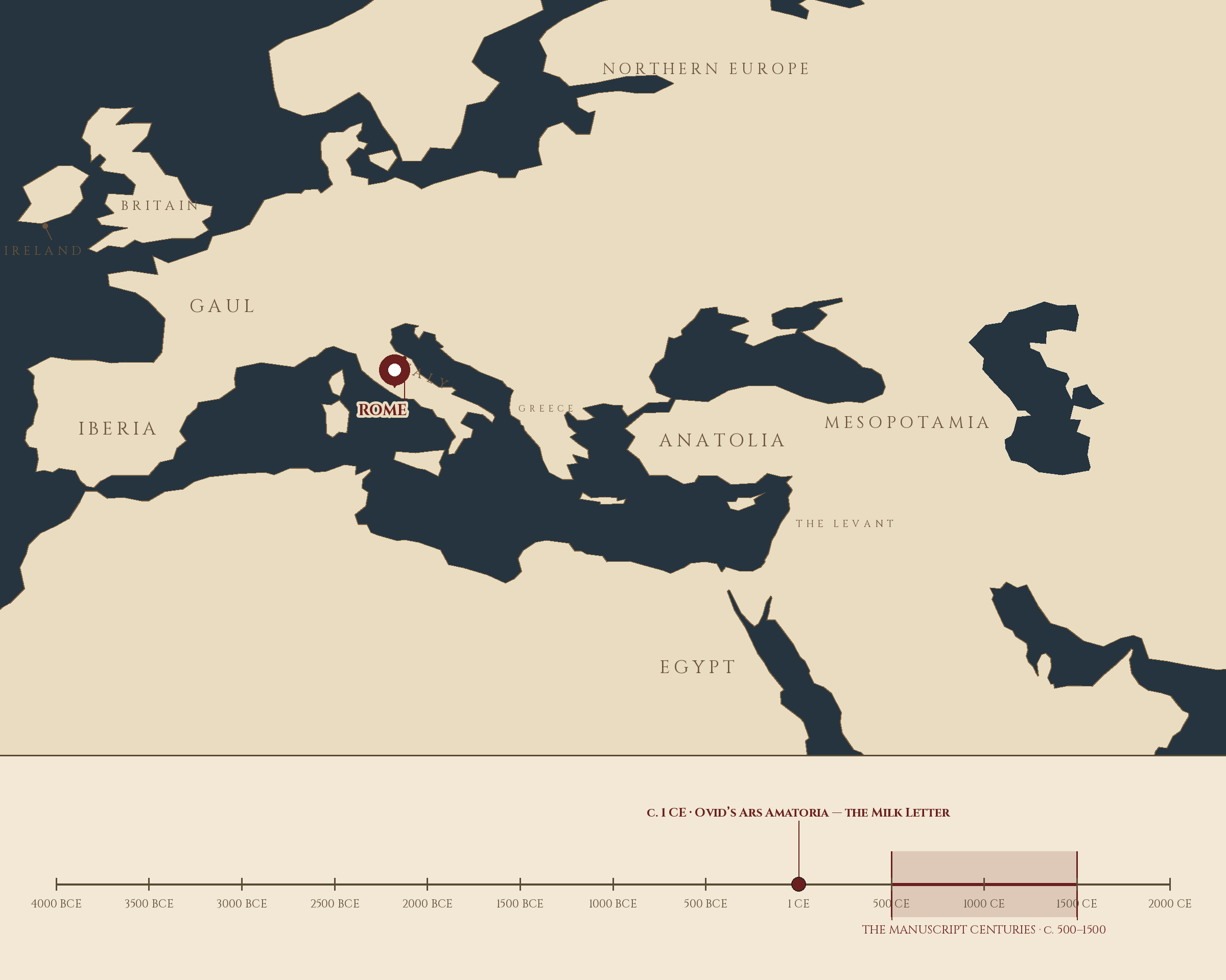
Where and when: Rome, Italy, c. 1 CE — Ovid's Ars Amatoria — the Milk Letter. The pin is this lesson. The line beneath the map is our road: every stop a place where writing changed, every lesson a pin.
Lesson Objectives
By the end of this lesson, you will be able to:
- Define invisible ink, sympathetic ink, steganography, developer, reagent, carbonization, acid-base indicator, and ultraviolet
- Explain why gentle heat turns lemon juice and milk brown while the paper around them stays pale
- Describe three historical uses of invisible ink: a Greek siege, a Roman love poem, and an American spy ring
- Compare heat-developed inks with chemically developed inks
- Write and reveal a secret message using only safe household materials
Reading this lesson: ★ marks the passages to remember. They return on the unit quiz and the class test. Check in questions ask the material back as you go; answer them in your workbook when you meet them.
Working this lesson: Your assignment packet is the first download on this page. Work in it as the lesson moves along, answering each assignment as its subject is taught — or read the lesson through for your notes and take the assignments as homework afterward. Both are proper ways to sit this class. Signposts in the reading tell you where each assignment belongs. Written answers are short answers in your own words; a few honest lines are worth more than a filled page.
Your Assignment Packet
This lesson's assignments live in its packet: the Lexicon Handout (every term, course terms marked ◆), Materials, Guided Practice, the Assignment Manual with its answer key for self-checking, the Reflection Questions, and the Workbook Checklist. Download the packet before you begin and keep it beside you as you read.
The Message Under the Wax
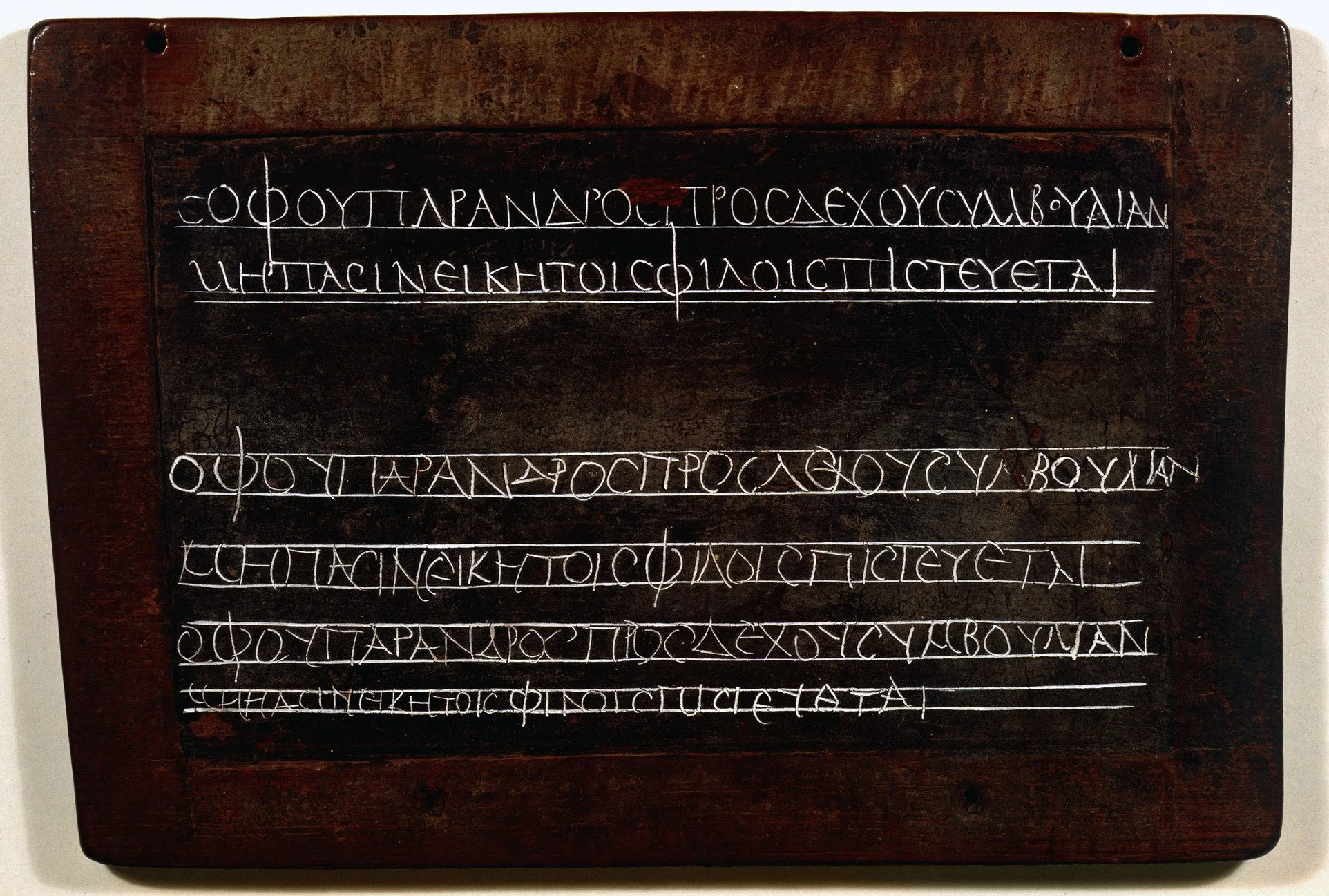
The tablet itself. A Greek schoolboy's exercise tablet of the 2nd century CE: two model lines from the poet Menander written neatly at the top, then copied twice below between the ruled lines — and holes in the frame for binding it to its fellow. This is the very object Herodotus' story turns on. Demaratus scraped the wax from a tablet like this one, wrote his warning on the wood beneath, and melted the wax back over it, and the message crossed Persia looking like homework.
The British Library, London (Add MS 34186). CC0.
The oldest secret-writing manual in the Western world was not written for spies. It was written for a city under siege.
★ Around 360 BCE, a Greek general named Aeneas Tacticus wrote On the Defense of Fortifications, a handbook for holding a walled city against an enemy. Its thirty-first chapter is devoted entirely to secret messages: twenty-some ways to get word in and out past men who are watching for exactly that. One of his methods is a true invisible ink — writing that dries unseen and appears only when a second treatment wakes it — and it is older than most of the scripts you have studied.
★ Write your message on a boxwood tablet, Aeneas says, in good ink, and let it dry. Then whiten the tablet, coating it until the letters vanish beneath the white. Carry it openly. It looks like a blank board. When it reaches the friend who knows the secret, he puts the tablet into water, and the writing rises out of the white, clear as the day it was written. In another version, the tablet is whitened, painted over with a little picture, hung up in a roadside shrine like a votive offering, and later soaked in oil to bring the message back.
★ Aeneas was not the first to think this way. The historian Herodotus tells of Demaratus, a Greek exile at the Persian court, who learned that King Xerxes meant to invade Greece. He took a writing tablet, scraped the wax from its wooden frame, wrote his warning on the bare wood, and melted the wax back over it. The tablet traveled as a blank. At the other end, someone who knew to look scraped the wax away and read the wood beneath. The message crossed an empire inside nothing at all.
Notice what these tricks have in common. None of them depends on a rare substance. The secrecy is not in the material. It is in the method: in knowing that water, or oil, or a scraped surface will do what eyes alone cannot. That is the whole philosophy of invisible ink, and it has not changed in twenty-four centuries.
Check in: Aeneas's whitened tablet and Demaratus's wax tablet use different materials. What single thing do all these tricks share?
❦ In your workbook: record Aeneas's chapter, the whitened tablet and its water reveal, and Demaratus's warning under the wax in your own way — copy, sketch, or note what matters.
Milk and Coal Dust
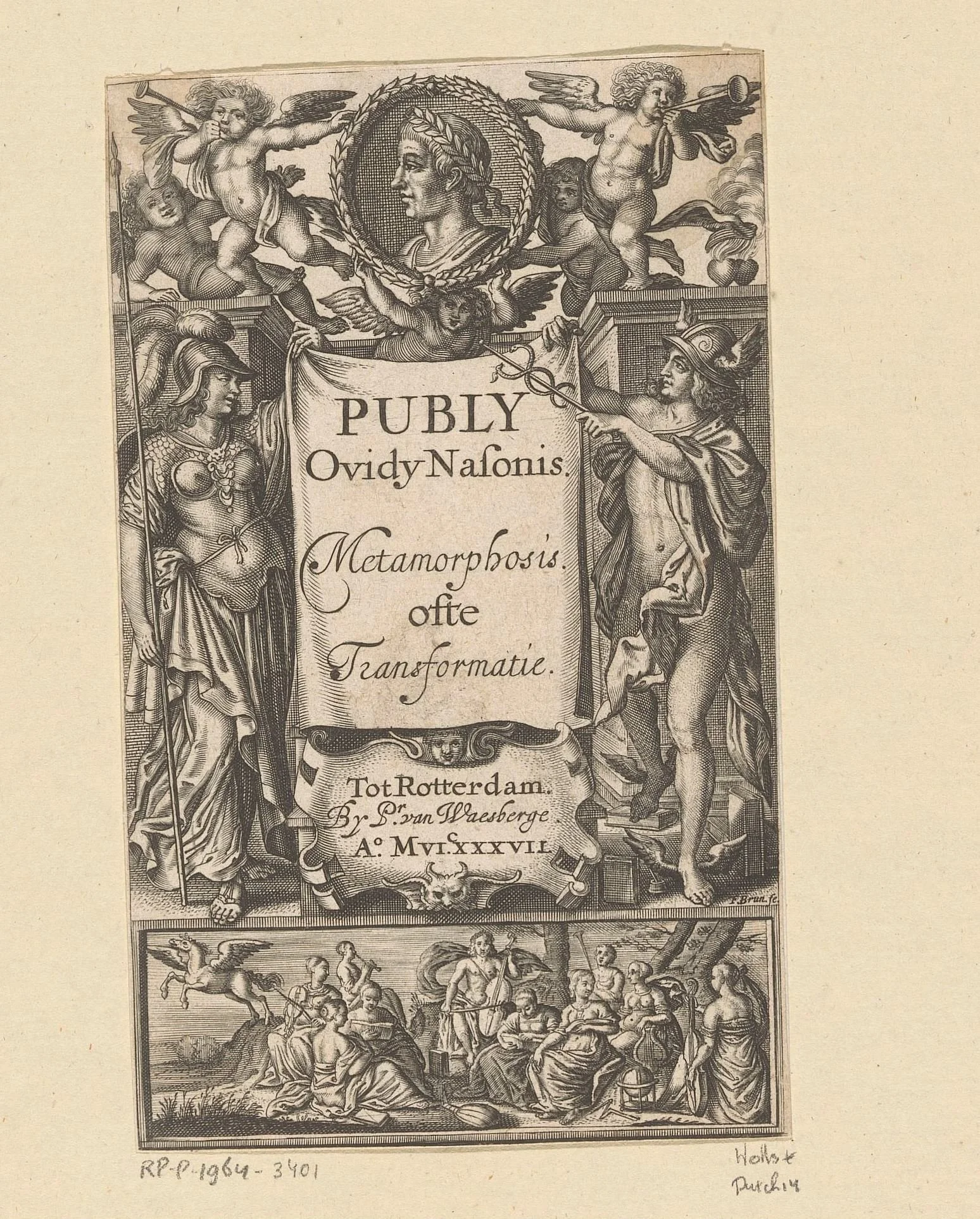
The poet of the milk letter. Ovid in his laurel wreath, on the title page of a 1637 Dutch edition of his Metamorphoses. The poem this lesson quotes is a different work — the Ars Amatoria, his handbook of love, where the milk letter appears as calmly as a recipe: write in fresh milk, let it dry invisible, and sprinkle coal dust to make the words stand up and introduce themselves.
Rijksmuseum, Amsterdam (RP-P-1964-3401). CC0.
Four hundred years after Aeneas, the Roman poet Ovid put invisible ink into a love poem.
★ His Ars Amatoria, the Art of Love, published around the year 1 CE, is a handbook of seduction, and it includes practical advice for lovers writing under the eyes of a jealous guard. Ovid tells his reader that a letter written in fresh milk will pass any inspection. It dries invisible. Then, he says, sprinkle coal dust over it, and the words appear.
Think about what that means for the history of writing. Here is one of Rome's most famous poets, in one of his most famous works, calmly describing a secret ink as if it were common knowledge. Milk was on every table. Coal dust was in every brazier. The technique needed no laboratory, no rare import, no specialist. A lover, a guard, a letter, and the kitchen: that was the whole apparatus.
The chemistry is simple enough to explain. Milk is mildly acidic, and it contains sugars and proteins. Where the milk touches the paper, those substances soak into the fibers. When the paper dries, nothing shows. But the milk has changed the paper in those lines: it has weakened and loaded the fibers with organic matter. Brush fine dark powder over the sheet, and the powder clings to the roughened, milk-touched lines while sliding off the smooth untouched paper. The message was there all along. The dust only introduced it.
Ovid's trick belongs to a family of inks that wait for a second substance to wake them. The ink is the question. The developer is the answer. Remember those two roles. You will meet them again, in war, some seventeen centuries later and an ocean away from Ovid's Rome.
I have read Ovid's instructions with a scribe's eye, and I tell you this: the man understood materials. He knew that the best hiding place for a letter is inside an ordinary one, and the best ink is the one nobody thinks to look for. The guard checks the seal, the paper, the messenger. He never checks the milk.
Check in: In Ovid's trick, which substance is the ink and which is the developer, and how does the powder know where the writing is?
❦ In your workbook: record Ovid's milk letter, the coal-dust reveal, and why the powder clings to the milk lines in your own way — copy, sketch, or note what matters.
In your packet: Assignment II — The Milk Letter ◐ is this lesson's Guided Practice, further down this page. Work it when you reach it, or read on and take it as homework — your choice.
The Natural Magician

The natural magician. Giambattista della Porta of Naples (1535–1615), whose Magia Naturalis — Natural Magic — turned secret writing from a spy's guarded trick into something any curious reader could learn, recipes and all. His "magic" was not spells: it was physics, chemistry, and optics, learned by doing.
Engraving via Wikimedia Commons. Public domain.
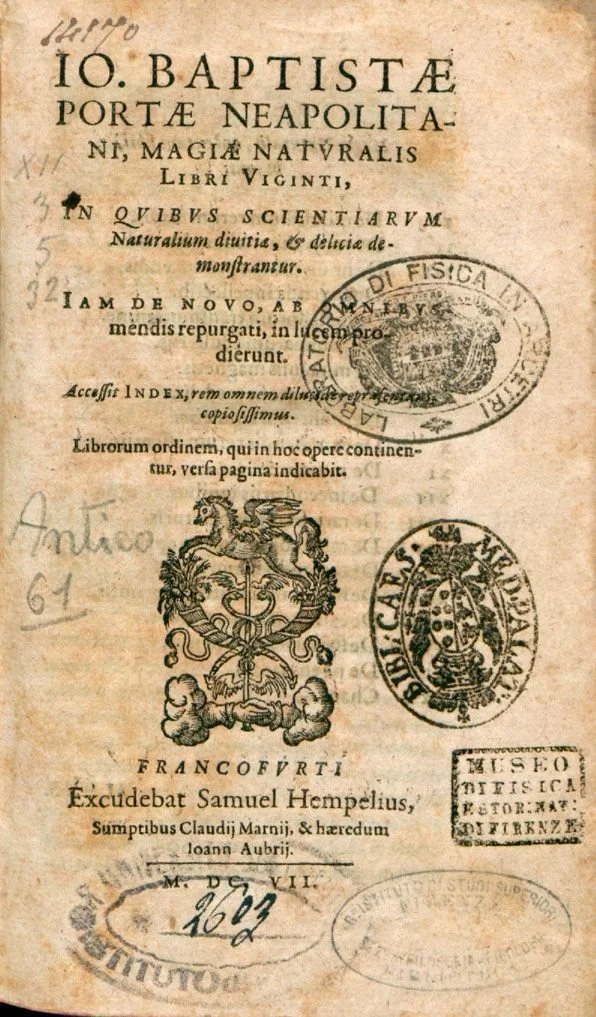
The book of secrets itself. Title page of della Porta's Magia Naturalis in its expanded twenty-book form (Frankfurt, 1607): "The Twenty Books of Natural Magic of Giovanni Battista Porta of Naples." Book Sixteen is practically a spy's handbook, full of writing that appears only under the right treatment — and one famous trick that uses no ink at all, a message slipped inside an eggshell, travelling in a basket of eggs past every guard.
From the copy digitized by BEIC (Biblioteca Europea di Informazione e Cultura), Milan. Public domain.
★ In 1558, an Italian scholar named Giambattista della Porta published Magia Naturalis, Natural Magic, and turned secret writing into something anyone could learn.
Della Porta's book belonged to a tradition called the Books of Secrets: collections of recipes, tricks, and natural experiments, written for curious readers rather than scholars. Natural magic, in his sense, did not mean spells. It meant physics, chemistry, and optics: understanding the world by doing things with it. And Magia Naturalis is full of invisible inks. Book Sixteen is practically a spy's handbook, with recipes for writing that appears only under the right treatment.
★ His most famous trick hides a message inside an egg. Make an ink from alum and oak galls dissolved in strong vinegar, he says, and write your message on the eggshell. The solution eats through the shell and marks the white inside. Peel the egg, and there is your message, written on the albumen where no eye could have suspected it.
A later English writer, Thomas Lupton, gave the smuggling version in his A Thousand Notable Things (1579), and it does not use invisible ink at all, which is exactly its point. Soak a raw egg in strong vinegar until the shell softens. Write your message on a slip of paper, fold it small, cut a fine slit in the softened shell with a penknife, and slip the paper inside. Then put the egg in cold water. The shell hardens again, good as new. Drop it in a basket of eggs, and who inspects a whole basket?
★ Della Porta matters for a second reason. He understood, as Aeneas did, that a recipe book is not enough. His descriptions give the ingredients and the general method, but making the trick actually work takes experiment: the right strength, the right timing, the right hand. Reading about invisible ink and making invisible ink are two different skills. You are about to learn the second one.
Check in: Della Porta's book gives ingredients and a general method. What does it not give you, and why does that matter for this lesson?
❦ In your workbook: record della Porta and the Books of Secrets, the two egg tricks step by step — della Porta's alum ink and Lupton's smuggled slip — in your own way — copy, sketch, or note what matters.
In your packet: Assignment V — The Egg Trick (Level Two) ◐ begins here. Work it now, or mark the place and take it as homework — your choice.
The Sympathetic Stain
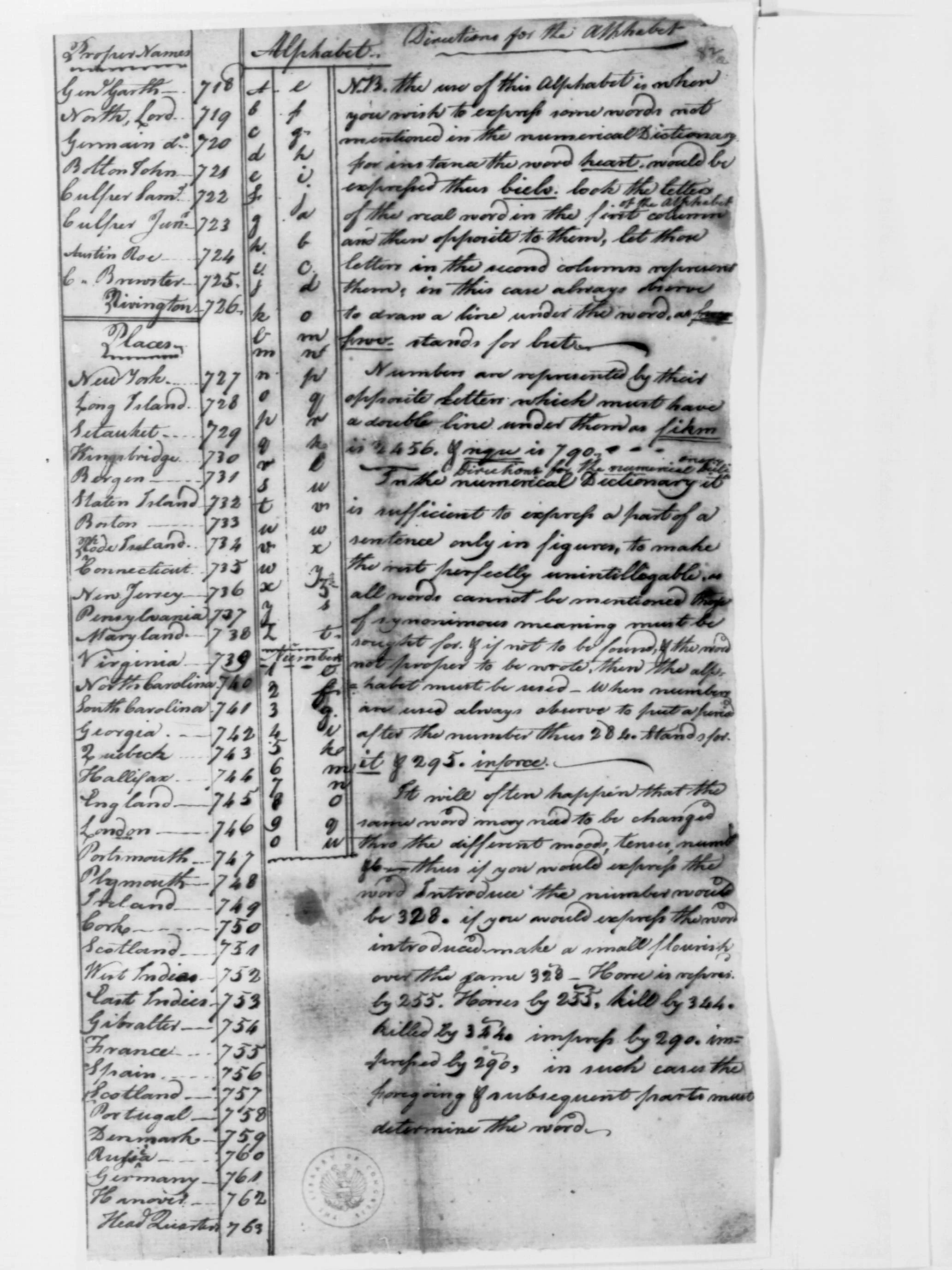
The ring's other tool. A page of the Culper Ring's own code book, compiled under Benjamin Tallmadge: on this page, Culper Saml — Samuel Culper, the ring's chief agent — is number 722, and Setauket, the Long Island village the ring worked from, is 729. The Culper reports travelled in James Jay's invisible ink, hidden between the lines of ordinary letters; when a name was too dangerous even for the stain, it went by number. Ink to hide the letter, numbers to hide the names.
The Culper Ring code book (Benjamin Tallmadge); image via the Library of Congress, Washington, D.C. Public domain.
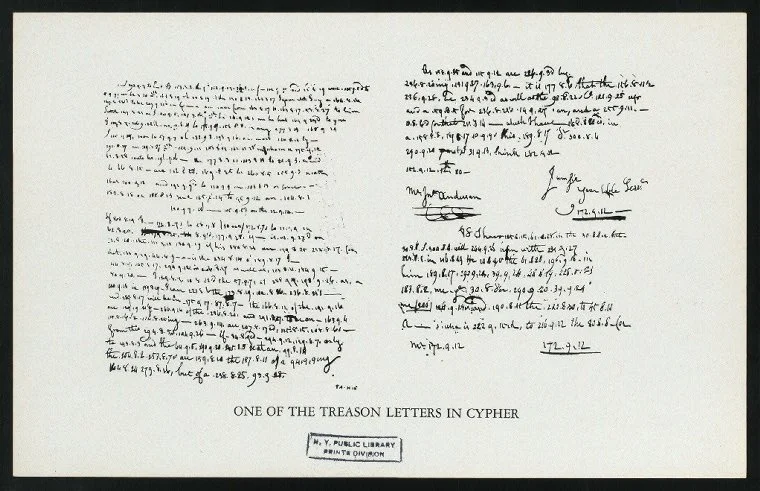
The other side's secrets. One of Benedict Arnold's treason letters in cipher, written to the British officer John André in 1780: the photostat's own printed title calls it what it is. Arnold's correspondence mixed a book code with passages in invisible ink — the two arts of this unit travelling in a single letter. Jay's stain hid Washington's spies; Arnold's ink hid a traitor, and neither page, held up to a guard's eye, confessed to anything.
The New York Public Library, Prints Division. Public domain.
The most consequential invisible ink in American history was invented by a doctor, kept secret by a general, and taken to the grave by its maker.
★ James Jay was a New York physician, brother of the founding father John Jay. Before the Revolutionary War, working in England, he became convinced that the coming struggle would need a secure way to pass intelligence. After long experimenting, he produced a two-part chemical system: one liquid served as the invisible ink, and a second liquid, the counterpart, was required to develop it. Write with the first, and the page looks blank. Apply the second, and the message appears. Neither liquid alone betrayed anything.
Jay sent quantities of both liquids to his brother, and some reached General George Washington. Washington was delighted. He called it the "sympathetic stain" — a sympathetic ink, the period's name for an ink that answers only to its counterpart — ordered his agents to use it, and wrote that it would "relieve the fears of such persons as may be entrusted in its conveyance." A courier carrying a blank-looking letter had nothing to confess if searched. The Culper Ring, Washington's spy network on British-occupied Long Island, wrote its reports in Jay's ink, hidden between the lines of innocent-looking letters, and developed them at the other end with the counterpart.
★ Jay described his success in a letter years later: by this method, he said, he had transmitted to America the first authentic account Congress received of Britain's determination to reduce the colonies to unconditional submission, writing the secret message in the blank spaces of an ordinary letter to his brother. He never published the formula. He carried it to his grave, and no one has recovered it since.
There is a lesson in that silence for a student of writing. Every ink you have studied was a recipe handed down: carbon, gall, vermilion, all of them open books. Jay's ink was the opposite: a recipe deliberately unhanded, a scribe's knowledge kept from the world on purpose. The same craft that preserves can also conceal. Whether that is a triumph or a loss depends on which side of the secret you stand on.
Check in: Washington praised Jay's ink for relieving the fears of the people carrying it. What did a blank-looking letter protect the courier from?
❦ In your workbook: record Jay's two liquids, Washington's name for the ink, the Culper Ring, and the formula that was never published in your own way — copy, sketch, or note what matters.
Why the Heat Works
You have now met inks that answer to water, to oil, to powder, and to a chemist's counterpart. The most famous family answers to heat, and it is the one you will try yourself.
Lemon juice is the classic. Write with it, let it dry, and the paper looks untouched. Warm the paper gently, and the writing blooms brown. Milk, vinegar, apple juice, onion juice, and even sugar water do the same. The mechanism is straightforward, and it is worth understanding, because it explains both the trick and its limits.
★ These liquids are full of organic compounds: acids, sugars, and proteins. Paper is mostly cellulose, a tough fiber that browns only at high heat. The organic compounds in lemon juice or milk break down at much lower temperatures. When you warm the sheet, the juice lines scorch first — carbonization, the browning and blackening of organic matter under heat — caramelizing and darkening while the surrounding paper is still pale. The message was always there, written in chemistry. The heat only hurries what time would do slowly.
That is also why the trick has a cost, and a scribe should know it. The acid in the juice weakens the paper fibers where it sits. A heat-developed message is a small, controlled injury to the sheet. Archivists who find such letters centuries later sometimes find the writing has eaten clean through. Invisible ink is not gentle. Nothing that changes paper is gentle.
★ The chemical inks work differently. Jay's sympathetic stain needed no heat at all: the developer was a second chemical, a reagent — a substance used to produce a chemical reaction — that acted on the first. Your own experiments will include a modern version of this idea. Write with a baking soda solution, let it dry, and brush the paper with grape juice. The juice acts as an acid-base indicator, a substance that changes color in the presence of an acid or a base, so the writing appears in a dark line with no heat required. Two families, one art: heat inks answer to temperature, chemical inks answer to reaction. A third, newest family answers to light itself: some inks stay invisible in ordinary light but glow under an ultraviolet lamp, a light beyond the violet end of the spectrum that the eye cannot see directly. The lamp is modern; the family's principle, writing that waits for its revealer, is as old as Aeneas. The scribe chooses according to the tools at hand and the eyes he means to fool.
A word of professional pride, before you touch a drop. Anyone can buy a trick pen. A scribe understands why the trick works. When you warm that paper and watch the letters rise, you are watching organic chemistry do calligraphy. Know the mechanism, and you are a scholar. Skip it, and you are only a prankster. I expect scholars in my library.
Check in: Two families of invisible ink stand side by side in this section. What wakes each one, and why do the juice lines brown before the paper does?
❦ In your workbook: record the heat mechanism (organic compounds against cellulose), the cost the acid charges the paper, and the baking soda and grape juice version in your own way — copy, sketch, or note what matters.
In your packet: Assignment III — The Heat Comparison ◐ begins here. Work it now, or mark the place and take it as homework — your choice.
In your packet: Assignment IV — The Baking Soda Ink ◐ begins here. Work it now, or mark the place and take it as homework — your choice.
A Word on Fire
This section is not decoration. Read it before you open a single bottle.
★ Paper burns. That is the whole of the safety lecture, and everything else follows from it. You will not use an open flame in this lesson. No candles, no lighters, no matches, no stove burners. A sheet of paper held over a flame does not develop a message; it becomes a fire, and fires do not care what you meant to do.
Heat in this lesson comes from safe sources only, and always with an adult present. A shaded desk lamp with an incandescent or warm bulb, held at a distance, will develop lemon juice writing slowly and safely. A hair dryer on its low setting works. A warm clothes iron, operated by the adult and never left unattended, works. Keep the paper moving, keep your fingers clear, and stop the moment anything smells scorched. Scorched is too far.
Better still, begin with the methods that need no heat at all. The baking soda and grape juice experiment develops at room temperature. The milk and powder experiment needs nothing warmer than your hands. Master the safe methods first. The heat can wait until an adult is beside you, and there is no shame in that. The scribes of Aeneas's garrison would have traded half their tricks for a grown-up in the room.
Professor Quillberry Nocturne Scrollwork Library Master Scribe & Illuminator
Check in: Name the heat sources this lesson allows, the one condition attached to every one of them, and the signal that means stop at once.
❦ In your workbook: record the no-flame rule, the allowed heat sources, and the stop-at-scorch signal in your own way — copy, sketch, or note what matters.
Guided Practice
Safety Rules — Read First
These rules are not suggestions. An adult must be present for every heat experiment.
- No open flames. Ever. No candles, no lighters, no matches, no stove burners, no exceptions. Paper burns, and a sheet held over a flame becomes a fire, not an experiment.
- Heat sources allowed: a shaded desk lamp with a warm bulb (paper held at a distance and kept moving), a hair dryer on its lowest heat setting, or a warm clothes iron operated only by the adult. Nothing else.
- Stop at scorch. If the paper smells scorched, discolors beyond the writing, or curls sharply, stop immediately and let it cool. Scorched is too far.
- Vinegar and lemon juice are food-safe but sting eyes. Wash hands after handling, and keep liquids away from the face.
- The baking soda and grape juice experiments need no heat at all. If no adult is available, do those two and save the heat experiments for later. There is no shame in the safe path.
A student who follows these rules is a scholar. A student who improvises with fire is a former student of this lesson.
Assignment II — The Milk Letter ◐ ★
Objective: Reproduce Ovid's method: write invisibly in milk and reveal it with powder.
Instructions:
- Dip a cotton swab in milk and write a short message on white paper. Use thin lines and dip often. Let the sheet dry completely, at least thirty minutes. Confirm it looks blank.
- Scribble heavily with a soft pencil on a scrap sheet to make graphite dust. Pick up the dust on a dry fingertip and rub it very lightly over the area where you wrote.
- Record what appears, and photograph the result if you can.
- In your workbook, explain in your own words why the powder clings to the writing and not to the blank paper, using the lesson's account of what milk does to paper fibers.
To submit: Your workbook explanation and, if possible, a photograph of the revealed message.
Your keepsake: your revealed milk letter — Ovid's trick in your own hand, the first secret you have written and read back. Keep it with your workbook; paper that looks blank to everyone else is yours alone.
❦ Workbook path: working in your workbook instead of on loose sheets? Write the milk message directly on a workbook page, let it dry fully before the page is turned, and dust it there; write your explanation of the powder's clinging on the facing page.
Materials
Required (Level One — household items)
- White paper: plain printer or notebook paper. Several sheets; you will ruin a few learning the timing.
- Milk: any fresh milk. Your Ovid ink.
- Lemon juice: bottled or fresh-squeezed. Your heat ink.
- Cotton swabs or a small paintbrush: your pen. Dip often; thin lines hide best.
- A soft pencil: scribble heavily on scrap paper, then rub the graphite dust lightly over the milk writing with a fingertip. Your coal dust, without the coal.
- Baking soda and water: two spoonfuls of each, stirred. Your no-heat ink.
- Sugar and water: a spoonful of sugar stirred into warm water. Your fourth heat ink, for Assignment III's comparison.
- Grape juice: red or purple. Your no-heat developer. A tissue or cotton ball applies it.
- A shaded desk lamp, a hair dryer, or a warm clothes iron: your heat sources, with an adult present; the iron is the adult's to operate. See Safety Rules.
Suggested (Level Two — historically closer)
- White vinegar and a raw egg: for Lupton's egg trick (adult supervision; the vinegar softens the shell over several hours).
- A penknife or sharp craft knife: for Assignment V's slit in the softened shell. The adult's hands only; cut away from the body, on a board, as Lesson 10 taught.
- Onion juice: press a cut onion through cloth. A period-plausible heat ink with a memorable smell; ventilate well.
- A quill or dip pen: write the invisible inks with the scribe's own tool, as the historical writers did.
No purchased kits or specialty chemicals are required. The core lesson (milk, lemon, baking soda) is fully achievable with kitchen materials.
Reflection Questions
Answer in your workbook.
- Aeneas, Ovid, della Porta, and Jay all hid messages with ordinary materials. What does that suggest about where secrecy really lives: in the substance, or in the method?
- Why did Washington value Jay's ink for the fears of the couriers, not just for fooling the British?
- Your heat experiment browned the juice before the paper. Explain, using carbonization, why that order matters.
- Jay took his formula to the grave. Was that a triumph of the scribe's craft or a loss to it? Defend your answer.
- Ovid's milk letter and your baking soda cipher both avoid heat. What advantage does a no-heat method have for a real messenger?
- You have now studied inks made to last (Lessons 5–8) and ink made to hide. When would a scribe choose each, and what does the choice reveal about the scribe?
Workbook Checklist — Lesson 24
In my workbook I have:
- ☐ defined invisible ink, sympathetic ink, steganography, developer, reagent, carbonization, acid-base indicator, and ultraviolet
- ☐ explained why gentle heat turns lemon juice and milk brown while the paper around them stays pale
- ☐ described three historical uses of invisible ink: a Greek siege, a Roman love poem, and an American spy ring
- ☐ compared heat-developed inks with chemically developed inks
- ☐ written and revealed a secret message using only safe household materials
- ☐ reproduced Ovid's milk letter and explained why the powder clings to the writing (Guided Practice)
- ☐ run the heat comparison with an adult present and explained the result using carbonization (Assignment III)
- ☐ made the baking soda cipher and explained ink, developer (reagent), and acid-base indicator (Assignment IV)
☐ Lesson completed Date: ___ Signature: ___
Professor's Closing Note
Seal this lesson in your memory, scholar. You began this course learning to make marks that last. You end this unit learning to make marks that hide. Both are the scribe's work. The visible word preserves knowledge for strangers. The invisible word protects it from enemies. Knowing which one the moment calls for, and having the skill for either, is what separates the copyist from the master. Write carefully. Reveal wisely. And keep your lamp shaded.
PROFESSOR QUILLBERRY NOCTURNE
Scrollwork Library — Master Scribe & Illuminator
Further Reading & Sources
- "How George Washington Used Spies to Win the American Revolution" (History.com) — James Jay's sympathetic stain, the Culper Ring, and Washington's own words on relieving the fears of his couriers. history.com/articles/george-washington-general-espionage-culper-spy-ring
- "The cipher of Aeneas" (Telsy) — Aeneas Tacticus, his chapter on secret messages, and the thread-and-disk cipher, with clear diagrams. telsy.com/en/the-cipher-of-aeneas
- "Ciphers, Disguise, and Invisible Ink" (Spycast, CyberWire) — historians Pete Langman and Nadine Akkerman on della Porta's Magia Naturalis and why his recipes take real experimenting to make work. thecyberwire.com/podcasts/spycast/652/transcript
- "Secret Writing" (faqs.org, Encyclopedia of Espionage) — lemon juice chemistry, the baking soda developer family, and the long list of household sympathetic inks. faqs.org/espionage/Re-Se/Secret-Writing
Browse the Scrollwork shelf in the school Library for readable editions of these works.
Submit your work for this lesson using the form below.
CONTINUE IN THE SCROLLWORK LIBRARY
← Previous · Lesson 23: Archive Labels & Library Systems Next · Lesson 25: Caesar Ciphers & Code Wheels →
Unit VII — Ciphers & Hidden Writing Scrollwork Library — All 26 Lessons
The rest of Unit VII: Lesson 25 · Caesar Ciphers & Code Wheels