

SCROLLWORK
Unit VI · Lesson 23ARCHIVE LABELS & LIBRARY SYSTEMS
How did a scribe find the right book?
Professor's Introduction
You have built the scroll. You have sealed the letter. Now comes the question that decides whether any of it mattered: when someone comes looking for that scroll a year from now, or a century from now, will they find it?
A library is not a pile of books. A pile of books is a hoard. A library is a memory with a system. The monks who built the great medieval libraries understood something we still wrestle with: a book that cannot be found is a book that does not exist. So they labeled the bindings, numbered the cupboards, listed the volumes, and in some places chained the books to the desks, all so that the memory would hold.
This is the last lesson of Unit VI, and it closes the circle. Lesson 21 gave you the object. Lesson 22 gave you the guarantee. This lesson gives you the memory. Pay attention. The scribes who did this work were not filing clerks. They were the keepers of everything their world knew.
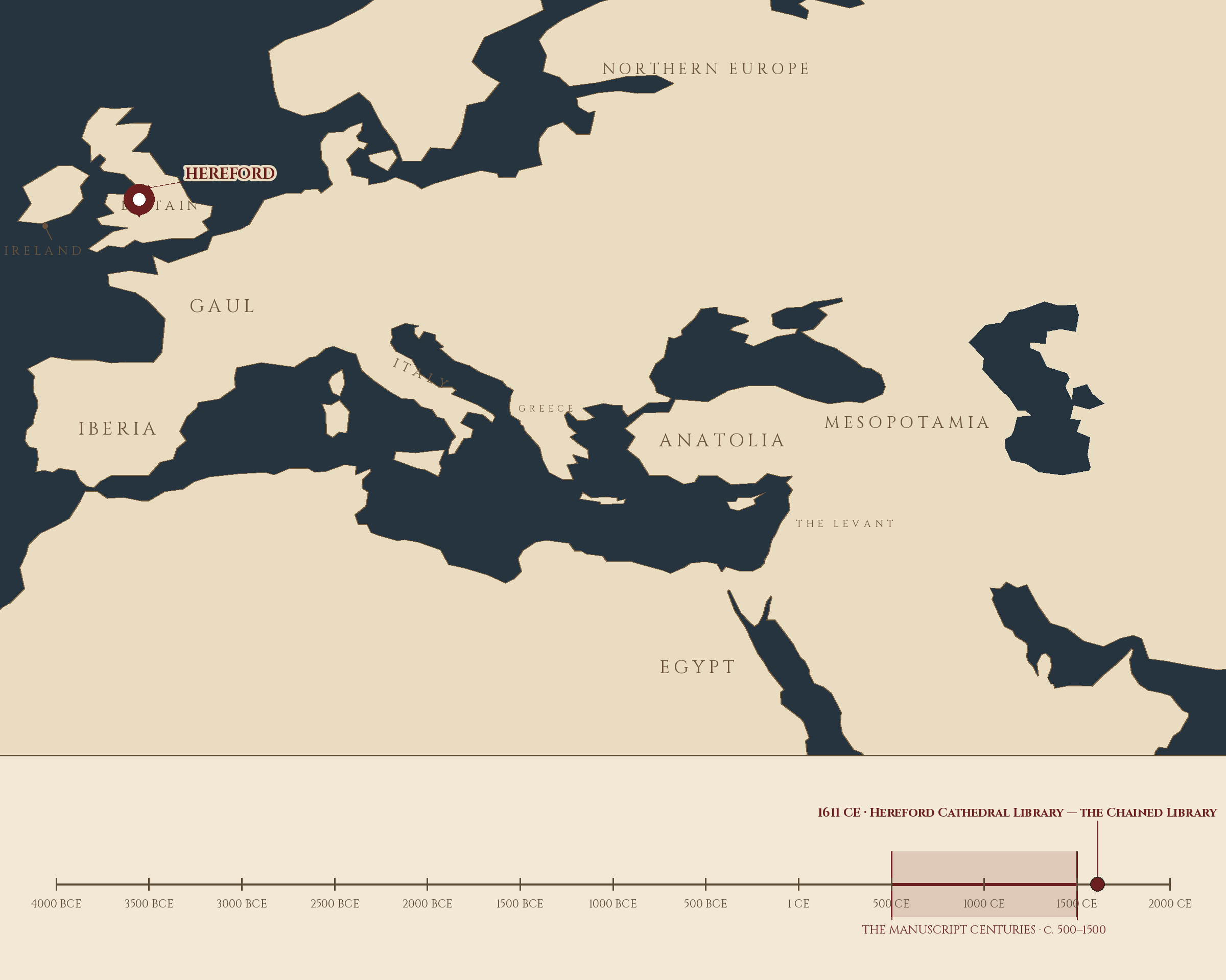
Where and when: Hereford, England, 1611 CE — Hereford Cathedral Library — the Chained Library. The pin is this lesson. The line beneath the map is our road: every stop a place where writing changed, every lesson a pin.
Lesson Objectives
By the end of this lesson, you will be able to:
- Define titulus (in its book-label sense), shelfmark, pressmark, armarium, armarius, catalog, inventory, chained library, ex libris, and colophon.
- Explain how medieval books were labeled, shelved, and listed so they could be found again
- Describe the duties of the monastic armarius and the purpose of a library catalog
- Compare the three great tools of the medieval library: the label, the list, and the lock
- Design a working label-and-catalog system for a small collection of your own
Reading this lesson: ★ marks the passages to remember. They return on the unit quiz and the class test. Check in questions ask the material back as you go; answer them in your workbook when you meet them.
Working this lesson: Your assignment packet is the first download on this page. Work in it as the lesson moves along, answering each assignment as its subject is taught — or read the lesson through for your notes and take the assignments as homework afterward. Both are proper ways to sit this class. Signposts in the reading tell you where each assignment belongs. Written answers are short answers in your own words; a few honest lines are worth more than a filled page.
Your Assignment Packet
This lesson's assignments live in its packet: the Lexicon Handout (every term, course terms marked ◆), Materials, Guided Practice, the Assignment Manual with its answer key for self-checking, the Reflection Questions, and the Workbook Checklist. Download the packet before you begin and keep it beside you as you read.
The Label on the Book
Before a book can live in a library, it must be able to announce itself. A codex sitting on a shelf with a bare binding is a closed mouth. The medieval answer was the label.
★ The most common label was a small piece of parchment or paper, written with the book's title or a short description of its contents, and fixed to the binding. It might be pasted to the cover or slipped into a frame on the spine. Surviving bindings still carry them: a vellum label on the spine announcing the work inside, written in a hurried hand because the label was working equipment, not decoration. In the Latin of the book world, such an inscription could be called a titulus, a word that means inscription, title, or label.
(You will remember that Runes Lesson 21 uses titulus for the little stroke above an abbreviated word. It is the same Latin word. A titulus is a small inscription, whether it sits above a letter or on the spine of a book. The classroom you are in decides which one we mean. Here, in the library, a titulus is a label.)
Labels solved the first problem of storage: identification at a distance. A monk scanning a row of bindings could read the labels without lifting a single volume. But labels have a weakness. They fall off. They fade. They lie, because a book rebound gets a new label, and the new label may describe the old book wrongly. The medieval librarians knew this. That is why the label was only the first of three tools. The second was the list.
Check in: The titulus lets a monk identify a book without lifting it. What three weaknesses do labels have, and what was the second of the three tools?
❦ In your workbook: record the titulus, what it is fixed to, and why a working label is written in a hurried hand, in your own way — copy, sketch, or note what matters.
In your packet: Assignment II — The Titulus Workshop ◐ is this lesson's Guided Practice, further down this page. Work it when you reach it, or read on and take it as homework — your choice.
The Cupboard and the Code
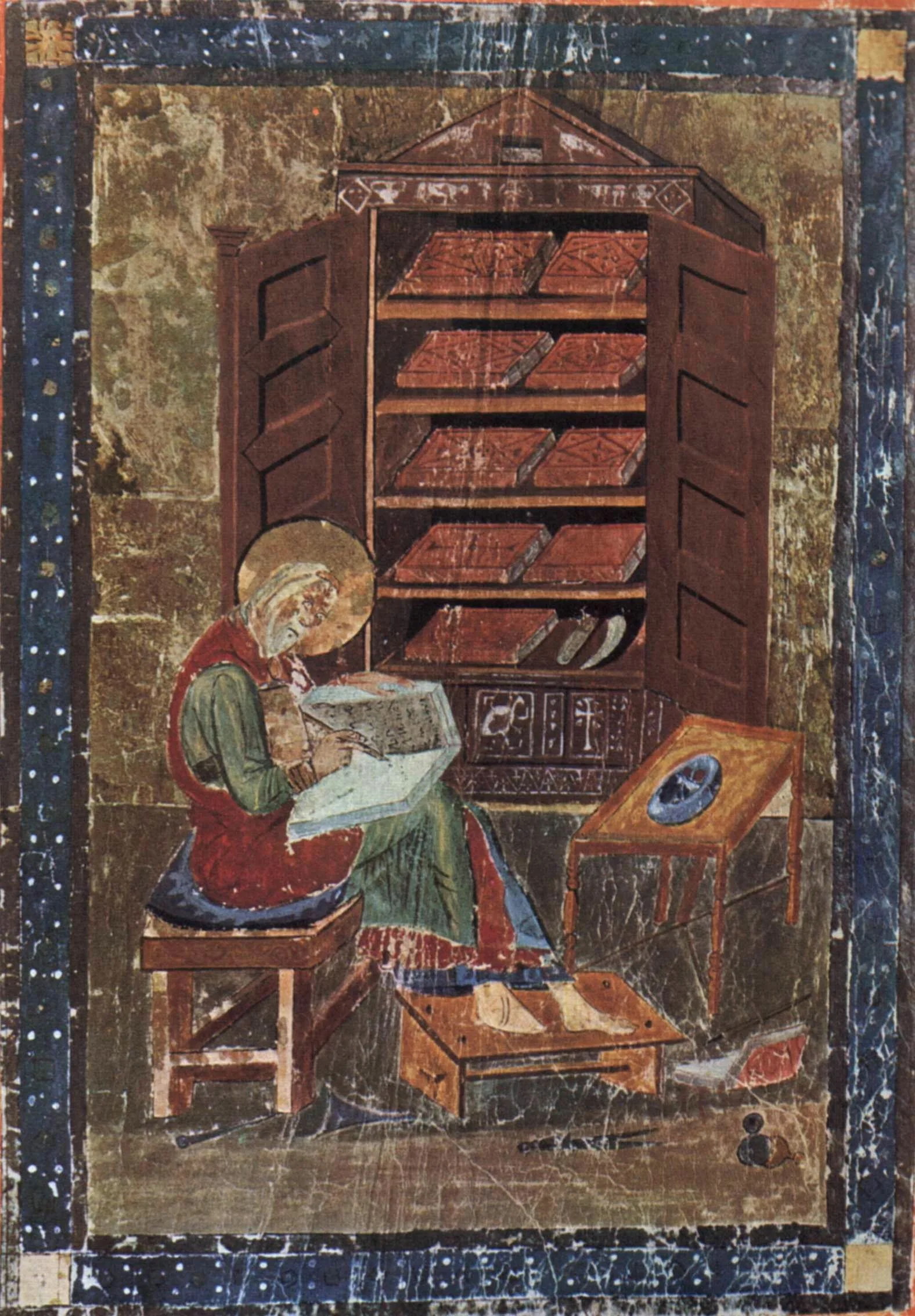
The cupboard at the center of everything. Ezra the scribe, from the Codex Amiatinus (Wearmouth-Jarrow, about 700–716) — and behind him the armarium, doors open, with nine great codices lying flat on its shelves, two of them stood aside on the lowest shelf as if just put back. For a thousand years this cupboard, and its keeper, were the library system.
Codex Amiatinus, fol. 5r (Biblioteca Medicea Laurenziana, Florence); reproduction via The Yorck Project / Wikimedia Commons. Public domain.
Medieval books lived in cupboards. The Latin word is the armarium, plural armaria: a press or cupboard, often with doors, in which books stood or lay on shelves. The great libraries of the later Middle Ages had whole rooms of such presses. And a press full of books needs an addressing system, or the librarian spends the day opening doors at random.
★ The answer was the shelfmark. A shelfmark is a mark in or on a book that records where the book lives: which cupboard, which shelf, which position. Its close cousin the pressmark records only the cupboard. Shelfmarks began in the early Middle Ages, usually as combinations of letters and numbers, probably indicating the cupboard and the shelf. When a book moved, the old mark was crossed out and a new one written in. Those crossed-out marks, layered like tree rings, can still tell a researcher where a manuscript has traveled.
The simplest shelfmarks were beautifully plain. A book might carry nothing more than a note that it was the twelfth volume in its cupboard. In small collections, a single letter did the work. At Bethlehem Priory near Brussels, each book in a small library of Middle Dutch texts received a letter, written on a flyleaf with a short title. The first book on the shelf, a late-fourteenth-century copy of the mystic Hadewijch's works, still faintly reads "Visiones haywigis. A." The visions of Hadewijch, shelf A. Six hundred years later, you can still find it.
★ Larger libraries needed more machinery. In the chained libraries, where books rested on lecterns rather than shelves, the shelfmark had two parts: a letter pointing to the right lectern, and a number giving the book's position on it. And because manuscripts lay on both sides of a lectern, color did the rest of the work. Red numbers marked the books on the right side. Black numbers marked the books on the left. A whole library, addressed in letter, number, and color, readable at a glance by anyone who knew the code.
I have spent forty years in libraries, and I tell you this: the shelfmark is the humblest piece of writing in the building, and the most load-bearing. The illumination gets the visitors. The shelfmark gets the book into your hands.
Check in: A shelfmark records three things about a book. What are they, and how did the lectern libraries add color to the code?
❦ In your workbook: record the shelfmark and the pressmark, the Bethlehem letter "A," and the red-and-black lectern code in your own way — copy, sketch, or note what matters.
The List That Remembers
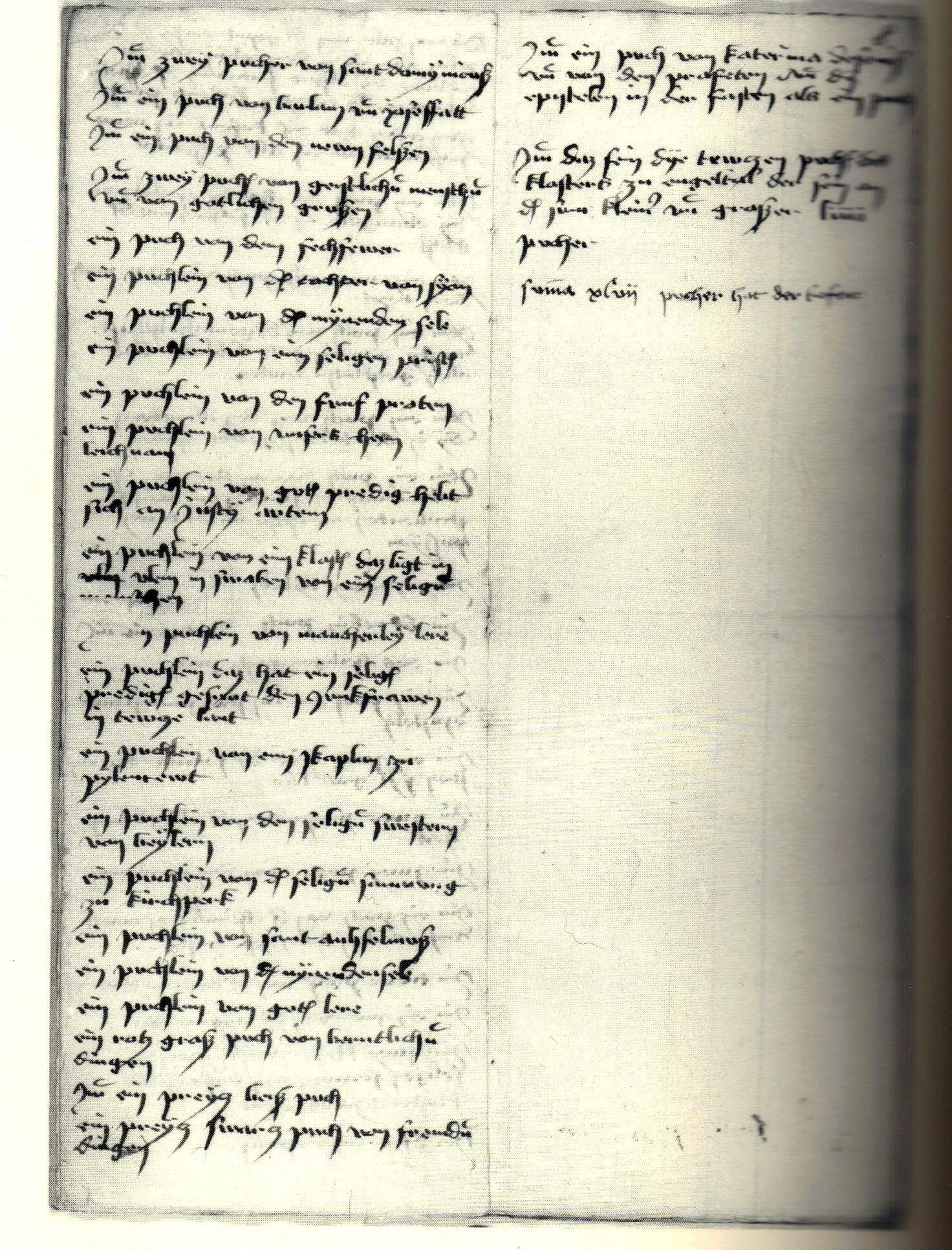
The list that remembers. A page of the book-list of Engelthal, a Dominican convent near Nuremberg, written in 1447: one line, one book, down the whole page — the sisters' whole library held in a single gathering, so that what the house owned could be known, checked, and missed if it wandered. A catalog like this was not paperwork about the library. It was how the library remembered itself.
Staatsarchiv Nürnberg (Rep. 59, Nürnberger Salbücher, Nr. 45a, fol. 7v–8r); reproduced in Johanna Thali, Beten – Schreiben – Lesen (2003). Public domain.
A label identifies one book. A shelfmark locates one book. But a library of hundreds of volumes needs something larger: a list of everything it owns, so that nothing vanishes unnoticed and nothing is bought twice. The medieval names for such lists are the inventory and the catalog. An inventory records what the house possesses. A catalog arranges that knowledge so it can be searched.
★ The earliest catalogs were practical tools, not scholarly ones. Their first job was simple: help a reader find the manuscript he needed, and help the house keep track of a growing collection. That practical work reached a landmark in the early ninth century at Reichenau Abbey. There, the monks made a thematic catalog with an author's index, the first of its kind. Its sections read like a map of a monastic mind: De libris canonum (books of canon law), De regulis (rules), De libris homeliarum (homilies), De passionibus sanctorum (sufferings of the saints), De libris glossarum (glossaries), and on through the works of Eusebius, Josephus, Orosius, and Bede. The compilers even distinguished between the work (the liber) and the physical volume (the volumen or codex) that carried it, a distinction modern catalogers still make. One monk, Reginbert, went further and described every codex he had personally given to the monastery, book by book.
★ Other houses followed with their own lists: Saint-Riquier, Bobbio, Lorsch, Murbach, Saint Gall. Most ninth- and tenth-century booklists are plain enumerations of titles, sometimes grouped by donor rather than subject. But Bobbio's great inventory, made in the ninth or tenth century and preserved only in a fragmentary eighteenth-century transcription, lists 666 items. When the monks of Bobbio counted again in the fifteenth century, they found 243. Books had been pawned, borrowed, carried off by scholars. The two inventories, set side by side, tell the story of a library's rise and ruin more honestly than any chronicle.
★ Someone had to keep these lists, and that someone had a title: the armarius. The Rule of St. Benedict advised that the monastery's possessions be inventoried, books included, and the armarius was the monk charged with the library and the scriptorium together. He kept the inventory. He inspected the holdings. He regulated who could take a book and for how long. He oversaw the scribes. There were no formal cataloging rules; the armarius simply kept lists, and the lists grew more detailed with time, from author and title and condition down to descriptions of the text's contents, so that a volume could not be quietly swapped for a cheaper one. The ideal arrangement began with the Bible, then the Church Fathers, then medieval theologians, then ancient authors, then the liberal arts. In practice, books seem to have stood in whatever order they happened to occupy in the reading room, and readers asked the armarius where things were. The system was the man.
Check in: Bobbio's two inventories, set side by side, tell a story neither tells alone. What happened to the library between the count of 666 and the count of 243?
❦ In your workbook: record the difference between an inventory and a catalog, Reichenau's landmark, Bobbio's two counts, and the armarius and his duties in your own way — copy, sketch, or note what matters.
In your packet: Assignment III — The Armarius's Catalog ◐ begins here. Work it now, or mark the place and take it as homework — your choice.
The Chained Book
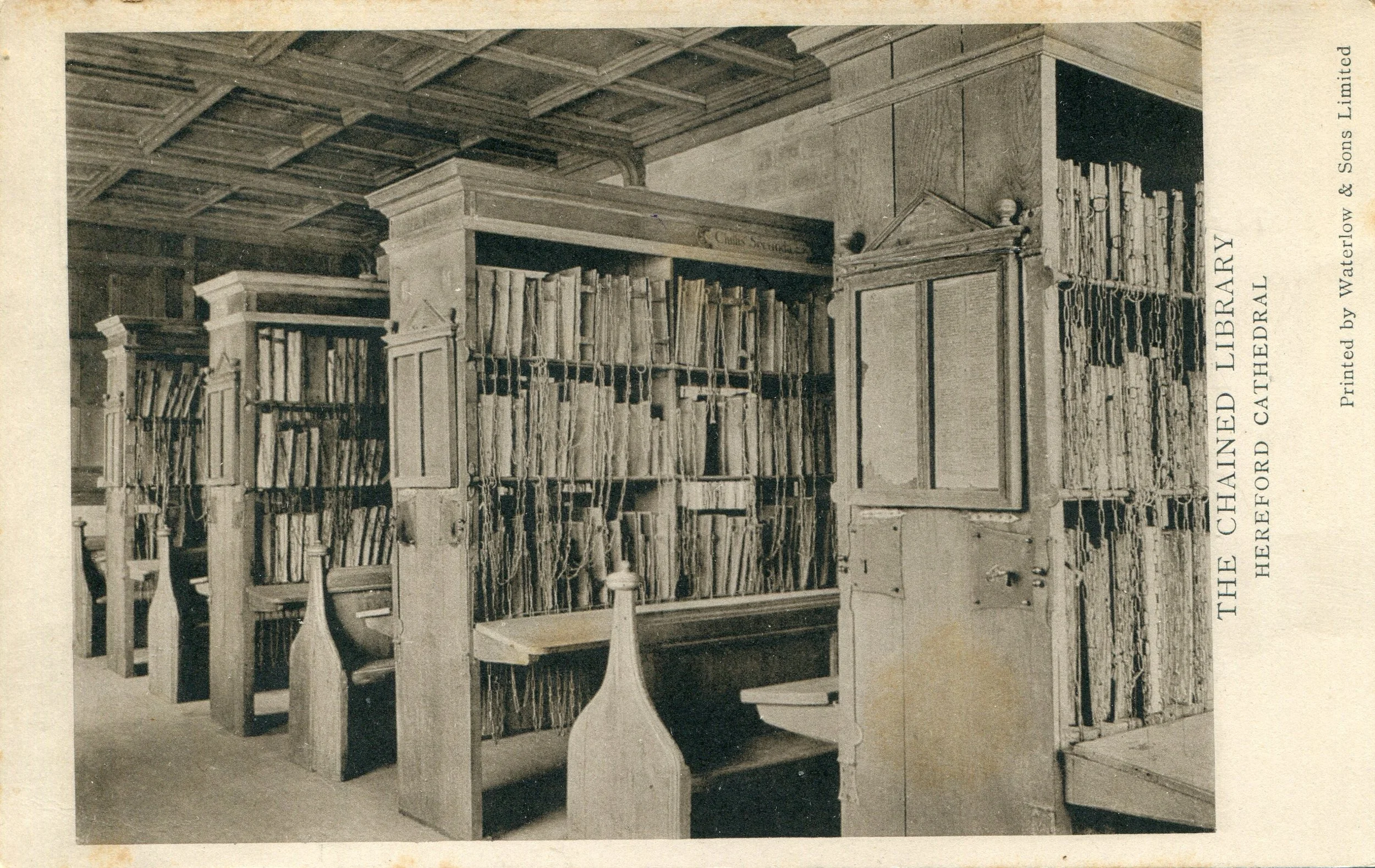
The chained room. The Chained Library at Hereford Cathedral in an early postcard photograph: press after press of books standing fore-edge out, each chained by its cover to the rod along its shelf, with the desk below to read at — you came to the book, because the book could not leave. The press in the middle still wears its painted class name above the shelves.
Postcard printed by Waterlow & Sons Ltd (undated, early 20th century); scan via Wikimedia Commons. Public domain.
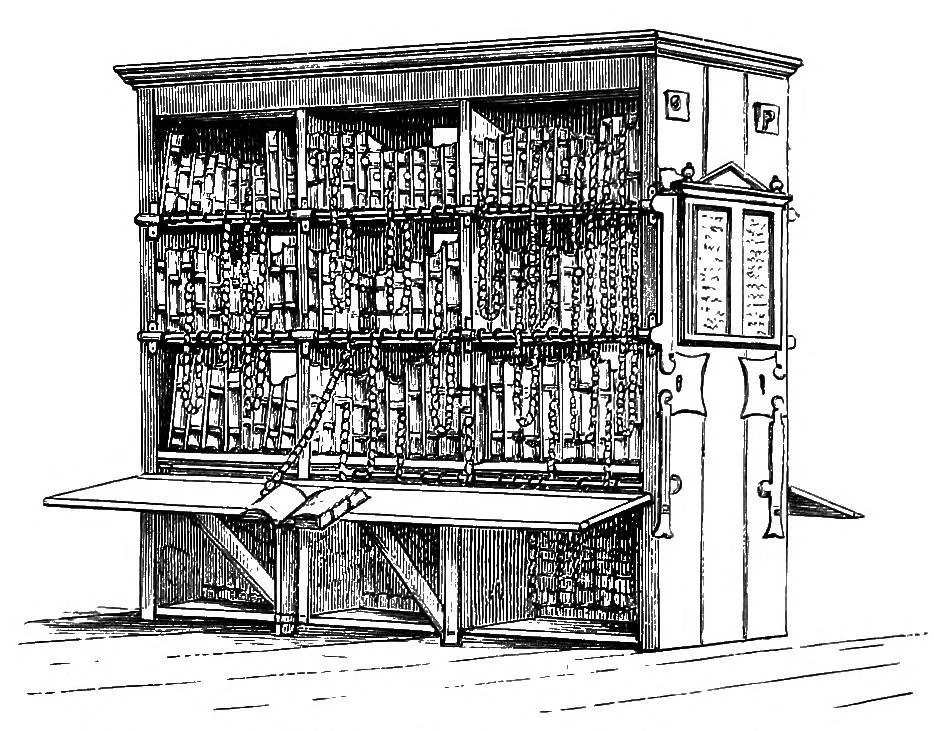
One press, whole system. J. W. Clark's 1894 engraving of a Hereford bookcase shows what the photograph cannot isolate: the chain fixed at each book's fore-edge, the rings free on the rod, the desk beneath — and, on the end of the press, the letters O and P. Those letters are addresses: the pressmark system of this lesson, painted where a reader could find it.
J. W. Clark, Libraries in the Medieval and Renaissance Periods (Cambridge, 1894), fig. 4, via the Internet Archive. Public domain.
A library's memory is worthless if the books walk away. Manuscripts were among the most valuable objects a medieval institution owned: months of a scribe's labor, skins of a herd, sometimes gold on the page. So some libraries added a third tool to the label and the list. The lock.
The most dramatic form of the lock was the chain: the chained library, whose books were fastened by iron chains to the lectern or desk where they were read. In 1481, Sir Thomas Lyttleton left books to the canons of Halesowen in Worcestershire with instructions that they be "laid and bounded with an iron chain" in a convenient part of the church, at his cost, "so that all priests and others may see and read it when it pleaseth them." The chain was not a punishment. It was a promise: this book will be here when you come.
★ Several chained libraries survive with their furniture, chains, and books intact, and they are worth knowing by name. The largest is Hereford Cathedral Library, established in 1611, holding some 1,500 texts including 229 medieval manuscripts. The chains fasten to the edges of the books' front covers and run to a rod along the bottom of the shelf. The books stand with their spines facing inward, the reverse of modern shelving, so that a reader can lift a volume down to the desk below without tangling the chain. The oldest book there is the Hereford Gospels, a book of around 780 — nearly twelve centuries old, chained in this library since its founding, and still read.
In the Netherlands, the Librije of Zutphen keeps its books chained to ancient wooden desks in St. Walburga's church, a room barely changed since 1564. In Italy, the Biblioteca Malatestiana at Cesena, opened in 1454 — the first civic library in Europe — was built for the public rather than for monks or scholars alone. Smaller chained collections survive at Wimborne Minster, at Grantham's Francis Trigge library of 1598, and in parish churches across England. Chaining faded only when printing made books cheap enough, and plentiful enough, that losing one stopped being a catastrophe.
★ And there was one library that solved the security problem the other way around. At Marsh's Library in Dublin, founded in 1701, it was not the books that were chained. The readers were locked into cages. The books roamed free.
Check in: Hereford's books stand with their spines facing inward, the reverse of modern shelving. Why, and what does the chain promise the reader?
❦ In your workbook: record the chain as the third tool, Hereford and its inward spines, Zutphen and Cesena, and Marsh's caged readers in your own way — copy, sketch, or note what matters.
The Guide and the Lender
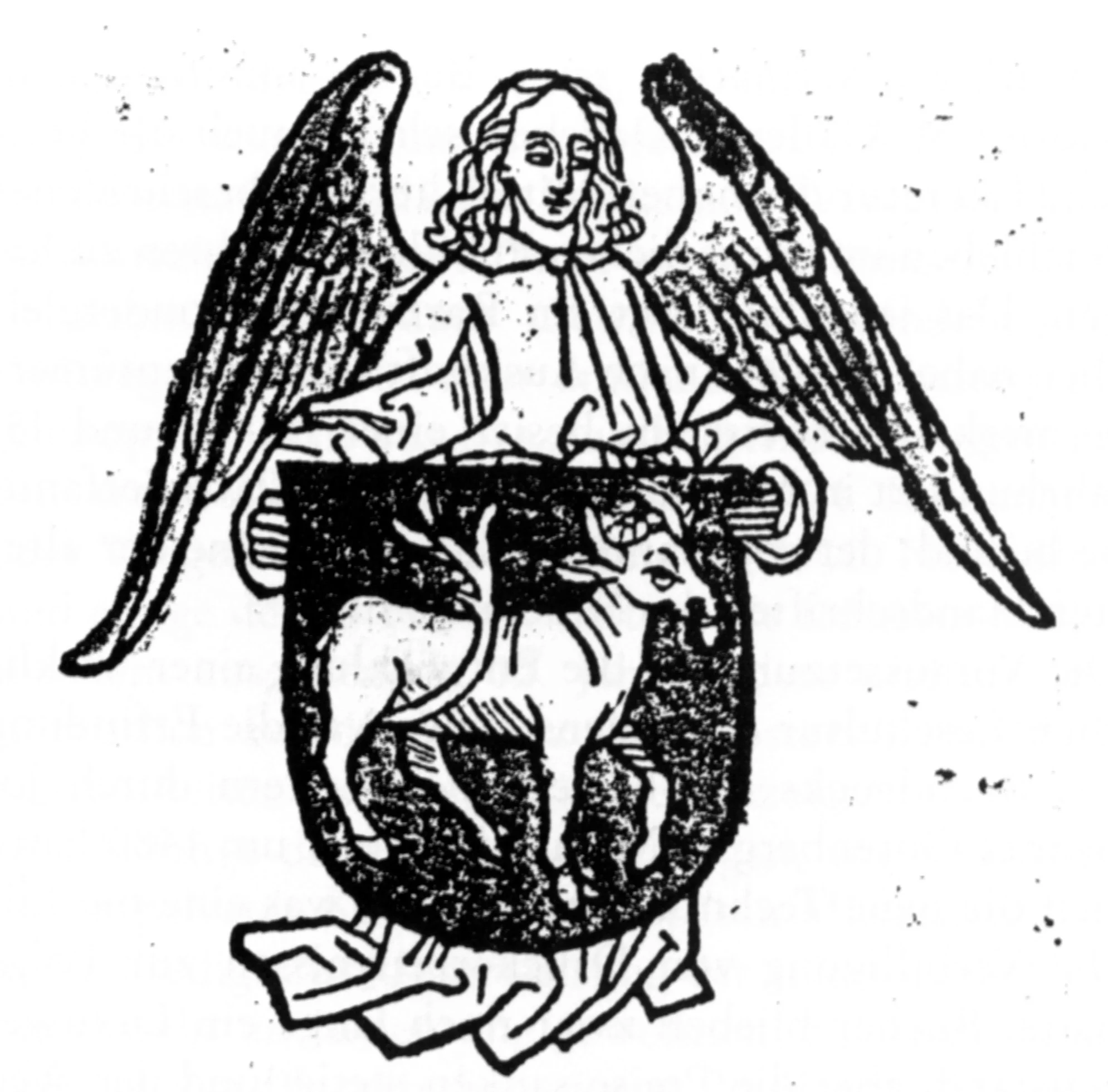
His name, pasted in every gift. The ex libris of Hildebrand Brandenburg of Biberach, a woodcut bookplate — among the earliest ever printed — showing an angel who holds his shield, a white ox on black. He pasted it into the front of books he gave to the charterhouse at Buxheim, so that wherever a volume traveled, its first page remembered whose it had been.
Stadtbibliothek Memmingen; reproduction via Wikimedia Commons. Public domain.
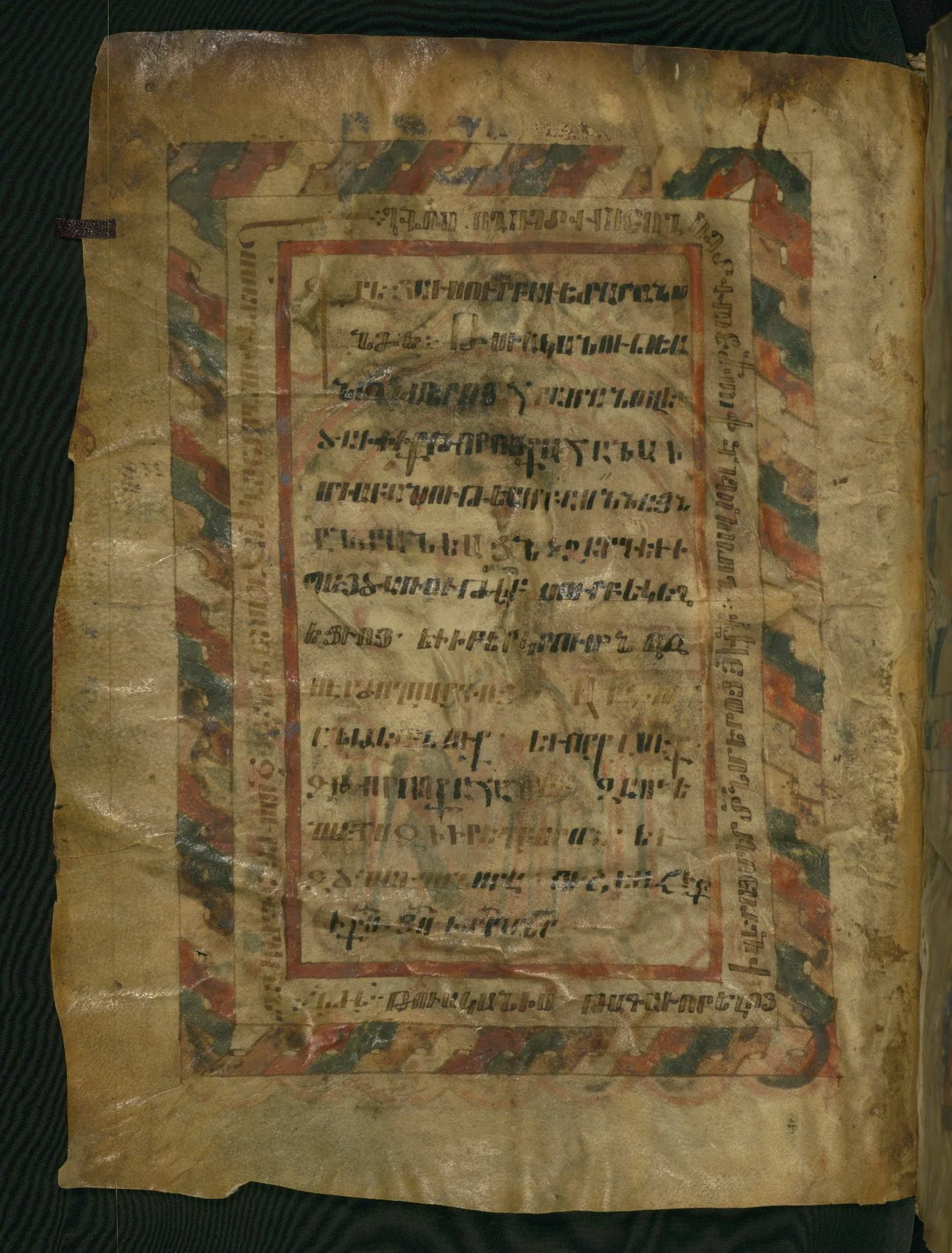
The scribe signs his work. The colophon leaf of an Armenian Gospel book (Walters Art Museum, W.537) — the book's own record of itself, set at its front inside a painted frame. The Walters' catalog reads it for us: the priest Sargis finished the text in the year 415 of the Armenian era — 966 by our count — and said who had commissioned the book, and why. A colophon is a label, a catalog entry, and a signature, all in the maker's own hand.
The Walters Art Museum, Baltimore (W.537, fol. 2v). CC0 (Walters Open Access).
Labels, lists, and locks kept the books safe and findable. But two medieval writers asked a larger question: what is a library for? Their answers still shape how we think about collections.
★ The first was Cassiodorus, a Roman statesman who retired in the sixth century to found the monastery of Vivarium in southern Italy. He endowed it with his own extensive Roman library and wrote the Institutiones, a guide to study composed between the 530s and the 550s. Its first book walks the reader through Scripture and the Christian authors, naming which Latin and Greek fathers expounded each book. Its second book treats all seven liberal arts, grammar through astronomy, in a single volume, as a curriculum for monks. The Institutiones is, among other things, an annotated bibliography of an entire library, telling each monk what to read and why. Cassiodorus even urged his monks to copy any book they found that the library lacked, "that by the help of God and their labour the library of the monastery might be benefited."
★ Eight hundred years later, Richard de Bury, Bishop of Durham and servant of Edward III, wrote the Philobiblon, the love of books, in 1345. He died that same year, in April, in poverty, his great collection already scattering. The book has twenty chapters with titles like "That the Treasure of Wisdom is chiefly contained in books" and "Of the manner of lending all our books to Students." That chapter on lending is one of the longest surviving medieval texts on library management: rules for who may borrow, for how long, under what care, with what accountability. De Bury had meant to found a hall at Oxford and stock its library with his own books as the nucleus. The hall was never built. The book about loving books outlived the library it was meant to serve.
★ One last mark of ownership deserves a place here. Long before the printed bookplate, owners marked their books by hand. The first recorded printed ex libris, Latin for "from the books of," belonged to Hildebrand Brandenburg of Biberach in Germany, usually dated about 1460 (though the record is not certain — one reading of its host volume puts it not before 1491): an angel holding a shield with his family's crest, pasted inside the front cover of a manuscript he later gave to the Carthusians of Buxheim. Every bookplate since, down to the ones in your own shelves, descends from that angel.
And at the end of many manuscripts, the scribe himself signed off. The colophon, from the Greek for summit or finishing touch, is the closing note: who wrote this, when, where, sometimes how the hand ached. The label says what the book is. The catalog says where the book belongs. The colophon says who made it. Between the three of them, the medieval book was never anonymous.
Check in: Cassiodorus and de Bury both wrote about libraries. What larger question were they answering that the label, the list, and the lock do not?
❦ In your workbook: record Cassiodorus and the Institutiones, de Bury and the Philobiblon's lending rules, the first ex libris, and the colophon in your own way — copy, sketch, or note what matters.
Unit VI Review: The Memory of the House
Three lessons, one arc.
Lesson 21 gave you the scroll: the rolled book, its tension and its wrapping, the oldest book-form in our story. Lesson 22 gave you the seal: wax pressed with authority, the guarantee that a document is what it claims to be. This lesson has given you the library: labels, shelfmarks, catalogs, chains, and the men and women who kept them.
★ Put them together and you have the complete medieval answer to a single fear: that writing might be lost. The scroll preserves the words. The seal preserves the trust. The library preserves the finding. A scribe in a chained library at Hereford, lifting down a book by its chain, reading the vellum label on its spine, checking the letter and number against the catalog the armarius kept, was participating in a system eight centuries in the making. The system said: this book matters, this book is here, and this book will be here tomorrow.
Your unit review task is in the assignment packet. Build the system yourself, at the scale of your own shelves, and you will understand the monks better than any chapter could teach you.
Professor Quillberry Nocturne Scrollwork Library Master Scribe & Illuminator
Check in: The scroll, the seal, and the library each preserve something different. What does each of the three preserve?
❦ In your workbook: record the unit's arc — the object, the guarantee, the memory — and the Hereford scribe working the whole system in your own way — copy, sketch, or note what matters.
In your packet: Assignment IV — Unit VI Review: The Memory of the House ✎ begins here. Work it now, or mark the place and take it as homework — your choice.
Guided Practice
Assignment II — The Titulus Workshop ◐ ★
Objective: Give every book in your collection a working label, medieval style.
Instructions:
- Choose ten or more books from your shelves. For each, write a titulus: a small paper slip giving the title and, where useful, the author or a few words of contents. Keep it short enough to read at arm's length.
- Fix each label to its book: taped to the spine, tucked under a cover flap, or tied on with string (Level Two). The label must identify the book without opening it.
- Arrange the books on your shelf or in your box, spines facing you, and test your labels: have someone call out a title and time how long it takes you to lay hands on the book.
- Now remove three labels and repeat the test. Write a paragraph on what changed, and what it tells you about the value of the label as a tool.
To submit: Photograph your labeled shelf and include your test paragraph. Legibility matters more than calligraphy.
❦ Workbook path: working in your workbook instead of at loose slips? Sketch each book's titulus in your workbook first, lettered exactly as it will sit on the spine; record both finding-test times there — with labels and without — and write the paragraph on the label's value on the same page. Working alone? Time yourself; the test keeps its honesty.
Materials
Required (Level One — household items)
- Ten or more books from your own shelves: any books you own or can borrow. These are your collection to label and catalog.
- Paper slips and tape or sticky notes: your tituli. Cut small slips to serve as spine and cover labels.
- A pen or pencil: for writing labels, shelfmarks, and catalog entries.
- A notebook or blank pages: your catalog and inventory. Lined or unlined, it will hold the lists.
- A shelf, box, or table section: your armarium. One shelf or one box is a complete medieval press for this lesson.
Suggested (Level Two — historically closer)
- Kraft paper tags with string: the tied-on label. Thread the string through a punched hole and tie the tag to the book, as labels were tied to bindings.
- A wax seal or sticker seal: mark your catalog's title page the way an institution marked its property, a small echo of Lesson 22.
- A second shelf or box: a second press, so your shelfmark system must distinguish between cupboards, not just positions.
No purchased kits or specialty tools are required. The core lesson is fully achievable with books you already own, paper slips, and a pen.
Reflection Questions
Answer in your workbook.
- Why did medieval librarians need both labels and lists? What does each do that the other cannot?
- The armarius had no formal cataloging rules, yet the great libraries functioned. What does that suggest about systems versus the people who keep them?
- Chained books could be read but not removed. What did the chain protect, and what did it cost the reader?
- De Bury wrote rules for lending books to students. Why would a man who loved books want them to leave the library at all?
- You have now studied the scroll, the seal, and the library. Which of the three would you trust most to carry a text across five hundred years, and why?
- Write your own colophon for this lesson's work: who made it, when, and where.
Workbook Checklist — Lesson 23
In my workbook I have:
- ☐ defined titulus (in its book-label sense), shelfmark, pressmark, armarium, armarius, catalog, inventory, chained library, ex libris, and colophon
- ☐ explained how medieval books were labeled, shelved, and listed so they could be found again
- ☐ described the duties of the monastic armarius and the purpose of a library catalog
- ☐ compared the three great tools of the medieval library: the label, the list, and the lock
- ☐ labeled ten or more of my own books with tituli and run the finding test, with labels and without (Guided Practice)
- ☐ built an inventory and a subject catalog of my collection, with a shelfmark on every book and in both lists (Assignment III)
- ☐ moved two books and crossed out their old shelfmarks, as provenance (Assignment III)
- ☐ written my library's three rules and a signed colophon for my catalog (Assignment IV)
☐ Lesson completed Date: ___ Signature: ___
Cross-Class Connections

Runes · Lesson 21 — The Shorthand Abbreviation Matrix
I teach the titulus as the stroke above a shortened word, and why 'macron' is the wrong name for it. One Latin word, two small inscriptions: mine rides above a letter, Professor Nocturne's rides on a spine. Read my lesson and you will never confuse them, or forget either.
PROFESSOR THISTLELOOM WEBBLETHORN
Runes & Ancient Writing

Herbology · Unit IV, Lesson 29 — Pressing & Preserving Plant Specimens
My specimen sheets carry their labels in the lower right corner, where every botanist looks first, and my collection numbers do the shelfmark's work among plants. Label a plant completely, and it becomes a record that outlasts memory. The library could not have said it better, and Professor Nocturne's scholars are welcome in the Greenhouse to watch a label earn its keep.
PROFESSOR BERYL FERNFOOT
Herbology Greenhouse • Master Herbalist • Head of House Oriens

Potions · Unit I, Lesson 3 — Vessels, Jars & Blown Glasswork
Every vessel in my laboratory is registered before it is filled, and the dangerous ones are marked twice: my labels are tituli with consequences. Professor Nocturne's labels keep books findable; mine keep scholars safe. Come and see how the Potions Laboratory keeps its memory, in ink, on glass, where a mistake can be smelled.
Potions, Unit I, Lesson 4 — Labels, Wax Seals & Ingredient Markings.
Muddlenook labels every vessel before it is filled, and marks the dangerous ones twice. His labels are tituli with consequences. When your catalog is finished, go and see how the Potions Laboratory keeps its memory — in ink, on glass, where a mistake can be smelled.
PROFESSOR CRIMBLEBREW MUDDLENOOK
Potions Laboratory • Master Apothecary • Head of House Meridies
Professor's Closing Note
Seal this lesson in your memory, scholar. The monks counted their books because each one was irreplaceable. Count yours, label them, list them, and lend them carefully, as de Bury taught. A library is a promise that the words will be there when they are needed. Keep the promise.
PROFESSOR QUILLBERRY NOCTURNE
Scrollwork Library — Master Scribe & Illuminator
Further Reading & Sources
- Erik Kwakkel, "Finding Books" (Smarthistory) — the clearest illustrated introduction to medieval shelfmarks, with photographs of real marks including the Bethlehem Priory "A" and the red-and-black lectern numbers. smarthistory.org/finding-books
- "Shelfmark" (Wikipedia) — a compact overview of shelfmark and pressmark history, from early medieval letter-and-number codes to the Cotton library's emperor busts. en.wikipedia.org/wiki/Shelfmark
- "Carolingian Libraries" (Wikipedia) — the Reichenau catalog in detail: its thematic sections, the liber/volumen distinction, and Reginbert's donated codices. en.wikipedia.org/wiki/Carolingian_libraries
- "The First Bookplate" (Brandeis University Library) — the Hildebrand Brandenburg ex libris, usually dated c. 1460 (the date is debated), with full provenance of the manuscript that carries it. brandeis.edu/library/archives/essays/special-collections/first-bookplate.html
- *Richard de Bury, The Philobiblon (1345)* — the love of books, in twenty chapters; Chapter XIX gives the medieval rules for lending. The 1888 Ernest C. Thomas translation is in the public domain and widely available.
- "Hereford Cathedral Library" (Wikipedia) — the largest surviving chained library: its 1611 foundation, the chain-and-rod system, and the eighth-century Hereford Gospels. en.wikipedia.org/wiki/Hereford_Cathedral_Library
Browse the Scrollwork shelf in the school Library for readable editions of these works.
Submit your work for this lesson using the form below.
THE UNIT VI QUIZ
SCROLLWORK LIBRARY · UNIT VI: SCROLLS & ARCHIVES · LESSONS 21–23
Unit VI is complete: the scroll constructed, the seal pressed, and the archive labeled. This quiz gathers the whole unit, all three lessons, into one sitting. Take it from memory first, before you look back at your notes, because it measures what has stayed with you. If you completed the Exercises marked ★ in your lesson packets, you have already practiced most of what it asks.
The quiz packet is a single download. Part I gathers questions from every lesson in the unit, Part II matches the unit's vocabulary, and the answer key waits at the back for self-checking. When you have finished, score it honestly, note the result in your workbook, and revisit any lesson whose questions went wrong before you move on to Unit VII.
CONTINUE IN THE SCROLLWORK LIBRARY
← Previous · Lesson 22: Wax Seals & Authentication Next · Lesson 24: Invisible Inks →
Unit VI — Scrolls & Archives Scrollwork Library — All 26 Lessons
The rest of Unit VI: Lesson 21 · Constructing the Scroll · Lesson 22 · Wax Seals & Authentication