
SCROLLWORK
Unit VI · Lesson 21CONSTRUCTING THE SCROLL
PROFESSOR QUILLBERRY NOCTURNE
Scrollwork Library • Master Scribe & Illuminator
Professor's Introduction
My students arrive at this lesson carrying a misunderstanding, and I do not blame them for it. They think of the scroll as a primitive book, a rough draft of the codex, something the clever Romans tolerated until someone invented pages. This is backwards. The scroll was not a failed book. It was a perfected technology that served the Mediterranean world for three thousand years, and it is still in daily use in synagogues on every continent. You will not understand the codex until you have built a scroll with your own hands and felt why it worked. So we begin with paste, and patience.
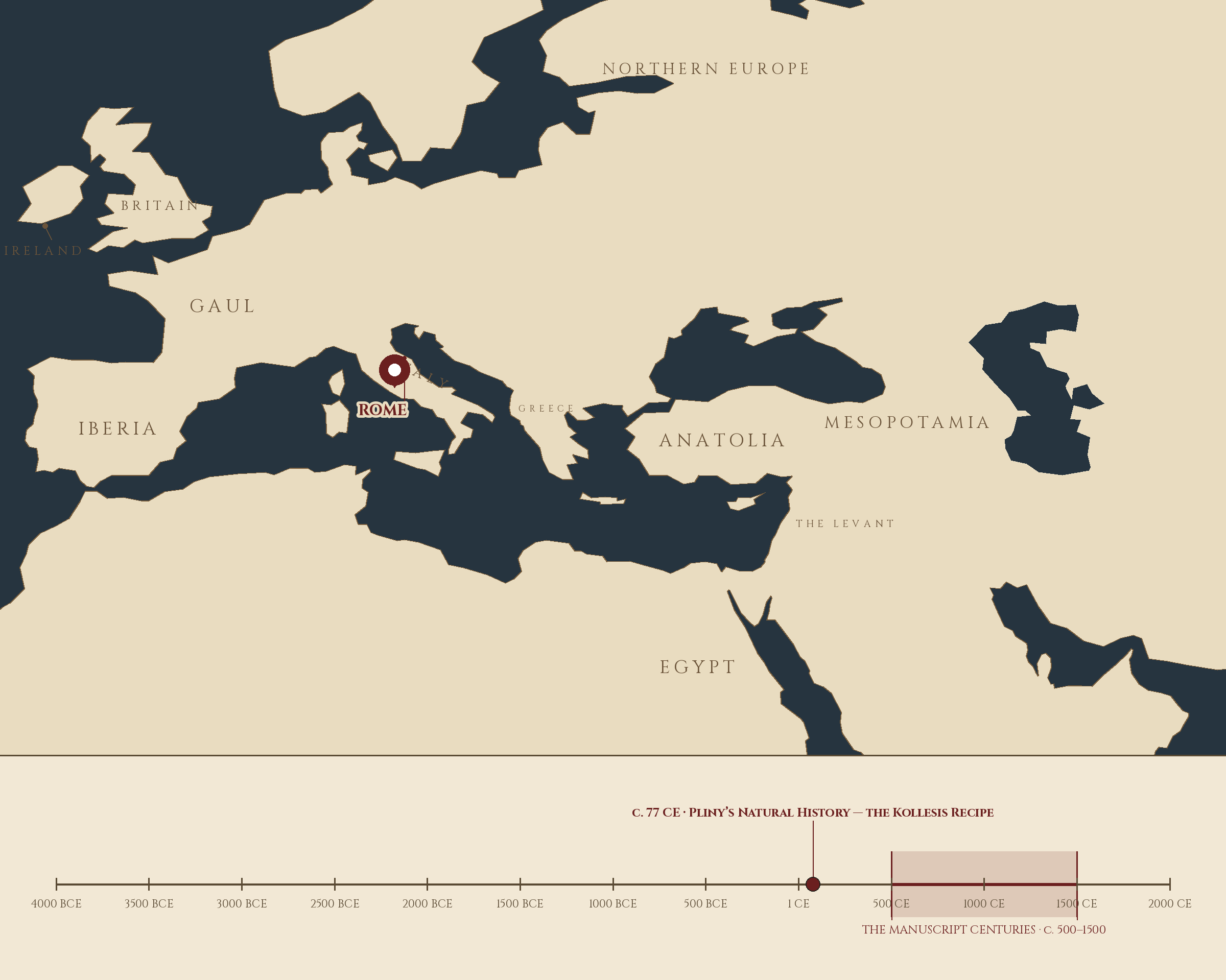
Where and when: Rome, Italy, c. 77 CE — Pliny's Natural History — the Kollesis Recipe. The pin is this lesson. The line beneath the map is our road: every stop a place where writing changed, every lesson a pin.
Lesson Objectives
By the end of this lesson, you will be able to:
- Define scroll, volumen, umbilicus, kollesis, protokollon, and codex, and use each term correctly.
- Describe how individual sheets were joined into a continuous roll, and why the join had to be nearly invisible to the pen.
- Explain how a reader handled a scroll: which hand unrolled, which hand rewound, and why.
- Construct a working scroll of your own, with even tension and a secured roller.
- Compare the scroll traditions of Rome, China, and the Jewish scribal tradition, and explain what each culture's scroll reveals about its readers.
Reading this lesson: ★ marks the passages to remember. They return on the unit quiz and the class test. Check in questions ask the material back as you go; answer them in your workbook when you meet them.
Working this lesson: Your assignment packet is the first download on this page. Work in it as the lesson moves along, answering each assignment as its subject is taught — or read the lesson through for your notes and take the assignments as homework afterward. Both are proper ways to sit this class. Signposts in the reading tell you where each assignment belongs. Written answers are short answers in your own words; a few honest lines are worth more than a filled page.
Your Assignment Packet
This lesson's assignments live in its packet: the Lexicon Handout (every term, course terms marked ◆), Materials, Guided Practice, the Assignment Manual with its answer key for self-checking, the Reflection Questions, and the Workbook Checklist. Download the packet before you begin and keep it beside you as you read.
The Roll Before the Book
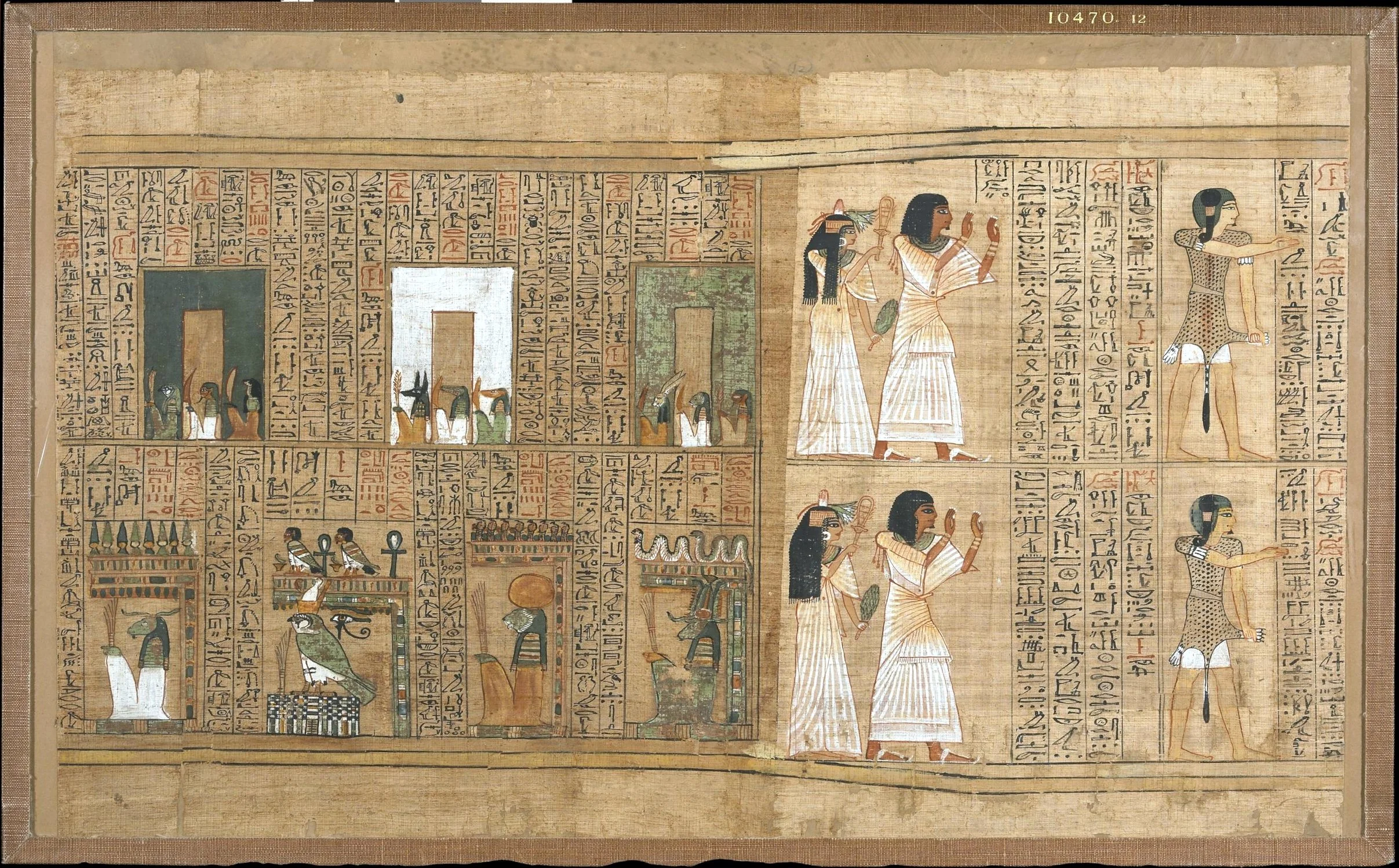
One sheet of a roll. Sheet 12 of the Papyrus of Ani — the "Book of the Dead" made for the scribe Ani (Egypt, 19th Dynasty, about 1250 BCE). The text runs in ruled columns, and sheets like this one were pasted edge to edge, sheet after sheet, to build a roll of whatever length the work required.
British Museum, London (EA 10470, sheet 12). Public domain.
Before there were pages, there were rolls. The papyrus scroll — a long strip of joined sheets wound into a roll — was the standard book of the ancient Mediterranean for roughly three thousand years. Egyptian scribes were rolling papyrus by 2500 BCE. Greek philosophers, Roman poets, and imperial administrators all read from rolls. When Ovid counted the fifteen books of his Metamorphoses, he called them ter quinque volumina, fifteen rollings. ★ The Latin word for a book roll, volumen, comes from volvere, to roll, and it is the ancestor of our English word volume.
A finished Roman scroll averaged about thirty feet long and, wound tight, was roughly the diameter of a wine bottle. Callimachus, the great librarian of Alexandria, warned against making them longer, with the proverb that a big book is a big evil. Usually one literary work, or one book of a longer work, occupied one scroll. The physical limit of the roll shaped literature itself: authors composed in book-length units because the roll demanded it.
★ The roll was not crude. It was engineered. Sheets of papyrus were trimmed, polished smooth with shell or ivory, and joined edge to edge with a wheat paste made from flour and boiling water, left to set for a day, with a few drops of vinegar added to discourage mold. This is Pliny the Elder's recipe, and modern reconstructions confirm it works. Each sheet, called a scheda in Latin or kollema in Greek, overlapped the one to its right, so that the nib of the pen would glide over the join instead of catching on it. The join itself was called the kollesis, and a good kollesis, flattened with a mallet, was scarcely thicker than the sheet. A standard manufactured roll ran to twenty sheets, about eleven or twelve feet, though scribes cut rolls longer or shorter to fit the text at hand. A long book joined roll to roll by the same kollesis until it reached its full length — the thirty feet of the finished scroll above.
★ The beginning of the roll carried one or more blank sheets, the protokollon, which protected the written text the way a flyleaf protects a modern book. The end of the roll was sometimes finished with a wooden rod, and the projecting ends of the rod were called the umbilici, little navels, or cornua, little horns. Martial mentions them in his epigrams, and notes that they could be brightly colored. Over time the word umbilicus came to mean the rod itself. A scroll stored on its side in a Roman bookcase often wore a small parchment tag at the top, the titulus, bearing the title and the author's name, hanging down like a luggage label so the reader could find the book without unrolling it.
★ To read, the Roman held the roll in both hands, unrolling it with the right hand while winding the read portion back up with the left. The Latin verb for this was explicare, to unfold, which gives us our word explicit, still printed at the end of some books. Because the roll had no pages, the text ran in columns called paginae, typically eight to ten inches tall, holding twenty-five to forty-five lines, with narrow margins between them. A reader who appears in ancient art holding a scroll in the left hand was understood to have finished reading; a scroll in the right hand meant the reading had not yet begun. The written face was the roll's inner face: rolled inward, it was protected, and it never rubbed against another written surface — which is why a scroll is written on one side only.
Check in: Name the scroll's parts and their jobs: which sheet protects the text at the roll's beginning, what the rod's projecting ends are called, and which tag lets a reader find the book without unrolling it?
❦ In your workbook: record the roll's anatomy — the join, the protecting sheet, the rod and its ends, the label — and how a Roman reader's two hands worked it, in your own way — copy, sketch, or note what matters.
Professor Nocturne
You will notice, if you are paying attention, that every part of the scroll answers a question. The overlap answers the pen. The protokollon answers protection. The umbilicus answers the hand. The titulus answers the shelf. Nothing on a scribe's desk is decoration. I have told you this before, and I will keep telling it until the habit of asking "what is this for" becomes faster than the habit of admiring.
How to Roll: Tension and the Reader's Hands
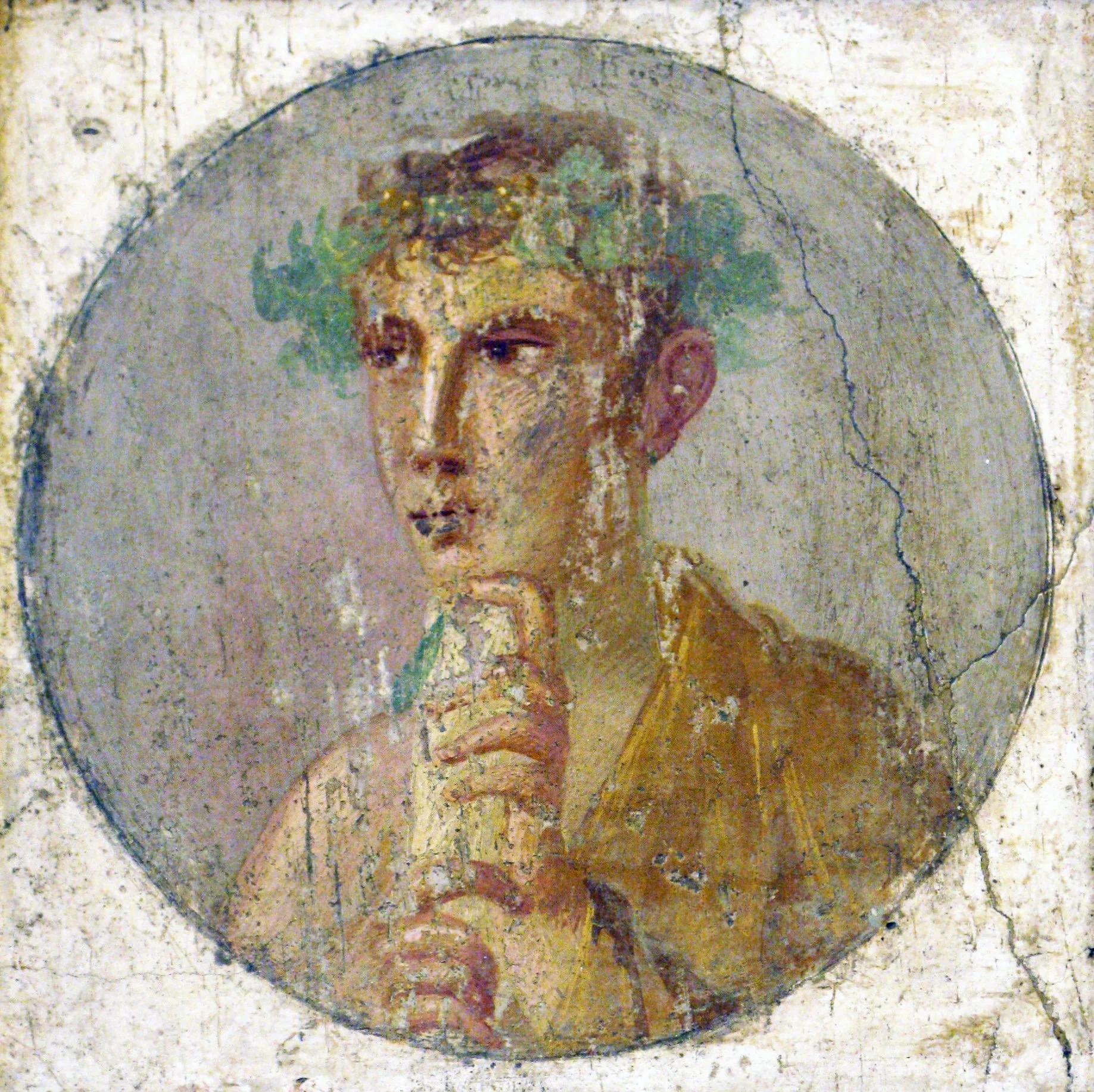
The reader's hands. A young man of Pompeii holds his rotulus in both hands (fresco, 1st century CE). A scroll is a two-handed instrument: one hand pays out the fresh text, the other takes up what has been read — and when you finished, you owed the next reader the courtesy of rolling it back to the beginning.
Museo Archeologico Nazionale, Naples (inv. 9085); photograph by Olivierw via Wikimedia Commons. Public domain.
A scroll is a negotiation between two forces: tight enough to be compact, loose enough to survive. Roll it too tight and the sheets crease and crack along the kollesis. Roll it too loose and it telescopes, the layers sliding sideways until the roll goes slack and shapeless. The scribe's hands learn the middle ground the way a musician's hands learn pressure on a string: by doing it badly first.
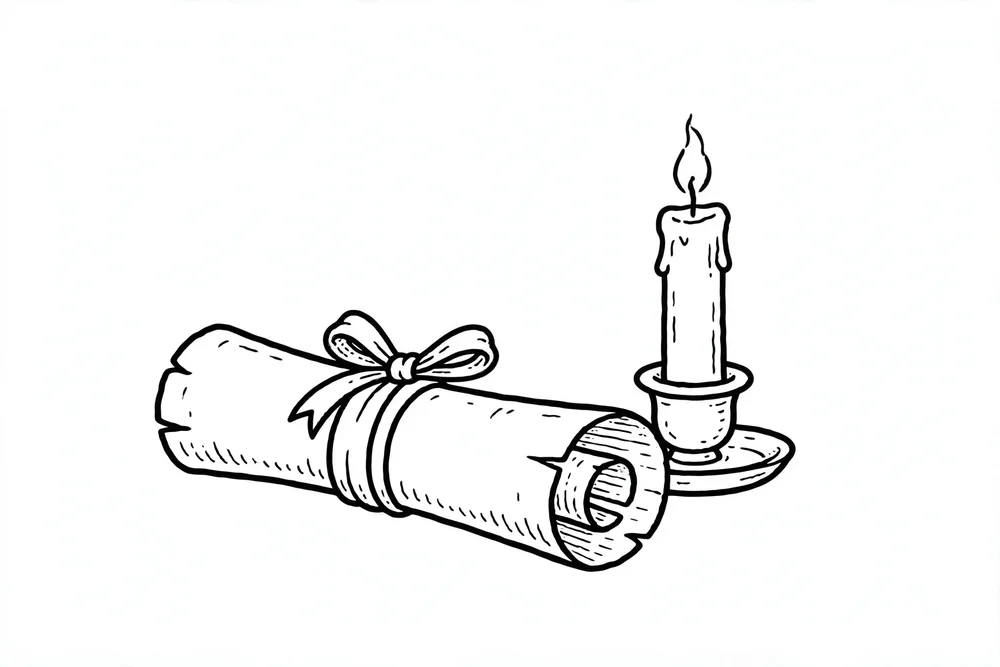
The direction matters. Papyrus rolls were wound from right to left, so that the beginning of the text sat at the outer end of the finished roll and the reader unrolled toward the left as the reading progressed. When you build your own scroll in this lesson's assignments, you will roll from right to left for the same reason, even if your writing material is modern paper. The habit is three thousand years old. There is no reason to invent a new one.
★ Even tension is the whole craft. As you roll, keep the edges aligned. If one edge creeps ahead of the other, stop, back up a turn, and correct it. A roll that drifts will never sit straight on its roller, and a roller that sits crooked will wear one edge of the scroll faster than the other. The Romans knew this. The Chinese handscroll makers knew this. Every culture that rolled books learned the same lesson independently, because paper and physics do not negotiate.
The roller itself, the umbilicus in the Roman tradition, gives the scroll its spine. Without a rod, a long roll goes soft in the middle and sags. With a rod, the roll keeps its shape on the shelf and in the hand. The rod also gives the reader something to grip that is not the writing surface, which matters more than students expect. Skin oils damage ink and parchment over time, a fact you met in Lesson 4 at the scribe's desk. The roller is, among other things, a handle for hands that must not touch the text.
Check in: A roll can fail two opposite ways as you wind it. What are they, and what do you do the moment one edge creeps ahead of the other?
❦ In your workbook: record the rolling craft — the two failures, the right-to-left direction, and why the roller is a handle as well as a spine — in your own way — copy, sketch, or note what matters.
In your packet: Assignment II — Build the Scroll ◐ begins here. Work it now, or mark the place and take it as homework — your choice.
In your packet: Assignment III — The Reader's Hands ◐ begins here. Work it now, or mark the place and take it as homework — your choice.
The Scroll Around the World
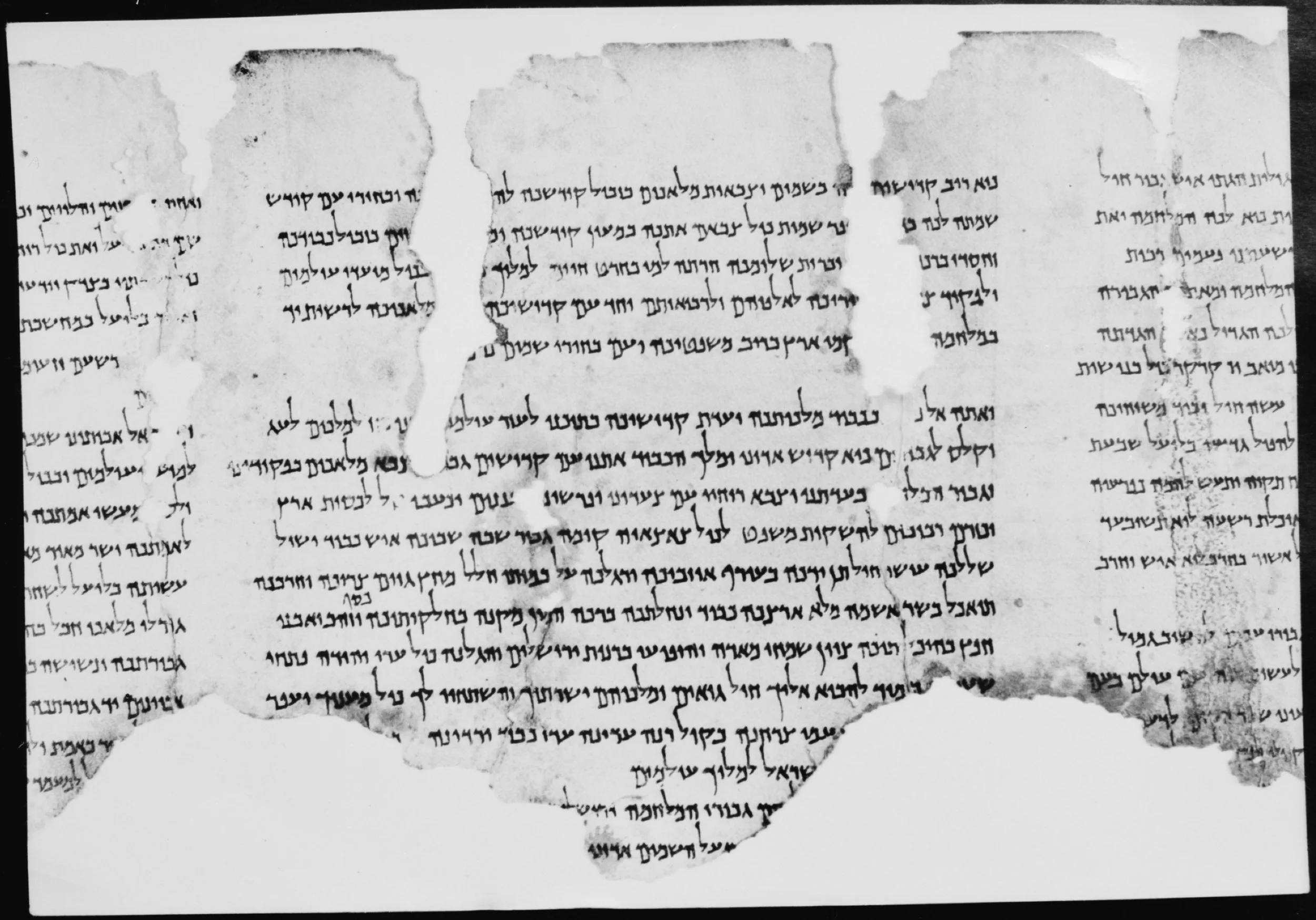
A scroll of sewn sheets. Columns of the War Scroll (1QM), one of the Dead Sea Scrolls found at Qumran (1st century BCE–1st century CE). Its makers joined sheet to sheet of parchment and ruled each sheet into columns before a word was written — the same construction as a papyrus roll, in a tougher skin.
Library of Congress, G. Eric and Edith Matson Photograph Collection (matpc.13011). Public domain.
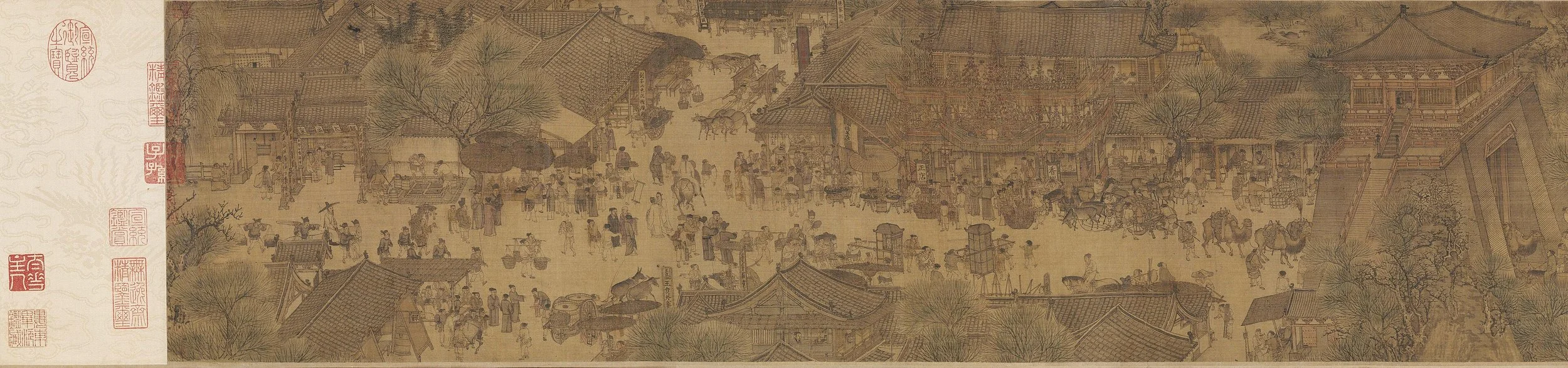
An arm's length at a time. One passage of Along the River During the Qingming Festival, Zhang Zeduan's handscroll of the Northern Song capital (12th century) — a work over five metres long, made to be viewed exactly this way, one section at a time. The red seals at the left stand on the scroll's mounting: the marks of later collectors who owned and treasured it.
After Zhang Zeduan (Northern Song, 12th century); reproduction via Wikimedia Commons. CC0 (underlying work public domain).
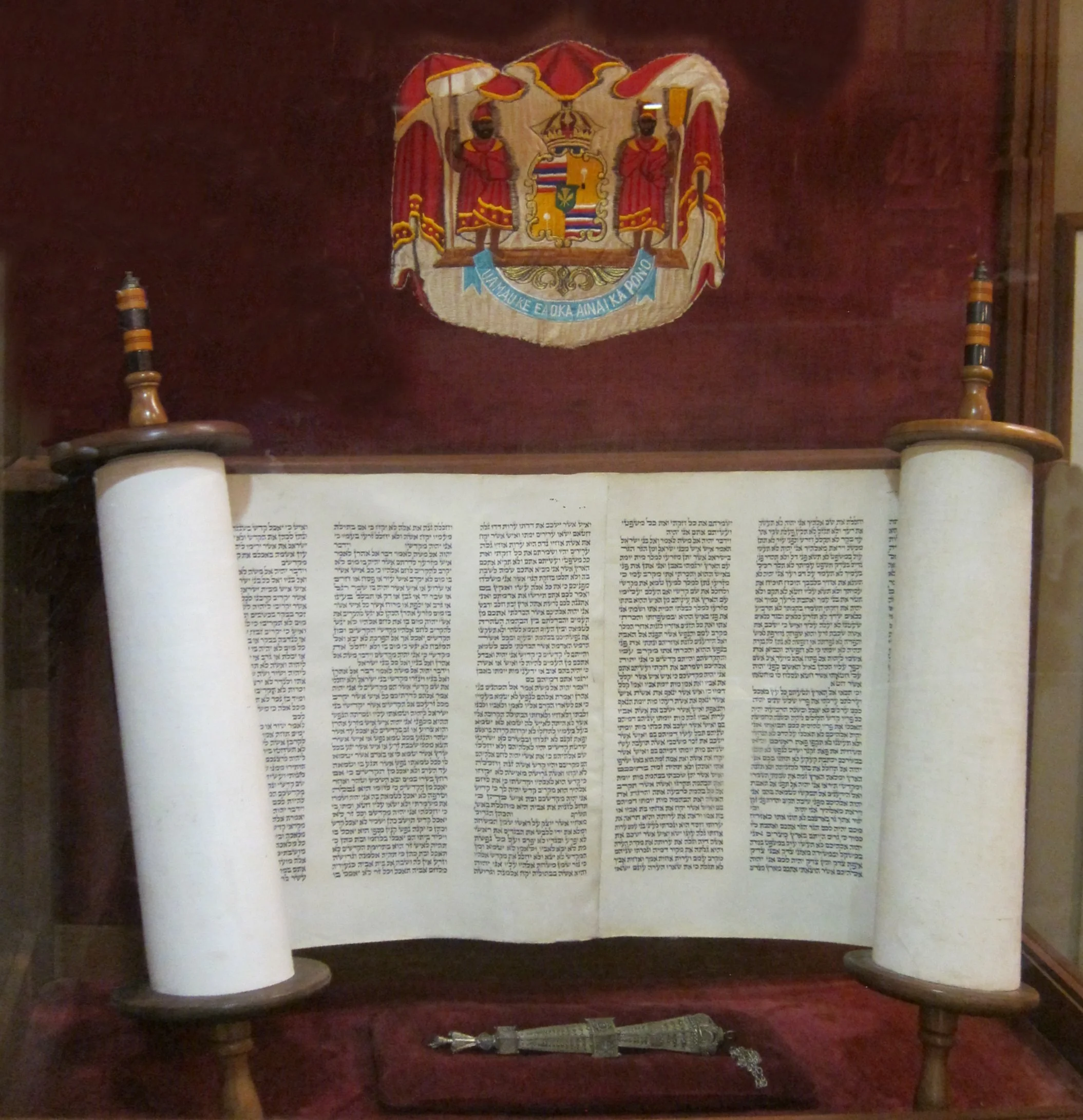
The scroll on its trees of life. A Torah scroll open between its two rollers — the atzei chayim, "trees of life" — its embroidered mantle hung behind it and its silver reading pointer, the yad, resting before it. This scroll was presented to King Kalākaua of Hawai'i and is kept at Temple Emanu-El, Honolulu.
Photograph by Wmpearl via Wikimedia Commons (Temple Emanu-El, Honolulu). CC0.
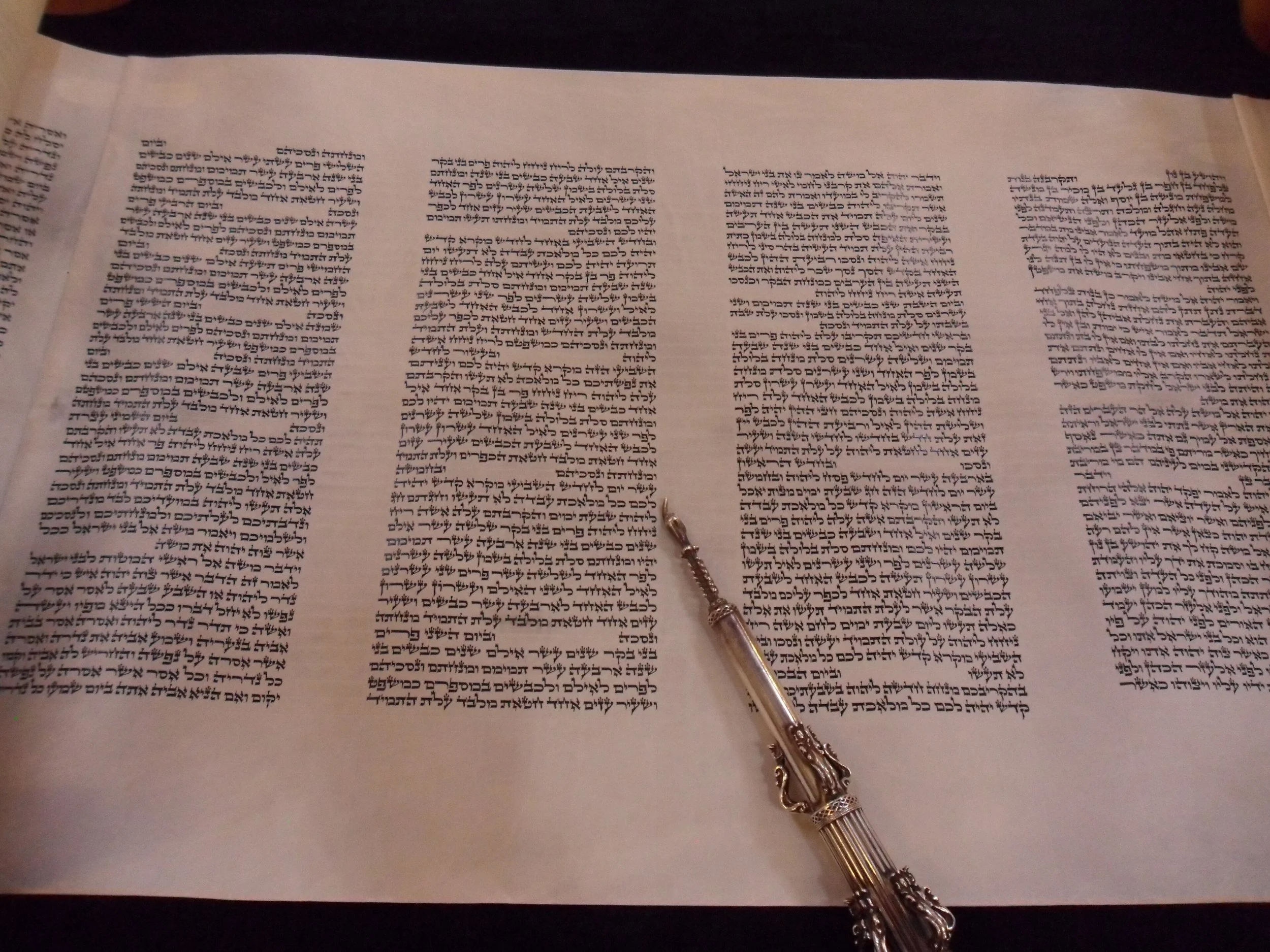
Reading without touching. The silver yad at rest across the columns of an open Torah scroll (Synagogue Beth Yaacov). Its tip is a little hand, forever pointing: the reader follows the line with the pointer, and the parchment — which one touch of skin oil can harm, and which reverence sets apart — is never handled at all.
Photograph by Mourad Ben Abdallah via Wikimedia Commons. Public domain.
Rome did not have the only scroll tradition, and the others solve the same problems in their own ways. Compare them, and you will see that a scroll is not one invention but a family of answers to the same question: how do you keep a long text portable, protected, and readable?
★ The Chinese handscroll grew out of bamboo and wooden slips bound together in the centuries before paper, and by the Eastern Han period it was the standard form for texts and paintings alike. A handscroll carries a wooden stave at its right end, the beginning, which stiffens the opening, and a wooden roller at its left end around which the whole scroll winds. A silk cord and fastener secure the rolled scroll. The scroll is viewed from right to left: the left hand unrolls while the right hand rolls up the viewed portion, keeping a comfortable section open. It is the mirror image of the Roman two-handed reading, adapted to a script that reads right to left. The great handscroll paintings, like Zhang Zeduan's Along the River During the Qingming Festival, were meant to be experienced in time, unrolled section by section, the way music is heard measure by measure rather than all at once.
★ The Torah scroll of the Jewish scribal tradition is a parchment scroll sewn, not pasted, sheet to sheet with sinew thread from a kosher animal. Between sixty-two and eighty-four sheets of parchment make a complete Torah, containing exactly 304,805 letters. It is mounted on two wooden rollers called the atzei chayim, the trees of life, named for the verse in Proverbs: "It is a tree of life to those who hold fast to it." The rollers carry round plates at top and bottom that keep the parchment from sliding off or touching the table, because the sacred parchment must not be touched by bare hands. The reader follows the text with a yad, a pointer, often ending in a small sculpted hand, so that skin oils never reach the ink. A Torah scroll, cared for, remains usable for a century and a half or more. There are scrolls in use today older than any book in most libraries.
Three traditions, three materials, three scripts, one shape. The scroll endures wherever a text must travel, be read aloud in sequence, or be handled with reverence. It is worth asking, before we move on, why the codex replaced it in Europe at all.
Check in: The Torah scroll's panels are joined differently from the Roman roll's sheets. How, and with what — and what are its two rollers called?
❦ In your workbook: record the three traditions side by side — material, joining, roller, and the reader's hands for each — in your own way — copy, sketch, or note what matters.
In your packet: Assignment IV — Three Scrolls, One Shape ✎ begins here. Work it now, or mark the place and take it as homework — your choice.
Why the Codex Won, and What Survived
★ The codex, the book of folded pages bound at one edge, began displacing the scroll in the Roman world between the first and fourth centuries. The Christians adopted it early, which helped, but the deeper reasons were practical. A codex can be written on both sides. It opens flat to any page without unrolling thirty feet of papyrus. It is compact. For reference works, law codes, and the Gospels, which readers consulted rather than read straight through, the codex was simply the better tool.
★ But the scroll did not vanish. It survived everywhere its particular strengths mattered: in the synagogue, where the Torah is read in unbroken sequence week after week; in East Asia, where the handscroll became a vehicle for painting as well as text; in the chancery, where long rolls of parchment carried legal records for centuries (England's Master of the Rolls takes his title from them). Technologies rarely die outright. They retreat to the ground where they are strongest, and they wait.
There is a lesson in this for the scribe, and it is not only about history. Every tool you have met in this course, from the reed pen to the iron gall ink, was once the new thing that displaced something older, and most of them survived somewhere, serving someone, long after their supposed replacement arrived. The scroll teaches the pattern most clearly because its replacement is the object sitting on your desk right now.
Check in: Name the codex's three practical advantages over the scroll — and one place where the scroll, not the codex, is still the right tool.
❦ In your workbook: record why the codex won, where the scroll survived, and the pattern the scroll teaches about old tools — in your own way — copy, sketch, or note what matters.
Materials
Required (Level One — household items)
- Long paper: several sheets of plain paper taped or glued edge to edge into one strip, at least six feet long. Printer paper, butcher paper, or a cut-open paper grocery bag all work. This is your scroll.
- Two dowels, sticks, or rolled cardboard tubes: about a foot long each, for the rollers. Wooden dowels from a craft store, straight sticks, or sturdy cardboard tubes will do.
- Tape or glue: for joining the sheets and fastening the scroll ends to the rollers. A flour-and-water paste also works and is closer to the Roman recipe — flour and boiling water, with a few drops of vinegar, as the Suggested list's recipe details.
- A pen and ink: any pen you have. You will write the scroll in columns before rolling it.
- String or ribbon: to tie the finished scroll shut, the way a silk cord secured a handscroll.
- A small scrap of paper: for the titulus label of Assignment II, step 4.
- A ruler: for ruling column lines and keeping the sheet edges aligned as you join them.
Suggested (Level Two — historically closer)
- Parchment paper or papyrus sheets: real papyrus sheets are sold by educational suppliers; parchment paper from a craft store approximates the weight and feel of a skin scroll.
- Wooden dowels with knobs: add small wooden beads or buttons to the dowel ends as your umbilici, the little navels the Romans gripped.
- Wheat paste: flour and boiling water, left to set, with a few drops of vinegar, mixed to Pliny's recipe for the kollesis joins.
- A reed or quill pen with carbon ink: the scriptorium writing kit, for writing the columns the way an ancient scribe would.
No purchased kits or specialty tools are required. The core lesson (joining, rolling, tension, the reader's hands) is fully achievable with paper, dowels, tape, and a pen.
Reflection Questions
Answer the following questions in your workbook.
- Why did the kollesis overlap each sheet over the one to its right, rather than simply butting the edges together?
- What problem does the umbilicus solve that the roll alone cannot solve?
- Why would a scroll normally be written on one side only?
- The codex could be written on both sides, opened to any page, and carried compactly. Given those advantages, why did the scroll survive in synagogues and in East Asian painting?
- You unrolled with the right hand and rewound with the left. What did your hands teach you that the lesson text could not?
- Every part of the scroll answers a question, the lesson says. Pick one part — the protokollon, the titulus, the kollesis, the roller — and state its question and its answer in your own words.
Workbook Checklist — Lesson 21
In my workbook I have:
- ☐ defined scroll, volumen, umbilicus, kollesis, protokollon, and codex, and used each term correctly
- ☐ described how individual sheets were joined into a continuous roll, and why the join had to be nearly invisible to the pen
- ☐ explained how a reader handled a scroll: which hand unrolled, which hand rewound, and why
- ☐ constructed a working scroll of my own, with even tension and a secured roller
- ☐ compared the scroll traditions of Rome, China, and the Jewish scribal tradition, and explained what each culture's scroll reveals about its readers
☐ Lesson completed Date: ___ Signature: ___
Professor Nocturne
You have now built, with your hands, the oldest book technology in continuous use. The scroll you made in this lesson's assignments is a small thing, paper and dowels, but it works on the same principles as the rolls of Alexandria and the Torah scrolls of living synagogues. Treat it with the respect its ancestors earned. Roll it evenly. Store it on its side. And the next time someone calls the scroll primitive, you will know exactly how wrong they are, and exactly why.
Professor's Review
Six units in, and you have moved from the desk to the ink to the quill to the letterform to the decorated page, and now to the book itself. The scroll is the first complete book technology you have built from nothing, and it will not be the last. Next we turn to seals and archives: how a document proves it is what it claims to be, and how a library remembers where it put things. Bring the patience you learned at the rolling table. You will need it.
PROFESSOR QUILLBERRY NOCTURNE
Scrollwork Library
Master Scribe & Illuminator
Cross-Class Connections

Runes · Lesson 1 — Mesopotamian Cuneiform
My first lesson offers the clay tablet, the scroll's great rival in the ancient Near East: a technology you impress, where yours is one you roll. My scribes pressed wedges into clay that outlasted empires; yours pasted sheets into rolls that outlasted libraries. Come and compare the two survivals before you judge either.
Runes · Lesson 3 — Old Persian Cuneiform
The Behistun inscription is a text that could never be scrolled, carved where only gods and climbers could read it. Some texts demand stone, scholars. Stone does not roll, does not travel, and does not forgive, which is precisely its point. Come and stand before it, in words at least.
PROFESSOR THISTLELOOM WEBBLETHORN
Runes & Ancient Writing

Creative Arts · Unit II, Lesson 8 — Scrolls, Rolls & Cases
My bench teaches the same rolled family from the maker's side: rolling a long sheet evenly on rods, fitting a roll with a title label in the tradition of the Roman titulus, and building the fitted case a finished roll travels and shelves in. You have built the book in Professor Nocturne's library. I will house it. A scroll without a case is a book without a shelf; bring yours to the workshop.
PROFESSOR COGBRANCH TIMBERCLANK
Creative Arts Workshop
Further Reading & Sources
- Keith Houston, The Book: A Cover-to-Cover Exploration of the Most Powerful Object of Our Time (W. W. Norton, 2016). Chapters on the scroll and the codex transition, written for general readers. - The University of Chicago's Encyclopaedia Romana, Scroll and Codex. Detailed account of the Roman volumen, the umbilicus, the kollesis, and reading practice, with ancient sources cited. - The Dartmouth Ancient Books Lab, The Historical Background of the Ancient Scroll. Clear diagrams of scroll parts including the protokollon and umbilicus. - The Metropolitan Museum of Art's Heilbrunn Timeline, search "handscroll" for essays on Chinese scroll mounting and viewing. - Congregation Beth El, Berkeley, About Our Torah Scrolls. A clear explanation of Torah scroll construction, the atzei chayim, and sewn panels. Browse the Scrollwork shelf in the school Library for readable editions of these works.
A scroll commissioned at the Desk is constructed as this lesson constructs it: the protective leader, the ruled field, the rod with its umbilici, the title tag tied on. The Desk computes the field; your hands roll the real thing.
The Commission DeskPROFESSOR QUILLBERRY NOCTURNE · SCROLLWORK LIBRARY
Submit your work for this lesson using the form below.
CONTINUE IN THE SCROLLWORK LIBRARY
← Previous · Lesson 20: Marginalia & Manuscript Creatures Next · Lesson 22: Wax Seals & Authentication →
Unit VI — Scrolls & Archives Scrollwork Library — All 26 Lessons
The rest of Unit VI: Lesson 22 · Wax Seals & Authentication · Lesson 23 · Archive Labels & Library Systems