

SCROLLWORK
Unit V · Lesson 20MARGINALIA & MANUSCRIPT CREATURES
Professor Quillberry Nocturne
Master Scribe & Illuminator
The Scrollwork Library • School of Evershade
Professor's Introduction
Play seriously, scholars, and welcome to the last lesson of our fifth unit.
In our seventeenth lesson, you learned to order the page: hierarchy, headings, and the architecture of the text block. In our eighteenth, you laid gold, and learned why a shining initial is worth more than its weight in patience. In our nineteenth, you grew borders, vines and leaves that frame the words without crowding them. You have built the page from the center outward. Tonight we go to the farthest edge, where the rules loosen and the scribes played.
The margins of medieval manuscripts hold some of the strangest art ever made: knights doing battle with snails, rabbits hunting hunters, foxes preaching to geese, monks with the bodies of birds. Scholars have argued for a century about what any of it means, and I will not pretend to settle the argument tonight. What I will do is teach you to look at the edge of the page the way a scribe did, and then to draw there yourself.
One warning, delivered in my sternest voice. Play is not carelessness. The illuminators who drew these creatures were masters of the pen. Their jokes are drawn with the same discipline as their saints. If your marginalia are sloppy, they are not drolleries. They are smudges. Earn the joke.
Take up your pen. The margins are waiting.
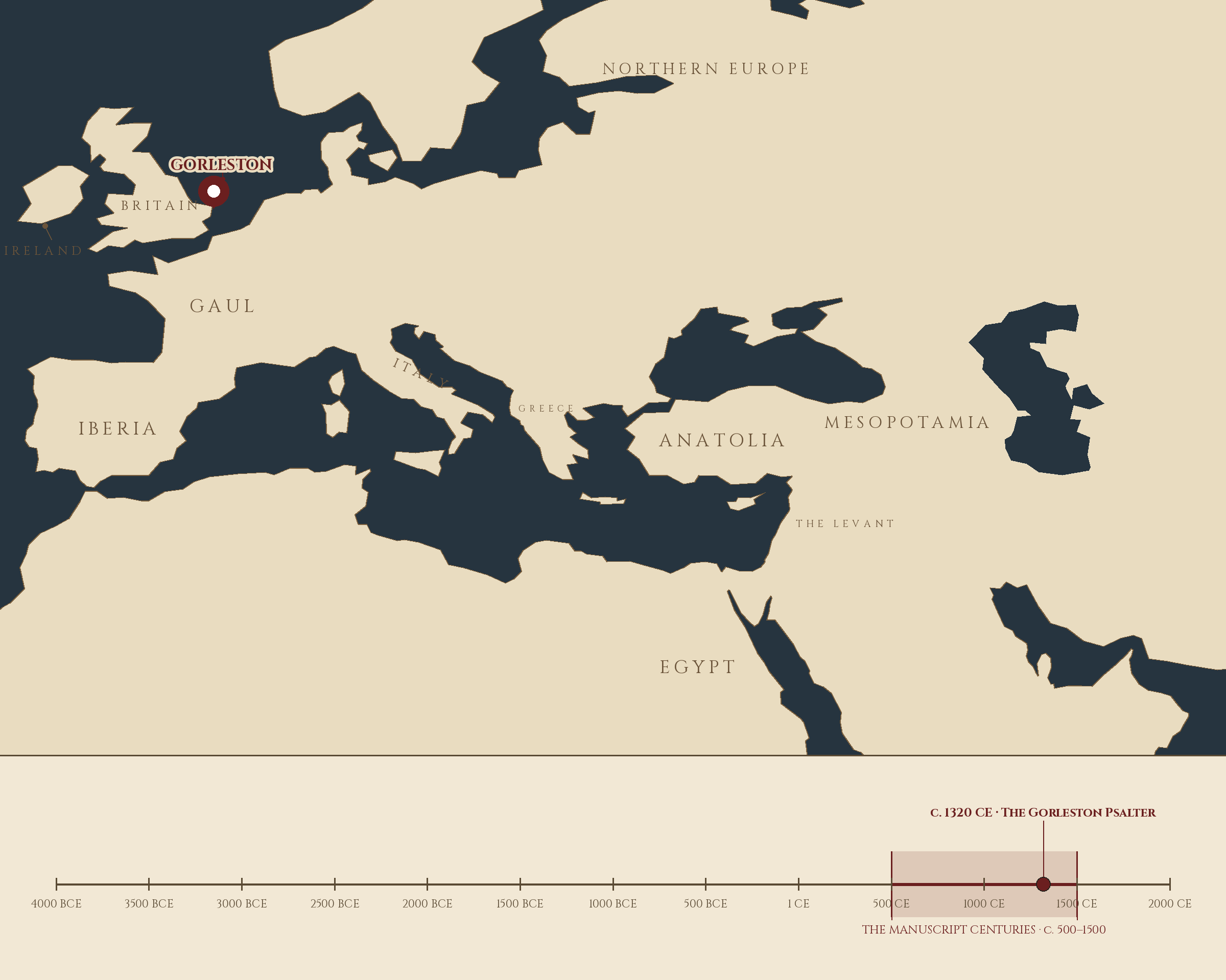
Where and when: Gorleston, Norfolk, c. 1320 CE — The Gorleston Psalter. The pin is this lesson. The line beneath the map is our road: every stop a place where writing changed, every lesson a pin.
Lesson Objectives
By the end of this lesson, students should be able to:
- Define marginalia, drollery, bas-de-page, hybrid creature, manicule, and monde renversé.
- Describe the knight-versus-snail motif and summarize at least three scholarly theories of its meaning.
- Explain Michael Camille's argument about what marginalia do to the text they surround.
- Identify the Smithfield Decretals, the Luttrell Psalter, the Gorleston Psalter, and the Taymouth Hours as key sources of marginal imagery.
- Draw a manicule and explain its function as the medieval reader's highlighter.
- Design an original drollery in the medieval spirit, drawn with controlled pen work.
- Summarize the arc of Unit V, from page layout through marginalia.
Reading this lesson: ★ marks the passages to remember. They return on the unit quiz and the class test. Check in questions ask the material back as you go; answer them in your workbook when you meet them.
Working this lesson: Your assignment packet is the first download on this page. Work in it as the lesson moves along, answering each assignment as its subject is taught — or read the lesson through for your notes and take the assignments as homework afterward. Both are proper ways to sit this class. Signposts in the reading tell you where each assignment belongs. Written answers are short answers in your own words; a few honest lines are worth more than a filled page.
Your Assignment Packet
This lesson's assignments live in its packet: the Lexicon Handout (every term, course terms marked ◆), Materials, Guided Practice, the Assignment Manual with its answer key for self-checking, the Reflection Questions, and the Workbook Checklist. Download the packet before you begin and keep it beside you as you read.
The Edge of the Page
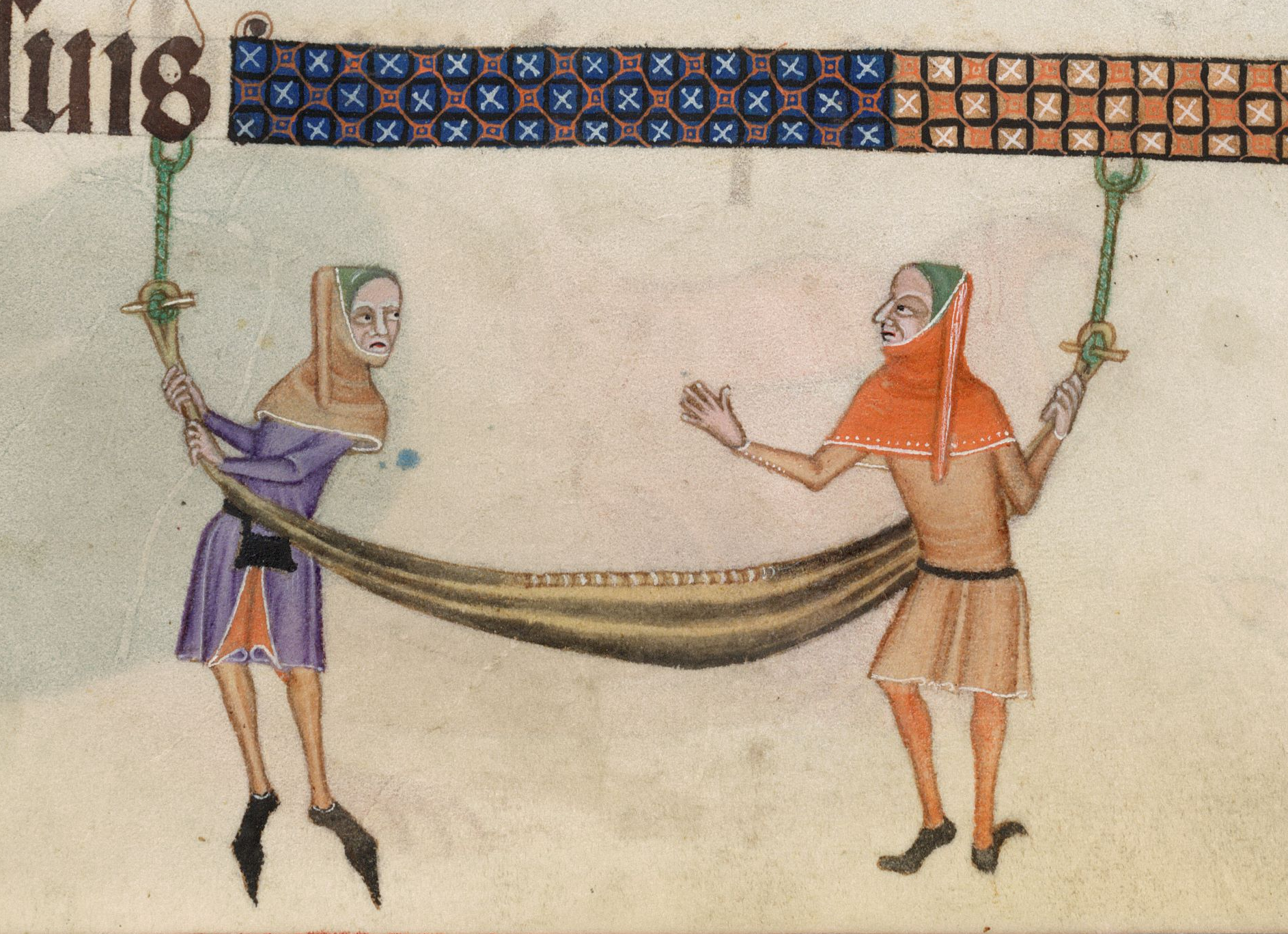
Along the foot of the page. A bas-de-page detail from the Luttrell Psalter (Lincolnshire, about 1325–1340): two hooded men carry a cloth sling beneath the border bar while hybrids prowl the same margin — the solemn page above, the play below.
The Luttrell Psalter. British Library, London (Add MS 42130). Via Wikimedia Commons.
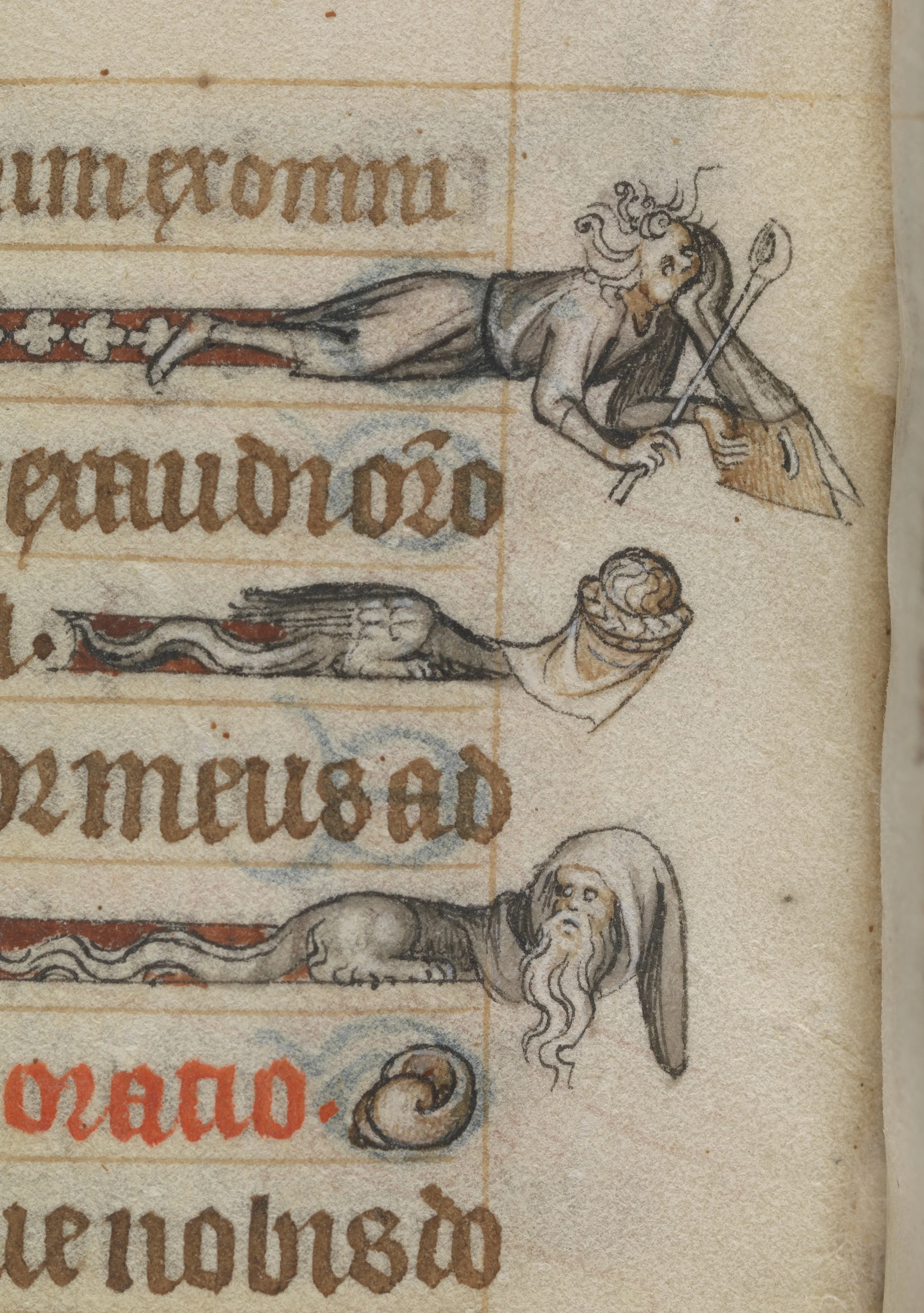
Where the margin begins. A detail from the Hours of Jeanne d'Évreux (Paris, about 1324–28): the little bars that fill out short lines sprout into creatures at their ends — a woman with a psaltery, a winged hybrid, a hooded beast — and the prayer rubric below is closed by a snail's shell. The menagerie does not start in the margin. It starts inside the line.
The Hours of Jeanne d'Évreux, Queen of France (detail). Jean Pucelle, Paris, c. 1324–1328. The Metropolitan Museum of Art, New York, The Cloisters Collection (54.1.2). Via Wikimedia Commons.
Every manuscript page has two territories. The center belongs to the text: ruled, measured, written in the formal hand, corrected and guarded. The edge belongs to everyone else. Readers scribbled there. Correctors marked there. And the illuminators, those disciplined craftsmen who painted the great initials and miniatures, kept a corner of their imagination for the margins, where they drew things no patron would have commissioned for the center.
This was not a medieval invention. Readers have always talked back to their books. But in the thirteenth and fourteenth centuries, particularly in England and northern France, the margin became a gallery. The blank spaces around prayers and psalms and law texts filled with an entire population: knights, snails, rabbits with swords, foxes in bishops' miters, apes playing bagpipes, hybrids no naturalist has ever catalogued.
★ Two kinds of marginalia share this territory, and you must learn to tell them apart. The first is the reader's marginalia: notes, corrections, manicules, the occasional complaint. A famous Icelandic scribe once wrote in a margin that his hand was cold. These are unplanned, personal, and often later than the book. The second is the illuminator's marginalia: drolleries and bas-de-page scenes painted as part of the book's original decoration, planned by the workshop and executed with full professional skill. Both are marginalia. Only the second is tonight's subject, though the first will have its moment.
A question you should ask of every margin: who was allowed to play here? The answer tells you something about medieval workshops. The great miniatures were expensive, closely supervised, theologically checked. The margins were cheaper, looser, and the illuminators used that freedom. What they drew there was still professional work, still disciplined penmanship, but it was work done with a wink.
Check in: Two kinds of marginalia share the margin. Who makes each kind, and which kind is tonight's subject?
❦ In your workbook: record the page's two territories and the two kinds of marginalia that share the margin in your own way — copy, sketch, or note what matters.
The Knight and the Snail
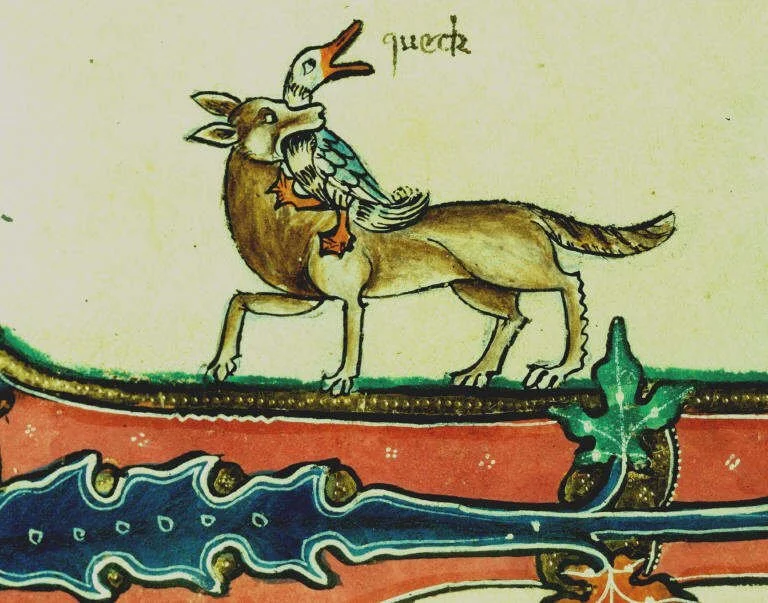
Queck." From the Gorleston Psalter (East Anglia, about 1310–24) — the same book whose margins hold the most famous knight-and-snail combat of all — a fox trots along the border with a goose in his jaws, and the goose cries out from inside the fox's mouth in written letters: the margin's animals do not just act. They talk back.
The Gorleston Psalter. British Library, London (Add MS 49622). Via Wikimedia Commons.
★ The most famous of all marginal images is also the most puzzling. Across dozens of thirteenth- and fourteenth-century manuscripts, in psalters and books of hours and law texts, a knight in full armor confronts a snail. Sometimes he is mounted. Sometimes he is on foot. Sometimes the snail is monstrous, sometimes tiny. Usually the knight looks worried. The snail, as snails do, looks unbothered.
The British Library, which holds many of these manuscripts, calls it one of the great unsolved mysteries of medieval art. Scholars have proposed at least half a dozen explanations, and honesty requires me to lay them before you without declaring a winner, because there is no winner.
★ The best-known theory belongs to the scholar Lilian Randall. She argued that the snail stood for the Lombards, a people vilified in the Middle Ages for usury and treacherous behavior, whom medieval writers had nicknamed with snail imagery. A twelfth-century poem describes a Lombard readying himself to battle a snail, which may have given illuminators the idea. On this reading, the knight fighting the snail is a joke about cowardly opponents: look at our brave knight, trembling before a snail, which is to say, before Lombards.
★ An older theory, proposed by the French bibliophile the Comte de Bastard in 1850, reads the snail as a symbol of resurrection. The snail withdraws into its shell and seems lifeless, then emerges again, like Lazarus raised from the dead. Bastard noticed snail images placed near miniatures of the Raising of Lazarus. The difficulty is that most snail combats appear nowhere near Lazarus, and it is unclear why a knight would attack a symbol of resurrection.
The medievalist Lisa Spangenberg proposed a scriptural reading from Psalm 58, where the wicked "melt away" like a snail: the snail is sin, and the knight is righteousness punishing it. But if the knight is virtue triumphant, why does he so often look frightened of his slow, weaponless foe?
The curator Beverley Nenk, examining a tiny silver-gilt mount of a knight emerging from a snail shell, suggested the image satirizes cowardly or unchivalrous behavior, a parody of the knightly classes themselves. Others read it as pure absurdity, a medieval meme: the humor is the point, the armored warrior terrified of the most heavily armored and least dangerous animal in the garden.
★ Here is what I want you to notice. Every theory agrees on one thing: the image is a joke about power. Whether the snail is a Lombard, a sin, a coward's emblem, or simply a snail, the knight's fear is the punchline. The mightiest figure in the medieval imagination, reduced to panic by a creature that moves slower than a liturgy. The margins specialized in exactly this kind of inversion, and the snail combat is its mascot.
You will also notice that the debate itself is part of the lesson. When scholars argue for a century without settling a question, the honest scribe reports the argument. Certainty is not always available. Curiosity always is.
Check in: Scholars have proposed the Lombards, resurrection, Psalm 58, and cowardice satire for the fighting snail. What does the lesson say about whether any one of those theories has won?
❦ In your workbook: record the knight and the snail and the theories scholars argue for it in your own way — copy, sketch, or note what matters.
Sealed note from Professor Nocturne. You have met the most argued-over doodle in manuscript history. Before we go further into the margin's population, stop and look at an actual snail combat image. The British Library's digitized manuscripts are the place. Notice the knight's posture before you read another theory. The drawing tells you the joke before the scholarship tells you the meaning.
Drolleries and the World Upside Down
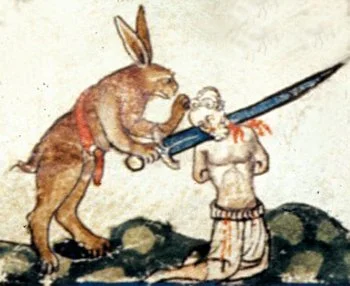
The world upside down. From the Smithfield Decretals (about 1340): a rabbit stands over a kneeling man and raises the sword to his neck — the hunted beheading the hunter. The margin delighted in inversions like this: hares hunting hounds, prey turning on predators, the small and meek executing the great.
Smithfield Decretals, folio 61v (detail). British Library, London (Royal MS 10 E IV). Via Wikimedia Commons.
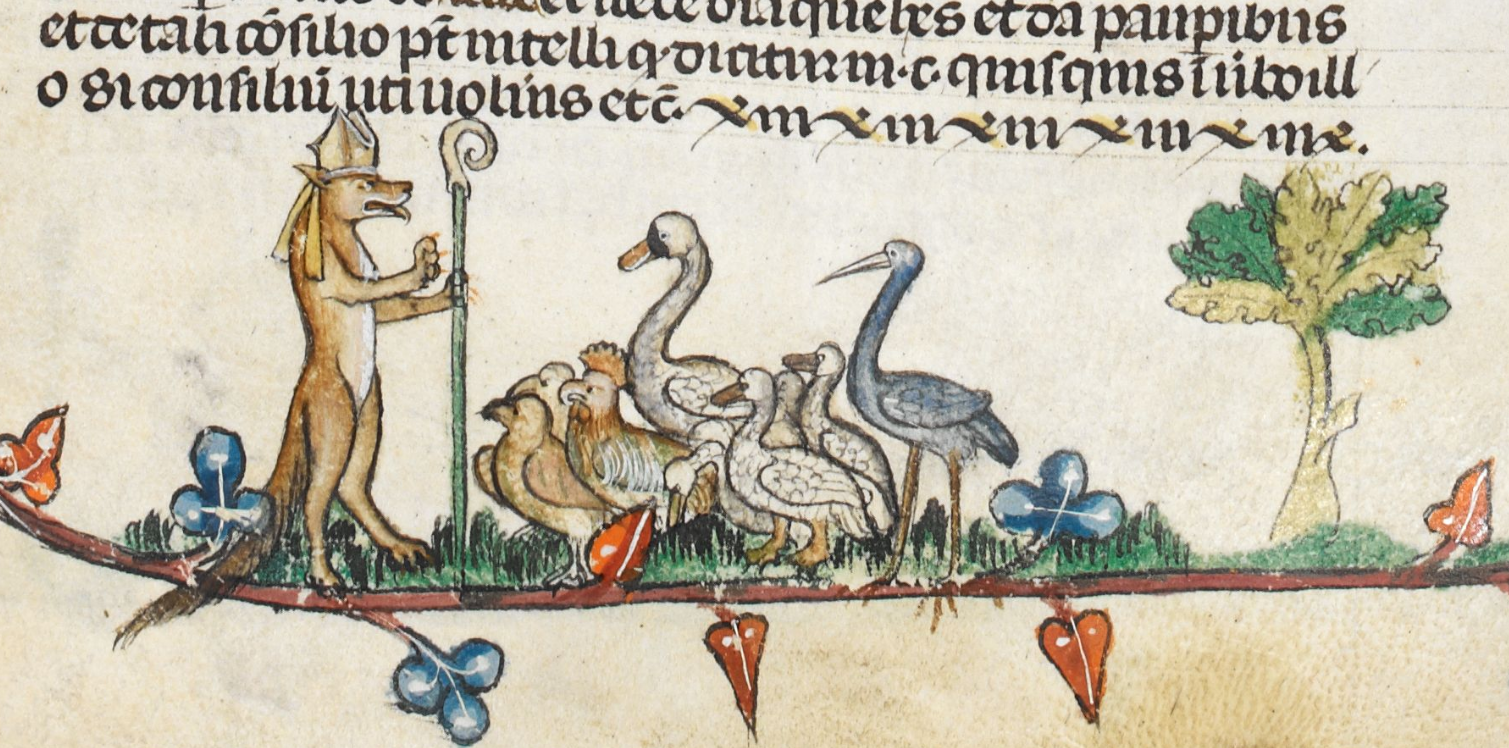
Reynard in bishop's dress. Across the foot of a Smithfield Decretals page (about 1340), the fox Reynard — mitre, crozier and all — preaches to a congregation of geese, a swan, a cockerel and a stork, who crane up to listen. The joke's edge is the cost: these jokes live in a law book that means business, painted for a patron who paid for every one of them.
Smithfield Decretals, folio 49v. British Library, London (Royal MS 10 E IV). Via Wikimedia Commons.
★ The snail has a knight, but the margins hold whole armies of the absurd. The general name for these humorous marginal images is the drollery, and the fourteenth century was their golden age, particularly in East Anglia, where workshops produced psalters and hours crowded with marginal life.
★ The Luttrell Psalter, made in Lincolnshire around 1340, is perhaps the most famous: its margins swarm with hybrid creatures — beings compounded of parts from different creatures — peasants at labor, and grotesques on nearly every page. The Gorleston Psalter, made a generation earlier, holds some of the finest snail combats. The Taymouth Hours keeps its scenes in the bas-de-page — "bottom of the page", a painted scene filling the lower margin — framed rather than marginal. And the Smithfield Decretals, a copy of Pope Gregory IX's canon law written in southern France around 1300 to 1340 and given its drolleries in England, is the most extreme case of all: 1,971 documents of ecclesiastical law, with nearly every margin filled by illustrators who drew demons, killer rabbits, and knights battling snails around some of the driest text ever written. The original French scribes had left the margins blank for readers' notes. The English illustrators had other plans.
★ Among the drolleries, one theme recurs so often it has its own French name: the monde renversé, the world upside down. Rabbits, the most hunted of creatures, turn hunter: they ride out armed, behead knights, and hold trials. Geese hang the fox who has preyed on them all his life. The fox himself appears constantly, often as Reynard, the trickster of the great beast epic, sometimes dressed as a monk or preaching to a flock of geese, a warning about corrupt clergy who prey on the trusting.
Read these images as the illuminators' commentary on power. The knight exists to hunt. The rabbit exists to be hunted. Reverse the roles and you have either a joke or a protest, and the margin refuses to tell you which. That refusal is the point. The center of the page states the law. The edge of the page asks what the law feels like to those underneath it.
★ I must add a caution, because my stern side insists. Not every drollery is a protest. Some are simply play: monkeys playing bagpipes, a man teaching his dog to beg, fools frolicking among flowers. Scholars debate how much subversion the margins really contain, and Michael Camille, whose book Image on the Edge is the great modern study of this art, argued something subtler than simple rebellion. The margins, he wrote, gloss — comment on and explain — parody, and question the text's authority without ever truly undermining it. The joke needs the law to be funny. The edge needs the center to be an edge. Remember this when you draw your own: the best marginal humor sharpens the page rather than tearing it.
Check in: The Smithfield Decretals is a book of canon law. Who left its margins blank, and who filled them, and with what?
❦ In your workbook: record the drollery's golden age, its great books, and the world upside down in your own way — copy, sketch, or note what matters.
The Reader's Margin: The Manicule
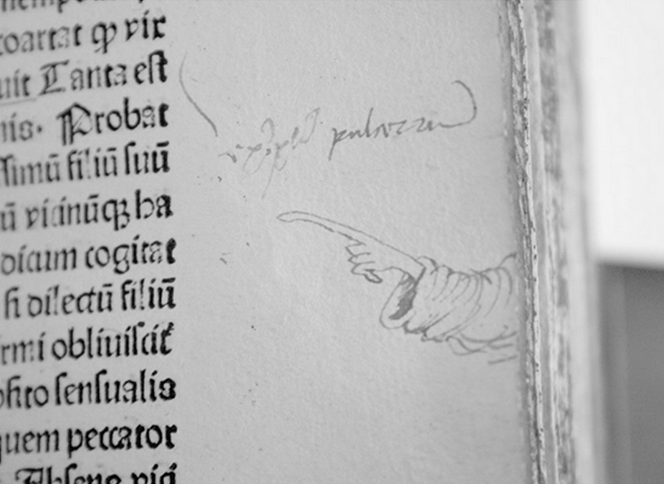
The reader's hand. A manicule drawn into the margin of a fifteenth-century book — a pointing hand in a fine cuff, its long finger aimed at the passage its reader meant to find again, the reader's own note above it. Before bookmarks, before sticky notes, the hand in the margin was how a reader said: this. Remember this.
Manicule in a fifteenth-century book of William Scheves, Archbishop of St Andrews. University of St Andrews Library (Typ NL.A85JT); photograph by Daryl Green. Via Wikimedia Commons.
So far tonight we have studied the illuminator's margins, planned and painted. But the reader's margins deserve their chapter too, because you are a reader, and your hand will do what medieval hands did.
★ The most beloved of readers' marks is the manicule, the little pointing hand. Drawn in the margin with its index finger extended toward the line that mattered, it says what every highlighter has ever said: look here. This is the important part. Manicules appear from at least the twelfth century, they flourished in fourteenth- and fifteenth-century Italian manuscripts, and they range from hasty scribbles to elaborate shaded hands with ruffled cuffs and visible fingernails. The scholar William Sherman, who documented thousands of them in English books, showed that each reader's hands were as individual as handwriting.
★ Some manicules are playful beyond their function. A fourteenth-century manuscript of Cicero at Berkeley holds manicules whose fingers stretch to bracket entire passages, one shaped like an octopus, another wielding a snake. The great Italian humanists drew them: Petrarch's hands are recognizable by their long index fingers. When printing came, publishers borrowed the mark, and it marched through centuries of books and advertisements until, in our own century, interface designers chose a pointing hand to mark the clickable link. The cursor hovering over this page's links is the manicule's direct descendant, eight hundred years old and still pointing.
There is a lesson here about tools that I want you to carry out of this unit. The manicule survived because it solved a problem perfectly: how to say "this matters" in the smallest possible gesture. Quills gave way to presses, presses to screens, and the little hand endured through all of it. When you design anything, a page, a sign, a lesson, ask whether your solution is a manicule: the smallest gesture that does the whole job.
Check in: What problem does the manicule solve, and where do you meet its descendant every day?
❦ In your workbook: record the manicule, its long life from margin to cursor, and the smallest-gesture test in your own way — copy, sketch, or note what matters.
In your packet: Assignment II — The Manicule Study ◐ begins here. Work it now, or mark the place and take it as homework — your choice.
Drawing at the Edge: The Scribe's Discipline
Now the practical matter. You have studied the margins. Tonight you draw in them.
The medieval drollery looks spontaneous, and that is the trap. Every confident marginal creature is built on the same disciplines you have practiced all unit: controlled pen angle, consistent stroke weight, planned composition. The snail's spiral is a controlled curve. The knight's armor is built from the same steady lines as a Roman capital. The joke is in the invention. The drawing is in the discipline.
★ Begin with observation. Before you invent a creature, copy one. The digitized manuscripts of the British Library give you hundreds of models: choose a snail combat, a hybrid, a bas-de-page scene, and reproduce it at twice its size. Copying teaches your hand the vocabulary. You cannot improvise fluently in a language you have not practiced.
Then invent. The medieval formula is simple: take two things that do not belong together and join them cleanly. A knight and a snail. A rabbit and a sword. A monk and a fish's body. The humor lives in the seam, so draw the seam carefully. A sloppy hybrid is not funny; it is confusing. The illuminators knew this. Their impossible creatures are drawn with entirely possible penmanship.
Place your creature with intention. A drollery in the margin should relate to the page: beside the text it comments on, below the line it underlines, facing the initial it answers. The margin is small, so composition matters more, not less. And keep the creature out of the text block. The medieval rule, broken only by the boldest illuminators, was that the margin's play must not touch the text's authority. Camille's point again: the edge needs the center.
★ One final technical note. Marginalia were often drawn first in the same ink as the text, then washed with color. For your exercises, draw in ink first and add color only after the drawing is complete and dry. Color forgives nothing. It only decorates what the pen has already earned.
Check in: Before you invent a single creature of your own, what must you do first, and in what order do ink and color go down?
❦ In your workbook: record the scribe's discipline: copy first, invent second, ink before color in your own way — copy, sketch, or note what matters.
In your packet: Assignment III — Copy the Margin ⚒ begins here. Work it now, or mark the place and take it as homework — your choice.
In your packet: Assignment IV — The Original Drollery ⚒ begins here. Work it now, or mark the place and take it as homework — your choice.
Unit V Review: The Decorated Page
We close the unit where we began it: with the whole page in view.
In Lesson 17, you learned hierarchy: the architecture that tells the reader what matters, titles, headings, and the ranked order of the text block. In Lesson 18, you laid gold: the raised gilding that makes an initial shine, and the patience such shining requires. In Lesson 19, you grew borders: the botanical ornament that frames the page, ivy leaf first of all, then acanthus and vine, drawn to honor the text without crowding it. And tonight, in Lesson 20, you have reached the margin: the edge where the illuminator's discipline loosens into play and protest.
★ See the unit as a single movement from center to edge. Hierarchy orders the middle. Gold honors it. Borders frame it. Marginalia comment on it. Each lesson moved one step outward, and each step required the same hand, the same pen control, the same willingness to serve the page. The drollery and the historiated initial are not opposites. They are the same craftsmanship aimed at different distances from the center.
★ Carry this outward movement into your future work. Whatever page you make, ask the four questions of this unit in order: What matters most? What deserves honor? What frames it? And what would the margins say?
❦ In your workbook: record the unit's movement from center to edge and its four questions in your own way — copy, sketch, or note what matters.
In your packet: Assignment V — Unit V Review: The Decorated Page ✎ begins here. Work it now, or mark the place and take it as homework — your choice.
Materials
Required (Level One — household items)
- Paper: plain paper for drawing exercises. Printer paper or a sketchbook works well; one ruled page with a text block for the drollery exercise.
- Pens: any fine pen or marker for ink drawing, plus colored pencils for the colour work. A brush pen is useful for practicing the controlled curve.
- Gold paint or a gold pen: for Assignment V's gilded initial — Lesson 18's stand-in gold serves again.
- Internet access: for studying digitized manuscripts (the British Library's digitized collections are the primary source).
- A ruler: for ruling the text block and margins in Assignment IV.
Suggested (Level Two — historically closer)
- A quill or dip pen with carbon ink: the medieval drawing tool. Iron gall or carbon ink on laid paper behaves most like the historical materials.
- Parchment paper or laid paper: a closer surface to vellum for the finished drollery page.
- Wash colors: watercolor or diluted ink for the tinted washes illuminators applied after the ink drawing dried.
No purchased kits or specialty tools are required. Every assignment is fully achievable with paper, pens, and colored pencils.
Reflection Questions
Answer in your workbook.
- Why did the illuminators put their strangest art in the margins rather than the center of the page?
- Summarize the snail-combat debate in your own words. Which theory do you find most convincing, and what is its strongest weakness?
- What does Camille mean when he says the margins question the text's authority without undermining it?
- How does the monde renversé work as social commentary? Give an example.
- Why did the manicule survive from the twelfth century to the computer cursor?
- What is the difference between a reader's marginalia and an illuminator's marginalia?
- Look at your Unit V page as a whole. What did the four lessons teach your hand that no single lesson could?
Workbook Checklist — Lesson 20
In my workbook I have:
- ☐ defined marginalia, drollery, bas-de-page, hybrid creature, manicule, and monde renversé
- ☐ described the knight-versus-snail motif and summarized at least three scholarly theories of its meaning
- ☐ explained Camille's argument about what marginalia do to the text they surround
- ☐ identified the Smithfield Decretals, the Luttrell Psalter, the Gorleston Psalter, and the Taymouth Hours as key sources of marginal imagery
- ☐ drawn a manicule and explained its function as the medieval reader's highlighter
- ☐ designed an original drollery in the medieval spirit, drawn with controlled pen work
- ☐ summarized the arc of Unit V, from page layout through marginalia
☐ Lesson completed Date: ___ Signature: ___
Professor's Review
Sealed review. Four lessons, one page.
You began with order and you end with mischief, and I tell you plainly that the mischief was the harder lesson. Anyone can learn to follow a rule. It takes a master to know where the rule ends and still draw beautifully.
Keep your copy of the snail combat. When your pen work feels stiff, look at it and remember that the steadiest hands in England once drew a knight losing an argument with a mollusk, and drew him beautifully. Discipline is not the enemy of play. It is what makes play legible.
Unit V is complete. The decorated page is yours now, from the golden initial to the joking margin. Use all of it.
PROFESSOR QUILLBERRY NOCTURNE
Scrollwork Library
Master Scribe & Illuminator
Cross-Class Connections
Runes · Lesson 18 — The Celtic Manuscript Tradition
I teach the Insular manuscripts and the monastic culture behind them: the world that made tonight's great psalters possible. The history of those books is mine; the creatures in their margins are Professor Nocturne's. Read my lesson, then go back and prowl his edges with a scribe's eyes.
Runes · Lesson 20 — Spacing & Punctuation
The word separation and punctuation of my lesson grew up on the same page you decorated tonight, and the manicule belongs to that reader's toolkit. My marks pace the text; his point at it. When your six manicules are drawn, come and meet the quieter marks my scribes invented.
PROFESSOR THISTLELOOM WEBBLETHORN
Runes & Ancient Writing
Further Reading & Sources
For scholars who want to prowl the margins further, these are the places I send my own students first.
*Michael Camille. Image on the Edge: The Margins of Medieval Art. Reaktion Books, 1992.* Google Books: Image on the Edge The great modern study of marginalia: apes, dragons, harp-playing asses, and the argument that margins gloss, parody, and question the text without undermining it. Start here.
*Lilian M. C. Randall. Images in the Margins of Gothic Manuscripts. University of California Press, 1966.* The foundational catalog of marginal imagery, including the snail-combat survey behind the Lombard theory. The source every later scholar argues with.
"Drollery." Wikipedia. Wikipedia: Drollery The French drôlerie, "a joke": hybrid creatures, the Luttrell Psalter, the Smithfield Decretals, the Gorleston Psalter and Taymouth Hours, and the bas-de-page distinction.
"Smithfield Decretals." Wikipedia. Wikipedia: Smithfield Decretals The British Library's Royal MS 10 E IV: 1,971 documents of canon law, written in southern France around 1300 to 1340, English drolleries added around 1340, now digitized.
"Manicule." Wikipedia. Wikipedia: Manicule The little pointing hand from the Latin manicula: twelfth-century Spain, Domesday Book, Petrarch's hands, William Sherman's Used Books, and the road to the cursor.
Smarthistory. "Getting personal in the margins." Smarthistory: Getting personal in the margins Readers' marginalia up close: manicules, the Berkeley octopus hand, and what marginal marks reveal about the minds of medieval readers.
Browse the Scrollwork shelf in the school Library for readable editions of these works.
Submit your work for this lesson using the form below.

The creatures in your margins have a hall of their own now, and a keeper. In the Bestiary we follow the beings themselves — how each was first told, the tales and pictures it gathered, where it was supposedly spotted, and what was true underneath — and every scholar writes the entries in a bestiary of their own. Begin where your own lesson ends: with the marginal creatures themselves.
The Bestiary Hall Lesson 1: Meeting the CreaturesPROFESSOR SABLE ROOKMERE · THE BESTIARY
THE UNIT V QUIZ
SCROLLWORK LIBRARY · UNIT V: MANUSCRIPT DECORATION · LESSONS 17–20
Unit V is complete: hierarchy and layout, gold leaf, botanical borders, and the creatures in the margins. This quiz gathers the whole unit, all four lessons, into one sitting. Take it from memory first, before you look back at your notes, because it measures what has stayed with you. If you completed the Exercises marked ★ in your lesson packets, you have already practiced most of what it asks.
The quiz packet is a single download. Part I gathers questions from every lesson in the unit, Part II matches the unit's vocabulary, and the answer key waits at the back for self-checking. When you have finished, score it honestly, note the result in your workbook, and revisit any lesson whose questions went wrong before you move on to Unit VI.
CONTINUE IN THE SCROLLWORK LIBRARY
← Previous · Lesson 19: Botanical Borders & Ornament Next · Lesson 21: Constructing the Scroll →
Unit V — Manuscript Decoration Scrollwork Library — All 26 Lessons
The rest of Unit V: Lesson 17 · Hierarchy & Page Layout · Lesson 18 · Gold Leaf & Gilding · Lesson 19 · Botanical Borders & Ornament