

THE BESTIARY
Unit I · Lesson 1Meeting the Creatures
Professor Sable Rookmere
Bestiary Keeper
The Bestiary Hall • School of Evershade
Professor's Introduction
Welcome to my hall. I keep the castle's creature records — the gathered file of first tellings, old pictures, travelers' reports, and the corrections added as later records arrived — and this class is that file, opened to you lesson by lesson. We begin, as every keeper should, with the creature who has been drawn more often, by more people who had never seen him, than any other on the shelf: the lion. By the end of this lesson you will have read his story the way it was told for a thousand years, watched his picture change as the centuries changed, and met the real animal underneath — who is, I promise you, quite splendid enough without any help from the storytellers. Bring a journal. By the end of the class it will hold a bestiary of your own, and it will be an honest one.
The Bestiary
Bestiary Keeper
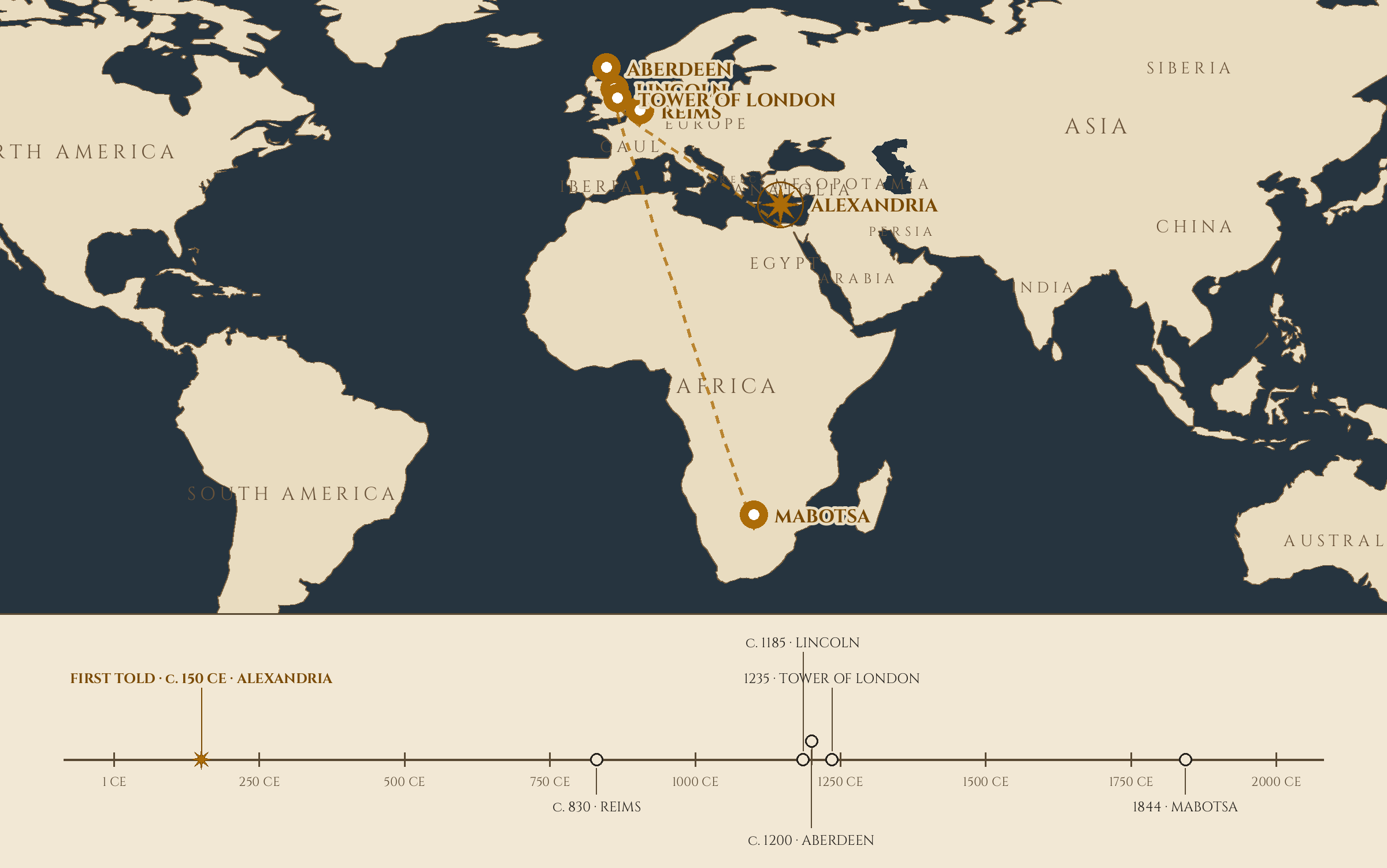
Where this lesson travels: Alexandria, where the Physiologus was composed in the second century; Reims, whose scribes copied it in the 800s; Lincoln and Aberdeen, where the great beast-books were made around 1185–1200; and Paris, where the lion was retold in French. The starred pin is the first record; the dashed line is the telling, traveling.
Lesson Objectives
By the end of this lesson, you will be able to:
- Say how we know about the creatures in this class: through stories, pictures, reports, and the real animals underneath them.
- Tell the lion's tale as the old books give it, and set the true facts of the animal beside it.
- Follow a creature's pictures through history, from a copied medieval drawing to a photograph.
- Begin your own bestiary, and mark every line in it with the keeper's marks — T, S, or F — that you will use all through this class.
- Say why this class's shelf holds more than beasts: fairies and ghosts stand in the same kinds of records as the lion.
- Name the road through the class: six units of creatures, and a capstone entry of your own.
Your Assignment Packet
This lesson's work lives in its packet: the Lexicon Handout (every term, the core terms marked with the keeper's diamond ◆), Materials, Guided Practice, the Assignment Manual written out whole, the Scholar's Entry Page, the Reflection Questions, the Workbook Checklist, and the Keeper's Notes, for whoever teaches the lesson. Download the packet before you begin and keep it beside you as you read. The packet's assignment is Rookmere's own word for the work: Entry No. 1 — The Lion, and the Opening of Your Bestiary (written) ✎. The Unit I Quiz is not printed in the packet; it waits at the end of the unit, with Lesson 6.
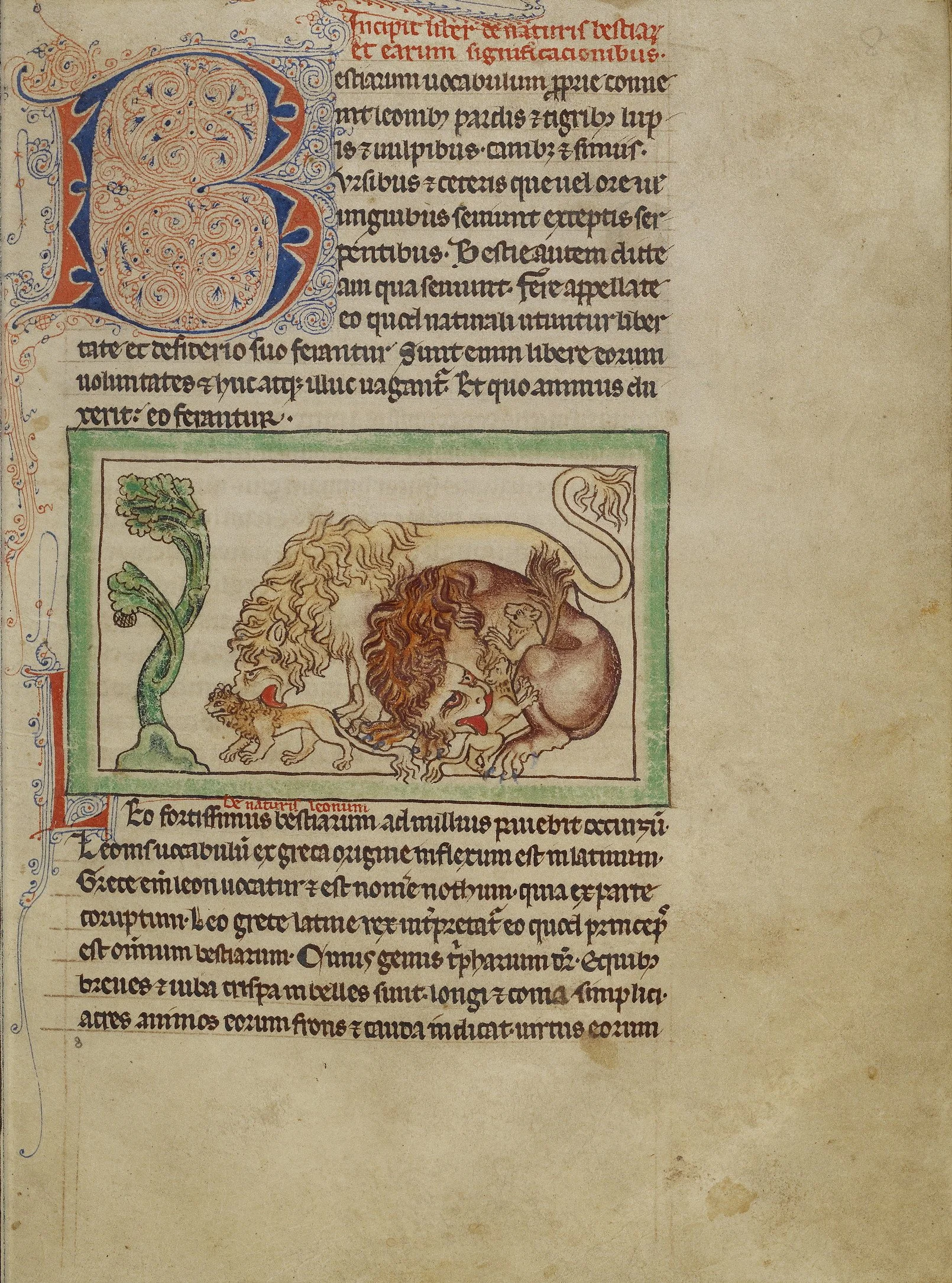
The opening of the Northumberland Bestiary (England, c. 1250–1260): Incipit liber de naturis bestiarum — “Here begins the book of the natures of the beasts” — and below the great initial, the lion, first entry of the book. Public domain, via Wikimedia Commons.
The Creature
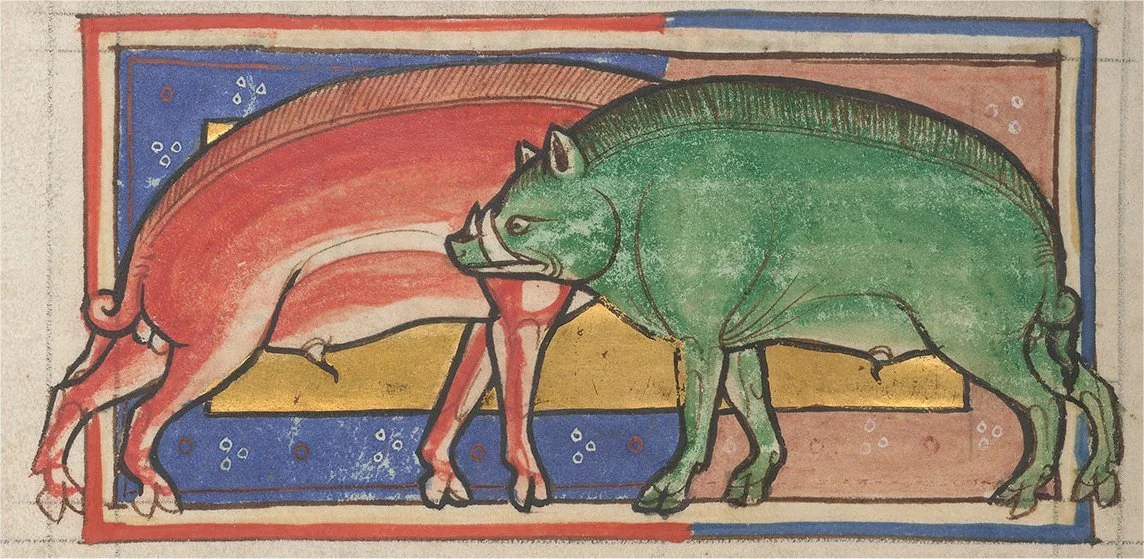
One entry, one beast: the aper (the boar) in the Worksop Bestiary, England, c. 1185. Public domain, via Wikimedia Commons.
The lion — Panthera leo, in the Latin name science gives him — is a real animal, and this class always meets the creature before the story. A grown male stands about 1.2 meters at the shoulder, chest-high on a tall man. He runs close to two meters in the body, with up to a meter of tail behind that, and he weighs somewhere between 150 and 250 kilograms. The great mane that crowns him in every old picture is his alone; the lioness goes bare-necked, and a male's mane darkens and fills in as he ages. Lions live in companies, called prides, across sub-Saharan Africa, with one population left in and around the Gir Forest in India.
Now look at his pictures, because this class reads pictures the way it reads words — as evidence with a date on it. This lesson hangs four.
The first is the opening page of the Northumberland Bestiary, made in England around 1250–1260, and the lion stands at the head of the book, as he stands first in nearly every bestiary — the medieval book of beasts from which this class takes its oldest lessons. Look at the painter's lion before you read a word of him. He has a fine mane and a long tail and a body that owes more to the dogs of the scriptorium yard than to any cat of Africa — and he is standing over his cubs, for a reason you will meet in the tales below. The painter had, in all likelihood, never seen a lion. He copied his lion from an older book's lion, and that painter had copied his, back through generations. The artists were not careless. They were faithful — to the record in front of them.
The second and third pictures are pages from the lion's relations: the Physiologus Bernensis, made at Reims in the ninth century — the spotted panther of the little book the bestiaries grew from — and a folio of the Worksop Bestiary, made in England around 1185, showing the wild boar. Medieval animal pictures are documents about their makers: what they had seen, what they had only read, and how carefully they copied.
The fourth picture ends the line, and it is not a drawing at all. It is a photograph of a Barbary lion, taken in Algeria in 1893 and published in Alfred Edward Pease's The Book of the Lion in 1913. Set it beside the Northumberland lion and you can see six and a half centuries of picture-making in two glances: first the lion as a chain of copies, then the lion as a camera found him. Lions were pictured superbly long before either — the lion-hunt reliefs carved for the Assyrian king Ashurbanipal at Nineveh, around 645–635 BCE, are as fine as animal art gets — but the medieval West, which told the lion's story longest, drew him for a thousand years without once looking at him. That is the first thing to learn about creatures in this class: a picture is a record of what its maker knew, and of how he knew it.
First Told
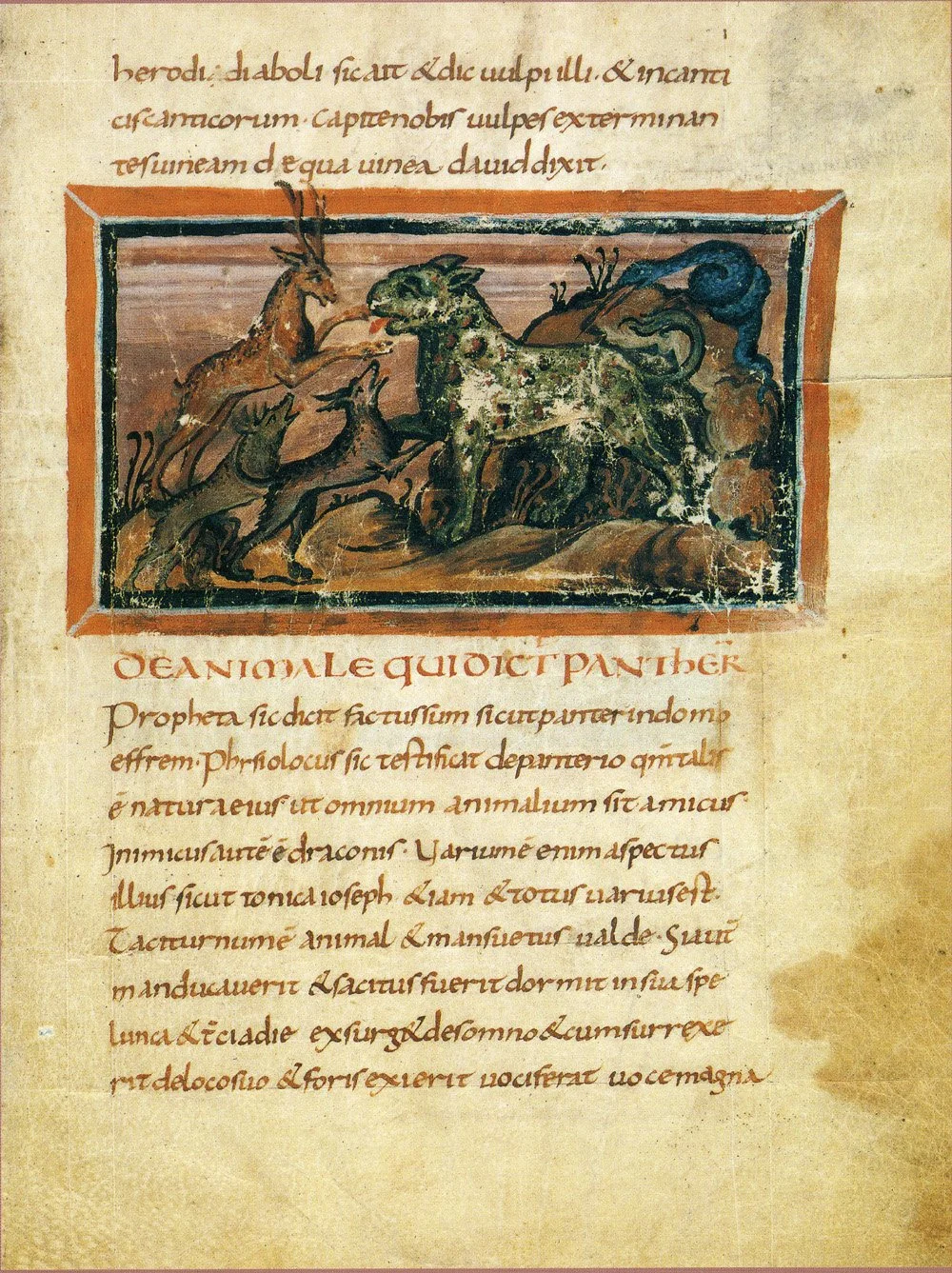
The panther chapter of the Bern Physiologus (Reims, 800s) — among the earliest illustrated copies of the root book. Public domain, via Wikimedia Commons.
Where does the lion of the stories come from? From a small, strange book: the Physiologus, Greek for "the naturalist," written in Alexandria, in Egypt, in the second century of the common era, by an author whose name we do not know. It holds some fifty short chapters — a lion, a panther, an eagle, a serpent, a phoenix, an ant — and the lion stands at its head, as he would stand at the head of every book that followed it.
People could not leave the little book alone. It was translated early and often — into Latin, Ethiopic, Armenian, Syriac, and more — and in the twelfth and thirteenth centuries, especially in England and northern France, compilers built it out with material from older authorities — above all Isidore of Seville, whose Etymologiae (written in the 600s) devoted a book to animals, and behind him the Roman natural historians Pliny and Solinus. The result was the great age of the bestiary: large, ordered, illuminated books of beasts, copied by the hundred, living where books lived then — monasteries, cathedrals, schools, and in time the houses of wealthy readers. Well over a hundred and fifty of them survive today.
That is all the book-history this lesson needs, and it needs exactly that much because it is the lion's own road: Alexandria in the second century, Reims in the ninth, England in the twelfth and thirteenth. The map at the head of this lesson follows that road. Each pin is a place where the record left a mark — a book written, a picture painted, a report filed. The starred pin is the first telling that survives. The dashed line joins the pins in time order, and the strip below is the same journey told as a timeline. One caution before you trust any map in this class: the starred pin marks the earliest account that survives. The telling itself is always older than its first surviving page, carried by mouths no pin can stand for. Keepers map what can be proven, and say so.
The Tales
The Physiologus gives the lion three natures, and the bestiaries kept all three, word for word, for a thousand years. These are the tales — the stories told of the lion, in the form the record hands them down.
The first nature: when the lion crosses the mountains and the scent of hunters reaches it, it wipes out its tracks with its tail, so that they cannot follow it to its den.
The second nature: the lioness bears her cubs dead. She guards the bodies, and on the third day the father comes and breathes on their faces, and they live. This is the nature the Northumberland painter chose: look again at his lion, standing over the cubs.
The third nature: the lion sleeps with its eyes open. The old writer even cites his authority for it, a verse from the Song of Songs: "I sleep, but my heart waketh."
Medieval copies went one step further and attached a reading — a meaning — to each nature, and preachers used the entries to teach from. This class sets those readings aside, and it is worth saying why, once, plainly: they belong to the history of how the book was used, not to the history of the lion. What concerns a keeper is the sorting. The tales are stories, told and copied in earnest. Whether they are true of the animal is a different question, and it has its own section below.
Watch the same habit of picture-making once more, in a single line, on the bestiary's most beloved bird. The pelican of the old books was said to wound her own breast to feed her young with her blood, and the picture of her doing it — the pelican in her piety, head bowed to her breast — was carved on church fonts and lecterns, set in the arms of colleges, and worked into jewelry, until for centuries it was one of the most familiar animal pictures in Europe, drawn from a bird almost none of the carvers had watched. Remember her when a picture looks too familiar to question. Familiar is not the same as seen.
KEEPER'S CHECK-IN
What are the lion's three natures as the Physiologus and the bestiaries give them, and which one did the Northumberland painter choose to show?
Spotted
The lion is real, so his reports are real reports — and they show what a sighting record looks like when it can be checked. Lions were kept in England for centuries: in 1235 the Emperor Frederick II sent King Henry III three leopards — in the heraldry of the day, the "leopards" of a coat of arms were lions — and lions were kept at the Tower of London's menagerie, where records of their keeping, feeding, and deaths were written down like any other royal accounts. A keeper could go and look at the evidence, and men did.
The file also holds named witnesses meeting the animal in the wild. In 1844, at Mabotsa in what is now Botswana, the missionary and explorer David Livingstone was mauled by a lion while out with a hunting party, and his shoulder was crushed. He wrote the account himself, in detail, in his Missionary Travels and Explorations in South Africa (1857) — who was there, what happened, what it cost him. Hold that shape in mind. Later in this class you will meet reports of creatures no camera has caught and no cage has held, written by witnesses just as certain as Livingstone. The keeper's question is never was the witness sincere. It is what does the record actually show, and what would check it.
KEEPER'S CHECK-IN
What makes the Tower lions of 1235 and David Livingstone's 1844 account checkable reports, and what question does a keeper ask of a report instead of asking whether the witness was sincere?
What It Actually Is
Now the animal himself, set beside the tales, line by line.
The cubs: a lioness bears her cubs alive, usually two or three at a time and sometimes more, each cub weighing about three pounds, blind and helpless, their eyes sealed shut. The eyes open at about eleven days — a week and a half. For their first weeks their mother keeps them hidden away in thick cover and goes back to nurse them. No father comes to breathe on anything; the fathers are off being lions.
The sleep: lions do sleep deeply and long, most of the day and night, and a well-fed male can sleep twenty hours out of the twenty-four — but he sleeps with his eyes shut, like the rest of us.
The tracks: no lion erases them. A lion's footprints are broad and plain to read, and hunters have followed lions by their footprints for as long as there have been hunters.
So where did the tales come from? Honestly, in this case, we mostly do not know — and a keeper says so rather than inventing a root. The three natures were already old when the Physiologus wrote them down. What can be said is what the record shows: the tales traveled because they were good tales, copied by careful men who had no way to check them and no habit of checking — checking came later, and slowly, as naturalists began to demand specimens and eyewitnesses instead of authorities. By Conrad Gessner's Historia Animalium (1551), the first great printed animal book, the standard was beginning to move from the books say to I have seen. It took centuries to finish moving. The bestiaries retired to library treasuries — until our own age opened them again as records: the Aberdeen Bestiary sits online tonight, folio by folio, free to anyone.
Still With Us
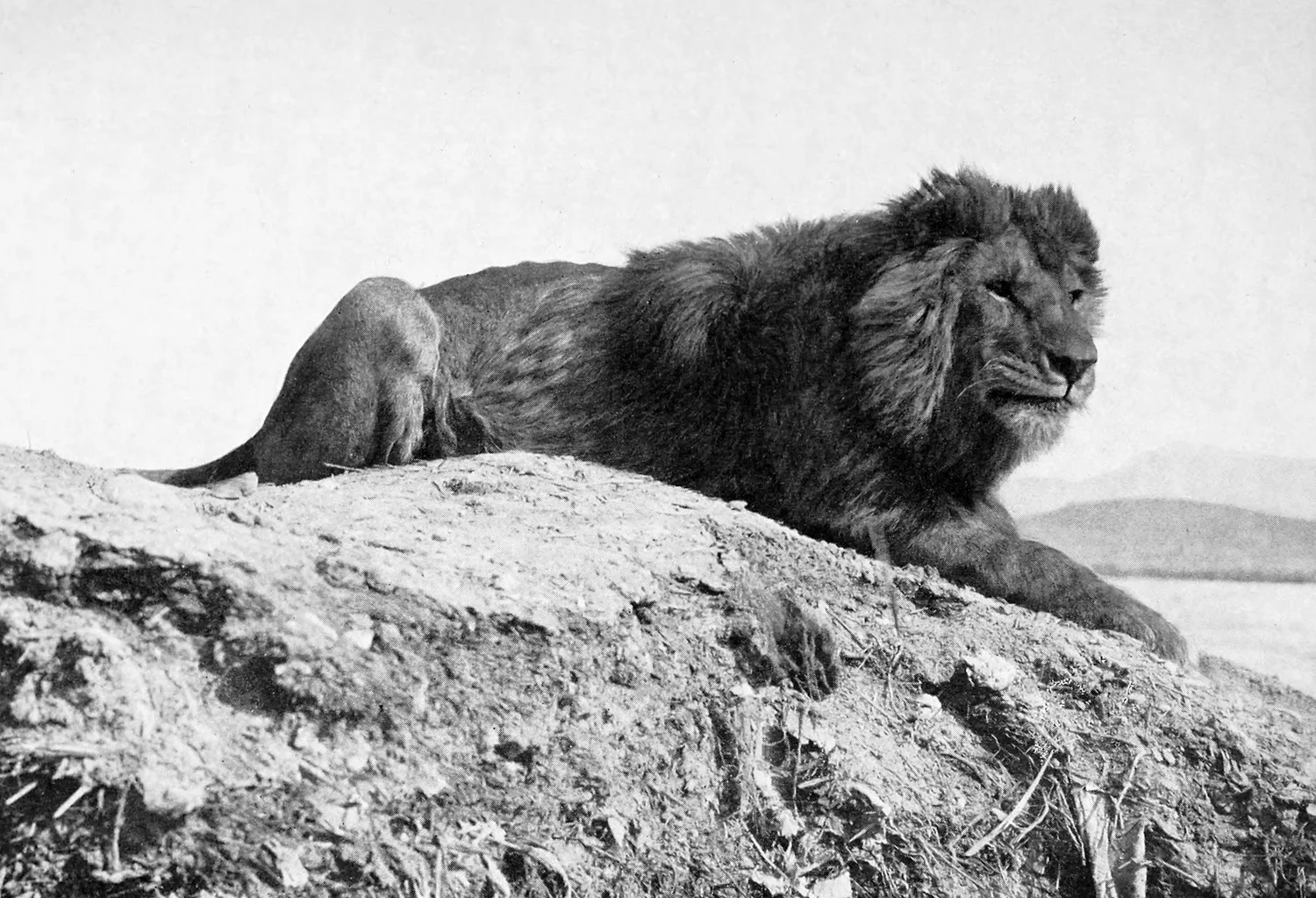
A Barbary lion photographed in Algeria in 1893, published in Alfred Edward Pease's The Book of the Lion (1913) — the lion as a camera found him, after centuries of copied drawings; the Barbary lion is now extinct in the wild. Public domain, via Wikimedia Commons.
Why does the lion's story endure? Partly because the animal earns it: he is still, in picture and proverb, the king of beasts, and heraldry never let him go — lions stand on coats of arms, flags, coins, and pub badges across the world, most of them still drawn, whether their drawers know it or not, in the posture the medieval copyists settled.
And partly because the real lion now needs the attention his story always commanded. The lion is listed as Vulnerable on the IUCN Red List (assessed in 2023), his numbers decreasing: roughly 23,000 African lions remain, and one isolated population in India's Gir Forest. The Barbary lion in this lesson's photograph — the lion of North Africa, the one nearest to the Europe that told his story — is extinct in the wild. The photograph outlived its subject's whole population. That is what records are for, and it is not a bad first lesson in keeping them.
You will need a way to keep your own records straight, so here is the tool this class uses, and it is the last thing this lesson teaches. Every line in your bestiary gets one of the keeper's marks:
- T — a tale: a story told of the creature. The lion wipes out its tracks with its tail — T. - S — a sighting: a report that someone met the creature, saw it, heard it, or kept it. Lions were kept at the Tower of London from 1235 — S, and a checkable one. - F — a fact: something verifiably true. A lion's cubs are born alive, with their eyes sealed shut — F. The Physiologus was written in Alexandria in the second century — F: a true fact about the book, which is a different thing from a true fact about the lion, and the marks will teach you to feel that difference in your fingers.
T, S, F. A true creature entry holds all three, often on the same page. That is not a fault in it. It is the subject of this class.
Why, then, does this shelf hold more than beasts? Because the record holds whatever people set down in earnest as true of the world. The dragon and the phoenix stand in the old bestiaries beside the lion, recorded in the same hand, from the same authorities. The fairies and the ghosts live in the same kind of record, one shelf over: in chronicles and parish manuscripts, in sermons and court reports, in the careful letters of officials who did not believe what they were filing and filed it anyway. If it was recorded as real, by named people, in a datable place — it is on our shelf, and it gets a map.
Here is the road. Unit I meets the creatures and how we know about them — this lesson, then the fairies, the hidden folk, the household helpers, and the four kinds of spirits a sixteenth-century physician set in order. Unit II walks the beasts of the land, from the unicorn to the wild men of the woods. Unit III goes to the waters: kraken, mermaids, selkies, and the serpents of the sea reports. Unit IV takes the skies — dragons east and west, the phoenix, the roc, the thunderbird. Unit V studies the changed: werewolves, vampires, ghouls — beings that were people, or were said to be. Unit VI ends with those who linger: ghosts, revenants, the banshee, the poltergeist, and the newest beings of all. And the capstone — the Unfinished Page — is yours: a being of your own choosing, documented to the class standard, in your own guide, in your own hand.
How the class runs, so you can plan your keeping: each lesson studies one being (or one tight family) and writes one entry in your guide — forty-one entries by the end, each with its map, each marked line by line. At the end of each unit, a quiz waits in the last lesson's packet; at the end of the class, a test, and then the capstone. Everything you need for the whole class is gathered on the class supply list (/bestiary-supplies); lesson by lesson, each packet names its own materials.
Guided Observation
Study the Northumberland opening page again, slowly. The painter had, in all likelihood, never seen a lion — no lion had lived wild in England for thousands of years, and the menageries of kings were far from a monastic scriptorium. So look at his lion as evidence: What has he given it that a lion truly has? What has he borrowed from animals he had seen — dogs, horses, the beasts of his own fields? Where can you see the cubs of the second nature? Then turn to the Barbary lion photograph (1893, published 1913) and ask the opposite question: what does the photograph show that no drawing in this lesson can — and what can it not show that the drawing, standing over its cubs, does? Write down three things the pictures tell you that the words do not, and one thing the words tell you that no picture can. This is how a keeper reads a plate: as a record of what its maker knew, and of how he knew it.
Assignment Manual
✎ WRITTEN · ⚒ HANDS-ON · ◐ BOTH
✎ Written · Entry No. 1: The Lion, and the Opening of Your Bestiary.
- Prepare your guide. Open your journal at its first page. Write your name, the words My Bestiary, the class, and the date begun. Leave the facing page blank: the class contents list will grow there, entry by entry, all year.
- Rule your first entry page. Turn to the Scholar's Entry Page in this lesson's packet and rule a page of your journal to match it, or copy the entry onto the printed page itself if your guide is a binder.
- Write the lion's entry, to the standard. The Creature: the lion's true size and shape, in your own words, and his pictures — name at least two plates from this lesson and their dates. First Told: the Physiologus — where it was written, roughly when, and how its lion reached the great English bestiaries. The Tales: the three natures, as the record gives them. Spotted: the Tower lions of 1235, or Livingstone's account of 1844 — say which you chose and why it counts as a report. What It Actually Is: three lines of modern fact — the cubs, the sleep, the tracks. Still With Us: the lion today, in two or three lines, including his IUCN standing. The Keeper's Line: one or two lines of your own — what this first entry has taught you about records.
- Mark every line. Go back through your entry and mark every line in the margin with the keeper's marks: T for a tale, a story told of the creature; S for a sighting, a report that someone met it; F for a fact, something verifiably true. A true entry holds all three. That is not a fault in it; it is the subject of this class.
- Bind the method into the book. Inside the front cover of your guide, copy the keeper's marks and what they mean, in your own hand. A book that teaches its own method can be lent, inherited, and understood by whoever opens it next. The old writers never did that for us — their readers had to pick the method up by watching. Yours will carry it in the front, in your own hand, where the next keeper cannot miss it.
The printable packet for this lesson — the Lexicon Handout, the Guided Practice, this manual, and the Scholar's Entry Page — is linked on this page.
Materials
· Your creature-guide journal or notebook — kept for the whole class
· Pencils, and a pen you like
· A ruler, for ruling your entry pages
· This lesson's packet (the Scholar's Entry Page is in it)
Reflection
The copyists copied the lion faithfully for a thousand years and never checked him. What made checking so unnecessary to them — and what had to change in the world before checking became the habit?
Of the three marks — T, S, F — which is hardest to assign honestly, and why? Use a line from your own entry as your example.
What animal would open your bestiary, if the lion did not? Hold the thought; the capstone will ask again.
Cross-Class Connections
A word from the Scrollwork Library, keeper to keeper. Your Professor Rookmere reads the beasts as they were written in the body of the book; in my library we keep the ones that escaped into the edges — the snails jousting with knights, the rabbits with axes, the whole unruly menagerie the scribes drew in the margins when the text was not looking. They are the same creatures, copied from the same old books, and they will teach you as much about the copyists as any entry. When you are ready, come and meet them.
The lesson is Lesson 20: Marginalia & Manuscript Creatures, in Unit V of Scrollwork. The door stands open.
Scrollwork
Keeper of the Scrollwork Library
A Closing Note
One lesson in, and the whole method is already in your hands: a creature, its tales, its reports, its facts, and the marks in the margin to keep them sorted. Next lesson, the fairies — the most argued-over beings on my shelf. Their record runs from a queen on an island of apples to a pair of cardboard cutouts in a Yorkshire garden, and I have been looking forward to telling you about them since before you enrolled. Keep your journal dry, and your T, S, and F honest.
The Bestiary
Bestiary Keeper
Further Reading & Sources
Michael J. Curley (trans.), Physiologus (University of Texas Press, 1979) — the standard English translation of the root text.
The Aberdeen Bestiary, University of Aberdeen — the full manuscript online, folio by folio, with translations: abdn.ac.uk/bestiary.
Willene B. Clark, A Medieval Book of Beasts: The Second-Family Bestiary (Boydell, 2006).
Florence McCulloch, Mediaeval Latin and French Bestiaries (University of North Carolina Press, 1960).
The Northumberland Bestiary (c. 1250–1260), J. Paul Getty Museum, Ms. 100 — the manuscript this lesson's opening page comes from.
Alfred Edward Pease, The Book of the Lion (1913) — the Barbary lion photograph in this lesson.
David Livingstone, Missionary Travels and Explorations in South Africa (1857) — the lion encounter of 1844, in his own words.
Nicholson et al., Panthera leo, The IUCN Red List of Threatened Species (assessed 2023) — the lion's present standing.
Conrad Gessner, Historia Animalium (1551–1558) — the first great printed animal book, free in facsimile at the Internet Archive.
Submit your work for this lesson using the form below.
CONTINUE IN THE BESTIARY HALL
Unit I — Meeting the Creatures The Bestiary Hall — All 41 Lessons
The rest of Unit I: Lesson 2 · Fairies · Lesson 3 · The Hidden Folk · Lesson 4 · Brownies & the Household Helpers · Lesson 5 · The Elementals of Paracelsus · Lesson 6 · The Made