

THE BESTIARY
Unit I · Lesson 2Fairies
Professor Sable Rookmere
Bestiary Keeper
The Bestiary Hall • School of Evershade
Professor's Introduction
The lion had copyists. The fairies have witnesses — poets, parish ministers, a famous novelist — each swearing to what they saw, and the record is richer and more quarrelsome for it. This lesson follows one being across eight centuries of that record: a queen, a stage sprite, a photograph, a sparkle. I have chased this file the whole way and argued with half of it, which is more than I can say for most of my shelf. Keep the stages in order as you go, and the file stays honest.
The Bestiary
Bestiary Keeper
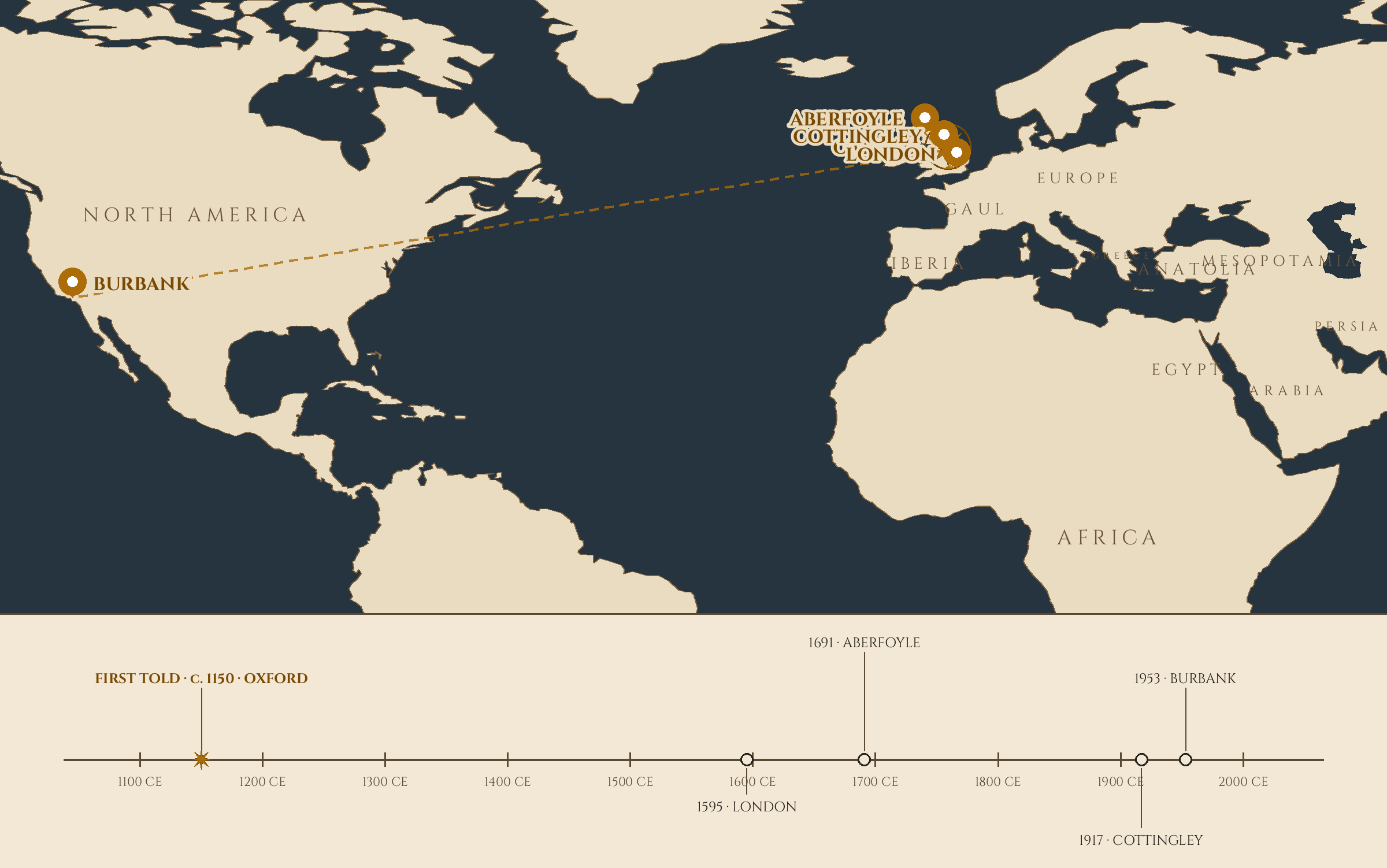
Where this lesson travels: Oxford, where Geoffrey of Monmouth's Vita Merlini (c. 1150) set Morgen, chief of the nine sisters of Avalon, the Isle of Apples — the fairy queen's first named appearance; London, where Shakespeare's A Midsummer Night's Dream put Oberon, Titania and Puck on the stage in 1595; Aberfoyle, where the Rev. Robert Kirk wrote The Secret Commonwealth of Elves, Fauns and Fairies in 1691; Cottingley, where the fairy photographs were taken in 1917 and Conan Doyle championed them in 1920; and Burbank, where Disney's Peter Pan (1953) made Tinker Bell the modern face of the fairy. The starred pin is the first record; the dashed line is the telling, traveling.
Lesson Objectives
By the end of this lesson, you will be able to:
- Describe the fairies as the early record gives them — a people, not an animal — and follow their pictures from a 1478 woodcut to a 1920 photograph.
- Say what the word fairy meant before it named a being, and where the word fay comes from.
- Name the first fairy in writing, and tell who invented the fairy the world now pictures — and by what steps.
- Follow the goblin line from its first medieval records to its modern fantasy face, and say what the word sprite first meant.
- Tell how the London stage shrank the fairies — and what they were before it did.
- State the changeling belief plainly, as history, with its real-world weight.
- Name the custom of the fairy thorn, and tell what happened when a motorway met one in 1999.
- Name the Cat Sìth as the Tiree record describes her, follow the King of the Cats in print from 1570 to 1894, and state the black cat's luck both ways — with its one famous document, of 1233, read straight.
- Write Entry No. 2 in your bestiary, to the keeper's standard, marking every line T, S, or F.
Your Assignment Packet
This lesson's work lives in its packet: the Lexicon Handout (every term, the core terms marked with the keeper's diamond ◆), Materials, Guided Practice, the Assignment Manual written out whole, the Scholar's Entry Page, the Reflection Questions, the Workbook Checklist, and the Keeper's Notes, for whoever teaches the lesson. Download the packet before you begin and keep it beside you as you read. The packet's assignment is Rookmere's own word for the work: Entry No. 2 — The Fairies (written, with a keeper's test) ✎. The Unit I Quiz is not printed in the packet; it waits at the end of the unit, with Lesson 6.
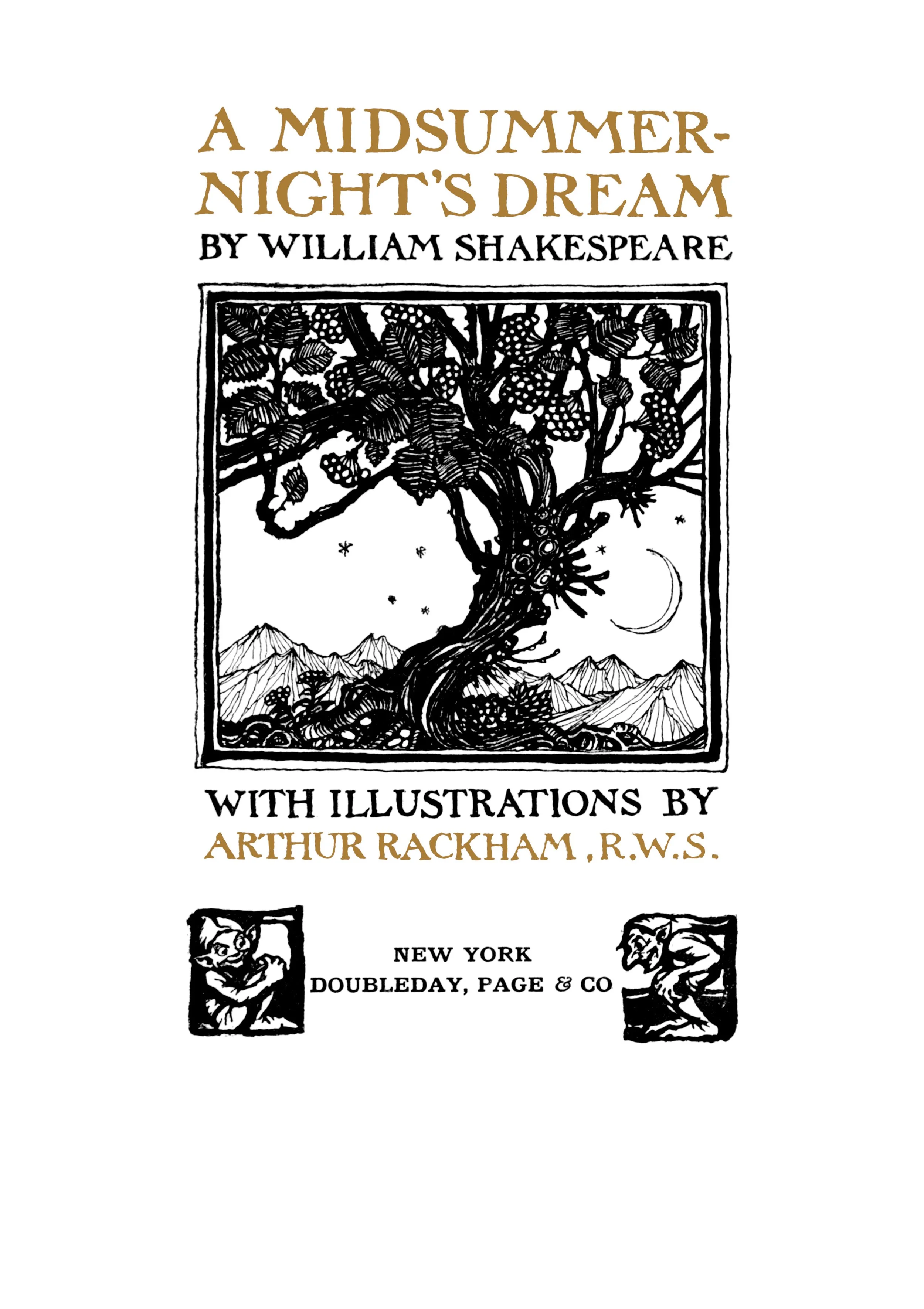
Arthur Rackham's plate for A Midsummer Night's Dream (1908): the fairy court in the wood — the London stage's fairies, painted three centuries after Shakespeare shrank them. Public domain, via Wikimedia Commons.
The Creature
Begin with the word, as this class always begins. A fairy was not originally a creature at all. The English word comes from the Old French faerie, which named first the enchantment itself, then the country where enchantments happened, and only afterward the beings who lived there. The smaller word fay — as in Morgan le Fay — is older still in its roots: it comes from the Latin fata, the Fates, the three who measured out human lives. A fay was a being with a fate-worker's power over mortals, and the record never quite forgot it.
For what the record describes is not an animal. It is a people: queens and courts, kings and huntsmen, a nation living beside ours — under hills, inside hollow mounds, on islands no ship can find twice. They are beautiful and they are dangerous, often in the same paragraph. They heal and they steal. They hold feasts that last one night or a hundred years. The smallest thing the early record says about them is their size, because the early record rarely makes them small at all.
Their neighbors knew better than to call them by a plain name. In Ireland they were the Good People — a name meant to keep them good. In Wales they were the Tylwyth Teg, the Fair Family. In Scotland, the Good Neighbours. The pattern is plain: people who live beside a power they cannot control speak of it politely, and not by its true name. The little winged sprites of the early modern stage are fairy-kin of a later, lighter chapter; they belong to this lesson's growth, not to its beginning. The word itself explains why a sprite is hard to pin to one kind. Sprite is not the name of a separate being at first: it is a doublet of spirit — in English from about 1300 as sprit, also spelled spright, from the Old French esprit and the Latin spiritus. By the middle of the fourteenth century it could mean an immaterial being of almost any sort — angel, demon, elf, fairy, or ghost. The stage gave that loose word a body. In Shakespeare's The Tempest, first performed at court on 1 November 1611, the cast list names Ariel "an airy spirit," and Ariel — flying, singing, vanishing at a word — is the sprite the later pictures copy: light because the being is made of air, not because the old record made fairies small.
Now the pictures, because the fairies' depiction line teaches its own lesson: their pictures start late, and they start literary. Nobody drew the neighbors the parish feared; painters drew the queens the poets described. The earliest plate in this lesson is a woodcut from 1478: Mélusine, the fairy bride of a French romance, discovered in her bath with a serpent's tail — a great lady of a great house, drawn at full human size by the first printers. The line then jumps four centuries to Arthur Rackham's plates for A Midsummer Night's Dream (1908), where the whole court stands in one wood — great figures and flower-small attendants together, because by Rackham's century the record held both sizes at once. And the line ends, for now, with a photograph: Frances Griffiths among the Cottingley fairies in 1920 — small, winged, and, as the Spotted section will tell, made of cardboard. Queen, court, cutout: that is the fairies' picture history in three frames, and the Guided Observation will make you read all three.
First Told
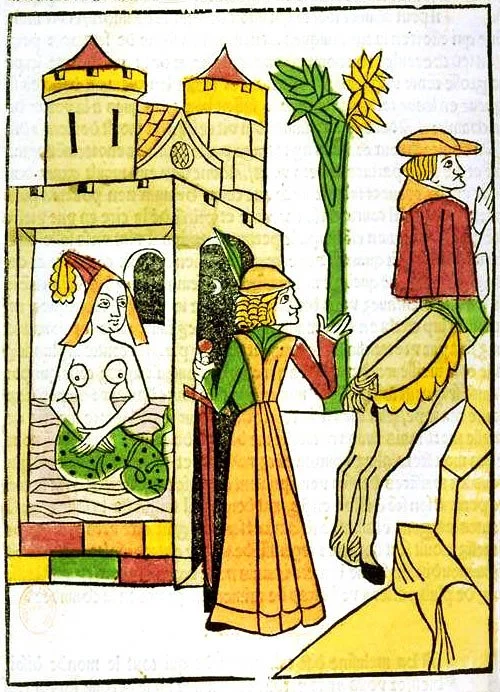
Mélusine discovered in her bath, her lower body a serpent's — woodcut from Jean d'Arras's Histoire de la belle Melusine (Geneva, 1478): the first fairy picture in the file, a fairy bride at full human size. Public domain, via Wikimedia Commons.
The first fairy with a name of her own steps into writing around 1150, in the Vita Merlini — the Life of Merlin — by Geoffrey of Monmouth, a clerk and historian writing in Latin, in Britain.
Geoffrey tells of the Isle of Apples, the island the Welsh called Avalon, ruled by nine sisters. The chief of them is Morgen — the first form of the name the world would know as Morgan le Fay. She is the most learned of the sisters, skilled in healing, and she can change her shape and fly through the air. It is to her island, Geoffrey says, that the wounded King Arthur was carried after his last battle, so that she might heal him. Geoffrey had named Avalon once before, in his earlier History of the Kings of Britain (about 1136); here, for the first time, its queen has a face, a name, and a profession.
So who invented the fairy? Asked head-on, the honest answer is a relay, not a person. The folk belief is older than any writing — people feared and courted the fairies long before a clerk wrote Morgen's name. What begins in 1150 is the fairies' file: the part a keeper can point to, date, and argue over. Geoffrey gives the fairy her first named queen. The French romances give her a court and, in Mélusine, a dynasty. The London stage, as the next section tells, gives her wings and shrinks her. And the nineteenth and twentieth centuries give her the nursery. Each age invented the fairy it needed, on top of the last age's work.
The fairies were not the only small people entering writing in those same decades. The goblin line opens in Normandy. Orderic Vitalis, writing his Historia Ecclesiastica about 1140, records a demon haunting the country around Évreux that the local people called gobelinus. In 1195 the Norman monk Ambroise used the Old French gobelin as a byword for a treacherous man — a use that only works if his readers already knew the word. The received derivation, as the Oxford English Dictionary summarizes it, runs from Old French gobelin back, probably, to Greek kobalos, a rogue or knave, whose plural kobaloi could mean mischievous sprites. English takes the word up solidly from about 1330. The hobgoblin is this being with a familiar name welded on: Hob, the country nickname for Robin or Robert, and the compound is first known from John Palsgrave's French grammar of 1530, where Hobgoblyng glosses gobelin. Lesson 4 meets that compound again at the brownie's bowl, where Hob's kind belongs.
Look at the map at the head of this lesson. The starred pin — the first telling, as always — stands at Oxford, the town tradition associates with Geoffrey's writing. Tradition is the honest word for it: the poem is datable, its author's desk is not, and the map says so by the kind of pin it uses. From Oxford the dashed line runs to London, to a parish in the Scottish hills, to a Yorkshire beck, and at last across an ocean. The map follows the record; the belief is older and wider than any map could draw.
Through the next centuries the fairy court grows grander, and more entangled with human houses. The French poet Chrétien de Troyes, writing about 1170, names Morgain as a healer of Arthur's court. In 1393 Jean d'Arras writes the romance of Mélusine: a fairy bride who founds a great dynasty — the house of Lusignan — and who, one day in every week, is from the waist down a serpent. Her husband must never see her on that day. He does. The fairy of romance is no decoration: she builds castles, founds families, and keeps her own terms. The 1478 woodcut in this lesson shows the moment the terms break — her husband at the door of her bath, the serpent tail in the water. It is the first fairy picture in the file, and it is worth noticing what it is a picture of: not a being anyone claimed to have met, but a scene from a book.
The Tales
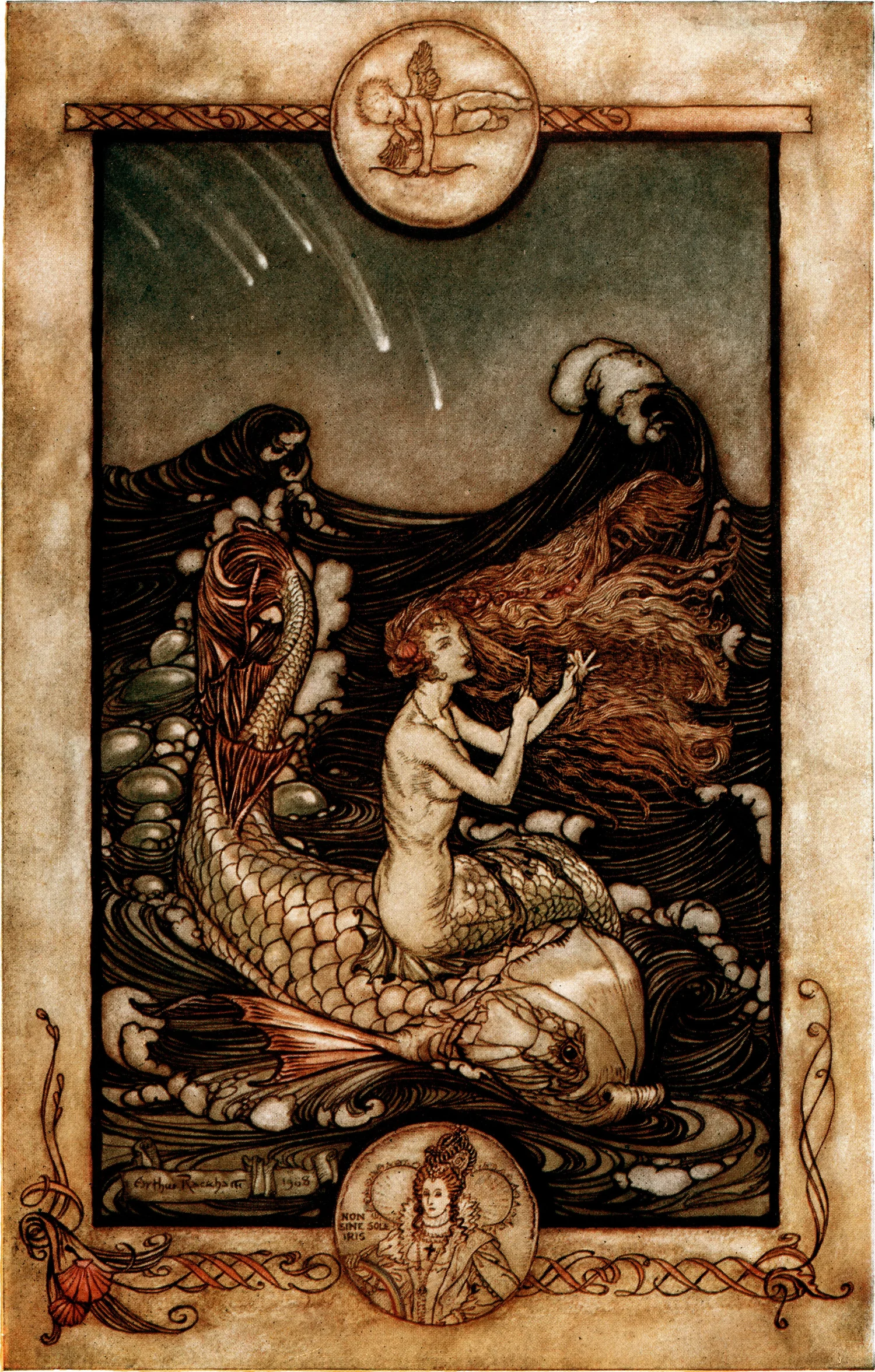
A second plate by Arthur Rackham for A Midsummer Night's Dream (1908) — the fairy court as the illustrated book handed it on to the modern reader. Public domain, via Wikimedia Commons.
Then, in about 1595, the fairies go on the London stage, and the record changes size forever. Shakespeare's A Midsummer Night's Dream assembles its court from three different shelves of the store-room. Oberon, the fairy king, arrives from the French romance of Huon of Bordeaux. Titania, his queen, takes her name from Ovid, where it is an epithet of goddesses. Puck — Robin Goodfellow — walks in from English fields and farmyards, a household spirit of pranks. And on that stage, for the play's delight, the beings shrink: Shakespeare's attendants hide in cowslip bells, carry dewdrops for earrings, and serve a queen who is grandeur itself at the size of a flower. It was theater that did it. The small fairy is a stage effect that never left.
Two of this lesson's plates are Arthur Rackham's, drawn for an edition of the play in 1908, and they hang at the head of the lesson so the shrinking can be watched. Rackham crowds his wood with the whole court at once — great figures and flower-small attendants sharing the same gnarled trees — because by his century the record held both sizes at once, and a painter could use them all in one picture. The plates are read properly in the Guided Observation. For now, notice the mixture. No earlier age in this file would have painted it that way.
The tales themselves, across all these centuries, keep one shape: somebody crosses over. A mortal visits the fairy country — for a feast, a dance, a night's lodging — and the crossing costs time. The ballads remember Thomas the Rhymer, carried off by the Queen of Elfland for what felt like days and was seven years. The rule the tales repeat, in every country, is plain: eat nothing. Fairy food binds the eater to the place, the way a signature binds a contract.
Protection, in the tales and the custom alike, often meant iron. The belief that iron repels fairies is collected at length in Robert Means Lawrence's The Magic of the Horseshoe (1898): an iron horseshoe nailed over a doorway, Lawrence records, was held to keep fairies and other unwanted otherworldly guests out — the horseshoe being the readiest piece of iron in a farmhouse. Beside the cradle the custom ran the other way, against theft: Henderson's Notes on the Folk-Lore of the Northern Counties (1866) records steel placed with a child in Northumberland, to keep the fairies from taking the baby. Both records are beliefs, and the keeper files them as exactly that — but they were beliefs with hardware attached, kept in real houses.
The fairy record has a cat of its own, and she is a being in her own right, not a witch's accessory. John Gregorson Campbell, minister of Tiree, collected Highland belief entirely from oral sources, and his Superstitions of the Highlands and Islands of Scotland (1900) gives the Cat Sìth — his elfin cats, cait shìth — a keeper's description in one sentence: a wild, not domesticated, breed, as large as dogs, black, with a white spot on the breast, and with arched backs and erect bristles. Campbell also records the disagreement inside his own record: many maintained, he writes, that these cats have no connection with the fairies at all, but are witches in disguise. Both readings stand in the file, as he left them. The being is filed here, with the fairies, because the name, the size, and the fairy reading are the record's own — this class files the creature, and notes the second reading as the record's second voice.
The Cat Sìth had a cousin in the same collection, and Campbell files him just before her, among the fairy dogs. The Cù Sìth — cu sìth, the fairy dog — is his dark green hound: as large as a two-year-old stirk, a young bullock in the Scots word, "a dark green colour, with ears of deep green," lighter towards the feet, its long tail in some tellings rolled up in a coil on its back, in others flat and plaited like the straw rug of a pack-saddle. He was kept tied as a watch dog in the brugh, the fairy dwelling, but at times accompanied the women on their expeditions or roamed about alone, making his lairs in clefts of the rocks; his immense footmarks, as large as the spread of a human hand, were found the next day traced in the mud, in the snow, or on the sands. His motion was silent and gliding — except for the bark. There is a considerable interval between each bark, Campbell writes, and at the third — it barks only thrice — the terror-struck hearer is overtaken and destroyed, unless he has by that time reached a place of safety. And the warning that stands behind the hound is Campbell's own, in the same chapter: it was women not yet risen from childbed, and their babes, whom the fairies most often abducted — the fairy women, Campbell records, were said to be unable to suckle their own children, and so sought a human wet-nurse — and so a new mother was not to be left alone, and a house full of women gathered and watched through the first days after a birth. He is filed here, with the fairies whose name he carries, and not among the black dogs: green, not black, a fairy's watch dog in the record's own filing — Campbell sets him in his chapter on the fairies, a page before the elfin cats. F for Campbell's collecting, in the book of 1900. T for the hound in the clefts, and for the third bark on the moor.
Later retellings give the Cat Sìth two further customs, and a keeper dates them honestly. She is said to take a soul by passing over a corpse before burial, so that the dead were watched day and night in the vigil called the Late Wake; and on Samhain a saucer of milk left out for her would earn the house a blessing, while a house that left none would be cursed and its cows' milk dried up. Campbell's 1900 collection — the fullest early record of the being — contains neither custom. They circulate in modern retellings, the milk and the blessing among them (Folklore Scotland's account of the Cat Sìth, 2022, is one such), and no earlier printed source for them was found for this file. They stand here as the living tradition's later layer, marked as such — not back-dated to the Highlands Campbell recorded.
The cats of this record also keep a court, and a succession. The tale folklorists call the King of the Cats enters print early: William Baldwin's Beware the Cat, written in 1553 and published in 1570, already tells of a cat who hears that Grimalkin is dead, bids her household farewell, and is never seen again. The full form most readers know is the one Joseph Jacobs printed as "The King o' the Cats" in More English Fairy Tales (1894): a man meets nine black cats with white spots on their breasts, carrying a small coffin with a crown on it, and one of them charges him — Tell Tom Tildrum that Tim Toldrum is dead. He tells the tale at his own fireside, and the house cat, Old Tom, cries out that if old Tim is dead, then he is King of the Cats — and goes up the chimney, and is never seen again. A cat monarchy beside the fairy court, with a printed line of more than three centuries between its first telling and its fullest one. Note, for the file, what the tale is not: the cat who made a poor boy Lord Mayor of London belongs to a different tale altogether, Dick Whittington's, first recorded in 1605 — a fortune tale, with no coffin, no crown, and no succession.
And the crossing runs both ways, which brings this lesson to the belief it must state carefully. The record holds, for century after century, a belief about changelings: that the fairies steal a healthy human child and leave one of their own in its cradle — a sickly, failing, strange child, who is not, the belief said, really yours. The signs the old books list are the signs of a child who is ill or not thriving: it does not grow, it cries without ceasing, its face looks old. The folklore also records the tests and treatments people used to force the fairies to take the changeling back and return the true child — some merely foolish, some cruel.
A keeper does not soften what the record did in real houses. In 1826, in County Kerry in Ireland, a four-year-old boy named Michael Leahy — a child who could neither stand, nor walk, nor speak — was held to be fairy-struck. On his grandmother's direction, an older woman named Ann Roche, helped by Mary Clifford, bathed him in the River Flesk on three mornings, to put the fairy out of him. On the third morning he drowned. Roche was tried for murder at the Tralee Assizes; the judge directed the jury that there was no evidence she had meant to kill, and she was acquitted. In 1895, in County Tipperary, Bridget Cleary was burned by her husband Michael, who insisted that the woman in his house was a changeling and the fairies had his real wife — he was convicted of manslaughter. These are not tales. They are court records, and they are part of this being's file, because the belief is part of the record. The belief itself is marked T — a tale told of the fairies; that the trials happened, and how they ended, is F. We write such lines down without flinching, because a bestiary that hides what belief cost is not honest enough to keep.
KEEPER'S CHECK-IN
How did Shakespeare's stage change the fairies' size, and what rule do the tales repeat about fairy food for a mortal who crosses over?
Spotted
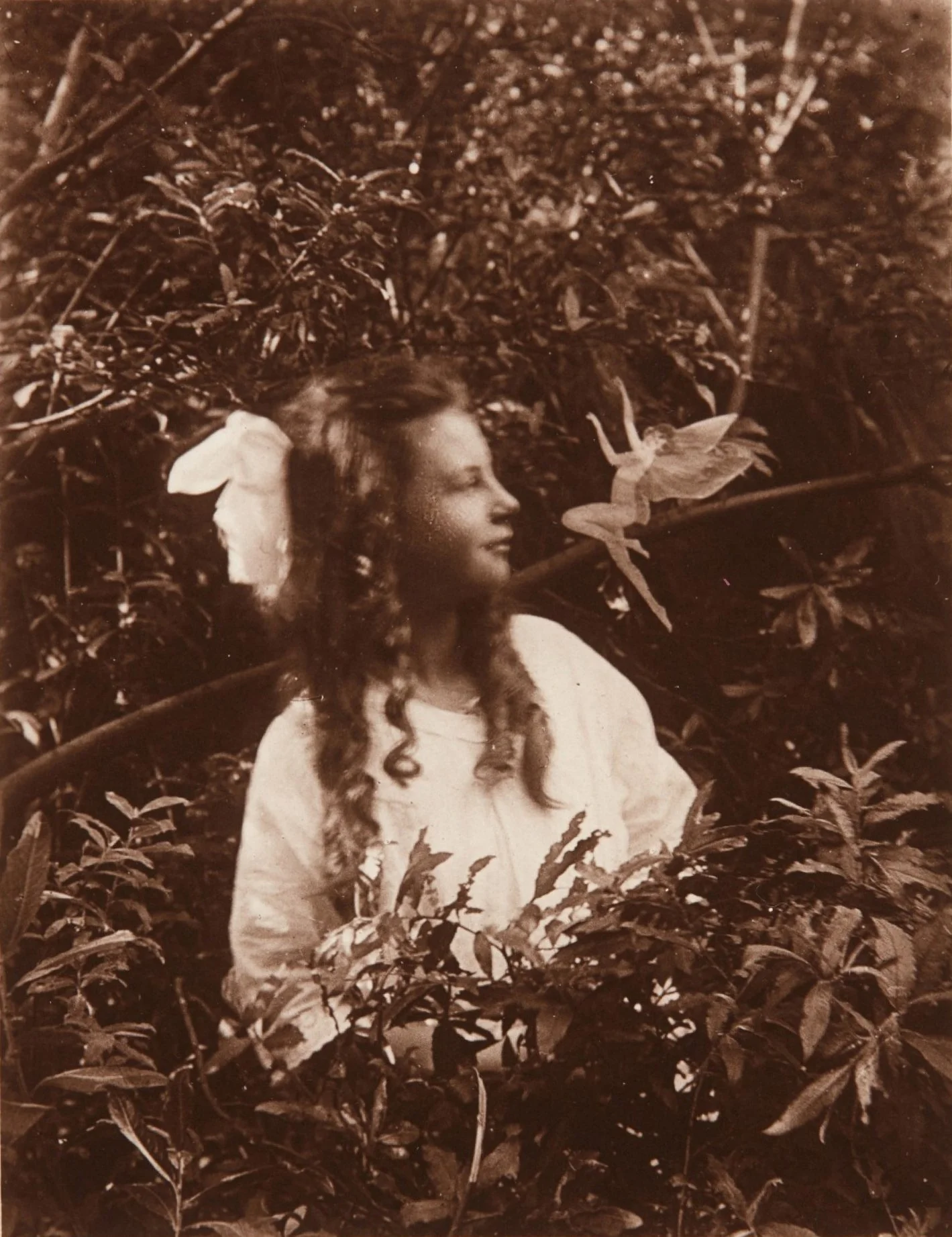
The third Cottingley photograph (1920): Frances Griffiths with a leaping fairy — championed by Conan Doyle in print, and admitted in 1983 to have been cardboard cutouts. Public domain, via Wikimedia Commons.
The fairies also have witnesses — people who reported, on the record, that they had met them. One witness stands behind a whole parish. In 1691 the Reverend Robert Kirk, minister of Aberfoyle in Perthshire, wrote a short book from his parishioners' testimony: The Secret Commonwealth of Elves, Fauns and Fairies. Kirk did not treat the fairies as fancies. He recorded them as a neighboring nation with its own order, its houses under the hills, its comings and goings at the quarters of the year — field notes, in effect, taken from people who believed they lived alongside the subject. The book was not printed until 1815, more than a century after he wrote it. Kirk himself died in 1692, found on the hill above his manse that the parish called the Fairy Knowe. His people said the fairies had taken him for telling their secrets. That is what his parish said, and the keeper files it as exactly that: a report of a belief about a death, marked S for the reporting and T for the tale inside it.
The reports never stopped. In 1911 the folklorist W. Y. Evans-Wentz published The Fairy-Faith in Celtic Countries, first-person testimony collected across Ireland, Scotland, Wales, Cornwall, the Isle of Man, and Brittany — witnesses speaking in their own names and parishes. And in the summer of 1917, in Cottingley, a village in Yorkshire, two cousins borrowed a camera: Elsie Wright, sixteen, who worked in a photographer's studio, and Frances Griffiths, nine, newly arrived from South Africa. They came back from the beck with photographs of Frances among small winged fairies. In 1920 two more photographs followed, and the pictures reached Arthur Conan Doyle — the creator of Sherlock Holmes, the most famously rational detective in fiction. Doyle championed them: he published them in The Strand Magazine in December 1920 and defended them in his book The Coming of the Fairies (1922). Technicians at Kodak examined the negatives and reported no sign of studio fakery — while declining to say the pictures showed fairies.
In 1983 the cousins, by then old women, told the writer Joe Cooper the truth of it, and it must be stated exactly. Four of the five photographs were faked: the fairies were cardboard cutouts, copied from illustrations in a children's gift book and held up with hatpins. The fifth photograph Frances Griffiths maintained, to the end of her life, was genuine. That is the record — an admission, and one reservation, standing side by side. A keeper does not iron it flat in either direction. The Cottingley file is this class's standing lesson in what an S-line is: a report can be dated, named, examined by experts — and still be a report of a cardboard fairy.
KEEPER'S CHECK-IN
What did the Reverend Robert Kirk record from his parishioners in 1691, and what did the Cottingley cousins admit in 1983 about four of their five fairy photographs?
What People Watched For — Never Shift a Fairy Bush
In Ireland, a hawthorn growing alone in a field — a fairy thorn — is not the farmer's to cut. Lone thorns were held to be the fairies' own trees, meeting places and markers of their roads, and the custom was simple and total: you plowed around it. Generation after generation of farmers left one useless, thorny tree standing in good land rather than shift it, and the custom outlasted the belief that built it.
The tree itself deserves a keeper's look, because it had to stand alone a long time to earn that custom. The fairy thorn is usually the common hawthorn, Crataegus monogyna: a tough, thorny small tree, commonly about 5 to 15 meters tall when fully grown and often much less in a grazed or windswept field. It covers itself in white blossom in May and carries deep red berries — haws — into the autumn, and a hawthorn can live a long time, a few hundred years for the oldest of them. A lone one in the middle of good land shows from every side of the field. Farmers were not sparing a weed. They were sparing a landmark.
It was tested in our own time. At Latoon, in County Clare, a whitethorn — by local account a meeting place where the fairies of Munster gathered — stood in the path of a new motorway bypass. In 1999 the folklorist and storyteller Eddie Lenihan warned publicly that destroying the bush would bring death and misfortune on the road, and gave the custom its modern words: Never shift a fairy bush. The tree was spared. It stands today, fenced, between the motorway and its slip road — and the honest footnote belongs in the file too: the county engineer later pointed out that the bush had lain between the carriageway and the slip road all along. The record and the story of the record grow side by side, here as everywhere in this class. What is certain is the custom's strength: in 1999, in a country building motorways, a warned-of tree was left standing, and no one in authority chose to be the one who cut it.
Watched for, too: the black cat. The thorn is not this lesson's only watched-for sign. The black cat was watched for on roads, at doors, on ships, and at weddings — and the record, read whole, points both ways at once.
Take the bad-luck side first, and take its most famous document straight. In June 1233 Pope Gregory IX issued the decretal Vox in Rama to the authorities in Germany, on the report of the inquisitor Konrad von Marburg, describing the initiation of an alleged heretical sect. The novice, the letter says, first meets a toad — sometimes as large as a goose or a duck — then kisses a pale, emaciated man and forgets his faith; after a meal, a black cat about the size of an average dog descends backwards from a statue, tail erect, and is kissed in turn. That is what the letter says, in the translation printed by Alan Charles Kors and Edward Peters in Witchcraft in Europe, 400–1700. It does not order anyone to kill a cat. It does not declare black cats an incarnation of Satan. It does not mention house cats at all. Those claims arrive in modern retellings — Donald Engels's Classical Cats (1999) is the influential one — and the letter itself does not support them. File it as what it is: a famous official document that puts a black cat inside a devil-worship charge levelled at people, in one part of Germany, in 1233. A document about an accusation is not a document about a cat.
The crossing-path belief itself has no such single paper origin. Iona Opie and Moira Tatem's A Dictionary of Superstitions (1989), which traces British beliefs by their print references, dates the black-cat meeting-belief to 1620 — and the British record it collects will not sit on one side: meeting a black cat was lucky or unlucky depending on the place and the teller, and the dictionary's returns run more often to lucky than to unlucky. In the United States the crossing form hardened into the bad-luck version most people now know, recorded again and again by twentieth-century collectors. The belief is real, and well attested. A single medieval birthday for it is not in the record.
And the counter-record is as well documented as the charge. Sailors kept cats aboard for the plain work of the stores — the rodents — and a black cat aboard was held to bring good luck and a safe return; sailors' wives kept a black cat at home to guard the husband at sea. In the English Midlands, a black cat given to a bride was a wedding gift meant to bring a lucky marriage. A black cat in the audience on a theatre's opening night was held to promise the play a long and successful run. The Smithsonian's Archives of American Art, surveying the record in 2017, lists the spread in one breath: black cats on ships as a longstanding good-luck tradition, and, in Britain, prosperity, a blessed marriage, and success for a theatre production. One animal, two opposite lucks, both in print. A keeper writes both down, and lets the cat walk out of the file as what she is: a cat, whose reputation people made — twice, in opposite directions.
The cat's remaining file — the cat kept as a witch's familiar, named and testified to in the witch trials — is a record about a human practice and the courts that ran it, and it belongs where that practice is the subject: the History of Magic class, to be met there.
What It Actually Is
What stands under this record, in the checkable world? Some of it is landscape. A fairy ring is real: a circle of mushrooms, or of grass growing greener in a ring, made by a fungus — the fairy ring mushroom, Marasmius oreades, is the usual maker — spreading outward underground year by year and fruiting at its edge. The mushroom itself is a modest thing — a small buff-tan cap, about 2 to 5 centimeters across, on a thin stem, coming up after rain from late spring into autumn. The ring can be wide, though: the fungus grows outward through the soil a little each year, so an old ring may run many meters across, with its middle long since grown over. People found perfect circles in the grass, in a world that made few perfect circles, and gave them to the dancers. The fairy forts are real too: the grassy ring-forts, or raths, that dot Ireland by the tens of thousands are the earthworks of early medieval farmsteads — real places, made by real hands, left unplowed for centuries in part because the fairies were said to hold them. The rings and the forts did not need inventing. They needed explaining, and the explanation nearest to hand was a people.
The Cat Sìth has a candidate root of the same kind, standing in the Highlands all along. The Kellas cat — a hybrid of the Scottish wildcat and the domestic cat, black and dog-sized, long a rumour in the glens — was secured as specimens only in the 1980s, and the cryptozoologist Karl Shuker proposed in Mystery Cats of the World (1989) that such cats stand behind the elfin-cat reports. It is a proposal, and the keeper labels it so. But a dog-sized black cat in country that holds a real dog-sized black cat is an observation before it is a marvel — Gerald's barnacles, in a fur coat.
The changeling belief asks for the same honesty, turned the other way. Modern scholars read it as the explanation grieving people reached for when a child sickened, failed to thrive, or changed in ways no one could name — the belief said the real child was elsewhere, safe, and could be won back. It is a reading, not a certainty, and the keeper labels it so. But it fits the record's shape: the belief was cruelest exactly where medicine was helpless. That reading explains something real, and it still leaves most of the file unexplained. No root dug up under a fairy ring will account for a queen on an island of apples, or for a sparkle in a nursery eight centuries later. So set down what can be checked, leave the rest marked as what it is, and let the file stay open where it is open.
Still With Us
Why does the fairy endure? Partly because the reports never quite stopped, and honest keepers keep gathering them. Marjorie Johnson, of the Fairy Investigation Society, ran a census of fairy encounters in 1955–56; her collection was published as Seeing Fairies in 2014. The historian Simon Young revived the census in 2014, and the first Fairy Census volume (2018) holds some five hundred first-hand experiences recorded between November 2014 and November 2017. The census takes no side: it files what people say they saw, with dates and places, the way Kirk filed his parish. Whatever a keeper makes of the accounts, their existence is a fact about our own century — the fairies are still being reported, by named people, in a form a keeper can check.
The goblin took the opposite road into the modern world. George MacDonald's The Princess and the Goblin (1872) gave the word a people again: a race living in underground caverns, who had once lived above ground and were very like other people — called by some gnomes, by some kobolds, by some goblins. Tolkien, who wrote that his orcs were influenced by MacDonald's goblins, preferred the word goblin itself in The Hobbit (1937); orc appears only once in that book's first edition. The modern fantasy goblin — small, ugly, underground, and met in troops — descends from that relay.
And the same century that kept reporting her also gave the fairy her smallest and sweetest shape. J. M. Barrie's stage play Peter Pan (1904) made Tinker Bell a fairy who could die of disbelief, saved by an audience clapping. Cicely Mary Barker's Flower Fairies books, from 1923, drew her small, winged, and botanically correct. And in 1953 Disney's film of Peter Pan fixed the modern face: a sparkle of light with a temper, small enough to stand on a hand. Disney drew her as a small blonde figure in a green dress, all light and temper, and that drawing — not Geoffrey's queen — is the one most people now see first when the word fairy is said. The record that began with a queen who could heal a king ends, for now, as a nursery light. The old pages have not gone anywhere. They are waiting, as records do, for whoever reads the whole file.
Guided Observation
This lesson hangs four pictures, and they do not agree with each other — which is the lesson. First, the Mélusine woodcut of 1478: a fairy at full human size, in a scene from a book. What in the picture tells you it illustrates a story rather than reports a sighting? Then Arthur Rackham's plate for A Midsummer Night's Dream (1908): the fairy court in the wood, painted three centuries after Shakespeare. Look at the sizes Rackham gives his company: which figures are grand, which are small, and what does the painting gain by mixing them? Then turn to the Cottingley photograph in this lesson — Frances Griffiths with a leaping fairy, 1920. Read it as evidence, the way Kodak's men had to. Look for the flatness of the figure, its stillness, the way the light sits on it compared with the light on Frances, and ask what a living, flying thing would do to a photograph that a paper one does not. Write down three things the photograph itself tells you that its believers did not ask it. This is the keeper's question in its purest form: not do I believe this witness, but what does the thing in front of me actually show.
Assignment Manual
✎ WRITTEN · ⚒ HANDS-ON · ◐ BOTH
✎ Written, with one keeper's test · Entry No. 2: The Fairies.
- Rule your entry page. Rule a fresh page of your creature guide to match the Scholar's Entry Page, as you did for Entry No. 1, and add the fairies to your contents page: name, and the year of the first telling.
- Write the entry, to the standard. The Creature: the fairies as the early record describes them, and their pictures — the 1478 Mélusine, Rackham, the Cottingley photograph — with dates. First Told: Geoffrey's Vita Merlini — who wrote it, roughly when, and who stands at its head. The Tales: the crossing over, the rule of the food, the iron that was set against them, and the changeling belief stated plainly. Spotted: Kirk's parish reports of 1691, and Cottingley, stated exactly. What It Actually Is: the ring, the fort, and the reading scholars give the changeling belief — marked as a reading. Still With Us: the fairy censuses, the small bright fairy the century settled on, and the goblin's modern fantasy face. The Keeper's Line: your own judgment, in one or two lines.
- ◐ The keeper's test. From the Cottingley plate in this lesson, list three physical signs that the fairy is paper and not a living being — in its shadow, its focus, its edges, its stillness. No mockery: the cousins were a studio girl and a child with a borrowed camera, and the man who believed them wrote Sherlock Holmes. The test is about evidence, and it is the same test you will use on every plate in this class.
- Mark every line. T for a tale, S for a sighting or report, F for a verifiable fact, through the whole entry — the changeling paragraph included. If a line about the Kerry court case tempts you to mark it T because it is about a belief, look again: that the trial happened, and how it ended, is F. What the belief claimed is T. The distinction is the discipline.
The printable packet for this lesson — the Lexicon Handout, the Guided Practice, this manual, and the Scholar's Entry Page — is linked on this page.
Materials
· Your creature-guide journal or notebook — kept for the whole class
· Pencils, and a pen you like
· A ruler, for ruling your entry pages
· This lesson's packet (the Scholar's Entry Page is in it)
Reflection
Robert Kirk believed his parishioners, and Conan Doyle believed two girls' photographs. What is the difference between believing a witness and believing a thing — and which did each man do?
The changeling belief hurt real children, and this class teaches it anyway. What does a keeper owe the people inside a record like that?
The fairy shrank from a queen to a sparkle across eight centuries of record. What shrank her — and is the small fairy less true to the record, or only later in it?
A Closing Note
The fairies are filed — for now. A file this quarrelsome never quite stays shut, and I would not trust one that did. Next come their cousins, who never shrank and never went to the nursery: the hidden folk of the North — grave, tall, and still consulted when the road crews arrive with their drawings. Three families share their entry, and keeping them unblended is the whole exercise. Bring your ruler.
The Bestiary
Bestiary Keeper
Further Reading & Sources
Geoffrey of Monmouth, Vita Merlini (c. 1150) — the first telling: Morgen and the Isle of Apples.
Robert Kirk, The Secret Commonwealth of Elves, Fauns and Fairies (written 1691; first published 1815).
W. Y. Evans-Wentz, The Fairy-Faith in Celtic Countries (Oxford University Press, 1911) — first-person testimony, collected on the record.
Arthur Conan Doyle, The Coming of the Fairies (Hodder & Stoughton, 1922).
Joe Cooper's interviews with Elsie Wright and Frances Griffiths, The Unexplained (1983) — the admission, and the one reservation.
Marjorie T. Johnson, Seeing Fairies (Anomalist Books, 2014) — the 1955–56 census of encounters.
Simon Young (ed.), Fairy Census 2014–2017 (2018) — some five hundred modern reports, filed without endorsement.
Robert Means Lawrence, The Magic of the Horseshoe (Houghton, Mifflin, 1898) — iron and the horseshoe against the fairies, collected.
Katharine Briggs, An Encyclopedia of Fairies (Pantheon, 1976).
Angela Bourke, The Burning of Bridget Cleary: A True Story (Pimlico, 1999).
Reports in The Irish Times, May 1999 — the Latoon fairy bush, County Clare.
William Sayers, "The Dispossessed House-Spirit: The Etymology of goblin and Some Thoughts on its Early History," Tradition Today 10 (2020) — Orderic's gobelinus (about 1140), Ambroise's gobelin (1195), and the Oxford English Dictionary's received derivation.
Douglas Harper, Online Etymology Dictionary, s.v. "sprite" — sprit and spright from about 1300, and the word's fourteenth-century range of beings.
George MacDonald, The Princess and the Goblin (1872) — the goblins underground, and the line Tolkien acknowledged for his own.
John Gregorson Campbell, Superstitions of the Highlands and Islands of Scotland (James MacLehose and Sons, 1900) — the elfin cats, cait shìth, collected from oral sources on Tiree; note this Campbell is the Tiree minister, not John Francis Campbell of Islay, editor of Popular Tales of the West Highlands (1860–62).
William Baldwin, Beware the Cat (written 1553; published 1570) — the King of the Cats in its earliest printed form.
Joseph Jacobs (ed.), More English Fairy Tales (1894) — "The King o' the Cats," the tale's fullest printed form.
Pope Gregory IX, Vox in Rama (June 1233), in Alan Charles Kors and Edward Peters (eds.), Witchcraft in Europe, 400–1700: A Documentary History — the decretal read straight: the toad, the pale man, and the black cat of the alleged rite, and no order against cats.
Iona Opie and Moira Tatem (eds.), A Dictionary of Superstitions (Oxford University Press, 1989) — the black cat's luck, both ways, traced by print reference from 1620.
Karl Shuker, Mystery Cats of the World (Robert Hale, 1989) — the Kellas-cat proposal for the Cat Sìth's root, filed as a proposal.
Submit your work for this lesson using the form below.
CONTINUE IN THE BESTIARY HALL
← Previous · Lesson 1: Meeting the Creatures Next · Lesson 3: The Hidden Folk →
Unit I — Meeting the Creatures The Bestiary Hall — All 41 Lessons
The rest of Unit I: Lesson 1 · Meeting the Creatures · Lesson 3 · The Hidden Folk · Lesson 4 · Brownies & the Household Helpers · Lesson 5 · The Elementals of Paracelsus · Lesson 6 · The Made