

THE BESTIARY
Unit I · Lesson 6The Made
Professor Sable Rookmere
Bestiary Keeper
The Bestiary Hall • School of Evershade
Professor's Introduction

The last lesson in this unit gave you beings with one author and a system. This lesson gives you beings made twice — once by the maker in the story, and once by the writer who wrote the maker.
Three records stand here: a clay man in the Jewish tradition, a little man in a flask in the alchemical tradition, and an assembled man in a novel of 1818. They ask the same question from three sides: what do we owe a thing we have made that can stand in front of us? Keep your dates in front of you. This file contains the widest gap in the unit between when a story is set and when it was written down — more than two hundred years wide, in Prague — and the lesson will not let you step over it without looking down.
The Bestiary
Bestiary Keeper
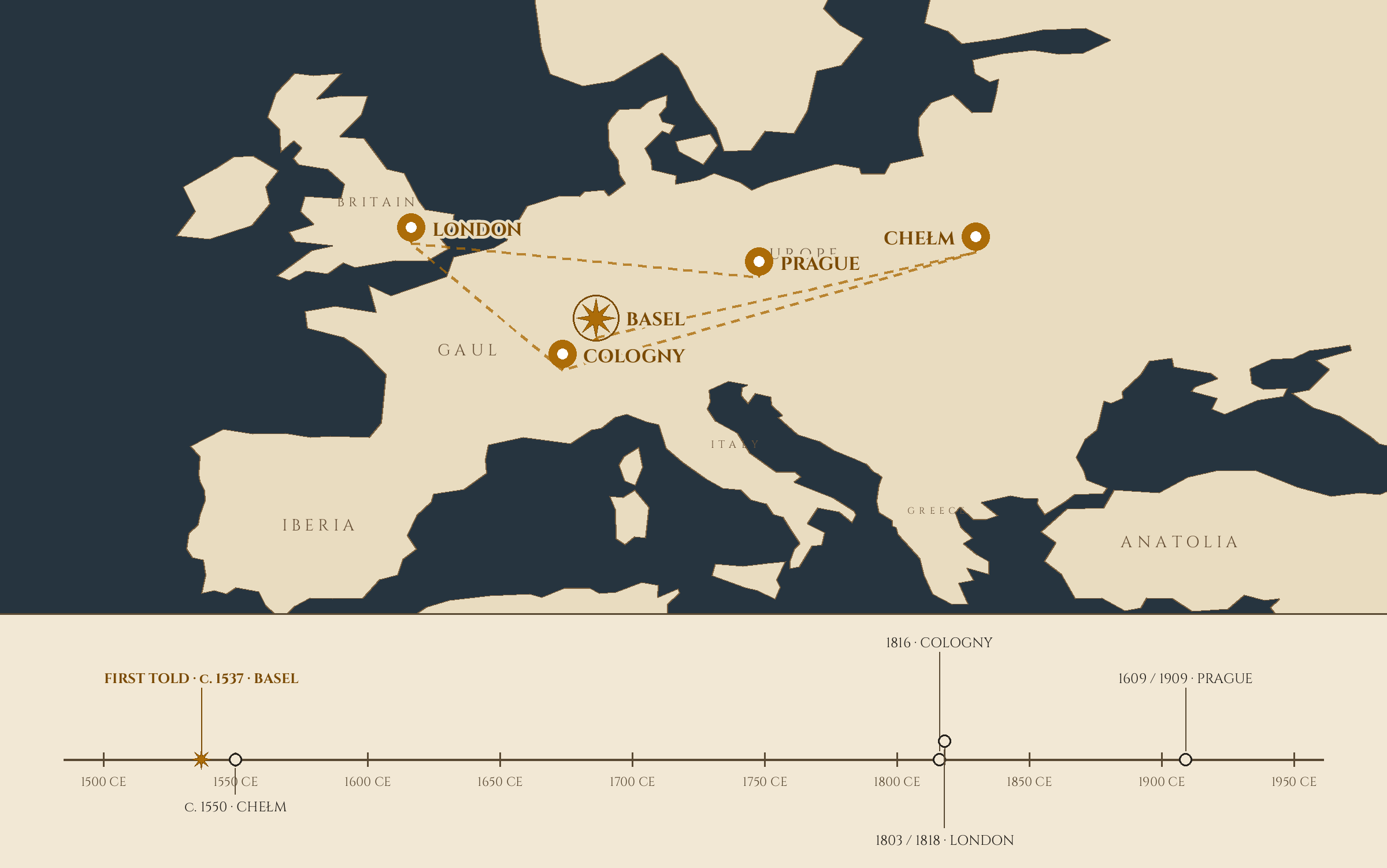
Where this lesson travels: Chelm, where Elijah Ba'al Shem (c. 1550–1583) is the first named golem-maker of the later record; Basel, the approximate pin for De natura rerum, the homunculus claim published under Paracelsus's name (letter dated 1537; first printed 1572); Prague, where the Maharal (d. 1609) was given his golem in print more than two centuries later, in Yudl Rosenberg's Niflaot Maharal (1909); Cologny, near Geneva, where the Villa Diodati ghost-story summer of 1816 began Frankenstein; and London, where Aldini demonstrated galvanism at Newgate in 1803 and Frankenstein was published anonymously on 1 January 1818. The starred pin is the first record; the dashed line is the telling, traveling.
Lesson Objectives
By the end of this lesson, you will be able to:
- Name the three records filed together here — the golem, the homunculus, and Frankenstein's creature — and say what makes them one kind: beings made by human hands and knowledge, not born.
- Trace the golem's paper trail in order: Psalm 139, the Talmud's man who could not speak, the Sefer Yetzirah as root-text, Elijah of Chelm as first named maker.
- State the Prague problem: the Maharal died in 1609, his golem reached print more than two centuries later — and name the 1909 book that made the familiar story.
- Report the homunculus claim honestly — what book carries it, under whose name, and what modern scholarship has done to that name — without repeating any procedure, because this class does not teach making.
- Read Shelley's creature as written — eloquent, reasoning, unnamed — and explain how the stage (1823) and film (1931) took away his voice and gave him his maker's name.
- Say why Spotted holds no sightings, what the attic visits found, and what the one living custom in the file is.
- Weigh all three records in a single entry, marked T, S, and F, and write the Keeper's Line.
Your Assignment Packet
This lesson's work lives in its packet: the Lexicon Handout (every term, the core terms marked with the keeper's diamond ◆), Materials, Guided Practice, the Assignment Manual written out whole, the Scholar's Entry Page, the Reflection Questions, the Workbook Checklist, and the Keeper's Notes, for whoever teaches the lesson. Download the packet before you begin and keep it beside you as you read. The packet's assignment is Rookmere's own word for the work: Entry No. 6 — The Made (written, with a table) ✎. The Unit I Quiz is not printed in the packet; it closes the unit, and it stands at the end of this very lesson, below.
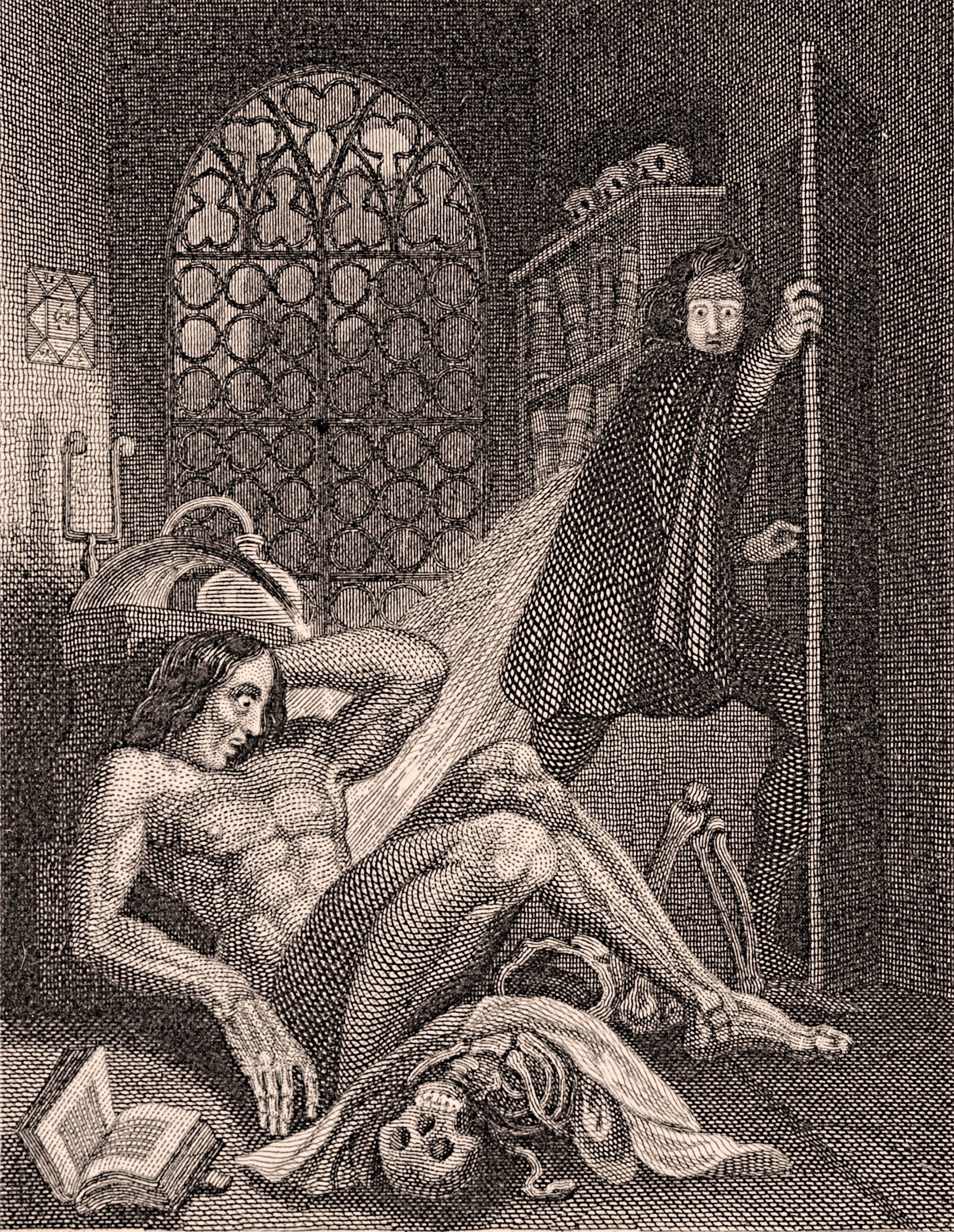
Theodor von Holst's frontispiece to the revised edition of Frankenstein (London, 1831), engraved by William Chevalier: the creature awakening on the work-table as Victor Frankenstein flees through the door — the first illustration published with the novel itself. Public domain, via Wikimedia Commons.
The Creature
The made are not a species. They are a situation: a human-shaped being that did not arrive the way human beings arrive, but was made — shaped, assembled, or generated by a person's hands and knowledge — and then had to be dealt with. This lesson files three of them, from three separate records that never met, because the records agree on the shape of the problem: each story gives you a maker, a material, and a result the maker did not fully intend.
The first record is the golem, the lead of this lesson and the oldest file in it. In Jewish tradition, a golem is a human-shaped figure made from inanimate matter — in the familiar tellings, clay or river mud — and brought to movement by a divine name, a shem, written and placed on the figure or in its mouth. The golem of the tales is strong, obedient, tireless, and silent. It works; it does not converse. Its oldest records are not monster stories at all: a single word in a psalm, and a few lines in the Talmud.
The second record is the homunculus — Latin for "little man" — the alchemists' made being: a miniature human said to be generated artificially and raised in glass. Where the golem is made of earth and a word, the homunculus is made of a claim about generation itself: that life's beginning could be reproduced by knowledge, without a mother. Its defining picture is literary — a bright little figure in a vial in Goethe's Faust — and its defining fact is scholarly: the book that carries the claim was published under a famous name modern research has largely taken off it.
The third record is the youngest and most exactly dated being in this entire class: the creature in Mary Shelley's Frankenstein; or, The Modern Prometheus (1818) — assembled by a named maker, Victor Frankenstein, in a book whose author, editions, and adaptations can all be dated to the year. He is also the most misreported being in the file. As Shelley wrote him, he is eloquent: he teaches himself to speak and read, and argues his own case in long, reasoned speeches. And he is unnamed: the novel gives him no name at all. "Frankenstein" is his maker's name. The maker's name sliding onto the made being is the commonest error in this subject, and this lesson treats it as a teaching point: call the creature by his maker's name, and you have already taken the maker's side in the story's central quarrel — responsibility.
Their pictures state the same problem as their texts. This lesson hangs two plates: Aleš's drawing of 1899 — the Maharal conjuring the golem — drawn two hundred and ninety years after the death of the man it shows at work; and von Holst's frontispiece to the 1831 Frankenstein. The two most famous faces of the made — Wegener's clay giant of 1920 and the flat head of 1931 — are not hung here: the film images are under copyright, and the 1920 stills carry a split rights status this class does not paper over. §3 describes both in words.
First Told
✦ On the class test
The golem's record begins with a word, in a poem. The Hebrew word golem occurs once in the Hebrew Bible, in Psalm 139:16: golmi, "my golem" — in the standard English rendering, "Your eyes saw my unformed substance." The psalm speaks of a human being before birth, seen by God while still unformed: matter not yet become a person. Rabbinic tradition took the word up for Adam in the same state — shaped from dust, in the hours before his soul was given. Hold that definition: a golem is what a person is before the part that cannot be manufactured has been added.
The second record is the Talmud, and it is short enough to file exactly. In the Babylonian Talmud, tractate Sanhedrin 65b, the sage Rava (fourth century CE) is reported in a few words: Rava created a man, and sent him to Rabbi Zeira. Zeira spoke to the man, and the man did not answer. Zeira recognized the work — "You were created by one of the members of the group" — and told him: "Return to your dust." The passage does not use the word golem; it describes no clay, no letters, no method. It states a making, a test, and an ending, and the test is speech: the created man could be sent on an errand, but he could not answer a question. In the same passage, Rav Hanina and Rav Oshaia are said to have studied the "laws of creation" every Sabbath eve and made a calf, which they ate. That is the whole Talmudic file — some twenty-three words in the Aramaic — and later centuries built on it at a distance.
The tradition's root-text is the book the Talmud's phrase points toward: the Sefer Yetzirah, the "Book of Formation." What it is, as history: a very short Hebrew treatise, traditionally ascribed to the patriarch Abraham and dated by modern scholarship most often to late antiquity, the third to sixth centuries CE. It existed by the tenth century, when Saadia Gaon and others wrote commentaries on it, and was first printed complete at Mantua in 1562. What it claims, as a text: that God formed the world through thirty-two paths — ten numbers and the twenty-two letters of the Hebrew alphabet — so that, in the book's account, letters are not signs for things but the material things are made of. That claim is why later readers treated the book as the golem tradition's root. This class reports the book and its history, and nothing more: it does not reproduce procedures from this book or any other, and it does not teach making.
The first named golem-maker of the later record is Rabbi Elijah of Chelm — Elijah Ba'al Shem (c. 1550–1583). The Jewish Encyclopedia, taking its account from the bibliographer Hayyim Azulai, states it plainly: Elijah was the first person credited with having made a golem with a Shem, a written divine name — "for which reason he was known as a 'Ba'al Shem,'" a master of the Name. Chelm is where the record first attaches the making to a datable man in a datable town; what his golem did belongs to §3. Note the pattern: a word, a twenty-three-word report, a short ancient book — and then, more than a thousand years after the Talmud, the first named maker.
The Tales
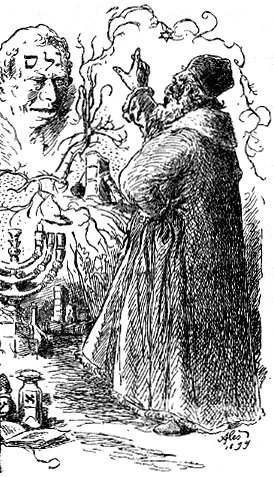
Mikoláš Aleš, “The Maharal of Prague and the Golem,” Květy, 1899: the Maharal conjuring the golem, the letters on its forehead — drawn 290 years after the Maharal's death in 1609. Public domain, via Wikimedia Commons.
Chelm: the golem that grew. Of Elijah of Chelm's golem, the Jewish Encyclopedia tells a short story with a long shadow. The figure, animated by the Shem on its forehead, grew — to be a monster, in the Encyclopedia's word — until the rabbi feared it might destroy the world. At last he extracted the Shem from its forehead, and the golem returned to dust. Later tellings add the machinery a growing story collects: the golem too tall for its maker to reach its brow, and the word emet, "truth," deactivated by erasing its first letter to leave met, "dead." File the additions as a story improving itself. The core is the first full golem tale in the file — a servant that does not stop growing, and a maker who must unmake his own work. Elijah's descendant, the Haham Tzvi, took the account seriously enough to rule on whether a golem counts in a minyan, the prayer quorum (Responsa, No. 93, Amsterdam, 1712).
Prague: the servant, the Sabbath, and the attic. The famous story is set in Prague under Rudolf II, where Rabbi Judah Loew ben Bezalel, the Maharal (c. 1525–1609) is said to have shaped a man of clay from the banks of the Vltava and brought it to life with the Shem. In the tellings the golem is named Josef, called Yossele, and does the household's heavy work. Every Friday afternoon the rabbi removes the Shem from his mouth so that he, like everyone else in the house, rests on the Sabbath. The Jewish Encyclopedia tells the ending: one Friday the rabbi forgot; fearing the golem would desecrate the Sabbath, he ran after it, caught it in front of the synagogue just before the Sabbath began, and pulled the Shem out in haste — and the golem fell in pieces, never to be reanimated. Its remains, the tale says, were carried up into the attic of the Old New Synagogue, where they lie to this day. In the fuller later tellings — above all Yudl Rosenberg's Niflaot Maharal (1909) — the golem's work grows: he defends the ghetto against the blood libel, the false accusation that Jews murdered Christians for ritual purposes. That defender is the golem the modern world knows — and he is the youngest layer of the story. Here the tale must be interrupted by its record, because the gap is the lesson. The Maharal died in 1609. No work of his, of his contemporaries, or of his disciples mentions a golem. The Maharal–golem connection debuts in print in the first third of the nineteenth century — Berthold Auerbach's Spinoza (1837) is the first the scholarship lists — as a domestic servant tale. Rosenberg's 1909 book did the rest: his own stories presented as a discovered manuscript by the Maharal's son-in-law — a framing scholars recognize as a literary hoax — and it is Rosenberg's version that the twentieth century and the films inherited. Prague's golem has two birthdays, and a keeper keeps both: set about 1580; written 1837–1909.
The homunculus: the claim, and the little man in the flask. The claim stands in De natura rerum, "On the Nature of Things," a treatise carrying a dedicatory letter dated 1537 and first printed in 1572 — thirty-one years after its supposed author's death — published under the name of Paracelsus, the physician of Lesson 5. Its first book asserts that a homunculus — a living, miniature, fully formed human child — can be artificially generated and raised. That the claim was published is the fact this lesson teaches. The method claimed is not reproduced here, in summary or in steps: a claim can be filed, dated, and weighed without being handed on as an instruction. The name on the title page can also be weighed, and modern scholarship has found it wanting: Urs Leo Gantenbein's study (Ambix, 2020) concludes that at least three hands wrote De natura rerum, and that its first books — the homunculus book among them — are most likely forgeries of the 1560s. So the homunculus, like the Prague golem, is a made being whose making was backdated — the same keeper's lesson in two traditions.
The homunculus's story proper was written by Goethe. In Faust, Part Two (published 1832), Act II opens in a laboratory, where Wagner — Faust's former assistant, now a master himself — completes the work: in a glass vial, a small luminous figure takes shape and speaks. Goethe's Homunculus is everything the golem is not: bodiless, brilliant, and talkative — a mind without a body, "only half born" in the play's own phrase. He reads the sleeping Faust's dream, leads Faust and Mephistopheles to the Classical Walpurgis Night in Greece, and goes himself in search of a real body; his journey ends in the Aegean, in that search. Goethe took the figure from the Paracelsian tradition — the scholarship names De natura rerum as his main source. Watch the voices from here: silence, then speech in glass, then speech that will not stop until it has been answered.
The creature: the novel, told straight. Mary Shelley's Frankenstein; or, The Modern Prometheus was published anonymously in London on 1 January 1818. Its frame is letters from an Arctic explorer, Walton, who picks up the dying Victor Frankenstein on the ice. Victor, a student from Geneva, assembles a being from dead matter and animates it — and at the moment it opens its eyes, he is disgusted by it and runs away. Everything that follows follows from that running away. The creature, alone, teaches himself the world: sheltering beside a cottage, he watches the De Lacey family and from their speech learns language, then reading — his books are Paradise Lost, Plutarch's Lives, and The Sorrows of Young Werther. Every approach he makes is answered with horror, blows, or a gunshot. He finds Victor and makes the novel's central demand, in reasoned, eloquent speech: benevolent by nature, made miserable by rejection, he asks his maker to create a companion for him and let them disappear where no one will see them. Victor begins the second making, destroys it half-finished before the creature's eyes, and the revenge takes the rest of the book — brother, friend, and bride killed, the pursuit north, Victor dead on Walton's ship — until the creature speaks the last great speech over his maker's body and goes out onto the ice to build his own funeral pile. That is the being as written: the most articulate character in his own book, and the one nobody in it will listen to.
How the telling was then unmade is also part of the tales, because for most of the world the unmaking is the tale. In 1823, Richard Brinsley Peake's melodrama Presumption; or, The Fate of Frankenstein opened in London, with T. P. Cooke as the creature — listed on the playbill not by a name but by a line of dashes, "––––––," a namelessness Shelley, who attended, called rather good. But a melodrama has no room for a reasoned speech, and Peake's creature does not argue: the flattening of the eloquent being into a speechless one begins on that stage, in 1823, not in any film. In 1831 Shelley published her revised edition, with the new Introduction telling the Geneva story — her own account, written fifteen years after the summer, and filed as exactly that. A century later, in 1931, Universal's film Frankenstein, directed by James Whale, fixed the face the world now carries: Boris Karloff, billed in the early publicity as "?", in Jack Pierce's makeup — the head squared and flattened (Pierce's stated reasoning was a surgeon's: the skull sawn straight across, hinged, and clamped), electrodes at the neck, heavy lids. And Karloff's creature, like Cooke's, does not speak — he grunts, gestures, reaches for light, and is answered with fire. Between the novel and the film, the made being lost the one thing Shelley had given him that nobody else in this file has: a voice that could present his own case. Paul Wegener's clay golem of 1920 — Wegener himself in the suit, in a film drawn from Meyrink's 1915 novel and Rosenberg's retelling — fixed the golem's modern face eleven years earlier. The two silent faces are the made beings as the twentieth century received them. The records underneath are older, stranger, and — on one side — more talkative.
KEEPER'S CHECK-IN
The Prague golem has two birthdays — when is the story set, when did it actually reach print, and which 1909 book made the familiar version?
Spotted
For made beings, this section reports where the made ones were said to walk — told as the reports they are. A made being generates no sighting tradition of the kind the fairies did: the file holds three placed settings and one set of visits.
Chelm's market and the rabbi's house. The Chelm tale places its golem in a working household in a named Polish town, growing day by day past the size of a servant into the size of a problem. That is a tale's geography — a setting, not a sighting — filed T.
Prague's ghetto and the synagogue attic. The Prague tales set their golem walking a real geography: the lanes of Josefov, the rabbi's house, the door of the Old New Synagogue — built in the thirteenth century and standing today — at the moment the Sabbath came in. The attic above it is the one place in this lesson where Spotted holds events a keeper can check, because people went up and looked. The tradition says the looking was forbidden — the rabbi who climbed there in the eighteenth century returned, in the telling, pale and shaken. In 1920 the journalist Egon Erwin Kisch got the Jewish community's permission, climbed up, and published his findings in the Prager Tagblatt: beams, gravel, a dead bird, a bat — and no clay body. In the 1980s Ivan Mackerle searched with geological radar and found nothing unusual; a renovation exploration in 2014 found no trace. File the visits F — named men, dated searches, printed results — and their yield S of the emptiest honest kind: the attic, every time, containing an attic. That empty result is the record, for a being whose home was always a book.
The creature's Arctic. Shelley's novel gives its made being a last geography: the ice of the Arctic Ocean, Walton's ship beset in it, and beyond it the Pole, where the creature promises to build his funeral pile. This lesson's map will not pin it — a novel's north is a direction, not a place. It stands here because Spotted's rule is to say where the made ones were said to walk, and what kind of saying it was: T, set in a real ocean. The ice is real. The walker is hers.
KEEPER'S CHECK-IN
What did the searches of the Old New Synagogue attic — in 1920, in the 1980s, and in 2014 — actually find?
What People Watched For — the Psalms Sung Twice
This lesson's box holds a custom, and only a custom. At the Old New Synagogue in Prague, in this one congregation, Psalms 92 and 93 are sung through twice at the Sabbath's opening. Prague City Tourism's official account gives the reason the congregation itself gives, and states that the practice is preserved to this day: when Rabbi Loew, in the tale, had begun the psalms on the Friday he forgot the golem, he had to break off, run out, and stop the golem in front of the synagogue — and when he came back in, he began the psalms again from the beginning. The congregation kept the doubling. That is the whole box: not a creature watched for, but a song sung twice, every week, in one old room in Prague, because a story once interrupted it. The Sabbath-rest tale stands in §3, where tales belong; what stands here is the verifiable residue — a named congregation, a named practice, a dated official source. A custom does not need the tale to be true to be real; it needs people to keep doing it. These people do.
What It Actually Is
There is no animal at the bottom of this file, and no hoax, and no single book. The three records are made of three different real things.
The golem is made of a word, a book, and a community's need. The word is the psalm's: unformed substance, the state before the unmanufacturable part is added. The book is the Sefer Yetzirah and its commentaries, which gave the tradition a textual root to point to — though the little book itself is a cosmology of letters and numbers and contains no golem and no rite. And the need is documented history, not atmosphere: the communities of the tales lived under real accusation, including the blood libel. A people repeatedly accused of secret murders imagined, in print, a protector made from the river bank and a holy word, who could be laid down in an attic when the danger passed — and then, in the Prague case, the imagining was backdated by three centuries and pinned to the community's most famous rabbi. The real root of the golem is not clay. It is the wish, filed under pressure, for strength that could be switched off.
The homunculus is made of a theory of generation, and a forged name. In Paracelsus's century, how life begins was an open question, and the claim that the process could be reproduced by art was a claim about where knowledge ended. Filed under the most famous medical name of the age, it traveled for centuries and fed Goethe's laboratory scene. But the weighing matters: no homunculus was ever produced, and no reliable account of one exists. It is the only being in this unit whose entire record is a claim and its consequences — never spotted, never found in an attic, because there was never anything to find.
Frankenstein's creature is made of a newspaper science and a novelist's decision. The science is documented: in 1803, in London, Giovanni Aldini applied electrical current to the body of an executed man at Newgate before an audience, and the corpse's jaws quivered, one eye opened, a hand rose and clenched — reported in the papers. In the wet summer of 1816, the Villa Diodati party talked late about whether a corpse could be re-animated. Shelley's Introduction of 1831 names the talk: galvanism had given token of such things. Her decision was the literary one, and the root the adaptations cut away: she gave the made being the book's best mind. Set the three roots side by side: the made are ideas that acquired bodies in print — each era's account of what it would mean to make a person, written in the materials that era feared and hoped with: sacred letters, generation-theory, electricity. That is the keeper's reading; your assignment will ask you to test it, not copy it.
Still With Us
The made beings never left.
Prague keeps its golem in public. The Old New Synagogue stands at the center of the Jewish Quarter's visitor routes, its attic still closed and still pointed out; the Maharal's tombstone in the Old Jewish Cemetery receives its visitors' pebbles; the rabbi has his bronze statue by Ladislav Šaloun near the New City Hall, put up in 1910 — one year after Rosenberg's book, which is the correct order of cause and effect — and the golem is sold on every lane in Josefov: clay figurines, golem-shaped biscuits, guided walks. A story that reached print in the nineteenth century is now part of how a city presents its thirteenth-century synagogue. The keeper files that without sneering: the record became a tale, and the tale became a city's furniture.
The words went further than the statues. When a new technology arrives that people experience as a made thing with a mind of its own, the language reaches — in print, on the record — for this lesson's file. In 1965, at the dedication of the Weizmann Institute's new computer, Gershom Scholem, the great scholar of the golem tradition itself, explained his proposed name for the machine: Golem Aleph, Golem Number One — and closed by telling golem and creator alike to develop peacefully and not destroy the world. In 1984 Isaac Bashevis Singer, asked about the computers and robots of the time, answered with a question: what were they, if not golems? In March 2023, in "The AI Dilemma," Tristan Harris and Aza Raskin coined "Golem-class AIs" for the new generative systems — built from language, like the figure animated by letters. In 2025 Michael Rosen's Like Silicon from Clay read AI through the golem tradition at book length. The creature's file traveled the same road in the other direction — the maker's name attached to everything made that frightens its makers. In 1992 a letter to The New York Times coined "Frankenfood" for genetically engineered crops, and the word outran the letter within the year; the Science Museum records that when laboratory fertilization of a human egg was first reported, the Times headline reached for the same name.
And the creature himself is now the template: the assembled body, the awakening, the maker's recoil, the creation's return with a grievance and a case to argue — Shelley's pattern of 1818, reused most often in its flattened film form. Unit I ends here: you began with a lion everybody drew and nobody had seen; you end with beings nobody has seen because there was never anything to see — only records. A record is a thing made by hands, at a date, out of older records — and sometimes the record is about making, and the hands are inside the story too.
Guided Observation
This lesson hangs two plates, two different kinds of lateness.
First, Aleš's Maharal and golem (1899): an illustration made for a magazine story, for readers who already knew how it went. Look at what Aleš gives the golem: not a body at work but a face emerging — clay, smoke, and the letters on the forehead, over the books and vessels below. Then do the keeper's arithmetic: the Maharal died in 1609; the drawing is dated 1899. Write down what a picture made two hundred and ninety years after its scene can be evidence of — and what it cannot.
Second, von Holst's frontispiece (1831): the first image bound into an edition of Frankenstein. Look at the creature: long-limbed, wild-haired, one arm raised at the first moment of movement — and Victor, small in the doorway, already leaving. Shelley's text gives the creature yellow skin drawn tight over the workings beneath, lustrous black hair, teeth of a pearly whiteness. Write down two things in Holst's figure that come from the text, and one thing the stage melodramas of the 1820s had already taught his audience to expect. Then answer in your margin: each plate fixed a face for a being whose record contains no witnessed face at all. What is a reader trusting, when they trust a frontispiece?
Assignment Manual
✎ WRITTEN · ⚒ HANDS-ON · ◐ BOTH
✎ Written, with a table to draw · Entry No. 6: The Made.
- Rule your entry page. Turn to the Scholar's Entry Page in this packet and rule the next page of your journal to match it.
- Write the entry, to the standard. The Creature: the made as a kind — maker, material, and a result the maker did not intend — with the three records in a paragraph each. First Told: the golem's paper trail in order — Psalm 139; Sanhedrin 65b at its true size; the Sefer Yetzirah as root-text, text and history only; Chelm as first named maker — then the homunculus claim (dated 1537, printed 1572, under Paracelsus's name) and Frankenstein (London, 1818, anonymous). The Tales: Chelm's growing golem; the Prague tale whole — Josef, the Sabbath rest, the forgotten Friday, the attic — with its record (1609, 1837, Rosenberg 1909) filed facing it; Goethe's Homunculus; the creature as Shelley wrote him, and the unmaking of 1823, 1831, and 1931. Spotted: the three settings, marked as settings, and the attic visits with their findings. What It Actually Is: the three real roots. Still With Us: Prague today; the documented usages; the creature as template. The Keeper's Line: your own judgment, in one or two lines.
- Draw the table of the three records. ◐ On a fresh page, rule three columns — Maker · Material · Voice — and three rows, one for each made being, and fill them from the records: who made it (with the record's own doubts attached), what it was made of, and what it could say. The voice column is the lesson in miniature: the golem, silent; the homunculus, speaking from his flask; the creature, eloquent — with, in brackets, what the adaptations did to the third row.
- Mark every line. T, S, or F, as always — and this entry has two testing seams. Rabbi Loew made a golem may not be marked F: what is F is the story reached print in the nineteenth century, and Rosenberg's book of 1909 made it famous — the tale is T, the lateness is F, and the entry must show both marks on facing lines. Likewise the homunculus: mark F the publication (1572, under Paracelsus's name), with the scholarship's verdict on the attribution beside it. Your S marks will fall on the attic visits alone — lines that record that nothing was found, which is a finding.
Materials
· Your creature-guide journal, with the earlier Unit I entries in it
· Pencils, and a pen you like
· A ruler — this lesson's table wants ruled lines
· This lesson's packet (the Scholar's Entry Page is in it)
Reflection
The Maharal's golem reached print more than two hundred years after his death. Does the lateness weaken the story, or tell you what the story is for? For whom was it written in 1837, and for whom in 1909? Answer with the dates in your answer.
The three records test their made beings three ways: the Talmud's man fails at speech, Goethe's Homunculus speaks but has no body, Shelley's creature speaks and is never heard. Which test is our own age running on the things it makes now — and what in §6 supports your answer?
Two modern usages in §6 lend a made being's name to a technology; one lends a maker's. What is lost when the name travels — and does the loss matter, if the warning still lands?
Cross-Class Connections

A word from the Creative Arts Workshop, keeper to keeper. Your lesson is about beings that were made — clay given a word, and the word given work to do. I spend my days on the other side of that story: hands in clay, making things that hold their shape when the water dries. A golem is a potter's question before it is anyone else's — how much of the maker goes into the made thing, and what does the made thing owe back? Come down to my workshop, work through the clay of Unit V, and you will read the Maharal's entry with different eyes.
Bench rules, because they are mine and they do not bend: tools down when you are spoken to, slabs rested before they are joined, and nothing rushed that is still wet. What is made in a hurry cracks in the drying — in Prague as surely as at my bench.
The clay work is Unit V — Clay & Garden, in the Creative Arts Workshop. The door stands open.
Creative Arts Workshop
Master Artisan, Head of House Occidens
A Closing Note
This file closes the last shelf of Unit I: the beings who were made, filed beside the beings who were systematized, the helpers who were fed, the folk who were hidden, and the lion who was drawn from drawings. You have the method whole now — trace the record, date every hand it passed through, mark every line, and let an empty shelf say what an empty shelf says. There is a quiz at the end of this packet, and it asks nothing you have not already done with your own hand.
The Bestiary
Bestiary Keeper
Further Reading & Sources
Psalm 139:16 — the word golem (golmi, "my unformed substance").
Babylonian Talmud, Sanhedrin 65b — Rava's created man, in the Sefaria translation (sefaria.org).
Sefer Yetzirah (the Book of Formation) — the tradition's root-text; Gershom Scholem, Kabbalah (Keter, 1974), gives the dating debate. Reported here as text and history only.
The Jewish Encyclopedia (1901–1906), entry "Golem" — Chelm, the growing golem, the Prague tale, and the Haham Tzvi's ruling (jewishencyclopedia.com).
Curt Leviant (trans.), The Golem and the Wondrous Deeds of the Maharal of Prague (Yale University Press, 2007) — Rosenberg's 1909 Niflaot Maharal in English.
Edan Dekel & David Gantt Gurley, "How the Golem Came to Prague," Jewish Quarterly Review 103.2 (2013).
Urs Leo Gantenbein, "Real or Fake? New Light on the Paracelsian De natura rerum," Ambix 67.1 (2020).
Johann Wolfgang von Goethe, Faust, Part Two (1832), Act II — Homunculus.
Mary Shelley, Frankenstein; or, The Modern Prometheus — the 1818 text; the 1831 edition for the Introduction and von Holst's frontispiece.
Science Museum, London, "The science behind Mary Shelley's Frankenstein" — Villa Diodati, Tambora, and Aldini's 1803 demonstration.
Prague City Tourism, "The Old-New Synagogue, resting place of the mythical Golem" (prague.eu, 2025) — the attic searches and the doubled psalms.
### Images
Hero: `be-rf-made-frankenstein-holst-1831.jpg` — Theodor von Holst, frontispiece to the revised edition of Frankenstein (London, 1831), engraved by William Chevalier. Public domain (PD-Art), via Wikimedia Commons.
Support: `be-rf-made-golem-ales-1899.jpg` — Mikoláš Aleš, "The Maharal of Prague and the Golem," Květy, 1899. Public domain (PD-Art), via Wikimedia Commons. Small file (274×477) — support only.
Described, not hung: Wegener's golem (1920) — stills documented, not downloaded: split status (PD in the USA; named rights holder in Germany). Karloff's creature (1931) — in copyright; §3 only.
Map: `be-u1l6-map-timeline.png` — pins per the research file.
Full audit: `MANIFEST-made.md`, in the plates folder.
The Unit I Quiz
The Unit I Quiz checks the whole of the unit — Lessons 1–6, from meeting the creatures to the beings made by hands — and its answers and self-check stand at the back of the quiz packet, so you can mark your own work the keeper's way. Take it with your bestiary beside you, Entries No. 1–6 open: everything it asks for is work your own hand has already done.
Download the Unit I Quiz (PDF)
Submit your work for this lesson using the form below.
CONTINUE IN THE BESTIARY HALL
← Previous · Lesson 5: The Elementals of Paracelsus Next · Lesson 7: The Unicorn →
Unit I — Meeting the Creatures The Bestiary Hall — All 41 Lessons
The rest of Unit I: Lesson 1 · Meeting the Creatures · Lesson 2 · Fairies · Lesson 3 · The Hidden Folk · Lesson 4 · Brownies & the Household Helpers · Lesson 5 · The Elementals of Paracelsus