
THE BESTIARY
Unit I · Lesson 3The Hidden Folk
Professor Sable Rookmere
Bestiary Keeper
The Bestiary Hall • School of Evershade
Professor's Introduction
The fairies had queens, courts, and finally photographers. Their cousins in this lesson are older and quieter: a hidden people with farms and churches of their own, who in one country are still consulted before a road is dug. I keep this entry in mind whenever someone assures me the old beings were all small and harmless. These were not. Three families share this entry. They are kin, but they are not the same being, and the keeper who blends them has stopped keeping.
The Bestiary
Bestiary Keeper
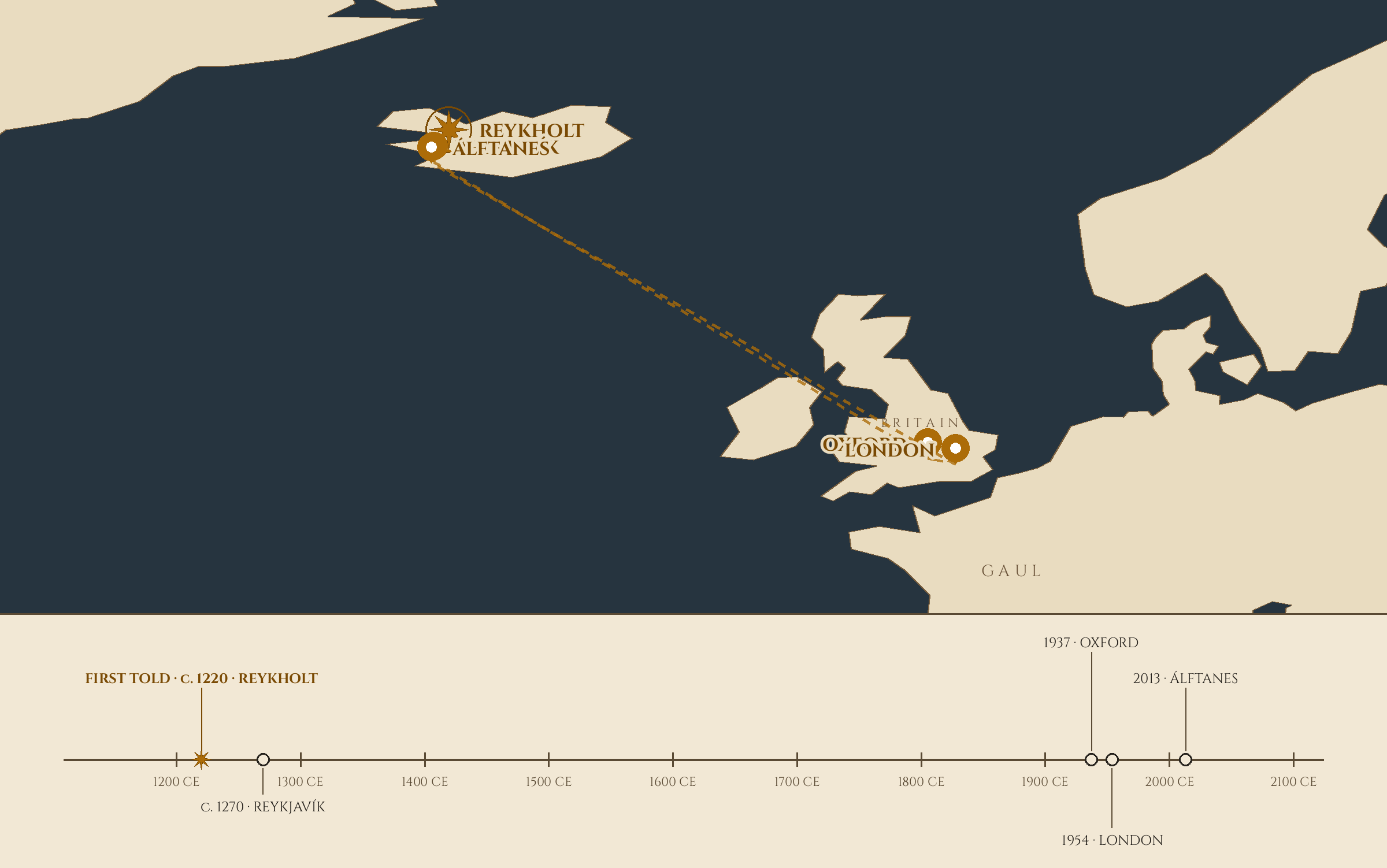
Where this lesson travels: Reykholt, where Snorri Sturluson wrote the Prose Edda (c. 1220) and set Álfheimr and the light-elves and dark-elves in order — the poems behind him are older; Reykjavík, where those poems were written down in the Codex Regius (c. 1270); Oxford, where J. R. R. Tolkien published The Hobbit in 1937 and the tall, grave elf entered modern storytelling; London, where The Fellowship of the Ring was published in 1954; and Álftanes, where road works at Gálgahraun were halted and redesigned around the elf rocks in 2013. The starred pin is the first record; the dashed line is the telling, traveling.
Lesson Objectives
By the end of this lesson, you will be able to:
- Name the three families gathered in this lesson — elves, pixies, and leprechauns — and the record each one stands on.
- Describe the hidden folk as their records give them, and follow their pictures from an eighth-century carving to a 1906 nursery plate.
- State what Snorri Sturluson set down about the elves around 1220, and why the older poems behind him matter to the record.
- Tell who Völundr is in the elf record, and what elf-shot meant to the people who used the word.
- Trace the leprechaun from an eighth-century water sprite to a solitary shoemaker.
- Give the dated reports: the álfablót of about 1018, Árnason's collected encounters, and the Icelandic surveys in which about one Icelander in twenty says they have seen an elf.
- Name the custom of the álagablettur, and tell what happened to a road at Álftanes in 2013.
- Write Entry No. 3 in your bestiary — three families, kept unblended — marking every line T, S, or F.
Your Assignment Packet
This lesson's work lives in its packet: the Lexicon Handout (every term, the core terms marked with the keeper's diamond ◆), Materials, Guided Practice, the Assignment Manual written out whole, the Scholar's Entry Page, the Reflection Questions, the Workbook Checklist, and the Keeper's Notes, for whoever teaches the lesson. Download the packet before you begin and keep it beside you as you read. The packet's assignment is Rookmere's own word for the work: Entry No. 3 — The Hidden Folk (written and hands-on) ◐. The Unit I Quiz is not printed in the packet; it waits at the end of the unit, with Lesson 6.
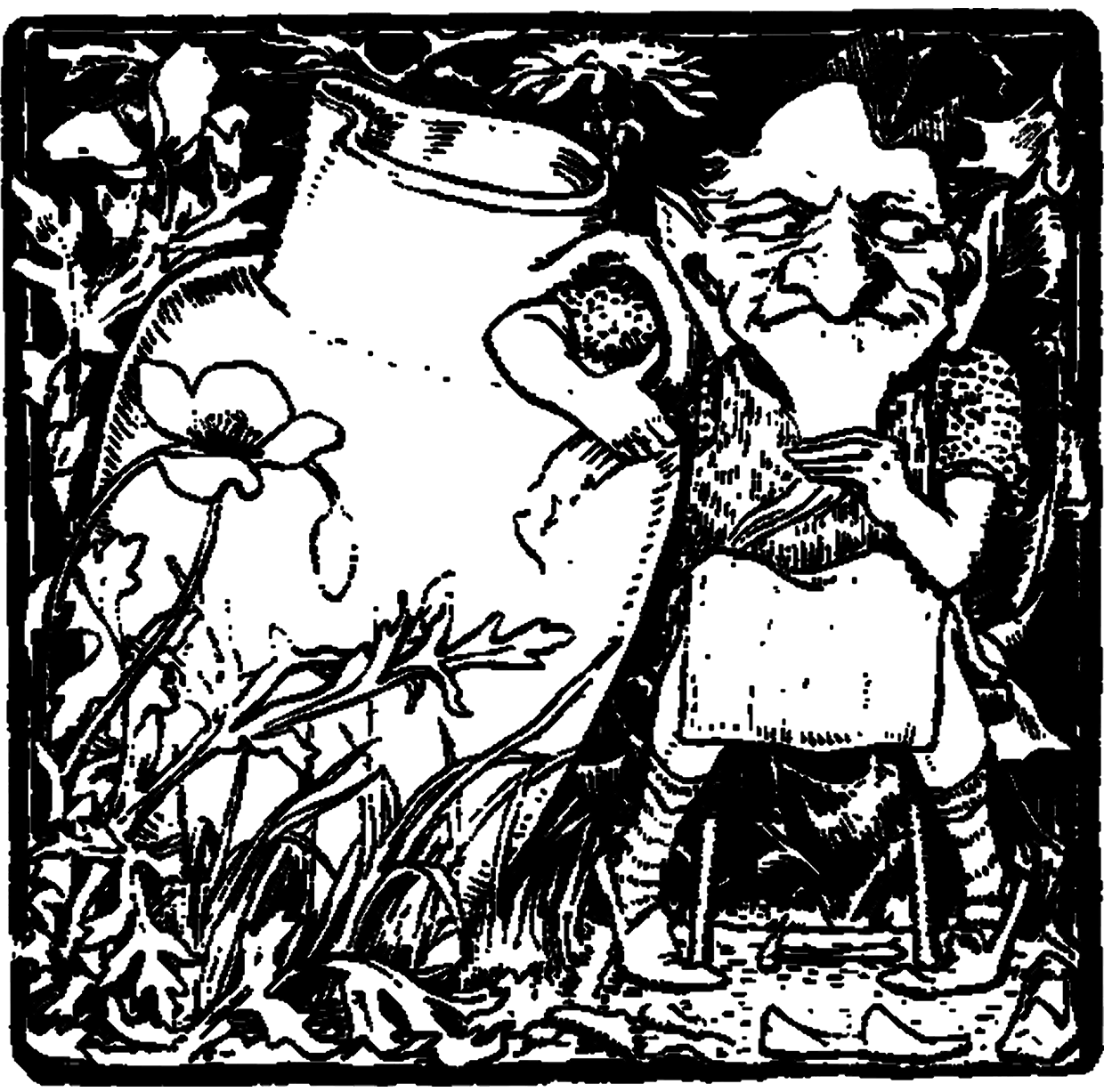
“A Leprechaun or Clurichaun” — the leprechaun's first book life, from T. C. Croker's Fairy Legends and Traditions of the South of Ireland (first published 1825; illustrated edition, 1862). Public domain, via Wikimedia Commons.
The Creature
The elf is the English form of a word the whole North once used: Old English ælf, Old Norse álfr. Wherever the word traveled, it named a people — powerful, long-lived, and near at hand: in the next field, the next hill, the rock at the pasture's edge. Iceland's name for them is the plainest description any being in this class receives: huldufólk, the hidden people. In the tales collected there, they keep farms, cattle, and churches of their own, a whole country running beside the visible one and mostly content to be left alone in it.
Note, before the record even opens, what the oldest witnesses do not say. They do not say small. The elves of the early record are a people the size of people — smiths, healers, powers — and if that surprises you, hold the surprise. It is evidence of how completely a later century's small fairy has overwritten an older file. This lesson reads the file from the front.
The lesson gathers three families under one roof, because later tradition mixed them so thoroughly that a keeper must learn to unmix them: the elves themselves, on their Norse and English record; the pixies of England's southwest, on a record gathered mostly in the nineteenth century; and the leprechauns of Ireland, whose written life is the oldest of the three families after the elves — and the most changed by it.
Their pictures tell the same uneven story. The earliest picture in this file is not a painting at all: it is a carving. The Franks Casket, a box of whale's bone made in Northumbria in the first half of the eighth century, carves Völundr — the elves' great smith, whom you will meet in the Tales — at his forge, a skull-cup in his tongs, his brother catching birds beside him for the wings of his escape. This lesson's plate of it is a drawing published in the Encyclopædia Britannica in 1911, and even that double distance is instructive: the elf enters the picture record as a carving five centuries older than the book that arranged his kind. The leprechaun's first book picture is the hero plate here, from Croker's Fairy Legends (1825; the illustrated edition of 1862): a solitary tradesman at his bench. The pixies, collected in print only in the 1830s, have no early pictures at all — everything drawn of them is later illustration, and the lesson says so rather than pretending a longer line. And the modern plate, Rackham's Kensington Gardens fairies of 1906, shows where part of the family ended up: small, graceful, and urban, in a London park.
First Told
✦ On the class test
Around 1220, in Iceland, a chieftain, poet, and historian named Snorri Sturluson sat down at his farm of Reykholt to write the Prose Edda — a handbook of the old Norse stories, set down so that poets could go on understanding the verses built on them. In its opening part, the Gylfaginning, Snorri gives the elves their fixed address and their two kinds. Álfheimr, Elf-home, is one of the worlds, and it belongs to the light elves, who are, in Snorri's words, fairer than the sun to look at. Against them he sets the dark elves, who live down in the earth and are blacker than pitch. (His later pages name black elves too, where the kinds blur toward the dwarfs — record-keepers have argued the seam ever since.)
Look at the map at the head of this lesson. The starred pin stands at Reykholt: the first telling set in order, as always. But this lesson's star carries Lesson 1's caution in its strongest form. Snorri is not the beginning of the elves; he is their first great arranger, writing two hundred years after Iceland had formally taken a new religion, organizing poems and beliefs that were old when he was young. The poems behind him survive in the Poetic Edda, written down in the manuscript called the Codex Regius about 1270 — the map's second pin — but composed long before. One of them, the Grímnismál, already knows Álfheimr: it was given to the god Freyr as a tooth-gift, a present for a child's first tooth, in the days of old. So who invented the elf? No one person did: the belief and the poems came first, nameless and many-handed, and Snorri — a named man, at a named farm, in a datable decade — is where the file becomes a record a keeper can cite.
From Snorri's Iceland the two branches of the record run very differently. In England, the elves dwindled — but they begin there as powers on the page. The poem Beowulf lists the ylfe among the kin of Cain, set down with giants and the strange orcneas in the monster-kindreds of the world, and Old English medicine knew them as powers worth charms and leechcraft. By the time of the theaters, the English elf had slid down the scale toward the fairy of the last lesson — a small, tricksy sprite, fit for a stage wood. The word stayed; the being shrank inside it.
In Iceland, nothing shrank. The huldufólk kept their size, their farms, and their tempers through century after century of tales. The tales give them a calendar as well as a country: the hidden people are said to move house at the New Year, traveling between their dwellings while the human year turns — one more entry in a whole parallel order of life, with its own seasons and removals. And when the great collecting age came, the folklorist Jón Árnason gathered them by the hundred into his Icelandic Legends (1862–64) — the hidden people at full stature, in their own country, in the age of the railway.
The other two families got their collectors in the same decades. England's pixies step into print in force in the 1830s, when Anna Eliza Bray wrote down the traditions of Devon. Ireland's leprechaun had been in writing far longer — eight centuries longer — but as a different being entirely, and it is the collectors of Croker's generation, in the 1820s, who fix the form the world now knows. Three families, then, each arriving in print at its own speed. That uneven growth — three records running at three speeds — is what this lesson has to hold, without smoothing it flat.
The Tales
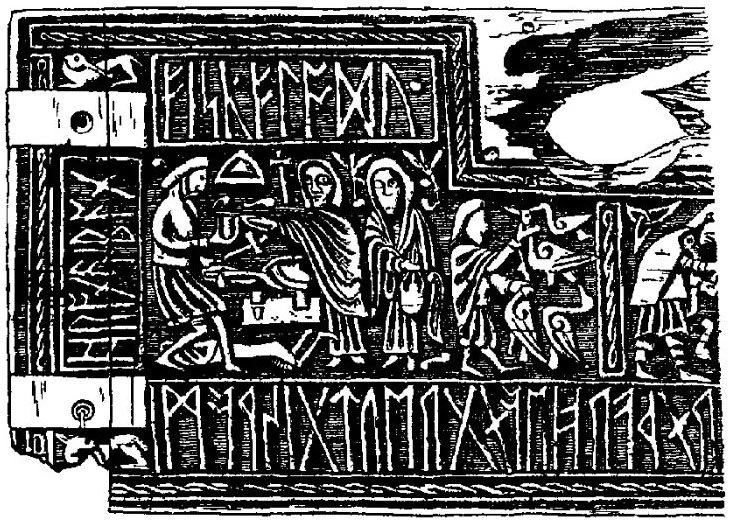
Völundr, prince of the elves, at his forge — a drawing (Encyclopædia Britannica, 1911) of the Franks Casket panel, carved in Northumbria in the first half of the eighth century: the earliest picture in the elf file. Public domain, via Wikimedia Commons.
The elves. The old poems give the álfar a smith at their head: Völundr, the master craftsman of the Völundarkviða, called in the poem a prince of the elves — a maker of treasures, maimed by a greedy king, who takes a terrible revenge and flies away on wings of his own making. It is Völundr whom the Franks Casket carves, five centuries before the poem was written down: the tale was old, and pictured, before it was ever a text a keeper could shelve. Beside the smith stand the healers' records. In Old English medical books, a sudden pain — a stitch in the side, a stabbing in the limbs — could be diagnosed as elf-shot: an invisible arrow from an elf's bow, and the leechbooks preserve charms and remedies against it. Whatever a modern reader makes of the diagnosis, the record of it is careful, practical writing by people treating real pain with the best theory they had.
The pixies. In Devon and Cornwall the piskies — as Cornwall spells them — are the small people of the moors and lanes, and their best-recorded habit is a mischievous one: leading travelers astray. To be pixie-led was to lose a road you knew, at dusk, and walk in circles until you sat down in despair or thought of the counter-charm the tradition prescribes: turn your coat inside out, and the spell of the leading breaks. Bray's Devonshire collections of the 1830s are full of them — no queens, no courts, just the small neighbors and the trouble they cause within a mile of home.
The leprechauns. The first leprechauns in writing are nothing like the figure on a cereal box. In the Old Irish tale Echtra Fergus maic Léite — the Adventure of Fergus son of Léite, whose language dates it to the eighth century — the lúchorpáin, "small bodies," are water sprites. They fall upon King Fergus asleep on the shore of Lough Rudraige and try to drag him into the water; he wakes with his hands full of them, and the captives buy their freedom with a gift. The pattern that will define the being — catch one, and bargain — is already there, in a band of water people, eleven centuries before the green coat. By the time Croker's Fairy Legends and Traditions of the South of Ireland appears in 1825, the transformation is complete: the leprechaun is solitary now, a shoemaker forever at work on one shoe, with a hidden crock of gold and one unbreakable rule — hold him in your sight and he must deal with you; glance away, and he is gone. This lesson's hero plate is his first book life: A Leprechaun or Clurichaun, from Croker's illustrated edition. The clurichaun, named here from that same plate, is the leprechaun's cellar-haunting cousin, said to guard wine, ride sheep and dogs by night, and keep worse hours than his relative. Spend a moment with the plate before you move on. The engraver draws his figure the way the tales describe him: a solitary tradesman at work on a single shoe — no crown, no wand, nothing grand about him at all. After the queens of the last lesson, that plainness is worth noticing. Ireland's most famous small being earned his place in the file at a workbench.
KEEPER'S CHECK-IN
What was elf-shot, what breaks a pixie-leading, and what happens if you glance away from a leprechaun you have caught?
Spotted
The hidden folk were also met — or so the reports say — and this file's reports begin remarkably early. A skaldic poem of about 1018 records a Swedish household turning a traveling poet away from the door because the women were holding the álfablót, the sacrifice to the elves, and no outsider could be admitted. The poet was Sigvatr Þórðarson, the poem is the Austrfararvísur, and the report is a practical one: not "I saw an elf," but "the elves were being attended to tonight, and the door was shut." That order — people doing something about the elves long before anyone sat down to arrange them into a system — turns up again and again in this class: the practice was there first, and the system came last.
The encounter tales themselves were gathered at full strength in the nineteenth century. Jón Árnason's Icelandic Legends (1862–64) are full of them: the hidden people met on roads, seen at their farms and churches, bargained with, offended, and propitiated — reported by named tellers in named districts, in the age of the railway. A keeper files them as S: reports, carefully kept, of meetings the tellers believed had happened.
And the reporting has a modern, measurable form. In 1974 the psychologist Erlendur Haraldsson surveyed Icelanders on their beliefs: 5 percent of respondents said they had actually seen an elf, 7 percent were certain elves exist, and a third held it possible. A newspaper poll in July 1998 (Dagblaðið Vísir) found 54.4 percent answering yes to believing in elves — belief, note, not sighting; the two are different marks and a keeper does not merge them. When the University of Iceland ran the survey again in 2006–07, the sighting figure stood where it had stood thirty years before: about 5 percent said they had seen one, and more than half entertained the possibility. Whatever stands behind those answers, the answers themselves are a record — steady, dated, and collected by named researchers — and they are why this lesson's beings, alone in Unit I, are still consulted before a road is dug.
KEEPER'S CHECK-IN
What did Sigvatr's shut door of about 1018 report, and what share of Icelanders — in 1974 and again in 2006–07 — said they had actually seen an elf?
What People Watched For — The Enchanted Spot
Icelanders have a word for the practical heart of this lesson's belief: an álagablettur, an enchanted spot — a particular rock, hill-face, or patch of ground that is under a ban. You do not dig it, blast it, mow it, or build on it, because something lives there, and the something is a neighbor. The folklore collections record the belief in full; the modern record shows the custom still at work, in the plainest possible form: roads in Iceland curve around particular rocks, and building plans are redrawn around them.
Its test case is on this lesson's map, the last pin. In 2013, road works across the Gálgahraun lava field at Álftanes, near Reykjavík, were halted and designed again around the elf rocks after protests — the enchanted spot, defended in the century of the bulldozer. It is not the only road in Iceland that bends. At Álfhóll — Elf Hill — in Kópavogur, the road narrows and curves to pass a low rock the crews built around rather than through, and the rock stands protected in the street's own plan. Nobody issued a law for these places. The custom did the work a law would do, and the map of Iceland's roads is, in a small and literal way, partly drawn by the hidden people. Note what the record does and does not say. It does not say that Icelanders, as a nation, hold one belief: surveys that ask find most people unwilling either to swear by the huldufólk or to swear against them. It says the custom holds — that a warned-of rock gets left alone, by believers and skeptics together, because leaving it alone is what is done. A custom does not need every hand that keeps it to believe. It needs only to be kept.
What It Actually Is
Part of this record left physical evidence behind, and it is still turning up in plowed fields. The arrows of elf-shot were not imaginary to the people who feared them: across Britain, Neolithic flint arrowheads — worked stone points thousands of years old — came up under the plow and were gathered as elf-bolts, the spent missiles themselves, proof you could hold in your hand. Flint knaps to a razor edge, and the Neolithic hunters and farmers who worked it in Britain, roughly between 4000 and 2500 BCE, shaped it into leaf-like and barbed points fitted to wooden shafts. The points outlasted the shafts, the hunters, and every language ever spoken over them. The root runs the other way, of course: the arrowheads are real, and far older than the belief; they are the cast-offs of Stone Age hunters, not of elves. But find a sharp stone point in a field where no battle was ever recorded, in a world where sudden pain also arrives from nowhere, and the explanation writes itself. The keeper's phrase for this is worth learning: the record is the evidence misread honestly.
For the álfar themselves, scholars have long offered a reading — and it is offered here as a reading, not a root you can dig up: that the hidden people began, in part, as the honored dead, the ancestors of the farm, kept in their mounds and consulted at their sacrifices. The álfablót of 1018 fits that reading; so does the huldufólk's attachment to particular farms and rocks. What is certain is the ground itself. The elves' homes in the record are real, findable places — named rocks, hills, and lava fields — and the custom of the álagablettur has kept those places unquarried and unbuilt into the present day. Whatever the beings are, their addresses have outlasted most human buildings in Iceland.
Still With Us
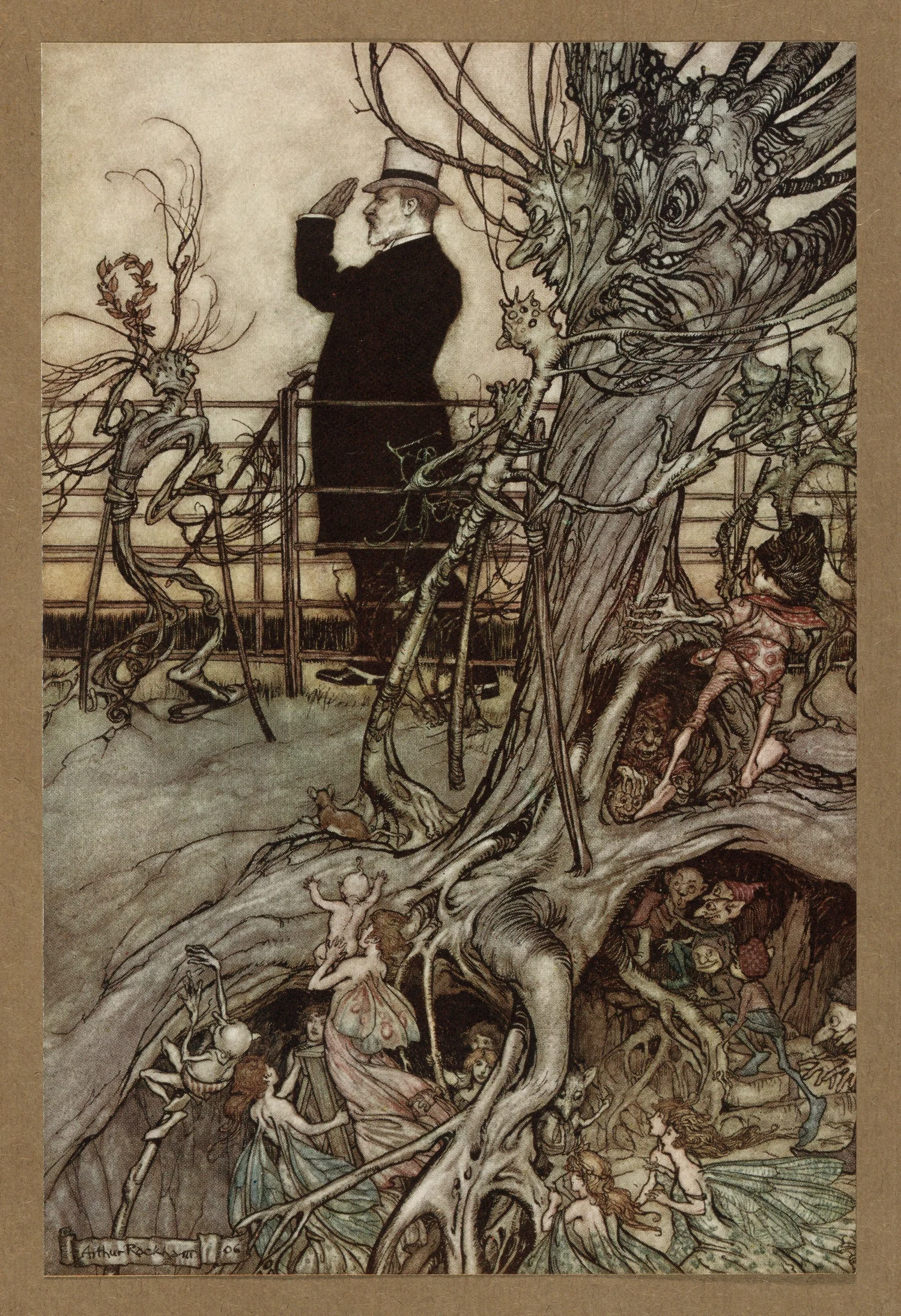
Arthur Rackham's plate for Peter Pan in Kensington Gardens (1906): London's fairies in their park — the hidden folk drawn small, graceful, and urban. Public domain, via Wikimedia Commons.
The modern elf has two faces, and this lesson's map ends holding both. The first is a reconstruction. J. R. R. Tolkien was a philologist — a professor of the very languages this lesson began with — and when he came to write the elves of The Hobbit (1937), he did not take them from the nursery shelf. He took them from the old books: from Beowulf's list of Cain's kin, from the Norse álfar, from the grave, tall, long-lived people behind Snorri's summaries. In The Fellowship of the Ring (1954) the restoration stands complete: elves older than kingdoms, fair and sorrowful and dangerous to meet. Nearly every elf in modern storytelling walks in that restored shape — a scholar's reading of the record, become the record's most famous page.
The second plate in this lesson shows the other road the family took. Arthur Rackham drew the fairies of Kensington Gardens for Peter Pan in Kensington Gardens in 1906 — London park fairies, small and graceful among the leaves and blossom of a city garden, drawn for nursery readers. Set that picture beside Snorri's sentence about light elves fairer than the sun, and the entry's whole difficulty stands in two glances: one family name, carried by beings who share almost nothing but the name. The Guided Observation will make you do the comparison properly.
The second face never needed restoring. In Iceland the huldufólk went on being neighbors: elf houses stand by roadsides, the roads bend at Álftanes as this lesson's map shows, the surveys still find their five percent who say they have seen one, and the enchanted spots still get their fence and their courtesy. The fairies of the last lesson ended their record, for now, as a sparkle in a nursery. The hidden folk end theirs as a planning consideration. A being's modern face is whatever its record has been carried into — and carrying is done by people, in print, in custom, or not at all.
Guided Observation
This lesson's hero plate is the leprechaun's first book life: A Leprechaun or Clurichaun, from the illustrated edition of Croker's Fairy Legends (1862). Read the figure as a keeper reads any plate — as a claim. What trade does the picture give him, and what tools prove it? What is he making, and how many of it — and what does the folklore say about that number? Does the engraver draw him as a power, a joke, or a tradesman? Then turn to the oldest picture in the file: the drawing of the Franks Casket panel (carved in the eighth century, drawn for the Encyclopædia Britannica in 1911), showing Völundr at his forge. What is he holding, and what is his brother doing at the panel's edge? Set both beside Snorri's prose — light elves fairer than the sun. Same family, in the record's long view; nothing like each other, in the pictures. Write down two details from the Croker plate that come straight from the tales, one detail from the casket drawing that comes straight from Völundr's story, and one detail from Rackham's Kensington plate (1906) that could only come from the nursery century. A plate is a record of its maker's century as much as of its subject.
Assignment Manual
✎ WRITTEN · ⚒ HANDS-ON · ◐ BOTH
◐ Written and hands-on · Entry No. 3: The Hidden Folk.
- Rule your entry page. Rule a fresh page to match the Scholar's Entry Page, and add the hidden folk to your contents page — elves, pixies, leprechauns, each with the year of its own first telling.
- Write the entry, to the standard, keeping the families apart. The Creature: the three families as their records describe them, and their pictures — the casket carving, Croker's leprechaun, Rackham's park fairies — with dates. First Told: Snorri's Prose Edda — who wrote it, where, roughly when, and what it fixes about the elves. The Tales: the three families in their kinds — Völundr and elf-shot; the pixies and the inside-out coat; the lúchorpáin of the eighth century and the shoemaker they became. Spotted: Sigvatr's shut door of about 1018; Árnason's collected encounters; the survey line — 5 percent who say they have seen one, in 1974 and again in 2006–07. What It Actually Is: the flint elf-bolts, and the ancestors reading, marked as a reading. Still With Us: Tolkien's restoration, and Iceland's unbroken custom — two faces, both named. The Keeper's Line: your own judgment, in one or two lines.
- ⚒ The enchanted spot. Walk ground you know well — a garden, a park, a street you use daily — and find the place that is already kept the álagablettur way: the corner no one mows, the rock no one moves, the tree the path bends around. You are looking for the custom, not the belief: a spot left alone by unspoken agreement. Record it in your notes with a keeper's sentence — where it is, what is not done there, and who keeps it so. Look only. Move nothing; that is rather the point of the custom.
- Mark every line. T for a tale, S for a sighting or report, F for a verifiable fact, through the whole entry — and check your three families as you go. If any line could belong to any small people anywhere, it belongs nowhere yet: give it its family, its place, and its date, or cut it.
The printable packet for this lesson — the Lexicon Handout, the Guided Practice, this manual, and the Scholar's Entry Page — is linked on this page.
Materials
· Your creature-guide journal or notebook — kept for the whole class
· Pencils, and a pen you like
· A ruler, for ruling your entry pages
· This lesson's packet (the Scholar's Entry Page is in it)
Reflection
Snorri arranged the elves two hundred years after his country had formally changed its religion. What does a record owe to beliefs its writer no longer holds?
The fairies shrank on the English stage; the huldufólk did not shrink in Iceland. What in each country's record kept one small and the other full-sized?
Your enchanted spot: is leaving a place alone a belief, a custom, or a courtesy — and does the distinction change how a keeper writes it down?
A Closing Note
Three families, one entry, no blending — that was the discipline, and you have it. Next lesson the record comes indoors, to the beings who worked for their porridge and left when they were thanked wrong: the brownies and the household helpers. Mind how you speak of the help, between now and then. They are, by every account in the file, excellent listeners.
The Bestiary
Bestiary Keeper
Further Reading & Sources
Snorri Sturluson, The Prose Edda (trans. Jesse L. Byock, Penguin, 2005) — Álfheimr, the light elves and the dark.
The Poetic Edda (trans. Carolyne Larrington, Oxford University Press, 2014) — the older poems behind Snorri, Völundr among them.
Jón Árnason, Icelandic Legends (Íslenzkar þjóðsögur og ævintýri, 1862–64) — the huldufólk collected at full stature.
T. Crofton Croker, Fairy Legends and Traditions of the South of Ireland (1825) — the leprechaun's book life begins.
Anna Eliza Bray, Traditions, Legends, Superstitions, and Sketches of Devonshire (1838) — the pixies written down.
Echtra Fergus maic Léite (The Adventure of Fergus son of Léite) — Old Irish tale, language of the eighth century: the lúchorpáin.
Valdimar Hafstein, "The Elves' Point of View," Journal of Folklore Research (2000) — the Icelandic surveys, including Haraldsson's of 1974, summarized.
Katharine Briggs, The Vanishing People: A Study of Traditional Fairy Beliefs (Batsford, 1978).
Submit your work for this lesson using the form below.
CONTINUE IN THE BESTIARY HALL
← Previous · Lesson 2: Fairies Next · Lesson 4: Brownies & the Household Helpers →
Unit I — Meeting the Creatures The Bestiary Hall — All 41 Lessons
The rest of Unit I: Lesson 1 · Meeting the Creatures · Lesson 2 · Fairies · Lesson 4 · Brownies & the Household Helpers · Lesson 5 · The Elementals of Paracelsus · Lesson 6 · The Made