

THE BESTIARY
Unit I · Lesson 4Brownies & the Household Helpers
Professor Sable Rookmere
Bestiary Keeper
The Bestiary Hall • School of Evershade
Professor's Introduction
The beings in this lesson are the closest to home of any on our shelf. They did not live in forests or in the sea. They lived in the kitchen, the barn, and the mine — wherever work was left unfinished at dark and found finished at dawn. That makes their record a comfortable one to read, and an easy one to read carelessly.
Read it the keeper's way anyway. A bowl of cream on a hearth is a small thing, but it is evidence: somebody set it there, on purpose, for centuries. This lesson asks who, and when, and what they were watching for. I have read this file in collectors' notebooks, in farmhouse kitchens, and once in a mine office with the rain coming down outside, and the shape of it never changes: work left ready, a bowl set out, nobody watching.
The Bestiary
Bestiary Keeper
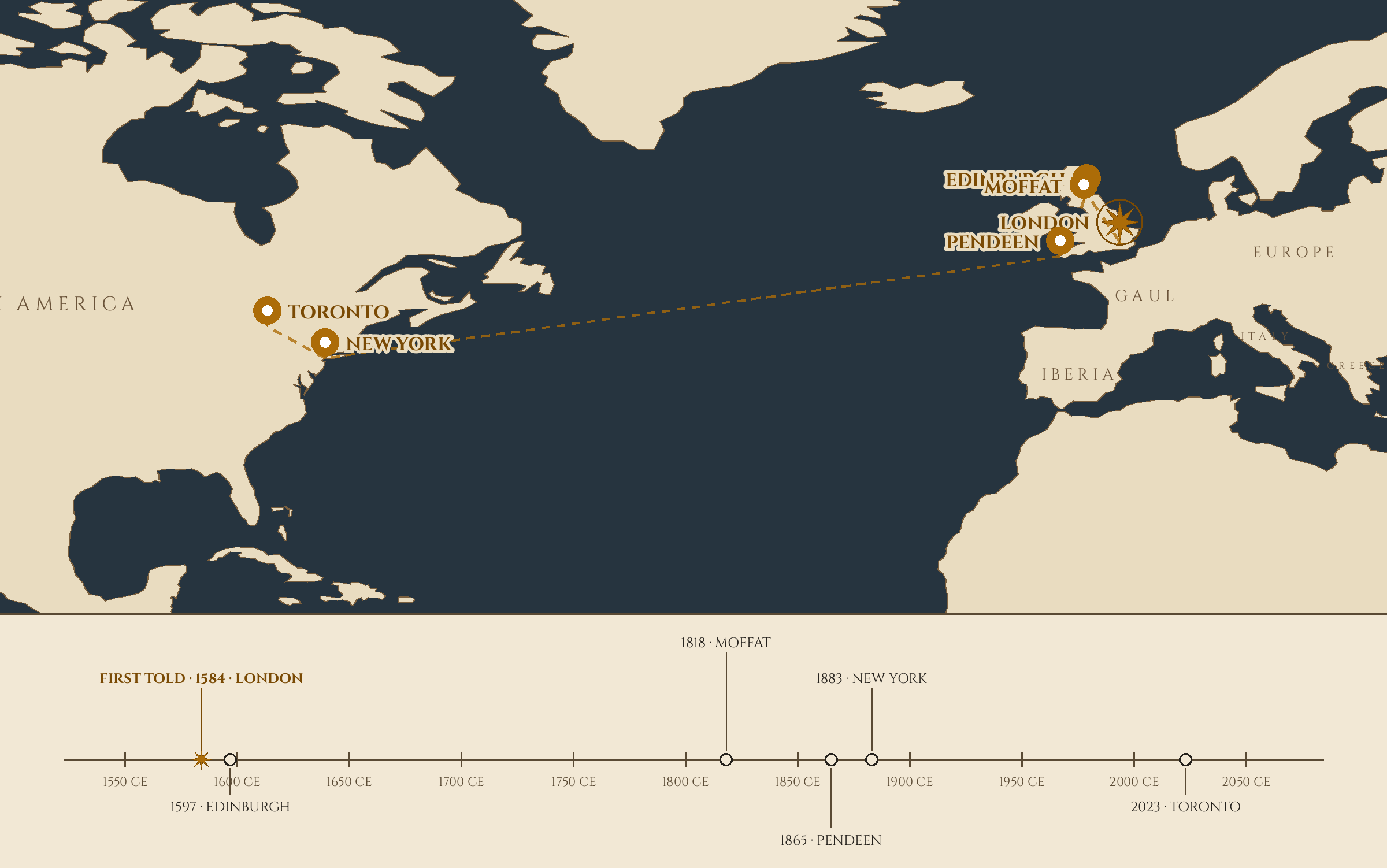
Where this lesson travels: London, where Reginald Scot's Discoverie of Witchcraft (1584) gave the brownie his first famous English appearance, bowl, clothes and all; Edinburgh, where James VI's Daemonologie (1597) filed the brownie as a harmless devil that haunts houses; Moffat, in whose hills James Hogg set The Brownie of Bodsbeck (1818); New York, where Palmer Cox's Brownies made their debut in St. Nicholas magazine in 1883; and Toronto, where the Girl Guides of Canada renamed their Brownies branch “Embers” in 2023. The starred pin is the first record; the dashed line is the telling, traveling.
Lesson Objectives
By the end of this lesson, you will be able to:
- Describe the brownie as the record gives him, and tell his depiction line honestly — three centuries of text before the first famous picture.
- Name the book that gives the brownie its first famous English appearance, and say what its author was trying to prove.
- Tell how the brownie's record grew — through a king's book on devils, the folklore collectors, and a novel.
- Tell the brownie's tales: the night work, the bowl, and why a gift of clothes ends the story.
- Name the brownie's Scandinavian kin — the tomte or nisse, and the Finnish tonttu — and describe his look, his farm work, and his Christmas porridge.
- Name the German kobold, give the line of his name, and tell his two workplaces — the house and the mine — including how the metal cobalt took its name from the mine beings.
- Name the Slavic domovoi, describe his place behind the stove and among the horses, and tell the customs that attach to him — his portion of supper, and the invitation that carried him to a new house.
- Follow the brownie's kin — the hobgoblin who became Puck, and the knockers who crossed an ocean.
- Give the reports for what they are: work found done, knocking heard in the rock, in named collectors' books.
- Say what real household and mine the record grew out of, and mark every line of it T, S, or F.
Your Assignment Packet
This lesson's work lives in its packet: the Lexicon Handout (every term, the core terms marked with the keeper's diamond ◆), Materials, Guided Practice, the Assignment Manual written out whole, the Scholar's Entry Page, the Reflection Questions, the Workbook Checklist, and the Keeper's Notes, for whoever teaches the lesson. Download the packet before you begin and keep it beside you as you read. The packet's assignment is Rookmere's own word for the work: Entry No. 4 — The Brownie, and the Helpers of House and Mine (both) ◐. The Unit I Quiz is not printed in the packet; it waits at the end of the unit, with Lesson 6.
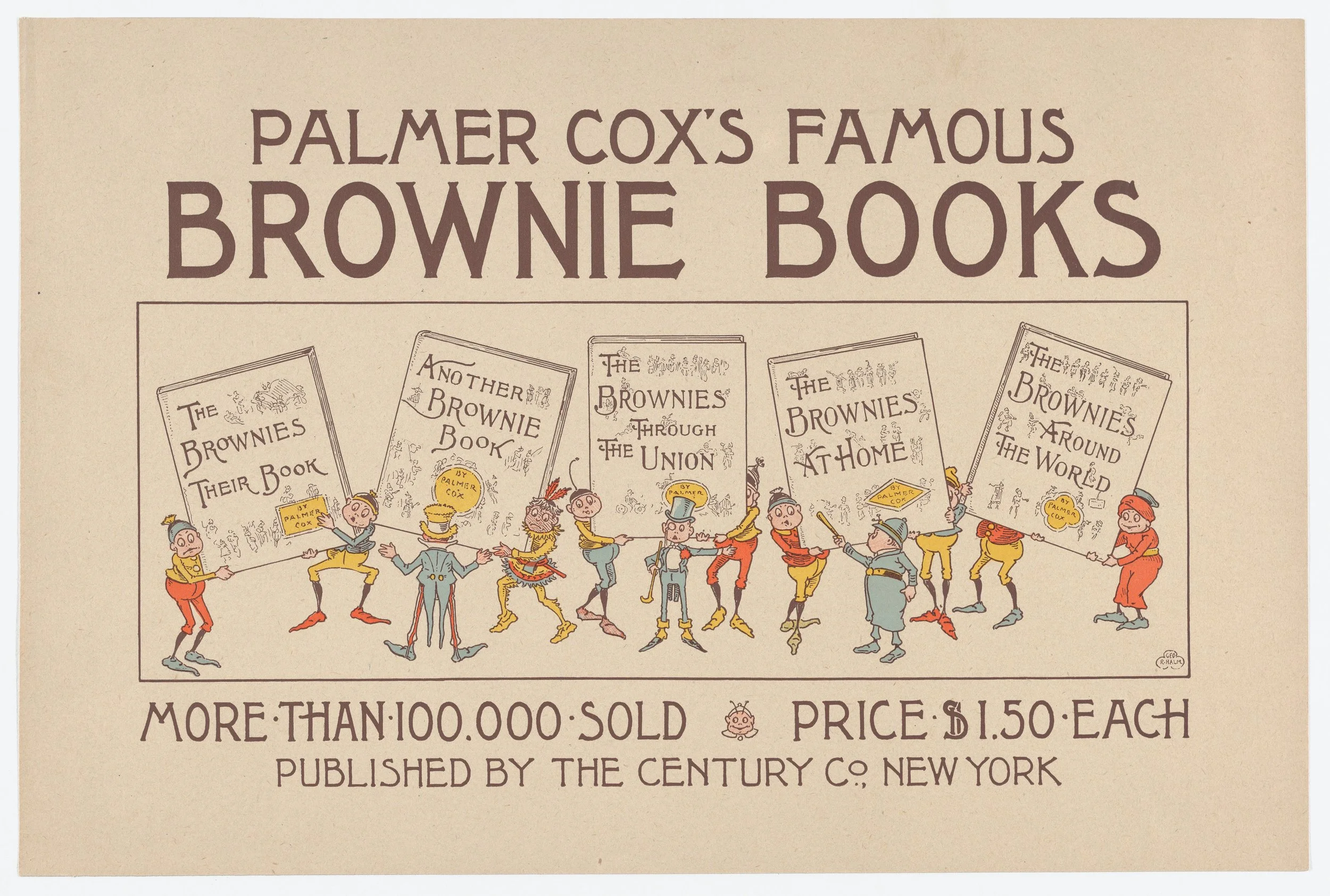
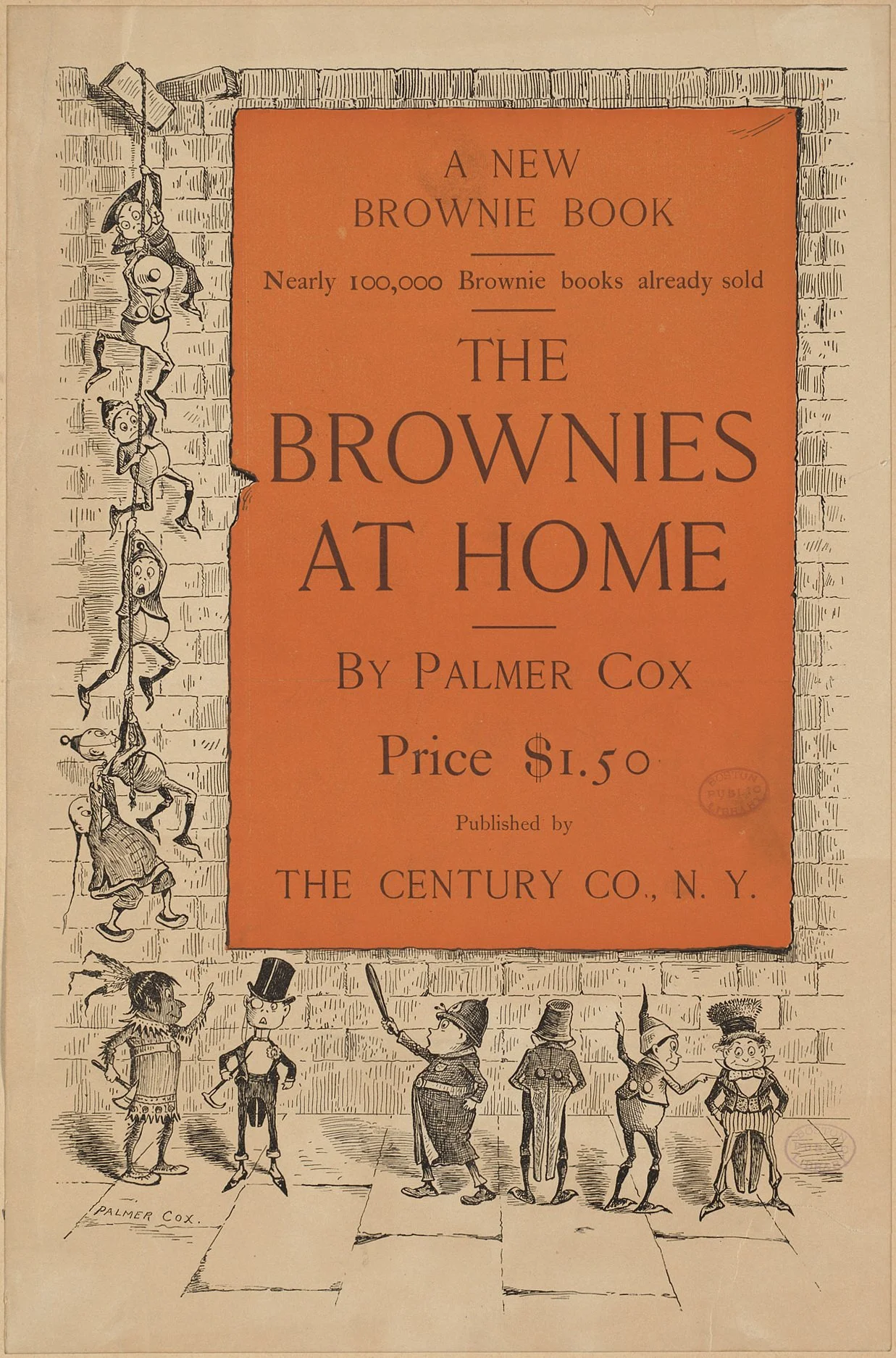
Palmer Cox's Brownies carrying their own books — the Century Company's advertising poster for Palmer Cox's Famous Brownie Books (c. 1890s): the brownie's visual canon in one sheet. CC0, via Wikimedia Commons.
The Creature
The brownie is a household spirit of Scotland and the north of England: a small, shaggy, raggedly dressed worker who comes out at night and does the work the household left undone — threshing, sweeping, churning, tending the beasts — asking no wages, and taking offence easily. The word itself is older than any book we will meet here. It is a Lowland Scots word, in use by the early 1500s, and the brown-clad, brown-faced little man it names was already a familiar of Border farmhouses before print caught up with him.
Scotland was not the only country keeping such a helper. In Sweden he is the tomte, in Norway and Denmark the nisse, and in Finland the tonttu. The Swedish name tells his address: tomte is the "homestead man," from tomt, the house plot or farmstead itself — the being belongs to the place, not only to the family living on it. The Finnish tonttu is borrowed from the Swedish word, though the Finnish spirit gained a distinct identity of his own; as early as 1551 the Finnish reformer Mikael Agricola listed a Tonttu who "managed the household" among the old beings of Häme. Herman Hofberg's Swedish folklore anthology of 1882 describes the tomte as the record usually gives him: a little old man the size of a child of three or four, in coarse grey clothes and a pointed red cap, living in the pantry or the barn, busy night and day, and keeping watch over the whole arrangement of the farm.
Germany kept the same helper under the name that became the general word for the kind. The kobold is the German household spirit — hausgeist, house-spirit — doing the brownie's work in German houses: at night, from the hearth area, the woodhouse, the barn, and the stable, he sweeps the kitchen, scrubs the dishes and pots, cleans the stables, and feeds and grooms the cattle and horses. His name has a line a keeper can follow. Middle High German kobolt or kobólt is attested from the thirteenth century — its earliest uses joke about wooden or waxen figures of a house spirit — and by 1517 a gloss was explaining kobelte as the common word for the Roman house gods, the Lares and Penates. The standard derivation now given reads the word as a compound: kob or kof, house or chamber, plus walt, power or authority — the ruler of the house. Jacob Grimm preferred a descent from Greek kobalos, a rogue or trickster; the record has since set his derivation aside for the Germanic one.
East of Germany, in the Slavic lands, the helper is the domovoi — in Russian domovoy, literally "[he] of the house"; domowik in Polish, domovyk in Ukrainian. He belongs to a kin and its house together, and the family addressed him as kin: Grandfather, or Master — khozyain. Jan Máchal's Slavic Mythology (1918), the scholarly survey this lesson draws on for him, gives his usual form as an old, grey-haired man with flashing eyes, who might also appear as the master of the house or as a departed ancestor of the family. The Russian record Ralston printed in 1872 made him smaller and more particular: a little old man the size of a five-year-old boy, in a red shirt with a blue girdle, his beard white and his eyes glowing like fire. His address is the warmest hidden place in the house: behind the great brick stove that heated the Russian cottage, under the threshold, or out among the buildings — in the stable, where his charge of the horses was his own.
Grandfather's household held a second spirit, and she is filed here by name rather than as a full member, because her paper is thinner than his. The kikimora is the Slavic household being of the night and the spinning wheel: a female house spirit, set beside the domovoi in the record — in some tellings his wife — who keeps her place, like him, behind the stove, or in the cellar. Her work is the women's work of the house. When the house is in order, she looks after the chickens and the housework; when it is not, she whistles, breaks dishes, and makes noises in the night. And she comes out at night to spin thread — the detail her whole file turns on. The -mora in her name is the Slavic word for a nightly spirit, a bad dream, kin to the root that stands behind the English nightmare; and the spinning carries the night with it, for to see the kikimora spinning was held a sign that the seer would soon die. Anatoly Lyadov, whose tone poem Kikimora (1909) carried her out of the house and into the concert hall, printed the spinning in his own summary of her: she "spins flax from dusk to dawn, with evil intentions for the world." A helper at the distaff and a warning at it, in one small figure — the domovoi worked the house and the stable; the kikimora worked the night shift, at the thread.
His pictures come late, and the lateness is itself a fact of the file. For three centuries the brownie was described, rhymed about, argued over by a skeptic and a king — and not drawn. Nobody pictured the help. The family's first face in this lesson belongs to his cousin: Robin Goodfellow, the hobgoblin, illustrated in Thomas Percy's Reliques of Ancient English Poetry in 1765 — a horned, broom-carrying figure of the ballads, printed a full century after the brownie's record was already old. The brownie's own visual canon arrives all at once, in the 1880s and 1890s, drawn by one man: Palmer Cox, whose troop of Brownies — dozens strong, in full character dress — carries this lesson's hero plate. And the knockers of Cornwall, the brownie's underground kin, left no portrait at all: their plate in this lesson is their workplace, a postcard of the Geevor Tin Mine at Pendeen, because the knockers lived where the camera of the day could not go. Queen, carving, bench, broom, poster, postcard — each unit's beings enter the picture record by a different door, and the brownie's door was the advertisement.
First Told
Print caught up with the brownie in 1584, in London, in one of the great skeptical books of the age. Reginald Scot's Discoverie of Witchcraft was written to argue that the witchcraft prosecutions of his day rested on delusion, old tales, and cruelty — that the accused were not in league with anything. To make his case, Scot set down the whole nursery of old fears: elves, hags, changelings, Robin Goodfellow — and the brownie's household, described in a passage a keeper should know nearly by heart.
Your grandmothers' maids, Scot writes, used to set a bowl of milk before the brownie and his cousin Robin Goodfellow, for grinding malt or mustard and sweeping the house at midnight. The bowl was the spirit's standing fee — his regular portion, always left, never handed over. And Scot records the rule that governs the whole lesson: if the maid, taking pity on the brownie's nakedness, laid out clothes for him besides his bowl, he took offence and left, singing as he went: What have we here? Hemton, hamten — here will I never more tread nor stampen.
Hold the shape of that for a moment, because it is the keeper's shape. Scot did not believe a word of it. He printed the brownie the way a magistrate files a report he doubts: because people acted on it. So who invented the brownie? No inventor can be named — the belief is older than its first book, carried in farmhouses by people who left no names. What Scot invented, if anything, is the brownie's file: the first famous, dated, printed account, from which every later record descends. The first telling on this lesson's map is therefore not a sighting. It is a dated, named, printed account of a custom — and for household beings, that is what first records usually are.
The map at the head of this lesson works as all our maps work. The starred pin is London, 1584: Scot's book, the brownie's first famous appearance in English print. The dashed line then walks the record north to Edinburgh, out to the Border hills, and across the Atlantic — the same road this lesson walks. The telling is older than the star, as tellings always are. The record begins where we can point.
Thirteen years after Scot, the brownie received an unlikely honor: a king wrote him down. James VI of Scotland published his Daemonologie at Edinburgh in 1597 — a book about devils, written by a monarch who took the subject in deadly earnest. Among the spirits his book counts as haunting houses, James names the brownie: a devil, in the king's filing, but a house-haunting one, of the sort that troubled a family less than it served it. Scot the skeptic had printed the brownie to laugh a fear away; the king printed him to file him among real dangers. Between the two books you can watch a belief being argued over by the two sides of an age — which is itself a record, and a good one.
The northern helper's file opens earlier, and in church ink. Two fourteenth-century Swedish records name the tomta gudhi — the "tomte gods." In the Revelations of Saint Birgitta, priests are recorded forbidding their congregations to make offerings to them; another Swedish text of the same century, the Själinna thröst, tells of a woman who set the table after her meal for them, certain that if the offering was eaten her livestock would be cared for. Nobody was describing a creature for a book. They were trying to stop, or quietly keep, an offering custom — which is why the record survives at all.
The German file opens in the same decades as Scot's, and part of it is a mining book. In 1549 Georgius Agricola — physician in the mining towns of the Erzgebirge, the Ore Mountains, and the founder of mineralogy as a system — published De animantibus subterraneis, his book of underground creatures. Among them he set down the mine beings the Germans called cobali: about two feet tall, venerable-looking, dressed like miners in a filleted garment with a leather apron about their loins, laughing with glee and pretending to do much work while doing nothing. Martin Luther, dead three years when Agricola's book appeared, had commented on the same underground company: his Table Talk, as Davidson and Duffin quote it, has the devil vexing workmen in the mines, making them think they have found fine new veins of silver that turn out, after much labor, to be illusions.
The domovoi's file opens later, and differently: not in one dated book arguing a case, but in the great nineteenth-century collections of Russian folk belief. Alexander Afanasiev — whose Russian folk tales were published in eight volumes between 1855 and 1867, and whose Poetic Views of the Slavs on Nature (1865–1869) treated the old beliefs as a system — stands behind the first full English account: W. R. S. Ralston's The Songs of the Russian People (1872), which gives the domovoi a chapter of his own, house-changing ceremonies included, and cites Afanasiev throughout. Máchal's scholarly survey followed in 1918, and Linda Ivanits's Russian Folk Belief (1989) gathered the record again in our own time. No Scot, no king: the domovoi enters print as collected custom, reported house by house — which is why his record is rich in what families did, and thin in named first sightings.
The Tales
✦ On the class test
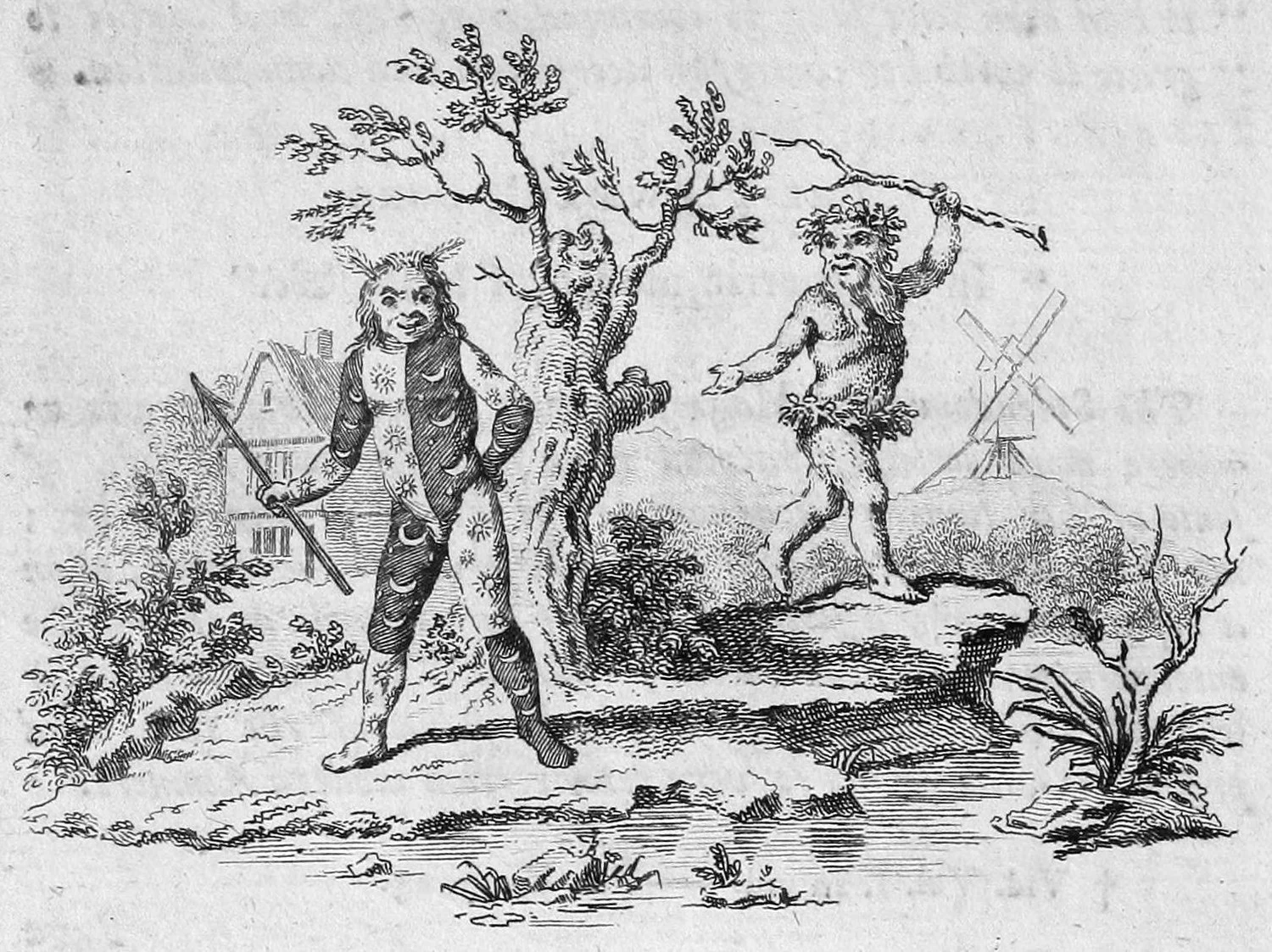
Robin Goodfellow as Thomas Percy's Reliques of Ancient English Poetry (1765) pictured him — horned, broom in hand: the household family's first face in this file, printed two centuries before Cox drew the brownie. Public domain, via Wikimedia Commons.
The brownie's tales are the tales of one household at a time, and they run on rules as regular as a contract — a contract nobody was allowed to sign.
He works at night, unseen. To watch him at his work, to mock him, to criticize a job finished, or to name him wrongly could end everything. He threshes a barn's worth of corn in a night, sweeps, churns, herds, runs errands, and becomes attached to a family — sometimes, the tales say, to one member of it above the rest. In return he has his portion: a bowl of cream or the best milk, or a good cake. Henderson records the Border custom in detail: the housewife made little knuckled cakes — meal warm from the mill, toasted over the embers, spread with honey — and laid them carefully where the brownie might find them by chance. That last phrase is the whole etiquette. The portion was left within reach. It was never offered. An offered reward was payment, and payment ended the arrangement as surely as the gift of clothes.
Why clothes ended it, the tales explain several ways, and a keeper records them all without choosing: that the brownie was a free spirit and clothes were the livery of a servant; that he was bound to serve until paid, and payment released him; that it was the quality of the gift that offended — as in the Lincolnshire tale Henderson and Briggs retell, where a brownie who had received a fine linen shirt each year was left a shirt of coarse sacking by a new, miserly farmer, and sang his dismissal as he left: Harden, harden, harden hamp! I will neither grind nor stamp. At Hylton Castle in County Durham, the household spirit called the Cauld Lad of Hylton — half brownie, half ghost in the telling — was laid at last by leaving him a green cloak and hood beside the fire; he danced in them till dawn and cried that he would do no more good, and was gone. A household that wanted its spirit gone knew exactly how to dismiss him. A household that wanted him to stay knew exactly what not to do.
The tomte keeps the same contract, in a colder kitchen. He works the farm at night, expects the farm itself to be kept well, and takes offence at disorder and at bad treatment of the animals. His portion is not cream but porridge. Kvideland and Sehmsdorf's Scandinavian Folk Belief and Legend (1988) prints the tale "When the Nisse Got No Butter on His Christmas Porridge," collected in Østfold, Norway: the farmer set the butter under the porridge, the nisse found none on top and killed the farm's cow in his rage, then ate, found the butter at the bottom of the bowl, and replaced the cow with an identical one taken from another farm. Hofberg's Swedish telling runs the same pattern with honey melted down into hot Christmas mush at an estate called Tobo. And the clothes rule holds in the North exactly as in Scotland: Hofberg also tells of a tomte spied sifting meal in a larder, whom the grateful housewife rewarded with a fine new suit — he put it on, found that sifting would dust it, threw down the sieve, and sifted no more.
The kobold's house tales run on the same contract, with a German thoroughness about the paperwork. Thomas Keightley, in The Fairy Mythology (1850), prints the kobold's entrance test: a kobold thinking of settling brings chips and sawdust into the house and throws dirt into the milk vessels; if the master leaves the chips undisturbed and drinks the milk as it stands, the kobold comes and stays as long as one of the family lives. The fullest single file is one castle's. Hinzelmann, the kobold of Hudemühlen Castle in Lower Saxony, announced himself in 1584 by knocking and making noises, and stayed five years in the diary kept by Pastor Feldmann, printed at length in 1704 as Der vielförmige Hintzelmann and retold by the Grimms in Deutsche Sagen (1816). Hinzelmann washed dishes and scrubbed cookware in the kitchen, groomed horses, and recovered lost things; he had a room of his own, with chair, table, and bed, and the servants were obliged to set out a bowl of sweet milk with crumbled white bread on his table, which was afterwards found eaten clean. Luther's generation knew the house kind by a pet name of its own: a house kobold called Heintzlein stands in his Table Talk.
The domovoi's tales are a household's tales too, told from behind the stove. By day, Ralston records, he hid behind the stove; at night, when the house slept, he came out and ate what had been left for him. Some families always set aside a portion of the supper — if he was neglected, he knocked the tables and benches about in the night. His second workplace was the stable, and there his temper showed clearest. He was very fond of horses, Ralston says, and often rode them all night, so that they were found in the morning foaming and exhausted; Ivanits's record adds the other side of the stable rule — a horse he disliked had its feed scattered and its tail tied to the manger, while a horse he liked was cared for closely. So a newly bought animal was formally introduced to him: led to its stall, its owner bowing to each of the four corners of the building in turn — Here is a shaggy beast for thee, Master! Love him, give him to eat and to drink! — and the cord it was led by was tied to the kitchen stove, putting the new horse, formally, in Grandfather's charge.
And when the family itself moved, the domovoi had to be moved too — by invitation, not by assumption. Ralston records the rite: the fire was raked out of the old stove into a jar and solemnly carried to the new house, and Welcome, Grandfather, to the new home! was said when it arrived. Máchal records the formula in its other form: a hen and the first slice of bread from the first dinner in the new house were offered, with the words Our supporter, come into the new house to eat bread and obey your new master. He had to be asked.
An offended brownie did not always leave. Sometimes he turned: the same energy that had tidied the kitchen by night began to wreck it, and the helper became a boggart — the household spirit in his mischievous, troublesome form. The line between the brownie and the boggart is not a line between two beings. It is a line between two tempers of one being, and the tales keep it carefully.
The brownie's rougher cousin brings us to the theater. A hobgoblin is the same class of being with the mischief turned up: Hob is the old country nickname for Robert or Robin, and the hobgoblin is Robin's kind of goblin. Scot's book had set the brownie and Robin Goodfellow side by side at the same bowl of milk, and in 1595 William Shakespeare put Robin on the London stage in A Midsummer Night's Dream — as Puck, who introduces himself to a fairy with the words of a household spirit with a record: those that call him Hobgoblin, he says, and sweet Puck, he does their work for them and makes them fruitful. The stage Puck — jester, wanderer, maker of mistakes in the dark — is the hobgoblin with his paperwork in order: a farm spirit in a play, mischief first, labor second, loved for both. The Percy illustration of 1765, this lesson's fourth plate, is that same Robin in his ballad dress — the face the eighteenth century gave the cousin, two centuries before Cox gave the brownie his.
The knockers' tales belong to a harder workplace. Miners heard knocking in the rock where no man was working, and read it two ways, sometimes in the same breath: the knockers were leading them toward a rich vein of tin, the sound growing as the men followed it; or the knockers were warning them — a fierce knocking in the timbers meant get out, now, before the ground came down. The same beings hid tools, blew out candles, and stole unattended food. What they were, the miners argued: spirits of miners killed underground, said some; older things, said others. What they were owed, everyone knew: the last of the pasty. A Cornish miner's dinner was a pasty, and its crimped crust — the part held in a dirty hand — was thrown down the mine for the knockers when the meal was done. A pasty, for readers who have never held one, is a folded pastry case — traditionally beef, potato, swede (rutabaga), and onion, seasoned and baked solid — made to be eaten by hand underground, which is why the crust mattered so much: a miner's dinner came with its own handle, and the handle was not his to eat.
Cornwall was not the only mining country keeping underground company, and the German record is the place to set the two side by side. The knockers knocked; the German mine beings were seen — or said to be. Agricola's cobali of 1549, dressed as miners and mimicking miners, sometimes threw pebbles at the workmen, though they rarely injured them unless the men first ridiculed or cursed them; they might warn of trouble or lead men to a rich vein, and they were also blamed for cave-ins. Above all, they were blamed for a swindle in the rock itself. Identification of minerals was in its infancy, and an ore that looked like promising silver ore might smelt down to nothing but noxious fumes that injured the miners and killed livestock. The miners' explanation was substitution: the kobolds had exchanged one ore for another. The fumes, Davidson and Duffin note, probably came from arsenic compounds in the ore. Here the names must be filed carefully. The house word was kobold; the mine word in Agricola was properly kobel, for the Bergmännlein, the little mountain men — close kin in the record, and conflated early and often, the Grimms' dictionary itself treating kobel as an offshoot of kobold. It was the mine beings, under that tangled name, who gave a metal its name: the troublesome ore was kobelt, kobold ore, and when Georg Brandt isolated the metal in it in 1735, the metal kept the miners' name — cobalt.
The tales reached print in force in the nineteenth century, when the folklore collectors went out with notebooks: William Henderson, whose Notes on the Folk-Lore of the Northern Counties of England and the Borders (1866) set down the brownie's portion, his habits, and his dismissal rhymes county by county; Robert Hunt, whose Popular Romances of the West of England (1865) did the same work for Cornwall — and so brought the brownie's underground kin into print. Katharine Briggs's Dictionary of Fairies (1976) gathered the whole file in our own century. The northern collections came in the same decades: Peter Christen Asbjørnsen and Jørgen Moe's Norwegian collections, gathered from the 1840s, evidence the nisse in living nineteenth-century use, and when H. L. Braekstad translated Asbjørnsen's Round the Yule Log into English in 1881, he rendered nisse simply as "brownie" — the translator saw one file, not two. Keightley's Fairy Mythology (1850) had already filed the kobold as the brownie's German counterpart in so many words, and Ralston's Songs of the Russian People (1872) did the same office for the domovoi — three countries' collectors, one file. What the collectors found, county after county, was the same small man with the same rules. The brownie also entered literature on his own account: James Hogg — the Ettrick Shepherd, a Border poet who knew the farm world from inside — published The Brownie of Bodsbeck in 1818, a novel named for the brownie said to haunt a farm in the hills above Moffat, in the hard years of the Covenanters. By then the brownie was no longer only something a housewife watched for. He was something a reader could buy.
KEEPER'S CHECK-IN
What is the brownie's portion, why must it be left and never offered, and what gift ends his service for good?
Spotted
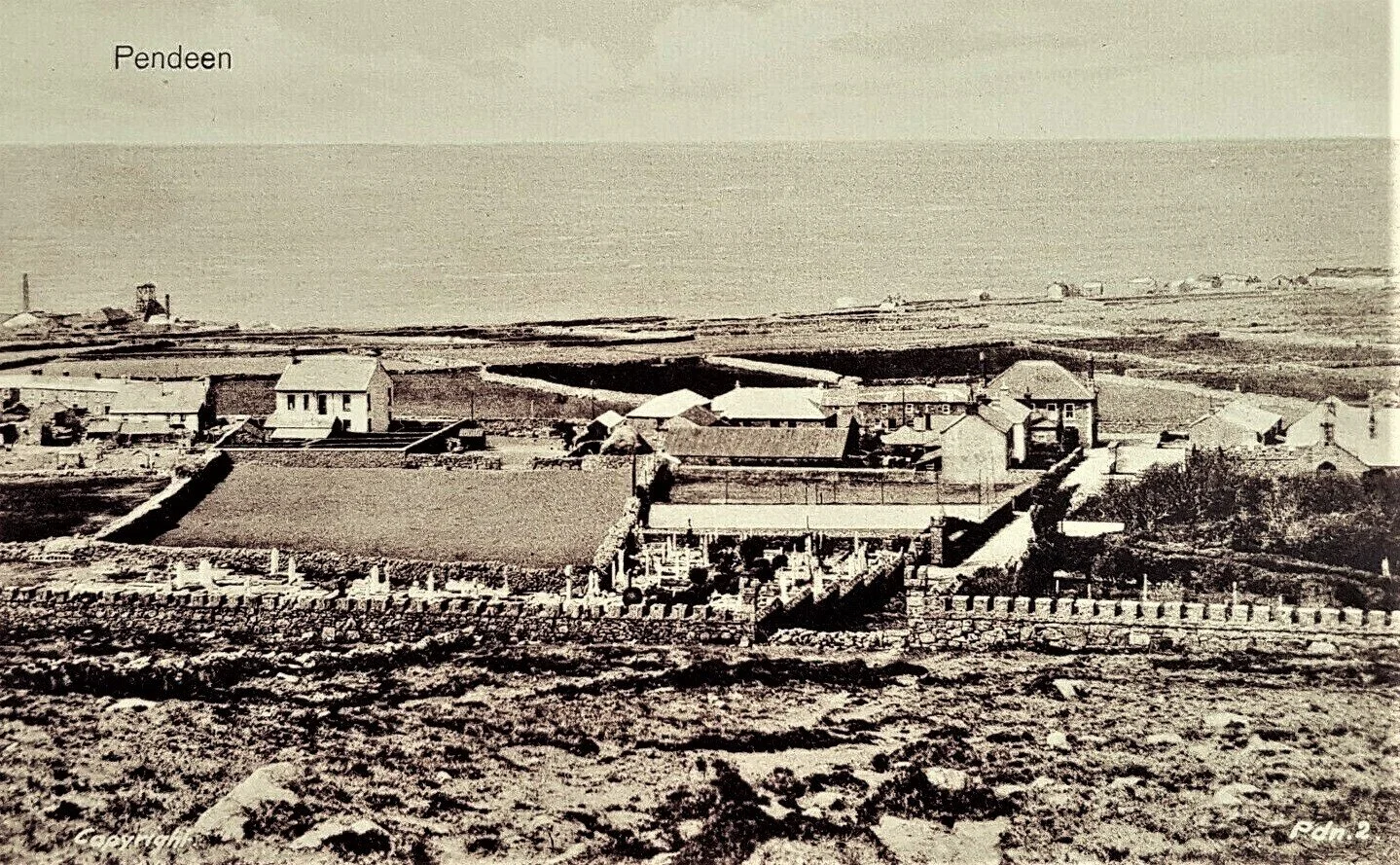
Pendeen churchyard and Geevor Tin Mine, Cornwall, on an early-20th-century postcard — the knockers' workplace above ground; the beings themselves lived where no camera of the day could go. Public domain, via Wikimedia Commons.
Household beings are almost never seen — that is rather their defining rule — so this file's reports are of a different kind, and a keeper should name the difference honestly. What people reported was evidence of presence: work left undone at dark and found finished at dawn; a bowl emptied; tools hidden or food taken underground; knocking in the rock where no man stood. Scot's 1584 account is itself such a report — a named skeptic relaying what the maids of the last generation did and what they said happened when the rules were broken. The collectors of the 1860s gathered the same reports house by house and mine by mine: Henderson in the northern counties, Hunt in Cornwall, where the knocking in the Geevor and Pendeen workings was reported by men who staked their dinners, and sometimes their lives, on reading it right. These are S-lines — reports, dated and sourced — but they are reports of signs, not portraits, which is why this lesson's mine plate shows a workplace and a churchyard, and no being at all.
The reports crossed an ocean. In the 1820s, Cornish and Welsh miners carried the tommyknockers — the name the knockers took in America — into the coal mines of western Pennsylvania. When gold and silver drew Cornish miners west after mid-century, the tommyknockers went with them into the mines of Colorado, Nevada, and California, where they kept their whole character: the hidden tools, the stolen food, the warning knocks. Miners who had never seen Cornwall left them pasty crusts and cake. The belief is still found in American mining country in the collectors' books of the last century — a Cornish household custom, of a sort, that crossed an ocean in working men's luggage and set up housekeeping in the dark of another continent.
KEEPER'S CHECK-IN
Household beings are almost never seen, so what kind of evidence do this lesson's reports actually report — and what did the tommyknockers keep doing in American mines?
What People Watched For — the Bowl and the Clothes
This lesson's custom is documented at both ends of the record, which is why it earns its place here. In 1584, Reginald Scot records that households set a bowl of milk before the brownie and Robin Goodfellow for the night's grinding and sweeping — and that laying out clothes for the brownie, in pity for his nakedness, drove him away singing his rhyme. In 1866, Henderson's collectors found the same custom still kept in the northern counties: the portion — cream, good milk, or honeyed knuckled cakes — prepared by the housewife and laid where the brownie would find it by chance, because to hand it over as payment was to end the service.
So what people watched for was a household kept in a particular state: work left ready at nightfall, the bowl set out but not offered, no clothes laid by the fire, no one watching the kitchen in the dark. The custom the belief produced was a tidy, provisioned, unspied-on workplace, maintained by the whole household, every night. Keepers record it as what it is: a documented practice, carried on for centuries in real houses, whatever walked the floors after midnight.
The North kept the same custom with a different dish, which is why the northern helper belongs in this box and not in a second one. At Christmas the tomte's standing portion was julgröt, Christmas porridge, set out with butter or honey — in Sweden, Hilding Celander's Nordisk jul (1928) records, on the corner of the cottage, in the barn, or in the stable; in Finland, on the grain-kiln or in the sauna. Hofberg, writing in 1882, gives the test the household read in the morning: the porridge was particularly important at Christmas, and if the bowl stood empty on Christmas morning, everyone on the farm believed all would be well for another year. Cream, milk, honeyed cakes, porridge — the food changes with the country. The custom does not: a portion left, not handed over, for the worker nobody was to watch. The domovoi's portion was kept the same way in Russia: Ralston, in 1872, records families who always set aside a portion of the supper for him, and a pot of stewed grain left for him on 28 January on the hearth in front of the stove, surrounded with hot embers.
What It Actually Is
The brownie has no animal behind him, and a keeper should say so plainly. His real root is not a creature. It is a household.
Consider the world the record grew in: farms and great houses worked by human hands, where threshing a barn of corn was days of labor, where butter had to be churned and floors swept daily, where servants rose before the family and worked after it. In such a world, work genuinely could be found done in the morning — done early, quietly, by a servant, a daughter, a hired hand, or a master who would not say so. The brownie gave that work a worker: one who needed no wages, resented payment, and whose rules — leave the work ready, do not watch, do not criticize — happen to be exactly the rules that keep a proud, unpaid helper helping. The belief also did quieter work. A household that sets out a bowl every night is a household that keeps a stocked dairy and a swept hearth. A household that leaves work ready for the brownie has its work ready by nightfall, every night. Keep the custom long enough and the house runs tidy on habit alone — the story saw to that, year in and year out, without ever raising its voice.
The knockers' root is easier to put a hand on, because it is a sound. Rock carries noise a long way. Picks working in a neighboring shaft can be heard through solid stone as knocking where no one stands; water moves and drips; and timbers under load creak and crack before they fail — which means the warning knocks sometimes told the truth. A miner who believed in knockers was a miner listening to his mine, and a miner listening to his mine lived longer. The belief lasted because, in the one way that mattered most underground, it worked.
The German mine beings have a root of the same practical kind, and it is chemical. The "swapped" ore was real: cobalt-bearing ore that looked like silver ore and yielded none, carrying arsenic that came off in the smelting as poisonous fumes. A miner who believed the kobolds had tampered with his ore was a miner who had learned, the hard way, that a promising-looking rock could poison him — and the belief kept the lesson attached to the rock's name, where chemistry still keeps it.
Still With Us
The cover of The Brownies at Home by Palmer Cox (Appleton, 1893): the same company, at home in the world Cox made for them. CC BY 2.0 — Boston Public Library, via Wikimedia Commons.
The brownie's modern face was drawn by one man. Palmer Cox, a Canadian illustrator working in America, gave his Brownies their first story — "The Brownies' Ride" — in the February 1883 issue of St. Nicholas magazine, a children's periodical published in New York. Cox said he had the beings from the Scottish tales of his childhood, but look at what he did to them: the solitary, ragged, touchy night-worker became a whole company of jolly little men, dozens strong, each with a nationality, an occupation, and a costume — a policeman, a dude, an Uncle Sam. They did not serve one household; they roamed the world having adventures, and they were a publishing phenomenon. The stories were gathered as The Brownies, Their Book in 1887; the Brownies sold books, toys, and advertisements by the millions of impressions; and in 1900 Eastman Kodak named its one-dollar camera — the camera that put photography into ordinary hands — the Brownie, after Cox's company. The poster at the head of this lesson shows them carrying their own books: look for the troop of them in full character dress, marching with their own volumes held high — an advertisement in which the beings themselves do the selling. The household spirit had become an industry.
In Scandinavia the tomte took a Christmas job of his own in the nineteenth century, becoming the jultomte in Sweden and the julenisse in Norway and Denmark — the Christmas gift-bringer, the farm helper turned seasonal visitor, arriving at the door instead of living under the floor.
The kobold and the domovoi each kept a modern address of a different kind. The kobold's is on the periodic table: cobalt, element 27, carries the mine beings' name into every chemistry classroom, long after the mines that named it closed. The domovoi's is in the ethnographic record of our own century: fieldworkers in rural Russia — Ansimova and Golubkova's interviews, published in 2016 — still found a villager in the Omsk region who could say where he lives ("He lives with [them] behind the stove; he would jump out of there. Small, shaggy"), and another, in the Novgorod region, who warned that a family moving house must surely invite him to the new house, or he will not go, but will remain where he was.
The name took one more respectable job. When the Girl Guides organized their youngest branch — girls of seven and eight — they named it the Brownies, after the helpful household spirit (by way of Juliana Horatia Ewing's story "The Brownies," which had carried the being into the nursery in 1865). In January 2023, the Girl Guides of Canada changed the branch's name to Embers, after members reported that the old name caused harm to racialized girls and women; the beings of this lesson thus gained a modern record of a new kind — a name retired, on the record, by the people who carried it. The last pin on the map is Toronto, 2023.
No modern survey counts brownie believers, and the lesson does not pretend one does. What the modern record holds is the reporting line of the Spotted section — tommyknockers still in the collectors' books, the custom still remembered in mining country — and the name's long career in nursery and camera shop. That is the brownie's file, and it is plenty: a Scots word, a skeptic's book, a king's filing, a bowl left carefully un-offered, and a long road that ends, for now, in New York shops and Western mines. For such small beings, they got around.
Guided Observation
Study the Palmer Cox poster at the head of this lesson — the Brownies carrying their own books, in a Century Company advertisement of the 1890s. Set it against the brownie of the record: one being, ragged, solitary, never seen if the household could help it. Count Cox's company. Note what they are wearing — the full dress of named characters, the very gift of clothes that ends every folk tale. Note what they are carrying, and who the advertisement is for. Then look at the cover of The Brownies at Home (1893), the second plate: the same company, at home in the world. Write down three things Cox changed to make the brownie saleable, and one thing he kept exactly — the night work itself, done while the world sleeps.
Then turn to the Cornish plate: a postcard of Pendeen, looking over the churchyard to the engine houses and chimneys of Geevor Tin Mine. There are no knockers in this picture, and there could not be; the knockers lived where the camera of the day could not go. Look instead at the workplace the postcard does show: the engine houses that pumped the shafts dry, the chimneys, the bare ground of a worked coast. Everything in this scene is on the surface. The knockers' Cornwall is underneath it — miles of shafts below a postcard of stillness. And before you close the plates, look at the fourth: Robin Goodfellow as Percy printed him in 1765, horned and broom in hand — the family's only pre-Cox face. Write one sentence on what it means that this lesson's most traveled beings left, for three centuries, no portrait at all — only a workplace, a bowl, and a sound.
Assignment Manual
✎ WRITTEN · ⚒ HANDS-ON · ◐ BOTH
◐ Both · Entry No. 4: The Brownie, and the Helpers of House and Mine.
- Rule your entry page. Turn to the Scholar's Entry Page in this packet and rule the next page of your journal to match it, as you did for Entry No. 1.
- Write the brownie's entry, to the standard. The Creature: the brownie as the record describes him, and his pictures — Percy's Robin of 1765, Cox's company, the portraitless knockers. First Told: Scot's Discoverie of Witchcraft — London, 1584, what Scot was arguing, and what he set down about the bowl and the clothes. The Tales: the night work and its rules; the portion and why it must not be offered; a dismissal rhyme; the tomte's Christmas porridge, and the butter hidden under it; the boggart turn; Puck's paperwork; the knockers' knocks and the pasty crust; the kobold's entrance test and Hinzelmann's milk bowl, and the swapped ore that named cobalt; the domovoi's supper portion, his introduced horses, and the Welcome, Grandfather carried to a new house. Spotted: the reports of work found done and knocking heard, in Scot, Henderson, and Hunt, and the tommyknockers in America. What It Actually Is: the household itself, and the sounds of a mine, in your own words. Still With Us: Cox's company and the camera that took their name; the Embers renaming of 2023 — two or three lines each at most. The Keeper's Line: your own judgment, in one or two lines.
- Set out the bowl. ◐ One evening, with your household's leave, do what the record describes: finish a piece of work and leave it ready, and set out a small bowl of milk or cream where the work is done — left, not offered, with no clothes anywhere in the arrangement. In the morning, look. Write down exactly what you find, as a record: what is true, what is unchanged, what you cannot account for. This is the custom recreated as households kept it, studied as history. What the morning shows is data; write it as data.
- Mark every line. Go back through your entry and mark every line in the margin, T for a tale, S for a sighting or report, F for a verifiable fact, as always. This entry will hold long stretches of each — the customs are F, the singing departures are T, the reports of finished work are S, and the bowl in your own kitchen is F the moment you write down what you actually found.
Materials
· Your creature-guide journal, with Entries No. 1–3 in it
· Pencils, and a pen you like
· A ruler, for ruling your entry pages
· This lesson's packet (the Scholar's Entry Page is in it)
· For Step 3: a small bowl, and milk or cream — with your household's leave
Reflection
Scot printed the brownie to disprove him, and James VI printed him to file him among devils. Which writer did the brownie's record more good — and what does that tell you about how records survive?
The brownie's portion had to be left, never offered. What changes between a gift left to be found and a payment handed over — in the tales, and in ordinary life?
The knockers' warning knocks sometimes told the truth, because timbers creak before they fail. Does a belief that works stop being "only a belief"? Where does a keeper file it — T, S, or F?
A Closing Note
Four entries in, your bestiary has reached the size of a household — which is the right size for it. Households are where I learned this trade, if I am honest: small records, kept nightly, by people who never thought of themselves as record-keepers at all. Next lesson the shelf changes scale entirely: one physician, one book, and four whole peoples set in order like specimens in a cabinet. Bring your marks. A system is only as honest as the keeper who files it.
The Bestiary
Bestiary Keeper
Further Reading & Sources
Reginald Scot, The Discoverie of Witchcraft (London, 1584) — Book IV's account of the bowl of milk and the brownie's rhyme is the lesson's first telling; the 1886 reprint is free at Project Gutenberg.
James VI, Daemonologie (Edinburgh, 1597) — the brownie filed among house-haunting spirits, by a king.
William Henderson, Notes on the Folk-Lore of the Northern Counties of England and the Borders (1866) — the brownie's portion, the knuckled cakes, and the dismissal rhymes, collected county by county.
Robert Hunt, Popular Romances of the West of England (1865) — the Cornish collections in which the knockers reached print.
James Hogg, The Brownie of Bodsbeck (1818) — the brownie in literature, from a Border poet who knew the farm world.
Katharine M. Briggs, A Dictionary of Fairies: Hobgoblins, Brownies, Bogies and Other Supernatural Creatures (1976) — the modern gathering of the whole file: brownies, hobgoblins, and the clothes motif traced through the record.
Palmer Cox, The Brownies, Their Book (1887) — the modern face in its first book form.
Herman Hofberg, Svenska folksägner (1882), "Tomten" — in English in Swedish Fairy Tales, trans. W. H. Myers (1890): the tomte's look and watch, his Christmas mush and honey at Tobo, and the new suit that ended his sifting.
Reimund Kvideland & Henning K. Sehmsdorf (eds.), Scandinavian Folk Belief and Legend (University of Minnesota Press, 1988) — the nisse tales, including "When the Nisse Got No Butter on His Christmas Porridge" (Østfold, Norway) and "The Nisse's New Clothes."
Hilding Celander (ed.), Nordisk jul: Julen i gammaldags bondesed (Stockholm, 1928) — the Christmas porridge custom: where the julgröt was set out in Sweden and Finland, and its butter or honey.
Georgius Agricola, De animantibus subterraneis (1549) — the mine beings, the cobali, in a founder of mineralogy's own book; the description is quoted in Herbert and Lou Henry Hoover's translation of De re metallica (1912), in the note to Book VI.
Jane P. Davidson & Christopher John Duffin, "Stones and Spirits," Folklore 123:1 (2012) — the kobolds in the mines: the pebble-throwing, the ore-switching, the arsenic fumes, and the naming of cobalt, with Luther and Agricola side by side.
Thomas Keightley, The Fairy Mythology (1850), "The Kobolds" — the kobold filed as the brownie's German counterpart, with the entrance test and the Grimms' abridgement of the Hinzelmann history.
W. R. S. Ralston, The Songs of the Russian People (London, 1872), "The Domovoy, or House-spirit" — the first full English account: behind the stove, the supper portion and the stewed grain, the horses, and the house-changing ceremonies; Afanasiev's Poetic Views of the Slavs on Nature is cited throughout.
Jan Máchal, "Slavic Mythology," in The Mythology of All Races, Vol. III (1918), and Linda J. Ivanits, Russian Folk Belief (M. E. Sharpe, 1989) — the domovoi in the scholarly record: his look and places, his animals and tempers, his offerings, and the invitation to the new house.
Submit your work for this lesson using the form below.
CONTINUE IN THE BESTIARY HALL
← Previous · Lesson 3: The Hidden Folk Next · Lesson 5: The Elementals of Paracelsus →
Unit I — Meeting the Creatures The Bestiary Hall — All 41 Lessons
The rest of Unit I: Lesson 1 · Meeting the Creatures · Lesson 2 · Fairies · Lesson 3 · The Hidden Folk · Lesson 5 · The Elementals of Paracelsus · Lesson 6 · The Made