
THE BESTIARY
Unit II · Lesson 7The Unicorn
Professor Sable Rookmere
Bestiary Keeper
The Bestiary Hall • School of Evershade
Professor's Introduction
Unit II opens with the beast every child can draw and no medieval writer ever saw. Its file is the longest in this unit. It begins with one Greek physician at a Persian court, writing down a country he never visited. His name is Ctesias. You will meet him again in Lesson 10, at the same desk, with a redder beast. Watch how much of Europe's natural history flows out of that one man's notebook, and keep your marks ready: this lesson's record and its beliefs are braided tighter than any yet.
The Bestiary
Bestiary Keeper

Where this lesson travels: Susa, where Ctesias, at the Persian court, describes the Indian one-horned ass — the first surviving unicorn record; Rome, where Pliny's Natural History gives the monoceros to Roman natural history; Edinburgh, where the unicorn enters Scotland's royal arms; Rochester, whose bestiary entry is the medieval telling at full flower; and Brussels, where the Unicorn Tapestries were woven in the Southern Netherlands. The starred pin is the first record; the dashed line is the telling, traveling.
Lesson Objectives
By the end of this lesson, you will be able to:
- Retell the first unicorn record, and say what kind of witness its author was.
- Tell Pliny's monoceros apart from the unicorn itself, and keep the two apart in your entry.
- Follow the telling through the Physiologus, the bestiaries, and the great tapestries.
- Explain the real root of the horn — the narwhal, the trade, and the man who proved it.
- Mark every line of your entry with the keeper's marks — T for tale, S for a sighting-report, F for fact — with the horn trade filed as fact and the horn's powers filed as tale.
Your Assignment Packet
This lesson's work lives in its packet: the Lexicon Handout (every term, the core terms marked with the keeper's diamond ◆), Materials, Guided Practice, the Assignment Manual written out whole, the Scholar's Entry Page, the Reflection Questions, the Workbook Checklist, and the Keeper's Notes, for whoever teaches the lesson. Download the packet before you begin and keep it beside you as you read. The packet's assignment is Rookmere's own word for the work: Entry No. 7 — The Unicorn (written) ✎. The Unit II Quiz is not printed in the packet; it waits at the end of the unit, with Lesson 15.
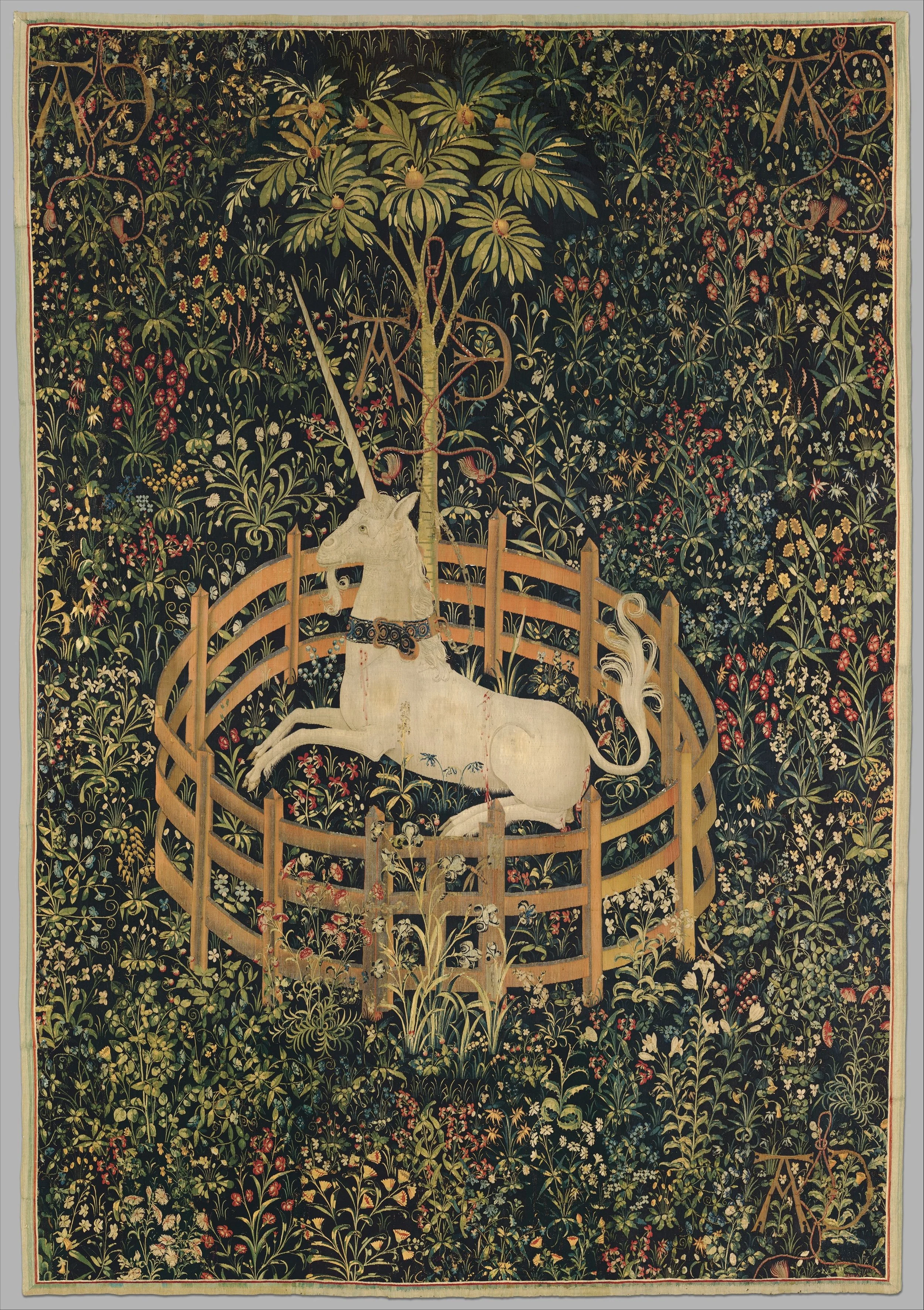
The Unicorn in Captivity (c. 1495–1505), the last of the Unicorn Tapestries: the unicorn chained to a pomegranate tree inside its fence, a prisoner in a garden. CC0, via Wikimedia Commons.
The Creature
The unicorn takes its English name from the Latin unicornis — "one-horned." The Greek word is monokeros, "single horn," and between those two plain labels the record hides a crowd. A keeper's first job in this lesson is to keep three different one-horned beasts from merging into one.
There is Ctesias's Indian ass: a great white wild ass of India with a single striped horn, swift, fierce, and hunted for that horn. There is Pliny's monoceros: a stitched-together monster — stag's head, elephant's feet, boar's tail, horse's body, one black horn — which this lesson keeps as a NAMED neighbor of the unicorn, not the unicorn itself. And there is the unicorn of the medieval bestiaries: smaller, fiercer, and stranger than either, the beast that only a virgin could take and whose horn could cleanse poisoned water.
There is also a fourth road into the file, and it runs through translation. The Hebrew Bible speaks of a mighty horned animal called the re'em — in truth the wild ox, the aurochs. When the Hebrew scriptures were translated into Greek in Alexandria, the translators rendered re'em as monokeros, "one-horn." The Latin Bible followed with unicornis, and when the Bible was Englished, the word became unicorn: the King James Bible of 1611 says "unicorn" in nine verses, every one of them standing over a Hebrew wild ox. A translation choice put the unicorn into the most-read book in Europe. Keepers file that as a record about books, and it helps explain why, for centuries, doubting the unicorn felt like doubting scripture.
The aurochs itself is worth a look while it is here, because it was a formidable animal in its own right and needed no horn added. A bull stood about 1.8 meters at the shoulder and could weigh close to a ton, with long horns curving forward from a broad head. Aurochs lived in herds across Europe and Asia for a very long time. The last one, a cow, died in Poland in 1627. When the translators reached for a word for that strength, they gave it one horn instead of two, and centuries of readers pictured something else entirely.
The pictures tell the same story in a shorter line, and the line starts late. No ancient artist drew Ctesias's beast: the unicorn enters pictures only with the medieval bestiaries — the Aberdeen painter's small, sturdy animal of about 1200, one of this lesson's plates. The Unicorn Tapestries (about 1495–1505) made the beast beautiful at full size, and print after 1551, in the Gessner-line woodcut, fixed the white horse with the spiraled horn. The 19th century took the tapestry unicorn back up: Gustave Moreau's The Unicorns (about 1888), this lesson's fourth plate, sets three of them in a jewelled landscape with their ladies — the medieval scene repainted as a dream. Read the four plates in that order and the depiction line is the lesson in miniature: goat-like book beast, woven captive, printed horse, painted dream.
First Told
The starred pin on this lesson's map stands at Susa, in Persia, about 398 BCE — and the first thing to notice is what the star is pinned to. Not a sighting. A desk.
Ctesias of Cnidus was a Greek physician serving Artaxerxes II, king of Persia. For some seventeen years he lived at the Persian court, and there he wrote his Indica, a book about India — a country he never visited. What he knew came from the travelers, traders, and envoys who passed through Susa with India behind them. The Indica itself is lost. We read it in the summary made twelve centuries later by Photius, a Byzantine scholar who worked through Ctesias's book and wrote down what it said — which is why this lesson quotes a lost book in a ninth-century summary of a fifth-century-BCE original, and why the keeper's first question is always how many hands has this passed through?
Here is the first unicorn, as Photius preserves him. In India, Ctesias says, there are wild asses as large as horses, or larger. Their body is white, their head dark red, their eyes bluish, and they carry a horn on the forehead about a cubit long — the lower part white, the middle black, the upper part, ending in a point, a flaming red. Those who drink from cups made of this horn are proof, he says, against convulsions, epilepsy, and even poison. The animals are too swift for any horse to overtake. There is only one way to take them: when they bring their young out to feed, hunters surround them, and the asses, unwilling to abandon their foals, stand and fight — butting, kicking, biting, killing men and horses — until they are shot down. They are never taken alive. Their flesh is too bitter to eat; they are hunted only for the horn, and for a strange treasure in their ankles, a huckle-bone heavy as lead and red as cinnabar all through.
Hold the record at arm's length now, as its own age did. Aristotle, writing a generation later, cites Ctesias on India with the coldest footnote in ancient science: Ctesias, who is not worth believing. He copied the beasts anyway. So did everyone after him. The unicorn's first record is a report its readers doubted from the start, and it ruled the file for two thousand years anyway. That happened with a lot of records, not just this one. Learning to see how it happened is why Susa carries this unit's first star.
The Tales
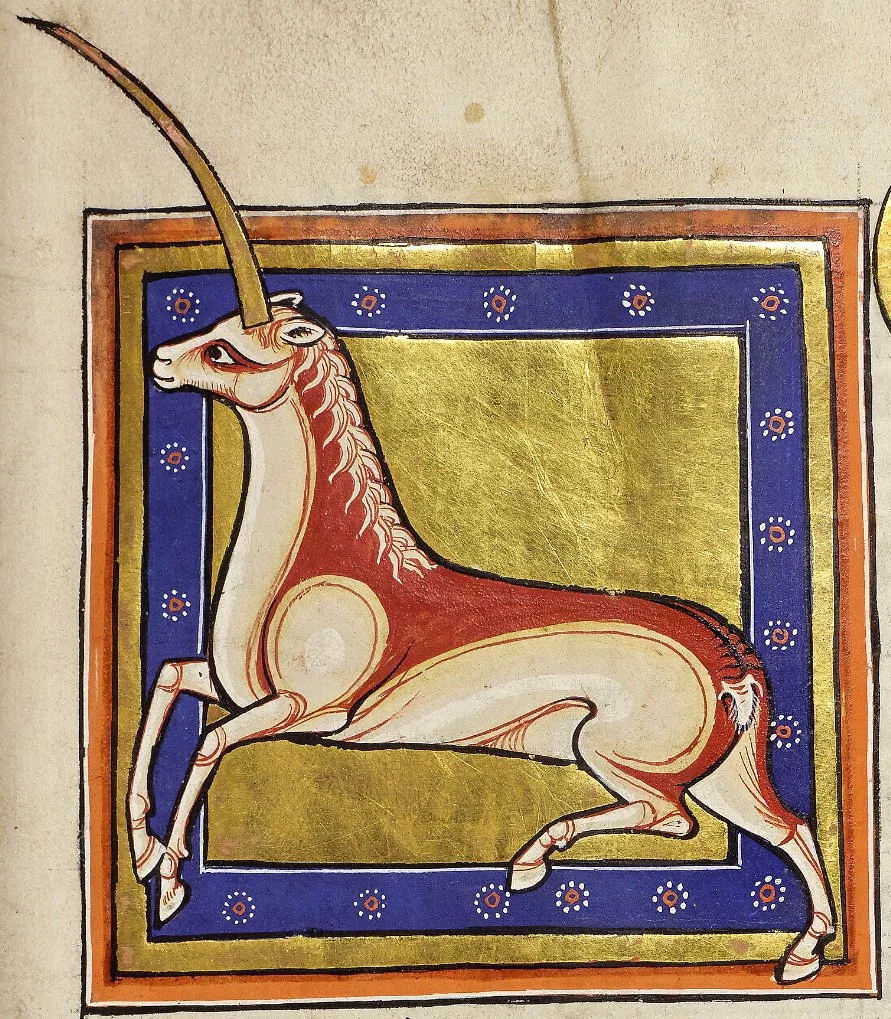
The unicorn of the Aberdeen Bestiary (England, c. 1200): smaller, dog-like, earnest — and carrying the one fact every artist received from the record, the long straight horn. Public domain, via Wikimedia Commons.
The dashed line on the map runs from Susa to Rome, 77 CE, where Pliny the Elder sets the one-horned beasts into his Natural History. Note that Pliny, like a good keeper, keeps his file in two folders. He passes on the Indian one-horned ass of Ctesias's tradition. And separately he describes the monoceros: "a very fierce animal which has the head of the stag, the feet of the elephant, and the tail of the boar, while the rest of the body is like that of the horse; it makes a deep lowing noise, and has a single black horn, which projects from the middle of its forehead, two cubits in length." Pliny says it cannot be taken alive. Two beasts, two entries. In later centuries the folders were merged, and the monoceros's name came to be used for the unicorn itself — the Aberdeen Bestiary's unicorn page, one of this lesson's plates, is even captioned for the pair of them. Look at that plate while you are here. The painter has drawn a small, sturdy beast, more like a goat that has been told it is important than like any horse, with a single straight horn and its head lowered toward the maiden beside it. A hunter waits close by. The painter is showing you the capture story from the next paragraph, not a portrait from life, and he fits the whole tale into one small painted space. In your own entry, keep them apart. You will be doing what Pliny did and what the centuries between you did not.
The medieval telling was written by the Physiologus — the little Alexandrian book from Lesson 1 — whose chapter on the monoceros gave the unicorn its two lasting stories. In the first, the beast is so fierce and swift that no hunter can approach it. So a virgin is set before it, alone; and the unicorn, seeing her, comes and lays its head in her lap and sleeps, and is taken. Medieval church art used the story as a picture of Christ coming to the Virgin — recorded here in one line, as depiction history — and the image of the unicorn asleep in a maiden's lap became one of the most painted scenes of the Middle Ages.
In the second story, the animals of a dry country gather at evening beside a great water and find that a serpent has poisoned it. They do not drink. They wait. At last the unicorn comes, steps into the water, and makes the sign of the cross over it with its horn — and the water is clean, and all the animals drink. Ctesias's poison-proof horn has become, in a thousand years of retelling, a horn that heals water itself. The bestiaries took both stories in. The Rochester Bestiary, written about 1230 — the map's English pin — gives the unicorn its entry in the full medieval form.
The telling reached heraldry, too. About 1165, under William I, the unicorn entered the royal arms of Scotland — the map's Edinburgh pin — where it has stood ever since. And when print came, the woodcutters settled the unicorn's shape: Conrad Gessner's Historia Animalium (1551) and the books that copied it, like Edward Topsell's, fixed the form the modern world inherited — a white horse with a long spiraled horn, as in this lesson's third plate. The medieval beast had been smaller and fiercer, part goat, part horse. Print made him beautiful, and beauty won.
Two tales carry the unicorn, and you have met them both: the virgin and the pool. Tell them once more slowly, because their details are the entry's work.
The virgin capture works because the unicorn cannot be taken any other way. Force fails; spears fail; the beast outruns horses and turns on its hunters. So the hunters use the one approach the record allows: they lead out a maiden and leave her alone in the unicorn's country, and the fiercest animal in the book lays its head in her lap like a pet and sleeps. In church art the scene stood for the Incarnation; in the great secular telling — the seven Unicorn Tapestries woven in the Southern Netherlands about 1495–1505, the map's last pin — it becomes a hunt: lords and hounds track the unicorn, wound it, and kill it at a stream, and carry it back to a castle on a horse. And then the weavers did something the hunters did not. In the seventh and last tapestry — the plate at the head of this lesson — the unicorn is alive again, unhurt, wearing a collar and chained to a pomegranate tree inside a low fence, in a garden thick with flowers. Look closely at the red marks on his white coat. Generations of viewers have read them as juice dripping from the split pomegranates above him, not as wounds, which fits the scene the weavers made: he looks settled in there, head up, in no hurry to go anywhere. Nobody wrote that ending in a text; the weavers wove it, and the picture, not any book, is its record. The tapestries hang today at The Cloisters, the Metropolitan Museum's medieval house in New York.
The poisoned pool is the quieter tale, and the more useful one to a keeper, because you can watch a belief travel in it. In Ctesias, the horn protects the man who drinks from a cup of it. In the Physiologus tradition, the horn cleanses the water for every animal at the pool. In the centuries after, as you will see in a moment, the horn sat on real tables doing the same office for real kings. The tale grew as the practice spread, and the practice lasted longer because the tale gave it a respectable reason. You will meet that kind of back-and-forth again in this class, so it is worth noticing here, where you can watch it happen over a few paragraphs.
KEEPER'S CHECK-IN
Pliny keeps two one-horned beasts in two folders, and the centuries merged them — which beast is the monoceros, and which two stories belong to the unicorn itself?
Spotted
Reports of the unicorn seen, as against the unicorn told of, are few, and each names its reporter.
Julius Caesar, in Book 6 of De Bello Gallico (written about 50 BCE), passes on an animal of the Hercynian Forest in Germany: an ox with a single horn rising from the middle of its forehead. Caesar had the report from the country; he does not claim the sighting. File it S — a sighting-report — with the second-hand hedge kept on it.
One traveler refused the whole telling. Marco Polo, who had actually been to the East, reported the unicorns he met there with open disappointment: they were not the graceful beasts of the books but ugly, mud-wallowing animals that delighted in filth. He had seen rhinoceroses. The kind that lives where Polo was traveling is the Indian rhinoceros, and it is easy to see both why it disappointed him and why it got into this file at all. It does carry a single horn, a stubby thing of keratin — the same stuff as your fingernails — usually about 20 to 60 centimeters long, on the front of an enormous grey head. The animal itself stands about 1.7 to 1.9 meters at the shoulder and weighs well over a ton. Its thick skin hangs in heavy folds at the neck and shoulders, so that at a distance it can look almost like armor. It has poor eyesight and a very good nose, it spends a lot of its time grazing or standing in water and mud, and it mostly keeps to itself. Polo had gone east expecting a horse and found that. To his credit, he wrote down the animal he actually saw.
The third report is an object presented as evidence: in 1577 Martin Frobisher laid a long spiral "horn" before Queen Elizabeth I as the horn of a sea-unicorn found dead in the Canadian Arctic. The presentation is fact; the horn was a narwhal's tusk. Its full telling stands in the Watched-For box below, where the custom it fed is recorded.
KEEPER'S CHECK-IN
Marco Polo reported the unicorns he met in the East with open disappointment — what animal had he actually seen, and what marks the difference between his report and Caesar's second-hand one from the Hercynian Forest?
What People Watched For — the Horn at the Table
This lesson's custom is Ctesias's claim grown into tableware. Because the horn was held to defeat poison, pieces of it — the substance was called alicorn — were set into goblets, mounted as cups, worked into knife handles, and kept in small pieces by the plate at great tables. By the Renaissance the horn was said to do more than cure: it was said to warn, sweating or changing color in the presence of poison. So at the tables of kings, what people watched for, before the lord drank, was the horn itself — the cup's rim, the little piece of alicorn laid by the trencher — for a sign that never came and was therefore never disproved.
The horns on those tables were narwhal tusks, though the tables did not know it, and the prices were royal. In 1577 the English explorer Martin Frobisher, home from the Canadian Arctic, presented Queen Elizabeth I with the long spiral "horn" of a strange dead fish his journal calls the sea-unicorn. A tusk in the Queen's treasury was valued at £10,000 — by report, the price of a castle. Mary Queen of Scots, held prisoner by Elizabeth, wanted unicorn horn to test her own food. In Denmark, the kings were crowned in a throne built of narwhal tusks, which stands at Rosenborg Castle in Copenhagen still.
The custom the belief produced was a trade: for centuries, northern hunters took narwhals and sold the tusks south at many times their weight in gold, and the traders kept the source as quiet as they could. A horn on the table was the visible end of a supply chain nobody at the table ever saw. Keepers record the custom as it was: a documented practice at real tables, built on a belief about an animal that was not in the room — while the animal that was in the room, so to speak, swam in the Arctic, unrecorded.
What It Actually Is
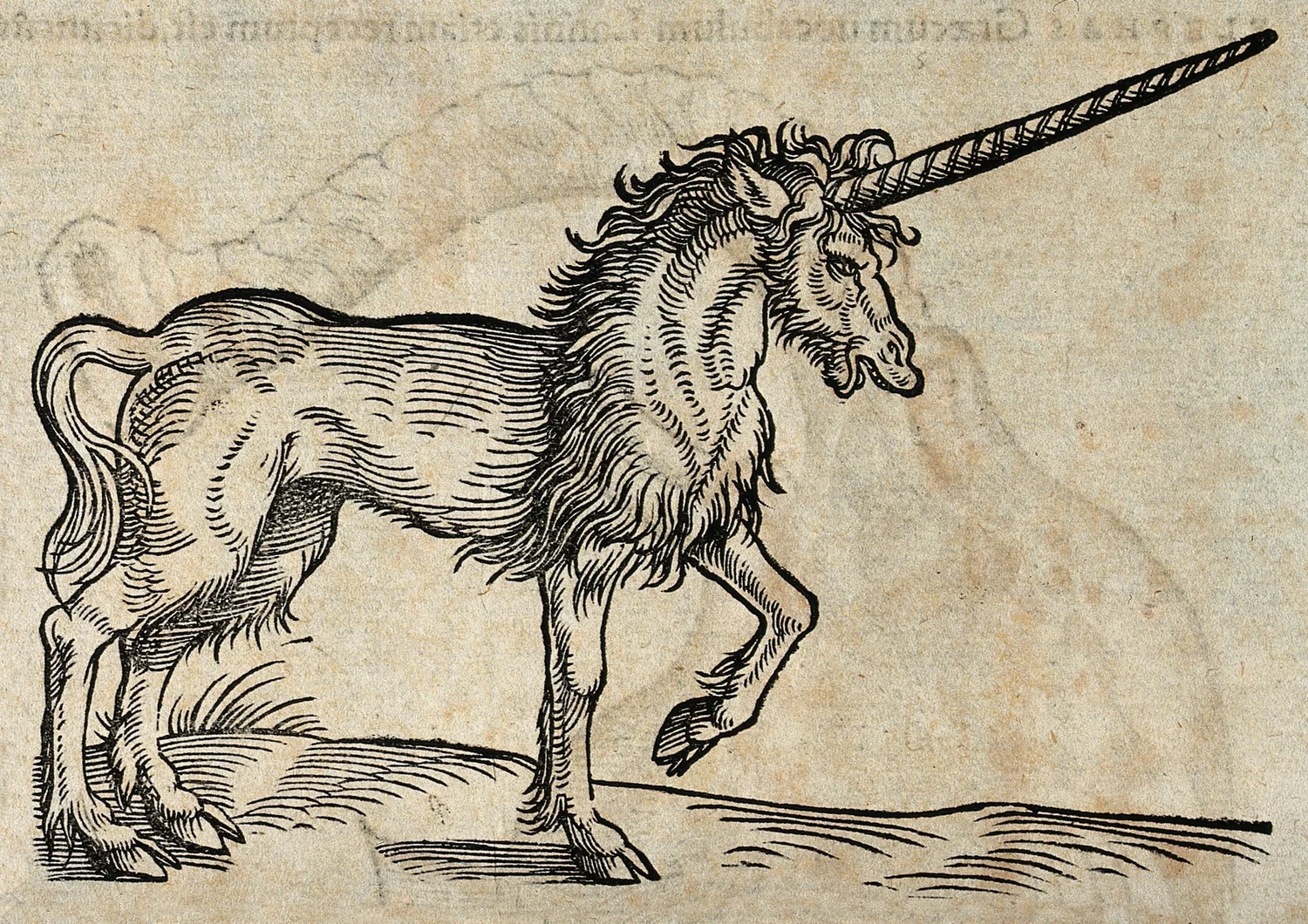
The printed unicorn, in the line of Gessner's Historia Animalium (1551): print has made the beast a horse at last, its horn spiraled like the narwhal tusks then filling Europe's cabinets. Public domain, via Wikimedia Commons.
The root of the horn is a whale. The narwhal is a small Arctic whale whose males carry a single long tusk — not a horn at all, but a tooth: the left upper canine, grown out through the lip and spiraling as it lengthens, sometimes more than eight feet long, and in a big male up to about three meters. The whale behind the tusk is about four to five meters long without it, mottled grey and white, with a rounded head and no fin on its back, which is handy under ice. Most females have no tusk showing at all. Narwhals live in the cold waters around Greenland, Arctic Canada, Svalbard, and the Russian Arctic, and they dive deep — sometimes well over a thousand meters down — after Greenland halibut, cod, shrimp, and squid. They are not easy animals to watch even now, and for most of the centuries in this lesson, nobody in Europe who traded in the tusks had ever seen one swimming. Tusks like that reached the markets of Europe from the northern seas by the Viking age, carried south by Norse and other northern traders, and they matched the books too well to question: one horn, straight, spiraled, ivory-white, from a beast no buyer would ever see alive. The unicorn of Ctesias and the unicorn of the bestiaries were stories; the narwhal was inventory.
Other one-horned reports fed the same file and are worth separating, as Pliny separated his. The rhinoceros stands behind some of them — Marco Polo's mud-wallowing "unicorns" among them — and the oryx, a straight-horned antelope, stands behind others: both sexes carry a pair of long, nearly straight horns, about two feet long in the Arabian kind, and seen squarely in profile the two horns line up so neatly that an oryx shows one horn. But the horn of the tables, the horn of the treasure houses, was the narwhal's.
The trade's secret kept for centuries. It broke, as records do, when somebody put the evidence in a room and made people look at it. In 1638 the Danish scholar Ole Worm showed his visitors a "unicorn horn" still fixed in the skull it grew from — and the skull was a narwhal's. Worm's museum catalogue, Museum Wormianum, printed after his death in 1655, carried the proof across Europe: the horns were tusks, and the unicorn of the tables had been a whale. Note the keeper's honesty in the man: Worm still tested whether ground narwhal tusk cured poison, feeding it to poisoned animals and watching — because identifying the horn did not, by itself, settle what the horn could do. The record and the belief had to be checked separately. He checked them separately. Alicorn powder was still sold by apothecaries well into the eighteenth century, but after Worm, it was sold against the evidence, and the evidence was in print.
Still With Us
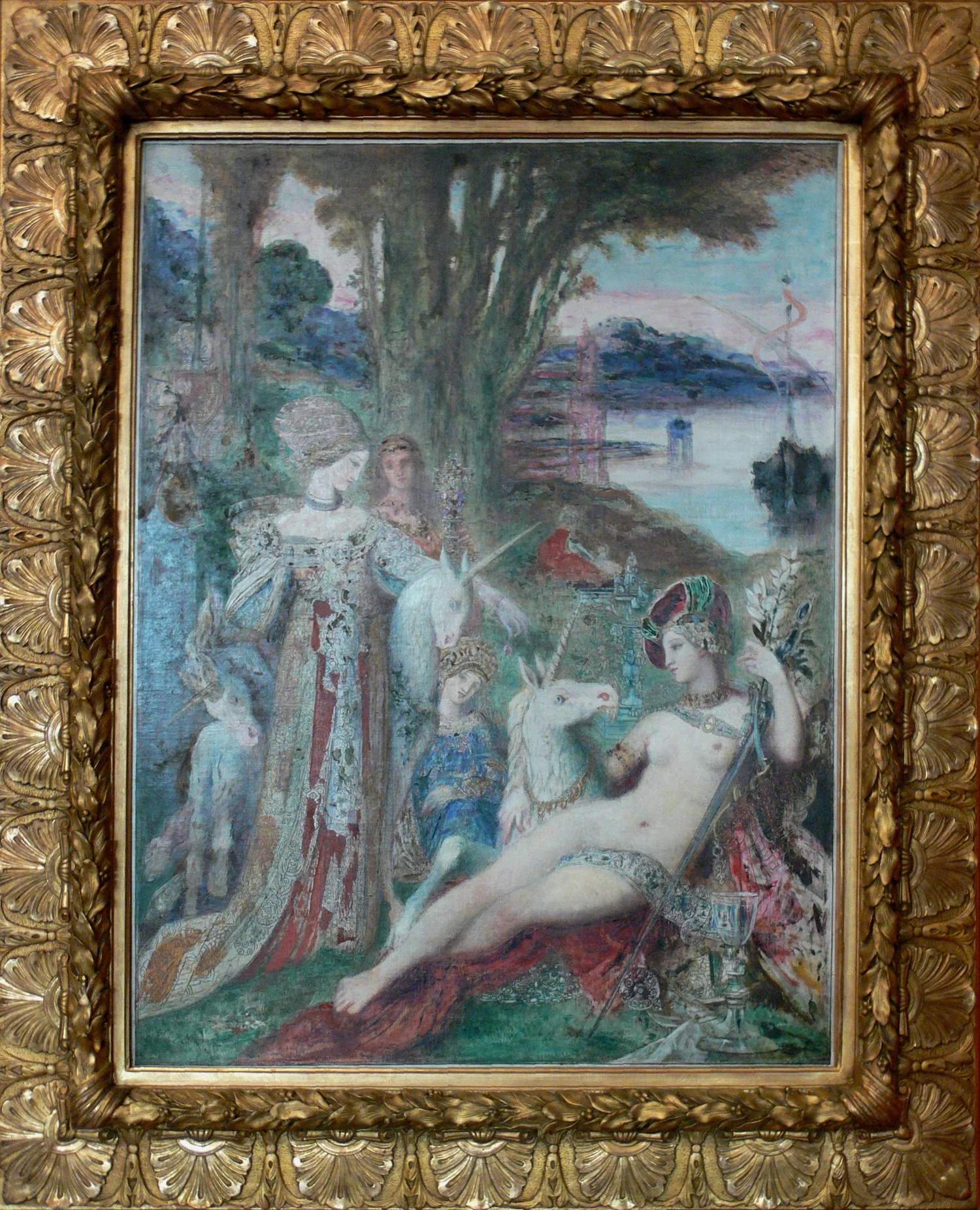
Gustave Moreau, The Unicorns (about 1888): three unicorns in a jewelled landscape with their ladies — the medieval tapestry scene repainted as a dream, the 19th century's unicorn. Public domain, via Wikimedia Commons.
The unicorn has two modern faces, and they barely speak to each other.
One is the nursery's: in the later twentieth century the fierce little beast of the bestiaries was remade as a gentle white horse with a rainbow mane, a toy of sweetness and wishes. That face is real as a record — it sells more unicorns in a year than the Middle Ages carved in a century — but it is a make-over, and a keeper files it as one: almost nothing of Ctesias, Pliny, or the Physiologus survives in it except the horn.
The other face is Scotland's. The unicorn that entered the royal arms under William I never left them: it is Scotland's national animal, borne crowned and chained as a supporter of the royal arms — heralds read the chain as the mark of a beast too dangerous to leave loose — and carved over gatehouses and market crosses across the country. The country that adopted the fiercest one-horned beast in the book keeps the fierce version still.
And the narwhal, the animal under the whole file, has a modern face of its own: studied now in its own right, its tusk found to be packed with nerves — a sense organ, tasting the water it swims through. The tooth that Europe mistook for a horn of miracles turns out to be interesting for reasons nobody at those tables could have guessed. Given six hundred years, the record did correct itself here, which does not always happen. That is a good place to close Entry No. 7.
Moreau's painting of about 1888, this lesson's fourth plate, belongs to this face of the file: the 19th century found the tapestries again and repainted the unicorn as a dream of the Middle Ages — which is why the modern unicorn looks medieval even when it is being gentle.
Guided Observation
Study the tapestry at the head of this lesson — The Unicorn in Captivity, the last of the seven Unicorn Tapestries (about 1495–1505). Look first at the unicorn's situation: the low fence, the collar, the chain running to the pomegranate tree. He is a prisoner, and the weavers have made the prison a garden: count the flowering plants around him, each one drawn from life with a gardener's care. Look at the split pomegranates on the tree, red seeds showing. Then consider what the picture claims: this is the same unicorn the earlier tapestries hunt and kill. Write down one thing this plate says that no text in the lesson says, and one thing the texts say that no weaver could show.
Then set the Aberdeen Bestiary's unicorn beside it (c. 1200), three centuries older. The English painter's beast is smaller, dog-like, earnest — and he has given it the one thing the tapestry weavers also gave it: the horn, long and straight, the single fact every artist received from the record and none from life. Note where the painter puts the unicorn's strength — in what part of the body does his drawing believe?
Last, look at the printed unicorn, the woodcut in the line of Gessner's Historia Animalium (1551). Print has made the beast a horse at last: long legs, flowing tail, the horn spiraled like a narwhal tusk — because by 1551 the tusks themselves were in the cabinets of Europe, and the picture quietly follows the merchandise. Write one sentence on what each of the three artists — painter, weaver, woodcutter — had actually seen: a book, a book, and a tusk.
Last, the fourth plate: Moreau's The Unicorns (about 1888). The 19th-century painter had seen the tapestries, not the books alone — his unicorns are the woven ones, come back as a dream. Note what he kept (the horn, the ladies, the jewelled garden) and what he let go (the hunt, the fence, the chain).
Assignment Manual
✎ WRITTEN · ⚒ HANDS-ON · ◐ BOTH
✎ Written · Entry No. 7: The Unicorn.
- Rule your entry page. Turn to the Scholar's Entry Page in this packet and rule the next page of your journal to match it, as you did for Entries No. 1–6.
- Write the unicorn's entry, to the standard. First Told: Ctesias at Susa, about 398 BCE — what he was (a Greek physician at the Persian court), what he wrote (the Indica, lost, read in Photius's summary), what he had not done (seen India), and the beast he described, with the horn's three colors. How the Telling Grew: Pliny's two one-horned beasts, kept apart — say which is which; the Physiologus and the bestiaries; the tapestries; Scotland's arms. The Tales: the virgin capture and the poisoned pool, as the record gives them. What It Actually Is: the narwhal and its tooth; the horn trade; Ole Worm's proof of 1638; and the horn at the table, filed here as the custom the belief produced. Still With Us: the nursery unicorn and Scotland's, in a line or two each. The Keeper's Line: your own judgment, in one or two lines.
- Keep the folders apart. Read back through your entry and check one thing with care: nowhere does the monoceros borrow the unicorn's stories, and nowhere does the unicorn borrow the monoceros's body. Pliny kept them separate in 77 CE. Your entry is finished only when yours does too.
- Mark every line. Go back through your entry and mark every line in the margin, T for tale, S for a sighting-report, or F for fact, as always. This entry will test the marks honestly: the tusk in the treasury is F; what the tusk was believed to do is T; and the narwhal's tooth is F of a newer kind — a record the animal itself filed, in bone, against the books.
Materials
· Your bestiary journal, with Entries No. 1–6 in it
· Pencils, and a pen you like
· A ruler, for ruling your entry pages
· This lesson's packet (the Scholar's Entry Page is in it)
· The lesson page, for the map and the tapestry plate
Reflection
Ctesias never saw India, and Aristotle said in print that he was not worth believing. His wild ass ruled the unicorn's file for two thousand years anyway. What carried it — the author, the court, or the horn?
Pliny kept two one-horned beasts in two folders; the centuries merged them into one. What does a keeper gain by keeping records separate when the world prefers a single story?
The weavers ended the hunt with the unicorn alive, collared, and chained in a garden of flowers. No text told them to. What do you think they were saying — and is a picture allowed to be a record's last word?
Cross-Class Connections
A word from the Celestial Tower, keeper to keeper. Your unicorn walks the earth in this lesson, but he also walks my sky: Monoceros, the Unicorn, stands among the winter stars, a faint beast drawn in starlight beside Orion. In Monterrey, where I first learned the sky, we say cada estrella guarda un cuento — every star keeps a story — and this one's story begins in the same old books that Professor Rookmere keeps.
The lesson is Lesson 21: Constellations & Their Stories, in Unit IV of Celestial Studies. Come and find him overhead.
Celestial Studies
Keeper of the Celestial Tower
A Closing Note
Seven entries in, and your bestiary holds its first beast of the borderlands — which is where Unit II lives. Next lesson the shelf moves to the other great borderland creature, the griffin, who guards a different frontier treasure: not a horn against poison, but gold against men. The griffin's file begins in pictures older than its first written word, and ends — bring your marks — in a church treasury, in an eggshell.
The Bestiary
Bestiary Keeper
Further Reading & Sources
Ctesias, Indica, as summarized by Photius — the first record of both this lesson's unicorn and Lesson 10's manticore; J. H. Freese's translation is free at Livius.org.
Pliny the Elder, Natural History, Book 8 — the monoceros and the Indian one-horned beasts, in the Bostock translation at Perseus.
Odell D. Shepard, The Lore of the Unicorn (1930) — the standard scholarly history of the unicorn's whole file, horns, trades, and all.
Chris Lavers, The Natural History of Unicorns (2009) — the modern keeper's account: Ctesias, the narwhal, and the alicorn trade.
The Unicorn Tapestries, The Cloisters, Metropolitan Museum of Art — the seven hangings, plate by plate, at metmuseum.org.
Ole Worm, Museum Wormianum (1655) — the catalogue that printed the narwhal skull and ended the horn trade's secret.
Submit your work for this lesson using the form below.
CONTINUE IN THE BESTIARY HALL
← Previous · Lesson 6: The Made Next · Lesson 8: The Griffin →
Unit II — Beasts of the Land The Bestiary Hall — All 41 Lessons
The rest of Unit II: Lesson 8 · The Griffin · Lesson 9 · The Basilisk & the Cockatrice · Lesson 10 · The Manticore & the Spotted Beasts · Lesson 11 · Giants & the Cyclops · Lesson 12 · Centaurs & Satyrs · Lesson 13 · The Wild Men of the Woods · Lesson 14 · Bigfoot & the Yeti · Lesson 15 · Real Animals in the Bestiary