
CELESTIAL STUDIES
Unit IV · Lesson 21Constellations & Their Stories
Professor Vesper Glimmerwick
Astronomer & Celestial Historian
The Celestial Tower • School of Evershade
Professor's Introduction
Gather round, scholars,
Every evening, when the last light drains out of the west, I do something I have done for longer than I can count. I climb to the top of the Celestial Tower, fold my wings, and I look up. Not to check anything. Not to measure. Just to look.
And on clear October nights, the first thing that meets my eyes is the great W of Cassiopeia, riding high overhead, with the swan of Cygnus stretched along the Milky Way beside her. I have seen those stars from Mexico and from Kansas, from ship decks and from mountain tops, and every place I have ever flown has had a different name for them, and a different story.
That is what this lesson is about: the stories humans have told about the same stars. We will begin with the Greek list, because it is the one our modern constellations grew from, and we will tell its history honestly, including the parts where the Greeks borrowed, and the parts where the stories came later than the star figures. Then we will do something more important. We will leave the Mediterranean entirely.
We will cross the Pacific with navigators who steered by starlight and knew exactly which star marked the latitude of home. We will stand under southern skies with the peoples of Australia, who read the dark spaces between the stars as carefully as we read the stars themselves. We will watch the dawn with Māori astronomers as the Pleiades rise to begin a new year, a ceremony their people still keep, and which their nation now honors as a public holiday.
These are not decorations on the Greek story, my dears. They are separate astronomies, complete and sophisticated, and they deserve the same respect we give Ptolemy. You will learn five constellations for your own sky this season, with star-by-star directions for finding them, and at least one of your five will come with a non-Western story attached. The sky belongs to everyone who has ever looked up. Tonight, we prove it.
One safety word before we begin. This is a night-observing lesson, so read the Safety Briefing with care. Go out with an adult, stay in places you know, and dress for October. The stars are in no hurry. Neither should you be.
PROFESSOR VESPER GLIMMERWICK
Celestial Studies
Astronomer & Celestial Historian
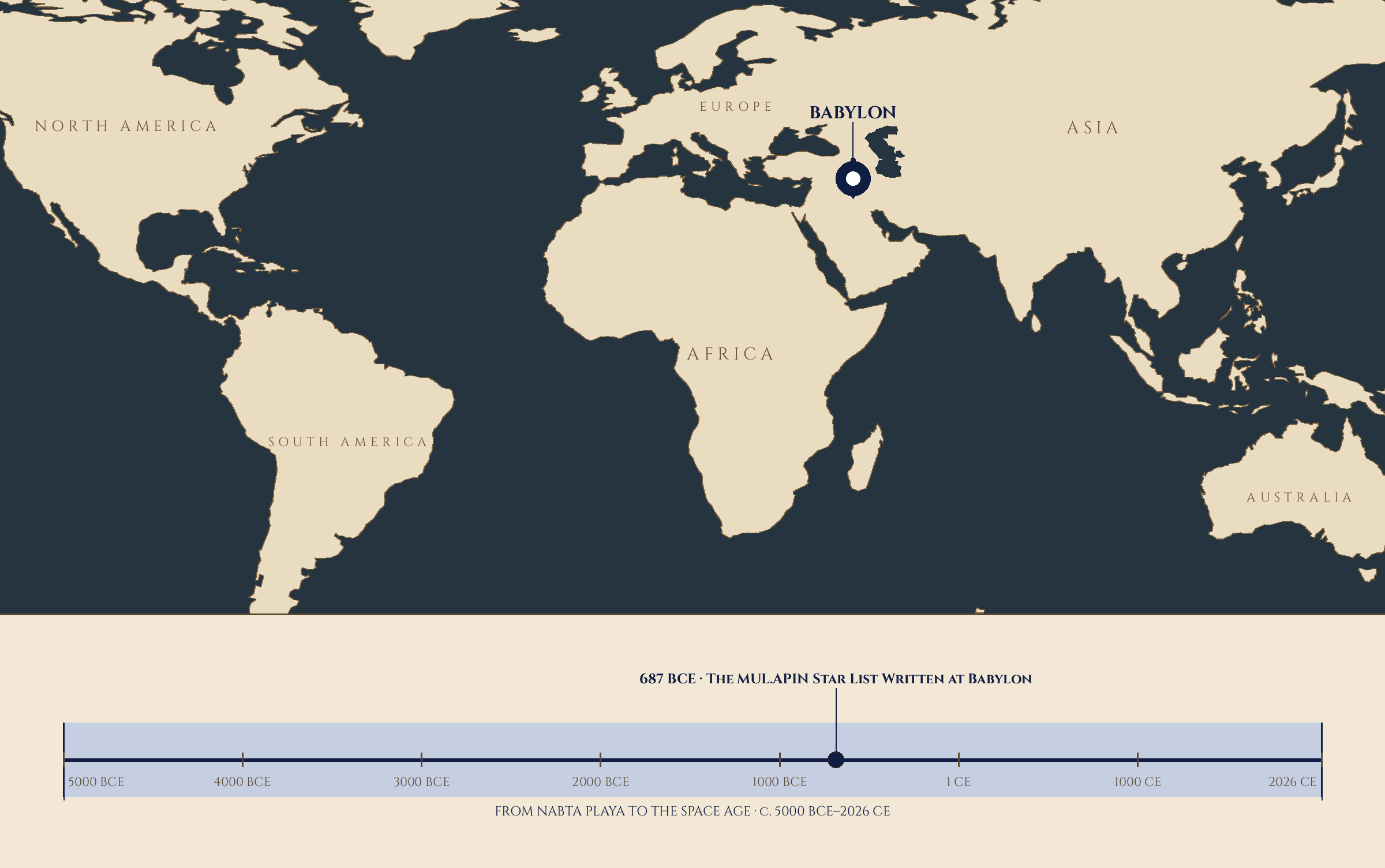
Where and when: BABYLON, 687 BCE · The MUL.APIN Star List Written at Babylon (year −687) — Constellations & Their Stories. The pin is this lesson. The line beneath the map is our road: every stop a moment when watching the sky changed, every lesson a pin upon it.
Lesson Objectives
By the end of this lesson, you will be able to:
- Find and identify their own sky's constellations — five on the northern list, four on the southern — visible in the October evening sky from their own latitude, using star-by-star locating directions.
- Name the principal stars of those constellations and describe each pattern's shape and brightest members.
- Explain, honestly, where the Greek constellation tradition came from: the Babylonian roots, Aratus, Ptolemy's 48, and the later additions, including where the myths fit in time.
- Describe the Chinese xiu (lunar mansion) system and name at least two of its mansions and the Four Symbols.
- Explain how Polynesian navigators used the star compass and zenith stars, with Hōkūleʻa (Arcturus) as the worked example.
- Describe the Emu in the Sky as a dark constellation and explain how it differs from a star-based constellation.
- Summarize what Matariki is, when and how it is observed, and when it became a New Zealand public holiday.
- Explain which constellations are circumpolar, which are seasonal, and why the Southern Hemisphere sky differs from the northern one.
Reading this lesson: ★ marks the passages to remember. They return on the unit quiz and the class test. Check in questions ask the material back as you go; answer them in your workbook when you meet them.
Working this lesson: Your assignment packet is the first download on this page. Work in it as the lesson moves along, answering each exercise as its subject is taught — or read the lesson through for your notes and take the exercises as homework afterward. Both are proper ways to sit this class. Signposts in the reading tell you where each exercise belongs. Written answers are short answers in your own words; a few honest lines are worth more than a filled page.
Your Assignment Packet
This lesson's exercises live in its packet: the Lexicon Handout (every term, course terms marked ◆), Materials, Guided Practice, the Assignment Manual with its answer key for self-checking, the Reflection Questions, and the Workbook Checklist. Download the packet before you begin and keep it beside you as you read. The packet's exercises are Glimmerwick's own word for the work: Exercise I — The Five-Constellation Practical ◐, Exercise II — The Constellation Timeline ⚒, and Exercise III — The Respectful Retelling ✎. The lesson's quiz is not printed in the packet; it pools to the Unit IV Quiz, where it will meet you again.
Apparatus note on the season (overhaul apparatus, not the professor's text): this lesson's sky is October's, exactly as Professor Glimmerwick wrote it — the objectives, the Try It Tonight directions, and Exercise I all name a clear October evening, and no other season's sky is offered anywhere in the lesson. If you reach this lesson in another season, work it as written and let the packet's workbook paths carry the observing on the page; the October sky itself is the lesson's, and it has not been rewritten.
Safety Briefing
Night-observing safety. This is a night-observing lesson, and the rules are simple and absolute.
All night observing is done with an adult present. Go out together, in a familiar and safe location: your own yard, a park you know well, a school field. Tell someone where you are and when you expect to return. Do not wander into unfamiliar or isolated places after dark, no matter how dark the sky is there.
Dress for the season and watch your footing. October nights are cold. Warm layers, sturdy shoes, and a flashlight you can point at the ground. Walk slowly when your eyes are dark-adapted; your night vision makes you nearly blind to obstacles at your feet.
Protect your night vision. Use a dim red flashlight or cover a regular flashlight with red cellophane when reading your chart. White light destroys dark adaptation in an instant, and it takes twenty minutes or more to recover. Warn your observing partner before switching on any light.
Never look at the sun to find anything in this lesson. Nothing in this lesson requires solar observing, so there is no reason to aim your eyes anywhere near the sun. If you practice your locating directions in daylight, do it on paper.
No equipment is required. Everything in this lesson is naked-eye work. If you use binoculars (Level Two), use them only after dark, never near sunrise or sunset when the sun might enter the field of view.
The Wonder
Step outside on a clear October evening, about two hours after sunset, and face north.
High overhead, tilted like a crown, you will see five bright stars in a jagged W. That is Cassiopeia, the Queen. Below her and to the south, the band of the Milky Way runs diagonally across the sky, and along it lies a great cross of stars: Cygnus, the Swan, flying down the length of the galaxy with its wings spread. To the west, one brilliant blue-white star outshines everything near it. That is Vega, the anchor of little Lyra. In the east, a huge square of four nearly equal stars has risen: the Great Square of Pegasus. And climbing in the northeast, between Cassiopeia and the horizon, a spray of stars fans out like a burst of sparks. That is Perseus, rising.
Five constellations. Five sets of stars that humans have been looking at for thousands of years.
Now here is the wonder, and it is the whole subject of this lesson. Those exact same stars, the ones you can see tonight from Kansas or from Nottinghamshire, were watched by Chinese court astronomers who never heard of Cassiopeia, by Polynesian navigators who knew them as road signs on an ocean with no roads, by Australian peoples who saw the dark spaces between them more clearly than the stars themselves, and by Māori elders who read the rising of one small cluster as the turning of the year.
The sky is one sky. The stories are many. And tonight, you are going to learn to read it the way five different traditions did, starting with your own constellations — five on the northern list, four on the southern, star by star.
❦ In your workbook: record the wonder in your own way — the W overhead, the swan on the river of light, and the one sky that five traditions read five ways — copy, sketch, or note what matters.
The Story
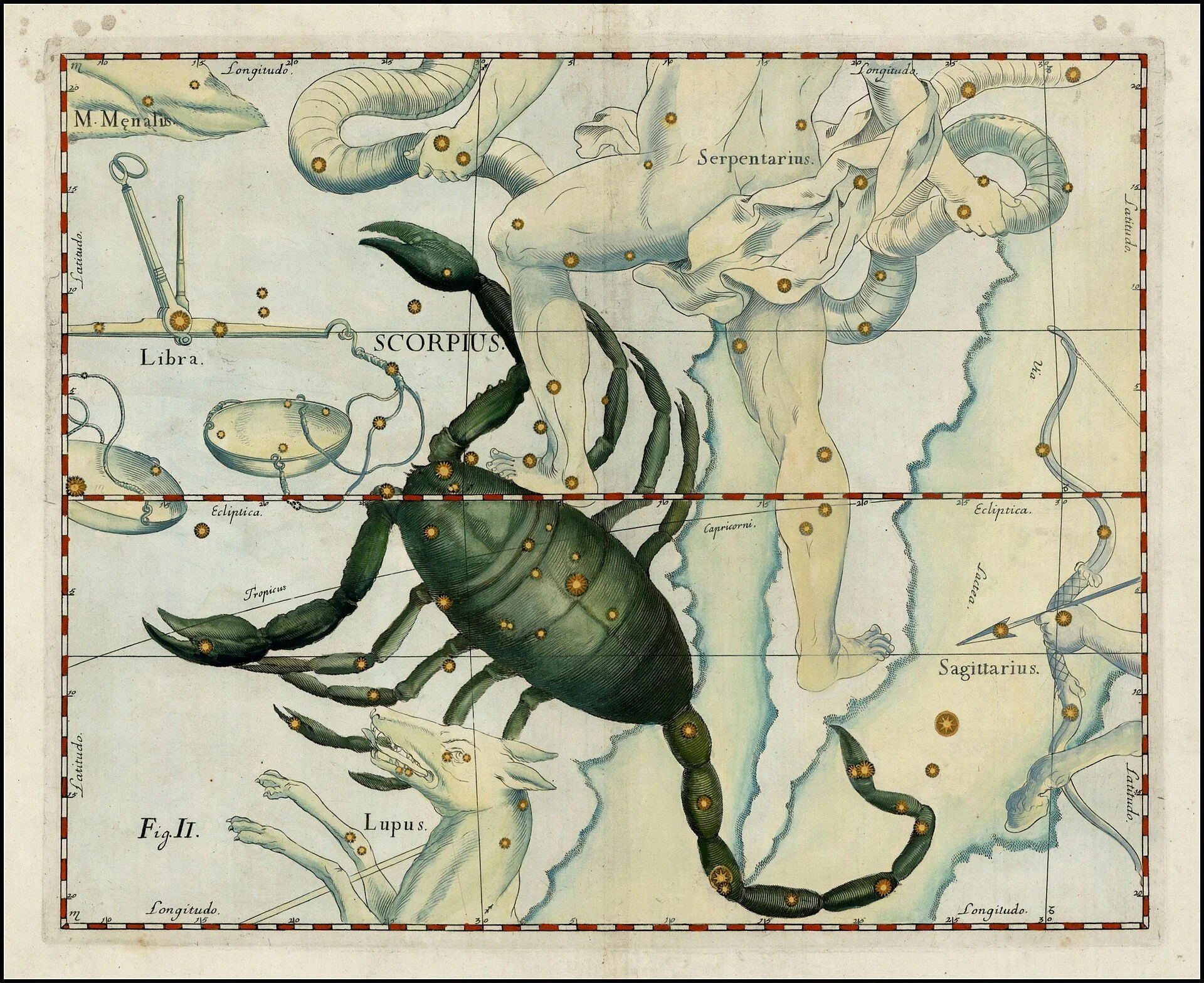
Scorpius in Hevelius (1690) — with Libra's scales drawn right beside the scorpion's claws. That is the lesson's point in a single plate: Ptolemy listed those stars as Chelai, the Claws; the Scales were a later identity laid over the same stars. Antares burns at the scorpion's heart, and southern scholars meet this fishhook in Part One.
Johannes Hevelius, Firmamentum Sobiescianum, sive Uranographia (1690), hand-colored plate.
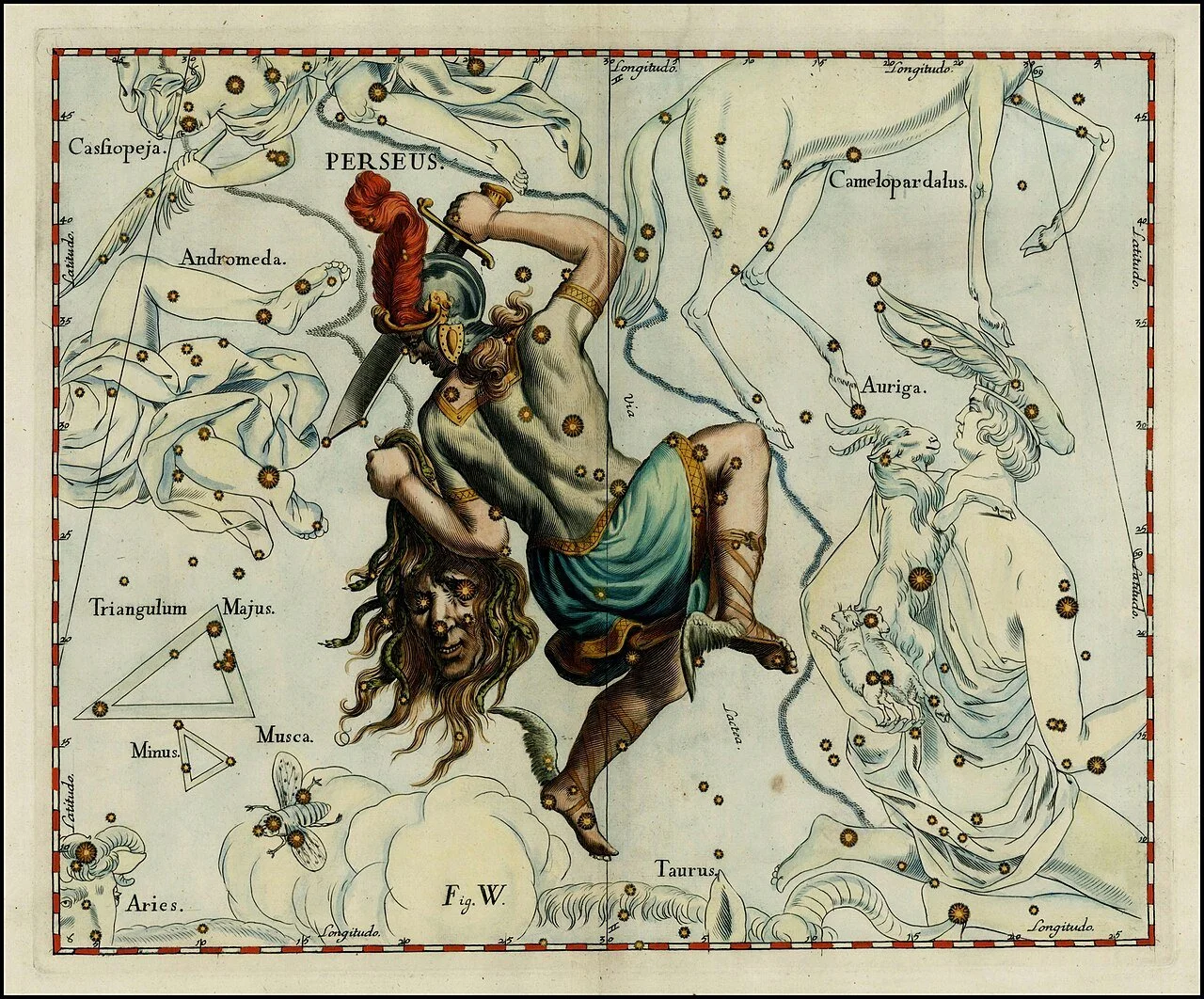
Perseus in Hevelius (1690), Medusa's head in his hand — the whole cast of the Cassiopeia story on one plate: the queen above, the chained princess at his side, the hero between them. The bright star in the Gorgon's head is Algol, the Demon Star of the lesson's chart, the variable that winks every 2.9 days.
Johannes Hevelius, Firmamentum Sobiescianum, sive Uranographia (1690), hand-colored plate.
The list that became the sky
Our modern constellations did not begin with the Greeks. That is the first honest thing to say, and it matters.
The oldest star list we have was written in cuneiform on clay tablets in Babylon, in what is now Iraq. Scholars call the series MUL.APIN, from the first words on the tablets, and one copy is dated to 687 BCE. It names dozens of constellations, and historians have shown that many of the star figures we use today, especially the twelve of the zodiac, have Babylonian ancestors. The Babylonians' own ancestors, the Sumerians, were mapping the sky before 2000 BCE. The figures are older than the Greek stories by more than a thousand years.
The first complete Greek guide to the constellations comes not from a scientist but from a poet. Around 275 BCE, a Greek named Aratus, working at the court of the king of Macedonia, versified an earlier astronomer's descriptions into a long poem called the Phaenomena (Appearances). The poem names the star figures, describes where each one rises and sets, and gives sailing and farming advice based on them. It was wildly popular: the most-read astronomy text of the ancient world for centuries.
★ Then, around 150 CE, the astronomer Claudius Ptolemy, working in Alexandria in Egypt, published the Almagest, the great mathematical treatise of ancient astronomy. Books VII and VIII contain a star catalogue of 1,022 stars, organized into 48 constellations: twelve of the zodiac, twenty-one north of it, fifteen south of it. This list became the foundation of the Western constellation system. Ptolemy did not invent the figures. He catalogued, measured, and preserved them, and because his book survived when so much else was lost, his 48 became the sky the West inherited.
★ The list did not stop at 48. Over the following centuries, astronomers filled in the gaps between Ptolemy's figures and mapped the southern sky that had been below the Greeks' horizon. The Dutch cartographer Petrus Plancius added new figures in the late 1500s; the French astronomer Nicolas-Louis de Lacaille, working from the Cape of Good Hope in the 1750s, carved up the great ship Argo Navis into three smaller constellations (Carina, Vela, and Puppis) and added fourteen new ones of his own. The result, agreed internationally by the International Astronomical Union in 1922, with official boundaries fixed in 1928, is the 88 constellations astronomers use today: contiguous regions covering the whole sky, like counties on a map.
Check in: Ptolemy's catalogue held 1,022 stars in 48 constellations — so what did Ptolemy not do, and whose much older star figures was he preserving?
❦ In your workbook: record the list in your own way — Babylon's tablets, the poet who versified the sky, the catalogue of 48, and the road from 48 to 88 — copy, sketch, or note what matters.
In your packet: Exercise II — The Constellation Timeline ⚒ begins here — its five sourced events are this section's dates. Work it now, or mark the place and take it as homework — your choice.
The myths came later
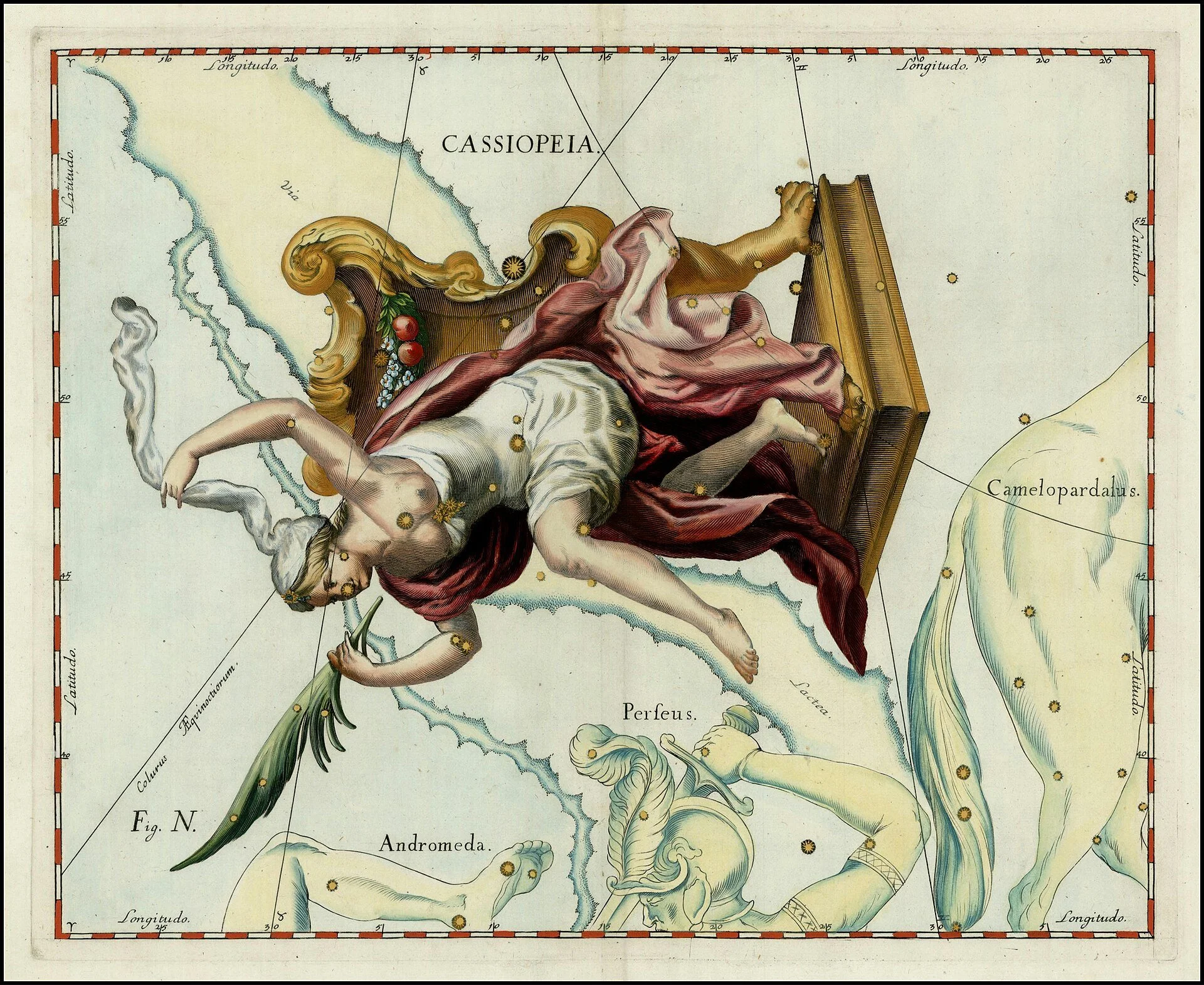
Cassiopeia in Hevelius's Uranographia (1690): the Queen upside down on her throne — the posture of humiliation the later storytellers gave her. The star figure was already ancient when the story was attached to it; Hevelius, drawing the figures as seen from outside the celestial sphere, shows her mid-tumble over the Milky Way.
Johannes Hevelius, Firmamentum Sobiescianum, sive Uranographia (1690), hand-colored plate.
★ Here is the second honest thing, and students usually find it surprising. The star figures are older than most of the stories we attach to them.
The Greeks inherited old figures and then, over centuries, embroidered them with mythology. Aratus's poem already carried some stories, but the elaborate tales we repeat today, the chained princess, the boastful queen, the hero with the mirrored shield, were largely assembled by later writers: the Roman poet Ovid, the mythographer Hyginus in the second century CE, and generations of storytellers after them. The myths are Greek and Roman literature applied to the sky, not the sky's original meaning.
Take Cassiopeia. In the familiar story, she was a queen of Ethiopia who boasted that she, or her daughter Andromeda, was more beautiful than the sea nymphs. The sea god punished the boast by sending the monster Cetus, Andromeda was chained to a rock as a sacrifice, and the hero Perseus rescued her; the whole cast was placed in the sky, where Cassiopeia circles the pole forever, sometimes upside down, in a posture of humiliation. It is a fine story. But the star figure was already old when the story was attached to it, and different ancient sources tell the story differently, with different characters boasting and different endings. The stars did not change. The storytelling did.
Or take Libra, the Scales. Ptolemy listed it, but his own Greek name for it was Chelai, the Claws: it was the claws of neighboring Scorpius, the Scorpion. The separate figure of the scales, and its later association with balance and justice, came later. When you look at Libra tonight (low in the southwest in October evenings, setting early), you are looking at a constellation whose identity changed while the stars stayed exactly where they were.
The lesson is not that the myths are worthless. They are wonderful, and they carried the star figures through two thousand years of retelling. The lesson is that the stories are stories, layered onto the sky by particular people at particular times, and that other peoples layered different stories onto the same stars.
Check in: Libra's stars never moved, yet Libra changed. What was Ptolemy's own Greek name for it, and what does that change prove about the difference between stars and stories?
❦ In your workbook: record the late myths in your own way — old figures, later embroidery, and the queen whose posture of humiliation was a storyteller's addition — copy, sketch, or note what matters.
The lodgings of the moon
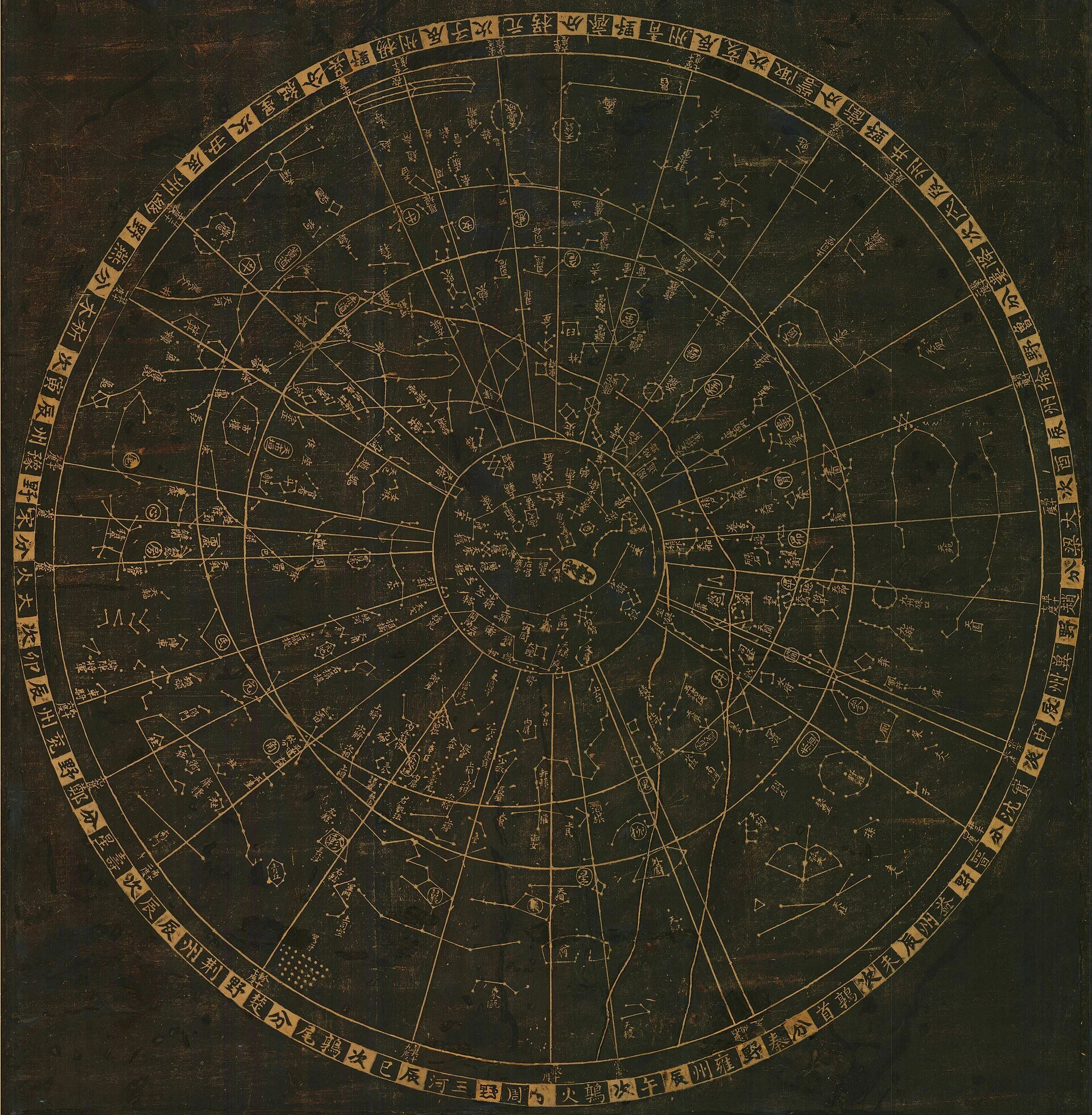
The Suzhou planisphere (drawn 1193, engraved in stone 1247): the Chinese sky entire — 283 asterisms on the lesson's count, the twenty-eight lunar mansions radiating as spokes, the Three Enclosures around the pole at the center, and the Milky Way drawn as a band across it all. A complete astronomy sharing almost no figures with the Western one, built from the same stars.
Huang Shang (chart, 1193) / Wang Zhiyuan (stone engraving, 1247); rubbing.
China built an entirely different sky.
★ Where the Western system follows the sun through twelve zodiac figures across a year, the classical Chinese system followed the moon through twenty-eight stations across a month. They are called xiu (pronounced "syo"), usually translated as mansions or lodgings: the places where the moon spends each night of its 27.3-day circuit around the sky.
The twenty-eight mansions are grouped into four sets of seven, the Four Symbols, each ruling a direction and a season: the Azure Dragon of the East (spring), the Vermilion Bird of the South (summer), the White Tiger of the West (autumn), and the Black Tortoise of the North (winter). The circumpolar stars around the pole form the Three Enclosures, with Polaris at the center as the Celestial Emperor, around whom the whole court of heaven revolves: the Chinese sky was organized like a Chinese imperial court.
The Chinese star figures are generally smaller than Western constellations, and there are hundreds of them: a 13th-century Chinese star chart, the Suzhou planisphere, shows 283 asterisms. Here are three mansions you can find tonight:
- Mao, the Hairy Head, in the White Tiger of the West. Its determinative star is in the little dipper-shaped cluster we call the Pleiades. The same cluster the Greeks called the Seven Sisters, and the Māori call Matariki, is the eighteenth mansion of the Chinese moon road. Keep that in mind. We will meet it again.
- Shen, the Three Stars, in the White Tiger as well. Its determinative star is Zeta Orionis, the leftmost star of Orion's Belt. Orion's Belt, the most recognizable star line in the winter sky, is a Chinese mansion in its own right.
- Shi, the Encampment, and Bi, the Wall, in the Black Tortoise of the North. Their determinative stars are Alpha and Gamma Pegasi: two corners of the Great Square of Pegasus, the square you will learn tonight. When you find the Great Square, you are looking at two Chinese lunar mansions.
The xiu system was used for calendar-keeping, for astrology, and for navigation. It was adopted in Korea, Japan, and Vietnam. It is a complete, working astronomy that shares almost no figures with the Western one, built from the same stars.
Check in: The Western system follows the sun through twelve figures across a year. The Chinese system follows what, through how many stations — and which two corners of tonight's Great Square are Chinese mansions, and which are they?
❦ In your workbook: record the moon's lodgings in your own way — twenty-eight mansions, four Symbols, three Enclosures, and the cluster that is at once the Seven Sisters, the Hairy Head, and Matariki — copy, sketch, or note what matters.
The navigator's sky
Now cross the Pacific.
The Polynesian peoples settled the largest ocean on Earth, a triangle of islands with corners at Hawaiʻi, Rapa Nui (Easter Island), and Aotearoa (New Zealand), thousands of miles of open water between. They did it without compasses, sextants, or charts, navigating instead by a memorized astronomy so precise that modern scholars consider it one of the great intellectual achievements in human history.
A traditional navigator carries the sky in memory. The foundation is the star compass: a mental map of the horizon divided into thirty-two directional houses, each named, each associated with the stars that rise and set there. The navigator knows hundreds of stars by name and knows, for each one, exactly where it rises and where it sets, and how those positions shift with latitude. To hold a course at night, the navigator steers by a chosen star, and as it climbs too high to read, hands the heading to the next star rising behind it, all night, for weeks.
The most elegant trick is the zenith star. A star passes directly overhead only at the latitude matching its declination. Every island has a zenith star, and a navigator who knows the target island's star can sail north or south until that star crosses the zenith, and then turn east or west and sail along the latitude until landfall. Latitude from starlight, with no instrument at all.
★ The worked example is Hōkūleʻa (pronounced ho-koo-lay-AH), "the star of gladness." Its Western name is Arcturus, the brilliant orange star of Boötes, the fourth-brightest star in the night sky. Arcturus has a declination of about +19 degrees, and the Hawaiian Islands sit at about 19 to 22 degrees north. Sailing north from Tahiti, a navigator watches Hōkūleʻa climb higher each night until it passes directly overhead. At that moment, the canoe is at the latitude of Hawaiʻi. Turn west, keep the star's rising and setting points on the beam, and the islands will come up over the horizon.
The knowledge was nearly lost. By the 1970s, no living Hawaiian could navigate the old way, and a Satawalese master navigator named Mau Piailug, from the Caroline Islands of Micronesia, agreed to teach it. In 1976, the double-hulled voyaging canoe Hōkūleʻa, named for the star, sailed from Hawaiʻi to Tahiti and back guided only by traditional wayfinding: stars, swells, winds, and birds. The voyage proved the old knowledge worked, and it ignited a renaissance. The Polynesian Voyaging Society's canoes have since sailed around the world, and the star knowledge is taught again, as knowledge, in living schools.
Learn this fact and hold it with respect: the same orange star you can find tonight by arcing from the Big Dipper's handle ("arc to Arcturus," as the old saying goes) is a latitude marker, a canoe's name, and a proof that human memory, trained for decades, can do what instruments do.
Check in: A navigator sails north until Hōkūleʻa crosses the zenith, then turns west. Why does the turn come at exactly that moment — what has the star just told him, in one word from this lesson's lexicon?
❦ In your workbook: record the navigator's sky in your own way — thirty-two houses, a star handed to the next star all night, and the star of gladness climbing to the zenith — copy, sketch, or note what matters.
The dark constellations
Now go south, to skies the Greeks never saw.
Many Aboriginal Australian peoples read the sky the way Western astronomy does not: by the dark spaces, not the bright points. The most famous of these dark constellations is the Emu in the Sky.
★ On a moonless night, look at the band of the Milky Way near the Southern Cross. Beside the Cross sits a dark oval patch, the Coalsack Nebula, a cloud of dust blotting out the stars behind it. That is the emu's head. From the head, the emu's long neck stretches through the gap between the two bright Pointer stars, and its body and legs extend along the dark dust lanes of the Milky Way, the Great Rift, all the way to Scorpius. The whole bird spans half the sky, drawn in absence: a constellation made of shadows.
The Emu is not decoration. It is a calendar. To the Wiradjuri people of central New South Wales, the celestial emu is Gugurmin. When Gugurmin rises at dusk in autumn, the real emus are nesting, and it is the season to gather their eggs. As the year turns, the emu's posture in the sky changes, tracking the bird's life cycle on the ground: nesting, hatching, the chicks reared through spring. Sky and land mirror each other, and the constellation tells its readers when to eat.
Two things must be said, because this knowledge is alive and belongs to its keepers. First, there is no single Aboriginal astronomy. There are hundreds of nations across Australia, and they read the sky differently: to the Wardaman people, the Coalsack is not an emu's head at all, but the head of a lawman. Second, this lesson can only introduce the Emu. The full knowledge, the stories, the law, the ceremony attached to it, belongs to Aboriginal and Torres Strait Islander peoples, and the right way to learn more is from Indigenous astronomers and educators, several of whom are listed in Further Reading. We study the Emu here the way we would study a masterpiece in a museum we do not own: with attention, with gratitude, and without touching.
Check in: The Emu is a constellation, yet you cannot point to a single one of its stars. What is it drawn in, where does its head sit, and what does its autumn rising tell Wiradjuri families to do?
❦ In your workbook: record the dark constellations in your own way — a bird drawn in absence, head to Scorpius, whose posture is a calendar — copy, sketch, or note what matters.
The living holiday
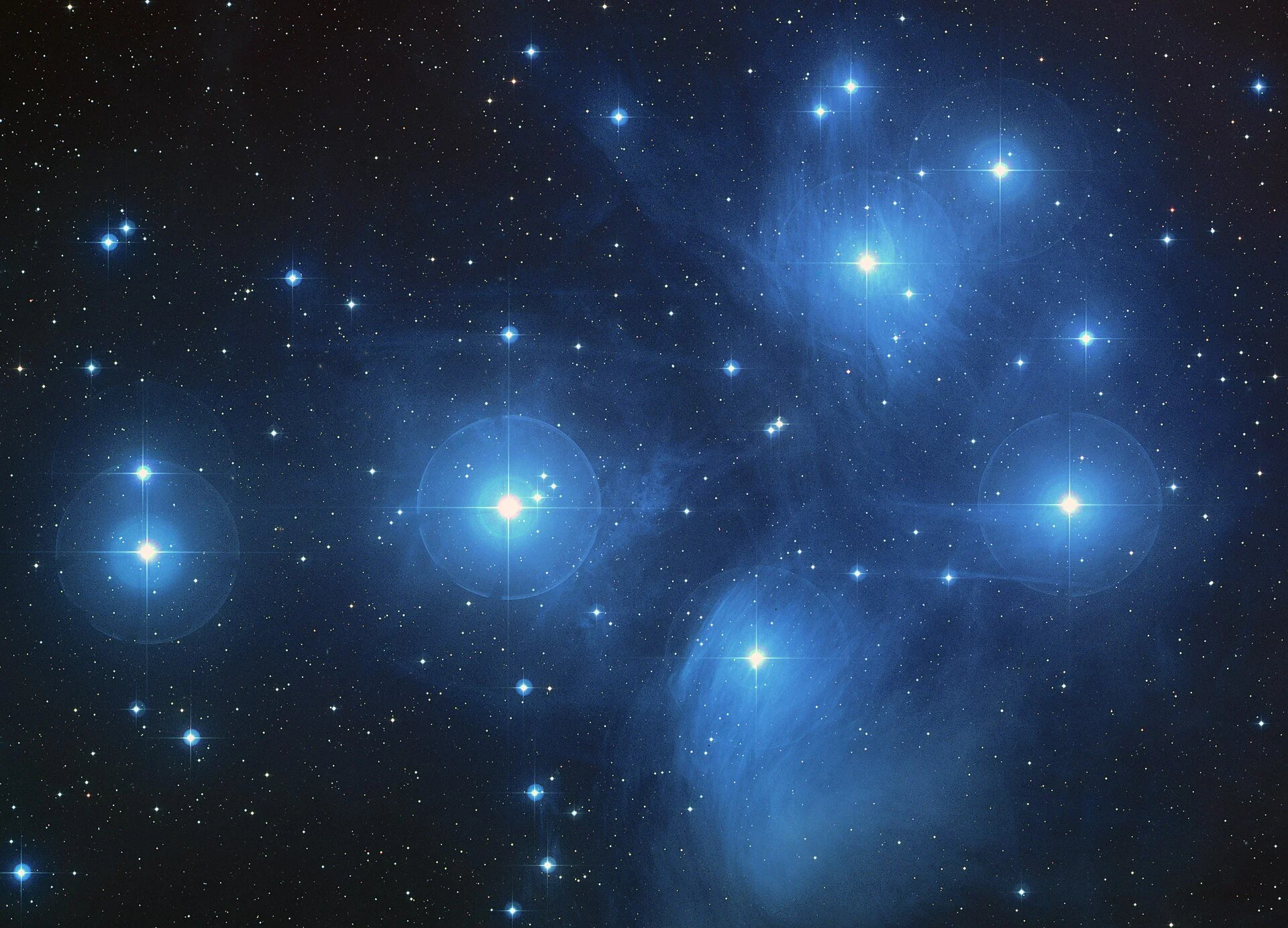
The Pleiades, the cluster this lesson meets three times: the Seven Sisters of the Greeks, Mao, the Hairy Head, eighteenth mansion of the Chinese moon road — and Matariki, whose pre-dawn return in late June or early July begins the Māori new year. Māori astronomers recognize nine stars in the cluster, each with a name and a domain.
NASA / ESA / AURA / Caltech (Palomar Digitized Sky Survey mosaic).
Finally, the Pleiades, the little cluster we have now met three times: the Seven Sisters of the Greeks, the Mao mansion of the Chinese, and now Matariki.
In Māori tradition, Matariki is the Māori name for the Pleiades star cluster, in the constellation Taurus. The name is a shortened form of Ngā mata o te ariki o Tāwhirimātea, "the eyes of the god Tāwhirimātea," the god of winds and weather. Māori astronomers, the tohunga kōkōrangi, the learned elders of the houses of astronomical learning, recognize nine stars in the cluster, each with a name, a domain, and a forecast: Matariki herself for health and well-being, Tupuārangi for food from the skies, Tupuānuku for food from the soil, Ururangi for the winds, Waipunārangi for rain, Waitī for fresh water, Waitā for the ocean, Pōhutukawa for the departed, and Hiwa-i-te-rangi, the wishing star, for hopes and desires.
Matariki disappears from the evening sky around May and reappears just before dawn in late June or early July: its heliacal rising. That first pre-dawn appearance marks the beginning of the Māori lunar new year. The traditional celebration had three parts: reading the individual stars for forecasts of the coming year (clear bright stars promised a warm, prosperous season; hazy ones warned of hardship), mourning and naming the dead of the past year, and whāngai i te hautapu, the ceremonial offering of food, whose steam rose to feed the stars. Then came days of feasting, song, and dance.
★ The celebration declined through the twentieth century, then revived from the early 1990s onward, led by Māori scholars and communities. In 2022, Aotearoa New Zealand made Matariki its newest public holiday: the first public holiday anywhere to recognize an Indigenous astronomical tradition, and the country's first new public holiday in decades. The first was observed on Friday, 24 June 2022. Because the holiday follows the actual rising of the stars, its date moves each year: 20 June in 2025, 10 July in 2026, always on a Friday or Monday.
This is lore in living use, and that changes how we study it. The Greek myths are literature now; nobody sacrifices to Cetus. Matariki is a holiday people will celebrate next June, with dawn ceremonies and family gatherings. We learn it the way we would learn about any living tradition: accurately, respectfully, and aware that we are guests.
Check in: What is a heliacal rising, what does Matariki's rising begin — and in what year did it become a public holiday, the first anywhere to recognize what?
❦ In your workbook: record the living holiday in your own way — nine named stars, three parts to the celebration, and a holiday whose date follows the stars themselves — copy, sketch, or note what matters.
In your packet: Exercise III — The Respectful Retelling ✎ begins here — every tradition it offers you is taught in this Story. Work it now, or mark the place and take it as homework — your choice.
The Mechanism
Why the sky changes with the seasons
Your constellations are October constellations, not forever constellations. Here is why.
Earth orbits the sun once a year, and the night side of Earth faces a different direction in space as the months pass. In October, the midnight sky faces one way; in April, it faces the opposite way. The stars themselves have barely moved. We have.
There is a second, smaller motion layered on top. Earth also spins, once a day, and the sky appears to wheel overhead at about fifteen degrees per hour. Because the stars rise about four minutes earlier each night, the whole pattern slides steadily westward through the seasons. A constellation that stands overhead at 9 p.m. in October stood overhead at 11 p.m. in September and will stand overhead at 7 p.m. in November. This is the same clock-time rule from Lesson 2: observe at the same hour, and the seasonal shift becomes visible in weeks.
So "visible this season" means: these are the constellations on the night side of Earth in October, at convenient evening hours. In April, you will meet a different cast.
❦ In your workbook: record the turning year in your own way — the night side facing a new direction each season, and the four-minutes-earlier slide that moves October's 9 p.m. sky to November's 7 — copy, sketch, or note what matters.
Circumpolar and seasonal: the latitude rules
Whether a constellation ever sets depends on your latitude. From Lesson 2: stars within your latitude's distance of the celestial pole never set. They circle the pole all night, all year. These are the circumpolar constellations. Stars farther from the pole rise and set, and among those, Earth's orbit decides which ones grace your evenings in which season. These are the seasonal constellations.
★ The altitude of the celestial pole above your horizon equals your latitude. At 40 degrees north (Kansas, roughly), Polaris stands 40 degrees above the northern horizon, and every constellation within 40 degrees of the pole is circumpolar. Cassiopeia, at about 60 degrees north declination, never sets for most northern observers. That is why the Queen is an October constellation and also a January and April constellation: she is always up, wheeling around the pole.
Cross the equator, and the sky changes completely. The north celestial pole sinks below the horizon; the south celestial pole rises. Polaris is gone. In its place, southern observers get the Southern Cross, the Magellanic Clouds, and the great sweep of the Milky Way's center overhead. There is no bright southern pole star. The nearest naked-eye star to the south celestial pole, Sigma Octantis, glows at magnitude 5.5, barely visible even on a dark night, so southern navigators and astronomers locate the pole geometrically, often with the help of the Southern Cross itself. The southern sky is not a mirror of the northern one. It is a different sky, with different constellations, different stories, and different teachers.
Check in: At 40 degrees north, the pole stands 40 degrees high. Which of tonight's five northern constellations never sets at that latitude, and what is the rule that decides it?
❦ In your workbook: record the latitude rules in your own way — the pole's height is your latitude, the circle that never sets, and the different sky waiting across the equator — copy, sketch, or note what matters.
What a constellation is, officially
★ When astronomers say "constellation" today, they mean something precise: one of 88 regions that tile the entire sky without gaps or overlaps, with fixed boundaries agreed in 1928. The star figures we draw inside them, the W, the Cross, the Swan, are asterisms: patterns we trace, not official borders. The Big Dipper is an asterism inside the constellation Ursa Major. The Great Square of Pegasus is an asterism shared between Pegasus and Andromeda.
This matters for the lesson's honesty. The 88 are a modern filing system, built on Ptolemy's 48. The figures people actually see and tell stories about are older, looser, and shared across cultures in ways the official map does not show. When the lesson says "learn five constellations," it means the figures: the patterns your eyes can find.
❦ In your workbook: record the official sky in your own way — 88 regions tiling the sky like counties, and the figures your eyes actually find drawn inside them as asterisms — copy, sketch, or note what matters.
How bright is bright: the magnitude scale
Finding constellations means judging brightness, and astronomers inherited their brightness scale from the Greeks. Hipparchus, in the second century BCE, sorted the visible stars into six classes: the brightest were first magnitude, the faintest visible were sixth. Ptolemy kept the system in the Almagest.
The modern scale kept Hipparchus's numbers and made them mathematical. Each magnitude step is about two and a half times in brightness. The scale now runs past both ends: Vega, the anchor of Lyra, is magnitude 0.0, and Sirius blazes at negative 1.5. A sixth-magnitude star is the faintest most eyes can catch from a dark site. The magnitudes in your five-constellation charts below use this scale, so "magnitude 2.5" tells you exactly how bright to expect each star.
❦ In your workbook: record the brightness scale in your own way — Hipparchus's six classes, each modern step about two and a half times, from Vega at 0.0 down to the faintest star your dark site allows — copy, sketch, or note what matters.
A Sealed Note on the Stories
I want to tell you something about my own sky, scholars, because it belongs in this lesson.
I am a bat. I navigate by sound in the dark, which means I have spent my whole life listening to a world I cannot see. When I first began to study the stars, I assumed the pictures were in the sky itself, the way echoes are in a cave. It took me years to understand that the pictures are not in the sky at all. They are in us.
Every culture that ever looked up found the same scattered lights and drew different lines between them. The Greeks drew heroes. The Chinese drew a celestial court. The navigators of the Pacific drew a compass. The peoples of Australia drew the spaces between. None of them was wrong about the stars. The stars are the same for everyone. What differed was the question each culture asked of them: What do the gods require? When do we plant? How do we get home? When do we eat?
So when you learn your constellations tonight, learn the figures carefully, and then ask the question. Not "what is the story," but "whose question does this story answer?" That is the difference between collecting myths and understanding astronomies. You are scholars of the Celestial Tower. I expect you to understand.
❦ In your workbook: record the sealed note in your own way — the pictures are in us, not in the sky, and the scholar's question to ask of every story: whose question does it answer? — copy, sketch, or note what matters.
PROFESSOR VESPER GLIMMERWICK
Celestial Studies
Astronomer & Celestial Historian
Guided Observation
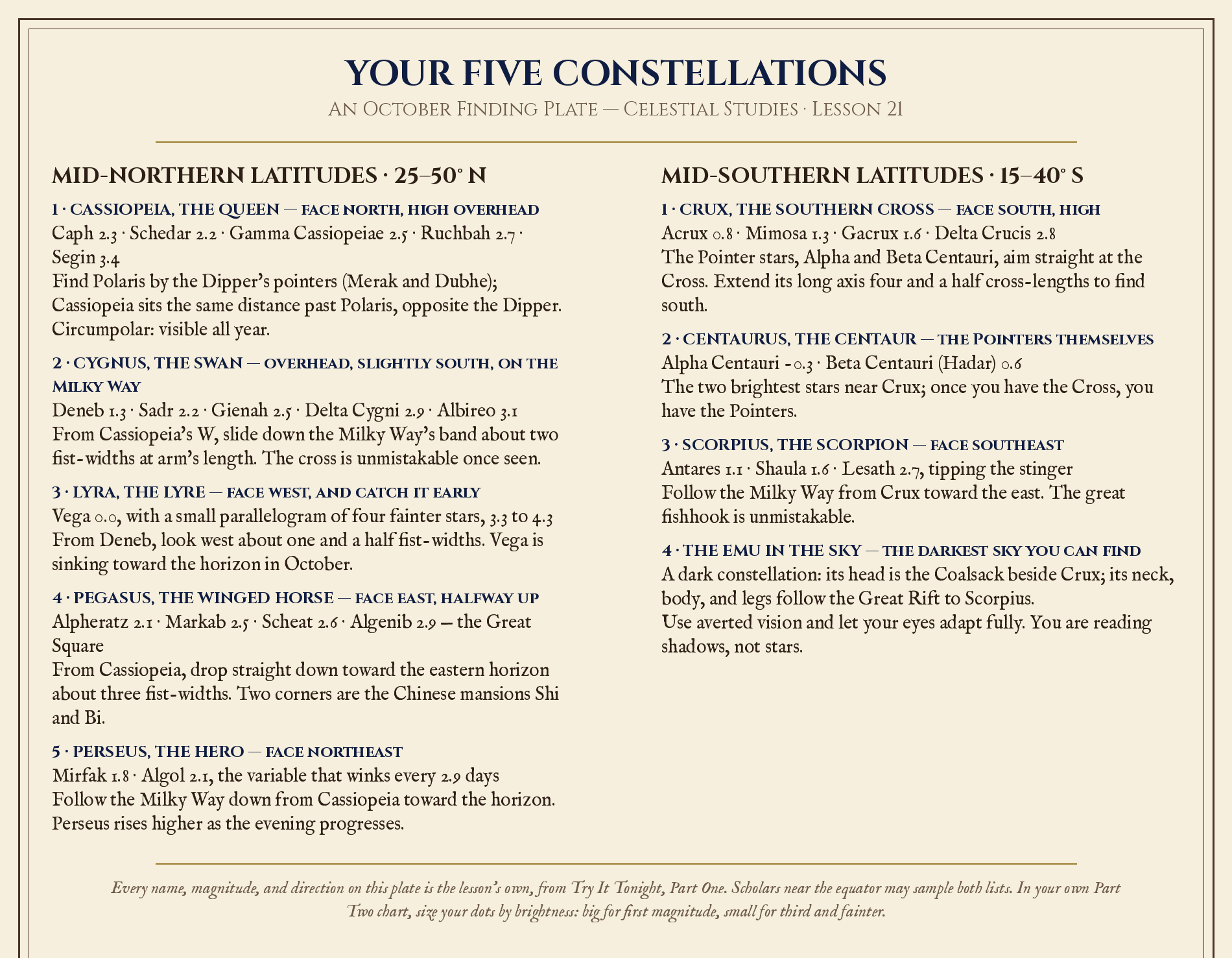
Your Five Constellations: an October finding plate. Every name, magnitude, and direction is the lesson's own, from Try It Tonight, Part One — the northern five and the southern set side by side, so a scholar can carry the whole finding on one page beside the red flashlight.
Built digitally for this overhaul (Python/PIL, typeset labels), from the finding data taught in the lesson text.
Try It Tonight
Part One: Find Your Five
Go out about two hours after sunset with your adult, your red flashlight, and your workbook. Face the directions given. Give each constellation ten unhurried minutes.
For scholars at mid-northern latitudes (about 25 to 50 degrees north):
★ 1. Cassiopeia, the Queen. Face north and look high overhead. Five bright stars form a wide W (or M, depending on the hour). From left to right across the W: Caph (magnitude 2.3), Schedar (2.2, the brightest), Gamma Cassiopeiae (2.5, the middle peak), Ruchbah (2.7), and Segin (3.4, the faintest). Locating direction: find Polaris using the Big Dipper's pointer stars (Merak and Dubhe), then look the same distance past Polaris on the far side. Cassiopeia sits opposite the Dipper, balancing across the pole. She is circumpolar: visible all year.
2. Cygnus, the Swan. Look straight up, slightly south of overhead. A great cross of stars lies along the Milky Way. Deneb (magnitude 1.3), one of the brightest stars in the sky, marks the tail at the top of the cross. Albireo (magnitude 3.1) marks the head at the bottom. Sadr (2.2) sits at the center where the wings cross the body, with Gienah (2.5) and Delta Cygni (2.9) tipping the wingtips. Locating direction: from Cassiopeia's W, slide down along the Milky Way's band about two fist-widths at arm's length. The cross is unmistakable once seen. Best in summer and autumn evenings.
3. Lyra, the Lyre. Face west. One brilliant blue-white star dominates: Vega (magnitude 0.0), the fifth-brightest star in the night sky. Beside it hangs a small parallelogram of four fainter stars (magnitudes 3.3 to 4.3), the body of the lyre. Locating direction: from Deneb in Cygnus, look west about one and a half fist-widths. Vega is sinking toward the horizon in October, so catch it early in the evening.
4. Pegasus, the Winged Horse. Face east and look about halfway up. Four stars of nearly equal brightness form an enormous square, wider than your fist at arm's length: Markab (2.5), Scheat (2.6), Algenib (2.9), and Alpheratz (2.1, the northeast corner, technically in Andromeda). Locating direction: from Cassiopeia, drop straight down toward the eastern horizon about three fist-widths. The Great Square is the landmark of autumn. Remember: two of its corners are Chinese lunar mansions, the Encampment and the Wall.
5. Perseus, the Hero. Face northeast, between Cassiopeia and the horizon. A spray of stars fans upward from the bright star Mirfak (magnitude 1.8) at its center. Below Mirfak, find Algol (magnitude 2.1), the famous variable star that winks from bright to faint and back every 2.9 days. Locating direction: follow the Milky Way down from Cassiopeia toward the horizon. Perseus rises higher as the evening progresses.
For scholars at mid-southern latitudes (about 15 to 40 degrees south):
★ 1. Crux, the Southern Cross. Face south and look high. Four bright stars form a small, tight kite: Acrux (magnitude 0.8) at the foot, Gacrux (1.6) at the head, Mimosa (1.3) and Delta Crucis (2.8) as the crossbar. Locating direction: find the two brilliant Pointer stars, Alpha and Beta Centauri; they aim straight at the Cross. To find south, extend the long axis of the Cross (Gacrux through Acrux) about four and a half cross-lengths toward the horizon. The south celestial pole lies near the end of that line.
2. Centaurus, the Centaur. The Pointers themselves belong to this sprawling constellation. Alpha Centauri (magnitude negative 0.3), the third-brightest star in the sky, and Beta Centauri, Hadar (0.6), stand side by side. Locating direction: they are the two brightest stars near Crux; once you have the Cross, you have the Pointers.
3. Scorpius, the Scorpion. Face southeast. A great fishhook of stars curves across the sky, anchored by the red giant Antares (magnitude 1.1), the heart of the scorpion, with Shaula (1.6) and Lesath (2.7) tipping the stinger. Locating direction: follow the Milky Way from Crux toward the east. The hook shape is unmistakable.
4. The Emu in the Sky. This is your non-Western constellation, and it requires the darkest sky you can find. Find Crux, then look just beside it for a dark oval blotch against the Milky Way: the Coalsack, the emu's head. Trace the dark lane of the Great Rift as it stretches from the head, past the Pointers, along the Milky Way toward Scorpius: the neck, the body, the legs. Use averted vision and let your eyes adapt fully. You are reading shadows, not stars.
Scholars near the equator: you can sample both lists. Polaris sits on your northern horizon and the Southern Cross scrapes your southern one. Note in your Sky Log which list you used and why.
Check in: Which list did you work from tonight — the northern five, the southern set, or a sample of both — and what decided it? Name your latitude honestly in your Sky Log, the way this lesson asks.
❦ In your workbook: record the finding in your own way — each constellation's direction faced, its brightest star, and the locating route you actually walked star by star — copy, sketch, or note what matters.
Part Two: Draw the Chart
Choose one of your constellations. In your workbook, draw its star pattern as accurately as you can: the relative positions of the stars, and dots sized by brightness (big dot for first magnitude, small dot for third and fainter). Label every star you named in Part One with its name and magnitude. Below the chart, write two sentences: what the Western tradition calls this figure, and one non-Western reading of the same stars if you know one (the Great Square's Chinese mansions count, and so does the Emu).
❦ In your workbook: the chart itself is the workbook record — dots sized by brightness, every named star labeled with its name and magnitude, and the two sentences beneath it.
Part Three: Retell One Story
Choose one non-Western story from this lesson: the Chinese mansions, the voyage of Hōkūleʻa, the Emu in the Sky, or Matariki. Retell it in your own words in three to five sentences, as if explaining it to a friend. Begin with the name of the tradition it belongs to. End with one sentence saying what question that tradition was asking of the sky. (Examples: How do we get home? When do we eat? When does the year begin?)
❦ In your workbook: record the retelling in your own way — the tradition named first, the story in your own words, and the question it answers last — copy, sketch, or note what matters.
In your packet: Exercise I — The Five-Constellation Practical ◐ is these three parts, written up whole: the finding, the chart, and the retelling. Work it now, or mark the place and take it as homework — your choice.
Sky Log Entry
Date and time of observation: _______________
Your latitude (approximate) and location: _______________
Sky conditions (clear, partly cloudy, moon phase, town or country sky): _______________
Constellations found tonight (list all of yours — five on the northern list, four on the southern — or note honestly which ones clouds defeated): _______________
Brightest star you saw, and its constellation: _______________
Chart sketch (Part Two): attach or draw below. _______________
Non-Western story retold (Part Three): which tradition, and the question it answers. _______________
Moon Journal check-in: tonight's phase, in one line. _______________
❦ In your workbook: the Sky Log entry itself is the workbook record — all of them found or the clouded ones noted honestly, the chart attached, the retelling named, and the Moon Journal's one line written.
Materials
Required (Level One — household items)
- Your workbook and a pencil for constellation charts, the Sky Log, and the story retelling.
- A dim red flashlight (or a regular flashlight covered with red cellophane) for reading your chart without destroying night vision.
- Warm layers and sturdy shoes: October nights are cold, and dark-adapted eyes miss obstacles.
- A ruler for drawing straight constellation lines and sizing star dots by magnitude.
Suggested (Level Two — historically closer)
- Binoculars for splitting Albireo into its celebrated double and for tracing the Milky Way's texture around Cygnus (use only after dark).
- Black construction paper, silver and gold gel pens for a permanent constellation chart in the Creative Arts style.
Reflection Questions
Answer in your workbook, in complete sentences.
- The same stars carry Greek myths, Chinese mansions, a navigator's compass, and an emu drawn in darkness. What does that tell you about where constellation "pictures" actually live: in the sky, or in the observer?
- This lesson insists that Ptolemy did not invent his 48 constellations and that the Greek myths were attached later. Why does that distinction matter for a student of history?
- A navigator sails north until Hōkūleʻa passes directly overhead, then turns west. Explain in your own words why this works, using the idea of declination and latitude.
- The Emu in the Sky is made of dark dust, not bright stars. How does that change what a skywatcher needs (eyes, sky, patience) compared to finding Cassiopeia?
- Matariki is described in this lesson as "lore in living use." What is different about studying a tradition people still practice, compared to studying one that survives only in old books?
Workbook Checklist — Lesson 21
In my workbook I have:
- ☐ found my constellations (five on the northern list, four on the southern) on a clear October evening (or logged each clouded attempt honestly), with date, time, direction faced, brightest star, and one honest sentence about the seeing for each
- ☐ drawn the Part Two chart of one constellation, stars sized by magnitude, every named star labeled with its name and magnitude, and the two sentences written beneath it
- ☐ retold one non-Western story in Part Three, naming its tradition and ending with the question that tradition asked of the sky
- ☐ drawn Exercise II's timeline from 2000 BCE to today: the five sourced events plus one non-Western milestone, each with its contribution sentence
- ☐ written Exercise III's one-page Respectful Retelling from this lesson and at least one Further Reading source, with the sentence acknowledging what belongs to the tradition's keepers
- ☐ completed tonight's Sky Log Entry, the Moon Journal one-line check-in included
☐ Lesson completed Date: ___ Signature: ___
Cross-Class Connections
Scrollwork · Unit VI, Lesson 23 — Archive Labels & Library Systems
Mind your lists, scholars. Glimmerwick's sky was kept in lists: Ptolemy's thousand stars copied hand to hand for a thousand years, the Suzhou planisphere's hundreds of asterisms, every catalogue a promise that what was written down could be found again. This lesson teaches how anything gets kept so it can be found — the shelfmark, the label, the catalogue with rules — first in medieval libraries, where star catalogues themselves were shelved and listed. The Tower reads the sky the lists describe. Here, we keep the lists.
PROFESSOR QUILLBERRY NOCTURNE
Scrollwork Library

Creative Arts · Studio Extension E1 — Precision Paper Instruments, Built to Last
Set up your bench, scholars, and bring the chart you drew tonight. A paper chart tears, a paper wheel wobbles at its pin — you know this already if your workbook chart has survived a schoolbag. In this extension we rebuild the tower's own paper instruments to last: the planisphere you will meet in Lesson 30 among them, in board and brass where brass earns its place, with a pivot fitted the way a hinge is fitted. Make tonight's constellation chart the same way and it will still be true, and still be turning, in ten years of Sky Logs.
PROFESSOR COGBRANCH TIMBERCLANK
Creative Arts Workshop

Herbology · Unit II, Lesson 15 — Seasonal Growing Cycles
Gently does it, scholars. In the Tower tonight you read the calendars the sky keeps: the Emu whose rising tells Wiradjuri families when to gather, Matariki whose rising opens a planting year. My greenhouse keeps the other half of that one system — the earth calendar: how long a plant lives, how it sleeps through winter, when the frost lets you plant and when it tells you to gather. Sky and soil were never two calendars. Come down from the tower and learn to grow by the year both of them write. — Professor Beryl Fernfoot, Herbology Greenhouse • Master Herbalist • Head of House Oriens
History of Magic (a future class) — named only. The zodiac began as Babylonian calendar science and became, over centuries, the astrological system Unit V will study as history. This lesson covers the constellations; that course will take up the signs — the honest distinction between the constellations and the signs, exactly as the bullet above frames it. No invitation is written: the class is not yet built.
Celestial Studies forward note (no invitation — this class's own road): the star wheel named in the Creative Arts bullet above is built in full in Celestial Studies Lesson 30 — The Planisphere & Star Charts, where you will make a planisphere for your own latitude. (Named from the final's own text; Celestial Studies has no live lesson slugs yet, so this class's own Lesson 30 is named without a link.)
Runes & Ancient Writing · Unit I, Lesson 1 — The Structural Wedge
The Professor's Closing Note
And so we come down from the sky, scholars, with new constellations in our notebooks and five new stories in our heads.
You now know that the Greek list began in Babylon, was versified by a poet, was catalogued by Ptolemy into 48, and grew by 40 more into the 88 we use today. You know that the myths were embroidered onto old figures, that Libra was once a scorpion's claws, and that the stars never once changed while the stories did. You know that China followed the moon through twenty-eight mansions, that Polynesian navigators crossed an ocean on memorized starlight, that the peoples of Australia read the dark between the stars, and that the Māori New Year still begins when the Pleiades rise before dawn, a holiday now, and a living ceremony.
Keep your charts. Keep your Sky Log. And the next time someone tells you a constellation's story as if it were the only one, smile the way I do from the top of the tower, and tell them about the Emu, or the mansions, or the star of gladness. The sky is big enough for all of them. It always was.
PROFESSOR VESPER GLIMMERWICK
Celestial Studies
Astronomer & Celestial Historian
Further Reading & Sources
These are real destinations for further study, verified live at the time of writing. Begin with Ian Ridpath's Star Tales for the Greek history; the Polynesian Voyaging Society and the Indigenous astronomy pages speak for their own traditions.
- Ian Ridpath's Star Tales: the complete history of the Western constellations, from Babylon to the IAU. http://www.ianridpath.com/startales/startales1a.html
- The Almagest: Ptolemy's treatise, its 48 constellations, and its 1,022-star catalogue. http://en.wikipedia.org/wiki/Almagest
- The Twenty-Eight Mansions: the Chinese xiu system, the Four Symbols, and the full mansion list. https://en.wikipedia.org/wiki/Twenty-Eight_Mansions
- Polynesian Wayfinding Traditions (Hackaday): Hōkūleʻa/Arcturus as the latitude star for Hawaiʻi, and the 1976 voyage. https://hackaday.com/2024/02/01/polynesian-wayfinding-traditions-let-humans-roam-the-pacific-ocean/
- Hōkūleʻa: Holding a Course (Polynesian Voyaging Society): the star compass, steering by stars, and the zenith-star method, in the navigators' own teaching. http://worldwidevoyage.hokulea.com/education-at-sea/polynesian-navigation/polynesian-non-instrument-wayfinding/holding-a-course/
- Hōkūleʻa homepage: the voyaging canoe, its voyages, and the living wayfinding tradition. https://hokulea.com
- Australian Aboriginal Astronomy: the Emu in the Sky, the Seven Sisters songlines, and the diversity of nations' sky readings. https://en.wikipedia.org/wiki/Australian_Aboriginal_astronomy
- The Emu in the Sky (Astrotourism WA): how to find the dark constellation, with guidance from Indigenous astronomers. https://astrotourismwa.com.au/emu-in-the-sky/
- Matariki: the nine stars, the heliacal rising, the revival, and the public holiday. https://en.wikipedia.org/wiki/Matariki
- The Matariki Public Holiday (NZ Ministry of Business, Innovation & Employment): the 2022 Act, the first holiday date, and the threefold purpose of the celebration. https://www.mbie.govt.nz/business-and-employment/employment-and-skills/employment-legislation-reviews/matariki/matariki-public-holiday
Sealed in the Celestial Tower, in deep midnight blue, by Professor Vesper Glimmerwick.
Browse the Celestial Studies shelf in the school Library for readable editions of these works.
Every figure from this lesson stands on the Wheel. Find yours in tonight's list, see where it rides right now, and learn when it climbs highest.
Open the WheelPROFESSOR VESPER GLIMMERWICK · CELESTIAL TOWER
Three of the beings in your star charts keep their older records in my hall. Monoceros stands behind the unicorn's long file; Draco coils through the Western dragon's; and the Phoenix of the southern sky carries the oldest skeptical paragraph in my whole archive — its first recorder admitted he had seen only its picture. Come and read what the ground made of the beings the sky kept.
The Unicorn Dragons of the West The PhoenixPROFESSOR SABLE ROOKMERE · THE BESTIARY
Submit your work for this lesson using the form below.
CONTINUE IN THE CELESTIAL TOWER
← Previous · Lesson 20: The Names of the Stars Next · Lesson 22: Deep Sky Wonders →
Unit IV — The Fixed Stars Celestial Tower — All 33 Lessons
The rest of Unit IV: Lesson 18 · The Sun · Lesson 19 · What Stars Are · Lesson 20 · Star Names · Lesson 22 · Deep Sky Wonders · Lesson 23 · Fireworks