
CELESTIAL STUDIES
Unit IV · Lesson 18The Sun: Our Star
PROFESSOR VESPER GLIMMERWICK
Celestial Studies
Astronomer & Celestial Historian
Sunspots and the solar cycle, the life story of our star, and the northern lights: the sun's breath, reaching Earth.
Professor's Introduction

The lamps are lit, scholars,
You may wonder why a bat is teaching you about the sun. I sleep through its whole shift, after all. The sun is my opposite number: I keep the night, and it keeps the day, and we hand the sky back and forth like neighbors sharing a fence.
But here is the secret that made me fall in love with it anyway. The sun is a star. The same kind of thing as every spark I chase across the dark on my evening flights. It only looks different because it is close, so close that its light reaches us in about eight minutes instead of years. Every lesson in this unit has been about distant suns. Tonight, at last, we study the one we live beside.
We will watch its face change. We will meet the man who proved the heavens were not perfect. We will visit seventy years when the spots nearly vanished, and ask what that did to Earth's weather, honestly. And at the end, we will stand under the northern lights and learn that they are the sun itself, reaching across ninety-three million miles to touch our sky.
You must promise me one thing first, and it is not a small promise. We will speak of the safety rules in this lesson the way sailors speak of the sea: with respect, and without exceptions.
Fly gently, and do not look at the sun.
PROFESSOR VESPER GLIMMERWICK
Celestial Studies
Astronomer & Celestial Historian
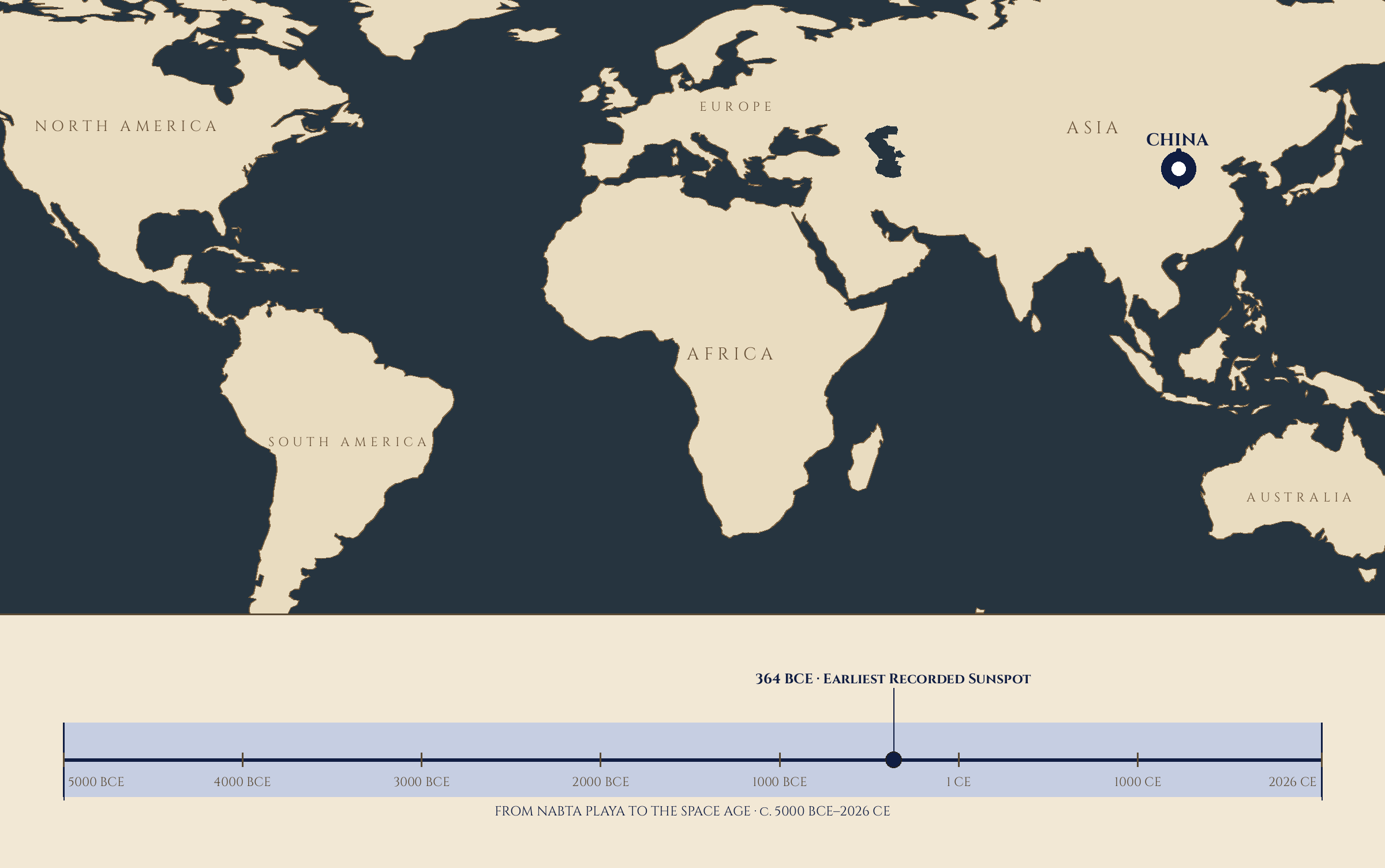
Where and when: CHINA, 364 BCE · Earliest Recorded Sunspot (year −364) — The Sun: Our Star. The pin is this lesson. The line beneath the map is our road: every stop a moment when watching the sky changed, every lesson a pin upon it.
Lesson Objectives
By the end of this lesson, you will be able to:
- Describe what the sun is: a G-type main-sequence star powered by the fusion of hydrogen into helium in its core, and name its main layers from core to corona.
- Explain what sunspots are, why they look dark, and how their numbers rise and fall in a cycle of about eleven years.
- Describe Galileo's sunspot observations of 1612 to 1613 and explain what they proved: that the sun rotates, and that the heavens are not perfect and unchanging.
- Describe the Maunder Minimum of 1645 to 1715 and explain, honestly, what scientists do and do not agree about its link to the Little Ice Age.
- Explain how the solar wind creates aurorae: charged particles, Earth's magnetosphere, and collisions with oxygen and nitrogen that produce the colors.
- Retell at least three pieces of aurora lore from different cultures, distinguishing story from mechanism.
- State the solar observing safety rules from memory: never look directly at the sun; certified ISO 12312-2 viewers or indirect pinhole projection only.
Reading this lesson: ★ marks the passages to remember. They return on the unit quiz and the class test. Check in questions ask the material back as you go; answer them in your workbook when you meet them.
Working this lesson: Your assignment packet is the first download on this page. Work in it as the lesson moves along, answering each exercise as its subject is taught — or read the lesson through for your notes and take the exercises as homework afterward. Both are proper ways to sit this class. Signposts in the reading tell you where each exercise belongs. Written answers are short answers in your own words; a few honest lines are worth more than a filled page.
Your Assignment Packet
This lesson's exercises live in its packet: the Lexicon Handout (every term, course terms marked ◆), Materials, Guided Practice, the Assignment Manual with its answer key for self-checking, the Reflection Questions, and the Workbook Checklist. Download the packet before you begin and keep it beside you as you read. The packet's exercises are Glimmerwick's own word for the work: Exercise I — Galileo's Rotation Watch ◐, Exercise II — The Sun's Life Story, Illustrated ⚒, and Exercise III — An Aurora Field Report ✎. The lesson's quiz is not printed in the packet; it pools to the Unit IV Quiz, where it will meet you again.
Safety Briefing
- NEVER look directly at the sun, not even for a second, not even through clouds, and not even while squinting. There is no safe way to improvise this.
- Direct viewing of the sun is safe ONLY through viewers that conform to the international standard ISO 12312-2. Inspect the viewer before every use. If it is scratched, punctured, torn, creased, or coming apart at the edges, throw it away and do not use it.
- Ordinary sunglasses, smoked glass, exposed camera film, CDs, and stacked sunglasses are NEVER safe for looking at the sun, no matter how dark they seem.
- A pinhole projector is for INDIRECT viewing only. Stand with your back to the sun and watch the projected image on the card. Never look at the sun through the pinhole.
- Binoculars and telescopes must never be pointed at the sun unless they carry a proper front-mounted solar filter made for the purpose. When in doubt, do not point them at the sun at all.
- All night observing for the aurora watch happens with a trusted adult, in a safe and familiar location. Tell someone where you will be and when you expect to be back inside. Dress warmly; aurora watching means standing still in the cold.
The Wonder
Stand in sunlight with your eyes safely averted from the disk itself, and feel the warmth on your face. That warmth left the sun's surface about eight minutes ago. But the energy behind it is far older. The light warming your skin began as fusion in the sun's core, and then spent on the order of a hundred thousand years fighting its way outward through the sun's own body before it ever touched space. You are warmed by something ancient, arriving late.
Now the deeper wonder. Every star you have learned to find in this unit is a sun. The only reason ours looks like a blazing disk instead of a point of light is that it sits ninety-three million miles away instead of light-years. We live beside a star. We live, as the scientists at NASA like to say, inside its atmosphere: the sun's outer influence stretches past all the planets, so Earth itself hangs within the bubble the sun blows around itself.
And the sun writes to us. Not in words, but in light. When its breath reaches our magnetic field and slides down toward the poles, our whole sky can catch fire in curtains of green and red. The people of the far north have watched those letters for thousands of years and told stories about every one of them. Tonight we learn to read both the letter and the stories, and to keep them straight.
❦ In your workbook: record the wonder in your own way — warmth eight minutes old on the surface and a hundred thousand years old underneath, the star we live beside, and the letters its breath writes over the poles — copy, sketch, or note what matters.
The Story
Spots on the perfect sun
Long before anyone had a telescope, sharp-eyed watchers noticed that the sun's face was not always clean. The earliest recorded sunspot observation comes from China, in the year 364 BC. The Greek writer Theophrastus mentioned spots on the sun. In the year 1129, an English monk named John of Worcester drew what he saw on the sun's disk, and his drawings are the earliest pictures of sunspots that survive to this day.
Then the telescope arrived, and several people saw the spots almost at once. In December 1610, the Englishman Thomas Harriot sketched sunspots through his telescope but never published what he drew. In 1611, Johannes Fabricius published a pamphlet about them, the first printed account. And in Italy, Galileo Galilei had been watching them for a year and a half, and he was about to turn them into an argument that shook the heavens.
❦ In your workbook: record the first spots in your own way — China in 364 BC, John of Worcester's drawings of 1129, and the three telescopic watchers who saw them almost at once — copy, sketch, or note what matters.
Galileo's letters
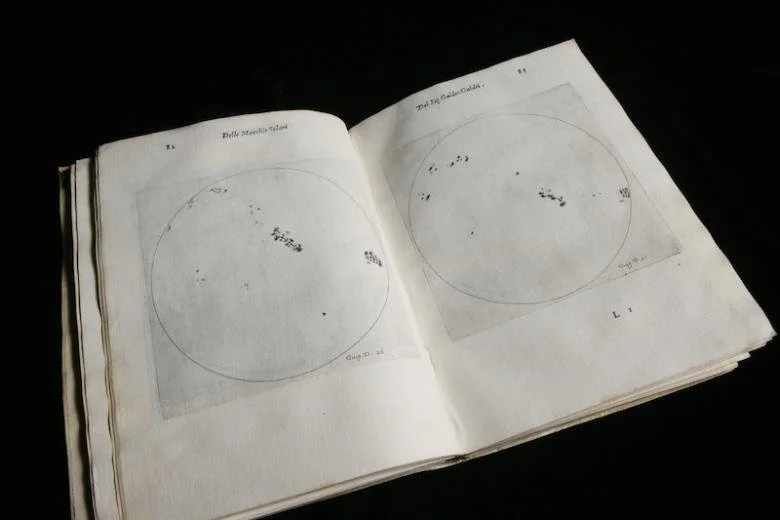
Galileo's Letters on Sunspots, open at two of its full-page engravings (Rome, 1613). Each disk is one day's sun; watch the spot clusters change shape and thin toward the edge, and you are watching Galileo's argument — the spots sit on the sun, and the sun turns.
Galileo Galilei, Istoria e dimostrazioni intorno alle macchie solari (1613); copy photographed for the University of Oklahoma's Galileo exhibit, "Letters on Sunspots."
In 1612 and 1613, Galileo wrote a series of letters to the Augsburg scholar Mark Welser about the spots. They were published in Rome in 1613 by the Accademia dei Lincei under the title Istoria e dimostrazioni intorno alle macchie solari: the History and Demonstrations Concerning Sunspots. The letters were an answer to a Jesuit astronomer, Christoph Scheiner, who had been writing about the spots under a pen name and who believed they were tiny planets circling the sun.
Galileo disagreed, and his disagreement was built on watching carefully.
★ First, he showed that the spots moved across the sun's disk in an orderly procession, taking roughly a lunar month to cross from one edge to the other, and that they changed shape as they traveled. A fleet of tiny planets would keep its shape and its schedule; these did not.
★ Second, he noticed that the spots looked thinner near the sun's edge and broader near the middle, exactly the way a mark painted on a ball looks when the ball turns. From this foreshortening he argued the spots sat on the sun's surface, or just above it, and that the sun itself was rotating, carrying them around.
★ Third, and most dangerous of all, he said what the spots meant. For two thousand years, following Aristotle, scholars had taught that the heavens were perfect and unchanging, and the sun above all was flawless. Here were blemishes on the flawless thing, changing from day to day. The heavens, Galileo wrote in effect, were not what the philosophers had promised. The Letters on Sunspots was one of the first works in which he publicly declared for the Copernican system, the sun-centered universe, and the road from those letters to his famous trial ran straighter than he knew.
One honest footnote, because a historian owes them: Galileo was not the first to see the spots, and he knew the Chinese records were older than his telescope. Being first to publish the argument is not the same as being first to see.
Check in: Scheiner said the spots were tiny planets circling the sun. What two things Galileo watched — the spots' changing shape, and their thinning near the edge — ruled that out, and what did he argue instead?
❦ In your workbook: record Galileo's letters in your own way — the procession across the disk, the foreshortening that placed the spots on the surface, and the dangerous third point about the perfect heavens — copy, sketch, or note what matters.
In your packet: Exercise I — Galileo's Rotation Watch ◐ begins here — its five days of SDO images repeat exactly this measurement. Work it now, or mark the place and take it as homework — your choice.
The eleven-year heartbeat
★ After Galileo, astronomers kept watching the spots, and in 1843 a German apothecary and amateur astronomer named Heinrich Schwabe announced something strange. He had been watching the sun for years, hoping to find a planet inside Mercury's orbit, and instead he found that the number of sunspots rose and fell in a cycle of about eleven years. We now call it the Schwabe cycle, or the solar cycle.
The rhythm has held ever since. At solar maximum, the sun's face is freckled with spots, and eruptions are common. At solar minimum, the disk can go nearly blank for weeks. And there is a deeper beat beneath it: about every eleven years, the sun's magnetic poles swap places, north becoming south and south becoming north, so the full magnetic cycle takes about twenty-two years.
The cycle we are living through now, Solar Cycle 25, began in December 2019, and it reached its maximum around 2024 and 2025. The total solar eclipse of April 2024 crossed North America near that maximum, which is why the corona watchers saw such a wild, structured crown, and why auroras in May 2024 danced as far south as many Americans had ever seen them.
❦ In your workbook: record the heartbeat in your own way — Schwabe's eleven-year rise and fall, the poles that swap beneath it, and Solar Cycle 25's maximum in our own years — copy, sketch, or note what matters.
The seventy years without spots
★ Now the strangest chapter. From about 1645 to 1715, the sunspots nearly vanished. For seventy years, astronomers who watched the sun diligently found almost nothing to draw. In one twenty-eight-year stretch inside that span, fewer than fifty sunspots were recorded, where a modern stretch of the same length would show tens of thousands.
The gap was first noticed by the German astronomer Gustav Spörer in the 1880s, and studied in the 1890s by the English astronomer Edward Walter Maunder, with important work by his wife and collaborator Annie Russell Maunder. But it was the American astronomer John Eddy who, in a landmark 1976 paper in the journal Science, pulled the evidence together: the old observations had been careful, the gap was real, and tree rings confirmed it, because carbon-14 builds up in wood during times of low solar activity. Eddy named the long quiet the Maunder Minimum, after Maunder.
Here is where your professor asks you to think like a historian, because the next part is the interesting argument.
The Maunder Minimum falls inside the Little Ice Age, a centuries-long stretch of cooler-than-average temperatures in Europe and beyond, roughly 1300 to 1850. It is tempting to join the two with a straight line: quiet sun, cold Earth. And the quiet sun may indeed have contributed; estimates suggest the sun's total output dipped by a few tenths of a percent.
★ But honesty requires the rest of the sentence. The cooling began before the sun went quiet, and most climate scientists today judge volcanic eruptions, which throw sun-blocking haze into the atmosphere, to be the larger cause. A few tenths of a percent of dimming is real, but it is a small lever for a big chill. So the careful statement is this: the Maunder Minimum coincided with some of the coldest decades of the Little Ice Age, and reduced solar activity may have helped, but the link is debated and volcanoes likely mattered more. Anyone who tells you the case is closed, in either direction, has stopped doing history.
Check in: State the careful sentence about the Maunder Minimum and the Little Ice Age — what coincided, what may have helped, and what likely mattered more?
❦ In your workbook: record the seventy quiet years in your own way — fewer than fifty spots in twenty-eight years, Eddy's tree-ring proof, and the honest sentence about volcanoes — copy, sketch, or note what matters.
Letters in the northern sky
People have watched the aurora far longer than they have understood it, and the written record is deep. Assyrian astronomers pressed an aurora sighting into cuneiform tablets around 679 to 655 BC. King Nebuchadnezzar II's royal astronomers logged one in 567 BC. Aristotle, in his Meteorology, described "chasms" and "trenches" and blood-red colors forming in the night sky. In AD 34, the Roman emperor Tiberius reportedly sent soldiers to the town of Ostia, thinking it was on fire; it was the aurora overhead.
The name we use came much later. In 1619, Galileo himself coined the term aurora borealis: Aurora for the Roman goddess of the dawn, Boreas for the Greek north wind. A few scholars note that the French astronomer Gassendi may have used it independently decades later; the credit commonly goes to Galileo.
The slow work of understanding took centuries more. In 1716, Edmond Halley, of comet fame, pointed out that the aurora lines up with Earth's magnetic field. In 1790, Henry Cavendish used triangulation to estimate its height at roughly sixty miles up. In 1859, the English astronomer Richard Carrington watched a brilliant white flare erupt on the sun's face on the morning of September 1st; about seventeen hours later, the greatest geomagnetic storm ever recorded struck Earth. Telegraph wires sparked and shocked their operators, and auroras blazed as far south as the Caribbean. The sun and the lights were linked at last, dramatically.
In the early 1900s, the Norwegian physicist Kristian Birkeland built a little laboratory Earth, a magnetized sphere in a box, and bombarded it with electrons. It glowed near its poles, just like the real thing. In 1910, another Norwegian, Carl Størmer, began photographing auroras from two stations at once, eventually taking over a hundred thousand pictures and mapping their true height and shape. In March 1989, a solar storm collapsed the power grid of Quebec and pushed the aurora deep into the United States. In May 2024, near the peak of Solar Cycle 25, the strongest geomagnetic storm in more than twenty years painted the sky over much of America and Europe. The letters keep arriving.
❦ In your workbook: record the letters' long record in your own way — Assyrian tablets, the fire that was not a fire at Ostia, Carrington's flare and the storm seventeen hours later, and the storms of 1989 and 2024 — copy, sketch, or note what matters.
What the peoples of the north said
Before the mechanism, there were stories, and they deserve their telling, as stories.
In Finland the lights are called revontulet, "fox fires." The legend says an arctic fox runs across the fells, and where its great tail brushes the mountains, sparks fly up into the night sky. In another telling, the tail sweeps snowflakes upward, and they catch the moonlight on the way. Either way, the lights are fox-made, quick and bright and mischievous.
Among the Sami peoples of the far north, traditions varied from group to group, as living traditions do. Some said the lights were the souls of the dead; the Skolt Sami held them to be the souls of those killed in war. Many held that the lights could hear and take offense: during strong displays, people stayed quiet, and pointing at the sky was avoided for fear of insulting them.
The Inuit of Greenland call the aurora aqsarniit. One tradition says the lights are the souls of the dead playing ball in the sky. In Norse-flavored retellings, the shimmer is sometimes called the reflection of the Valkyries' armor as they ride, or the glow of Bifröst, the bridge between worlds. Treat these the way a historian treats all retellings: they are how later storytellers dressed an older wonder, and the dressing is beautiful even when the history is uncertain.
Swedish fishermen once prayed for the lights under the name sillblixt, "herring flash," believing them to be the reflection of great herring schools, a promise of a good catch. And across medieval Europe, when a great aurora burned red in the south, chroniclers often read it as an omen: of war, of plague, of princes falling. Red in the night sky has rarely comforted anyone.
Keep every one of these stories. None of them is the mechanism, and all of them are human.
❦ In your workbook: record the northern stories in your own way — the fox fires, the souls at their ball game, the herring flash, and the red omens — and mark each one, in your own hand, as story, not mechanism — copy, sketch, or note what matters.
The Mechanism
What the sun is
★ The sun is a star: a G-type main-sequence star, to use the astronomers' filing system. The letter G — the sun's spectral class, the astronomers' temperature filing system for stars — places it in the middle of the temperature sequence, and main sequence means it is in the long, stable middle of its life, fusing hydrogen the way most stars spend most of their lives. Astronomers sometimes call it a yellow dwarf, though its light is truly white; Earth's atmosphere scatters away some of the blue, which is why it looks golden to us.
It is about 4.6 billion years old, a little less than halfway through its life, and it holds 99.8 percent of all the mass in the solar system. It is about 109 times as wide as Earth, and it sits about 93 million miles away, which means its light takes roughly eight minutes to reach us.
The sun has no solid surface. It is a ball of plasma, which is what physicists call gas heated until its atoms fall apart into electrons and bare nuclei, a state of matter that conducts electricity and answers to magnetic fields. What we call "the surface" is the photosphere, the layer where the sun finally becomes transparent enough for light to escape. It is about 5,500 degrees Celsius there. The core, where the action is, is about 15 million degrees, squeezed by pressures hundreds of billions of times greater than the air pressing on you as you read this.
❦ In your workbook: record what the sun is in your own way — a G-type main-sequence star, a ball of plasma with no solid surface, and the photosphere where its light escapes — copy, sketch, or note what matters.
The furnace in the core
Every second, the sun's core fuses about 600 million tons of hydrogen into helium. This is nuclear fusion — hydrogen nuclei joining into helium — and the process is called the proton-proton chain, and its bookkeeping is simple enough to say in one line: four hydrogen nuclei go in, one helium nucleus comes out, and a small leftover scrap of mass becomes energy, following Einstein's famous relation. That energy does not sprint to the surface. It wrestles outward through the radiative zone, bouncing from atom to atom for on the order of a hundred thousand years, then bubbles up through the churning convection zone like heat in a pot of soup. The warmth on your face is ancient the moment it arrives.
Above the photosphere lie the chromosphere, a thin pinkish layer, and then the corona, the sun's vast outer atmosphere. Here is one of the great unsolved puzzles of solar physics, and your professor will not pretend otherwise: the corona is far hotter than the surface below it, reaching some 2 million degrees Celsius. Walking away from a bonfire should not make you warmer. Why it does, on the sun, is a question working scientists still argue about.
❦ In your workbook: record the furnace in your own way — 600 million tons a second, the hundred-thousand-year wrestle outward, and the corona that breaks the bonfire rule — copy, sketch, or note what matters.
Sunspots: the magnetic freckles
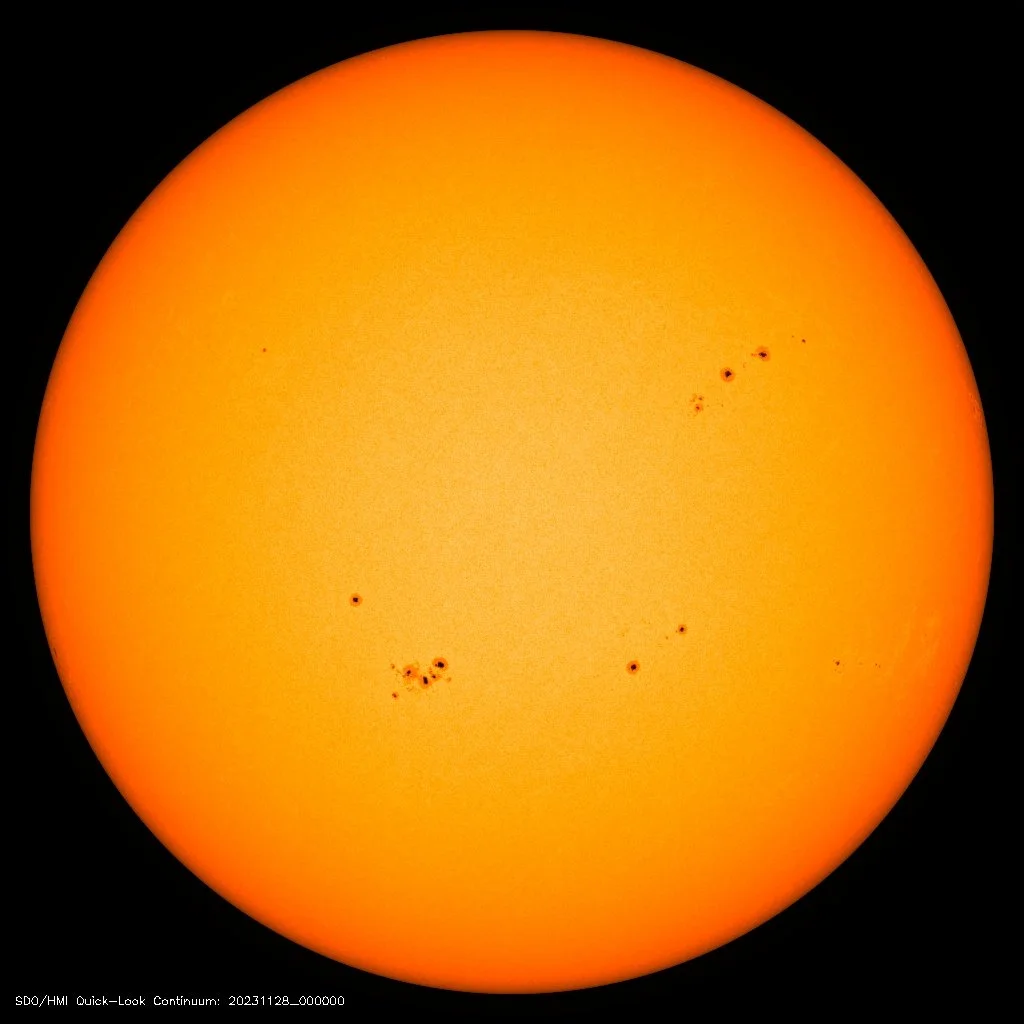
The sun in visible light, photographed by NASA's Solar Dynamics Observatory on November 28, 2023 (HMI continuum). The dark patches are sunspots: cooler, magnetically held-back regions of the photosphere, black only by contrast with the 5,500-degree surface around them. Images like this one, day after day, are how you repeat Galileo's rotation watch from your screen.
NASA / SDO and the HMI science team.
★ Sunspots are cooler, darker patches on the photosphere, and "cooler" needs its quotation marks: a spot's dark center is still around 3,500 to 4,000 degrees Celsius. It looks black only by contrast with the 5,500-degree surface around it, the way a shaded porch looks dark at noon.
★ What makes a spot is magnetism. The sun's magnetic field is a tangled, restless thing, and where a bundle of field lines punches through the surface, it holds back the hot plasma bubbling up from below. Less heat reaches that patch, so it cools, and so it darkens. Each spot has a dark central umbra and a lighter, filamentary ring around it called the penumbra.
Spots come and go with the solar cycle, the roughly eleven-year heartbeat Schwabe found. At solar maximum the sun is freckled and stormy; at solar minimum it can be nearly blank. And because the sun is not solid, it does not rotate as one piece: the equator spins once in about 25 days, the poles in about 36. Galileo's spots took roughly a month to cross the disk, and from that drift he read the sun's rotation, the first proof that the "perfect" heavens moved in an imperfect way.
Check in: A sunspot's dark center is still 3,500 to 4,000 degrees — hotter than anything on Earth. Why does it look black, and what holds its heat back?
❦ In your workbook: record the magnetic freckles in your own way — umbra and penumbra, the field lines holding back the heat, and a sun that spins at two speeds — copy, sketch, or note what matters.
The solar wind and the breath that paints the sky
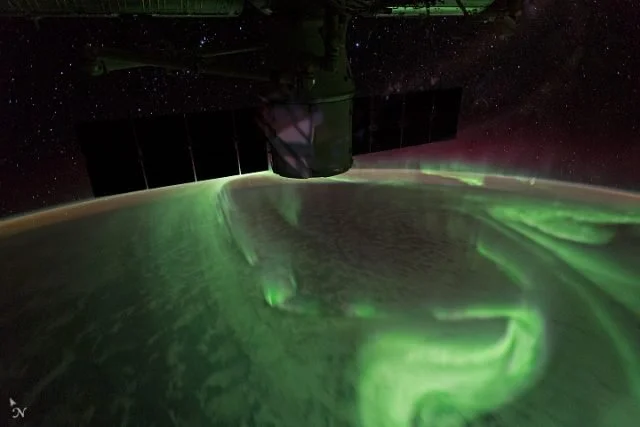
The aurora from the International Space Station: green curtains — oxygen excited a hundred to two hundred kilometers up — swirling over Earth's limb, with the station itself silhouetted above. From the ground the letter arrives as ribbons in the north; from orbit you can see the whole envelope.
NASA / ISS crew photography.
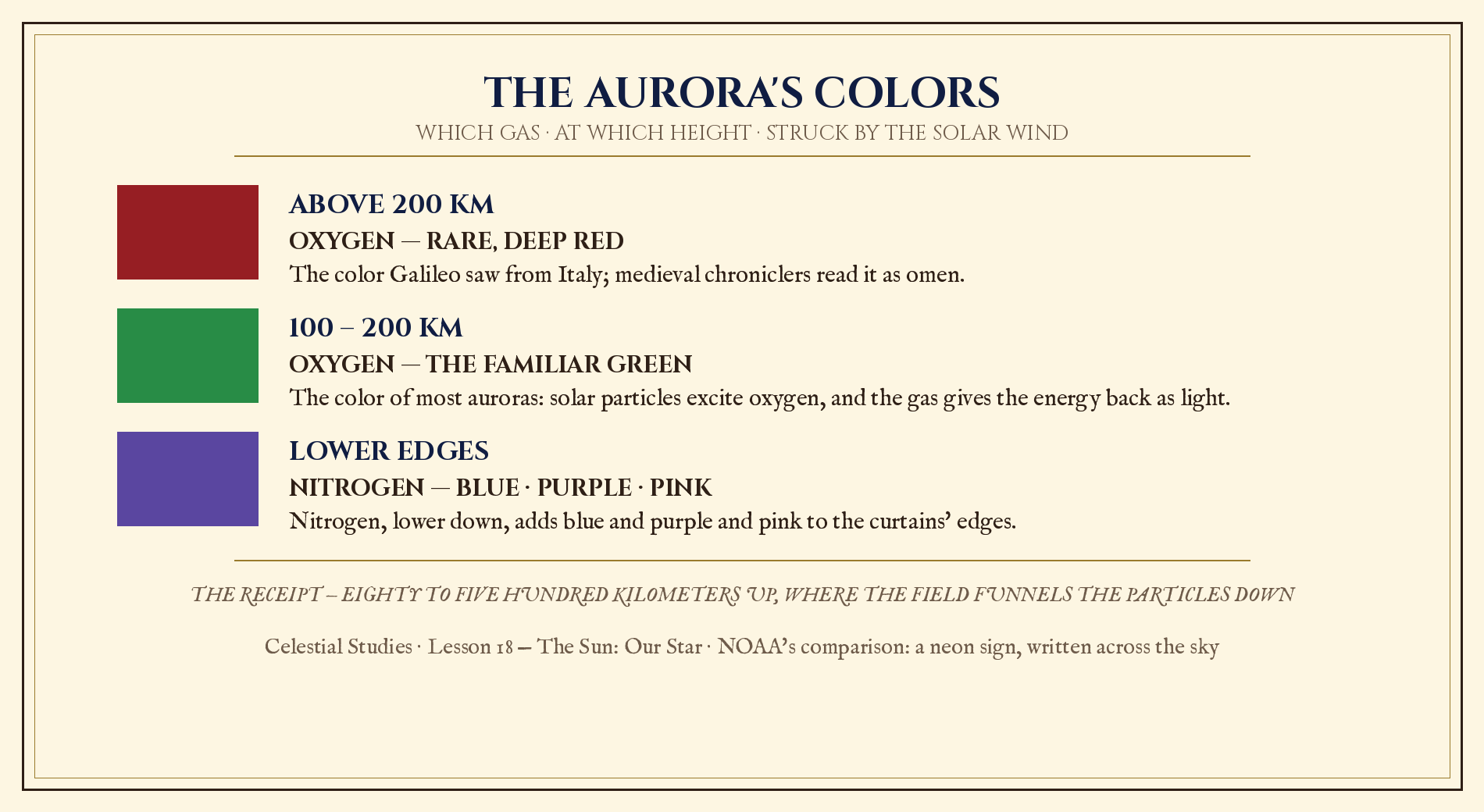
The Aurora's Colors: which gas, at which height, struck by what. Oxygen glows green at 100 to 200 kilometers and a rare deep red above 200; nitrogen adds blue, purple, and pink at the curtains' lower edges. That is the whole receipt.
Built digitally for this overhaul (Python/PIL, typeset labels), from the mechanism taught in the lesson text.
★ The sun never stops exhaling. From the corona streams the solar wind: a thin, ceaseless flow of electrically charged particles, mostly electrons and protons, blowing outward in all directions at around 450 kilometers per second. It does not stop at the planets. It inflates a vast magnetic bubble called the heliosphere that reaches past Pluto, and Earth hangs inside it. We live within the sun's exhaled breath; that is not poetry, it is NASA's description.
Sometimes the sun coughs. A solar flare is a sudden eruption of energy above a sunspot group. A coronal mass ejection is bigger: a billion tons of plasma and magnetic field hurled into space at once. When one of these clouds is aimed at Earth, it arrives in one to three days, and our planet's magnetic field takes the blow.
Earth's magnetosphere is the shield: a comet-shaped bubble of magnetism that deflects most of the solar wind around us. But the shield leaks at the poles. Some of the incoming charged particles get funneled down along the magnetic field lines toward the north and south magnetic poles, and there, eighty to five hundred kilometers overhead, they slam into the upper atmosphere.
What happens next works like a neon sign, which is the comparison the space-weather forecasters at NOAA themselves use. A neon sign glows because electricity excites the gas inside the tube, and the gas gives the energy back as light. In the aurora, solar particles excite the gases of our own sky, oxygen and nitrogen, and the gases give the energy back as light.
★ The colors are the gases' signatures, written at different heights. Oxygen, excited at roughly 100 to 200 kilometers up, glows the familiar green, the color of most auroras. Higher still, above 200 kilometers, oxygen glows a rare, deep red, the color Galileo saw from Italy and medieval chroniclers read as omen. Nitrogen, lower down, adds blue and purple and pink to the curtains' edges. That is the whole receipt: which gas, at which height, struck by what.
This is also why the lights ring the poles. The magnetic field aims the particles there, the way a funnel aims water. During great storms the auroral ovals swell outward, and the lights slide down over lands that rarely see them: the Caribbean in 1859, Cuba in 1989, much of the United States in May 2024.
Check in: Trace the aurora's receipt from start to finish — wind, shield, funnel, collision — and name the gas and the height behind the familiar green.
❦ In your workbook: record the breath that paints the sky in your own way — the wind that never stops, the shield that leaks at the poles, the neon-sign sky, and the colors written by gas and height — copy, sketch, or note what matters.
In your packet: Exercise III — An Aurora Field Report ✎ begins here — its mechanism paragraph is exactly this receipt, in your own words. Work it now, or mark the place and take it as homework — your choice.
The life story of a star
The sun was born about 4.6 billion years ago, when a vast cloud of gas and dust, the solar nebula, collapsed under its own gravity. Most of the cloud gathered at the center and grew hot enough to light the fusion furnace; the leftovers flattened into a disk and became the planets.
It has about 5 billion years of steady hydrogen-burning left. When the core's hydrogen runs low, the story turns dramatic: the sun will swell into a red giant, growing so large it engulfs Mercury and Venus, and possibly Earth as well. Then it will shrug off its outer layers, and the leftover core, a dense ember about the size of Earth, will settle into a long cooling as a white dwarf.
★ It will never explode. Only stars far more massive than the sun die as supernovae. Our star's ending is quieter: a swelling, a shedding, and a slow fade, five billion years from now.
❦ In your workbook: record the life story in your own way — the collapsed nebula, the five billion steady years left, the swelling and the shedding, and the quiet ending that is not an explosion — copy, sketch, or note what matters.
In your packet: Exercise II — The Sun's Life Story, Illustrated ⚒ begins here — its five-stage timeline is this story, drawn. Work it now, or mark the place and take it as homework — your choice.
A Sealed Note on the Sun's Letters
My darlings, I keep the night, and the sun keeps the day, and I used to think we had nothing to say to each other.
Then I learned about the aurora, and I understood: the sun writes letters to the night. It seals them in green and red and sends them across ninety-three million miles, and they arrive over the far north like ribbons, and nobody signed them, and everybody knows who they are from.
This is what I want you to carry out of this lesson. The sky is always talking to itself. The sun talks to the Earth. The Earth answers in light. And we, small and bright-eyed underneath it all, get to read the correspondence.
Learn the mechanism, scholars. Then go outside on a cold clear night and let the letter arrive.
❦ In your workbook: record the sealed note in your own way — the sun's letters sealed in green and red, the Earth answering in light, and your place underneath, reading — copy, sketch, or note what matters.
PROFESSOR VESPER GLIMMERWICK
Celestial Studies
Astronomer & Celestial Historian
Guided Observation
Try It Tonight
Part One: Project the Sun, Safely (Level One — everyone)
Project the sun, safely. Build the pinhole projector from Lesson 9: two stiff cards, a small hole in one, your back to the sun, and the sun's image caught on the second card. You will see a small, sharp disk of light. That disk is the photosphere, watched without any risk to your eyes. Do not expect to see sunspots in it; the image is small. What you are seeing is the sun's visible surface itself, which is wonder enough. Never look at the sun through the pinhole, only at the card.
❦ In your workbook: record the projection in your own way — the small sharp disk on the card, caught with your back to the sun — copy, sketch, or note what matters.
Part Two: Track the Spots Like Galileo, From Your Screen (Level One — everyone)
Track the spots like Galileo, from your screen. No eyes need ever point at the sun for this. Find the daily images from NASA's Solar Dynamics Observatory, which photographs the sun in several wavelengths every few seconds, and look at the visible-light images across several days. Pick one large sunspot group and note its position each day. How many days does it take to cross the disk? Your answer should land near four weeks, the same drift Galileo measured, and the same conclusion follows: the sun rotates, carrying its spots with it.
❦ In your workbook: record the tracking in your own way — the group's position day by day, and how near four weeks your crossing estimate landed — copy, sketch, or note what matters.
In your packet: Exercise I — Galileo's Rotation Watch ◐ grows out of this tracking — the five-day log is this watch, written down with its estimate. Work it now, or mark the place and take it as homework — your choice.
Part Three: Plan an Aurora Watch (Level One — everyone)
Plan an aurora watch. Check the aurora forecast from NOAA's Space Weather Prediction Center, which predicts how far south the lights may reach. Then, with an adult, on a dark and preferably moonless night, go somewhere with a clear view north (in the Northern Hemisphere; southern scholars face south, toward the aurora australis, the southern lights) and simply watch, giving your eyes twenty minutes to adjust. The lights often start as a pale glow low in the north and build into curtains. Log what you see: the time, the direction, the colors, and how far across the sky the display reached. If the forecast is quiet, the watch still counts: negative observations are real data, and Galileo would approve.
❦ In your workbook: record the aurora watch in your own way — the forecast you checked, the glow or the honest dark sky, and the colors if they came — copy, sketch, or note what matters.
In your packet: Exercise III — An Aurora Field Report ✎ begins here as well — this watch, real or imagined, is its field night. Work it now, or mark the place and take it as homework — your choice.
Sky Log Entry
Date your entry and record the calendar date and which of the three activities you attempted. For the pinhole projection: describe the image you caught, its size and sharpness, and the sky conditions. For the sunspot tracking: record the dates of the images, the spot group's position each day, and your estimate of the crossing time in days. For the aurora watch: record the time, the viewing direction, the colors you saw (or the honest note that the sky stayed dark), and the forecast you checked beforehand. Finish with one sentence: what surprised you most about the sun, up close?
❦ In your workbook: record the Sky Log entry in your own way — which of the three activities you attempted, its record kept honestly, and the one sentence about what surprised you — copy, sketch, or note what matters.
Materials
Required (Level One — household items)
- Two stiff white cards or pieces of cardboard (index cards work well) for the pinhole projector.
- A pin or sharp pencil for making the pinhole, with an adult's help.
- Tape for holding cards steady if your hands tire.
- Your workbook and a pencil for the Sky Log, the rotation watch, and the field report.
- A flashlight for the aurora watch; a red-filter or dim one preserves night vision.
- Access to dated solar images online (NASA's Solar Dynamics Observatory) for tracking a sunspot group across several days.
Suggested (Level Two — historically closer)
- A long cardboard box for a sturdier box-style pinhole viewer (a hole at one end, a white paper screen at the other).
- A kitchen colander to try as a many-holed pinhole projector on any sunny day.
- A compass for finding north before the aurora watch.
Reflection Questions
Answer each in a few thoughtful sentences. There are no trick questions; there are only interesting ones.
- For two thousand years, scholars taught that the heavens were perfect and unchanging. Why do you think sunspots, of all things, were able to crack that idea?
- Sunspots look black, but they are still hotter than anything on Earth. What does that tell you about how our eyes and brains judge brightness?
- The Maunder Minimum's link to the Little Ice Age is still debated, with volcanoes as the leading alternative explanation. What makes a historical scientific question like this hard to settle, even centuries later?
- The same green curtains have been called fox fires, the souls of the dead, herring flashes, and omens of war. What does it suggest about human beings that every culture told a different story about the same lights?
- You live inside the sun's atmosphere, inside the bubble its wind blows around the planets. Does knowing that change how the daytime sky feels to you? Explain your thinking.
Workbook Checklist — Lesson 18
In my workbook I have:
- ☐ projected the sun safely by pinhole, back to the sun, and described the disk I caught
- ☐ tracked one sunspot group across at least five days of SDO images and estimated its crossing time
- ☐ completed Exercise I's five-day log, with the estimate, Galileo's conclusion, and the book's name
- ☐ drawn Exercise II's five-stage life-story timeline, with both sentences at every stage
- ☐ written Exercise III's one-page aurora field report, ending with the mechanism paragraph and the labeled lore line
- ☐ kept the Sky Log entry for this lesson: the activity attempted, its record, and my one surprising sentence
☐ Lesson completed Date: ___ Signature: ___
The Professor's Closing Note
And so we have met our star: not a perfect lamp hung in a perfect heaven, but a restless, magnetic, breathing thing, middle-aged and magnificent, with freckles that come and go and breath that paints our poles in green.
Remember what the scientists say, because it is the loveliest fact in this whole lesson: we live inside the sun's atmosphere. Its bubble holds every planet. Its wind passes through the space where you are standing. You have never been separate from your star, not for one day of your life.
Keep the safety rules the way you keep a promise. Watch the cycle turn. And when the northern lights come south to visit, go outside and wave at the sun's handwriting.
Until the next clear night,
PROFESSOR VESPER GLIMMERWICK
Celestial Studies
Astronomer & Celestial Historian
Cross-Class Connections
Runes · Unit I, Lesson 1 — The Structural Wedge
Tower scholars, tonight's oldest lights were written down by scribes pressing wedges into wet clay — Assyrian astronomers logged an aurora in cuneiform around 679 to 655 BC, and Babylon's diaries kept the sky's diary for centuries. Come down to the Runes Classroom and learn that writing from its first wedge: how a shaped reed and a scribe's patience became cuneiform. Professor Glimmerwick reads what the sky was doing when the writing was wet. Here, we read the writing.
PROFESSOR THISTLELOOM WEBBLETHORN
Runes & Ancient Writing

Creative Arts · Studio Extension E4 — Painted Wheels at Full Size
Bring your paper solar-cycle wheel to my bench, scholars, and we will give the cycle the monument it deserves. In this extension we paint Professor Glimmerwick's wheels at full size, on board, in ground pigment, with a rotating overlay where the wheel's working demands one — your eleven-year wheel, with its windows for the quiet years and the freckled years and a marker you advance as the cycle turns, hung where it can be read across the room for decades. A cycle is never finished being true; build it to last as long as it is.
PROFESSOR COGBRANCH TIMBERCLANK
Creative Arts Workshop
Further Reading & Sources
These are real destinations for further study, drawn from the authorities this lesson leans on. Start with NASA and NOAA.
- NASA Science: Sun Facts (what the sun is, its layers, the solar cycle, and the sun's life story). https://science.nasa.gov/sun/facts/
- Letters on Sunspots: Galileo's 1612 to 1613 pamphlet, the Scheiner debate, and what the spots proved. https://en.wikipedia.org/wiki/Letters_on_Sunspots
- Encyclopaedia Britannica: Maunder Minimum (the seventy quiet years and the Little Ice Age debate). https://www.britannica.com/science/Maunder-minimum
- NASA Earth Observatory: Purple Haze Aurora (how the solar wind, magnetosphere, and atmospheric gases make the colors). https://science.nasa.gov/earth/earth-observatory/purple-haze-aurora/
- NOAA Space Weather Prediction Center: Aurora (the mechanism, the neon-sign comparison, and tonight's forecast). https://swpc-drupal.woc.noaa.gov/phenomena/aurora
- Discover Magazine: The Northern Lights, a History of Aurora Sightings (from Assyrian tablets to the Carrington Event). https://www.discovermagazine.com/the-northern-lights-a-history-of-aurora-sightings-43592
- American Astronomical Society: How to View a Solar Eclipse Safely (ISO 12312-2 guidance and pinhole projection instructions). https://eclipse.aas.org/eye-safety/
- NASA Goddard: Some Interesting Facts about the Sun (core temperature and pressure, solar wind speed, the sun's vital statistics). https://pwg.gsfc.nasa.gov/istp/outreach/workshop/thompson/facts.html
Sealed in the Celestial Tower, in deep midnight blue, by Professor Vesper Glimmerwick.
Browse the Celestial Studies shelf in the school Library for readable editions of these works.
Submit your work for this lesson using the form below.
CONTINUE IN THE CELESTIAL TOWER
← Previous · Lesson 17: Pluto & What a Planet Is Next · Lesson 19: What Stars Are & How Far They Are →
Unit IV — The Fixed Stars Celestial Tower — All 33 Lessons
The rest of Unit IV: Lesson 19 · What Stars Are · Lesson 20 · Star Names · Lesson 21 · Constellations · Lesson 22 · Deep Sky Wonders · Lesson 23 · Fireworks