CELESTIAL STUDIES
Unit III · Lesson 17Pluto & What a Planet Is
Professor's Introduction

Come up, come up, scholars,
I have a confession to make before we begin, and I ask you to be gentle with me, because I am an old bat and my feelings bruise easily.
I loved Pluto first as a planet, and I love Pluto still as a dwarf planet, and nobody in the Celestial Tower is permitted to tell me those are two different loves. They are the same love. It simply learned something.
I remember the summer of 2006. I was roosting in the observatory dome with the star charts spread around me like a picnic, when a student came running up the tower stairs waving a newspaper and shouted the news across the whole dome: Pluto is not a planet anymore. Half the tower gasped. The other half had already guessed. And I sat there among my charts thinking about a small cold world with a heart of ice, feeling something I did not have a word for yet.
I have the word now. The word is proud.
This lesson is about the most famous reclassification in the history of science, and why it was not a defeat at all. It is about a farm boy from Kansas who found a world with a blinking machine, an eleven-year-old girl in Oxford who named it, a goddess of discord who forced astronomy to make up its mind, and a heart-shaped glacier of nitrogen ice that nobody expected. It is about what a planet actually is, which turns out to be a harder question than anyone thought, and about the day science changed its mind in front of everybody, on purpose, and was right to do it.
You are allowed to love Pluto. I insist on it, in fact. Loving a world and filing it correctly are two different jobs, and tonight we will do both.
PROFESSOR VESPER GLIMMERWICK
Celestial Studies
Astronomer & Celestial Historian
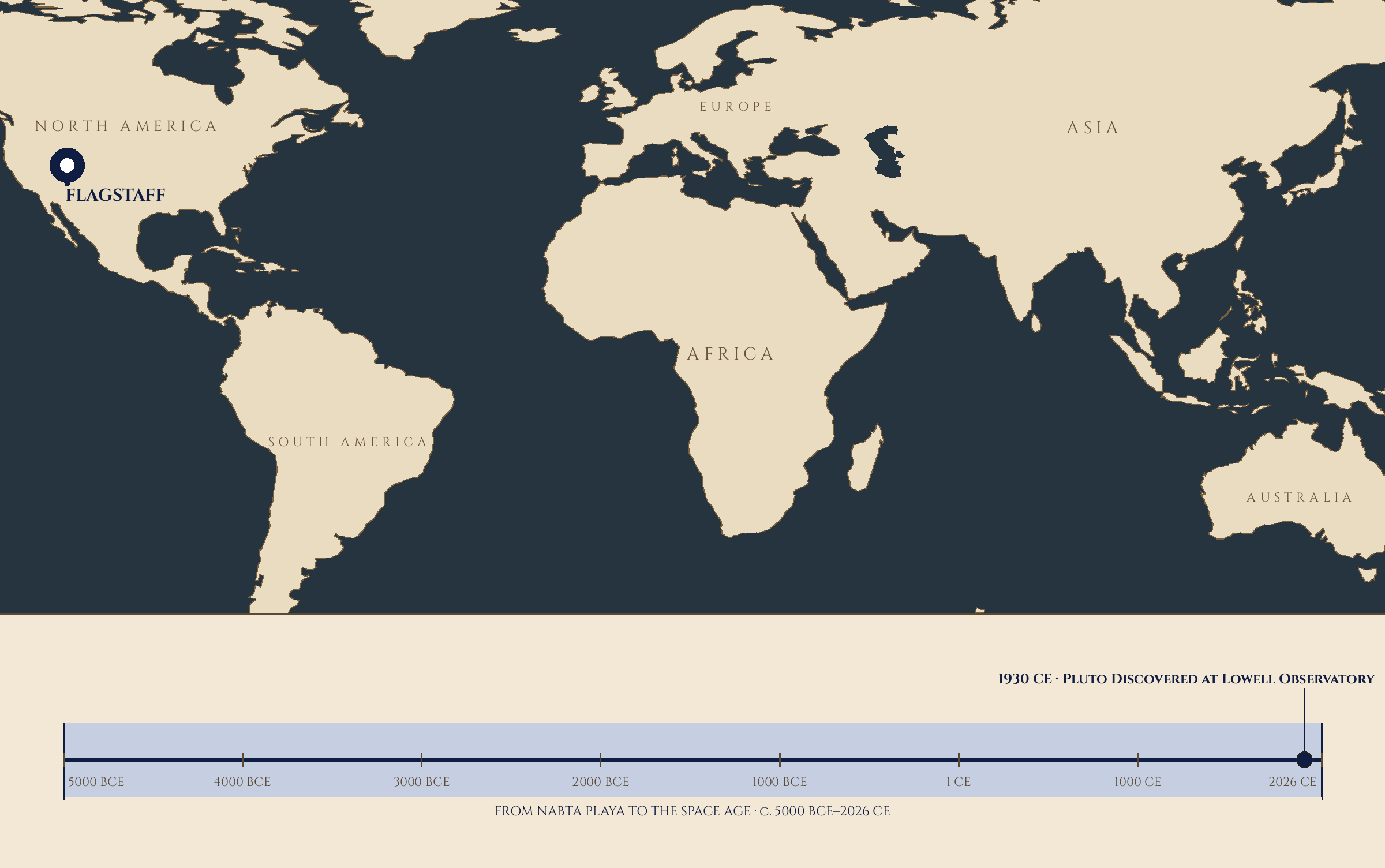
Where and when: LOWELL OBSERVATORY, FLAGSTAFF (label: FLAGSTAFF), 1930 CE · Pluto Discovered at Lowell Observatory (year 1930) — Pluto & What a Planet Is. The pin is this lesson. The line beneath the map is our road: every stop a moment when watching the sky changed, every lesson a pin upon it.
Lesson Objectives
By the end of this lesson, you will be able to:
- State the International Astronomical Union's three criteria for planethood, and explain what each one means in plain language.
- Explain what "cleared the neighborhood" actually means, and why Neptune passes the test while Pluto does not.
- Tell the discovery story of Pluto in order: Lowell's Planet X, Tombaugh's blink comparator, and Venetia Burney's naming, with the correct dates.
- Describe how the discovery of Eris in 2005 forced the IAU to define the word "planet" for the first time.
- Summarize the parallel history of Ceres: called a planet, then an asteroid, now a dwarf planet.
- Explain why science revising a definition in public is a strength, not an embarrassment.
Reading this lesson: ★ marks the passages to remember. They return on the unit quiz and the class test. Check in questions ask the material back as you go; answer them in your workbook when you meet them.
Working this lesson: Your assignment packet is the first download on this page. Work in it as the lesson moves along, answering each exercise as its subject is taught — or read the lesson through for your notes and take the exercises as homework afterward. Both are proper ways to sit this class. Signposts in the reading tell you where each exercise belongs. Written answers are short answers in your own words; a few honest lines are worth more than a filled page.
Your Assignment Packet
This lesson's exercises live in its packet: the Lexicon Handout (every term, course terms marked ◆), Materials, Guided Practice, the Assignment Manual with its answer key for self-checking, the Reflection Questions, and the Workbook Checklist. Download the packet before you begin and keep it beside you as you read. The packet's exercises are Glimmerwick's own word for the work: Exercise I — The Three Tests ⚒, Exercise II — Ceres, the First Pluto ✎, and Exercise III — The Neighborhood Demonstration ⚒. The lesson's quiz is not printed in the packet; it pools to the Unit III Quiz, where it will meet you again.
Safety Briefing
- All night observing is done with an adult present, in a familiar and safe location. Tell someone where you are and when you expect to return. Dress warmly; the best observing happens when you are comfortable enough to stay still.
- Pluto is far too faint to see with the naked eye. Do not spend a dark-adapted night sweeping the sky for it without a large telescope and a current star chart. You will not find it by accident, and you will waste good dark adaptation that your Moon Journal deserves.
- Level Two observers: never point any telescope or binoculars at or near the sun. This lesson involves no solar observing of any kind.
- The card sort and the neighborhood demonstration are indoor tabletop activities. Keep magnets away from phones, compasses, watches, and bank cards. Small parts (paper clips, marbles) are choking hazards for very young siblings; tidy them afterward.
The Wonder
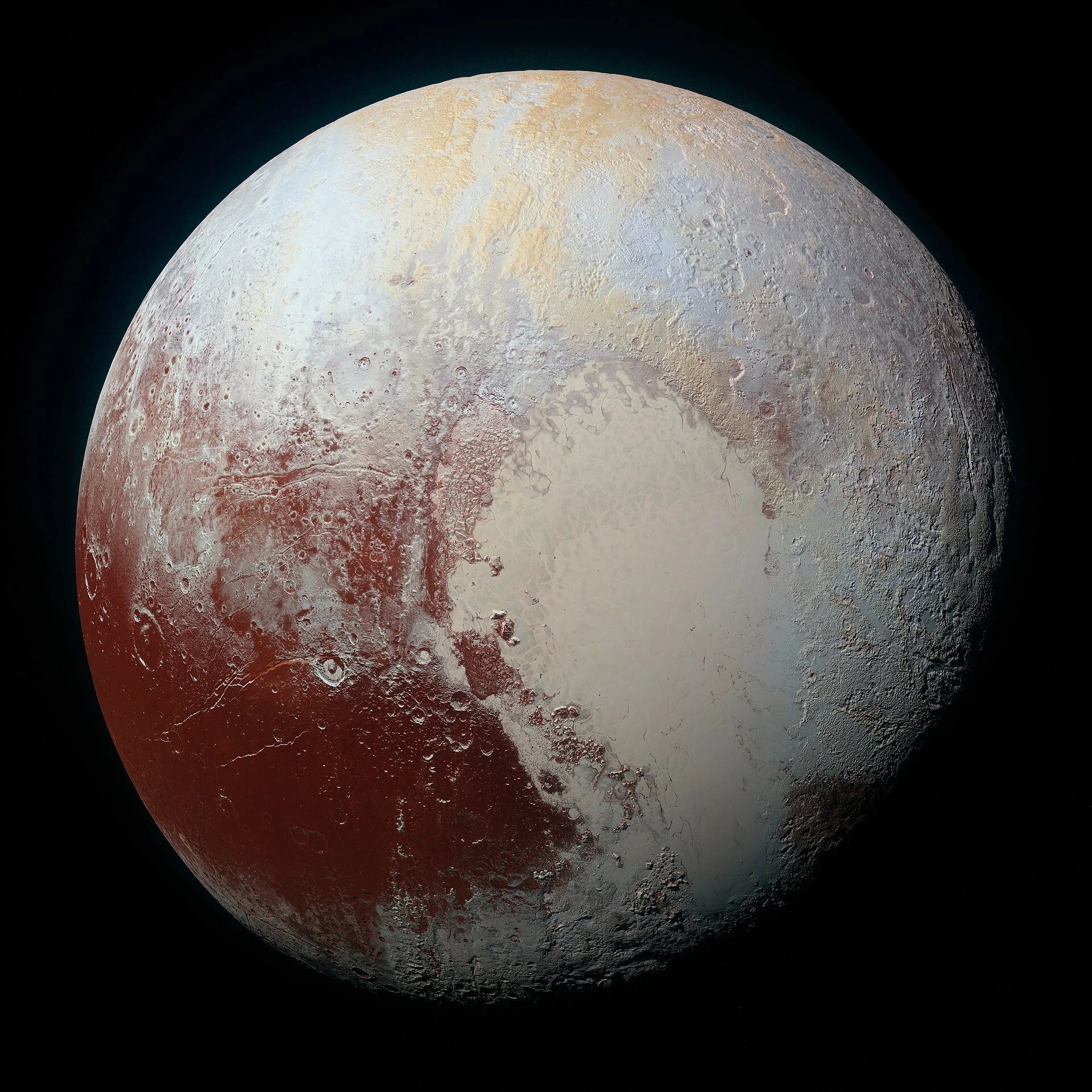
Pluto's heart, photographed by New Horizons in July 2015: the pale Tombaugh Regio, named for the man who found Pluto, with Sputnik Planitia — a craterless plain of churning nitrogen ice — as its left lobe. The reclassification did not make Pluto smaller or duller; the first close look made it stranger.
NASA / Johns Hopkins University Applied Physics Laboratory / Southwest Research Institute.
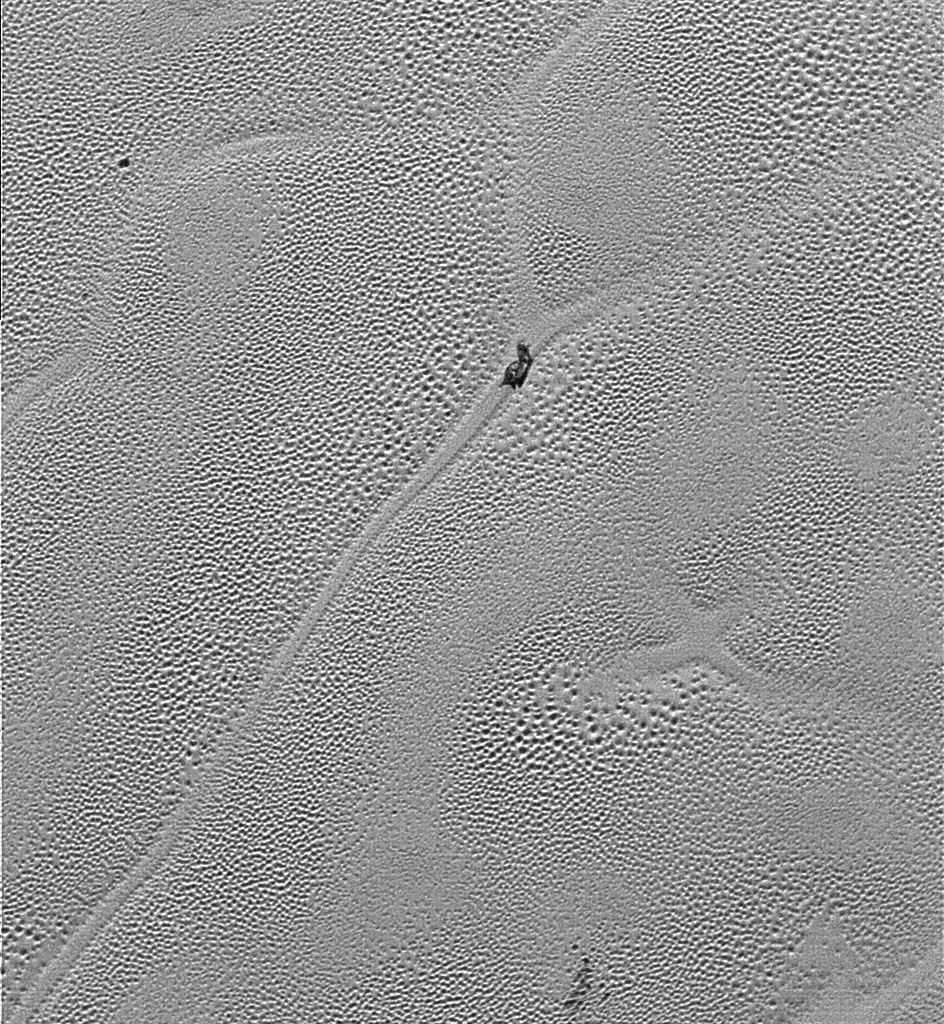
Sputnik Planitia up close: nitrogen ice pitted and slowly churning in convection cells, its surface crater-free because it is still renewing itself — on a world near minus 230 degrees. The dark block near the center is water ice afloat on the nitrogen glacier.
NASA / Johns Hopkins University Applied Physics Laboratory / Southwest Research Institute (New Horizons LORRI).
Look at the heart first. Everything else can wait.
In July of 2015, a spacecraft the size of a grand piano flew past a world three billion miles from the sun and sent home a photograph of a heart. Not a metaphorical heart. A real one, drawn in ice across the face of Pluto: a vast pale region shaped unmistakably like a valentine, big enough to cover Texas and Oklahoma together. Astronomers named it Tombaugh Regio, for the man who found Pluto. The left lobe of the heart got its own name: Sputnik Planitia, a plain of nitrogen ice roughly a thousand kilometers across.
Here is what makes the heart wonderful rather than merely pretty. Sputnik Planitia has almost no craters. On an airless world, no craters means the surface is young, because impacts accumulate over time like dust on a shelf. Something is resurfacing that plain right now, today, on a world where the sun is a bright star and the temperature sits near minus 230 degrees. The nitrogen ice is churning in slow convection cells, the way a pot of thick soup churns, each cell the size of a small county. Glaciers of nitrogen ice flow around islands of water ice. Mountains stand kilometers high, built not of rock but of water ice, which at Pluto's temperature is as hard as granite. Above it all hangs a thin nitrogen atmosphere with layers of blue haze.
Pluto was the ninth planet for seventy-six years. It hung on classroom walls beside the other eight. Generations of children memorized it in mnemonics: My Very Excellent Mother Just Served Us Nachos. Then, in August of 2006, the news broke on every channel at once: Pluto was not a planet anymore. For many people, it was the first time they ever watched science change its mind in public.
And here is the wonder inside the wonder. The reclassification did not make Pluto smaller or duller. It came with the first close look anyone had ever had, and the world turned out to be stranger and more alive than the textbooks ever said. A demoted world with a beating heart of ice. Tonight you will learn exactly why the vote happened, what the definition actually says, and why the heart was worth the wait.
❦ In your workbook: record the wonder in your own way — the heart drawn in ice, the craterless plain that is still resurfacing itself, and the demoted world that turned out stranger than the textbooks said — copy, sketch, or note what matters.
The Story
The Planet That Was Predicted
Our story begins with a wealthy Bostonian named Percival Lowell, who founded an observatory on a pine-covered hill in Flagstaff, Arizona, in 1894. Lowell was fascinated by the planet Mars, but his longest project was a ghost hunt. In 1846, astronomers had discovered Neptune by mathematics before anyone saw it: its gravity was tugging on Uranus in ways the numbers could not otherwise explain. Lowell reasoned that a similar unseen world, which he called Planet X, might be tugging on Neptune and Uranus from farther out. He calculated where it should be and searched for it from 1905 to 1909. He died in 1916 without finding it.
The search did not die with him. In 1928, Lowell's brother Abbott donated ten thousand dollars for a powerful new photographic telescope, a thirteen-inch astrograph, built specifically to resume the hunt. The observatory's director, Vesto Slipher, needed someone patient enough to do the most tedious job in astronomy: photograph the same patches of sky night after night, then compare the plates looking for anything that moved. He hired a twenty-three-year-old farm boy from Kansas who had mailed the observatory his hand-drawn sketches of Mars and Jupiter.
❦ In your workbook: record the predicted planet in your own way — Lowell's ghost hunt, the Planet X reasoning from Neptune's discovery, and the Kansas farm boy hired for the patience work — copy, sketch, or note what matters.
The Farm Boy and the Blinking Machine
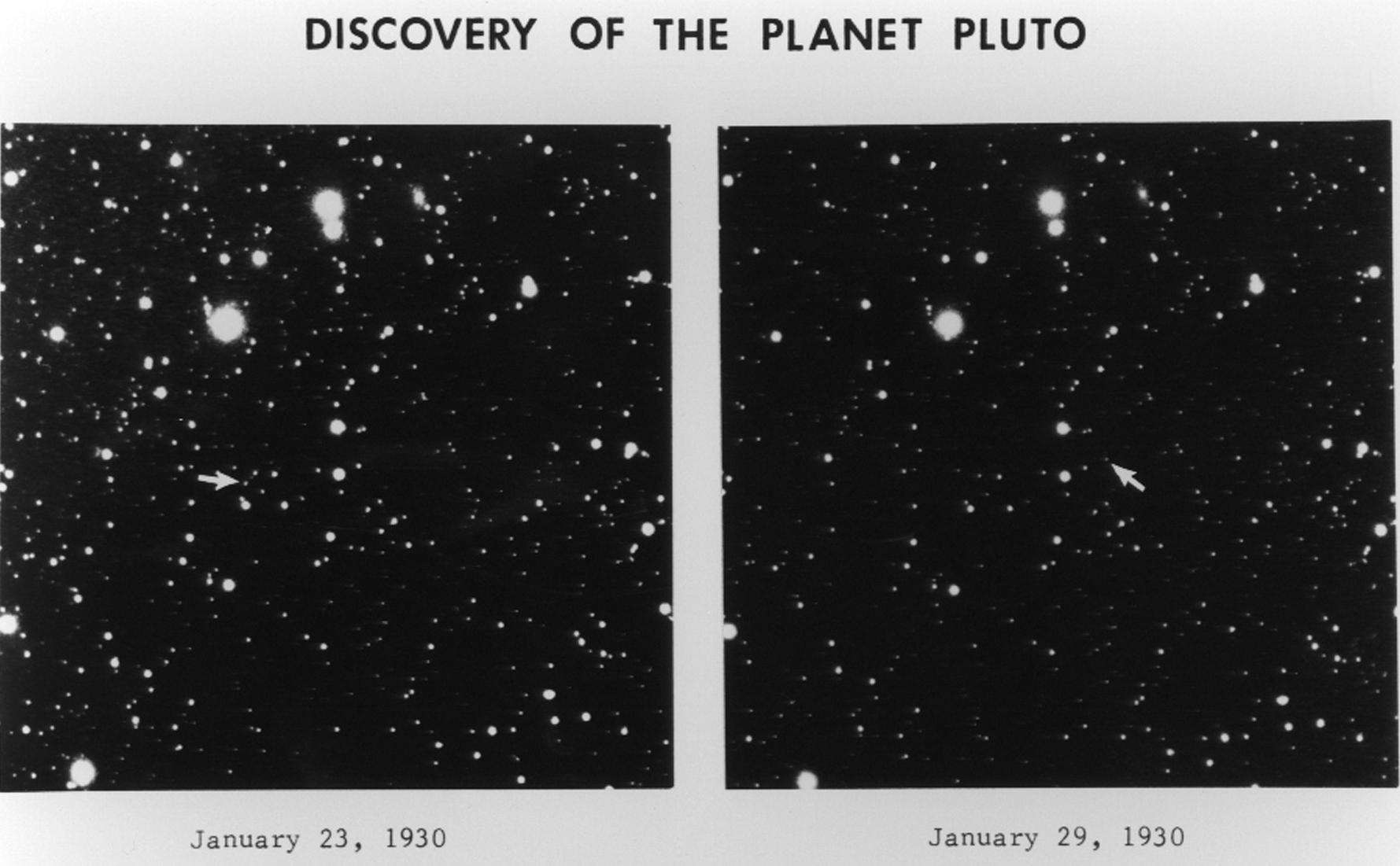
Tombaugh's discovery plates, January 23 and January 29, 1930. The stars are fixed; the arrowed speck has moved. Blink the two views against each other and the speck jumps — a world, found on February 18, 1930, by a twenty-four-year-old farm boy from Kansas.
Clyde Tombaugh / Lowell Observatory plates (via The Planetary Society).
Clyde Tombaugh was born in 1906 and raised on a Kansas farm, self-taught in astronomy, with no university degree when Slipher hired him in January of 1929. His assignment was the Planet X search. His instrument was the thirteen-inch astrograph. ★ His method was a device called a blink comparator: it held two photographic plates of the same star field, taken days apart, and flipped rapidly between them. Stars, being effectively fixed, stayed put. Anything that jumped back and forth between the two views was moving through the solar system, and therefore nearby.
Tombaugh spent up to nine hours a day at the comparator, examining plate after plate of star-crowded sky. On the afternoon of February 18, 1930, he was comparing two plates taken on January 23 and January 29, and a tiny speck of light popped in and out of place between the blinks. He checked a third plate to be sure the speck moved the way a distant world should. Then he walked down the hall to the director's office and said, in effect: I have found your Planet X.
The discovery was announced on March 13, 1930, which would have been Percival Lowell's seventy-fifth birthday. Tombaugh, at twenty-four, became only the third person in recorded history to discover a planet with his own eyes on the evidence: William Herschel had found Uranus in 1781, Johann Galle had found Neptune in 1846 from Urbain Le Verrier's calculations, and now a Kansas farm boy had found the ninth.
There is a postscript to the prediction that matters. The wobbles in Uranus's orbit that launched the whole hunt turned out to be based on slightly wrong numbers. When the Voyager 2 spacecraft flew past Neptune in 1989 and measured the giant planet's mass precisely, astronomers recalculated, and the mysterious discrepancies melted away. There had never been a Planet X tugging on anything. Tombaugh had found something real, but it was not what Lowell predicted. It was better: the first known citizen of a whole undiscovered realm.
Check in: How did the blink comparator separate a moving world from the fixed stars — and on what date, comparing plates from which two nights, did Tombaugh's speck jump?
❦ In your workbook: record the blinking machine in your own way — the two plates, the speck that jumped on February 18, 1930, and the postscript that dissolved Planet X — copy, sketch, or note what matters.
The Girl Who Named a World
★ A new planet needs a name, and this one got its name from an eleven-year-old. Venetia Burney was a schoolgirl in Oxford, England. Her grandfather, the former librarian of the Bodleian Library, read about the discovery over breakfast and mentioned that the new world had no name yet. Venetia suggested Pluto, for the Roman god of the underworld, who could make himself invisible. It was perfect for a world so dim and distant, and it had a bonus: the first two letters, P and L, were Percival Lowell's initials. Her grandfather passed the suggestion to astronomers, and on May 1, 1930, the name Pluto was officially adopted.
Venetia Burney grew up, became a teacher, and lived a long life. She died in April of 2009, which means she lived to see her planet reclassified. She reportedly took the whole thing in stride.
❦ In your workbook: record the naming in your own way — an eleven-year-old at breakfast, the god who could make himself invisible, and the initials hidden in the name — copy, sketch, or note what matters.
The Doubts Gather
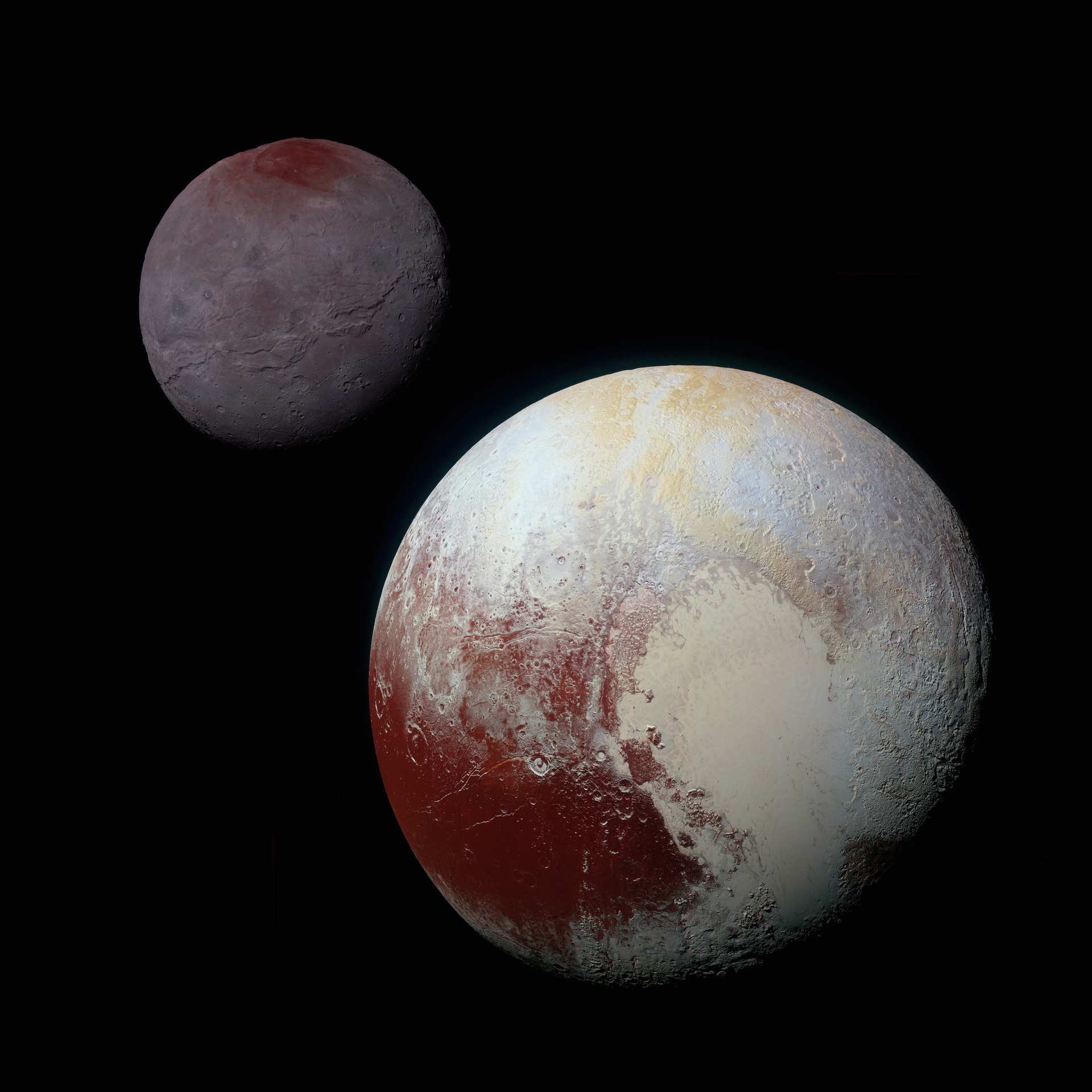
Pluto and Charon, both photographed by New Horizons in 2015 and shown here at true relative size: Charon is half Pluto's diameter, so close in size that the two wheel around a balance point floating in the space between them. It was Charon, found in 1978, that let astronomers weigh Pluto — and find it a featherweight.
NASA / Johns Hopkins University Applied Physics Laboratory / Southwest Research Institute.
Pluto was odd from the beginning, and astronomers knew it. It was tiny: smaller than Earth's moon, and we now know it measures 2,377 kilometers across, about two-thirds the width of the moon. Its orbit was tilted seventeen degrees to the plane of the planets and stretched into a long ellipse, so elongated that for twenty years of every 248-year lap, Pluto actually travels closer to the sun than Neptune. The most recent such stretch ran from 1979 to 1999. No other planet behaves like that.
In 1978, an astronomer named James Christy at the United States Naval Observatory noticed a bump on Pluto's image that turned out to be a moon: Charon, half Pluto's diameter, orbiting so close that the two worlds wheel around a balance point floating in the empty space between them. Charon let astronomers weigh Pluto properly for the first time, and the answer was startling: Pluto has only about one-sixth the mass of Earth's moon. The ninth planet was a featherweight.
Still, it was the ninth planet, and textbooks said so, and children memorized it. Then, in 1992, the sky changed.
❦ In your workbook: record the doubts in your own way — the tilted, stretched orbit, the inside-Neptune years, and the featherweight answer Charon made possible — copy, sketch, or note what matters.
Company at Last
In 1992, two astronomers, David Jewitt and Jane Luu, bolted a new electronic camera, a CCD, to a 2.2-meter telescope on Mauna Kea in Hawaii and pointed it at the dark beyond Neptune. They found a small icy world about 250 kilometers across, catalogued as 1992 QB1 and later named Albion. It was only the second known object of Pluto's kind, sixty-two years after the first. Then came another. Then dozens. Then thousands.
Pluto, it turned out, was not a lonely oddball at the edge of the planetary system. It was the brightest member of an enormous population: the Kuiper Belt, a vast doughnut of icy bodies beyond Neptune, named for the astronomer Gerard Kuiper, who had speculated about such a region in a 1951 paper. (An astronomer named Kenneth Edgeworth had suggested it even earlier, in the 1940s, which is why you will sometimes see it called the Edgeworth-Kuiper Belt.) The belt holds thousands of known objects and likely hundreds of thousands more, most of them dark and small. Jane Luu is reported to have looked at that first new discovery and said, in effect: that is the end of Pluto.
❦ In your workbook: record the company in your own way — 1992 QB1 after sixty-two years alone, then dozens, then thousands, and what the belt's existence meant for Pluto — copy, sketch, or note what matters.
The Goddess of Discord
The crisis arrived in 2005. A team led by Mike Brown of the California Institute of Technology, with Chad Trujillo and David Rabinowitz, had been systematically surveying the outer solar system with the Samuel Oschin telescope at Palomar Observatory. On January 5, 2005, digging through images taken in October of 2003, they found a slow-moving world far beyond Pluto. Their own software had skipped it at first because it moved too slowly across the sky. They announced it on July 29, 2005.
★ It was bigger than Pluto. Not by much in width (a 2010 measurement showed it slightly narrower), but in mass, measured by tracking its little moon Dysnomia: twenty-seven percent heavier than Pluto. The team's informal nickname for it was Xena, after the television warrior princess, because it started with X, for Planet X. NASA's announcements called it the tenth planet, and why not? If Pluto was a planet, this one had the better claim.
Its formal name, assigned on September 13, 2006, was Eris, for the Greek goddess of strife and discord. Nobody has ever named a world more honestly. Eris forced the question astronomers had been avoiding: if this counts as a planet, what stops the next survey from finding the eleventh, and the twelfth, and the fiftieth? The International Astronomical Union, the body that names and classifies everything in the sky, had never actually defined the word "planet." After Eris, it had no choice.
Check in: Eris is slightly narrower than Pluto, so why did its discovery — not Pluto's own oddness — force the IAU to define "planet" at last?
❦ In your workbook: record the goddess of discord in your own way — the world found in old images, the moon that let astronomers weigh it, and the question it forced — copy, sketch, or note what matters.
Prague, August 2006
The IAU holds a General Assembly every three years. The twenty-sixth, in Prague in August of 2006, became the most famous astronomy meeting in history. A committee had spent a year drafting a definition, and its proposal was generous: twelve planets. It would have added Ceres, Charon, and Eris to the existing nine and created a new category called "plutons" for Pluto-like worlds. Under that draft, your classroom wall would have gained three planets overnight, with more to come.
It did not survive the week. Astronomers who study orbits argued, in hallways and in session after session, that any useful definition had to account for what a body does to its neighborhood, not just how round it is. A definition that would soon produce dozens of planets was no definition at all. The draft was rewritten from the floor.
★ On August 24, 2006, the rewritten Resolution 5A came to a vote. Of the IAU's roughly ten thousand members, only a little over four hundred were still in Prague for the closing session, and they voted. The resolution passed. A companion resolution, 6A, declared Pluto a dwarf planet and the prototype of a new category of trans-Neptunian objects. From that afternoon on, the solar system had eight planets.
The reaction was immediate and loud. Newspapers on every continent ran the story. Teachers rewrote mnemonics. Alan Stern, the lead scientist of the New Horizons mission, organized a petition, and hundreds of planetary scientists signed a statement saying they would not use the new definition. Some still will not. The argument continues to this day, in journals and conferences, conducted the way science conducts all its arguments: with evidence, in public.
That is the story. Now for the mechanism: what the definition actually says, and why it says it.
❦ In your workbook: record Prague in your own way — the twelve-planet draft that did not survive the week, the floor rewrite, and the August 24 vote — copy, sketch, or note what matters.
The Mechanism
The Three Tests
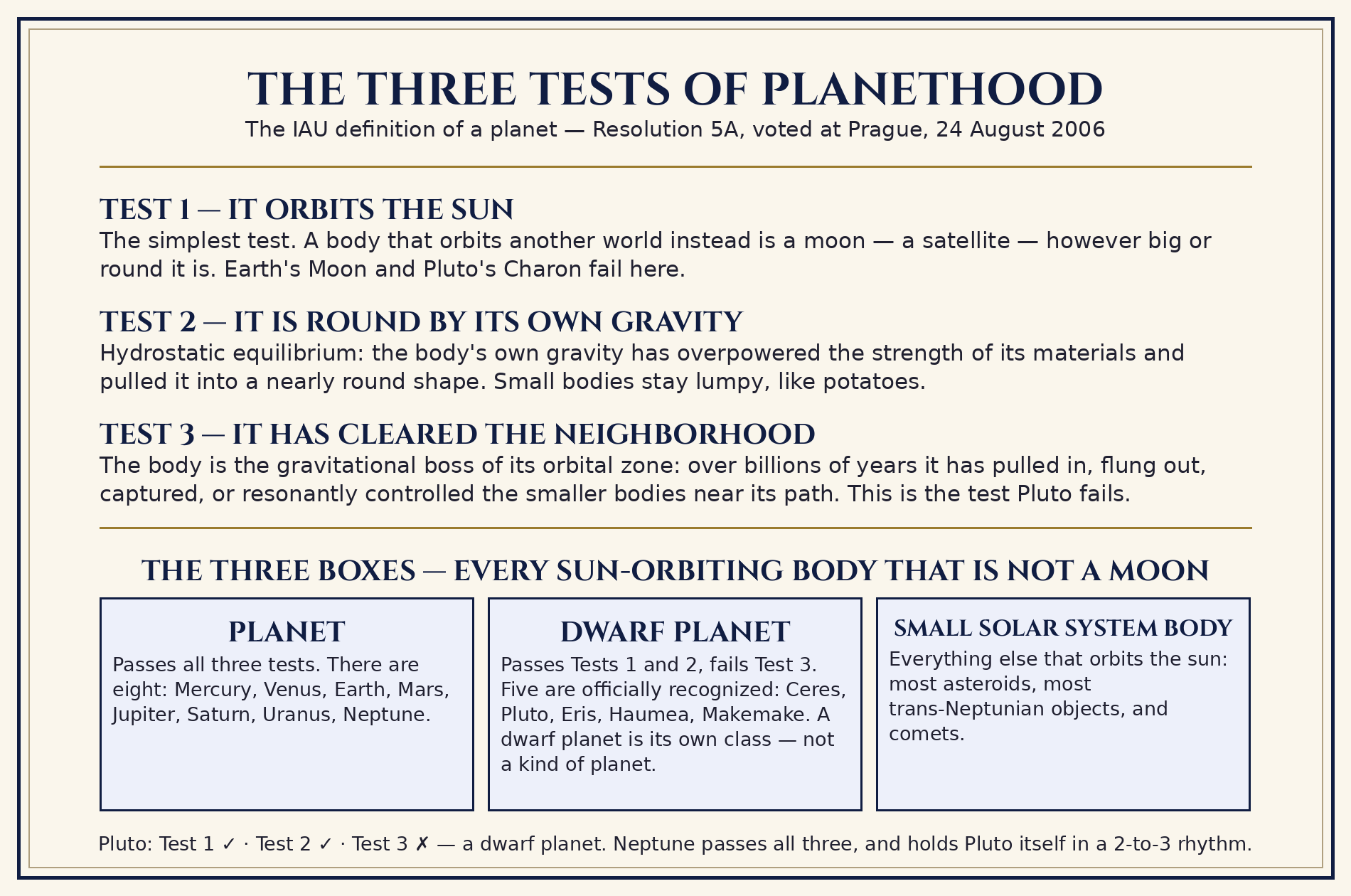
The Three Tests of Planethood (IAU Resolution 5A, Prague, August 24, 2006) and the three boxes they sort the solar system into. Pluto passes the first two tests and fails the third — a dwarf planet, which is its own class, not a small kind of planet.
Built digitally for this overhaul (Python/PIL, typeset labels), from the mechanism taught in the lesson text.
Here is the IAU's definition of a planet, passed as Resolution 5A on August 24, 2006, in plain language. A planet is a body that does all three of these things:
★ 1. It orbits the sun. This is the simplest test, and it is why Earth's moon is not a planet: the moon orbits Earth. Moons are their own category, no matter how big or how round.
★ 2. It is round, pulled into a ball by its own gravity. The technical phrase is hydrostatic equilibrium, and it means the body's own gravity has overpowered the strength of its materials and crushed it into a nearly round shape. Small bodies stay lumpy, like potatoes, because rock and ice are strong enough to hold odd shapes against weak gravity. Past a certain size, a few hundred kilometers across for icy bodies, gravity wins and the world becomes a ball. Ceres, at about 940 kilometers wide, is round. Pluto, at 2,377 kilometers, is round. Eris is round. Roundness alone, though, is not enough, or the moon would qualify. It takes all three tests.
★ 3. It has cleared the neighborhood around its orbit. This is the test Pluto fails, and it is the whole lesson in three words, so let us unpack it properly.
★ "Clearing the neighborhood" does not mean the orbit is literally empty. It means the body is the gravitational boss of its orbital zone. Over the four and a half billion years of the solar system's history, a true planet's gravity has organized everything near its path: pulling smaller bodies in to build itself, flinging others out of the zone entirely, capturing some as moons, and locking the rest into orbital rhythms it controls. A planet owns its lane. Everything else in the lane answers to it.
Now compare the two contestants.
★ Neptune is seventeen times the mass of Earth. Its gravity utterly dominates the region around its orbit. Thousands of icy bodies share Pluto's general neighborhood, including Pluto itself, and they are locked in a two-to-three rhythm with Neptune: for every two laps Pluto makes around the sun, Neptune makes three, and Neptune's gravity holds that pattern steady. These bodies are called plutinos, and they are Neptune's captives, not Pluto's companions. Neptune cleared its neighborhood the way a snowplow clears a road: everything in the lane was moved by Neptune.
★ Pluto is about two-thousandths the mass of Earth, roughly one-sixth the mass of Earth's moon. It shares its orbital zone with thousands of Kuiper Belt objects of comparable size, and it dominates none of them. The total mass of the Kuiper Belt outweighs Pluto dozens of times over. Pluto did not clear its lane. Pluto is the lane's most famous piece of traffic.
Astronomers can even put a number on this. In 2000, two planetary scientists, Alan Stern and Harold Levison, proposed a mathematical version of the neighborhood test: a value called lambda that measures how thoroughly a body's gravity can scatter smaller bodies out of its zone. For the eight planets, lambda runs from the thousands to the billions. For Pluto and Eris, it is a small fraction. This is not a close call with Pluto just missing the cutoff. It is a chasm, with every planet on one side and every dwarf planet on the other.
Why does the third test exist at all? Because without it, the word "planet" stops being useful. When Eris was found, astronomers could see the future: the next survey would find more round, sun-orbiting worlds, and the next one more after that. A definition based only on roundness would have produced dozens of planets within a decade, and a word that means fifty different things means nothing. The third test keeps "planet" as a meaningful category: the eight gravitationally dominant worlds. And it gives everything else an honest category of its own, instead of pretending the problem does not exist.
Check in: Name the three tests in order — and state, for Pluto, exactly which test it passes and which it fails, with the evidence for the failure.
❦ In your workbook: record the three tests in your own way — the lane each planet owns, Neptune the snowplow, Pluto the lane's most famous traffic, and the lambda chasm between them — copy, sketch, or note what matters.
In your packet: Exercise I — The Three Tests ⚒ begins here — its eight-body table applies exactly these tests. Work it now, or mark the place and take it as homework — your choice.
The Other Two Boxes
The definition sorts every sun-orbiting body that is not a moon into one of three boxes.
Planets pass all three tests. There are eight: Mercury, Venus, Earth, Mars, Jupiter, Saturn, Uranus, and Neptune. The definition names them in a footnote, so there is no ambiguity.
★ Dwarf planets pass the first two tests and fail the third: they orbit the sun, they are round, but they have not cleared their neighborhoods, and they are not moons. The IAU officially recognizes five: Ceres, Pluto, Eris, Haumea, and Makemake. Astronomers suspect hundreds more are waiting in the Kuiper Belt, including many we have already spotted but not yet measured well enough to certify as round. The IAU was explicit about one thing that confuses everyone: despite the name, dwarf planets are a separate class. A dwarf planet is not a kind of planet. It is its own thing.
Small Solar System Bodies are everything else that orbits the sun: most asteroids, most trans-Neptunian objects, and comets. Lumpy, small, uncleared, unround: honest bodies in an honest box.
Two honest boundaries are worth stating plainly. First, the 2006 definition covers only our solar system. Planets around other stars get a separate working definition, because we often cannot measure their neighborhoods at all. Second, real astronomers still argue about the definition. Alan Stern, who led the New Horizons mission to Pluto, thinks the third test is the wrong test and has said so for twenty years. That argument is not a scandal. It is the mechanism working: a definition is a tool, and scientists are allowed to argue about their tools, in public, with evidence.
Check in: A round, sun-orbiting body that has not cleared its neighborhood lands in which box — and why is it wrong, in the IAU's own terms, to call it a small kind of planet?
❦ In your workbook: record the three boxes in your own way — eight planets, five recognized dwarfs, everything else honest in the third box, and the two boundaries the definition states plainly — copy, sketch, or note what matters.
Pluto's New Address
Nothing about Pluto changed on August 24, 2006, except its filing. Here is its true address, and it is a grander one than "ninth planet" ever was.
Pluto is a Kuiper Belt object, the brightest known member of the solar system's third great realm: the eight planets close in, the asteroid belt in the middle, and the vast icy belt beyond Neptune. It is a plutino, locked in its two-to-three rhythm with Neptune. It circles the sun once every 248 years on a tilted, stretched orbit, swinging inside Neptune's path for about twenty years of each lap. It has five known moons, and the largest, Charon, is so large relative to Pluto that the two wheel around a balance point floating in the space between them, each showing the other the same face forever, like dancers who never look away.
And it has a heart of churning nitrogen ice.
A definition is a tool, not a verdict. The tool got better. The world stayed wonderful.
❦ In your workbook: record the new address in your own way — Kuiper Belt object, plutino, five moons, the balance point between the dancers, and the heart — copy, sketch, or note what matters.
A Sealed Note on Loving Pluto Anyway
My dears,
If you felt a pang when you read about the vote in Prague, I want you to know that I felt it too, and I am a professor of this subject. I sat in my dome with the newspaper and felt sad for a world I will never visit, and there was nothing unscientific about the feeling. You can know exactly why a definition changed and still wish, for one small moment, that it had not needed to.
Here is what I have learned in the years since, roosting upside down and thinking it over. Loving Pluto was never about the word "planet." Nobody loved Pluto because of its filing. We loved it because it was small and far and brave, because a farm boy found it with a blinking machine, because an eleven-year-old named it, because it has a heart. None of those things changed in Prague. The heart is still there. The nitrogen ice is still churning. New Horizons flew three billion miles to look at it closely, and no spacecraft has ever flown three billion miles to look at a filing cabinet.
So love Pluto as loudly as you like. Just file it correctly. Those are two different jobs, and you are old enough now to do both at once.
❦ In your workbook: record the sealed note in your own way — loving a world and filing it correctly as two different jobs, both of them yours — copy, sketch, or note what matters.
PROFESSOR VESPER GLIMMERWICK
Celestial Studies
Astronomer & Celestial Historian
Guided Observation
Try It Tonight
Part One: The Three Tests Card Sort (Level One — everyone)
Make eighteen small cards, one for each of these: Mercury, Venus, Earth, Mars, Jupiter, Saturn, Uranus, Neptune, Pluto, Eris, Ceres, Haumea, Makemake, Earth's Moon, Charon, Vesta, Halley's Comet, and 1992 QB1 (Albion). Draw three boxes on a large sheet of paper and label them Planet, Dwarf Planet, and Small Solar System Body, with a fourth box labeled Satellite. Sort the cards using the three tests, in order. The two hardest cards are Charon and 1992 QB1: Charon is round and hefty, but it orbits Pluto, so it fails test one and lands in Satellite. Albion orbits the sun, but it is small and lumpy, so it was never round enough for the dwarf box. Check your sort against the answer key in your assignment packet, then argue about the close calls. Arguing about close calls is the job.
Check in: Charon is round and hefty, and Albion orbits the sun — so why does neither land in the Dwarf Planet box? Name the test each one fails.
❦ In your workbook: record the card sort in your own way — your eighteen cards in their four boxes, and the close calls you argued about — copy, sketch, or note what matters.
In your packet: Exercise I — The Three Tests ⚒ grows out of this sort — the table is the sort, written down with its evidence. Work it now, or mark the place and take it as homework — your choice.
Part Two: The Neighborhood Demonstration (Level One — everyone)
You will need a shallow tray or baking sheet, about thirty paper clips, and two magnets: one large and strong, one small and weak. Scatter the paper clips across the tray; they are the icy bodies of a crowded orbital zone. Now sweep the large magnet slowly across the tray, the way a planet sweeps its lane over millions of years. Then reset the clips and sweep the small magnet. Record what happens: which magnet cleared its path, which one merely nudged a few clips, which one picked up passengers it could not control? The large magnet is Neptune. The small one is Pluto. Write one paragraph explaining what your tray has to do with Resolution 5A.
❦ In your workbook: record the demonstration in your own way — what each magnet did to its lane, and the paragraph that ties your tray to Resolution 5A — copy, sketch, or note what matters.
In your packet: Exercise III — The Neighborhood Demonstration ⚒ begins here. Work it now, or mark the place and take it as homework — your choice.
Part Three: Hunting Pluto (Level Two — for the patient and well-equipped)
Pluto shines at about magnitude fourteen, far beyond naked-eye range. Spotting it requires a telescope of at least eight inches aperture, truly dark skies, and a current star chart or planetarium app set to tonight's date. It will look exactly like a faint star, because that is what Tombaugh saw too. The only way to know you have found it is to sketch the field on two different nights and find the "star" that moved. This is an advanced challenge, not a requirement. If you attempt it, you are repeating, with better equipment, the exact observation Clyde Tombaugh made in 1930.
❦ In your workbook: record the hunt in your own way — attempted or honestly not attempted, and why Level One stands complete either way — copy, sketch, or note what matters.
Sky Log note for all levels: Pluto will not appear in your Sky Log tonight, and that absence is the point of this lesson. Log the moon for your Moon Journal, log any naked-eye planets you can find, and write one line about the most interesting world you cannot see.
Sky Log Entry
Continue your Moon Journal: date, time, phase, and a quick sketch of the moon's shape and position. Below it, add a "Wanderers" line for tonight. List any planets you can identify with the naked eye and where they stood. Then add one final line, and be honest: Pluto: not visible, magnitude fourteen, three billion miles away, heart intact. Some entries in a sky log are about what is there. This one is about what you now understand.
❦ In your workbook: record the Sky Log entry in your own way — tonight's moon for the Moon Journal, the Wanderers line, and the honest Pluto line — copy, sketch, or note what matters.
Materials
Required (Level One — household items)
- Eighteen index cards and a pen for the Three Tests card sort (Mercury, Venus, Earth, Mars, Jupiter, Saturn, Uranus, Neptune, Pluto, Eris, Ceres, Haumea, Makemake, Earth's Moon, Charon, Vesta, Halley's Comet, 1992 QB1).
- A large sheet of paper for drawing the four sorting boxes: Planet, Dwarf Planet, Small Solar System Body, Satellite.
- A shallow tray or baking sheet, about thirty paper clips, and two magnets (one large and strong, one small and weak) for the neighborhood demonstration.
- Your workbook and a pencil for the Sky Log, the demonstration record, and the timeline exercise.
- A flashlight for night observing (point it at the ground, never at eyes).
Suggested (Level Two — historically closer)
- A telescope of at least eight inches aperture for the optional Pluto-hunting challenge, under truly dark skies.
- A current star chart or planetarium app set to tonight's date, for identifying Pluto's field.
- A funnel and a set of marbles of graduated sizes as an alternative neighborhood demonstration.
Reflection Questions
Answer each in a few thoughtful sentences. There are no trick questions; there are only interesting ones.
- The reclassification of Pluto upset many people who are not astronomers and never will be. Why do you think a change in a scientific definition provoked such strong feelings? What does that tell us about how humans relate to categories?
- The IAU's 2006 definition covers only our solar system; planets around other stars use a separate working definition. Is that a flaw in the definition or a sensible boundary? Defend your answer with reasoning, not just preference.
- Alan Stern, the scientist who led the New Horizons mission, still argues that the IAU's definition is wrong, and hundreds of scientists agree with him. Does their disagreement make the science weaker or stronger? Explain.
- Ceres went from planet to asteroid to dwarf planet. Pluto went from planet to dwarf planet. What pattern do you see in these two histories, and what does it suggest about how science responds when a world turns out to have company?
- Write a short paragraph in Professor Glimmerwick's voice, as kindly as you can: explain to a young scholar who is sad about Pluto why loving the world and accepting the reclassification are not opposites.
Workbook Checklist — Lesson 17
In my workbook I have:
- ☐ sorted the eighteen cards by the three tests, in order, and argued about the close calls
- ☐ run the neighborhood demonstration, counted what each magnet cleared, and written the Resolution 5A paragraph
- ☐ completed Exercise I's eight-body table, with an evidence phrase for every yes and no
- ☐ drawn the Ceres–Pluto parallel timeline and written the paragraph of at least 150 words
- ☐ written Exercise III's labeled explanation, ending with my sentence on the third test
- ☐ kept my Moon Journal going: tonight's moon logged, the Wanderers line written, and the honest Pluto line entered
☐ Lesson completed Date: ___ Signature: ___
The Professor's Closing Note
My dearest scholars,
I want to tell you one last thing about Clyde Tombaugh, because it is my favorite part of the whole story and I saved it for the end.
★ When the New Horizons spacecraft launched for Pluto in January of 2006, seven months before the vote in Prague, it carried a small canister tucked inside its frame. Inside the canister were some of Clyde Tombaugh's ashes. He had died in 1997, never knowing that a spacecraft would one day visit his world. Nine years and three billion miles later, the man who found Pluto with a blinking machine arrived at Pluto after all, riding the fastest spacecraft ever launched, and was there when humanity saw the heart for the first time.
That is what science does, my dears. It argues about definitions in public, it votes, it revises, it gets embarrassed in the newspapers, and then it builds a machine, flies it three billion miles, and looks. The looking is the point. The labels are just how we keep the photographs organized.
Keep looking up. And keep your definitions sharp: the universe deserves accurate labels.
PROFESSOR VESPER GLIMMERWICK
Celestial Studies
Astronomer & Celestial Historian
Cross-Class Connections
Scrollwork · Unit VI, Lesson 23 — Archive Labels & Library Systems
Tower scholars, tonight's lesson files a world. This one teaches you how anything gets filed so it can be found again. The astronomers' numbered lists — Eris entered as (136199) in a catalog with rules — are the sky's version of the shelfmark: a label, a list, and a system that holds when memory fails. Come to the Scrollwork Library and learn how medieval houses labeled, listed, and locked their books, and design a catalog of your own. Professor Glimmerwick reads the entry. Here, we keep the book it lives in.
PROFESSOR QUILLBERRY NOCTURNE
Scrollwork Library

Creative Arts · Studio Extension E5 — Relief & Scale Displays
Bring your two solar systems to my bench, scholars: the twelve that Prague nearly voted in, and the eight-plus-five we actually have. A scale display is a claim made solid, and claims made solid must confess what they bent — your sizes can be true, or your distances can, but no room holds both, and your maker's plate will say which you chose and why. That honesty is the whole craft of the display, and it is the same honesty Professor Glimmerwick's astronomers voted for. Build it to stand, and label it true.
PROFESSOR COGBRANCH TIMBERCLANK
Creative Arts Workshop
Further Reading & Sources
- NASA Science: Pluto. The space agency's Pluto hub: facts, news, images, and classroom resources on the dwarf planet and the New Horizons flyby. https://science.nasa.gov/dwarf-planets/pluto/
- NASA Science: Kuiper Belt Exploration. How the belt was found, from Pluto in 1930 to Jewitt and Luu's 1992 QB1 to New Horizons' ongoing journey. https://science.nasa.gov/solar-system/kuiper-belt/exploration/
- NASA Science: Ceres (Dawn mission). Ceres as the first-discovered dwarf planet and the first visited by a spacecraft. https://science.nasa.gov/mission/dawn/science/ceres/
- IAU definition of planet (Wikipedia). The full text of Resolutions 5A and 6A, the vote details, and the history of the controversy, with sources. https://en.wikipedia.org/wiki/IAU_definition_of_planet
- EarthSky: Pluto demoted to dwarf planet twenty years ago. A clear retelling of the 2006 vote and what has been learned since. https://earthsky.org/human-world/pluto-dwarf-planet-august-24-2006/
- SpaceNews: Pluto at 90. Tombaugh's discovery story and how it opened the Kuiper Belt, with the detail about his ashes aboard New Horizons. https://spacenews.com/pluto-at-90-tombaughs-discovery-revolutionized-knowledge-of-our-solar-system/
Sealed in the Celestial Tower, in deep midnight blue, by Professor Vesper Glimmerwick.
Browse the Celestial Studies shelf in the school Library for readable editions of these works.
Submit your work for this lesson using the form below.
THE UNIT III QUIZ
CELESTIAL TOWER · UNIT III: THE WANDERERS
Unit III is complete: the five wanderers have all had their evenings — their retrograde loops drawn as true geometry, Venus tracked as the morning star, Mars followed from the canal craze to the rovers, the giant worlds weighed and measured, and Pluto, whose story ends this unit by teaching us what a planet is. This quiz gathers the whole unit into one sitting. Take it from memory first, before you look back at your notes, because it measures what has stayed with you. If you kept the passages marked ★ in your workbook as you read, you have already practiced most of what it asks.
The quiz packet is a single download. Part I gathers multiple-choice questions from across the unit, Part II asks true or false, Part III matches the unit's vocabulary, and the answer key waits at the back for self-checking. When you have finished, score it honestly, note the result in your workbook, and revisit any lesson whose questions went wrong before you move on.
CONTINUE IN THE CELESTIAL TOWER
← Previous · Lesson 16: The Giant Worlds Next · Lesson 18: The Sun: Our Star →
Unit III — The Wanderers Celestial Tower — All 33 Lessons
The rest of Unit III: Lesson 12 · The Naked-Eye Planets · Lesson 13 · Retrograde · Lesson 14 · Venus · Lesson 15 · Mars · Lesson 16 · The Giant Worlds
From the Celestial Shelf
The printed companions to this lesson, from Professor Glimmerwick’s shelf in the shop.