
CELESTIAL STUDIES
Unit III · Lesson 13Retrograde & the Model Wars
Professor Vesper Glimmerwick
Astronomer & Celestial Historian
The Celestial Tower • School of Evershade
Professor's Introduction

The stars are out, scholars,
Every evening I fly out of the Celestial Tower on my rounds, and every evening the sky is honest with me. It shows me exactly where everything is. The trouble, I have learned, is that showing me where things are is not the same as telling me what they are doing. The sky shows you a flat picture. The universe is a deep one. Confusing the two is one of the oldest mistakes in astronomy, and it is also one of the most beautiful, because untangling it took humanity two thousand years and some of the finest thinking anyone has ever done.
Tonight's lesson is about a planet that appears to change its mind. Mars sails eastward among the stars for months, then stops, slides backward for weeks, stops again, and sails on as if nothing happened. Ancient observers saw this and were baffled. Brilliant observers saw this and were baffled for a very long time. The answer, when it came, was not that Mars ever goes backward. It never does. The answer is that you are moving too.
I want to be plain about something before we begin, because I am fond of you and I am fond of the truth in equal measure: this is the lesson where I will not let wonder do the teaching for me. The sky is wonderful, but the mechanism is the lesson. By the end of tonight you will be able to stand in front of anyone, draw two circles, and explain retrograde motion with a pencil. That is a small magic and a large one at the same time.
One more thing, and it is important. You will meet Claudius Ptolemy tonight, and I will ask you to treat him with the respect he earned. His model of the universe was wrong about the center, and it predicted the planets' positions well enough to be used for about fourteen hundred years. A wrong model that works for fourteen hundred years is not a joke. It is a warning and an inspiration at once: a warning that a good prediction is not the same as a true picture, and an inspiration that careful observation and honest mathematics can carry us very far indeed.
Fly carefully, watch closely, and keep your notebook open.
PROFESSOR VESPER GLIMMERWICK
Celestial Studies
Astronomer & Celestial Historian
Where and when: your own sky, tonight — Retrograde & the Model Wars. This lesson has no pin and no stop: its place is wherever you stand under the night sky. The line beneath the map is our road through the course: every stop a moment when watching the sky changed, every lesson a place upon it.
Lesson Objectives
By the end of this lesson, you will be able to:
- Explain retrograde motion geometrically: Earth overtaking an outer planet on a faster inner orbit, so the planet only appears to move backward against the stars.
- Describe Ptolemy's Earth-centered model (deferent, epicycle, equant) and explain how it accounted for retrograde motion, and why it predicted planetary positions well for about fourteen hundred years.
- Describe the sun-centered model of Copernicus and explain why retrograde motion needs no special machinery in it.
- Summarize Galileo's two decisive observations of 1610 (the moons of Jupiter, the phases of Venus) and explain exactly what each one ruled out.
- Define all lexicon terms and use them correctly in the quiz, the exercises, and the Sky Log.
- Act out or diagram the overtaking geometry and identify the stationary points of a retrograde loop.
Reading this lesson: ★ marks the passages to remember. They return on the unit quiz and the class test. Check in questions ask the material back as you go; answer them in your workbook when you meet them.
Working this lesson: Your assignment packet is the first download on this page. Work in it as the lesson moves along, answering each exercise as its subject is taught — or read the lesson through for your notes and take the exercises as homework afterward. Both are proper ways to sit this class. Signposts in the reading tell you where each exercise belongs. Written answers are short answers in your own words; a few honest lines are worth more than a filled page.
Your Assignment Packet
This lesson's exercises live in its packet: the Lexicon Handout (every term, course terms marked ◆), Materials, Guided Practice, the Assignment Manual with its answer key for self-checking, the Reflection Questions, and the Workbook Checklist. Download the packet before you begin and keep it beside you as you read. The packet's exercises are Glimmerwick's own word for the work: Exercise I: The Overtake, Acted and Drawn ⚒, Exercise II: Ptolemy's Circles, Drawn with Respect ⚒, and Exercise III: The Long Watch ◐. The lesson's quiz is not printed in the packet; it pools to the Unit III Quiz, where it will meet you again.
Safety Briefing
Night-observing safety. This lesson sends you outside after dark, so this section comes first and is not negotiable.
All night observing is done with an adult present, in a familiar and safe location. Tell someone where you are going and when you expect to return. Dress warmly, bring a flashlight (a dim or red-filtered one preserves your night vision), and watch your footing in the dark.
This lesson involves no solar observing of any kind. Everything you track in this lesson is a planet or a star, watched after dark. The solar safety rules from Lesson 9 still stand for all time: never look at the sun except through a certified ISO 12312-2 viewer, and never improvise.
Indoor activities are safe by design. The passing-car demonstration uses household objects; the only rule is not to run with them.
The Wonder
Go outside on a clear night and find Mars. It is the red one, the one that does not twinkle the way stars do. If you have been watching it for a few weeks, you may have noticed something strange: Mars has been creeping eastward among the stars, night after night, slow and steady, and then one night it simply stops. For a few nights it hangs almost still. Then, impossibly, it begins to drift westward, backward against the stars, back the way it came. It keeps this up for weeks. Then it stops again, turns around, and resumes its eastward journey as though the whole backward episode never happened.
The oldest bafflement in astronomy
Priests and scribes in ancient Babylon recorded this backward dance in clay thousands of years ago. The Greeks gave the planets their name for it: planētēs, the wanderers. Stars keep their places in their constellations, wheeling as one great sphere. Planets wander. And every so often, the wanderers wander backward.
The bafflement was not that Mars moved. The bafflement was that the motion made no sense in the picture everyone trusted. The heavens were supposed to be orderly. Everything celestial moved in perfect, stately, forward circles. A planet that stopped and reversed was an insult to the order of things, and for centuries the insult stood unexplained.
Check in: What exactly baffled the ancient observers — that Mars moved, or something about how it moved?
❦ In your workbook: record the wonder in your own way — Mars creeping east, hanging still, then drifting west for weeks — copy, sketch, or note what matters.
What you are about to learn
★ Here is the whole secret, stated plainly before we earn it: Mars never goes backward. Not once. What goes backward is your point of view, because you are standing on a planet that is moving too, and moving faster. Retrograde motion is not a planet backtracking. It is perspective, the same perspective that makes a slower car seem to slide backward when you pass it on the highway. The universe did not care which model flattered us. It only ever cared about geometry.
❦ In your workbook: record the secret in your own way — Mars never goes backward; the watcher is moving — copy, sketch, or note what matters.
The Story
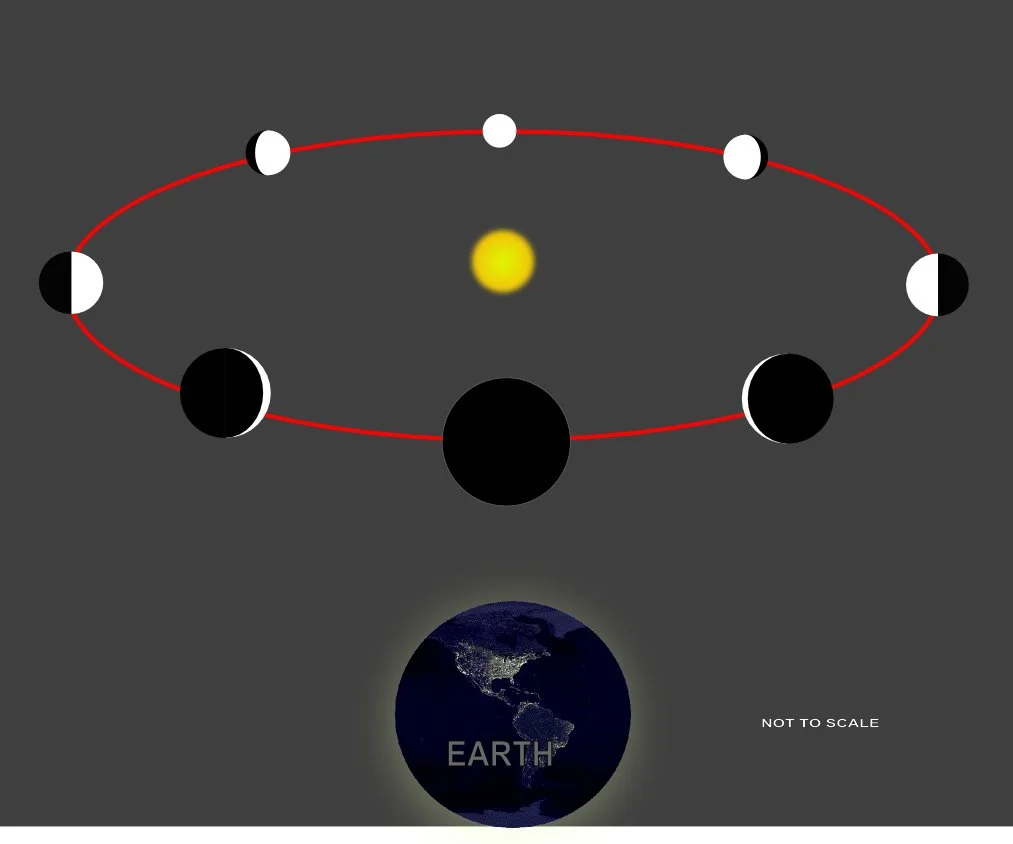
The phases of Venus, as the sun-centered geometry predicts them: Venus circles the sun, so from Earth it runs the full sequence — crescent, half, gibbous, full — growing smaller as it grows fuller. In Ptolemy's arrangement, Venus never left the sunward side and could only ever show a thin crescent; the full set Galileo saw in the fall of 1610 was impossible there.
Public-domain diagram via Wikimedia Commons.
The man who saved the appearances
Claudius Ptolemy lived in Alexandria, in Roman Egypt, from roughly 100 to roughly 170 of the Common Era. He wrote in Greek, and his great astronomical work was the Mathēmatikē Syntaxis, the Mathematical Treatise, in thirteen books. Later readers, awed by it, called it simply the Greatest, the Almagest, and the name stuck.
Ptolemy inherited two commitments from the Greek tradition. First, Earth sat motionless at the center of the universe. Second, all heavenly motion was circular and uniform, because the circle was considered the most perfect of motions. These were not silly commitments. Earth feels motionless, and the stars do wheel overhead in what looks like a perfect sphere. Ptolemy then did something magnificent with these commitments: he built a machine of circles that reproduced what observers actually saw, including the baffling backward loops.
★ His machinery had three main parts. The deferent was a great circle centered near Earth, carrying each planet around the sky. The epicycle was a smaller circle whose center rode along the deferent, with the planet itself riding the epicycle. And the equant was an offset point from which the planet's motion appeared uniform, a clever adjustment that made the predictions fit the observations. When the planet rode the inner part of its epicycle, nearest Earth, its motion on the small circle ran counter to its motion on the big one, and for a while the planet appeared to move backward. Ptolemy sized each epicycle to fit the observed loops. The system was intricate, but it worked: its tables predicted where the planets would be, and astronomers used it, refined it, and trusted it for about fourteen hundred years.
★ I want you to sit with that number. Fourteen hundred years. Ptolemy was wrong about the center of the universe and right about almost everything the numbers needed. His model is the great lesson of this unit: a model can predict beautifully and still misdescribe reality. Predicting and picturing are different jobs.
Check in: Name Ptolemy's three pieces of machinery, and say what each one does.
❦ In your workbook: record Ptolemy's machine in your own way — deferent, epicycle, equant, and fourteen hundred years of working predictions — copy, sketch, or note what matters.
The quiet canon and the book that waited
Nicolaus Copernicus was a Polish church canon who, around 1514, quietly circulated a short manuscript among friends arguing that the sun, not Earth, stood at the center, and that Earth itself moved. He spent decades refining the idea and hesitating to publish it. De revolutionibus orbium coelestium, On the Revolutions of the Heavenly Spheres, finally appeared in print in 1543, the year of his death.
★ Copernicus's great simplification was this: put the sun at the center, let Earth be a planet like the others, and retrograde motion needs no machinery at all. If Earth moves on a faster inner track, then of course an outer planet appears to slide backward when we overtake it. The loops are not real motions requiring circles upon circles. They are what a moving observer sees. One moving Earth explains the retrograde of every outer planet at once.
Honesty requires one more sentence, and it is an important one. Copernicus did not throw away all of Ptolemy's circles. Because he kept the old commitment to perfect circular motion, he still needed small epicycles to make his predictions match the observations, and his predictions were no better than Ptolemy's. His victory was not accuracy. It was simplicity and sense: retrograde motion fell out of his system for free, as perspective, instead of being bolted on as machinery. The circles were not finished until Johannes Kepler, working with the superb observations of Tycho Brahe, showed in 1609 that the planets move in ellipses, not circles. Then the epicycles could finally go.
Check in: Copernicus's predictions were no better than Ptolemy's, and he still kept small epicycles. So what exactly was his victory?
❦ In your workbook: record the quiet canon in your own way — the book of 1543, retrograde for free as perspective, and the epicycles Kepler's ellipses finally removed — copy, sketch, or note what matters.
The telescope settles it
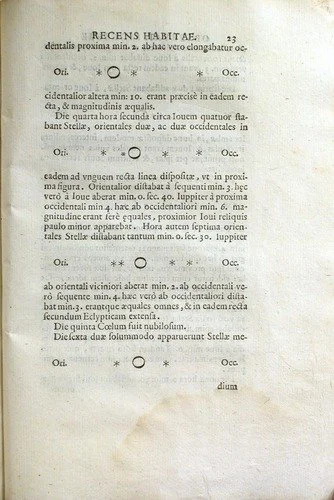
Galileo's own record, from the Sidereus Nuncius (1610): Jupiter (the large circle) with its small "stars" set east and west of it, row by row, night by night. The dots moved with Jupiter and changed sides — they were moons orbiting the planet, and not everything in the heavens circles Earth.
Galileo Galilei, Sidereus Nuncius, Venice, 1610 (page scan via Wikimedia Commons).
Galileo Galilei did not invent the telescope, but in 1609 he built his own and pointed it upward, and what he saw rewrote the sky. In January of 1610 he watched Jupiter for a week and found four small points of light that moved with the planet, shifting position night after night. They were moons, orbiting Jupiter. Not everything in the heavens circled Earth. The old cosmos had exactly one center, and here were four bodies plainly circling something else.
★ Later that same year, in the fall of 1610, Galileo turned his telescope to Venus and watched it move through a full sequence of phases: crescent, half, gibbous, full, just like the moon. This was fatal to Ptolemy's geometry specifically. In Ptolemy's system, Venus's epicycle was locked so that the planet always stayed between Earth and the sun, on the sunward side. We could therefore only ever see it as a thin crescent, its dark side mostly toward us. A full set of phases, including a nearly full Venus, was geometrically impossible in that arrangement. The only arrangement that produced what Galileo saw was one in which Venus circled the sun, coming around behind it where its fully lit face could turn toward us.
Galileo knew what he had. He announced the Venus discovery concealed in an anagram in a letter, the seventeenth-century version of a sealed envelope, so no one could steal the credit while he confirmed it. The unscrambled Latin announced that Venus imitates the figures of the moon. It did, and Ptolemy's circles could not survive it.
So the model wars ended the way science usually ends its wars: not with one dramatic duel, but with evidence accumulating until the old picture could no longer hold it. Ptolemy had fourteen hundred years of successful prediction. Copernicus had the simpler picture. Galileo had the telescope. And Kepler had the ellipses that made the whole thing finally, beautifully work.
Check in: Galileo made two decisive observations in 1610. What did each one rule out?
❦ In your workbook: record the telescope's verdict in your own way — four moons circling Jupiter, a full set of phases on Venus, and the anagram that sealed the claim — copy, sketch, or note what matters.
The Mechanism
This is the heart of the lesson. Read it slowly, and if you can, act it out with a friend as you read. Everything in this section is something you can see with your own eyes in the geometry.
The setup: two racers on two tracks
Picture the solar system from above, looking down on the sun. Draw the sun as a coin in the middle of a table. Now draw two circular tracks around it: Earth's track close in, Mars's track farther out. Put a pebble on each track. Both pebbles always move the same direction around the sun (counterclockwise, as seen from above Earth's north pole), and neither ever stops or reverses. This is the entire truth of the planets' real motion. Everything strange happens in how it looks from one moving pebble to another.
Earth's track is the inside lane, and the inside lane is the fast lane. Earth races around the sun at about 29.8 kilometers per second, roughly 107,000 kilometers per hour. Mars, on the farther and slower track, manages only about 24.1 kilometers per second. So Earth laps Mars. About every 26 months, Earth comes up behind Mars and passes it, the way a faster car passes a slower one on the highway.
Check in: Both pebbles always move the same direction and neither ever reverses. Then where does the backward motion come from?
❦ In your workbook: record the setup in your own way — two tracks, one direction, the inside lane the fast lane — copy, sketch, or note what matters.
The pass, step by step
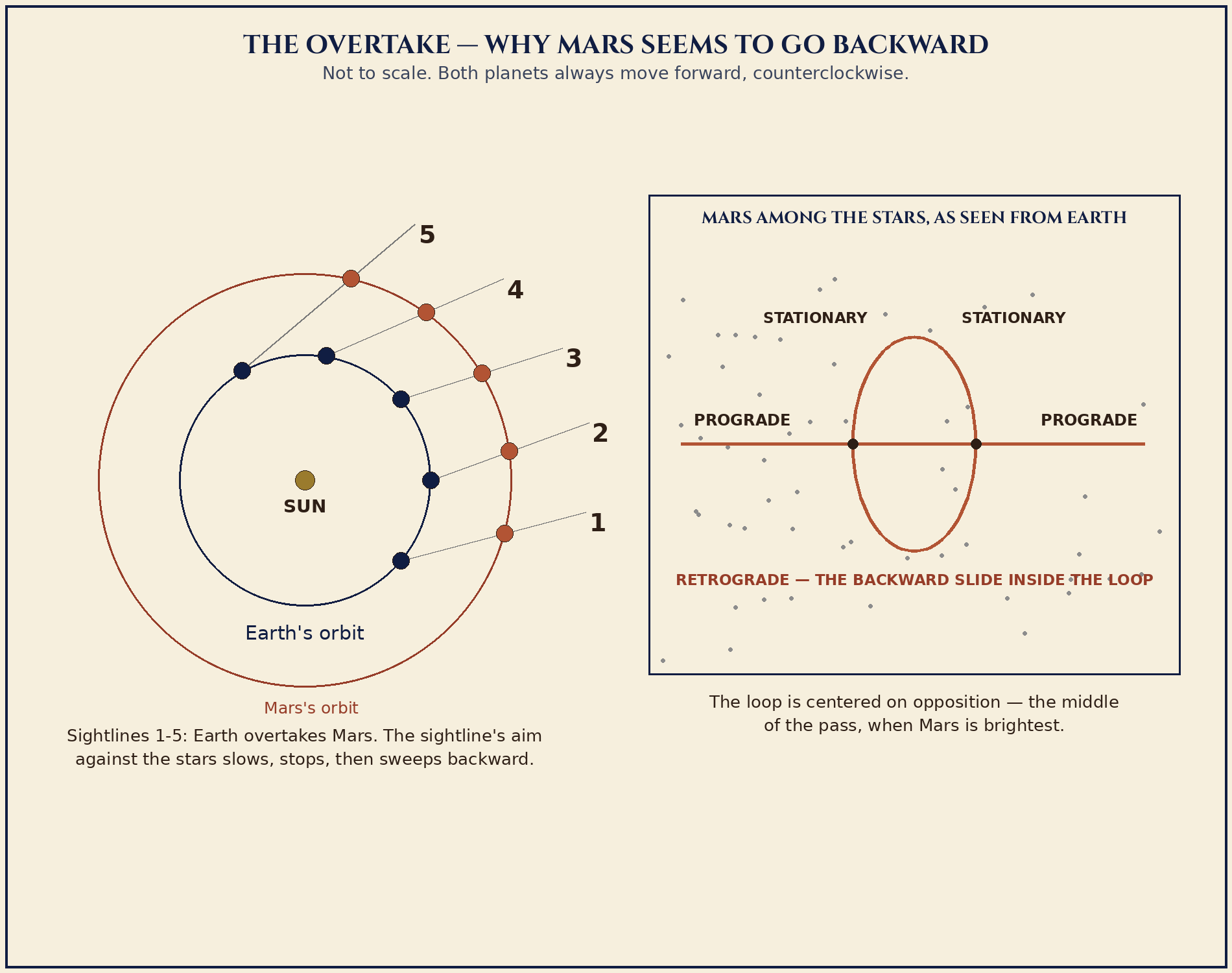
The overtake, in two views. On the left: Earth on the fast inner track laps Mars; the sightline's aim against the stars (1–5) slows, stops, and sweeps backward. In the sky: Mars drifts prograde, halts at a stationary point, loops backward, halts again, and resumes — the loop centered on opposition, when Mars is closest and brightest. Mars never reverses.
Built digitally for this overhaul (Python/PIL, Cinzel/DejaVu typeset labels), from the geometry taught in the lesson text.
Stand on Earth, the faster pebble, and watch Mars against the distant stars. Walk through the pass in five stages.
Stage one: the approach. Months before the pass, Earth is well behind Mars on its inner track. From Earth, Mars appears to drift slowly eastward among the stars. Astronomers call this eastward drift prograde motion. It is the planet's normal behavior, and it is what Mars does most of the time.
Stage two: the slowdown. Earth is catching up. As our faster motion starts to line up with Mars's position, Mars's eastward drift against the stars begins to slow. Night after night, it covers less ground. It is not slowing down in its orbit. It is that our changing viewpoint is beginning to cancel out its apparent motion, the way a car ahead of you seems to slow as you close the distance.
Stage three: the standstill. For a few nights, Mars appears to hang almost motionless among the stars. This is the stationary point, the moment when our forward rush exactly balances the geometry of the sightline. Nothing has stopped. Mars still sails forward on its orbit, and Earth still races forward on hers. But the line from your eye to Mars is sweeping neither east nor west. It is the hinge of the whole illusion.
★ Stage four: the backward slide. Now Earth is alongside and pulling ahead of Mars. Watch the slower car on the highway as you pass it: against the distant hills, it seems to slide backward, even though it is still driving forward. That is exactly what happens in the sky. The sightline from Earth to Mars now sweeps westward against the stars, and Mars appears to move backward, westward, for about 72 days. This is retrograde motion: apparent motion only, perspective only, never a real reversal.
Stage five: the resume. Earth pulls far enough ahead that the geometry settles. Mars reaches a second stationary point, hangs still for a few nights, and then resumes its normal eastward, prograde drift. The loop is complete. Mars never once changed direction.
Check in: Walk the five stages in order, and name what Mars is really doing at the standstill and during the backward slide.
❦ In your workbook: record the pass in your own way — approach, slowdown, standstill, backward slide, resume — copy, sketch, or note what matters.
In your packet: Exercise I: The Overtake, Acted and Drawn ⚒ begins here — its tabletop pass acts out exactly these five stages. Work it now, or mark the place and take it as homework — your choice.
Why it happens near opposition
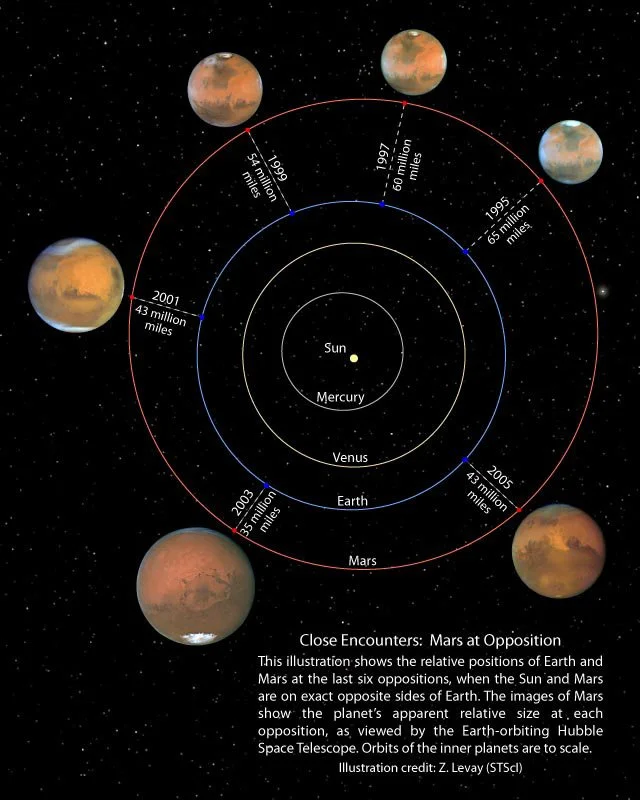
Mars at six oppositions, 1995–2005 (STScI illustration; Hubble images): every pass brings a different closest approach, so Mars's apparent size — and the middle of its retrograde loop — changes from opposition to opposition. At each one, Earth stands directly between the sun and Mars.
Illustration by Z. Levay (STScI), with Hubble Space Telescope images of Mars.
★ The pass happens when Earth comes directly between the sun and Mars. Astronomers call this alignment opposition: Mars is opposite the sun in our sky. Three things are true at opposition, and they are all the same geometry. Mars is closest to Earth, so it looks biggest and brightest. Mars rises at sunset and is up all night, so it is easiest to observe. And Earth is in the middle of overtaking Mars, so the retrograde loop is centered on opposition. When you see Mars at its brightest and boldest, you are watching the middle of the pass.
Draw Mars's path among the stars during those weeks and you get the famous retrograde loop, sometimes an open zigzag, sometimes a full loop, the signature shape that baffled the ancients. Every outer planet does this: Jupiter, Saturn, all of them, each centered on its own opposition, each loop the signature of Earth lapping it.
Check in: Why is Mars brightest at the middle of its retrograde loop — and why is the loop centered there?
❦ In your workbook: record opposition in your own way — closest, brightest, up all night, and the loop centered on the pass — copy, sketch, or note what matters.
The inner planets do it differently
Mercury and Venus orbit closer to the sun than Earth does, on the inside tracks, so they are the fast ones and we are the slow car. They lap us. Their retrograde motion happens when they pass between Earth and the sun, the alignment called inferior conjunction, and for that reason it always happens while they stand near the sun in our sky. Venus goes retrograde about every 19 months, for roughly six weeks, always in the sun's neighborhood, which is why Venus is seen as morning or evening star around those times. Mercury does it three or four times a year, for about three weeks each time, usually lost in the sun's glare. The geometry is the mirror image of the outer planets' loops, and it is the same lesson: nobody is going backward. Someone is being passed.
Check in: Mercury and Venus are never overtaken by Earth. How do they manage a retrograde of their own, and where in the sky does it happen?
❦ In your workbook: record the inner planets in your own way — they lap us, their retrograde sits at inferior conjunction, near the sun — copy, sketch, or note what matters.
How Ptolemy built the same picture with Earth standing still
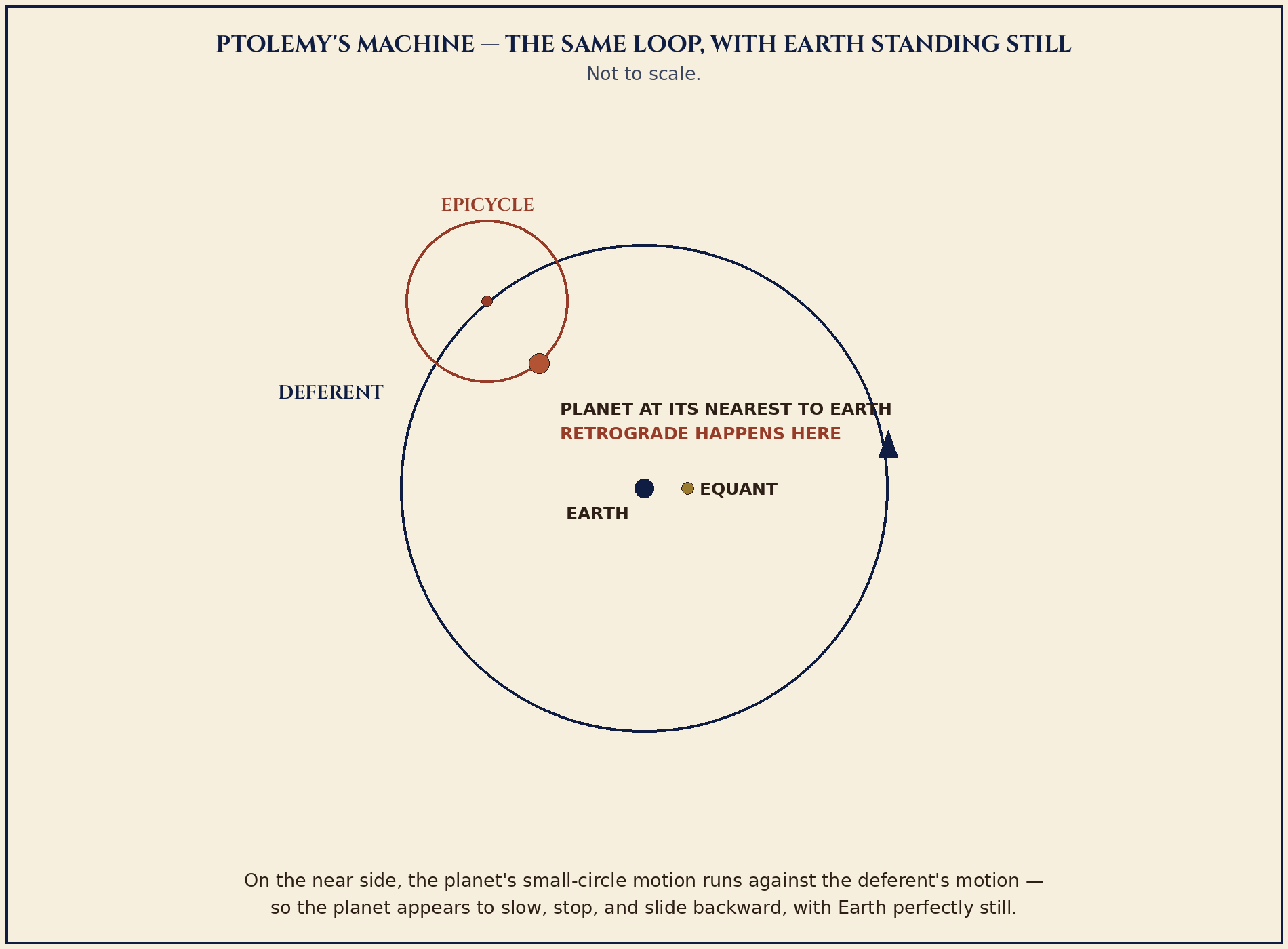
Ptolemy's machine: a planet rides a small epicycle whose center rides the great deferent around a motionless Earth, the equant offset beside Earth. On the epicycle's near side the small-circle motion runs against the deferent's, and the planet appears to slow, stop, and slide backward — a retrograde loop built from circles.
Built digitally for this overhaul (Python/PIL, Cinzel/DejaVu typeset labels), from the machinery described in the lesson text.
Now put yourself in Ptolemy's sandals. You believe Earth does not move, and you must explain the loops. You cannot use the pass, because in your universe there is no pass. So you build machinery.
Give each planet a great circle around Earth, the deferent. Give the planet a small circle, the epicycle, whose center rides along the deferent. Let the planet ride the epicycle. Now arrange the speeds: when the planet is on the far side of its epicycle, its small-circle motion adds to the deferent's motion and the planet sweeps forward briskly. When the planet swings around to the near side of its epicycle, closest to Earth, its small-circle motion runs against the deferent's motion. If you size the epicycle just right, the planet appears to slow, stop, move backward, stop, and move forward again: a retrograde loop, built from circles, with Earth standing perfectly still.
Add the equant, Ptolemy's cleverest adjustment: an offset point from which the planet's angular motion looks uniform, which made the predictions fit the recorded observations more closely. Tune every planet's circles to its own observed loops. The result is a universe of wheels within wheels, and it is a genuine intellectual achievement. Feed it a date, and it tells you where Mars will be. That is why it survived fourteen hundred years. Ptolemy did not guess. He measured, he calculated, and he fit the appearances with the best geometry his century allowed. He was wrong about the center. He was magnificent about the math.
Check in: With Earth standing still, where on the epicycle does the retrograde happen, and why there?
❦ In your workbook: record Ptolemy's still-Earth picture in your own way — the near side of the epicycle running against the deferent — copy, sketch, or note what matters.
In your packet: Exercise II: Ptolemy's Circles, Drawn with Respect ⚒ begins here. Work it now, or mark the place and take it as homework — your choice.
Why the moving Earth wins
Now let Earth move, and watch what happens to all that machinery. The deferent, the epicycle, the equant: none of them are needed to produce the loops. The loops were never motions at all. They were the view from a moving platform, and a single moving Earth produces every planet's loop at once, each centered on its opposition, each lasting exactly as long as the overtaking geometry requires. Copernicus's model did not predict better than Ptolemy's at first. It explained with one assumption what Ptolemy explained with dozens. That is the difference between a model that fits and a model that understands.
★ And there is the deepest lesson of the model wars, the one I want you to carry out of the tower with you. Ptolemy's system and Copernicus's system both predicted the planets' positions. Prediction alone could not choose between them. What chose was simplicity, and then the telescope, and then the ellipses: evidence and elegance together, the two great judges of every scientific idea. A model can be useful without being true. The universe keeps the true picture, and it lets us earn it one observation at a time.
Check in: Both systems predicted the planets' positions, so prediction alone could not choose between them. What did choose?
❦ In your workbook: record why the moving Earth wins in your own way — one assumption in place of dozens, then the telescope, then the ellipses — copy, sketch, or note what matters.
A Sealed Note on Being Wrong Well
My dearest scholars,
I have a confession that may surprise you: I love Ptolemy. I love him the way I love an old, intricate clock that keeps the wrong time beautifully. He looked at the same sky you look at, with worse instruments and no concept that he was moving, and he built a machine of circles that told sailors and scholars where the planets would be for fourteen centuries. When you draw his epicycles tonight, do not draw them with scorn. Draw them with the respect due to a mind that refused to let a mystery stay mysterious.
Being wrong the way Ptolemy was wrong is not a failure. It is most of the history of science. Everyone is wrong about something the way he was wrong: working hard, reasoning honestly, and missing the one assumption nobody thought to question. The scholars who come after you will say the same about some of our own certainties. The goal was never to be the one who is never wrong. The goal is to be the one who builds so carefully that when the better idea arrives, your measurements are still good enough to prove it.
❦ In your workbook: record the sealed note in your own way — being wrong well, and building so carefully that your measurements outlast your model — copy, sketch, or note what matters.
PROFESSOR VESPER GLIMMERWICK
Celestial Studies
Astronomer & Celestial Historian
Guided Observation
Try It Tonight
Part One: The Highway Overtake
You need a friend, two paper plates, two coins, a lamp or flashlight, and a piece of string. This is the whole lesson in your hands.
- Put the lamp in the middle of a table: the sun. Lay the two paper plates around it, one inside the other: Earth's orbit (inner) and Mars's orbit (outer). Put one coin on each plate.
- Your friend is Mars. You are Earth. Both of you move your coins counterclockwise around the plates, always forward, never stopping. You move yours faster: two steps for every one of your friend's.
- Stretch the string from your coin to your friend's coin. The string is your line of sight. Have a third person, or a fixed mark on the far wall, stand in for the distant stars. Watch where the string points on the wall as you move.
- Keep going until you lap your friend's coin. Watch the string's aim on the wall: as you approach from behind, the aim slows; as you draw alongside, it stops; as you pull ahead, it sweeps backward. Your friend's coin never reversed. The wall says it did.
- Mark the wall positions with small stickers at each stage: prograde, stationary, retrograde, stationary, prograde. You have just drawn a retrograde loop.
Level Two: Time your laps. If your Earth coin completes a lap in 20 seconds and your Mars coin in 38, how many Earth laps pass before Earth laps Mars? (This is the idea behind the synodic period, which you will meet properly in the lexicon.)
❦ In your workbook: record the overtake in your own way — the string's aim slowing, stopping, and sweeping backward while both coins moved forward — copy, sketch, or note what matters.
In your packet: Exercise I: The Overtake, Acted and Drawn ⚒ begins here. Work it now, or mark the place and take it as homework — your choice.
Part Two: Build Ptolemy's Machine
On paper, draw Earth as a dot in the center. Draw a large circle around it: the deferent. Pick a point on the deferent and draw a small circle around it: the epicycle. Put the planet on the epicycle.
- Draw the planet at four positions on its epicycle: far side, near side, and the two quarters between. For each, draw a short arrow showing which way the planet moves along the epicycle, and a long arrow showing which way the epicycle's center moves along the deferent.
- Mark the position where the two arrows point in opposite directions and the planet is nearest Earth. Label it: retrograde happens here.
- Now write one paragraph, in your workbook, beginning with the words "Ptolemy deserves respect because..." and give the real reasons: the predictions worked, the math was honest, the observations were real.
❦ In your workbook: record the machine in your own way — the four positions, the opposing arrows, and where retrograde happens — copy, sketch, or note what matters.
In your packet: Exercise II: Ptolemy's Circles, Drawn with Respect ⚒ begins here. Work it now, or mark the place and take it as homework — your choice.
Part Three: Meet the Sky
Find a bright planet in tonight's sky (Jupiter and Saturn are splendid targets when they are up; Mars when it is near opposition). Note its position relative to two nearby stars, and write the date in your Sky Log. You are beginning a watch that the Babylonian scribes would recognize. If the planet is near opposition, you may catch it mid-loop. If not, you are recording the prograde drift that makes the loop meaningful.
❦ In your workbook: record tonight's planet in your own way — its place against two landmark stars, with the date — copy, sketch, or note what matters.
Sky Log Entry
Log 13: The Wanderer's Path. On a clear night, locate one bright planet and sketch its position relative to the surrounding stars. Record the date, the time, and the two or three stars you used as landmarks. Return to the same planet once a week for at least six weeks, and plot each new position on the same sketch. Look for the slowing, the standstill, and, if your timing is fortunate, the backward slide. Label each observation with its date. A page of dated dots is exactly how the ancient observers caught the loops, and it is how you will catch one too. Note in the margin whether the planet is east or west of the sun in the sky, and whether it seems to be approaching or leaving opposition.
❦ In your workbook: record the Sky Log entry in your own way — the first dated dot, its landmark stars, and whether the planet seems to be approaching or leaving opposition — copy, sketch, or note what matters.
In your packet: Exercise III: The Long Watch ◐ begins here. Work it now, or mark the place and take it as homework — your choice.
Materials
Required (Level One — household items)
- Two paper plates and two coins for the Highway Overtake orbit model (Exercise I).
- A lamp or flashlight for the sun in the model.
- A piece of string or yarn for the line of sight from Earth to Mars.
- Small stickers or sticky notes for marking the planet's apparent positions on the wall.
- Paper, a pencil, and a ruler for drawing Ptolemy's deferent and epicycle (Exercise II).
- Your workbook and Sky Log for the diagrams, the respect paragraph, and the six-week planet watch (Exercise III).
- A flashlight for night observing.
Suggested (Level Two — historically closer)
- A compass for drawing clean circles and a protractor for measuring the epicycle angles in the Ptolemy drawing.
- A planetarium app or a printed star chart for identifying which bright planet is near opposition during the long watch.
- Binoculars for a closer look at Jupiter and its four bright moons, the same moons Galileo sketched in 1610.
Reflection Questions
Answer in your workbook, in complete sentences.
- Retrograde motion fooled observers for centuries because it looks like a planet changing its mind. What does this lesson suggest about the difference between what the sky shows and what the sky is doing?
- Ptolemy's model predicted planetary positions well for about fourteen hundred years while being wrong about the center of the universe. What does that tell you about the relationship between prediction and truth?
- Copernicus's model was simpler but no more accurate, at first, than Ptolemy's. Why did simplicity matter, and what finally made the sun-centered picture win?
- Galileo saw moons orbiting Jupiter and a full set of phases on Venus. Explain, in your own words, why each observation was a problem for the Earth-centered picture.
- The lesson says the universe did not care which model flattered us. What do you think that means, and can you think of another time in science when the flattering answer turned out to be wrong?
Workbook Checklist — Lesson 13
In my workbook I have:
- ☐ acted out the Highway Overtake and marked the wall positions through all five stages: prograde, stationary, retrograde, stationary, prograde
- ☐ sketched the overtake from above, with the sightline extended to the background stars, and drawn Mars's five-stage apparent path with each stage labeled
- ☐ drawn Ptolemy's machine — deferent, epicycle, retrograde zone marked — and written the paragraph beginning "Ptolemy deserves respect because..."
- ☐ begun the Long Watch: my first dated planet positions plotted against the same landmark stars, with my written prediction of prograde motion and approach to (or retreat from) opposition
- ☐ kept my Sky Log entry for Log 13, The Wanderer's Path, dated, with its landmark stars named
☐ Lesson completed Date: ___ Signature: ___
The Professor's Closing Note
Dearest night-watchers,
When I fly home at dawn, the stars thin out and the planets go with them, and I am always a little sorry to see them go. But I carry tonight's lesson with me into the daylight: nothing up there is ever going backward. The sky only ever looks backward when the watcher is rushing forward, and there is something deeply comforting in that. We are the ones in motion. We always were.
You now know something that took humanity two thousand years to learn, and you know it the right way: not as a story about who was foolish, but as a piece of geometry you can draw, act out, and explain. Ptolemy built his circles. Copernicus moved the Earth. Galileo looked through glass. Kepler drew the ellipses. And you, tonight, stretched a string across a table and saw the whole war resolved in a line of sight.
Keep watching the wanderers. They are still wandering, and now you know why.
PROFESSOR VESPER GLIMMERWICK
Celestial Studies
Astronomer & Celestial Historian
Cross-Class Connections

Runes · Unit III, Lesson 7 — The Invention of Vowels
Tower scholars, tonight's wanderers carry Greek names, and the book that ruled them for fourteen hundred years was written in Greek. Come down to the Runes Classroom and meet the alphabet that book was written in: how the Greeks took the Phoenician letters and invented vowels, letter by letter, until the signs could spell anything — including planētēs, the wanderer, and the Almagest itself. Professor Glimmerwick reads what the letters foretold. Here, we read the letters.
PROFESSOR THISTLELOOM WEBBLETHORN
Runes & Ancient Writing
Further Reading & Sources
These are real destinations for further study, verified live at the time of writing. Start with NASA: the retrograde loop photographs are the single best thing you can show anyone.
- NASA Astronomy Picture of the Day: Mars in the Loop (composite photographs tracing Mars's 2011-2012 retrograde loop, with the overtaking explanation). https://science.nasa.gov/image-article/apod-2012-august-9-mars-in-the-loop/
- NASA Astronomy Picture of the Day: Retrograde Mars and Saturn (the 2016 loops of both planets near opposition, photographed against the stars). https://science.nasa.gov/image-article/apod-2016-september-15-retrograde-mars-and-saturn/
- National Radio Astronomy Observatory: Mars Retrograde Motion (a plain-language answer to a skywatcher's question, with recent retrograde dates). https://public.nrao.edu/ask/mars-retrograde-motion/
- The Galileo Project, Rice University: Galileo's Venus observations (the fall-1610 phase observations, the anagram announcement, and the Ptolemaic vs. Copernican predictions). https://galileo.library.rice.edu/lib/student_work/astronomy96/tdunn/venus.html
- Ptolemy: the life, the Almagest, and the geocentric system (dates are approximate; his birth and death years are inferred, not recorded). https://en.wikipedia.org/wiki/Ptolemy
- Oxford, Philosophy of Cosmology: Ptolemy (the equant, the epicycles, and the note that his system converts to Copernicus's by a change of coordinates). http://philosophy-of-cosmology.ox.ac.uk/ptolemy.html
Browse the Celestial Studies shelf in the school Library for readable editions of these works.
Submit your work for this lesson using the form below.
CONTINUE IN THE CELESTIAL TOWER
← Previous · Lesson 12: The Naked-Eye Planets Next · Lesson 14: Venus, the Morning Star →
Unit III — The Wanderers Celestial Tower — All 33 Lessons
The rest of Unit III: Lesson 12 · The Naked-Eye Planets · Lesson 14 · Venus · Lesson 15 · Mars · Lesson 16 · The Giant Worlds · Lesson 17 · Pluto