
CELESTIAL STUDIES
Unit III · Lesson 16The Giant Worlds
Professor Vesper Glimmerwick
Astronomer & Celestial Historian
The Celestial Tower • School of Evershade
Professor's Introduction

The charts are unrolled, scholars,
There is a moment on every clear autumn evening when I leave the Celestial Tower for my flight, and it comes while the sun's light is still fading in the west. I lift off from the observatory dome, and there, low in the east, hangs the first bright light of the night. Not a star. A planet. Most nights it is Jupiter, steady and gold-white, brighter than anything around it except the moon.
I have flown under that light for many years, and I never stop wondering at what it really is: a world eleven times wider than our own, wrapped in storms that could swallow Earth whole, attended by moons that changed the whole human idea of the universe. And tonight I get to tell you about all four of the giant worlds, which is a little like introducing you to the oldest, wildest siblings of the solar family.
This lesson has a twist that I love. Jupiter and Saturn have been watched since before history was written. But Uranus was seen again and again by careful astronomers who never realized what they were looking at, and Neptune was found because two people did mathematics so careful that the planet had nowhere to hide. Two different kinds of discovery, and both of them true, and both of them worth knowing exactly right.
So read carefully, my dears, and notice the details. The sky rewards the careful observer. Tonight, that observer is you.
PROFESSOR VESPER GLIMMERWICK
Celestial Studies
Astronomer & Celestial Historian
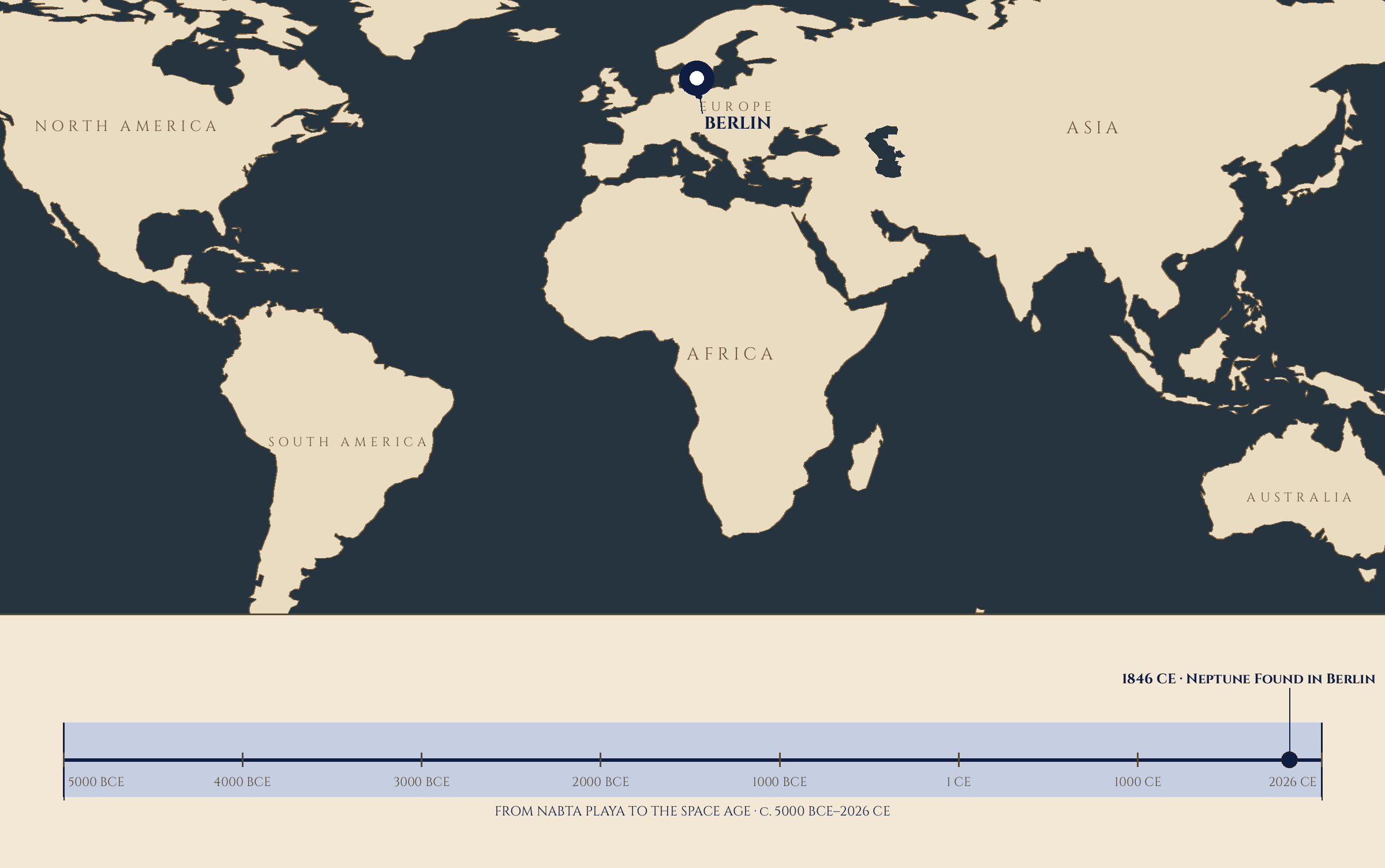
Where and when: BERLIN, 1846 CE · Neptune Found in Berlin (year 1846) — The Giant Worlds. The pin is this lesson. The line beneath the map is our road: every stop a moment when watching the sky changed, every lesson a pin upon it.
Lesson Objectives
By the end of this lesson, you will be able to:
- Name the four giant planets in order from the sun and explain the difference between a gas giant and an ice giant.
- Name Jupiter's four Galilean moons and explain, in their own words, why their discovery mattered to the argument over whether everything orbited Earth.
- Describe the Great Red Spot: what it is, how large it is compared to Earth, and what is happening to its size today.
- Describe Saturn's rings: what they are made of, how thin they are, and why they appear to vanish from time to time.
- Tell the discovery stories of Uranus and Neptune correctly: Uranus was observed as a star by several astronomers before Herschel recognized it as a planet in 1781; Neptune was predicted mathematically by Adams and Le Verrier before Galle observed it in 1846.
- Explain what opposition is and why it is the best time to observe the giant planets.
- Complete the practical work: sketch Jupiter's four bright moons over several nights (Level Two) or track Saturn's position against the background stars (Level One), and record both in the Sky Log.
Reading this lesson: ★ marks the passages to remember. They return on the unit quiz and the class test. Check in questions ask the material back as you go; answer them in your workbook when you meet them.
Working this lesson: Your assignment packet is the first download on this page. Work in it as the lesson moves along, answering each exercise as its subject is taught — or read the lesson through for your notes and take the exercises as homework afterward. Both are proper ways to sit this class. Signposts in the reading tell you where each exercise belongs. Written answers are short answers in your own words; a few honest lines are worth more than a filled page.
Your Assignment Packet
This lesson's exercises live in its packet: the Lexicon Handout (every term, course terms marked ◆), Materials, Guided Practice, the Assignment Manual with its answer key for self-checking, the Reflection Questions, and the Workbook Checklist. Download the packet before you begin and keep it beside you as you read. The packet's exercises are Glimmerwick's own word for the work: Exercise I: The Giant Planet Watch ◐, Exercise II: The Two Discoveries ✎, and Exercise III: The Storm and the Rings ✎. The lesson's quiz is not printed in the packet; it pools to the Unit III Quiz, where it will meet you again.
Safety Briefing
Night observing in this course is always done with an adult present, in a familiar and safe location. Tell someone where you are going and when you expect to return. Dress warmly, bring a flashlight for the walk, and watch your footing in the dark.
Telescope and binocular safety. The Level Two practical for this lesson uses binoculars or a small telescope after dark, which is the safest possible way to use them: the sun is nowhere near the sky. The rule that never changes: never point binoculars or a telescope at or near the sun, not even briefly, and never leave an uncovered telescope where the sun could shine through it. You are working at night, so simply keep to that habit and you will be safe.
Steady observing. A tripod or a steady elbow on a fence rail makes binocular observing far easier and much less tiring. If you use a telescope, let an adult help with setup and alignment until you have done it several times.
The Wonder
Go outside on a clear night this week and look up with your naked eyes. The brightest "star" in the sky that is not really a star is probably Jupiter. It does not twinkle the way stars do. It burns steadily, gold-white, outshining every true star except Sirius on the best nights. Further along the sky's road, gold-tinted Saturn follows.
Now let the wonder in. That steady point of light is a world. Jupiter is eleven times wider than Earth and more than three hundred times as massive. A single day there lasts about ten hours, because the whole enormous planet spins that fast. And on its face, visible even in a modest telescope, rages a storm wider than our entire planet: a storm that has been spinning for longer than anyone reading this has been alive, and that is now shrinking before our eyes.
Saturn is stranger still. That gold point of light wears a ring system wide enough to hold more than twenty Earths side by side, a ring system made almost entirely of ice, and that whole immense structure is, in places, only about ten meters thick. Ten meters. Stand at one end of a football field and look down its length: the rings are thinner, proportionally, than anything you have ever held in your hands.
And then the two giants you cannot see at all without help. Uranus, rolling around the sun on its side like a kicked ball. Neptune, the windiest world in the solar system, with winds that could outrun any aircraft ever built. Jupiter and Saturn have been humanity's companions since the first people looked up. Uranus and Neptune arrived only when telescopes and mathematics let us see further than eyes alone could reach. This lesson is the story of all four, and of how we found them.
Check in: Two of the four giants cannot be seen at all without help. Which two — and what is each one famous for?
❦ In your workbook: record the wonder in your own way — Jupiter steady and gold-white, Saturn's rings wider than twenty Earths yet ten meters thin, and the two giants no eye can reach alone — copy, sketch, or note what matters.
The Story
The moons that broke the sky: Jupiter, 1610
In January of 1610, the Italian astronomer Galileo Galilei turned a telescope he had built himself, magnifying about twenty times, toward Jupiter. On the night of January 7 he noticed three small points of light near the planet, arranged in a straight line. He thought they were distant stars. The next night they had moved. Night after night, through January, he watched them change places: sometimes all on one side of Jupiter, sometimes strung out on both, sometimes vanishing as they passed in front of or behind the planet. On January 13 he found a fourth.
★ By January 15, Galileo had reached the only conclusion that fit what he saw: these were not stars at all. They were moons, orbiting Jupiter. In March 1610 he published his observations in a short book, Sidereus Nuncius, the Starry Messenger, one of the most important scientific books ever printed.
Now, why did four little dots of light matter so much? Because the reigning model of the universe, the one taught in every university, insisted that every object in the heavens circled the Earth. The sun, the moon, the planets, the stars: all of them moved around us. Copernicus had proposed, nearly seventy years earlier, that the Earth moved around the sun, but his was a mathematical argument on paper, and it had won few converts.
Here, through a tube of glass, was something no argument could dodge. Four bodies were plainly, visibly orbiting Jupiter. Not the Earth. Jupiter. The universe had more than one center of motion. And the discovery quietly answered one of the oldest objections to a moving Earth. Critics had said: if the Earth travels through space, surely it would leave the moon behind. But here was Jupiter, clearly traveling through space, carrying its family of moons along with it, exactly as a moving Earth would carry its own.
Check in: Four little dots of light mattered enormously in 1610. What were they doing that nothing was supposed to do — and which old objection to a moving Earth did they quietly answer?
Galileo, who had naming rights as discoverer, flattered his patrons and called them the Medicean Stars, after the Medici family of Florence. In his own notes he numbered them I, II, III, and IV in order of distance from Jupiter. The German astronomer Johannes Kepler suggested naming them after figures from mythology connected to Jupiter: Io, Europa, Ganymede, and Callisto. Kepler's names took more than two hundred years to catch on, but they are the names we use today, and we still call the four the Galilean moons in honor of the man who first watched them move.
❦ In your workbook: record the moons that broke the sky in your own way — January 1610, night after night of changing places, and the conclusion Galileo reached by January 15 — copy, sketch, or note what matters.
The planet with ears: Saturn, 1610 to 1675
In the same miraculous year of 1610, Galileo turned his telescope to Saturn and saw something he could not understand. The planet appeared to have bumps on either side, like handles or ears. He wrote that Saturn looked like three bodies stuck together: a large one in the middle and a smaller one on each side. Two years later the "ears" seemed to vanish entirely, which baffled him further.
What Galileo was seeing, without knowing it, was Saturn's ring system seen nearly edge-on. His telescope was not good enough to resolve the rings as rings, and he was watching at a time when the rings happened to be tilted nearly edge-on to Earth, the same geometry that makes them "disappear" every dozen or so years (you will meet that trick again in this lesson).
The mystery waited forty-five years for its solution. The Dutch astronomer Christiaan Huygens, working with a better telescope, realized in 1655 that Saturn was surrounded by a thin, flat ring that never touched the planet. He published the explanation in 1659. (The same year, 1655, Huygens discovered Saturn's largest moon, Titan, which is bigger than the planet Mercury.) In 1675, the Italian-French astronomer Giovanni Domenico Cassini, the same Cassini who had watched a spot on Jupiter a decade earlier, spotted a dark gap dividing Saturn's rings. We still call it the Cassini Division.
So the story of Saturn's rings is a story in three acts: Galileo saw something strange and could not explain it; Huygens explained it with better glass; Cassini found structure inside the explanation. That is how astronomy usually works. It is rarely one genius and one moment. It is better instruments, and patience, and someone willing to look again.
Check in: Galileo saw Saturn with 'ears' that later vanished. What was he actually seeing, and why did the ears disappear in 1612?
❦ In your workbook: record the planet with ears in your own way — Galileo's three stuck-together bodies, Huygens' ring, and Cassini's gap: three acts, better glass each time — copy, sketch, or note what matters.
The planet that was seen but not recognized: Uranus, 1690 to 1781
Here is the first of the two discovery stories you must get exactly right, because it is easy to tell wrong.
Uranus is just barely visible to the naked eye on a very dark night. It moves so slowly, taking 84 years to circle the sun, that it looks like nothing so much as a dim, uninteresting star. And so, for nearly a century, that is exactly what everyone thought it was.
In 1690, the English astronomer John Flamsteed, the first Astronomer Royal, observed the object at least six times and catalogued it as a star: 34 Tauri, a star in the constellation Taurus. Between 1750 and 1769, the French astronomer Pierre Charles Le Monnier observed it at least twelve times, including on four consecutive nights, and also recorded it as a star. It may even have been recorded as long ago as 128 BC by the Greek astronomer Hipparchus. Everyone saw it. Nobody recognized it.
Then came William Herschel. Herschel was a German-born musician living in Bath, England, who had taught himself astronomy and ground his own telescope mirrors because he could not buy instruments good enough. On the night of March 13, 1781, while surveying the sky for double stars, he found an object that looked like a small disk rather than a point of light. He recorded it as either "a nebulous star or perhaps a comet," and when he presented it to the Royal Society he continued to call it a comet, noting that it moved and had no tail. It was the Astronomer Royal, Nevil Maskelyne, who wrote back that it might just as well be a planet moving in a nearly circular orbit, and the Finnish-Swedish astronomer Anders Lexell who computed that its orbit was indeed nearly circular: planetary, not cometary.
The final proof came from the past. The German astronomer Johann Elert Bode searched old star catalogues and found the object sitting there in Flamsteed's and Le Monnier's records, listed as a star. Its slow motion across those old positions confirmed it: a new planet, the first ever discovered, twice as far from the sun as Saturn.
As discoverer, Herschel got to name it, and he chose Georgium Sidus, George's Star, after King George III. Astronomers outside Britain disliked naming a planet for a living king, and Bode's suggestion won out: Uranus, from the Greek god of the sky, father of Saturn in mythology. It remains the only planet whose English name comes from Greek rather than Roman mythology. Herschel's discovery made him famous overnight; the king gave him a pension, and Herschel went on to discover Uranus's two largest moons, Titania and Oberon, in 1787.
★ Hold the lesson of Uranus carefully. It was not found by mathematics. It was found by a telescope, after being seen as a star many times over nearly a century. Herschel's achievement was not seeing it first. It was recognizing what he was seeing.
Check in: Flamsteed and Le Monnier both saw Uranus before Herschel did. So what was Herschel's achievement — and what did he first think he had found?
❦ In your workbook: record the unrecognized planet in your own way — 34 Tauri in the old catalogues, a 'comet' in Bath in 1781, and the old records that proved it a planet — copy, sketch, or note what matters.
In your packet: Exercise II: The Two Discoveries ✎ begins here — its first paragraph is this story. Work it now, or mark the place and take it as homework — your choice.
The planet found by mathematics: Neptune, 1845 to 1846
Now the second story, and the contrast is the whole point.
After Uranus was discovered, astronomers tracked its orbit carefully. And something was wrong. Uranus did not quite go where Newton's laws of motion and gravity said it should go. Its position drifted from the predictions, as if something unseen were tugging at it.
There were two possible explanations. Perhaps Newton's laws were not quite right at such distances. Or perhaps an even more distant, unseen planet was pulling Uranus off course. Two young astronomers chose the second explanation and set out to find the planet by calculation alone: to work backward from the tugs on Uranus and compute where the tugger must be.
In Cambridge, England, John Couch Adams completed his calculations in 1845 and sent them to the Astronomer Royal, who did little with them. In Paris, Urbain Le Verrier worked the same problem independently, published his predicted position in 1846, and, getting no help from French observatories, wrote to Johann Gottfried Galle at the Berlin Observatory, urging him to look.
Galle received Le Verrier's letter on September 23, 1846. That very night, with his student Heinrich Louis d'Arrest, he pointed the observatory's telescope at the predicted spot. D'Arrest suggested comparing the view with a newly drawn star chart of that region: any "star" not on the chart would be the planet. Within an hour of searching, d'Arrest called out that one star was not on the map. Neptune had been found, less than one degree of sky from where Le Verrier had said it would be.
★ Neptune was the first planet found by prediction rather than by accident or by simple observation: mathematics pointed, and the telescope confirmed. (There is a wistful footnote. The English astronomer James Challis, searching on Adams's calculations, had actually observed Neptune twice in August 1846 without recognizing it, for lack of a good star chart. And Galileo himself, watching Jupiter's moons in December 1612 and January 1613, had recorded Neptune as a background star without knowing it. The unseen planet kept being seen.)
The discovery set off a nationalistic quarrel between France and Britain over who deserved the credit. The modern consensus gives Le Verrier the primary credit for the successful prediction and Galle the credit for the observation, with Adams recognized for his independent calculations. Neptune was named for the Roman god of the sea, fitting for a blue world found by following gravitational currents. Seventeen days later, the English astronomer William Lassell discovered its largest moon, Triton.
So now you have both stories straight, and you can see why the distinction matters. Uranus: seen many times, recognized once, by telescope. Neptune: never seen at all until mathematics said where to look. Two different triumphs. Do not mix them up, and do not let anyone tell you both were "found by math." Only one was.
Check in: Neptune was found in under an hour of searching. What made the search so short — and how close to the prediction was the planet?
❦ In your workbook: record the planet found by mathematics in your own way — the tugs on Uranus, two calculators working separately, and one night in Berlin — copy, sketch, or note what matters.
In your packet: Exercise II: The Two Discoveries ✎ finishes here — its second paragraph is this story, and its final sentence is the difference between the two. Work it now, or mark the place and take it as homework — your choice.
The space age: from Galileo's eyes to today's
For nearly three hundred years, everything humanity knew about the giant planets came through telescopes like Galileo's and Herschel's, only larger. Then, in the last fifty years, we went to see them ourselves.
The Pioneer spacecraft flew past Jupiter in 1973 and 1974. The two Voyager spacecraft visited Jupiter in 1979 and Saturn in 1980 and 1981, then Voyager 2 went on to Uranus in 1986 and Neptune in 1989, the only spacecraft ever to visit those two worlds. The Galileo orbiter circled Jupiter from 1995 to 2003. The Cassini spacecraft orbited Saturn for thirteen years, from 2004 to 2017, ending its mission by diving into Saturn's atmosphere. The Juno spacecraft has been orbiting Jupiter since 2016, peering deep beneath its clouds.
Every one of these missions rewrote the textbooks. What follows is what they taught us.
❦ In your workbook: record the space age in your own way — Pioneer, the Voyagers, Galileo, Cassini, Juno — and what it means that every mission rewrote the textbooks — copy, sketch, or note what matters.
The Mechanism
Gas giants and ice giants
The four giant planets fall into two families, and the names tell you the chemistry.
★ Jupiter and Saturn are gas giants. They are made almost entirely of hydrogen and helium, the two lightest elements, the same gases the sun is made of. They have no solid surface to stand on. If you could descend into Jupiter, you would pass through ever-thicker, ever-hotter gas until the pressure crushed the hydrogen into a strange liquid metal, and deeper still, a core of rock and ice perhaps ten times Earth's mass. The "surface" you see in pictures is only cloud tops.
★ Uranus and Neptune are ice giants. They are smaller, and beneath their hydrogen-helium atmospheres they hold deep layers of water, ammonia, and methane. Astronomers call these substances "ices," which is confusing, because down inside Uranus and Neptune they are not cold ice at all: they are hot, dense, electrically conducting fluids, squeezed by enormous pressure. The name is about chemistry, not temperature. The methane in their atmospheres absorbs red light and reflects blue-green, which is why both planets look blue, Neptune a deeper blue than Uranus.
Check in: Both families are giants, and both wear hydrogen and helium on the outside. What is the difference between a gas giant and an ice giant — and why does the word 'ice' not mean cold?
❦ In your workbook: record the two families in your own way — gas giants of hydrogen and helium with no surface to stand on, ice giants whose 'ices' are hot, dense fluids — copy, sketch, or note what matters.
Jupiter: the king and its storm
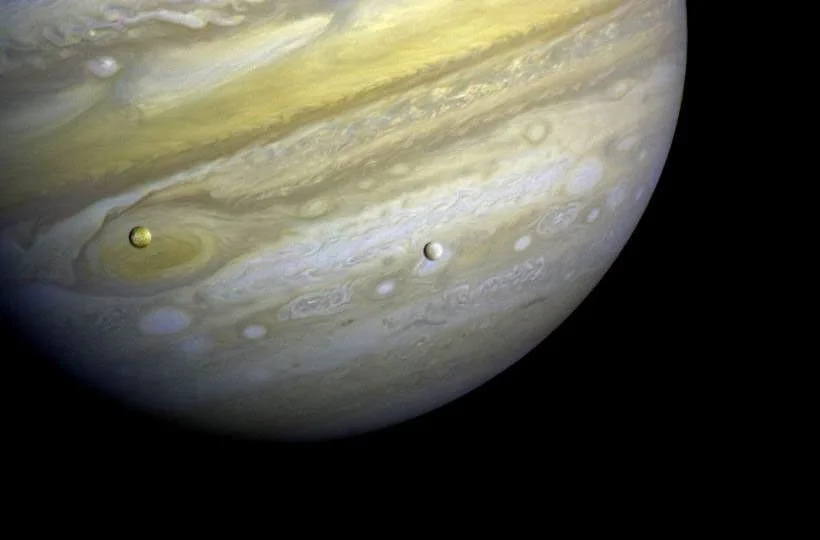
Jupiter from Voyager 1, February 13, 1979: Io (yellow, left) passing above the Great Red Spot, Europa (white, right of center) above the clouds — two of the four moons Galileo watched change places in 1610, photographed by a spacecraft 369 years later.
NASA/JPL, Voyager 1 (Photojournal PIA00144).
Jupiter is the giant among giants: about eleven times Earth's diameter, more than three hundred times Earth's mass, and so large that every other planet in the solar system could fit inside it with room to spare. It spins once in just under ten hours, the fastest day of any planet, which is why it bulges slightly at its equator. Its year lasts nearly twelve Earth years.
The bands you see in pictures of Jupiter are cloud belts: light zones and dark belts of ammonia clouds, flowing in opposite directions, driven by the planet's rapid spin and deep heat. And embedded in those bands, in the southern hemisphere, spins the Great Red Spot.
The Great Red Spot is an anticyclone: a vast, persistent high-pressure storm, spinning counterclockwise, like a hurricane that never makes landfall because there is no land. It is the largest known storm in the solar system. NASA's measurements give its current size as about 10,250 miles across, roughly 1.3 times Earth's diameter, with winds inside it reaching 500 miles per hour. The Juno spacecraft has shown that the storm's roots reach 300 to 500 kilometers below the cloud tops: it is a deep structure, not a surface blemish.
Check in: How large is the Great Red Spot today compared to Earth — and what has been happening to its size since the late 1800s?
★ And here is the honest, current truth about it, because this lesson does not deal in outdated facts. The Spot is shrinking. In the late 1800s it measured some 25,500 miles across, wide enough to hold two Earths. By the Voyager flybys of 1979 it was down to about 14,500 miles. Hubble's measurements show it is now the smallest ever recorded, losing roughly 580 miles of width per year along its long axis, and growing rounder as it shrinks. Astronomers do not know whether it will stabilize at some smaller size or fade away entirely within the lifetimes of students reading this lesson.
There is a second honest correction to make. You may read that the Great Red Spot has been observed for over 350 years, since Giovanni Cassini watched a "permanent spot" on Jupiter in 1665. A 2024 study of nearly 360 years of drawings and photographs concluded that Cassini's spot was probably a different, smaller storm that vanished sometime in the 1700s, and that the current Great Red Spot likely formed around 1831, making it about 190 years old rather than 350. The old spot and the new one sit at the same latitude, which is why they were long assumed to be the same storm. They probably are not. Science updates itself, and this lesson updates with it.
❦ In your workbook: record the king and its storm in your own way — eleven Earths wide, a ten-hour day, and a shrinking anticyclone whose roots reach hundreds of kilometers down — copy, sketch, or note what matters.
In your packet: Exercise III: The Storm and the Rings ✎ begins here — its first two questions are the Spot's. Work it now, or mark the place and take it as homework — your choice.
The four moons that matter most
Jupiter has dozens of known moons, but four of them changed history. Here they are, in order outward from the planet:
Io, the innermost, is the most volcanic world in the solar system. Its surface is constantly repaved by eruptions from hundreds of volcanoes. The heat comes from tidal heating: Jupiter's immense gravity squeezes and stretches Io as it orbits, kneading the moon's interior the way you might warm clay by working it in your hands. That flexing generates the heat that melts rock.
Europa, the next out, looks like a cracked eggshell of ice, and it may be the most interesting world in the outer solar system. Its surface is the smoothest of any known object, bright water ice over what spacecraft data strongly suggests is a deep, salty, liquid-water ocean beneath the crust, kept warm by the same tidal heating that torments Io. Where there is liquid water and an energy source, scientists ask the obvious question, carefully: could anything live there? No one knows. NASA's Europa Clipper mission is on its way to look closer.
Ganymede, the third, is the largest moon in the solar system, bigger than the planet Mercury, and the only moon known to generate its own magnetic field, which means it has a churning liquid-iron core like a planet's.
Callisto, the outermost, is the most heavily cratered world we know. Its ancient surface has sat nearly unchanged for billions of years, recording every impact, a museum of the solar system's violent youth.
Check in: Match each moon to its distinction: the most volcanic world; the smooth ice shell over a possible ocean; the largest moon in the solar system; the most heavily cratered world.
Remember what made them historic: they orbit Jupiter, not Earth. Every time you sketch them changing places from night to night, you are repeating the observation that broke the Earth-centered universe.
❦ In your workbook: record the four moons in your own way — Io, Europa, Ganymede, Callisto, in order outward, and the one thing that makes each unforgettable — copy, sketch, or note what matters.
Saturn: the rings and why they vanish
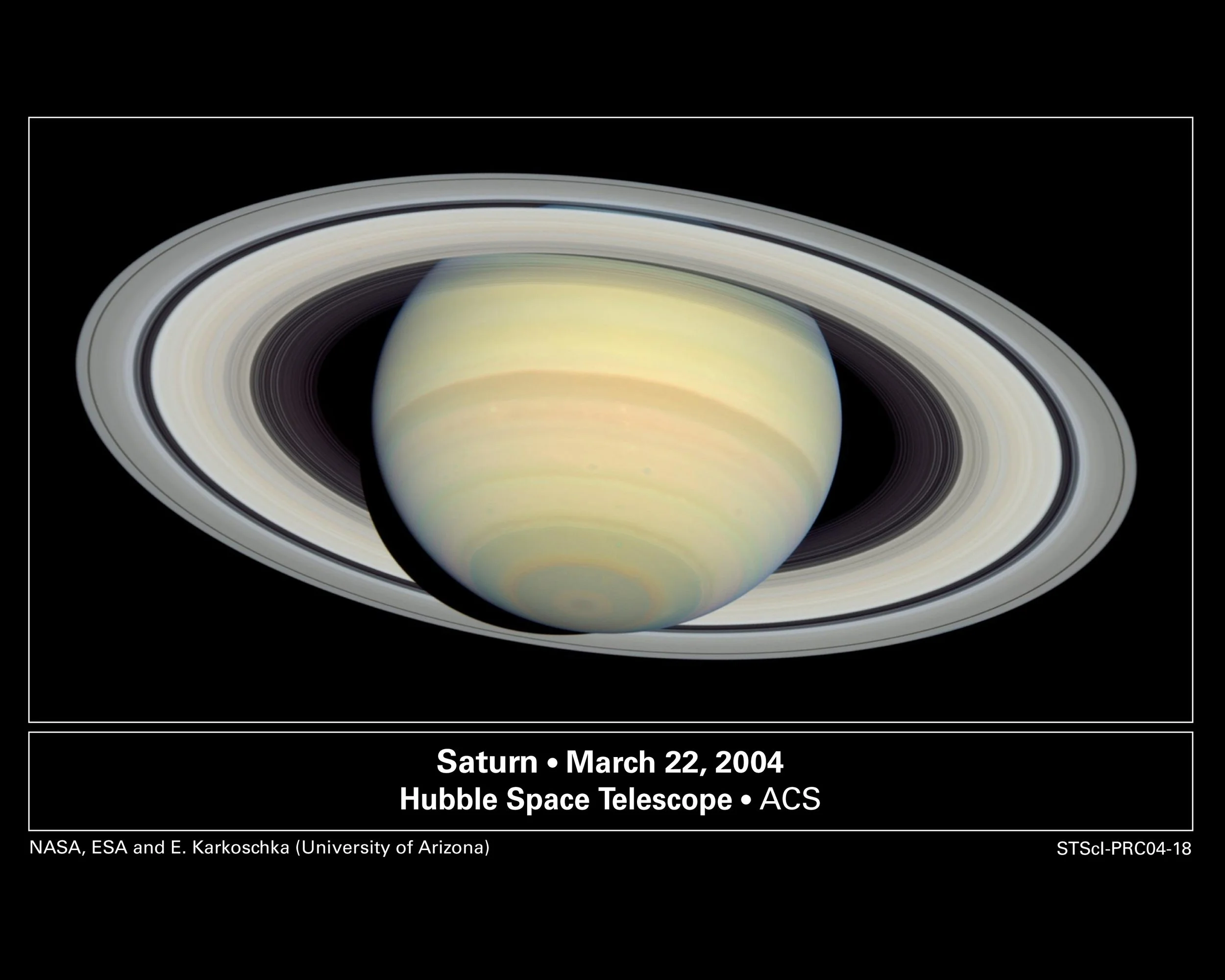
Saturn with its rings wide open, Hubble Space Telescope, March 22, 2004: countless water-ice particles in their own orbits, the dark Cassini Division dividing the bright B ring from the outer A ring. Compare this tilt with your Ring Watch sketch — in March 2025 this whole system stood edge-on to Earth and effectively disappeared.
NASA, ESA and E. Karkoschka (University of Arizona), Hubble Space Telescope / ACS.
Saturn is the showpiece of the solar system, and its fame is deserved. The planet itself is about nine times Earth's diameter and 95 times Earth's mass, yet its average density is lower than water's: in the old classroom saying, Saturn would float. (Do not try to find a bathtub large enough. Professor Glimmerwick has checked.)
★ The rings are the wonder. Here is what they are, exactly: countless particles of almost pure water ice, ranging in size from dust grains to boulders tens of meters across, each particle in its own orbit around Saturn, spread across a system some 280,000 kilometers wide. More than twenty Earths could be laid side by side across them. And their thickness, in places, is about ten meters. NASA's Cassini-era measurements put the main rings at under 100 meters thick nearly everywhere. The grandest structure in the solar system is, proportionally, thinner than a sheet of paper.
The rings have structure. The largest gap, the Cassini Division, separates the bright B ring from the outer A ring, and it is held open by a gravitational resonance with the moon Mimas: ring particles that would orbit there get tugged regularly by Mimas and cleared out. Small moons called shepherd moons, including Prometheus and Pandora around the narrow F ring, and Pan inside a gap in the A ring, gravitationally herd the ring edges and keep them sharp. Where the rings came from is still an open question: a shattered moon, a torn-apart comet, or something else. Cassini's measurements suggest the rings may be only a few hundred million years old, young by solar system standards, and found that ring material is slowly raining down into Saturn, so the rings we see may be a temporary feature on cosmic timescales. The honest answer to "who made Saturn's rings" is that nobody knows yet.
★ And now the trick that fooled Galileo. Saturn's axis is tilted about 27 degrees, like Earth's 23.5, so as Saturn travels its 29.5-year orbit, we see its rings sometimes wide open, sometimes nearly edge-on. Twice per Saturnian year, near Saturn's equinoxes, Earth passes through the plane of the rings. Seen exactly edge-on, a sheet of ice ten meters thick at a distance of over a billion kilometers effectively disappears, even in large telescopes. Astronomers call this a ring plane crossing. The most recent one was in March 2025. They happen roughly every 13 to 15 years, and while the rings are "gone," astronomers use the opportunity to discover faint moons and study the system from a rare angle. Between 1655 and 1980, thirteen of Saturn's moons were discovered, many during such crossings. The rings never go anywhere. It is pure geometry, and it is one of the finest perspective tricks in astronomy.
Check in: The rings are 280,000 kilometers wide and, in places, about ten meters thick. So why do they effectively disappear every 13 to 15 years — and what is that event called?
Saturn's moons deserve a line of their own. Titan, found by Huygens in 1655, is the second-largest moon in the solar system, bigger than Mercury, and the only moon with a thick atmosphere, rich in nitrogen like Earth's. Enceladus, a small bright moon, sprays geysers of salty water from cracks at its south pole, fountains spotted by the Cassini spacecraft, feeding the faint E ring and hinting at another subsurface ocean.
❦ In your workbook: record the rings in your own way — water-ice particles in their own orbits, the Cassini Division held open by Mimas, and a sheet of ice that vanishes edge-on — copy, sketch, or note what matters.
In your packet: Exercise III: The Storm and the Rings ✎ finishes here — its last three questions are the rings'. Work it now, or mark the place and take it as homework — your choice.
Uranus: the sideways world
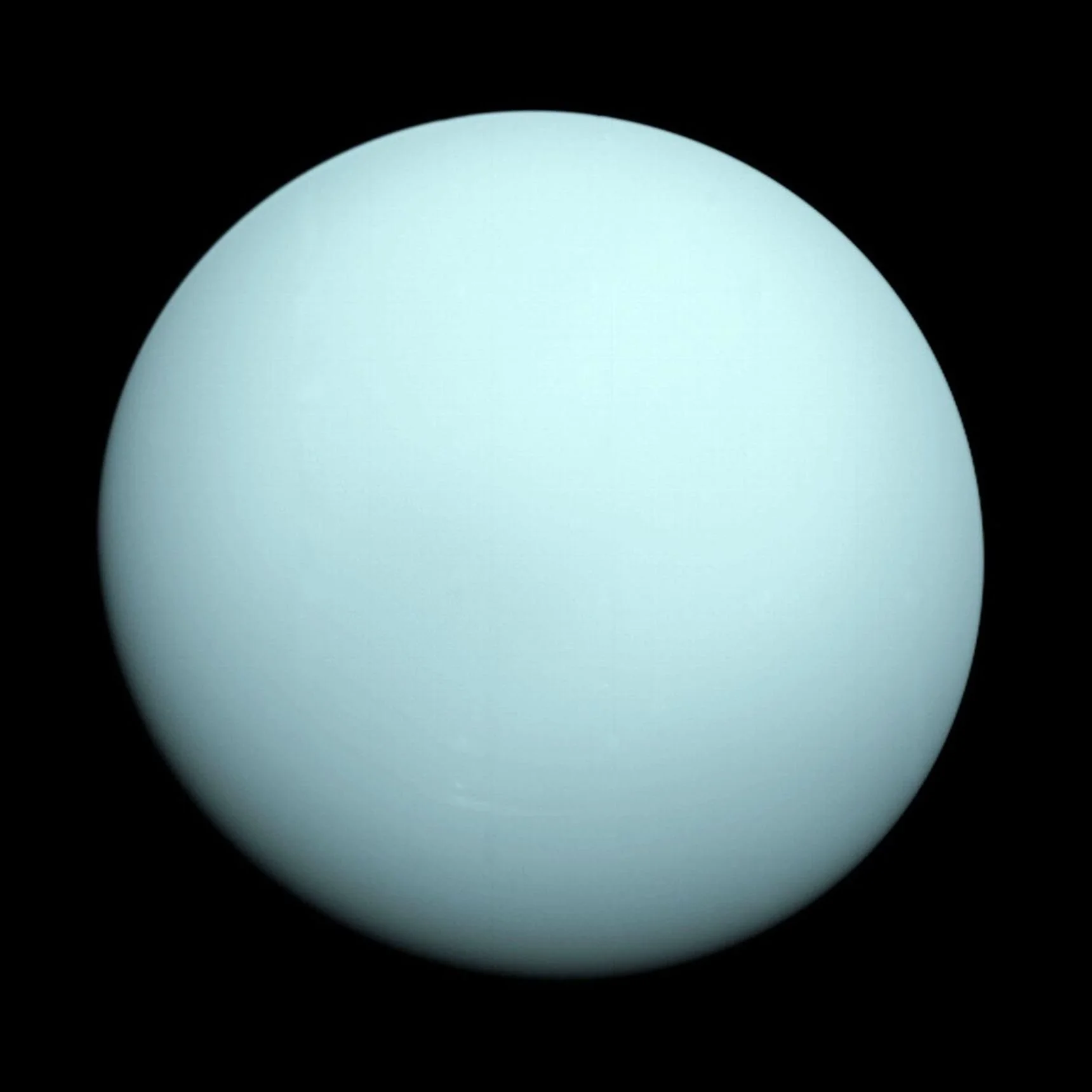
Uranus from Voyager 2, January 14, 1986 — the only spacecraft ever to visit it. A pale blue-green, nearly featureless disk: methane absorbs the red light and reflects the blue-green. The planet that was seen as a star for nearly a hundred years still looks like almost nothing at all.
NASA/JPL, Voyager 2 (Photojournal PIA18182).
Uranus is the oddest of the four, and it wears its oddness openly. It orbits the sun at a tilt of about 98 degrees: essentially knocked on its side, rolling around its orbit like a ball. Each pole gets 21 years of sunlight followed by 21 years of darkness. The leading explanation is that something enormous struck Uranus early in its history and tipped it over, but that is an inference, not a witnessed fact, and the lesson marks it as such.
It is the coldest world in the solar system by measured atmospheric temperature, dropping to about minus 224 degrees Celsius, colder than Neptune despite being closer to the sun. Its methane atmosphere gives it a pale blue-green color. It takes 84 Earth years to complete one orbit, which means that since its discovery in 1781, it has not yet completed three full trips around the sun.
Uranus has rings too, but nothing like Saturn's: thirteen known rings, narrow, dark, and nearly invisible, reflecting only about 5 percent of the sunlight that hits them. They were discovered in 1977 not by seeing them, but by watching a distant star blink: as Uranus passed in front of the star, the star winked out several times before and after the planet itself covered it. Those extra blinks were the rings, found by occultation. Its moons carry the most literary names in the solar system: unlike every other planet's moons, which are named from mythology, Uranus's moons are named for characters from Shakespeare and Alexander Pope, Titania and Oberon among them, a tradition begun when Herschel's successors named the first ones.
Check in: Uranus rolls around the sun on its side. What is its tilt — and how were its dark rings discovered in 1977, if nobody could see them?
❦ In your workbook: record the sideways world in your own way — a 98-degree tilt, 21 years of sunlight at each pole, and rings found by a blinking star — copy, sketch, or note what matters.
Neptune: the windy blue giant
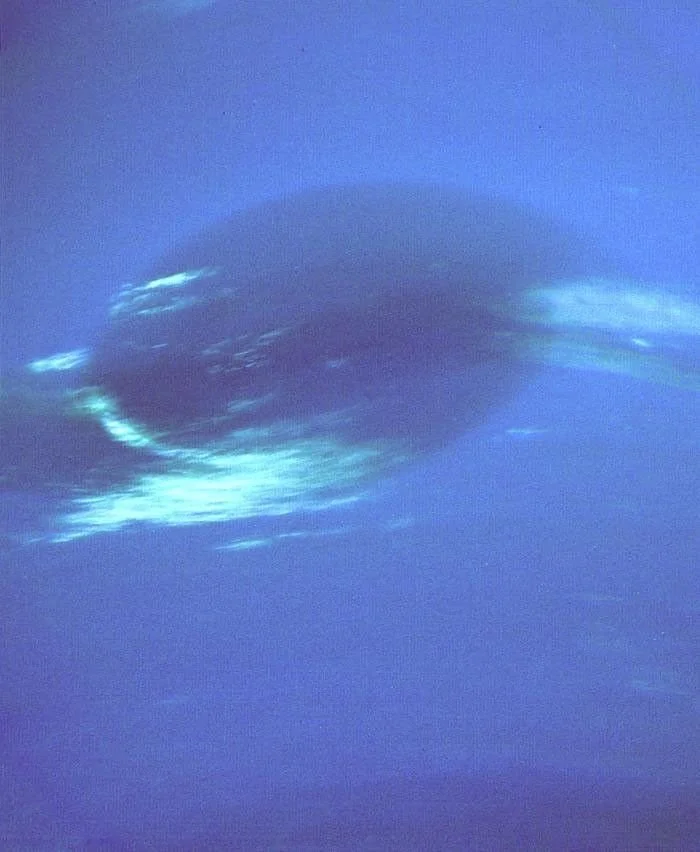
Neptune's Great Dark Spot in high resolution, Voyager 2, August 1989: an Earth-sized storm with feathery white clouds along its edge, on the windiest world in the solar system. When later telescopes looked, it was gone — Neptune's storms form, rage, and dissolve within years, mayflies beside Jupiter's centuries-long Spot.
NASA/JPL, Voyager 2 (Photojournal PIA00052).
Neptune is the outermost giant, thirty times farther from the sun than Earth, so dim that it is the only planet invisible to the naked eye. It is a deep, vivid blue, colored by methane like Uranus, but unlike bland Uranus it has ferocious weather. Neptune has the fastest winds in the solar system, measured at up to 2,000 kilometers per hour: supersonic, ten times faster than the strongest winds on Earth. What powers such winds on a world so far from the sun's warmth is still not fully understood; internal heat leaking from the planet's formation seems to drive them.
When Voyager 2 flew past in 1989, it photographed a Great Dark Spot, a storm the size of Earth reminiscent of Jupiter's Great Red Spot. When later telescopes looked, it was gone, replaced by other dark spots that also came and went. Neptune's storms are mayflies compared to Jupiter's centuries-long Spot: they form, rage, and dissolve within years.
Neptune takes 165 Earth years to orbit the sun. In 2011, Neptune completed its first full orbit since its discovery in 1846. One Neptunian year, one full trip around the sun, takes longer than the entire history of photography.
Its largest moon, Triton, orbits backward compared to Neptune's spin, and its surface has geysers that vent nitrogen gas: ice volcanoes on a world where the "lava" is frozen gas. Triton was captured by Neptune's gravity long ago, not born with it, which is why its orbit runs the wrong way.
Check in: Neptune's winds are the fastest in the solar system. How fast — and how are its great storms different from Jupiter's Great Red Spot?
❦ In your workbook: record the windy blue giant in your own way — supersonic winds on the farthest giant, storms that form and dissolve within years, and a moon that orbits backward — copy, sketch, or note what matters.
Opposition: when to look
★ One practical piece of mechanism, because it governs your observing. The giant planets are best seen at opposition: the night when Earth passes directly between the sun and the planet, so the planet rises at sunset, stands highest at midnight, and sets at dawn. At opposition the planet is also at its closest to Earth for the year, and fully lit as seen from here, like a full moon. Jupiter comes to opposition roughly every 13 months, Saturn roughly every 12 and a half months. This is why almanacs and astronomy guides always note opposition dates: they are the appointment nights for planet watching.
Check in: What is opposition, in one sentence — and why is it the best night of the year to watch a giant planet?
Every twenty years or so, Jupiter and Saturn reach opposition near each other and appear spectacularly close in the sky, an event called a great conjunction. The most recent was in December 2020. The ancients watched these meetings closely; Kepler himself studied a great conjunction while working out the laws of planetary motion.
❦ In your workbook: record opposition in your own way — Earth passing between sun and planet, the planet up all night and fully lit, and the great conjunction when the two giants meet — copy, sketch, or note what matters.
A Sealed Note on Being Seen
Scholars, I want you to sit with the story of Uranus a little longer, because it is really a story about you.
Flamsteed saw Uranus six times and wrote down "star." Le Monnier saw it twelve times and wrote down "star." They were not careless men. They were among the finest observers of their age, working with the best instruments of their age, and they looked directly at a planet and filed it under the wrong name, again and again, for nearly a hundred years.
They were not wrong to write down what they saw. Writing it down was exactly right. It was the old records, those careful wrong entries, that finally proved Herschel's object was a planet, because Bode could trace its slow motion through Flamsteed's "star" positions across the decades. The mislabeled notes became the evidence.
So here is what I want you to take from this. When you go out to sketch Jupiter's moons or track Saturn's path, you will sometimes write down things you do not understand. Write them down anyway, with the date, as carefully as you can. You do not have to know what you are seeing for the note to matter. A hundred years from now, nobody will read your Sky Log. But next month, you might, and you may find that the thing you did not understand was the most important thing on the page.
Being seen is not the same as being recognized. The sky is full of things waiting for their Herschel. Keep looking.
❦ In your workbook: record the sealed note in your own way — being seen is not the same as being recognized, and the mislabeled note that became the evidence — copy, sketch, or note what matters.
PROFESSOR VESPER GLIMMERWICK
Celestial Studies
Astronomer & Celestial Historian
Guided Observation
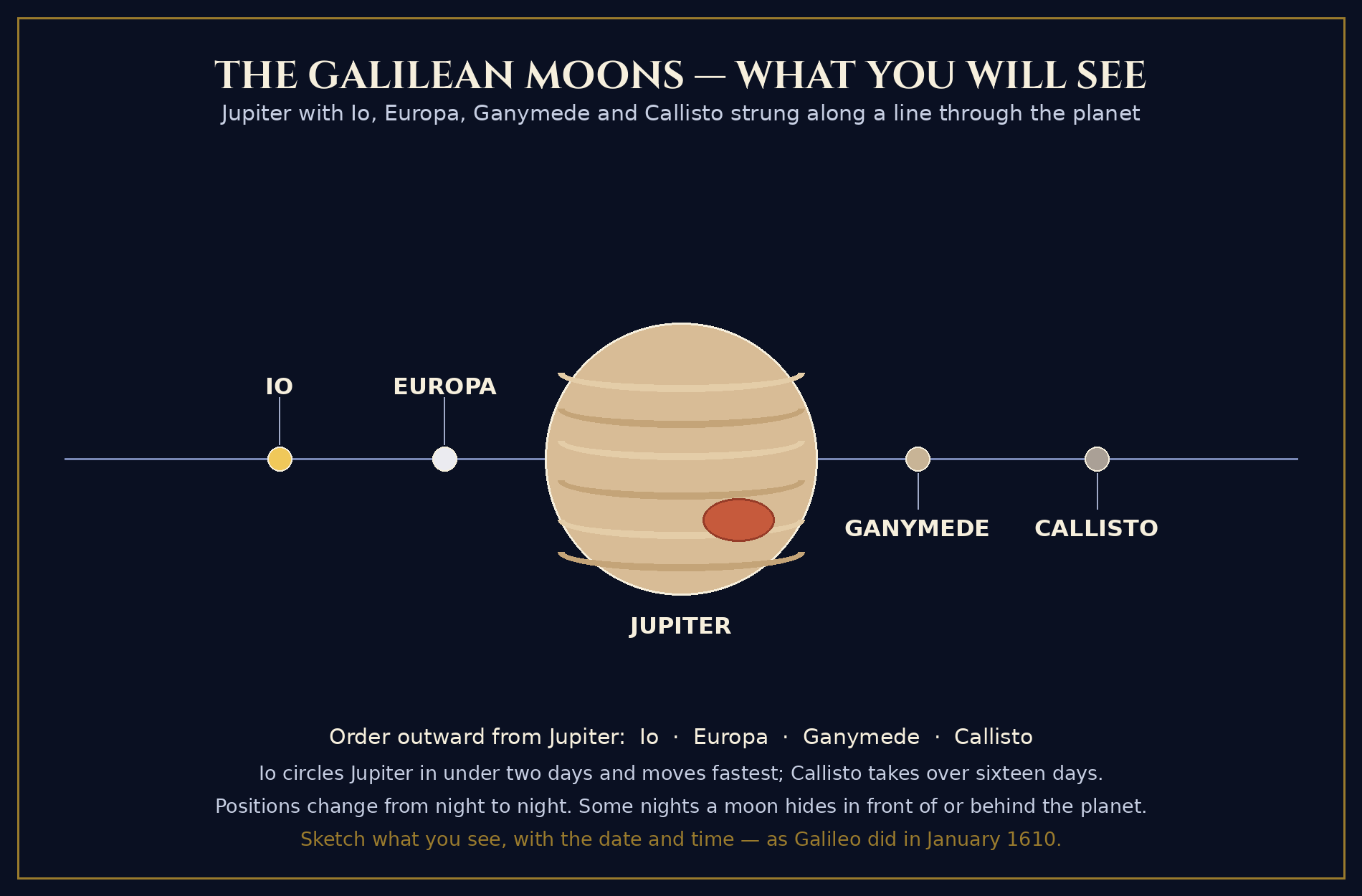
What your binoculars will show: Jupiter with up to four tiny points of light strung along a line through the planet — Io, Europa, Ganymede, and Callisto, in order outward. Their positions change from night to night; some nights one hides in front of or behind the planet. Sketch what you see, with the date and time, as Galileo did in January 1610.
Built digitally for this overhaul (Python/PIL, Cinzel + DejaVu Sans labels), from the moon order and periods taught in the lesson text.
Try It Tonight
Part One: Find the Giants (everyone)
Step outside after dark with your adult and find Jupiter first: the brightest steady, non-twinkling light in the evening sky, gold-white. Saturn is dimmer and gold-tinted; on many nights this season it follows along the same road across the sky. Use a free planetarium app or the month's sky guide to confirm which bright "stars" are planets, then put the app away and learn the sky with your eyes.
Record in your Sky Log: the date, the time, and where each planet stood (which constellation, how high, in which direction). You will need these notes for the Level One practical.
❦ In your workbook: record finding the giants in your own way — where each planet stood tonight, in which constellation, how high, in which direction — copy, sketch, or note what matters.
In your packet: Exercise I: The Giant Planet Watch ◐ begins here. Work it now, or mark the place and take it as homework — your choice.
Part Two, Level One: Track Saturn's Path
Saturn moves slowly against the background stars, taking nearly thirty years to circle the sky, but its motion is detectable within weeks. Once a week for at least a month, at about the same time of night, sketch Saturn's position relative to two or three nearby bright stars. Draw the little star pattern in your Sky Log and mark Saturn's place in it with the date.
After a month, compare your sketches. Saturn will have shifted. You are watching a world move in its orbit with your own eyes, the same slow wandering that gave the planets their name. (If Jupiter is better placed than Saturn on your observing nights, you may track Jupiter instead and note the substitution.)
❦ In your workbook: record Saturn's path in your own way — the little star pattern, Saturn's dated place in it each week, and the shift you can see after a month — copy, sketch, or note what matters.
Part Two, Level Two: Sketch the Galilean Moons
With binoculars (even modest ones will do) or a small telescope, look at Jupiter on three or more nights. You will see up to four tiny points of light strung along a line through the planet, on one or both sides. These are Io, Europa, Ganymede, and Callisto, the same four points of light Galileo watched in January 1610.
For each night, in your Sky Log, draw Jupiter as a small circle and mark the exact positions of the moons you see, with the date and time. Some nights you may see only two or three: the others may be hidden in front of or behind the planet, exactly as Galileo recorded.
Check in: On some nights you will see only two or three moons. Where are the missing ones?
After three or more nights, compare your sketches. The moons will have changed places. Try what Galileo tried: can you tell, from the pattern of changes, which moons orbit closest to Jupiter? (The innermost moon, Io, circles Jupiter in under two days, so it moves the fastest from night to night. The outermost, Callisto, takes over sixteen days.) You do not need to name them to succeed at this. Noticing the motion is the whole discovery.
❦ In your workbook: record the Galilean moons in your own way — Jupiter as a small circle each night, the moons marked with date and time, and how their pattern changed — copy, sketch, or note what matters.
Part Three: The Ring Watch (everyone, optional)
If your Level Two instrument can resolve Saturn's rings, or if you simply want a long-term project, note the current tilt of Saturn's rings in your Sky Log with a dated sketch. The rings were edge-on and effectively invisible in March 2025; they are slowly opening again and will be at their widest in the early 2030s. A sketch made now, and another made a year from now, will show the change. You are watching Saturn's seasons turn.
❦ In your workbook: record the ring watch in your own way — tonight's dated sketch of the rings' tilt, kept beside the one you will make a year from now — copy, sketch, or note what matters.
Sky Log Entry
Date and time of observation: _______________
Conditions (clear, partly cloudy, moonlight): _______________
Jupiter found? Position in the sky: _______________
Saturn found? Position in the sky: _______________
Level One: Saturn's position relative to nearby stars (sketch and date each observation): _______________
Level Two: Jupiter's moons (sketch Jupiter as a circle; mark each moon's position with date and time): _______________
Night 1: _______________
Night 2: _______________
Night 3: _______________
What changed between nights, and what does it tell you? _______________
Ring watch (optional): sketch of Saturn's ring tilt, dated: _______________
❦ In your workbook: record the Sky Log entry in your own way — tonight's positions, your level's sketches, and what changed between nights and what it tells you — copy, sketch, or note what matters.
Materials
Required (Level One — household items)
- Your naked eyes and a dark, clear sky: the Level One practical needs no equipment at all.
- An adult observing companion in a familiar, safe location.
- Your workbook and a pencil for the Sky Log: star patterns, dates, and positions.
- A free planetarium app or a printed monthly sky guide to confirm which bright lights are planets, then put away so you learn the sky with your eyes.
- A flashlight for walking (red light is best for observing: it preserves night vision).
- Warm clothing: giant-planet watching means standing still in the dark.
Suggested (Level Two — historically closer)
- Binoculars or a small telescope for sketching Jupiter's four bright moons (even modest binoculars show all four).
- A tripod, fence rail, or other steady support: rested binoculars show far more than shaky ones.
- Sky Log pages with a moon-sketch grid: Jupiter drawn as a small circle, moons marked with date and time.
- An adult's help with telescope setup and alignment until you have done it several times yourself.
Reflection Questions
Answer in your workbook, in complete sentences.
- Uranus was observed as a star many times over nearly a century before anyone recognized it as a planet. What does that story suggest about the difference between looking at something and truly seeing it?
- Four tiny points of light near Jupiter helped end the Earth-centered model of the universe. What made that evidence so hard to argue against?
- Neptune was found because two people did mathematics carefully enough to point a telescope at the right patch of sky. What does that story say about what mathematics can do in astronomy?
- Saturn's rings vanish from view every dozen or so years through pure geometry. Why does this lesson call that disappearance "a trick of perspective, not of substance"?
- Which of the four giant worlds would you most want to observe through a powerful telescope, and what would you most want to see? Give a reason drawn from this lesson.
Workbook Checklist — Lesson 16
In my workbook I have:
- ☐ found Jupiter and Saturn and recorded where each stood, with date and time, in my Sky Log
- ☐ carried my level's watch at full strength: Saturn (or Jupiter) tracked weekly for at least a month against my guide stars (Level One), or Jupiter's moons sketched on at least three nights with date and time (Level Two)
- ☐ told the two discoveries apart in my own words — Uranus seen and recognized by telescope, Neptune predicted by mathematics — without saying both were found by mathematics
- ☐ gathered the storm-and-rings fact page: the Spot's sizes then and now, the rings' width against their thickness, and the March 2025 ring plane crossing
- ☐ kept my Sky Log dated and honest — positions I did not understand written down anyway, as the sealed note asks
☐ Lesson completed Date: ___ Signature: ___
The Professor's Closing Note
And so we come home from the outer dark, scholars, past Neptune's winds and Uranus's sideways roll, past Saturn's impossible rings and Jupiter's great storm, back to our own small warm world.
You now carry four worlds in your head, and two stories about how they were found, and you know the difference between them. Uranus was seen and not recognized until a telescope and a careful man in Bath put the pieces together. Neptune was never seen at all until mathematics pointed at a patch of sky and said: look there. One was a triumph of observation. The other was a triumph of reason. Astronomy needs both, and so do you.
You also know that the sky is still changing while you watch it. The Great Red Spot is shrinking. Saturn's rings were edge-on just last year and are opening again. Somewhere out there, right now, a storm is forming on Neptune that no one will see for years, and a moon is sliding in front of Jupiter exactly the way it did for Galileo.
Keep your Sky Log. Keep your dates. And the next time someone tells you that a planet was "just discovered," ask them the question this lesson taught you to ask: was it seen, or was it predicted? The answer is always a story worth hearing.
PROFESSOR VESPER GLIMMERWICK
Celestial Studies
Astronomer & Celestial Historian
Cross-Class Connections

Runes · Unit I, Lesson 1 — The Structural Wedge
Tower scholars, the Babylonians of tonight's lesson kept their records of Jupiter's wanderings pressed into wet clay, wedge by wedge, and some of those tablets still carry the oldest astronomical data we have. Come down to the Runes Classroom and learn that writing from its first wedge: how a shaped reed and a scribe's patience became cuneiform. Professor Glimmerwick reads what the tablets recorded. Here, we read the tablets.
PROFESSOR THISTLELOOM WEBBLETHORN
Runes & Ancient Writing

Creative Arts · Studio Extension E3 — Models That Move, Built as Machines
Set up square, scholars, and mind the gearing. Tonight's lesson begs to be built: a true-scale Saturn — a ball for the planet, a sheet of ice-thin card for rings 280,000 kilometers wide and ten meters thin, tilted at 27 degrees — and a working orrery whose wheels show why the rings vanish on schedule, every thirteen to fifteen years, and open again. Bring your Sky Log sketches to my bench, and we will build the geometry until the vanishing makes perfect sense in your hands.
PROFESSOR COGBRANCH TIMBERCLANK
Creative Arts Workshop
Further Reading & Sources
These are real destinations for further study, verified live at the time of writing. Start with NASA; it is the authority this lesson leans on.
- NASA: 410 Years Ago, Galileo Discovers Jupiter's Moons (the January 1610 observations, Sidereus Nuncius, and the Medicean Stars). https://www.nasa.gov/history/410-years-ago-galileo-discovers-jupiters-moons/
- NASA Science: Jupiter's Great Red Spot (the largest known storm in the solar system; current size, winds, and shrinking). https://science.nasa.gov/asset/hubble/jupiters-great-red-spot-2/
- Science News: Jupiter's Great Red Spot May Be Less Than 200 Years Old (the 2024 study separating the current Spot from Cassini's 1665 Permanent Spot). https://www.sciencenews.org/article/jupiter-great-red-spot-shrinking
- NASA Science: Saturn's Rings (composition, particle sizes, ring thickness, the Cassini Division, shepherd moons). https://science.nasa.gov/resource/saturns-rings-2/
- NASA: 175 Years Ago, Astronomers Discover Neptune, the Eighth Planet (Adams and Le Verrier's calculations, Galle's September 1846 observation). https://www.nasa.gov/history/175-years-ago-astronomers-discover-neptune-the-eighth-planet/
- NASA Science: 240 Years Ago, William Herschel Identifies Uranus as the Seventh Planet (the March 1781 observation, Georgium Sidus, and the naming). https://science.nasa.gov/missions/hubble/240-years-ago-astronomer-william-herschel-identifies-uranus-as-the-seventh-planet/
- Astronomy Magazine: September 23, 1846, Galle Discovers Neptune (the "that star is not on the map" night). https://www.astronomy.com/today-in-the-history-of-astronomy/sept-23-1846-johann-galle-discovers-neptune/
- Scientific American: Scientific American Is Older Than the Discovery of Neptune (the Adams/Le Verrier story with the priority debate handled honestly). https://scientificamerican.com/article/scientific-american-is-older-than-the-discovery-of-neptune/
- Astronomy Magazine: January 7, 1610, Galileo Sees Four Moons of Jupiter (the night-by-night discovery). https://www.astronomy.com/today-in-the-history-of-astronomy/jan-7-1610-galileo-sees-four-moons-of-jupiter/
Browse the Celestial Studies shelf in the school Library for readable editions of these works.
Submit your work for this lesson using the form below.
CONTINUE IN THE CELESTIAL TOWER
← Previous · Lesson 15: Mars, the Red Wanderer Next · Lesson 17: Pluto & What a Planet Is →
Unit III — The Wanderers Celestial Tower — All 33 Lessons
The rest of Unit III: Lesson 12 · The Naked-Eye Planets · Lesson 13 · Retrograde · Lesson 14 · Venus · Lesson 15 · Mars · Lesson 17 · Pluto