
CELESTIAL STUDIES
Unit III · Lesson 14Venus, the Morning Star
Professor Vesper Glimmerwick
Astronomer & Celestial Historian
The Celestial Tower • School of Evershade
Professor's Introduction
Dusk has settled, scholars,
I am a bat, which means I do most of my thinking at dusk and dawn, in that blue hour when the world is changing shifts. And I will tell you something true: on almost every evening flight I take, and on almost every morning flight home, the brightest thing in my sky is not a star at all. It is Venus. It hangs there before the sky is even properly dark, steady as a held breath, outshining everything except the sun and the moon.
Tonight we follow that bright impostor. You will learn why it is so brilliant, why it never strays far from the sun, and why it shows phases like a tiny moon. You will meet the Maya astronomers who tracked it to the day across centuries, the 18th-century expeditions that sailed to the ends of the Earth to watch it cross the sun, and the runaway fever that turned Earth's sister into the hottest world in the solar system.
One thread runs through the whole lesson and out past its end: Venus is your project for the month. You will watch it as morning star or evening star, whichever it is being right now, and log it in your Sky Log. A month of Venus teaches what a single night cannot. The planet is always moving. So are you. Go and notice.
PROFESSOR VESPER GLIMMERWICK
Celestial Studies
Astronomer & Celestial Historian
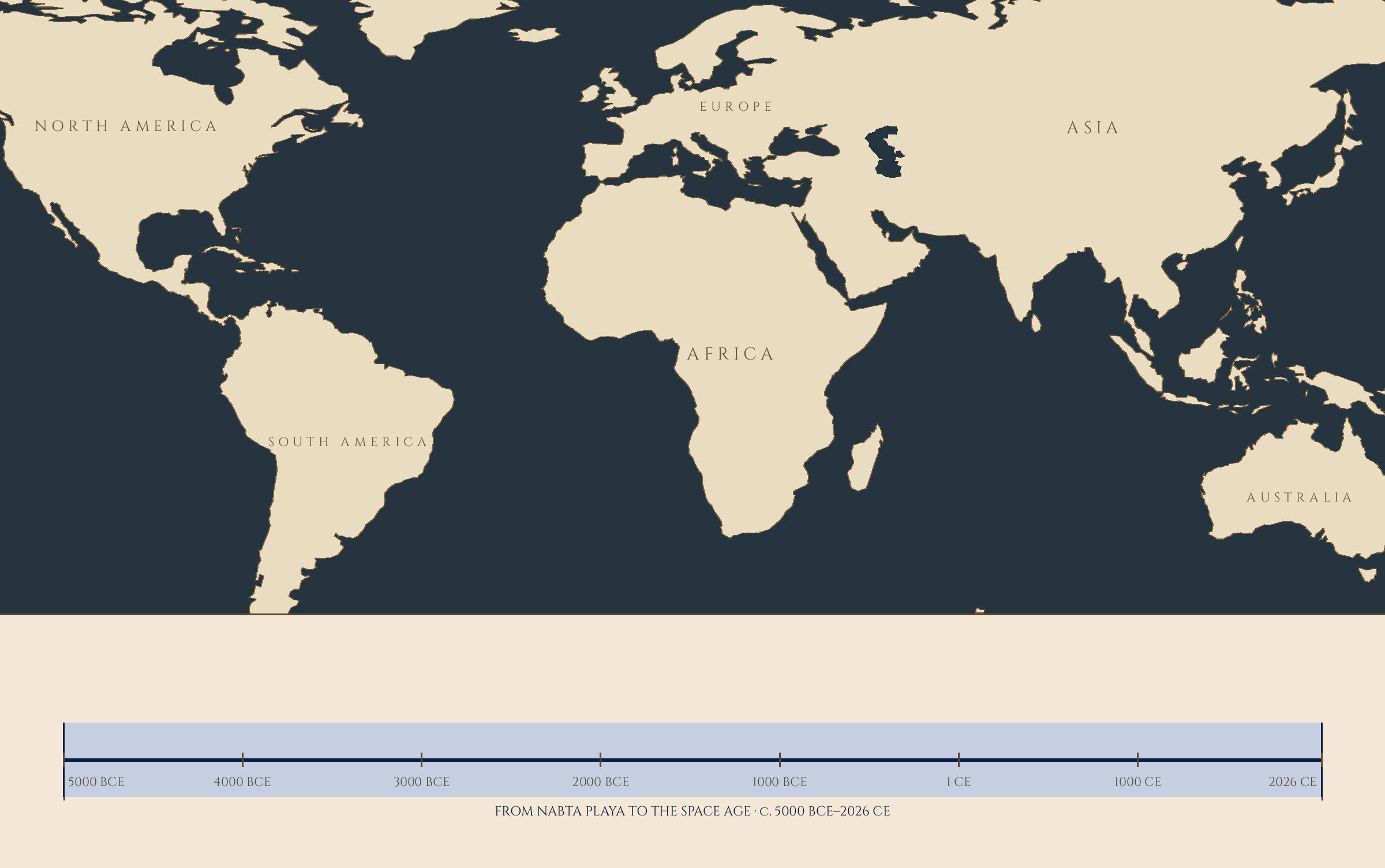
Where and when: your own sky, tonight — Venus, the Morning Star. This lesson has no pin and no stop: its place is wherever you stand under the night sky. The line beneath the map is our road through the course: every stop a moment when watching the sky changed, every lesson a place upon it.
Lesson Objectives
By the end of this lesson, you will be able to:
- Explain, with the geometry of an interior orbit, why Venus never appears far from the sun in our sky.
- Describe why Venus is the brightest planet: highly reflective clouds combined with closeness to Earth and the sun.
- Explain the phases of Venus, and what Galileo's 1610 observations ruled out about Ptolemy's model.
- Summarize the Dresden Codex Venus table: the 584-day cycle, its four stations, and why the table needed corrections.
- Tell the transit-of-Venus story: Halley's 1716 proposal, the 1761 and 1769 expeditions, the black-drop effect, and what the expeditions actually achieved.
- Explain the runaway greenhouse effect and why Venus is hotter than Mercury even though Mercury is closer to the sun.
- Track Venus as morning or evening star for one month and record the observations in the Sky Log.
Reading this lesson: ★ marks the passages to remember. They return on the unit quiz and the class test. Check in questions ask the material back as you go; answer them in your workbook when you meet them.
Working this lesson: Your assignment packet is the first download on this page. Work in it as the lesson moves along, answering each exercise as its subject is taught — or read the lesson through for your notes and take the exercises as homework afterward. Both are proper ways to sit this class. Signposts in the reading tell you where each exercise belongs. Written answers are short answers in your own words; a few honest lines are worth more than a filled page.
Your Assignment Packet
This lesson's exercises live in its packet: the Lexicon Handout (every term, course terms marked ◆), Materials, Guided Practice, the Assignment Manual with its answer key for self-checking, the Reflection Questions, and the Workbook Checklist. Download the packet before you begin and keep it beside you as you read. The packet's exercises are Glimmerwick's own word for the work: Exercise I: The Month of Venus ◐, Exercise II: The Lamp and the Inner Track ⚒, and Exercise III: The Calendar and the Expeditions ✎. The lesson's quiz is not printed in the packet; it pools to the Unit III Quiz, where it will meet you again.
Safety Briefing
Night-observing safety. All night observing in this course is done with an adult present, in a familiar and safe location. Tell someone where you are going and when you expect to return. Dress warmly, bring a flashlight, and watch your footing in the dark. A dim red flashlight preserves your night vision better than a bright white one.
Venus lives near the sun, and that is the whole safety story. Because Venus never strays far from the sun, you must never sweep binoculars or a telescope around the part of the sky where Venus sits while the sun is up or near the horizon. Pointing magnifying optics anywhere near the sun can injure eyes instantly and painlessly, before you have time to flinch. Observe Venus only when the sun is safely below the horizon and well clear of your line of sight. If you are using binoculars or a telescope, an adult handles the aiming.
Looking at Venus with your bare eyes is completely safe. It cannot hurt your eyes. It is only reflected sunlight, and by the time it reaches you it is far too dim to do harm.
The Wonder
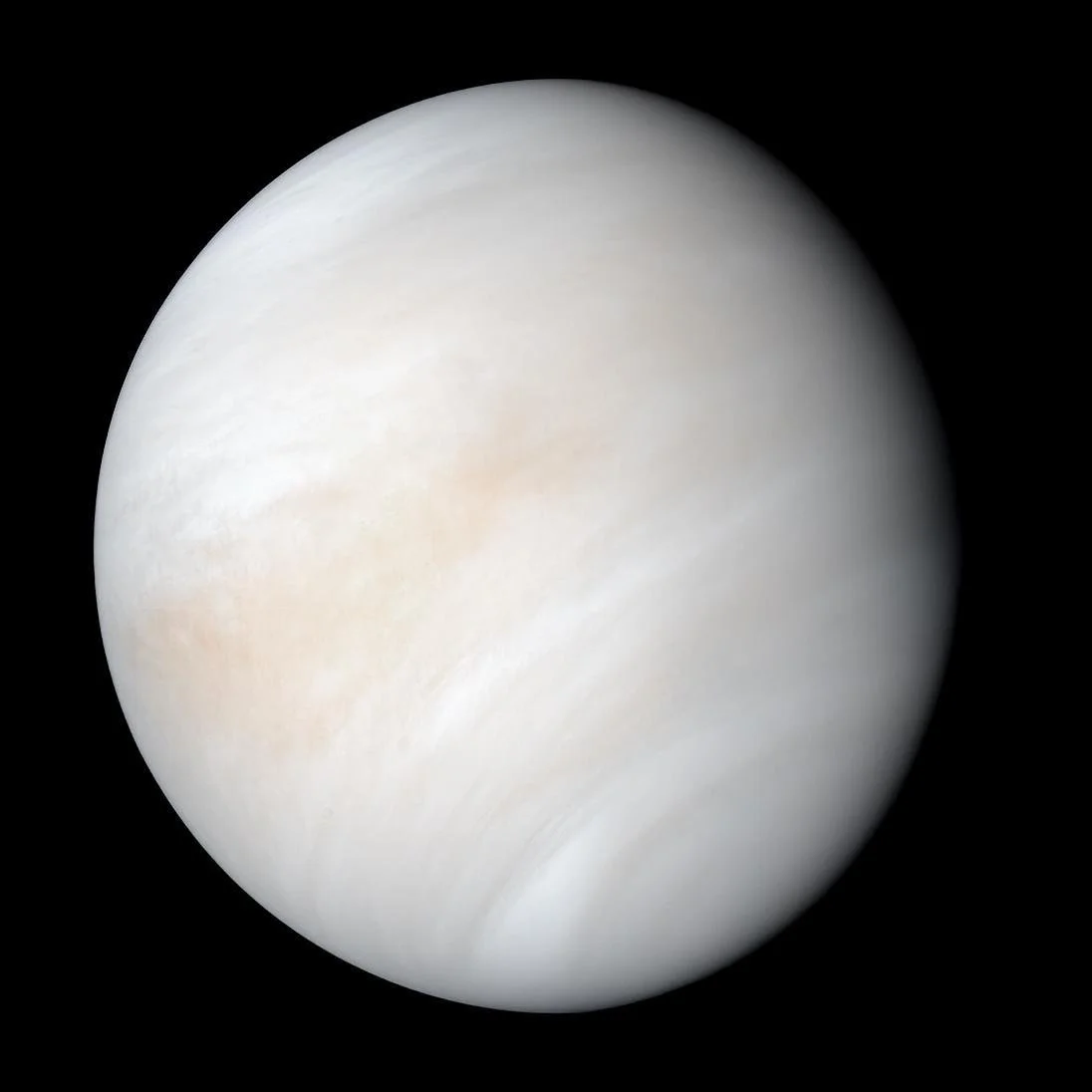
Venus from Mariner 10: a serene, cloud-covered globe — and a world of intense heat, crushing pressure, and clouds of corrosive acid beneath the calm. The clouds reflect about three quarters of the sunlight that hits them, which is why Venus outshines every other planet.
NASA / JPL (Mariner 10, February 1974; processing by JPL engineer Kevin M. Gill from archived data), PIA23791.
Go out just after sunset some clear evening, or just before sunrise some clear morning, and look toward the sun's neighborhood. Before any true star has mustered the courage to appear, one brilliant point of light is already there, steady and white, too bright to be a star and too still to be a plane. For part of the year it follows the sun down in the west: the evening star. For another part it rises ahead of the sun in the east: the morning star. In truly dark country, at its brightest, it throws the faintest shadow a planet can throw.
★ It looks like the brightest star in the sky. It is not a star. It makes no light of its own. It is a world, a rocky ball nearly the size of Earth, wrapped in clouds of acid, spinning backward so slowly that its day outlasts its year, with a surface hot enough to melt lead. The morning star and the evening star are the same object wearing two costumes, and humanity took thousands of years to catch it in the act.
Venus is the second planet from the sun, circling it once every 224.7 days on an orbit only slightly inside our own. It is the closest planet to Earth in size, which is why the old books call it Earth's sister. And it is the subject of one of the strangest stories in astronomy: how a planet was tracked with astonishing precision by people who never saw its surface, how it sent ships around the world to measure the size of the solar system, and how it became the hottest world we know.
❦ In your workbook: record the wonder in your own way — one brilliant point already shining before the true stars, and the morning star and evening star as one object in two costumes — copy, sketch, or note what matters.
The Story
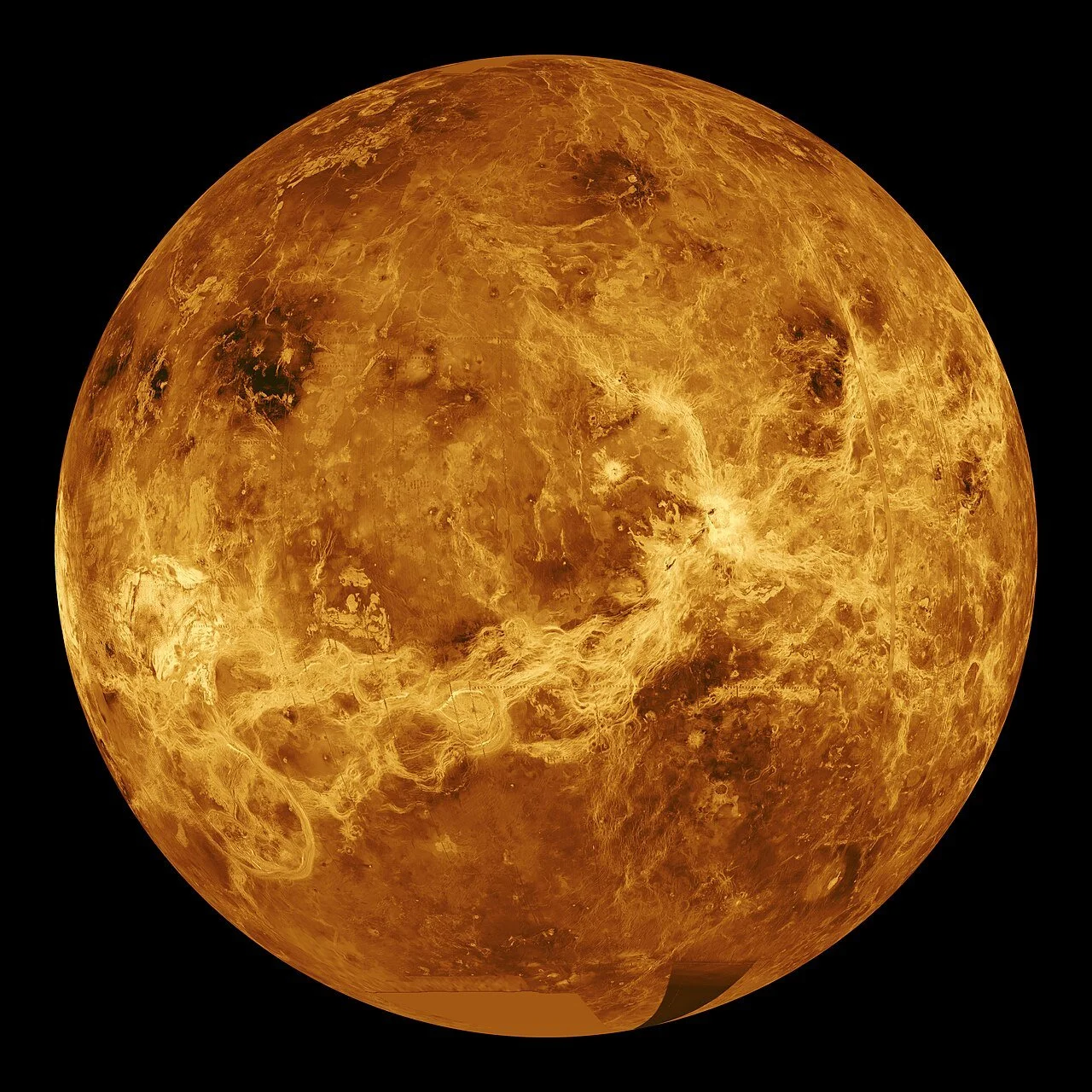
The surface the clouds hide: NASA's Magellan orbiter mapped Venus by radar (1990–94), seeing straight through the cloud deck. The golds and oranges are simulated color laid over radar measurements, keyed to the surface colors the Soviet Venera landers photographed.
NASA / JPL (Solar System Visualization project and the Magellan science team, JPL Multimission Image Processing Laboratory), NASA Photojournal PIA00104; frame released 29 October 1991.
Two stars, one world
For most of human history, the morning star and the evening star were two different beings. The Greeks called the morning one Eosphorus or Phosphorus, "bringer of light," and the evening one Hesperus. Homer knew them both. Pliny the Elder later reported that tradition credited Pythagoras of Samos with discovering that the two were one planet. But the Greeks were late to a truth others already held: Babylonian astronomers had recorded the morning and evening appearances of Venus as one cycle in the Venus tablet of Ammisaduqa, around the 16th century BCE, roughly a thousand years before Pythagoras. The Romans, translating the Greek names into Latin, called the morning aspect Lucifer and the evening aspect Vesper.
The planet gathered gods the way it gathers light. The Babylonians gave it to Ishtar, the Greeks to Aphrodite, the Romans to Venus, goddess of love and beauty. In the Americas, the Maya gave Venus a god of its own and watched it more carefully than any other people on Earth. That watching is where our story properly begins.
❦ In your workbook: record the two stars that were one world in your own way — Eosphorus and Hesperus, the Venus tablet of Ammisaduqa a thousand years before Pythagoras, and the gods the planet gathered — copy, sketch, or note what matters.
The Maya and the 584-day calendar
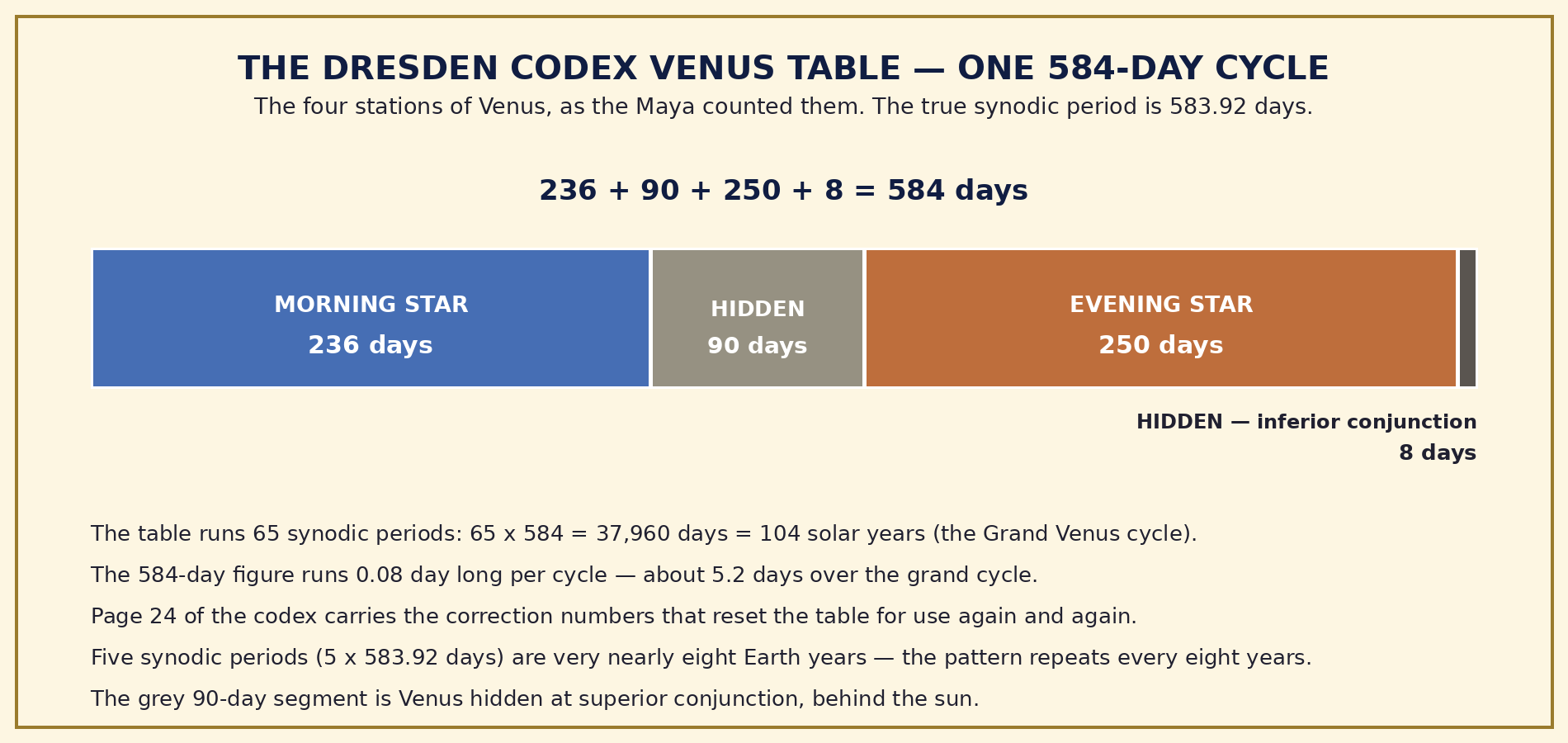
The Dresden Codex Venus table as a single cycle: four stations adding to 584 days — the closest whole number to the true 583.92-day synodic period, found by watching the heliacal rising and counting. Page 24's corrections keep the table honest across the 104-year grand cycle.
Built digitally for this overhaul (Python/PIL, DejaVu Sans labels), from the numbers taught in the lesson text and verified in its fact-check notes (Park & Chung, Estudios de Cultura Maya).
Of the many books the Maya wrote, only four are known to survive: the codices of Paris, Madrid, Dresden, and Grolier, named for the cities where they were found. The Dresden Codex, written in the most refined hieroglyphs and pictures of the four, holds the most complete astronomy. And its most remarkable section is the Venus table: page 24, which serves as the user's guide and the correction manual, and pages 46 through 50, which lay out the calendar itself.
★ The table divides the Venus cycle into four stations. Venus spends 236 days as the morning star, then hides for 90 days behind the sun at superior conjunction, then spends 250 days as the evening star, then hides for 8 days at inferior conjunction before bursting back into the dawn. Add them up: 236 plus 90 plus 250 plus 8 equals 584 days. That is the closest whole number to the true synodic period of Venus, 583.92 days, and it is an extraordinary piece of naked-eye astronomy. The Maya found it by watching the heliacal rising, the day Venus reappears in the dawn after its eight days of hiding, and counting.
★ The table does not stop at one cycle. Each of the five pages covers one Venus synodic year, and the table repeats across thirteen rows, describing sixty-five synodic periods in all: 65 times 584 equals 37,960 days, which is 104 solar years. That is the Grand Venus cycle. But the small error in the 584-day figure, eight hundredths of a day per cycle, accumulates: after a full grand cycle the calendar runs about 5.2 days long. The Maya knew. Page 24 of the codex carries the correction numbers, methods for resetting the table so it can be used again and again. A calendar that corrects itself is a calendar built by people who expected their grandchildren to use it.
The Venus pages are not only dates. Beside the columns of numbers run augural glyphs and painted figures: gods of Venus aiming their rays at victims, symbolic warnings tied to the planet's stations. For the Maya, this calendar had stakes. The heliacal rising of Venus was watched the way other peoples watched eclipses: as a moment that demanded attention.
And here is a rhythm worth noticing. Five synodic periods of Venus, 5 times 583.92 days, equal 2,919.6 days, which is very nearly eight Earth years. So the whole pattern of Venus's appearances repeats almost exactly every eight years. The Greeks gave that eight-year return its own name, the octaeteris. Two civilizations, an ocean apart, found the same heartbeat in the same planet.
Check in: The Dresden table's four stations are 236, 90, 250, and 8 days. What do they add to, how far is that from the true synodic period, and what is page 24 for?
❦ In your workbook: record the 584-day calendar in your own way — the four stations, the grand cycle of 65 periods, and the correction numbers on page 24 — copy, sketch, or note what matters.
The phases that broke a universe
In late 1610, Galileo turned his new telescope on Venus and watched it change shape. Not just a crescent, as it sometimes shows to patient naked eyes, but a full set of phases: crescent, half, gibbous, nearly full, like a tiny moon. He was so sure of what he had seen that he announced it in cipher in December 1610, to claim the discovery before he had finished it.
★ Why did it matter? Because Venus never strays far from the sun, Ptolemy's Earth-centered system had parked Venus on its epicycle always between Earth and the sun. In that arrangement, Venus could never show more than a crescent. A full or gibbous Venus meant the planet sometimes travels around the far side of the sun, which Ptolemy's machinery could not allow. The phases were the first observation that flatly ruled Ptolemy's version out. Lesson 13 told the full story of the model wars; this is the piece of evidence that landed the hardest blow.
Check in: In Ptolemy's arrangement, why could Venus never show more than a crescent — and what did a gibbous Venus prove instead?
❦ In your workbook: record the phases that broke a universe in your own way — Galileo's full set in late 1610, the cipher announcement, and the arrangement they ruled out — copy, sketch, or note what matters.
Chasing a black dot across the sun
Very rarely, Venus passes directly between Earth and the sun, and we see it as a small black disk crossing the solar face. These transits come in pairs eight years apart, because five synodic periods make eight years, and the pairs are separated by a little over a century. The geometry is strict: Venus's orbit is tilted about three degrees to Earth's, so most inferior conjunctions carry Venus above or below the sun. Only when an inferior conjunction happens near one of the orbit's nodes does a transit occur.
Kepler predicted a transit for 1631. The Mercury half of his prediction was observed by Pierre Gassendi, but Venus's 1631 transit was not visible from Europe. The first transit of Venus ever observed came in 1639, predicted by the young English astronomer Jeremiah Horrocks and watched by him and his friend William Crabtree. Horrocks used the observation to estimate the Earth-sun distance.
★ Then, in 1716, Edmond Halley made his proposal: station observers as far apart on Earth as possible, time the transit from each station, and use the parallax between their views to calculate the distance from Earth to the sun. That distance, the astronomical unit, was the missing number of the solar system. Kepler's third law gave every planet's distance relative to Earth's; nail down Earth's, and you had them all. Halley died in 1742, nineteen years before the next transit, but his plea was not forgotten.
The transits of 1761 and 1769 became the largest scientific expeditions the world had yet seen. For 1761, parties set out for India, Siberia, Norway, Newfoundland, Madagascar, and the East Indies. Charles Mason and Jeremiah Dixon, later famous for a boundary line in America, were sent toward Sumatra, turned back after a French ship fired on them, and ended up observing from Cape Town instead. The French astronomer Guillaume Le Gentil sailed for India, missed the transit at sea, and stayed in the region eight years for the next one, only to be clouded out in 1769 as well; he sailed home to find he had been declared dead. Mikhail Lomonosov, observing the 1761 transit from St. Petersburg, noticed a luminous ring around Venus's dark disk and argued that the planet must have an atmosphere. He was right.
For 1769, more than 150 observations were recorded, from Canada, Norway, California, Russia, and, most famously, Tahiti, where Captain James Cook and the astronomer Charles Green observed from a headland still called Point Venus. The French astronomer Joseph-Nicolas Delisle had improved Halley's method: if observers knew their exact positions, they needed only the moment when Venus's edge touched the sun's edge. And Jean Chappe d'Auteroche, who had observed the 1761 transit from Siberia, traveled to Baja California for 1769 and timed that one too, the only astronomer to observe both in full.
★ The results were disappointing in the narrow sense and magnificent in every other. A strange smearing called the black-drop effect made Venus's disk seem to cling to the sun's edge at the contact moments, so the exact timings the whole method depended on were blurred. In 1771, Jérôme Lalande combined the 1761 and 1769 data and calculated the astronomical unit as 95 million miles, about 153 million kilometers: closer than anyone had come, but not the precision they had sailed for. A century later the 1874 and 1882 transits, armed with photography, did better, and the space age finished the job with radar and telemetry: 149,597,870.7 kilometers. The 18th-century expeditions had not failed. They were the first time humanity organized itself across the whole planet to answer one question, and the black dot they chased gave the solar system its true size.
The next transit of Venus comes in 2117. None of us will see it. The Maya's grandchildren watched Venus return every eight years; we get our transits roughly once a century. Different rhythms, same planet.
Check in: What was Halley asking the world's observers to measure in 1716, and what effect blurred the exact timings the method depended on?
❦ In your workbook: record the black dot in your own way — Halley's proposal, the 1761 and 1769 expeditions, the black-drop effect, and what the expeditions actually achieved — copy, sketch, or note what matters.
Earth's sister, gone wrong
For all that watching, nobody knew what Venus looked like up close. The clouds never part. Until the space age, the surface was pure speculation: swamps, oceans, deserts, jungles, every guess a mirror of its maker's hopes.
The truth arrived the hard way. In 1970, the Soviet Venera 7 became the first spacecraft to land on another planet and transmit data from the surface. Then, from 1990 to 1994, NASA's Magellan orbiter mapped nearly the whole surface with radar, seeing straight through the clouds. What it found was a world of volcanic plains and fractured highlands under a sky that never clears.
Venus is almost Earth's size, almost Earth's mass, and sits only slightly closer to the sun. By every starting measure it should have been the most Earthlike world. Instead its surface averages about 465 degrees Celsius, hotter than Mercury, which bakes far closer to the sun. Its air is 96.5 percent carbon dioxide at ninety-two times Earth's surface pressure, under clouds of concentrated sulfuric acid. Something went wrong on the way to being a sister. The next section is about what.
❦ In your workbook: record the sister gone wrong in your own way — Venera 7's landing, Magellan's radar map, and the numbers 465 degrees, 96.5 percent, and ninety-two times — copy, sketch, or note what matters.
The Mechanism
Why it is so bright
Venus makes no light. Everything you see is sunlight, borrowed and returned. Two facts about that borrowing make Venus the brightest planet in our sky.
★ First, the clouds. Venus is wrapped in droplets of concentrated sulfuric acid, and those clouds are spectacularly reflective. They bounce back about three quarters of the sunlight that hits them, an albedo of roughly 0.75, the highest of any planet. For comparison, the moon reflects about one eighth of the sunlight it receives, and Earth as a whole reflects about three tenths. Venus is wearing a mirror.
Second, closeness. Venus is the nearest planet to the sun after Mercury, so it is drenched in sunlight, and at its closest it comes within about 40 million kilometers of Earth, nearer than any other planet ever gets to us. Brightness falls off with the square of the distance, so being near the lamp and near the watcher both count double.
There is a lovely subtlety. Venus is brightest not when it is full but when it is a fat crescent, fairly close to inferior conjunction. Brightness is illuminated fraction times apparent size, and the two pull in opposite directions: near the far side of the sun, Venus shows a full face but a tiny disk; near our side, it shows a thin sliver of a huge disk. The product peaks in between, at greatest brilliancy, when Venus blazes near magnitude minus 4.7. That is bright enough to be seen in daylight if you know exactly where to look, which you should not attempt near the sun without the safety rules of this lesson firmly in mind.
❦ In your workbook: record the brightness in your own way — a mirror of acid clouds at albedo 0.75, closeness counted double, and greatest brilliancy in the fat crescent — copy, sketch, or note what matters.
Why it never leaves the sun's side
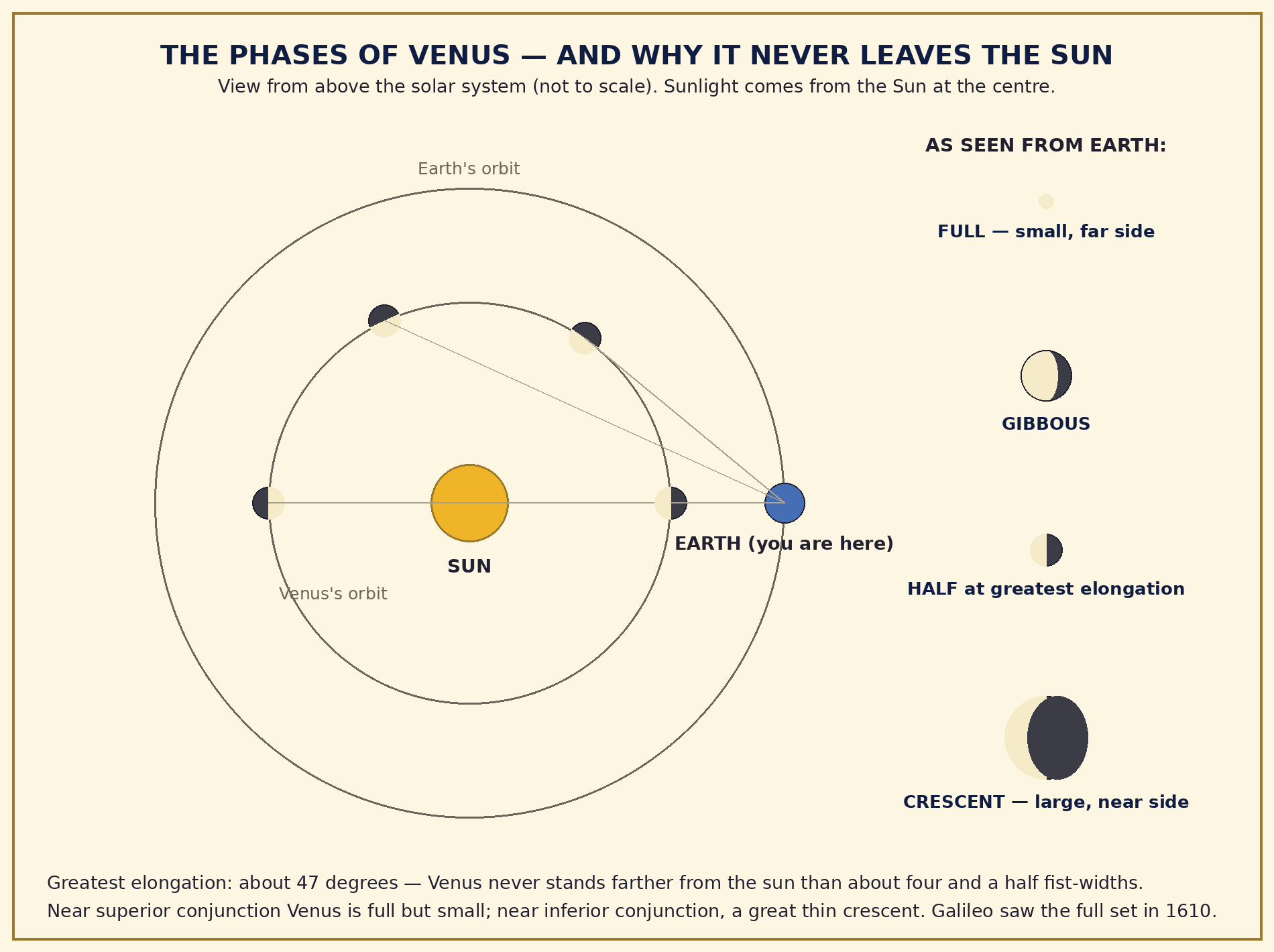
The inner track, from above: because Venus's whole orbit lies inside Earth's, it never stands more than about 47 degrees from the sun — and its phase and apparent size trade off around the circuit, full and small on the far side, a great thin crescent on ours. The lamp-and-ball model of Exercise II acts out exactly this diagram.
Built digitally for this overhaul (Python/PIL, DejaVu Sans labels), from the geometry taught in the lesson text.
Picture the solar system from above. The sun sits at the center. Venus runs on an inside track, Earth on an outside one. Now stand on Earth and look at Venus wherever it happens to be. Because Venus's whole orbit lies inside ours, the line of sight from Earth to Venus can never point far away from the line of sight to the sun. The geometry caps how far apart they can appear: about 47 degrees at most, a span you can cover with your outstretched hand (a fist at arm's length covers roughly 10 degrees, so Venus never gets more than about four and a half fists from the sun).
★ That single fact explains the morning star and the evening star. When Venus is on one side of inferior conjunction, it trails the sun and sets after it: the evening star, hanging in the west after sunset. When it has passed between us and the sun, it leads the sun and rises before it: the morning star, waiting in the east before dawn. Between those seasons it hugs the sun too closely to be seen at all. Venus is never opposite the sun. It is never up at midnight. Mercury obeys the same rule on a tighter leash, never straying more than about 28 degrees from the sun, which is why Mercury is so much harder to catch.
The 47-degree cap also explains the transit geometry from the story above. Most of the time, when Venus passes between us and the sun, its orbit carries it a little above or below the solar disk as seen from Earth, because the orbit is tilted about three degrees to ours. Only when inferior conjunction lands near a node, where the two orbital planes cross, do we get a transit.
Check in: Venus's whole orbit lies inside Earth's. How far from the sun can Venus ever appear, and why is it therefore never up at midnight?
❦ In your workbook: record the sun's-side rule in your own way — the inside track, the 47-degree cap in fist-widths, and Mercury's tighter 28-degree leash — copy, sketch, or note what matters.
In your packet: Exercise II: The Lamp and the Inner Track ⚒ begins here — its lamp, ball, and fixed watching spot model exactly this geometry. Work it now, or mark the place and take it as homework — your choice.
The phases, explained
Venus goes through phases for the same reason the moon does: it is a ball lit from one side by the sun, and we see different amounts of its day side as the geometry changes. The sequence runs with the 584-day synodic cycle. Near superior conjunction, Venus is on the far side of the sun: fully lit, but small and distant, a tiny full disk lost in the glare. As it swings around toward us, it wanes through gibbous to half, growing larger as it approaches. Near inferior conjunction it is a great thin crescent, its night side toward us, its sunlit rim a curved sliver, and then it vanishes into the sun's glare for its eight days of hiding before emerging on the other side as the morning star.
This is the same evidence Galileo read in 1610, and it is worth pausing on what it proved. In Ptolemy's arrangement, Venus rode its epicycle always between Earth and the sun, so we could only ever see its night side and a sliver of day: crescents, forever. A gibbous or full Venus meant the planet sometimes circles around to the far side of the sun, which meant it orbits the sun, not Earth. The phases did not merely decorate the sky. They voted.
❦ In your workbook: record the phases in your own way — full and small at superior conjunction, a great thin crescent near inferior conjunction, and why the phases voted — copy, sketch, or note what matters.
The runaway greenhouse
Now the fever. Venus receives about twice the sunlight Earth does, which is significant but not nearly enough to explain 465 degrees. The explanation is the atmosphere, and it works like this.
Sunlight arrives mostly as visible light, which carbon dioxide lets straight through. It warms the surface. The surface, being warm, radiates heat back upward, but as infrared light, which carbon dioxide absorbs greedily. The heat is caught: in through the open door, out through the locked one. That is the greenhouse effect, and on Earth it is gentle and essential. Without it our planet would be frozen; with it, we are comfortable.
★ On Venus the effect ran away. The young Venus likely had oceans. As the planet warmed, more water evaporated, and water vapor is itself a greenhouse gas, so the warming fed on itself. The oceans boiled away entirely. High in the atmosphere, sunlight split the water vapor apart, and the light hydrogen escaped to space, lost forever. With no oceans left to dissolve carbon dioxide into rocks, the gas accumulated in the air until the atmosphere became 96.5 percent CO2, ninety-two times the pressure of Earth's air at sea level, capped by clouds of sulfuric acid. The heat could never leave. The surface settled at about 465 degrees Celsius, hot enough to melt lead, and it stays that hot everywhere, day and night, because the thick air spreads the heat around the whole planet.
Two corrections, because this lesson corrects misconceptions. First, Venus is hotter than Mercury not because it is closer to the sun; Mercury is closer. Venus is hotter because Mercury has almost no atmosphere to trap heat, while Venus has the thickest blanket in the solar system. Proximity starts the story; the atmosphere finishes it. Second, a real glass greenhouse works mostly by stopping warm air from rising and blowing away, which is a different mechanism from the infrared trapping that warms planets. The name is a metaphor, and like all metaphors it is useful until you lean on it too hard.
Earth's sister had nearly the same size, nearly the same mass, and a head start of liquid water. The difference between a comfortable world and a furnace turned out to be whether the carbon had anywhere else to go.
Check in: Venus gets only about twice Earth's sunlight, so why is it hotter than Mercury — and what did its oceans have to do with the runaway?
❦ In your workbook: record the runaway in your own way — visible light in, infrared caught, oceans boiled, hydrogen lost, and carbon with nowhere else to go — copy, sketch, or note what matters.
A Sealed Note on Being Bright
My dears, a small confession from your bat professor. I navigate by echoes in the dark, so I have opinions about brightness, and here is mine: brightness is mostly a trick of geometry.
Venus is not the biggest planet. It is not the closest to the sun. It does not make any light at all. It is simply near, and shiny, and well lit, and those three ordinary facts add up to the most brilliant thing in the night sky. Jupiter is vastly larger and incomparably dimmer. Sirius is a true star, burning with its own fire, and Venus outshines it without breaking a sweat.
There is a lesson in that for scholars, and it is not about planets. Being the brightest thing in the room rarely means being the largest or the loudest. It usually means being well placed, well prepared, and reflective in the best sense: taking the light you are given and sending it back out into the dark. Shine accordingly.
❦ In your workbook: record the sealed note in your own way — brightness as geometry, and what being well placed, well prepared, and reflective means for a scholar — copy, sketch, or note what matters.
PROFESSOR VESPER GLIMMERWICK
Celestial Studies
Astronomer & Celestial Historian
Guided Observation
Try It Tonight
Part One: find Venus. Tonight, determine which costume Venus is wearing. If the sun has just set, look west: is there a brilliant steady light hanging low where the sun went down? That is the evening star. If it is an hour before dawn, look east: is there a brilliant steady light rising ahead of the sun? That is the morning star. It will be the brightest point of light in that part of the sky by an overwhelming margin, and it will not blink the way an airplane does. If you cannot find it, it may be in one of its hiding seasons, too close to the sun to see. Note that too; absence is also data.
Part Two: anchor it. Note exactly where Venus sits relative to a landmark: a rooftop, a tree, a hill. Estimate its height above the horizon in fist-widths at arm's length (about 10 degrees per fist). Write down the time. Come back in one week, at the same time, and measure again. Venus moves against the background, and a month of such notes will show you whether it is climbing away from the sun or sinking toward it.
Level Two: watch the phase. With a small telescope, or with binoculars held very steady on a tripod or a fence post, Venus is not a point but a disk, and the disk has a shape. Sketch what you see: is it round, half, gibbous, crescent? Compare it with the moon's phase on the same night. The two are lit by the same sun, from the same direction, which is why the comparison works.
Remember the safety briefing: observe only when the sun is down and well clear, and never sweep optics near the sun.
❦ In your workbook: record tonight's Venus in your own way — which costume it wears, its landmark and fist-width height, and (Level Two) the shape of its disk beside the moon's phase — copy, sketch, or note what matters.
In your packet: Exercise I: The Month of Venus ◐ begins here — this Sky Log page, kept for one full month. Work it now, or mark the place and take it as homework — your choice.
Sky Log Entry
Copy this page into your Sky Log and keep it going for one full month. This is the practical heart of the lesson.
The Month of Venus
| Date | Morning or evening? | Time | Height above horizon (fists) | Landmark | Phase (Level Two) | Notes |
|---|
At the end of the month, answer in your log: Did Venus climb higher or sink lower over the month? Did it change from evening to morning star, or stay in one role? What does your answer say about where Venus is in its 584-day cycle right now?
❦ In your workbook: record the month's end in your own way — whether Venus climbed or sank, whether it changed costume, and where that places it in the 584-day cycle — copy, sketch, or note what matters.
Materials
Required (Level One — household items)
- Your workbook, a pencil, and the Sky Log page from this lesson for the Month of Venus (Exercise I).
- A lamp, a small ball on a string or circular track (Venus), and yourself as Earth for the inner-track geometry model (Exercise II), in a darkened room with an adult's help.
- A clear view of the eastern or western horizon at dawn or dusk, and a landmark (rooftop, tree, hill) to anchor Venus's position.
- A flashlight for night observing, dim or red-filtered if you have one.
Suggested (Level Two — historically closer)
- A small telescope, or binoculars held steady on a tripod or fence post, for sketching Venus's phase across the month.
- A printed star chart or sky app to confirm which bright point is Venus and which constellation it sits in.
- Graph paper for plotting Venus's height above the horizon against the date, turning the month's log into a curve.
Reflection Questions
Answer in your workbook, in complete sentences.
- The Maya used Venus to keep time and to read warnings; Halley used a transit of Venus to measure the solar system. What does each use assume about what the sky is for?
- The 1761 and 1769 expeditions did not get the precise number they sailed for, yet historians call them a triumph. What did they actually achieve?
- Venus is the brightest planet and the hottest planet, for completely different reasons. Explain both reasons, and why neither one is "because it is closest to the sun."
- Suppose you watch Venus for a month and it crosses from the evening sky to the morning sky. What has actually moved to make that happen, and what has only seemed to move?
- "Earth's sister, gone wrong." What does the runaway greenhouse effect on Venus suggest about the difference between a planet's starting conditions and its fate?
Workbook Checklist — Lesson 14
In my workbook I have:
- ☐ kept the Month of Venus in my Sky Log for one full month — dates, morning or evening, heights in fist-widths, landmarks, and honest cloudy gaps
- ☐ answered the month-end questions: whether Venus climbed or sank, whether it changed costume, and where that places it in the 584-day cycle
- ☐ worked the lamp and the inner track with my adult, or drawn the four setups and answered the four questions
- ☐ completed one Calendar and Expeditions investigation in complete sentences, with the numbers shown
- ☐ (Level Two) sketched Venus's phase at the start and end of the month and compared it with the mechanism's prediction
☐ Lesson completed Date: ___ Signature: ___
The Professor's Closing Note
My dearest scholars,
You have now kept company with a planet that has been watched, worshipped, measured, and misunderstood for four thousand years, and you have joined the watchers. The Maya counted its days. Halley dreamed of measuring the heavens with it. Galileo let it break a universe. And tonight, or tomorrow morning, you will step outside and find it yourself, which is the oldest astronomy there is.
Keep the month of Venus. It asks little: a few minutes, a clear patch of sky, an honest note. At the end of it you will know something in your bones that no diagram can give you, which is how a planet moves. The sky rewards the patient. It has always rewarded the patient. That is why the patient keep looking up.
PROFESSOR VESPER GLIMMERWICK
Celestial Studies
Astronomer & Celestial Historian
Cross-Class Connections
Runes · Unit I, Lesson 1 — The Structural Wedge
Tower scholars, tonight's planet was first written down by scribes pressing wedges into wet clay — the Venus tablet of Ammisaduqa kept Venus's morning and evening appearances as one cycle a thousand years before Pythagoras. Come down to the Runes Classroom and learn that writing from its first wedge: how a shaped reed pressed into clay became cuneiform, the script that stored careful observations so the grandchildren could use them. Professor Glimmerwick reads what the tablet recorded. Here, we read the tablet.
PROFESSOR THISTLELOOM WEBBLETHORN
Runes & Ancient Writing
Further Reading & Sources
These are real destinations for further study, verified live at the time of writing. Start with NASA for the planet itself, then follow the history.
- NASA Solar System Exploration: Venus, facts and overview. https://solarsystem.nasa.gov/planets/venus/overview/
- Park and Chung, "Identification of Postclassic Maya Constellations from the Venus Pages of the Dresden Codex" (Estudios de Cultura Maya): the 584-day cycle, the 236/90/250/8-day stations, the grand cycle, and the page 24 corrections. http://www.scielo.org.mx/scielo.php?script=sci_arttext&pid=S0185-25742010000100002
- Scientific American guest blog: "Venus' Transits Through History": Horrocks, Halley, Delisle, Cook's Tahiti expedition, the black drop, and Lalande's result. https://blogs.scientificamerican.com/guest-blog/venus-transits-through-history/
- UCL News: "Venus transit pays homage to physics' past and future" (2012): parallax explained, the black-drop effect, and how transits now serve exoplanet science. https://www.ucl.ac.uk/news/2012/jun/venus-transit-pays-homage-physics-past-and-future
- New Mexico State University Astronomy: "Galileo": the phases-of-Venus section, why a full Venus ruled out Ptolemy's model. http://astronomy.nmsu.edu/aklypin/WebSite/galileo.htm
Browse the Celestial Studies shelf in the school Library for readable editions of these works.
Submit your work for this lesson using the form below.
CONTINUE IN THE CELESTIAL TOWER
← Previous · Lesson 13: Retrograde & the Model Wars Next · Lesson 15: Mars, the Red Wanderer →
Unit III — The Wanderers Celestial Tower — All 33 Lessons
The rest of Unit III: Lesson 12 · The Naked-Eye Planets · Lesson 13 · Retrograde · Lesson 15 · Mars · Lesson 16 · The Giant Worlds · Lesson 17 · Pluto