
CELESTIAL STUDIES
Unit III · Lesson 12The Naked-Eye Planets
Professor Vesper Glimmerwick
Astronomer & Celestial Historian
The Celestial Tower • School of Evershade
Professor's Introduction

Night has fallen, scholars,
I do my best thinking on the wing. There is a particular hour, just after sunset, when I lift off from the Celestial Tower and the sky is doing two things at once: the west is still holding the day's last color, and the east has already gone properly dark, and the first stars are pricking through. It was in that hour, flying my usual loop over the Remembrance Gardens, that I first began to keep track of the wanderers.
I did not mean to. I was watching for the moon, the way I always do, when a light near the western horizon caught my eye. It was too bright for a star so low, too steady for a star at all, and it did not twinkle. I memorized its position against the bare branches of an oak. Three nights later I flew the same loop, and the light had moved. It had slid a little along the sky, as if the sky were a page and the light were a word being underlined.
That, my dears, is a planet. The word means "wanderer," and once you have caught one wandering, you will never look at the night sky the same way again.
This lesson is about the five planets the ancients knew, the five you can see with no equipment at all: Mercury, Venus, Mars, Jupiter, and Saturn. You will learn why they do not twinkle the way stars do, how to tell them apart from the fixed stars around them, where in the sky to look for each one, and what "planet" meant to the people who named them. Your practical work this month is simple and wonderful: spot and log two planets.
You will need your Sky Log, your patience, and an adult beside you. The sky provides everything else.
PROFESSOR VESPER GLIMMERWICK
Celestial Studies
Astronomer & Celestial Historian
Where and when: your own sky, tonight — The Naked-Eye Planets. This lesson has no pin and no stop: its place is wherever you stand under the night sky. The line beneath the map is our road through the course: every stop a moment when watching the sky changed, every lesson a place upon it.
Lesson Objectives
By the end of this lesson, you will be able to:
- Explain what the Greek word planetes means and why the ancients gave the planets that name.
- Describe why planets twinkle far less than stars, using the difference between a point of light and a small disk.
- Identify each of the five naked-eye planets by its character: Venus's brilliance, Mars's red color, Jupiter's steady brightness, Saturn's golden hue, and Mercury's closeness to the sun.
- Define conjunction, opposition, elongation, greatest elongation, inferior planet, and superior planet, and explain how each arrangement changes what you can see.
- Locate the ecliptic in the sky and explain why every planet travels near it.
- Spot and log two planets in the real sky over the course of a month, recording date, time, direction, and the method used to identify each one.
Reading this lesson: ★ marks the passages to remember. They return on the unit quiz and the class test. Check in questions ask the material back as you go; answer them in your workbook when you meet them.
Working this lesson: Your assignment packet is the first download on this page. Work in it as the lesson moves along, answering each exercise as its subject is taught — or read the lesson through for your notes and take the exercises as homework afterward. Both are proper ways to sit this class. Signposts in the reading tell you where each exercise belongs. Written answers are short answers in your own words; a few honest lines are worth more than a filled page.
Your Assignment Packet
This lesson's exercises live in its packet: the Lexicon Handout (every term, course terms marked ◆), Materials, Guided Practice, the Assignment Manual with its answer key for self-checking, the Reflection Questions, and the Workbook Checklist. Download the packet before you begin and keep it beside you as you read. The packet's exercises are Glimmerwick's own word for the work: Exercise I: The Twinkle Test, Written Up ◐, Exercise II: The Wanderer Log ◐, and Exercise III: Tonight's Planets Forecast ◐. The lesson's quiz is not printed in the packet; it pools to the Unit III Quiz, where it will meet you again.
Safety Briefing
Night-observing safety. All night observing in this course is done with an adult present, in a familiar and safe location: your own yard, a known park, the school terrace. Tell someone where you are going and when you expect to return. Dress warmly, bring a flashlight, and watch your footing in the dark. A red filter over the flashlight, or a dim setting, will help your night vision recover faster.
Never look directly at the sun. Planet hunting for Mercury and Venus means scanning the twilight near the sunset or sunrise horizon. Do this only with your bare eyes, and never sweep that low horizon with binoculars or a telescope until you are completely sure the sun has set below it from your location. Concentrated sunlight through optics can injure eyes in a fraction of a second.
Mercury and Venus only appear near the sun's position in the sky. You will never look at them by looking anywhere near the sun itself. Find the sunset point after the sun is gone, or the sunrise point before the sun arrives, and search the darkening or brightening sky well away from where the sun sits.
The Wonder
Go outside on a clear night, with your adult, and look up. The sky is full of lights. Most of them are stars, and most of them twinkle: they shiver and sparkle, flashing faintly brighter and dimmer, as if they cannot quite sit still.
Now look for the light that does not shiver.
It will be brighter than most of the stars, or redder, or steadier, and it will not twinkle the way its neighbors do. It hangs there with a calm, unwavering glow that looks almost deliberate. If it is very low in the west after sunset, blazing white and steady, it is probably Venus. If it is high overhead, bright and white and calm, it may be Jupiter. If it glows a deep rusty red, it is Mars.
Here is the wonder: that light is not a star at all. It is a world. You are looking at another planet in our own solar system, close enough and large enough that your bare eyes can see it shining, millions of miles away, with no telescope and no instrument. Every human who ever lived looked at the same five lights and wondered about them. The Babylonians kept records of them on clay tablets more than three thousand years ago. The Greeks named them wanderers. Tonight, you get to do what both of them did: go outside, look up, and watch them wander.
❦ In your workbook: record the wonder in your own way — the light that does not shiver, how you would guess Venus, Jupiter, and Mars apart at a glance, and the thought that the steady light is a world — copy, sketch, or note what matters.
The Story
Seven wanderers
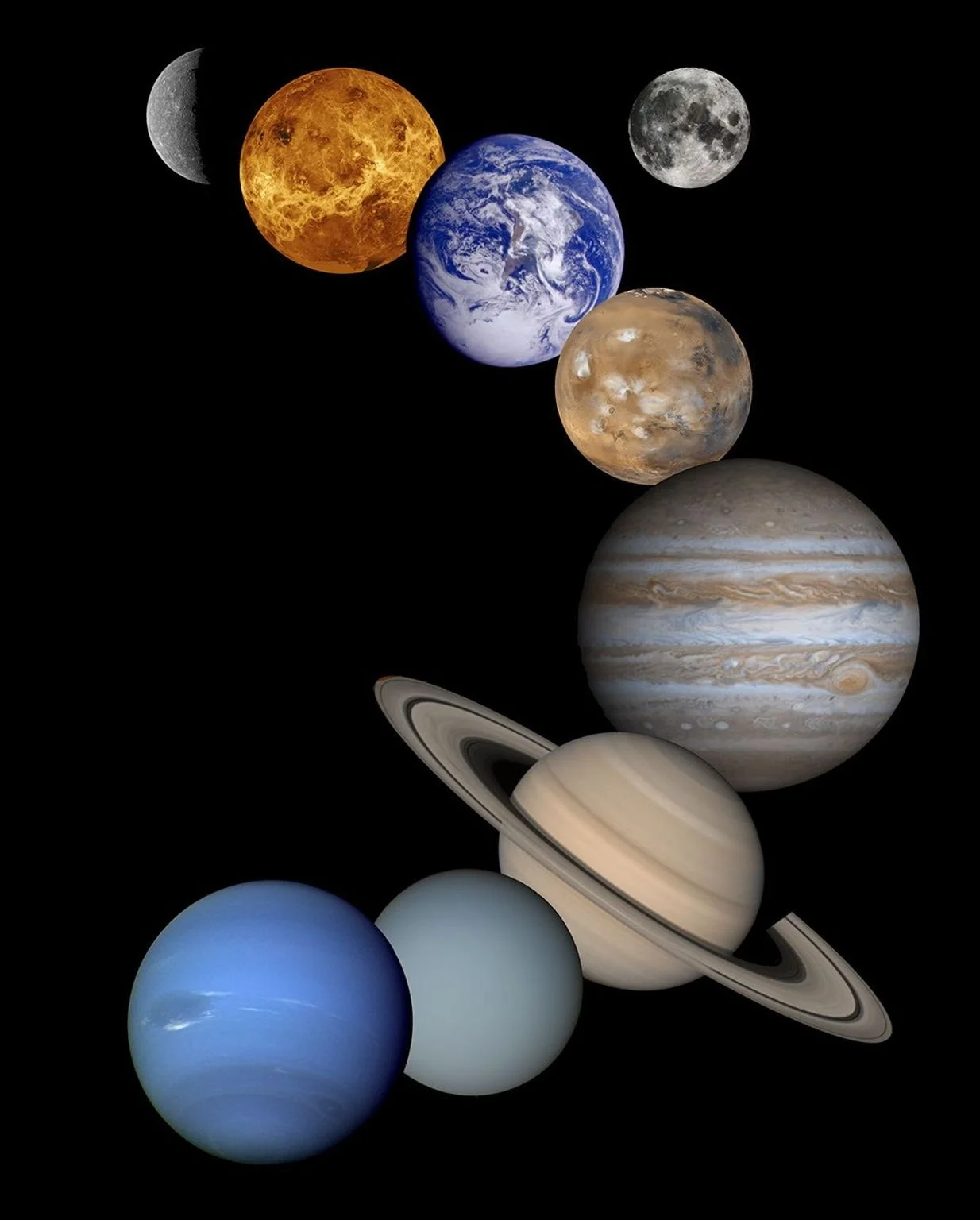
The wanderers as worlds, seen by spacecraft (NASA/JPL montage PIA03153): Mercury, Venus, Earth and Moon, Mars, Jupiter, Saturn, Uranus, and Neptune. Your eyes meet these same worlds as five steady points of light — Venus fierce white, Mars rust-red, Jupiter creamy, Saturn pale gold — with no telescope at all.
NASA/JPL (spacecraft: Mariner 10, Magellan, Galileo, Mars Global Surveyor, Cassini, Voyager), PIA03153, March 29, 2001.
Long before anyone knew what a planet was, people noticed that most of the lights in the sky never change their arrangement. The constellations wheel overhead through the night and through the seasons, but the stars keep their places relative to one another. They were the fixed stars, the reliable ones.
But a few lights refused to keep still. Night after night, week after week, they drifted against the background stars, sometimes moving forward, sometimes pausing, sometimes even looping backward. The Greeks called them asteres planetai, the wandering stars, from planan, to wander. Our word "planet" comes straight from that Greek root.
★ The ancients actually counted seven wanderers, not five: the sun, the moon, and the five bright planets Mercury, Venus, Mars, Jupiter, and Saturn. The sun and moon visibly move against the stars too, the sun along its yearly path and the moon through its monthly journey, so they earned the name as honestly as the rest. The five this lesson studies are the ones that are planets in the modern sense: worlds orbiting the sun. The sun and moon got promoted, in a manner of speaking, to their own lessons.
Check in: What does the Greek word planetes mean — and why did the ancients count seven wanderers when this lesson studies five planets?
❦ In your workbook: record the seven wanderers in your own way — the fixed stars, the lights that refused to keep still, and why the sun and moon once counted among them — copy, sketch, or note what matters.
The first planet watchers
The Babylonians were among the most patient sky watchers in history. In the great omen series Enuma Anu Enlil, the Venus Tablet of Ammisaduqa records the appearances and disappearances of Venus, its first and last visibilities before sunrise and after sunset, across a period of 21 years. The tablet that survives in the British Museum is a seventh-century BCE copy, but scholars believe the observations themselves were first compiled during the reign of King Ammisaduqa, around 1650 BCE. That is more than three and a half thousand years of someone writing down, night after night, where Venus was. The lesson of the tablet is the lesson of this whole course: prediction began as patience. (Cross-class: Runes Lesson 1 reads the cuneiform writing on tablets like these; this lesson reads what the writing was for.)
★ The Greeks gave the wanderers their lasting name, and they also gave Venus its most famous identity puzzle. Venus appears sometimes in the east before dawn and sometimes in the west after sunset, and for a long time it was treated as two different stars. The morning one was called Phosphorus or Eosphorus, the bringer of light; the evening one was Hesperus, the star of evening. Homer mentions them both. Tradition credits Pythagoras with the realization that the two were one planet, though some ancient sources give the credit to Parmenides instead. Either way, it was an early triumph of record-keeping over first impressions: the same light, watched long enough, gave itself away.
❦ In your workbook: record the first watchers in your own way — the Venus Tablet's 21 years, patience becoming prediction, and the morning star and evening star proved one — copy, sketch, or note what matters.
What the ancients called them
The names we use today come from Rome. The Romans named the planets for their gods: Mercury for the swift messenger, always darting near the sun; Venus for the goddess of love and beauty, the brightest and loveliest; Mars for the god of war, red as blood; Jupiter for the king of the gods, the largest and most stately; Saturn for the old god of the harvest and of time, the slowest and faintest of the five, farthest out.
The Romans were not the only ones naming. The Babylonians linked Venus with Ishtar, their great goddess. Chinese astronomers named the five for the five elements: Mercury the water star, Venus the metal star, Mars the fire star, Jupiter the wood star, Saturn the earth star. Every culture that watched the sky found its own names for the wanderers, because every culture could see them. They belonged to everyone.
❦ In your workbook: record the names in your own way — Rome's gods, Babylon's Ishtar, and China's five elements matched to the five wanderers — copy, sketch, or note what matters.
Uranus, the one they missed
There is a sixth planet just barely visible to the naked eye: Uranus. On a very dark night, a keen-eyed observer under perfect conditions can glimpse it, but it looks exactly like a faint star, and it moves so slowly that no ancient observer ever caught it wandering. It was not recognized as a planet until William Herschel found it with a telescope in 1781. The ancients were not careless. They simply watched with their eyes, and their eyes gave them five. (Unit III, Lesson 16 will tell the full story of Uranus and Neptune, the planets that needed glass to be found.)
❦ In your workbook: record the one they missed in your own way — why Uranus escaped three thousand years of watchers, and the year the telescope found it — copy, sketch, or note what matters.
The Mechanism
Why planets do not twinkle
Twinkling is not something stars do. It is something Earth's atmosphere does to starlight. Starlight crosses roughly a hundred kilometers of moving, turbulent air on its way to your eyes, and that air bends the light this way and that. The bending is called scintillation, and you met the word in Lesson 1. Because a star is enormously far away, it arrives at your eye as effectively a single point of light, and the atmosphere's shivering bends that whole point at once. The result is the twinkle.
★ A planet is enormously closer. Even to the naked eye, a planet is not a point. It is a tiny disk, a small round face of reflected sunlight, tens of arcseconds across where a star is a fraction of one. Light reaches you from the top edge of that disk, the bottom edge, and every point between, and each little bundle of light passes through a slightly different patch of turbulent air. One bundle is bent one way while another is bent another way, and the variations average out. The planet's light arrives steady, the way a crowd's murmur stays steady even while individual voices rise and fall.
That is the whole secret of the twinkle test, and it is the single most useful planet-finding skill you will ever learn. Find a bright light in the sky and stare at it. If it shivers and sparkles, it is a star. If it shines with a calm, steady light, it is very likely a planet. Two honest cautions go with the rule. First, very close to the horizon, where starlight and planet light both plow through the thickest air, even planets can wobble and flash colors. Compare lights at similar heights above the horizon. Second, a steady light low in the sky could also be an airplane, which blinks and moves. Watch for a minute. Airplanes announce themselves. Planets do not.
Check in: A bright light shines calm and steady while the lights around it shiver and sparkle. What is it likely to be, why does its light behave differently — and what are the rule's two honest cautions?
❦ In your workbook: record the twinkle test in your own way — point against disk, the averaging crowd, and the two cautions that keep the test honest — copy, sketch, or note what matters.
The highway in the sky
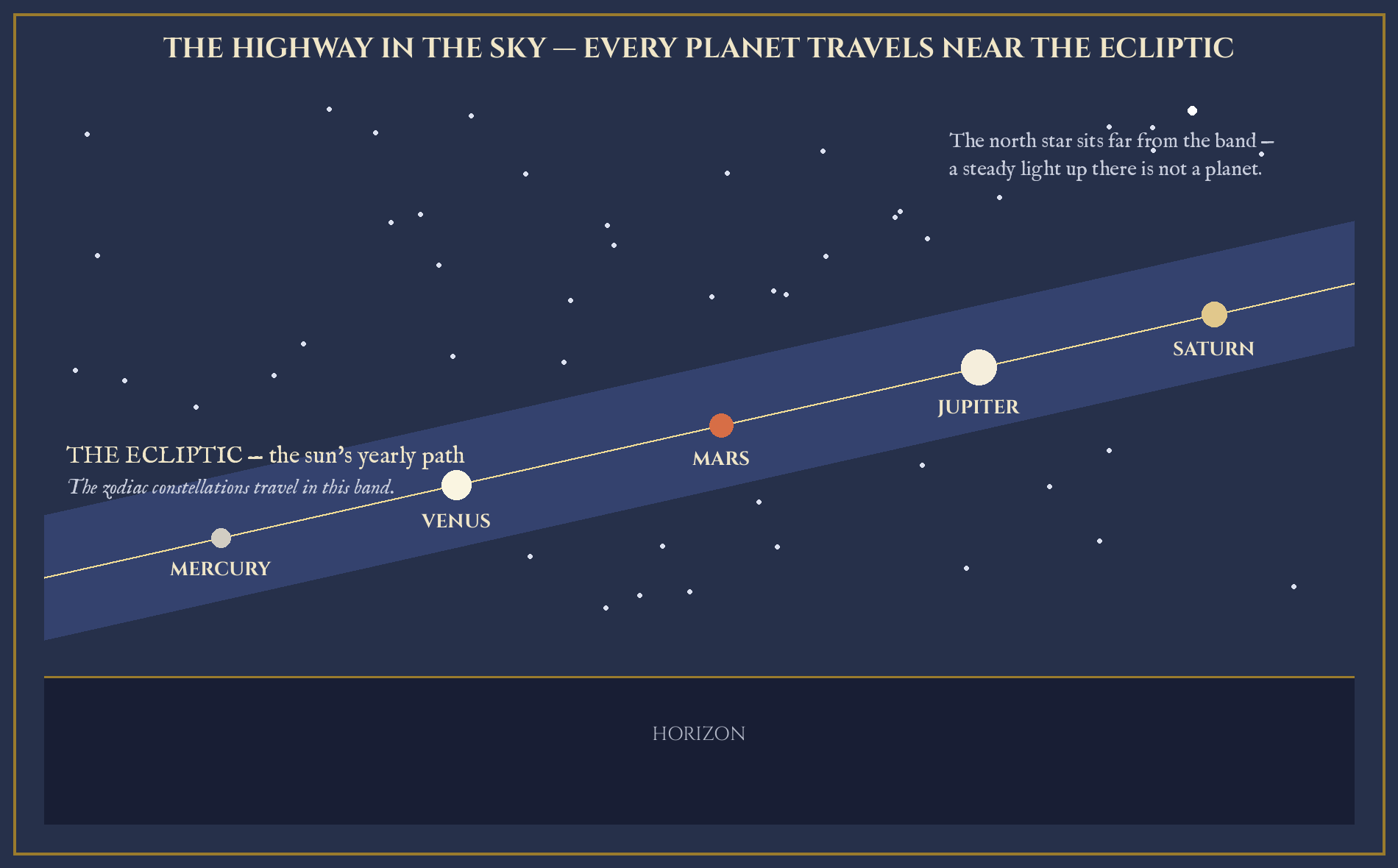
The highway in the sky: every planet travels near the ecliptic, the sun's yearly path, inside the zodiac's band. A steady, bright, untwinkling light far from that band — up near the north star, for instance — is probably not a planet.
Built digitally for this overhaul (Python/PIL, Cinzel and IM Fell English labels), from the geometry taught in the lesson text.
There is a second test, and it is just as powerful. Planets do not appear just anywhere. Every planet in our solar system orbits the sun in nearly the same flat plane, the plane of Earth's own orbit, because all of them formed from the same spinning disk of gas and dust. From our seat on Earth, that plane draws a line across the sky: the ecliptic, the sun's apparent yearly path, which you mapped in Lesson 3.
★ So the planets travel along the ecliptic like wagons on a road. The road has some width, because the orbits are not perfectly flat: Mercury's orbit is tilted the most, about seven degrees, and the others less. But no naked-eye planet ever strays far from the ecliptic's band. If you see a steady, bright, untwinkling light far from the ecliptic, up near the north star or down near the southern horizon's odd corners, be suspicious. If it sits in the band where the sun, moon, and zodiac constellations travel, you may have found a wanderer.
This is why the constellations of the zodiac matter to planet hunters. The zodiac is the belt of constellations the ecliptic passes through, the sun's yearly road and the planets' road alike. Learn which constellations the ecliptic crosses in the current season, and you will know where to search.
❦ In your workbook: record the highway in your own way — one flat plane, one line across the sky, and why a steady light far from the band fails the second test — copy, sketch, or note what matters.
Brightness, and how astronomers measure it
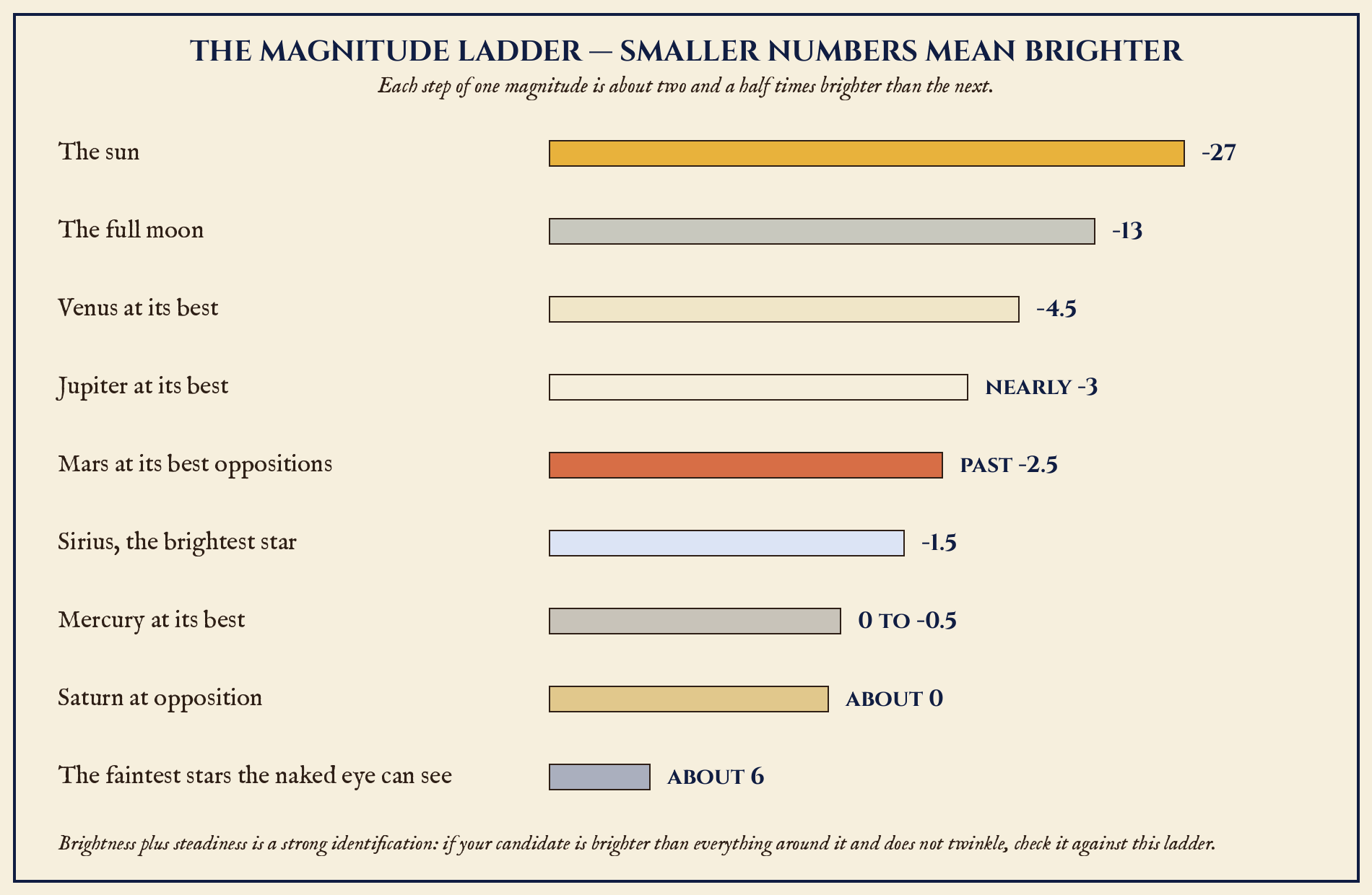
The magnitude ladder, in the lesson's own numbers: smaller means brighter, each step about two and a half times the next. Against this scale the planets are royalty — Venus at −4.5 far outshines Sirius at −1.5 — and brightness plus steadiness is a strong identification.
Built digitally for this overhaul (Python/PIL, Cinzel and IM Fell English labels), from the figures taught in the lesson text.
Astronomers measure apparent brightness on the magnitude scale, which began with the Greek astronomer Hipparchus sorting stars into six classes, the brightest as first magnitude and the faintest visible as sixth. The modern scale keeps his direction: smaller numbers mean brighter, and the scale runs past zero into negatives for the brightest objects. Each step of one magnitude is about two and a half times brighter than the next. The sun is about magnitude negative 27. The full moon is about negative 13. The brightest star in the night sky, Sirius, is about negative 1.5.
★ Against that scale, the planets are royalty. Venus at its best reaches about magnitude negative 4.5, far brighter than any star. Jupiter reaches nearly negative 3. Mars, at its best oppositions, can pass negative 2.5 and outshine Jupiter. Mercury, at its best, glows around magnitude zero to negative 0.5, brighter than most stars. Saturn, the faintest of the five, still reaches about magnitude zero at opposition, about as bright as a bright star. If your candidate "star" is brighter than everything around it and does not twinkle, check it against this ladder. Brightness plus steadiness is a strong identification.
❦ In your workbook: record the ladder in your own way — Hipparchus's six classes, smaller meaning brighter, and where each of the five planets stands against Sirius — copy, sketch, or note what matters.
Where each wanderer can be
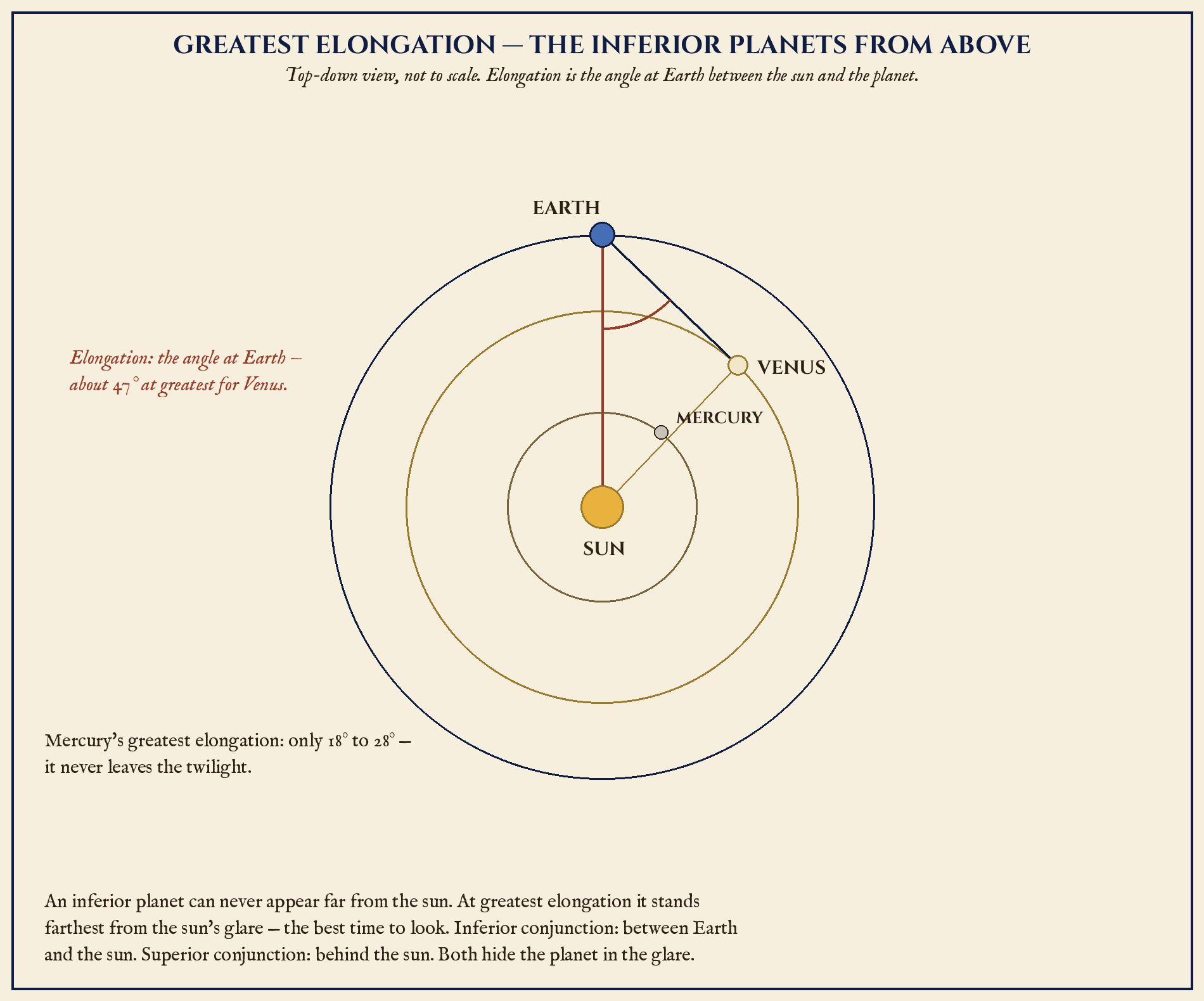
Greatest elongation, from above (not to scale): Earth looks toward the sun along one line and toward Venus, tangent to Venus's orbit, along another — the angle between them is the elongation, about 47° at greatest for Venus and only 18° to 28° for Mercury. Inferior conjunction puts the planet between Earth and the sun; superior conjunction, behind it; both hide it in the glare.
Built digitally for this overhaul (Python/PIL, Cinzel and IM Fell English labels), from the geometry taught in the lesson text.
The five planets fall into two families, and the families behave differently in the sky.
★ The inferior planets: Mercury and Venus. Inferior means closer to the sun than Earth is. Because they orbit inside Earth's path, they can never appear far from the sun in our sky. They are twilight planets: you see them low in the west after sunset or low in the east before dawn, never high overhead at midnight. The angle between the planet and the sun, as seen from Earth, is called elongation, and the farthest an inferior planet ever gets from the sun is its greatest elongation. For Venus that is about 47 degrees, nearly a sixth of the sky, which is why Venus can hang high and bright in a dark sky. For Mercury it is only 18 to 28 degrees, varying because Mercury's orbit is quite eccentric, which is why Mercury is always tangled in twilight and so much harder to catch.
When an inferior planet passes between Earth and the sun, that is inferior conjunction, and it vanishes into the sun's glare. When it passes behind the sun, that is superior conjunction, and it vanishes the other way. Between those vanishings, Venus spends roughly nine months as the evening star, setting after the sun in the west, then about nine months as the morning star, rising before the sun in the east. Mercury does the same dance in miniature, switching sides of the sun several times a year, never lingering long.
★ The superior planets: Mars, Jupiter, and Saturn. Superior means farther from the sun than Earth is. These can appear anywhere along the ecliptic, including high overhead at midnight. Their great moment is opposition, when Earth passes directly between the planet and the sun. At opposition the planet rises at sunset, stands highest around midnight, sets at sunrise, and is up all night. It is also at its closest to Earth and its brightest for the year, fully lit as seen from our side. Mars comes to opposition about every 780 days, roughly every two years. Jupiter and Saturn each come to opposition about once a year, Saturn's cycle running about 378 days.
The opposite arrangement is conjunction with the sun, when the planet passes behind the sun from our view and is lost in the glare for a few weeks. Between oppositions, the superior planets drift eastward against the stars most of the time, but around opposition they appear to slow, stop, and loop backward for a while. That backward loop is retrograde motion, and it gets its own lesson: Lesson 13 will show you exactly why it happens and how two rival models of the universe each tried to explain it.
Check in: Why can Mercury never stand high overhead at midnight — and what happens, hour by hour and in brightness, when a superior planet reaches opposition?
❦ In your workbook: record the two families in your own way — twilight planets against all-night planets, elongation and the two conjunctions, and opposition as the superior planets' great moment — copy, sketch, or note what matters.
Meeting the five
Venus, the brilliant one. Look for the brightest light in the twilight sky, low in the west after sunset or low in the east before dawn. Venus at its brightest is about magnitude negative 4.5, and there is nothing else in the sky that comes close except the moon. It does not twinkle. Its light is a steady, white, almost fierce glow, and on a truly dark night it can cast a faint shadow. Venus is so bright because it is near us and because its thick clouds reflect most of the sunlight that strikes them, a property astronomers call high albedo, which you studied on the moon in Lesson 11. When you find a light and your first thought is "that cannot be a star, it is too bright," it is Venus. Check which side of the sun it is on: west after sunset means evening star, east before sunrise means morning star.
★ Mars, the red one. Look for the color. Mars glows a distinct rusty red-orange, and nothing else bright in the sky shares it. The color comes from iron oxide, literal rust, coating the planet's surface. Mars is at its best around opposition, when it rises at sunset and burns all night, and at the finest oppositions, when Mars is near perihelion, its closest point to the sun, it can outshine Jupiter. Between oppositions it is smaller and dimmer, sometimes just a modest red spark. If the red light you found is bright and high at midnight, check whether Mars is near opposition this month. If it is dim, it may be Mars far from opposition, and that is still Mars, worth logging.
Jupiter, the steady giant. Look high. Jupiter is the largest planet, and it is usually the brightest object in the night sky after Venus and the moon, reaching nearly magnitude negative 3 at opposition. Its light is a calm, creamy white, and it holds its place among the stars with a stately slowness, taking nearly twelve years to circle the zodiac. When you see a brilliant white light that does not twinkle, sitting well up in the sky at a dignified height, think Jupiter first. Lesson 16 will introduce its four great moons, which sharp eyes and steady binoculars can sometimes catch.
Saturn, the golden one. Look for the color and the modesty. Saturn shines with a pale golden light, steadier and dimmer than Jupiter, about as bright as a bright star at opposition, near magnitude zero. The golden hue comes from hazes high in its atmosphere. Saturn moves the slowest of all, taking nearly thirty years to circle the sky, so from month to month it barely seems to move at all. Its famous rings are a Level Two sight, needing a telescope, but the golden color is a naked-eye signature. If you find a steady golden light where the charts say Saturn should be, you have found it. Patience is the whole skill with Saturn. It rewards the watcher who comes back.
Mercury, the elusive one. Look low, and look quickly. Mercury never strays far from the sun, so you will only ever find it in twilight: low in the west just after sunset during its evening appearances, low in the east just before sunrise during its morning ones. The best time is around greatest elongation, when it stands farthest from the sun, and even then it is only a modest pale light, whitish, about as bright as a bright star, sitting in the glow near the horizon. You will need a flat, open horizon with no trees or buildings, and you will need to look in the first half hour after sunset or the last half hour before sunrise. Mercury darts around the sun in only 88 days, so it switches from evening to morning and back several times a year. Catching it feels like an accomplishment because it is one. The ancients respected Mercury for exactly this reason: the swift messenger does not wait for slow watchers.
Check in: A steady rusty-red light burns high at midnight, and a pale golden light barely seems to move from month to month. Name each planet, and the character that gives it away.
❦ In your workbook: record the five in your own way — brilliant Venus, red Mars, steady Jupiter, golden Saturn, elusive Mercury, each with the sign you will know it by — copy, sketch, or note what matters.
Putting it together: the identification
Here is the whole method in one place, the way you will actually use it tonight.
First, find a bright light and apply the twinkle test. Stare for half a minute. Twinkling means star. Steady means possible planet.
Second, check the neighborhood. Is it near the ecliptic, in the band where the sun and moon travel? A steady bright light far from that band is probably not a planet.
Third, check the character. Blazing white in twilight: Venus. Rusty red: Mars. Brilliant creamy white, high up: Jupiter. Pale gold, modest: Saturn. Pale and low in twilight near the sunset or sunrise point: Mercury.
Fourth, check the calendar. Is there an opposition this month for Mars, Jupiter, or Saturn? Is Venus a morning or evening star right now? Is Mercury near greatest elongation? A sky calendar, a planetarium app, or the skywatching pages in Further Reading will tell you, and the habit of checking is half the craft.
Three tests agreeing is an identification. Log it.
❦ In your workbook: record the method in your own way — twinkle test, neighborhood, character, calendar, in that order — copy, sketch, or note what matters.
In your packet: Exercise III: Tonight's Planets Forecast ◐ begins here — its calendar check is this section's fourth step, worked for the whole month. Work it now, or mark the place and take it as homework — your choice.
A Sealed Note on the Steady Ones
Scholars sometimes ask me why I love the planets more than the stars. It is not that I do not love the stars. I am a bat who flies at night. The stars are my ceiling and my company.
But the stars are far away, and their light is old, and they keep their distance. The planets are neighbors. When you look at Venus in the west after sunset, you are looking at a world you could reach, a place with weather and mountains under those clouds. When you look at Mars, you are looking at rust, actual rust, on another world, red for the same reason an old nail is red. The steadiness of their light is the steadiness of nearness. They do not twinkle because they are close enough to be real to your eyes.
There is a lesson in that which has nothing to do with astronomy. The things closest to you are the steadiest lights you have. The faraway things shimmer and dance and are beautiful, and they are also, always, a little unreliable. Trust the steady ones. Watch them the way the Babylonians watched Venus: night after night, writing it down, until the pattern shows itself.
Your eyes are good enough for this science. They were good enough for three thousand years of watchers before you.
❦ In your workbook: record the sealed note in your own way — neighbors against faraway lights, steadiness as nearness, and the Babylonian habit of writing it down — copy, sketch, or note what matters.
PROFESSOR VESPER GLIMMERWICK
Celestial Studies
Astronomer & Celestial Historian
Guided Observation
Try It Tonight
Part One: The Twinkle Test
Go outside with your adult on a clear night. Give your eyes ten minutes to adjust to the dark. Now pick the five brightest lights you can see and study each one for a full minute.
For each light, record: where it is (which direction, how high), whether it twinkles or shines steadily, and what color it seems to be. Rank your five from twinkliest to steadiest. The steadiest one or two are your planet candidates. Do not decide which planet yet. Just notice the difference. Most scholars are startled by how obvious it is once they look for it.
Level Two: If you have binoculars, compare the steadiest and the twinkliest through the lenses. The planet will resolve as a tiny, steady disk. The star will remain a point, dancing.
❦ In your workbook: record the twinkle test in your own way — your five lights ranked from twinkliest to steadiest, with direction, height, and color for each — copy, sketch, or note what matters.
In your packet: Exercise I: The Twinkle Test, Written Up ◐ begins here. Work it now, or mark the place and take it as homework — your choice.
Part Two: Meet Two Planets
Using the identification method from The Mechanism and a skywatching resource (see Further Reading), find out which planets are visible this month and where to look. Then go out with your adult and find two of them.
For each planet, log in your Sky Log: the date and time, the direction and height, which planet you believe it is, and the evidence: the twinkle test result, the color, the position near the ecliptic, and what the sky calendar said should be there. If you can, sketch the planet's position relative to two or three nearby stars.
A week later, go out at the same time and find one of them again. Sketch its position against the same stars. Has it moved? Against the fixed stars, a week is enough to catch a wanderer wandering, especially for Venus, Mars, or Mercury.
Level Two: With binoculars, try for Mercury near greatest elongation, or try to spot one of Jupiter's moons as a tiny star hugging the planet. Record what the optics add that your eyes could not show.
❦ In your workbook: record the two planets in your own way — each one's evidence, its sketch against the same stars, and what the week showed about its wandering — copy, sketch, or note what matters.
In your packet: Exercise II: The Wanderer Log ◐ begins here. Work it now, or mark the place and take it as homework — your choice.
Part Three: Morning Star or Evening Star
Pick Venus and follow it for a month. Note each week: is it visible after sunset in the west, or before sunrise in the east? How high does it climb before the twilight swallows it? Sketch its height above the horizon once a week from the same spot.
At the end of the month, answer in your workbook: which role is Venus playing right now, morning star or evening star? What does that tell you about which side of the sun it is on? If you keep watching for nine months, you would see it switch. You do not have to wait that long for the lesson. The geometry in The Mechanism already told you why it must.
Check in: Venus stands in the west after sunset this month. Which star is it playing, the morning star or the evening star — and on which side of the sun does that place it?
❦ In your workbook: record the Venus watch in your own way — its weekly heights from the same spot, its role this month, and what the role tells you about its place beside the sun — copy, sketch, or note what matters.
Sky Log Entry
Date and time of observation: _______________
Adult observer present: _______________
Light 1: direction and height _______________ Twinkles or steady? _______________ Color _______________
Light 2: direction and height _______________ Twinkles or steady? _______________ Color _______________
Light 3: direction and height _______________ Twinkles or steady? _______________ Color _______________
Planet candidate 1: which planet, and what is your evidence? _______________
Planet candidate 2: which planet, and what is your evidence? _______________
One-week check: did either planet move against the background stars? Sketch both positions. _______________
Venus watch: morning star or evening star this week? _______________
❦ In your workbook: record the Sky Log entry in your own way — your three lights, your two candidates with their evidence, the one-week movement check, and this week's Venus watch — copy, sketch, or note what matters.
Materials
Required (Level One — household items)
- Your Sky Log and a pencil for the twinkle test, the planet log, and the one-week movement check.
- A flashlight for night observing (a red filter or dim setting protects night vision).
- Warm clothing and sturdy shoes: planet hunting means standing still in the dark, which gets cold fast.
- A watch or clock so your one-week position check happens at the same clock time.
- A chair or blanket: a comfortable watcher is a patient watcher.
Suggested (Level Two — historically closer)
- Binoculars for the Level Two twinkle-test comparison, Mercury hunting, and a possible glimpse of Jupiter's moons.
- A planetarium app or a printed monthly sky calendar for checking oppositions and greatest elongations.
- A red-filter or dim flashlight for preserving night vision while logging.
Reflection Questions
Answer in your workbook, in complete sentences.
- The ancients counted seven wanderers, including the sun and the moon. We count five planets plus the sun and moon as separate kinds of objects. What changed: the sky, or our understanding of it?
- Venus was treated as two different stars, Phosphorus and Hesperus, until record-keeping proved them one. What does that story suggest about the difference between seeing and knowing?
- Why does this lesson insist that a steady light low in the sky is not automatically a planet? What else could it be, and how do you rule the alternatives out?
- The planets all travel near the ecliptic because they formed from the same flat spinning disk. How does that single fact about the solar system's birth still shape what you see on any clear night?
- Which of the five planets would you most want to visit, now that you know its character, and what in this lesson made you choose it?
Workbook Checklist — Lesson 12
In my workbook I have:
- ☐ ranked my five brightest lights from twinkliest to steadiest, each with direction, height, twinkle-or-steady verdict, and color, and named my planet candidates with the parts of the identification method that pointed to each
- ☐ written up the light that fooled me, what corrected me, and my own-words explanation of why the twinkling light twinkles and the steady light does not
- ☐ logged two planets this month with date, time, direction, height, identification, and evidence, and sketched each against two or three nearby stars
- ☐ re-found one planet a week later at the same clock time, sketched its new position against the same stars, and described its movement along the ecliptic
- ☐ ruled my forecast page: this month's evening and morning planets with family, direction, and rough time, the next opposition and greatest elongation dates, my calendar mark, and two sentences on what I expect to see
- ☐ followed Venus week by week and answered, in my workbook, whether it is playing morning star or evening star and which side of the sun that places it
☐ Lesson completed Date: ___ Signature: ___
The Professor's Closing Note
And so the wanderers keep wandering, scholars, whether we watch them or not.
You now know the five by character, the way you would know five neighbors: brilliant Venus, red Mars, stately Jupiter, golden Saturn, and quicksilver Mercury, always hurrying near the sun. You know the twinkle test, which is worth more than any chart. You know the ecliptic road they all travel, and you know the words for where they stand: conjunction, opposition, elongation. You know that "planet" means wanderer, and you know it the way the Greeks knew it, because you have watched one wander yourself.
Next lesson, the wandering gets stranger. Sometimes the planets appear to stop in the sky and walk backward, and two great models of the universe fought over why. You will learn the geometry that settles it, and you will never be fooled by a backward loop again.
Until then: keep your Sky Log honest, keep your adult beside you, and keep looking up. The steady lights are waiting.
PROFESSOR VESPER GLIMMERWICK
Celestial Studies
Astronomer & Celestial Historian
Cross-Class Connections
Runes · Unit I, Lesson 1 — The Structural Wedge
Tower scholars, the Venus your professor bids you follow for a month was followed for twenty-one years by Babylonian watchers, and their record survives because it was pressed into clay in cuneiform — wedge by wedge, tablet by tablet. Come down to the Runes Classroom and learn that writing from its first wedge: how a shaped reed made the marks in which the wanderers were first written down. Professor Glimmerwick reads what the tablets recorded. Here, we read the tablets.
PROFESSOR THISTLELOOM WEBBLETHORN
Runes & Ancient Writing

Creative Arts · Studio Extension E3 — Models That Move, Built as Machines
Set up square, scholars. Professor Glimmerwick is right that a lamp, a marble, and a bead on a wire will show you greatest elongation — and in my workshop we build that demonstrator to last: a framed base, the bead's arbor turning true in its bearing, the wire's angle set from your own measurement of Venus's 47 degrees. Cardboard teaches the geometry once; a machine teaches it for years. Bring your elongation diagram to my bench, and we will make the wanderers move at true rates under your own hand.
— Professor Cogbranch Timberclank, Creative Arts Workshop
Scrollwork — named in the lesson; no invitation written. Glimmerwick's text above names the medieval planetary tables copied into illuminated manuscripts, but no Scrollwork lesson teaches astronomical manuscripts or planetary tables: the word "planet" occurs in no Scrollwork final at all (the class runs scriptorium tools → inks → nibs → scripts → page craft → seals, archives, and ciphers → capstone), so there is no destination lesson to invite to. The connection stands as the lesson's own prose mention above.
Herbology — named in the lesson; no invitation written. Glimmerwick's text above names the old planting lore tied to the moon and the planets, treated as belief-history, but no Herbology lesson teaches that lore: the word "moon" occurs in no Herbology final at all, so there is no destination lesson to invite to. The connection stands as the lesson's own prose mention above.
History of Magic — named in the lesson; a future class. The final names it as a class that has not opened its doors; there is no lesson to link and no professor to invite. The mention stands exactly as sourced.
Further Reading & Sources
These are real destinations for further study. Start with the skywatching pages: they will tell you which planets are up tonight, which is exactly what this lesson's practical work needs.
- EarthSky: Mercury After Sunset, greatest elongation October 2026, with finding charts and magnitude notes. https://earthsky.org/tonight/mercury-after-sunset-greatest-elongation-east/
- EarthSky: Venus at Its Brightest, greatest brilliancy explained, with 2026 dates. https://earthsky.org/astronomy-essentials/venus-brightest-greatest-brilliancy-greatest-illuminated-extent-2/
- IFLScience: Why Do Stars Twinkle But Planets Don't, the point-source versus disk explanation. https://www.iflscience.com/why-do-stars-twinkle-but-planets-dont-77772
- Science Notes: Why Do Stars Twinkle But Planets Do Not, with the low-horizon exception. https://sciencenotes.org/why-do-stars-twinkle-but-planets-do-not/
- Wikipedia: Venus Tablet of Ammisaduqa, the 21-year Venus record and its 7th-century BCE copies. https://en.wikipedia.org/wiki/Venus_tablet_of_Ammisaduqa
- Phys.org: Venus Rules the Dusk Skies at Greatest Elongation, elongation geometry and magnitude notes. http://phys.org/news/2017-01-venus-dusk-greatest-elongation.html
- Astronomy Now: Mars Comes to Opposition, the 780-day cycle and opposition viewing. https://astronomynow.com/2022/12/05/mars-comes-to-opposition-and-is-occulted-by-the-moon/
- Astronomy Magazine: Observe Jupiter and Saturn at Their Best, opposition magnitudes and naked-eye sightings. https://www.astronomy.com/science/observe-jupiter-and-saturn-at-their-best/
- Space and Telescope: Saturn at Opposition 2026, what opposition means and how often it comes. https://spaceandtelescope.com/saturn-at-opposition-2026/
Browse the Celestial Studies shelf in the school Library for readable editions of these works.
Submit Your Work
When your Lesson 12 work is complete, submit it through the Submit Your Work form at the foot of this page: your scholar's name, your house (Septentrio / Oriens / Meridies / Occidens / Not sorted yet), this lesson (Unit III, Lesson 12 — The Naked-Eye Planets), a photo of your work — your twinkle-test ranking, your two-planet Wanderer Log with its one-week movement sketches, or your month's planets forecast page — and, if you wish, the permission-to-display checkbox so your work can appear in the school galleries.
Submit your work for this lesson using the form below.
CONTINUE IN THE CELESTIAL TOWER
← Previous · Lesson 11: The Moon Up Close Next · Lesson 13: Retrograde & the Model Wars →
Unit III — The Wanderers Celestial Tower — All 33 Lessons
The rest of Unit III: Lesson 13 · Retrograde · Lesson 14 · Venus · Lesson 15 · Mars · Lesson 16 · The Giant Worlds · Lesson 17 · Pluto