
CELESTIAL STUDIES
Unit III · Lesson 15Mars, the Red Wanderer
PROFESSOR VESPER GLIMMERWICK
Celestial Studies
Astronomer & Celestial Historian
Professor's Introduction

Another night, another sky, scholars. Tonight we visit the most storied planet in the sky.
For four thousand years, Mars has been the color of blood in the night, and humans have told blood-colored stories about it: war gods, invaders, dying civilizations, faces staring back from the dust. Mars is the only planet that has headlined a thousand novels, the only one with its own invasion genre, and for most of that storytelling the planet itself was a distant red point too small to contradict anybody.
This lesson is about what happened when we finally got close enough to check. It is about a real Italian astronomer whose honest Italian word was mistranslated into a fantasy, an American astronomer who spent twenty years mapping rivers that never existed, a small spacecraft that proved him wrong, a famous face that turned out to be a hill, and five brave little rovers that are still rewriting the story of water on another world.
The lesson of Mars is not that people were foolish. The lesson is that wanting is not seeing, and that the truth, once we earned it, was better than the fantasy. The canals were never built. But what the rovers found may be more wonderful than canals ever were.
PROFESSOR VESPER GLIMMERWICK
Celestial Studies
Astronomer & Celestial Historian
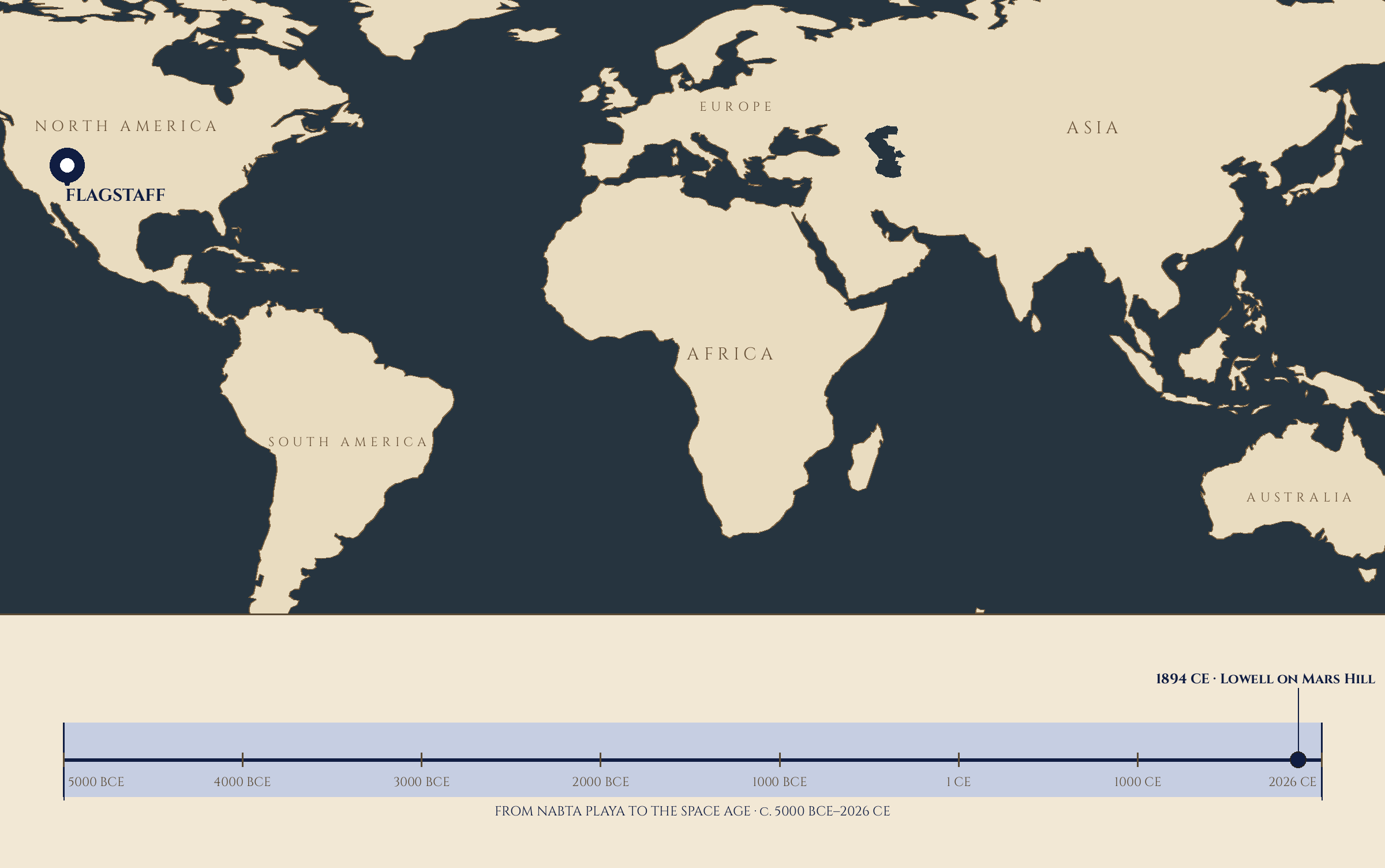
Where and when: LOWELL OBSERVATORY, FLAGSTAFF (label: FLAGSTAFF), 1894 CE · Lowell on Mars Hill (year 1894) — Mars, the Red Wanderer. The pin is this lesson. The line beneath the map is our road: every stop a moment when watching the sky changed, every lesson a pin upon it.
Lesson Objectives
By the end of this lesson, you will be able to:
- Explain why Mars looks red: iron-rich dust rusting across the whole planet, and what the newest research says about that rust.
- Define an opposition and explain, with Mars's eccentric orbit, why the planet's brightness swings so dramatically from one apparition to the next.
- Retell the canal story in full: Schiaparelli's canali, the mistranslation, Lowell's conviction, and the evidence that ended it.
- Describe the Face on Mars episode: what was photographed, why it looked like a face, and what sharper images revealed.
- Name the five NASA rovers and summarize what rovers have actually found: ancient water, ancient lakes, and the carbon chemistry life uses.
- Carry out a brightness watch on Mars across an opposition, estimating magnitude by comparison with nearby stars.
Reading this lesson: ★ marks the passages to remember. They return on the unit quiz and the class test. Check in questions ask the material back as you go; answer them in your workbook when you meet them.
Working this lesson: Your assignment packet is the first download on this page. Work in it as the lesson moves along, answering each exercise as its subject is taught — or read the lesson through for your notes and take the exercises as homework afterward. Both are proper ways to sit this class. Signposts in the reading tell you where each exercise belongs. Written answers are short answers in your own words; a few honest lines are worth more than a filled page.
Your Assignment Packet
This lesson's exercises live in its packet: the Lexicon Handout (every term, course terms marked ◆), Materials, Guided Practice, the Assignment Manual with its answer key for self-checking, the Reflection Questions, and the Workbook Checklist. Download the packet before you begin and keep it beside you as you read. The packet's exercises are Glimmerwick's own word for the work: Exercise I: The Opposition Log ◐, Exercise II: The Eye That Draws Lines ⚒, and Exercise III: Rover Report ✎. The lesson's quiz is not printed in the packet; it pools to the Unit III Quiz, where it will meet you again.
Safety Briefing
- Night observing is always done with an adult present. This is a standing rule of the Celestial Tower, and it has no exceptions.
- Observe from safe, familiar locations: your own yard, a trusted neighbor's garden, or a familiar spot your family already uses. Never wander to unfamiliar or unlit places at night.
- Mars is best observed late at night near opposition, so plan your session like an expedition: tell someone where you will be, dress more warmly than you think you need, and bring a red-covered flashlight to protect everyone's night vision.
- Level Two: binoculars and telescopes are for night observing only. Never point them at or near the sun, not even for a moment. Mars itself is perfectly safe to observe, bright but harmless to your eyes.
The Wonder
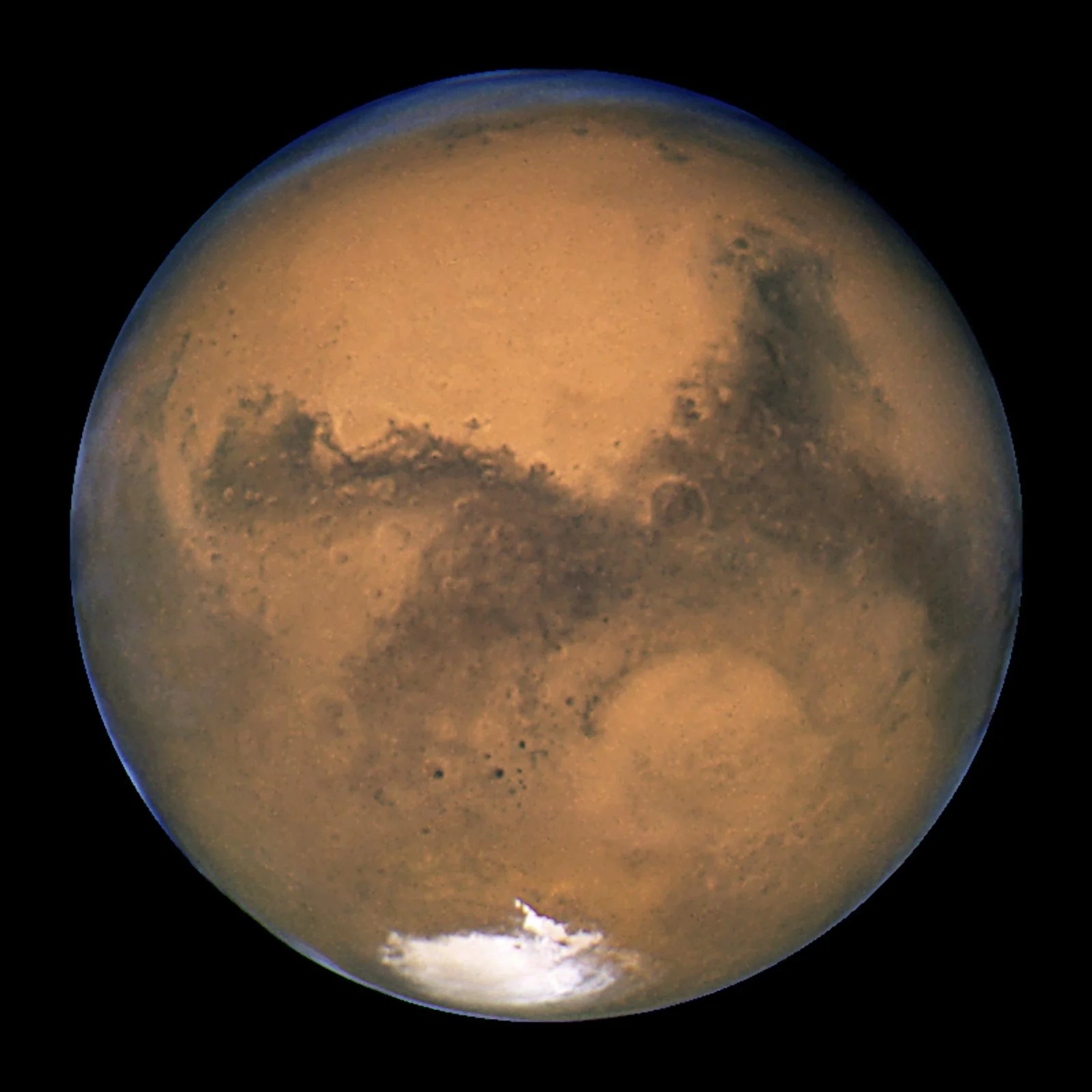
Mars at the great opposition of 27 August 2003, closer than it had been in nearly 60,000 years — the ember at its brightest, with Syrtis Major dark across its face.
NASA, ESA, and the Hubble Heritage Team (STScI/AURA) — Public domain, verified on the Commons file page for
Find a clear night and look east after dark for a steady point of rust-orange light that does not twinkle the way stars do. ★ When Mars is near opposition, it outshines every star in the sky: the third-brightest thing in the night after the moon and Venus, and its color is unmistakable, the color of embers, of old blood, of rust.
The ancients saw the same color and named the planet for it. The Romans named it for their god of war, because its redness reminded them of blood. The Egyptians called it "Her Desher," the red one. Four thousand years before any telescope, farmers and priests watched this ember drift among the stars, loop backward in its strange retrograde dance (you mapped that motion in Lesson 13), and return brighter some years than others, as if the god were sometimes angry and sometimes merely watchful.
Here is the wonder that will carry this whole lesson. That red point has been two completely different planets to us: the Mars of our wanting, and the Mars of our knowing. The Mars of our wanting had canals and engineers and a face carved in stone. The Mars of our knowing has rust and riverbeds and robots. Tonight you meet both, and you learn how we told them apart.
❦ In your workbook: record the wonder in your own way — the ember that does not twinkle, the war god and "Her Desher," and the two planets, the Mars of our wanting and the Mars of our knowing — copy, sketch, or note what matters.
The Story
The red wanderer through history
Mars was one of the five wanderers the ancients tracked: Mercury, Venus, Mars, Jupiter, Saturn, the five bright points that refused to stay fixed among the stars. You met them in Lesson 12. Of the five, Mars was the most dramatic, because it changes the most. Some years it is a dim red spark. Other years it blazes. The difference is geometry, and the mechanism section will walk you through it.
What matters for the story is that Mars's redness made it a character before it was a planet: a war god in Rome, an omen star in China, a restless ember in Egypt. When the telescope arrived, that character got a face, or rather several faces, one after another, each one drawn more by human desire than by Martian geography.
❦ In your workbook: record the red wanderer in your own way — the five wanderers, the dim spark and the blaze, and the character Mars wore before it was a planet — copy, sketch, or note what matters.
The canals
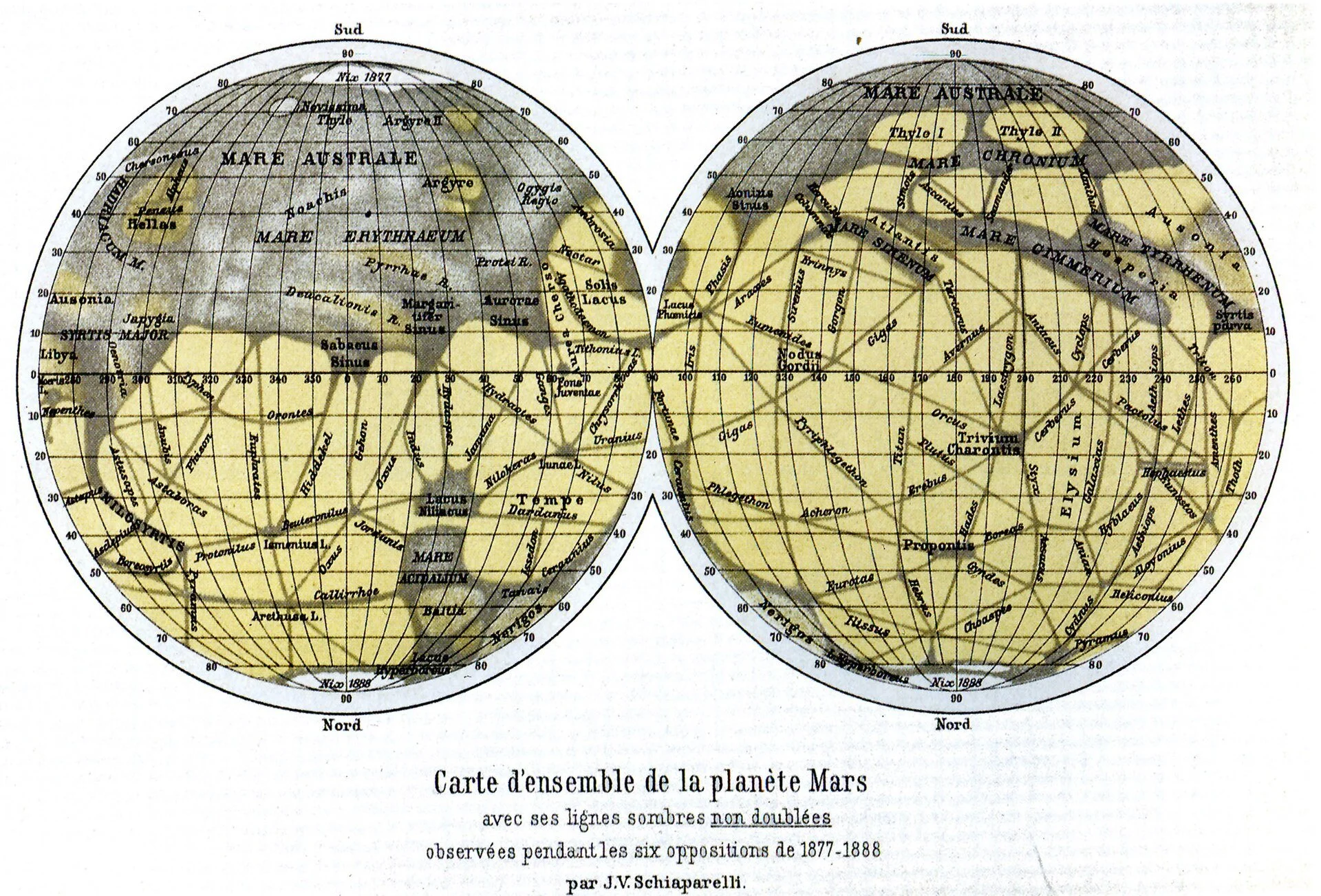
Schiaparelli's map of Mars, drawn from the oppositions of 1877–1888: the canali as he recorded them — channels, he said, of the natural kind.
Giovanni Schiaparelli, 1888 — Public domain, verified on the Commons file page for
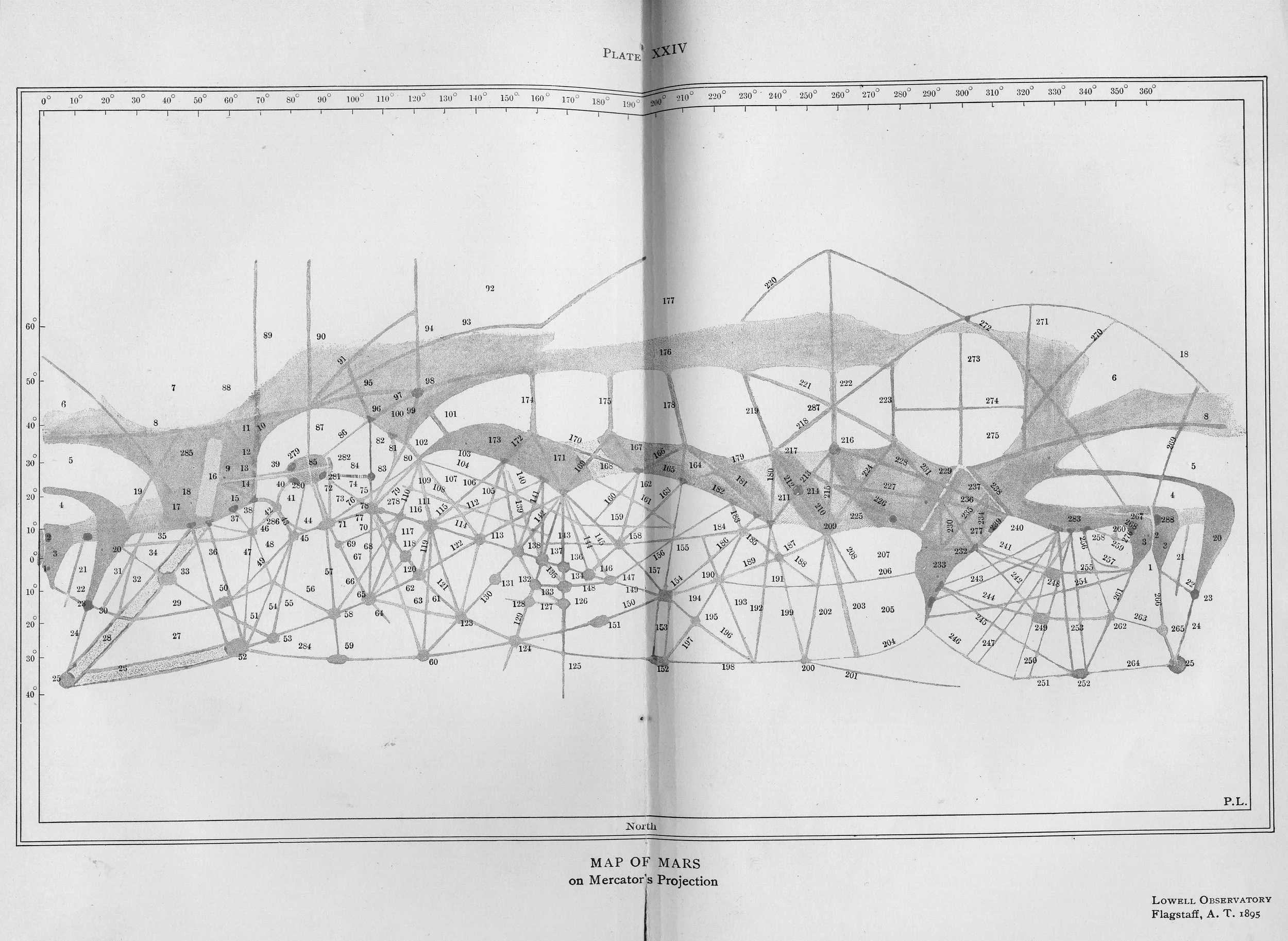
Lowell's Mars, 1895: the canal network ruled across a whole world — geometry a careful man drew from real evenings at the eyepiece, and believed.
Lowell Observatory, Flagstaff, 1895 — Public domain, verified on the Commons file page for
The story begins on September 5, 1877, with a perihelic opposition of Mars, the planet unusually close to Earth. In Milan, the Italian astronomer Giovanni Schiaparelli turned a 22-centimeter refractor on the red disc and began the most detailed map of Mars anyone had ever made. His maps showed long, straight, dark lines crossing the brighter regions. He called them canali.
★ In Italian, canale (plural canali) means channel, duct, or gully. It can also mean canal, the artificial kind, but Schiaparelli meant the natural kind: channels. He named them after famous rivers of Earth and the rivers of the underworld, and he regarded them as natural features of the planet. He never claimed they were built by anyone. That claim came from the translation.
In English, canali became "canals," and a canal is something people build. Other observers picked up the thread. The French astronomers Henri Perrotin and Louis Thollon, working in Nice with one of the largest telescopes of the day, reported seeing some of the lines too. Some astronomers saw them. Many saw nothing at all. The lines sat exactly at the edge of what the telescopes of the 1880s and 1890s could resolve, which is the most dangerous place for an observation to sit: close enough to glimpse, too faint to check.
Then came Percival Lowell.
★ Lowell was born in 1855 into a distinguished Boston family, graduated from Harvard in mathematics, and spent his twenties and thirties in the family business and in diplomacy in the Far East. In 1893, home from years abroad, he decided to pursue the Mars observations that had fascinated him. He spent his own fortune founding an observatory on a hill in Flagstaff, Arizona, chosen for its clear air and steady atmosphere, and had it ready for the favorable opposition of 1894. The hill came to be called Mars Hill, and the Lowell Observatory still operates there today.
Lowell had no trouble seeing the canals. He mapped hundreds of them, drew them as razor-straight lines, measured some at over 30 miles wide and an average of 1,500 miles long, and wove them into a grand theory: Mars was a dying world, its water locked in the polar caps, and an ancient, intelligent, industrious race was keeping itself alive with a planet-wide irrigation system, carrying meltwater from the poles to the equator. He published it in three books, Mars in 1895, Mars and Its Canals in 1906, and Mars as the Abode of Life in 1908, and the public devoured them. H. G. Wells published The War of the Worlds in 1898. Edgar Rice Burroughs sent John Carter to a Mars of dying seas and canal cities. The canals became the furniture of a century of science fiction.
Here is the part this lesson insists on. Lowell was not a fool, and the believers were not fools either. He was a serious, wealthy, disciplined observer working at the limit of his instruments, in an era when Mars genuinely seemed Earthlike: a 24.6-hour day, seasons, polar caps that grew and shrank, dark regions that changed color with the seasons and were read as vegetation. The idea that a dry world would irrigate itself was not absurd in the 1890s; it was an inference from the evidence as it then stood, pushed too far by a mind that had already decided.
And other minds pushed back. In 1907 the British naturalist Alfred Russel Wallace published Is Mars Habitable?, arguing from physics that Mars was far too cold and its air far too thin for Lowell's world to work. In 1909 the great French observer Eugène Antoniadi turned the 83-centimeter telescope at Meudon on Mars during a favorable opposition and saw no canals at all, only irregular mottled markings, exactly what you would expect from a real desert world. Spectroscopes found no water vapor in the Martian air. As telescopes grew larger, the canals grew fewer, which is the opposite of what happens with real features. Real features get clearer. Imaginary ones dissolve.
But the canal idea survived every telescope, because it lived in the public imagination, not in the eyepiece. It took a spacecraft to kill it.
★ On November 28, 1964, NASA launched Mariner 4. On July 14, 1965, it flew past Mars at less than 10,000 kilometers above the surface and sent back 22 photographs: the first close-up pictures of another planet ever taken. They showed a vast, barren, heavily cratered wasteland, more like the moon than like Earth. No canals. No cities. No Martians. The pictures covered only about one percent of the surface, but they covered enough. The canals had been an optical illusion all along: at the limit of resolution, the eye connects scattered dark markings into lines, the way you connect dots into constellations. In 1903, two British experimenters, Joseph Evans and Edward Maunder, had already demonstrated exactly this with schoolboy volunteers: show people scattered dots at the edge of visibility, and they draw lines between them. The canals were drawn by human brains, not Martian engineers.
Lowell died in 1916, never abandoning his belief. History has been kinder to him than the canals were. His observatory went on to do real, lasting astronomy: in 1930, fourteen years after his death, Clyde Tombaugh, working at Lowell Observatory on the search for a predicted outer planet that Lowell himself had set in motion, discovered Pluto. Lowell was wrong about Mars and right that the sky rewards those who look hard. Both things are true, and the lesson holds them both.
Wanting canals did not build them. That is the corrector of this lesson, and you should carry it the way you carry a compass.
Check in: Schiaparelli wrote canali and meant something natural; English heard "canals" and imagined builders. What did Schiaparelli himself claim — and what finally ended the canal story, and in what year?
❦ In your workbook: record the canals in your own way — canali and its mistranslation, Lowell's irrigation world, the skeptics, Mariner 4, and the corrector — copy, sketch, or note what matters.
In your packet: Exercise II: The Eye That Draws Lines ⚒ begins here — it repeats the Evans and Maunder experiment that unmade the canals. Work it now, or mark the place and take it as homework — your choice.
The face
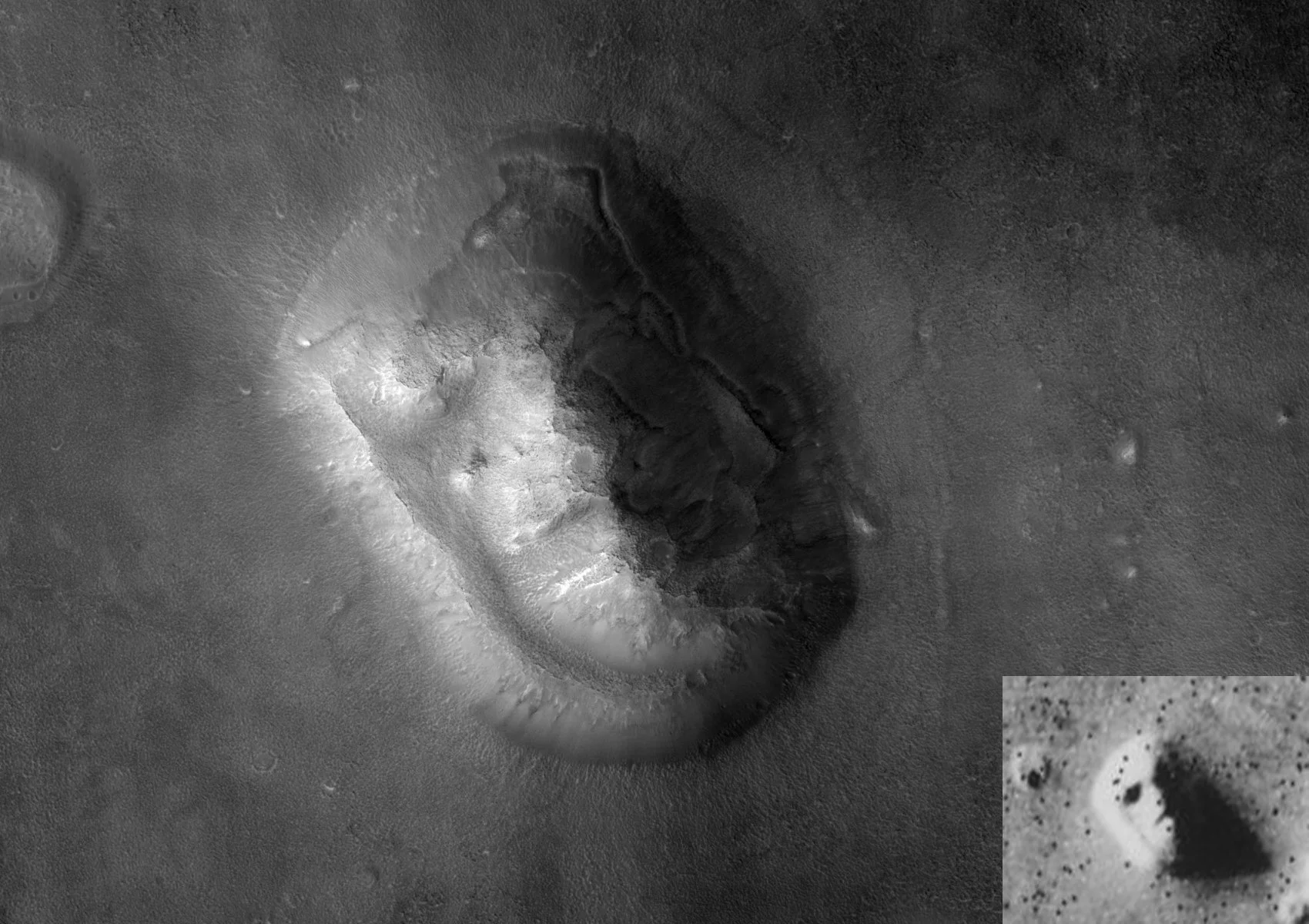
The Face, twice. Inset: Viking 1, 1976 — low resolution and slanting sunlight. Main image: the same Cydonia mesa in HiRISE detail — an ordinary eroded hill.
NASA/JPL/University of Arizona (HiRISE) with the Viking inset — Public domain, verified on the Commons file page for
Eleven years after Mariner 4, Mars played the same trick a second time, and humans fell for it the same way.
On July 25, 1976, the Viking 1 orbiter photographed the Cydonia region of Mars. One image, catalogued as 035A72, showed a mesa — a flat-topped hill — about two kilometers long that looked uncannily like a human face staring up at the camera: two eye-like shadows, a nose ridge, a mouth-like line. Viking's chief scientist, Gerald Soffen, dismissed it at once as a trick of light and shadow. But the image leaked into the public imagination, and the Face on Mars was born. Books were written. A ruined city was imagined around it. The face became the canals of the space age: a story too good to check.
★ This time the check came faster. The Viking image had been taken at a resolution of about 50 meters per pixel, with the sun low and slanting across the mesa, carving deep shadows exactly where eyes and a mouth would be. In 1998 and 2001, NASA's Mars Global Surveyor photographed the same mesa at much higher resolution. In 2007, the HiRISE camera on the Mars Reconnaissance Orbiter photographed it sharper still. The face vanished, image by image, until nothing was left but an ordinary eroded hill, one of thousands in Cydonia, interesting to geologists and to no one else.
The phenomenon has a name you already know from Lesson 11: pareidolia, the mind's habit of finding faces in random shapes. It is the same habit that put a man in the moon and a rabbit beside him. The Face on Mars is the canals' younger sibling: low resolution plus suggestive lighting plus a brain that evolved to spot faces in the forest. The brain did its job. The job was just never meant for Mars.
Check in: The Face and the canals grew from the same root. What did they share — and what extra ingredient, named in this section, does pareidolia add to the second?
❦ In your workbook: record the face in your own way — 035A72, the low sun and the 50-meter pixels, the sharper images of 1998, 2001, and 2007, and the ordinary hill that remained — copy, sketch, or note what matters.
The Mars we actually know

Perseverance in Jezero Crater, 2021: the fifth rover, working the bed of an ancient lake, sealing samples of Mars for a future return.
NASA/JPL-Caltech/MSSS — Public domain, verified on the Commons file page for (delivered as a JPEG edition for the pack)
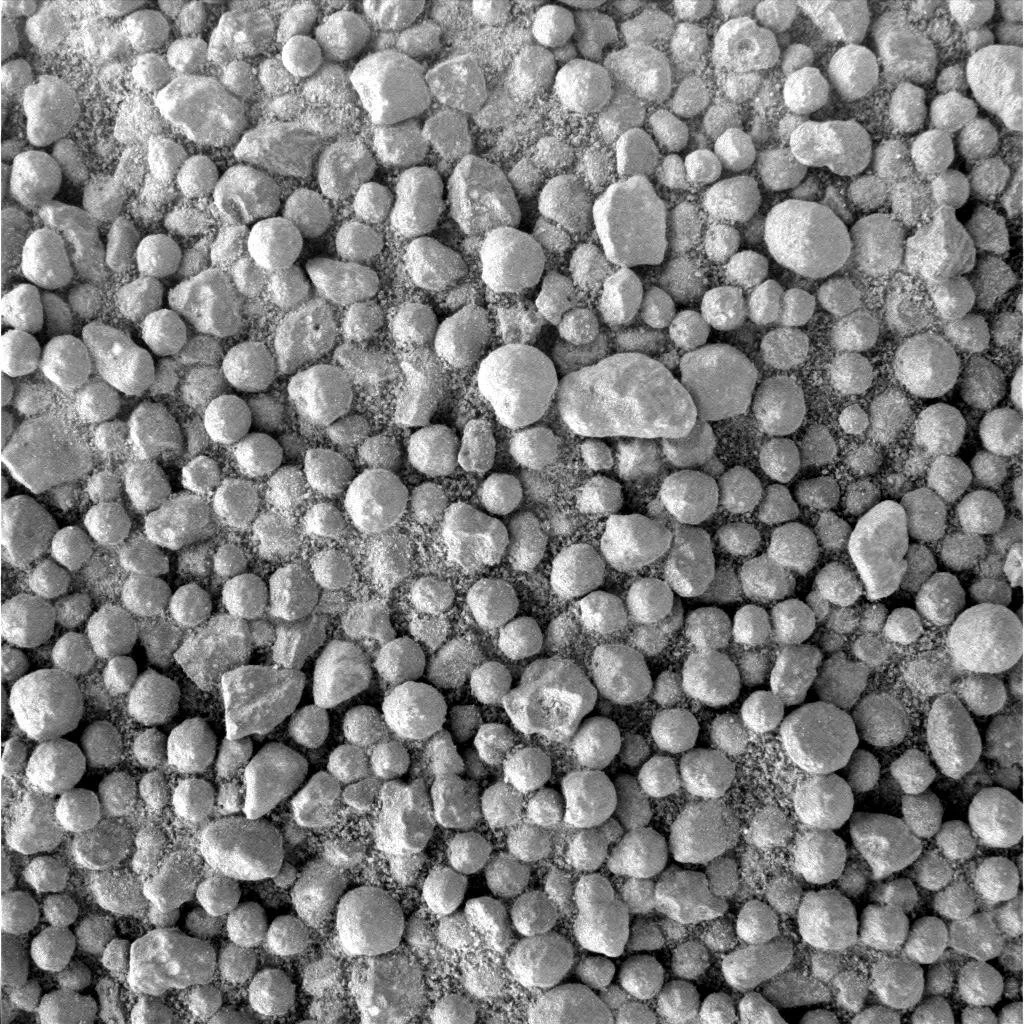
Opportunity's 'blueberries,' 2004: beads of hematite, an iron mineral that on Earth forms in standing water — proof that liquid water once pooled on Mars.
NASA/JPL (Opportunity Microscopic Imager) — Public domain, verified on the Commons file page for
So what is actually there? The honest answer is more interesting than the fantasy, and it took fifty years of robots to earn it.
Mariner 4's cratered wasteland was only the first chapter, and it was slightly misleading in its own way: the spacecraft happened to photograph one of the most heavily cratered regions, so early Mars looked deader than it is. Later orbiters, especially Mariner 9 in 1971, mapped the whole planet and found a world of superlatives: Valles Marineris, a canyon system about 2,400 miles long and up to 5.8 miles deep, the largest canyon in the solar system; Olympus Mons, a shield volcano more than 25 miles high, the tallest mountain in the solar system, its base as wide as the state of Arizona; and everywhere, the dried traces of water: branching valley networks like river systems, lakebeds, deltas.
Then came the rovers, the patient geologists.
- Sojourner (1997). The first rover, no bigger than a microwave oven, rode to Mars aboard the Pathfinder lander and spent three months trundling around its landing site, proving that a rover could work on another world at all.
- Spirit (2004). Landed in Gusev Crater and found silica-rich deposits and minerals that form in hot water, evidence that water had once moved through those rocks.
- Opportunity (2004). Landed on the opposite side of the planet at Meridiani Planum and found tiny round hematite concretions nicknamed "blueberries," laid down in ancient salty water. Designed to last 90 days, it explored for nearly 15 years.
- Curiosity (2012). Landed in Gale Crater, a vast basin with a mountain of layered sediment at its center. It found an ancient lakebed, minerals that formed in drinkable water, and, in 2018, organic molecules preserved in 3.5-billion-year-old mudstone: the carbon chemistry that life uses, surviving from an era when Mars was wet. Not life. The ingredients and the setting.
- Perseverance (2021). Landed in Jezero Crater, chosen because orbiters had spotted an ancient river delta fanning into it: the unmistakable signature of a lake that once stood there. It is studying the delta's rocks and sealing samples in tubes for a future mission to bring home, the first leg of a sample return that would let Earth laboratories examine Mars directly.
★ What the rovers have found, taken together, is a planet that was once warm and wet, with rivers, lakes, and possibly oceans, that lost its water and its thick air and became the cold desert we see. Whether life ever started there, in that long wet chapter, is the open question driving the whole program. The canals were a fantasy about Martians. The riverbeds are evidence about water. The difference between those two sentences is the difference between wanting and knowing, and it is the most important sentence in this lesson.
Check in: Name the five rovers in order, and give one water finding for any two of them. Then state, in the lesson's own terms, what the rovers have not found.
❦ In your workbook: record the Mars we actually know in your own way — the superlatives Mariner 9 found, the five rovers and their water, and the difference between wanting and knowing — copy, sketch, or note what matters.
In your packet: Exercise III: Rover Report ✎ begins here. Work it now, or mark the place and take it as homework — your choice.
The Mechanism
Why Mars is red
★ The redness is rust. That is the whole of it, and it is wonderful.
★ The rocks of Mars are rich in iron, and over billions of years that iron has reacted with water and oxygen in some form, the way an old nail rusts in damp air. The rusted material, iron oxide, was ground down by wind and time into fine dust, and Martian winds have spread that dust across the entire planet, into the air itself. From Earth we see the planet through its own rusty haze, and the disc glows ember-red. Up close, as the rovers' cameras show, the surface holds many colors: browns, tans, golds, even greenish rocks. The red is the dust, and the dust is everywhere.
★ Here is a live edge of the science, and your professor will not pretend it is settled. For years, scientists assumed the rust was a dry kind of iron oxide, a mineral called hematite, formed slowly in the thin modern air. But new research published in February 2025, combining spacecraft observations with laboratory replicas of Martian dust, found that the red color is better matched by a different iron oxide called ferrihydrite, which forms quickly in cool water. If that result holds, Mars rusted early, back when the planet was still wet, and the dust has carried the chemical memory of that water ever since. The redness is not just rust. It may be a fossil of an ocean's chemistry. Science updating itself in public: you will meet this theme again in Lesson 17, and it is a strength, not an embarrassment.
Check in: Why is Mars red — and what does the February 2025 ferrihydrite research suggest about when the rust formed, and in what?
❦ In your workbook: record why Mars is red in your own way — iron, rust, dust spread planet-wide, and the ferrihydrite finding that may make the redness a fossil of water — copy, sketch, or note what matters.
Oppositions, and why Mars can't sit still
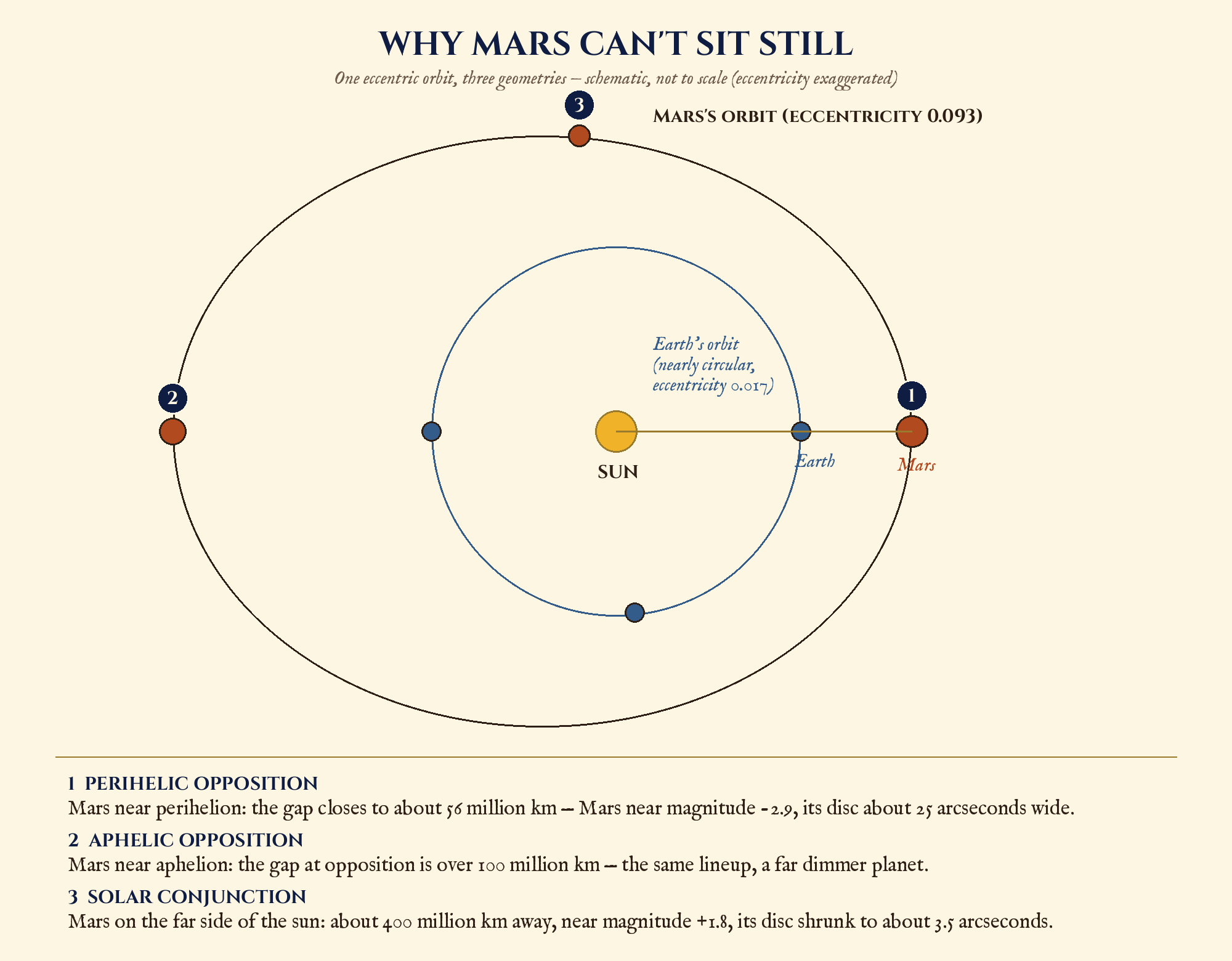
Opposition, perihelion, and the swing: why one Mars blazes and another barely glows. All figures are this lesson's own; the eccentricity is exaggerated so the eye can see it.
Built for this lesson from the lesson's own numbers. No third-party material
Now the geometry that makes Mars the most dramatic planet in the sky.
★ An opposition is the moment when Earth passes directly between the sun and an outer planet, so that sun, Earth, and planet form a straight line. At opposition the planet is opposite the sun in our sky: it rises as the sun sets, climbs high around midnight, and sets as the sun rises, visible all night long. It is also at its closest to Earth for that apparition, so it appears at its largest and brightest. Oppositions are syzygies, the straight-line lineups you studied in Lesson 9.
Earth laps Mars about every 780 days, roughly every 26 months, because Earth moves faster on its inside track. So oppositions come about every two years. But they are not all equal, and the reason is Mars's orbit.
★ Mars's orbit is noticeably eccentric: stretched to an eccentricity of 0.093, against Earth's nearly circular 0.017. Mars swings from about 1.38 astronomical units from the sun at perihelion to about 1.67 at aphelion. When an opposition happens while Mars is near perihelion, the two planets meet at the narrowest gap between their orbits: a perihelic opposition, and Mars can come within about 56 million kilometers of Earth. When opposition falls near Mars's aphelion, the gap is far wider, over 100 million kilometers. And when Mars is on the far side of the sun from us, near conjunction, it can be 400 million kilometers away.
★ That is why Mars changes so much. From its faintest to its brightest, the planet swings through nearly five magnitudes, from about +1.8 at its dimmest to about -2.9 at a great opposition: roughly eighty times brighter at the peak. Its tiny disc grows from about 3.5 arcseconds across to about 25, seven times wider, big enough in a modest telescope to show the white polar cap and the great dark marking called Syrtis Major. Among the bright planets, none varies so dramatically. It is the eccentric orbit doing it, and it is the reason the ancients found Mars so alarming: some years the ember barely glowed, and other years it blazed like a coal.
★ The most famous perihelic opposition in modern times came in August 2003. On August 27, Mars came within 55.8 million kilometers of Earth, the closest approach in nearly 60,000 years, a record that will stand until August 2287. The next comparably close approach comes in 2035. Oppositions near perihelion are the ones that made Schiaparelli's and Lowell's careers possible, and they are the ones your brightness watch wants.
And there is one more motion to fold in, from Lesson 13. In the weeks around opposition, Mars traces its retrograde loop: it appears to slow, stop, and drift backward against the stars, then resume its forward march. It is not backtracking. It is perspective: Earth on the inside track overtaking Mars, the way a faster car seems to make a slower car slide backward. Watch for the loop during your brightness watch. It is the signature that opposition is near.
Check in: One opposition brings Mars within about 56 million kilometers and another leaves it over 100 million away. What single property of Mars's orbit explains the difference — and what happens to the planet's brightness and disc size across that swing?
❦ In your workbook: record the oppositions in your own way — the straight-line lineup, the 780 days, eccentricity 0.093 against 0.017, the 56-to-400-million-kilometer swing, and the retrograde loop that signs it — copy, sketch, or note what matters.
In your packet: Exercise I: The Opposition Log ◐ begins here — the Brightness Watch below is its work. Work it now, or mark the place and take it as homework — your choice.
Why wanting is not seeing
The mechanism of the canals is not Martian. It is human.
A telescope at the limit of its resolution does not draw sharp lines. It smears. Dark markings blur together, the eye hunts for pattern in the blur, and the brain, which is a tireless pattern-finding engine, connects scattered dots into lines. Evans and Maunder proved it in 1903 with schoolboys and paper: give people scattered dots at the edge of visibility and they will draw canals. Lowell, staring for hours through desert air at a disc tinier than a pea held at arm's length, drew what every human visual system draws. His eye was honest. His conclusion was not checked.
Add the mistranslation, and the trap was complete. Canali are channels. "Canals" are works. One word smuggled intention across the Atlantic, and an entire civilization was built on the smuggling. The corrector stands: wanting canals did not build them. Only a spacecraft, going there and looking, could settle it, and the settling is what science is for.
❦ In your workbook: record why wanting is not seeing in your own way — the smear at the limit of resolution, the brain connecting dots, the smuggled word, and the spacecraft that settled it — copy, sketch, or note what matters.
A Sealed Note on Wanting and Seeing
Scholars, I navigate by sound. I send my voice into the dark and listen to what comes back, and I have learned something about perception that I will now give you for free.
Every sense is an interpreter, not a window. My ears build a world out of echoes, and your eyes build a world out of light, and both of us are guessing. Usually the guesses are excellent. Sometimes, at the edge of what the sense can resolve, the guessing takes over, and you start hearing, or seeing, what you expected to find.
Lowell expected engineers. So did thousands of readers who had thrilled to his books. The eye obliged them all. There is no shame in this. The shame would have been in refusing to check.
So check everything, scholars, especially the things you want to be true. Wanting is a fine fuel for the journey to the telescope. It is a terrible lens to look through.
❦ In your workbook: record the sealed note in your own way — every sense an interpreter, the guessing at the edge of resolution, and the rule to check especially what you want to be true — copy, sketch, or note what matters.
PROFESSOR VESPER GLIMMERWICK
Celestial Studies
Astronomer & Celestial Historian
Guided Observation
Try It Tonight
The Brightness Watch
Mars's brightness is the most dramatic slow-motion show in the naked-eye sky, and this is the practical heart of the lesson: track it through an opposition.
- Find the next opposition date. Check a planetarium app, an astronomy magazine's sky calendar, or the almanac tables at your library. Oppositions come roughly every 26 months. If the next one is within a few months, begin your watch now; if it is far off, start a baseline log anyway and note Mars's current modest brightness for comparison later.
- Choose comparison stars. On your first night, find Mars and pick two or three nearby stars, one clearly brighter than Mars and one clearly fainter. Write down their names. (A star chart or app will give you their magnitudes; record those too.)
- Estimate by bracketing. Each clear night, decide: is Mars brighter than star A? Fainter than star B? About equal to star C? Record your estimate as a range, for example "between magnitude 0 and -1, closer to -1." Do not chase false precision; honest bracketing beats invented decimals.
- Log twice a week. For six to eight weeks around opposition, record the date, the time, Mars's constellation, your comparison stars, your brightness estimate, and the sky conditions. Note the color: does the red deepen as it brightens?
- Watch for the loop. While you log brightness, note Mars's position against the background stars once a week. Near opposition you will catch the retrograde loop from Lesson 13: the planet slowing, reversing, and resuming. Mark the turnaround dates in your log.
- Level Two: with binoculars or a small telescope, note the disc itself. Near a perihelic opposition it swells to seven times its smallest size. Look for the brilliant white polar cap and the great dark wedge of Syrtis Major. Sketch the disc once a week at the same magnification.
Expect the pattern the mechanism predicts: a slow brightening for weeks, a steep climb near opposition, a peak around the opposition date, then a long fade. Your log is a direct measurement of the geometry of two orbits. Few school exercises let you feel the solar system move. This is one.
❦ In your workbook: record the watch in your own way — your opposition date, your comparison stars, your bracketed estimates, and the loop's turnaround dates — copy, sketch, or note what matters.
In your packet: Exercise I: The Opposition Log ◐ is this watch, written up. Work it now, or mark the place and take it as homework — your choice.
Sky Log Entry
Copy this entry into your Moon Journal's companion pages and complete it on each watch night.
- Date and time of observation:
- Days until / since opposition:
- Mars's constellation and rough position:
- Comparison stars used (names and magnitudes):
- Brightness estimate (bracketed range):
- Sky conditions (clear, hazy, moonlight, town lights):
- Color notes (how red tonight?):
- Position check (moving forward, slowed, or in retrograde?):
- Level Two: disc sketch, polar cap visible? Syrtis Major visible?
- One thing I noticed tonight:
❦ In your workbook: record the Sky Log entry in your own way — tonight's bracketed brightness, the color, the position check, and the one thing you noticed — copy, sketch, or note what matters.
Materials
Required (Level One — household items)
- Your Moon Journal's companion pages and a pencil for the Brightness Watch log and disc sketches.
- A planetarium app, astronomy magazine sky calendar, or library almanac for finding the next Mars opposition date.
- A star chart of the region where Mars is currently traveling for choosing comparison stars.
- A red-covered flashlight for reading your log without ruining your night vision.
- Warm clothing and a chair or blanket for long late-night watches.
Suggested (Level Two — historically closer)
- Binoculars or a small telescope for watching Mars's disc swell near opposition and for spotting the polar cap and Syrtis Major.
- A printed Mars map for identifying the dark markings in the eyepiece.
- Graph paper for a finished brightness curve to bind into your sky journal.
Reflection Questions
Answer in your workbook, in complete sentences.
- Schiaparelli wrote canali and meant something natural; English heard "canals" and imagined builders. How did one translated word change the whole story, and what does that tell you about the relationship between language and science?
- Lowell was wrong about the canals. Name two things his Mars work got right, or two lasting contributions that came out of his observatory, and explain why historians treat him with respect rather than ridicule.
- Wanting canals did not build them. What finally settled the canal question, and why did the answer have to wait until 1965?
- The canals and the Face on Mars were both tricks of perception with the same root cause. What did they have in common, how was each one resolved, and what does pareidolia explain about the second that it cannot explain about the first?
- Using the geometry of the two orbits, explain why Mars is roughly eighty times brighter at a perihelic opposition than near conjunction. What would change about Mars's apparitions if its orbit were nearly circular like Earth's?
Workbook Checklist — Lesson 15
In my workbook I have:
- ☐ logged Mars's brightness at least twice a week for six weeks around opposition, each estimate bracketed against named comparison stars — or worked the watch from the lesson's own recorded data in my workbook, saying so plainly, if no opposition window was open
- ☐ noted Mars's motion against the background stars each week and marked the retrograde loop's turnaround dates (or explained from the geometry when the loop should have occurred)
- ☐ drawn my brightness curve as a hand chart and written my one page: when Mars was brightest, and whether the peak matched the published opposition date
- ☐ scattered my forty dots, sketched what my eye invented at the edge of visibility, and counted the lines that were never there
- ☐ written my rover report — landing place and year, the rover's job, its great water finding — and closed it with my question for the rover team
- ☐ kept my Sky Log entries in my Moon Journal's companion pages on each watch night, as the lesson asks
☐ Lesson completed Date: ___ Signature: ___
The Professor's Closing Note
You have now met both Martians: the one we wanted and the one we found.
The one we wanted built canals and carved faces. He was a magnificent story, and he taught us something true about ourselves: that the mind draws lines between dots, faces out of hills, and whole civilizations out of a translated word. Remember him kindly. He meant well.
The one we found is better. He is a world of rust and riverbeds, of a canyon longer than a continent and a volcano taller than any mountain on Earth, of deltas that remember lakes and mudstones that remember carbon chemistry. Five little rovers are crawling across him at this very moment, reading the rocks like pages. The story they are spelling out, letter by letter, is the story of water on another world, and it is not finished.
Keep your brightness log. When the next great opposition comes, and Mars blazes like a coal again, you will know exactly why, and you will know exactly how far wanting is from knowing.
Until the next clear night, scholars. The Tower's telescopes are always warm.
PROFESSOR VESPER GLIMMERWICK
Celestial Studies
Astronomer & Celestial Historian
Cross-Class Connections

Runes · Unit I, Lesson 2 — The Uniliteral Sound-Signs
Scholars of the Tower, tonight's lesson turns on a word that changed its meaning as it crossed from one language into another — canali, channels, became canals, works. My classroom teaches the discipline underneath that accident: transliteration, the carrying of a writing system's signs into another system's letters, with their values recorded and their appearances set aside. Come and learn how signs travel — how eight pictures became eight consonants you can write — and you will never trust a translated label again without asking what it carried, and what it dropped, on the way. — Professor Thistleloom Webblethorn, Runes & Ancient Writing

Creative Arts · Unit II, Lesson 9 — Pamphlet & Single-Section Binding
Set up square, scholars. Six weeks of watch nights deserve better than loose pages in a drawer. In my workshop you will fold one gathering, pierce its stations true, and sew it once through the fold — the same single-section build that carries Professor Glimmerwick's Moon Journal through its year of nights, and the build her own classroom names for its sky logs. Bring your opposition pages and your brightness curve, and we will give the light of two orbits a spine of its own: measured, sewn, and made to last. — Professor Cogbranch Timberclank, Creative Arts Workshop

Potions · Unit III, Lesson 20 — Salts, Clays & Mineral Materials
Come down to the Laboratory, Tower scholars, and put your hand in the jar. The red dust Professor Glimmerwick showed you tonight is iron oxide, and on my mineral shelf it sits as ochre: a natural mixture of iron oxide with clay and sand, yellow from goethite, red from hematite — the same mineral that makes rust red, and the red of Mars. In this lesson you will wash and levigate a gritty pigment until it earns its place on the shelf. The chemistry in the jar is the chemistry on the planet; here, you purify it with your own hands. — Professor Crimblebrew Muddlenook, Potions Laboratory
Scrollwork — named in the lesson; no invitation written. Glimmerwick's text above sends scholars to Nocturne's scribe's craft as preparation for reading old astronomical charts as handmade documents, but no Scrollwork lesson teaches astronomical manuscripts or Mars charts: the class runs from the scriptorium desk through inks, nibs, scripts, and page craft to seals, archives, and ciphers, and no specific partner lesson verifies for this hook. The connection stands as the lesson's own prose mention above; the Schiaparelli and Lowell maps themselves are carried in this lesson's image pack as the period documents.
Further Reading & Sources
- Mars: Facts — NASA Science — NASA's official fact sheet: why Mars is red, the Roman and Egyptian names, the rovers' evidence for a wetter past, and the planet's vital statistics.
- Martian canals — Wikipedia — the full canal history: Schiaparelli's 1877 canali, the mistranslation, Lowell, the skeptics, and Mariner 4's definitive 1965 photographs.
- Canals on Mars? — Magdalen College, Oxford — the story of Lowell's 1895 book Mars, with photographs of his hand-drawn canal maps and their elaborate naming system.
- Cydonia (Mars) — Wikipedia) — the Face on Mars: the July 1976 Viking image, the later high-resolution views, and the pareidolia explanation.
- Mars Opposition — Space.com — what an opposition is, why some are closer than others, and the 2003 record approach.
- Why is Mars red? — ESA — the iron-oxide explanation and the 2025 ferrihydrite research suggesting Mars rusted in water.
Browse the Celestial Studies shelf in the school Library for readable editions of these works.
Submit Your Work
When your Lesson 15 work is complete, submit it through the Submit Your Work form at the foot of this page: your scholar's name, your house (Septentrio / Oriens / Meridies / Occidens / Not sorted yet), this lesson (Unit III, Lesson 15 — Mars, the Red Wanderer), a photo of your work — your opposition log and brightness curve, your dot sheet beside its edge-of-visibility sketch, or your rover report — and, if you wish, the permission-to-display checkbox so your work can appear in the school galleries.
Submit your work for this lesson using the form below.
CONTINUE IN THE CELESTIAL TOWER
← Previous · Lesson 14: Venus, the Morning Star Next · Lesson 16: The Giant Worlds →
Unit III — The Wanderers Celestial Tower — All 33 Lessons
The rest of Unit III: Lesson 12 · The Naked-Eye Planets · Lesson 13 · Retrograde · Lesson 14 · Venus · Lesson 16 · The Giant Worlds · Lesson 17 · Pluto
From the Celestial Shelf
The printed companions to this lesson, from Professor Glimmerwick’s shelf in the shop.

Celestial Studies — Sky Log Pages: Brightness Watch Set (Lesson 15) (14 Pages)
$4.99
View in the Shop