CELESTIAL STUDIES
Unit II · Lesson 11The Moon Up Close
PROFESSOR VESPER GLIMMERWICK
Celestial Studies
Astronomer & Celestial Historian
Professor's Introduction

The sky is clear tonight, scholars.
You have been watching the moon for weeks now. Your Moon Journals are filling with sketches: crescents and gibbous bulges, the bright limb and the dark one, the little irregularities along the edge where mountains catch the last light. You have learned the phases, named the full moons, and stood under eclipses in perfect safety.
Tonight we do something new. Tonight we go closer.
Lift your eyes to the full moon, or better yet your binoculars, and look at the familiar face. The dark patches you have been shading in your sketches all along are not shadows and not seas, though centuries of astronomers called them seas. They are plains of frozen lava, more than three billion years old. The bright freckle low in the southern highlands, the one with the pale streaks reaching across half the disc, is a crater that formed while dinosaurs still walked the Earth. And the smooth dark plain in the upper right, the Sea of Tranquility, is a place where human footprints are still waiting in the dust.
The moon has been telling you this story since Lesson 7. Tonight you will learn to read it.
PROFESSOR VESPER GLIMMERWICK
Celestial Studies
Astronomer & Celestial Historian
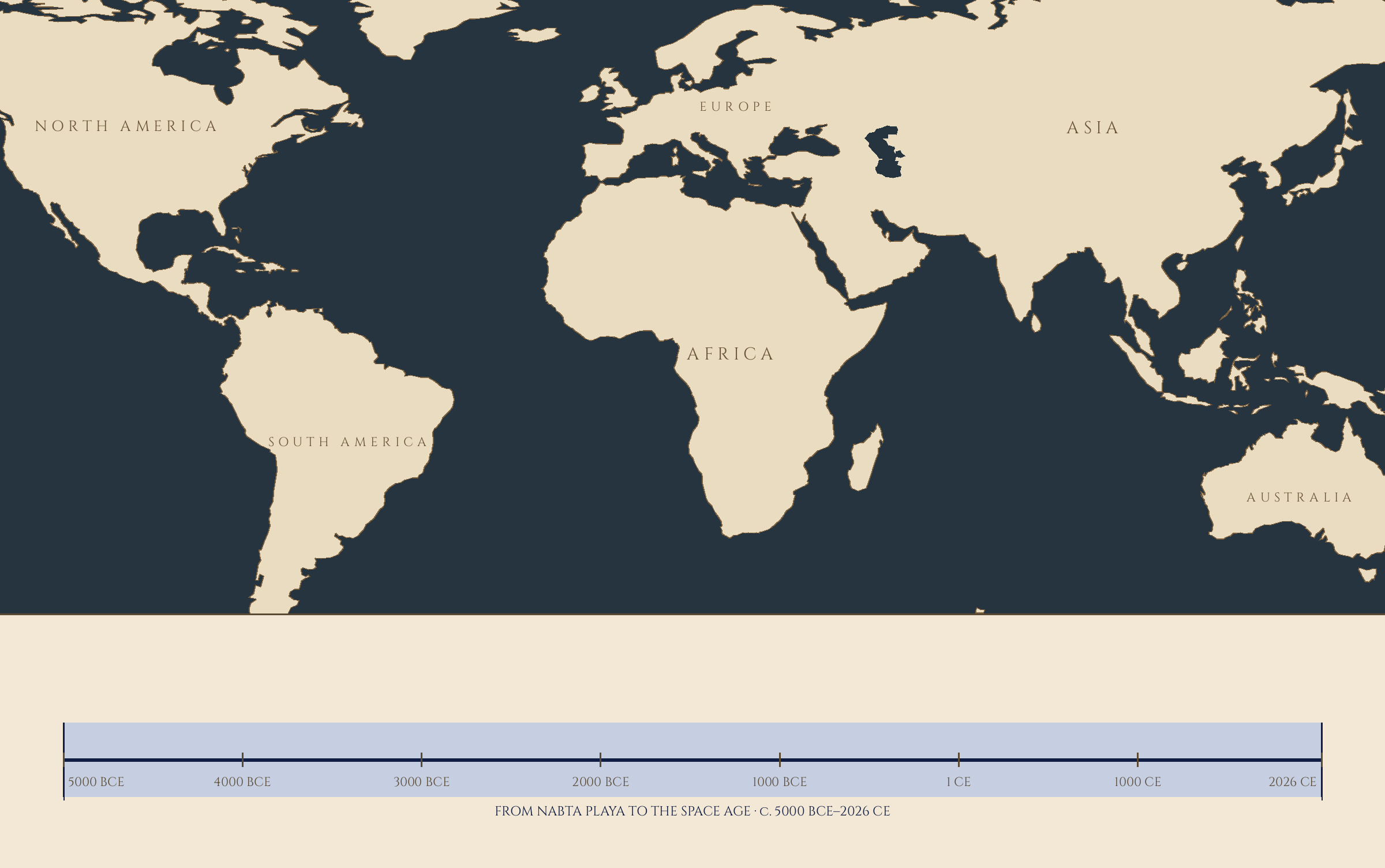
Where and when: your own sky, tonight — The Moon Up Close. This lesson has no pin and no stop: its place is wherever you stand under the night sky. The line beneath the map is our road through the course: every stop a moment when watching the sky changed, every lesson a place upon it.
Lesson Objectives
By the end of this lesson, you will be able to:
- Retell the giant-impact story of the Moon's formation and name one piece of evidence that supports it.
- Distinguish the lunar maria from the lunar highlands and explain what each one is made of.
- Describe how an impact crater forms and what craters record about a surface's age.
- Explain why the near side of the Moon looks so different from the far side, and identify which part of that story scientists are still working out.
- Locate the major near-side features on a map or sketch: Oceanus Procellarum and the maria Imbrium, Serenitatis, Tranquillitatis, and Crisium, plus the craters Tycho and Copernicus.
- Describe the Apollo landings as the modern chapter of the Moon's story: who went, when, and what they brought home.
Reading this lesson: ★ marks the passages to remember. They return on the unit quiz and the class test. Check in questions ask the material back as you go; answer them in your workbook when you meet them.
Working this lesson: Your assignment packet is the first download on this page. Work in it as the lesson moves along, answering each exercise as its subject is taught — or read the lesson through for your notes and take the exercises as homework afterward. Both are proper ways to sit this class. Signposts in the reading tell you where each exercise belongs. Written answers are short answers in your own words; a few honest lines are worth more than a filled page.
Your Assignment Packet
This lesson's exercises live in its packet: the Lexicon Handout (every term, course terms marked ◆), Materials, Guided Practice, the Assignment Manual with its answer key for self-checking, the Reflection Questions, and the Workbook Checklist. Download the packet before you begin and keep it beside you as you read. The packet's exercises are Glimmerwick's own word for the work: Exercise I: The Near-Side Map ◐, Exercise II: The Crater Detective ✎, and Exercise III: Retelling the Giant Impact ✎. The lesson's quiz is not printed in the packet; it pools to the Unit II Quiz, where it will meet you again.
Safety Briefing
- Night observing is always done with an adult present. This is a standing rule of the Celestial Tower, and it has no exceptions.
- Observe from safe, familiar locations: your own yard, a trusted neighbor's garden, or a familiar spot your family already uses. Never wander to unfamiliar or unlit places at night.
- Dress more warmly than you think you need. Night air cools quickly, and a cold scholar is a hurried observer.
- A flashlight with a red cover, or a flashlight wrapped in red cellophane, protects everyone's night vision. White light resets your eyes' dark adaptation; red light is kinder.
- Level Two: binoculars and telescopes are for night observing only. Never point them at or near the sun, not even for a moment. The moon itself is perfectly safe to observe: bright, but harmless to your eyes.
The Wonder
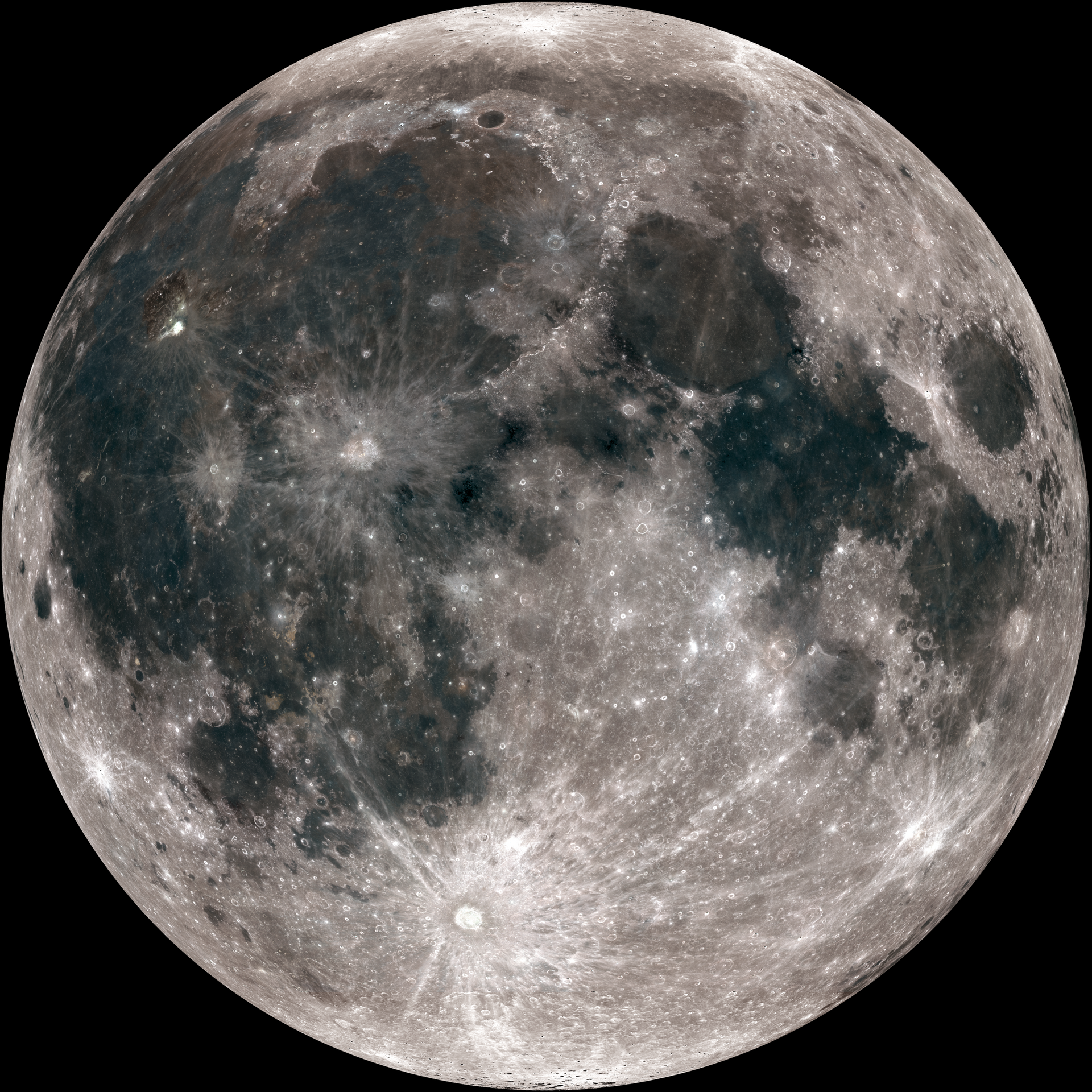
The near side as the Lunar Reconnaissance Orbiter sees it: the face of the Man in the Moon resolved into geography. The dark plains are the maria — frozen basalt lava; the bright freckle low in the southern highlands is Tycho, whose rays cross half the disc; the dark plain at right-center is Mare Tranquillitatis, where Apollo 11 landed.
Lunar Reconnaissance Orbiter near-side color mosaic, NASA.
Every culture that has ever looked up has seen a face in the moon. In Europe and the Americas, people describe the Man in the Moon: two dark eyes, a nose, a mouth, gazing down. In China and Japan, the same dark patches become a rabbit, pounding rice cakes in a mortar. The phenomenon has a name: pareidolia, the mind's habit of finding familiar patterns, especially faces, in random shapes.
Here is the wonderful part. The face is not random.
The "eyes" of the Man in the Moon are vast plains of dark basalt: Mare Imbrium and Mare Serenitatis on one side, Mare Tranquillitatis on the other. The "mouth" is the long sweep of Oceanus Procellarum. What your ancestors read as a face was real geography all along, drawn in frozen lava billions of years before any human eye existed to see it. Tonight the face resolves, feature by feature, into the most readable landscape in the sky.
❦ In your workbook: record the wonder in your own way — the face every culture saw, the word pareidolia, and the discovery that the face was real geography all along — copy, sketch, or note what matters.
The Story
The seas that are not seas
When telescopes first turned to the moon in the early 1600s, observers saw the dark patches and made a reasonable guess: they looked like seas, so they called them seas. The Latin word for sea is mare, plural maria, and the name stuck even after everyone learned the truth.
★ The truth is more dramatic than the guess. About three and a half billion years ago, the Moon's interior was still hot enough to melt rock. Again and again, molten basalt welled up through cracks in the crust and flooded the lowlands, spreading across hundreds of miles and cooling into smooth dark plains. The largest floods filled basins gouged out by earlier, enormous impacts. What looks like a sea from Earth is a sea of stone: frozen lava, dark because basalt is dark, smooth because it flowed like water before it hardened.
★ The names those early observers gave the maria are still the names we use, because in 1651 the Jesuit astronomer Giovanni Battista Riccioli published a lunar map, drawn by his colleague Francesco Grimaldi, that named the features for weather and moods: the Sea of Tranquility, the Sea of Serenity, the Sea of Rains, the Ocean of Storms. Riccioli named the craters for scholars and philosophers instead. His system won out over every rival, and the International Astronomical Union still keeps the official list today. When you say "Mare Tranquillitatis," you are speaking seventeenth-century Latin, and every astronomer on Earth knows exactly which dark plain you mean.
❦ In your workbook: record the seas that are not seas in your own way — what the maria really are, when the lava flowed, and whose 1651 map named them — copy, sketch, or note what matters.
The scars that are clocks
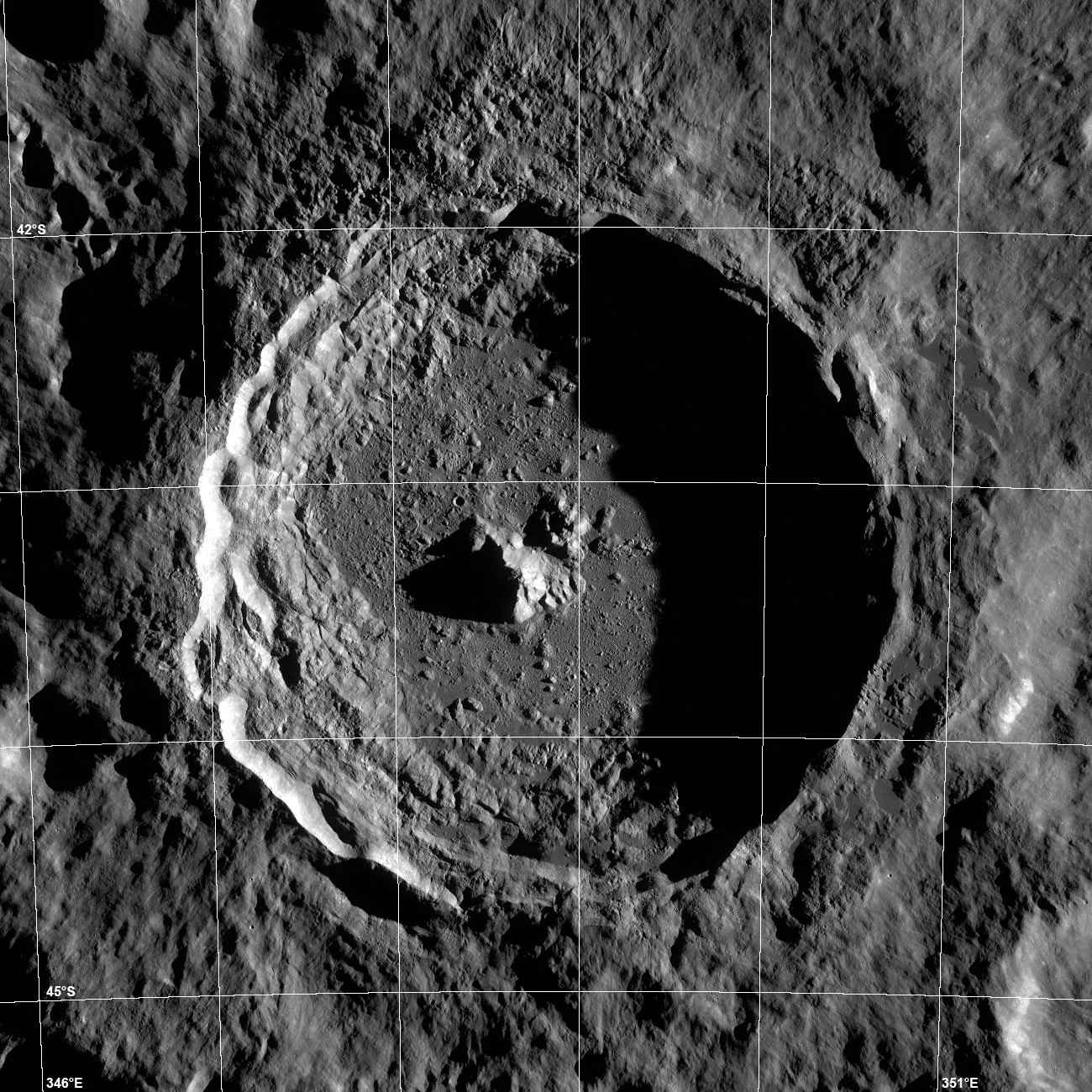
Tycho up close, from the Lunar Reconnaissance Orbiter: terraced inner walls catching the sun, the central peaks standing left of center, half the floor in shadow. About 85 kilometers across and only about 108 million years old — its age was fixed by radiometric dating of glassy samples likely blasted from Tycho all the way to the Apollo 17 landing site.
LRO WAC mosaic, NASA / GSFC / Arizona State University.
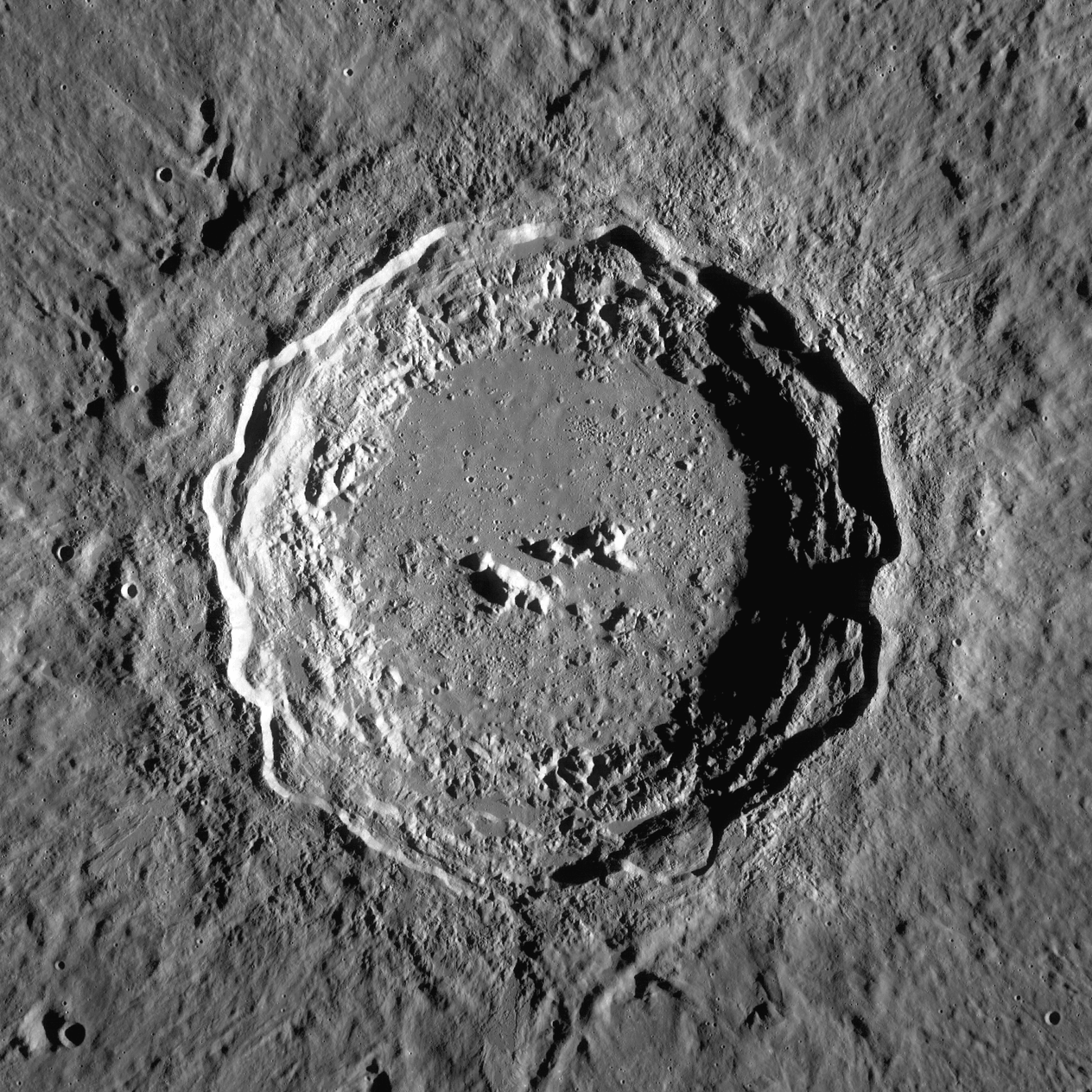
Copernicus from orbit: terraced walls, a cluster of central peaks, and a bright ray system the binocular scholar can find in the eastern Oceanus Procellarum. About 93 kilometers across and roughly 800 million years old — the type example of craters from its era of lunar history.
Lunar Reconnaissance Orbiter image, NASA.
The bright parts of the moon are the highlands: older, rougher, higher ground, crowded with craters. A crater is the scar of a collision. Asteroids and comet fragments strike the Moon at tremendous speeds, and the energy of the impact does the rest: rock vaporizes and melts, a bowl is excavated, debris is thrown outward in a bright ejecta blanket, and the rim is raised and terraced. In the largest craters, the floor rebounds after the shock and freezes into a central peak, a mountain raised from below by the violence of the impact itself.
★ Craters are clocks. A fresh crater looks sharp, with bright rays of ejected material streaking across the surface. Over millions of years, exposure to the space environment, called space weathering, darkens those rays until they fade into the background. So brightness is youth: the brighter the rays, the more recent the impact. And density is age: a surface crowded with overlapping craters has been collecting scars for longer than a smooth plain with few. By counting craters and comparing with surfaces whose ages we know from actual rock samples, scientists date landscapes across the whole solar system. The moon is the calibration stone for every other world.
★ Two craters will become old friends in this course. Tycho, in the southern highlands, is about 85 kilometers across and only about 108 million years old: young enough that its rays still stretch up to 1,500 kilometers, visible to the naked eye at full moon as pale streaks radiating from a bright spot. Its age comes from radiometric dating of glassy impact samples, likely blasted from Tycho all the way to the Apollo 17 landing site. Copernicus, in the eastern Oceanus Procellarum, is about 93 kilometers across and roughly 800 million years old, with terraced walls and a central peak, and it is an easy binocular target. Both were named by Riccioli: Tycho for the Danish astronomer Tycho Brahe, Copernicus for Nicolaus Copernicus, the Polish astronomer who set the sun at the center.
Check in: You are shown two patches of the moon: one crowded with overlapping craters, one smooth with few. Which is older, and what two separate clues — density and rays — does the lesson give you for telling a surface's age?
❦ In your workbook: record the scars that are clocks in your own way — how a crater forms, why brightness is youth and density is age, and the two old friends, Tycho and Copernicus — copy, sketch, or note what matters.
In your packet: Exercise II: The Crater Detective ✎ begins here. Work it now, or mark the place and take it as homework — your choice.
The chapter with footprints
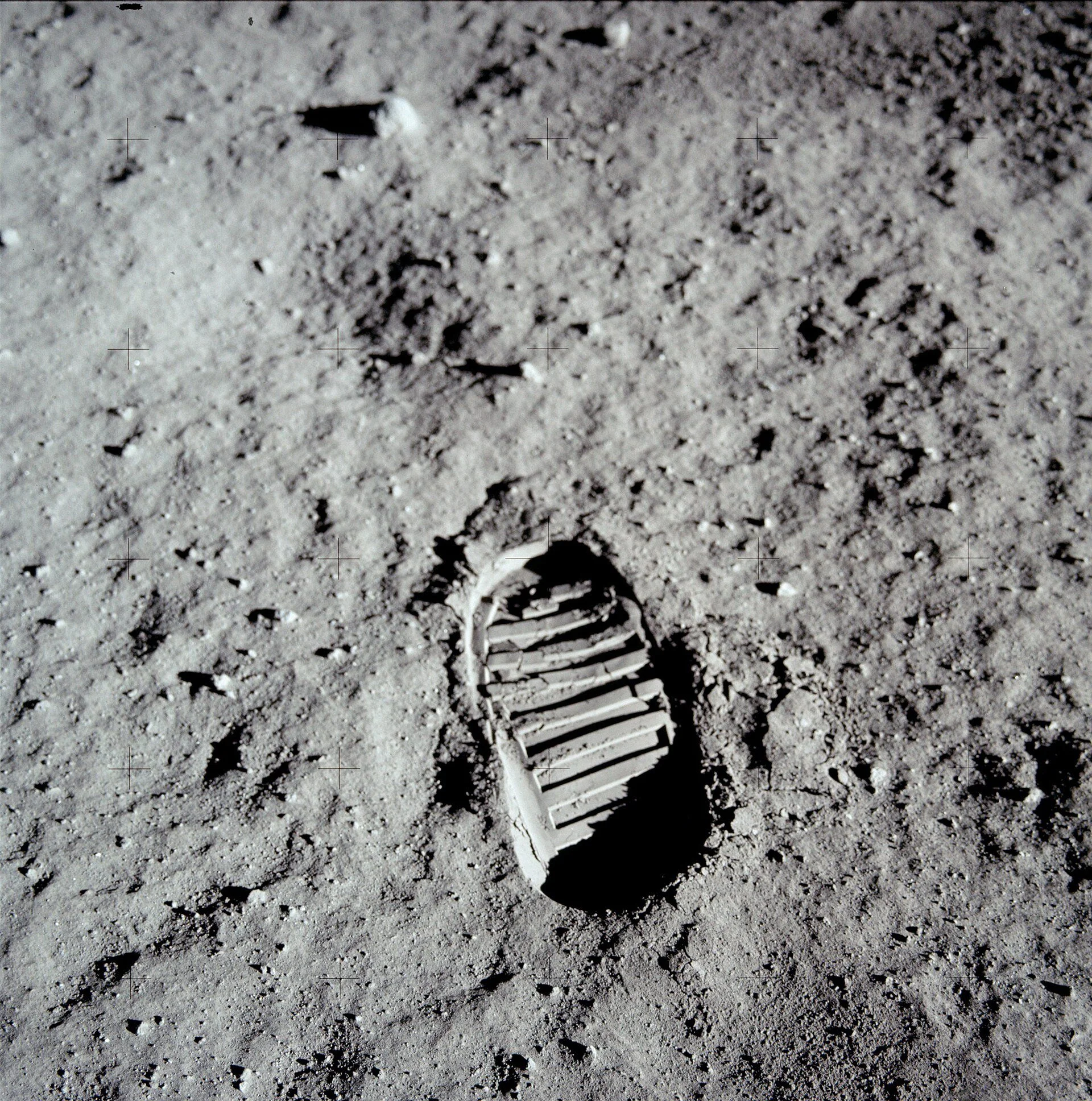
A footprint in the regolith, Apollo 11, Mare Tranquillitatis, July 1969. With no wind or water to erase it, a track like this could survive for millions of years. The astronauts left thousands of them — and brought home 382 kilograms of the rock and soil they were pressed into.
Apollo 11 surface photograph, NASA (Buzz Aldrin's bootprint, photographed by Aldrin as a soil-mechanics record).
For all of human history, the moon was the thing we watched. Then, within a single decade, it became a place people had stood.
★ Between 1969 and 1972, NASA's Apollo program landed six crews on the lunar surface. Twelve astronauts walked on the Moon. The first were Neil Armstrong and Buzz Aldrin, who set down in Mare Tranquillitatis, the Sea of Tranquility, on July 20, 1969, while Michael Collins kept station in orbit above them. The last were Eugene Cernan and Harrison Schmitt, who left in December 1972.
They did not just visit. They worked as field geologists: hammering, drilling, photographing, and hauling home 382 kilograms of rock and soil. Those samples are the reason we can date the maria, the reason we know Tycho's age, and the reason crater counting works on Mars and Mercury and beyond. The moon rocks also rewrote the story of the Moon's birth, which is where the mechanism begins.
(And yes, the footprints are still there. With no wind or water to erase them, the tracks the astronauts left could survive for millions of years.)
❦ In your workbook: record the chapter with footprints in your own way — six crews, twelve walkers, 382 kilograms of rock, and what those samples made possible — copy, sketch, or note what matters.
The Mechanism
How the Moon was born
★ The leading explanation for the Moon's origin is almost embarrassingly dramatic. About 4.5 billion years ago, when the Earth was young and still forming, a Mars-sized body struck it. Astronomers have named the impactor Theia, after the Greek Titan who was the mother of Selene, goddess of the moon. The collision blasted enormous quantities of rock into orbit around the Earth, and that debris, over time, clumped together under its own gravity and became the Moon.
★ It is called the giant-impact hypothesis, and it is a hypothesis in the scientific sense: the best current explanation, supported by evidence, still being tested and refined. The evidence in its favor is strong. The Moon's composition closely resembles the Earth's mantle, as if it were made from Earth's own outer layers mixed with the impactor. The Moon has only a tiny iron core, which fits the idea that it formed from lighter material thrown off in the collision rather than from a body that formed on its own. And the Earth-Moon system spins with exactly the angular momentum such a collision would produce.
Scientists are still debating the details: whether the impact was head-on or a glancing blow, how much of the Moon is Theia and how much is Earth, and whether it happened in one collision or two. New analyses of the Apollo samples keep sharpening the picture. What is not debated is the shape of the story: the Moon was born in violence, from the wreckage of a world that no longer exists.
Check in: Retell the giant-impact story in one breath, then name the three pieces of evidence the lesson gives for it. Which part of the story is still debated?
❦ In your workbook: record how the Moon was born in your own way — Theia, the debris, the three pieces of evidence, and the details still debated — copy, sketch, or note what matters.
In your packet: Exercise III: Retelling the Giant Impact ✎ begins here. Work it now, or mark the place and take it as homework — your choice.
Why the two faces differ
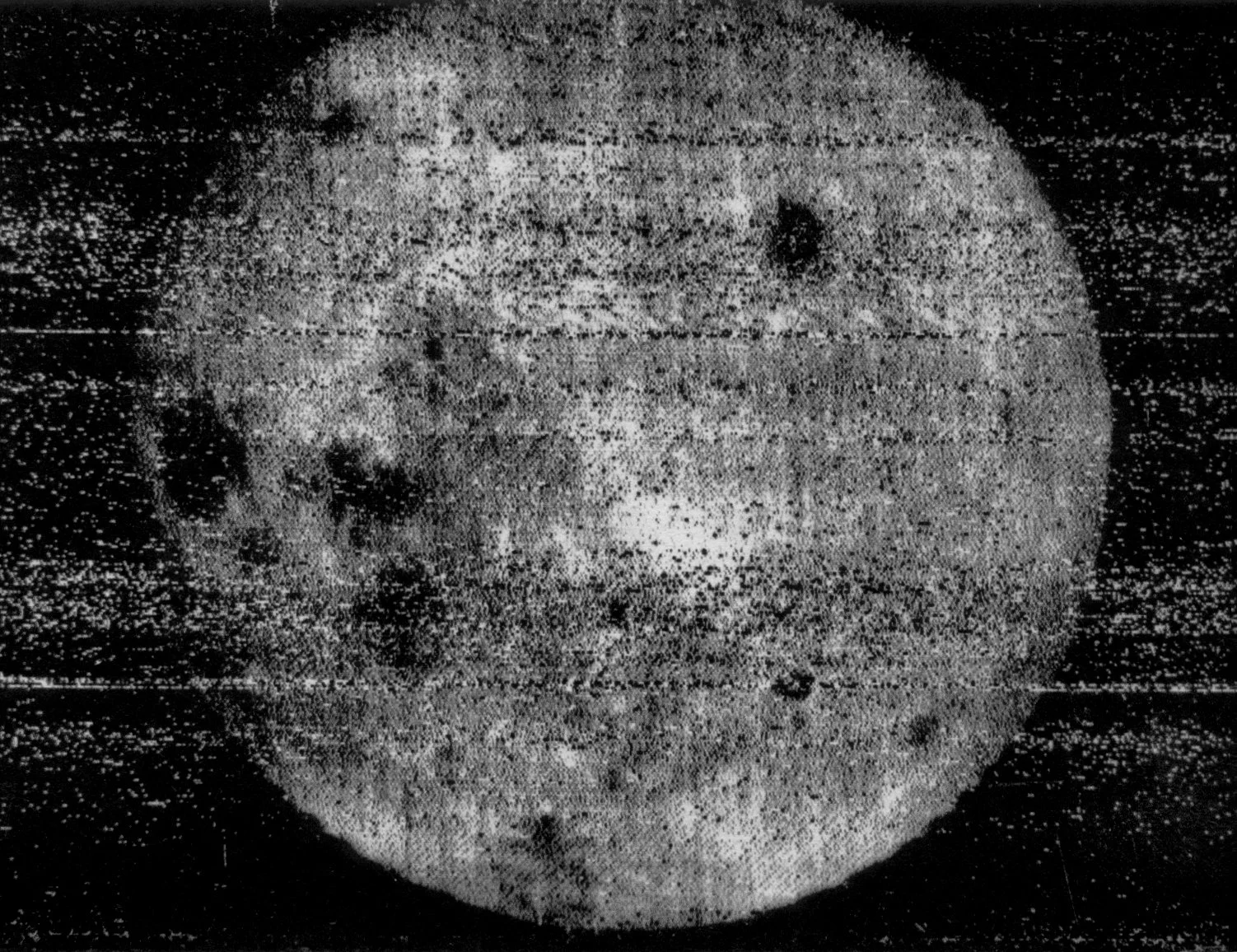
The first glimpse of the far side: Luna 3's 1959 photograph, grain and all. The message survived the noise — the far side looks nothing like the near side. It is almost entirely highlands, crowded with craters, with hardly any maria at all.
Luna 3 photograph, 7 October 1959, OKB-1 (Soviet space program).
★ Here is a fact you have lived with your whole life without noticing: you have never seen the far side of the Moon, and neither has anyone else who stayed on Earth. The Moon spins on its axis exactly once per orbit around the Earth, so the same face always points at us. This is called synchronous rotation, or being tidally locked. The far side is not dark: it gets just as much sunlight as the near side. It was simply hidden until 1959, when the Soviet spacecraft Luna 3 swung around the Moon and photographed it for the first time. The pictures were grainy, but the message was clear: the far side looks nothing like the near side. It is almost entirely highlands, crowded with craters, with hardly any maria at all.
★ The reason is crust. The Moon's crust is thinner on the near side and thicker on the far side, a difference measured precisely by NASA's GRAIL mission, which mapped the Moon's gravity field in 2011 and 2012. When the Moon's interior was hot and the great basins were being flooded with basalt, the magma could rise through the thinner near-side crust and spread across the surface. On the far side, the thicker crust mostly held. So the near side got the seas of lava, and the far side kept its ancient, cratered face.
One honest note, because this course does not pretend certainty where none exists: scientists are still working out exactly why the crust differs between the two sides. The thickness difference itself is well measured. Whether it goes back to the giant impact's aftermath, to an ancient second collision, or to something else entirely is still an open question. The moon keeps some of its secrets, and that is part of the fun.
Check in: Why does the near side hold most of the maria? In your answer, separate what is settled — the crust measurement — from what is still open.
❦ In your workbook: record why the two faces differ in your own way — synchronous rotation, Luna 3 in 1959, the thinner near-side crust GRAIL measured, and the open question of why — copy, sketch, or note what matters.
A Sealed Note on Reading the Terminator
Scholars, a confession: I am a bat, and I do my finest work in the dark. The moon and I understand each other.
Here is a secret your Moon Journal has been keeping from you. The best time to see the moon's mountains and craters is not at full moon, when the sun shines straight down and washes everything flat. It is along the terminator, the line dividing the moon's day from its night. Near that line, the sun is low, and every crater rim and mountain peak throws a long shadow across the ground. The landscape leaps into relief, and the moon looks less like a flat disc and more like a world.
So do not only sketch the full moon. Sketch the moon at quarter phase, when the terminator runs straight down the middle. Watch how different features appear as the line sweeps across them night after night. Tycho's rays love the full moon, but Tycho's walls love the terminator. Give each its proper lighting, the way you would seat guests at a table.
❦ In your workbook: record the sealed note in your own way — why the terminator, not the full moon, shows the moon's relief, and Glimmerwick's rule of giving each feature its proper lighting — copy, sketch, or note what matters.
PROFESSOR VESPER GLIMMERWICK
Celestial Studies
Astronomer & Celestial Historian
Guided Observation
Try It Tonight
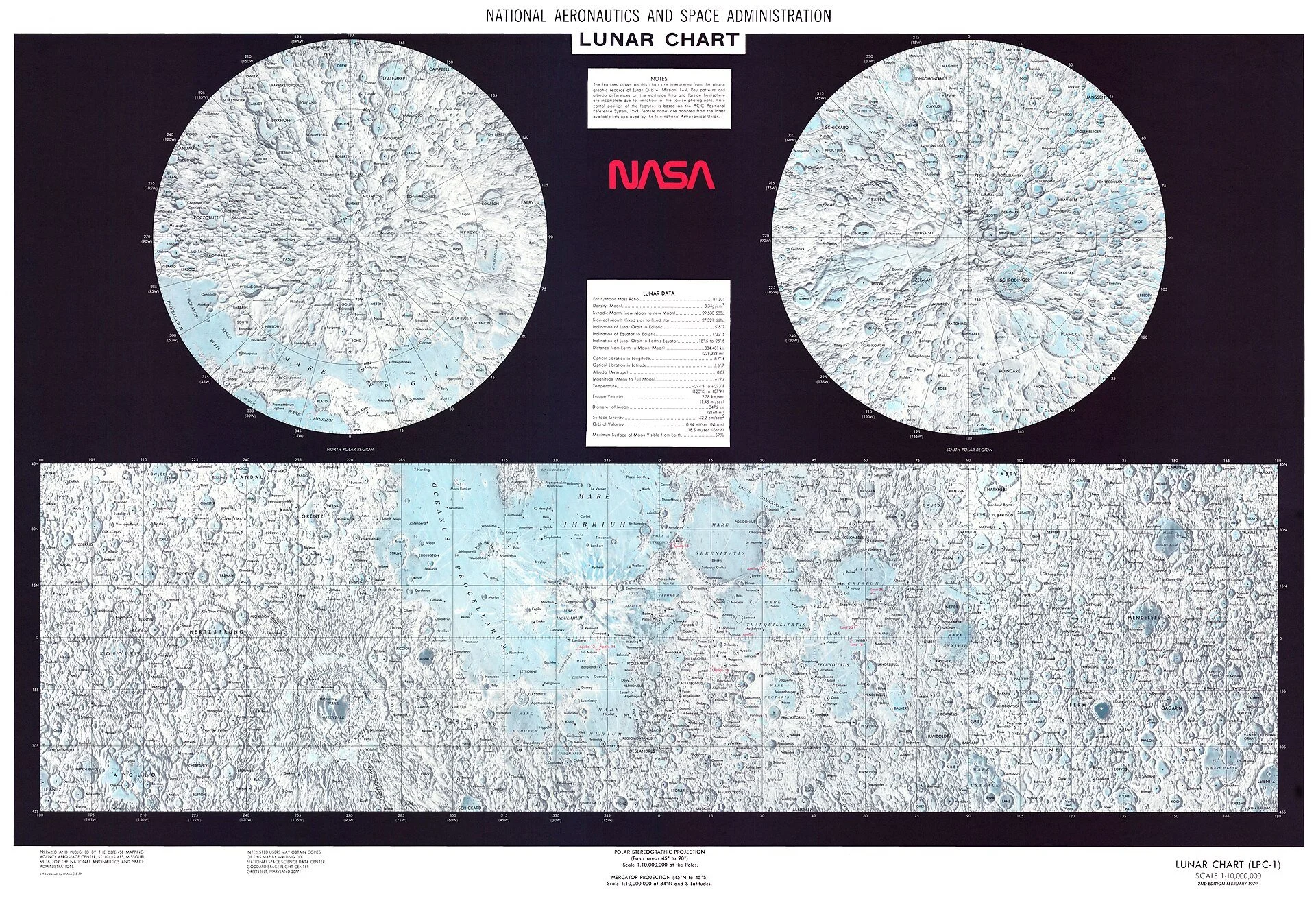
A printed chart, as the lesson promises one: NASA's Lunar Chart LPC-1 (1979), drawn from Lunar Orbiter photography with feature names adopted from the International Astronomical Union's list. The middle band carries the near side — find Oceanus Procellarum, Imbrium, Serenitatis, Tranquillitatis, and Crisium in print, then find them again in the sky.
Lunar Chart LPC-1, NASA / Defense Mapping Agency Aerospace Center, 1979.
Map the near side of the moon, using your Moon Journal sketches or a printed chart.
- Choose your night. A waxing gibbous or full moon shows the dark maria at their boldest. A first- or last-quarter moon puts the terminator across the disc and shows craters and mountains in sharp relief. Try both over the coming weeks: the same face wears different lighting.
- With the naked eye, sketch the outline of the dark patches. Do not worry about precision; capture the shapes and their positions relative to each other. The maria are your continents.
- Label the great features. The broad dark sweep on the western side is Oceanus Procellarum, the Ocean of Storms, the largest of them all. The round dark plain upper-middle is Mare Imbrium, the Sea of Rains. East of it sits Mare Serenitatis, the Sea of Serenity, and below that Mare Tranquillitatis, the Sea of Tranquility, where Apollo 11 landed. The isolated dark oval near the eastern edge is Mare Crisium, the Sea of Crises.
- Find Tycho. Look to the southern highlands for a bright spot with pale streaks radiating outward. At full moon, trace how far its rays reach. You are looking at a 108-million-year-old scar.
- Find Copernicus. In the eastern Oceanus Procellarum, look for a bright crater with its own smaller ray system. With binoculars, you can make out its terraced walls.
- Mark Tranquility Base. Put a tiny footprint symbol in southwestern Mare Tranquillitatis and label it July 20, 1969. Your map now holds a human landing site.
Level One completes this map with the naked eye and patience. Level Two, with binoculars or a small telescope, adds Copernicus's central peaks, the terracing of crater walls, and the fine texture of the highlands. Both levels produce a true map. The only difference is how close you get.
❦ In your workbook: record tonight's mapping in your own way — the night you chose and its lighting, the maria you outlined, and where Tycho, Copernicus, and the footprint stand on your map — copy, sketch, or note what matters.
In your packet: Exercise I: The Near-Side Map ◐ begins here. Work it now, or mark the place and take it as homework — your choice.
Sky Log Entry
Copy this entry into your Moon Journal and complete it on your mapping night.
- Date and time of observation:
- Moon's phase and approximate illumination:
- Sky conditions (clear, hazy, clouds, town lights):
- Terminator position (which features does the day-night line cross tonight?):
- Maria identified and labeled on my sketch:
- Craters identified (Tycho? Copernicus? others?):
- Apollo 11 landing site marked: yes / not yet
- One thing I noticed tonight that I had never seen before:
❦ In your workbook: record the Sky Log entry in your own way — tonight's phase and terminator, the maria and craters you identified, and the one new thing you noticed — copy, sketch, or note what matters.
Materials
Required (Level One — household items)
- Moon Journal and pencil: your sketches from earlier lessons are the raw material for tonight's map.
- A printed near-side moon chart (optional): useful for checking your labels, but try identifying the features on your own first.
- Red-covered flashlight (or a flashlight wrapped in red cellophane) for reading your journal without ruining everyone's night vision.
- Warm layers, plus a blanket or chair: mapping takes unhurried time, and night air cools fast.
- An adult observing partner: night observing is never a solo expedition.
Suggested (Level Two — historically closer)
- Binoculars: enough to resolve Copernicus's walls and the texture of the highlands.
- A small telescope: brings out central peaks, wall terracing, and fine ray structure.
- A lunar atlas or detailed moon map: for naming the smaller craters you discover along the way.
Reflection Questions
Answer the following questions in your workbook.
- Why do scientists favor the giant-impact explanation for the Moon's formation? Name the evidence, not just the story.
- What do craters record about a surface, and why do bright rays mean a crater is young?
- Why does the near side of the Moon look so different from the far side? Which part of that explanation is settled, and which part is still open?
- The Apollo crews brought home 382 kilograms of Moon rock. How did those samples let scientists date landscapes they never visited, on the Moon and beyond?
- You have seen the same face of the Moon your whole life. Now that you know the dark patches are frozen lava and the bright freckle is a 108-million-year-old scar, how has the face changed for you?
Workbook Checklist — Lesson 11
In my workbook I have:
- ☐ drawn my near-side map on two different nights — once at or near full moon, once at first or last quarter — or completed it from a printed chart and my Moon Journal sketches, with the clouds noted honestly if they took my nights
- ☐ labeled all five great features (Oceanus Procellarum and the maria Imbrium, Serenitatis, Tranquillitatis, and Crisium), marked Tycho and Copernicus, and placed my footprint symbol at Tranquility Base, July 20, 1969
- ☐ written two sentences under each sketch comparing what the different lighting revealed
- ☐ counted the visible craters in a crowded highland region and a smooth mare region, and written which surface is older and how I know, with the ray evidence
- ☐ retold the giant impact in my own words with the impactor and its size, when it happened, what became of the debris, one piece of evidence, and one question scientists are still trying to answer
- ☐ kept my map with my Moon Journal, as the closing note asks — it sits beside my constellation guide in the capstone
☐ Lesson completed Date: ___ Signature: ___
The Professor's Closing Note
You began this course by learning that the sky is a clock. Tonight you learned that the moon is a book.
Its pages are written in basalt and craters. The maria are the chapters about fire, when the young Moon bled lava across its face. The highlands are the older chapters, crowded with the punctuation of impacts. The rays of Tycho are a footnote so fresh the ink is barely dry, geologically speaking. And the footprints in the Sea of Tranquility are the first lines of a chapter humanity has only just begun to write.
Keep your map. In the capstone, your constellation guide will sit beside it, and the two together will be a portrait of your sky: the deep history written on the moon, and the stories written among the stars.
Until the next clear night, scholars. The Tower's telescopes are always warm.
PROFESSOR VESPER GLIMMERWICK
Celestial Studies
Astronomer & Celestial Historian
Cross-Class Connections

Runes · Unit III, Lesson 9 — The Architecture of Stone
Scholars, every name on Professor Glimmerwick's map is Latin, and Latin is my classroom's home ground. In this lesson the alphabet arrives at Rome itself: the twenty-three letters of the classical Latin alphabet, the inscriptions they were carved in, and the letters you are reading right now. Come and read the stones of the city whose language named the Sea of Tranquility — when you write "Mare Tranquillitatis" in your Sky Log, you will know exactly whose letters you are writing it in. — Professor Thistleloom Webblethorn, Runes

Creative Arts · Studio Extension E5 — Relief & Scale Displays
Bring that flat map down to my workshop, scholars, and we will make it stand up. This extension builds the standing version of just such a drawing: a relief Moon at display scale, its maria sunk low, its highlands built up, its crater rims raised where your hand can read them. A sketch is an argument made quickly; a display is an argument made to stand in a room. Professor Glimmerwick taught you the Moon's face — here, we give it back its depth. — Professor Cogbranch Timberclank, Creative Arts
Herbology — named in the lesson; no invitation written. Glimmerwick's text above names Fernfoot's moon-phase planting lore, taught as belief-history, but no Herbology lesson teaches moon-phase planting: the word "moon" occurs in no Herbology final at all, so there is no destination lesson to invite to. The connection stands as the lesson's own prose mention above, and a genuine pairing can be written in the final interdisciplinary sweep if the Herbology overhaul's reshaped material ever supports one.
History of Magic — named in the lesson; a future class. The final names it as a class that has not opened its doors; there is no lesson to link and no professor to invite. The mention stands exactly as sourced.
Further Reading & Sources
- The Apollo Program — NASA — NASA's official history of the program that landed six crews on the Moon between 1969 and 1972.
- Tycho Crater on the Moon (Labeled) — NASA Science — how Tycho's age was dated from Apollo samples, and how crater counting dates surfaces across the solar system.
- First Close-up of the Far Side of Moon — NASA Science — the story of Luna 3's 1959 photographs, the first human glimpse of the far side.
- Gazetteer of Planetary Nomenclature — USGS Astrogeology / IAU — the official record of every named lunar feature, maintained for the International Astronomical Union.
- How the Moon Formed: Lunar Rocks Support Giant Impact Theory — Space.com — the evidence for the Theia impact, explained from the Apollo rock analyses.
- Browse the Celestial Studies shelf in the school Library for readable editions of these works.
Submit Your Work
When your Lesson 11 work is complete, submit it through the Submit Your Work form at the foot of this page: your scholar's name, your house (Septentrio / Oriens / Meridies / Occidens / Not sorted yet), this lesson (Unit II, Lesson 11 — The Moon Up Close), a photo of your work — your two-night near-side map with its footprint at Tranquility Base, your crater-detective table, or your giant-impact retelling — and, if you wish, the permission-to-display checkbox so your work can appear in the school galleries.
Submit your work for this lesson using the form below.
THE UNIT II QUIZ
CELESTIAL TOWER · UNIT II: THE MOON
Unit II is complete: a full turning of the Moon, from her phases as sunlit geometry and the honest history of her names, through the shadow-play of eclipses and the long pull of the tides, to the Moon herself up close — born of a giant impact, faced in dark maria and bright highlands, and walked on within living memory. This quiz gathers the whole unit into one sitting. Take it from memory first, before you look back at your notes, because it measures what has stayed with you. If you kept the passages marked ★ in your workbook as you read, you have already practiced most of what it asks.
The quiz packet is a single download. Part I gathers multiple-choice questions from across the unit, Part II asks true or false, Part III matches the unit's vocabulary, and the answer key waits at the back for self-checking. When you have finished, score it honestly, note the result in your workbook, and revisit any lesson whose questions went wrong before you move on.
CONTINUE IN THE CELESTIAL TOWER
← Previous · Lesson 10: Tides & the Moon's Pull Next · Lesson 12: The Naked-Eye Planets →
Unit II — The Moon Celestial Tower — All 33 Lessons
The rest of Unit II: Lesson 7 · Moon Phases · Lesson 8 · Names of the Moon · Lesson 9 · Eclipses · Lesson 10 · Tides
From the Celestial Shelf
The printed companions to this lesson, from Professor Glimmerwick’s shelf in the shop.