
CELESTIAL STUDIES
Unit II · Lesson 8Names of the Moon
PROFESSOR VESPER GLIMMERWICK
Celestial Studies
Astronomer & Celestial Historian
Professor's Introduction

The moon is up, scholars,
On my evening flights I have listened to the moon being called by a dozen names in a single season, and I confess I love every one of them. The Wolf Moon sounds like cold air and distant howling. The Harvest Moon smells of cut wheat. The Blue Moon sounds like something that should not exist, which is exactly why people cannot stop saying it.
But I am your Celestial Historian as well as your storyteller, and a historian owes you the truth beneath the poetry. Some of these names are old enough to have been spoken by people who never saw a printed book. Some were written down by a traveler with a notebook in the 1700s. And some, I am sorry to tell you, were invented within living memory and dressed up in older clothes.
Tonight we sort them honestly. We will keep the beautiful names and the true ones, and where a name is both beautiful and true, we will celebrate twice.
Fly gently, and read with both eyes open.
PROFESSOR VESPER GLIMMERWICK
Celestial Studies
Astronomer & Celestial Historian
Where and when: your own sky, tonight — Names of the Moon. This lesson has no pin and no stop: its place is wherever you stand under the night sky. The line beneath the map is our road through the course: every stop a moment when watching the sky changed, every lesson a place upon it.
Lesson Objectives
- Name the twelve traditional full moon names of the almanac list and describe what each one marks in the seasonal year.
- Explain which moon names are genuinely old, which were documented in the 1700s, and which are modern popularizations, with the evidence for each.
- Describe how the Harvest Moon got its name from the geometry of moonrise near the autumnal equinox.
- Compare moon-naming traditions from at least three cultures beyond the almanac list.
- Research one culture's moon names and present the findings with honest sourcing.
Reading this lesson: ★ marks the passages to remember. They return on the unit quiz and the class test. Check in questions ask the material back as you go; answer them in your workbook when you meet them.
Working this lesson: Your assignment packet is the first download on this page. Work in it as the lesson moves along, answering each exercise as its subject is taught — or read the lesson through for your notes and take the exercises as homework afterward. Both are proper ways to sit this class. Signposts in the reading tell you where each exercise belongs. Written answers are short answers in your own words; a few honest lines are worth more than a filled page.
Your Assignment Packet
This lesson's exercises live in its packet: the Lexicon Handout (every term, course terms marked ◆), Materials, Guided Practice, the Assignment Manual with its answer key for self-checking, the Reflection Questions, and the Workbook Checklist. Download the packet before you begin and keep it beside you as you read.
Safety Briefing
- All night observing for this lesson happens with a trusted adult, in a safe and familiar location: your yard, a porch, a park you know well.
- This lesson needs no equipment at all. If you use binoculars for a closer look at the moon, never turn them toward the sun, not even for a second.
- Dress for the season. A scholar shivering too hard to hold a pencil learns nothing.
- Tell someone where you will be and when you expect to be back inside.
- If the sky is cloudy, the lesson still works. Moon names are a human tradition; the clouds do not cancel them.
The Wonder
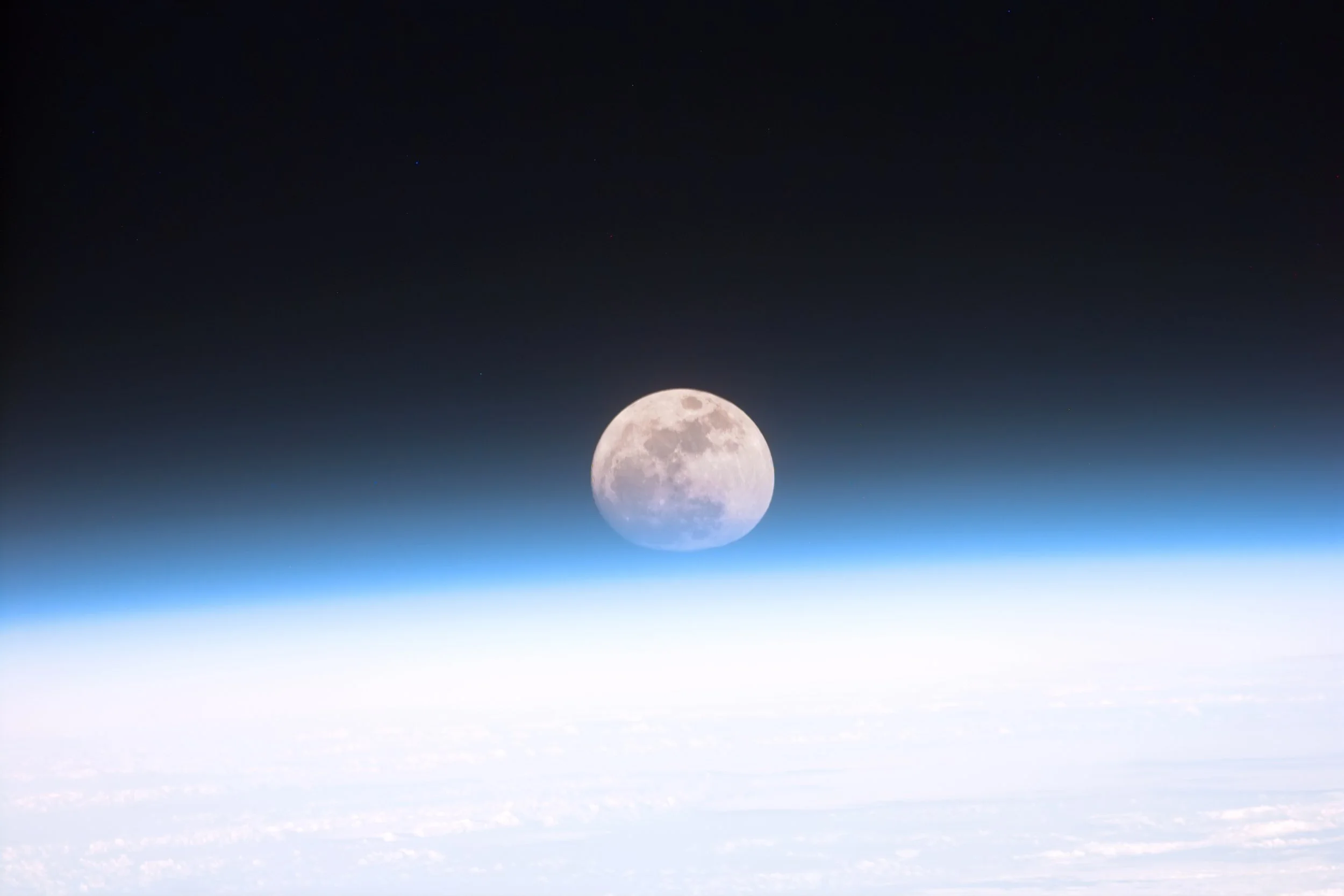
The moon above the air. A full moon seen from orbit, its lower limb tinted blue by Earth's atmosphere — a reminder that "blue moon" began as a saying, and only rarely as a sight.
NASA (STS-103). Public domain.
Step outside on the night of a full moon, with an adult beside you, and say its name out loud. In January you might say Wolf Moon. In September, Harvest Moon. The name changes nothing about the light, and yet it changes everything about the evening. A named moon feels known, like a neighbor. An unnamed moon is only weather.
Every culture that has watched the sky has felt this pull to name the moon's faces. The wonder of this lesson is not that the names are pretty, though they are. The wonder is that names are how humans filed the year before filing cabinets existed. Each name is a small drawer, and inside it sits a season's work: the planting, the harvest, the hunger, the cold.
And here is the second wonder, the one that makes this a historian's lesson instead of only a poet's: the drawers have labels, but some of the labels were written recently in antique handwriting. Telling the difference is a skill, and it is one you can learn in a single evening.
Check in: In the filing-cabinet image, what does each moon name's drawer hold?
❦ In your workbook: record the wonder in your own way — the named moon that feels like a neighbor, the drawers of the year, and the labels written recently in antique handwriting — copy, sketch, or note what matters.
The Story
The list everyone knows
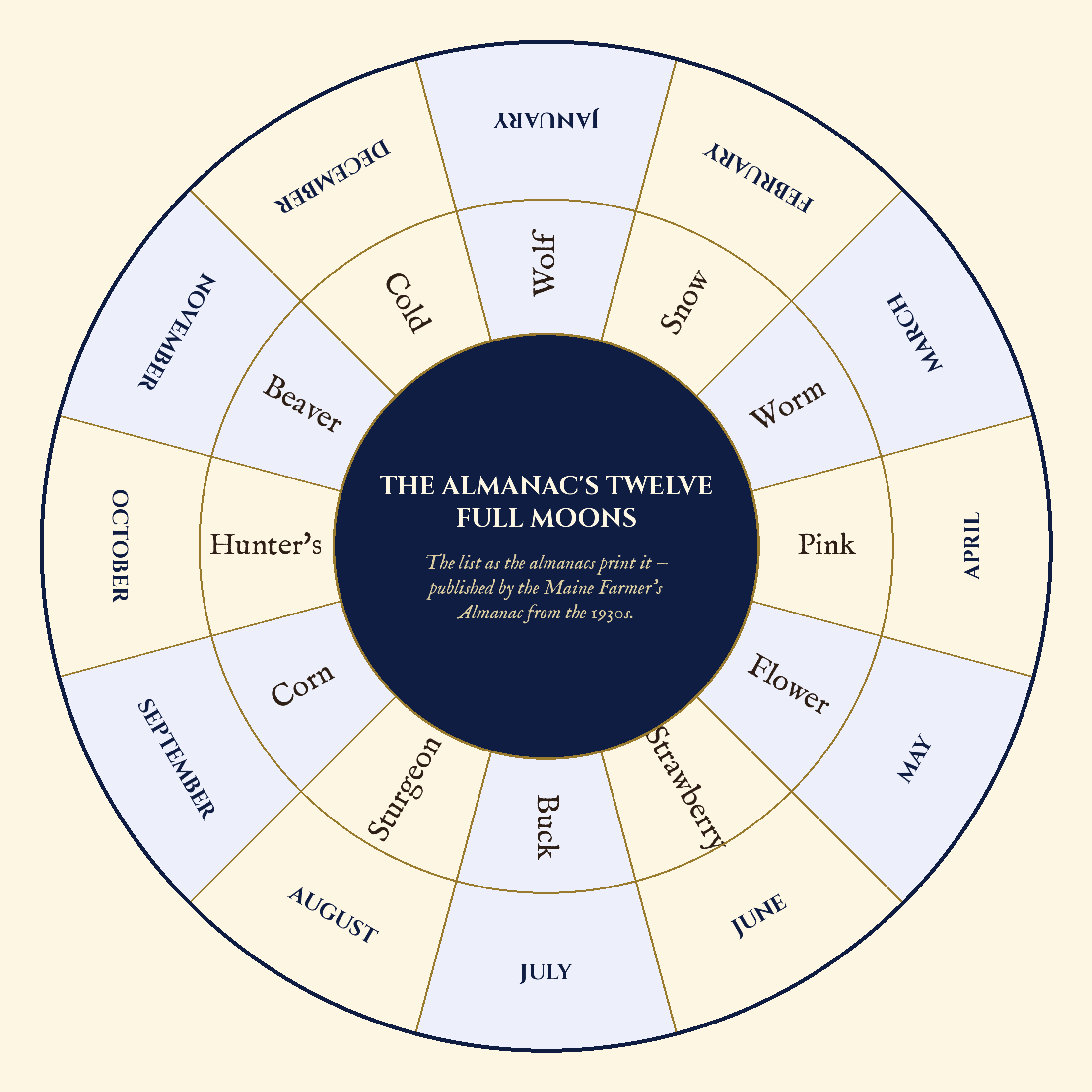
The almanac's twelve, on one wheel. January's Wolf Moon at the top, the year running clockwise to December's Cold Moon. The center carries the lesson's honest stamp: this list was published by the Maine Farmer's Almanac from the 1930s.
Built for Evershade (typeset plate; Cinzel + IM Fell English). Builder:.
Open almost any almanac (a yearly book of calendars, tables, and seasonal lore), newspaper, or website in January and you will meet the Wolf Moon. February brings the Snow Moon, March the Worm Moon, April the Pink Moon, May the Flower Moon, June the Strawberry Moon, July the Buck Moon, August the Sturgeon Moon, September the Corn Moon, October the Hunter's Moon, November the Beaver Moon, and December the Cold Moon.
This list feels ancient. It is not as ancient as it feels.
★ The Maine Farmer's Almanac began publishing a list of moon names in the 1930s. The Old Farmer's Almanac picked the list up, newspapers repeated it, and the internet carried it everywhere. By the time most of us learned these names, they arrived with the firm stamp of tradition, and almost nobody asked where the stamp came from.
★ The Old Farmer's Almanac is admirably honest about this, if you read its fine print. Its editors write that the names come from Native American, Colonial American, and other traditional North American sources, and that they varied among tribes and regions. They also admit something wonderful: January's Wolf Moon is not a traditional Native American name at all. It is thought to have English origins, carried to North America by European settlers. The wolves-howling-from-hunger story is the part everyone repeats; the almanac's own page quietly files the name itself under European import.
Check in: Which January name does the Old Farmer's Almanac itself say is not a traditional Native American name, and where does it say the name came from?
In your packet: Exercise I — The Honest Name Card ◐ begins here. Work it now, or mark the place and take it as homework — your choice.
One traveler's notebook
Several of the names do have genuinely old paperwork, and it comes from one man with a notebook. In the 1760s, Captain Jonathan Carver traveled among the Naudowessie (the Dakota) and other peoples of the upper Mississippi region, and he wrote down the moon names he heard. The Snow Moon, the Worm Moon, the Buck Moon (named for the bucks growing new antlers), the Sturgeon Moon, the Corn Moon, and the Beaver Moon all appear in his account.
This is real documentation, and it is some 250 years old. But handle it the way a historian handles any single witness. Carver was one traveler, writing in the language of his own time, describing peoples whose own lists varied from band to band. His notes prove that names of this kind were in living use in the 1700s. They do not prove that every tribe used every name, and the almanac's neat twelve-month list is a later assembly, not one tribe's calendar.
Two names with deep roots
Two names on the familiar list stand apart, because they were never anyone's tribal property and they were never assembled by an editor. They are old the way tools are old.
★ The Harvest Moon is the full moon nearest the autumnal equinox (the September moment when day and night are nearly equal), and the Hunter's Moon is the full moon that follows it. The Old Farmer's Almanac traces the first printed use of "Hunter's Moon" to 1710. These are working names from agricultural England, carried wherever English farming went, and they describe a real job of work. You will find the job described in The Mechanism below.
The blue moon that was misread
No moon name has a stranger paper trail than the Blue Moon, and it is the perfect lesson in how folklore gets manufactured.
★ The story starts in 1937, in the Maine Farmer's Almanac. When a season contained four full moons instead of the usual three, the almanac's editor called the third of the four a Blue Moon, so the seasonal naming scheme would not break. That was the original calendrical meaning: the third full moon in a season of four.
★ In March 1946, an amateur astronomer named James Hugh Pruett wrote an article for Sky and Telescope magazine and misread the almanac. He concluded that a blue moon was the second full moon in a single calendar month, and he printed that definition. In January 1980, the Star Date radio program repeated Pruett's version, and the game Trivial Pursuit cemented it in 1986. The mistake won. Today nearly everyone means "second full moon in a month," and the original meaning survives mostly among people who enjoy correcting others at parties.
The phrase itself is older than either definition. "Once in a blue moon" was in print by 1824, meaning something rare or absurd. And once in a while the moon truly does look blue: after the eruption of Krakatau in 1883, dust in the atmosphere gave the moon a blue cast for nearly two years. Great forest fires and other eruptions have done it since. So the Blue Moon is three things at once: an old saying, a real but rare optical event, and a calendrical term with two competing definitions, one of them born from a misreading.
Check in: What was a Blue Moon in the almanac's original 1937 meaning, and how did the meaning most people use today come about?
A monk's month names
For genuinely old moon naming, in writing, by a named author, we can go back to the year 725. The English monk Bede, in his book De temporum ratione (The Reckoning of Time), recorded the month names used by the English people of his day: Giuli, Solmonath, Hrethmonath, Eosturmonath, Thrimilchi, Litha, Weodmonath, Halegmonath, Winterfylleth, Blodmonath, and Giuli again.
★ Winterfylleth is the treasure for us. Bede explains that it joins the words for "winter" and "full moon," because winter began on the first full moon of October. Thirteen hundred years ago, someone looked at the October moon and named the whole cold half of the year after it.
Be honest about the edges here too. Bede was a Christian monk writing about a pagan past, working partly from memory and hearsay. His list is genuine eighth-century writing, which is remarkable enough without pretending it is a perfect record.
The wider world keeps its own lists
The almanac's twelve names are one tradition among many, and some of the others are older, livelier, and still in use.
★ The Anishinaabe peoples of the Great Lakes teach the thirteen moons on the turtle's back: thirteen sections of the shell for thirteen moons of the year, each with its own name and story, from the Spirit Moon of deep winter to the Sugar Moon of maple-sap spring to the Rice Moon of the wild-rice harvest. Different communities keep different lists, and that variation is itself traditional.
★ In East Asia the harvest moon is a festival, not just a name. The Mid-Autumn Festival falls on the 15th day of the 8th month of the Chinese lunisolar calendar (one that tracks both the moon's phases and the solar year), when families gather to admire the full moon and share mooncakes. Korea celebrates Chuseok on the same date, Japan practices Tsukimi, moon viewing, and Vietnam keeps Tet Trung Thu. These are living traditions with centuries behind them.
In the Hindu calendar, the autumn full moon is Sharad Purnima, also called Kojagari Purnima, a harvest moon festival of the bright half of the year's clearest season. In the Islamic calendar, which is purely lunar, the full moon always falls on the 14th night of the month, and the 13th, 14th, and 15th are the "white days," the Ayyam al-Bid, bright nights long set aside for fasting and reflection.
In your packet: Exercise II — Two Traditions, Side by Side ✎ begins here. Work it now, or mark the place and take it as homework — your choice.
The cautionary tale
Now the warning, because a historian who loves stories must also love checking them.
★ You may meet the "Celtic tree calendar," a handsome system that assigns each month of the year a tree: birch, rowan, ash, and so on, presented as ancient druid wisdom. It is not ancient. It was invented by the English poet Robert Graves and published in his 1948 book The White Goddess. Scholars are blunt about it: Graves's tree calendar has no relation to any historical Celtic calendar. It is a modern poem wearing an old costume.
Graves's calendar is not the villain of this lesson. It is the lesson. A beautiful story, sincerely made, repeated often enough, starts to feel like history. Our job is to love the story and check the costume.
❦ In your workbook: record the story in your own way — the almanac list and its 1930s stamp, Carver's single notebook, the two old working names, the misread Blue Moon, Bede's Winterfylleth, the wider world's lists, and Graves's costume — copy, sketch, or note what matters.
The Mechanism
Why the moon needed names at all
The moon is a clock that almost fits the year. A full cycle of phases, the synodic month, takes about 29 and a half days. Twelve of those make about 354 days, which is eleven days short of a solar year. So the moons slide against the seasons, and every few years a thirteenth full moon squeezes into the year. Any culture that farmed, fished, or traveled by season needed a way to talk about where the moons had gotten to. Names were the filing system.
That is why so many moon names are work orders in disguise. Strawberry Moon means the berries are ready. Sturgeon Moon means the fish are running. Beaver Moon means trap now, before the freeze. The poetry sits on top of a practical layer, and the practical layer is what made the names worth remembering.
The Harvest Moon's trick
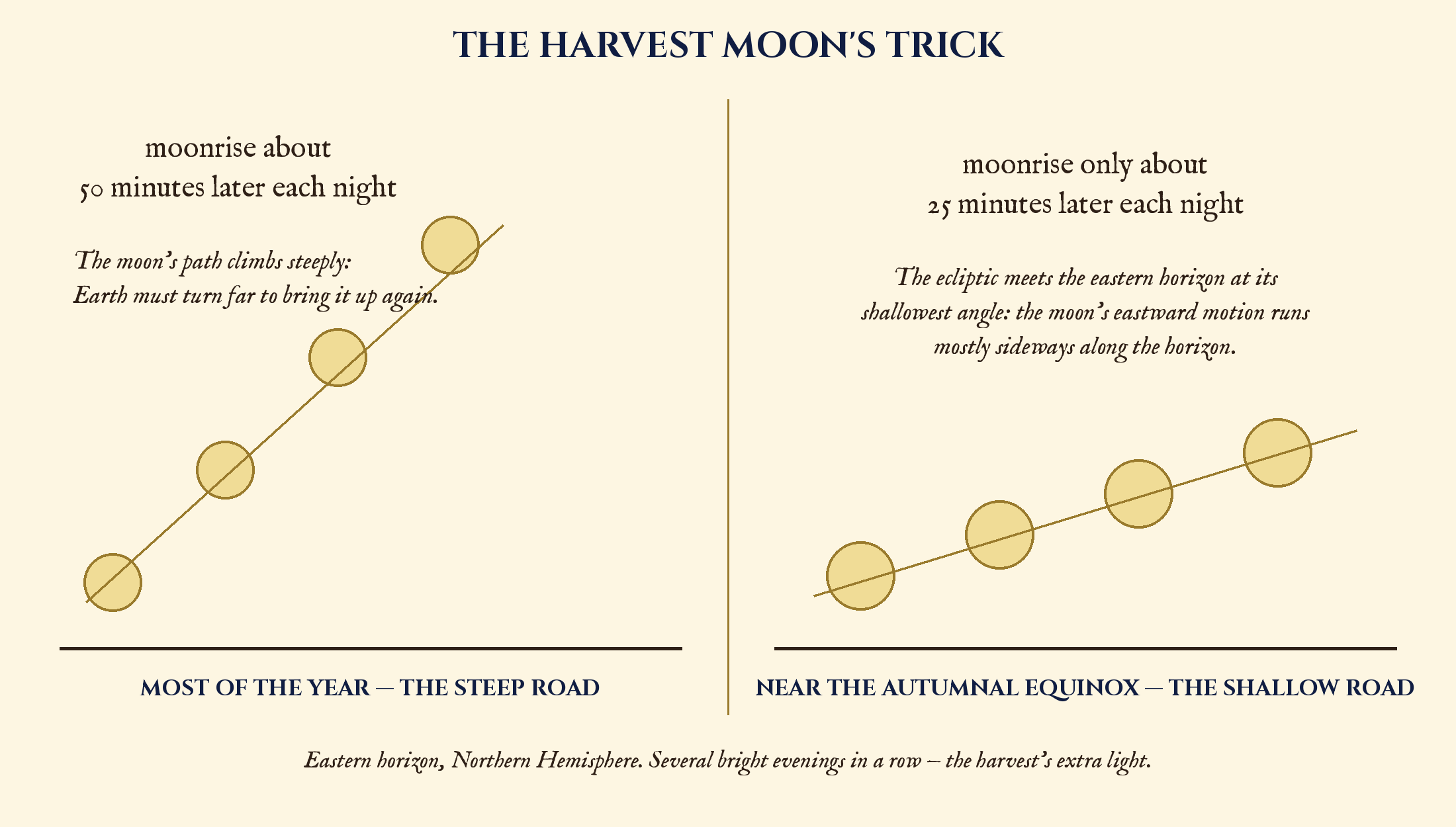
Why the Harvest Moon rises early, evening after evening. Most of the year the moon's road climbs steeply and moonrise slips about 50 minutes a night; near the autumnal equinox the road runs shallow, and the slip shrinks to about 25.
Built for Evershade (typeset plate; Cinzel + IM Fell English). Builder:.
The Harvest Moon earns its fame from geometry, not brightness.
★ Most nights of the year, the moon rises about 50 minutes later each night, because the moon moves eastward along its orbit while the Earth turns. But near the autumnal equinox in the Northern Hemisphere, the moon's path, the ecliptic, meets the eastern horizon at its shallowest angle of the year. The moon's nightly eastward motion then runs mostly sideways along the horizon instead of steeply below it, so the Earth does not have to turn as far to bring the moon up again. Moonrise comes only about 25 minutes later each night, and in far northern latitudes the gap shrinks even further.
The result is several evenings in a row when a full or nearly full moon rises soon after sunset. Before electric light, that sequence of bright early evenings extended the working day at exactly the moment the grain had to come in. The name is the mechanism's receipt.
Note the hemisphere. This is a Northern Hemisphere phenomenon. In the Southern Hemisphere the geometry reverses: their shallow-angle evenings come around the March equinox, and at our Harvest Moon they get an unusually long gap between moonrises instead.
Check in: Why does moonrise come only about 25 minutes later each night near the Harvest Moon, instead of the usual 50?
The Hunter's Moon follows the harvest
The Hunter's Moon is the full moon after the Harvest Moon, and its name is the next chapter of the same work year. With the fields cleared, game animals are easier to spot, and the deer have fattened on summer. Moonlight stretched the hunting day the way it had stretched the harvest, and meat laid down now would carry a household through winter. The name marks the hinge between gathering the crops and gathering the winter stores.
The thirteenth moon and the leap month
Because twelve moons fall short of the year, moon-counting cultures had to insert extra time. Lunisolar calendars add a leap month every few years to keep the moons aligned with the seasons. Bede describes the English doing exactly this: in a year of thirteen moons, the extra month was given to summer, making three months together called Litha, and the whole year was called Thrilithi. The Blue Moon is the almanac's small version of the same fix: a spare name for a spare moon, keeping the calendar's drawers labeled.
❦ In your workbook: record the mechanism in your own way — the clock that almost fits, the work orders in disguise, the shallow ecliptic angle and the 25-minute moonrise, and the spare moon that needs a spare name — copy, sketch, or note what matters.
A Sealed Note on Names That Lie
My darlings, I want to tell you something about my friend the tree calendar.
Robert Graves loved trees and moons the way I love star charts, and he built a calendar out of that love. It is rather beautiful. I would hang it on my tower wall for the pictures alone. But if I taught it to you as ancient druid lore, I would be lying to you with lovely wallpaper, and a professor must never wallpaper over the truth.
Here is the rule I fly by: love the story for what it is, and love the truth for what it is, and never let one of them pretend to be the other. A story you know is new can still give you joy. A name you know is old can still give you wonder. The checking does not spoil the magic. The checking is part of the magic.
❦ In your workbook: record the sealed note in your own way — love the story for what it is, and love the truth for what it is, and never let one pretend to be the other — copy, sketch, or note what matters.
PROFESSOR VESPER GLIMMERWICK
Celestial Studies
Astronomer & Celestial Historian
Try It Tonight
With an adult beside you, go outside on the next full-moon night and find the moon. Look up which name the almanac gives this month's moon, then write down the honest version of that name's story in your own words: who used it, when it was first written down, and what nobody knows for certain.
Then find one name from outside the almanac list, from any tradition in this lesson, and learn to pronounce it. Say it to the moon. Notice how the evening feels different with two names in it instead of one.
Log your observation in your Moon Journal as usual: phase, sky conditions, and anything you noticed.
In your packet: Exercise III — Name the Next Moon Yourself ✎ begins here. Work it now, or mark the place and take it as homework — your choice.
❦ In your workbook: record Try It Tonight in your own way — this month's moon under its almanac name with its honest story, and the second name you learned to say to the moon — copy, sketch, or note what matters.
Sky Log Entry
Date your entry and record: the calendar date, the moon's almanac name for this month, and a one-paragraph honest sourcing note (who used this name, when it was first written down, what is uncertain). Then add one moon name from a tradition outside the almanac list that you find beautiful, with its culture and meaning. Finish with a single sentence: what did naming the moon change about your evening?
❦ In your workbook: record the Sky Log entry in your own way — the date, the almanac name with its honest sourcing note, the outside name you chose, and your single sentence on what naming changed — copy, sketch, or note what matters.
Materials
Required (Level One — household items)
- Your Sky Log or a notebook: the honest name cards and comparisons are written work.
- Pencil and pen: pencil for drafts, pen for the finished cards.
- The printed lesson: the Story section is your evidence file for the quiz and exercises.
- A safe outdoor spot with a clear view of the eastern sky, and a trusted adult beside you for the night observing.
- Warm layers suited to the season: a shivering scholar learns nothing.
Suggested (Level Two — historically closer)
- Binoculars for a closer look at the moon's face while you name it (never turned toward the sun).
- A printed copy of the almanac's full moon name list for reference while you build your Honest Name Card.
Reflection Questions
Answer the following questions in your workbook.
- Why do you think so many moon names describe work (harvest, hunting, trapping, sugaring) rather than the moon itself?
- The lesson calls Graves's tree calendar "a modern poem wearing an old costume." Is there still value in using a name or story once you know it is new? Explain your thinking.
- Compare the almanac's twelve-name list with the Anishinaabe thirteen moons. What does each system assume about how a year should be counted?
- Why would a purely lunar calendar, like the Islamic one, make seasonal moon names impractical?
- If you were keeping a moon calendar for your own household, what would you name the next three full moons, and what honest sourcing note would you attach to each?
Workbook Checklist — Lesson 8
In my workbook I have:
- ☐ named the almanac's twelve full moons and what each one marks in the seasonal year
- ☐ sorted the names honestly: genuinely old, documented in the 1700s, and modern popularizations, with the evidence for each
- ☐ explained the Harvest Moon's name from the geometry of moonrise near the autumnal equinox
- ☐ compared the almanac list with at least one tradition beyond it, side by side
- ☐ written my Sky Log entry: the almanac name with its honest sourcing note, one outside name, and what naming changed about my evening
- ☐ named the next full moon myself, with an honest sourcing note of my own
☐ Lesson completed Date: ___ Signature: ___
The Professor's Closing Note
And so the moon goes on being called, by farmers and monks and travelers and poets, and every name is a small lamp lit against the dark.
Keep your favorite names, scholars, and keep your questions sharper than your favorites. The sky has room for both the poetry and the proof. That is why I never tire of it, night after night, season after season, name after name.
Until the next full moon,
PROFESSOR VESPER GLIMMERWICK
Celestial Studies
Astronomer & Celestial Historian
Cross-Class Connections
Scrollwork · Unit V, Lesson 18 — Gold Leaf & Gilding
Mind the gold, scholars. Medieval manuscripts loved the moon: illuminated calendars marked the year's moons in gold and color, and historical star catalogs were copied by hand for centuries. Gold is this lesson's craft — laid so thin a breath can lift it, and bright five hundred years later. Glimmerwick's tower teaches the names those calendars carried; my Library teaches the hand that marked them in gold. Your Sky Log keeps that scribal tradition alive — come and learn what its makers were doing.

Herbology · Unit IV, Lesson 27 — Timing the Harvest
Gently does it, scholars. Many moon names are plant notes in disguise — Strawberry Moon, Flower Moon, Worm Moon, Sugar Moon — and the greatest of them names my own autumn work: the Harvest Moon, the full moon nearest the autumnal equinox, whose light once stretched the harvest day itself. In my greenhouse you will learn to time that harvest — roots up in autumn, perennials resting before the frost, each plant gathered at its right moment. I keep moon-phase planting lore here as belief-history, labeled as belief and never as proof, which pairs with tonight's lesson on what is old and what is newly labeled. Come down from the tower and gather at the right hour. — Professor Beryl Fernfoot, Herbology Greenhouse • Master Herbalist • Head of House Oriens

Creative Arts · Studio Extension 4 — Painted Wheels at Full Size
Set up square, scholars. Glimmerwick asks you to build a moon-name wheel — a rotating disc that shows which name belongs to which season, with a window for the honest sourcing note — and wheels are this extension's work: the great cycles, the moon names among them, painted at full size on board, made to hang and be read across a room. Build yours true at my bench, honest sourcing note and all, and it will still be turning truly when you have left the school.
History of Magic (a future class) — named only. Harvest-moon festivals, Blue Moon folklore, and the old bright-night customs will get their full treatment there. This lesson covers the history; that course will cover the beliefs as beliefs. No invitation is written: the class is not yet built.

Runes & Ancient Writing · Unit IV, Lesson 14 — Ogham — The Celtic Edge Script
Further Reading & Sources
- The Old Farmer's Almanac: Full Moon Names — the complete popularized list, with the editors' own notes on origins, including the admission that the Wolf Moon is not a traditional Native American name.
- timeanddate.com: Full Moon Names — a month-by-month guide to the names and their meanings, with notes on Celtic, Anglo-Saxon, and Neo-Pagan variants.
- HISTORY: How Are Full Moons Named? — traces individual names through Captain Jonathan Carver's 1760s journals and other early sources.
- Sky & Telescope: December's Blue Moon? Bah, Humbug! — the full story of the 1937 definition, the 1946 misreading, and the 1980 broadcast that spread the mistake.
- EarthSky: The September Full Moon Is the Harvest Moon — the moonrise geometry explained, with the shallow ecliptic angle and the 25-minute figure.
- Wikipedia: Winterfylleth — Bede's "winter full moon" and the Old English lunar month names.
- Wikipedia: The White Goddess — Robert Graves's 1948 book and the scholarly verdict on his invented tree calendar.
- Browse the Celestial Studies shelf in the school Library for readable editions of these works.
You have learned the names the year gives her. The Wheel keeps her as she goes between them — tonight's true shape, her rising and her setting, and the road she travels from one name to the next. Look up your month's Moon, and see where she stands on the road tonight.
Open the WheelPROFESSOR VESPER GLIMMERWICK · CELESTIAL TOWER
Submit your work for this lesson using the form below.
CONTINUE IN THE CELESTIAL TOWER
← Previous · Lesson 7: The Phases of the Moon Next · Lesson 9: Eclipses →
Unit II — The Moon Celestial Tower — All 33 Lessons
The rest of Unit II: Lesson 7 · Moon Phases · Lesson 9 · Eclipses · Lesson 10 · Tides · Lesson 11 · The Moon Up Close