
CELESTIAL STUDIES
Unit II · Lesson 10Tides & the Moon's Pull
Professor Vesper Glimmerwick
Astronomer & Celestial Historian
The Celestial Tower • School of Evershade
Professor's Introduction

Up the tower stairs with you, scholars,
There is a question I am asked more often than almost any other, usually in a whisper, as if the asker suspects it might be a silly one. "Professor," the scholar says, "does the moon really pull the sea?"
It is not a silly question. It is one of the best questions in this whole course, and I want you to notice something about it: it asks whether something is really true, which means the asker has already heard both a story and a doubt. The story is old. The doubt is older. And the answer, which took humanity some two thousand years to earn, is one of the most satisfying mechanisms in all of astronomy.
Twice a day, nearly everywhere there is a coast, the sea breathes in and the sea breathes out. It has done this since before there were eyes to watch it. Fishermen set their lives by it. Ports are built around it. Wars have been won and lost on it. And for most of human history, nobody knew why. They guessed at dragons, at winds, at the sloshing of a great basin. One of the cleverest men who ever lived guessed wrong, in print, with complete confidence. You will meet him in this lesson, and I hope you will be kind to him, because the history of this question is the history of learning to be wrong in public until you are right.
This week you will also do something no earlier lesson has asked of you: you will test the sky against a table made by humans. Take a tide table, take the moon's phase, and watch them agree. There is a particular joy in that moment, the moment the numbers and the moon nod at each other. I felt it as a young bat, and I have never quite gotten over it.
PROFESSOR VESPER GLIMMERWICK
Celestial Studies
Astronomer & Celestial Historian
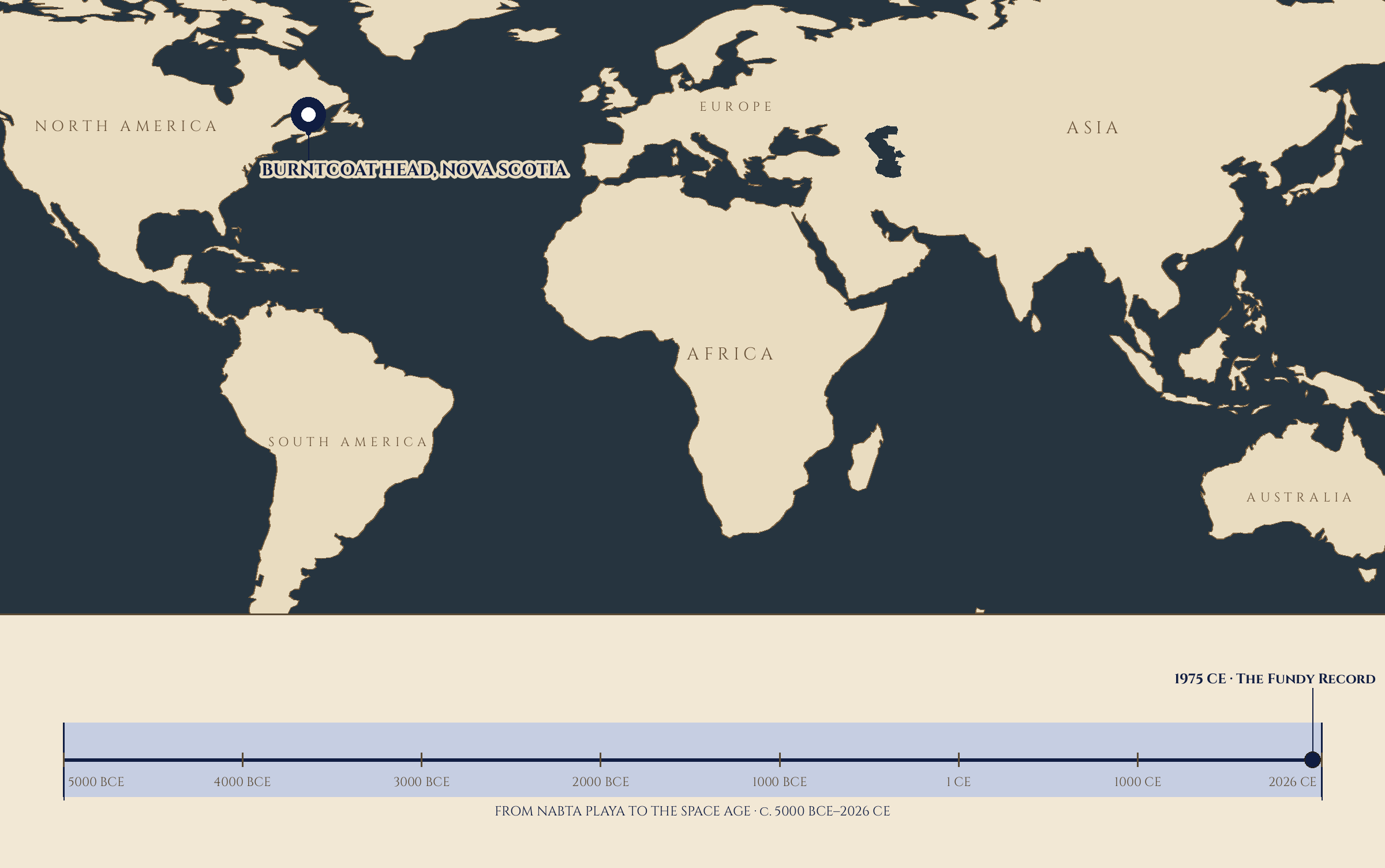
Where and when: BURNTCOAT HEAD, NOVA SCOTIA, 1975 CE · The Fundy Record (year 1975) — Tides & the Moon's Pull. The pin is this lesson. The line beneath the map is our road: every stop a moment when watching the sky changed, every lesson a pin upon it.
Lesson Objectives
By the end of this lesson, students should be able to:
- Explain, in their own words, why there are usually two high tides each day, using the moon's gravity and the inertial effect that together make two tidal bulges.
- Distinguish spring tides from neap tides: when each occurs in the moon's cycle, why the difference exists, and where the names really come from.
- Summarize the human history of the tides, from Pytheas to Newton to Laplace to Kelvin's tide-predicting machine.
- Treat tidal lore (moon planting, full-moon births, and similar claims) as belief-history: describe what was believed and what the evidence actually says.
- Check a published tide table against the moon's phase for one full week and identify the spring-neap pattern in the data.
- State the shore-safety rules for any in-person tide watching.
Reading this lesson: ★ marks the passages to remember. They return on the unit quiz and the class test. Check in questions ask the material back as you go; answer them in your workbook when you meet them.
Working this lesson: Your assignment packet is the first download on this page. Work in it as the lesson moves along, answering each exercise as its subject is taught — or read the lesson through for your notes and take the exercises as homework afterward. Both are proper ways to sit this class. Signposts in the reading tell you where each exercise belongs. Written answers are short answers in your own words; a few honest lines are worth more than a filled page.
Your Assignment Packet
This lesson's exercises live in its packet: the Lexicon Handout (every term, course terms marked ◆), Materials, Guided Practice — the tide-week practical, carried in full — the Assignment Manual with its answer key for self-checking, the Reflection Questions, and the Workbook Checklist. Download the packet before you begin and keep it beside you as you read.
This lesson's quiz is not printed in the packet. It now sits in the Unit II Quiz, where this unit's quizzes are gathered and its questions are pooled with the other lessons of Unit II.
Safety Briefing
Shore safety. If you visit a real shoreline for this lesson, tides deserve the same respect you give the sun in eclipse lessons. A rising tide can cut off a beach, a headland path, or a stretch of mudflat far faster than you expect, and cold water steals strength quickly. Never go tide-watching alone, never go without telling an adult where you are and when you will return, and always check the local tide times before you go, not after. Wet rock is treacherous, mudflats can trap the unwary, and breaking waves are stronger than they look. If the shore near you is unfamiliar, go with someone who knows it.
Night-observing safety. All night observing in this course is done with an adult present, in a familiar and safe location. Tell someone where you are going and when you expect to return. Dress warmly, bring a flashlight, and watch your footing in the dark.
The practical for this lesson needs no shore at all. The tide-table exercise uses published predictions online, which means every scholar, including scholars hundreds of miles from the nearest coast, can do the full assignment from home.
❦ In your workbook: record the safety briefing in your own way — the rising tide that cuts off beaches and mudflats, the cold-water rule, never tide-watching alone, and the tide times checked before you go, not after — copy, sketch, or note what matters.
The Wonder
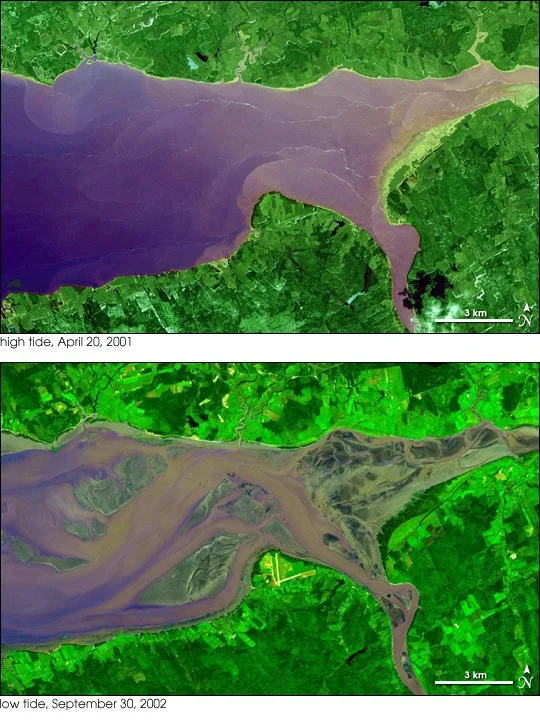
The breathing sea, seen from orbit. The head of the Bay of Fundy at high tide (top, April 20, 2001) and at low tide (bottom, September 30, 2002): the same basin, filled and emptied. At Burntcoat Head in this basin the range has been measured at 16.3 meters.
NASA Earth Observatory (Landsat). Public domain.
Stand on a beach at low water in the morning, and come back in the afternoon, and the sea will have moved. Not a little. On an ordinary coast the difference between high water and low water is a meter or two, enough to strand boats and uncover rock pools. On some coasts it is the height of a house. And it happens twice a day, every day, as regular as a heartbeat, whether anyone is watching or not.
Now travel, in your mind, to the head of the Bay of Fundy, between New Brunswick and Nova Scotia in Canada. The bay is shaped like a great funnel, narrowing as it runs inland, and the Atlantic tide pours into that funnel twice a day. ★ At Burntcoat Head, in the Minas Basin, the difference between low water and high water has been measured at 16.3 meters. That is about 53 feet, taller than a five-story building. The Guinness record book has listed it since 1975 as the greatest tidal range in the world. (Honest footnote, because this course keeps them: in 2025 a study from Nunavik reported a range of 16.35 meters at Leaf Basin in northern Quebec, and the record is now politely contested. Science is allowed to argue with record books. The record books usually lose eventually.)
At low tide at Burntcoat Head you can walk on the ocean floor among flowerpot-shaped rocks that stood drowned a few hours earlier. At high tide the water covers them completely. More than a hundred billion tons of seawater move in and out with each tide. Twice a day.
Or travel to England's River Severn, where the Bristol Channel's great tidal range squeezes into a narrowing estuary and the incoming tide arrives as a single traveling wave, a wall of water up to two meters high that runs miles upriver against the current. It is called a tidal bore. Surfers have ridden the Severn bore since 1955. The wave is graded on a five-star scale, like a restaurant, which tells you something about the British.
All of this, the breathing sea and the walking-on-the-ocean-floor and the surfable river wave, is the moon at work. Not the moon's light. The moon's weight. The moon is pulling the ocean, and the ocean is answering, twice a day, all over the world.
The question is how.
Check in: How large is the tidal range at Burntcoat Head — and what honest footnote does this course keep about that record?
❦ In your workbook: record the wonder in your own way — the breathing sea, Fundy's funnel and its record range, and the Severn bore — copy, sketch, or note what matters.
The Story
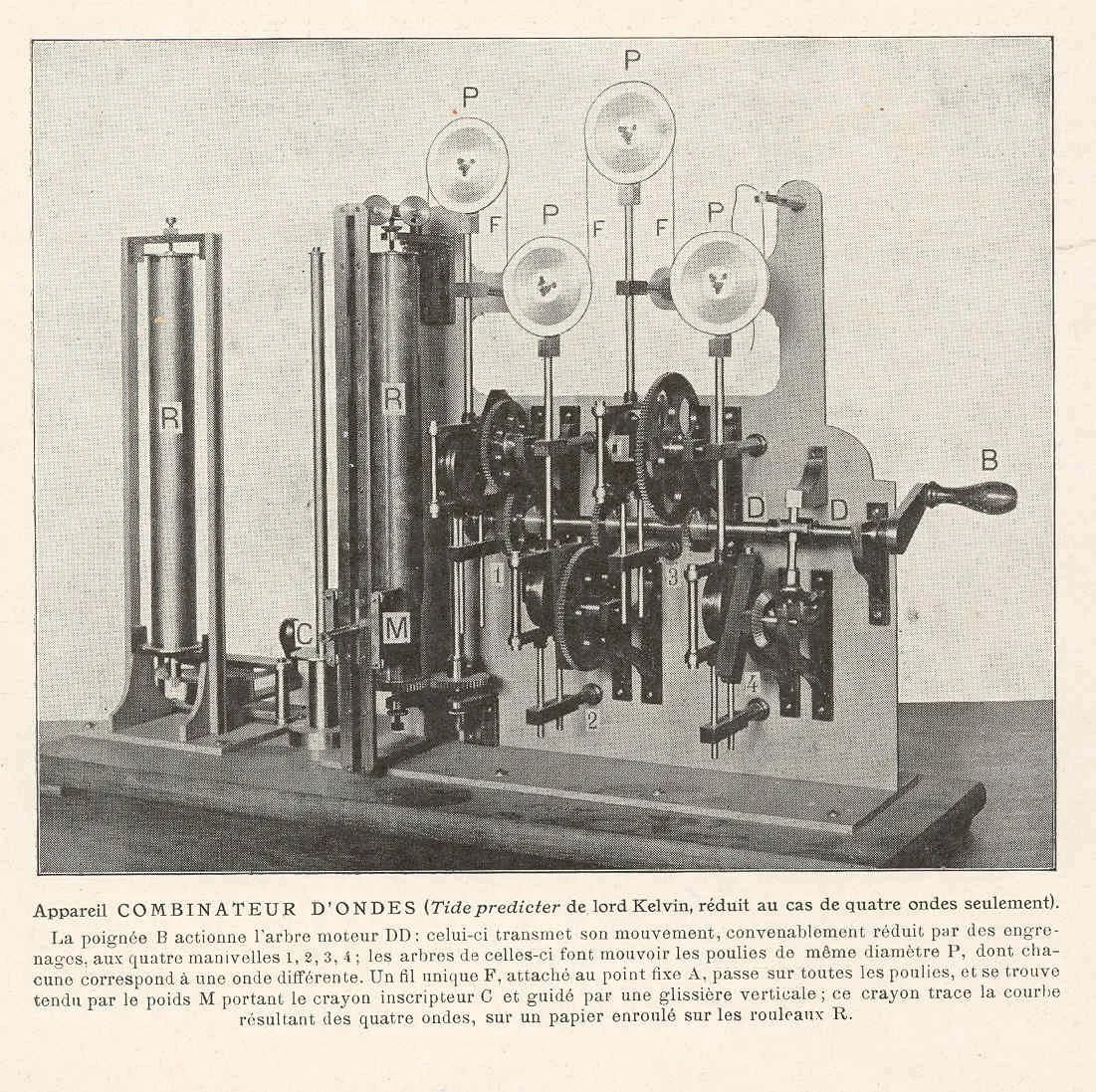
Kelvin's idea in brass and wire: the tide-predicting apparatus shown reduced to four components. One wire runs over every pulley, adding the rhythms together, and the pen draws the sum — a harbor's coming tides as a single curve. French plate from the FMIB bulletin series.
Plate from the FMIB (Fisheries) bulletin, via NOAA's Fisheries collection. Public domain.
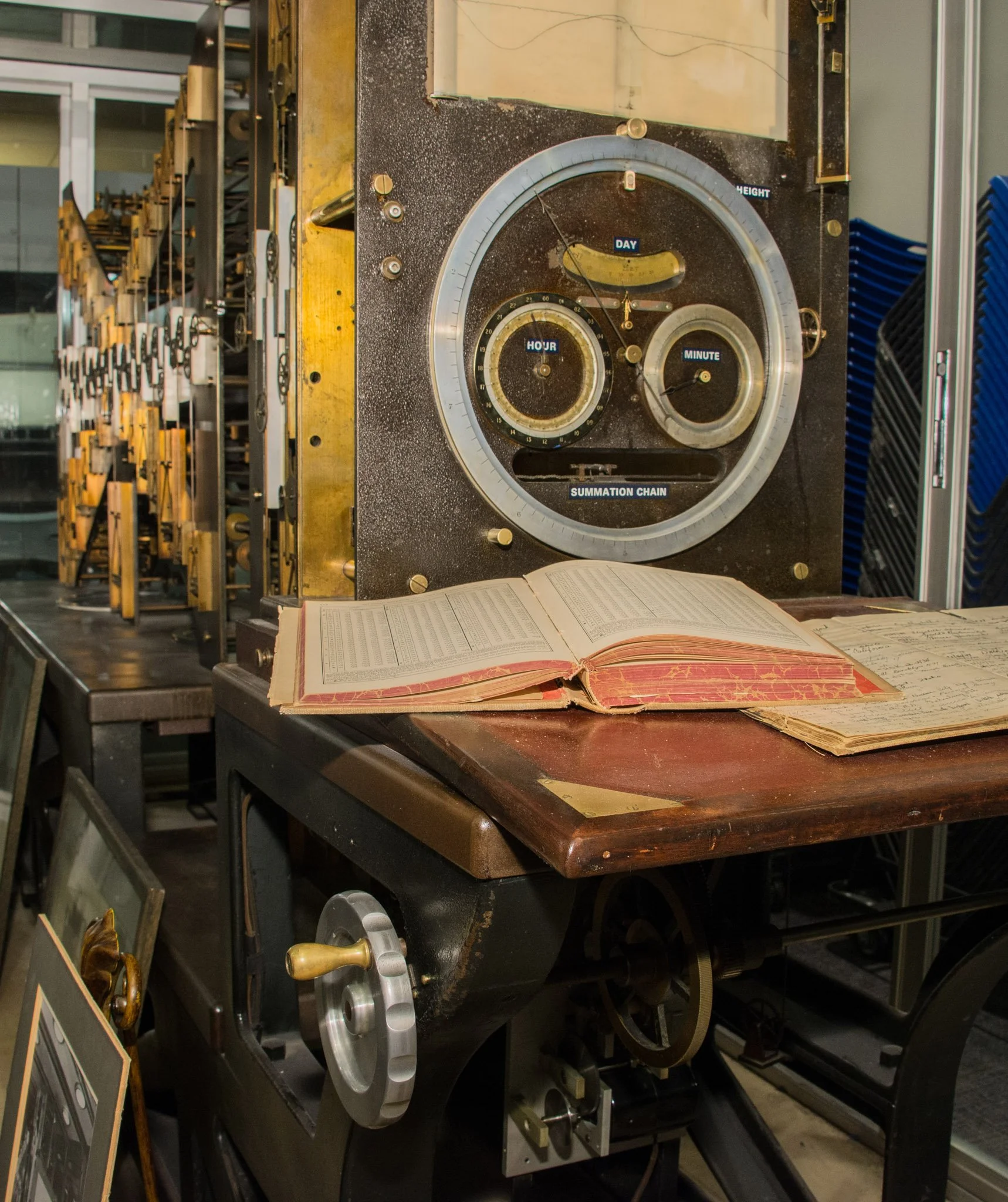
Old Brass Brains." The US Coast and Geodetic Survey's Tide Predicting Machine No. 2, which ran from 1912 to 1965 and computed the tide tables used for the D-Day landings in Normandy. The summation chain added the harmonic constituents; the dials read out the day, hour, and minute of the tide it was drawing.
Photograph by Steven Finegan, released CC0 via Wikimedia Commons.
The sea that barely moved
The civilizations around the Mediterranean Sea paid the tides very little attention, for the excellent reason that Mediterranean tides are tiny. Where the tide barely moves, nobody builds a science of it. The ancient theories that did exist compared the sea's movements to breathing or blood flow, or blamed undersea caverns, or whirlpools, or winds. Plato reportedly thought water flowed in and out of undersea caverns. Aristotle is thought to have blamed winds driven by the sun's heat, and to have rejected the idea that the moon had anything to do with it. There is an old legend that Aristotle despaired of understanding the tides of the Strait of Euripus so completely that he threw himself in. It is only a legend, but it tells you how the tides tormented even the great minds.
Meanwhile, on the other side of the world, the Yolngu people of northeastern Arnhem Land in Australia had identified the link between the moon and the tides, and explained it in their own way: the moon fills with water and empties out again. That is not the mechanism, but the observation underneath it was exactly right.
The Greek who sailed past Gibraltar
Around 325 BCE, a Greek explorer and astronomer named Pytheas of Massalia (Massalia is modern Marseille, in France) sailed out through the Strait of Gibraltar and up the Atlantic coast of Europe toward Britain. The Mediterranean had not prepared him for what he found. The Atlantic tides were enormous compared with anything at home, and they kept lunar time.
Pytheas was the first Greek we know of to connect the tides with the phases of the moon. His own writings are lost, and what survives comes to us in fragments quoted by later authors, so scholars still argue about exactly what he meant. The phases themselves cannot cause the daily tides, and some translators think he meant the spring and neap cycle, which really does follow the phases. The details are debated. The breakthrough is not: somebody had finally written down that the moon and the tides belong to the same story.
In the century that followed, others filled in the schedule. Posidonius, in the first century BCE, made long observations of the sea on the Spanish coast and wrote detailed descriptions of the tides and their relationship to the moon's phases. Seleucus of Seleucia, around 150 BCE, went further and theorized that the tides were caused by the moon, as part of a model in which the Earth itself moved around the sun. And in England, centuries later, the Venerable Bede wrote in The Reckoning of Time that the twice-daily timing of the tides is related to the moon, and that the monthly cycle of spring and neap tides is related to the moon's position. He even noted that high water comes at different times along different stretches of the same coast, and that the water's movement makes it low tide in one place while it is high tide in another. He did not know how the moon did it. Nobody did. But the schedule was getting sharper.
Medieval sailors carried the schedule in their heads as rules of thumb. There was said to be a way to know "what moon makes high water," meaning which phase of the moon brings high tide at your particular harbor. Every port had its own answer, because every port's tide keeps its own hours, and that fact would turn out to be a deep clue.
The mystic who was right and the genius who was wrong
★ In 1609, Johannes Kepler suggested, correctly, that the gravitation of the moon causes the tides. He compared the moon's pull to magnetic attraction, which was the strongest image of invisible action-at-a-distance anyone had at the time. In the introduction to his Astronomia Nova he wrote that if the earth ceased to attract the waters of the sea, the seas would rise and flow into the moon. He had the right intuition, and he had it a century before anyone could prove it.
★ Seven years later, Galileo Galilei wrote his Discourse on the Tides and took the opposite view, mockingly. Galileo rejected the lunar theory and argued that the tides were caused by the earth's rotation and its revolution around the sun, sloshing the oceans the way water sloshes in a moving basin. He liked this theory because it gave him what he thought was a proof that the earth moves. The trouble was that his theory predicted only one high tide per day, while sailors everywhere knew there were about two. His contemporaries noticed. Galileo waved the discrepancy away, blaming the shape of the sea and its depth. He was completely wrong, and he was wrong in exactly the confident, brilliant way that should make every scholar a little humble. Being a genius is no protection against a bad theory. Only the evidence is protection, and the evidence was counting two tides a day.
Newton draws the two bulges
★ In 1687, Isaac Newton published the Principia and gave the first correct gravitational explanation of the tides. His model was deliberately simplified: imagine the earth covered entirely by ocean, with no continents, and water that responds to gravity instantly. In that idealized world, the moon's gravity and the inertial effect of the earth-moon pair's motion produce two bulges of water on opposite sides of the earth, one facing the moon and one facing away. As the earth turns beneath the bulges, each coast passes through two high waters a day. Newton even noted that the tides come about fifty minutes later each day, because the moon has moved along in its orbit.
This simplified picture is called the equilibrium theory of the tides. It gets the two bulges right and the rhythm right. What it cannot do is predict the actual tide at any real harbor, because real harbors have continents, shallow seas, friction, and basins that slosh at their own natural periods. The equilibrium tide, worked out on paper, is less than half a meter tall. The real tide at Fundy is sixteen meters. Something else was going on.
Laplace, Kelvin, and the brass brains
The something else was dynamics. Beginning in 1775, Pierre-Simon Laplace worked out how the oceans actually respond to the moon's and sun's pull: as moving water with friction, with basins that resonate like struck bells, with great rotating wave systems circling the ocean basins. His dynamic theory of tides predicts the large patterns sailors really observe, and modern satellite measurements of the sea surface match it to within centimeters. The equilibrium theory told us why there are tides. The dynamic theory told us what they actually do.
But sailors and harbor masters did not need a theory of everything. They needed to know when high water would come next Tuesday. In the 1860s, William Thomson, who would later become Lord Kelvin, applied a new mathematical idea to the problem: any tide, however complicated, can be broken down into a sum of simple repeating rhythms, its harmonic constituents, each with its own period, like the notes in a chord. The moon's twice-daily rhythm is one note. The sun's twice-daily rhythm is another. There are dozens more, some tied to the moon's distance, some to the tilt of its orbit. Analyze years of water-level records from a harbor, find the strength and timing of each note at that harbor, and you can add the notes back together to predict the tide years in advance.
The arithmetic was crushing. So Kelvin had a machine built to do it. The first tide-predicting machine, constructed in 1872-73, was a beautiful brass contraption of gears, pulleys, and cranks: each wheel turned at the period of one tidal rhythm, a cord running over the pulleys added all the rhythms together, and a pen drew the coming year's tide curve on a roll of paper. Turn the crank, and four hours of cranking produced a full year of predictions for a harbor. Later machines grew to dozens of components. The United States Coast and Geodetic Survey built its Machine No. 2, nicknamed "Old Brass Brains," which ran from 1912 to 1965 and computed the tide tables used for the D-Day landings in Normandy. The brass brains were retired only when digital computers took over in the 1960s and 1970s. You can still see some of them in museums, in London and Washington and Munich, turning their slow gears for visitors.
From Pytheas watching the Atlantic in 325 BCE to a brass machine drawing next year's tides: that is the whole story of this lesson, and it is the story of a question that refused to stay mysterious.
Check in: Who first connected the tides with the moon's phases, who first proposed the moon's gravity as the cause — and what single observation disproved Galileo's theory?
❦ In your workbook: record the story in your own way — Pytheas and the schedule, Kepler right and Galileo wrong, Newton, Laplace, and Kelvin's brass machine — copy, sketch, or note what matters.
In your packet: Exercise III — The Lore Audit ✎ begins here. Work it now, or mark the place and take it as homework — your choice.
The Mechanism
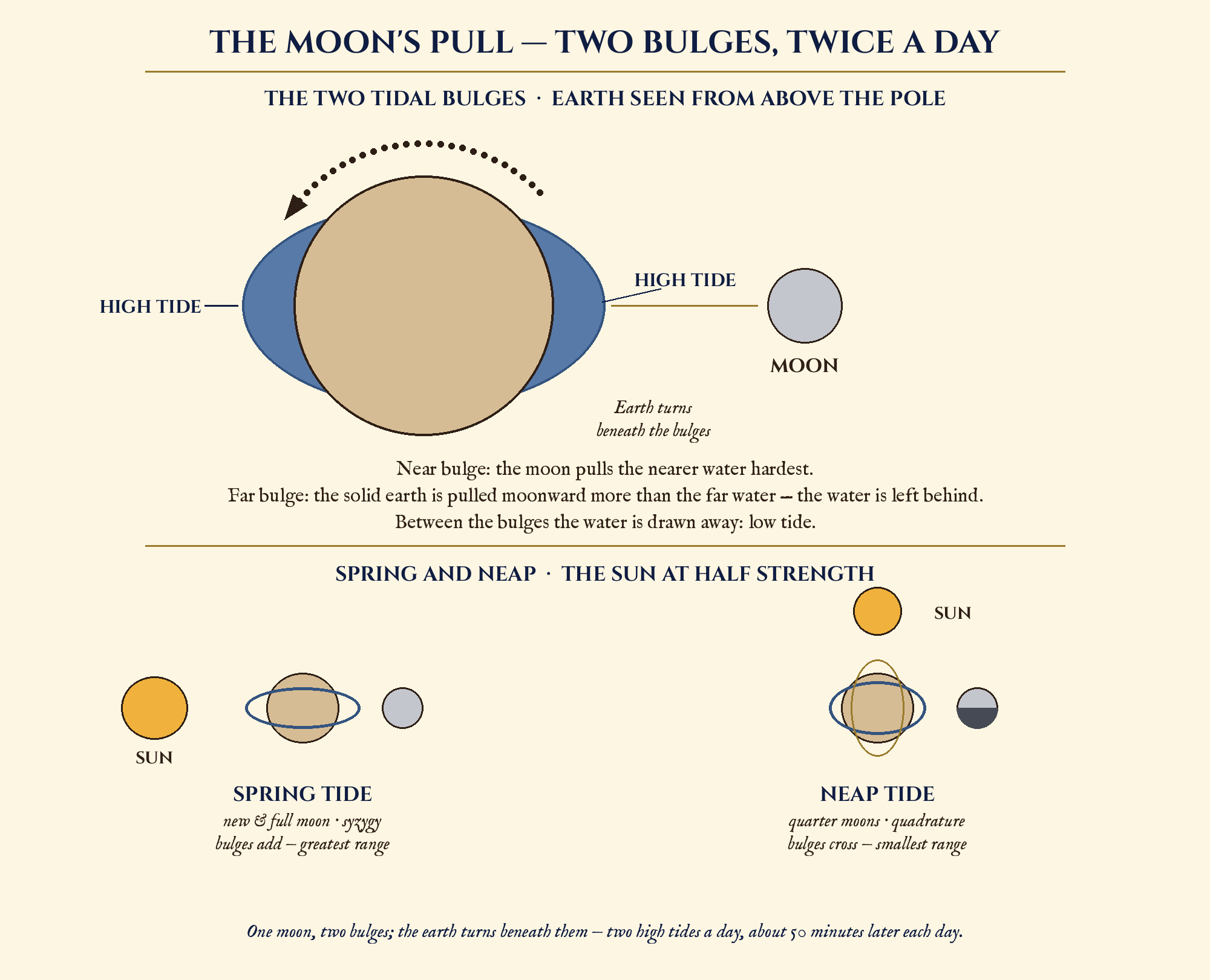
The mechanism as a picture. Two bulges, lined up with the moon; the earth turns beneath them. Below: spring tides when sun, earth, and moon align, neap tides when they stand at right angles. Typeset plate built for this lesson — every label is set type, not drawn lettering.
Built for the School of Evershade (typeset plate; Cinzel / IM Fell English, SIL OFL). Builder:.
Here is the mechanism, and I want you to learn it the way you learned the geometry of eclipses: as a picture you can draw, not a sentence you memorize.
The moon pulls unevenly
Gravity weakens with distance. The moon pulls on the whole earth, but it pulls hardest on the part of the earth nearest to it and weakest on the part farthest away. Now think about what that means for the ocean.
★ On the side of the earth facing the moon, the ocean water is closer to the moon than the solid earth beneath it is, so the water feels a stronger pull. The water is tugged toward the moon, and it piles up into a bulge. That is high tide number one, and it is the easy one. Everybody's first guess gets this one right.
★ On the side of the earth facing away from the moon, the ocean water is farther from the moon than the solid earth is, so the water feels a weaker pull than the planet beneath it. The solid earth is yanked toward the moon more strongly than the far-side water is, and the water gets left behind. Left-behind water piles up into a second bulge, on the far side. That is high tide number two.
There is another way to say the same thing, and some scholars find it clearer. The earth and moon are a pair, swinging around their common center of balance as the moon orbits. In that swinging frame, everything feels a slight outward fling, strongest on the far side, and that fling raises the far-side bulge. Both descriptions are the same physics seen from different seats. The astronomers call the difference in the moon's pull across the earth's diameter the tide-generating force. It is small, a tiny fraction of ordinary gravity, but it acts on the whole ocean at once, and the ocean is very large.
Two bulges, one turning earth
★ The two bulges stay lined up with the moon while the earth turns beneath them. Stand on a coast, and the turning earth carries you through one bulge, then through the low water between the bulges, then through the second bulge, then through low water again. Two high tides and two low tides, roughly every 24 hours and 50 minutes.
That number matters. The moon moves along its orbit while the earth spins, so the earth must turn a little extra each day to bring the moon back overhead. A lunar day is 24 hours and 50 minutes, not 24 hours, and the tides come about fifty minutes later each day. Newton noticed this. Your tide table will show it: compare Monday's high waters with Tuesday's.
Between the bulges, the water is drawn away toward the high-water regions, and the sea level falls. That is low tide. The whole pattern marches steadily around the planet, always keeping step with the moon.
The sun joins in, at half strength
The sun plays exactly the same game, and the sun is much farther away. Remember the rule: the tide-generating force weakens with the cube of the distance, so distance matters far more than mass. The sun's pull on the earth is enormously stronger than the moon's, but its pull is nearly the same on the near side and the far side, because the sun is so far away that the earth's diameter barely counts. ★ The difference, which is all the tide cares about, comes out to roughly half the moon's effect. The usual figure is about 46 percent. The moon is the senior partner; the sun is the junior partner with real influence.
★ Twice a month, at the new moon and the full moon, the sun, earth, and moon line up (astronomers call this alignment syzygy, which you met in the eclipse lesson). The sun's bulges fall on top of the moon's bulges. The partners pull together, the bulges grow taller, and the low waters between them sink lower. The difference between high and low, the tidal range, is at its maximum. These are the spring tides.
"Spring" here has nothing to do with the season. It is the older sense of the word, as in a spring of water bursting forth, or springing up. Spring tides spring higher. They happen all year round, twice every lunar month.
★ A week later, at the first and last quarter moons, the sun and moon stand at right angles as seen from earth (this is quadrature). Now the sun's bulges fall where the moon's low waters are, and the sun partly cancels the moon. The tidal range shrinks to its minimum. These are the neap tides. The usual etymology traces "neap" to an Old English word meaning "without power," which is exactly what a neap tide feels like if you were hoping for drama.
So the monthly rhythm is: spring tides at new and full moon, neap tides at the quarters, spring again, neap again, all year, every year.
Why your harbor keeps its own hours
If the equilibrium picture were the whole truth, high tide would arrive when the moon is overhead, and every coast would keep the same schedule. Neither is true, and the reasons are the most interesting part.
First, water takes time to respond. The bulges are the forcing; the actual high water at your coast arrives hours later, after the water has sloshed into place. This delay is called tidal lag, and it is different at every harbor.
Second, coastlines reshape everything. A funnel-shaped bay like Fundy piles the tidal wave higher and higher as it narrows. A broad shallow shelf slows the wave down. Basins the size of oceans slosh at their own natural periods, the way a bathtub has a favorite sloshing rhythm, and Laplace's dynamic theory is the mathematics of that sloshing.
That is why most coasts see two nearly equal high tides a day (semi-diurnal tides), some coasts see two unequal ones (mixed tides), and a few, like the Gulf of Mexico, see only one high tide a day (diurnal tides). The moon provides the rhythm section. The coastline writes the melody.
One more refinement, because you will see the phrase in tide tables: when a spring tide coincides with the moon at perigee, its closest approach to earth, the tides run a little stronger than usual. These extra-high spring tides are popularly called king tides. It is a popular term, not a formal astronomical one, and it is worth knowing because harbor flood warnings use it.
And a final honesty note: the moon pulls on the solid earth too, not just the water. The ground beneath you rises and falls with the tides by a few dozen centimeters. You never notice, because everything around you rises with it. The ocean notices, because water can flow.
That is the whole mechanism. The moon pulls unevenly, the difference piles water into two bulges, the earth turns beneath them, the sun strengthens or weakens the pattern twice a month, and the coastline decides what the result looks like at your shore. No dragons. No sloshing basin. Just gravity, inertia, and geometry, checked against the tide tables for two thousand years.
Check in: Why are there two tidal bulges when there is only one moon — and when do spring tides and neap tides each occur?
❦ In your workbook: record the mechanism in your own way — the uneven pull, the two bulges, the 24-hour-50-minute lunar day, and the sun at half strength — copy, sketch, or note what matters.
In your packet: Exercise II — The Two-Bulge Sketch ⚒ begins here. Work it now, or mark the place and take it as homework — your choice.
A Sealed Note on Being Wrong
My dears, I want to say something about Galileo, because I have been thinking about him all through this lesson and I do not want you to leave it feeling superior to him.
Galileo was one of the sharpest minds our species has produced, and on the tides he was completely, confidently, publishedly wrong. He had the moon's true role described to him by Kepler, and he mocked it. He had sailors telling him there were two tides a day, and he explained it away. His theory was beautiful, it supported the cause he cared about, and it was false.
Kepler, meanwhile, believed all sorts of strange things. He cast horoscopes for money. He heard the music of the spheres. And on the tides he was right, because he let the observation lead: the waters rise when the moon is in certain places, so the moon must be doing it.
Here is the lesson inside the lesson. Cleverness is not the defense against error. Only the check is the defense: the tide table against the moon, the prediction against the water, the beautiful theory against the stubborn count of two tides a day. When you do this week's practical and the numbers agree with the moon, you are doing the thing Galileo would not do. Be proud of that. And be kind to him anyway. We have all been sure and wrong. The good scholars are the ones who keep checking.
❦ In your workbook: record the sealed note in your own way — cleverness is not the defense against error; only the check is — copy, sketch, or note what matters.
PROFESSOR VESPER GLIMMERWICK
Celestial Studies
Astronomer & Celestial Historian
Guided Observation: Testing the Sky Against a Table
Part One: The Week of Tides (Level One)
This is the lesson's core practical, and every scholar can do it, coast or no coast.
- Open the NOAA Tide Predictions page (linked in Further Reading) and choose any coastal station. If you have a favorite coast, use it. If not, try a station with big tides, like somewhere in Maine, so the pattern is easy to see.
- For seven days, record for each day: the date, the moon's phase (from your Moon Journal), and the predicted times and heights of every high and low water. Compute each day's tidal range: the highest high minus the lowest low.
- In your workbook, make a small table: date, moon phase, number of high tides, tidal range.
- Now answer in writing: How many high tides did most days have? Did the range grow or shrink across the week, and which way was the moon's phase moving? Can you find the day the pattern turned?
Inland scholars: there are no tide stations in Kansas, and that is itself data. The moon pulls on Kansas exactly as hard as it pulls on Maine. The difference is all coastline. Note that in your workbook.
Part Two: Spring Against Neap (Level Two)
- Pick two weeks from the predictions: one centered on a new or full moon, one centered on a quarter moon.
- Compute the average daily tidal range for each week.
- Write up the comparison: how much bigger was the spring-tide week's range? Does the difference match what the mechanism predicts?
- If a perigean spring tide ("king tide") falls anywhere near your weeks, note it and see whether the table shows the extra height.
Moon Journal Prompt
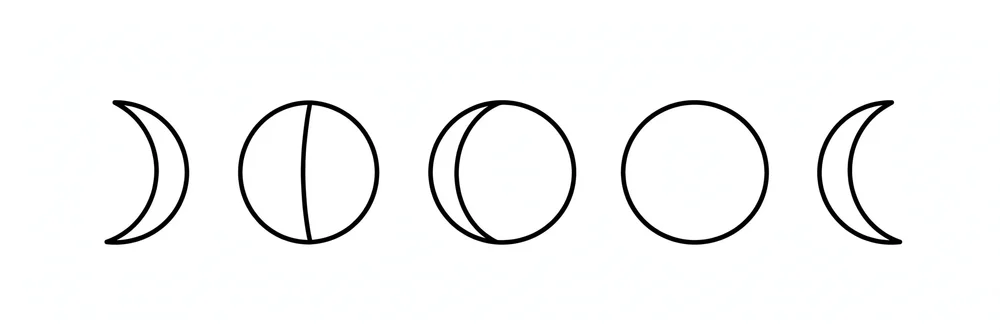
Each night of your tide week, sketch the moon's phase in your journal next to that day's tide data. By the end of the week you will have a picture of the exact relationship this whole lesson is about: the moon's face and the sea's breathing, side by side.
Check in: Your tide week runs on published predictions, not on a shore — what does Kansas having no tide stations prove about the mechanism?
Sky Log Entry
Record this lesson's practical in your Sky Log in the usual form:
- Date and time of each observation or reading.
- Location: your home coordinates, plus the tide station you chose (name and state).
- Moon phase: sketch and name, each night of the week.
- Tide data: for each day, the predicted high and low waters with times and heights, and the day's tidal range.
- Notes: the pattern you found, in two or three sentences, and whether it matched the mechanism's prediction.
❦ In your workbook: record the tide week in your own way — the seven days of station data with the moon's phase from your Moon Journal beside each day, the daily ranges, and the day the pattern turned — copy, sketch, or note what matters.
In your packet: Exercise I — The Week of Tides ◐ begins here. Work it now, or mark the place and take it as homework — your choice.
Materials
Required (Level One — household items)
- A workbook or several sheets of paper and a pencil for the tide table, the daily range calculations, and the two-bulge sketch.
- Internet access to reach the NOAA Tide Predictions page (linked in Further Reading) and choose a coastal station.
- Your Moon Journal, for the nightly phase sketches that run alongside the tide week.
- A ruler for drawing the earth, moon, and sun alignment sketches in Exercise II.
- A flashlight for any night observing.
Suggested (Level Two — historically closer)
- Printed predictions from two different stations (one semi-diurnal, one diurnal or mixed) to compare tidal types side by side.
- Graph paper for plotting the week's tidal ranges as a curve against the moon's phase.
Reflection Questions
Answer the following questions in your workbook.
- The same moon that raises two bulges of water was once blamed for madness and consulted about planting. What has to change for a belief to move from lore to mechanism, and who gets to decide when the move is complete?
- Galileo was brilliant and wrong about the tides; Kepler held strange beliefs and was right about them. What does that suggest about how we should judge ideas, and about the limits of cleverness?
- Sailors watched two tides a day for thousands of years before Newton explained them in 1687. Why do you think the correct mechanism took so long, and what finally made it possible?
- A tide table is a prediction built from years of local measurements, not a reading of the moon's position alone. Why does the prediction need the local measurements? What would go wrong if you predicted tides from astronomy alone?
- What is one thing you believed, or half-believed, about the moon and the sea before this lesson that the mechanism corrected, and what convinced you?
Workbook Checklist — Lesson 10
In my workbook I have:
- ☐ explained in my own words why there are two high tides each day — the near-side bulge and the far-side bulge
- ☐ distinguished spring tides from neap tides, named when each occurs, and given where the names really come from
- ☐ summarized the history from Pytheas to Newton to Laplace to Kelvin's tide-predicting machine
- ☐ treated one piece of tidal lore as belief-history, with the evidence stated beside the belief
- ☐ checked a tide table against the moon's phase for one full week and found the spring-neap pattern in the data
- ☐ recorded the shore-safety rules for any in-person tide watching
☐ Lesson completed Date: ___ Signature: ___
The Professor's Closing Note
My dearest scholars,
We began this course by learning to watch the moon change its shape without changing at all. Now you know that the same moon is lifting the sea, twice a day, on every coast in the world, and has been doing it since before there was anyone to wonder at it.
I want to leave you with the image I carry. On my evening flights, I sometimes cross the place where a river meets the sea, and if the tide is running I can see it from the air: the line where the salt water pushes upstream, bright against the dark river. It looks like the earth inhaling. Then the tide turns, and the earth exhales. In, out. In, out. The moon conducting, the ocean breathing, and all of us, bats and scholars alike, living our small loud lives on the shore of it.
Keep your tide table beside your Moon Journal this week. Watch the numbers and the moon nod at each other. And the next time someone whispers, "Does the moon really pull the sea?", you will know exactly what to tell them, and exactly how we know.
PROFESSOR VESPER GLIMMERWICK
Celestial Studies
Astronomer & Celestial Historian
Cross-Class Connections

Herbology · Unit I, Lesson 5 — The Historian's Herbarium
Glimmerwick is right about my greenhouse, scholars: we keep the old beliefs the way a museum keeps old tools — with respect and clear labels. Come and learn the discipline this Tower lesson borrows: how a plant's folklore is genuine cultural history, worth recording with care in its own clearly labeled section, and why it must never be mistaken for proof of what a plant does. Bring that habit back to every moon-planting and tide-harvesting claim you meet. — Professor Beryl Fernfoot, Herbology Greenhouse

Scrollwork · Unit VI, Lesson 23 — Archive Labels & Library Systems
Before a reckoning could travel, Glimmerwick's scholars, someone had to keep it findable. Bede's works stand in my lesson's earliest catalogs — the monks of Reichenau listed him beside the canon law and the homilies — and my lesson teaches the labels, shelfmarks, and catalogs by which houses like his kept a tide reckoning from vanishing among hundreds of volumes. The scribes copied the tables; the Library kept them. Come and learn how. — Professor Quillberry Nocturne, Scrollwork Library

Creative Arts · Studio Extension E3 — Models That Move, Built as Machines
Your professor calls Kelvin's machine the most Evershade machine ever built, and she is right — it is my extension's patron instrument. In my workshop we study how it summed ten tidal cycles with gears, cranks, and a cord into one true drawn curve, and we build demonstrators on its pattern: cycles, rates, an honest sum, and a crank. When you are ready to build Glimmerwick's two-rhythm tide adder at bench strength — wheels, cord, and pen — the workshop doors are open and the brass stock is waiting. — Professor Cogbranch Timberclank, Creative Arts Workshop
Further Reading & Sources
These are real destinations for further study, every one verified live at the time of writing. Start with NOAA; it is the authority this lesson leans on.
- NOAA Education: Tides, what causes them, the types of tides, and how predictions are made. https://www.noaa.gov/education/resource-collections/ocean-coasts/tides
- NOAA Tide Predictions: choose any of 3,000+ coastal stations and read its tide tables (the practical's home page). https://tidesandcurrents.noaa.gov/tide_predictions.html
- Theory of Tides: the full history from Pytheas and Posidonius through Newton, Laplace, and Kelvin. https://en.wikipedia.org/wiki/Theory_of_tides
- Tide-Predicting Machine: Kelvin's brass computers, "Old Brass Brains," and the D-Day tide tables. https://en.wikipedia.org/wiki/Tide-predicting_machine
- Browse the Celestial Studies shelf in the school Library for readable editions of these works.
Submit your work for this lesson using the form below.
CONTINUE IN THE CELESTIAL TOWER
← Previous · Lesson 9: Eclipses Next · Lesson 11: The Moon Up Close →
Unit II — The Moon Celestial Tower — All 33 Lessons
The rest of Unit II: Lesson 7 · Moon Phases · Lesson 8 · Names of the Moon · Lesson 9 · Eclipses · Lesson 11 · The Moon Up Close