
CELESTIAL STUDIES
Unit II · Lesson 9Eclipses
Professor Vesper Glimmerwick
Astronomer & Celestial Historian
The Celestial Tower • School of Evershade
Professor's Introduction
Settle in under the stars, scholars,
I was flying home to the Celestial Tower one evening, just after sunset, when I overheard two young Eversparks on the terrace below me, arguing in the friendliest possible way about the eclipse of 2024. One of them had stood in the path of totality and seen the sun go out at midday. The other had watched it from far away, where the sun only thinned into a crescent. "You saw the real one," the second one sighed, "and I only saw the rehearsal."
Oh, my dears. There is no rehearsal eclipse. Every eclipse is the real one, and every witness is a real witness. The scholar in the path of totality saw the corona. The scholar outside it saw the crescents in the tree shadows and felt the strange afternoon chill. Both of them stood inside the same enormous shadow, and both of them will remember where they were for the rest of their lives.
This lesson is about the most dramatic thing the sky ever does: the day the sun goes dark and the night the moon turns red. It is about why our ancestors feared eclipses, how they learned to predict them, and how the geometry works, because geometry is the whole secret, and it is a beautiful one.
One important thing before we begin, and I say it with all the kindness in the world: the safety rules in this lesson are not suggestions. The sun can injure eyes in seconds, and it does not announce itself. Read the Safety Briefing as carefully as you read anything else tonight. The sky will wait for you. It has waited billions of years. It can wait until you are ready to meet it safely.
PROFESSOR VESPER GLIMMERWICK
Celestial Studies
Astronomer & Celestial Historian
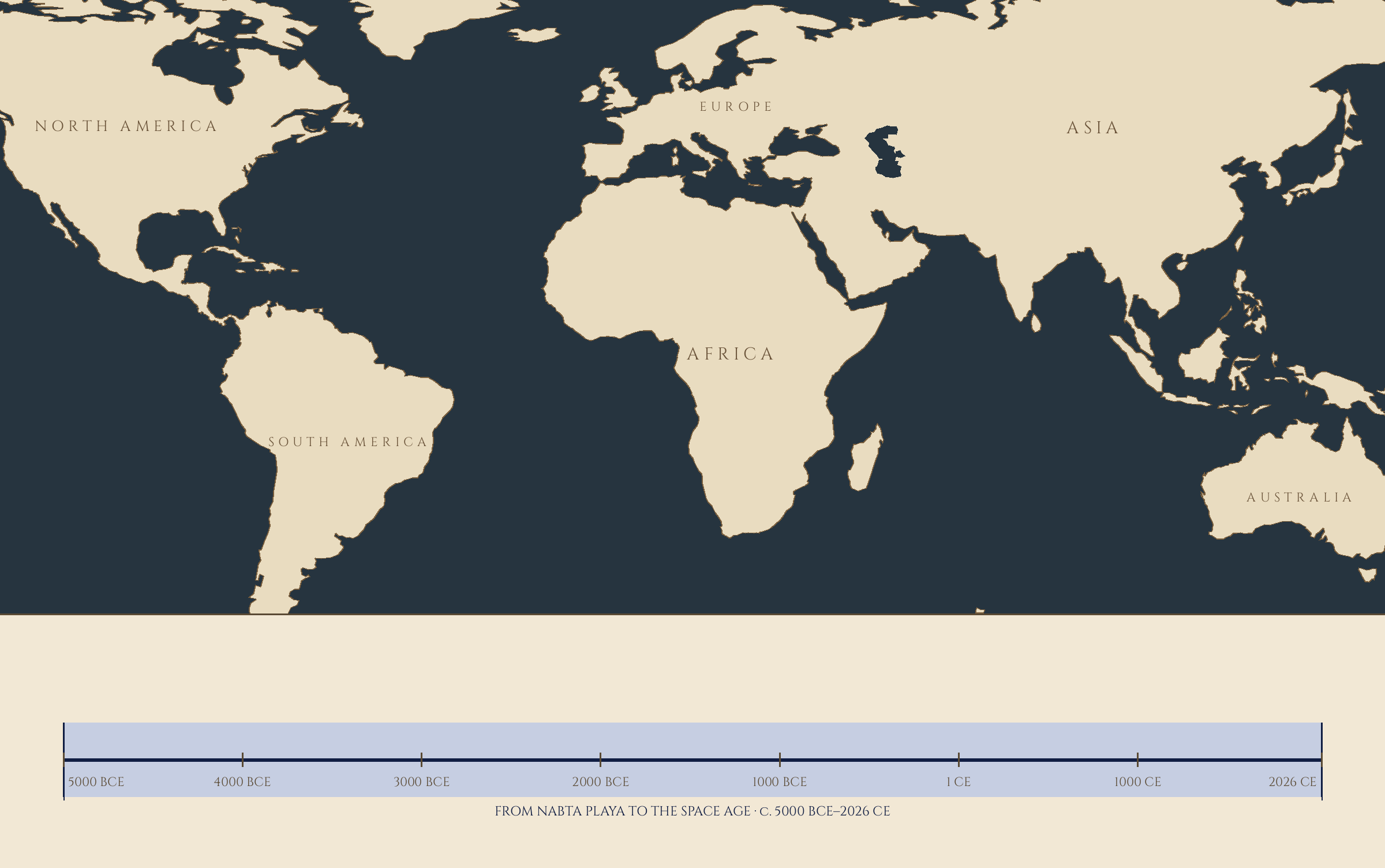
Where and when: your own sky, tonight — Eclipses. This lesson has no pin and no stop: its place is wherever you stand under the night sky. The line beneath the map is our road through the course: every stop a moment when watching the sky changed, every lesson a place upon it.
Lesson Objectives
By the end of this lesson, you will be able to:
- Explain, in their own words, how a solar eclipse and a lunar eclipse each happen, and which phase of the moon each one requires.
- Describe why eclipses do not happen every month, using the tilt of the moon's orbit and the idea of the nodes.
- Define umbra, penumbra, totality, the Saros cycle, and the other key terms of eclipse geometry.
- Summarize the human history of eclipses: fear, record-keeping, and the long road to prediction.
- State the three non-negotiable rules of eclipse viewing safety and demonstrate them with a pinhole projector and a safety drill.
- Build a working pinhole projector for indirect solar viewing and explain exactly what it is and is not for.
Reading this lesson: ★ marks the passages to remember. They return on the unit quiz and the class test. Check in questions ask the material back as you go; answer them in your workbook when you meet them.
Working this lesson: Your assignment packet is the first download on this page. Work in it as the lesson moves along, answering each exercise as its subject is taught — or read the lesson through for your notes and take the exercises as homework afterward. Both are proper ways to sit this class. Signposts in the reading tell you where each exercise belongs. Written answers are short answers in your own words; a few honest lines are worth more than a filled page.
Your Assignment Packet
This lesson's exercises live in its packet: the Lexicon Handout (every term, course terms marked ◆), Materials, Guided Practice, the Assignment Manual with its answer key for self-checking, the Reflection Questions, and the Workbook Checklist. Download the packet before you begin and keep it beside you as you read. The packet's exercises are Glimmerwick's own word for the work: Exercise I: The Pinhole Projector and the Safety Drill ⚒, Exercise II: The Shadow Game ⚒, and Exercise III: Your Eclipse Calendar ✎. The lesson's quiz is not printed in the packet; it pools to the Unit II Quiz, where it will meet you again.
Safety Briefing
Solar viewing safety. This section leads the lesson for a reason. Read every word, and treat every rule below as absolute.
Never look directly at the sun except during the brief total phase of a total solar eclipse. That exception applies only if you are inside the narrow path of totality, only while the moon completely covers the sun's bright face, and only until the bright sun begins to reappear. At every other time, during every partial and annular eclipse and on every ordinary day, looking directly at the sun can cause serious and permanent eye injury. The damage is painless and you may not notice it while it happens.
Eclipse glasses and handheld solar viewers must conform to the ISO 12312-2 international standard. This is the standard the American Astronomical Society, NASA, and the national eye-care organizations all point to. Buy viewers from a reputable supplier (the American Astronomical Society keeps a public list of verified suppliers), check that the ISO 12312-2 marking is printed on the viewer itself, and inspect the filter before every use. If it is scratched, punctured, torn, or coming loose from its frame, throw it away and do not use it. Put the glasses on before you look up, look away before you take them off, and always supervise children using them. Ordinary eyeglasses do not count as protection.
Never improvise solar viewing. No exceptions. Sunglasses, even very dark ones, are not safe. Smoked glass is not safe. Exposed photographic film, CDs, space blankets, and binoculars or telescopes without certified full-aperture solar filters are not safe. Do not hold eclipse glasses in front of binoculars or a camera lens either: concentrated sunlight can damage the filter and then your eyes. If you do not have a certified viewer, use indirect viewing only.
A pinhole projector is for indirect solar viewing only. It is a way to watch the sun's light fall on a surface. It is not for looking at the sun, and you must never look at the sun through the pinhole. Stand with your back to the sun, let sunlight pass through the small hole, and watch the projected image on the card or ground behind you. A pinhole projector is also not for lunar eclipses: the moon needs no eye protection at all. You may watch any lunar eclipse with your bare eyes, binoculars, or a telescope, with perfect safety.
Night-observing safety. All night observing in this course is done with an adult present, in a familiar and safe location. Tell someone where you are going and when you expect to return. Dress warmly, bring a flashlight, and watch your footing in the dark.
The Wonder
Imagine an ordinary afternoon. The sun is high, the birds are loud, the world is going about its business. Then the light begins to change, not the way it changes toward evening, but wrongly, thinly, as if someone were turning down a lamp that should not be turned down. The air cools. Birds fall silent and head for their roosts. A wind stirs from nowhere.
And then the sun goes out.
Not behind a cloud. The sky is clear, but where the sun was there is now a black disk, ringed with pale streaming fire, and the brighter stars are out at midday, and people around you are gasping or crying or laughing, because no description ever quite prepares you.
That is a total solar eclipse. It lasts a few minutes at most, and then the light comes flooding back, and the world exhales.
Scholars who stood in the path of the great North American eclipse of April 8, 2024, will tell you this is not an exaggeration. Ask one of them sometime. They are everywhere now, and they love to talk about it. Some of them are sitting in this very tower.
A lunar eclipse is the gentler sibling. On the night of a full moon, Earth's shadow begins to take a bite out of the lunar disk. The bite grows until the whole moon hangs in the shadow, and then something marvelous happens: the moon does not vanish. It turns red. A coppery, rusty, ember-colored moon glows where the bright moon was, and it stays that way for an hour or more before the bright moon slides back out of the shadow.
Two questions have followed humans through all of history. The first is: what is happening? The second, asked in a much smaller voice, is: is it angry at us?
This lesson answers the first question completely. The second question belongs to history, and history has a great deal to say.
❦ In your workbook: record the wonder in your own way — the sun gone out at midday inside the path, the thinned crescent outside it, and the moon that turns red instead of vanishing — copy, sketch, or note what matters.
The Story
The sun has been eaten
The oldest verifiable eclipse records we have were carved into bone in China, more than three thousand years ago. The city was Anyang, then called Yin, capital of the Shang dynasty, the first Chinese period to leave behind written records. The bones are ox shoulder blades and tortoise shells, cracked by heat in divination rituals, and they are the oldest known documents in the Chinese language. Among the fifty thousand inscribed bones recovered there, several mention eclipses. One inscription is a king reading the cracks and declaring that there will be harm. Another is shorter and more startling: "The sun has been eaten."
The eaten sun was not only a Chinese image. Across the ancient world, eclipses arrived as monsters and omens: a dragon devouring the sun, the gods expressing displeasure, a warning written across the sky. People banged drums and shouted to frighten the creature away. It is easy to smile at this from the far side of understanding, and we should not. These were careful observers of the sky, people whose calendars and harvests depended on it, watching the most reliable thing in their world fail without warning. Fear was the reasonable response. It took humanity centuries of patient watching to replace fear with prediction, and the story of that replacement is one of the great stories in all of science.
❦ In your workbook: record the eaten sun in your own way — Anyang, the oracle bones, and why fear was the reasonable response — copy, sketch, or note what matters.
The battle that stopped for an eclipse
Around 585 BCE, in what is now Turkey, two kingdoms had been at war for years. The Medes and the Lydians met for a battle on the plain, and in the middle of the fighting, the day turned to night. Both armies stopped, and both sides were suddenly very interested in making peace.
We know this from Herodotus, the Greek historian, writing about a hundred and fifty years after the event. Herodotus adds a remarkable detail: the philosopher Thales of Miletus had predicted the year of the eclipse in advance. If true, it would be the earliest known successful eclipse prediction in history. Modern astronomers have identified the eclipse in question as the solar eclipse of May 28, 585 BCE, whose path crossed Anatolia in the evening hours.
★ But here the honest historian must raise a hand. Modern scholars of ancient science are deeply skeptical that Thales could have done what Herodotus says he did. At the time, nobody yet understood that a solar eclipse is caused by the moon passing in front of the sun; that understanding would not arrive for more than a century. No known cycle could have told Thales where a solar eclipse's narrow shadow would fall, and the Babylonians, the finest eclipse watchers of the age, were nowhere near predicting the local circumstances of a solar eclipse either. Herodotus may have been repeating a proud local legend. Thales may have gotten the year right by luck, or by some rough pattern that happened to work once.
So we tell the story the way it deserves to be told: an eclipse very likely did interrupt a battle, and very likely did help end a war, and whether Thales predicted it or not, the story shows what people already suspected, that eclipses might follow rules, and rules can be learned. The wish to predict is older than the ability. That wish is the engine of this whole history.
Check in: Herodotus says Thales predicted the year of the 585 BCE eclipse. Why do modern scholars doubt he could have done it?
❦ In your workbook: record the stopped battle in your own way — what very likely happened, what Herodotus claims, and why the honest historian raises a hand — copy, sketch, or note what matters.
The eighteen-year rhythm
The ability arrived in Mesopotamia. Astronomers of the Chaldean tradition, the heirs of Babylon, kept eclipse records on clay tablets for centuries, and in the last few centuries BCE they noticed something extraordinary: eclipses repeat. After 223 lunar months, which is 6,585 and one-third days, or 18 years, 11 days, and 8 hours, the sun, Earth, and moon return to nearly the same relative geometry, and a nearly identical eclipse occurs.
★ This is the Saros cycle. It was known to Hipparchus, to Pliny, and to Ptolemy. The name itself has a curious history: it was applied to the cycle in 1686 by Edmond Halley, who took it from a Byzantine lexicon called the Suda, which had garbled an old Babylonian word. The word may come from the Babylonian saru, meaning 3600, or from a Greek verb meaning to sweep the sky. Nobody is entirely sure, and there is something fitting in that: even the name of the prediction cycle arrived through a chain of imperfect copies, the way so much ancient knowledge did.
The Saros is not perfect. That extra third of a day means each repetition happens about eight hours later in the day, so the eclipse's shadow falls about a third of the way around the world to the west. Three Saros cycles, about 54 years, bring the timing nearly full circle again; the Greeks called that longer rhythm the exeligmos, the turn of the wheel. And the Saros never predicts exactly: it says a similar eclipse will happen, not precisely where its shadow will fall. But it was the first proof that eclipses obey a timetable, and it changed the human relationship with the sky from terror to bookkeeping.
The ancient Greeks built the cycle into machinery. The Antikythera mechanism, a bronze calculating device made around 150 to 100 BCE and recovered from a shipwreck, carries a dial marked with the Saros period of 223 months, used to predict eclipses. It is the oldest known geared mechanism in the world, and one of its jobs was telling the future of the sky.
❦ In your workbook: record the eighteen-year rhythm in your own way — 223 months, the third of a day that walks each repetition west, and the machine that carried the cycle in bronze — copy, sketch, or note what matters.
The eclipse that saved Columbus, or so the story goes
On the evening of February 29, 1504, a total lunar eclipse rose over Jamaica. Christopher Columbus was stranded there on his fourth voyage, his ships ruined by shipworm, his crew's food supply cut off by the local people after months of tension. Columbus carried an almanac of astronomical tables, the kind every European navigator owned, and in it he found the coming eclipse. He told the local leaders that his god was angry and would take the moon away. When the moon reddened and darkened on schedule, the frightened community resumed supplying food. Columbus timed the eclipse with an hourglass in his cabin and emerged just before totality ended to announce that his god was appeased, and the moon returned.
We know this story through the account of Columbus's son Ferdinand, so it arrives to us already shaped by family loyalty. But the astronomy checks out: a total lunar eclipse did occur that night, with totality lasting 47 minutes and 36 seconds, and Columbus himself credited the astronomical tables of Abraham Zacuto for the prediction. The honest moral is worth stating plainly. Columbus did not discover the eclipse by genius. He had access to books, calculations, and centuries of recorded observation that the people he confronted did not have in the same form. The astronomy was sophisticated. What he did with it was a calculated deception, and it is one of history's starkest demonstrations that knowing the sky's schedule is a form of power.
❦ In your workbook: record the Columbus eclipse in your own way — the almanac, the hourglass, whose tables they were, and the honest moral — copy, sketch, or note what matters.
The eclipse that proved Einstein right
On May 29, 1919, British expeditions sailed to two places in the path of a total solar eclipse: Sobral, in Brazil, and the island of Principe, off the west coast of Africa. Their leader was the astronomer Arthur Eddington. Their mission was to test a wild new theory by a then little-known German physicist named Albert Einstein.
Einstein's general theory of relativity predicted that the sun's mass would bend the light of distant stars passing near it, shifting their apparent positions by a tiny amount. Normally the sun's glare makes such a measurement impossible. But during a total eclipse, the moon blocks the sun's disk, and the stars near the sun become photographable. The 1919 eclipse offered nearly six minutes of totality, among the longest of the century, and the bright Hyades star cluster stood conveniently near the sun.
Through gaps in threatening clouds, both expeditions photographed the eclipsed sun and its neighboring stars. When Eddington analyzed the plates, the stars had shifted by exactly the amount Einstein's theory demanded. The results were announced in November 1919, and Einstein became a world celebrity overnight. The European Space Agency has called it probably the most important eclipse in the history of science. A prediction made with pencil and paper, confirmed in four minutes of darkness.
❦ In your workbook: record the Einstein eclipse in your own way — two expeditions, one prediction, and what totality let the cameras see — copy, sketch, or note what matters.
The eclipse as living memory
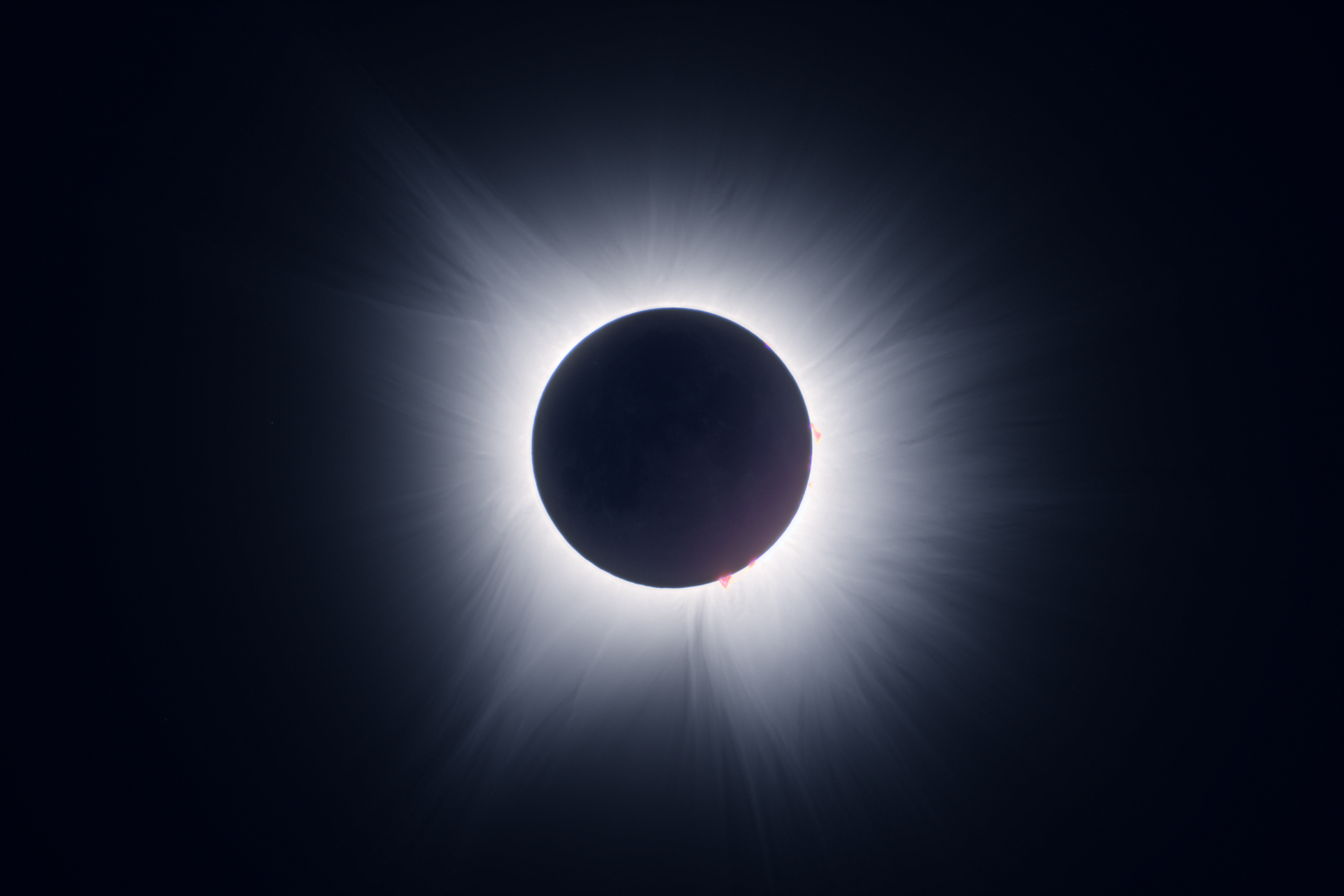
Totality, April 8, 2024: the moon covers the photosphere and the corona streams around the black disk, pink prominences curling off the edge — as witnesses from Mexico to Maine saw it, totality lasting at most 4 minutes and 28 seconds near Torreon. Only during these minutes, and only inside the path of totality, is it safe to look at the sun with the naked eye.
Photograph by Brandon Ghany / Horizon Productions SFL, April 8, 2024, released into the public domain (via NASA's Flickr eclipse imagery).
★ On April 8, 2024, the moon's shadow swept from Mexico's Pacific coast across Texas and fifteen American states to Maine and into Canada. The path of totality was 108 to 122 miles wide. At its longest, near Torreon in Mexico, totality lasted 4 minutes and 28 seconds. About 31.6 million people lived inside the path in the United States, and 99 percent of Americans could see at least a partial eclipse from home. The sun was near the peak of its eleven-year activity cycle, so witnesses saw a wild, tangled corona and pink prominences curling off the sun's edge.
Just this past August, on August 12, 2026, another total solar eclipse crossed Greenland, Iceland, and northern Spain, the first total eclipse visible from mainland Spain in over a century.
Eclipses are no longer omens. They are appointments. NASA's eclipse bulletins, computed from the work of astronomer Fred Espenak, predict them centuries in advance, to the second and the kilometer. The road from "the sun has been eaten" to a published timetable is about three thousand years long, and it was paved by people who refused to stop watching.
❦ In your workbook: record the living memory in your own way — the 2024 path and its longest totality, the August 2026 eclipse, and what changed between omens and appointments — copy, sketch, or note what matters.
The Mechanism
The lineup
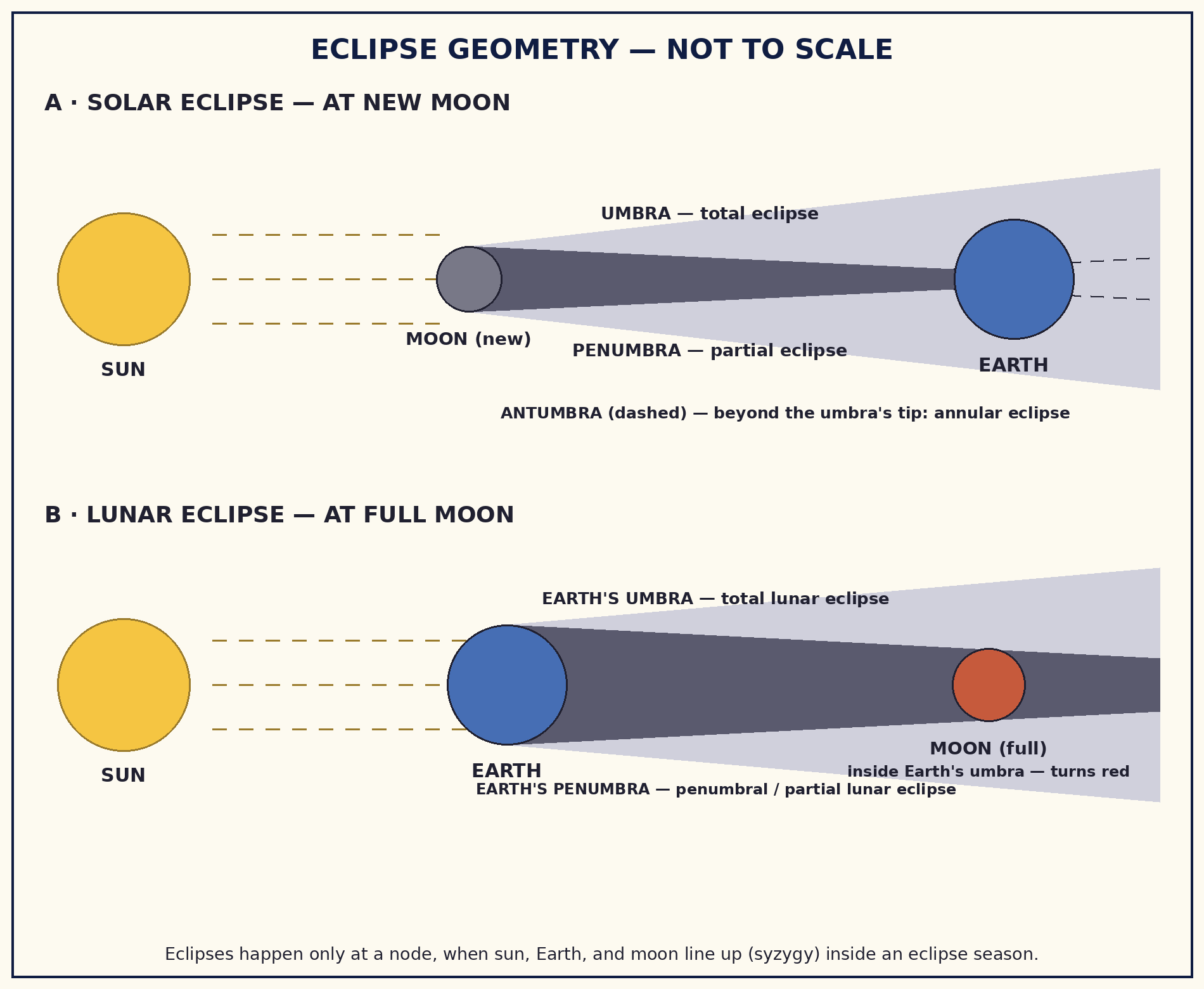
The geometry of both eclipses, not to scale. A solar eclipse: the new moon's shadow falls on Earth — umbra (total), penumbra (partial), antumbra beyond the cone's tip (annular). A lunar eclipse: the full moon passes through Earth's shadow — and turns red inside the umbra instead of vanishing. Eclipses happen only near a node, in an eclipse season.
Built digitally for this overhaul (Python/PIL, DejaVu Sans labels), from the geometry taught in the lesson text.
An eclipse is a shadow game played by three bodies. The word itself comes from the Greek ekleipsis, meaning an abandonment: the sun abandoning its accustomed place in the sky.
★ A solar eclipse happens when the new moon passes directly between the sun and Earth, and the moon's shadow falls on Earth. This can only happen at new moon, because only then is the moon on the sun's side of us.
★ A lunar eclipse happens when the full moon passes through Earth's shadow, which means Earth sits directly between the sun and the moon. This can only happen at full moon.
★ Here is the question Lesson 7 left hanging: if the moon is new every month and full every month, why is there not an eclipse every month? Because the moon's orbit is tilted. The moon circles Earth in a plane tipped about five degrees from the plane of Earth's orbit around the sun. Most months, the new moon passes a little above or below the sun, and the full moon passes a little above or below Earth's shadow, and nothing happens.
★ Twice a year, the geometry lines up. The moon's orbit crosses the plane of Earth's orbit at two points called the nodes, and when the sun is near one node at new or full moon, the three bodies form a nearly straight line, a syzygy, and an eclipse occurs. Astronomers call these windows eclipse seasons: each lasts a few weeks, and they come about 173 days apart. Every eclipse you will ever see happens inside one of these seasons.
Check in: Why is there not an eclipse every month? Answer with the tilt, the nodes, and the eclipse seasons.
❦ In your workbook: record the lineup in your own way — which eclipse needs which phase, the five-degree tilt, and the two windows a year when the geometry lines up — copy, sketch, or note what matters.
In your packet: Exercise II: The Shadow Game ⚒ begins here — its lamp, ball, and walnut act out exactly this lineup. Work it now, or mark the place and take it as homework — your choice.
The cosmic coincidence
Here is the strangest true thing in this lesson. The sun is about 400 times wider than the moon. It is also about 400 times farther away. So the two look almost exactly the same size in our sky, each about half a degree across, about the width of your little fingernail held at arm's length.
This is a coincidence, and astronomers say so plainly. It has not always been true and it will not always be true: the moon is drifting away from Earth by a few centimeters every year, and in the distant past it loomed larger, while in the far future it will look too small to cover the sun at all, and total solar eclipses will end. We happen to live in the brief chapter of Earth's history when the fit is nearly perfect. That fit is what makes totality possible, and totality is what makes the corona visible.
Because the two orbits are ellipses, the apparent sizes vary a little through the year. When the moon is near perigee, its closest approach, it looks slightly larger. When it is near apogee, its farthest point, it looks slightly smaller. This small difference decides what kind of solar eclipse you get.
❦ In your workbook: record the coincidence in your own way — 400 times wider, 400 times farther, and why perigee and apogee decide the kind of eclipse — copy, sketch, or note what matters.
Shadows and kinds of eclipses
★ Every shadow has two parts. The umbra is the dark central cone where the light source is completely blocked. The penumbra is the lighter outer region where it is only partly blocked.
★ In a total solar eclipse, you stand in the moon's umbra. The moon covers the sun completely. The umbra on Earth is never more than about 270 kilometers wide, a narrow ribbon racing across the planet, and totality at any one spot lasts from a few seconds to about seven and a half minutes. The longest total eclipse between the years 4000 BCE and 6000 CE will be the eclipse of July 16, 2186, with 7 minutes and 29 seconds of totality.
In a partial solar eclipse, you stand in the penumbra. The moon takes a bite out of the sun. This is the most common kind, and it is the kind most people outside the path of totality see.
★ In an annular solar eclipse, the moon is near apogee and appears slightly smaller than the sun, so it cannot cover the sun's disk completely. You stand in its antumbra, the region of shadow beyond the tip of the umbra, where a ring of light remains visible. A brilliant ring, the annulus, remains visible around the dark moon. The sky does not go dark, the corona does not appear, and at no point is it safe to look at the sun without protection. An annular eclipse crossed the Americas in October 2023, the famous "ring of fire."
A lunar eclipse comes in three kinds as well. In a total lunar eclipse, the whole moon passes through Earth's umbra. Earth's shadow is much larger than the moon's, so totality can last well over an hour. In a partial lunar eclipse, only part of the moon enters the umbra. In a penumbral lunar eclipse, the moon passes only through the faint outer penumbra and merely dims slightly; many people do not notice it at all.
Total solar eclipses are rare for any given place but common for the planet: somewhere on Earth sees one about every eighteen months, but a particular town waits centuries. On average, a total solar eclipse returns to the same spot roughly once every 375 years, though luck varies enormously. Lunar eclipses are far easier to catch, because a lunar eclipse is visible from the entire night half of Earth at once. In a typical year there are at least two solar and two lunar eclipses somewhere on the planet, and never more than seven of both kinds combined.
Check in: You stand in the moon's penumbra at midday. Which kind of eclipse do you see — and if the moon is near apogee and you stand in its antumbra instead, what changes?
❦ In your workbook: record the shadows in your own way — umbra, penumbra, antumbra, and the kind of eclipse each one gives its observers — copy, sketch, or note what matters.
What totality looks like
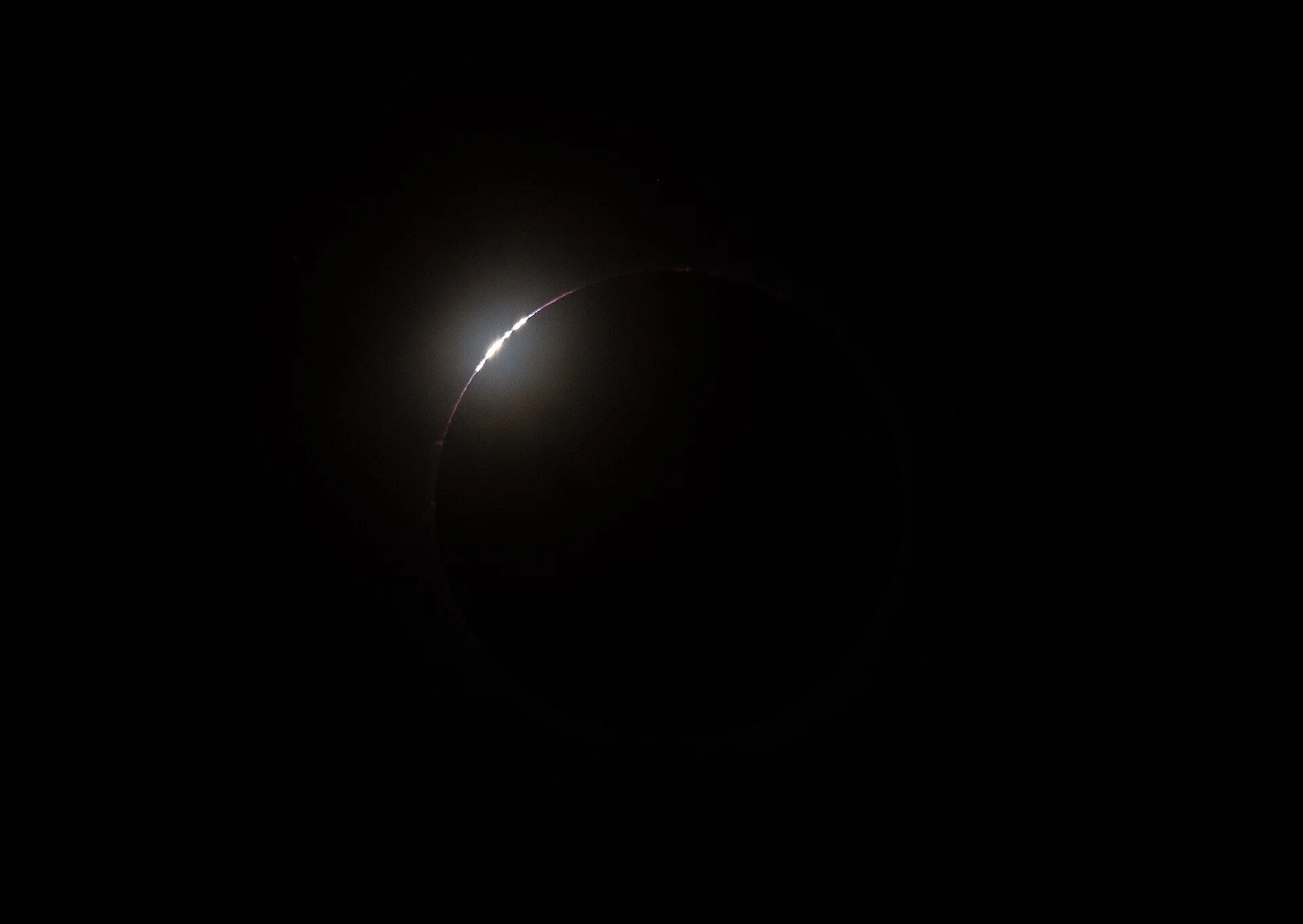
Baily's beads, Kerrville, Texas, April 8, 2024: the last sunlight breaking through valleys on the moon's edge just before totality, the pink chromosphere tracing the limb. The moment the diamond ring flares on the far side of totality, the viewers go back on — the beads are sunlight, and sunlight outside totality is never safe to look at directly.
NASA / Aubrey Gemignani, April 8, 2024.
The partial phases can last over an hour, the sun thinning to a crescent. Then, in the last minute before totality, strange things happen. Shadow bands, faint rippling lines of light and dark, may shimmer across pale surfaces. The last bead of sunlight shining through the valleys on the moon's edge flares into the diamond ring effect, and then breaks into Baily's beads, glittering points of light along the lunar limb.
Then totality. The corona, the sun's outer atmosphere, streams around the black disk of the moon: pale, structured, delicate, shaped by the sun's magnetic field. Pink prominences, great loops of glowing gas, may curl off the sun's edge. The brighter stars and planets come out. The temperature drops noticeably. Animals behave as if night has fallen.
Only during these minutes, and only inside the path of totality, is it safe to look at the sun with the naked eye. The moment the diamond ring flares on the other side, the viewers go back on.
❦ In your workbook: record totality in your own way — shadow bands, diamond ring, Baily's beads, then the corona — and the rule for the moment the diamond ring returns — copy, sketch, or note what matters.
Why the eclipsed moon turns red
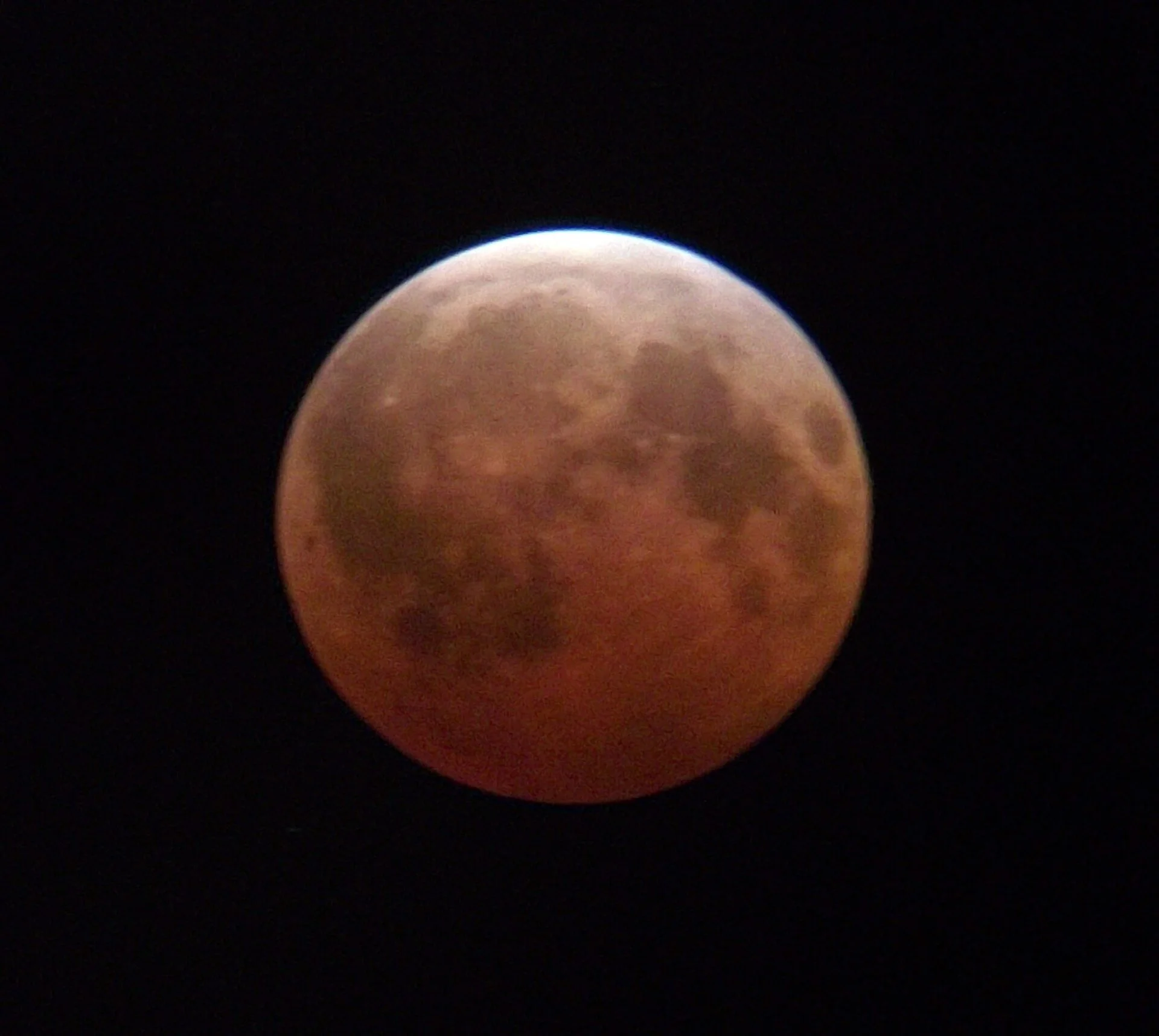
A total lunar eclipse, December 21, 2010: the moon inside Earth's umbra does not go black — sunlight bent through Earth's atmosphere, its blue scattered away, paints it copper. All the world's sunrises and sunsets, projected onto the moon at once. A lunar eclipse needs no eye protection at all: watch it with bare eyes, binoculars, or a telescope, in perfect safety.
Photograph by Supportstorm (Wikimedia Commons), December 21, 2010, released into the public domain by the author.
★ During a total lunar eclipse, the moon sits inside Earth's umbra, cut off from direct sunlight. But it does not go black, because Earth's atmosphere bends some sunlight into the shadow. That light has passed through a great thickness of air, and the air scatters away the blue light, the same scattering that makes our skies blue and our sunsets red. What is left is red and orange light, which falls on the moon and paints it copper.
NASA describes it beautifully: a total lunar eclipse is like seeing all the world's sunrises and sunsets projected onto the moon at once. The exact shade depends on Earth's atmosphere at the time. Dust and clouds make it redder; a major volcanic eruption can darken it almost to invisibility. If you stood on the moon during totality and looked back, you would see Earth as a dark disk ringed with red light: every sunrise and sunset happening on the planet, all at once, bent into a glowing ring.
And here is the comfort the whole lesson has been building toward. None of this requires protection, prediction by priests, or drums to frighten dragons. It requires three round bodies, one tilted orbit, and the patience to watch.
Check in: The moon inside Earth's umbra is cut off from direct sunlight, so why does it glow copper-red instead of going black?
❦ In your workbook: record the red moon in your own way — light bent through Earth's air, blue scattered away, and why none of it needs eye protection — copy, sketch, or note what matters.
A Sealed Note on Prediction
Scholars sometimes ask me which moment in the history of eclipses is my favorite. It is not the battle that stopped, though that is a fine story. It is not Columbus and his hourglass, though I admit a bat's admiration for anyone who can time the sky with sand.
My favorite moment is a Babylonian astronomer whose name we will never know, hunched over clay tablets covered in wedge-shaped numbers, realizing that the eclipses keep coming back after the same long interval. No telescope. No theory of gravity. No understanding of what the moon even was. Just records, and patience, and the willingness to believe that a pattern noticed is a pattern that can be trusted.
That is what prediction is, my dears. It is not magic and it is not genius, most of the time. It is writing things down and refusing to throw the notes away. The Saros cycle is 223 months of somebody paying attention.
So here is my wish for you. Keep your Sky Log. Keep your Moon Journal. Write down what you see, with the date, even when it seems too small to matter. You are doing exactly what the Babylonians did, and you do not know yet which of your notes will turn out to be the important one.
❦ In your workbook: record the sealed note in your own way — prediction as records plus patience, and the wish Glimmerwick seals with it — copy, sketch, or note what matters.
PROFESSOR VESPER GLIMMERWICK
Celestial Studies
Astronomer & Celestial Historian
Guided Observation
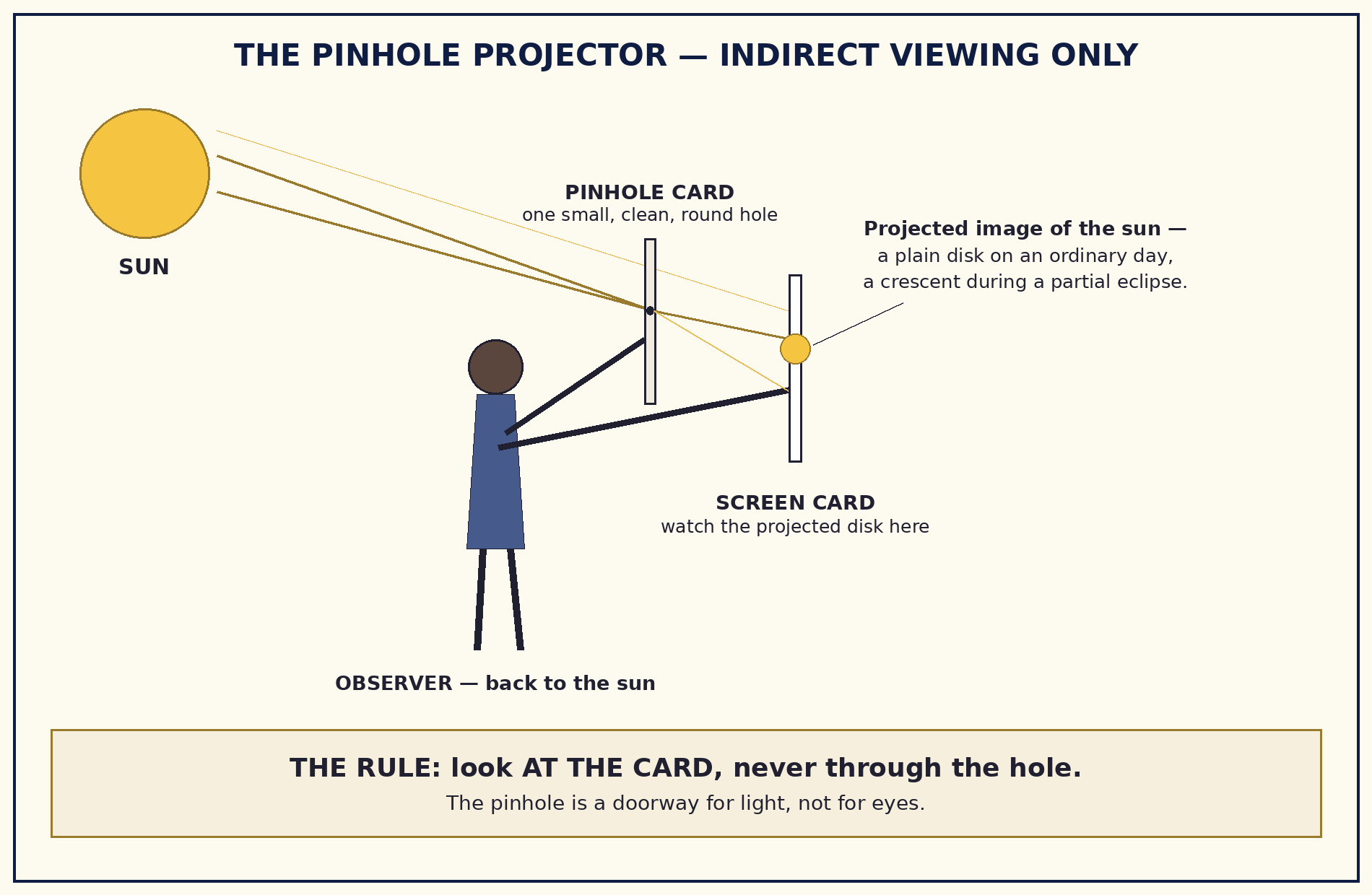
The pinhole projector, indirect viewing only: back to the sun, sunlight through the hole, the sun's image watched on the screen card — a plain disk on an ordinary day, a crescent during a partial eclipse. Never look at the sun through the pinhole.
Built digitally for this overhaul (Python/PIL, DejaVu Sans labels), following the build steps in Try It Tonight, Part One, exactly.
Try It Tonight
Part One: Build a Pinhole Projector
You will need: two stiff white cards or pieces of cardboard (index cards work), a pin or sharp pencil, tape, and a sunny day. An adult's help with the pin is welcome.
Workshop Note: Cutting instrument cards cleanly — mat, blade, and clamped work — is taught in Creative Arts Lesson 3, 'Cutting, Scoring & Clamping.'
- In the center of one card, make one small, clean, round hole with the pin. This is your pinhole card. Smaller and rounder is better: a neat hole makes a sharper image.
- Stand with your back to the sun. Hold the pinhole card up so sunlight falls through the hole, and hold the second card two or three feet behind it, in the shadow of the first card.
- Move the second card closer or farther until a small, sharp disk of light appears on it. That little disk is the sun itself, projected safely. On an ordinary day it is a plain round disk. During a partial eclipse, you would see the crescent shape.
- Now say the rule out loud, the way Professor Glimmerwick's students do: "The projector is for looking AT THE CARD, never through the hole." Never look at the sun through the pinhole. The pinhole is a doorway for light, not for eyes.
Alternatives that work on the same principle: a kitchen colander held up with your back to the sun (each hole projects a little sun), or the shadow of a leafy tree, whose leaves make hundreds of natural pinholes. During any partial solar eclipse, the ground beneath a tree fills with crescent-shaped suns. It is one of the loveliest sights in astronomy, and it requires no equipment at all.
❦ In your workbook: record the projector build in your own way — your hole, your screen distance, and the disk you saw, with the rule said out loud — copy, sketch, or note what matters.
Part Two: The Eclipse-Viewing Safety Drill
Do this drill now, long before any eclipse, so the habits are ready when you need them.
- Examine a pair of eclipse glasses or a handheld solar viewer (a real one if your family owns one, or study the pictures on the American Astronomical Society's eye-safety page). Find the ISO 12312-2 marking printed on it. Check the filter for scratches, punctures, or tears. State out loud what you would do if you found damage. (Answer: discard it and do not use it.)
- Practice the sequence with the glasses OFF the sun, using a bright indoor lamp as your stand-in: glasses on and settled before you turn toward the light; brief look; turn fully away before removing them. The order never changes: protection first, looking second, looking away third, removal last.
- Recite the three rules from memory: only ISO 12312-2 viewers for direct viewing; pinhole means indirect only, never look through the hole; never improvise, with sunglasses, smoked glass, or anything else, no exceptions.
- Explain to your adult observer why lunar eclipses need no protection at all. If you can teach the rule, you know the rule.
Check in: Your viewer has a small scratch on its filter. What do you do — and what is the full order of the drill's looking sequence?
❦ In your workbook: record the drill in your own way — the marking you found (or studied in pictures), the sequence you practiced, and the three rules recited — copy, sketch, or note what matters.
In your packet: Exercise I: The Pinhole Projector and the Safety Drill ⚒ begins here. Work it now, or mark the place and take it as homework — your choice.
Part Three: Meet the Moon
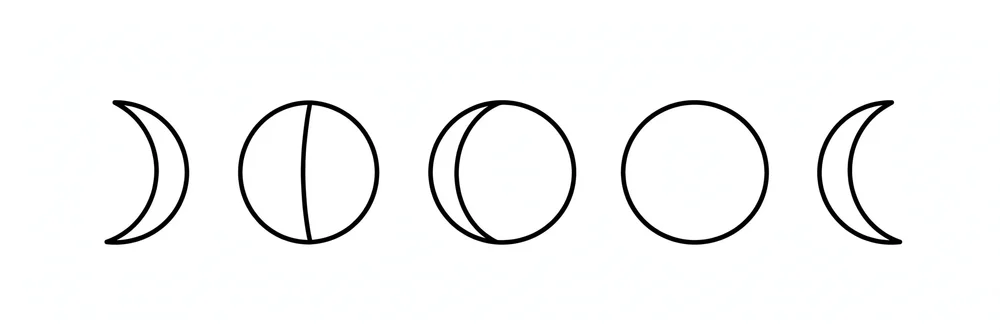
Step outside after dark with your adult and find the moon. Sketch its phase in your Sky Log. If it is near full, look for the dark patches you will map in Lesson 11's work on the lunar surface. Remind yourself which kind of eclipse could happen at this phase, and which could not, and why.
❦ In your workbook: record tonight's moon in your own way — its phase sketched, and which eclipse this phase could host and which it could not — copy, sketch, or note what matters.
Sky Log Entry
Date and time of observation: _______________
Moon phase tonight (sketch the disk and shade the dark portion): _______________
Could a solar eclipse happen at this phase? Could a lunar eclipse? Why or why not? _______________
Pinhole projector test: describe the projected sun disk you saw. _______________
Safety drill: write the three viewing rules in your own words. _______________
Next eclipses on your personal calendar: using NASA's eclipse pages, find the dates of the next solar and lunar eclipses visible from your region, and write them here with a note on what kind each will be. _______________
❦ In your workbook: record the Sky Log entry in your own way — tonight's phase, the projector disk, the three rules in your own words, and your next eclipses — copy, sketch, or note what matters.
In your packet: Exercise III: Your Eclipse Calendar ✎ begins here. Work it now, or mark the place and take it as homework — your choice.
Materials
Required (Level One — household items)
- Two stiff white cards or pieces of cardboard (index cards work well) for the pinhole projector.
- A pin or sharp pencil for making the pinhole, with an adult's help.
- Tape for holding cards steady if your hands tire.
- A lamp, a grapefruit or large ball, and a walnut or small ball on a stick for the shadow-game geometry model (Exercise II).
- Your workbook and a pencil for the Sky Log, the drill, and the interview notes.
- A flashlight for night observing.
Suggested (Level Two — historically closer)
- A long cardboard box for a sturdier box-style pinhole viewer (a hole at one end, a white paper screen at the other).
- A kitchen colander to try as a many-holed pinhole projector during any partial solar eclipse.
- A red-filter or dim flashlight for preserving night vision while logging.
Reflection Questions
Answer in your workbook, in complete sentences.
- Eclipses changed, in human minds, from omens to appointments. What had to change for that to happen: the sky, or the watchers?
- Thales may or may not have predicted his eclipse; Columbus certainly used his almanac to frighten people; Eddington used his to test a theory of the universe. What does each story suggest about what eclipse knowledge is for?
- Why does this lesson insist the safety rules have no exceptions? What is it about the sun, and about human eyes, that makes "just a quick look" dangerous?
- The sun is about 400 times wider than the moon and about 400 times farther away. How does this coincidence shape everything you can see during a total solar eclipse?
- What is one thing you believed about eclipses before this lesson that the mechanism corrected, and what convinced you?
Workbook Checklist — Lesson 9
In my workbook I have:
- ☐ built my pinhole projector, described the projected disk, and said the projector rule out loud
- ☐ performed the full safety drill with my adult: viewer inspected, sequence practiced, three rules recited from memory
- ☐ played the shadow game through all four setups, or drawn them with umbra, penumbra, and antumbra labeled
- ☐ entered my next solar and lunar eclipses on my eclipse calendar, with kind, regional visibility, and Saros series
- ☐ recorded an eclipse interview like a historian, or written my travel paragraph for the next total solar eclipse
- ☐ kept my Moon Journal going, as the sealed note asks
☐ Lesson completed Date: ___ Signature: ___
The Professor's Closing Note
And so the shadow passes, scholars, and the light comes back, as it always does.
You now know what an eclipse is, and that is a larger thing than it sounds. You know that the sun and moon look the same size in our sky by a coincidence of fours, that the moon's orbit is tilted just enough to make eclipses rare, that shadows come in two parts with two names, and that humanity went from banging drums at a dragon to publishing the sky's schedule centuries in advance.
You also know the most important thing in the lesson, and it is not astronomical at all. The rules that keep your eyes safe are absolute because your eyes are irreplaceable. The sky is patient. It will still be there when you have your certified viewers in hand, your back to the sun, and your projector card ready. There is no eclipse worth an injury, and there is no hurry that the next eclipse cannot satisfy.
Keep watching. Keep writing things down. Somewhere in your notes, a pattern is waiting.
PROFESSOR VESPER GLIMMERWICK
Celestial Studies
Astronomer & Celestial Historian
Cross-Class Connections
Runes · Unit I, Lesson 1 — The Structural Wedge
Tower scholars, the eclipses in tonight's lesson were first predicted from records pressed into wet clay — wedge by wedge, tablet by tablet, for centuries. Come down to the Runes Classroom and learn that writing from its first wedge: how a shaped reed, a token, and a scribe's patience became cuneiform, the script the Saros was written in. Professor Glimmerwick reads what the tablets foretold. Here, we read the tablets.
PROFESSOR THISTLELOOM WEBBLETHORN
Runes & Ancient Writing

Creative Arts · Unit I, Lesson 3 — Cutting, Scoring & Clamping
Set up square, scholars, and mind the blade. Tonight's lesson sends you cutting instrument cards for a pinhole projector and building a shadow game that must stand true on its wire. Both are workshop work before they are sky work: cards cut clean on a mat, work clamped, hands behind the edge, always. Bring your projector cards and your grapefruit-and-walnut rig to my bench, and we will build them the way this workshop builds everything — measured, clamped, and safe.
PROFESSOR COGBRANCH TIMBERCLANK
Creative Arts Workshop
Further Reading & Sources
These are real destinations for further study, verified live at the time of writing. Start with NASA and the American Astronomical Society; they are the authorities this lesson leans on.
- NASA: How the 2024 Total Solar Eclipse Was Different from the 2017 Eclipse. https://science.nasa.gov/solar-system/skywatching/how-is-the-2024-total-solar-eclipse-different-than-the-2017-eclipse/
- NASA Eclipse Website: Besselian Elements for the Total Solar Eclipse of 2024 April 8. https://eclipse.gsfc.nasa.gov/SEsearch/SEdata.php?Ecl=20240408
- American Astronomical Society: How to View a Solar Eclipse Safely (ISO 12312-2 guidance, pinhole projection instructions, verified supplier list). https://eclipse.aas.org/eye-safety/
- The Saros Cycle: history, mathematics, and the Halley naming story. https://en.wikipedia.org/wiki/Saros_(astronomy))
- The Eclipse of Thales: Herodotus's account and the modern scholarly debate. https://en.wikipedia.org/wiki/Eclipse_of_Thales
- The March 1504 Lunar Eclipse: Columbus, Zacuto's almanac, and the Jamaica story. https://en.wikipedia.org/wiki/March_1504_lunar_eclipse
- Space.com: How a Total Solar Eclipse Helped Prove Einstein Right About Relativity. https://www.space.com/37018-solar-eclipse-proved-einstein-relativity-right.html
- Scientific American: How Ancient Humans Studied and Predicted Solar Eclipses (oracle bones, the six-five beat, the Saros). https://scientificamerican.com/article/how-ancient-humans-studied-and-predicted-solar-eclipses/
- NASA: Why the Moon Turns Red During a Lunar Eclipse (Rayleigh scattering explained). https://science.nasa.gov/solar-system/moon/what-you-need-to-know-about-the-nov-2022-lunar-eclipse/
- Astronomy Magazine: Why the Moon Is Exactly the Same Apparent Size as the Sun (the 400-times coincidence). https://www.astronomy.com/science/why-is-the-moon-exactly-the-same-apparent-size-from-earth-as-the-sun/
- National Radio Astronomy Observatory: Total Solar Eclipse Durations (why totality ranges from seconds to about seven and a half minutes). https://public.nrao.edu/ask/total-solar-eclipse-durations/
- Browse the Celestial Studies shelf in the school Library for readable editions of these works.
Submit your work for this lesson using the form below.
CONTINUE IN THE CELESTIAL TOWER
← Previous · Lesson 8: Names of the Moon Next · Lesson 10: Tides & the Moon's Pull →
Unit II — The Moon Celestial Tower — All 33 Lessons
The rest of Unit II: Lesson 7 · Moon Phases · Lesson 8 · Names of the Moon · Lesson 10 · Tides · Lesson 11 · The Moon Up Close