
CELESTIAL STUDIES
Unit II · Lesson 7The Phases of the Moon
Professor Vesper Glimmerwick
Astronomer & Celestial Historian • Celestial Studies
School of Evershade
Professor's Introduction

Come in, come in, scholars, and welcome back to the Celestial Tower.
I am Vesper Glimmerwick, and tonight we talk about the oldest show in the sky. The moon has been performing it for longer than there have been eyes to watch, and no performance has ever been watched more closely. Every culture on Earth has kept an eye on the moon's changing face, and most of them rearranged their whole year around it.
And yet, for all that watching, most people arrive at this lesson carrying one very confident, very wrong idea about what they are seeing. I know, because I carried it too, long before I ever taught here. When I was young and flying the night skies over Mexico, I watched the moon grow and shrink and thought, as almost everyone does, that something was happening to the moon itself.
Nothing is happening to the moon. The moon is a rock, round as an orange, doing the same thing it has always done: circling us, catching sunlight. What changes is us. What changes is the angle we look from.
That is the whole secret of this lesson, and it is a good one: the most-watched object in the sky is a trick of perspective. By the end of it you will be able to stand outside, look up at any phase you please, and point with confidence to where the sun is hiding.
Your Moon Journals began in Lesson 1. Tonight, they become your true textbook.
PROFESSOR VESPER GLIMMERWICK
Celestial Studies
Astronomer & Celestial Historian
Where and when: your own sky, tonight — The Phases of the Moon. This lesson has no pin and no stop: its place is wherever you stand under the night sky. The line beneath the map is our road through the course: every stop a moment when watching the sky changed, every lesson a place upon it.
Lesson Objectives
By the end of this lesson, scholars should be able to:
- Explain in their own words that moon phases are the changing portion of the moon's sunlit half visible from Earth, and that the moon itself never changes shape.
- Name the eight principal phases in order and describe the sun-moon-Earth geometry of each.
- Define and use the terms waxing, waning, crescent, gibbous, and terminator.
- State clearly that Earth's shadow does not cause the phases (that is a lunar eclipse, and eclipses are Lesson 9), and explain why the confusion is so common.
- Begin a full-lunation Moon Journal at their own pace, with dated nightly sketches.
Reading this lesson: ★ marks the passages to remember. They return on the unit quiz and the class test. Check in questions ask the material back as you go; answer them in your workbook when you meet them.
Working this lesson: Your assignment packet is the first download on this page. Work in it as the lesson moves along, answering each exercise as its subject is taught — or read the lesson through for your notes and take the exercises as homework afterward. Both are proper ways to sit this class. Signposts in the reading tell you where each exercise belongs. Written answers are short answers in your own words; a few honest lines are worth more than a filled page.
Your Assignment Packet
This lesson's exercises live in its packet: the Lexicon Handout (every term, course terms marked ◆), Materials, Guided Practice, the Assignment Manual with its answer key for self-checking, the Reflection Questions, and the Workbook Checklist. Download the packet before you begin and keep it beside you as you read. This lesson's quiz is gathered with the other Unit II lessons' quizzes into the Unit II Quiz, which you will meet at the end of the unit.
Safety Briefing
Moon-watching is gentle work, but it happens at night, so the castle rules apply in full.
- Night observing is done with an adult present, in safe familiar locations: your own yard, a porch, a familiar park with permission. Never wander after dark to find a better view.
- Do not stray onto roads or unfamiliar ground chasing a low moon near the horizon. If a tree or roof blocks your view tonight, the moon will be higher tomorrow.
- The moon is never dangerous to look at with the naked eye. But the safety rules of this course stand as written in Lesson 1: never look at the sun, not even a little, not even to find the moon near it. If you want to connect the moon's phase to the sun's position, do it by memory and logic, never by glancing sunward.
- Dress for the night and tell your adult when you step out and when you come back in.
The Wonder
Go outside tonight and look at the moon. Really look. Not the way you have looked a thousand times, but the way a naturalist looks: with a question.
The question is this: what is that shape?
Some nights it is a perfect round coin. Some nights a half coin, sharp as a cut apple. Some nights a thin sliver, a fingernail paring, hanging low in the west after sunset. And some nights there is nothing at all, and the stars have the whole sky to themselves.
Here is the strange part. The moon does not change. It is the same rock every night, the same size, the same shape, lit by the same sun. It has no moods and no seasons of its own. And yet we watch it swell and shrink like something breathing, and we named those breaths as if they were different moons entirely.
Every human society noticed this. It is impossible to be a person with eyes and not notice it. The moon is the brightest thing in the night sky by an enormous margin, and it changes visibly from one night to the next. A careful watcher can see the difference after a single day. A patient watcher can predict what it will look like tomorrow.
That predictability is the wonder. The moon's face changes, but it changes on schedule, and people thousands of years ago learned the schedule well enough to plant by it, pray by it, and build calendars around it. The whole cycle runs about 29 and a half days, and it has never once been late.
The question worth sitting with tonight: if the moon itself never changes, then what exactly are you seeing when you see a crescent?
Check in: The moon itself never changes — so what exactly are you seeing when you see a crescent?
❦ In your workbook: record the wonder in your own way — the coin, the half coin, the sliver, and the empty night, and the question they leave behind — copy, sketch, or note what matters.
The Story
People have been naming the moon's faces for as long as they have had names for anything. The moon gave us the month itself. The English words moon and month are old cousins, both grown from the same ancient root, because for most of human history a "month" simply was one full turning of the moon's face, from dark to dark.
Watch how the vocabulary grew. When the lit sliver is widening each night, we say the moon is waxing, from an old word for growing. When it is narrowing, the moon is waning, from an old word for diminishing. A thin moon is a crescent, from the Latin crescere, to grow, the same root that gives us crescendo in music, because the earliest crescents people named were the growing ones after the new moon. A fat moon, more than half lit but not yet full, is gibbous, from the Latin gibbosus, meaning humped or rounded like a back. The language of the phases is the language of a body swelling and shrinking, which tells you exactly what our ancestors thought they were watching.
They watched with purpose. Consider the Islamic calendar, which is a living lunar calendar used by nearly two billion people today. Each month begins with the sighting of the hilal, the first thin crescent after the new moon. On the 29th day of each month, observers go out at dusk to scan the western horizon. If the crescent is seen, the new month begins the next day. If clouds hide it, the old month is completed to 30 days and the new month begins after that. Ramadan, Eid al-Fitr, and Eid al-Adha are all set this way, which is why their dates move through the seasons from year to year. In an age of atomic clocks, millions of people still open each month by looking at the sky and asking what shape the moon is.
Now consider one Greek philosopher, because he is the hinge of this whole story. Anaxagoras lived in Athens in the 400s BCE, and he did something almost nobody else had dared to do: he treated the moon as an object. He said the moon was rock, not so different from the Earth under his feet, and that it shone only because the sun's light fell on it. A surviving fragment of his writing puts it plainly: it is the sun that puts brightness into the moon. From that one insight he worked out, geometrically, why the moon shows different faces through the month, and he correctly explained eclipses too.
★ Saying this in Athens was genuinely dangerous. The moon was a goddess, and calling a goddess a rock was impiety. Anaxagoras was arrested, tried, and sentenced to death. Only the intervention of his powerful friend Pericles saved him, and even then he spent his last years in exile. A crater near the moon's north pole now bears his name, which feels like the universe's own small act of apology.
Here is what to take from his story. For roughly two and a half thousand years, anyone with a clear head and a patient eye could have worked out the phases. The obstacle was never the difficulty. The obstacle was the idea that the moon was too sacred, too strange, or too far above us to be explained by ordinary geometry. Anaxagoras looked anyway.
Check in: What single insight did Anaxagoras start from, and what did he work out from it?
❦ In your workbook: record the story in your own way — the growing vocabulary, the hilal that opens the month, and Anaxagoras, who treated the moon as an object — copy, sketch, or note what matters.
The Mechanism
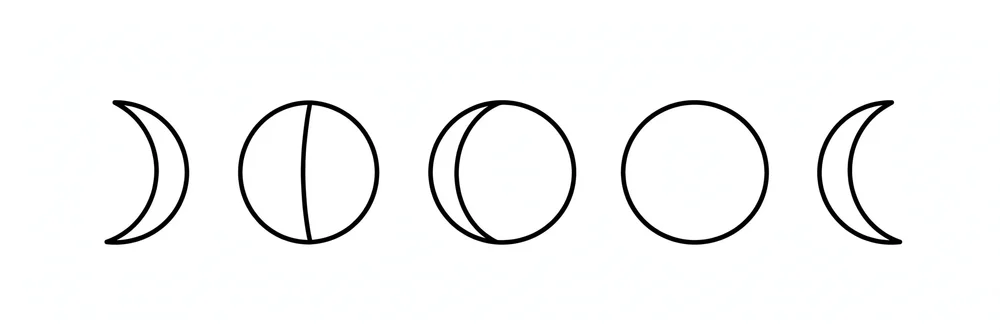
Now we stop telling stories and do the geometry. This is the heart of the lesson, and it is simpler than you expect.
★ The moon makes no light of its own. All moonlight is reflected sunlight. At every moment, exactly one half of the moon faces the sun and is in daylight, and exactly one half faces away and is in night. This is always true. It was true yesterday, it is true right now, and it will be true on every night of your life.
★ The phases are our view of that half-lit ball from different angles. As the moon orbits the Earth, we see different amounts of its sunlit half. That is all. The moon does not shrink. It does not get eaten. Nothing is covering it. We are simply walking around a lamp-lit orange in the dark and watching how much of the lit side faces us.
Walk through the cycle from the beginning.
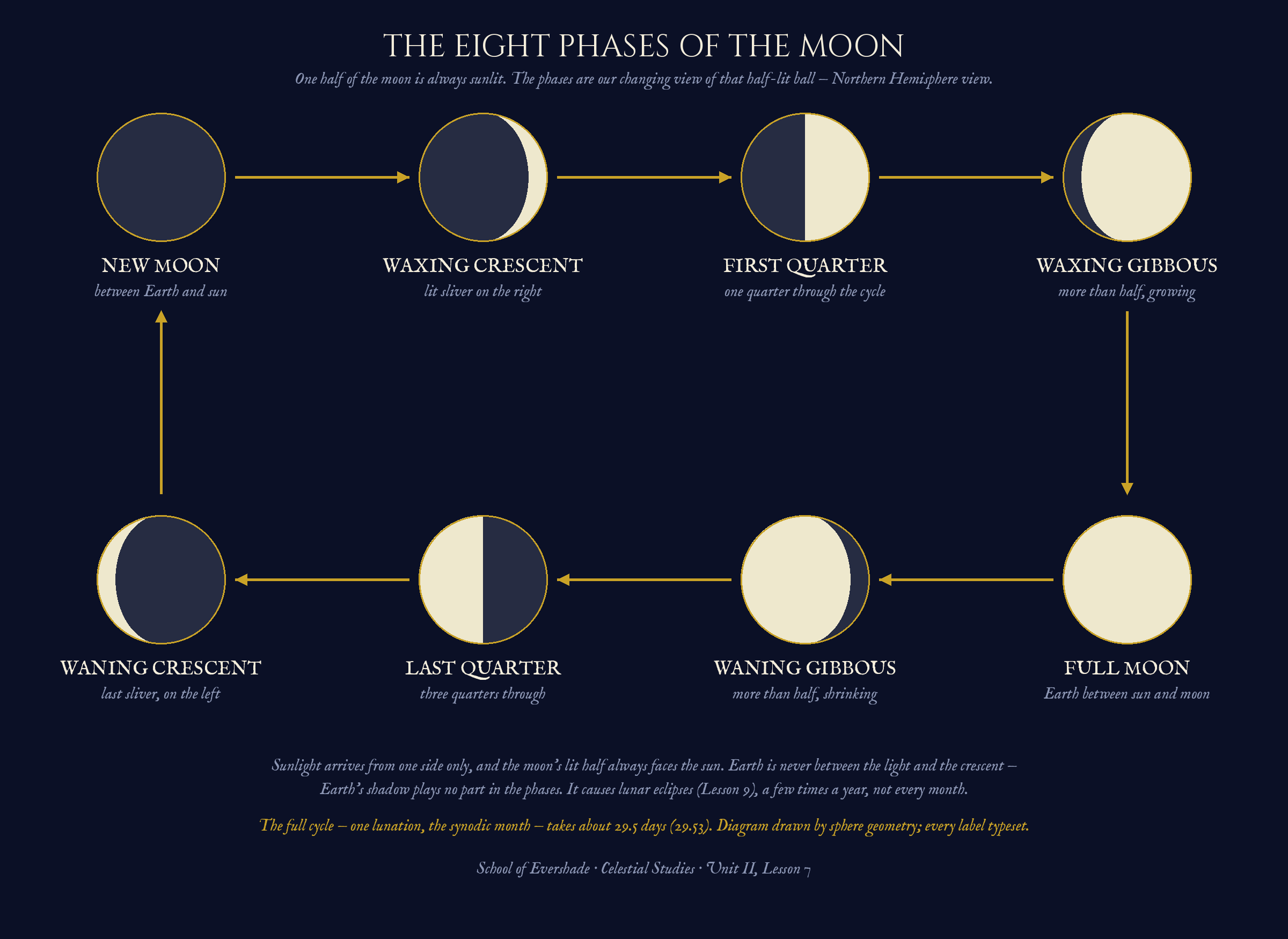
The eight phases of the moon in one view: eight discs in cycle order, each carrying its geometry note. The lit half always faces the sun; Earth’s shadow plays no part in the phases — it causes lunar eclipses instead (Lesson 9) — and the whole cycle takes about 29.5 days.
School of Evershade teaching plate.
New moon. The moon sits between the Earth and the sun. Its sunlit half faces entirely away from us, toward the sun. We see the night side: nothing. The moon is up during the day, lost in the sun's glare, and astronomers call this the moon's conjunction with the sun. (For most months this alignment is not exact, which is why we do not get an eclipse every month. When it is exact, we do. That is Lesson 9.)
Waxing crescent. A day or two later, the moon has moved eastward in its orbit and a thin sliver of the sunlit half swings into view. In the Northern Hemisphere the sliver appears on the right side of the disc. Look for it low in the west just after sunset, because a young moon follows the sun down. The word waxing tells you the story: it will grow fatter each night.
★ First quarter. About a week after new moon, we see exactly half of the sunlit half: a half disc. It is called quarter not because half the moon is lit, but because the moon is one quarter of the way through its monthly cycle. The right half glows (in the Northern Hemisphere) and the moon rides high in the south at sunset.
Waxing gibbous. More than half lit now, still growing, bulging outward like the Latin hump it is named for. The lit portion swells night by night toward full.
★ Full moon. The Earth sits between the sun and the moon, and the entire sunlit half faces us. The full moon rises around sunset and sets around sunrise, which is why it owns the whole night. It is the middle of the cycle, about two weeks after the new moon.
Waning gibbous. The light begins to shrink from the right side (Northern Hemisphere). More than half is still lit, but the disc is now waning, diminishing each night.
Last quarter. Three quarters of the way through the cycle. Again half the disc is lit, but now it is the left half (Northern Hemisphere), the mirror of the first quarter. A last-quarter moon rises around midnight and is high at dawn.
Waning crescent. The last thin sliver, shrinking toward the next new moon, hanging in the east before sunrise. Then darkness again, and the cycle restarts.
A few truths that make the whole system click:
- ★ Earth's shadow is not involved. This is the single most common wrong answer in the history of astronomy classrooms, and it is worth saying plainly: the phases are not caused by Earth's shadow falling on the moon. Earth's shadow causes lunar eclipses, and those happen only a few times a year, not every month. NASA's own moon page answers the question directly: are moon phases caused by shadows from Earth? No. The only time Earth's shadow touches our view of the moon is during an eclipse. Hold onto that sentence. It will save you on the quiz.
- ★ The line between lunar day and lunar night has a name: the terminator. It is the sunrise-sunset line sweeping across the moon's face, and it is where the most dramatic observing happens. Near the terminator, mountains and crater rims cast long shadows, and the moon's surface shows its texture. If you have binoculars (Level Two), look at the terminator on a gibbous night. That is where the moon stops being a flat picture and becomes a world.
- The same phase looks flipped in the Southern Hemisphere. Everyone on Earth sees the same phase on the same night, but observers south of the equator see it rotated. The waxing crescent's lit sliver sits on the left, not the right. If you ever compare moon photos with someone in the other hemisphere, expect a mirror image.
- The moon rises about 50 minutes later each day, on average. Each day the moon moves roughly 12 degrees eastward along its orbit, and Earth must turn a little extra to catch up. That is why the crescent owns the evening, the full moon owns midnight, and the waning crescent owns the dawn.
- ★ The cycle takes about 29.5 days. Astronomers call this the synodic month: new moon to new moon, 29.53 days. The moon actually completes one orbit in about 27.3 days, but because the Earth has moved along in its own orbit meanwhile, the moon needs about two extra days to catch back up to the same alignment with the sun. Two clocks, two answers, and now you know why.
Check in: A friend says the crescent moon is Earth's shadow biting into the moon. What causes the phases instead — and what does Earth's shadow actually cause?
Try the whole thing with a ball and a lamp tonight, in a dark room. Hold the ball at arm's length, turn slowly in place, and watch. You are the Earth. The ball is the moon. The lamp is the sun. Every phase in this lesson will appear on that ball, in order, and no shadow of yours ever needs to touch it. When the mechanism is in your hands, it stops being something you memorized and becomes something you know.
In your packet: Exercise II: The Lamp and the Ball ⚒ begins here. Work it now, or mark the place and take it as homework — your choice. Exercise III: Chasing Moonrise ◐ begins with the moonrise truth above; its signpost stands with the journal below as well.
❦ In your workbook: record the mechanism in your own way — the half-lit ball, the eight stops of the cycle, the shadow that is not involved, and the two clocks, 27.3 and 29.53 — copy, sketch, or note what matters.
A Sealed Note on Chasing the Terminator
My dear night-watchers,
If you take one habit from this lesson, let it be this: learn to love the terminator.
Most people only look at the moon when it is full, which is a little like only listening to music at full volume. The full moon is glorious, I grant you, but it is flat. The sun is shining straight down on everything you see, and all the mountains politely hide their shadows.
The terminator is where the moon shows off. Along that moving line of lunar sunrise, every crater becomes a bowl of shadow and every mountain range throws a long dark finger across the plains. The surface turns three-dimensional. It turns real.
Each night the terminator moves, because the phase moves. Your Moon Journal will track it without you even trying. And here is a small bat's secret: the best nights for really seeing the moon's face are not the full nights at all. They are the crescent and quarter nights, when the terminator is doing all the work and the glare is kind to your eyes.
Watch the edge of the light, scholars. That is where the moon keeps its texture.
❦ In your workbook: record the sealed note in your own way — why the edge of the light, not the full face, is where the moon keeps its texture — copy, sketch, or note what matters.
PROFESSOR VESPER GLIMMERWICK
Celestial Studies
Astronomer & Celestial Historian
Try It Tonight
The Moon Journal begins in earnest. You started it in Lesson 1 with a first observation. Now it becomes a daily practice and the backbone of your capstone.
What to do: Every clear night, at roughly the same time, step outside with your adult, find the moon, and sketch it in your journal. Draw the disc as a circle. Shade in the dark part. Leave the lit part blank. Mark which side the light is on. Write the date, the time, and one sentence about what you see.
How long: One complete lunation, about 29.5 days, from one new moon to the next. If clouds steal a night, skip it and note the gap. A journal with honest gaps beats a journal with invented entries.
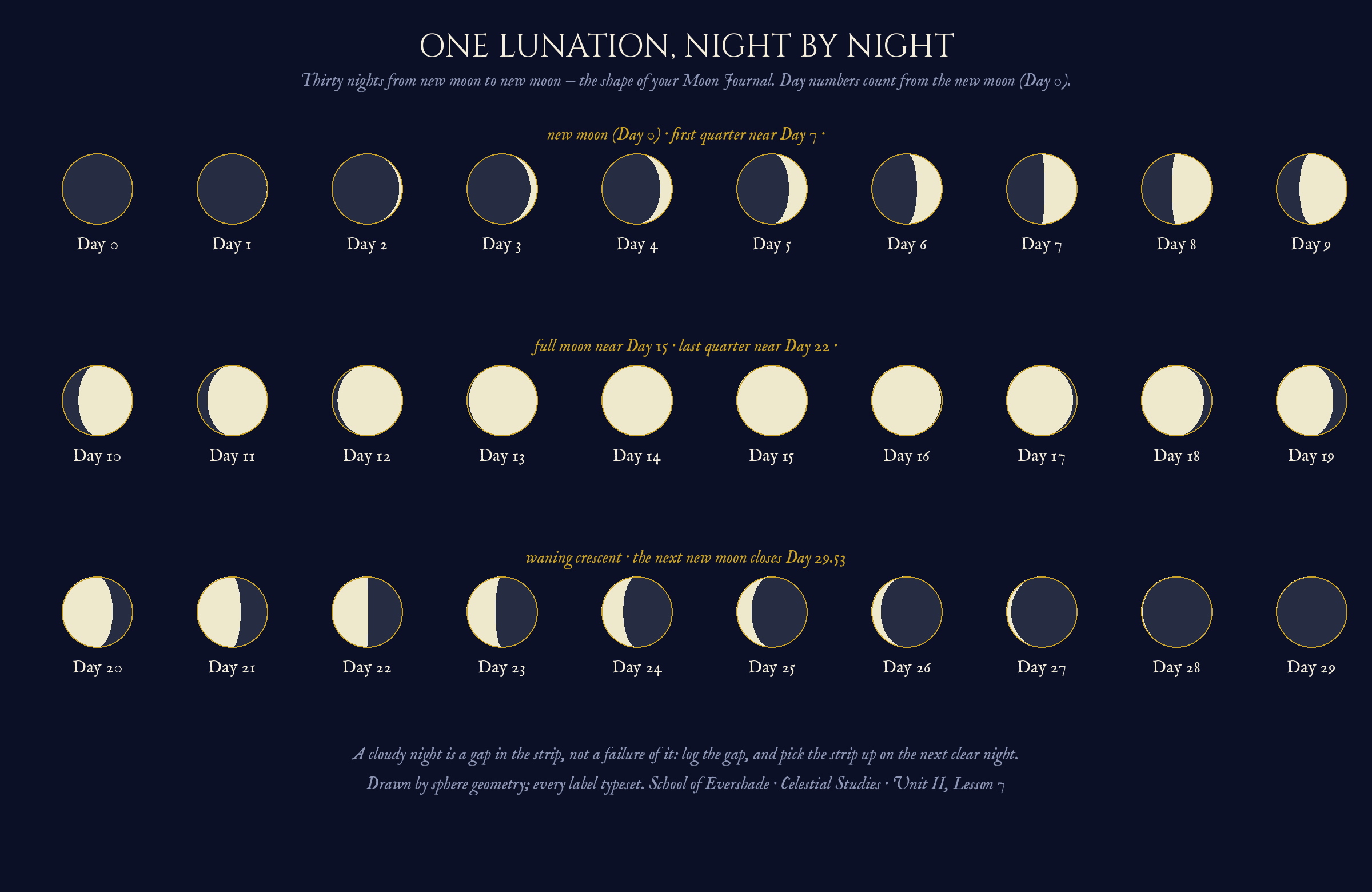
One lunation, night by night — thirty discs from new moon to new moon, drawn by the lesson's geometry. Your journal will fill with the real ones.
Your pace, your rules: The Moon Journal never gates your progress through the lessons. Keep reading, keep learning, and let the journal fill in alongside. Some scholars finish a lunation in a month. Some take a season. The moon is patient. Be patient with yourself.
Level One (naked eye): Everything above is the whole assignment. No equipment needed, none missed.
Level Two (binoculars or small telescope): Add the terminator to your sketches. Draw two or three features near the day-night line: a crater, a bright ray, the edge of a dark plain. Watch how the shadows change from night to night as the terminator sweeps across them. This is the observation that turns a journal into a scientific record.
Tonight specifically: Find the moon and name its phase out loud. Then answer, out loud, the question that is now yours to answer: where is the sun? Point to it, even if it is below the horizon. If you can do that, the geometry is yours.
In your packet: Exercise I: The First Week of the Journal ◐ begins here. Work it now, or mark the place and take it as homework — your choice. Exercise III: Chasing Moonrise ◐ rides on this same week's evenings; its times belong in this same journal.
❦ In your workbook: on a cloudy night, do not invent an entry. Log the cloud, the date, and — from your last clear sketch and the lesson's cycle — the phase you predict is hiding above it, marked as a prediction. On the next clear night, sketch what is actually there and let the journal catch up honestly; the gap stays in the journal, named as a gap.
Sky Log Entry
Date: _______________ Time: _______________ Observer: _______________
Phase seen tonight: _______________
Sketch: Draw the moon's disc. Shade the dark portion. Mark the lit side.
Terminator notes (Level Two): _______________
One sentence about tonight's moon: _______________
Prediction for tomorrow night: The lit portion will be (wider / narrower) _______________ because the moon is (waxing / waning) _______________.
❦ In your workbook: record the Sky Log in your own way — one entry a night, dated, the dark part shaded and the lit side marked, gaps honest — copy, sketch, or note what matters.
Materials
Required (Level One — naked eye)
- A Moon Journal notebook: any bound notebook, started in Lesson 1. Lined or unlined both work.
- Pencil and eraser: for nightly phase sketches and shading.
- A ball and a lamp: any ball and any shaded lamp for the geometry model in Exercise II.
- A watch or clock: for recording observation times in Exercise III.
Suggested (Level Two — binoculars or small telescope)
- Binoculars or a small telescope: for terminator detail in journal sketches and Exercise II.
- A red flashlight or red cellophane over a flashlight: preserves night vision while writing in the journal.
Reflection Questions
Answer the following questions in your workbook.
- For most of history, people believed the moon itself was changing shape. What makes that belief so natural, and what does it take to let go of it?
- Anaxagoras said the moon was a rock and that the sun "puts brightness into the moon." Why was saying this in ancient Athens dangerous, and what does his story tell you about the relationship between new ideas and old beliefs?
- The Islamic calendar opens each month with the sighting of the hilal rather than a fixed count of days. Why does a lunar calendar need the actual sky, and what is gained or lost by trusting observation over calculation?
- Stand outside on a crescent night and a full night. The same moon, the same sun, the same you. Describe what is different about the two experiences, and then explain the geometry that makes both true at once.
- Your Moon Journal will take about a month to complete, and it never blocks your progress through the lessons. What is the value of a slow observation kept alongside fast learning?
Workbook Checklist — Lesson 7
In my workbook I have:
- ☐ begun the Moon Journal in earnest: dated nightly sketches at roughly the same time, the dark part shaded, the lit side marked
- ☐ kept the journal's gaps honest — cloudy nights logged as gaps, never invented entries
- ☐ explained the mechanism in my own words: half the moon is always sunlit, and the phases are our changing view of that half-lit ball
- ☐ stated plainly that Earth's shadow does not cause the phases, and named what it does cause
- ☐ named the eight principal phases in order and pointed, from tonight's phase, to where the sun is
- ☐ completed the lamp-and-ball turn and the shadow paragraph (Exercise II), and the moonrise week's average delay (Exercise III)
☐ Lesson completed Date: ___ Signature: ___
The Professor's Closing Note
And so the first great mystery of the sky turns out to be no mystery at all, only geometry wearing a disguise.
I want you to carry two things out of this lesson. The first is the mechanism itself: half the moon is always lit, and we see the phases because we see that half-lit ball from different angles as it orbits. Say it until it is boring. Boring means it is yours.
The second is Anaxagoras. He had no telescope, no spacecraft, no photographs. He had eyes, patience, and the courage to treat the moon as an object instead of a goddess, and it nearly cost him his life. You have better tools than he did and, I hope, a safer classroom. The least we can do with our advantages is to look as carefully as he did.
Next lesson, we turn to the names humans have given the moon: Wolf Moon, Harvest Moon, Blue Moon. Some of those names are older than you think. Some are much younger than they pretend to be. Bring your skepticism. Professor Glimmerwick will bring the tea.
Watch the sky, scholars. It is doing something wonderful tonight, and it does not charge admission.
PROFESSOR VESPER GLIMMERWICK
Celestial Studies
Astronomer & Celestial Historian
Cross-Class Connections

Creative Arts · Unit II, Lesson 9 — Pamphlet & Single-Section Binding
Tower scholars, you have just made a journal your true textbook — a whole lunation of dated sketches, honest gaps and all. A book worked that hard deserves a cover of its own making. In my workshop you will fold one gathering, sew it once through the fold, and bind a journal with your own hands: the Moon Journal first among them. Measure twice, sew once, and bind it well — these are exactly the kind of pages worth binding well.
PROFESSOR COGBRANCH TIMBERCLANK
Creative Arts Workshop

Runes & Ancient Writing · Unit I, Lesson 1 — Cuneiform — The Structural Wedge
Further Reading & Sources
- Top Moon Questions — NASA Science : NASA's plain-language answers on phases, including the direct statement that Earth's shadow does not cause the phases.
- Moon Phases — ESA Space for Kids : a short, clear explainer: half the moon always lit, phases as our changing viewpoint.
- An Ancient Greek Philosopher Was Exiled for Claiming the Moon Was a Rock, Not a God — Smithsonian Magazine : Anaxagoras, reflected sunlight, and the cost of saying so in Athens.
- How Do We Know When Ramadan Starts and Ends? It's Up to the Moon — National Geographic : the hilal sighting tradition and the living lunar calendar.
- Browse the Celestial Studies shelf in the school Library for readable editions of these works.
Submit Your Work
Use the form below to submit your work for this lesson: a picture of your work, your house, and your name as you would like it known. Professor Glimmerwick reads everything the Tower receives.
The phases from this lesson are drawn live on the Wheel: tonight's Moon in her true shape, with her rising, her setting, and the stars actually behind her.
Open the WheelPROFESSOR VESPER GLIMMERWICK · CELESTIAL TOWER
Submit your work for this lesson using the form below.
CONTINUE IN THE CELESTIAL TOWER
← Previous · Lesson 6: The Longitude Problem Next · Lesson 8: Names of the Moon →
Unit II — The Moon Celestial Tower — All 33 Lessons
The rest of Unit II: Lesson 8 · Names of the Moon · Lesson 9 · Eclipses · Lesson 10 · Tides · Lesson 11 · The Moon Up Close