CELESTIAL STUDIES
Unit I · Lesson 6The Longitude Problem
PROFESSOR VESPER GLIMMERWICK
Celestial Studies
Astronomer & Celestial Historian
Professor's Introduction

Welcome back to the Celestial Tower, scholars. I am Professor Vesper Glimmerwick, and tonight I am going to tell you about the greatest navigational headache in human history, and the clockmaker who cured it.
Bats know a thing or two about finding their way in the dark. I have flown across whole counties on a summer evening and found my way home by the shape of the land, the smell of the river, and a certain feel for where I am. But I fly home. I do not sail for six weeks across a featureless ocean with no landmarks at all, and neither, I imagine, do you. The sailors who did had one question that could kill them if they answered it wrong: where exactly am I, from east to west?
They could answer the other question, north to south, with a glance at the sky. Tonight you will learn why east to west refused to be answered, why the answer turned out to be a clock, and why your own town's noon is almost certainly not at twelve.
PROFESSOR VESPER GLIMMERWICK
Celestial Studies
Astronomer & Celestial Historian
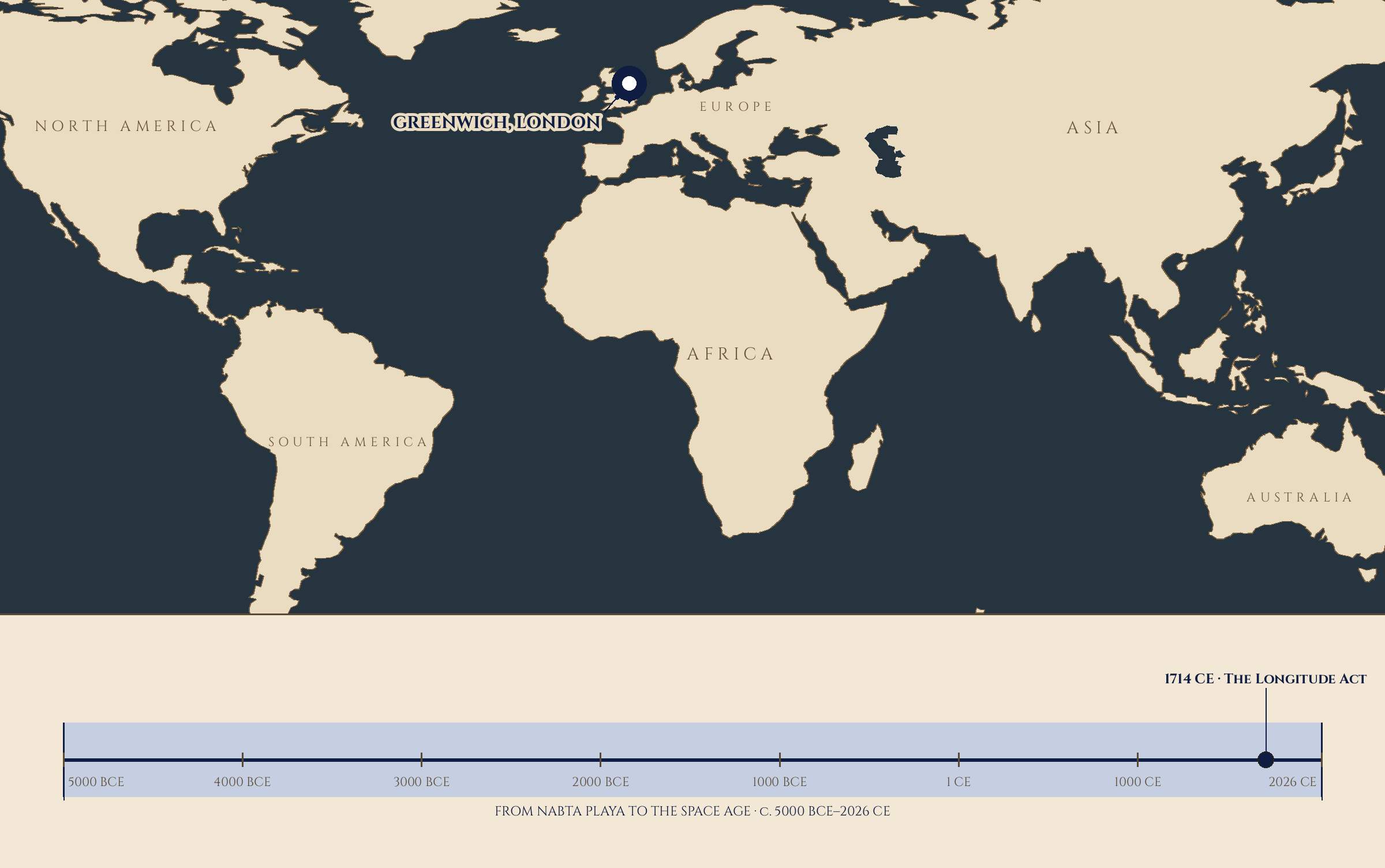
Where and when: GREENWICH, LONDON, 1714 CE · The Longitude Act (year 1714) — The Longitude Problem. The pin is this lesson. The line beneath the map is our road: every stop a moment when watching the sky changed, every lesson a pin upon it.
Lesson Objectives
By the end of this lesson, you will be able to:
- Explain, with the arithmetic, why finding longitude at sea required knowing the time at a reference place.
- Describe the Longitude Act of 1714 and the three levels of reward it offered.
- Retell the story of John Harrison's sea clocks, including the trial of the H4 and the fate of the full twenty thousand pound prize.
- Compute the difference between local mean solar noon and clock noon for your own town using the four-minutes-per-degree rule.
- Explain how time zones became the modern everyday answer to the longitude problem.
Reading this lesson: ★ marks the passages to remember. They return on the unit quiz and the class test. Check in questions ask the material back as you go; answer them in your workbook when you meet them.
Working this lesson: Your assignment packet is the first download on this page. Work in it as the lesson moves along, answering each exercise as its subject is taught — or read the lesson through for your notes and take the exercises as homework afterward. Both are proper ways to sit this class. Signposts in the reading tell you where each exercise belongs. Written answers are short answers in your own words; a few honest lines are worth more than a filled page.
Your Assignment Packet
This lesson's exercises live in its packet: the Lexicon Handout (every term, course terms marked ◆), Materials, Guided Practice, the Assignment Manual with its answer key for self-checking, the Reflection Questions, and the Workbook Checklist. Download the packet before you begin and keep it beside you as you read.
Safety Briefing
Read these before you do anything else. Every lesson in this course that sends you outside carries the same standing rules.
- Night observing is done with an adult, in safe and familiar locations. If an activity asks you to step outside after dark, a grown-up comes with you, and you stay where you know the ground.
- The noon observation in this lesson needs no sun-viewing at all. You will watch a shadow, never the sun itself. Never look directly at the sun, with or without sunglasses. Ordinary sunglasses are not safe solar viewers, and there is no improvised substitute.
- Midday observing means sun overhead and heat underfoot. Bring water, wear a hat, and take shade breaks. If the day is dangerously hot, do the computation part of the lesson and save the shadow watch for a milder day.
- If you use a compass or a map app to find your town's longitude, that is a daytime, indoor job. No expedition required.
The Wonder
★ Imagine you are the captain of a sailing ship in the year 1700, somewhere in the Atlantic, two weeks out of sight of land. You know exactly how far north or south you are. You learned that in your first year at sea: measure the height of the sun at midday, consult your table, and there is your latitude. At night, the height of the Pole Star above the horizon tells you the same thing. Latitude is solved.
But how far east or west have you sailed? Nobody can tell you. Your best tool is dead reckoning: you throw a knotted line over the stern to judge your speed, you note your compass course, you multiply speed by time and draw the result on the chart. Every hour the little errors grow. After two weeks at sea your drawn position and your true position can disagree by a hundred miles or more, and the ocean offers no landmarks to correct you.
Now imagine the coast of England appearing out of the fog where your chart swears there is only open water. That is not a story. That is what happened, again and again. In October of 1707, Admiral Sir Cloudesley Shovell's fleet, sailing home from Gibraltar, ran onto the rocks of the Scilly Isles off the southwestern tip of England. Four ships went down. More than a thousand sailors drowned; some accounts put the toll near two thousand. The navigators were not fools. They simply had no reliable way to know their east-west position, and a fleet that believed itself safely clear of danger sailed straight into it.
Here is the wonder, and the cruelty of it: the sky above those sailors held the answer the whole time. They were looking at a clock every clear night and every clear noon. They just did not know how to read it yet.
❦ In your workbook: record the wonder in your own way — latitude readable at a glance, longitude withheld, and a fleet lost for want of an east–west answer — copy, sketch, or note what matters.
The Story
★ The Scilly disaster sharpened an urgency that had been building for decades. In the spring of 1714, merchants and seamen petitioned Parliament for a solution, and in July of 1714 Parliament passed the Longitude Act. The act created a panel of judges called the Board of Longitude and offered not one prize but three, scaled to accuracy: ten thousand pounds for finding longitude within one degree, fifteen thousand for within forty minutes of arc, and twenty thousand pounds, a fortune, for finding it within half a degree. At the equator, half a degree of longitude is thirty nautical miles. The method had to work at sea, on a rolling ship, and be proven on a voyage.
Check in: The top prize is twenty thousand pounds for longitude within half a degree. How many minutes of time is half a degree — and why does that make the prize a prize for a clock?
The prize attracted astronomers, mathematicians, and cranks in glorious variety. And then it attracted a carpenter's son from Yorkshire.
John Harrison was born in 1693 and raised around Lincolnshire, the son of a carpenter, and he taught himself clockmaking the way some people teach themselves languages: by taking the thing apart in his head until he understood it. His early clocks were built largely of wood, and they ran with a precision that embarrassed far fancier instruments. He understood something the university astronomers kept missing. Pendulums, the heart of every accurate clock on land, are useless at sea. A rolling ship destroys a pendulum's rhythm, and temperature swings stretch and shrink its rod. If you wanted a clock that kept true time on the ocean, you had to throw out the pendulum entirely and build a timekeeper around springs.
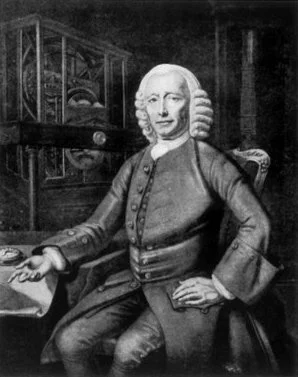
John Harrison (1693–1776), after Thomas King, 1767 — the carpenter's son with the first of his sea clocks behind him. Public domain.
Harrison presented his first sea clock, the H1, in 1735. It was tested on a voyage to Lisbon in 1736, and on the return trip it did something no instrument had done before: when the ship's officers calculated their position as off the Start, a headland in Devon, Harrison's clock placed them off the Lizard, in Cornwall, sixty miles west. The clock was right. The Board of Longitude was impressed enough to grant him five hundred pounds to continue. He built the H2, then discovered a serious flaw in its design and abandoned it. He spent seventeen years on the H3, which never quite satisfied him, though it left the world two lasting gifts: the bimetallic strip, which bends with temperature in a predictable way, and the caged roller bearing.
★ Then came the H4, finished in 1759: not a great brass machine but a beautiful sea watch, like an oversized pocket watch, built with Harrison's accumulated bag of tricks. In 1761 his son William carried it on a voyage to Jamaica. The voyage lasted eighty-one days, and the records of the trial report that the watch lost only about five seconds across the whole crossing. Five seconds of time is a little over one minute of longitude. The prize's top tier demanded accuracy within half a degree, which is two minutes of time. The H4 had cleared the bar with room to spare.
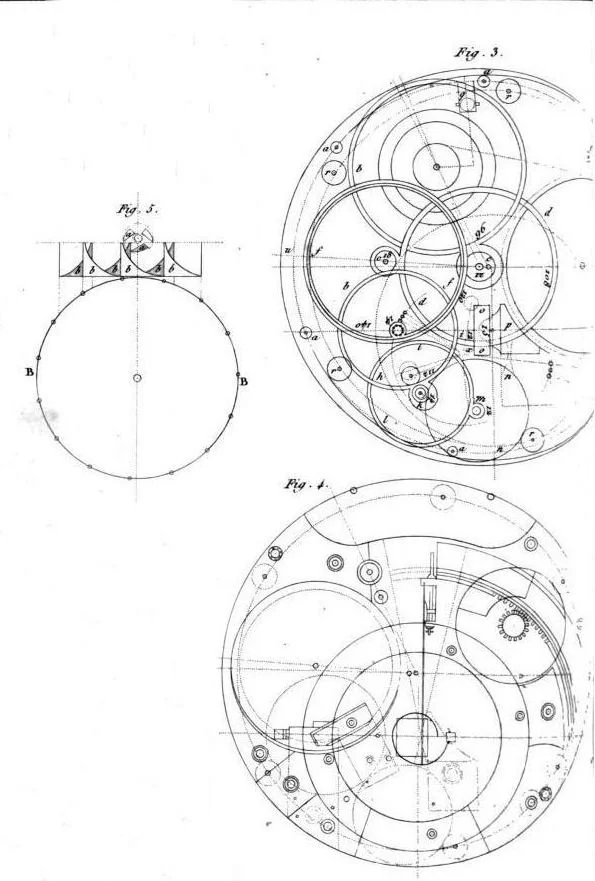
The H4's movement, engraved for The Principles of Mr. Harrison's Time-Keeper (1767) — the design published so other makers could reproduce it. Public domain.
★ And then the trouble started. The Board paid Harrison ten thousand pounds in 1765 as an interim award, but it demanded the watch be taken apart and examined by its experts, and it wanted the design made reproducible by other makers, which is a reasonable thing for a government to want and a maddening thing for an inventor to hear. The full twenty thousand pounds was never formally awarded to anyone. Harrison, feeling cheated after decades of work, appealed over the Board's head to King George the Third, who had a personal love of scientific instruments and his own observatory. The king tested Harrison's fifth timekeeper, the H5, at Kew through the summer of 1772, ten weeks of daily observations, and found it accurate to within a third of a second per day. In 1773 Parliament awarded Harrison a further eight thousand seven hundred and fifty pounds. In total he received about twenty-three thousand pounds for his life's work. He died in 1776, three years later.
There is a rival road in this story, and an honest lesson must walk it. While Harrison built clocks, astronomers pursued the lunar distance method: measuring the angle between the moon and a known star, then consulting tables that predicted those angles for Greenwich time, which gives the Greenwich time without any clock at all. Tobias Mayer's lunar tables were good enough that the Board of Longitude paid three thousand pounds to his widow for them in 1765, and the Astronomer Royal Nevil Maskelyne's Nautical Almanac, first published for 1767, made the method practical for working navigators. Captain James Cook used lunar distances on his first Pacific voyage, and on his second and third he carried K1, a copy of Harrison's H4 made by Larcum Kendall, which his logs praise warmly. The two methods were complements, not enemies: lunars needed no expensive instrument but took hours of skilled calculation, while the chronometer — a precision timekeeper built to keep true time aboard a moving ship — gave the answer at a glance once you owned one.
Popular retellings sometimes cast Maskelyne as the villain of Harrison's story. Modern historians take a kinder view. Maskelyne never claimed the prize for himself, the Board's demand for a copyable design was reasonable, and the rivalry between clock and moon did more to solve the problem than either approach would have done alone. When you read the old story, remember the new scholarship. History, like the sky, looks different when you check it twice.
❦ In your workbook: record the story in your own way — the Act's three tiers, Harrison's forty years, and the two roads, clock and moon, that solved the problem together — copy, sketch, or note what matters.
In your packet: Exercise III — The Prize Files ✎ begins from this story. Work it now, or mark the place and take it as homework — your choice.
The Mechanism
Now the part you came for: the actual arithmetic. This is the lesson's load-bearing wall, so we will build it slowly and check every joint.
Why latitude was easy. At local noon the sun stands at its highest point of the day. Measure that height above the horizon, look up the sun's declination for the date in a table, and a little subtraction gives your latitude. At night, in the northern hemisphere, the height of the Pole Star above the horizon is very nearly your latitude. The sky cooperates: it gives you a fixed reference.
Why longitude needed time. Sail two ships to the same latitude but a thousand miles apart in longitude, and the sky looks identical above both of them, except that everything happens at a different time. Noon arrives later for the western ship. The stars rise later. There is no landmark in the sky that says "you are here, east to west." There is only timing.
★ The key number. The Earth turns a full circle, three hundred and sixty degrees, in twenty-four hours. Three hundred and sixty divided by twenty-four is fifteen. The Earth turns fifteen degrees of longitude every hour. Work it down one more step: sixty minutes of time divided by fifteen degrees is four minutes of time per degree of longitude. And one minute of arc, one sixtieth of a degree, is four seconds of time. Memorize the middle one: one degree of longitude equals four minutes of time. Everything else in this lesson is arithmetic built on that fact.
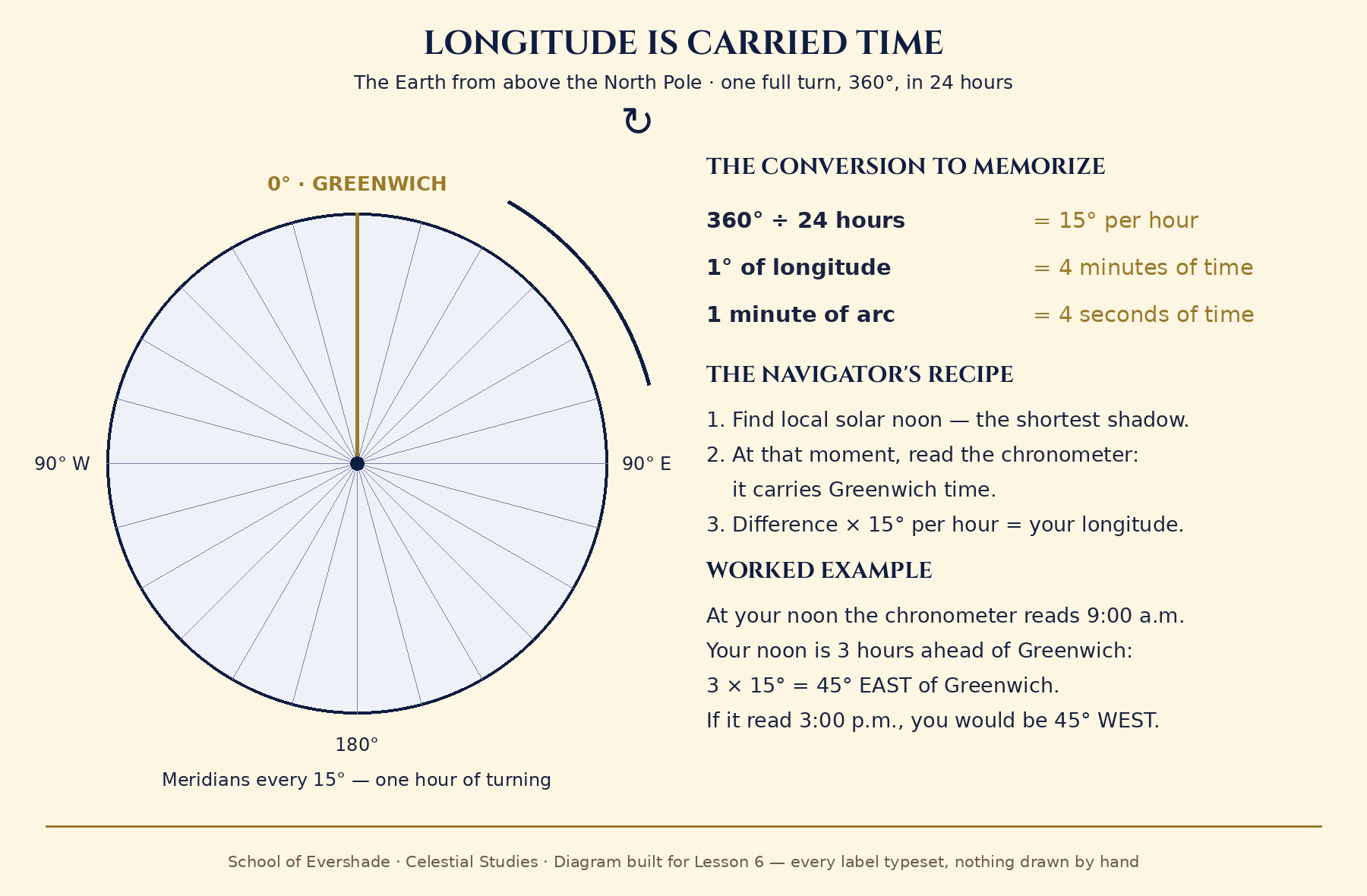
“Longitude is carried time”: the Earth seen from above the North Pole, its meridians drawn every 15° — one hour of turning — with the conversion to memorize (360° ÷ 24 hours = 15° per hour; 1° of longitude = 4 minutes of time), the navigator’s three-step recipe, and the lesson’s own worked example.
Built for the School of Evershade; every label typeset.
Check in: Your local noon arrives and your Greenwich chronometer reads 10:00 in the morning. Are you east or west of Greenwich, and by how many degrees?
The navigator's recipe. Here is exactly what a chronometer let a sailor do:
- Find local solar noon: the moment the sun stands highest, when a vertical stick casts its shortest shadow. That moment is noon at your position, wherever you are.
- At that exact moment, read the chronometer, which has been carrying the time of your home port, say Greenwich — the London district whose meridian marks zero longitude — the whole voyage.
- Multiply the difference by fifteen degrees per hour.
A worked example. Your sun reaches its highest point. You read the chronometer: it says 9:00 in the morning, Greenwich time. Your noon is happening three hours ahead of Greenwich's clocks, so you are three times fifteen, or forty-five degrees, east of Greenwich. If the chronometer instead read 3:00 in the afternoon, Greenwich's noon is still three hours away, so you are forty-five degrees west of Greenwich. Time difference times fifteen degrees per hour. That is the whole secret, and it is why the prize was really a prize for a clock.
Why dead reckoning failed. Speed times time times compass course sounds reasonable, and for a day or two it is. But a knotted log line gives speed roughly, a compass gives course roughly, currents push the ship sideways without leaving a trace, and every rough estimate feeds the next one. Errors do not cancel; they accumulate. Dead reckoning is a guess with a memory, and after weeks at sea the memory is mostly fiction.
Your town's noon. Now bring the mechanism home. Your wall clock says noon because your time zone says noon, but the sun keeps its own schedule. Here is how to compute the difference for your town, step by step:
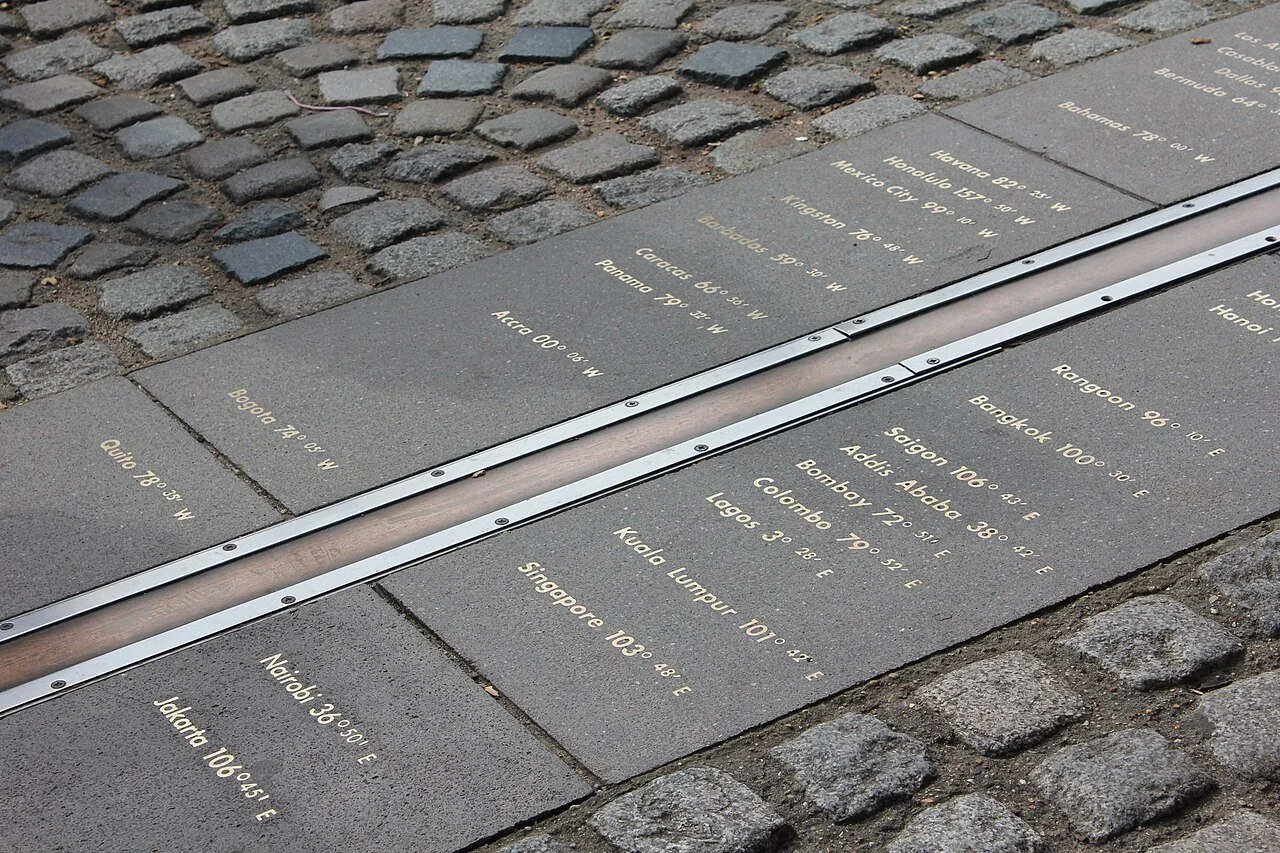
The prime meridian in the courtyard of the Royal Observatory, Greenwich — city longitudes engraved east and west of the line. Photograph by Perituss, 2011, CC0.
- Find your town's longitude. A map app or an atlas will give it. Write it down in degrees west (or east, if you live east of Greenwich).
- Find your time zone's standard meridian, the line of longitude your zone's clocks are set to. In the United States: Eastern is 75 degrees west, Central is 90 degrees west, Mountain is 105 degrees west, Pacific is 120 degrees west.
- Subtract. Take the difference in degrees between your town and the standard meridian.
- Multiply by four minutes per degree. That is how far your solar noon sits from twelve o'clock standard time.
- ★ Direction matters. If your town is west of the standard meridian, your solar noon comes later than twelve. If east, earlier.
- If daylight saving time is in effect, add one hour to the clock reading. Daylight saving moves the clocks forward; the sun does not get the memo.
Check in: Your town sits west of its standard meridian. Will your solar noon come before or after twelve o'clock standard time — and which single fact decides it?
A worked example from near the castle's earthly neighborhood. Lawrence, Kansas sits at about 95.2 degrees west longitude. Central Time's standard meridian is 90 degrees west. Lawrence is 5.2 degrees west of the meridian. Five point two times four minutes is about twenty-one minutes. So local mean solar noon in Lawrence falls at about 12:21 in the afternoon Central Standard Time, or about 1:21 in the afternoon when daylight saving time is in effect.
★ One honest complication, and the course would be cheating you if it hid it. The computation above gives local mean solar noon, the average. The real sun runs up to about sixteen minutes early or late across the year, because the Earth's orbit is slightly elliptical and its axis is tilted. Astronomers call this drift the equation of time. So when you compare your stick-shadow observation with your arithmetic, expect a gap of up to about a quarter of an hour, wandering with the seasons. That gap is not an error. It is the difference between the average sun and the real one, and noticing it is doing real astronomy.
❦ In your workbook: record the mechanism in your own way — 360 degrees in 24 hours, 15 degrees an hour, one degree worth four minutes of time — copy, sketch, or note what matters.
In your packet: Exercise I — Compute Your Solar Noon ✎ begins here. Work it now, or mark the place and take it as homework — your choice.
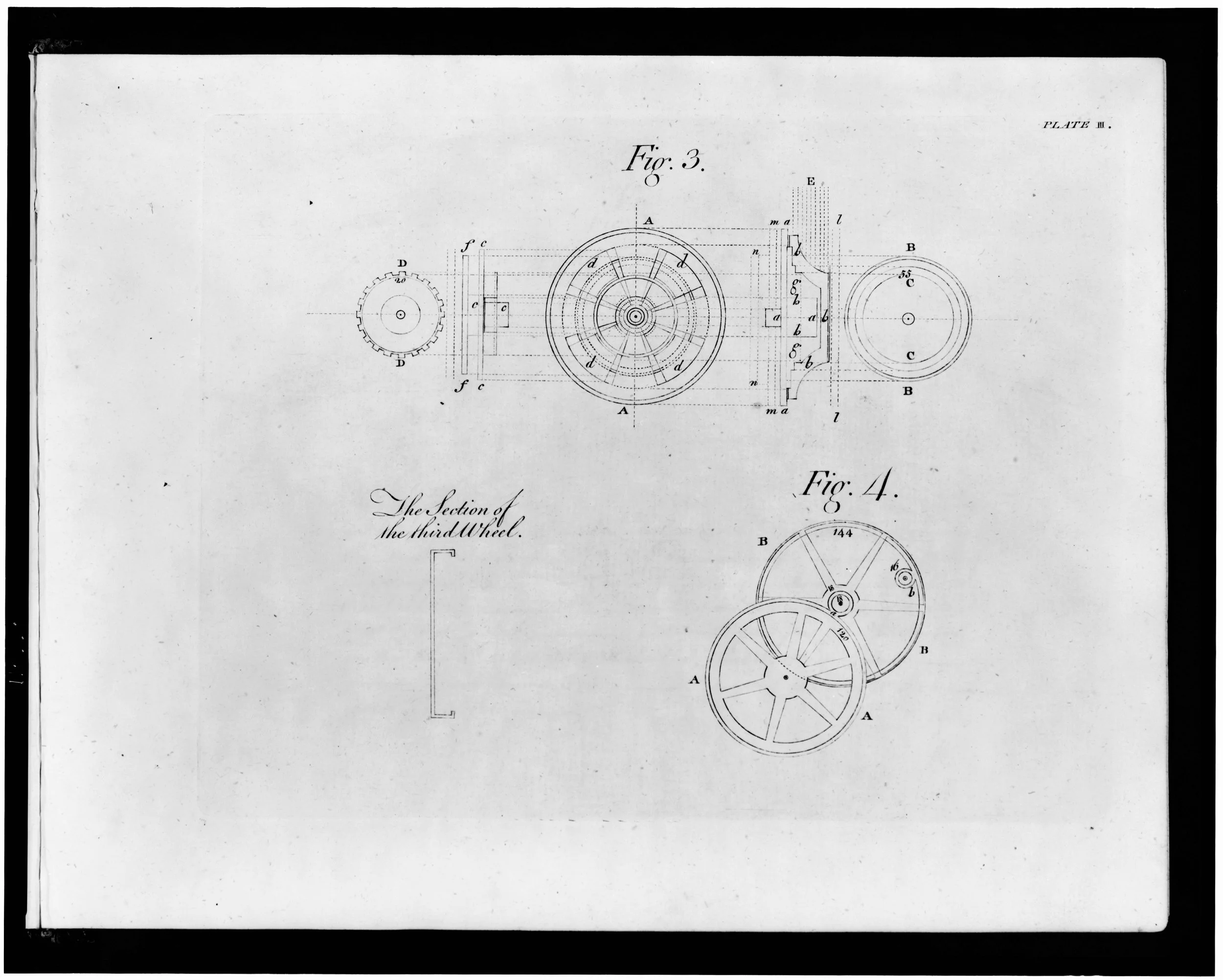
Construction details of Harrison's chronometer, Plate III — 'The Section of the third Wheel.' Library of Congress, public domain.
A Sealed Note on the Slow Victory
Scholars, a word about the ending of the story, because it is not the ending the story deserved.
John Harrison spent more than forty years on the longitude problem. He was twenty-one when the Longitude Act was passed and eighty when Parliament finally paid him the last of his money. The full twenty thousand pounds, the prize the whole race was run for, was never formally awarded to anyone, not even to the man whose watch beat the requirement.
Was that fair? I will not answer for you. I will only say this: Harrison's clocks worked. The records of the Jamaica voyage say so, Captain Cook's logs say so, and the king's own ten weeks of watching the H5 say so. A thing can be true long before the world admits it is true, and the admitting can take longer than the proving.
There is a lesson in that for scholars. Keep your observations. Write down your numbers. Date your pages. If you ever build something the world is slow to believe, you will want the receipts, and forty years of receipts is a very hard argument to lose. Harrison kept his. The clocks are still ticking in Greenwich, and they are still right.
Work the arithmetic in this lesson carefully. It is the same arithmetic that beat the greatest prize in navigation history, and it fits in your notebook.
❦ In your workbook: record the slow victory in your own way — why dated, written receipts matter to a scholar — copy, sketch, or note what matters.
PROFESSOR VESPER GLIMMERWICK
Celestial Studies
Astronomer & Celestial Historian
Try It Tonight
Your work begins tonight and finishes tomorrow at midday. Tonight you prepare; tomorrow you observe.
Tonight: the computation. Do steps one through six from The Mechanism for your own town and write the predicted solar noon in your Sky Log. Show your arithmetic, all of it: your town's longitude and where you found it, the standard meridian, the difference in degrees, the multiplication by four minutes, the direction, and the daylight saving adjustment if one applies. This is Exercise I, and the lesson's whole mechanism lives or dies in your showing the work.
Tonight: the setup. Find a flat, sunny spot that will be in full sun around midday tomorrow, a windowsill, a patio, a patch of yard. Plant a straight stick upright in the ground or in a pot of soil, or tape a pencil upright to a flat stone. It should stand as vertical as you can make it; a dangling string with a small weight, a plumb line, hung beside it will tell you if it leans. Mark where the base sits so you can put it back if it gets knocked over. An adult should know where you will be working tomorrow and come with you if the spot is anywhere beyond your own yard.
Tomorrow: the shadow watch. This is Exercise II. Starting about half an hour before your computed solar noon, watch the stick's shadow. Mark the tip of the shadow every few minutes with chalk, tape, or small stones. The shadow will shrink, reach its shortest, then grow again. The moment of the shortest shadow is your local apparent solar noon. Read your clock at that moment and write it down.
Level One, the household version, is exactly what is described above: a stick, marks, and a clock. Level Two, for scholars who have them: use a compass to lay out a true north-south line under the stick first, and compare your result with a printed almanac's equation of time table for the date.
Compare your observed noon with your computed noon. They will differ, and the difference is the lesson: part of it is the equation of time, and part of it is the roughness of sticks and eyeballs. Write down both numbers and the gap between them, and one sentence about which part of the gap you think is astronomy and which part is you.
In your packet: Exercise II — The Shadow Watch ◐ begins here. Work it now, or mark the place and take it as homework — your choice.
❦ In your workbook: record tonight's preparation in your own way — your predicted noon, your upright stick, and your marked shadow tips — copy, sketch, or note what matters.
Guided Observation: Sky Log Entry
Record this lesson's work in your Sky Log under the heading Lesson 6: The Longitude Problem. A complete entry has:
- The date, your location, and the source of your town's longitude (which map, atlas, or app).
- Your time zone's standard meridian and the full arithmetic of your computation: degrees of difference, times four minutes, direction, daylight saving adjustment, and your predicted local mean solar noon.
- Your observed shortest-shadow time, the gap between observed and computed noon, and your one-sentence judgment about how much of the gap is the equation of time and how much is measurement roughness.
- One line on what surprised you. Scholars are always surprised by something here. Write down what it was.
Keep this entry. In Unit VI you will build a sundial, and the noon line you are about to find with a stick is the first line that sundial will need.
Materials
Required (Level One — household items)
- Your Sky Log or a notebook: all computation and observation work is recorded, dated, and kept.
- A straight stick, dowel, or pencil about a foot long, to serve as your gnomon.
- A flat, sunny spot you can reach safely around midday, plus chalk, tape, or small stones for marking shadow tips.
- A clock you trust: a watch or phone, checked against a reliable time source.
- Water and a hat for the midday shadow watch, as the Safety Briefing directs.
- A map, atlas, or map app to find your town's longitude in degrees.
- A plumb line (string with a small weight) to check that your stick stands truly vertical. Optional but recommended.
Suggested (Level Two — historically closer)
- A magnetic compass to lay out a true north-south line beneath your gnomon before observing.
- A printed almanac page or table of the equation of time for your observation date, to compare against your measured gap.
Reflection Questions
- Why was longitude so much harder to find at sea than latitude? Explain what the sky gives the navigator in each case, and what it withholds.
- John Harrison was a carpenter and clockmaker, not a university astronomer. What does his forty-year path to the solution suggest about who can solve great problems, and about the value of craft knowledge?
- The full twenty thousand pound prize was never formally awarded to anyone, though Harrison received about twenty-three thousand pounds in total across his lifetime. Was the outcome fair? Argue from the evidence in the lesson, considering both Harrison's achievement and the Board's demand for a reproducible design.
- Your town's clocks say noon, but the sun says otherwise. Which one is "right," and why do we live by the clock anyway? What did the railroads and the 1884 conference have to do with it?
- Why does a lesson about ships lost at sea belong in a course about the sky? What does the longitude story reveal about the relationship between timekeeping and astronomy?
Workbook Checklist — Lesson 6
In my workbook I have:
- ☐ computed my town's local mean solar noon with every step shown — longitude and its source, standard meridian, difference in degrees, times four minutes, direction, and daylight saving adjustment
- ☐ set up a straight stick as vertical as I could make it (plumb line checked) in a flat, sunny midday spot, with an adult knowing where I work
- ☐ watched the shadow to its shortest, recorded the clock time of my local apparent solar noon, and written the gap between observed and computed noon
- ☐ written my judgment of the gap — how much is the equation of time and how much is measurement roughness
- ☐ written the Board of Longitude clerk report for Exercise III, with one honest point and one honest doubt for each side, signed and dated as a clerk of 1770
- ☐ stated the safety rules in my own words: watch the shadow, never the sun; water, hat, and shade breaks at midday; an adult with me beyond my own yard
☐ Lesson completed Date: ___ Signature: ___
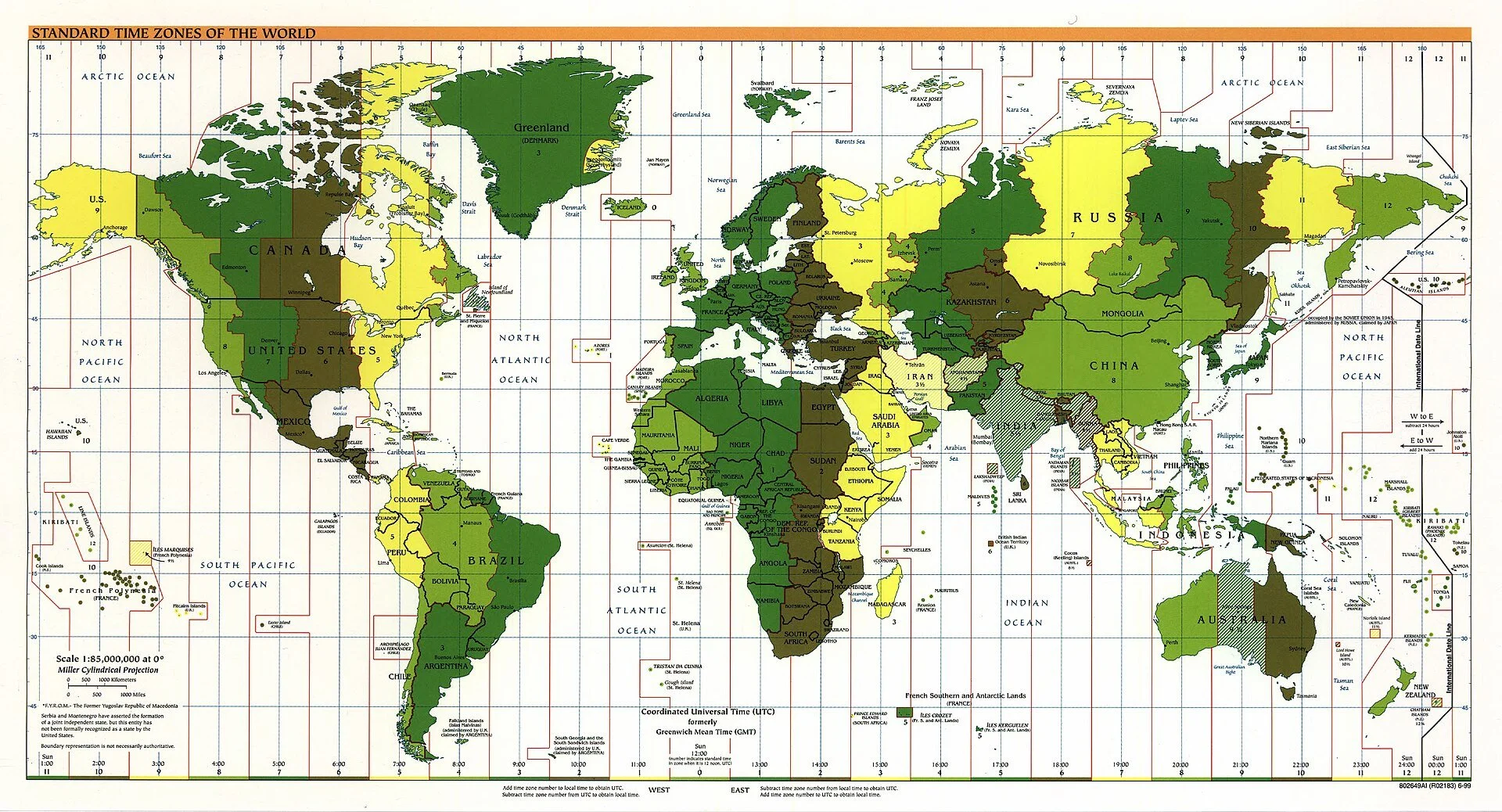
Standard Time Zones of the World (CIA, 1999, via the Library of Congress) — twenty-four bands of fifteen degrees, the longitude problem's everyday answer. Public domain.
The Professor's Closing Note
You have now done, with a stick and a clock, the core of what the greatest prize in navigation history was paying for. The sailors of 1700 would have wept to see it.
★ The modern answer to their problem surrounds you. Every time zone on Earth is fifteen degrees wide because the Earth turns fifteen degrees an hour. When you set your watch by the clock on the wall, you are living inside John Harrison's victory. Your phone knows your longitude to a few feet, which would have seemed like witchcraft to the Board of Longitude, except that it is not witchcraft at all. It is clocks, and arithmetic, and the sky, exactly as tonight's lesson taught.
Somewhere in this castle there is a room I am particularly fond of: a clock tower room with a whole wall of clocks, each one showing the time in a different time zone, each one quietly keeping a different longitude's noon. If you ever find it, stand in front of it for a minute and think of a carpenter's son from Yorkshire, and a watch the size of your palm, and forty years of receipts.
Sleep well, scholars. The moon journal continues, and the sky keeps excellent time.
PROFESSOR VESPER GLIMMERWICK
Celestial Studies
Astronomer & Celestial Historian
Cross-Class Connections

Runes · Unit I, Lesson 1 — The Structural Wedge
Seekers of old marks, come closer to the web. The Babylonian watching Professor Glimmerwick reads tonight was pressed into clay in cuneiform, and my first lesson teaches the wedges themselves: five basic impressions, a cut reed stylus, and tablets that outlasted their makers by thousands of years. Press the signs with me first, and when you return to her tower you will read the writing itself — not only what the writing was for.
Scrollwork — named in the lesson; no invitation written. Glimmerwick's text names Scrollwork's whole world — documents, illuminated star charts, and printed sky tables — but no single Scrollwork lesson teaches the Nautical Almanac or star tables, so no destination invitation is written here. The connection stands as the lesson's own prose mention above, and a genuine pairing can be written in the final interdisciplinary sweep if one is verified then.
Further Reading & Sources
- The longitude problem: 300-year-old archive opened to the world: University of Cambridge on the digitized Board of Longitude archive: 65,000 images of minutes, rivalries, wild proposals, and Cook's logbooks. Start here for the primary sources.
- Innovations in England: The Smithsonian's Time and Navigation exhibition on the Longitude Act's prize tiers and Harrison's sea clocks, clearly laid out.
- Longitude Act: The full text of the story in brief: the 1707 background, the petition, the three reward tiers, and the later acts that revised them.
- John Harrison: Harrison's life and machines in detail: the wooden clocks, H1 through H5, the Jamaica trial, the Board's resistance, the king's intervention, and the final accounting of twenty-three thousand and sixty-five pounds.
- John Harrison's marine timekeepers: Royal Museums Greenwich on the Harrison clocks themselves, which still tick in the Royal Observatory.
- The Prime Meridian: Establishing Global Time and Space: How the 1884 conference chose Greenwich, why the choice was political as well as practical, and how the twenty-four time zones followed from it.
Browse the Celestial Studies shelf in the school Library for readable editions of these works.
Submit Your Work
When your Lesson 6 work is complete, submit it through the Submit Your Work form at the foot of this page: your scholar's name, your house (Septentrio / Oriens / Meridies / Occidens / Not sorted yet), this lesson (Unit I, Lesson 6 — The Longitude Problem), a photo of your work — your Sky Log computation page, your marked shadow line at its shortest, or your signed clerk's report — and, if you wish, the permission-to-display checkbox so your work can appear in the school galleries.
Submit your work for this lesson using the form below.
THE UNIT I QUIZ
CELESTIAL TOWER · UNIT I: THE SKY AS CLOCK & CALENDAR
Unit I is complete: you have watched the sky turn through a day and a night, learned why the tilted year gives us seasons, stood among the ancient observatories raised in stone, read the calendars of the world, and followed the longitude problem from the sailor's despair to Harrison's clocks. This quiz gathers the whole unit into one sitting. Take it from memory first, before you look back at your notes, because it measures what has stayed with you. If you kept the passages marked ★ in your workbook as you read, you have already practiced most of what it asks.
The quiz packet is a single download. Part I gathers multiple-choice questions from across the unit, Part II asks true or false, Part III matches the unit's vocabulary, and the answer key waits at the back for self-checking. When you have finished, score it honestly, note the result in your workbook, and revisit any lesson whose questions went wrong before you move on.
CONTINUE IN THE CELESTIAL TOWER
← Previous · Lesson 5: Calendars of the World Next · Lesson 7: The Phases of the Moon →
Unit I — The Sky as Clock & Calendar Celestial Tower — All 33 Lessons
The rest of Unit I: Lesson 1 · Celestial Tower · Lesson 2 · Turning Sky · Lesson 3 · Tilted Year · Lesson 4 · Ancient Observatories · Lesson 5 · Calendars of the World
From the Celestial Shelf
The printed companions to this lesson, from Professor Glimmerwick’s shelf in the shop.