
CELESTIAL STUDIES
Unit I · Lesson 5Calendars of the World
Ten days vanished from October 1582, and the moon still sets the terms of Easter.
PROFESSOR VESPER GLIMMERWICK · Celestial Tower · Astronomer & Celestial Historian
Professor's Introduction

My dear scholars, I want to begin tonight with a confession. I am a bat, and bats are supposed to be creatures of instinct, not of calendars. But I keep three calendars on my observatory wall: one that counts by the sun, one that counts by the moon, and one small, hand-drawn chart that counts by the return of the swifts to the tower eaves. They almost never agree. And that, I have learned, is exactly how every human calendar in history began: with someone looking up at the sky, noticing that two different rhythms refused to march in step, and deciding to do something about it.
In this lesson we will meet the three great families of calendars, walk through the October that lost ten days, and learn why one spring festival can never sit still. Bring a pencil. There will be arithmetic, but it is the friendly kind, the kind that explains the world.
PROFESSOR VESPER GLIMMERWICK
Celestial Studies
Astronomer & Celestial Historian
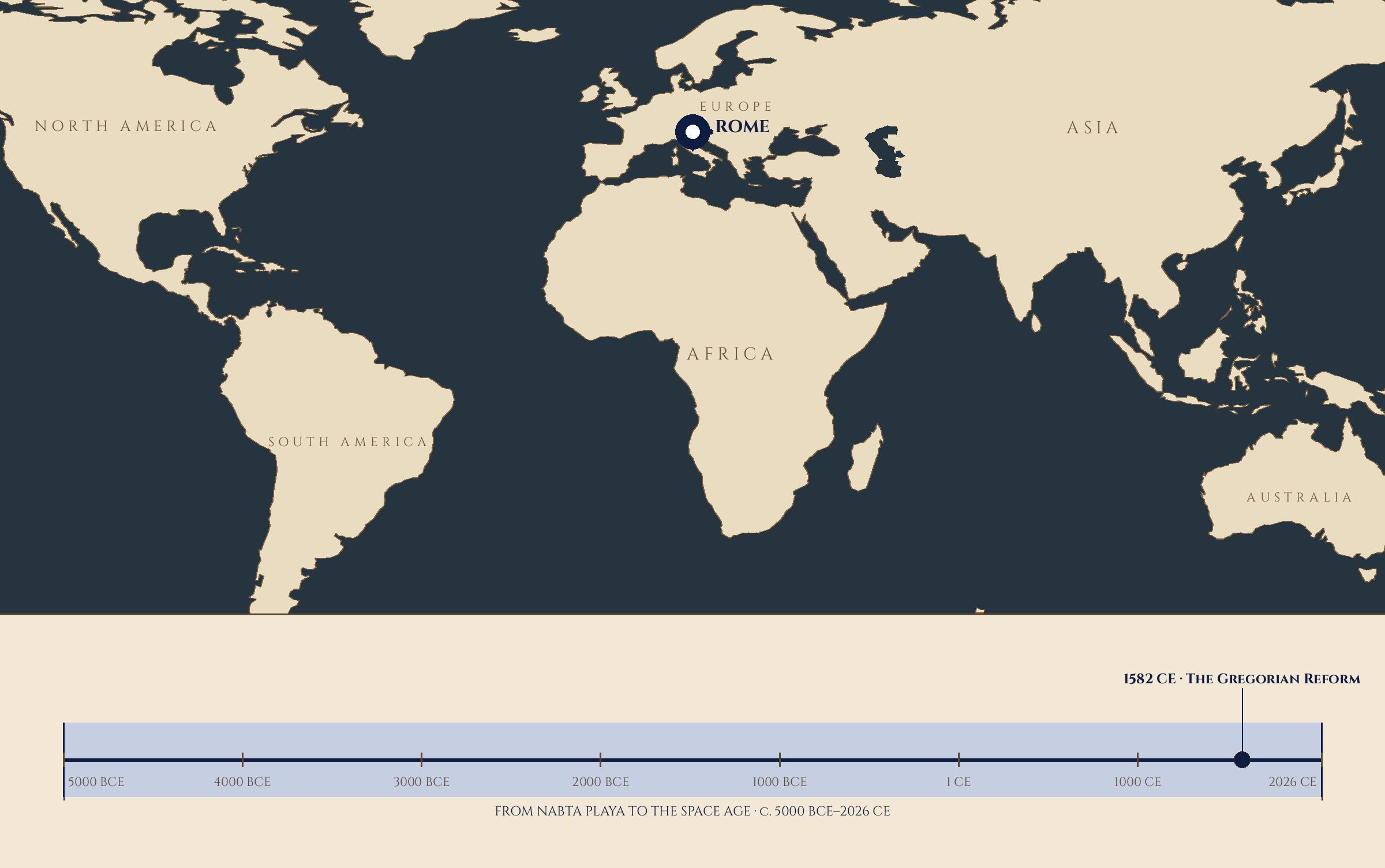
Where and when: ROME, 1582 CE · The Gregorian Reform (year 1582) — Calendars of the World. The pin is this lesson. The line beneath the map is our road: every stop a moment when watching the sky changed, every lesson a pin upon it.
Lesson Objectives
By the end of this lesson, you will be able to:
- Distinguish lunar, solar, and lunisolar calendars, and explain which sky rhythm each one follows.
- Describe the Gregorian reform of 1582: what was skipped, why, and how later adopters skipped different numbers of days.
- Explain why the date of Easter moves, using the terms computus, Paschal full moon, and ecclesiastical equinox.
- Describe how the Chinese, Hebrew, and Islamic calendars each solve (or accept) the mismatch between moon and sun.
- Explain intercalation and the Metonic cycle in your own words.
- Convert dates between the Julian and Gregorian calendars and between the Islamic and Gregorian calendars using the provided tables.
Reading this lesson: ★ marks the passages to remember. They return on the unit quiz and the class test. Check in questions ask the material back as you go; answer them in your workbook when you meet them.
Working this lesson: Your assignment packet is the first download on this page. Work in it as the lesson moves along, answering each exercise as its subject is taught — or read the lesson through for your notes and take the exercises as homework afterward. Both are proper ways to sit this class. Signposts in the reading tell you where each exercise belongs. Written answers are short answers in your own words; a few honest lines are worth more than a filled page.
Your Assignment Packet
This lesson's exercises live in its packet: the Lexicon Handout (every term, course terms marked ◆), Materials, Guided Practice — the conversion tables, carried in full — the Assignment Manual with its answer key for self-checking, the Reflection Questions, and the Workbook Checklist. Download the packet before you begin and keep it beside you as you read.
This lesson's quiz is not printed in the packet. It now sits in the Unit I Quiz, where this unit's quizzes are gathered and its questions are pooled with the other lessons of Unit I.
Safety Briefing
This lesson is mostly desk work, but your Moon Journal continues, and the sky is part of this lesson's soul.
- Night observing always happens with an adult, in a safe, familiar location. Tell someone where you are going and when you expect to be back.
- Dress for the temperature; still air at night is colder than it looks from a window.
- Never look directly at the sun, and never point binoculars or a telescope anywhere near it. This rule has no exceptions and no clever workarounds.
- Use a dim red flashlight if you need light while your eyes adjust. Your night vision is a tool; protect it the way you would protect any instrument.
❦ In your workbook: record the safety briefing in your own way — the adult rule, dressing for still night air, the sun rule that has no exceptions, and the red flashlight — copy, sketch, or note what matters.
The Wonder
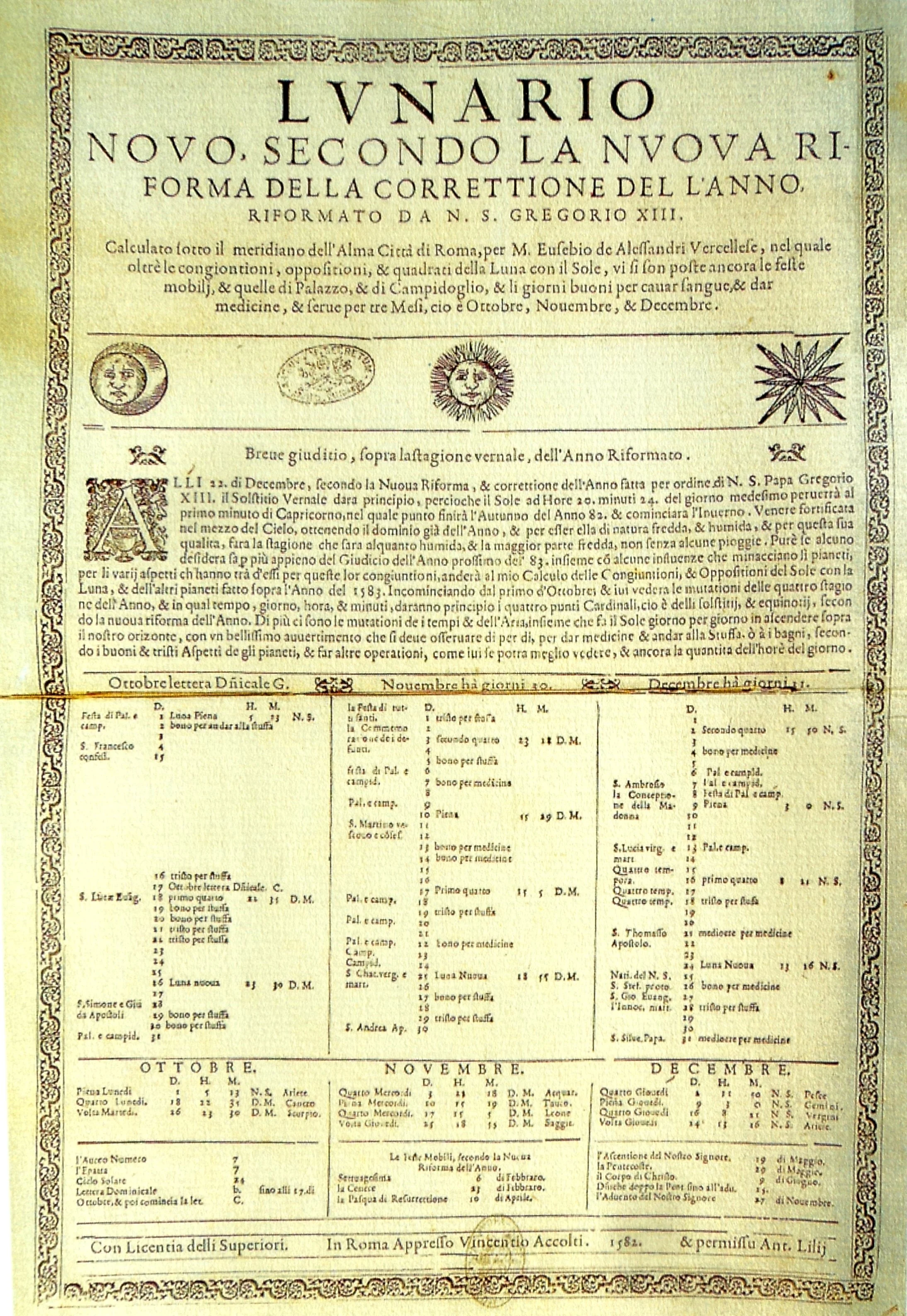
The reform, printed. The new calendar for October, November, and December 1582, issued at Rome with Antonio Lilio's permission. Look at the October column: after the 4th comes the 15th. The ten days were not crossed out — they were never printed.
Lunario Novo broadside, Rome, 1582 (printed by Vincentio Accolti). Public domain.
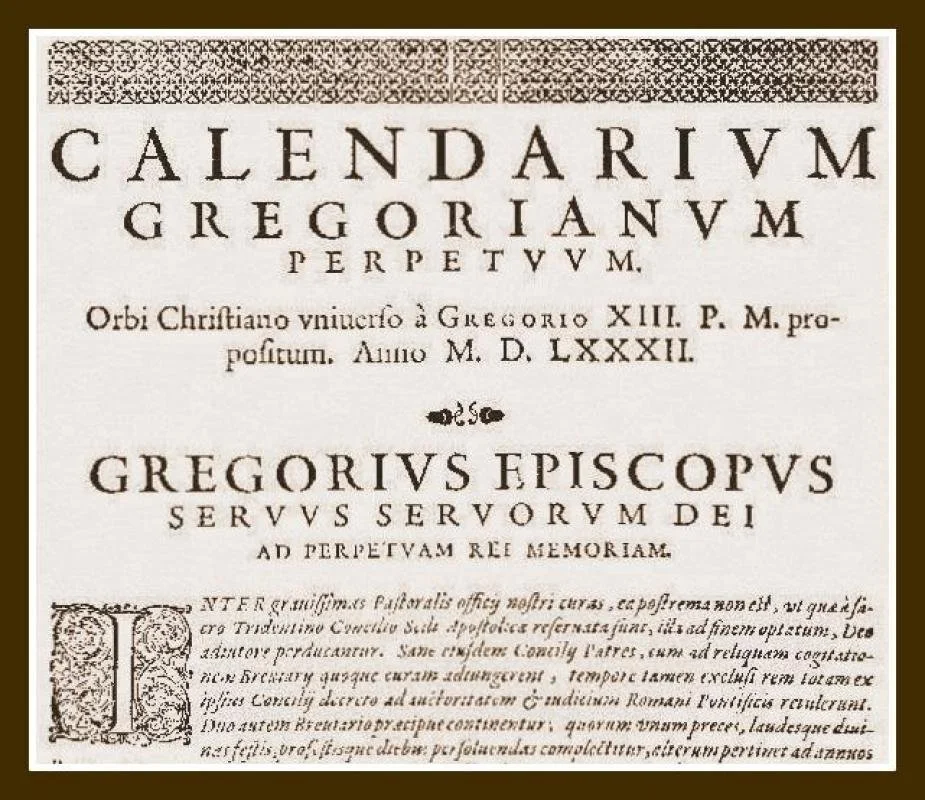
The order itself. The Calendarium Gregorianum Perpetuum (1582) opens with Pope Gregory XIII's bull Inter gravissimas — the document that deleted ten days from October 1582 and rewrote the leap-year rule.
Title page and bull opening, Calendarium Gregorianum Perpetuum, 1582. Public domain.
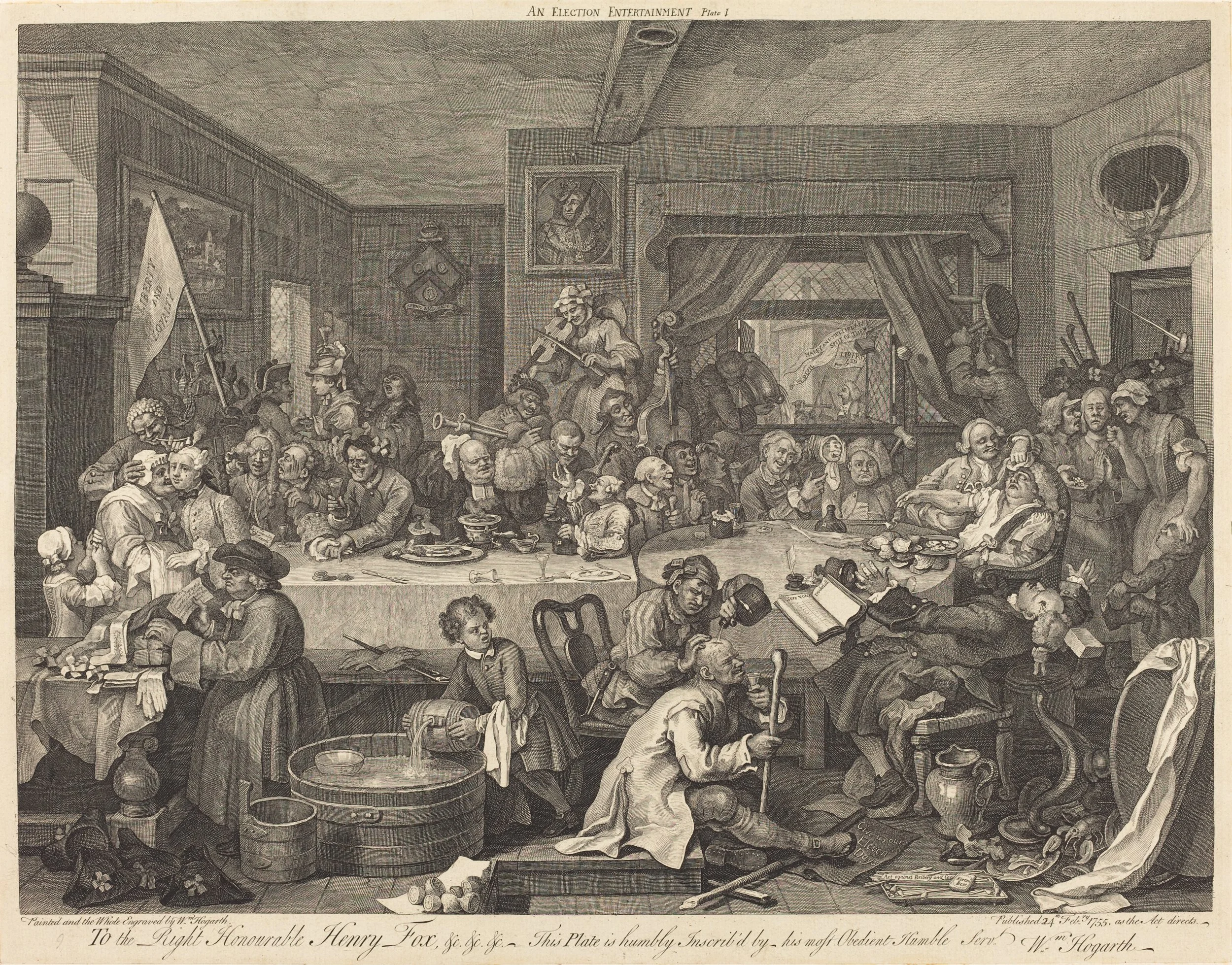
Give us our Eleven Days." William Hogarth, An Election Entertainment (1755). The banner protesting Britain's 1752 calendar reform — eleven days skipped, not ten — lies trampled on the tavern floor at lower right. Find it.
William Hogarth, An Election Entertainment, 1755, National Gallery of Art, Washington. CC0.
Here is a fact that sounds like a riddle and is entirely true: in the year 1582, in Spain, Portugal, Poland, and much of Italy, the month of October was only twenty-one days long.
★ Thursday, October 4, 1582, was followed by Friday, October 15, 1582. The dates October 5 through October 14 never happened. Ten days, gone from the calendar, gone from every contract and birthday and market day in those lands. People went to sleep on the 4th and woke up on the 15th, and the week carried on as though nothing had happened. Monday did not skip. The moon did not skip. Only the numbers skipped.
Why would anyone do such a thing? Because the calendar had been slowly lying about the date of spring for over a thousand years, and the lie had grown to ten days. The church's most important movable feast, Easter, is tied to the spring equinox, and the equinox had drifted to March 11 instead of March 21. Something had to give. So Pope Gregory XIII gave an order, issued in the papal bull Inter gravissimas in February 1582, and ten days vanished from history.
★ And here is the part that makes calendar historians smile: countries that adopted the reform later skipped different numbers of days. When Britain and its colonies finally made the change in 1752, Wednesday, September 2 was followed by Thursday, September 14. Eleven days vanished, because by then the old calendar had drifted one day further. Russia waited until 1918 and skipped thirteen. The same reform, applied at different times, erased different amounts of time, because the error it was correcting kept growing while people argued about whether to fix it.
Think about what that means for history. George Washington was born on February 11, 1731, by the calendar his family used. After Britain adopted the new calendar, his birthday was celebrated on February 22. Same man, same birth, two different dates, depending on which calendar you ask. Historians still write "Old Style" and "New Style" beside dates from those centuries, like a footnote apologizing to the sky.
Check in: Thursday, October 4, 1582 was followed by which date — and why did Britain skip eleven days in 1752 instead of ten?
This is the wonder at the heart of the lesson: timekeeping is not a single settled thing. It is a long argument between the sun, the moon, and the humans trying to please both at once.
❦ In your workbook: record the wonder in your own way — the October that lost ten days, and why later adopters lost more — copy, sketch, or note what matters.
The Story
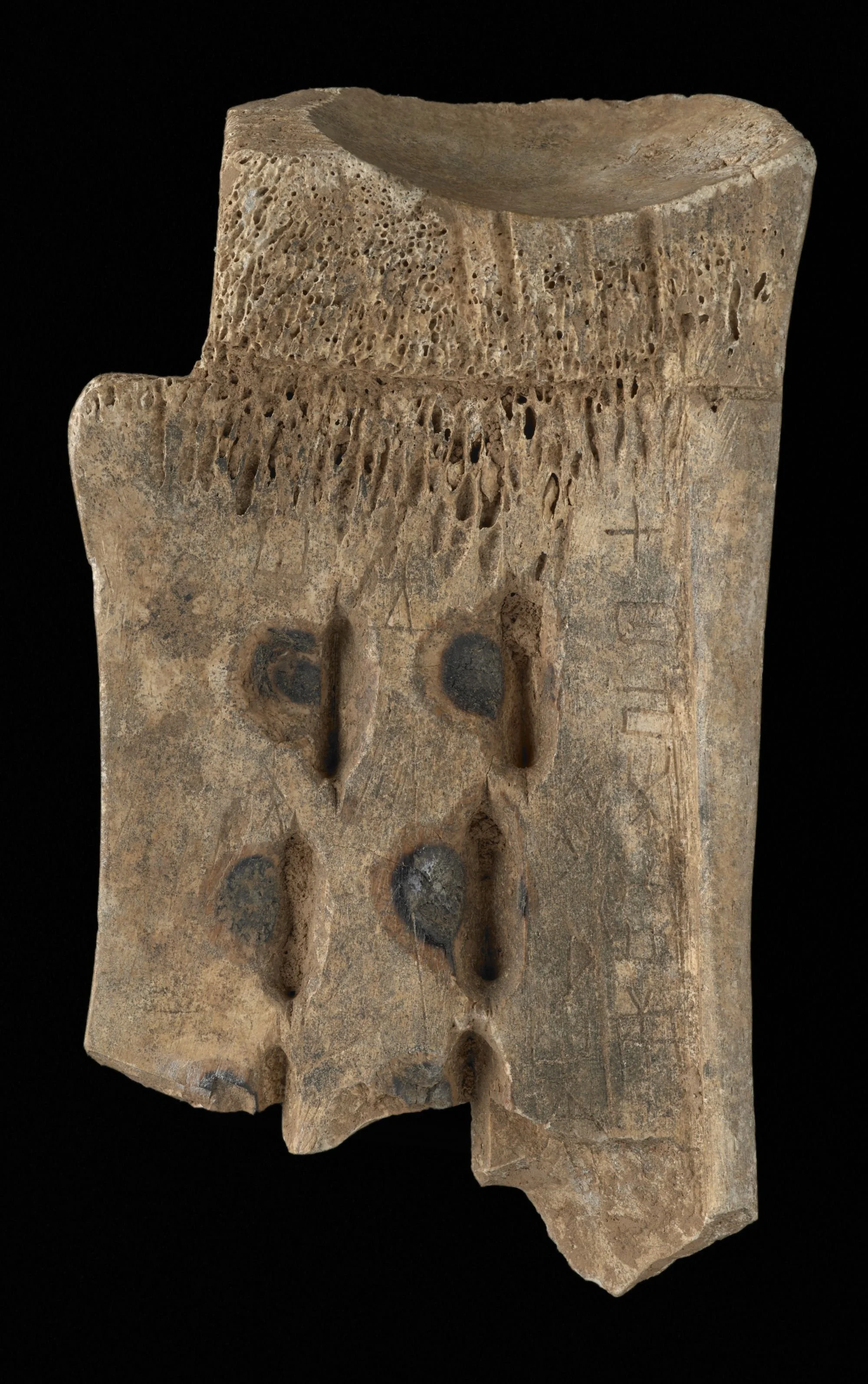
Writing time on bone. An oracle bone of Shang-dynasty China: the dark hollows are the scorch pits of divination, and the incised column at the right is among the earliest Chinese writing. The lesson's sixty-year stem-branch cycle — one of the oldest continuous numbering systems in use — already appears on oracle bones from around 1200 BCE.
Oracle bone, Couling-Chalfant collection. CC0.
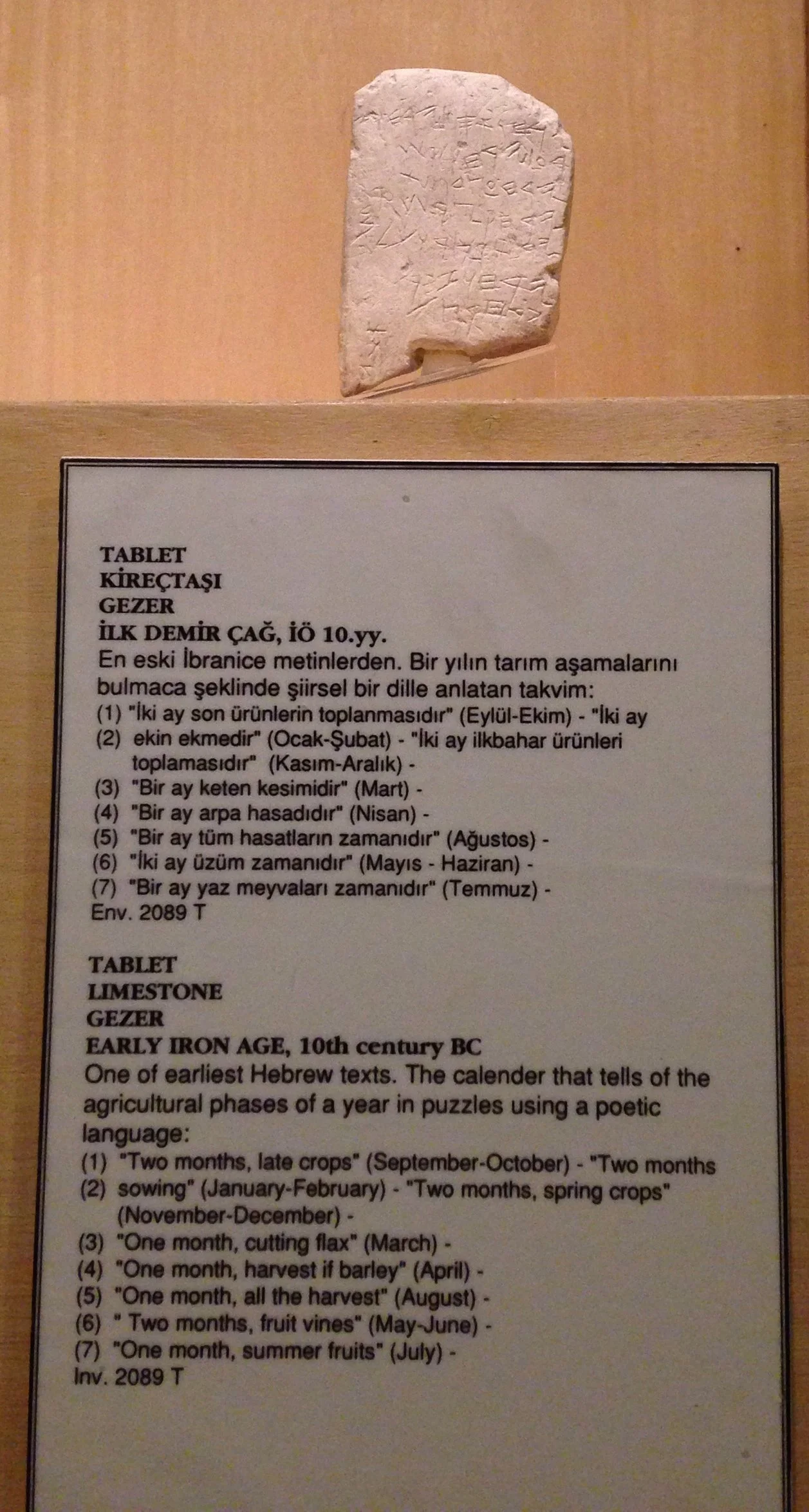
A calendar you can hold in one hand. The Gezer calendar (10th century BCE), one of the earliest Hebrew texts: seven lines on limestone naming the year's farm work, month by month — late crops, sowing, flax, barley, harvest, vines, summer fruit. Photographed with its museum label in Istanbul, which translates the lines.
Gezer calendar tablet, Istanbul Archaeology Museum; photograph released CC0.
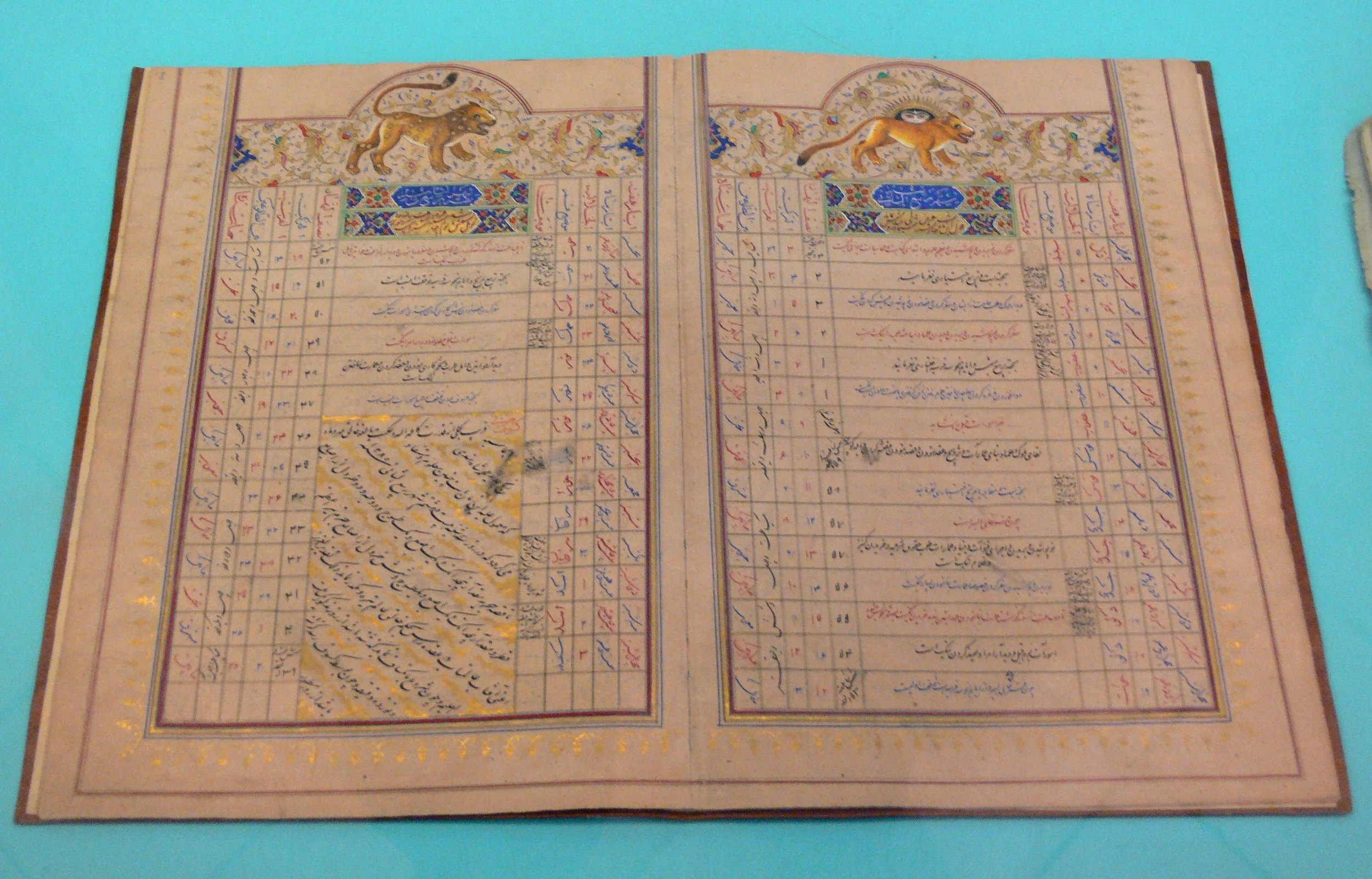
Timekeeping as high craft in the Islamic world: an illuminated Persian calendar manuscript of 1863, its days ruled in red, blue, and black beneath the lion-and-sun. The calendars of this lesson were working instruments — and, as here, works of art.
Persian calendar manuscript, 1863, Linden Museum, Stuttgart. Public domain.
Every calendar ever made is an answer to the same question: how do we count days in a way that stays true to the sky? The trouble is that the sky keeps time in at least two rhythms that do not fit together neatly.
The moon goes from new to new in about 29 and a half days. Twelve of those moon-months add up to about 354 days. The sun takes about 365 and a quarter days to return to the same place in its yearly path, bringing the seasons back around. Twelve moons are about eleven days short of one full seasonal year. That eleven-day gap is the engine of this entire lesson. Every calendar is a strategy for dealing with it, and the three families of calendars are the three basic strategies.
★ Lunar calendars follow the moon and let the seasons go. The Islamic calendar is the great living example: twelve lunar months, each beginning with the sighting of the new crescent moon, adding up to 354 days in an ordinary year (355 in leap years, which come 11 times in every 30 years in the calculated version). Because it is purely lunar, it makes no attempt to stay aligned with the sun. Ramadan, the ninth month, the month of daytime fasting, drifts about eleven days earlier through the solar year with each passing year, cycling through every season over roughly thirty-three years. A fast kept in the short days of winter will, a decade and a half later, fall in the long heat of summer. The calendar counts from the Hijra, the migration of the Prophet Muhammad from Mecca to Medina in 622 CE, and its years are marked AH, for Anno Hegirae, the year of the Hijra. Months are Muharram, Safar, Rabi al-Awwal, Rabi al-Thani, Jumada al-Awwal, Jumada al-Thani, Rajab, Shaban, Ramadan, Shawwal, Dhu al-Qada, and Dhu al-Hijja. Traditionally each month begins when the crescent is actually seen, which is why the exact start of Ramadan can differ by a day from place to place, depending on weather and geography. Some communities now use astronomical calculation instead. Both practices honor the same moon.
★ Solar calendars follow the sun and let the moon go. Our own Gregorian calendar is one: its months are called months, but they have nothing to do with the moon's phases. January is not a moon; it is a twelfth of a year, sized by tradition and by Julius Caesar's committee. The Gregorian calendar's whole genius is a single leap-day rule, and its whole drama is the story of how that rule came to exist.
Before the Gregorian calendar there was the Julian calendar, decreed by Julius Caesar in 45 BCE on the advice of the Alexandrian astronomer Sosigenes. Rome's old calendar had become a shambles, with priests inserting extra months for political reasons, so Caesar swept it away and declared a year of 365 days with an extra day every fourth year: an average year of 365.25 days. To get the new system started, the year 46 BCE was stretched to 445 days, the longest year in recorded history, sometimes called the Year of Confusion. It worked, and it worked for sixteen centuries. But the true solar year is about 365.2422 days, not 365.25. The Julian year was about eleven minutes too long. Eleven minutes a year does not sound like much, but over 1,600 years it added up to ten days. By 1582 the spring equinox, which the church had fixed at March 21 back in 325 CE, was arriving on March 11. That mattered enormously, because the date of Easter is computed from the equinox.
★ So came the Gregorian reform. Pope Gregory XIII's bull of 1582 did two things. First, it deleted ten days from October 1582, restoring the equinox to March 21. Second, it changed the leap-year rule so the error would not build up again: years divisible by 4 are leap years, except century years, which are leap years only if divisible by 400. The year 2000 was a leap year; 1900 was not; 2100 will not be. The average Gregorian year is 365.2425 days, so close to the true solar year that it will take more than three thousand years to drift by a single day. Catholic countries adopted it at once. Protestant and Orthodox countries held out for decades or centuries, which is why the same historical event can carry different dates in different sources, and why historians mark them Old Style and New Style.
★ Lunisolar calendars refuse to choose. They follow the moon for their months and the sun for their year, and they reconcile the two by inserting whole extra months, a practice called intercalation. Two of the world's great living calendars do this, each in its own elegant way.
The Chinese calendar is a lunisolar system of remarkable astronomical precision. Each month begins on the day of the true astronomical new moon, and months alternate between 29 and 30 days according to the actual moon, so a twelve-month year runs 353 to 355 days. To keep the seasons anchored, the calendar uses the 24 solar terms, divisions of the sun's yearly path spaced about fifteen days apart, each marking a seasonal turning point, from Lichun, the Start of Spring, to Dongzhi, the winter solstice. The rule for the extra month is beautifully simple in concept: if a lunar month contains none of the twelve principal solar terms, it is declared a leap month and takes the number of the month before it. The year 2023, for example, contained a leap second month. Roughly seven leap months fall in every nineteen years, and the winter solstice always falls in the eleventh lunar month, which keeps Lunar New Year drifting within its familiar window between January 21 and February 20. The Chinese year is also named by the twelve-animal zodiac cycling with the five elements in a sixty-year stem-branch cycle, one of the oldest continuous numbering systems in human use, appearing on oracle bones from around 1200 BCE. The calendar was codified as a national technical standard in 2017, and UNESCO inscribed the 24 solar terms as Intangible Cultural Heritage in 2016.
The Hebrew calendar is lunisolar by fixed arithmetic rather than by fresh observation. Its months begin with the new moon and alternate 29 and 30 days, but the leap months are scheduled by the nineteen-year Metonic cycle: years 3, 6, 8, 11, 14, 17, and 19 of each cycle get a thirteenth month. The extra month is a second Adar, called Adar I, placed before the regular Adar, which becomes Adar II, and the spring festival of Purim is kept in Adar II so it stays near Passover in the month of Nisan. Passover always falls in spring because the leap months hold it there; without them it would drift into winter within a few decades. The Hebrew day begins at sunset, the year is counted from the traditional date of creation (the year 5786 runs through much of 2026), and Rosh Hashanah, the New Year, falls in the autumn month of Tishrei. Before the fixed calendar was established in the fourth century CE, new months were proclaimed by witnesses who had actually sighted the crescent, a lovely reminder that every one of these systems began with someone looking up.
Check in: Which calendar family lets the seasons go, which lets the moon go, and which inserts whole extra months to keep both — and what is that insertion called?
Notice what all three families share: nobody gets to ignore the arithmetic. The moon and the sun simply do not divide evenly, and every calendar is a treaty between them, negotiated in days and months.
❦ In your workbook: record the story in your own way — the three families, the eleven-day gap, and how the Chinese and Hebrew calendars each reconcile moon and sun — copy, sketch, or note what matters.
In your packet: Exercise II — Three Calendars, One Year ✎ begins here. Work it now, or mark the place and take it as homework — your choice.
The Mechanism
Now let us do the arithmetic properly, because the numbers are the mechanism, and the mechanism is beautiful.
A synodic month, one full cycle of the moon's phases from new moon to new moon, averages 29.53059 days. Twelve of them total about 354.37 days. A tropical year, one full cycle of the seasons from one March equinox to the next, averages about 365.2422 days. Subtract: the lunar year is about 10.87 days short of the solar year. Every year, a purely lunar calendar starts its new year about eleven days earlier in the seasons. After sixteen years it has slipped half a year; after about thirty-three years it has lapped the seasons entirely and come back around.
★ Here is the discovery that changed calendar-making forever. In 432 BCE, the Athenian astronomer Meton noticed that nineteen solar years are almost exactly equal to 235 lunar months. Check it: 19 times 365.2422 is about 6,939.6 days, and 235 times 29.53059 is about 6,939.7 days. They differ by roughly two hours over nineteen years. This is the Metonic cycle, and it tells a calendar-maker exactly what to do: in every nineteen-year span, add seven extra lunar months (235 minus 228, the number of months in nineteen twelve-month years), and the moon and the seasons will stay in step. The Hebrew calendar builds its leap years directly on this cycle. The Chinese calendar arrives at the same average by astronomical rule rather than fixed schedule. Either way, the moon's vote is counted: seven extra months per nineteen years, about one extra month every two to three years.
★ The solar side has its own arithmetic. Julius Caesar's year of 365.25 days overshoots the true 365.2422-day year by about 11 minutes and 14 seconds per year. That is roughly one day of drift every 128 years, ten days by 1582, and it would have been thirteen by the time Russia reformed in 1918. The Gregorian rule trims the average year to 365.2425 days, overshooting by only about 26 seconds per year, which accumulates to one day in more than three thousand years. That is the whole reform in one sentence: a better average, achieved by skipping three leap days every four hundred years.
So intercalation is simply the general name for the fix: inserting extra time to reconcile two cycles that do not divide evenly. A leap day is intercalation. A leap month is intercalation. Choosing to intercalate nothing, as the Islamic calendar does, is also a decision, and it is an honest one: the calendar stays perfectly true to the moon and lets the seasons wander, rather than staying true to the seasons and letting the moon wander. There is no calendar that tracks both perfectly without adjustment, because the sky itself does not offer a whole number of moons per year. The imperfection is not human error. It is astronomy.
One more piece of the mechanism, because it explains Easter, and Easter is the reason the Gregorian reform happened at all. ★ The rule for Easter, settled at the Council of Nicaea in 325 CE, is this: Easter falls on the first Sunday after the first full moon that occurs on or after March 21. The full moon in question is the Paschal full moon, and it is not quite the astronomical full moon you see in the sky. It is the fourteenth day of the church's ecclesiastical lunar calendar, a calculated approximation, and March 21 is the ecclesiastical equinox, a fixed date, not the astronomical equinox, which can fall on March 19, 20, or 21. Because the church computes with tables rather than telescopes, the date it produces can differ by a few days from what strict astronomy would give. The full algorithm even has its own medieval name: the computus, Latin for computation, and monks once spent lifetimes mastering it.
Now the "why it moves" becomes obvious. The full moons march through the calendar year, and the Sundays march through the week, and the two marches are independent. Easter must satisfy both at once: a Sunday, after a particular full moon. Some years that Sunday comes as early as March 22; some years the geometry pushes it to April 25. In 2026, the Paschal full moon falls on April 1 and Easter Sunday is April 5. The date moves because it is the intersection of two cycles, and intersections move. Eastern Orthodox churches, which still reckon by the Julian calendar for church purposes, often celebrate on a different Sunday, which is why the same resurrection can be celebrated on different dates in the same city. The moon, the sun, and the week: three rhythms, one feast, and the date wanders through spring exactly as the arithmetic says it must.
Check in: Nineteen solar years equal how many lunar months — and state the rule for Easter in one sentence, naming the Paschal full moon and the ecclesiastical equinox.
❦ In your workbook: record the mechanism in your own way — the 10.87-day gap, the Metonic cycle's seven extra months, and why Easter's date must move — copy, sketch, or note what matters.
In your packet: Exercise III — The Wandering Feast ✎ begins here. Work it now, or mark the place and take it as homework — your choice.
A Sealed Note on the Moon's Vote
Scholars sometimes ask me which calendar is "correct." I always answer the same way: correct for what? If you want to know when to plant barley, ask the sun. If you want to know when the month begins, ask the moon. If you want both answers from one calendar, you must do what the Chinese astronomers and the rabbis and the pope's mathematicians all did: you must negotiate. You must add a day here, a month there, and accept that the treaty will need renegotiating in a few thousand years.
I find this comforting. Even time itself is a compromise. The next time someone tells you there is one right answer to everything, remember October 1582, and smile the small private smile of a scholar who knows better.
❦ In your workbook: record the moon's vote in your own way — "correct for what?", and why every calendar is a negotiated treaty — copy, sketch, or note what matters.
PROFESSOR VESPER GLIMMERWICK
Celestial Studies
Astronomer & Celestial Historian
Guided Observation: Converting Dates Between Calendars
Tonight's practical is a skill every historian needs: converting a date from one calendar to another. Real scholars do this with tables, not from memory, so your professor provides the tables. Copy them into your sky log; you will use them again.
Table A: Julian dates to Gregorian dates
Find the century of your Julian date, then add the number of days shown. The result is the Gregorian date.
| Julian date falls in | Add this many days |
|---|---|
| 5 October 1582 to 1699 | 10 days |
| 1700 to 1799 | 11 days |
| 1800 to 1899 | 12 days |
| 1900 to 2099 | 13 days |
Why the number grows: the Julian calendar keeps inserting leap days that the Gregorian calendar skips (1700, 1800, 1900), so the two systems drift one day further apart each time.
Table B: Islamic (Hijri) years to Gregorian years, approximate
The Islamic year is shorter than the solar year — roughly 33 Islamic years fit into 32 solar years — so scholars use this rough rule: Gregorian year ≈ (Islamic year × 32 ÷ 33) + 622. Use the anchor rows to check your work.
| Islamic year (AH) | Approximate Gregorian year |
|---|---|
| 1 AH | 622 CE |
| 500 AH | 1107 CE |
| 1000 AH | 1592 CE |
| 1447 AH | 2025 to 2026 CE |
This is an approximation, good to within a year or two. Exact conversion needs the month and day, because the years start at different seasons.
Your conversions
Work all three, showing which table and which row or rule you used.
- William Shakespeare died on April 23, 1616, by the English (Julian) calendar of his day. What is that date in the Gregorian calendar?
- A traveler’s journal is dated to the Islamic year 1000 AH. About what Gregorian year was the traveler writing in?
- The Great Fire of London began on September 2, 1666, by the English (Julian) calendar. What is that date in the Gregorian calendar, and how many days were skipped in Britain’s own calendar reform of 1752?
Check your answers against the key at the back of the assignment packet, then write one sentence in your sky log about which conversion surprised you most.
Check in: A Julian date in the 1700s converts to Gregorian by adding how many days — and why does the number in Table A grow by a day each century?
Sky Log Entry
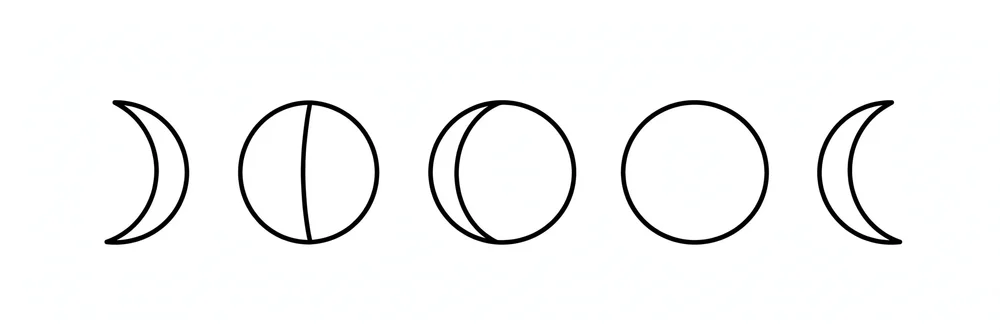
Date tonight's entry twice: once in the Gregorian style you use every day, and once by the moon. Record the moon's phase (your Moon Journal sketch covers this), then answer in two or three sentences: if your birthday were reckoned by a purely lunar calendar like the Islamic one, in which season would it fall ten years from now? Show the arithmetic: ten years times about eleven days of drift per year.
❦ In your workbook: record the conversions in your own way — copy Tables A and B into your sky log, work the three conversions showing your table and row, and date tonight's entry twice — copy, sketch, or note what matters.
In your packet: Exercise I — The Date Converter ✎ begins here. Work it now, or mark the place and take it as homework — your choice.
Materials
Required (Level One — household items)
- A notebook or sky log and a pencil: tonight's work is arithmetic and observation. Pencil, because calendar math gets revised.
- A ruler: for copying the conversion tables neatly into your sky log.
- A current wall calendar, desk calendar, or almanac page: any month will do. You will be reading it the way a historian reads it.
- A dim red flashlight (a flashlight covered with red cellophane works) for the Moon Journal observation after dark.
Suggested (Level Two — historically closer)
- A bound sky journal: stitched binding rather than spiral, closer to the ledgers historical astronomers kept.
- A printed perpetual calendar or ephemeris page for the current year, for checking your conversions against published tables.
- Binoculars for the Moon Journal's closer look at tonight's phase (Level Two only; never point them near the sun).
Reflection Questions
Answer the following questions in your workbook.
- The Islamic calendar deliberately does not correct its drift through the seasons. Is that a flaw in the calendar, or a different definition of what a calendar is for? Defend your answer.
- Pope Gregory XIII deleted ten days from October 1582. Who do you think objected, and why might ordinary people have been uneasy about losing ten days of their lives on paper?
- The Chinese calendar fixes leap months by astronomical observation, while the Hebrew calendar fixes them by arithmetic schedule. What does each method gain, and what does each method lose?
- Why do historians bother writing "Old Style" and "New Style" beside dates? Give an example from the lesson of a historical fact that would be confusing without those labels.
- Your birthday is fixed on the Gregorian calendar. If the whole world switched tomorrow to a purely lunar calendar, what would happen to birthdays within your lifetime? Describe the change in concrete terms.
Workbook Checklist — Lesson 5
In my workbook I have:
- ☐ distinguished lunar, solar, and lunisolar calendars, and named the sky rhythm each one follows
- ☐ described the Gregorian reform of 1582: the ten dates skipped, why, and why Britain skipped eleven in 1752 and Russia thirteen in 1918
- ☐ explained why Easter moves, using computus, Paschal full moon, and ecclesiastical equinox
- ☐ explained intercalation and the Metonic cycle in my own words — seven extra months in every nineteen years
- ☐ worked the three conversions with Tables A and B, showing the table, row, or rule I used
- ☐ dated tonight's sky log entry twice — Gregorian, and by the moon — and shown the birthday-drift arithmetic
☐ Lesson completed Date: ___ Signature: ___
The Professor's Closing Note
You now know something that most adults do not: that the calendar on your wall is a machine for reconciling the irreconcilable, and that it has been repaired, argued over, and occasionally rebooted for two thousand years. The next time you write the date, pause for half a second and feel the weight of it. Nineteen-year cycles, vanished Octobers, crescent sightings, solar terms, leap months, leap days. All of that, balanced on the page, so that spring arrives when the calendar says spring.
Keep watching the moon, scholars. It is still voting.
PROFESSOR VESPER GLIMMERWICK
Celestial Studies
Astronomer & Celestial Historian
Cross-Class Connections
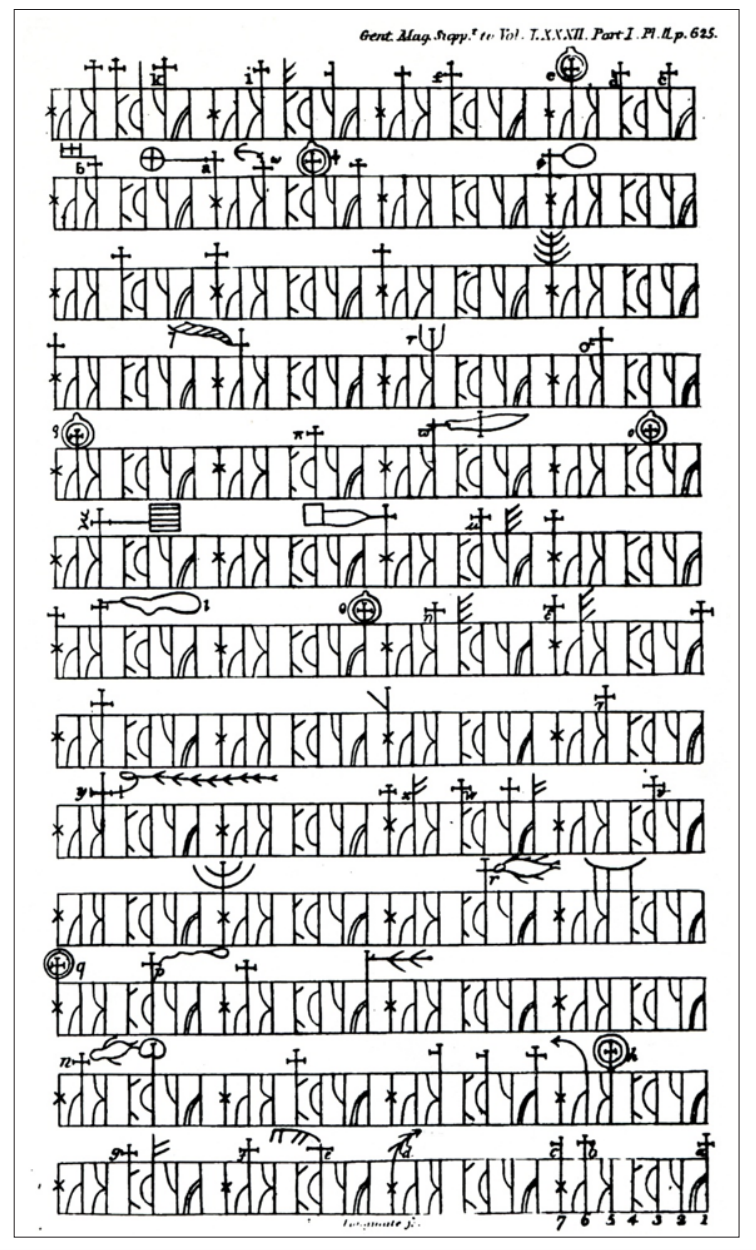
A year on a stick. An engraved drawing of a runic calendar — the kind of calendar stick Glimmerwick's closing cross-reference describes: a whole year of days and feast days in carved marks, published in the Gentleman's Magazine in 1812 from a calendar of Ösel (Saaremaa).
Drawing published in the Gentleman's Magazine, 1812. Public domain.

Runes · Unit IV, Lesson 12 — The Viking Compaction
Your tower keeps the year in numbers; my classroom keeps it in notches. The calendar sticks Glimmerwick describes were cut with the medieval Scandinavian runes my Lesson 12 teaches — the sixteen-sign Younger Futhark, read here in both its hands, in the rune poems that preserve its names, and on the wood Iceland carved when it raised no stones. Come and learn the sixteen signs, and a year of Sundays and feast days on a strip of wood will stop being a picture and start being a text. — Professor Thistleloom Webblethorn, Runes

Scrollwork · Unit II, Lesson 7 — Rubrication & Red Lettering
Open a liturgical calendar in my Library, Glimmerwick's scholars, and the red speaks first: in the calendars my lesson studies, the feast days that mattered most stood in red — which is why a memorable day is still, in English, a "red-letter day." Come and learn what the red marked, how the scriptorium laid it on, and how scholars still read a workshop's hand in its rubrication. Your professor showed you the calendar pages; mine shows you how their makers ranked the days. — Professor Quillberry Nocturne, Scrollwork Library

Herbology · Unit I, Lesson 5 — The Historian's Herbarium
Glimmerwick is right about my greenhouse, scholars: we keep belief and evidence in separate sections of the journal, clearly labeled, and we study both. Come and learn the discipline your Tower lesson borrows — how folklore about plants is genuine cultural history, worth recording with care, and why it must never be mistaken for proof of what a plant does. Bring that habit back to every planting-by-the-moon claim you meet. — Professor Beryl Fernfoot, Herbology Greenhouse
Herbology · Unit II, Lesson 15 — Seasonal Growing Cycles
And when you want the gardening year itself — the seasons your calendars were invented to hold — my Lesson 15 walks it in the greenhouse: how the growing year turns, and how a gardener plans by its turning. Glimmerwick's lesson taught you who writes the calendar; mine teaches you to garden by the one the sky hands us. — Professor Beryl Fernfoot, Herbology Greenhouse
Further Reading & Sources
- Encyclopedia Virginia, "The Gregorian Calendar": the 1582 reform, the ten deleted days, the new leap-year rule, and Britain's 1752 adoption with its eleven skipped days. https://encyclopediavirginia.org/entries/the-gregorian-calendar/
- USA Today graphics, "How is the date of Easter determined?": the Paschal full moon, the ecclesiastical equinox of March 21, and Easter's range from March 22 to April 25, with Eastern Orthodox differences. https://www.beaconjournal.com/story/graphics/2025/04/15/how-easter-date-determined-2025/82991941007/
- CalendarZ, "Why Some Years Have 13 Months: Lunisolar Leap Months Explained": intercalation in the Chinese, Hebrew, and Indian calendars, the Metonic cycle, and how leap months are chosen. https://www.calendarz.com/blog/why-some-years-have-13-months-lunisolar-leap-months-explained
- Islamic Voice, "The Islamic Calendar": the purely lunar year of 354 days, months beginning with the crescent sighting, and year-counting from the Hijra in 622 CE. https://islamicvoice.com/q-and-a/the-islamic-calendar/
- Easy Learn Hebrew, "How Many Months in the Jewish Calendar?": the lunisolar Hebrew year, Adar I and Adar II in leap years, and the nineteen-year Metonic cycle. https://www.easylearnhebrew.com/blog/how-many-months-in-the-jewish-calendar/
- Globerove, "Chinese Lunar Calendar": the lunisolar mechanics, the 24 solar terms, the leap-month rule, the zodiac and sixty-year cycle, and Lunar New Year dates. https://globerove.com/china/chinese-lunar-calendar/
Browse the Celestial Studies shelf in the school Library for readable editions of these works.
Submit your work for this lesson using the form below.
CONTINUE IN THE CELESTIAL TOWER
← Previous · Lesson 4: Ancient Observatories Next · Lesson 6: The Longitude Problem →
Unit I — The Sky as Clock & Calendar Celestial Tower — All 33 Lessons
The rest of Unit I: Lesson 1 · Celestial Tower · Lesson 2 · Turning Sky · Lesson 3 · Tilted Year · Lesson 4 · Ancient Observatories · Lesson 6 · The Longitude Problem