
CELESTIAL STUDIES
Unit I · Lesson 1Welcome to the Celestial Tower
Your first night under a truly dark sky begins here.
Professor's Introduction
Look up, little scholars, and welcome to the Celestial Tower. I am Professor Vesper Glimmerwick, and I will be your guide to the sky.
Here is the road we will travel. We begin with the turning sky itself — day and night, the seasons, and the observatories and calendars it taught people to build. Then a whole unit with the Moon, and one among the wandering planets. We will learn the stars and the stories told about them, follow the zodiac and astrology from Babylon to the present day, and finish with the instruments that read the sky: the sundial, the planisphere, the astrolabe, and the telescope. This first lesson is where the road begins: the Tower, the course ahead, and your first entries in the Sky Log you will keep all year.
This course is my invitation to you: come and look up with me, and learn both the sky and what people have made of it. We begin tonight, with your own two eyes and nothing else.
PROFESSOR VESPER GLIMMERWICK
Celestial Studies
Astronomer & Celestial Historian
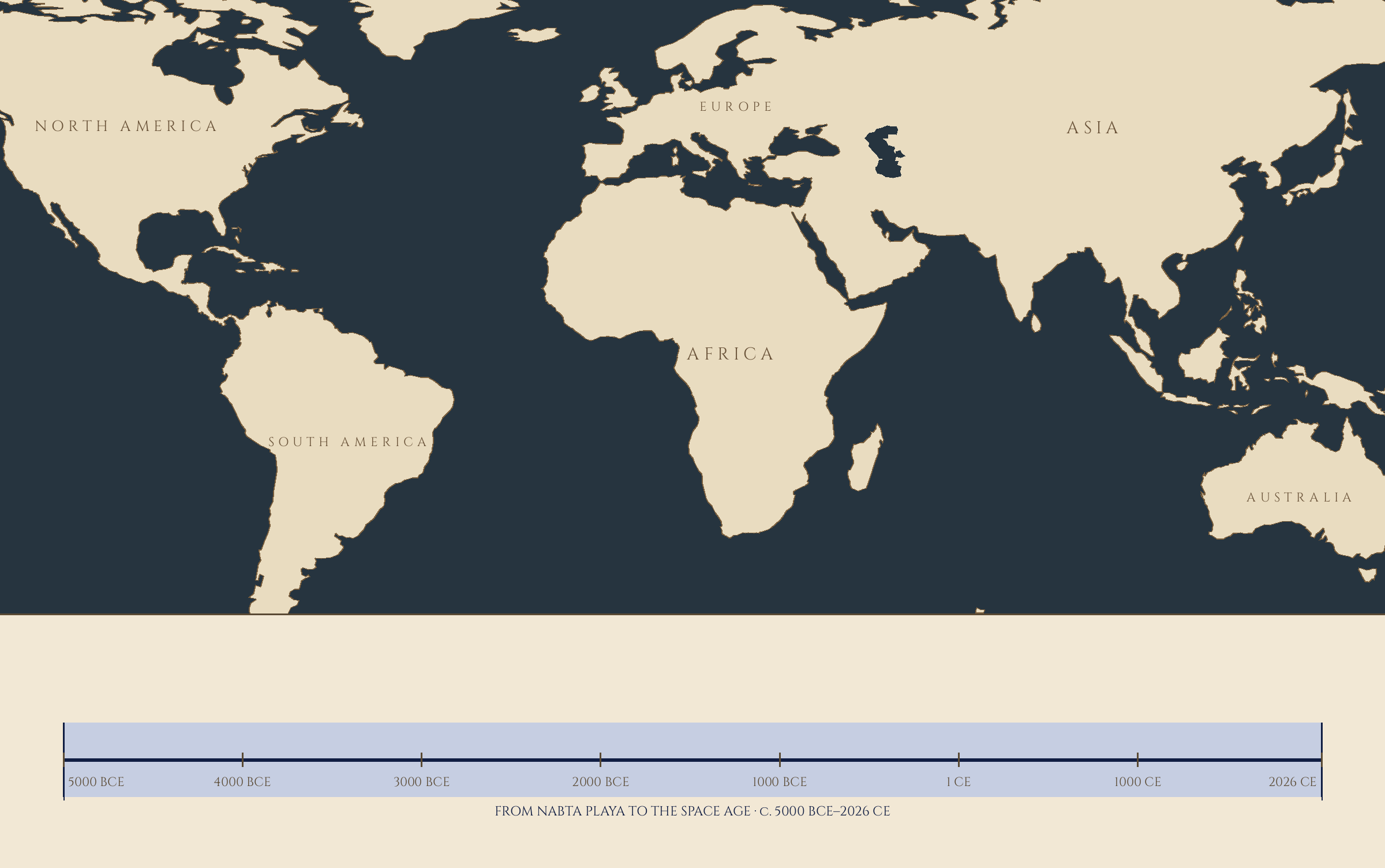
Where and when: your own sky, tonight — Welcome to the Celestial Tower. This lesson has no pin and no stop: its place is wherever you stand under the night sky. The line beneath the map is our road through the course: every stop a moment when watching the sky changed, every lesson a place upon it.
Lesson Objectives
By the end of this lesson, you will be able to:
- Explain what celestial studies is, and what it is not
- Name the six units of this course and its capstone
- Begin your Moon Journal, at your own pace
- Make your first naked-eye observation and record it in the Sky Log
- Follow the night-observing safety rules every time you go out
Reading this lesson: ★ marks the passages to remember. They return on the unit quiz and the class test. Check in questions ask the material back as you go; answer them in your workbook when you meet them.
Working this lesson: Your assignment packet is the first download on this page. Work in it as the lesson moves along, answering each exercise as its subject is taught — or read the lesson through for your notes and take the exercises as homework afterward. Both are proper ways to sit this class. Signposts in the reading tell you where each exercise belongs. Written answers are short answers in your own words; a few honest lines are worth more than a filled page.
Your Assignment Packet
This lesson's exercises live in its packet: the Lexicon Handout (every term, course terms marked ◆), Materials, Guided Practice, the Assignment Manual with its answer key for self-checking, the Reflection Questions, and the Workbook Checklist. Download the packet before you begin and keep it beside you as you read. This lesson's quiz is gathered with the other Unit I lessons' quizzes into the Unit I Quiz, which you will meet at the end of the unit.
Safety Briefing
- Night observing is always done with a trusted adult beside you, in a place you know well: your yard, your porch, a familiar spot. Tell someone where you will be.
- Stay where you know the ground. Do not wander off alone after dark, however tempting the darker field looks.
- Dress for the night air. Even summer nights cool down when you sit still, and autumn nights bite. Bring a blanket.
- Give your eyes time. Bright white light ruins night vision in an instant, so keep porch lights off if you can and avoid staring at phone screens while you observe.
- One rule stands for the whole course, day and night: never look directly at the sun. No exceptions, no improvisation.
❦ In your workbook: record the safety briefing in your own way — the trusted adult, the familiar place, warm layers, guarded night vision, and the rule about the sun that stands for the whole course — copy, sketch, or note what matters.
The Wonder
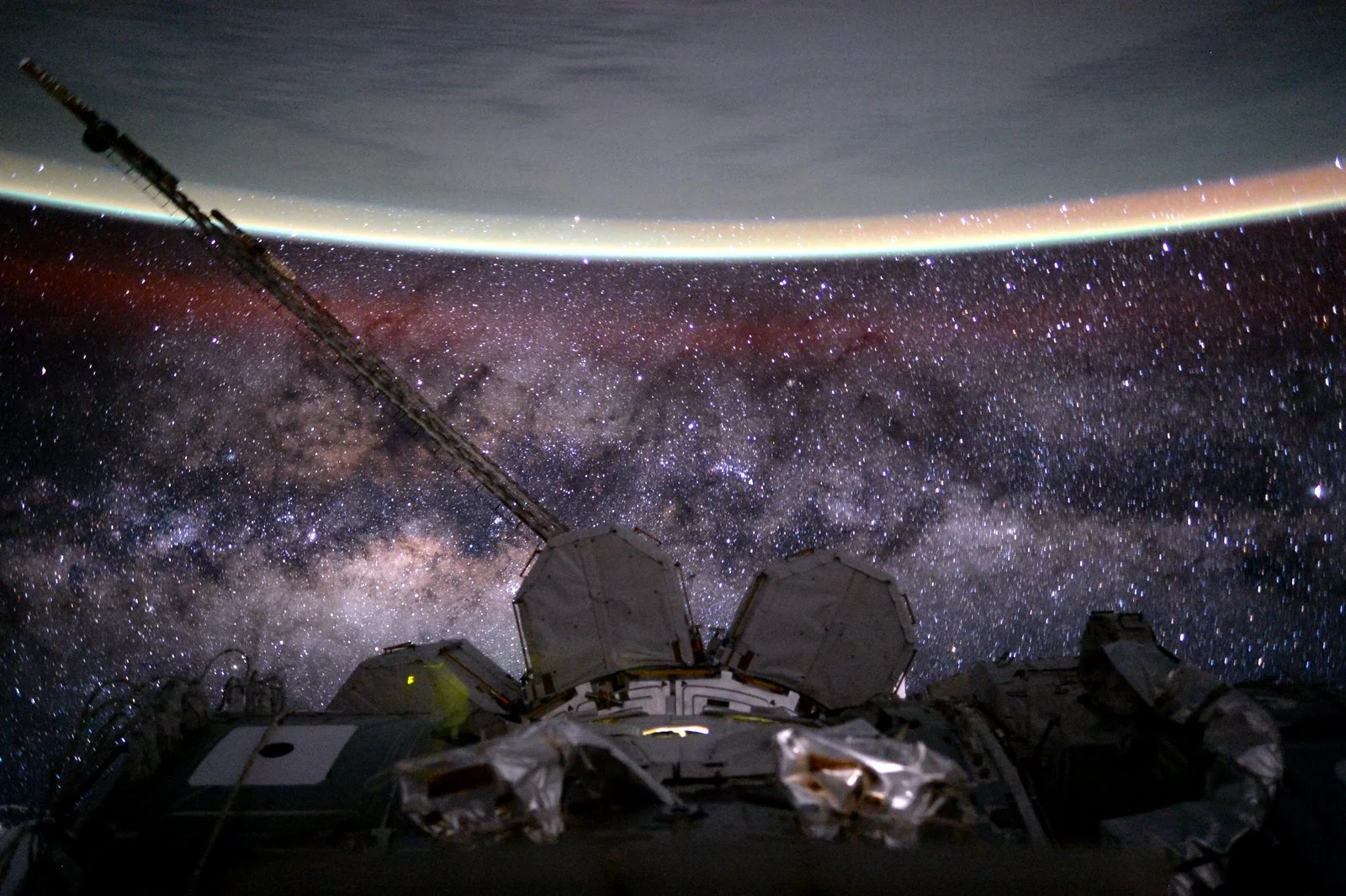
The Milky Way from the International Space Station — the same pale river of stars this lesson sends you out to see with your own two eyes. Earth's airglow limb curves above it; station hardware stands in the foreground. NASA / Scott Kelly, Expedition 44. Public domain.
Your first night under a truly dark sky.
Most scholars begin this course having never truly seen the night. City lights — light pollution, artificial light that brightens the night sky — wash the sky pale, and the stars that remain are the bright few, like lanterns glimpsed through fog. But take yourself somewhere dark, a field or a hilltop far from town lights, let your eyes settle, and the sky does something it never does at home. It deepens. Then it fills.
★ First the bright stars sharpen. Then, between them, fainter ones appear, and fainter ones behind those, until the whole dome seems dusted with light. And across the middle of it all runs the Milky Way, a pale river of uncountable stars, exactly as your ancestors saw it every clear night of their lives.
People have stood under that river and felt small in the best possible way for as long as there have been people. Tonight you join them. That feeling is where every lesson in this course begins.
❦ In your workbook: record the wonder in your own way — the deepening sky, the sharpening stars, and the Milky Way as a pale river — copy, sketch, or note what matters.
The Story
Astronomy — the scientific study of stars, planets, moons, and everything beyond Earth's atmosphere — is one of humanity's oldest fields of observation.
Long before anyone wrote the word "science," people watched the sky, because the sky was useful and because it was beautiful, and the two reasons were never really separate. The sun's rising point along the horizon told farmers when to plant. The moon's round gave the month its shape. Sailors learned the stars that never set and steered by them. Priests watched for the omens their gods were thought to send. ★ Nearly every culture that left written records also left sky records.
The Babylonians pressed their observations into clay tablets in cuneiform, tracking Venus and learning to predict eclipses centuries before the common era. You will read their writing itself in Runes; here we read what the writing was for. Egyptian priests watched for the dawn rising of Sirius, which warned that the Nile flood was coming. Stone circles like Stonehenge framed the solstice sunrises. Farmers, sailors, priests, and kings all read the same sky for different reasons, and all of them kept watching.
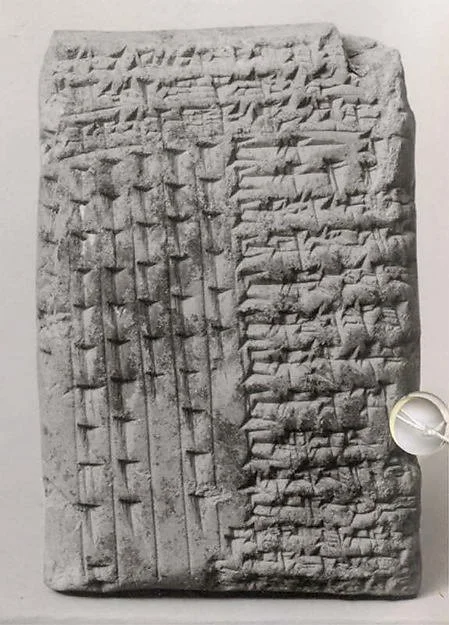
A Babylonian clay tablet covered in cuneiform, ca. 602 BCE — an account tablet from the Ebabbar archive, Sippar. Babylonian sky-watchers kept their observations on tablets of this same kind. The Metropolitan Museum of Art, 86.11.71. Public domain (CC0).
★ That is what celestial studies is: the history, the lore, and the science of the sky, studied together. It is the patient work of looking up, writing down what you see, and learning what others saw before you.
Here is what it is not. The sky does not decide your week, your loves, or your luck. Reading the future in the stars — astrology in its modern popular form — is called fortune-telling, and it is not what we do here. But the history of people believing the stars could speak is real, fascinating, and absolutely worth studying, and it has a home in this course: Unit V, The History of Astrology and the Zodiac, where we will study it the way historians study anything, as the story of a belief, never as a practice, and never as a label for any scholar. Inform, not convert. That is the rule of the whole castle, and it holds here.
Check in: In your own words: what is celestial studies, and what is it not? Where in this course does the history of fortune-telling belong, and under what rule?
The course map. Six units carry us from the first look to the finest instruments, and a capstone gathers everything you have learned:
- Unit I: The Sky as Clock and Calendar. How humans learned to read time itself from the turning sky.
- Unit II: The Moon. Our companion, studied the way we study everything here: lore first, mechanism always.
- Unit III: The Wanderers. The five bright "stars" that refused to stay put, and the centuries it took to understand them.
- Unit IV: The Fixed Stars. What stars are, what we have named them, and the deep sky beyond.
- Unit V: The History of Astrology and the Zodiac. The history of a belief, taught with honesty and kindness.
- Unit VI: Instruments of the Sky. Sundials, star wheels, astrolabes, and telescopes: the tools that extended human sight.
- Capstone: Chart Your Sky. Your planisphere, your completed Moon Journal, and your own guide to the constellations — the recognized patterns of stars treated as figures — defended in writing or in pictures.
In your packet: Exercise II — Mapping the Course ✎ begins here. Work it now, or mark the place and take it as homework — your choice.
★ The Moon Journal. Beginning tonight, you will follow the moon through one complete lunation, about 29.5 days from new moon to new moon, sketching and noting what you see. You will complete the cycle at your own pace. It never gates your progress: no lesson will ever be locked behind it. It is a thread, not a gate.
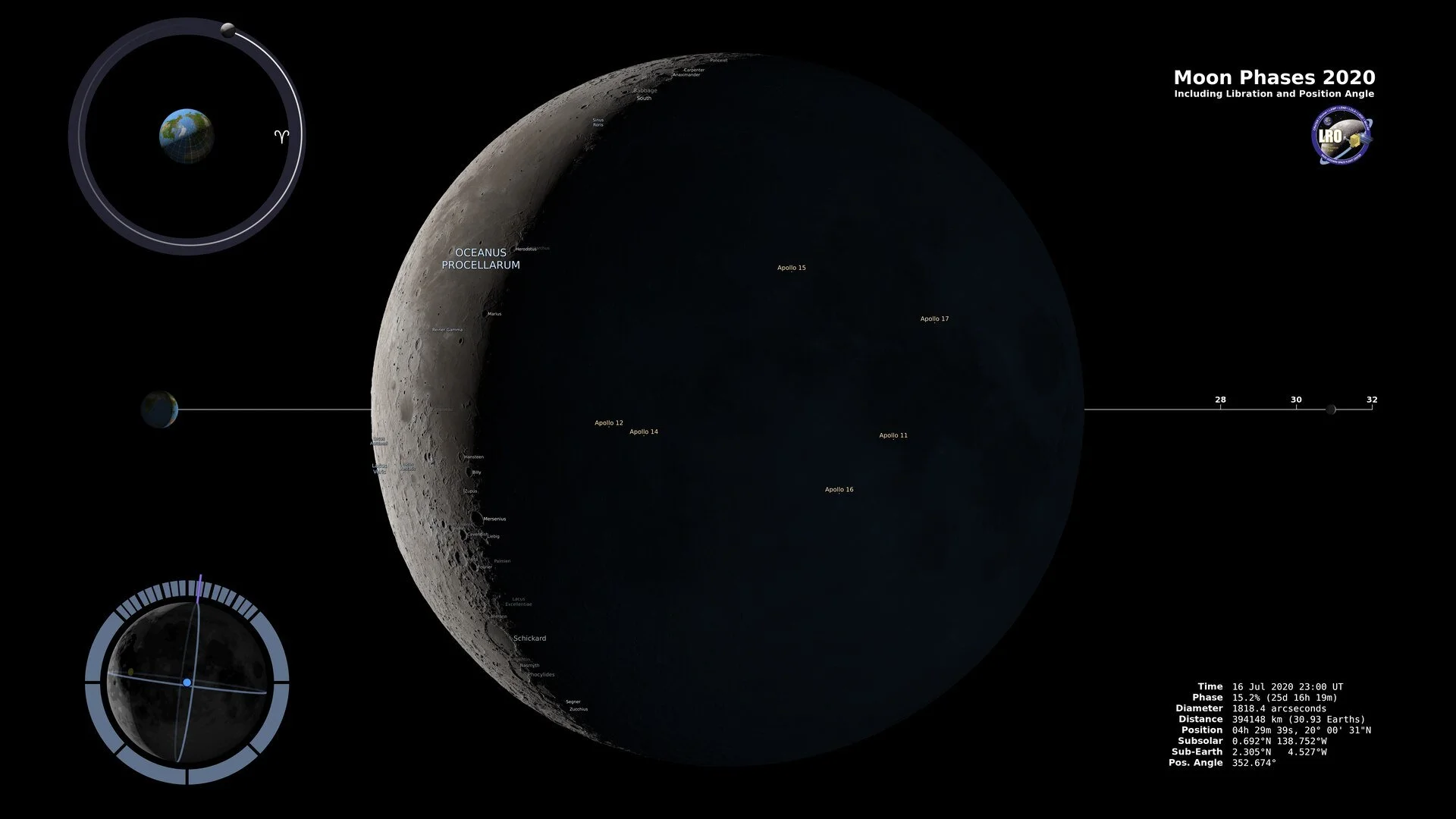
One dated frame from NASA's Moon Phases 2020: the Moon at 15.2% lit on 16 July 2020 — the kind of dated, honest record your Moon Journal keeps by hand. NASA Scientific Visualization Studio. Public domain.
In your packet: Exercise III — The Moon Journal Begins ◐ begins here. Work it now, or mark the place and take it as homework — your choice.
★ The two levels. Level One is the naked eye only. The entire course works with no equipment at all, exactly as it worked for every sky-watcher before the telescope. Level Two adds binoculars or a small telescope for scholars who have them. Both levels learn the same sky.
❦ In your workbook: record the story in your own way — the sky records of the old cultures, the course map, and the Moon Journal that is a thread, not a gate — copy, sketch, or note what matters.
The Mechanism
How looking actually works.
★ Your eyes are instruments, and like any instrument they need setting up. Step out of a lit room into darkness and at first you see almost nothing. Wait. Within minutes the world returns in shades of gray, and after twenty to thirty minutes your eyes reach their full night sensitivity. This is called dark adaptation. In bright light you see with cone cells, which need plenty of light and give you color. In darkness your rod cells take over. They cannot see color, but they are exquisitely sensitive to faint light, and they need time to rebuild a pigment called rhodopsin that bright light bleaches away. One glance at a white porch light spends that rebuilding all over again, which is why experienced observers guard their night vision jealously.
Check in: Why does one glance at a white porch light cost you so much, and how long must you wait before your eyes are fully ready again?
★ There is a second trick, and it feels like cheating until you understand it. Look directly at a faint star and it may vanish. Look slightly to one side of it and it reappears. This is averted vision. The center of your retina is packed with cones for sharp daylight seeing, while the rod-rich regions lie off to the sides. By aiming the faint light at the edges of your vision, you give it to the cells best equipped to catch it.
★ Now the question every beginner asks: which of those bright lights is a planet? Here is the honest field test. Stars twinkle. Planets, mostly, do not. Starlight arrives as a pencil-thin beam from a point, and Earth's restless air bends it this way and that, so the star seems to shiver. Planets show tiny disks, real width on the sky, so the shivering averages out across the disk and the light holds steady. The effect even has a name, scintillation, but the rule of thumb is simpler: the brightest light that holds still is very often a planet, usually Venus or Jupiter. It is not a proof, and turbulent air can make even planets flicker a little, but as a first-night guess it is a fine one.
Check in: You find two bright lights: one shivers, one holds steady. Which is very likely a planet, and why does its light behave differently?
★ Finally, the mechanism of the whole course: the written record. Memory is a generous editor; it improves every story, including the story of what you saw. A log does not improve anything. It keeps. Date, time, place, sky, sketch: the plain facts, written down the same night, become the foundation everything later is built on. The Babylonians knew this. So will you.
❦ In your workbook: record the mechanism in your own way — dark adaptation and rhodopsin, averted vision, the steady-light test, and the log that keeps — copy, sketch, or note what matters.
A Sealed Note on Why We Begin With the Naked Eye
Why start with nothing, when telescopes exist? Because every astronomer who ever lived before the telescope's invention in 1608 did all of it with eyes alone. They mapped the planets' wanderings, learned to predict eclipses, and built calendars that still work, using nothing but patient eyes and written records. The naked eye is the one instrument shared by every sky-watcher in human history, from Babylonian priests to the scholar reading this page.
Level One is not the easy version of this course. It is the foundation everything else stands on. Glass comes later, in Level Two, and when it comes you will know exactly what it is adding, because you will have learned the sky first without it.
❦ In your workbook: record the sealed note in your own way — why the naked eye comes first, and what glass adds later — copy, sketch, or note what matters.
PROFESSOR VESPER GLIMMERWICK
Celestial Studies
Astronomer & Celestial Historian
Try It Tonight
Your first observation.
- After dark, go outside with your trusted adult to your chosen spot. Bring your journal, a pencil, and a blanket.
- Sit still and let your eyes adapt. Give them at least ten minutes before you judge what you can see; twenty is better. No phone screens while you wait.
- Find the moon first, if it is up. Note its shape and where it sits in the sky.
- If the moon is absent, find the brightest point of light you can see. Watch it for a full minute. Does it twinkle, or hold steady? A steady light is very likely a planet.
- Try averted vision on the faintest star you can find. Look at it directly, then slightly away. Note the difference.
- Stay a little longer than you planned. The sky rewards patience more than any other virtue.
In your packet: Exercise I — First Light ◐ begins here. Work it now, or mark the place and take it as homework — your choice.
❦ In your workbook: record try it tonight in your own way — the six steps of your first observation, in order — copy, sketch, or note what matters.
Guided Observation: Sky Log Entry
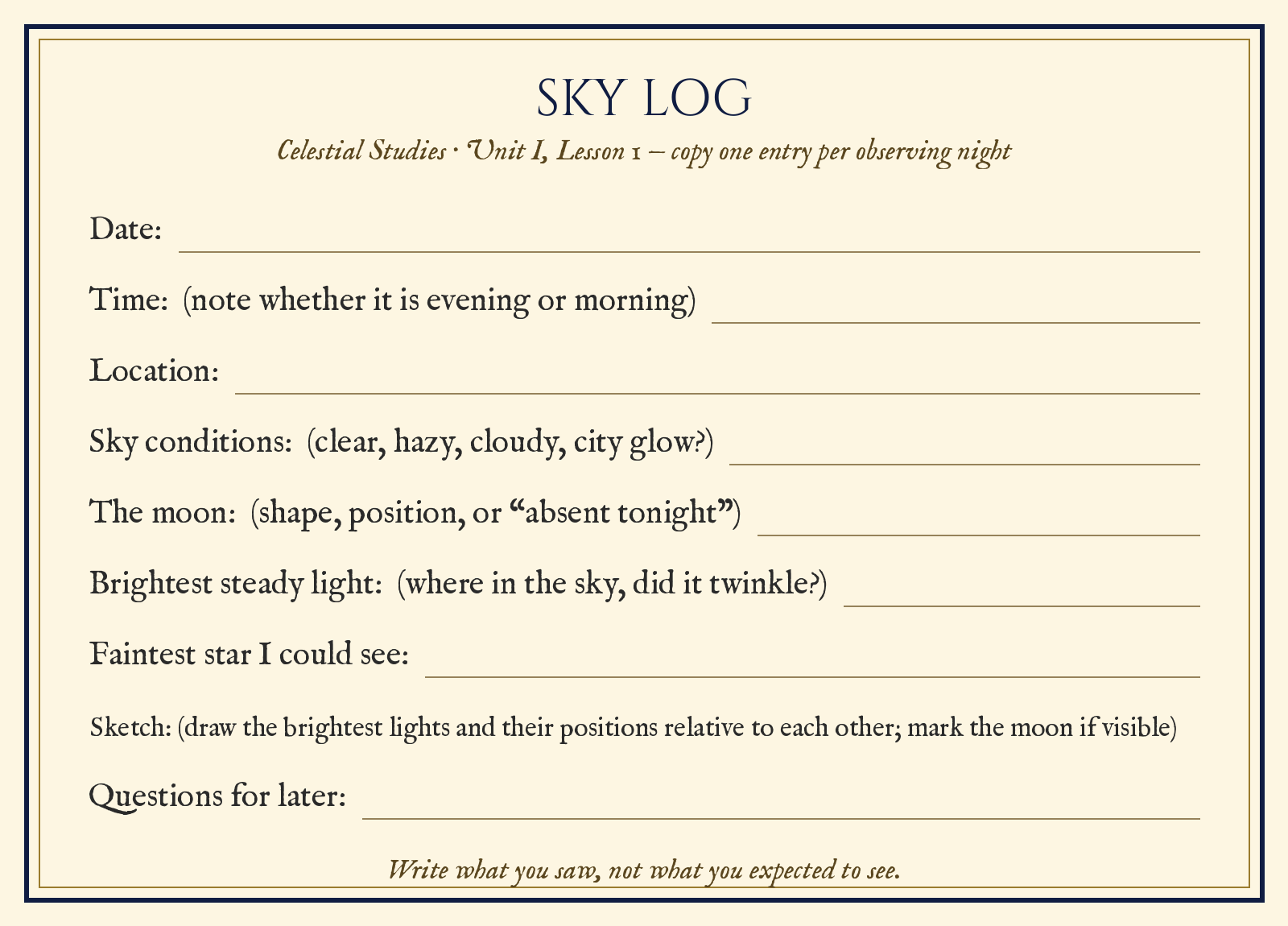
The Sky Log card, in the lesson’s own typeset plate: copy one entry per observing night, and write what you saw, not what you expected to see.
School of Evershade teaching plate.
Copy this template into your journal. Use one entry per observing night.
Date: _______________ Time: _______________ (note whether it is evening or morning) Location: _______________ Sky conditions: _______________ (clear, hazy, cloudy, city glow?) The moon: _______________ (shape, position, or "absent tonight") Brightest steady light: _______________ (where in the sky, did it twinkle?) Faintest star I could see: _______________ Sketch: (draw the brightest lights and their positions relative to each other; mark the moon if visible) Questions for later: _______________
The scholar's honesty rule: write what you saw, not what you expected to see. "Clouds covered everything" is a perfectly good entry. "I could not find the moon" is a perfectly good entry. The log is for the truth.
The entry you open here is the record Exercise I asks for, and its first dated moon entry is where Exercise III's Moon Journal begins.
Materials
Required (Level One — household items)
- A notebook or journal: any bound notebook becomes the home of your Sky Log and Moon Journal. Lined or unlined both work.
- Pencil and eraser: pencil survives night dew and cold fingers better than pen.
- Warm layers and a blanket: even summer nights cool down when you sit still. Dress for the night air.
- A watch or clock: for noting the exact time of each observation.
- A familiar outdoor spot with as little artificial light as you can manage: your yard, your porch, a known place.
Suggested (Level Two — optics)
- Binoculars or a small telescope for scholars who have them. The whole course works without them.
- A red flashlight: red light spares your night vision while you write, unlike white light.
- A simple printed star chart for the current month, to begin matching names to lights.
Reflection Questions
Answer the following questions in your workbook.
- Why does this course begin with the naked eye rather than a telescope? What changes when glass is added later, and what stays the same?
- Professor Glimmerwick says the sky does not decide your week, but the history of people believing it did is worth studying. Why study a belief you do not share?
- The Moon Journal never gates your progress through the lessons. Why do you think the course is built that way, and what does it ask of you instead?
- "Nearly every culture that left written records also left sky records." What does that suggest about the place of the sky in human life?
- Describe your first night's observation in a few sentences. What surprised you?
Workbook Checklist — Lesson 1
In my workbook I have:
- ☐ stated what celestial studies is, and what it is not, in my own words
- ☐ copied the six unit titles and the capstone, each with one sentence saying what I most want to learn from it
- ☐ opened my Moon Journal with its start date and the scholar's honesty rule copied beneath the title
- ☐ made my first naked-eye observation with a trusted adult in a familiar place, and completed one full, dated Sky Log entry, sketch included
- ☐ stated the night-observing safety rules in my own words, including the course rule: never look directly at the sun
- ☐ tested averted vision on the faintest star I could find, and noted the difference
☐ Lesson completed Date: ___ Signature: ___
The Professor's Closing Note
You have looked up on purpose for the first time, and that is no small thing. Most people never do. They live their whole lives under the sky the way fish live in water: surrounded, and incurious. You are curious now, and curiosity is the whole of it.
The Moon Journal begins tonight, but hear me clearly: it will never hold you back. Lessons will not wait for the moon, and neither should you. Observe when you can, write what you see, and let the lunation complete itself in its own time. In Lesson 2 we will learn why the whole sky seems to turn overhead, and you will meet the stars that never set. Until then, keep looking up. It is the oldest homework in the world, and still the best.
PROFESSOR VESPER GLIMMERWICK
Celestial Studies
Astronomer & Celestial Historian
Cross-Class Connections
Runes · Unit I, Lesson 1 — Cuneiform — The Structural Wedge
Tower scholars, you have learned what the Babylonians' tablets were for. Now come down to the Runes Classroom and learn to read the wedges themselves: how a shaped reed pressed into clay became the first writing, sign by sign. Your professor reads what the writing meant for the sky; in my classroom, we read the writing. Bring your patience — clay rewards it.
PROFESSOR THISTLELOOM WEBBLETHORN
Runes & Ancient Writing

Creative Arts · Unit II, Lesson 9 — Pamphlet & Single-Section Binding
Scholars of the Tower, that Moon Journal of yours deserves a cover that will outlast its first lunation. Come to the Workshop: one folded gathering, sewn once through the fold, becomes a journal — the Moon Journal, the field notebook, the practice book. Measure twice, sew once, and your journal comes home bound by your own hands.
PROFESSOR COGBRANCH TIMBERCLANK
Creative Arts Workshop
Further Reading & Sources
- NASA Science: What's Up (monthly skywatching tips): what to look for in the night sky each month, from NASA's Jet Propulsion Laboratory. Verified live 2026-10-12.
- timeanddate.com: Moon Phases 2026: the current lunation, with exact new moon, first quarter, full moon, and third quarter dates for planning Moon Journal entries. Verified live 2026-10-12.
- Wikipedia: History of astronomy: the long story this course belongs to, from Babylonian tablets to space telescopes; a starting point for curious scholars, not a textbook. Verified live 2026-10-12.
Browse the Celestial Studies shelf in the school Library for readable editions of these works.
Submit your work for this lesson using the form below.
CONTINUE IN THE CELESTIAL TOWER
Next · Lesson 2: Day, Night & the Turning Sky →
Unit I — The Sky as Clock & Calendar Celestial Tower — All 33 Lessons
The rest of Unit I: Lesson 2 · Turning Sky · Lesson 3 · Tilted Year · Lesson 4 · Ancient Observatories · Lesson 5 · Calendars of the World · Lesson 6 · The Longitude Problem
From the Celestial Shelf
The printed companions to this lesson, from Professor Glimmerwick’s shelf in the shop.
Celestial Studies — Sky Log Pages: Moon Journal Pages: One Full Lunation (18 Pages)
$4.99
View in the Shop