
CELESTIAL STUDIES
Unit I · Lesson 3The Tilted Year: Why We Have Seasons
Professor's Introduction

Ah, there you are, scholars,
Welcome back to the Celestial Tower. Tonight I begin with a confession, and I make it gladly: when I was a young bat, newly curious about the sky, I believed something about the seasons that was completely, confidently, beautifully wrong.
I believed that summer came when Earth wandered closer to the sun, the way you or I might shuffle nearer a lantern for warmth. It made such perfect sense. It was also perfectly untrue, and the sky itself told me so, the way it tells anyone patient enough to watch.
This lesson is my favorite kind: the kind where you arrive knowing something and leave knowing better. Keep your lantern picture handy. We are going to take it apart together, gently, and build something truer in its place.
PROFESSOR VESPER GLIMMERWICK
Celestial Studies
Astronomer & Celestial Historian
Where and when: your own sky, tonight — The Tilted Year: Why We Have Seasons. This lesson has no pin and no stop: its place is wherever you stand under the night sky. The line beneath the map is our road through the course: every stop a moment when watching the sky changed, every lesson a place upon it.
Lesson Objectives
By the end of this lesson, you will be able to:
- Explain why the tilt of Earth's axis, and not Earth's distance from the sun, causes the seasons.
- State when Earth reaches perihelion and aphelion, and what each word means.
- Name the two solstices and the two equinoxes, tell when each one falls, and describe what the sun is doing at each.
- Describe how the sun's path changes through the year: where it rises and sets, and how high it climbs at noon.
- Give the two working reasons tilt makes summer warm and winter cold: the directness of sunlight and the length of the day.
- Contrast the month of January in the Northern and Southern Hemispheres, and say why the difference matters.
- Track the sunset's position along the horizon for two weeks and record what you find.
Reading this lesson: ★ marks the passages to remember. They return on the unit quiz and the class test. Check in questions ask the material back as you go; answer them in your workbook when you meet them.
Working this lesson: Your assignment packet is the first download on this page. Work in it as the lesson moves along, answering each assignment as its subject is taught — or read the lesson through for your notes and take the assignments as homework afterward. Both are proper ways to sit this class. Signposts in the reading tell you where each assignment belongs. Written answers are short answers in your own words; a few honest lines are worth more than a filled page.
Your Assignment Packet
This lesson's assignments live in its packet: the Lexicon Handout (every term, course terms marked ◆), Materials, Guided Practice, the Assignment Manual with its answer key for self-checking, the Reflection Questions, and the Workbook Checklist. Download the packet before you begin and keep it beside you as you read.
Safety Briefing
Every practical in this course follows the same standing rules, and this lesson is no exception.
- All night observing is done with an adult, in a safe and familiar location. No exceptions, no improvisation.
- This lesson's practical follows the setting sun. Never stare at the sun, not even when it looks dim and orange near the horizon. Use quick glances to note which landmark the sun is sinking behind, then look away. Ordinary sunglasses are not solar protection.
- If you work at Level Two with binoculars or a camera, never point them anywhere near the sun, and never look at the sun through an optical viewfinder.
- Choose an observing spot you can reach safely in the evening, go there with your adult, and stay put for the whole session.
The Wonder
Stand in one spot and watch the sun go down. Do it in June, and do it again in December, from exactly the same place, and you will swear the sun has moved house.
In June, here in the Northern Hemisphere, the sun sets far to the north of due west, and it climbs high overhead at midday, throwing short, stubby noon shadows. In December, from that same spot, the sun sets far to the south of due west, and at midday it skulks low in the southern sky, dragging long blue shadows across the ground. The days shrink. The light turns thin and slanting.
So here is the question that started this whole lesson, thousands of years ago, in the minds of farmers and shepherds and anyone who ever watched a sunset twice: what is actually moving? Is the sun changing its road across the sky, or are we the ones shifting beneath it?
Most scholars arrive at this lesson with an answer ready. Summer, they say, is when Earth is closest to the sun. It feels like common sense, the way stepping nearer a fire feels warmer. Hold that thought. The sky is about to correct it.
Check in: From one fixed spot, how does the June sunset differ from the December sunset — and what does the midday sun do differently in each month?
❦ In your workbook: record the wonder in your own way — the June and December sunsets from one spot, and the question they raise — copy, sketch, or note what matters.
The Story
People noticed the sun's changing road long before anyone could explain it. They had to. If you farm, the sun is your calendar, and planting by the wrong week can mean an empty winter. So for thousands of years, patient watchers tracked exactly where the sun rose and set, and how high it climbed at noon, and they built the pattern into stone and story.
About four and a half thousand years ago, the builders of Stonehenge on Salisbury Plain raised great stones so that the axis of the monument frames the midsummer sunrise and the midwinter sunset. Whatever else Stonehenge was for, its stones mark the two turning points of the sun's year. In Egypt, priests and officials built a 365-day calendar out of the sun's yearly cycle, the practical year of flooding and sowing. In Greece, sky-watchers set up the gnomon, a simple upright stick, and read the seasons in its shadow: long at winter noon, short at summer noon. They could see the pattern clearly. The cause would wait another two thousand years.
Even our words remember the watching. Solstice comes from the Latin solstitium, "the sun stands still," because near each solstice the sun's rising and setting points seem to halt for a few days before creeping back the other way. Equinox comes from the Latin aequinoctium, "equal night," for the days when daylight and darkness come out roughly even.
The distance idea is old too, because it feels like sense: nearer the fire, warmer the hands. What finally broke it was careful measuring. Once astronomers could measure Earth's orbit precisely, they found something nobody's common sense had predicted: Earth is nearest the sun in early January, in the deep of the Northern winter. A theory that puts summer at the moment of greatest distance, in one hemisphere at least, is a theory in trouble.
The true explanation had to wait for a bigger correction. As long as everyone believed the sun circled a motionless Earth, the seasons were described as the sun's doing, the sun's road tipping north and south. The modern picture, a tilted Earth circling the sun, only became possible once astronomers accepted that Earth itself moves. Nicolaus Copernicus argued for the sun-centered system in 1543. A generation later, in the early 1600s, Galileo Galilei and Johannes Kepler worked out the motions of the planets, and the tilted, traveling Earth finally made sense of everything the stone circles and shadow sticks had recorded.
So the story of this lesson is really two stories: the long watching, and the late understanding. The watchers did their part beautifully. Tonight, you get the understanding.
Check in: What did the ancient watchers measure beautifully for thousands of years — and what single measured fact finally broke the distance idea?
❦ In your workbook: record the story in your own way — the stone circles and shadow sticks, the two word-histories, and the January measurement that broke the old idea — copy, sketch, or note what matters.
The Mechanism
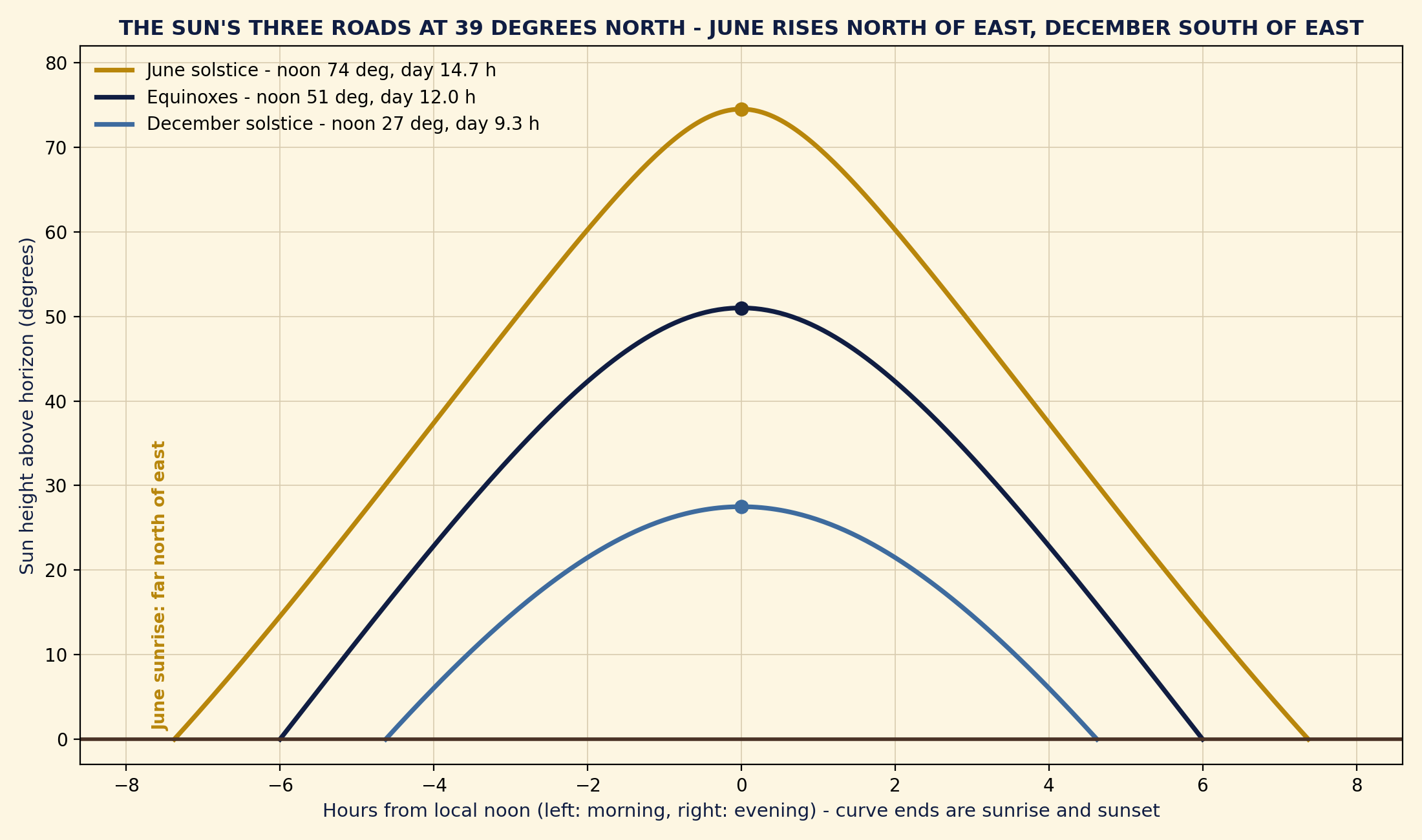
The sun's three roads at Lawrence's latitude (about 39 degrees north): high and long in June, low and short in December, midway at the equinoxes. Built chart from the lesson's own numbers.
Built for the School of Evershade (programmatic plate, matplotlib). No external license.
The orbit is nearly a circle
Begin with the fact that ends the lantern theory. Earth's path around the sun is very nearly circular. Once a year, in early January, Earth reaches perihelion, its closest approach to the sun, about 147 million kilometers away. Half a year later, in early July, it reaches aphelion, its farthest point, about 152 million kilometers away. The difference is only about 3 percent, which changes the strength of sunlight reaching us by roughly 7 percent.
★ Now apply the lantern theory and watch it fail. If distance made the seasons, January, the month of closest approach, should be the warmest month everywhere on Earth. It is not. January is the depth of winter in the Northern Hemisphere, and the height of summer in the Southern Hemisphere. No distance theory can explain opposite seasons happening at the same moment. One fact, honestly faced, and the lantern theory falls.
Check in: Earth is nearest the sun in early January — so why can distance not be what makes the seasons?
❦ In your workbook: record the orbit in your own way — perihelion, aphelion, the 3 percent difference, and the January fact that ends the lantern theory — copy, sketch, or note what matters.
The tilt
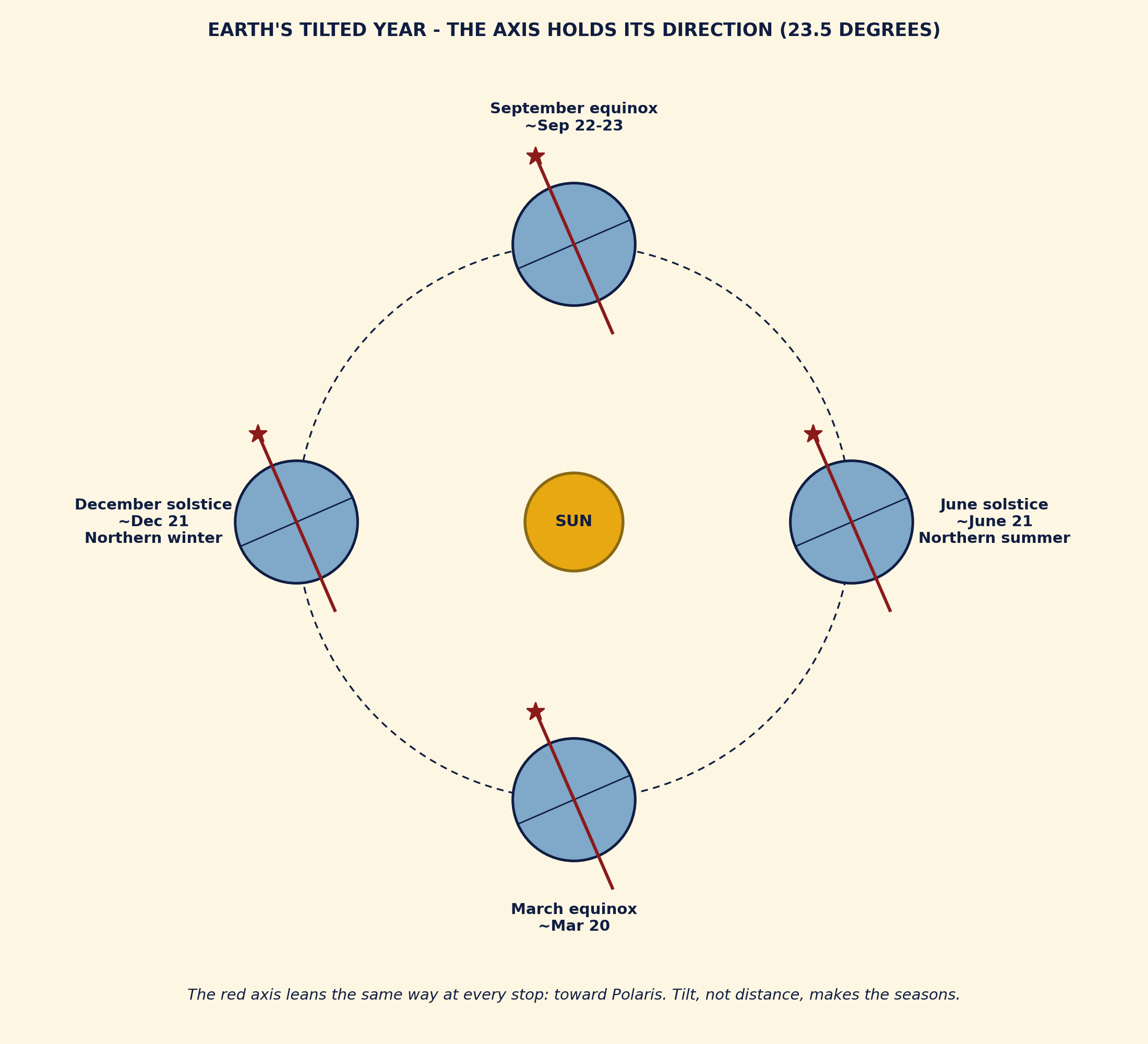
Earth's tilted year: the axis holds its 23.5-degree lean toward Polaris at all four stopping points, so each hemisphere takes its turn leaning toward the sun. Built diagram — draw yours the same way for Assignment III.
Built for the School of Evershade (programmatic plate, matplotlib). No external license.
★ What makes the seasons is the tilt of Earth's axis: about 23.5 degrees from the upright, as measured against the plane of Earth's orbit. And here is the detail that does all the work: as Earth travels around the sun, its axis keeps pointing in the same direction in space, toward the North Star, Polaris. The tilt does not swing around to face the sun. It leans, steadily, like a spinning top that refuses to straighten, while the planet carries it around its yearly circuit.
Picture it as a walk around a lamp in a dark room. Hold a small globe tilted, its top leaning a little to one side, and walk slowly around the lamp without ever changing the direction of the lean.
At one point in your walk, the Northern Hemisphere leans toward the lamp. The sun's light strikes it more directly, and its days are long. That is the June solstice, around June 21, the start of northern summer. Half a lap later, the lean points the other way: the Northern Hemisphere leans away from the lamp, the light strikes it at a slant, and the days are short. That is the December solstice, around December 21, the start of northern winter. At the two quarter points of the walk, the lean points neither toward nor away from the lamp but sideways, and neither hemisphere gets favored. Those are the equinoxes: the March equinox, around March 20, and the September equinox, around September 22 or 23.
Check in: As Earth travels around the sun, what does its axis keep doing — and why does that one steady detail produce opposite seasons half a year apart?
❦ In your workbook: record the tilt in your own way — the 23.5 degrees, the axis holding its direction toward Polaris, and the walk around the lamp at all four stopping points — copy, sketch, or note what matters.
In your packet: Assignment III. The Two Warmths ✎ begins here. Work it now, or mark the place and take it as homework — your choice.
Why tilt means warm and cold: the two reasons
Tilt makes summer warm and winter cold through two effects working together. Learn them both, because the lesson is not complete with only one.
★ First, the directness of the sunlight. When the sun stands high in the sky, its rays strike the ground nearly straight on, and a given patch of sunlight lands on a small patch of ground: concentrated energy, strong heating. When the sun hangs low, the same patch of sunlight arrives at a slant and smears itself across a larger stretch of ground: spread-thin energy, weak heating. High summer sun pours; low winter sun drizzles.
★ Second, the length of the day. A high summer sun also stays up longer, giving the ground more hours of heating and fewer hours of nighttime cooling. A low winter sun rises late, sets early, and surrenders the long night to cooling. More hours of strong sun versus fewer hours of weak sun: that is summer and winter, and both halves matter.
Check in: A scholar explains summer with only one of the two reasons. Which two halves must a complete explanation carry — and what does each half do?
❦ In your workbook: record the two warmths in your own way — directness and day length, pouring versus drizzling, hours of heating versus hours of cooling — copy, sketch, or note what matters.
The sun's changing road
Now you can read the sky the way the ancient watchers did, and know the reason behind every line.
Through spring, the sun's rising and setting points slide northward along the horizon, day by day, and the noon sun climbs higher each week. The slide halts at the June solstice: solstice, the sun standing still. For a few days the turning points barely move. Then the sun begins sliding southward again, through the shortening days of late summer and autumn, until it halts at the December solstice and turns back north. At the two equinoxes, midway between the halts, the sun rises due east and sets due west, and day and night come out roughly equal all over the world. Roughly, not exactly: our atmosphere bends sunlight a little, gifting every place on Earth a few extra minutes of daylight, so the truly equal day is a gentle fiction. The pattern is real all the same.
You can put numbers on the noon sun's climb. The rule is simple: at noon on an equinox, the sun stands 90 degrees minus your latitude above the southern horizon (for Northern Hemisphere watchers). Here in Lawrence, Kansas, at about 39 degrees north latitude, that is 90 minus 39, or 51 degrees. At the June solstice, add the tilt: 51 plus 23.5, about 74 degrees, high and blazing. At the December solstice, subtract it: 51 minus 23.5, about 27 degrees, low and slanting. Three numbers, one subtraction, and you can feel the whole year in them.
Check in: At about 39 degrees north, what are the noon sun's three numbers — equinox, June solstice, December solstice — and what single rule produces all three?
❦ In your workbook: record the sun's changing road in your own way — the northward slide, the two halts, the due-east equinox risings, and the three noon numbers for 39 degrees north — copy, sketch, or note what matters.
In your packet: Assignment II. Two Weeks of Sunsets ◐ begins here. Work it now, or mark the place and take it as homework — your choice.
The lines the tilt draws on the map
The tilt draws four famous lines on Earth's map, and now you know why each one sits where it does.
The Tropic of Cancer, at 23.5 degrees north latitude, marks the farthest north the sun can stand directly overhead at noon, which happens on the June solstice. The Tropic of Capricorn, at 23.5 degrees south, is its southern twin, where the sun stands overhead at noon on the December solstice. Between the tropics lies the only belt of Earth where the sun can ever be directly overhead.
The Arctic Circle, at 66.5 degrees north (90 minus 23.5), marks where the tilt's extremes become drama: inside it, there is at least one summer day when the sun never sets, the midnight sun, and at least one winter day when it never rises, the polar night. The Antarctic Circle, at 66.5 degrees south, mirrors it for the other end of the Earth.
Check in: Why do the tropics sit at 23.5 degrees and the polar circles at 66.5 degrees — what single number writes both?
❦ In your workbook: record the lines on the map in your own way — the two tropics, the two circles, and why each number is the tilt in disguise — copy, sketch, or note what matters.
The other hemisphere, and the equator's shrug
★ Everything above describes the Northern Hemisphere. The Southern Hemisphere lives the mirror image: when the north leans toward the sun, the south leans away. So December brings summer to Sydney and winter to Lawrence. June brings winter to Sydney and summer to Lawrence. And January, the month of perihelion, of Earth's closest approach to the sun: summer in the Southern Hemisphere, winter in the Northern. The lantern theory cannot survive that sentence. The tilt explains it without a wrinkle.
Near the equator, the tilt barely changes the sun's height or the day's length, so the tropics shrug at our four seasons and keep their own: wet season and dry season, set by winds and rains rather than by the sun's road. The tilt rules the temperate lands. The whole Earth, as always, is more various than any single rule.
Check in: In January, what season is Sydney living while Lawrence is in winter — and why does that one pairing settle the argument?
❦ In your workbook: record the other hemisphere in your own way — the mirror-image seasons, the January pairing, and the equator's wet-and-dry shrug — copy, sketch, or note what matters.
In your packet: Assignment IV. January in Two Hemispheres ✎ begins here. Work it now, or mark the place and take it as homework — your choice.
A Sealed Note on the January Surprise
I want you to sit with one fact until it shines, the way I did on a cold January evening in the tower, watching my breath fog the glass.
In early January, Earth is closer to the sun than at any other time of the year. Closer. In January. While half the world is scraping ice off its windows.
If summer meant nearness, January would be a furnace in Kansas. Instead it is the coldest month, and meanwhile, in the Southern Hemisphere, where it is summer, Earth is at its nearest too, which ought to make their summer fiercer than ours. It does not, not in any way that matters. The tilt swamps the distance entirely.
So here is my January surprise, gift-wrapped: the single most useful fact in this whole lesson is also the strangest. Nearest in January. Coldest in January, north of the equator. Any theory of the seasons has to survive that sentence, and only the tilt does.
❦ In your workbook: record the January surprise in your own way — nearest in January, coldest in January north of the equator, and the one theory that survives the sentence — copy, sketch, or note what matters.
PROFESSOR VESPER GLIMMERWICK
Celestial Studies
Astronomer & Celestial Historian
Guided Observation: The Two-Week Sunset Watch
You are going to do what the ancient watchers did, with better note-taking.
Level One: the two-week sunset watch. Choose one observing spot with a clear view of the western horizon: a porch, a yard, a park bench, a window you can return to. Go there with your adult. As the sun sets, use quick glances only, and note exactly which landmark the sun sinks behind: the chimney three houses down, the big oak, the fence post at the field's edge. Write down the date, the sunset time, and the landmark. Do this at least four times over two weeks. Then answer the only question that matters: is the sunset point drifting north or south along the horizon? From that drift, predict which turning point is coming next: solstice or equinox, and which one.
Level Two: measure the drift. Mark your exact standing spot with chalk or a stone, so every observation is made from the same place. Photograph each sunset from that spot, keeping the same landmarks in the frame, and compare the pictures side by side. If you have a compass, note the sun's azimuth, its compass bearing, at the moment it touches the horizon, and watch the number change. Optional extension for the ambitious: at local noon, stand a straight stick upright and measure its shadow once a week. The shadow's length is the sun's height, translated.
Whichever level you choose, remember the safety briefing: quick glances at the sunset, never a stare, and your adult beside you.
Copy this into your sky log and fill it in after each sunset session.
- Date and time:
- Observing spot:
- Landmark where the sun touched the horizon:
- Drift since last session (north, south, or holding still):
- Sketch: draw the horizon line, mark your landmarks, and dot where the sun went down.
- One-line reflection: "The sunset is drifting ___, which means we are heading toward the ___."
Check in: Your four sessions show the sunset point drifting south, week on week. Which turning point are you heading toward, and how do you know?
❦ In your workbook: record the sunset watch in your own way — your fixed spot, your landmarks, the drift you found, and the turning point you predicted — copy, sketch, or note what matters.
In your packet: Assignment II. Two Weeks of Sunsets ◐ begins here. Work it now, or mark the place and take it as homework — your choice.
Materials
Required (Level One — household items)
- A notebook or printed Sky Log pages, and a pencil: for the two-week sunset watch.
- A western-facing observing spot with clear landmarks: a porch, yard, park bench, or window you can return to with your adult.
- An adult observing partner: the standing rule for all night and evening observing in this course.
Suggested (Level Two — historically closer)
- A compass (a phone compass works) for measuring the sun's azimuth at the moment it touches the horizon.
- A camera or phone for photographing each sunset from a marked standing spot, so the drift can be compared side by side.
- A straight stick and a tape measure for the optional noon-shadow extension: the shadow's length is the sun's height, translated.
Materials restored from the original packet script (`build_celestial_u1l3.py`, MATERIALS_L1 / MATERIALS_L2), read as text only; the -final.md carries no Materials section of its own.
Reflection Questions
Answer the following questions in your workbook.
- The lantern picture, shuffling nearer a fire for warmth, makes the distance theory feel like common sense. What single fact from this lesson breaks it beyond repair, and why is that fact so decisive?
- Imagine you are an ancient farmer with no instruments but a fence post, a clear horizon, and patience. What could you learn about the sun in a year of watching? What could you never learn from watching alone, no matter how patient you were?
- The Tropic of Cancer sits at 23.5 degrees north and the Arctic Circle at 66.5 degrees north. Neither number is a coincidence. Explain what each one has to do with the tilt.
- A friend says, "Summer happens when Earth is closest to the sun." Correct them the way Professor Glimmerwick would: kindly, completely, and with no mercy for the misconception. Which facts do you reach for first?
- Which part of the sun's yearly road would you most want to watch from the Celestial Tower: the halt of a solstice, the balance of an equinox, or the long slide between? What would you hope to notice that this lesson taught you to look for?
Workbook Checklist — Lesson 3
In my workbook I have:
- ☐ stated the safety rules in my own words, including: never stare at the sun, not even near the horizon, and ordinary sunglasses are not solar protection
- ☐ explained, in my own words, why the tilt — not Earth's distance from the sun — causes the seasons
- ☐ recorded perihelion (early January, about 147 million kilometers) and aphelion (early July, about 152 million kilometers), and why the January date breaks the distance theory
- ☐ named the two solstices and the two equinoxes with their dates, and what the sun is doing at each
- ☐ stated both working reasons tilt makes summer warm: the directness of sunlight and the length of the day
- ☐ completed at least four sunset sessions over two weeks from one fixed spot, with date, time, and landmark for each, my drift finding, and my turning-point prediction
- ☐ drawn Earth at the four positions with the axis tilted 23.5 degrees and holding its direction, and written the two-warmths paragraph using the 74, 51, and 27 degree numbers
- ☐ written the January letter: perihelion, January, and the opposite seasons of the two hemispheres, ending with the conclusion the evidence forces
☐ Lesson completed Date: ___ Signature: ___
The Professor's Closing Note
Well, scholar. You arrived with a lantern theory, and you are leaving with a tilted planet. That is a fair trade, and I hope you feel the difference the next time someone says summer is about closeness.
The sky rewards the patient. The sun will keep its appointments, solstice after solstice, whether or not anyone is watching. But it is so much better with a watcher: a bat in a tower, a scholar on a porch, a fence post and a notebook and two weeks of evenings.
Keep watching. The moon is waiting in Lesson 7, and it has its own beautiful geometry to show you. But that is another night's story.
PROFESSOR VESPER GLIMMERWICK
Celestial Studies
Astronomer & Celestial Historian
Cross-Class Connections

Runes · Unit I, Lesson 1 — The Structural Wedge
Come closer, scholars, and mind the clay. The Babylonian sky-watchers who first measured the year's length pressed their records into cuneiform tablets — wedges in wet clay, the writing this lesson teaches from its very first wedge. Glimmerwick's tower reads the sky behind those tablets; this classroom reads the tablets themselves. Bring your patience for small marks: the year's length was kept in them.

Scrollwork · Unit V, Lesson 18 — Gold Leaf & Gilding
Mind the gold, scholars. Medieval makers drew the sun's yearly road into illuminated manuscripts, ringed in gold leaf — and gold is this lesson's craft: laid so thin a breath can lift it, and bright five hundred years later. The Tower teaches why the road runs where it does; the Library teaches the hand that ringed it in gold. Come and lay it true.

Herbology · Unit II, Lesson 15 — Seasonal Growing Cycles
Gently does it, scholars. Every planting calendar in my greenhouse runs on the tilt you have just learned — the garden keeps the sun's schedule, whether the gardener knows it or not. Come to the Greenhouse and read the calendars the tilt writes: how long a plant lives, how it sleeps through winter, and how a whole year of growing is planned around solstice, equinox, and frost. You have learned why the year turns; here you learn to grow by it. — Professor Beryl Fernfoot, Herbology Greenhouse • Master Herbalist • Head of House Oriens

Creative Arts · Studio Extension E2 — The Permanent Sundial & Horizon Alignment
Set up square, scholars, and mind the level. In the Tower you learned the sun's road; at my bench that road becomes a clock — a permanent sundial, aligned to its horizon, that tells the hours by the shadow this lesson taught you to read. Build it true and set it honest, and the shadow will keep the appointments the sun has never missed.
Celestial Studies forward note (no invitation — this class's own road): In Unit VI you will build a working sundial with Professor Timberclank, turning this lesson's sun-path into a clock you can hold. The shadow already knows everything you learned tonight. (Named from the -final.md's own Creative Arts line; Celestial Studies has no live lesson slugs yet, so this class's own Lesson 29 is named without a link.)
Further Reading & Sources
- NASA Space Place, "What Causes the Seasons?": a clear, student-friendly explanation of tilt versus distance: https://spaceplace.nasa.gov/seasons/en/
- timeanddate.com, "Perihelion, Aphelion and the Solstices": the dates and distances of Earth's closest and farthest approaches to the sun: https://www.timeanddate.com/astronomy/perihelion-aphelion-solstice.html
- Merriam-Webster, "solstice": word history: from Latin solstitium, from sol (sun) + -stitium (a standing still): https://www.merriam-webster.com/dictionary/solstice
- Merriam-Webster, "equinox": word history: from Latin aequinoctium, from aequi- (equal) + nox (night): https://www.merriam-webster.com/dictionary/equinox
- English Heritage, "What is the Winter Solstice?": how Stonehenge's stones frame the midsummer sunrise and the midwinter sunset: http://www.english-heritage.org.uk/visit/places/stonehenge/things-to-do/solstice/what-is-the-winter-solstice/
Browse the Celestial Studies shelf in the school Library for readable editions of these works.
Submit your work for this lesson using the form below.
CONTINUE IN THE CELESTIAL TOWER
← Previous · Lesson 2: Day, Night & the Turning Sky Next · Lesson 4: Ancient Observatories →
Unit I — The Sky as Clock & Calendar Celestial Tower — All 33 Lessons
The rest of Unit I: Lesson 1 · Celestial Tower · Lesson 2 · Turning Sky · Lesson 4 · Ancient Observatories · Lesson 5 · Calendars of the World · Lesson 6 · The Longitude Problem