

CELESTIAL STUDIES
Unit I · Lesson 2Day, Night & the Turning Sky
Professor Vesper Glimmerwick
Astronomer & Celestial Historian
The Celestial Tower • School of Evershade
Professor's Introduction

Evening, stargazers, and welcome back to the Celestial Tower. I am Professor Vesper Glimmerwick, and I keep the observatory here, which mostly means I dust the star charts, argue gently with the telescope, and watch the sky do what it has always done.
In our last lesson you began your Moon Journal, the slow portrait of one whole lunation that will travel with you through this entire course. Tonight we widen the frame. Forget the moon for one evening. Find the Big Dipper instead, fix its place in your memory, and then come back in one hour and look again. It will have moved. Everything up there is moving, all night, every night, wheeling around one still point like dancers around a maypole. That wheel is the subject of this lesson, and it is the oldest clock ever built. It needs no winding, it has never stopped, and every calendar your ancestors ever kept was read from its face.
I do my best thinking at dusk, when the first stars come out and the whole sky seems to take a breath before the turning begins. Come and watch it with me.
PROFESSOR VESPER GLIMMERWICK
Celestial Studies
Astronomer & Celestial Historian
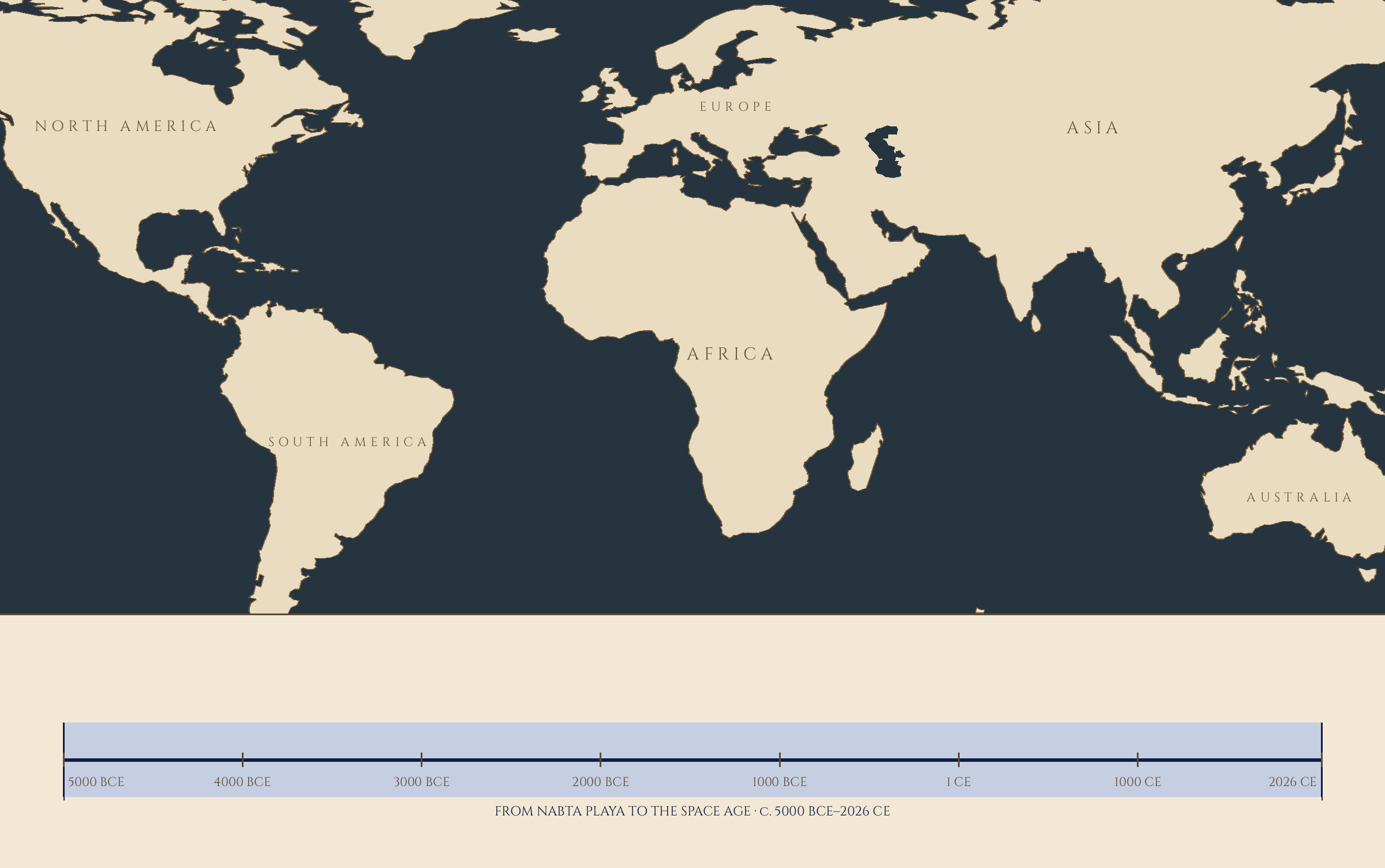
Where and when: your own sky, tonight — Day, Night & the Turning Sky. This lesson has no pin and no stop: its place is wherever you stand under the night sky. The line beneath the map is our road through the course: every stop a moment when watching the sky changed, every lesson a place upon it.
Lesson Objectives
By the end of this lesson, you will be able to:
- Explain that Earth's rotation, not the motion of the stars, causes the apparent nightly wheeling of the sky.
- Define circumpolar stars and the celestial pole, and describe how the two are related.
- Find Polaris using the Big Dipper's pointer stars, and explain why Polaris appears nearly fixed while other stars wheel around it.
- Sketch the Big Dipper's position on two different dates at the same clock time, and explain why keeping the same clock time matters.
- Describe how an observer's latitude determines which stars are circumpolar.
Reading this lesson: ★ marks the passages to remember. They return on the unit quiz and the class test. Check in questions ask the material back as you go; answer them in your workbook when you meet them.
Working this lesson: Your assignment packet is the first download on this page. Work in it as the lesson moves along, answering each exercise as its subject is taught — or read the lesson through for your notes and take the exercises as homework afterward. Both are proper ways to sit this class. Signposts in the reading tell you where each exercise belongs. Written answers are short answers in your own words; a few honest lines are worth more than a filled page.
Your Assignment Packet
This lesson's exercises live in its packet: the Lexicon Handout (every term, course terms marked ◆), Materials, Guided Practice, the Assignment Manual with its answer key for self-checking, the Reflection Questions, and the Workbook Checklist. Download the packet before you begin and keep it beside you as you read.
Safety Briefing
Every Celestial Studies lesson that sends you outside after dark carries the same standing rules. Learn them now; they do not change.
- Always observe with an adult. Night skywatching is never a solo activity at this school. Bring a parent, guardian, or another trusted adult, and stay where they can see you.
- Stay in safe, familiar locations. Your own yard, porch, balcony, or a well-known park you visit in daylight. Do not wander into unfamiliar ground in the dark, and do not go near roads, water, or steep drops after sunset.
- Tell someone your plan. Where you will be, and when you expect to be back inside.
- Dress for the night air. Even summer evenings cool down when you stand still and look up. Bring a layer, and something to sit on if the ground is damp.
- Light the way gently. A dim flashlight is fine for finding your seat and your notebook. Shield it or cover it with red cellophane if you can; bright white light ruins everyone's night vision for twenty minutes. Never shine lights toward roads or neighbors' windows.
- Keep your phone charged and with you. You will need it for the time, and for calling your adult if anything feels wrong.
- The standing sun rule, restated: never look directly at the sun, with or without instruments. This lesson happens at night, but the rule has no exceptions and no evenings off.
If the weather turns, or the sky clouds over, or your adult says it is time to come in, the sky will keep. It has kept for four billion years. It can wait one more night.
The Wonder
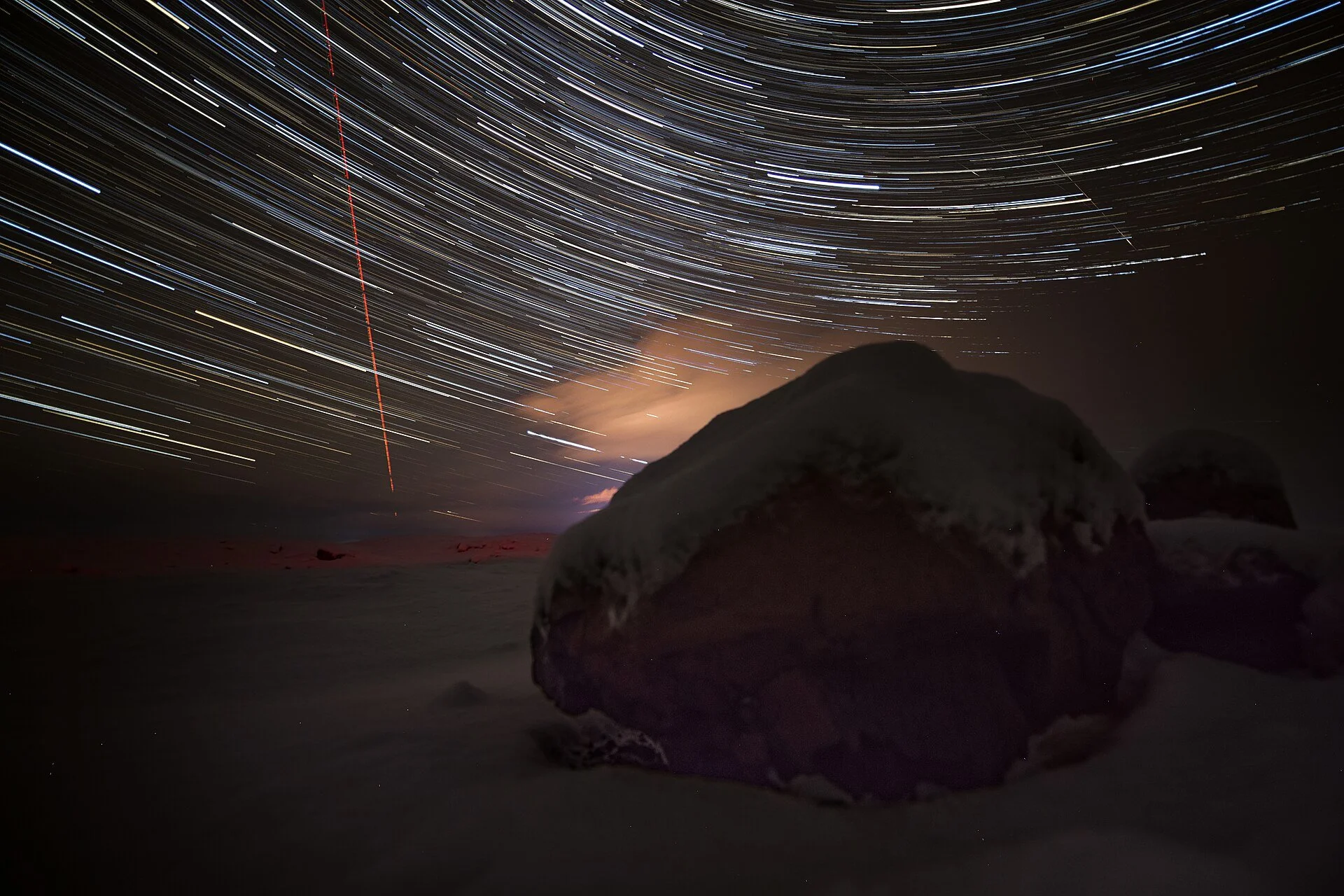
Fifty-four minutes of the turning sky over Thule Air Base, Greenland: 216 exposures combined. Every arc is one star's apparent path; all of them wheel around the one still point, the north celestial pole, just above the frame. The straight red line is an aircraft — the only thing in the picture that is not turning with the wheel.
U.S. Air Force photo, Thule Air Base (DVIDS image 4030153), via Wikimedia Commons. Public domain.
Step outside tonight, not long after dark, and face north. Find the seven bright stars shaped like a great ladle: four for the bowl, three for the handle. That is the Big Dipper, an asterism — a recognizable pattern of stars that is not itself a constellation. Fix its position in your mind against the rooftops and trees. Note which way the bowl tips, how high the handle rides.
Now go inside, have some cocoa, read a chapter of something, and come back in two hours. Face north again.
The Dipper has moved. It has swung visibly around the sky, tipped at a new angle, standing in a different place above the same rooftops. Nothing up there collided, nothing fell. The whole pattern simply turned, as if the sky were a great wheel with one still hub.
★ That hub is real, and you can find it. Draw a line through the two stars on the outer edge of the Dipper's bowl, the side farthest from the handle, and extend it about five times the distance between them. You will land on a modest, steady star. That is Polaris, the North Star. While the Dipper and every other pattern wheel around the sky through the night, Polaris barely moves at all. It is the still point, and everything else turns around it.
Here is the wonder that kept our ancestors outside on cold nights for ten thousand years: the turning never hurries and never rests, and it is perfectly regular. Once people noticed the regularity, they owned the first clock that could not be broken, the first calendar that could not be lost. The turning sky is why we have hours, weeks, months, and years. This lesson is about the turning itself: what it is, why it happens, and how to read it.
Check in: Which two stars do you draw the line through to find Polaris, and about how far do you extend the line beyond them?
❦ In your workbook: record the wonder in your own way — the Dipper found against your own rooftops, gone inside, and found moved — copy, sketch, or note what matters.
The Story
Long before anyone knew what a star was, people watched the wheel and learned its manners. The story of this lesson is the story of humans mapping the turning, and it begins with the stars that refuse to set.
The stars that never die
In the Nile valley, more than four thousand years ago, Egyptian priests and pyramid builders divided the night sky into two kinds of stars. Most stars rose in the east and sank in the west, living and dying each night like everything else. But a circle of stars around the northern sky never touched the horizon — the line where earth and sky appear to meet — at all. They wheeled endlessly above the desert, sleepless and undying.
The Pyramid Texts, among the oldest religious writings in the world, call these the Imperishable Stars, "those who do not know destruction." The texts promise the dead pharaoh a place among them: to join the stars that never set was to escape death itself. The Egyptians had noticed the turning sky and sorted it by the deepest question they owned. What never sets, never dies.
Egyptian priests also watched the sky the way a clerk watches a ledger. Painted star tables on Middle Kingdom coffin lids list the stars, called decans, that rose in the east through the weeks of the year. Some researchers think these tables worked as star clocks: note which decan is rising, and you know how much of the night has passed. Whether or not every table was used that way, the instinct is unmistakable. The turning sky was the night shift's timepiece.
The handle that told the season
Far to the east, early Chinese skywatchers found a different use for the same wheel. They watched the Big Dipper, which they called the Northern Dipper, and they read the year in the direction of its handle. Early Chinese writings describe the rule plainly: when the handle points east at nightfall, it is spring throughout the land; when it points south, summer; when it points west, autumn; when it points north, winter.
Think about what that means. The same pattern you sketch in this lesson's practical was, for ancient China, a calendar page the size of the sky. The Dipper's nightly wheeling made it a clock; its slow yearly wheeling made it a calendar. One pattern, two kinds of time. You will do exactly this reading yourself in the Try It Tonight exercise, with your own two sketches.
Steering by the hub
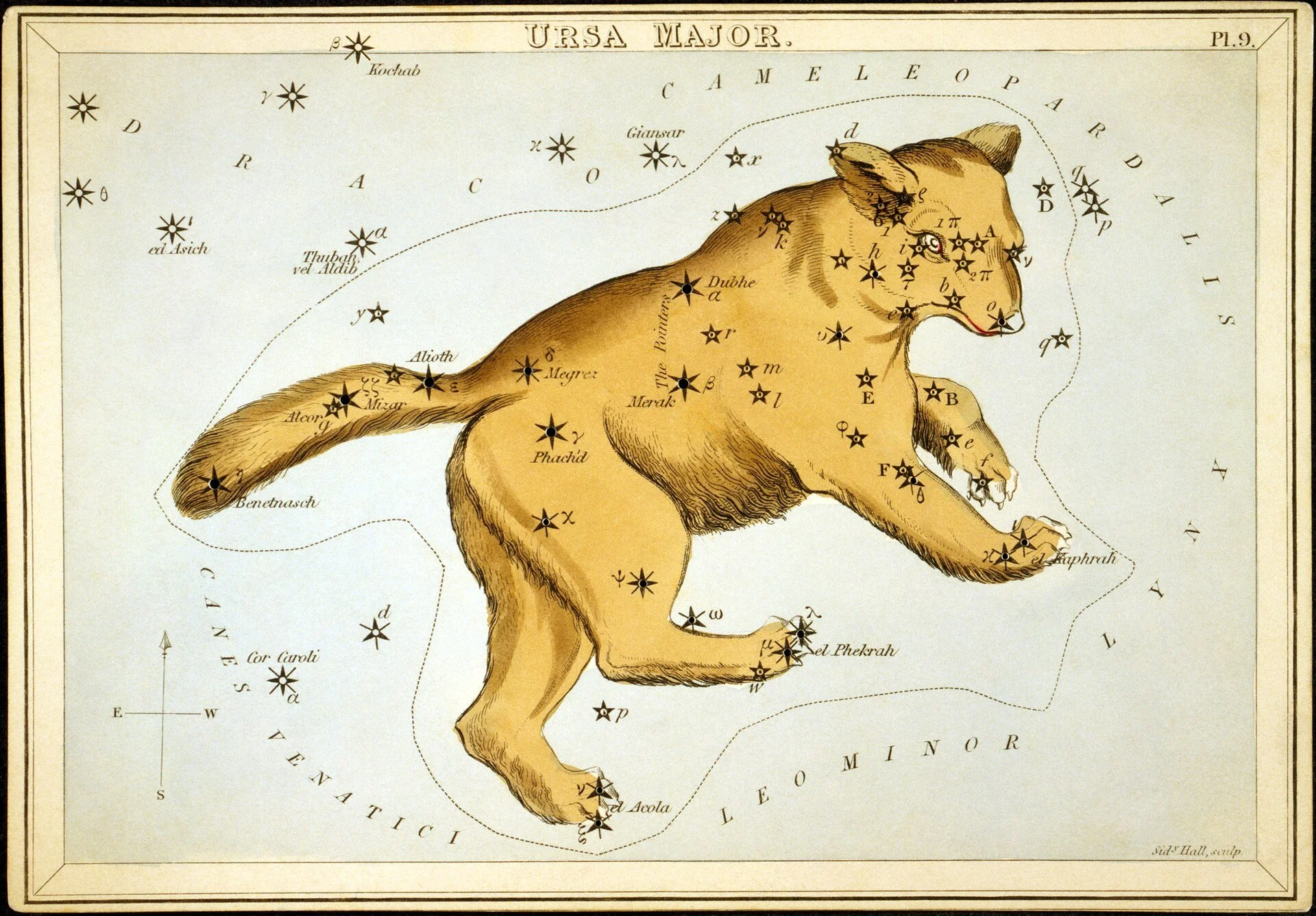
Ursa Major, plate 9 of Urania's Mirror (1825), engraved by Sidney Hall: the Great Bear with "The Pointers" lettered between Dubhe and Merak — and, at upper left in Draco, Thuban, the star that held the pole when the pyramids were rising.
Sidney Hall, Urania's Mirror (London, 1825), plate 9, via the Library of Congress, Prints and Photographs Division, digital ID cph.3g10058. Public domain.
Greek sailors learned the wheel as a compass. The Great Bear, our Ursa Major, circles wide around the pole, but the Little Bear circles much tighter, hugging the hub. Later Greek writers credited the philosopher Thales, around 600 BCE, with advising sailors to steer by the Little Bear rather than the Great Bear, precisely because it stays nearer the still point. Whether Thales himself gave the advice or the story grew around his name, the reasoning is sound and it is the reasoning of this lesson: the closer a star circles to the pole, the steadier a guide it makes.
The hub itself moves, slowly
Here is the last turn of the story, and a promise of a lesson to come. The still point is not perfectly still, and it has not always sat where it sits tonight. When the pyramids were rising in Egypt, the star nearest the northern hub was Thuban, a modest star in the constellation Draco, not our Polaris. Twelve thousand years from now, the brilliant Vega will hold the post. Earth's axis wobbles like a slow top, tracing a great circle in about 26,000 years, and the hub of the sky drifts with it. That wobble has a name, precession, and it gets its own full lesson in Unit V, where it quietly breaks astrology's favorite assumption. For now, file it as a wonder: even the still point is turning, just far too slowly for one lifetime to see.
❦ In your workbook: record the story in your own way — the Imperishable Stars, the handle that told the season, the sailors' hub, and the hub that itself drifts — copy, sketch, or note what matters.
The Mechanism
Wonder first, mechanism always. Here is what is actually happening above your head.
Day, night, and the spin
★ Earth is a ball, and it spins — that spinning is its rotation. Once a day, near enough, it turns completely around on its own axis, an imaginary line running through the North and South Poles. It spins from west to east. The half of the planet facing the sun has day; the half turned away has night; and the spin carries every place on Earth from one into the other. That is the whole of day and night. The sun is not circling us. We are turning under it.
★ Now apply the same spin to the stars. They are enormously distant, so distant that for tonight's purposes you can treat them as fixed points painted on a vast dome. As Earth turns beneath that dome, the dome appears to turn above us in the opposite direction: the stars seem to rise in the east, arc across the sky, and set in the west. This is apparent motion, movement as seen by the observer, and it is one of the great illusions of skywatching. The stars are not racing around us every night. We are spinning under them.
Check in: The stars appear to rise in the east and set in the west. What is actually moving, and in which direction?
The celestial pole
Extend Earth's axis out into space, northward, and the point in the sky it touches is the north celestial pole. Everything in the northern sky appears to rotate around that point, once per day, because everything is really rotating with us under it. Face north and the wheel turns counterclockwise around the pole. Face south and the non-circumpolar stars still rise in the east and set in the west, arcing high across the southern sky.
★ Polaris sits very close to the north celestial pole, about two-thirds of a degree away, which is why it looks fixed. It is not perfectly fixed. A time-lapse camera would show it tracing a tiny circle about 1.3 degrees across each day, the hub with a barely visible wobble. To the unaided eye, though, it holds its place while the whole sky wheels around it. That is why sailors, scouts, and lost travelers have trusted it for millennia: stand facing Polaris and you are facing north.
Circumpolar stars: the ones that never set
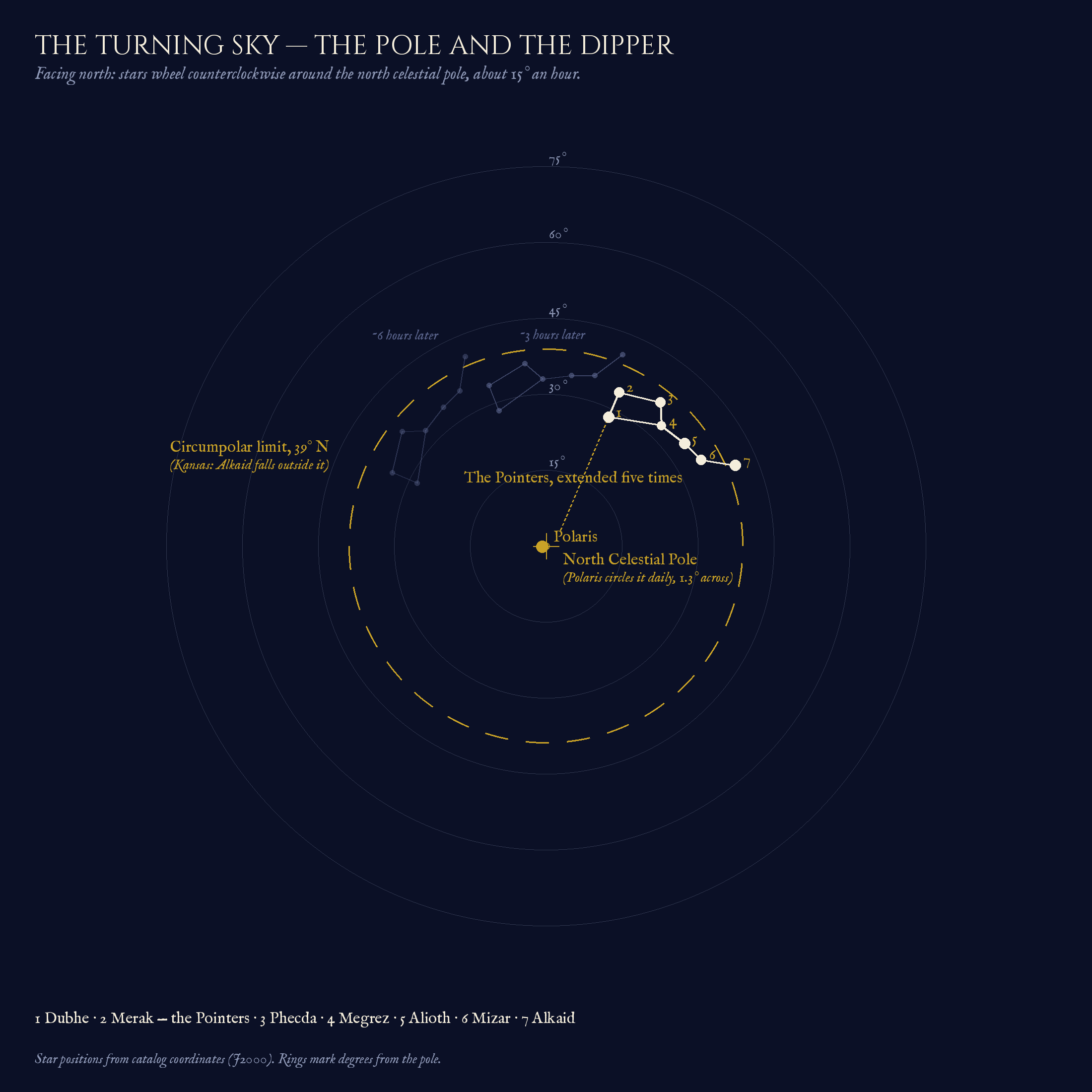
The pole and the Dipper, drawn from catalog positions: the Pointers' line run five times lands on Polaris, 0.65° from the true pole; the dashed circle is the circumpolar limit at 39° north — Alkaid, star 7, falls just outside it, which is why it alone of the seven dips below a Kansas horizon.
Built for the School of Evershade from catalog star coordinates (J2000); builder script. No third-party image; no license restriction.
Stars near enough to the celestial pole never dip below the horizon at all. Their daily circle fits entirely above it, so they circle the pole all night, every night, never rising and never setting. These are circumpolar stars, and which stars earn the title depends entirely on where you stand.
★ The rule is simple and beautiful. At the North Pole, the celestial pole stands directly overhead, so every visible star is circumpolar. At the equator, the celestial pole sits exactly on the northern horizon, so no star is circumpolar. Everywhere in between, the stars within a circle around the pole stay up, and the circle grows as you travel north. Your latitude — your angular distance north or south of the equator, measured in degrees — draws the circle.
The Big Dipper is the famous test case. At 41 degrees north latitude, roughly New York City, and everywhere farther north, all seven Dipper stars are circumpolar. And here is an honest wrinkle worth knowing, since our school sits in Kansas at about 39 degrees north. Six of the seven Dipper stars never set for us, but Alkaid, the last star of the handle, sits just far enough from the pole to dip briefly below the horizon each day. Move a little farther north and the whole ladle stays up all night, wheeling around Polaris like a clock hand that never leaves the clock. The title "circumpolar" is not a property of the star. It is a property of the star and your latitude together.
Check in: From Kansas, why does Alkaid dip below the horizon while the other six Dipper stars never set?
In your packet: Exercise III — The Latitude Thought Experiment ✎ begins here. Work it now, or mark the place and take it as homework — your choice.
The nightly wheel: about 15 degrees an hour
★ The sky turns 360 degrees in 23 hours and 56 minutes, which works out to roughly 15 degrees every hour. Hold your fist at arm's length against the sky: that is about 10 degrees. In one hour, the Dipper moves about a fist-and-a-half. In three hours, it has swung 45 degrees, an eighth of the whole circle, and the change is obvious even to a first-time watcher. Through a single night, the Dipper wheels counterclockwise around Polaris, tipping from one orientation to another: bowl-up in the evening, spilling sideways by midnight, standing on end by dawn, depending on the season.
The yearly wheel: why the same clock time matters
Now the part of the mechanism this whole lesson hinges on. Read it twice.
★ A day on the clock is 24 hours, but one full spin of Earth relative to the distant stars takes only 23 hours and 56 minutes. That spin-measured day is the sidereal day. Those missing four minutes are the price of also traveling around the sun: each day, Earth has moved a little along its orbit, so it must spin a few minutes extra to bring the sun back to the same place in the sky. The stars do not wait for those extra minutes. They rise about four minutes earlier every night.
Four minutes a night does not sound like much, and on any single evening you would never notice. But it accumulates. In a week, the stars have shifted about half an hour earlier, roughly 7 degrees along their circle. In a month, two hours, about 30 degrees. In three months, six hours, a quarter of the whole wheel. That is why the Dipper that rides high in the spring evening sky hangs low in the autumn evening sky: same clock time, different season, different sky.
★ And that is why the Try It Tonight exercise insists on the same clock time, and why this lesson insists you understand the reason. The Dipper's position changes for two completely different reasons at once: the nightly wheeling (fast, about 15 degrees an hour) and the yearly wheeling (slow, about 1 degree a day). If you sketch the Dipper at 9:00 pm and again at 11:30 pm, you will see a big change and learn nothing about the seasons, because the nightly motion swamps everything. Observe at the same clock time on both dates, and you subtract the nightly motion out. What remains is the slow yearly turning, the calendar wheel, visible in your own two sketches. Same hour, different week: the turning you see is the turning of the year.
Check in: A friend sketches the Dipper at 9:00 pm one week and at 11:30 pm the next, sees a large shift, and credits the seasons. Why can she not?
One pattern, two kinds of time
★ This is the mechanism entire, and it is worth holding in one thought. Earth spins: the sky appears to wheel each night, about 15 degrees an hour, counterclockwise around the celestial pole as seen facing north. Earth orbits: the same clock time shows you a slightly earlier sky each night, about 1 degree a day, and the seasons of stars wheel past across the year. The Big Dipper is therefore two instruments in one. Watch it through one night and it is a clock. Watch it at the same hour through the year and it is a calendar. The Chinese handle-readers knew it. The Egyptian star-clock keepers knew it. Tonight, you will know it too, from your own notebook.
❦ In your workbook: record the mechanism in your own way — the spin, the still point, the circle your latitude draws, and the two wheels, nightly and yearly — copy, sketch, or note what matters.
A Sealed Note on Keeping the Same Hour
Scholars, I want to tell you a secret about skywatching, and it is not about stars at all. It is about hours.
Anyone can look up and see that the sky has moved. That is the easy wonder, and it is free to whoever steps outside. The harder wonder, the one that made calendars and navigators and whole civilizations, belongs to the watcher who keeps the same hour. To stand in the same spot at the same clock time, a week apart, a month apart, and compare: that is not looking. That is measuring. And measuring is how wonder turns into knowledge.
The sky does not care whether you keep the hour. It will turn with you or without you. But if you keep it, the sky will tell you things it tells no one else: which motion is the night's and which is the year's, how fast the wheel spins, how slowly the calendar turns. The discipline is small. The reward is the whole turning sky, explained by your own two sketches.
I learned this the way bats learn most things: by doing it every evening without fail, because dinner depends on it. Your dinner does not depend on it, which makes your doing it anyway the more admirable. Keep the same hour, scholars. The sky is keeping it for you.
❦ In your workbook: record the sealed note in your own way — why keeping the same hour turns looking into measuring — copy, sketch, or note what matters.
PROFESSOR VESPER GLIMMERWICK
Celestial Studies
Astronomer & Celestial Historian
Try It Tonight
Objective: Observe the turning sky directly by sketching the Big Dipper twice, at the same clock time, about a week apart, and comparing the two sketches.
You will need: your Sky Log pages (or any notebook), a pencil, a dim flashlight, and your adult. Warm clothes and something to sit on are strongly advised.
In your packet: Exercise I — The Two-Sketch Watch ◐ begins here. Work it now, or mark the place and take it as homework — your choice.
Level One: the two-sketch watch (everyone does this)
- Choose your spot. Somewhere safe and familiar with a clear view to the north: a yard, a porch, a balcony, a known park. You must be able to stand in exactly the same place on both nights, so pick a spot you can find again in the dark. Note a fixed landmark in your northern view: a rooftop peak, a particular tree, a fence post. This landmark is your reference for everything.
- Choose your hour. Pick a clock time you can repeat, ideally between 8:00 and 10:00 pm. Write it down. On the second night, begin within fifteen minutes of the same time. This is the most important instruction in the exercise. The Dipper moves about 15 degrees every hour through the night, so even a one-hour difference would shift it more than a whole week's worth of seasonal motion.
- First sketch. Face north. Find the Big Dipper. In your Sky Log, record the date and the exact time. Then sketch: draw your northern horizon line, mark your landmark on it, and draw the Dipper where it stands relative to the landmark. Show which way the bowl tips and where the handle points. Label Polaris if you can find it with the pointer stars (Dubhe and Merak, the two outer bowl stars). Do not worry about artistry. A clear, honest sketch beats a pretty, vague one.
- Wait. Six to eight days is ideal. A full two weeks is even better; the shift will be larger and easier to measure. Do not observe on a cloudy night and pretend otherwise. Record what the sky actually gave you.
- Second sketch. Same spot, same clock time, same landmark. Record the date and exact time, then sketch the Dipper again. Resist the urge to peek at your first sketch while you draw. Draw what you see.
- Compare. Lay the two sketches side by side. Has the Dipper moved? In which direction, clockwise or counterclockwise around Polaris? Estimate how far using the fist rule: a fist held at arm's length covers about 10 degrees of sky. How many fist-widths did the pattern shift? Write your estimate in the log.
Level Two: measure the wheel (for scholars who want more)
- Clock the nightly motion. On one clear night, sketch the Dipper at two different times, for example 9:00 pm and 11:00 pm, from the same spot. The shift you see is the nightly wheeling alone. Measure it in fist-widths and convert to degrees. Does it match the expected 15 degrees per hour?
- Refine the yearly measurement. For your two-date comparison, record your times to the minute and note the exact number of days between sketches. The expected shift is about 1 degree per day. How close did your fist-width estimate come?
- Find your circumpolar circle. Using your latitude (look it up for your town), decide whether all seven Dipper stars are circumpolar for you, or whether one dips below the horizon like Alkaid does from Kansas. If you are up late enough on a clear night, try to catch the dip.
A note on failure, which is also data. If clouds ruin your second night, or your times drifted by an hour, say so in the log and say what you think the error did to your result. A ruined observation honestly recorded teaches more than a perfect one invented. Professor Glimmerwick would far rather read "clouded out, trying again Thursday" than a beautiful sketch of a sky you did not see.
❦ In your workbook: record the two-sketch watch in your own way — your spot, your hour, your landmark, and what the comparison showed — copy, sketch, or note what matters.
Sky Log Entry
Copy this form into your notebook (or rule it onto a fresh page) and complete one for each observing session. Keep both forms together; they are a matched pair.
| Session 1 | Session 2 | |
|---|---|---|
| Date | ||
| Exact clock time | ||
| Location (same spot both times?) | ||
| Facing | North | North |
| Northern landmark used | ||
| Sky conditions (clear, hazy, moonlit?) | ||
| Dipper visible? Fully or partly? | ||
| Polaris found? | ||
| Bowl tipping which way? | ||
| Handle pointing which way? | ||
| Height above horizon (in fist-widths) | ||
| Notes |
After both sessions, answer in your log:
- Describe the change between your two sketches in two to three sentences. Which direction did the Dipper move around Polaris?
- Estimate the shift in degrees using the fist rule (one fist at arm's length is about 10 degrees). Show your reasoning.
- The two sessions were _____ days apart. At about 1 degree per day of yearly wheeling, the expected shift is about _____ degrees. How does your estimate compare?
- In one or two sentences, explain why observing at the same clock time was necessary. What would have happened to your comparison if the second sketch had been made two hours later in the night?
File these pages at the front of your course notebook. They will sit beside the Moon Journal you began in Lesson 1: one journal for the moon's month, one log for the sky's turning. Together they are the beginning of your own observatory records.
❦ In your workbook: record the Sky Log in your own way — the matched pair of sessions, kept together at the front of your course notebook beside your Moon Journal — copy, sketch, or note what matters.
In your packet: Exercise II — The Star-Clock Reading ✎ begins here. Work it now, or mark the place and take it as homework — your choice.
Materials
Required (Level One — household items)
- Your Sky Log pages or a notebook — for both observing sessions and the comparison.
- A pencil — pens freeze up on cold nights; pencils do not.
- A dim flashlight — covered with red cellophane if you can, to protect everyone's night vision.
- Warm clothes and something to sit on — the ground is colder than you think when you stand still and look up.
- A watch or phone — for recording the exact clock time of each session.
Suggested (Level Two — historically closer)
- Binoculars — optional; the Dipper's stars are easy naked-eye targets, but binoculars show the fainter stars of Ursa Major around them.
- A compass — to confirm your northern landmark truly faces north.
- A protractor or printed angle guide — for measuring the Dipper's shift more precisely than the fist rule allows.
Reflection Questions
Answer the following questions in your workbook.
- Imagine Earth stopped rotating but kept orbiting the sun exactly as now. What would happen to day and night? What would happen to the stars' nightly wheeling? What does this thought experiment reveal about the true cause of the turning sky?
- The Egyptians called the never-setting stars "imperishable" and promised the dead a place among them. Why would stars that never set feel like a promise of permanence? What does this tell us about how skywatching shaped what people believed?
- "The stars are moving across the sky" is the natural first explanation of what you saw in Try It Tonight. What observation from this lesson disproves it most cleanly, and why is the wrong explanation so tempting?
- The Dipper is both a clock (through the night) and a calendar (through the year). Which motion would matter more to a farmer deciding when to plant, and which to a traveler finding direction on a single night? Explain your reasoning.
- Polaris looks fixed, but a time-lapse camera shows it tracing a tiny daily circle, and over millennia even the celestial pole drifts to new stars. Is anything in the sky truly still? What does your answer suggest about the difference between "looks still" and "is still"?
Workbook Checklist — Lesson 2
In my workbook I have:
- ☐ found the Big Dipper and Polaris by the pointer stars, Dubhe and Merak
- ☐ completed the two-sketch watch: same spot, same clock time, two dates about a week apart, with both Sky Log forms
- ☐ compared the sketches and estimated the shift in degrees by the fist rule, against the expected 1 degree per day
- ☐ explained the mechanism in my own words: rotation, apparent motion, sidereal day, and circumpolar used correctly
- ☐ worked the latitude thought experiment for the North Pole, the equator, and my own home
- ☐ stated the standing night rules in my own words, including always observing with an adult
☐ Lesson completed Date: ___ Signature: ___
The Professor's Closing Note
Well, scholars. You have now stood under the turning sky on purpose, which puts you in excellent company: Egyptian priests, Chinese calendar-keepers, Greek sailors, and one small bat professor who still goes outside every clear evening just to watch the wheel go round.
What you carry away from this lesson is not a list of star names. It is a motion. The sky turns because we turn, the stars wheel around a still point because our axis points at it, and the same wheel that tells the hour of the night tells the season of the year if you keep the same hour while you watch. Hold that motion in your mind. Every lesson from here to the capstone will hang something on it: the moon's phases, the planets' wanderings, the calendars of the world, the instruments that mechanized the watching.
Next lesson, we take up the year's other great motion. The turning sky gave us the day; the tilted year gives us the seasons, and with them the oldest and most stubborn misconception in all of astronomy. You arrive at Lesson 3 already certain you know why summer is warm. I am kindly, whimsically, and completely looking forward to correcting you.
Until then: same spot, same hour, clear skies.
PROFESSOR VESPER GLIMMERWICK
Celestial Studies
Astronomer & Celestial Historian
Cross-Class Connections

Scrollwork · Unit I, Lesson 3 — Writing Surfaces Through History
Historical star catalogs and astronomical manuscripts are among the most beautiful documents ever made, and they begin, as every chart does, with a surface that can carry them. In the Scrollwork Library we study the surfaces themselves — clay, papyrus, parchment, paper — and how a chart becomes a work of art without ceasing to be a chart. Bring your turning sky; we will show you what it was written on.

Creative Arts · Studio Extension 1 — Precision Paper Instruments, Built to Last
The planisphere you will build later in Professor Glimmerwick's course is a paper wheel, and paper wheels wear out. In my workshop we remake it — the planisphere, the astrolabe, the cipher wheel — in board and brass, built to be handled for years. Sky knowledge becomes sky craft at this bench. Build it true, and it will still be turning truly when you have left the school.

Herbology · Unit I, Lesson 1 — The Scholar's Familiar
Welcome, scholars. Gardeners read the same sky-clock you read tonight, in our own way: a plant's whole life is set by when the sun arrives at its window and when it leaves. In the Greenhouse you will choose a living companion plant and keep its light study in a grow ledger — the sun's daily round, recorded leaf by leaf. Come down from the tower and see what the turning does at windowsill height.

Runes & Ancient Writing · Unit I, Lesson 1 — Cuneiform — The Structural Wedge
Further Reading & Sources
- Circumpolar stars stay up all night long — EarthSky explains which stars never set, how latitude draws the circumpolar circle, and why the Big Dipper is circumpolar north of 41 degrees latitude.
- Use the Big Dipper to find Polaris, the North Star — EarthSky's guide to the pointer stars Dubhe and Merak, with the Dipper's seasonal positions through the year.
- Does the North Star ever move in the sky? — EarthSky on Polaris's tiny daily circle, why the stars appear to move at all, and the 26,000-year precession cycle that hands the North Star title to new stars.
- Day, night, and the seasons — The European Space Agency's lesson page on Earth's rotation causing day and night.
- Decoding the Star Charts of Ancient Egypt — Scientific American on the Egyptian decan star tables and what they reveal about ancient skywatching.
All links verified live on 2026-10-12.
Browse the Celestial Studies shelf in the school Library for readable editions of these works.
You have read how the sky turns. Now turn it yourself — the Wheel shows this lesson's sky, tonight, wheeling over your own horizon.
Open the WheelPROFESSOR VESPER GLIMMERWICK · CELESTIAL TOWER
Submit your work for this lesson using the form below.
CONTINUE IN THE CELESTIAL TOWER
← Previous · Lesson 1: Welcome to the Celestial Tower Next · Lesson 3: The Tilted Year: Why We Have Seasons →
Unit I — The Sky as Clock & Calendar Celestial Tower — All 33 Lessons
The rest of Unit I: Lesson 1 · Celestial Tower · Lesson 3 · Tilted Year · Lesson 4 · Ancient Observatories · Lesson 5 · Calendars of the World · Lesson 6 · The Longitude Problem