
CELESTIAL STUDIES
Unit I · Lesson 4Ancient Observatories
PROFESSOR VESPER GLIMMERWICK
Celestial Studies
Astronomer & Celestial Historian
Professor's Introduction

Scholars, I do my best thinking hanging upside down in the Celestial Tower, watching the sun hand over the sky to the stars at the end of every evening flight. You may take notes right side up. I will not judge.
Last lesson we learned that the sun does not rise in the same place twice. Its rising point slides along the horizon through the year, swinging between two far extremes. Tonight we ask the question that kept ancient sky-watchers awake in the best possible way: what if you built something that caught the sun exactly where it stood on the longest day, so the turning year could never slip past you unnoticed?
They built it. In England, in Mexico, in New Mexico, in the Sahara. With stones the size of carriages and staircases aimed like instruments. Some of what they built still works, thousands of years later, and you can watch it work with your own eyes. Some of what people claim about these places is argued about fiercely by scholars, and tonight you will learn to tell the difference, because a sky-watcher who cannot say "we do not know" is not a sky-watcher yet.
Bring your Sky Log. Bring an adult for the evening work. And bring your best questions, the kind with sharp edges. The stones have been waiting a very long time for someone to ask them properly.
PROFESSOR VESPER GLIMMERWICK
Celestial Studies
Astronomer & Celestial Historian
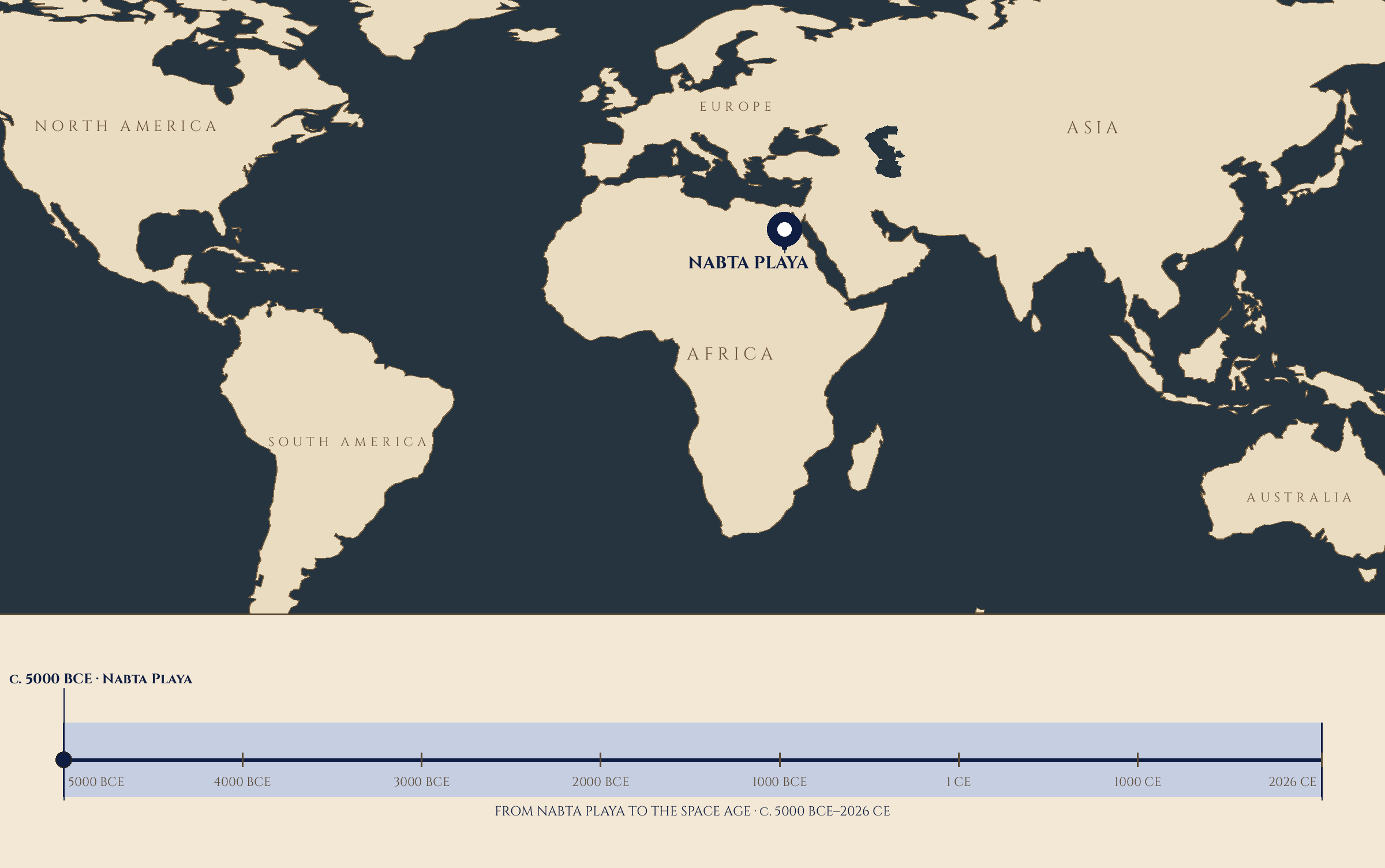
Where and when: NABTA PLAYA, c. 5000 BCE · Nabta Playa (year −5000) — Ancient Observatories. The pin is this lesson. The line beneath the map is our road: every stop a moment when watching the sky changed, every lesson a pin upon it.
Lesson Objectives
By the end of this lesson, you will be able to:
- Define archaeoastronomy and explain what the field studies, and what it is not.
- Describe the confirmed solstice alignments at Stonehenge, the sun dagger phenomena at Fajada Butte, the serpent light effect at El Castillo, and the calendar circle at Nabta Playa.
- Sort famous alignment claims into confirmed, debated, and too-approximate-to-call, and explain the evidence for each verdict.
- Explain the mechanism by which a fixed stone, a sightline, or a pattern of light and shadow marks the turning year.
- Design and begin a mini alignment of sticks and stones aimed at the next solstice or equinox.
Reading this lesson: ★ marks the passages to remember. They return on the unit quiz and the class test. Check in questions ask the material back as you go; answer them in your workbook when you meet them.
Working this lesson: Your assignment packet is the first download on this page. Work in it as the lesson moves along, answering each exercise as its subject is taught — or read the lesson through for your notes and take the exercises as homework afterward. Both are proper ways to sit this class. Signposts in the reading tell you where each exercise belongs. Written answers are short answers in your own words; a few honest lines are worth more than a filled page.
Your Assignment Packet
This lesson's exercises live in its packet: the Lexicon Handout (every term, course terms marked ◆), Materials, Guided Practice, the Assignment Manual with its answer key for self-checking, the Reflection Questions, and the Workbook Checklist. Download the packet before you begin and keep it beside you as you read. The packet's exercises are Glimmerwick's own word for the work: Exercise I — Tonight's Sunset Anchor ◐, Exercise II — Building Your Mini Alignment ⚒, and Exercise III — Confirmed or Claimed? ✎. The lesson's quiz is not printed in the packet; it pools to the Unit I Quiz, where it will meet you again.
Safety Briefing
- Night observing is always done with an adult, in safe, familiar locations. This is a standing rule of the Celestial Studies department, with no exceptions.
- Never look directly at the sun. Not at noon, not at sunset, not through clouds, not for a second. This lesson asks you to watch where sunlight lands and where the sun sits against fixed landmarks, never to stare at the solar disk itself. If you want a record of the sun's position, have your adult take the photograph.
- Build your mini alignment in daylight. Get permission before placing stakes or moving rocks anywhere that is not your own yard. Wear gloves when handling rough stones, and keep the structure low and stable so it cannot topple onto anyone.
The Wonder
Picture a dawn five thousand years old. The sky over the Wiltshire downs pales from black to grey to gold, and a crowd of people who raised stones heavier than houses stands waiting in the cold. The sun lifts over the edge of the world, and its first light strikes exactly where the builders aimed it: past a leaning boulder at the end of a long avenue, straight into the heart of the stone circle.
That still happens. Every midsummer morning, the sun still rises along the axis the builders laid down, and the stones still catch it.
Now picture a pyramid in the Yucatán jungle, nine stepped tiers climbing toward the sky. Twice a year, crowds gather at its foot in the late afternoon and watch the setting sun lay triangles of light and shadow down a stone staircase, one after another, until a great serpent of light seems to slide down the steps and join the carved serpent head waiting at the bottom.
And picture a butte in the New Mexico desert, where three leaning slabs of rock throw a dagger of light across a spiral carved into a cliff, piercing its exact center on the longest day of the year. And a circle of stones in the Sahara, older than the pyramids, whose builders aimed one stone window at the sunrise of the longest day so they would know the rains were coming.
These are not telescopes. They are something older and, in their way, stranger: whole buildings used as instruments. Long before anyone ground a lens, people anchored the sky in stone so the year could not get away from them. That urge, to pin the turning sky to the turning Earth, is the oldest scientific impulse there is. Tonight we follow it around the world.
❦ In your workbook: record the wonder in your own way — four places, four instruments of stone and light, and what each one was built to catch — copy, sketch, or note what matters.
The Story
The Name of the Game
The study of all this has a name: archaeoastronomy. It is the study of how people in the past understood the phenomena in the sky, how they used these phenomena, and what role the sky played in their cultures. The word itself is young, coined in 1973, but the questions are as old as the stones.
Here is what archaeoastronomy is not. It is not the study of ancient people doing modern astronomy with worse equipment. The people who raised these stones had their own reasons, their own stories, their own skies full of meaning, and a good archaeoastronomer listens for those before reaching for a calculator.
★ And here is the discipline that will carry you through this entire lesson: not every line between two stones is a sightline. A field full of rocks will always contain a few accidental alignments, the way a page of random letters will always contain a few accidental words. The honest archaeoastronomer measures, counts, checks the statistics, and asks what the culture itself cared about before declaring that a stone was aimed at the stars. Keep that sentence beside you. We are about to need it four times.
❦ In your workbook: record the name of the game in your own way — what archaeoastronomy studies, what it is not, and the sentence about sightlines you are keeping beside you — copy, sketch, or note what matters.
Stonehenge: The Axis Nobody Argues About
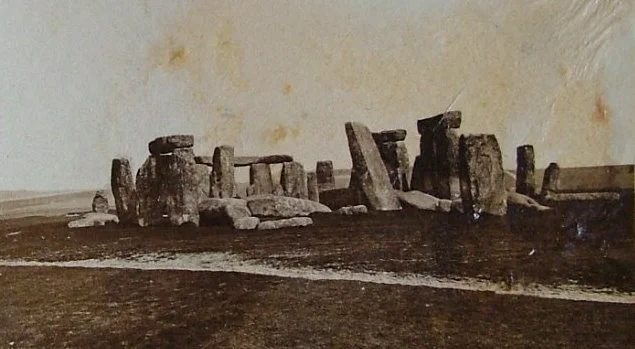
Stonehenge photographed in July 1877, before restoration: leaning and fallen stones among the uprights. The solstice axis the builders laid down — midsummer sunrise over the Heel Stone, midwinter sunset opposite — is the monument's confirmed alignment, identified by William Stukeley in 1720 and confirmed by three centuries of measurement since.
Photograph of July 1877 (photographer unknown), via Wikipedia, "Stonehenge."
On the Salisbury Plain in Wiltshire, England, stands the most famous stone circle on Earth. Stonehenge was raised in stages across many centuries, roughly five thousand years ago, by people who left no writing and no instruction manual. What they left instead is an axis.
★ Confirmed: the monument is aligned on the solstices. Stand in the center of the stones and look northeast along the Avenue on the morning of the summer solstice, and the sun rises close to a leaning boulder called the Heel Stone, its first rays shining into the heart of the circle between the great uprights. Turn around at midwinter sunset and the sun sets along the same axis in the opposite direction. This orientation was first identified by the antiquarian William Stukeley, who drew the site and recognized its midsummer sunrise axis in 1720. It has been confirmed by three centuries of measurement since. Nobody serious argues about the solstice axis. It is the foundation every other claim about Stonehenge has to reckon with.
Being refined: the Heel Stone itself is not precisely on the sunrise line. Recent excavation found evidence of a lost companion stone beside it, and some researchers now suggest the two stones formed a kind of solar corridor that framed the rising sun between them. The alignment is real; our understanding of exactly how the builders aimed it is still improving.
Debated: in 1963 the astronomer Gerald Hawkins announced, with the help of an early computer, that Stonehenge contained dozens of solar and lunar alignments and could have been used to predict eclipses. His 1965 book called it a Neolithic computer. Archaeologists pushed back hard. R. J. C. Atkinson showed in 1966 that with 165 features to choose from and a generous margin of error, the number of "alignments" Hawkins found was about what chance alone would produce. The eclipse computer is now largely dismissed. It remains a famous cautionary tale: the more lines you draw, the more coincidences you find.
Also debated: the four Station Stones, which form a rough rectangle around the monument. Some researchers have argued that the rectangle's long sides point to the moon's most extreme rising and setting positions during the 18.6-year lunar standstill cycle. Clive Ruggles, one of the founders of modern archaeoastronomy, notes that researchers have debated for years whether this was deliberate, and if so, how it was achieved and what it was for. The moon may be part of Stonehenge's story. Or the rectangle may be doing something else entirely. The jury is still out, and an honest lesson says so.
One more thread, because it is lovely: for years, archaeologists found the strongest evidence for gatherings at Stonehenge in midwinter, not midsummer. Pig bones at the nearby settlement of Durrington Walls show the animals were slaughtered in December or January, year after year. Mike Parker Pearson, who led the excavations, later concluded it was reasonable to assume the builders celebrated the midsummer solstice as well as the midwinter one. The stones catch both. Perhaps the people did too.
Check in: A visitor tells you Stonehenge was an eclipse-predicting computer. What did Atkinson show in 1966, and what does that make the claim?
❦ In your workbook: record Stonehenge in your own way — the confirmed axis, what is being refined, and what is debated, each in its own column — copy, sketch, or note what matters.
El Castillo: The Serpent Everyone Can See
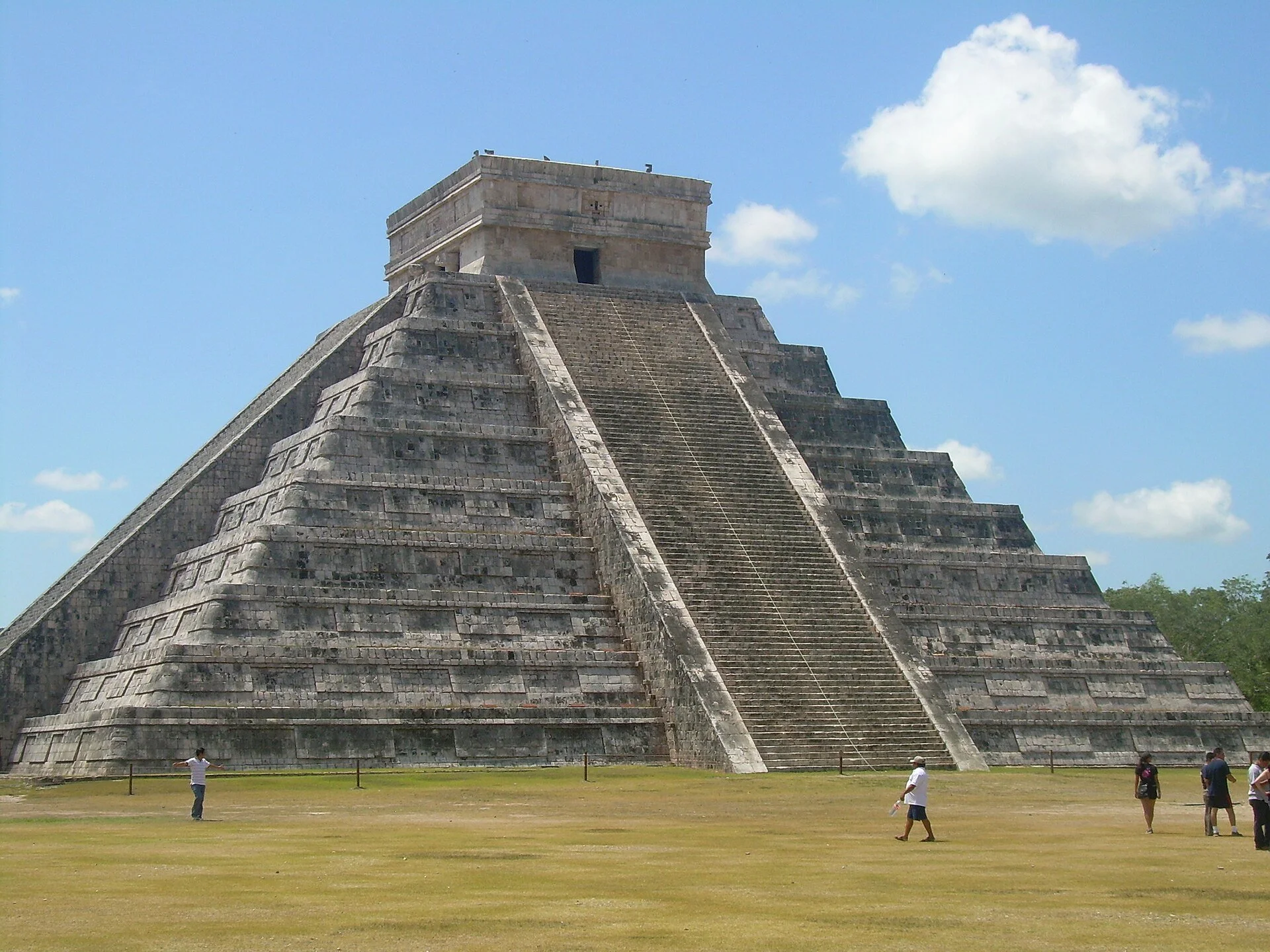
El Castillo at Chichén Itzá: nine stepped tiers, 30 meters tall, with stairways on all four sides. On equinox afternoons the setting sun lays triangles of light and shadow down this northern staircase until a serpent of light seems to descend — the effect is real and anyone can watch it; whether the Maya designed it deliberately is actively debated, and the 2026 Arqueología Mexicana study shows the pattern is a year-long sequence, not a one-day show.
Photograph by Lfyenrcnhan, 10 July 2007, released into the public domain by the author.
At Chichén Itzá in the Yucatán, Mexico, the Maya built a temple to Kukulcán, the Feathered Serpent, between the 8th and 12th centuries CE. El Castillo rises 30 meters in nine stepped tiers, with stairways climbing all four sides. It is a masterpiece of architecture. It may also be an instrument, and this is where our discipline gets its hardest workout.
★ Confirmed: the light effect is real, and anyone can watch it. In the late afternoon, the setting sun shines across the stepped northwestern corner of the pyramid and casts a zigzag of triangular light and shadow down the balustrade of the northern staircase. Within an hour the triangles stretch from top to bottom, like a diamondback rattlesnake in profile, and connect with the carved stone serpent head at the foot of the stairs. A serpent of light appears to descend the pyramid. The phenomenon was first noted in 1948 by the photographer Laura Gilpin, and in 1969 Jean-Jacques Rivard proposed that the Maya might have seen it as Kukulcán himself coming down to earth. Crowds of thousands gather for it every equinox. The shadows are not a trick of photography. They are really there.
★ Actively debated: whether the builders designed it on purpose. Some scholars argue the Maya architects calculated the pyramid's angle and orientation to produce exactly this effect. Others say it may be a fortunate byproduct: aim a stepped pyramid roughly north and the equinox sun will do the rest, with no serpent intended. Both sides agree the Maya were superb astronomers. They disagree about what this particular pyramid was engineered to do, and the debate is unresolved.
New evidence, still being absorbed: a 2026 study by four archaeoastronomers, published in the journal Arqueología Mexicana, watched the balustrade through the whole year and found that the famous "equinox serpent" is not a one-day show at all. The first faint triangle appears near the top as early as February 12. By March 15, seven triangles hold steady through sunset, a pattern that lasts about ten days and includes the spring equinox. By April 9 there are nine triangles, one for each of the pyramid's nine tiers. By May 24 the whole balustrade is lit, the date of the sun's first zenith passage — the day the sun passes directly overhead at noon — over Chichén Itzá, and it stays fully lit through the summer solstice, with a final full illumination on July 19 at the second zenith passage. The sequence reverses through autumn: nine triangles in early September, seven at the autumn equinox, five by October 9, last glimmers around October 29, and then shadow for 52 days before and 52 days after the winter solstice, until the cycle begins again in mid-February.
The researchers suggest this slow, repeating pattern would have been more useful than a single date: watching the triangles grow and shrink could have helped observers track the seasons and time their farming. In that reading, El Castillo is not a one-trick equinox monument but a working seasonal instrument. Note what this does to the debate. It does not settle whether the serpent was intended. It reframes the question entirely, which is often how science moves forward.
Check in: The serpent of light appears on El Castillo's staircase every year. Does that prove the Maya designed it deliberately? What do the two sides of the debate each say?
❦ In your workbook: record El Castillo in your own way — the confirmed effect, the debated intention, and the 2026 study's year-long sequence of triangles — copy, sketch, or note what matters.
Fajada Butte: The Sun Dagger
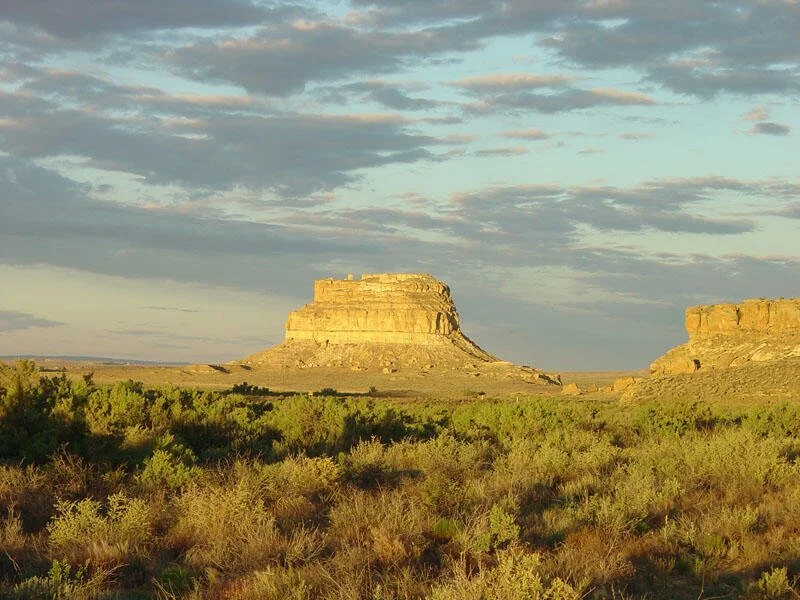
Fajada Butte, Chaco Canyon, New Mexico, rising 135 meters above the desert floor. Near its top, three leaning slabs throw a dagger of sunlight across a spiral petroglyph at the solstices and equinoxes — phenomena scholars generally agree were intended. The lunar-standstill claims for the site are debated and treated as unproven, and the slab that shifted in 1989 was stabilized but never moved back; the butte is closed to visitors.
U.S. Geological Survey photograph ("Chaco Culture — Fajada Butte," morning light).
In Chaco Canyon, New Mexico, a sandstone butte rises 135 meters above the desert floor. Near its top, on a southeast-facing cliff, two spiral petroglyphs are carved into the rock, and three tall slabs lean against the cliff in front of them. In 1977 an artist named Anna Sofaer was volunteering in the canyon, recording rock art, when she noticed something odd about the light on those spirals. She came back, and kept coming back, watching through the seasons. On the summer solstice, at about 11:15 in the morning, a dagger-shaped shaft of sunlight pierced the exact center of the larger spiral.
★ Confirmed, by general scholarly agreement: the solstice and equinox light phenomena at the site were intended to mark the sun's arrival at those turning points. Similar daggers frame the spirals at the winter solstice and the equinoxes. The Chacoan people of the 10th to 13th centuries watched the sky with great care, and critics across the debate agree that these particular patterns of light and shadow were meant.
Debated, and this is where it gets interesting:
First, the moon. Sofaer and her colleagues also reported that shadows marked the extremes of the moon's 18.6-year standstill cycle. The astronomer Michael Zeilik re-examined the site and found no ethnographic evidence that historic Pueblo peoples tracked the lunar standstill cycle at all, and showed the site could not have predicted the standstill year in advance. His 1985 verdict, published in the journal Science: the site most likely served as a sun shrine rather than an accurate solar calendar. Most scholars now treat the lunar claims as unproven, and a 2020 statistical review concluded that at most two of the site's claimed sun daggers are likely intentional, with the rest being false alarms.
Second, the slabs themselves. A team of geologists argued in Science in 1982 that the three slabs are the result of a natural rockfall, not stones the Chacoans set in place. Their reading: the rock fell on its own, the Chacoans watched the light play across the cliff for several annual cycles, and then carved the spirals to mark what they had seen. The U.S. Geological Survey's summary of the site presents this as the likely story. The intention is still human. It is just aimed differently than Sofaer first thought: not placed stones catching the sun, but carved spirals answering the light.
Third, the calendar question. Zeilik showed that the site could not have regulated a working calendar the way living Pueblo horizon observations could. A shrine that honors the solstice is a different thing from an observatory that measures it, and the evidence points to the shrine.
And there is a sad postscript the lesson must include. By 1989, erosion from modern foot traffic had shifted one of the slabs out of its ancient position. The dagger of light no longer crosses the center of the spiral the way Sofaer first saw it. The Park Service stabilized the stones in 1990 but did not move the shifted slab back, and the butte is closed to visitors. A stone instrument, once disturbed, cannot simply be reset.
Also note, because it teaches the discipline: at two other spots on the same butte, five more petroglyphs are struck by dramatic noontime light patterns at the solstices and equinoxes. A statistical check showed that five such events are about the number chance alone would produce on that cliff face. Even at a genuine site, some "alignments" are accidents. The stones do not come with labels.
❦ In your workbook: record Fajada Butte in your own way — the confirmed daggers, the three debated questions, and the sad postscript of the shifted slab — copy, sketch, or note what matters.
Nabta Playa: The Oldest Stones in the Story
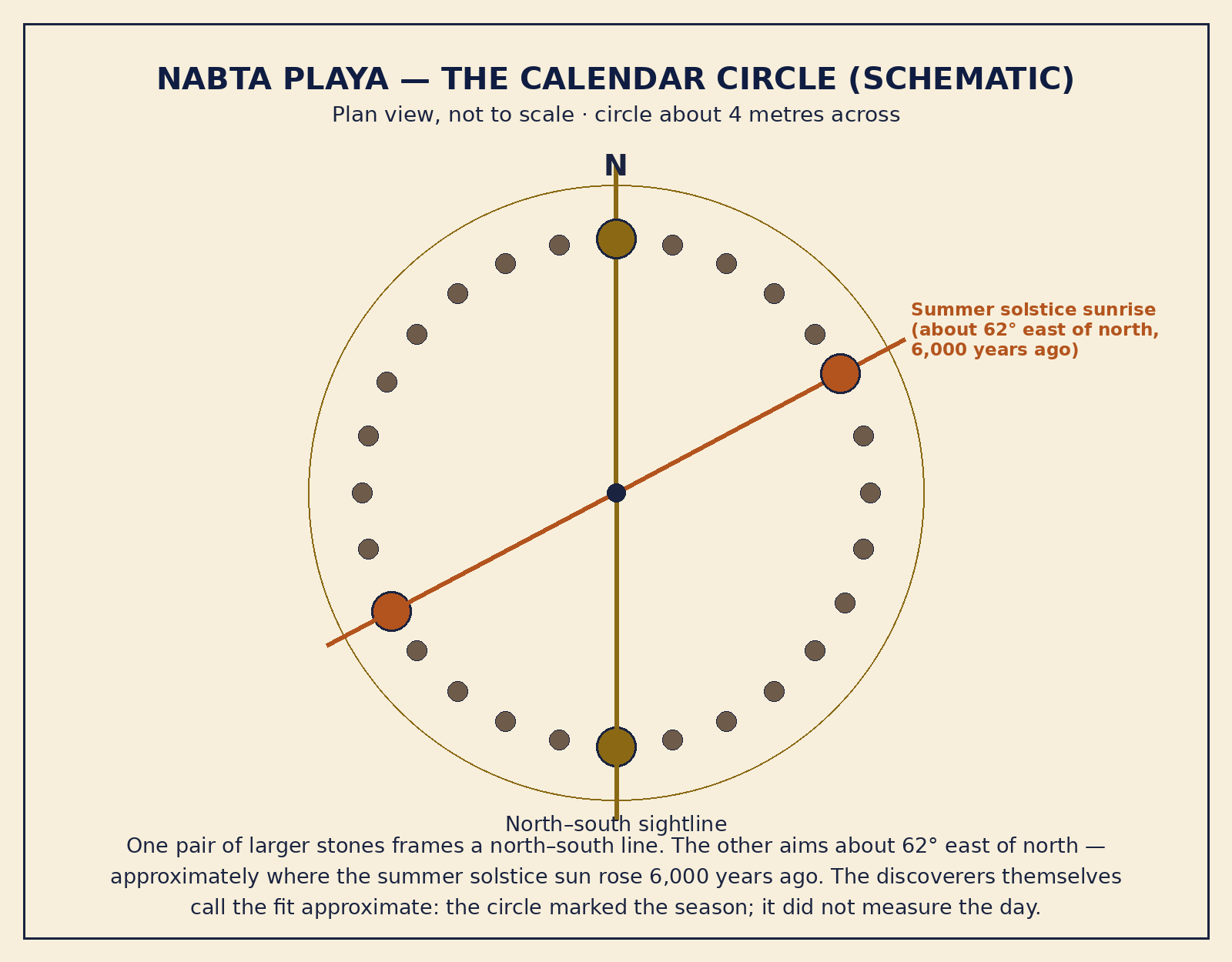
Schematic plan of Nabta Playa's calendar circle — not to scale. One pair of stones frames a north–south line; the other aims about 62° east of north, approximately where the summer solstice sun rose 6,000 years ago (Nature, 1998). The alignment is the discoverers' own approximate fit, and the proposed star alignments at the site are proposals, not consensus.
Built digitally for this overhaul (Python/PIL, DejaVu Sans labels), from the measurements in the lesson text (circle ~4 m; sightlines at 358° and ~62°, per Malville & Wendorf, Nature 1998, as cited in the lesson's fact-check notes).
Deep in the Nubian Desert of southern Egypt, about 500 miles south of Cairo, lies a dry lakebed called Nabta Playa. In 1973 a Bedouin guide named Eide Mariff, working with archaeologist Fred Wendorf's survey team, came across standing stones in the sand where no standing stones should have been. The team kept returning for decades. What they found rewrote the timeline of sky-watching.
When these stones were raised, the Sahara was green. Summer monsoon rains filled the seasonal lake, and nomadic cattle-herding people gathered at its shores with their herds. Then, in the early 1990s, Wendorf called in the archaeoastronomer J. McKim Malville, and the stones began to speak.
★ Confirmed: at the site stands a stone circle only about four meters across, with pairs of larger stones forming window-like sightlines. One pair frames a north-south line. The other aims about 62 degrees east of north, which is approximately where the summer solstice sun rose six thousand years ago. The team's findings were published in the journal Nature in 1998. The circle sits in deposits dated to between 7,000 and 6,700 years ago, and some of the slabs, dragged from outcrops a mile or more away, stand nine feet tall. For a cattle-herding people whose year turned on the coming of the rains, and for whom the summer solstice arrived with the monsoon, a stone window aimed at the longest sunrise is not decoration. It is survival information, set in rock.
★ Qualified, by the discoverers themselves: the fit is approximate. Malville and Wendorf describe the solstice alignment as approximate, and the circle is far too small, with far too wide a window, to have worked as a precision instrument. Calling it a "calendar" is their affectionate nickname for it, and even they would tell you it could never have served as a calendar in the modern sense. It marked the season. It did not measure the day.
Debated or unproven: Malville has proposed that other stones at the site once aligned with bright stars, Arcturus, Sirius, and Alpha Centauri, as they stood around 4800 BCE, and another researcher has proposed an Orion's Belt arrangement inside the circle. These are proposals, not consensus. They may be right. The evidence is not yet strong enough to say.
Malville calls Nabta Playa the oldest astronomical site ever discovered, about a thousand years older than Stonehenge, and the description has stuck. Treat it as his characterization of a remarkable place, and let the stones themselves carry the weight: people with no writing, no metal, and no draft animals dragged nine-foot slabs across the desert and aimed them at the sunrise of the longest day. Whatever else they were doing, they were watching the sky on purpose.
❦ In your workbook: record Nabta Playa in your own way — the confirmed window, the discoverers' own qualification, and the proposals that are not consensus — copy, sketch, or note what matters.
In your packet: Exercise III — Confirmed or Claimed? ✎ begins here. Work it now, or mark the place and take it as homework — your choice.
The Mechanism
How does a pile of stones catch the sun? It helps that the sun is a punctual traveler with fixed habits.
★ The swing. As you learned last lesson, the sun's rising point slides along the horizon through the year, swinging between its far northern extreme at the June solstice and its far southern extreme at the December solstice. A stone, a gap between stones, or a window aimed at one extreme will frame the sunrise only when the sun reaches that extreme. The rest of the year, the sun rises somewhere else along the horizon and misses the mark. That is the whole trick: a fixed marker plus a moving sun equals a calendar with no moving parts.
Why the solstices. The sun's daily shift along the horizon is not constant. Near the solstices it slows nearly to a standstill, the sun rising in almost the same place for several days running. That standstill is what the word solstice means: the sun stands still. Near the equinoxes, the shift is at its fastest, the sunrise point racing along the horizon. So a solstice marker is forgiving. It catches the sun for days. An equinox marker is finicky. This is why the great stone alignments of the world aim at solstices far more often than at equinoxes, and why El Castillo's long seasonal sequence, if the 2026 reading is right, would have been easier to use than a single equinox day.
Light and shadow as geometry. El Castillo and Fajada Butte work on the same principle with different furniture. The sun's position in the sky changes predictably through the year, so a staircase or a set of slabs turns that changing position into moving shapes. The shapes are the readout. The building is the instrument.
Why they still work. The Earth's tilt changes only very slowly over thousands of years, so a solstice sunrise aimed five thousand years ago still lands close to the same notch today. Stand at Stonehenge on a midsummer morning and the axis still works. The window at Nabta Playa still frames the solstice sunrise. These instruments were built to outlast their builders, and they have.
★ The mechanism of doubt. Here is the other mechanism you must carry out of this lesson. A landscape full of stones contains a huge number of possible lines, and some of them will point at interesting sky events purely by chance. That is why archaeoastronomers demand more than a striking photograph. They demand measurement, statistical testing, repeated observation across years, and evidence that the culture itself cared about the event in question. Atkinson's dismantling of Hawkins's eclipse computer and the statistical check on Fajada Butte's noontime shadows are the same lesson twice: wonder first, then count.
Check in: Why is a solstice marker more forgiving than an equinox marker? Answer from the sun's daily shift along the horizon.
❦ In your workbook: record the mechanism in your own way — the swing, the standstill, light and shadow as geometry, and the mechanism of doubt — copy, sketch, or note what matters.
A Sealed Note on What the Stones Do Not Say
Scholars, I want to tell you something the stones taught me while I hung in the Celestial Tower turning them over in my mind. The stones do not come with instruction manuals. The people who raised them are gone, and they left no notes in the margins. Everything we know about these places, we know by measuring shadows and arguing with each other, politely and at length, in journals.
This is not a failure. It is the job. "We do not know" is a complete sentence, and it is the most honest sentence in science. The scholars who say the serpent at El Castillo might be an accident are not ruining the wonder. They are protecting it, the way you would protect a candle flame by cupping your wings around it instead of grabbing it. Wonder that survives hard questions is stronger than wonder that was never tested.
So here is my rule for you, sealed and kept: when someone shows you a stone that catches the sun, admire it first. Then ask who measured it, how many times, and what the people who built it thought they were doing. If the answers are good, the wonder grows. If the answers are missing, the wonder waits. Either way, you are doing it right.
❦ In your workbook: record the sealed note in your own way — Glimmerwick's rule for a stone that catches the sun, in your own words — copy, sketch, or note what matters.
PROFESSOR VESPER GLIMMERWICK
Celestial Studies
Astronomer & Celestial Historian
Guided Observation
Try It Tonight
Tonight's work: find your own horizon anchors.
With your adult, go to one fixed observing spot you can return to many times: a backyard, a balcony, a park bench, a quiet stretch of sidewalk. Somewhere safe and familiar. Watch the sunset. Note exactly where the sun goes down against fixed landmarks: the left edge of the big oak, the corner of the garage roof, the notch between two hills. Do not stare at the sun. Watch where it sits, glance, look away, and mark the landmark, not the light.
Record the landmark in your Sky Log, with today's date. In two weeks, stand in the same spot and check again. The sun's setting point will have moved, and you will have caught it moving, the same way the builders of Nabta Playa caught it with stone windows. Every ancient observatory began exactly like this: one person, one horizon, paying attention.
Level Two: bring a compass or a phone compass and record the sunset's bearing in degrees. Bearings turn "near the oak tree" into a number you can compare across the whole year.
❦ In your workbook: record tonight's work in your own way — your fixed spot, your landmarks, and the prediction you will check in two weeks — copy, sketch, or note what matters.
In your packet: Exercise I — Tonight's Sunset Anchor ◐ begins here. Work it now, or mark the place and take it as homework — your choice.
Sky Log Entry
Date, time, and location. Sky conditions in a few words. Then:
- Where did the sun set tonight, measured against your fixed landmark?
- Sketch the horizon line with the sun's position marked.
- One question the observation gave you. (Example: will the sun set to the left or the right of the oak tree in two weeks?)
If the sky is cloudy, log the clouds and try again tomorrow. The builders of Stonehenge had cloudy evenings too. They just kept watching.
❦ In your workbook: record the Sky Log entry in your own way — tonight's sunset landmark, your horizon sketch, and your one question — copy, sketch, or note what matters.
In your packet: Exercise II — Building Your Mini Alignment ⚒ begins here. Work it now, or mark the place and take it as homework — your choice.
Materials
Required (Level One — household items)
- Your Sky Log and a pencil: every observation in this lesson is recorded, dated, and sketched.
- Gloves for handling rough stones while you build your mini alignment, as the Safety Briefing directs.
- One fixed observing spot you can return to many times: a yard, a balcony, a park bench, or a quiet stretch of sidewalk. Safe and familiar.
- An adult: all evening observing is done together. No exceptions.
- 4 to 6 straight sticks or garden stakes, small stones for packing, and a ball of string for the mini alignment.
- A compass or phone compass (optional, Level Two): for recording sunset bearings in degrees.
Suggested (Level Two — historically closer)
- A camera: have your adult photograph the sun's position against your landmarks, so you never need to look at the solar disk.
- Graph paper for plotting your sunset bearings across the season.
- The 2026 Arqueología Mexicana summary (linked in Further Reading): compare a professional light-sequence study with your own observations.
Reflection Questions
Answer the following questions in your workbook.
- Why did ancient sky-watchers favor the solstices over the equinoxes for their permanent stone markers?
- If a light effect happens at the same place every year on the equinox, does that prove the builders planned it? Why or why not?
- What is the difference between a sun shrine and a solar calendar, and why did Zeilik conclude Fajada Butte was the first rather than the second?
- The builders of Nabta Playa left no writing. What does that make their stones, and what does it cost us as students of their sky?
- A friend shows you a photograph of two old fence posts that line up with the sunrise on their birthday. Using what you learned in this lesson, what would you tell them, kindly, about their discovery?
Workbook Checklist — Lesson 4
In my workbook I have:
- ☐ found my fixed observing spot and recorded tonight's sunset against its landmarks, dated, in my Sky Log
- ☐ sketched my horizon line with the sun's setting position marked, and written my one question
- ☐ chosen my mini alignment's target date — the next solstice or the next equinox — and written my prediction in full
- ☐ sorted all eight Confirmed or Claimed? statements, with one evidence sentence for each verdict
- ☐ stated the confirmed-versus-claimed discipline in my own words: wonder first, then count
- ☐ kept my Moon Journal going, as the closing note asks
☐ Lesson completed Date: ___ Signature: ___
The Professor's Closing Note
And so the tower grows quiet, scholars, and the stones settle back into their long wait for the next solstice. Think about what those builders were really doing. They were not showing off. They were making the year findable. A year you can find is a year you can plan: when the rains come, when the days turn, when to gather and when to go. They anchored the sky in stone because they needed the sky to hold still, just for a moment, so they could get their bearings.
Your mini alignment is the same urge in miniature. Sticks and stones and a horizon, aimed at a day that has not happened yet. When the solstice or the equinox arrives and the light lands where you predicted, you will feel something those builders felt. I promise you that much.
Keep your Moon Journal going. Next lesson we meet the calendars themselves, the world's great systems for counting days, and you will see these stone instruments with new eyes: they were the calendars before the calendars.
Fly gently home, scholars. The stars are clocking in for their shift.
PROFESSOR VESPER GLIMMERWICK
Celestial Studies
Astronomer & Celestial Historian
Cross-Class Connections

Runes · Unit I, Lesson 2 — The Uniliteral Sound-Signs
Scholars, your tower watches stones that keep their silence — and well they might, for the builders left no words behind them. But north of Nabta's desert, the Egyptians this lesson names were drawing theirs: birds and snakes and water, kept as pictures for three and a half thousand years. Come down to my classroom and learn the eight small sound-signs with which those scribes could spell any word in their language. Professor Glimmerwick reads what the sky wrote. Here, we read what the sky-watchers wrote.
Further Reading & Sources
- Archaeoastronomy — the field's overview: its methods, its history, and the ongoing debate over how to prove an alignment was intentional.
- Archaeoastronomy and Stonehenge — Stonehenge's confirmed solstice axis, Stukeley's 1720 identification, and the rise and fall of Hawkins's "Neolithic computer."
- Seeing with Maya Eyes (Archaeology Magazine, 1996) — the serpent effect at El Castillo, first noted by Gilpin in 1948, Rivard's 1969 Kukulcán proposal, and the open question of intent.
- Temporal patterns in light and shadow at El Castillo (HeritageDaily, 2026) — the 2026 Arqueología Mexicana study: the serpent effect as a year-long sequence, February to October.
- Descent of Kukulcán (Ancient Pages, 2026) — INAH-based summary with the full annual calendar of the light triangles and the zenith-passage connection.
- Fajada Butte — Sofaer's 1977 discovery, the solstice and equinox daggers, the slab shift of 1989, and the full debate section.
- The Fajada Butte Solar Marker: A Reevaluation (Science, 1985) — Zeilik's abstract: a sun shrine, not an accurate calendar; the lunar standstill claims unsupported.
- Anasazi solar marker: The use of a natural rockfall (U.S. Geological Survey) — the geological case that the slabs fell naturally and the spirals were carved afterward.
- Neolithic Skywatchers (Archaeology Magazine, 1998) — Nabta Playa's calendar circle and solstice window, from the Nature 1998 report.
- Nabta Playa: The world's first astronomical site was built in Africa (Astronomy, 2020) — Malville on the discovery, the green Sahara, and the cattle-herding sky-watchers.
Browse the Celestial Studies shelf in the school Library for readable editions of these works.
Submit your work for this lesson using the form below.
CONTINUE IN THE CELESTIAL TOWER
← Previous · Lesson 3: The Tilted Year: Why We Have Seasons Next · Lesson 5: Calendars of the World →
Unit I — The Sky as Clock & Calendar Celestial Tower — All 33 Lessons
The rest of Unit I: Lesson 1 · Celestial Tower · Lesson 2 · Turning Sky · Lesson 3 · Tilted Year · Lesson 5 · Calendars of the World · Lesson 6 · The Longitude Problem