CELESTIAL STUDIES
Unit IV · Lesson 23Fireworks: Comets, Meteors & Supernovae
Professor Vesper Glimmerwick
Astronomer & Celestial Historian
The Celestial Tower • School of Evershade
Professor's Introduction
Fly up and join me, scholars,
I am writing this to you at dusk, which is a bat's favorite hour, and I have just come in from an evening flight with my head full of the lesson ahead. There is a particular joy that belongs to the night sky's sudden surprises: the comet that was not there last month and will not be there next year, the streak of light that crosses your vision before you can point at it, the star that appears where no star has any business being. Tonight's lesson is about the sky's fireworks, and I promise you they are worth staying up for.
We will meet three kinds of sky-fire tonight. Comets, which were once read as omens of doom and turned out to be dirty snowballs on very long walks around the sun. Meteors, which are not stars at all, no matter what the old name "shooting star" says, and which arrive in annual showers you can plan for like holidays. And supernovae, the deaths of massive stars, which have been seen from Earth only a handful of times in all of recorded history, and which twice rewrote what humanity believed about the heavens.
You will notice something as we go. Every one of these stories follows the same arc: fear, then watching, then understanding. People were terrified of comets. Then they wrote down where the comets went. Then a man with Newton's mathematics showed that a comet could be predicted like an appointment, and fear turned into scheduling. That arc is the whole history of astronomy in miniature, and it is why I love this lesson.
Your practical work tonight is the simplest and loveliest in the whole unit: go outside on a meteor shower's peak night, lie back, and count falling stars. No telescope. No equipment. Just you, a dark sky, and a pencil. Some lessons ask for instruments. This one asks only for patience.
PROFESSOR VESPER GLIMMERWICK
Celestial Studies
Astronomer & Celestial Historian
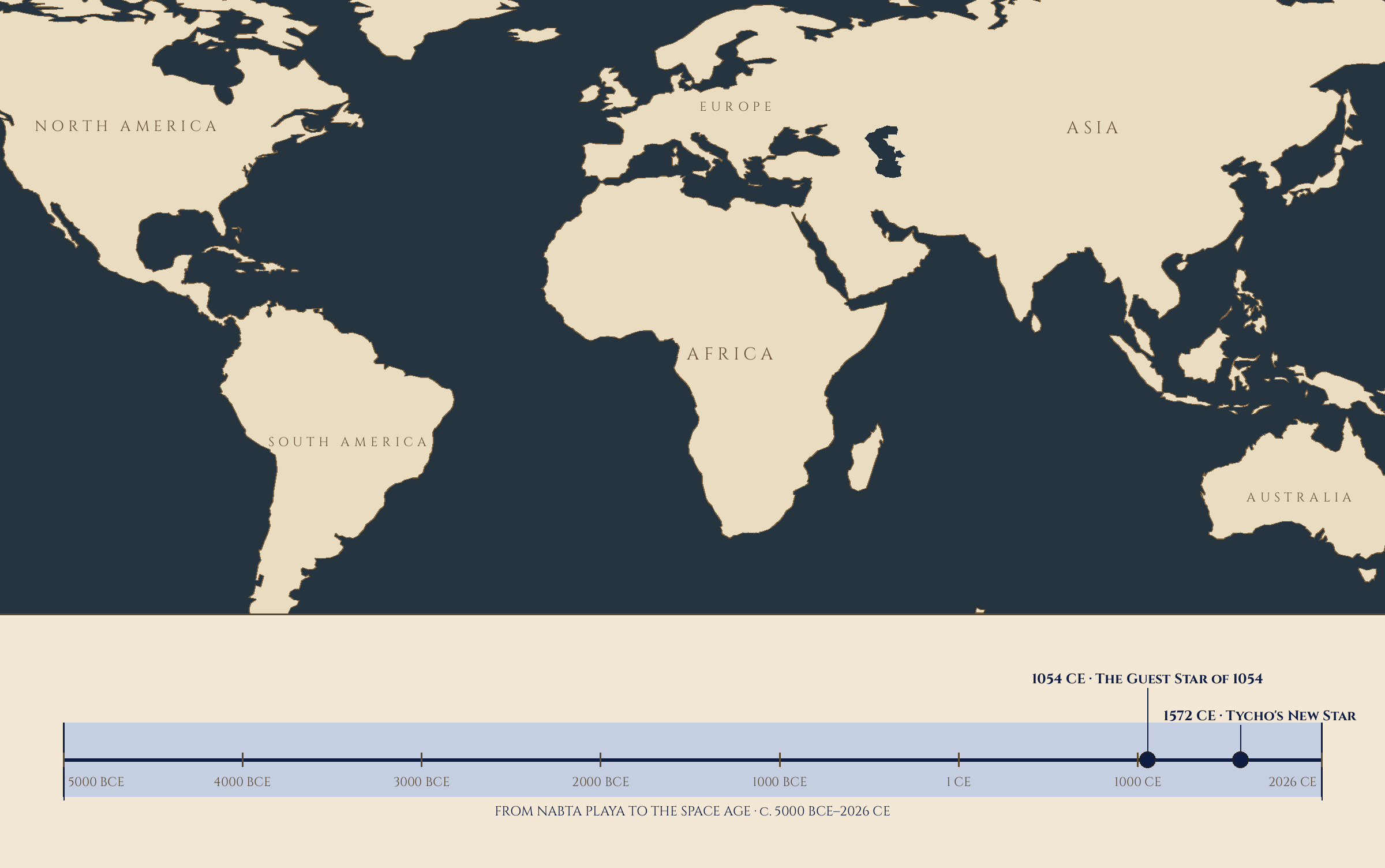
Where and when: your own sky, tonight — Fireworks: Comets, Meteors & Supernovae. This lesson has no pin: its place is wherever you stand under the night sky. Its stops stand on the road below: 1054 CE · The Guest Star of 1054 (year 1054) + 1572 CE · Tycho's New Star (year 1572). The line beneath the map is our road through the course: every stop a moment when watching the sky changed, every lesson a place upon it.
Lesson Objectives
By the end of this lesson, you will be able to:
- Describe what a comet is (a "dirty snowball" of ice, dust, and rock) and explain how its coma and its two tails form, including which tail points directly away from the sun and why.
- Tell the story of Halley's Comet from the 1066 omen to Edmond Halley's 1705 prediction and the comet's return in 1758.
- Distinguish a meteoroid, a meteor, and a meteorite, and explain why meteors are not stars.
- Explain why meteor showers happen every year at the same dates, and name the peak dates and parent bodies of the Perseids, Geminids, Leonids, and Quadrantids.
- Describe the two kinds of supernovae in simple terms and explain what Tycho Brahe's 1572 observations proved about the heavens.
- Plan and carry out a one-hour meteor watch, logging the rate of meteors seen.
Reading this lesson: ★ marks the passages to remember. They return on the unit quiz and the class test. Check in questions ask the material back as you go; answer them in your workbook when you meet them.
Working this lesson: Your assignment packet is the first download on this page. Work in it as the lesson moves along, answering each exercise as its subject is taught — or read the lesson through for your notes and take the exercises as homework afterward. Both are proper ways to sit this class. Signposts in the reading tell you where each exercise belongs. Written answers are short answers in your own words; a few honest lines are worth more than a filled page.
Your Assignment Packet
This lesson's exercises live in its packet: the Lexicon Handout (every term, course terms marked ◆), Materials, Guided Practice, the Assignment Manual with its answer key for self-checking, the Reflection Questions, and the Workbook Checklist. Download the packet before you begin and keep it beside you as you read. The packet's exercises are Glimmerwick's own word for the work: Exercise I: The Meteor Shower Watch ◐, Exercise II: Take a Comet Apart ⚒, and Exercise III: From Omen to Orbit ✎. The lesson's quiz is not printed in the packet; it pools to the Unit IV Quiz, where it will meet you again.
Safety Briefing
Night-observing safety. All night observing in this course is done with an adult present, in a familiar and safe location. Tell someone where you are going and when you expect to return. Dress warmly, bring a flashlight for the walk, and watch your footing in the dark. Do not climb onto roofs, walls, or anything you could fall from in the dark.
Your eyes and the dark. It takes your eyes twenty to thirty minutes to fully adjust to darkness. Once they have, a glance at a phone screen or a white flashlight will undo the work and you must start over. Use the dimmest light you can, and consider covering your flashlight with red cellophane: red light disturbs night vision far less than white. This is not about danger. It is about giving your eyes their best chance to catch faint meteors.
Meteors need no eye protection. A meteor shower is watched with the naked eye, exactly as people have watched them for thousands of years. No glasses, no filters, no equipment. The streaks are far away and harmless.
Binocular rule for comet hunting. If you take up the Level Two comet hunt, never sweep binoculars anywhere near the sun, and never use them in daylight to look for a comet. Comet hunting happens in full darkness, well after sunset or well before sunrise. Binoculars concentrate light, and concentrated sunlight injures eyes in seconds.
No open flames for night comfort. If the night is cold, dress for it. Do not bring candles or camp stoves to your observing spot. The sky has waited billions of years for you. It will wait while you fetch a blanket.
The Wonder
Pick a clear night in mid-August, find the darkest spot you can reach, and lie back on a blanket with your eyes on the whole sky. Do nothing. That is the entire technique.
After a few minutes, your eyes adjust, and the sky deepens. After ten, the faint stars come out like a held breath being released. And then, without warning, a line of light draws itself across the black, there and gone in less than a second. You gasp. You point, too late. Your companion says, "Did you see that?" and you both laugh, because that is the oldest conversation in astronomy.
If you stay an hour on a good night, you will see dozens. If you stay on the peak night of a great shower, you will see them faster than you can count. These are the Perseids, and they have fallen every August for as long as humans have written anything down. The ancient Chinese called meteors "scattered stars." The old English word for them meant sparks. Every culture that ever lay back under a dark sky has seen this show and tried to name it.
Tonight you will learn what the show is, where it comes from, and why it keeps such a faithful calendar. And you will learn about the sky's two grander fireworks: the comets that cross the sky for weeks like slow torches, and the supernovae that have, a few times in history, lit up the daytime sky itself. Lie back, scholars. The show is about to begin.
❦ In your workbook: record the wonder in your own way — the line of light there and gone in less than a second, the Perseids falling every August, and the oldest conversation in astronomy — copy, sketch, or note what matters.
The Story
The hairy star over Harold
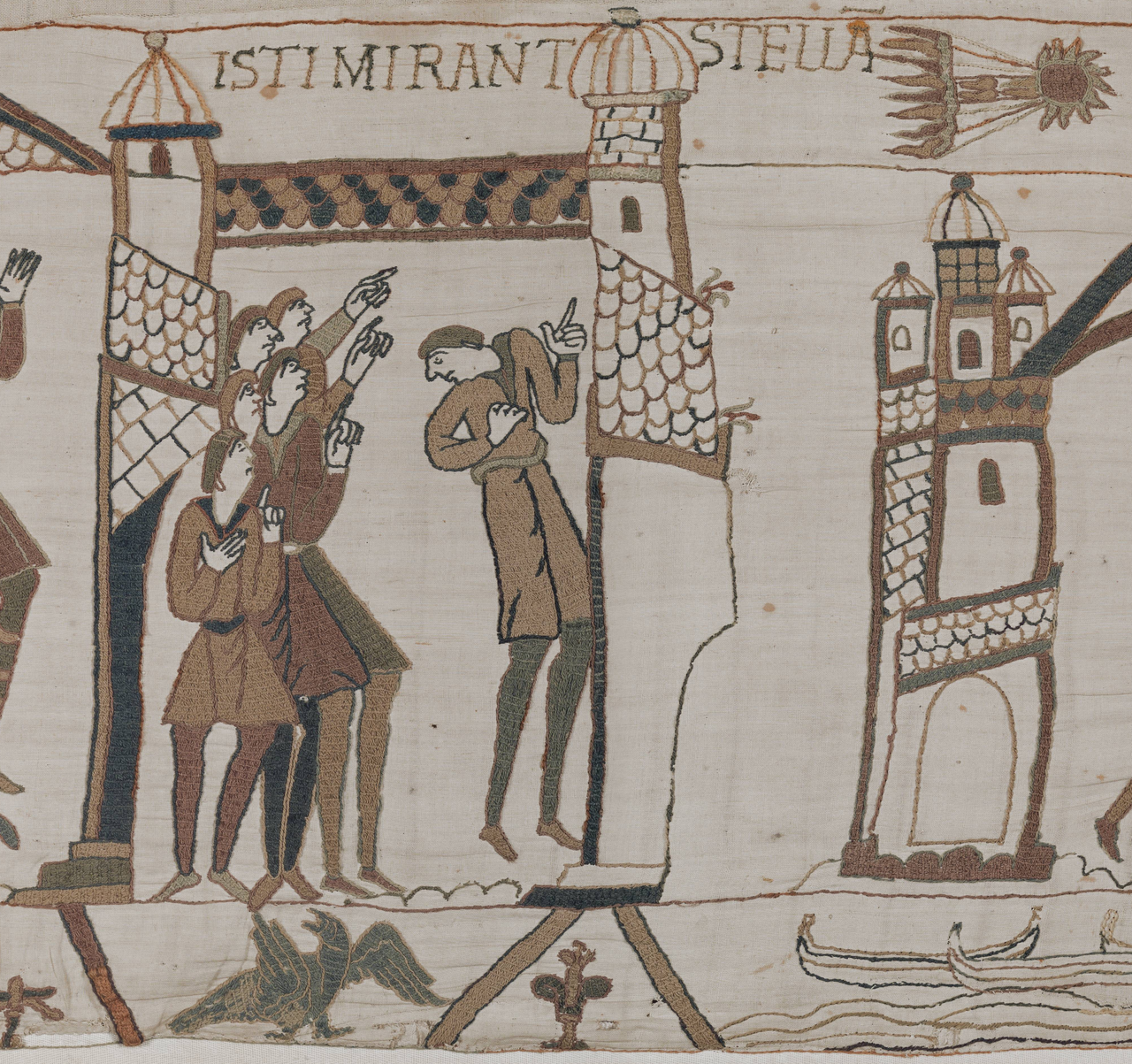
The comet of 1066 on the Bayeux Tapestry (scene 32): men point up at the streaking star beneath the caption ISTI MIRANT STELLA, "these men marvel at the star." The tapestry's makers placed the comet beside Harold's coronation, although it actually appeared months later, in April — heaven's verdict, arranged by the storytellers.
Bayeux Tapestry (11th century), photograph by Université de Caen Normandie · CNRS · ENSICAEN after the 2017 photographic campaign of the Fabrique de patrimoines en Normandie, via Wikimedia Commons.
In the spring of 1066, a comet appeared over England. The Anglo-Saxon Chronicle, the year-by-year record kept by English monks, notes that it was first seen on the evening of April 24 and "shone thus all week." The chroniclers called it the "haired star," which is what the word comet means: from the Greek kometes, the long-haired one. The hair was the tail, streaming across the spring sky.
King Harold had been crowned in January. To Harold's enemies, the comet's timing was a gift. The Bayeux Tapestry, the great embroidered chronicle of the Norman Conquest made in the 1070s, gives the comet its own scene: a crowd of men pointing upward at a streaking star, with the Latin caption ISTI MIRANT STELLA, "these men marvel at the star." The tapestry's makers placed the comet right after Harold's coronation, although the comet actually appeared months later, in April. That rearrangement was deliberate. For the Norman storytellers, the comet was heaven's verdict on Harold: a bad omen, a sign that his crown was doomed.
William of Normandy read the same comet the opposite way, as a good omen for his invasion. He won at Hastings that October, and the comet went into history as the sky's announcement of the Norman Conquest. That comet was Halley's. It has been linked to observations going back to 240 BC, and it would return again and again, every 74 to 79 years, long after Harold and William were dust. But in 1066, nobody knew it would ever come back. A comet was a visitor, not a resident. It appeared, it meant something terrible or wonderful, and it left.
Check in: The same comet was a bad omen for Harold and a good omen for William — what does that tell you about omens, and what did nobody in 1066 yet know about this visitor?
❦ In your workbook: record the hairy star in your own way — the Chronicle's April 24 entry, the tapestry's pointing crowd and its caption, and the comet rearranged to sit beside a coronation — copy, sketch, or note what matters.
The clerk who tamed the comet
Edmond Halley was an English astronomer, a friend and publisher of Isaac Newton, and a man with a clerk's love of lists. In 1705 he published the Synopsis of the Astronomy of Comets, in which he gathered 24 comet observations and did something no one had done before: he ran them through Newton's new laws of gravity and motion, calculating orbits the way Newton had shown planets' orbits could be calculated.
Three of the observations matched. The bright comets of 1531 (recorded by the German astronomer Petrus Apianus), 1607 (recorded by Johannes Kepler), and 1682 (which Halley himself had watched that September) had nearly the same orbit. Halley concluded they were one object, a single comet returning about every 76 years, its schedule nudged a little each time by the gravity of Jupiter and Saturn. And then he did the daring thing: he predicted. Allowing roughly for the planets' tugging, he said the comet would return in 1758.
★ Halley died in 1742, sixteen years before his appointment came due. But the comet kept it. On Christmas night, 1758, a German farmer and amateur astronomer named Johann Georg Palitzsch spotted it, and over the following weeks observers across Europe confirmed it. It reached perihelion, its closest approach to the sun, on March 13, 1759, delayed by the pull of Jupiter and Saturn, a delay three French mathematicians (Alexis Clairaut, Joseph Lalande, and Nicole-Reine Lepaute) had computed in advance. The return was the first proof that something besides a planet orbited the sun, and one of the earliest triumphs of Newton's physics. In 1759 the French astronomer Nicolas-Louis de Lacaille named the comet for the man who had predicted it.
The comet has kept every appointment since. In 1986 it was met by an international fleet of spacecraft, including the European Space Agency's Giotto, which flew within 600 kilometers of the nucleus and photographed it: a dark, potato-shaped lump about 15 kilometers long, blacker than coal, with jets of gas venting from its sunlit side. Its next perihelion comes in 2061. If you are young now, mark your calendar. You may get to see it twice.
Check in: Which three apparitions did Halley match as one comet, what did he predict, and who named the comet for him — and when?
❦ In your workbook: record the taming in your own way — 24 observations run through Newton's laws, three apparitions matched, a prediction made for 1758, and an appointment kept on Christmas night — copy, sketch, or note what matters.
The guest star of 1054
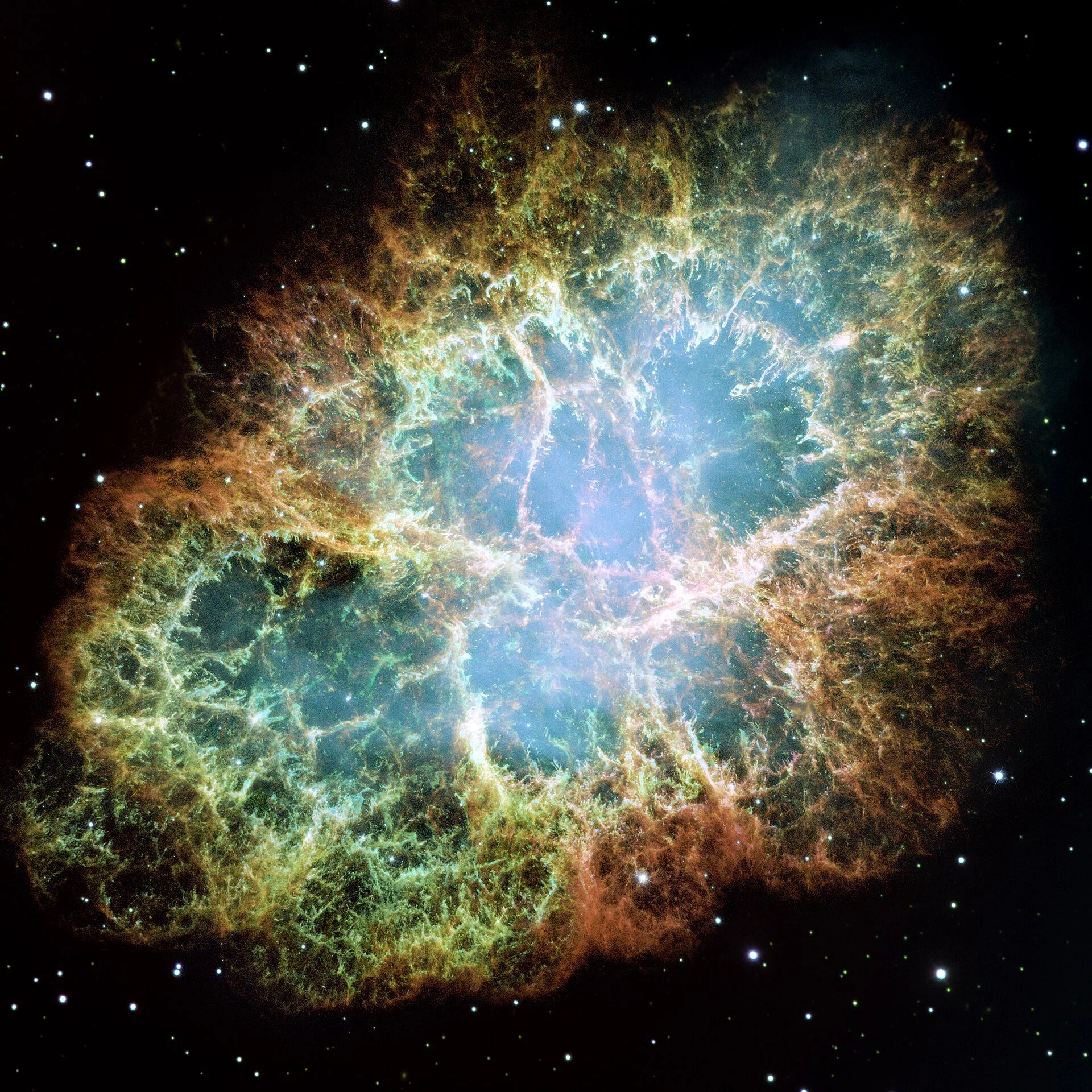
The Crab Nebula, photographed by the Hubble Space Telescope: the still-expanding remains of the guest star of July 4, 1054, about 11 light-years across and some 6,500 light-years away in Taurus. Messier catalogued it as M1 in 1758 while hunting for Halley's returning comet; at its heart spins the Crab Pulsar, the dead star's collapsed core, flashing 30 times a second.
NASA, ESA, J. Hester and A. Loll (Arizona State University) — Hubble Space Telescope mosaic (STScI).
★ On July 4, 1054, court astronomers in China recorded a "guest star" in the constellation Taurus, near the star the Chinese called Tien-Kuan. It was bright enough to see in daylight, and it stayed visible for 23 days in the daytime sky and nearly two years at night, 653 days in all, before it faded. Japanese observers recorded it too, in the court diary called the Meigetsuki. An Arab physician of the time, Ibn Butlan, noted it as well, in an account preserved in a later copy. (A rock drawing in Chaco Canyon in the American Southwest may depict it, but scholars debate the identification, so treat that one as a maybe.)
What they saw was a star dying. A massive star, nine to eleven times the mass of our sun, had run through its fuel, and its iron core had collapsed in less than a second. The outer layers rebounded off the collapsed core and were blown into space in one of the most violent events the universe produces. For weeks, that explosion outshone everything in the sky but the sun and moon.
★ The guest star is gone, but its remains are still there. In the constellation Taurus sits the Crab Nebula, a tangle of glowing filaments about 11 light-years across and some 6,500 light-years away, still expanding outward at about 1,500 kilometers per second. It was found in 1731 by the English astronomer John Bevis, and found again in 1758 by Charles Messier, who was hunting for Halley's returning comet and kept tripping over fuzzy objects that were not comets. The Crab was the first entry in the catalog Messier began to keep so that comet hunters would not be fooled again: Messier 1, M1. In the early 1840s, William Parsons, the Earl of Rosse, drew it through his great telescope and thought its filaments looked like a crab's legs. The name stuck.
In the 1920s, astronomers photographed the nebula years apart and saw it growing. Tracing the expansion backward led to a date in the mid-1000s, and the old guest-star records fell into place: the Crab Nebula is the leftover of the supernova of 1054, the first object in the sky ever proven to be a historical supernova's remains. At its heart spins the Crab Pulsar, the collapsed core of the dead star, a neutron star less than 30 kilometers across, spinning 30 times every second, flashing like a lighthouse.
Check in: Who recorded the guest star of 1054, how long did it stay visible — and what was Charles Messier hunting when he found its remains in 1758?
❦ In your workbook: record the guest star in your own way — 23 days in the daytime sky, a star's iron core collapsing in less than a second, and the Crab that Messier catalogued so comet hunters would not be fooled again — copy, sketch, or note what matters.
The new star of 1572
On the evening of November 11, 1572, the Danish astronomer Tycho Brahe was walking home when he noticed a brilliant new star in the constellation Cassiopeia, where no star had been before. He had his servants and passersby confirm it, because even Tycho wanted a second opinion when the sky did something impossible. The star was bright enough to rival Venus. It stayed visible for about eighteen months, slowly fading.
This was a crisis for the official science of the day. Every European university taught Aristotle's cosmology: the region beyond the moon was perfect and unchangeable, made of a flawless fifth element. Anything that appeared and vanished, a comet, a new light, had to be a weather event in Earth's own atmosphere, below the moon. If the new star were atmospheric, it would show daily parallax: it would appear to shift against the background stars as the observer's position changed through the day, the way a nearby tree shifts against distant hills when you walk.
★ Tycho measured. Night after night, with a large wooden sextant of his own construction, he fixed the new star's position against the stars of Cassiopeia, and it did not move. No measurable parallax meant it was farther than the moon, farther than any of the planets, up among the fixed stars themselves. A new star had appeared in the unchangeable heavens, and the unchangeable heavens had therefore changed. Tycho published his findings in 1573 in a book titled De nova stella, "On the New Star," and the word nova entered the languages of Europe as the name for such outbursts.
Five years later, in 1577, Tycho did it again with a great comet, measuring its parallax and proving it too was farther than the moon. Aristotle had said comets were burning gases in Earth's atmosphere. Tycho's measurements said otherwise. Between the new star and the comet, the doctrine of the immutable heavens was finished, and it was finished by the most old-fashioned method in science: careful measurement, night after night, written down. Modern studies of the 1572 remnant classify it as a Type Ia supernova, the complete detonation of a white dwarf star. You will meet both kinds of stellar death in the mechanism section below.
Check in: If the new star had been a weather event below the moon, what should Tycho have seen — and what did his measurements actually show?
❦ In your workbook: record the new star in your own way — a second opinion asked of passersby, night after night of measurement with a wooden sextant, and the unchangeable heavens changed — copy, sketch, or note what matters.
The Mechanism
What a comet is
★ A comet is a dirty snowball. That is the technical description, and it comes from the American astronomer Fred Whipple, who proposed it in 1950: a comet's solid heart is a mixture of water ice, frozen carbon dioxide and ammonia, dust, and rocky material, loosely packed, typically only a few kilometers across. The nucleus of Halley's Comet, photographed by the Giotto spacecraft in 1986, is about 15 kilometers long, shaped like a potato, and darker than coal, reflecting only about four percent of the sunlight that hits it. Most of the surface is not ice at all but dark dusty crust; the ice vents to space through cracks and pits on the sunlit side, in jets.
Far from the sun, a comet is inert, a dark lump on a long orbit. But when it ventures into the inner solar system, sunlight warms the nucleus, and the ices sublimate, turning directly from solid to gas in the vacuum of space. The escaping gas drags dust with it, and the comet grows a coma, a glowing atmosphere of gas and dust around the nucleus that can swell to 230,000 kilometers across, far larger than the nucleus itself. Keep falling sunward, and the coma grows the comet's famous tails.
Check in: What is a comet's nucleus made of, and what happens to those ices — and to the comet — as it falls sunward?
❦ In your workbook: record the dirty snowball in your own way — Whipple's 1950 description, a dark nucleus venting jets through its crust, and a coma swelling far larger than the heart inside it — copy, sketch, or note what matters.
The two tails
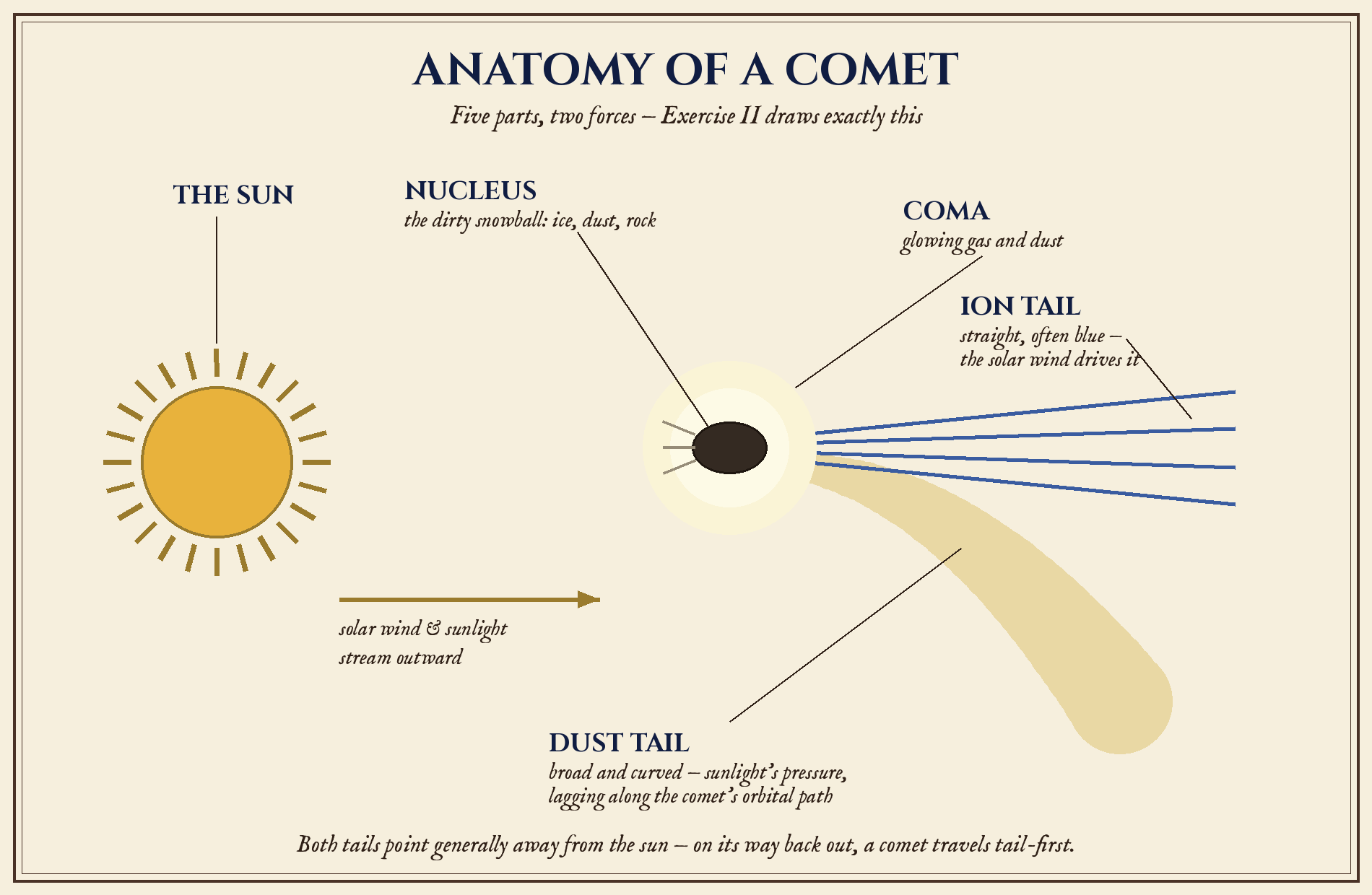
Anatomy of a comet: the dark nucleus inside its glowing coma, the ion tail blown straight away from the sun by the solar wind, and the dust tail curving behind under sunlight's pressure and the dust's own orbital motion. Draw it this way in Exercise II and you will never mix the tails up again.
Built digitally for this overhaul (Python/PIL, typeset labels and drawn diagram), from the mechanism taught in the lesson text.
A bright comet has two tails, and they are different things, made by different forces, pointing in slightly different directions. This is worth learning carefully, because the tails are a little physics lesson written across the sky.
★ The ion tail is made of gas that sunlight has ionized, stripping electrons from its atoms. The solar wind, the stream of charged particles flowing outward from the sun, grabs these ions and carries them straight outward. So the ion tail is straight, often blue (from glowing carbon monoxide ions), and it always points directly away from the sun, like a windsock in a gale.
★ The dust tail is made of solid dust grains released with the gas. Sunlight pushes on these grains, a gentle but relentless pressure of light, shoving them away from the sun. But dust grains are heavy compared to ions, so they lag: they keep something of the comet's orbital motion as they drift outward, and the tail curves, trailing behind along the comet's path. The dust tail shines yellowish-white by reflected sunlight, broader and softer than the ion tail.
Both tails point generally away from the sun, which leads to the comet's famous oddity: on its way back out of the inner solar system, a comet travels tail-first, like a torch carried backward. Tails can stretch for millions of kilometers, the longest structures in the solar system made by a single small body.
Check in: Which tail points directly away from the sun, what force drives it — and why does the other tail curve instead?
❦ In your workbook: record the two tails in your own way — one straight and blue on the solar wind, one broad and curving under sunlight's pressure, and a comet traveling home tail-first — copy, sketch, or note what matters.
In your packet: Exercise II: Take a Comet Apart ⚒ begins here — its drawing labels exactly these five parts and these two forces. Work it now, or mark the place and take it as homework — your choice.
Where comets live
Comets are deep-freeze leftovers from the solar system's formation, and they live in two great reservoirs. Short-period comets, which return in under 200 years, mostly come from the Kuiper Belt, a flat disc of icy bodies beyond Neptune, from about 30 to 50 times Earth's distance from the sun. Long-period comets, which may take thousands of years per orbit, fall in from the Oort Cloud, a vast spherical shell of icy bodies stretching from roughly 20,000 to 50,000 times Earth's distance, nearly halfway to the nearest star.
Halley is a short-period comet with a long-period past: its orbit suggests it began in the Oort Cloud and was gravitationally nudged by the giant planets into its present 76-year loop. Its orbit is extreme, with an eccentricity of 0.967 (a circle is 0), diving to within Mercury's distance of the sun at perihelion and retreating past Neptune, out to 35 times Earth's distance, at aphelion. It also orbits backward compared to the planets, a retrograde path tilted 18 degrees to the plane of the solar system. Every 76 years the planets tug it slightly, so its period wanders between 74 and 79 years. Predicting a comet is never quite as simple as setting an alarm.
❦ In your workbook: record the two reservoirs in your own way — the flat Kuiper Belt disc for the short-period comets, the vast Oort Cloud shell for the long, and Halley nudged from one home into its 76-year loop — copy, sketch, or note what matters.
What a meteor is
★ First, the vocabulary, because the three words sound alike and mean three different stages of one journey. A meteoroid is the object in space: a chip of rock or metal, usually no bigger than a grain of sand or a small pebble, drifting along its orbit. A meteor is the streak of light: the meteoroid plunging into Earth's atmosphere at tens of kilometers per second, heating white-hot by friction with the air, burning up tens of kilometers overhead. A meteorite is what reaches the ground, if anything survives the fall.
Note what is absent from that list: stars. A meteor is not a star, not a falling star, not a piece of a star. It is a speck of dust or a pebble, and the light you see is not the speck itself glowing but the air around it, heated to incandescence as the speck rams through it. On any clear dark night you can see a few random meteors per hour, the sporadic background drizzle of interplanetary dust. A shower is something else.
Check in: Name the three stages of one journey — the object in space, the streak of light, and what reaches the ground — and say why none of them is a star.
❦ In your workbook: record the three words in your own way — meteoroid in space, meteor in the air, meteorite on the ground, and the light that belongs to the heated air, not the speck — copy, sketch, or note what matters.
Why showers happen
★ Every year, on the same dates, Earth runs into a river of dust. The river was laid down by a comet (or, in one famous case, an asteroid): each time the parent body rounds the sun, it sheds dust and pebbles along its orbit, and over centuries the debris spreads into a continuous stream circling the sun. Earth's orbit crosses these streams at fixed points, so we plow through the same stream at the same time every year, and the meteors come in a meteor shower instead of a drizzle.
The meteors of a shower all travel on parallel paths, but perspective makes them appear to radiate from a single point in the sky, the radiant, the way parallel train tracks appear to meet at the horizon. Showers are named for the constellation that holds the radiant: the Perseids radiate from Perseus, the Geminids from Gemini, the Leonids from Leo. The Quadrantids are named for Quadrans Muralis, the Mural Quadrant, a constellation that was removed from the official list in 1922. The shower kept the name anyway, a small memorial to a deleted constellation.
Check in: Why does a shower return on the same dates every year, and why do its meteors seem to radiate from one point?
❦ In your workbook: record the river of dust in your own way — a stream laid down by a parent body, Earth crossing it at the same point each year, and parallel paths that only seem to meet at the radiant — copy, sketch, or note what matters.
The shower calendar
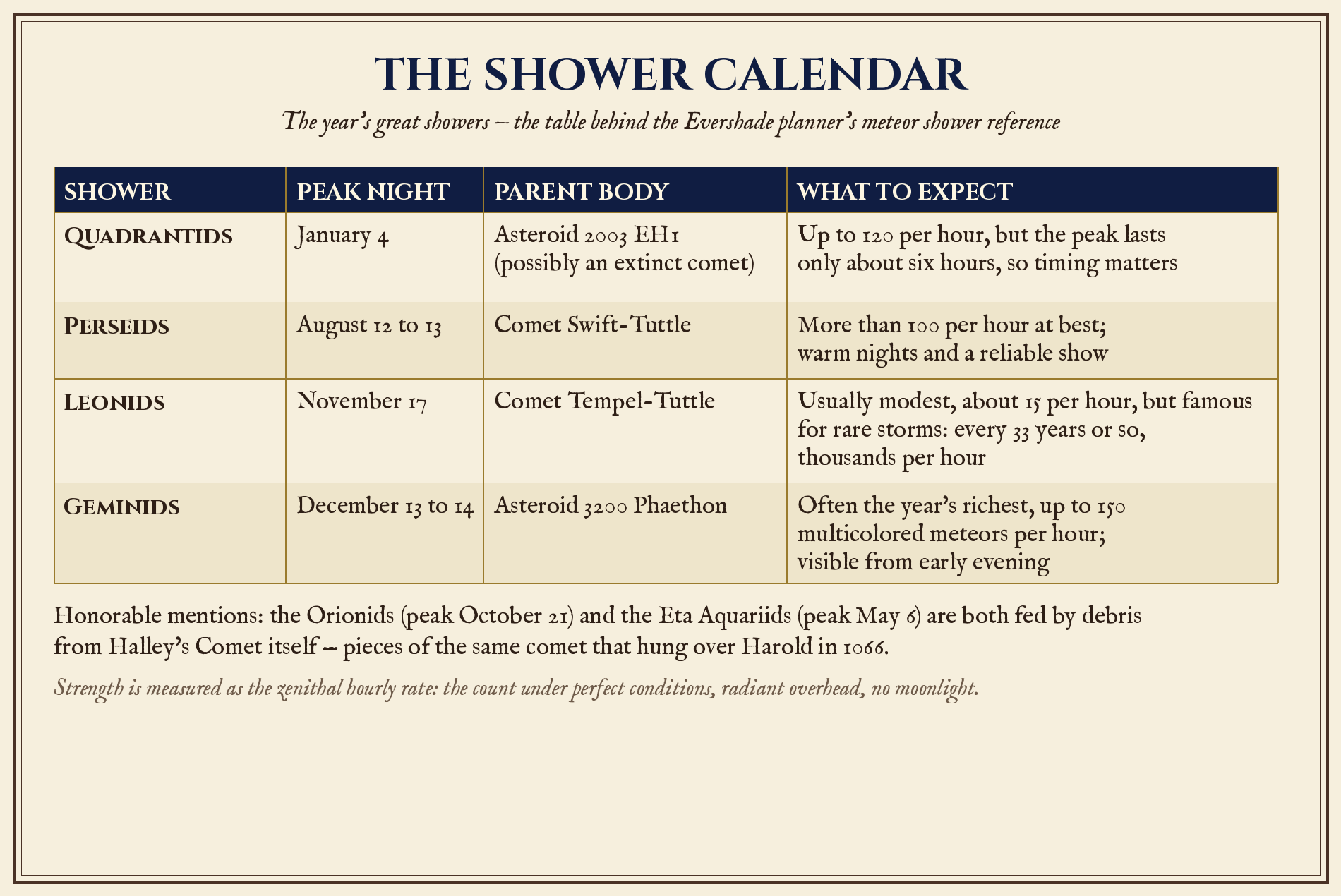
The Shower Calendar: the year's great showers, their peak nights, and their parent bodies — the table behind the Evershade planner's meteor shower reference. Exercise I begins here: choose the peak night of the next upcoming shower.
Built digitally for this overhaul (Python/PIL, typeset table), reproducing the final's taught table verbatim.
★ Here are the year's great showers, the ones worth planning around. Your Evershade planner carries a meteor shower reference, and this is the table behind it.
| Shower | Peak night | Parent body | What to expect |
|---|---|---|---|
| Quadrantids | January 4 | Asteroid 2003 EH1 (possibly an extinct comet) | Up to 120 per hour, but the peak lasts only about six hours, so timing matters |
| Perseids | August 12 to 13 | Comet Swift-Tuttle | More than 100 per hour at best; warm nights and a reliable show |
| Leonids | November 17 | Comet Tempel-Tuttle | Usually modest, about 15 per hour, but famous for rare storms: every 33 years or so, thousands per hour |
| Geminids | December 13 to 14 | Asteroid 3200 Phaethon | Often the year's richest, up to 150 multicolored meteors per hour; visible from early evening |
Two honorable mentions, because they tie this lesson together: the Orionids (peaking October 21) and the Eta Aquariids (peaking May 6) are both fed by debris from Halley's Comet itself. When you watch the Orionids, you are watching pieces of the same comet that hung over Harold in 1066.
Shower strength is measured as the zenithal hourly rate, the number of meteors a single observer would see in an hour under perfect conditions, with the radiant directly overhead and no moonlight. Real counts are lower: moonlight washes out faint meteors, and the radiant is rarely at the zenith. A bright moon near a shower's peak can halve your count, which is why shower watchers check the moon's phase before they check the weather.
Check in: Name each great shower's peak night and parent body from the table — and say which two showers on it are fed by asteroids, not comets.
❦ In your workbook: record the calendar in your own way — the four great showers with their peaks and parents, Halley's own two showers as the honorable mentions, and the zenithal hourly rate your real count will fall short of — copy, sketch, or note what matters.
What a supernova is
A supernova is a star dying violently, and there are two ways it happens. Keep them straight, because the two guest stars of this lesson's story were one of each.
A core-collapse supernova is the death of a massive star, at least eight times the mass of the sun. Such a star burns through its fuel in stages, fusing lighter elements into heavier ones, until its core is iron. Iron cannot be fused for energy, so the core's support vanishes in an instant and it collapses inward in less than a second, then rebounds. The outer layers are blasted into space at thousands of kilometers per second, and for weeks the explosion can outshine its entire galaxy. What remains is the collapsed core: a neutron star, or, for the most massive stars, a black hole. The supernova of 1054 was a core-collapse supernova. The Crab Pulsar is its leftover heart.
★ A Type Ia supernova is the death of a white dwarf, the small, dense remnant of a star like our sun, in a binary system. If the white dwarf steals enough matter from its companion, or two white dwarfs merge, its mass crosses a critical limit and the whole star detonates in a runaway thermonuclear explosion. Nothing is left behind: no neutron star, no black hole, just an expanding cloud of debris. Type Ia supernovae are remarkably consistent in brightness, which is why astronomers use them as standard candles to measure the universe. Tycho's supernova of 1572 is classified today as a Type Ia.
Both kinds leave expanding clouds of gas called supernova remnants, and both seed the universe with heavy elements. The iron in your blood, the calcium in your bones, the oxygen you are breathing: all of it was forged in stars, and much of it was scattered by supernovae. The fireworks are not just decoration. They are the reason rocky planets, and people, exist.
Check in: The two guest stars were one of each kind — which kind was 1054, which was 1572, and what does each kind leave behind?
❦ In your workbook: record the two deaths in your own way — the massive star whose iron core collapses and rebounds, the white dwarf that detonates and leaves nothing, and the heavy elements both kinds scatter — copy, sketch, or note what matters.
In your packet: Exercise III: From Omen to Orbit ✎ begins here — its eight events are this lesson's whole story, from the guest star of 1054 to the spacecraft of 1986, waiting to be put in order. Work it now, or mark the place and take it as homework — your choice.
A Sealed Note on Patience
Scholars sometimes ask me whether I have a favorite among the sky's fireworks, and I confess I cannot choose between them, so I will tell you instead what they have in common, which is patience.
Halley's Comet keeps a 76-year appointment, and no human impatience has ever hurried it. The meteor showers keep a one-year appointment, and the only price of admission is lying still in the dark for an hour while your eyes learn to see. Tycho's new star asked for the longest patience of all: night after night of measurement, each one small, each one written down, until the pile of small measurements became a proof that moved the heavens.
I am a bat, and I will tell you a bat's secret about patience. We do not hurry the dusk. We wait at the mouth of the roost while the light thins, and we launch ourselves into exactly the right dark. The insects come. They always come. The night rewards those who arrive on its schedule rather than their own.
So when you go out for your meteor watch, and the first ten minutes show you nothing at all, do not pack up your blanket. The first ten minutes are your eyes adjusting, and the sky is just getting started. The meteors are coming. They always come.
❦ In your workbook: record the sealed note in your own way — three appointments kept on the sky's schedule, not ours, and the first ten empty minutes that are only your eyes adjusting — copy, sketch, or note what matters.
PROFESSOR VESPER GLIMMERWICK
Celestial Studies
Astronomer & Celestial Historian
Guided Observation
Try It Tonight
Part One: Your Meteor Shower Watch (Level One)
No equipment needed. This is the whole point: meteor watching is the most democratic observation in astronomy.
- Pick your shower and your night. Use the shower calendar in this lesson (or your planner's meteor shower reference) and choose the peak night of the next upcoming shower. The Perseids in August and the Geminids in December are the friendliest for beginners. Check the moon's phase: a bright moon near the peak will wash out faint meteors, so the nights just before or after the peak can be better than the peak itself.
- Find dark sky. The darker the better. A backyard away from house lights will do; a field outside town is better. Give yourself a clear view of as much sky as possible.
- Get comfortable and recline. Bring a blanket or a reclining lawn chair. You will be looking up for an hour, and a cricked neck ends watches early. Dress warmly, even in August: lying still gets cold.
- Let your eyes adjust. Spend at least twenty minutes in the dark before you start counting. No phones. If you need light, use the dimmest red light you have.
- Count for one full hour. Log every meteor you see, with the time. Note any especially bright ones (fireballs — meteors brighter than the planet Venus; one that explodes is a bolide) and which direction they traveled. At the end, compute your hourly rate. Compare it honestly with the shower's zenithal hourly rate and write down why yours differs: moonlight, haze, the radiant's height, your own missed minutes.
An adult must be with you, and someone at home should know where you are and when you will be back.
Check in: Your watch is planned from the calendar, not the clock on the wall — which shower did you choose, why that one, and what will you compare your hourly count against?
❦ In your workbook: record the watch in your own way — your chosen shower and peak night from the calendar, the moon's phase you checked, and the dark-sky spot you will lie back in — copy, sketch, or note what matters.
In your packet: Exercise I: The Meteor Shower Watch ◐ begins here — the watch itself, logged and compared with the shower's zenithal hourly rate. Work it now, or mark the place and take it as homework — your choice.
Part Two: Hunt a Comet with Binoculars (Level Two)
Comets bright enough to see with the naked eye are rare, but binoculars reveal fainter ones, and hunting them teaches you what a comet actually looks like: not a dramatic streak, but a small fuzzy patch, brighter in the middle, sometimes with a faint tail.
- Find out if a comet is currently visible. Astronomy magazines and sky-watching websites publish monthly comet forecasts with finder charts. Start there, and pick a comet predicted to be within binocular range.
- Go out in full darkness, well after sunset, with an adult, to your dark-sky spot. Let your eyes adjust.
- Sweep slowly with the binoculars across the forecast region, moving in a slow grid. A comet looks like a tiny cotton ball, a soft glow with a condensed center, distinctly fuzzier than the sharp points of stars around it.
- Never sweep near the sun. Do this only in full darkness, and never point binoculars at or near the sun at any time, for any reason.
Log what you find in your Sky Log: the comet's name, the date and time, the constellation, and a sketch of what you saw. If you find nothing, log that too, with the conditions. A careful negative observation is real astronomy.
❦ In your workbook: record the hunt in your own way — attempted or honestly not attempted, the fuzzy patch found or the careful negative observation logged — copy, sketch, or note what matters.
Sky Log Entry
Date and time of observation: _______________
Shower watched (or comet hunted): _______________
Moon phase and sky conditions: _______________
Meteors counted in one hour: _______________
Brightest meteor seen (describe it): _______________
From which constellation did most meteors seem to radiate? _______________
Your hourly rate compared with the shower's zenithal hourly rate: what explains the difference? _______________
One thing that surprised you tonight: _______________
❦ In your workbook: record the Sky Log entry in your own way — the hour's count, the brightest meteor, the radiant's constellation, and the honest comparison with the zenithal hourly rate — copy, sketch, or note what matters.
Materials
Required (Level One — household items)
- A blanket or a reclining lawn chair for the meteor shower watch: you will be looking up for an hour.
- Warm clothing, even in summer: lying still under a night sky gets cold.
- A workbook and a pencil for the Sky Log, the meteor count, and the exercises.
- A watch or phone (kept face-down and dark) for timing your one-hour count. Check the time, then put it away.
- Optional: red cellophane over a small flashlight to preserve your night vision while writing.
Suggested (Level Two — historically closer)
- Binoculars for the Level Two comet hunt, with a current monthly comet forecast and finder chart from an astronomy magazine or sky-watching site.
- A star chart or planisphere for finding the shower's radiant constellation and logging directions.
Reflection Questions
Answer in your workbook, in complete sentences.
- Comets changed, in human minds, from omens to appointments. What had to change for that to happen: the sky, or the watchers?
- The same object, Halley's Comet, was a bad omen for Harold, a good omen for William, a predicted appointment for Halley, and a spacecraft target in 1986. What does that progression say about how knowledge changes what a thing is to us?
- Tycho Brahe never saw a supernova remnant, never knew what a white dwarf was, and still proved the heavens could change. What does his story suggest about what careful measurement can do without a correct theory?
- The Geminids come from an asteroid, not a comet. Why does that detail matter for the definition of a meteor shower, and what does it suggest about categories in science?
- If you could stand under the sky for any one event in this lesson, the comet of 1066, the guest star of 1054, Tycho's new star, or the next perihelion of Halley in 2061, which would you choose, and what would you most want to notice?
Workbook Checklist — Lesson 23
In my workbook I have:
- ☐ chosen my shower from the lesson's calendar and laid out my watch log page from its row
- ☐ carried out the one-hour meteor watch with an adult present, and logged the count, the fireballs, and the conditions
- ☐ written the paragraph comparing my hourly rate with the shower's zenithal hourly rate, with at least two reasons for the difference
- ☐ drawn and labeled the comet's five parts, with arrows for the solar wind and sunlight's pressure, and written the two-tails explanation beneath it
- ☐ numbered the eight events of Exercise III in chronological order, with one sentence of contribution for each
- ☐ completed my Sky Log entry for the watch night
☐ Lesson completed Date: ___ Signature: ___
Cross-Class Connections
Runes · Unit IV, Lesson 13 — The English Expansion
Tower scholars, the chroniclers who wrote down the haired star of 1066 wrote in Old English, in a land whose carvers had stretched twenty-four runes to twenty-nine so that every sound of that language could be written truly. Come to my web and learn the futhorc they built: the expansion, the thorn and the wynn, and the letters that outlived the runes themselves. Professor Glimmerwick reads what those sky-watchers saw. Here, we read the letterforms they saw it with.
PROFESSOR THISTLELOOM WEBBLETHORN
Runes & Ancient Writing
Scrollwork · Unit IV, Lesson 16 — Insular & Early Medieval Scripts
Tower scholars, the records this lesson leans on — the Chronicle's year-by-year entries among them — were written by hand, in the island hand my fourth unit ends with: wedge-shaped ascenders, spiked descenders, letters confined within four ruled lines. Come to the Scrollwork Library and learn to write that hand yourselves, stroke by stroke. Professor Glimmerwick shows you why the records' survival matters to science. Here, we teach you how such records were made.
PROFESSOR QUILLBERRY NOCTURNE
Scrollwork Library

Creative Arts · Studio Extension E5 — Relief & Scale Displays
Bring the comet to my bench, scholars: a dark nucleus, a glowing coma, one straight streamer for the ion tail pointing away from your lamp-sun, one curved streamer for the dust. A scale display is a claim made solid, and yours must confess what it bent — the tails run for millions of kilometers, and no workshop wall holds that, so your maker's plate will say what your scale kept and what it surrendered. Build it right, label it true, and you will never mix the tails up again.
PROFESSOR COGBRANCH TIMBERCLANK
Creative Arts Workshop
The Professor's Closing Note
And so the fireworks fade, scholars, as fireworks do, and the ordinary stars come back out, which were extraordinary all along.
You now carry three stories and the mechanisms behind them. You know that a comet is a dirty snowball wearing a glowing atmosphere, with one tail blown straight back by the solar wind and one tail curving with the dust, and that the most famous of them went from an omen over a battlefield to an appointment kept in 1758, 1835, 1910, and 1986. You know that meteors are specks of comet dust burning up overhead, that showers are Earth's annual appointments with debris streams, and that the Geminids come from an asteroid, which is the kind of detail that keeps astronomy interesting. And you know that twice in history, a new star appeared where none had been, and that patient measurement turned both appearances into revolutions: one gave us the Crab Nebula and its impossible spinning heart, and the other broke the doctrine that the heavens cannot change.
Keep your Sky Log. Write down the date of your meteor watch, your hourly count, and the one that made you gasp. Somewhere in your notes, the way the Babylonians' notes held the Saros, a pattern may be waiting. And mark 2061 on a calendar you intend to keep. Halley's Comet is coming back, and I fully expect some of you to be standing under a dark sky, sixty-odd years old and grinning, when it does.
Until our next evening together, keep looking up. The sky is patient with beginners, and it is spectacular with everyone.
PROFESSOR VESPER GLIMMERWICK
Celestial Studies
Astronomer & Celestial Historian
Further Reading & Sources
These are real destinations for further study. All were opened and verified live, including the NASA page (first checked via search results during a rate-limited session, opened and verified live on 2026-10-12).
- NASA Science: 1P/Halley, history and science of Halley's Comet. https://science.nasa.gov/solar-system/comets/1p-halley/
- Halley's Comet: the full story, from the 1705 prediction to the 1986 spacecraft encounters. https://en.wikipedia.org/wiki/Halley's_Comet
- Natural History Museum, London: meteor shower guide with 2026 peak dates, parent bodies, and watching tips. https://www.nhm.ac.uk/discover/meteor-shower-lyrids-perseids-geminids-leonids-orionids.html
- Astronomy Magazine: July 4, 1054, the Crab Nebula supernova and its records around the world. https://www.astronomy.com/today-in-the-history-of-astronomy/july-4-1054-the-crab-nebula-supernova-explodes/
- The Crab Nebula: supernova remnant, pulsar, and the Messier connection. https://en.wikipedia.org/wiki/Crab_Nebula
- Nautilus: The Supernova That Sparked the Original Scientific Revolution, on Tycho Brahe's 1572 observations. https://nautil.us/the-supernova-that-sparked-the-original-scientific-revolution-1281459/
Sealed in the Celestial Tower, in deep midnight blue, by Professor Vesper Glimmerwick.
Browse the Celestial Studies shelf in the school Library for readable editions of these works.
Submit your work for this lesson using the form below.
THE UNIT IV QUIZ
CELESTIAL TOWER · UNIT IV: THE FIXED STARS
Unit IV is complete: you have met the Sun as our own star, learned what stars are and how their distances are measured, followed their Arabic names across a thousand years of copying, read the constellations and their stories, wondered at the deep sky, and closed with the fireworks — comets, meteors, and supernovae. This quiz gathers the whole unit into one sitting. Take it from memory first, before you look back at your notes, because it measures what has stayed with you. If you kept the passages marked ★ in your workbook as you read, you have already practiced most of what it asks.
The quiz packet is a single download. Part I gathers multiple-choice questions from across the unit, Part II asks true or false, Part III matches the unit's vocabulary, and the answer key waits at the back for self-checking. When you have finished, score it honestly, note the result in your workbook, and revisit any lesson whose questions went wrong before you move on.
CONTINUE IN THE CELESTIAL TOWER
← Previous · Lesson 22: Deep Sky Wonders Next · Lesson 24: Babylon: Where the Zodiac Was Born →
Unit IV — The Fixed Stars Celestial Tower — All 33 Lessons
The rest of Unit IV: Lesson 18 · The Sun · Lesson 19 · What Stars Are · Lesson 20 · Star Names · Lesson 21 · Constellations · Lesson 22 · Deep Sky Wonders
From the Celestial Shelf
The printed companions to this lesson, from Professor Glimmerwick’s shelf in the shop.