
CELESTIAL STUDIES
Unit V · Lesson 24Babylon: Where the Zodiac Was Born
Professor Vesper Glimmerwick
Astronomer & Celestial Historian
The Celestial Tower • School of Evershade
The Professor's Introduction

The evening sky is waiting, scholars,
Every evening, when I slip out of the Celestial Tower for my flight, I do something the Babylonian sky-watchers did more than two thousand years ago: I check the sky before I do anything else. They watched it to advise kings. I watch it to decide whether it will rain on my wings. Different errands, same habit. The sky was the first thing humans ever learned to read on purpose, and Babylon was its first library.
This lesson is about that library: clay tablets covered in wedge-shaped writing, holding star lists, moon charts, and the omens of kings. It is about the invention of the zodiac, which began not as a guide to personalities but as a calendar and a coordinate grid. And it is about how astonishingly good the Babylonian astronomers were at watching, recording, and predicting, even while they believed the sky was speaking to them.
A word about how we study this, and I am very serious about it. Everything in this unit is history: the history of what people believed about the sky, and why. We will not cast horoscopes, we will not read omens for anyone, and this lesson will never sort you into a sign. The Babylonians read the sky for their king. We read their tablets to understand them. That is the whole of our business tonight.
Come and meet the first astronomers.
PROFESSOR VESPER GLIMMERWICK
Celestial Studies
Astronomer & Celestial Historian
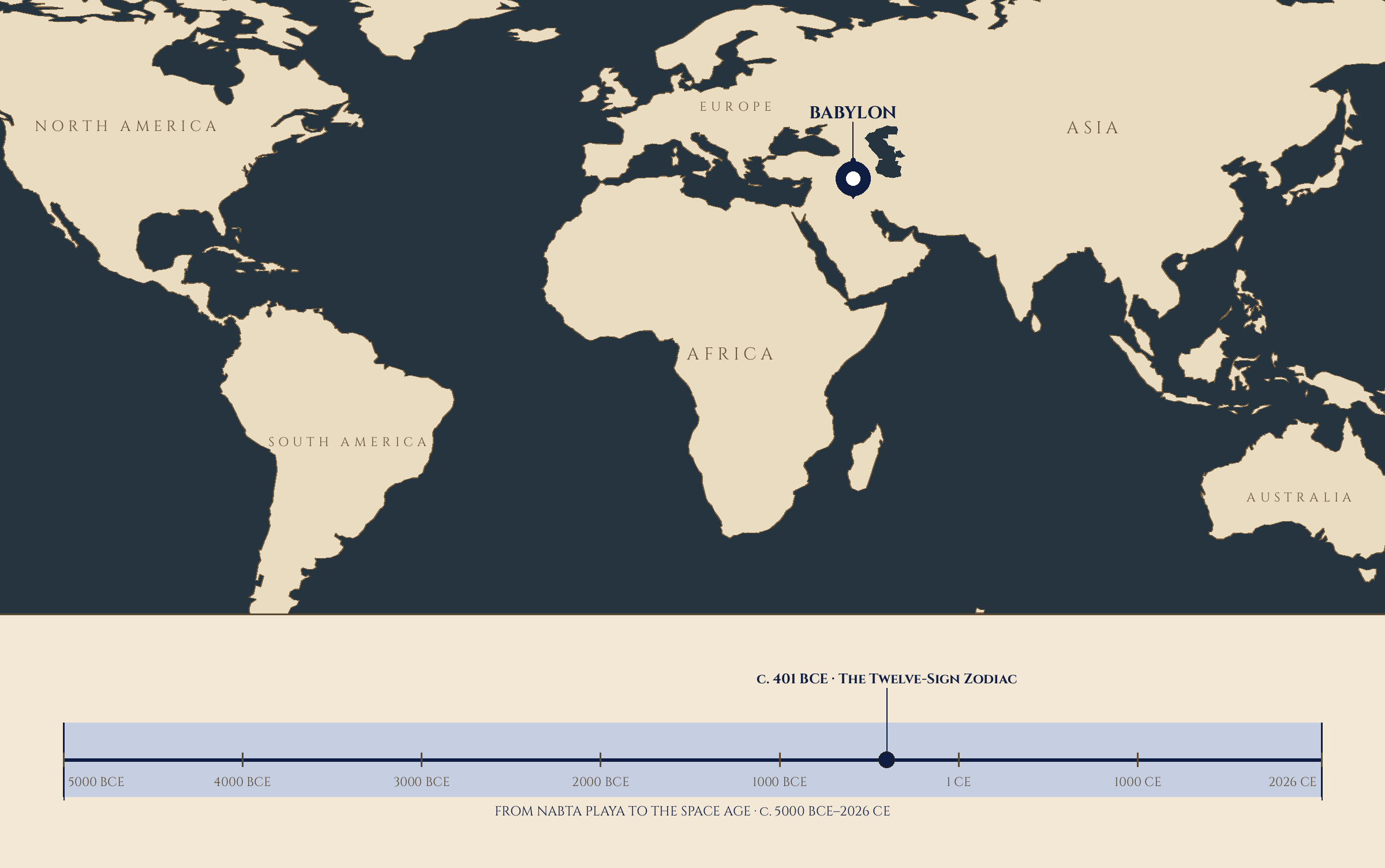
Where and when: BABYLON, c. 401 BCE · The Twelve-Sign Zodiac (year −401) — Babylon: Where the Zodiac Was Born. The pin is this lesson. The line beneath the map is our road: every stop a moment when watching the sky changed, every lesson a pin upon it.
Lesson Objectives
By the end of this lesson, you will be able to:
- Explain why the zodiac was invented: a calendar and a coordinate system, not a personality guide.
- Describe the cuneiform astronomical tablets (MUL.APIN, Enuma Anu Enlil, the Astronomical Diaries) and what each kind recorded.
- Explain the mechanism behind the twelvefold division: twelve 30-degree signs modeled on twelve ideal 30-day months, using base-60 arithmetic.
- State who Babylonian omens were for (the king and the state) and why personal horoscopes came later.
- Summarize what made Babylonian astronomy genuinely excellent: long records, recognized periodicities, eclipse prediction.
- Give the honest framing: statecraft and calendar-keeping expressed as divine signaling.
Reading this lesson: ★ marks the passages to remember. They return on the unit quiz and the class test. Check in questions ask the material back as you go; answer them in your workbook when you meet them.
Working this lesson: Your assignment packet is the first download on this page. Work in it as the lesson moves along, answering each exercise as its subject is taught — or read the lesson through for your notes and take the exercises as homework afterward. Both are proper ways to sit this class. Signposts in the reading tell you where each exercise belongs. Written answers are short answers in your own words; a few honest lines are worth more than a filled page.
Your Assignment Packet
This lesson's exercises live in its packet: the Lexicon Handout (every term, course terms marked ◆), Materials, Guided Practice, the Assignment Manual with its answer key for self-checking, the Reflection Questions, and the Workbook Checklist. Download the packet before you begin and keep it beside you as you read. The packet's exercises are Glimmerwick's own word for the work: Exercise I: The Twelvefold Circle ◐, Exercise II: Reading Like a Court Scholar ✎, and Exercise III: Three Nights a Babylonian ◐. The lesson's quiz is not printed in the packet; it pools to the Unit V Quiz, where it will meet you again.
Safety Briefing
Night-observing safety. All night observing in this course is done with an adult present, in a familiar and safe location. Tell someone where you are going and when you expect to return. Dress warmly, bring a flashlight, and watch your footing in the dark.
Indoor work safety. The drawing activity in this lesson uses a ruler, a pencil, and a protractor or compass. Handle the compass point with care, and never point it toward another person. Work at a clear table with good light.
A note on respect. The omen texts in this lesson are real historical documents from a real culture. We study them the way we would study any ancient record: with curiosity and respect, never as a game to play on ourselves or our friends. The Babylonians took these texts seriously, and so do we.
The Wonder
Imagine you are holding the oldest sky records in the world, and they are made of mud.
Not metaphorically. Literally. They are small clay tablets, some no bigger than your palm, covered in tiny wedge-shaped marks pressed into the wet clay with a cut reed, then baked or sun-dried until they were hard as stone. And what the wedges say, once scholars learned to read them, is this: Venus rose here, on this date. The moon was eclipsed in the small hours, and this is which part of the kingdom it touched. The Pleiades appeared just before sunrise, which means it is time to think about the calendar. Night after night, year after year, for centuries.
The people who wrote these tablets lived in Babylon, the great city on the Euphrates in what is now Iraq. They were scholar-priests, and they watched the sky the way a treasurer watches accounts: systematically, nightly, and in writing. Their records are the oldest continuous sky-watching program in human history. Without them, there would be no zodiac. Without them, the Greeks would have had far less to build on, and our whole sky would look different.
★ And here is the part that surprises most people. The zodiac these scholars invented had nothing to do with personality. It was a calendar tool and a measuring grid: twelve equal slices of the sky's great circle, each named for a constellation that sat roughly inside it, used to track where the sun, moon, and planets were. The Babylonians read it to keep the festivals on time and to warn the king when the sky looked threatening. Nobody asked what sign they were born under. That idea would not exist for centuries.
Tonight you get to read their tablets' purpose, meet their system, and learn why twelve became the number that still organizes the sky.
Check in: What was the zodiac for, when Babylon invented it — and what had it nothing to do with?
❦ In your workbook: record the wonder in your own way — records made of mud, Venus rising on a named date, and a zodiac that was a calendar tool and a measuring grid, never a personality guide — copy, sketch, or note what matters.
The Story
The first hard drive
Before we meet the tablets, meet the writing. The Babylonians pressed their records into clay in cuneiform, the wedge-shaped script of Mesopotamia. Runes Lesson 1 reads cuneiform as writing: how the signs work, why they are wedge-shaped, and what the tablets physically are. That lesson studies the handwriting. This lesson studies what the handwriting was for.
The writing matters because it is why we know any of this. Clay is nearly indestructible when it is baked, and Babylon baked a lot of it. Hundreds of astronomical tablets survive, many of them now in the British Museum, and scholars are still reading them. A tablet can sit in a drawer for a hundred years and then, newly translated, change what we know about ancient science. The clay remembers everything. It was the first hard drive, and it has outlasted every storage medium humans have invented since.

A Note from the Headmaster
Headmaster's interruption, and a happy one. The Babylonians of this lesson pressed their sky into clay — and not only their sky. One clay tablet, written by a Babylonian scribe in 177 BCE, describes a race game, and matching it to the boards from the royal tombs of Ur — shell, lapis, and red limestone, four and a half thousand years old — gave the game back its road. We race it in the Games Room today.
Check in: Why do we know any of this at all — what did the writing material itself do for the record?
❦ In your workbook: record the first hard drive in your own way — wedge-shaped marks pressed with a cut reed, clay baked hard as stone, and a tablet that can wait a hundred years in a drawer and still be read — copy, sketch, or note what matters.
Twenty-one years of Venus
The oldest great sky record in the Babylonian archive is devoted to a single planet: Venus.
Tablet 63 of the great omen series (more on that series in a moment) is known as the Venus Tablet of Ammisaduqa. It lists the first and last visible risings and settings of Venus, date by date, across about 21 years. The observations belong to the reign of a Babylonian king named Ammisaduqa, who ruled in the 17th century BCE, though the tablet we have is a much later copy. That is the important part: someone watched Venus appear and vanish, appear and vanish, for two decades, and wrote it all down.
★ Why does that matter? Because it is the earliest surviving evidence that anyone recognized a planetary phenomenon as periodic: that Venus does not wander at random but follows a rhythm that can be timed. Twenty-one years of patient watching to earn one insight. The Babylonian astronomers would repeat this pattern, records first and understanding later, for the next thousand years. It was their method, and it worked.
Check in: What does the Venus Tablet list, across how many years — and what makes it the earliest evidence of its kind?
❦ In your workbook: record the twenty-one years in your own way — first and last risings and settings, date by date, and one insight earned: Venus follows a rhythm that can be timed — copy, sketch, or note what matters.
The Plough tablet
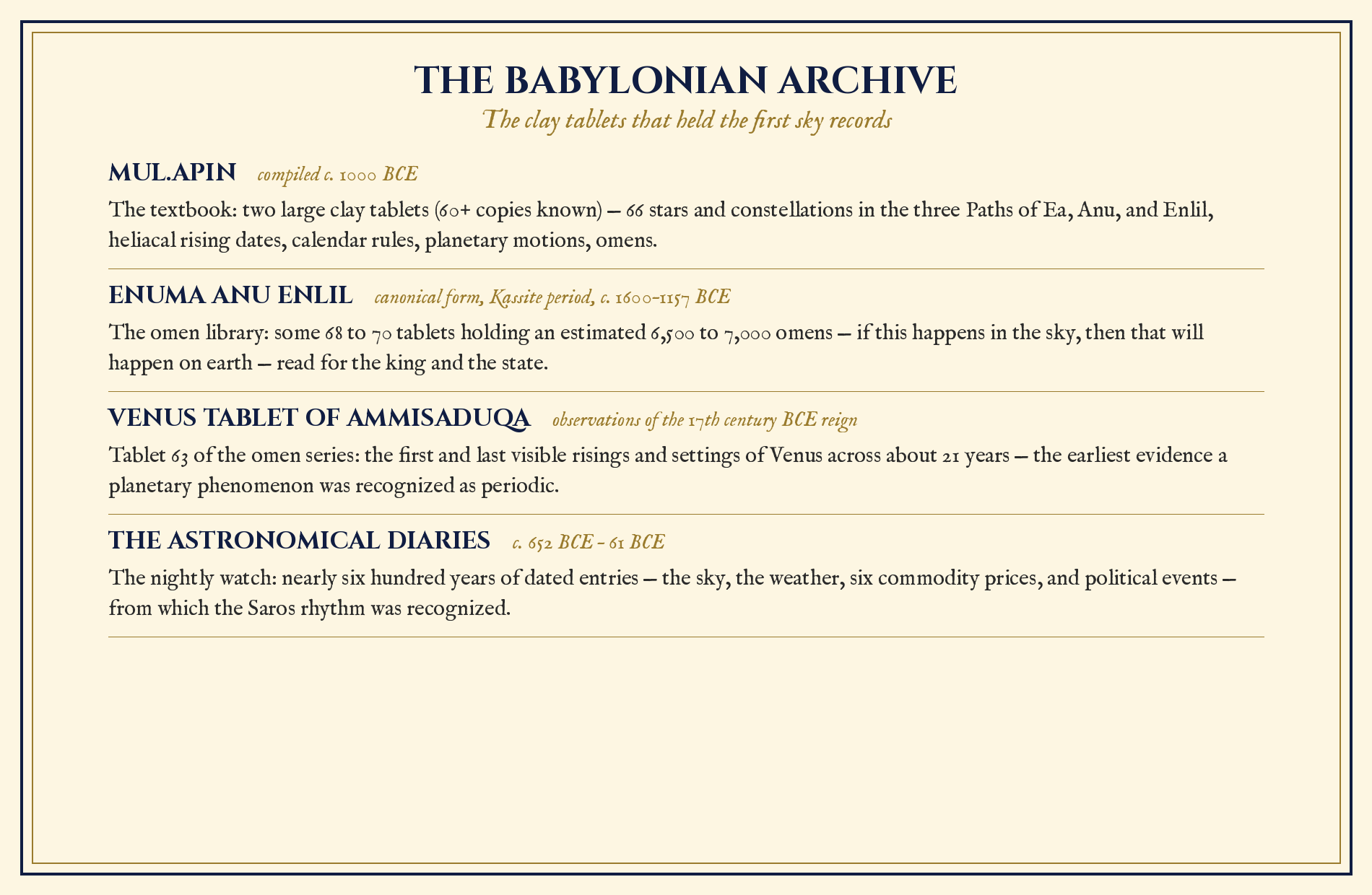
The Babylonian Archive: the four records this lesson reads — the MUL.APIN textbook, the Enuma Anu Enlil omen library, the Venus Tablet's twenty-one years, and the Astronomical Diaries' six centuries of nightly entries.
Built digitally for this overhaul (Python/PIL, typeset text), from the archive taught in the lesson text.
★ Around 1000 BCE, some Babylonian scholar did something no one had done before: gathered the sky knowledge of the whole tradition and organized it into a single reference work. The result is called MUL.APIN (𒀯𒀳), named for its first line, which names the constellation "The Plough." It survives on two large clay tablets (a third may once have existed), and more than sixty copies have been found, scattered across Babylonia and Assyria and as far as Anatolia, from the 7th century BCE down to around 300 BCE. The earliest surviving copy was made in 686 BCE. It was, in other words, the standard textbook of Babylonian astronomy, copied and recopied for centuries.
Open it, in translation, and here is what you find. Tablet One is the inventory of the static sky: 66 named stars and constellations, organized into three great bands called the Paths of Ea, Anu, and Enlil, three gods whose seats were imagined among the stars. The Path of Anu is a belt around the celestial equator, and the text divides it into twelve equal parts of 30 degrees each, representing twelve ideal months. Hold that thought. It is the seed of the zodiac.
Then come the dates of heliacal risings (the first yearly appearances of stars in the dawn sky), lists of stars that rise and set together, intervals between risings, the ziqpu stars that cross the zenith and served as a night clock, and the stars "in the path of the Moon," the constellations along the moon's road, which include every forerunner of the zodiac signs.
Tablet Two is the book of changes: the motions of the planets along the moon's path, rules for finding the solstices and equinoxes, how long each planet stays visible and invisible, intercalation rules for keeping the calendar aligned (more on those in The Mechanism), the length of a gnomon's shadow through the day, a water clock scheme, and a short collection of omens.
MUL.APIN is considered the earliest known compendium of astronomical knowledge anywhere. It is not a book of spells. It is a reference manual: star lists, dates, rules, instruments. The Babylonians were doing science with clay.
Check in: MUL.APIN takes its name from what, survives on how many tablets — and what does each of its two tablets hold?
❦ In your workbook: record the Plough tablet in your own way — a reference work named for its first line, sixty-six stars in three Paths, and a belt divided into twelve parts of thirty degrees: the seed of the zodiac — copy, sketch, or note what matters.
Seventy tablets of omens
If MUL.APIN is the textbook, Enuma Anu Enlil is the filing cabinet of everything the sky might mean.
The title means "When the gods Anu and Enlil...," its opening words, and the series runs to some 68 or 70 tablets holding an estimated 6,500 to 7,000 omens. It was compiled into its canonical form during the Kassite period (roughly 1600 to 1157 BCE), with earlier versions reaching back into the Old Babylonian period, and it stayed in use for over a thousand years: the latest known copy was written in 194 BCE.
The omens work like this: if this happens in the sky, then that will happen on earth. The first tablets cover the moon: its first appearances, its haloes, its eclipses. Then the sun, then weather and thunder, and finally the stars and planets. ★ And here is the crucial fact, the one this whole lesson turns on: the omens are interpreted in terms of the king and the state. A lunar eclipse might threaten the king's life. A strange halo around the moon might promise a good harvest or warn of war. More than five hundred actual reports survive, written by court scholars to Neo-Assyrian kings, quoting the relevant omens and advising the king what they meant for his reign. We have the memos. We can read the bureaucracy of the sky.
This was statecraft. The scholars watched, the tablets spoke, the king acted. When a lunar eclipse was predicted, and lunar eclipses were genuinely feared as threats to the king, the court could perform rituals to turn the danger aside, including, on some occasions, placing a substitute on the throne to absorb the omen's blow while the real king stepped quietly aside. The omen was not a fixed fate. It was a warning, and warnings can be answered.
Check in: How many tablets and omens does Enuma Anu Enlil hold, whom were its omens interpreted for — and were they fixed fate?
❦ In your workbook: record the filing cabinet in your own way — if this happens in the sky, then that will happen on earth; five hundred memos to kings; and a warning that could be answered, never a fixed fate — copy, sketch, or note what matters.
The nightly watch
All of this record-keeping reached its fullest form in the Astronomical Diaries: systematic nightly observations kept in Babylon from about 652 BCE to 61 BCE, nearly six hundred years of watching, written in Akkadian on clay.
The diaries are extraordinary documents. Each entry records the sky (moon, planets, eclipses, unusual phenomena), the weather, the prices of six commodities (barley, dates, mustard, cress, sesame, and wool), and notable political events. Sky, weather, markets, politics: one continuous log, night after night, century after century. Most of the surviving tablets are in the British Museum, and modern scientists still use them: the eclipse records help measure how Earth's rotation has gradually slowed.
★ It was the depth of these records that made discovery possible. In the reign of Nabonassar (747 to 734 BCE), the quality and frequency of observations jumped, and out of that deepening archive came one of the great pattern discoveries in history: eclipses repeat. The Babylonians recognized the Saros, the 18-year, 11-day, 8-hour rhythm of returning eclipses (Celestial Studies Lesson 9 tells the full story), and they used it to predict. Later astronomers compiled goal-year texts, gathering observations from whole cycles past to forecast the cycles to come, and eclipse tables listing predicted eclipses across centuries. The archive had become an oracle, but an honest one: it predicted from patterns in the data.
Check in: What four things did each diary entry record, for how long — and what great pattern did the deepening archive reveal?
❦ In your workbook: record the nightly watch in your own way — sky, weather, prices, and events in one continuous log for nearly six hundred years, and the Saros rhythm surfacing out of the depth of the records — copy, sketch, or note what matters.
Twelve slices of sky
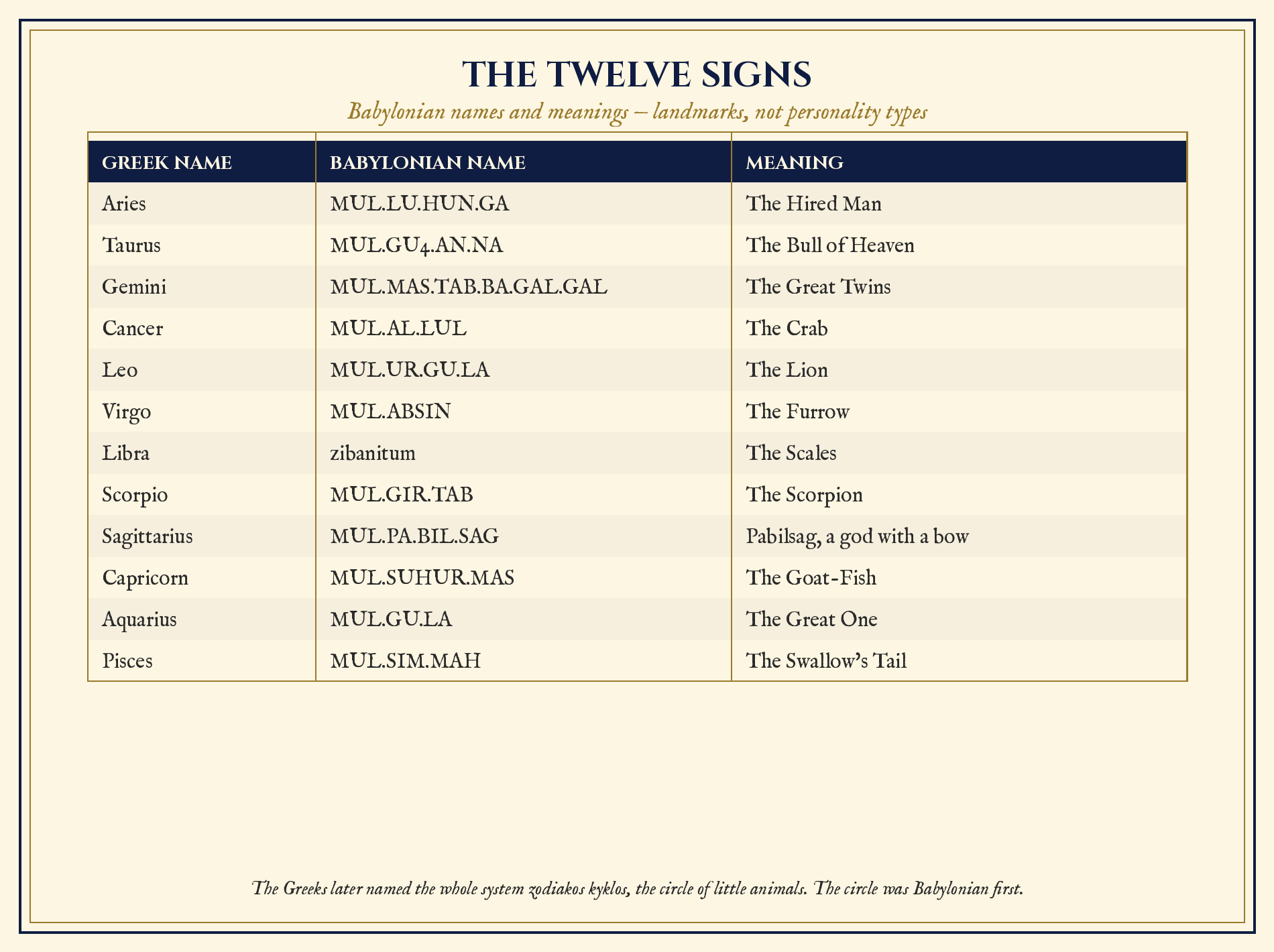
The Twelve Signs: the Babylonian names and their meanings — a hired man, a bull of heaven, a furrow, a goat-fish, a swallow's tail. Landmarks for measuring the sky, not personality types.
Built digitally for this overhaul (Python/PIL, typeset table), reproducing the final's taught table verbatim.
Now the zodiac itself. The constellations along the moon's path had been known for centuries, but they were uneven in size and more than twelve in number. In the 5th century BCE, Babylonian astronomers did something revolutionary: they stopped using the constellations as they found them and drew an ideal grid instead.
★ They divided the ecliptic, the sun's yearly path, into twelve equal signs of 30 degrees each: 360 degrees in all. Modern calculations place the introduction of this system within a few years of 401 BCE. Each sign took the name of a constellation sitting roughly within it. And here is the detail that Lesson 26 will take apart in full: the Babylonians fixed their zodiac to the stars, not to the equinox. It was a star-fixed grid for measuring positions, the first celestial coordinate system ever devised.
Why twelve, and why thirty? Because the Babylonians thought in a 360-day ideal year: twelve ideal months of thirty ideal days each, the same ideal calendar MUL.APIN uses. Twelve signs of 30 degrees mapped the sky the way twelve months of 30 days mapped the year. The zodiac was born as a calendar tool wearing a coordinate grid's clothing, or the other way around. Either way, it was for measuring, not for meaning.
The twelve signs carried Babylonian names, and most of them are still recognizable under their Greek and Latin successors:
| Greek name | Babylonian name | Meaning |
|---|---|---|
| Aries | MUL.LU.HUN.GA | The Hired Man |
| Taurus | MUL.GU4.AN.NA | The Bull of Heaven |
| Gemini | MUL.MAS.TAB.BA.GAL.GAL | The Great Twins |
| Cancer | MUL.AL.LUL | The Crab |
| Leo | MUL.UR.GU.LA | The Lion |
| Virgo | MUL.ABSIN | The Furrow |
| Libra | zibanitum | The Scales |
| Scorpio | MUL.GIR.TAB | The Scorpion |
| Sagittarius | MUL.PA.BIL.SAG | Pabilsag, a god with a bow |
| Capricorn | MUL.SUHUR.MAS | The Goat-Fish |
| Aquarius | MUL.GU.LA | The Great One |
| Pisces | MUL.SIM.MAH | The Swallow's Tail |
Read the list as a Babylonian would have: a hired man, a bull, twins, a crab, a lion, a furrow, scales, a scorpion, a god, a goat-fish, a great god, a swallow's tail. These are landmarks, not personality types. The Greeks would later give the whole system its familiar name: zodiakos kyklos, the circle of little animals. But the circle was Babylonian first.
Check in: What did the astronomers of the 5th century BCE divide, into how many equal signs of how many degrees — and what was the grid fixed to?
❦ In your workbook: record the twelve slices in your own way — an ideal grid drawn over uneven constellations, twelve signs of thirty degrees modeled on twelve ideal months, and Babylonian landmarks that are not personality types — copy, sketch, or note what matters.
The first horoscope
There is one more Babylonian invention to meet, and it is the one that points straight at the next lesson.
★ Around 410 BCE, someone in Babylon cast the earliest known personal horoscope: a clay tablet, now in Oxford's Bodleian Library, recording the exact positions of the moon and planets in the zodiac at the moment of a child's birth. Month of Nisan, night of the 14th: the moon below the Scorpion's horn, Jupiter in Pisces, Venus in Taurus, Saturn in Cancer, Mars in Gemini. It closes with a brief blessing for the newborn.
Here is the honest part. These earliest horoscopes were mostly astronomical lists: where everything was, with very little prediction attached. The Babylonians had invented the idea of reading an individual's sky, but the elaborate machinery of houses, aspects, and character readings came later, in the Hellenistic world, which is Lesson 25's story. For over a thousand years, Babylonian sky-reading had been about the king, the harvest, and the calendar. The personal horoscope was the new idea. It was about four centuries old when the Greeks got hold of it, and they ran with it further than Babylon ever had.
Check in: When and where is the earliest known personal horoscope, what did it actually record — and what did it not yet carry?
❦ In your workbook: record the first horoscope in your own way — positions at a birth in the month of Nisan, a brief blessing, and almost no prediction: the machinery came later — copy, sketch, or note what matters.
The Mechanism
Why twelve times thirty
The mechanism of the zodiac is arithmetic wearing a calendar's clothes.
★ The Babylonians counted in base sixty, the sexagesimal system. We still live inside it every day: sixty seconds in a minute, sixty minutes in an hour, and 360 degrees in a circle. The circle has 360 degrees because the Babylonians divided it that way, and they divided it that way because their ideal year had 360 days: twelve ideal months of thirty ideal days each.
Now watch the analogy click into place. The sun travels its full circle through the year. Divide that circle into twelve parts, one per ideal month, and each part is 30 degrees. Give each 30-degree part the name of a constellation lying roughly inside it, and you have twelve signs. The zodiac is the year's shape drawn on the sky. When scholars recorded that Jupiter stood "in the Lion," they were saying where it was the way we say "in July": a coordinate, a date-stamp, a position on the grid.
And because the Babylonians anchored the grid to the stars rather than to the equinox point, the signs stayed put against the constellations while the calendar drifted. The distinction between the sign grid and the star pictures is the whole subject of Lesson 26, which will show you, with your own arithmetic, why the two no longer line up.
Check in: Why twelve signs, and why thirty degrees each — and what were scholars saying when they recorded that Jupiter stood "in the Lion"?
❦ In your workbook: record the arithmetic in your own way — base sixty, a 360-day ideal year, and the year's shape drawn on the sky: a coordinate, a date-stamp, a position on the grid — copy, sketch, or note what matters.
How the calendar really worked
The ideal calendar was the map, not the territory. The real Babylonian year was lunar: each month began when the new crescent moon was first sighted at sunset, announced by the scholar-priests, and months ran 29 or 30 days. Twelve such months make about 354 days, eleven days short of the solar year, so every few years the king proclaimed a thirteenth month, on the advice of the sky-watchers, to pull the calendar back into line with the seasons. Festivals, taxes, and farming all depended on getting this right, which is why the king funded the watching.
MUL.APIN preserves the early intercalation rules: watch for the heliacal risings of the Pleiades, Sirius, and Arcturus, or the moon's position against the stars, and add the month when the sky tells you the calendar has slipped. Later astronomers refined this into a 19-year rhythm for inserting the extra months, the cycle the Greeks would later name for Meton of Athens. The mechanism is the same one every calendar-maker faces: the moon's months and the sun's year do not fit together neatly, and someone has to do the arithmetic. In Babylon, that someone was the scholar-priest, and the arithmetic was state business.
Check in: How did the real lunar year run, why did it need a thirteenth month — and who proclaimed it, on whose advice?
❦ In your workbook: record the real calendar in your own way — months begun at the sighted crescent, about 354 days against the solar year, and a thirteenth month proclaimed when the sky said the calendar had slipped — copy, sketch, or note what matters.
How omens worked
An omen is an if/then statement addressed to the state: if the moon wears a halo on the first day of the month, then the land will be happy and the king's reign will be long. The scholars were not guessing. They were matching what they saw against a reference library of thousands of precedents, the way a physician matches symptoms to a medical text. Enuma Anu Enlil was the library; the nightly watch supplied the symptoms.
Three things about the omen system are worth holding onto, because they are the honest core of this unit.
★ First, the omens were for the king and the land: harvests, wars, floods, the safety of the throne. Your birth date would not have interested a Babylonian omen scholar in the slightest. The sky spoke to power, because power paid for the watching.
Second, omens were warnings, not sentences. If the sky threatened, the court could act: rituals, prayers, and in the gravest cases the substitute-king rite, in which another person briefly took the throne to draw the danger onto himself while the true king waited it out. A system that lets you dodge the prediction is not describing fate. It is describing risk, and selling the management of risk was the scholars' profession.
Third, the system improved the astronomy. Because every omen had to be checked against what actually happened, the scholars kept records, and the records, over centuries, revealed real periodicities: the Saros, the planets' rhythms, the moon's habits. The omen library was wrong about causation and right about the value of data. That is an uncomfortable combination, and it is exactly why this history is worth studying.
Check in: Name the three things worth holding onto about the omen system — whom the omens served, what an omen was instead of a sentence, and what the system did for the astronomy.
❦ In your workbook: record how omens worked in your own way — an if/then matched against a library of precedents, warnings that could be dodged, and records that revealed real rhythms — copy, sketch, or note what matters.
In your packet: Exercise II: Reading Like a Court Scholar ✎ begins here — its three cases are omens of the kinds Enuma Anu Enlil records, each to be read for its state concern and its address to the king. Work it now, or mark the place and take it as homework — your choice.
How good they really were
Strip away the omens and the Babylonian record is genuinely excellent astronomy, the best in the ancient world until the Greeks built on it.
They recognized periodicities no one else had timed: Venus's rhythm across 21 years, the moon's cycles, the Saros. They predicted lunar eclipses from cycle records, compiled goal-year texts that gathered whole periods of past observations for forecasting, and produced eclipse tables spanning centuries. Their star catalog in MUL.APIN, organized into the three Paths, gave later astronomers, Greek and otherwise, the constellation framework to work from; several of our modern constellation names descend from Babylonian ones through Greek intermediaries.
They also had real limits, and honesty requires naming them. They had no telescopes, no theory of what the planets physically were, and no way to know that the omens' if/then logic was not causation. Their observations carried errors of days. Their finest predictions, the eclipse tables, forecast that an eclipse would happen, not exactly where its shadow would fall. And the whole enterprise was funded to serve the throne: the questions the astronomy answered were the king's questions.
That is the honest framing, and it is the one to carry out of this lesson. Babylonian astronomy was statecraft and calendar-keeping dressed as divine signaling. The signaling was the job description; the astronomy was the work. And the work was magnificent: six centuries of nightly records, the first coordinate grid of the sky, and a zodiac that still, twenty-four hundred years later, organizes how humans picture the heavens. They read the sky for their king. We read their tablets, and the sky gets bigger for both of us.
Check in: What did the Babylonians genuinely achieve — and what were their real limits? Give the honest framing in one sentence.
❦ In your workbook: record the honest framing in your own way — statecraft and calendar-keeping expressed as divine signaling; the signaling was the job description, the astronomy was the work — copy, sketch, or note what matters.
A Sealed Note on Sixty
Sixty, my dears. The Babylonians counted to sixty the way you count to ten, and I think about them every time I count my own wingbeats on a long flight home. One, two, three, and by the time I reach sixty I have usually forgotten what I was counting for, which is why I leave the arithmetic to scholars and keep to the flying.
Here is what I love about their sixty. It was not mystical. It was practical. Sixty divides evenly by two, three, four, five, six, ten, twelve, fifteen, twenty, and thirty. Try dividing one hundred into thirds and see how far you get. The Babylonians picked the number that made fractions easy, then built a calendar, a circle, and a zodiac out of it. Every time you say "a minute has sixty seconds," you are speaking a little bit of Babylonian.
The tablets did the same thing I do with my wingbeats, only better: they kept count until the counting turned into knowing. That is the whole secret of the Astronomical Diaries. Keep the record long enough, and the sky starts repeating itself back to you.
❦ In your workbook: record the sealed note in your own way — sixty chosen because it divides easily, not because it was mystical, and counting kept long enough until the counting turned into knowing — copy, sketch, or note what matters.
PROFESSOR VESPER GLIMMERWICK
Celestial Studies
Astronomer & Celestial Historian
Guided Observation
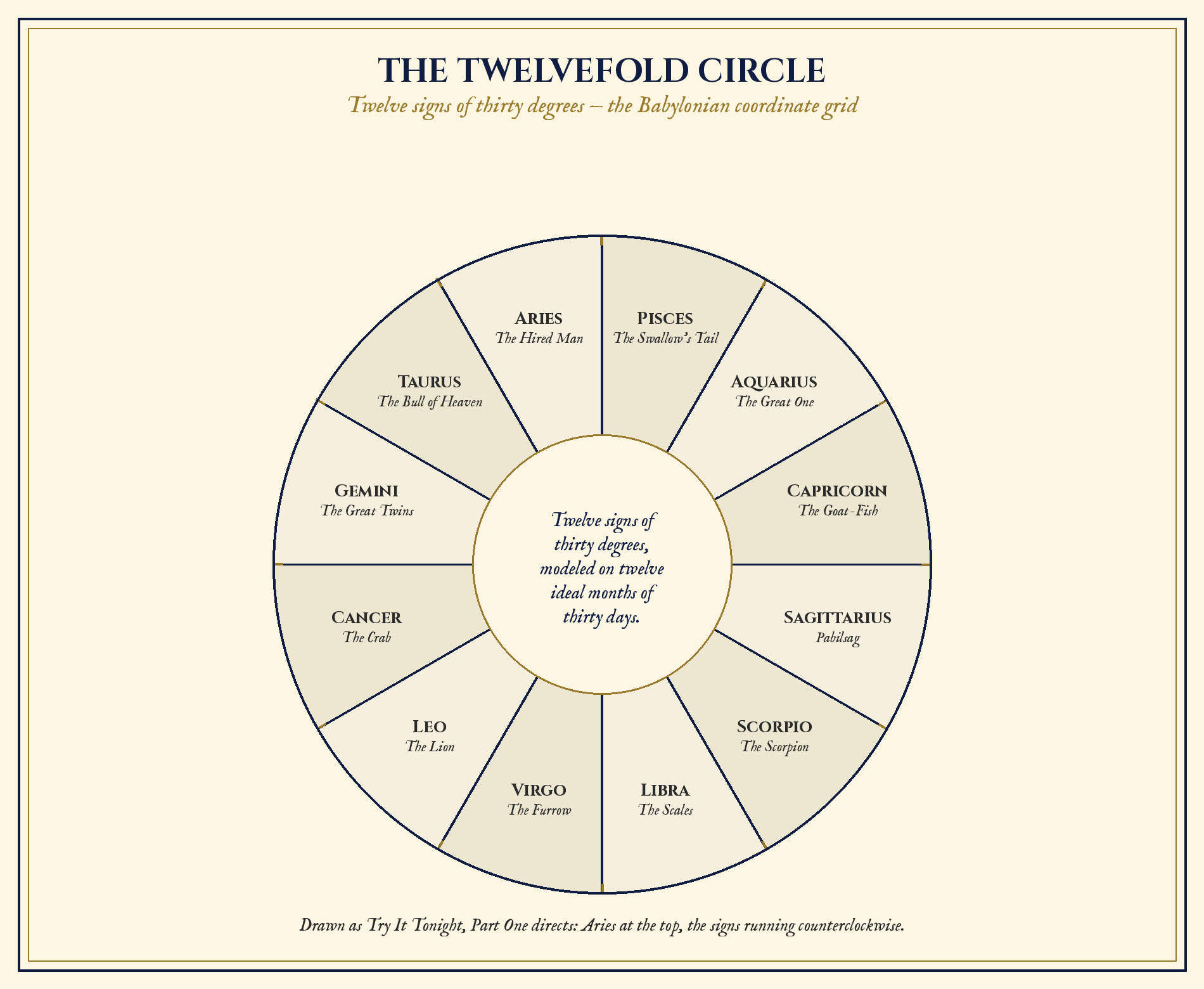
The Twelvefold Circle: twelve signs of thirty degrees, modeled on twelve ideal months of thirty days — Aries at the top, running counterclockwise, with each sign's Babylonian name. This is the wheel Exercise I works from, and the wheel Lesson 26 will test against the real constellations.
Built digitally for this overhaul (Python/PIL, typeset labels and drawn diagram), from the wheel taught in the lesson text.
Try It Tonight
Part One: Draw the Twelvefold Circle
You are going to build the Babylonian coordinate grid the way they conceived it: as a circle, divided by arithmetic.
- On a large sheet of paper, draw a circle. Mark its center.
- Divide the circle into twelve equal slices of 30 degrees each. A protractor makes this easy: mark every 30 degrees around the rim. If you have no protractor, fold a paper circle in half three times to get eight slices, then adjust by eye and ruler into twelve; the Babylonians would approve of practical geometry.
- Label each slice with its Greek name and its Babylonian name, in order, starting at the top with Aries / The Hired Man and going counterclockwise: Aries, Taurus, Gemini, Cancer, Leo, Virgo, Libra, Scorpio, Sagittarius, Capricorn, Aquarius, Pisces.
- Under each Babylonian name, write its meaning: The Hired Man, The Bull of Heaven, The Great Twins, The Crab, The Lion, The Furrow, The Scales, The Scorpion, Pabilsag, The Goat-Fish, The Great One, The Swallow's Tail.
- In the center of the circle, write the rule that built it: "Twelve signs of thirty degrees, modeled on twelve ideal months of thirty days."
Keep this wheel. You will use it again in Lesson 26, when you test whether the signs still line up with the constellations.
Check in: Your wheel is built from the lesson's rule, not copied from a chart — state the rule you wrote in its center, and say what you will use the wheel for in Lesson 26.
❦ In your workbook: record the wheel in your own way — twelve slices of thirty degrees, every Babylonian name and meaning lettered in, and the building rule at the center — copy, sketch, or note what matters.
In your packet: Exercise I: The Twelvefold Circle ◐ begins here — its five questions work from the wheel you have just built. Work it now, or mark the place and take it as homework — your choice.
Part Two: Three Nights a Babylonian
The Diaries recorded four things every night: the sky, the weather, prices, and events. You will keep a three-night diary in the same spirit.
- On three separate nights (they do not have to be consecutive), go outside with an adult and record: the moon's phase and position; one planet or bright star you can identify and where it stands; the weather (cloud cover, wind, temperature as it feels); and one everyday note, the way the Babylonians noted barley prices: what you had for dinner, or something that happened that day.
- Write each night's entry in four short columns, dated, the way a diary tablet is organized.
- After the third night, answer in your workbook: what could you learn from three nights? What could you learn from three hundred nights? From six hundred years of nights? Write one paragraph on what the length of the record makes possible that a single observation cannot.
❦ In your workbook: record the diary in your own way — three dated entries in four columns, sky, weather, and one everyday note each, and the paragraph on what the length of a record makes possible — copy, sketch, or note what matters.
In your packet: Exercise III: Three Nights a Babylonian ◐ begins here — it gathers these same three diary entries into the workbook and asks what patterns different lengths of record can show. Work it now, or mark the place and take it as homework — your choice.
Sky Log Entry
Date and time of observation: _______________
Moon phase tonight (sketch the disk and shade the dark portion): _______________
Your twelvefold circle: is it finished and labeled with all twelve Babylonian names? _______________
One diary-style entry (sky, weather, one everyday note): _______________
Which ideal Babylonian month are we in, counting from the spring equinox as Month One? (Remember: the ideal months are 30 days each, and the real months follow the moon.) _______________
What did three nights of records teach you that one night could not? _______________
❦ In your workbook: record the Sky Log entry in your own way — the moon's phase sketched and shaded, the finished wheel confirmed, and what three nights taught that one night could not — copy, sketch, or note what matters.
Materials
Required (Level One — household items)
- A large sheet of paper (or several sheets taped together) for the twelvefold circle.
- A ruler and a pencil for dividing the circle.
- A protractor, or a compass for drawing the circle (a plate to trace works too).
- Colored pencils or pens for labeling the twelve slices.
- Your workbook and a pencil for the Sky Log, the diary entries, and the exercises.
- A flashlight for night observing.
Suggested (Level Two — historically closer)
- A compass with a locking hinge for a precise circle, and a fine liner pen for final labels.
- A sheet of card or watercolor paper if you want the wheel to last until Lesson 26.
- A red-filter or dim flashlight for preserving night vision while logging.
Reflection Questions
Answer in your workbook, in complete sentences.
- The zodiac began as a coordinate grid and a calendar tool. What changed, between Babylon and today, in what people use it for, and what stayed the same?
- Why would a king fund centuries of nightly sky-watching? Whose questions was the astronomy answering, and what did the king get for his investment?
- The Babylonians watched Venus for 21 years before they could claim its rhythm, and kept the Diaries for nearly 600 years. What does that say about the relationship between records and discovery?
- Omens were treated as warnings that could be answered with rituals, not as fixed fate. How does that change the way you read an omen text: as a prediction, as a risk assessment, or as something else? Defend your choice.
- What is one thing you believed about the zodiac before this lesson that its history corrected, and what convinced you?
Workbook Checklist — Lesson 24
In my workbook I have:
- ☐ drawn the twelvefold circle in twelve slices of 30 degrees, labeled with all twelve Greek and Babylonian names and their meanings, with the building rule written at its center
- ☐ answered Exercise I's five questions from my wheel: the building rule, three Babylonian names, sign against constellation, the star-fixed anchor, and "Mars stands in the Lion"
- ☐ read the three omen cases like a court scholar, with the state concern and the address to the king answered for each, and the substitute-king paragraph written
- ☐ kept the three-night diary in four columns — date, sky, weather, everyday note — on three separate nights, each with an adult present
- ☐ answered what three nights can show, what three hundred nights would take, why the Diaries recorded barley prices, and one question a full year's diary could answer
- ☐ completed my Sky Log entry for the diary nights
☐ Lesson completed Date: ___ Signature: ___
Cross-Class Connections

Runes · Unit I, Lesson 1 — The Structural Wedge
Tower scholars, before a tablet can be read it must be written, and the writing is my lesson. Come to my web and press the wedge yourselves: the cut reed stylus, the five basic wedge forms, the signs AN, KI, and É, and the clay that remembers everything because it was baked, not despite it. Professor Glimmerwick reads what the wedges were for. Here, we teach your hand how the wedges were made.
PROFESSOR THISTLELOOM WEBBLETHORN
Runes & Ancient Writing

Scrollwork · Unit I, Lesson 3 — Writing Surfaces Through History
Tower scholars, Professor Glimmerwick's tablets survived because clay endures and because scholars kept copying them — and survival is my lesson's whole question. Come to the Scrollwork Library and examine how the materials of the page affected the making, use, and survival of manuscripts: papyrus, parchment, and paper, and what each chose to keep. The archive is not a mirror. It is a survivor's account. Here, we teach you to ask what did not survive to testify.
PROFESSOR QUILLBERRY NOCTURNE
Scrollwork Library

Creative Arts · Studio Extension E4 — Painted Wheels at Full Size
Bring me the paper wheel from the Tower, scholars — the zodiac wheel, charming, correct, and curling at the edges. In my workshop we paint one of those wheels at full size, on board, in ground pigment, with a rotating overlay where the wheel's working demands one, so it can hang and be read across a room for decades. A cycle deserves a monument, because a cycle is never finished being true. Mind the divider points while you work, and we will build the lasting version together.
PROFESSOR COGBRANCH TIMBERCLANK
Creative Arts Workshop
The Professor's Closing Note
And so the circle closes, scholars, twelve slices of thirty degrees, and the clay remembers.
You now know what the zodiac was for before it was ever about personality: a calendar you could hang on the sky, a coordinate grid for the wanderers, and a filing system for some six and a half thousand omens addressed to a king. You know the tablets by name, MUL.APIN and Enuma Anu Enlil and the Diaries, and you know what each one held. You know that the Babylonians watched Venus for twenty-one years to earn a single rhythm, and that they kept the nightly watch for six hundred years to earn the Saros.
Keep your twelvefold wheel somewhere safe. In Lesson 26 we will hold it up against the real constellations and do the arithmetic the Babylonians could not do, because they did not know the Earth's axis wobbles. The grid they drew was honest and brilliant and slightly wrong in a way that took two thousand years to notice. Finding that out is one of the great pleasures waiting for you.
Until then, keep watching, and keep writing it down. The clay taught us everything.
PROFESSOR VESPER GLIMMERWICK
Celestial Studies
Astronomer & Celestial Historian
Further Reading & Sources
These are real destinations for further study, verified live at the time of writing.
- MUL.APIN: the compendium, its two tablets, its compilation date, and its contents. https://en.wikipedia.org/wiki/MUL.APIN
- Enuma Anu Enlil: the omen series, its 68 to 70 tablets, and the court reports to the Assyrian kings. https://en.wikipedia.org/wiki/Enuma_Anu_Enlil
- The Babylonian Astronomical Diaries: six hundred years of nightly records, the Venus tablet, and the discovery of the Saros. https://en.wikipedia.org/wiki/Babylonian_astronomical_diaries
- How the ancients predicted eclipses: the Saros cycle, Babylonian eclipse tablets, and the substitute-king ritual. https://skyandtelescope.org/astronomy-news/how-did-the-ancients-predicted-eclipses-the-saros-cycle/
- Calendars in the Cradle of Civilization: the Venus tablet of Ammisaduqa, the lunar calendar, and the 360-day ideal year (Harper College open textbook). https://harpercollege.pressbooks.pub/cosmictime/chapter/11-calendars-in-the-cradle-of-civilization/
- Francesca Rochberg, Babylonian Horoscopes (1998): the scholarly edition and study of the cuneiform birth horoscopes, including the 410 BCE tablet. https://krasiancientastrology.com/wp-content/uploads/2016/11/babylonian-horoscopes.pdf
Browse the Celestial Studies shelf in the school Library for readable editions of these works.
Sealed in the Celestial Tower, in deep midnight blue, by Professor Vesper Glimmerwick.
Submit your work for this lesson using the form below.
CONTINUE IN THE CELESTIAL TOWER
← Previous · Lesson 23: Fireworks: Comets, Meteors & Supernovae Next · Lesson 25: The Hellenistic System →
Unit V — The History of Astrology & the Zodiac Celestial Tower — All 33 Lessons
The rest of Unit V: Lesson 25 · The Hellenistic System · Lesson 26 · Precession · Lesson 27 · Astrology Through the Ages · Lesson 28 · Why People Believe