
CELESTIAL STUDIES
Unit V · Lesson 27Astrology Through the Ages
Professor Vesper Glimmerwick
Astronomer & Celestial Historian
The Celestial Tower • School of Evershade
The Professor's Introduction

The sky has kept your seat, scholars,
I have a confession to make, and I will make it the way a bat makes everything: upside down, in the dark, and entirely honestly.
This lesson is about astrology. Not the kind anyone practices today, which is none of my business and none of this course's, but the kind that filled two thousand years of history: the astrology that chose the coronation day of a queen, that paid the salary of the man who discovered the laws of planetary motion, and that was taught in universities alongside the astronomy it refused to be separated from. We are going to study it the way a naturalist studies a moth: with attention, with curiosity, and without any desire to become one.
Here is my promise, and it is the standing law of this whole unit. No one in this lesson will be sorted, labeled, or described by any sign of the zodiac. We will name the historical machinery, because history requires names, but we will never turn those names toward you. You are scholars, not symbols. The sky is the subject; you are the students.
And here is my second promise: there will be no mockery in this lesson. The people we are about to meet were not fools. They were the cleverest minds of their centuries, and they believed something you and I do not believe. If we laugh at them, we will learn nothing. If we ask why they believed, honestly and with respect, we will learn one of the most important things a student of the sky can ever learn: that being brilliant and being wrong can live in the same head, sometimes in the same hour.
PROFESSOR VESPER GLIMMERWICK
Celestial Studies
Astronomer & Celestial Historian
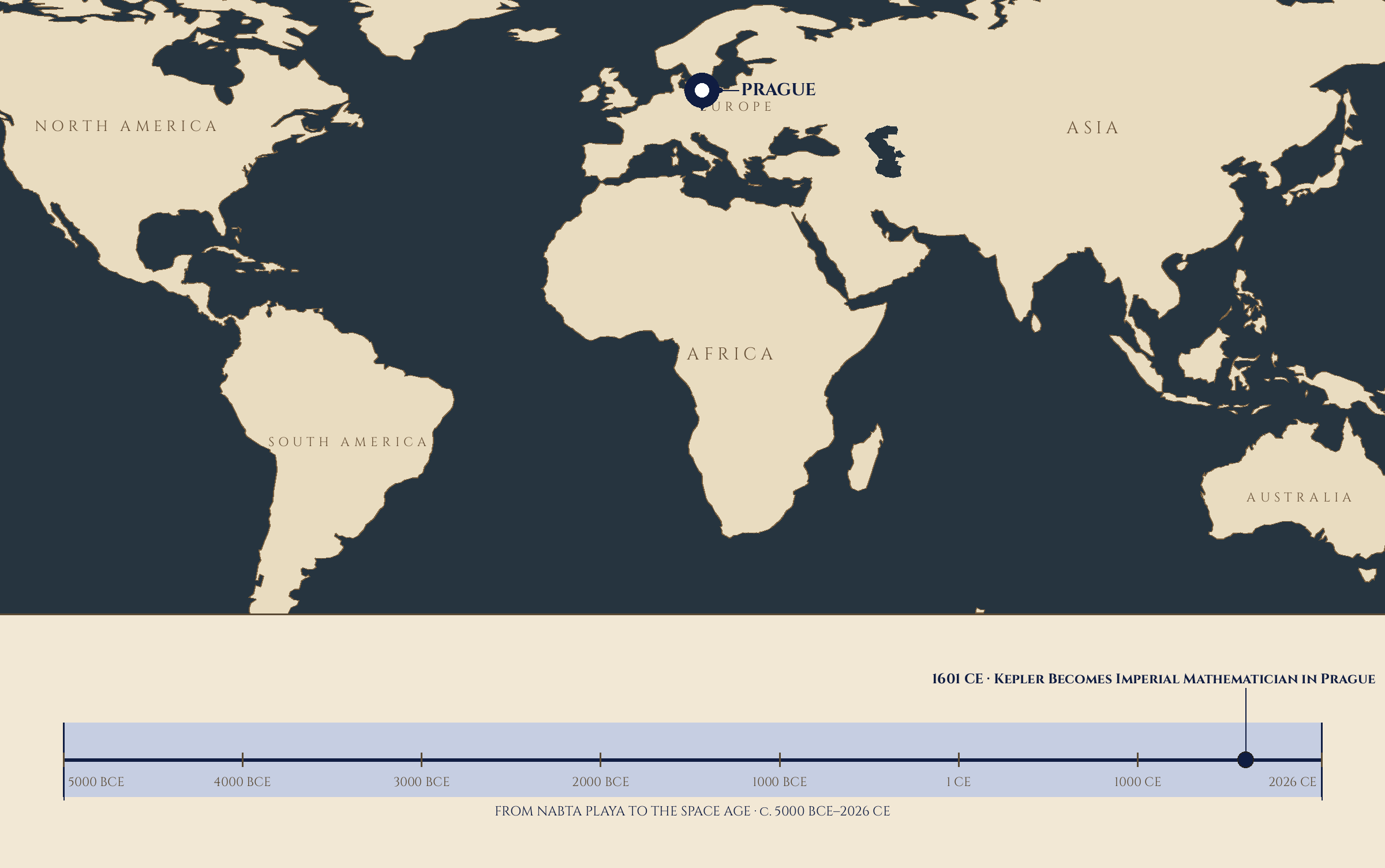
Where and when: PRAGUE, 1601 CE · Kepler Becomes Imperial Mathematician in Prague (year 1601) — Astrology Through the Ages. The pin is this lesson. The line beneath the map is our road: every stop a moment when watching the sky changed, every lesson a pin upon it.
Lesson Objectives
By the end of this lesson, you will be able to: - Trace the institutional history of astrology from ancient Rome through the Scientific Revolution, naming the key turning points. - Explain why astrology was taught in medieval universities as part of astronomy, not as an occult outsider. - Describe the work of court astrologers, using John Dee's service to Elizabeth I as the central example. - Explain the honest contradiction of Johannes Kepler and Galileo Galilei: men who remade astronomy while casting horoscopes. - Identify the major skeptics of every era, Cicero, Augustine, and Pico della Mirandola, and summarize their arguments. - Explain how and when astronomy and astrology separated, and why the separation took centuries.
Reading this lesson: ★ marks the passages to remember. They return on the unit quiz and the class test. Check in questions ask the material back as you go; answer them in your workbook when you meet them.
Working this lesson: Your assignment packet is the first download on this page. Work in it as the lesson moves along, answering each exercise as its subject is taught — or read the lesson through for your notes and take the exercises as homework afterward. Both are proper ways to sit this class. Signposts in the reading tell you where each exercise belongs. Written answers are short answers in your own words; a few honest lines are worth more than a filled page.
Your Assignment Packet
This lesson's exercises live in its packet: the Lexicon Handout (every term, course terms marked ◆), Materials, Guided Practice, the Assignment Manual with its answer key for self-checking, the Reflection Questions, and the Workbook Checklist. Download the packet before you begin and keep it beside you as you read. The packet's exercises are Glimmerwick's own word for the work: Exercise I — The Twin Test ✎, Exercise II — The Court Astrologer's Memo ✎, and Exercise III — Kepler's Third Party ✎. The lesson's quiz is not printed in the packet; it pools to the Unit V Quiz, where it will meet you again.
Safety Briefing
- All night observing for this lesson follows the standing rules: an adult present, a familiar and safe location, and someone at home who knows where you are and when you expect to return.
- This lesson studies horoscopes as historical documents. It never asks you to cast one, to act on one, or to let one describe you. If you come across modern horoscope content in the course of your research, you are welcome to enjoy it as entertainment, but keep the historian's lens on: ask who made it, when, and what they wanted from it.
- No equipment beyond your eyes, your workbook, and a flashlight is required. Level Two adds an almanac or ephemeris, printed or online, for the comparison exercise.
The Wonder
For two thousand years, the smartest people on Earth did their astronomy by day and their politics by night.
Picture it. A queen stands in a drafty palace in 1558, about to be crowned, and she does not ask her councilors when the ceremony should happen. She asks her astronomer. Not because she is foolish, but because in her century the man who charts the sky and the man who reads the future are the same man, and everyone at court knows it.
Picture another scene, fifty years later. A German mathematician sits up late in Prague, working out the mathematics that will prove the planets move in ellipses. He is inventing modern astronomy in the same room, in the same year, in which he is being paid to cast horoscopes. His employer, the emperor, considers the horoscopes the real job and the astronomy the hobby.
And now picture a third scene, older than both. A Roman senator named Cicero, who was himself an official interpreter of omens, sits down in 44 BC to write a book arguing that divination is nonsense. The skeptics were there from the very beginning. The argument about the stars is older than the Roman Empire's fall, and it never really stopped. It only changed costumes.
This lesson is the history of that argument: who believed the sky could speak, who doubted it, who got paid for it, and why the line between astronomy and astrology, which looks so bright and obvious to us, was invisible to nearly everyone for two millennia. The wonder is not that people believed strange things. The wonder is that the believing and the doubting went on side by side, in the same universities, the same courts, and sometimes the same heads.
❦ In your workbook: record the wonder in your own way — the queen who asked her astronomer, the mathematician paid for horoscopes in the room where he invented modern astronomy, and Cicero the augur arguing against divination — copy, sketch, or note what matters.
The Story
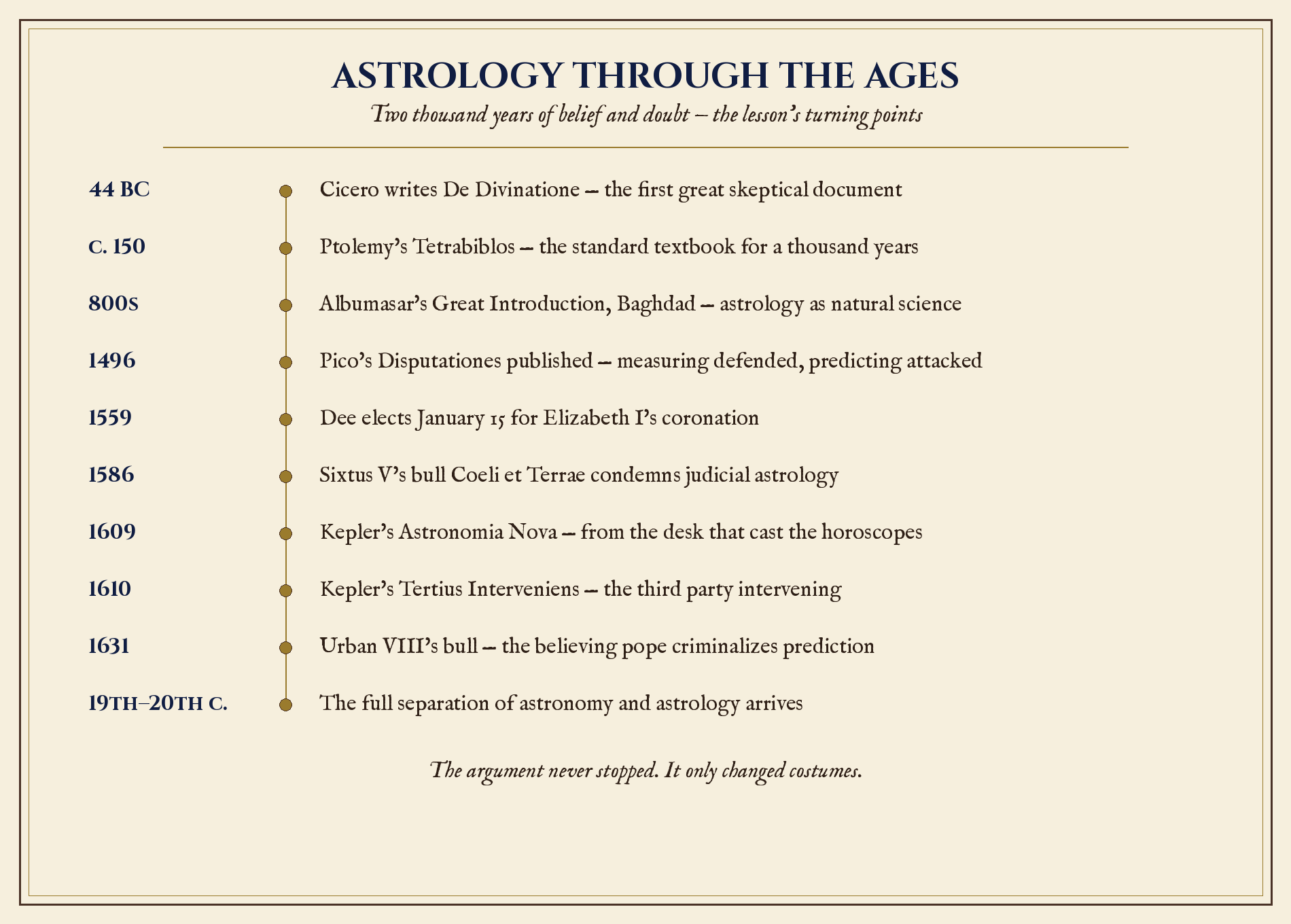
The argument's timeline: two thousand years of belief and doubt, from Cicero's refutation in 44 BC to the separation that only arrived in the 19th and 20th centuries. Every date on this plate is a turning point named in the lesson.
Built digitally for this overhaul (Python/PIL, typeset labels), from the dates taught in the lesson text.
The skeptic speaks first: Rome, 44 BC
The argument against astrology is older than almost every argument for it that survives in writing. In 44 BC, the Roman statesman Marcus Tullius Cicero wrote De Divinatione, "On Divination," as a dialogue between himself and his brother Quintus. Quintus defends divination, in the Stoic fashion of the time. Then Cicero, speaking for himself in the second book, takes it apart.
★ His attack on astrology is the first great skeptical document in the subject's history, and it is built from arguments that still work. His most famous is the argument of the twins: men born at the very same instant are unlike in character, career, and destiny, which makes it clear that the time of birth has nothing to do with determining a person's course in life. His second is the argument of the battlefield: at Cannae in 216 BC, Hannibal's army killed some 70,000 Romans in a single day. Every family in Rome was in mourning. Did all those dead men have the same horoscope? They all met the same end.
Notice something important, because it sets the pattern for the whole lesson. Cicero was not an outsider throwing stones. He was an augur himself, an official Roman interpreter of omens. The first great critic of divination was a diviner. Doubt did not arrive late to this subject. It was there at the beginning, wearing the same robes as belief.
Check in: Cicero was an augur himself — so who was the first great critic of divination, and what are his two arguments, the twins and the battlefield?
❦ In your workbook: record the skeptic in your own way — De Divinatione in 44 BC, the argument of the twins, the 70,000 dead at Cannae, and the critic who wore the augur's own robes — copy, sketch, or note what matters.
The Church's first objection: Augustine and the twins
★ Four centuries later, the argument found its Christian form. Saint Augustine, in The City of God, attacked astrology with Cicero's own weapon, sharpened. His chosen example was biblical: Esau and Jacob, the twin sons of Isaac, born of the same mother at nearly the same hour, who lived utterly different lives. If the stars at birth determined fate, Augustine asked, how could twins differ so completely?
Augustine's objection was theological as well as logical. Astrology threatened the doctrine of free will: if the stars compel, then human choice is an illusion and moral responsibility collapses. But notice what Augustine did not do. He did not deny that the heavens have real power. The sun plainly warms the earth; the moon plainly moves the tides. What he denied was that this power could reach into individual human destinies and bind them. The distinction between what the sky does to the world and what it means for a person would be argued about for the next thousand years.
Check in: How does Augustine sharpen Cicero's twin argument with Esau and Jacob — and what did Augustine not deny about the heavens' power?
❦ In your workbook: record the objection in your own way — Esau and Jacob, the threat to free will, and the line Augustine drew between what the sky does to the world and what it means for a person — copy, sketch, or note what matters.
In your packet: Exercise I — The Twin Test ✎ begins here — Cicero's argument and Augustine's are both on the table now, with Ptolemy's reply waiting in the next section. Work it now, or mark the place and take it as homework — your choice.
The standard textbook: Ptolemy and the road through Baghdad
★ Around the year 150, in Alexandria, the astronomer Claudius Ptolemy wrote the Tetrabiblos, the "Four Books," a complete system of astrology. It became the standard textbook of the subject for more than a thousand years. Ptolemy's defense of his art was the most complete ever written, and it is worth understanding because every astrologer after him repeated it. His reasoning went like this: no one denies that the sun heats and the moon moistens. These are observed, physical effects of celestial bodies on the earth. If the great lights have such obvious power, who is to say that subtler influences stop there? Astrology, in Ptolemy's framing, was not magic. It was physics extended one careful step further than the evidence allowed.
That step was a long one, and Cicero's twins were still waiting at the end of it. But the Tetrabiblos survived the fall of Rome, and it traveled. In the 800s, in Baghdad, the Persian scholar Abu Ma'shar, known in the West as Albumasar, wrote the Great Introduction to Astrology, the most influential astrological text of the Middle Ages, defending the subject as a legitimate natural science in the language of Aristotelian philosophy. Baghdad's scholars preserved the Greek texts, improved them, and wrote their own. In the 1100s, Latin translators in Spain, working in cities like Toledo, carried the whole body of learning, Greek and Arabic together, back into Western Europe. The medieval university inherited astrology not as a folk superstition but as a learned science with a pedigree stretching back to Ptolemy.
Check in: What was Ptolemy's defense of astrology — the observed effects he started from, and the one careful step further he took?
❦ In your workbook: record the textbook in your own way — the Tetrabiblos of about 150, the sun heats and the moon moistens, Albumasar's Great Introduction in Baghdad, and the translators of Toledo carrying it back — copy, sketch, or note what matters.
The university years: astrology as a required subject
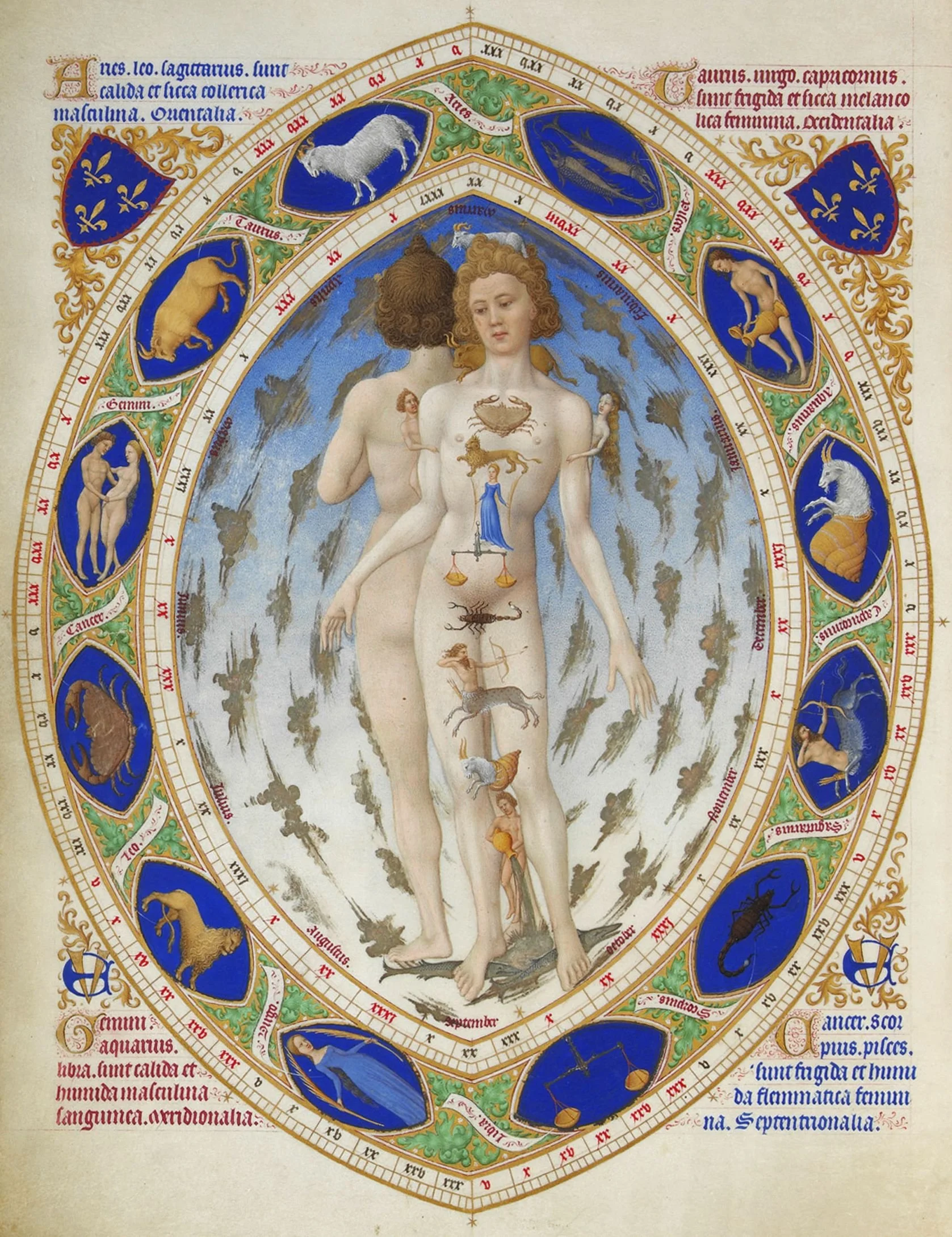
The zodiacal man of the Très Riches Heures (c. 1412–1416): the twelve divisions of the zodiac mapped onto the human body from head to feet. Medieval physicians used diagrams like this one — practical medical charts, not decorations — to schedule procedures like bloodletting. A historical document, studied here as the lesson studies all of them: as evidence of what was believed.
Limbourg brothers, Les Très Riches Heures du Duc de Berry, folio 14v (Musée Condé, Chantilly), via Wikimedia Commons.
This is the part of the story most people get wrong, so read it carefully. In the medieval university, astrology was not a guilty secret. It was part of the curriculum.
★ The universities organized learning around the seven liberal arts. The first three, the trivium, were grammar, rhetoric, and logic. The next four, the quadrivium, were arithmetic, geometry, music, and astronomy. Astronomy meant the mathematics of the heavens: the motions of the sun, moon, planets, and stars. Astrology, the interpretation of those motions and their effects on earthly life, was taught as the second half of the same subject. To study astronomy without astrology would have seemed, to a medieval professor, like studying grammar without ever reading a sentence.
The institutional evidence is plain. University statutes at Bologna, Ferrara, and Kraków explicitly named the required astrological reading for students: the works of Ptolemy, the Introductorius of Alcabitius (the 10th-century scholar al-Qabisi), and Albumasar's Great Introduction. Medical students learned astrology because doctors used it: the timing of treatments was routinely set by the sky, and the University of Padua had an especially strong tradition of medical astrology, teaching physicians how to cast charts for the onset of disease. The famous medieval diagrams of the "zodiacal man," mapping the twelve divisions of the zodiac onto the human body from head to feet, were practical medical charts, used to schedule procedures like bloodletting. However strange this looks to us, it was the medicine of the learned, not of the gullible.
And the doubters were inside the university too, which is the other half of the pattern. The Persian philosopher Avicenna, who died in 1037, argued that the stars might truly have influence, but that human beings could never acquire certain knowledge of it, which made prediction a fraud even if the theory were true. Thomas Aquinas, who died in 1274, drew the careful line his theology required: the stars could incline physical things, weather and bodies and humors, but they could not touch the human will, which remained free. Nicole Oresme, who died in 1382, tried to refute astrology outright, arguing that its basic claims were astronomically and mathematically impossible. Every generation produced both the professors and their critics, sitting in the same halls.
Even the Church, which is often imagined as astrology's great enemy, was of two minds for centuries. Popes from Sixtus IV (1471 to 1484) through Paul III (1534 to 1549) employed professional astrologers at the papal court. Condemnation and employment went on simultaneously, which tells you something honest about institutions: they can need an idea and distrust it at the same time.
Check in: Where did astrology sit in the medieval university — which half of which art — and which three authors did the statutes at Bologna, Ferrara, and Kraków require?
❦ In your workbook: record the university years in your own way — the quadrivium's second half, the required reading named in statutes, the zodiacal man on the medical chart, and the doubters sitting in the same halls — copy, sketch, or note what matters.
The Renaissance court: Pico draws the line
The sharpest attack of the Renaissance came from Giovanni Pico della Mirandola, who lived from 1463 to 1494. His Disputationes adversus astrologiam divinatricem, "Arguments Against Divinatory Astrology," ran to twelve books and was published after his death in 1496. Pico's move was brilliant in its precision. He did not attack the measuring of the heavens. He defended it. What he attacked was the predicting: the claim that future human events could be read from the stars.
★ His objections were practical as much as philosophical. Astrologers disagreed with each other about methods and meanings, which a true science should not do. Their predictions rarely came true except by chance or by being vague enough to fit anything. The stars could act only by light and motion, which fall on everyone equally, not on individuals particularly. And their reasoning ran on analogy, the logic of "as above, so below," which Pico showed could prove anything at all: just as life begins in spring, the zodiac begins with the spring division; but just as life began in the sea, it might as well begin with the fishes. Analogy was a machine for manufacturing conclusions.
Pico's attack was so forceful that it nearly wounded astronomy itself. His contemporary Rheticus, the associate of Copernicus, accused him of impugning not merely astrology but astronomy, because the two were so deeply entangled that striking one shook the other. One historian has plausibly argued that Copernicus was partly drawn to his sun-centered system because it answered Pico: if the order of the planets were certain, one of Pico's best arguments against astrology would fall. Doubt, once again, was not the enemy of the science. It was one of its engines.
The courts, meanwhile, went on employing astrologers regardless of what philosophers wrote. Guido Bonatti, who served the Holy Roman Emperor Frederick II in the 1200s and wrote the most influential Latin astrological manual of the Middle Ages, timed military campaigns by the stars. His contemporary Dante put him in the Eighth Circle of Hell, among the diviners, walking with his head twisted backwards so he could only see behind him. That is what the age thought of astrologers: indispensable, and damned.
Check in: Pico defended one art and attacked the other — which was which, and what did he show about reasoning by analogy?
❦ In your workbook: record Pico's line in your own way — twelve books against the predicting, the measuring defended, astrologers disagreeing and predictions fitting anything, and Dante's Bonatti walking backwards in Hell — copy, sketch, or note what matters.
The queen's astrologer: John Dee and Elizabeth I
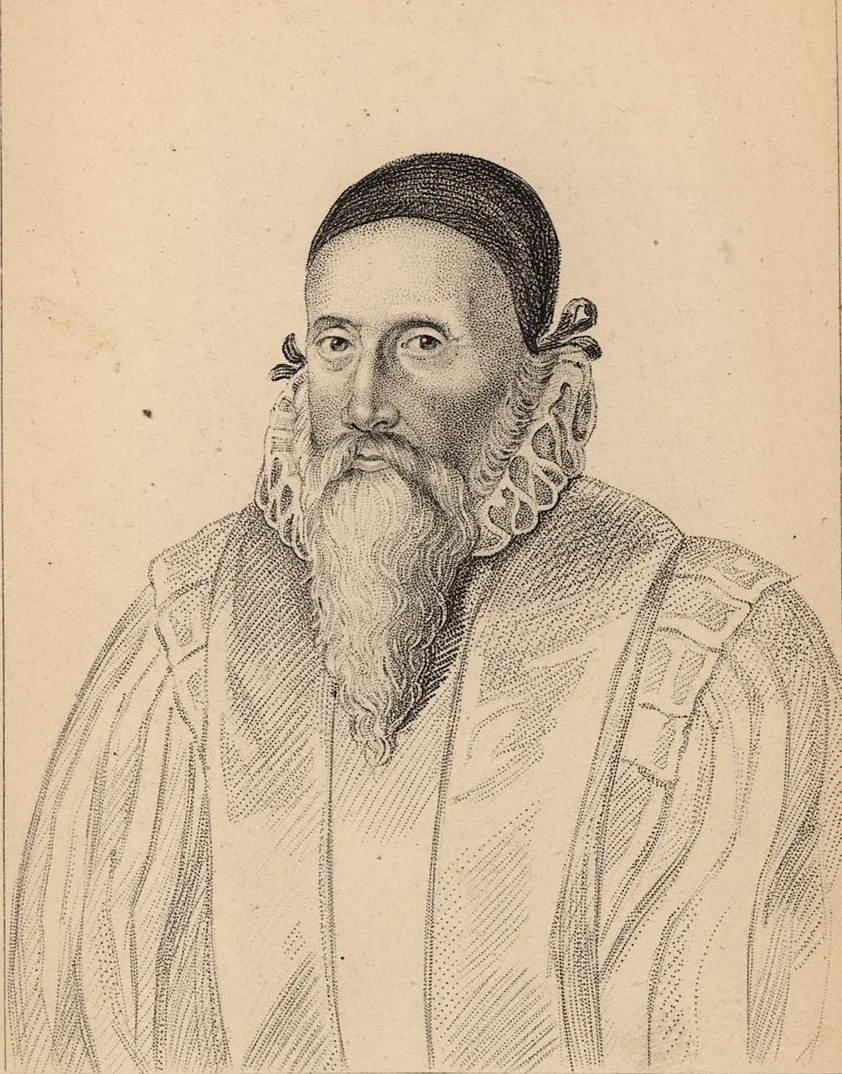
John Dee (1527–1608/09), in an engraved portrait: mathematician, astronomer, and the queen's astrologer — arrested under Mary for casting a royal horoscope, then asked by Elizabeth to elect her coronation day, January 15, 1559.
Engraved portrait of John Dee (after the 16th-century portrait tradition), via Wikimedia Commons.
No court astrologer is better documented than John Dee, and his story shows exactly what the job was.
★ Dee was born in London in 1527, a mathematician and astronomer of genuine distinction who also pursued alchemy and what he called angel magic. In 1555, during the reign of the Catholic queen Mary I, he was arrested for "conjuring or witchcraft" after casting horoscopes of Mary herself and of the young Princess Elizabeth. Casting a queen's horoscope was politically explosive, because a horoscope implies a predicted death, and predicting a monarch's death was close to treason. Dee defended himself before the Star Chamber and was cleared.
When Elizabeth took the throne, everything changed. The new queen was interested in astrology, and she asked Dee to choose an auspicious date for her coronation. He calculated January 15, 1559, electing the moment by the positions of the planets, the old art of choosing the right time for a great undertaking. Dee became her trusted counselor across an astonishing range: mathematics, astronomy, geography, navigation, chemistry, and the stars. He advised the explorers who were opening England's age of ocean voyaging. When Pope Gregory XIII reformed the calendar in 1582, Elizabeth asked Dee whether Protestant England should adopt the Catholic pope's new reckoning; he said yes, but recommended cutting eleven days gradually rather than ten all at once, to soften the disruption. The Church of England rejected the whole scheme as popish, and England kept the old Julian calendar until 1752.
Dee's later years were darker. He fell in with the scryer Edward Kelley in 1582 and spent years chasing conversations with angels. While the two were traveling in Europe, a mob ransacked Dee's great library at Mortlake, one of the largest private collections in England. When Elizabeth died in 1603, her successor James I, who detested all things witchcraft, withdrew the royal favor. Dee died in poverty at Mortlake, in late 1608 or early 1609, still casting charts to make a living.
Dee's whole career is the age in miniature: the same man advised on the calendar reform and tried to talk to angels, was arrested for a horoscope and honored for one, and ended his life selling the art that had made him famous. The court astrologer was not a fraud and not a sage. He was a scholar for hire in a world that had not yet decided which of his skills were real.
Check in: What date did Dee elect for Elizabeth's coronation, what had the same art cost him under Mary — and what did he advise on the calendar reform of 1582?
❦ In your workbook: record the queen's astrologer in your own way — the 1555 arrest for a queen's horoscope, January 15, 1559 elected, the calendar advice refused, and the library at Mortlake ransacked — copy, sketch, or note what matters.
In your packet: Exercise II — The Court Astrologer's Memo ✎ begins here — Dee's election of January 15, 1559 is this section's whole story. Work it now, or mark the place and take it as homework — your choice.
The contradiction, held honestly: Kepler
Johannes Kepler, born in 1571, is the central figure of this lesson, because his life contains the whole argument in one person.
Kepler was casting horoscopes as a student at Tübingen, where his fellow students sought him out for them. As a young mathematics teacher in Graz, from 1594 to 1600, he issued official calendars with astrological prognostications, the yearly forecasts that were part of a mathematician's ordinary duties. He had mixed feelings about the work and said so, disparaging the customary practices of astrologers, yet he believed deeply that the cosmos and the individual were connected. The money mattered too. He was often poor, and prognostications paid.
★ In 1601 he became imperial mathematician to the Holy Roman Emperor Rudolf II in Prague. His primary obligation in that post, the job description itself, was to provide astrological advice to the emperor. While holding that office he published the Astronomia Nova in 1609, containing the first two of his three laws of planetary motion, the mathematical foundation of modern astronomy. The same hand that derived the ellipse cast the emperor's charts.
In 1610, Kepler published Tertius Interveniens, "The Third Party Intervening," and the title is the whole of his position. He placed himself between the two camps: the flat deniers of astrology and the uncritical believers. Popular astrology, the precise prediction of specific events, he condemned as superstition, unequivocally. But he believed in a reformed astrology, rebuilt on geometry and on the real angular relationships of the planets, a "genuine astrology" he considered a testimony to the order of creation. His surviving charts, including two detailed nativities cast for the general Wallenstein in 1608 and 1625, show the care he put into the work.
Was he a hypocrite? The evidence says no, or at least not simply. He criticized the art in print while practicing it for pay, which looks like cynicism until you read what he actually believed: that most astrology was fraud and that a purified remnant might be true. That is an uncomfortable position, but it is not a dishonest one. It is the position of a man standing exactly on the fault line between two ages, doing the old job while inventing the new science that would replace it. Hold the contradiction the way he held it: without flinching.
Check in: What was Kepler's job description in Prague, what did he publish from that post in 1609 — and in Tertius Interveniens, what did he condemn and what did he keep?
❦ In your workbook: record the contradiction in your own way — horoscopes as the job description in Prague, the Astronomia Nova of 1609 from the same desk, and the third party of 1610 between the deniers and the believers — copy, sketch, or note what matters.
In your packet: Exercise III — Kepler's Third Party ✎ begins here — the honest contradiction is stated in full above. Work it now, or mark the place and take it as homework — your choice.
Galileo, too
Kepler was not alone on the fault line. Galileo Galilei, born in 1564, also cast horoscopes, and the records are extensive.
In Padua, where Galileo held the chair of mathematics from 1592, the word mathematicus covered three trades at once: mathematics, astronomy, and astrology. Teaching medical students to cast horoscopes for the onset of disease was part of the job, and most of Galileo's pupils were medical students. Beyond the classroom, he drew up charts for wealthy clients, friends, and patrons. Some twenty-five charts in his hand survive, along with his written character judgments. He cast horoscopes for his own two daughters, reading their temperaments from the planets with a father's anxious care.
★ In April of 1604, this work nearly destroyed him. A former household servant denounced him to the Inquisition, testifying that Galileo told his wealthy clients that the stars and celestial influences determined the course of events, even calling some predictions certain. The charge was astral fatalism: the doctrine that the stars compel, which the Church counted as heresy because it denied free will. Galileo was interrogated at Padua. The charge was not pursued, and it never reached Rome; his university chair protected him, and the Church had no wish for a fight with Padua.
Galileo did not abandon the symbolism afterward. His Sidereus Nuncius, "The Starry Messenger," of 1610, the book that announced the moons of Jupiter, opens with a dedication to his young patron Cosimo II de' Medici written in the full traditional language of planetary influence: Jupiter, the most benign star, pouring clemency and nobility into the duke, whose own horoscope Galileo had cast with the great planet standing at the highest point of the chart. The telescope and the horoscope shared the same dedication page.
The irony deepened with time. Urban VIII, the pope who would put Galileo on trial in 1633, was himself a firm believer in astrology. His enemies in Rome circulated predictions of his death, timed to eclipses in 1628 and 1630, and the pope responded with protective rites designed with the help of Tommaso Campanella, the astrologer-monk. Then, in 1631, Urban issued a bull against astrology, confirming the condemnations of Sixtus V's bull of 1586 and specifically criminalizing predictions of the death of princes, and especially of popes. The pope who believed in astrology made it a crime to use it against him. In 1630, Galileo's friend Orazio Morandi, an abbot, was arrested for circulating just such a prediction of the pope's death; he died in prison before trial.
Check in: What did the word mathematicus cover in Padua, what was Galileo charged with in 1604 — and what did Urban VIII, the pope who would try him, himself believe?
❦ In your workbook: record Galileo in your own way — twenty-five charts in his hand, his daughters' horoscopes, the 1604 charge of astral fatalism, and Jupiter's language on the dedication page of the Sidereus Nuncius — copy, sketch, or note what matters.
The long divorce
So when did astronomy and astrology actually separate? Not in any single year, and not by any single decree.
★ The legal break began with Sixtus V's bull Coeli et Terrae in 1586, condemning judicial astrology, and tightened with Urban VIII's bull of 1631. But laws do not end beliefs, and the intellectual separation was far slower. As one modern curator of medieval manuscripts puts it, the real fissure between the two subjects opened across the 17th and 18th centuries, as better instruments and better mechanics gave astronomy an independent foundation, and the full separation did not arrive until the 19th and 20th centuries.
Think about what that means. When Kepler died in 1630, no clear line divided his two crafts. When the first astronomers pointed telescopes at the sky, they were often the same men who cast the charts. Astronomy kept everything astrology had built, the mathematics, the tables, the instruments, the habit of precise observation, and set down only the predictions. The divorce took two hundred years because the marriage had been real.
That is the history, unvarnished. Smart people believed this for two thousand years, and the skeptics were smart people too, and they argued with each other in every century. The lesson is not that our ancestors were fools. The lesson is that telling the difference between a pattern and a meaning is one of the hardest things human minds do, and we have been practicing for a very long time.
Check in: When did astronomy and astrology actually separate — what began the legal break, and over how long did the full separation arrive?
❦ In your workbook: record the divorce in your own way — the bulls of 1586 and 1631, the fissure across the 17th and 18th centuries, and astronomy keeping the tables while setting down only the predictions — copy, sketch, or note what matters.
The Mechanism
★ In every lesson of this course, the mechanism is the part where wonder meets explanation. For this lesson, the mechanism has two halves: the actual machinery a historical astrologer used to cast a chart, and the honest question of what anyone thought connected the stars to a human life. Both are worth understanding. The first is genuine science, misapplied. The second is the hole at the center of the whole two-thousand-year story.
❦ In your workbook: record the mechanism's frame in your own way — the workbench machinery on one side, the proposed connection on the other, and the fourth step where the argument always lived — copy, sketch, or note what matters.
What casting a chart actually required
Forget the mystique for a moment and look at the workbench. To cast a nativity, the chart for a moment of birth, an astrologer of 1600 needed four things, and three of them were hard.
★ First, the exact time and place: the minute of birth and the latitude of the town. A few minutes of error could move the whole chart, which is why astrologers were obsessive about clocks and why the twin argument stung so badly. If the time had to be exact for the chart to work, then twins, born minutes apart under measurably different skies, should have measurably different fates, and they did not.
Second, an ephemeris: tables giving the daily positions of the sun, moon, and planets. Computing an ephemeris was serious mathematical astronomy. This is the great irony the lesson keeps returning to: astrology demanded better planetary tables than anything else in the age required, so the astrologers became the best calculators of their century. When Kepler labored over the Rudolphine Tables, the finest planetary tables of the age, he was doing work his astrological duties had trained him for.
Third, the geometry of the houses: dividing the sky into twelve sectors based on the local time and latitude, which required spherical trigonometry. Different schools divided them differently, which was one of Pico's complaints: the practitioners could not agree on the machinery.
Fourth, the interpretation: reading aspects, the angular relationships between planets, and the traditional meanings assigned to each configuration. This fourth step was where the science ended and the art began, and it was the step the skeptics attacked. The first three steps were mathematics. The fourth was judgment dressed as mathematics.
Understand this division and you understand why the separation took centuries. Nobody could dismiss the first three steps, because they were real. The argument was always about the fourth.
Check in: Name the four things a nativity required — and which step was mathematics, and which step was judgment dressed as mathematics?
❦ In your workbook: record the workbench in your own way — the exact minute and latitude, the ephemeris, the twelve houses drawn by spherical trigonometry, and the interpretation that followed them — copy, sketch, or note what matters.
What anyone proposed as the connection
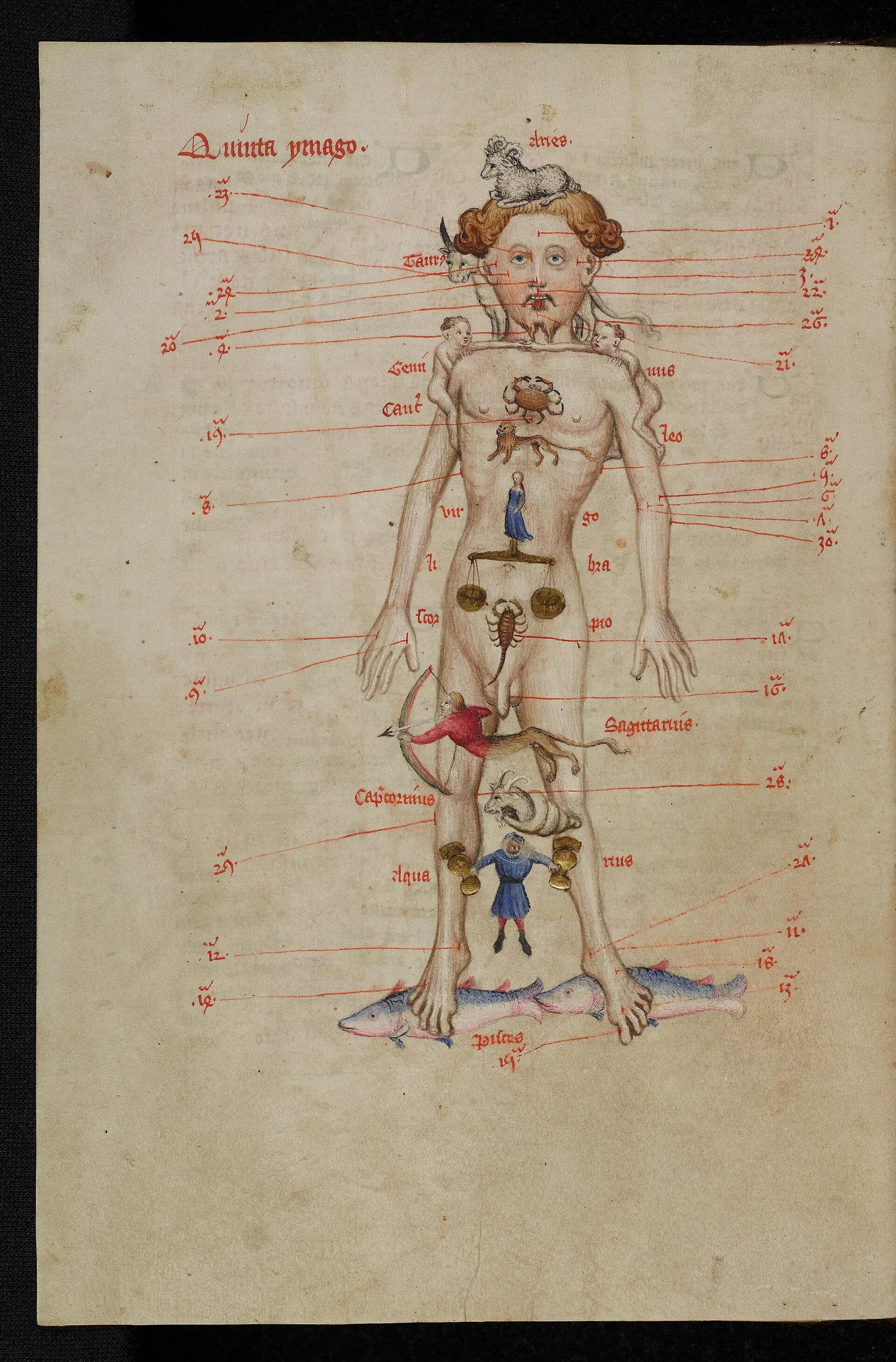
A phlebotomy zodiac man (Trinity College, Cambridge, MS R.15.21, fol. 28v): the signs mapped to the body, with red lines to the numbered bloodletting points. Within the humoral theory of the body, this was a working medical chart — the logical consequence of the biology everyone accepted, which is why medical students learned astrology.
Probably painted by John Siferwas; Trinity College, Cambridge, R.15.21, fol. 28v, via Wikimedia Commons / English Wikipedia file page.
If the machinery was real, what was it supposed to connect? The historical answers changed with the centuries, and each deserves a fair hearing.
Ptolemy's answer was physical: the sun heats, the moon moistens, and these are not metaphors but observed effects. Extend the principle. Perhaps subtler celestial configurations produce subtler terrestrial effects, including effects on the temperaments of the newborn. The weakness, which Cicero had already found, was that no one could show the mechanism for the extension. Heat and moisture were real. Everything past them was analogy.
The medieval answer ran through medicine. The body was thought to be governed by four humors: blood, phlegm, yellow bile, and black bile, whose balance determined health and temperament. The stars were believed to influence the humors the way the moon influences the tides, and so the physician needed the chart to know when to treat and when to wait. This is why medical students learned astrology and why the zodiacal man hung in medical manuscripts. Within the humoral theory of the body, astrological medicine was not an extra belief. It was the logical consequence of the biology everyone accepted. When the biology fell, the medicine fell with it.
Aquinas gave the theologians' answer: celestial bodies can move physical things, including the human body and its humors, but they cannot compel the rational soul. The stars incline; they do not necessitate. A person of strong character could resist a stellar inclination the way a sailor resists a current. This compromise let astrology predict weather, harvests, and bodily tendencies, the "natural" half of the art, while reserving human choice from the "judicial" half, the predictions about individual fates that the Church condemned.
Kepler's answer was geometrical. He threw out most of the traditional machinery, signs and houses and the lore of it, and kept the aspects: the angles the planets form with each other as seen from Earth. He believed the human soul could perceive these harmonies the way the ear perceives musical intervals, and that the perception stirred responses. It was the most scientific version of astrology ever proposed, built by the man who had just discovered the harmonies were real in the orbits themselves. And it still could not do the one thing astrology promised: tell the future reliably.
The modern answer, which belongs to the history of the idea rather than to this lesson's story, is that no mechanism has ever been found. The gravitational and luminous influence of the planets on a newborn is vanishingly small compared to the ordinary objects in the room, and controlled tests of astrological prediction have not found effects beyond chance. Pico said it first in 1494: the stars can act only by light and motion, which fall on everyone alike. Five centuries of physics have not overturned his sentence. They have only made it more precise.
Check in: Give each answer in one line — Ptolemy's, the physicians', Aquinas's, Kepler's — and then the modern answer the lesson closes with.
❦ In your workbook: record the connections in your own way — heat and moisture extended by analogy, the four humors, stars that incline but do not necessitate, Kepler's harmonies, and Pico's sentence standing five centuries later — copy, sketch, or note what matters.
A Sealed Note on Belief
My dears, we have reached the middle of the lesson, and I want to say the thing that matters most before we go any further.
It would be easy, standing here in our century with our telescopes and our physics, to feel superior to the people in this story. Do not. Superiority is the one instrument in the Celestial Tower that has never once given a true reading.
John Dee was brilliant. Kepler was one of the greatest scientific minds who ever lived. The physicians of Padua were learned men treating real patients with the best theories their age possessed. They were wrong about the stars, and being wrong did not make them fools. It made them human beings working at the edge of what anyone knew, which is exactly where you are working right now.
The rule of this unit is kindness toward the believers and honesty toward the belief. We do not mock. We do not sneer. We ask, with genuine curiosity: what did they see, what did they need, and what finally changed their minds? Those are the questions of a historian. They are also the questions of a scientist. It turns out they were the same questions all along.
❦ In your workbook: record the sealed note in your own way — kindness toward the believers and honesty toward the belief, and superiority as the one instrument that has never given a true reading — copy, sketch, or note what matters.
PROFESSOR VESPER GLIMMERWICK
Celestial Studies
Astronomer & Celestial Historian
Guided Observation
Try It Tonight
Part One: The Court Astrologer's Log (everyone does this)
Tonight you will do the first three steps of the historical astrologer's work, and stop before the fourth. That boundary is the whole lesson.
- Go outside with an adult, to your familiar safe spot. Bring your workbook, a pencil, and a flashlight.
- Find the brightest point of light in the sky that does not twinkle. Stars twinkle; planets shine steadily. That steady light is a planet, one of the ancient wanderers.
- Write down the exact time, to the minute. Write down the date. Then describe where the planet stands: which direction you face to see it, how high above the horizon it is (a fist held at arm's length covers about ten degrees), and which stars or landmarks stand near it. Sketch the scene.
- That record, a time, a date, and a position, is the entire raw material of the medieval astrologer. Everything else was machinery built on top of it. Notice how much care the raw material demands, and how little of it is interpretation.
Check in: Your log is the astrologer's first three steps and no more — what exactly did you record, and what did you deliberately stop before?
❦ In your workbook: record the log in your own way — the exact time to the minute, the date, the planet's direction and height in fists, and your sketch of the scene — copy, sketch, or note what matters.
Part Two: The Comparison (Level Two)
If you have access to an almanac, a planetarium app, or an online ephemeris, look up tonight's date and identify your planet. How close was your position estimate? Medieval astrologers worked from printed tables computed months in advance; you are checking yours against tables computed to the second. The comparison is the point: the first three steps of the old machinery were about getting the positions right, and getting them right is genuine astronomy, whatever you do with them afterward.
❦ In your workbook: record the comparison in your own way — your estimated position set against the almanac's, and how close the old machinery's first three steps brought you — copy, sketch, or note what matters.
Part Three: The Historian's Question
Now the step we do not take. A court astrologer of 1600, handed your log, would have added the fourth step: a judgment about what the planet's position meant. We do not do that step, because this course studies the history of the judgment without practicing it. Instead, answer in your workbook: what did the astrologer need that you did not collect? (The exact minute mattered to them far more than to you. Ask yourself why.) And what does the modern astronomer do with your record that the astrologer did not? (Compute the orbit. Predict where the planet will be next month, and check.)
You have just stood exactly where Kepler stood: the measurements in one hand, the meaning in the other, and the honesty to know which is which.
❦ In your workbook: record the historian's question in your own way — what the astrologer needed that you did not collect, and what the modern astronomer does with your record that the astrologer did not — copy, sketch, or note what matters.
Sky Log Entry
Date and time of observation: _______________
Planet observed (or "unidentified steady light"): _______________
Position notes (direction, height in fists, neighboring stars or landmarks): _______________
Sketch the scene, marking the planet and its surroundings: _______________
Moon phase tonight (sketch the disk and shade the dark portion): _______________
If this record fell into John Dee's hands in 1558, what three things would he have needed to add before he could use it? _______________
Kepler's question, in your own words: which part of your record is measurement, and which part would have been interpretation? _______________
Moon Journal check-in: what phase did you expect tonight, and what did you actually see? _______________
❦ In your workbook: record the Sky Log entry in your own way — the planet observed, its position notes, the moon phase you expected against the one you saw, and your answer to Kepler's question: which part is measurement, and which would have been interpretation — copy, sketch, or note what matters.
Materials
Required (Level One — household items)
- Your workbook and a pencil for the Court Astrologer's Log, the exercises, and the reflection questions.
- A flashlight for the night observation in Try It Tonight.
- Access to a library or the internet for the Further Reading sources used in Exercise II.
Suggested (Level Two — historically closer)
- An almanac or ephemeris, printed or online, for the Level Two comparison in Try It Tonight, Part Two.
- Binoculars, if you have them, for a closer look at your planet after the naked-eye log.
Reflection Questions
Answer in your workbook, in complete sentences.
- For two thousand years, the cleverest people in every generation believed astrology worked. What does that fact suggest about the relationship between intelligence and being right?
- Cicero argued from the twins, and then from the 70,000 dead at Cannae. Which of the two arguments is stronger, and why? Defend your choice.
- Kepler kept a reformed astrology while rejecting popular prediction; Pico defended the measuring of the stars while attacking the predicting. What is each man trying to save, and why does it matter to him?
- The Church both employed astrologers and condemned astrology, sometimes in the same century. What does that contradiction tell you about how institutions handle ideas they need but cannot bless?
- Whose story in this lesson most changed your idea of what kind of person believed in astrology, and what single detail did it?
Workbook Checklist — Lesson 27
In my workbook I have:
- ☐ stated Cicero's twin argument and Augustine's Esau-and-Jacob version, built the strongest Ptolemaic reply, and given my verdict with its tipping evidence (Exercise I)
- ☐ written the Court Astrologer's Memo: three things Dee computed or weighed, the political risk he took, and why Elizabeth asked an astronomer (Exercise II)
- ☐ stated Kepler's third-party position, defended my verdict on his honesty with two pieces of lesson evidence, and written the Prague sentence (Exercise III)
- ☐ completed the Court Astrologer's Log: the planet's exact time, date, and position recorded and sketched, stopping before the fourth step
- ☐ answered the Historian's Question: what the astrologer needed that I did not collect, and what the modern astronomer does with my record
- ☐ completed my Sky Log entry for the log night, including the Moon Journal check-in: the phase I expected and the phase I actually saw
☐ Lesson completed Date: ___ Signature: ___
Cross-Class Connections

Runes · Unit I, Lesson 1 — The Structural Wedge
Come closer to the web, scholars. The Babylonian omen tablets behind tonight's history were pressed into wet clay, wedge by wedge — and the pressing is this lesson's whole craft: the stylus, the clay, the tokens that became tallies and the tallies that became the world's first writing. The Tower reads what the tablets were for — the sky, recorded and asked for meaning. Here you read the tablets themselves, from the very first mark. Bring your patience for small signs.
PROFESSOR THISTLELOOM WEBBLETHORN
Runes & Ancient Writing
Scrollwork · Unit V, Lesson 17 — Hierarchy & Page Layout
Rulers out, Tower scholars. The Tetrabiblos and the Great Introduction you met tonight survived as illuminated copies because a scribe planned each page before a word was written: where the text would sit, where the great initials would rise, which spaces the illuminator would fill weeks later. My seventeenth lesson teaches you to read that planning — the architecture of the medieval page — and then to rule a page of your own. Professor Glimmerwick shows you why these books were required reading for a thousand years. Here, we teach you how such a book was built.
PROFESSOR QUILLBERRY NOCTURNE
Scrollwork Library

Herbology · Unit I, Lesson 5 — The Historian's Herbarium
Gently does it, scholars. In the Tower tonight you met the zodiacal man, the chart by which physicians once timed their treatments, and the moon-phase lore that still rides in gardening books. My greenhouse keeps the same discipline for plants: in this lesson you will learn to separate a plant's documented history from its folklore, and to keep the two in their own labeled sections of your journal — folklore studied with interest, and never confused for evidence. Glimmerwick asks what people believed about the sky. Here, we ask it about the garden, the same way.
PROFESSOR BERYL FERNFOOT
Herbology Greenhouse • Master Herbalist • Head of House Oriens

Creative Arts · Studio Extension E4 — Painted Wheels at Full Size
Bring the zodiac wheel to my bench, scholars — as what it is: a historical diagram, and a demanding piece of draftsmanship. In this extension we paint one of the Tower's paper wheels at full size on board: perfect circles struck from a found center, twelve divisions proved by closing the circle, clean lettering practiced before it touches the board, and a maker's plate at the foot stating what the wheel shows and where its reckoning comes from. Draw it true and label it honest, and the artifact will teach every scholar who walks past it.
— Professor Cogbranch Timberclank, Creative Arts Workshop
History of Magic (a future class) — named only. Astrology runs through the world's magical traditions, from protective talismans to divination, exactly as the bullet above frames it: when that class opens, it will study those traditions as history, the way this lesson studies the astronomy. No invitation is written: the class is not yet built.
The Professor's Closing Note
And so the chart is cast, the court is advised, the queen is crowned on the appointed day, and the mathematician goes back to his ellipses.
Here is what I want you to carry out of the Celestial Tower tonight. The story of astrology is not the story of foolish people believing foolish things. It is the story of the human mind doing what human minds do: finding patterns, building systems, hiring experts, and arguing about it all for two thousand years. The believers built the tables. The doubters sharpened the questions. The tables got better because the doubters would not stop asking.
You will meet people in your life who believe things you do not believe. Some of them will be brilliant. When you do, remember Kepler at his desk in Prague, the horoscope on one side and the laws of planetary motion on the other, and do what he did: hold both in view, be honest about which one the evidence supports, and never mistake a clever person for a correct one, including yourself.
That is the work. The sky is patient with all of us while we learn to read it.
PROFESSOR VESPER GLIMMERWICK
Celestial Studies
Astronomer & Celestial Historian
Further Reading & Sources
These are real destinations for further study, verified live at the time of writing. They are historians' sources, not practitioners': every one of them treats astrology as history.
- Smarthistory (Getty Museum): Written in the Stars, Astronomy and Astrology in Medieval Manuscripts. How the seven liberal arts framed the two subjects as one, with illuminated manuscript images. https://smarthistory.org/written-in-the-stars-astronomy-and-astrology-in-medieval-manuscripts/
- Scientific American: Astrology Was an Important Science for Medieval People. An interview with Getty curator Larisa Grollemond on astrology as university science, medical astrology, and the slow 17th- to 18th-century separation. https://scientificamerican.com/podcast/episode/astrology-was-an-important-science-for-medieval-people/
- Cicero's De Divinatione: the dialogue's structure, the Quintus-Cicero debate, and the 44 BC context. https://en.wikipedia.org/wiki/De_Divinatione
- Cicero and Pico: Two Famous Attacks on Astrology (50 BC and 1490 AD). A detailed summary of both skeptics' arguments, including the twin argument, the Cannae argument, and Pico's six objections. https://www.astrology-and-science.com/H-cice2.htm
- Johannes Kepler: the Imperial Advisor section documents his horoscope-casting from his Tübingen student days through the Prague years, and his "mixed feelings" about the art. https://en.wikipedia.org/wiki/Johannes_Kepler
- John Dee, Queen Elizabeth I's Court Astrologer: the 1555 arrest, the January 15, 1559 coronation election, the calendar advice, and the poverty of his final years. https://www.mentalfloss.com/history/royalty/john-dee-elizabeth-court-astrologer-facts
- Nicholas Kollerstrom: Galileo's Astrology. The surviving charts, the Padua mathematicus, the April 1604 Inquisition charge of astral fatalism, and the astrological dedication of Sidereus Nuncius. https://fundacionorotava.org/media/web/files/page145__cap_03_07_Kollerstrom.pdf
- D. P. Walker, The Pope's Horoscope (New York Review of Books, 1969). Urban VIII the believer-pope, the 1631 bull against astrology, and the rumor mill around Galileo in 1630. https://www.nybooks.com/articles/1969/01/30/the-popes-horoscope/
Browse the Celestial Studies shelf in the school Library for readable editions of these works.
Sealed in the Celestial Tower, in deep midnight blue, by Professor Vesper Glimmerwick.
Submit your work for this lesson using the form below.
CONTINUE IN THE CELESTIAL TOWER
← Previous · Lesson 26: Precession & the Thirteenth Sign Next · Lesson 28: Why People Believe & How It's Used Today →
Unit V — The History of Astrology & the Zodiac Celestial Tower — All 33 Lessons
The rest of Unit V: Lesson 24 · Babylon · Lesson 25 · The Hellenistic System · Lesson 26 · Precession · Lesson 28 · Why People Believe