
CELESTIAL STUDIES
Unit V · Lesson 26Precession & the Thirteenth Sign
Professor Vesper Glimmerwick
Astronomer & Celestial Historian
The Celestial Tower • School of Evershade
Professor's Introduction

Settle in, scholars,
I was coming home to the Celestial Tower at dusk, wings full of the evening air, when I heard the loveliest argument drifting up from the terrace below. Two young Eversparks, heads bent over a newspaper horoscope, were debating whether the stars had "changed the rules" and given everyone a new sign. One of them looked genuinely worried. The other looked delighted, which is the correct response to almost everything, but not to this.
So let me settle it before we begin, the way I settled it for them: nobody in this tower is getting relabeled tonight. No scholar will leave this lesson wearing a sign, old or new. That is not what we do here, and it is not what this lesson is about.
What this lesson is about is bigger and better than a headline. About two thousand years ago, a man working by lamplight compared the sky over his head with records written a century and a half before he was born, and he caught the Earth in the act of wobbling. He measured a motion so slow that a single human lifetime can barely see it move. He was right. And because he was right, the neat twelve-part map of the sky no longer sits squarely on the stars it was named for, and every few years the newspapers act surprised.
This is the honesty engine of our whole unit, scholars. Not a trick, not a gotcha, just the truth, worked out with arithmetic you can do yourself. Bring a pencil. The sky has been keeping its own books for a very long time, and tonight we are going to audit them.
PROFESSOR VESPER GLIMMERWICK
Celestial Studies
Astronomer & Celestial Historian
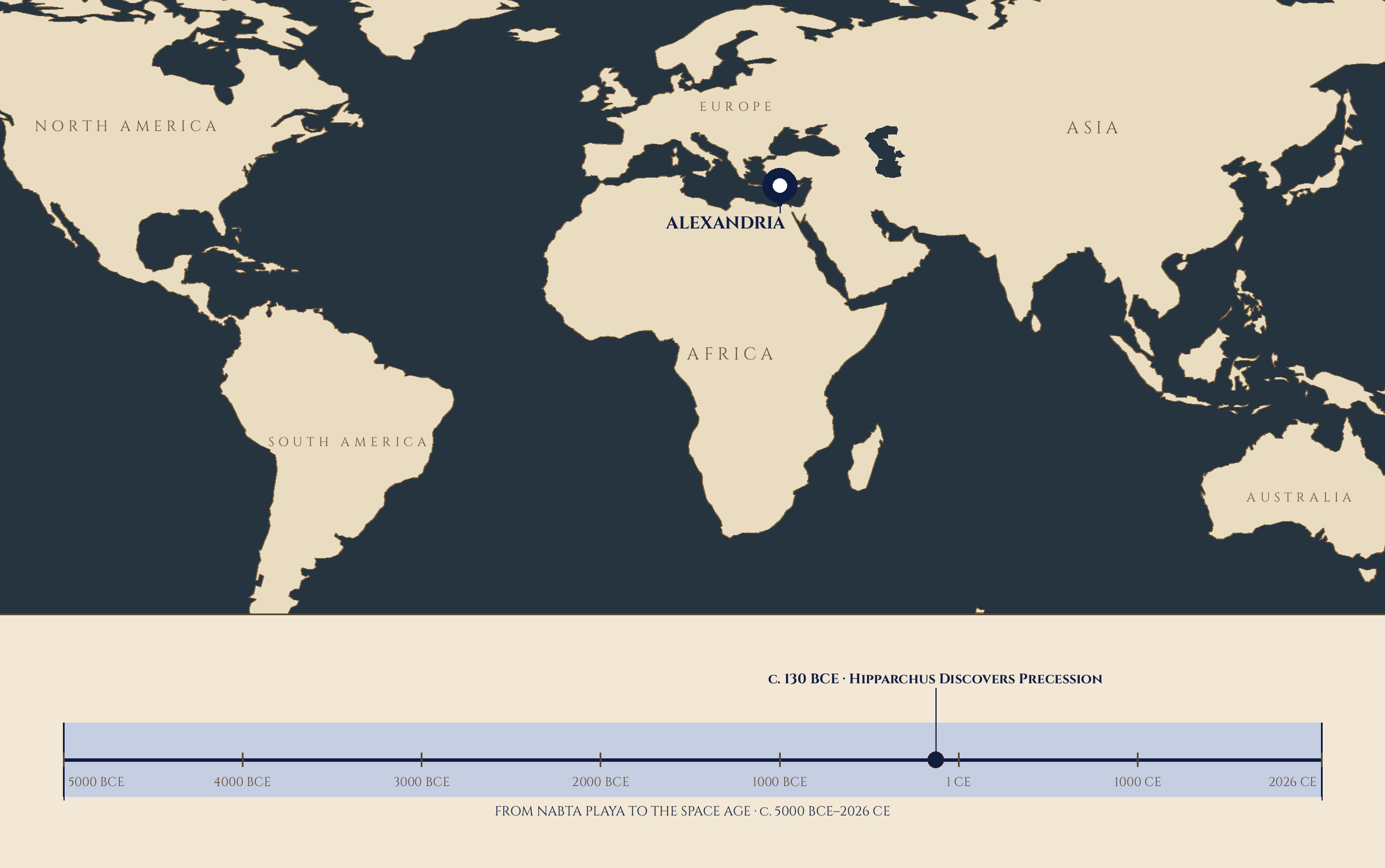
Where and when: ALEXANDRIA, c. 130 BCE · Hipparchus Discovers Precession (year −130) — Precession & the Thirteenth Sign. The pin is this lesson. The line beneath the map is our road: every stop a moment when watching the sky changed, every lesson a pin upon it.
Lesson Objectives
By the end of this lesson, you will be able to:
- Explain what axial precession is: the slow circling of Earth's rotation axis, like a wobbling top, completing one circuit in about 26,000 years.
- Name the physical cause of precession: the gravitational pull of the sun and moon on Earth's equatorial bulge, producing a torque on the spinning Earth.
- State the modern rate of precession (about 50 arcseconds per year, or roughly one degree every 72 years) and use it in simple arithmetic.
- Describe how Hipparchus discovered precession around 130 BCE, by comparing his own star measurements with records made about 150 years earlier.
- Distinguish the twelve astrological signs (a fixed 30-degree coordinate grid anchored to the equinoxes) from the thirteen ecliptic constellations (the actual star groups, with real and unequal boundaries).
- Compute for themselves how far the equinox has shifted since Hipparchus's time, and explain what that shift means in signs.
- Identify Ophiuchus as an ancient, long-recognized constellation, one of the 48 in Ptolemy's Almagest, and not a new discovery.
- Explain why this course studies astrology as cultural and intellectual history only, and why no scholar is ever labeled by any sign.
Reading this lesson: ★ marks the passages to remember. They return on the unit quiz and the class test. Check in questions ask the material back as you go; answer them in your workbook when you meet them.
Working this lesson: Your assignment packet is the first download on this page. Work in it as the lesson moves along, answering each exercise as its subject is taught — or read the lesson through for your notes and take the exercises as homework afterward. Both are proper ways to sit this class. Signposts in the reading tell you where each exercise belongs. Written answers are short answers in your own words; a few honest lines are worth more than a filled page.
Your Assignment Packet
This lesson's exercises live in its packet: the Lexicon Handout (every term, course terms marked ◆), Materials, Guided Practice, the Assignment Manual with its answer key for self-checking, the Reflection Questions, and the Workbook Checklist. Download the packet before you begin and keep it beside you as you read. The packet's exercises are Glimmerwick's own word for the work: Exercise I: The Precession Arithmetic, Written Up ✎, Exercise II: The Wobble Demonstrator's Report ◐, and Exercise III: Map Against Territory ⚒. The lesson's quiz is not printed in the packet; it pools to the Unit V Quiz, where it will meet you again.
Safety Briefing
- All night observing is done with an adult present, in a safe and familiar location. Tell someone where you are and when you expect to return.
- This lesson contains no solar observing of any kind. If any part of tonight's work happens outdoors, it happens after dark, looking at stars, never at the sun.
- The spinning-top demonstration uses small, hard objects. Clear a space on a table, keep the top away from table edges, and keep small siblings and pets out of the landing zone.
- Use a red or dim flashlight for night work so your eyes stay dark-adapted.
- The mathematics in this lesson needs nothing sharper than a pencil. Take your time with the arithmetic; the sky is in no hurry.
The Wonder
Every few years, the newspapers rediscover the sky. "NASA discovers a new zodiac sign!" the headlines shout. "Your sign is wrong! You have been a different sign all your life!" Readers gasp, astrologers sigh, astronomers rub their temples, and somewhere a bat professor folds her wings and smiles, because she has heard this story before and she knows exactly how it ends.
It ends with arithmetic. But before the arithmetic, sit with the puzzle, because it is a genuinely good one.
Here is the first half of it. The zodiac signs each have their dates, printed in every newspaper and on a thousand coffee mugs. But if you learn which constellation the sun actually stands in front of on those dates, the two lists do not match. On most birthdays, the sun stands in front of the constellation before the traditional sign. The sky and the calendar are telling two different stories, and they used to tell the same one.
Here is the second half. Count the constellations the sun passes through in a year, using the real boundaries astronomers drew on the sky in 1930. You will count thirteen, not twelve. The thirteenth is Ophiuchus, the Serpent Bearer, and the sun spends about eighteen days inside it every year, longer than it spends in Scorpius. Nobody told you about it. The coffee mugs left it off.
So: did the sky change its mind? Did someone hide a constellation? Is your sign wrong?
No, no, and it was never quite right in the way the headlines mean. What happened is stranger and more wonderful. The Earth wobbles. It has always wobbled. A man caught it wobbling two thousand years ago with nothing but old records and careful eyes, and everything in this lesson follows from that one patient act of noticing. By the end of tonight, you will have repeated his essential calculation yourself, with your own pencil, and you will understand the thirteenth constellation and the drifting signs better than any headline ever has.
The sky did not move. We did. Let us do the math and see.
Check in: The headlines say a constellation was hidden and your sign is wrong — what two counts create the puzzle, and what does the lesson say actually happened instead?
❦ In your workbook: record the wonder in your own way — the two lists that do not match, the thirteen constellations along the sun's road, and the wobble the lesson promises underneath it all — copy, sketch, or note what matters.
The Story
The man who caught the wobble
His name was Hipparchus. He lived in the second century BCE, working on the island of Rhodes and in Alexandria, and he was the kind of observer who wrote things down so carefully that his notes were still being used as evidence three hundred years after his death. Almost everything we know about him comes to us secondhand, through the writings of Ptolemy, because Hipparchus's own books are lost. That is worth pausing over: we know this man mainly because later scholars kept quoting him. He earned it.
★ Around 130 BCE, Hipparchus set out to measure the positions of the bright stars, including Spica, the brightest star in Virgo. Then he did the thing that made him immortal. He dug up older measurements: the star records of Timocharis of Alexandria, made around 320 to 260 BCE, and of Aristillus, made around 280 BCE, roughly 150 years before his own work. He laid the old numbers beside his new ones.
They did not agree. Spica had moved about two degrees relative to the autumnal equinox. Two degrees is a small amount, about four times the width of the full moon, but it was far too large to be a copying error, and it showed up in star after star. Hipparchus also compared two different ways of measuring the year: the tropical year, the time from one equinox to the next, and the sidereal year, the time for the sun to return to the same place among the stars. They were not the same length either. The year measured by the seasons was slightly shorter than the year measured by the stars.
There was only one explanation that fit both facts. The equinoxes themselves were moving, drifting westward along the ecliptic through the constellations of the zodiac. Hipparchus called the motion the precession of the equinoxes. He estimated that the drift was at least one degree per century, which meant the full circuit could take no more than 36,000 years. By one scholarly account of his figures, his own measured rate came out near 45 or 46 arcseconds per year, astonishingly close to the modern value of about 50. He was working with bronze instruments and clay-tablet-era records, and he nearly nailed it.
One more honest note, because this course insists on them. Hipparchus pictured the universe with the Earth at the center, as everyone in his tradition did. He interpreted what he saw as the whole sphere of the heavens slowly turning around a motionless Earth, not as the Earth itself wobbling. He was wrong about the frame and right about the motion, and the motion is what mattered. We will give him the modern explanation in The Mechanism. He deserves both the credit and the correction.
Check in: What did Hipparchus compare to catch the wobble, what had moved and by how much — and what did he get wrong about the frame?
❦ In your workbook: record the discovery in your own way — old numbers laid beside new ones, Spica two degrees from its recorded place, and a motion found by comparing records, not by looking harder — copy, sketch, or note what matters.
The twelve slices
To understand what precession broke, you need to know what was built. The zodiac, as Lesson 24 told in full, began as a Babylonian calendar and omen system: a way of dividing the sun's yearly road into useful pieces. The builders did something very practical. They took the full 360-degree circle of the ecliptic and cut it into twelve equal slices of 30 degrees each, one slice to match each month of their twelve-month calendar year.
Then they named each slice for the constellation that stood behind it at the time the system was fixed, roughly two thousand years ago. Slice one got the name of Aries, because the March equinox sun stood against the stars of Aries. Slice two got Taurus, and so on around the wheel.
Notice what kind of thing this is. It is a map drawn for convenience: equal slices, tidy numbers, a clean fit with the calendar. The constellations themselves are nothing like equal. Virgo sprawls across a huge stretch of sky. Scorpius is a narrow sliver; the sun hurries through it in about a week. The map was never a portrait of the territory. It was a filing system with starry labels, and it worked beautifully for the sky of its own century.
Check in: Why twelve equal slices of 30 degrees — and what were the slices named for when the system was fixed?
❦ In your workbook: record the twelve slices in your own way — a circle cut for a twelve-month calendar, slices named for the constellations behind them, and a map that was never a portrait — copy, sketch, or note what matters.
The thirteenth that was never new
★ Now count the constellations the sun actually passes in front of, using the official boundaries the International Astronomical Union fixed in 1930. The count is thirteen. The extra one is Ophiuchus, the Serpent Bearer, a large constellation sprawling between Scorpius and Sagittarius, and the sun travels through it every year from about November 30 to December 17: eighteen days, longer than its week in Scorpius.
Here is the point the plan for this lesson insists on, and it matters more than any date. Ophiuchus is not a new discovery. It has been a recognized constellation since antiquity. It is one of the 48 constellations catalogued by Ptolemy in the Almagest around 150 CE, and the Greeks associated its stars with Asclepius, the healer who carries a serpent, which is why the figure in the sky holds one. It was never hidden, never erased, never lost. Star charts have shown it for two thousand years. What happened in 2016 was not a discovery; it was a round of headlines "rediscovering" a fact astronomers had never forgotten, and NASA's own response was, in essence, that they had simply done the math in public.
So why twelve signs and thirteen constellations? The traditional telling, the one NASA's Space Place article gives, is disarmingly practical: the builders wanted twelve slices to match their twelve-month calendar, so they left one constellation out of the scheme. Ophiuchus kept its stars. It simply never got a slice. The map stayed tidy; the sky stayed itself.
Check in: How many days does the sun spend in Ophiuchus, where was it catalogued two thousand years ago — and why did it never get a sign?
❦ In your workbook: record the thirteenth in your own way — eighteen December days, a place in Ptolemy's 48, and a constellation that kept its stars but never got a slice — copy, sketch, or note what matters.
A name that outlived its sky
★ One loose end, and it is a lovely one. Astronomers still call the March equinox point the First Point of Aries. But the equinox point has not stood among the stars of Aries for about two thousand years. Precession has carried it westward into Pisces, where it has sat since roughly the beginning of the Common Era, and it is now drifting toward the border of Aquarius. The name is a fossil: a label given when it was true, kept long after the sky moved on, because astronomers needed a fixed name for a moving point and old names are comfortable.
If you have ever heard talk of the dawning of the Age of Aquarius, this is the machinery behind the poetry. The "ages" are simply the slow parade of the equinox point through the constellations, one sign's worth about every 2,160 years. The poetry is not our subject. The parade is.
Check in: Where does the point still called the First Point of Aries actually sit today, and why does the old name survive?
❦ In your workbook: record the fossil name in your own way — a label given when it was true, an equinox point now in Pisces and drifting toward Aquarius, and the slow parade behind the poetry — copy, sketch, or note what matters.
The Mechanism
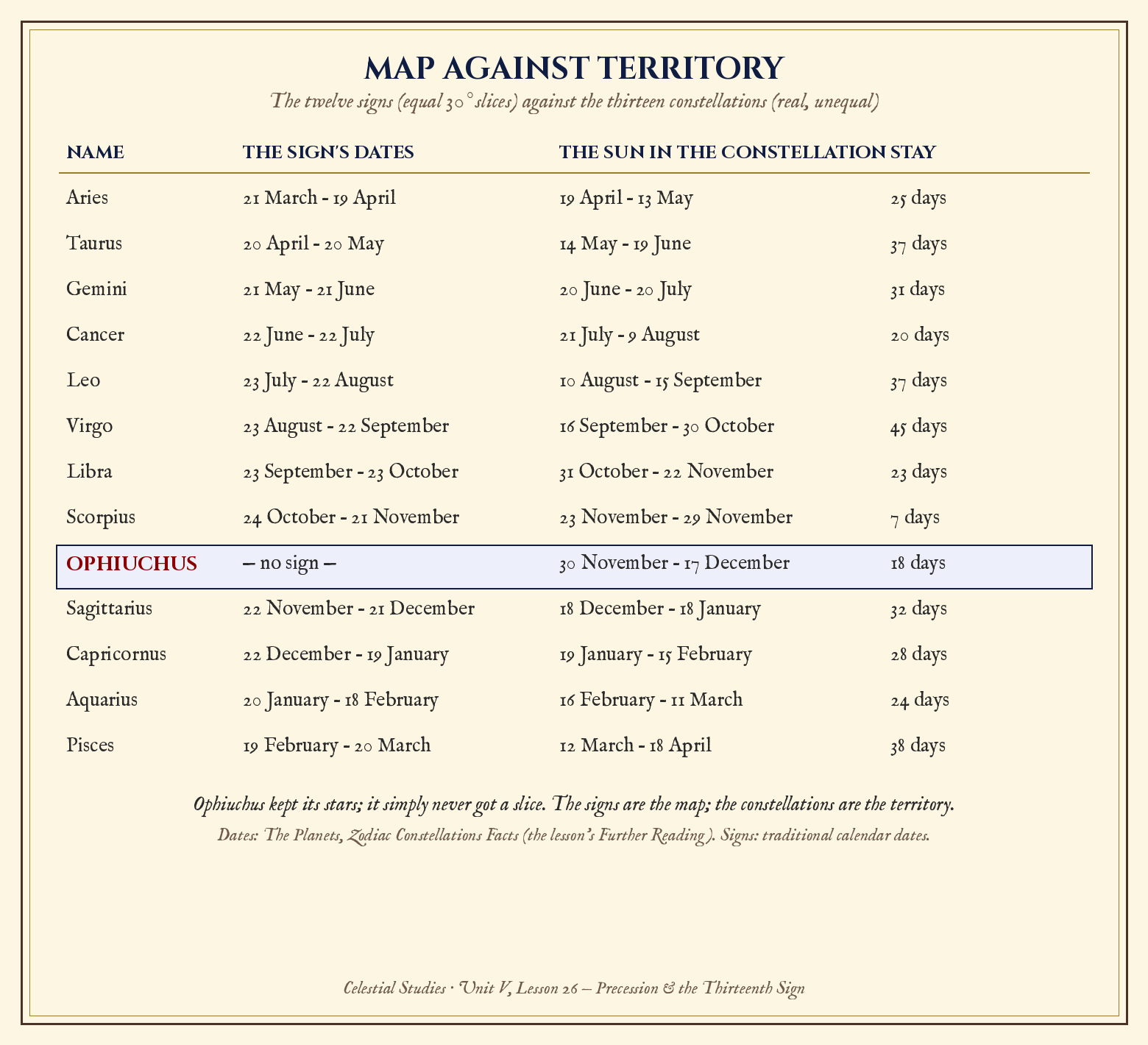
Map against territory: the twelve signs with their traditional dates beside the thirteen constellations with the sun's actual dates — the whole mismatch, about one sign wide, on one plate.
Built for Evershade (typeset plate). Constellation dates and stays from The Planets, Zodiac Constellations Facts — the lesson's own Further Reading source (its Ophiuchus 18 days, Scorpius 7 days, and Virgo 45 days are the fact-check-verified figures); sign dates are the traditional calendar dates the lesson's Exercise III asks scholars to list.
The top that is the Earth
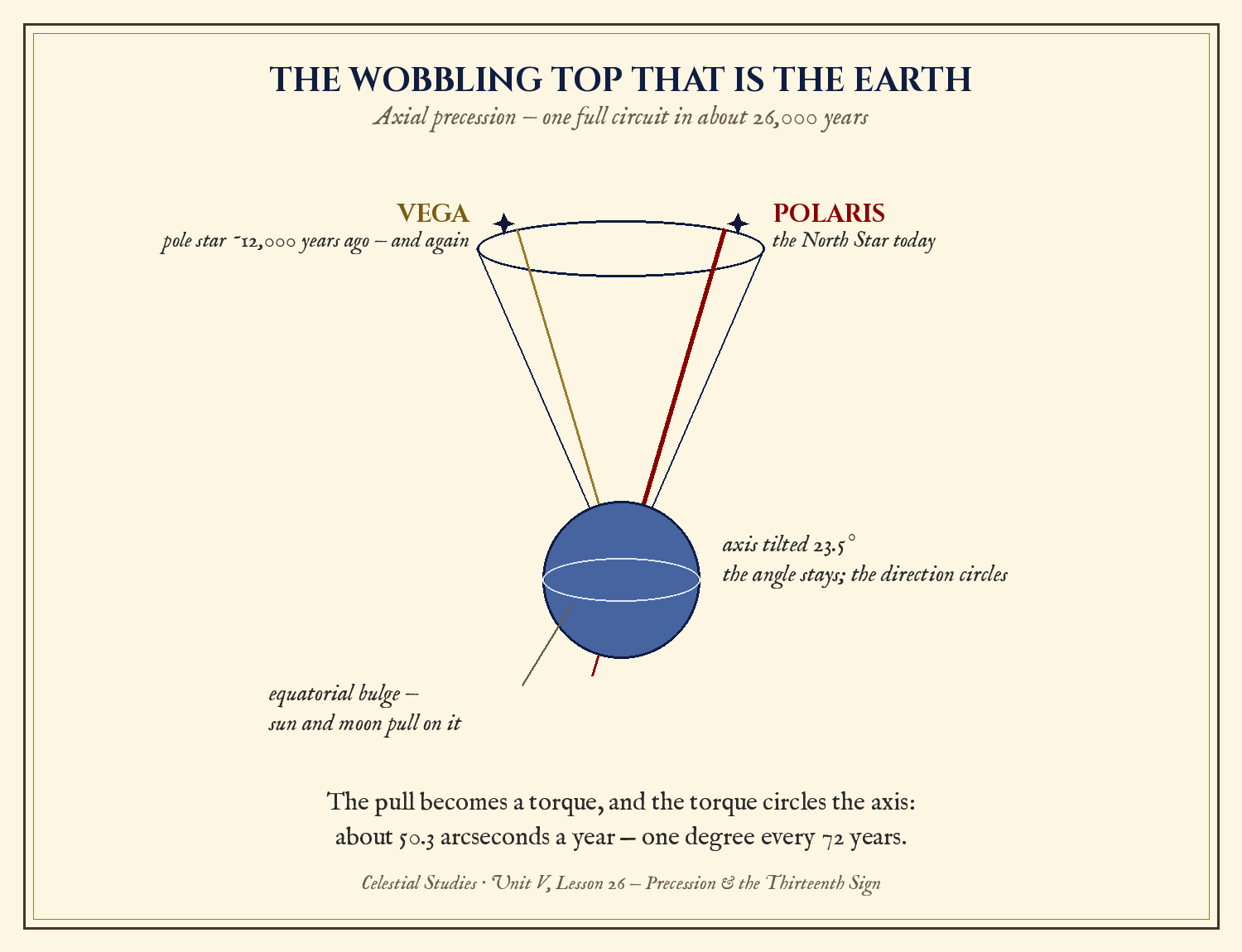
The wobbling top that is the Earth: the axis holds its 23.5° tilt and circles the cone once in about 26,000 years — Polaris today, Vega about 12,000 years ago and again to come.
Built for Evershade (typeset plate; no external image). All values are the lesson's own taught figures.
Find a spinning top, if you have one. Set it spinning with its axis tilted. Watch the axis itself: it does not stay pointed in one direction. It slowly circles, tracing out the surface of a cone, while the top keeps spinning underneath. Physicists call that slow circling precession, and a top does it because gravity tugs at its tilted weight while its spin turns the tug into a circling motion instead of a fall.
Earth is that top, on a timescale that makes tops look hyperactive. Earth's rotation axis is tilted about 23.5 degrees from the upright (Lesson 3's axial tilt, the lean that gives us the seasons). The angle of the lean stays roughly the same. But the direction of the lean slowly circles the sky, tracing a great cone among the stars, completing one full circuit in about 26,000 years. The tilt does not grow steeper or shallower in any way that matters here. The lean simply, patiently, turns.
Check in: In Earth's wobble, what circles and what stays roughly the same — the tilt's angle, or the tilt's direction?
❦ In your workbook: record the top in your own way — a tilted axis tracing a cone while the spin continues underneath, and a lean whose angle holds while its direction turns — copy, sketch, or note what matters.
Why it wobbles: the torque
What pushes it? Earth is not a perfect sphere. Its spin flings its middle outward into a slight bulge at the equator, the way a spinning ball of dough flattens and widens. The sun's gravity and the moon's gravity both pull on that bulge, trying to straighten the tilt upright. Because Earth is spinning, that straightening pull cannot simply tip the planet over; instead it becomes a torque, a twisting force, and a torque applied to a spinning body produces precession: the slow circling of the axis. The moon's pull does most of the work, the sun's does much of the rest, and the planets contribute only a whisper.
★ This is the mechanism in one sentence, and it is worth memorizing: the sun and moon pull on Earth's equatorial bulge, and because Earth spins, the pull twists the axis into a 26,000-year wobble instead of tipping it over.
★ The modern numbers: the axis direction currently drifts at about 50.3 arcseconds per year. An arcsecond is a tiny angle, one 3,600th of a degree, so 50 of them per year sounds like nothing, and in a human lifetime it nearly is. But multiply it out. Fifty arcseconds a year comes to about one full degree every 72 years, and 360 degrees at that pace takes about 25,772 years. Astronomers round it to "about 26,000 years," the Great Year, and that rounding is honest enough for every purpose in this lesson. One caution from the professionals: the rate varies slightly over time, so 26,000 years is a working number, not a prophecy. The wobble is real; the exact timetable breathes a little.
Check in: What pulls, what bulges, and why does the pull circle the axis instead of tipping the planet over — and what is the modern rate, in arcseconds per year and in years per degree?
❦ In your workbook: record the torque in your own way — sun and moon pulling on the equatorial bulge, spin turning the pull sideways, and 50.3 arcseconds a year adding up to a degree in a lifetime — copy, sketch, or note what matters.
What moves and what does not
Be precise about what is actually drifting, because this is where the understanding lives. The stars are not moving (not in any way that matters for this lesson). What moves are the equinox points: the two places where the ecliptic, the sun's yearly road, crosses the celestial equator. As the axis circles, those crossing points slide slowly westward along the ecliptic, opposite to the direction the sun travels through the year.
This gives us two different years. The tropical year, equinox to equinox, the year of the seasons, is about 20 minutes shorter than the sidereal year, star to star. Twenty minutes sounds like nothing, but it accumulates: after about 26,000 years the difference adds up to a whole year, and the seasons have lapped the stars completely.
It also gives us wandering pole stars. Polaris is the North Star today by pure coincidence of timing. About 12,000 years ago the celestial pole pointed near Vega, and in the far future it will point near Vega again, with other bright stars taking their turns in between. The "fixed" stars are fixed. The frame we hang them on is slowly turning.
Check in: What actually drifts — the stars, or the equinox points — and which of the two years is shorter, by about how much?
❦ In your workbook: record what moves in your own way — equinox points sliding westward along the ecliptic, a twenty-minute difference that laps a whole year, and pole stars that are only passing tenants — copy, sketch, or note what matters.
Signs are a map; constellations are the territory
Now the reckoning, and it is simple once the mechanism is clear.
★ The twelve signs of the tropical zodiac are a coordinate grid: twelve equal 30-degree slices beginning at the March equinox, nailed to the equinox, not to the stars. Wherever the equinox goes, the whole grid goes with it, like the lines of latitude painted on a turning globe.
The constellations are the territory: real groups of stars with real, unequal boundaries, thirteen of which the sun passes through, Ophiuchus included.
★ When the grid was laid down two thousand years ago, it sat squarely on the constellations it was named for. Since then the equinox, and the grid with it, has drifted westward by about one degree every 72 years. Two thousand years of drift is about 28 to 30 degrees: nearly one full 30-degree sign. So today the sign called Aries begins where the constellation Pisces stands, and the whole wheel is shifted by roughly one notch. The map did not lie when it was drawn. It has simply been carried, intact and honest, to a new place in the sky, while the territory stayed where it was.
That gap, about one sign wide, is the entire mystery of the headlines. No conspiracy, no hidden constellation, no rewritten rules. Just a wobble, a grid, and two thousand years.
Check in: What is anchored to the equinox and what is anchored to the stars — and how wide is the gap between them today, in degrees and in signs?
❦ In your workbook: record the reckoning in your own way — a grid nailed to the equinox, territory that stayed where it was, and a gap about one sign wide — copy, sketch, or note what matters.
In your packet: Exercise III: Map Against Territory ⚒ begins here — its two-column chart is built from exactly this reckoning. Work it now, or mark the place and take it as homework — your choice.
The honesty engine
This is why the lesson plan calls this the honesty engine of the unit, and why the course puts it near the center of the history of astrology rather than at the edges. A course that only told flattering stories about the zodiac would skip this lesson. We do not skip it. The zodiac's machinery was built for the sky of two thousand years ago, the builders chose twelve slices for a twelve-month calendar, the stars were always thirteen along the road, and the Earth was always wobbling. Saying so does not mock anyone who used the old map; maps are allowed to age. It simply refuses to pretend the map is the territory. That refusal is the whole spirit of this unit: inform, never convert, and let the arithmetic speak.
Check in: Why does this course call precession the unit's honesty engine rather than a gotcha?
❦ In your workbook: record the honesty engine in your own way — a map allowed to age, a refusal to pretend the map is the territory, and arithmetic left to speak — copy, sketch, or note what matters.
A Sealed Note on the Honest Sky
Scholars, a word about the difference between correcting an idea and mocking the people who held it, because this lesson walks right along that line and I want you on the right side of it.
The Babylonian sky-watchers who cut the circle into twelve were not fools. They were brilliant, practical people solving a calendar problem with the sky they had, and their solution worked for centuries. Hipparchus, who caught the wobble, was not trying to embarrass anyone; he was comparing numbers because the numbers did not match, and following them where they led. And the millions of people who read horoscopes today are not fools either. They are doing what humans have always done: looking for pattern and meaning in a world that does not always supply them on schedule. Lesson 28 will treat that urge with the kindness it deserves.
Our job in this tower is narrower and, I think, nobler. We check the arithmetic. We say what the sky is actually doing. We keep the history and the mechanism in the same room, and we do not let either one bully the other. If you take one habit from this lesson, let it be this: when the numbers and the story disagree, trust the numbers, and then tell the story again, better.
Now pick up your pencil. It is time to do what Hipparchus did.
❦ In your workbook: record the sealed note in your own way — brilliant builders, a comparer of numbers, and the habit of trusting the numbers and then telling the story again, better — copy, sketch, or note what matters.
PROFESSOR VESPER GLIMMERWICK
Celestial Studies
Astronomer & Celestial Historian
Guided Observation
Try It Tonight
Part One: Do the arithmetic yourself
This is the heart of the lesson, and you need nothing but a pencil and patience. You are going to repeat, in miniature, the essential calculation behind precession: how far has the equinox moved since Hipparchus measured the sky?
Step 1: Count the years. Hipparchus made his comparison around 130 BCE. This lesson is written in 2026 CE. How many years is that? Remember there is no year zero: from 130 BCE to 1 CE is 130 years, and from 1 CE to 2026 CE is 2,025 years. Add them.
Step 2: Multiply by the rate. Modern measurements give the drift as about 50.3 arcseconds per year. Multiply your year count by 50.3. Your answer is in arcseconds, and it will be a large number. That is fine. Large numbers are honest.
Step 3: Convert to degrees. There are 3,600 arcseconds in one degree. Divide your Step 2 answer by 3,600.
Step 4: Cross-check with the rule of thumb. Divide your year count by 72, since the equinox moves about one degree every 72 years. Your two answers should agree within a fraction of a degree. If they do not, check your arithmetic; the sky is consistent even when our pencils are not.
Step 5: Say what it means. Each zodiac sign spans 30 degrees. How many signs wide is your answer? Write one sentence explaining, in your own words, why the signs and the constellations no longer line up.
(If your arithmetic is right, both methods land near 30 degrees: about one full sign of drift since Hipparchus. You have just measured two thousand years of wobble with a pencil.)
Check in: Both of your methods should land near the same number — what is it, in degrees, and how many signs wide is that?
❦ In your workbook: record the arithmetic in your own way — the year count with no year zero, the multiplication, the conversion, and the cross-check that agrees — copy, sketch, or note what matters.
In your packet: Exercise I: The Precession Arithmetic, Written Up ✎ begins here — this same calculation, written up as a clean, labeled solution with its three follow-on questions. Work it now, or mark the place and take it as homework — your choice.
Part Two: Spin the wobble
Set a spinning top going with its axis tilted, or spin a hard-boiled egg on its side, or even spin a coin and watch it settle into its circling wobble. Watch the axis, not the spin: the slow circling of the tilted axis is the precession, and the fast spin is Earth's daily rotation. Sketch what you see: the cone the axis traces. Label where "north" points at four moments around the cone.
Then answer this in two sentences: gravity is pulling the top's tilted axis downward, so why does the axis circle instead of simply falling over? (Hint: the spin turns the pull sideways. That sideways-turned pull is the torque, and it is doing the same work on Earth, courtesy of the sun and moon pulling on our equatorial bulge.)
Check in: In your spinning demo, which motion is Earth's daily rotation and which is the precession — and what turns the downward pull into a circling?
❦ In your workbook: record the wobble in your own way — the cone your top's axis traced, north marked at four moments, and the two sentences on why the axis circles — copy, sketch, or note what matters.
In your packet: Exercise II: The Wobble Demonstrator's Report ◐ begins here — the demo performed and written up as a short report, sketch included. Work it now, or mark the place and take it as homework — your choice.
Part Three: Meet the thirteenth, when you can
Ophiuchus is a shy constellation to meet, and the lesson should be honest about why. The sun stands in front of it from about November 30 to December 17, which means in early December Ophiuchus is up in the daytime sky, drowned in sunlight. You cannot see it then. That is not a flaw in the plan; it is the whole point. The constellation the sun is "in" is always the one you cannot see that month.
To meet Ophiuchus, wait for summer. On July evenings in the Northern Hemisphere, the Serpent Bearer sprawls high in the southern sky, a large, dim house-shape of stars between Scorpius, low and curving, and Hercules overhead. Its brightest star, Rasalhague, marks the head at the top of the shape. Scholars in the Southern Hemisphere can find it too; it straddles the celestial equator, so both hemispheres share it. Use a star chart or a planetarium app, give your eyes twenty minutes to adapt, and be patient: Ophiuchus has no brilliant beacon, which may be one reason the coffee mugs left it off. Record in your Sky Log whether it was visible tonight or hiding behind the sun, and why.
Levels: Level One needs only eyes, a pencil, and patience; the whole lesson works naked-eye. Level Two scholars with binoculars can trace Ophiuchus's full sprawling outline on a dark July night and pick out its globular clusters, the great starry beehives the constellation is famous for among deep-sky observers.
Check in: Why can you not see Ophiuchus in early December, and when — and where in the sky — can you meet it instead?
❦ In your workbook: record the meeting in your own way — visible tonight or hiding behind the sun and why, the house-shape between Scorpius and Hercules, and Rasalhague at its head — copy, sketch, or note what matters.
Sky Log Entry
Date and time of observation: _______________
Your precession arithmetic: years elapsed since ~130 BCE: _______________; drift in arcseconds: _______________; drift in degrees: _______________; rule-of-thumb check (years ÷ 72): _______________
In one sentence, what does your answer mean for the signs and the constellations? _______________
Sketch the wobbling top's cone here, and mark where "north" points at four moments around the circle: _______________
Ophiuchus tonight: visible or behind the sun? Explain your answer: _______________
Moon Journal: note tonight's phase and add your sketch to the running lunation: _______________
❦ In your workbook: record the Sky Log entry in your own way — your arithmetic and its one-sentence meaning, the cone sketch, Ophiuchus visible or behind the sun, and tonight's Moon Journal line — copy, sketch, or note what matters.
Materials
Required (Level One — household items)
- Your workbook and a pencil: the precession arithmetic is done by hand, showing every step.
- A calculator for the large multiplications (the reasoning is yours; the arithmetic may have help).
- A spinning top, a hard-boiled egg, or a coin for the wobble demonstration in Part Two.
- A star chart or planetarium app for meeting Ophiuchus when it is visible.
- A ruler for ruling the two-column signs-against-constellations chart.
- A red or dim flashlight for night observing.
Suggested (Level Two — historically closer)
- A tilted globe and a lamp to model the axis, the cone it traces, and the drifting equinox.
- Binoculars for tracing Ophiuchus's full sprawling outline and its globular clusters on a dark July night.
Reflection Questions
Answer in your workbook, in complete sentences.
- Hipparchus discovered the wobble not by looking harder but by comparing old records with new measurements. What does his method suggest about how knowledge grows: is it mostly new observations, or mostly keeping good records of old ones?
- The lesson says the signs are a map and the constellations are the territory. When is a map allowed to disagree with the territory, and when should it be redrawn? Is the tropical zodiac a map that should be redrawn, or one that is fine as it is? Defend your answer.
- This lesson calls precession the unit's "honesty engine" rather than a gotcha. What is the difference between correcting an idea and mocking the people who held it, and why does the distinction matter for a school?
- Astronomers kept the name "First Point of Aries" for a point that has sat in Pisces for two thousand years. Is keeping an outdated name honest, confusing, or simply practical? Give reasons.
- The builders of the zodiac chose twelve equal slices to fit a twelve-month calendar, leaving Ophiuchus out of the scheme. What does that choice reveal about what the zodiac was originally built for, and how should that shape the way we read its history?
Workbook Checklist — Lesson 26
In my workbook I have:
- ☐ done the precession arithmetic both ways — by 50.3 arcseconds per year and by the divide-by-72 rule of thumb — and written the one sentence saying what the answer means
- ☐ performed the wobble demonstration and sketched the cone, with "north" marked at four points
- ☐ written the torque explanation: what pulls, what bulges, what spins, and why the result is a circle instead of a fall
- ☐ ruled the two-column chart — twelve signs with their traditional dates against thirteen constellations with the sun's actual dates — and answered its four questions
- ☐ written the three-sentence headline correction: accurate, kind, and free of mockery
- ☐ completed my Sky Log entry, including the Moon Journal line for tonight's phase
☐ Lesson completed Date: ___ Signature: ___
Cross-Class Connections

Runes · Unit I, Lesson 1 — The Structural Wedge
Tower scholars, the tablets this lesson reads the consequences of were pressed in my classroom first: wedge by wedge, a cut reed stylus in wet clay, in the Mesopotamia where writing itself began as accounting. Come to my web and learn the wedge forms Hipparchus's long memory was written in — the signs, the stylus, the clay that outlasted empires. Professor Glimmerwick reads what the writing made possible. Here, we read the writing itself.
PROFESSOR THISTLELOOM WEBBLETHORN
Runes & Ancient Writing

Scrollwork · Unit I, Lesson 1 — The Scriptorium Desk
Tower scholars, the Almagest reached your tower because copyists sat at desks like the one my first lesson sets: a sloped board, light placed true, a text copied by hand, and then copied again, for over a thousand years. Come to the Scrollwork Library and learn where the scribe sits, and how a manuscript was arranged, copied, and kept. Professor Glimmerwick shows you what the book preserved. Here, we teach you how such books survived to preserve anything at all.
PROFESSOR QUILLBERRY NOCTURNE
Scrollwork Library

Creative Arts · Studio Extension E3 — Models That Move, Built as Machines
Bring the wobbling top to my bench, scholars, and we will build it properly: a tilted globe on a mount that circles slowly and truly, arbors turning in real bearings, one patient crank carrying the axis around its cone while the pole star changes overhead. A machine is a promise that movement will repeat, and this one must keep a 26,000-year promise in miniature — with a maker's plate that states its ratios honestly. Build it right, and it will teach precession to scholars not yet enrolled.
PROFESSOR COGBRANCH TIMBERCLANK
Creative Arts Workshop
The Professor's Closing Note
And so the audit is complete, scholars, and the books balance.
You now know something that took humanity's best observer, working with the finest records of his age, to discover: that the Earth wobbles like a top, that the equinox slides westward about a degree in a human lifetime, and that two thousand years of that sliding have carried the zodiac's neat twelve slices about one notch away from the thirteen constellations they were named for. You did not take my word for it. You did the multiplication yourself. That is the difference between being told the sky is honest and checking its books personally.
You also know that Ophiuchus was never missing. It was there in Ptolemy's catalogue two thousand years ago, serpent in hand, keeping its eighteen December days exactly as it keeps them now. The headlines will come around again in a few years, breathless as ever. You will smile your kindest bat-professor smile, the one I am smiling now, and you will explain about the wobble and the grid and the territory, without mocking anyone who only read the headline.
No new labels tonight. You came in as scholars, and as scholars you leave: people who check the arithmetic and tell the story better. Keep watching. The equinox is moving even now, its fifty arcseconds a year ticking away while you read this sentence, and the sky has never once been in a hurry about it.
PROFESSOR VESPER GLIMMERWICK
Celestial Studies
Astronomer & Celestial Historian
Further Reading & Sources
These are real destinations for further study, verified live at the time of writing. Start with the precession overview, then the Ophiuchus story.
- Wikipedia: Axial precession (the mechanism, the 25,772-year period, the 1-degree-per-72-years rate, and Hipparchus's discovery from Timocharis's and Aristillus's records). https://en.wikipedia.org/wiki/Axial_precession
- Dr. Tony Phillips for Science@NASA: A Breeze from the Stars (the sun enters Ophiuchus each year between November 30 and December 17; the 13th constellation of the zodiac). https://phys.org/news/2004-12-breeze-stars.html
- Chandra X-ray Observatory, Harvard: Q&A on the vernal equinox (why the "First Point of Aries" now sits in Pisces; the ~50-arcsecond-per-year drift). https://chandra.harvard.edu/resources/faq/astrophysics/astrophysics-25.html
- Washington State University: Astronomy: precession of earth (Hipparchus's discovery, the 26,000-year wobble, Polaris and Vega as past and future pole stars). http://astro.wsu.edu/worthey/astro/html/lec-precession.html
- The Planets: Zodiac Constellations Facts (the full table of all thirteen constellations with the dates the sun spends in each, including Ophiuchus, November 30 to December 17). https://theplanets.org/constellations/zodiac-constellations/
- NASA Goddard / Stargaze (David P. Stern): Precession (the First Point of Aries, the equinox's journey from Aries through Pisces toward Aquarius, the spinning-top analogy, and the moon-and-sun torque on Earth's bulge). https://pwg.gsfc.nasa.gov/stargaze/Sprecess.htm
- Astronomy Magazine: Phil Harrington's Binocular Universe, "Here's what the doctor ordered" (finding Ophiuchus with binoculars; the thirteenth constellation's deep-sky riches). https://www.astronomy.com/science/phil-harringtons-binocular-universe-heres-what-the-doctor-ordered/
Browse the Celestial Studies shelf in the school Library for readable editions of these works.
Sealed in the Celestial Tower, in deep midnight blue, by Professor Vesper Glimmerwick.
Precession is no longer a diagram. The Wheel shows the Moon standing in her sign — and the different constellation actually behind her. Come and see the drift with your own eyes.
Open the WheelPROFESSOR VESPER GLIMMERWICK · CELESTIAL TOWER
Submit your work for this lesson using the form below.
CONTINUE IN THE CELESTIAL TOWER
← Previous · Lesson 25: The Hellenistic System Next · Lesson 27: Astrology Through the Ages →
Unit V — The History of Astrology & the Zodiac Celestial Tower — All 33 Lessons
The rest of Unit V: Lesson 24 · Babylon · Lesson 25 · The Hellenistic System · Lesson 27 · Astrology Through the Ages · Lesson 28 · Why People Believe