
CELESTIAL STUDIES
Unit V · Lesson 25The Hellenistic System
Professor Vesper Glimmerwick
Astronomer & Celestial Historian
The Celestial Tower • School of Evershade
Professor's Introduction
Welcome back to the tower, scholars,
Tonight we open a door I have kept shut for twenty-four lessons, and I am opening it the way one opens a museum case: with white gloves, and without touching the contents. This is the history of astrology. Not the practice of it. Never the practice of it. Nobody in this lesson will be told what sign they are, nobody will have a chart read, and nobody's future will be discussed, because that is not what we do here. What we do here is study how people thought, and people once thought about the sky the way a chess player thinks about a board: every piece with its place, every move with its rule, and the whole game played in earnest.
What you are about to learn is a machine for making decisions, built around 300 to 100 BCE in the city of Alexandria, out of Babylonian star-lore, Egyptian star-clocks, and Greek geometry. It has twelve signs, twelve houses, five aspects, and seven wandering lights. It is intricate, beautiful, and completely wrong about what it claimed to do. Both of those things can be true at once. The people who built it were not fools. They were working without statistics, without psychology, without weather satellites, and they built the best uncertainty-engine their mathematics allowed. I respect them enormously. I simply do not follow them.
You will find this lesson has no star charts of anyone you know. The wheels we draw will be blank geometry. The planets we place will be coins. Learn the rules the way you would learn the rules of an ancient board game: precisely, curiously, and from the outside.
PROFESSOR VESPER GLIMMERWICK
Celestial Studies
Astronomer & Celestial Historian
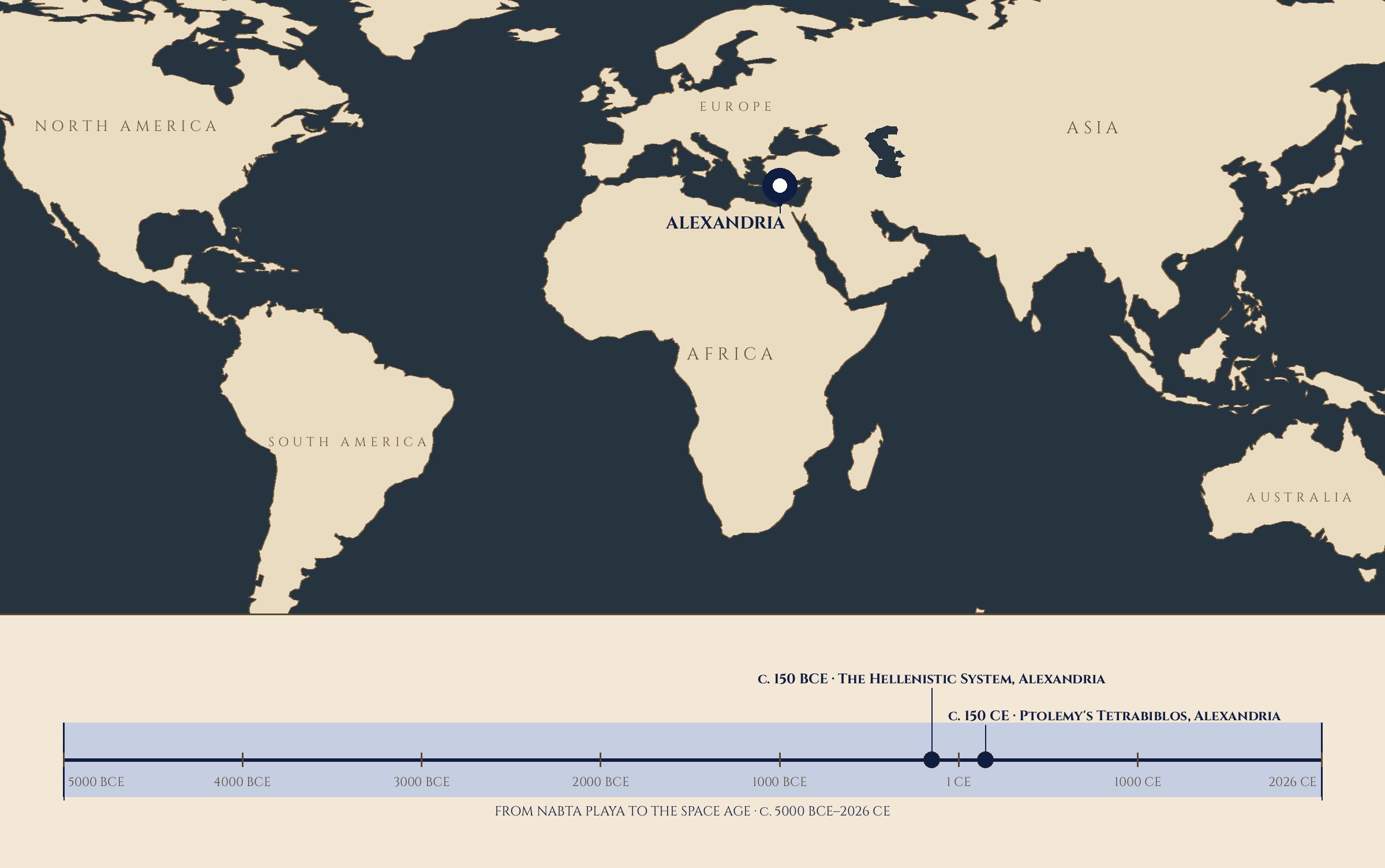
Where and when: ALEXANDRIA, c. 150 BCE · The Hellenistic System, Alexandria (year −150) + c. 150 CE · Ptolemy's Tetrabiblos, Alexandria (year 150) — The Hellenistic System. The pin is this lesson. The line beneath the map is our road: every stop a moment when watching the sky changed, every lesson a pin upon it.
Lesson Objectives
By the end of this lesson, you will be able to:
- Explain how Babylonian omen-lore, the Egyptian decans, and Greek philosophy combined in Alexandria to produce horoscopic astrology around the 2nd to 1st century BCE.
- Define horoscope, zodiac, ascendant, house, and aspect, and distinguish the twelve 30-degree signs from the constellations that share their names.
- Describe how a Hellenistic astrologer cast a chart: the moment and place, the ascendant, planet positions from tables, the houses, and the aspects.
- Name the five major aspects with their degree measures and explain what each was traditionally said to mean within the system.
- Summarize what horoscopic astrology was used for: personal guidance, choosing favorable moments, weather and politics, and medicine.
- State clearly, in their own words, that modern testing finds no evidence that charts predict anything, and explain why historians study the system anyway.
Reading this lesson: ★ marks the passages to remember. They return on the unit quiz and the class test. Check in questions ask the material back as you go; answer them in your workbook when you meet them.
Working this lesson: Your assignment packet is the first download on this page. Work in it as the lesson moves along, answering each exercise as its subject is taught — or read the lesson through for your notes and take the exercises as homework afterward. Both are proper ways to sit this class. Signposts in the reading tell you where each exercise belongs. Written answers are short answers in your own words; a few honest lines are worth more than a filled page.
Your Assignment Packet
This lesson's exercises live in its packet: the Lexicon Handout (every term, course terms marked ◆), Materials, Guided Practice, the Assignment Manual with its answer key for self-checking, the Reflection Questions, and the Workbook Checklist. Download the packet before you begin and keep it beside you as you read. The packet's exercises are Glimmerwick's own word for the work: Exercise I: The Twelve-Sign Wheel ⚒, Exercise II: The Twelve Places ⚒, and Exercise III: Reading the Geometry ◐. The lesson's quiz is not printed in the packet; it pools to the Unit V Quiz, where it will meet you again.
Safety Briefing
- This is a desk lesson. There is no observing, no equipment, and no eye-safety hazard.
- The standing rule of this unit applies in full: no scholar casts a personal chart, asks for anyone's birth data, or is labeled by any sign, at any point. The wheels in this lesson are blank geometry and the "planets" are coins.
- If you choose to do any night observing for your Sky Log, the usual rules hold: an adult present, a familiar and safe location, and someone told where you are.
- No page in this lesson will ask you for your birth date, time, or place. Be cautious of any website that does: birth data is personal data, and you do not owe it to a chart calculator.
- The medicine discussed in this lesson (the zodiac man, planetary hours) is history of medicine, not medicine. Nothing here is health advice.
The Wonder
Imagine you are an astrologer in Alexandria, two thousand years ago, and a merchant comes to your door. He is about to send a ship loaded with grain across the sea, and he wants to know one thing: is this a good moment to sail? You cannot check a weather forecast. There are no insurance tables, no shipping statistics, no psychologists. What you have is mathematics, a lifetime of sky-watching, and a circle drawn on papyrus.
You ask him when he means to leave, and you note where. You calculate which degree of the ecliptic is rising over the eastern horizon at that moment. You look up where the seven wanderers (the sun, the moon, and the five visible planets) stand in the twelve signs. You divide the sky into twelve houses from the rising point. You measure the angles between the planets: this pair 120 degrees apart, that pair 90. Then you give your answer, and the merchant pays you, and the ship sails or waits.
That circle is the horoscope. Not a personality quiz, not a newspaper column. A chart of the heavens at a moment, drawn to answer a question. For two thousand years, kings timed wars by such circles, doctors timed treatments by them, and ordinary people paid good money for them. In this lesson you will learn exactly how the machine worked: the twelve-sign grid, the houses, the angles called aspects, and the books that taught the rules. You will learn it the way you would learn the rules of senet or chess: completely, and from the outside.
There is a stone lion on a mountaintop in what is now Turkey, carved in 62 BCE, with nineteen stars across its body and the planets labeled in Greek across its back. It is a horoscope set in stone, and it has outlasted the kingdom that carved it. Machines like this one do not survive two millennia by accident. Let us find out what it was.
❦ In your workbook: record the wonder in your own way — the merchant's question, the circle drawn on papyrus to answer it, and the stone lion that has outlasted its kingdom — copy, sketch, or note what matters.
The Story
From omens to individuals
Last lesson's Babylonians read the sky for kings and for the state. Their great omen collections, above all the Enuma Anu Enlil, asked what an eclipse or a strange moon meant for the king, the harvest, the nation. But by about 450 BCE the Babylonian system had grown a second branch: the zodiac as a measuring instrument, twelve equal signs of 30 degrees each, and with it the first horoscopes cast for private individuals.
★ The earliest known one is dated to 410 BCE. It survives on a clay tablet now kept at Oxford, and it reads like a weather report for a birth: in the month of Nisan, on the night of the 14th, a son was born to Shumausur, and at that moment the moon stood below the Horn of the Scorpion, Jupiter in Pisces, Venus in Taurus, Saturn in Cancer, Mars in Gemini, and Mercury still invisible after setting. It closes with the words "Things will be good for you" (published in the Journal of Cuneiform Studies, 1952). About thirty such tablets survive, spanning roughly 410 to 69 BCE. Notice what they are: lists of positions at a moment, for one person. The idea that the sky at your birth is about you was a Babylonian invention.
Check in: Babylonian sky-reading began with kings and the state — what changed when the first horoscopes were cast, and what exactly does the earliest one, from 410 BCE, record?
❦ In your workbook: record the first horoscope in your own way — a clay tablet at Oxford, five planets placed at a birth, and the closing words "Things will be good for you" — copy, sketch, or note what matters.
Berossus and the road west
Around 290 BCE, a Babylonian priest of Bel named Berossus settled on the Greek island of Kos and opened a school where he taught Babylonian sky-lore to Greeks. Alexander's conquests had made Greek the shared language of the whole eastern Mediterranean, so the knowledge traveled fast: to Asia Minor, to Rhodes, to Rome. The Greeks took the Babylonian zodiac and its mathematics, and they began to rebuild it in their own philosophical image, adding the Greek gods to the planets, Greek geometry to the calculations, and Stoic ideas about a universe bound together by sympathy, the macrocosm mirrored in the microcosm.
Check in: Who carried Babylonian sky-lore to the Greeks, where did he teach — and what did the Greeks add of their own?
❦ In your workbook: record the road west in your own way — Berossus on Kos around 290 BCE, Greek becoming the shared language, and Babylonian mathematics rebuilt in a Greek philosophical image — copy, sketch, or note what matters.
Alexandria: the melting pot
★ The decisive fusion happened in Alexandria, in Ptolemaic Egypt, in the middle of the 2nd century BCE. Here three traditions met in one harbor city. From Babylon came the zodiac, the planetary periods, and the practice of casting charts. From Egypt came the decans: thirty-six star-groups that the Egyptians had used for two thousand years to tell the hours of the night, painted on coffin lids as early as 2100 BCE. From Greece came geometry, the four elements, and the philosophical frame that made the whole thing respectable to educated minds.
The ancients themselves credited the new system to shadowy founders: the Egyptian king Nechepso and his priest Petosiris, said to have written the first textbooks, and Hermes Trismegistus, the mythical sage to whom the secret handbooks were ascribed. Modern scholars are honest about the gap: almost no Greek astrological texts survive from 300 to 100 BCE, the very century the system was born. We know the explosion happened because the second-century CE authors quote the lost books constantly. What is certain is the shape of the result: horoscopic astrology, the astrology of the ascendant and the twelve houses, the system that would run, with few fundamental changes, for the next eight hundred years.
Check in: Name the three traditions that met in Alexandria, and say what each one brought — and what are modern scholars honest about not having?
❦ In your workbook: record the melting pot in your own way — Babylon's zodiac, Egypt's decans, Greece's geometry meeting in one harbor city, and the honest gap where the first textbooks should be — copy, sketch, or note what matters.
The lion on the mountain
In 62 BCE, on the summit of Nemrud Dag in the small kingdom of Commagene, King Antiochus I raised a monument to his own coronation. One slab shows a lion striding right, its body marked with the nineteen stars of the constellation Leo, a crescent moon at its neck set with the bright star Regulus, and three planets labeled in Greek across its back: Mars, Mercury, and Jupiter. The sky it shows is the sky of July 7, 62 BCE. Scholars call it the earliest Greek horoscope in the Mediterranean world, and some call it the oldest picture of a horoscope anywhere.
Notice what the lion is for. It is not a private reading. It is propaganda in stone: the heavens themselves, frozen at the king's coronation, witnessing that his rule is written in the stars. Astrology had become a language of power, and kings were now speaking it in public.
Check in: What sky does the Nemrud Dag lion show, and what was the monument for — a private reading, or something else?
❦ In your workbook: record the lion in your own way — nineteen stars across a stone lion's body, Regulus at its neck, three planets labeled in Greek, and a coronation witnessed by the heavens — copy, sketch, or note what matters.
The textbook shelf
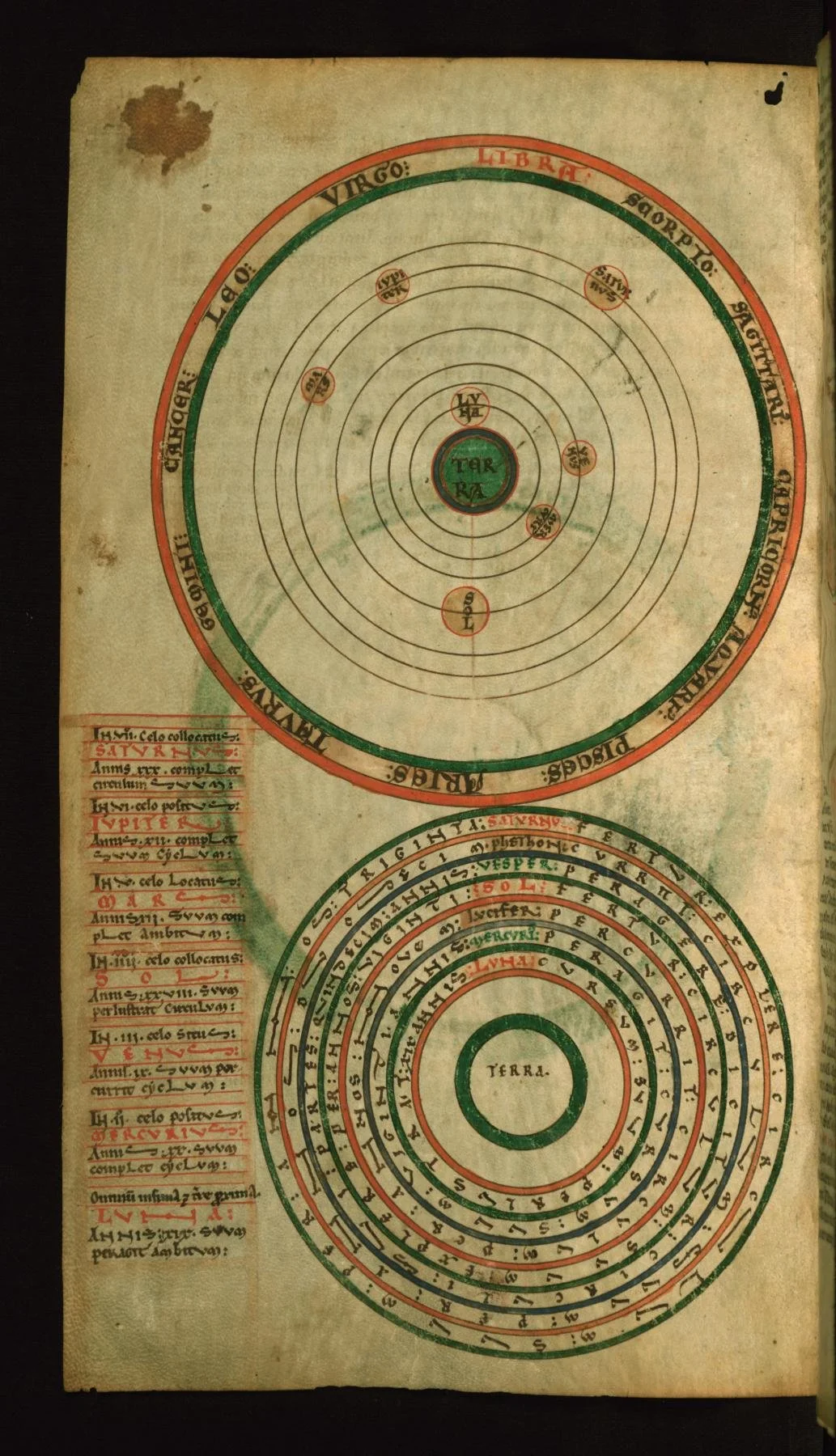
A medieval scholar's working wheel: Earth at the center, the seven wanderers on their rings, and the twelve signs lettered around the rim — from a 12th-century English cosmography manuscript (Walters Ms. W.73). The Tetrabiblos tradition reached the Middle Ages through copies like this one: the tables inside such books were some scholar's working tools.
The Walters Art Museum, Baltimore — Cosmography (Walters Ms. W.73, fol. 2v), late 12th century, England. Acquired by Henry Walters, 1903.
By the first and second centuries CE, the art had textbooks, and three of them matter for this lesson.
Dorotheus of Sidon, writing in Greek verse in the 1st century CE, composed the Carmen Astrologicum, the earliest systematic teaching manual we know of. It survives today mainly through a later Arabic translation, which tells you something about how far the books traveled.
Vettius Valens, writing in the 2nd century CE, left the Anthology: a working astrologer's casebook, packed with some hundred example charts worked through in full. If Dorotheus wrote the lectures, Valens left the problem sets.
★ And then there is Claudius Ptolemy of Alexandria, the great astronomer, writing in the middle of the 2nd century CE. His Tetrabiblos, Greek for "Four Books," is the theory text: Book I lays down the principles and the astronomical reasoning behind them; Book II covers general predictions for peoples, cities, and countries; Books III and IV cover individual nativities, the birth charts themselves. Ptolemy wrote it after his astronomical masterwork the Almagest (which was complete by about 145 CE), so it belongs to the last decades of his life, roughly 145 to 168 CE. He did not invent the techniques. His achievement was to arrange them into a system, to argue that astrology was a natural study fit to stand beside astronomy, and to write it all so clearly that his book became the standard textbook of the subject for the next fifteen hundred years, taught in medieval universities and copied, translated, and argued over in Greek, Arabic, and Latin.
Check in: The shelf holds three authors — who wrote the lectures, who left the problem sets, and who wrote the theory text, and when?
❦ In your workbook: record the textbook shelf in your own way — Dorotheus in verse, Valens and his hundred worked charts, and Ptolemy's Four Books standing as the standard for fifteen hundred years — copy, sketch, or note what matters.
The Mechanism
The wheel: twelve signs as a coordinate grid
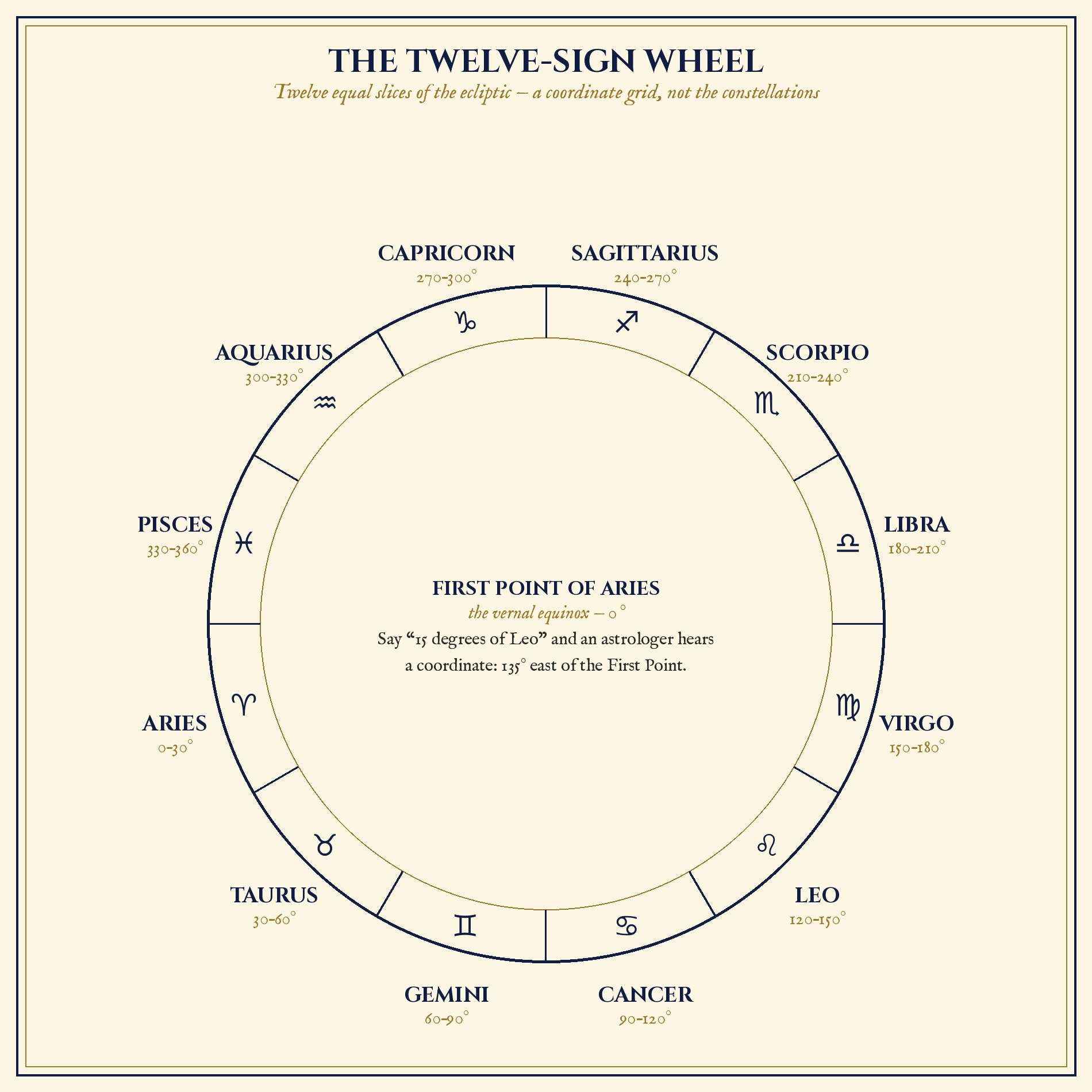
The twelve-sign wheel: twelve equal 30-degree slices of the ecliptic beginning at the First Point of Aries — a coordinate grid, not the constellations. This is the wheel Exercise I asks you to draw: blank geometry, a map with no travelers yet.
Built digitally for this overhaul (Python/PIL, typeset labels and drawn wheel), from the table taught in the lesson text (builder: ).
★ Everything in the Hellenistic system is built on one instrument: the ecliptic divided into twelve equal signs of 30 degrees each. (You met the ecliptic, the sun's apparent yearly path, in Lesson 3.) The grid starts at the vernal equinox, the First Point of Aries, and runs eastward through the signs in this fixed order:
| Sign | Degrees | Symbol |
|---|---|---|
| Aries | 0-30 | ♈ |
| Taurus | 30-60 | ♉ |
| Gemini | 60-90 | ♊ |
| Cancer | 90-120 | ♋ |
| Leo | 120-150 | ♌ |
| Virgo | 150-180 | ♍ |
| Libra | 180-210 | ♎ |
| Scorpio | 210-240 | ♏ |
| Sagittarius | 240-270 | ♐ |
| Capricorn | 270-300 | ♑ |
| Aquarius | 300-330 | ♒ |
| Pisces | 330-360 | ♓ |
Say "15 degrees of Leo" and an astrologer hears a coordinate: halfway through the fifth slice of the circle, 135 degrees east of the First Point of Aries. That is all a sign is in this system: a labeled slice of sky, a street address on the ecliptic.
★ This is the single most important distinction in the unit, and the next lesson will make it the whole story: the signs are not the constellations. The signs are twelve equal slices that begin at the equinox. The constellations are irregular star-pictures of different sizes. Two thousand years ago the two roughly lined up; the Earth's slow wobble has since pulled them apart (Lesson 26 will show you the math). When an ancient text says "Jupiter in Pisces," it means the twelfth 30-degree slice, not the star-picture of the Fish.
Check in: What is a sign in this system — and how does it differ from the constellation that shares its name?
❦ In your workbook: record the wheel in your own way — twelve equal 30-degree slices beginning at the vernal equinox, "15 degrees of Leo" as a coordinate, and the signs parted from the constellations — copy, sketch, or note what matters.
In your packet: Exercise I: The Twelve-Sign Wheel ⚒ begins here — the wheel itself, drawn and labeled, with its four questions. Work it now, or mark the place and take it as homework — your choice.
Houses: the sky made local
A chart is always drawn for a moment and a place, because the sky looks different from Alexandria than from Rome. The Hellenistic astrologers anchored the wheel to the observer with four angles:
- The Ascendant: the degree of the ecliptic rising over the eastern horizon at the moment in question. The Greeks called it the horoskopos, the hour-marker, and it is where our word "horoscope" comes from. It changes sign roughly every two hours as the Earth turns.
- The Midheaven: the highest point of the ecliptic above the horizon at that moment.
- The Descendant: the degree setting in the west, opposite the Ascendant.
- The Imum Coeli (the IC): the lowest point, beneath the Earth, opposite the Midheaven.
★ In the whole-sign house system, the standard of the Hellenistic age, the sign containing the Ascendant becomes the 1st house, and you count signs forward around the wheel: the next sign is the 2nd house, the next the 3rd, and so on to the 12th. The houses are the topics of life. The ancient textbooks attached a subject to each of the twelve places:
| House | Ancient name | Topics |
|---|---|---|
| 1st | The Helm | Life, the body, the native's own self |
| 2nd | The Gate of Hades | Livelihood, possessions, money |
| 3rd | The Goddess | Siblings, neighbors, short journeys |
| 4th | The Subterraneous | Parents, home, foundations, land |
| 5th | Good Fortune | Children, pleasure, gifts |
| 6th | Bad Fortune | Illness, injury, servitude |
| 7th | Setting | Marriage, partnerships, open opponents |
| 8th | The Idle Place | Death, legacies, other people's money |
| 9th | God | Travel, philosophy, religion, dreams |
| 10th | The Midheaven | Career, reputation, honors, authority |
| 11th | Good Spirit | Friends, allies, hopes |
| 12th | Bad Spirit | Hidden enemies, hardship, confinement |
(Different ancient authors phrase these a little differently; this is the standard scheme as the textbooks teach it.) A modern teacher's memory aid, which the ancients would have recognized: the planets are the actors, the signs are how they behave, and the houses are where in life the action happens.
Check in: What is the Ascendant, what does its Greek name mean — and in the whole-sign system, how does the sign holding it fix all twelve houses?
❦ In your workbook: record the houses in your own way — four angles anchoring the wheel to a place, the Ascendant's sign becoming the 1st house, and actors, behavior, and where the action happens — copy, sketch, or note what matters.
In your packet: Exercise II: The Twelve Places ⚒ begins here — the four angles marked, the twelve houses numbered, and their topics answered back. Work it now, or mark the place and take it as homework — your choice.
Aspects: the geometry of relationships
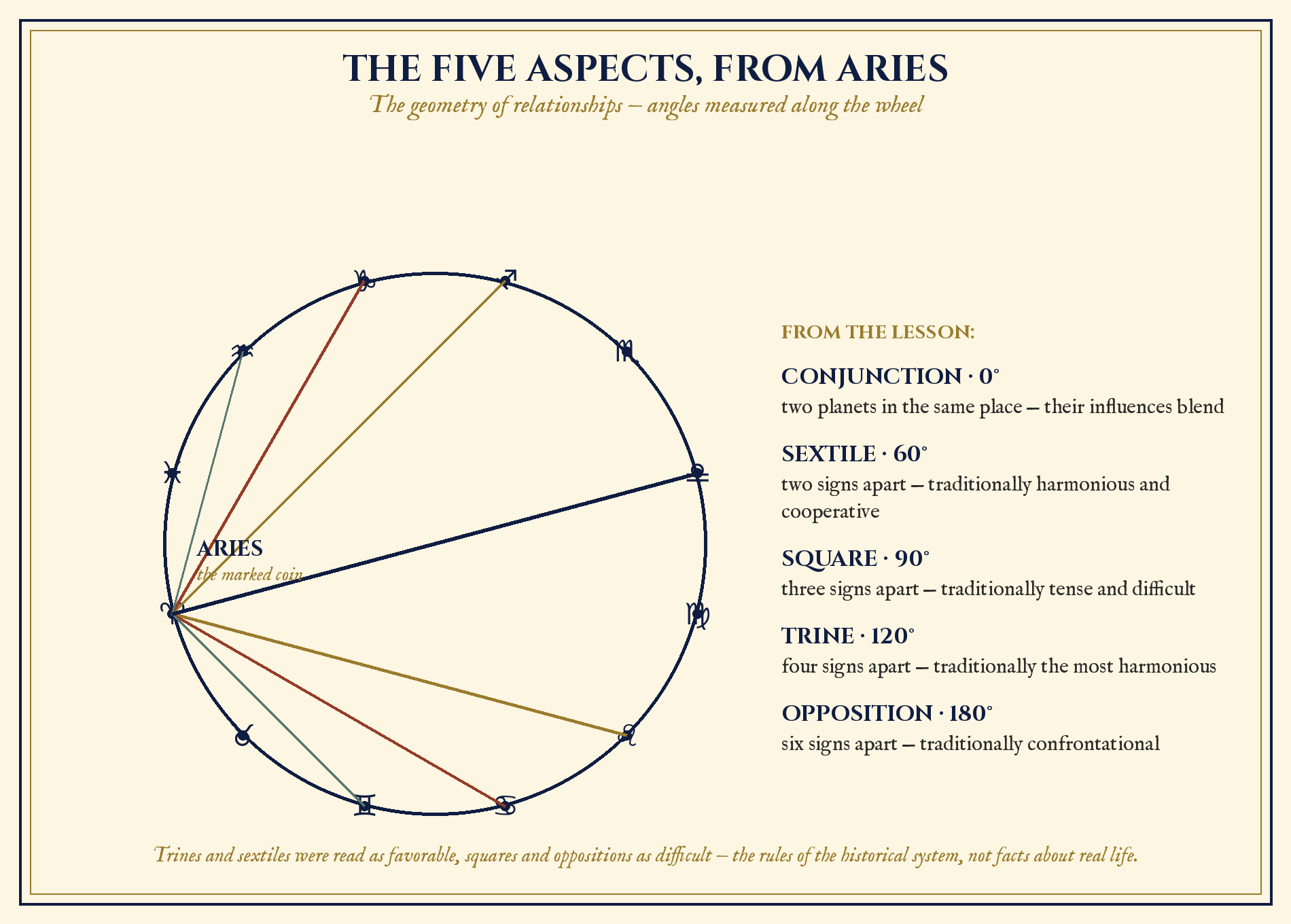
The five aspects from one marked coin in Aries: the angles are pure geometry on the wheel — trines to Leo and Sagittarius, squares to Cancer and Capricorn, the opposition straight across to Libra. Exercise III asks you to find them with coins before you check the list.
Built digitally for this overhaul (Python/PIL, typeset labels and drawn geometry), from the mechanism taught in the lesson text (builder: ).
★ Planets in a chart do not sit alone; they stand at angles to each other, and the Hellenistic system read those angles the way a musician reads intervals. The five major aspects, the ones Ptolemy lays out in the Tetrabiblos, are:
- Conjunction, 0 degrees: two planets in the same place. Their influences blend, for better or worse depending on the planets.
- Sextile, 60 degrees: two signs apart. Traditionally harmonious and cooperative.
- Square, 90 degrees: three signs apart. Traditionally tense and difficult, a source of friction.
- Trine, 120 degrees: four signs apart. Traditionally the most harmonious, an easy flow.
- Opposition, 180 degrees: six signs apart. Traditionally confrontational, two forces pulling opposite ways.
Notice the geometry hiding inside the names. Signs of the same element always trine each other: the fire signs Aries, Leo, and Sagittarius stand 120 degrees apart, as do the three earth signs, the three air signs, and the three water signs. The four signs that begin the seasons, Aries, Cancer, Libra, and Capricorn, all square each other. Learn the wheel and the aspects come free with it; that is why the first exercise in this lesson is simply to draw the wheel.
★ Within the system, the character of an aspect was a rule like any other: trines and sextiles were read as favorable, squares and oppositions as difficult, conjunctions as mixtures. Think of them as the moves the pieces are allowed to make. Whether the moves mean anything about real life is a separate question, and this lesson's answer to it is no.
Check in: Name the five major aspects with their degree measures — and say which were read as favorable, which as difficult, and which as mixtures.
❦ In your workbook: record the aspects in your own way — five angles from 0 to 180 degrees, the same-element signs standing in trine, and the season-opening signs squaring each other — copy, sketch, or note what matters.
In your packet: Exercise III: Reading the Geometry ◐ begins here — coins on the wheel, the aspects found from Aries and from Virgo, and the exactness of one near-trine measured. Work it now, or mark the place and take it as homework — your choice.
Planets in the machine: domicile, exaltation, decans
The seven wanderers known to the ancient world, the sun, the moon, Mercury, Venus, Mars, Jupiter, and Saturn, each had favorite and honored places in the grid. These were the dignity rules, the system's way of saying a planet was strong or weak in a given sign:
- Domicile, the planet's home sign: Sun in Leo, Moon in Cancer, Mercury in Gemini and Virgo, Venus in Taurus and Libra, Mars in Aries and Scorpio, Jupiter in Sagittarius and Pisces, Saturn in Capricorn and Aquarius. A planet at home was read as self-sufficient and effective.
- Exaltation, the planet's honored sign: Sun in Aries, Moon in Taurus, Mercury in Virgo, Venus in Pisces, Mars in Capricorn, Jupiter in Cancer, Saturn in Libra. A planet exalted was read as powerful and well placed.
★ Then there were the decans, Egypt's contribution. Each sign was divided into three slices of 10 degrees, thirty-six in all, each with its own planetary ruler. Remember where they came from: the Egyptians had watched thirty-six star-groups rise through the night for two thousand years, using them as a star-clock, painting them on coffin lids as early as 2100 BCE. The Hellenistic astrologers lifted the number 36 off the Egyptian sky and pinned it onto the twelve-sign grid, turning a clock into a finer set of chart divisions.
Check in: What is a planet's domicile, what is its exaltation — and where did the thirty-six decans come from, and how wide is each?
❦ In your workbook: record the dignities in your own way — home signs and honored signs for the seven wanderers, and a two-thousand-year-old star-clock folded into the grid as thirty-six slices of ten degrees — copy, sketch, or note what matters.
Casting the chart: the recipe
Here is the procedure, the actual work of a Hellenistic astrologer, as the textbooks teach it:
- Fix the moment and the place. Without both, there is no Ascendant, and without the Ascendant there is no chart.
- Find the Ascendant: which degree of the ecliptic is rising. This required tables of rising times, and it is why the exact hour mattered so much.
- Look up the planets. An ephemeris, a table of computed planetary positions, or hand calculation from astronomical tables gave the sign and degree of each of the seven wanderers.
- Lay the wheel: twelve whole-sign houses counted from the Ascendant, planets placed in their signs.
- Read the aspects: which planets stand in conjunction, sextile, square, trine, or opposition.
- Weigh the dignities: which planets are in domicile, exaltation, or their decans, and therefore "strong" or "weak" by the system's rules.
- Deliver the judgment, reading houses for topics, aspects for relationships, dignities for strength.
Understand what this meant in practice. Step 2 and Step 3 were serious mathematics done by hand, with no printed tables before the modern era and no calculators at all. A chart was expensive skilled labor, which is one reason astrology served kings, generals, and rich merchants long before it served anyone else.
Check in: Walk the recipe in order — what two things must be fixed before anything else can be done, and why was a finished chart expensive?
❦ In your workbook: record the recipe in your own way — seven steps from moment-and-place to delivered judgment, and the hand mathematics that made a chart costly skilled labor — copy, sketch, or note what matters.
What it was for
Strip away the mystery and the Hellenistic horoscope was a decision-support machine, built for a world without statistics:
- Personal guidance (genethlialogy): the great Hellenistic invention. Babylon had read the sky for kings; Alexandria read it for individuals. Character, marriage prospects, career, the shape of a life: the questions people now take to psychologists, counselors, and aptitude tests were taken to the chart.
- Choosing moments (katarchē, electional astrology): weddings, voyages, battles, the founding of cities, the crowning of kings. Antiochus put his coronation sky in stone because the right moment, certified by the heavens, was political capital.
- Cities and kingdoms (mundane astrology): eclipses, comets, and planetary cycles read as omens for the state, the direct heir of the Babylonian omen tradition.
- Weather: brontoscopic calendars tied thunder and storms to sky positions, the closest thing antiquity had to a forecast office.
- Medicine (iatromathematics): doctors timed treatments by the moon's sign and the chart of the illness. The famous "zodiac man" assigned each sign to a part of the body: Aries the head, Taurus the neck and throat, Gemini the arms and shoulders, Cancer the chest, Leo the heart, Virgo the belly, Libra the loins, Scorpio the genitals, Sagittarius the thighs, Capricorn the knees, Aquarius the legs, Pisces the feet. Medieval manuscripts are full of him. He is history of medicine, not medicine.
★ None of this worked as prediction. Say it plainly, because the unit's contract requires it: modern testing has found no effect beyond chance, and no known mechanism could carry an influence from the sky positions at birth to a person's life. The charts are studied here the way a historian studies an old map of a country that never existed: for what the map reveals about the mapmakers.
And the mapmakers left fingerprints on our language. Disaster is dis-aster, a bad star. Influence is the stars flowing in. Consider is con-sidera, being with the stars. Saturday is Saturn's day. You speak the leftovers of this system every week.
Check in: Name the machine's five uses — and state, plainly, what modern testing has found, and why the charts are studied anyway.
❦ In your workbook: record the uses in your own way — guidance, timing, kingdoms, weather, and medicine from one decision machine, the honest verdict that followed it, and the leftovers hiding in your own dictionary — copy, sketch, or note what matters.
A Sealed Note on the Rules of the Game
Scholars, a word from your bat in the tower, because this is the lesson where the line matters most.
I have spent years restoring old star charts in the observatory: brass instruments, vellum tables, a planisphere some careful hand inked three centuries ago. I love these objects the way I love my own wings. They are beautiful, and they are the work of brilliant people, and not one of them can tell you anything about your life. Loving the machine and believing the machine are two different things, and this school asks only the first of you.
So here is our contract for the rest of this unit. We will learn the rules completely: the signs, the houses, the aspects, the dignities. We will draw the wheels and place the coins and do the geometry, because geometry is honest work and the history is worth knowing. And we will never, not once, turn the machine on a real person. No birth charts. No signs assigned. No futures read. The moment the game stops being history and starts being advice, we close the book.
That is not a small rule. It is the whole difference between a museum and a fortune-teller's tent, and I intend to keep this castle firmly on the museum side of it.
❦ In your workbook: record the sealed note in your own way — loving the machine and believing the machine as two different things, the contract for the rest of the unit, and the line between a museum and a fortune-teller's tent — copy, sketch, or note what matters.
PROFESSOR VESPER GLIMMERWICK
Celestial Studies
Astronomer & Celestial Historian
Guided Observation
Try It Tonight
Part One: Draw the Twelve-Sign Wheel
On a large sheet of paper, draw a circle and divide it into twelve equal slices, like cutting a pie. Starting at the leftmost point of the circle and going counterclockwise, label the slices in order: Aries, Taurus, Gemini, Cancer, Leo, Virgo, Libra, Scorpio, Sagittarius, Capricorn, Aquarius, Pisces. Write the degree range under each name (Aries 0-30, Taurus 30-60, and so on to Pisces 330-360). Mark the starting point "First Point of Aries: the vernal equinox." This is the coordinate grid. Nothing personal goes on it; it is a map with no travelers yet.
Level Two: add the symbols from the table in The Mechanism next to each sign name, checking each glyph against the table as you draw.
❦ In your workbook: record the wheel in your own way — twelve slices labeled counterclockwise from the leftmost point, degree ranges beneath, and the First Point of Aries marked where the grid begins — copy, sketch, or note what matters.
In your packet: Exercise I: The Twelve-Sign Wheel ⚒ begins here — this drawing, kept as the wheel every later part of the lesson works on. Work it now, or mark the place and take it as homework — your choice.
Part Two: The House Cross
On a fresh wheel, mark the four angles: Ascendant at the left (the 9 o'clock position), Midheaven at the top, Descendant at the right, Imum Coeli at the bottom. Now number the twelve whole-sign houses: the sign holding the Ascendant is House 1, and count counterclockwise to House 12. Using the places table in The Mechanism, write each house's ancient topics beside its number. Then answer: which house would a Hellenistic astrologer consult about a voyage? About a marriage? About an illness? About a career?
❦ In your workbook: record the house cross in your own way — the four angles at left, top, right, and bottom, the twelve houses counted counterclockwise from the Ascendant's sign, and the four questions answered from the places table — copy, sketch, or note what matters.
In your packet: Exercise II: The Twelve Places ⚒ begins here — this cross and its numbering, with the lesson's questions answered back. Work it now, or mark the place and take it as homework — your choice.
Part Three: Aspect Geometry with Coins
Place twelve small coins or buttons on your wheel from Part One to stand for imaginary planets. They are not real planets and they do not represent anyone; they are game pieces. Pick one coin to be your "marked planet" in Aries. Without looking at the aspect list, use the geometry of the wheel to find: which two signs stand in trine to Aries? Which sign opposes it? Which two signs square it? Check your answers against The Mechanism, then repeat with your marked planet in Virgo. For Level Two, give two coins exact degrees (for example, Mars at 10 degrees of Leo, Venus at 12 degrees of Sagittarius) and decide which aspect they form and how close to exact it is.
❦ In your workbook: record the coin geometry in your own way — the marked coin in Aries and then in Virgo, the trines, squares, and opposition found from the wheel before checking, and the near-exact pair measured — copy, sketch, or note what matters.
In your packet: Exercise III: Reading the Geometry ◐ begins here — the coin work written up, with every aspect named and measured. Work it now, or mark the place and take it as homework — your choice.
Sky Log Entry
Date and time of observation: _______________
Moon phase tonight (sketch the disk and shade the dark portion): _______________
The sun's approximate position on the twelve-sign grid tonight (which 30-degree slice is it traveling through, and how do you know?): _______________
Roughly how many hours until the sun reaches the next sign? Show your reasoning: _______________
One thing this lesson changed about how you picture the zodiac: _______________
❦ In your workbook: record the Sky Log entry in your own way — the moon's phase sketched, the sun's slice of the grid named with its reasoning, and the hours to the next sign shown — copy, sketch, or note what matters.
Materials
Required (Level One — household items)
- Large paper, a ruler, a pencil, and a pen: the wheel is ruled work, and ruled work wants straight lines. A plate or compass for drawing the circle.
- Twelve coins or buttons to stand in for imaginary planets in the aspect drill. They represent no one and no real planet.
- Your workbook for the exercises, the Sky Log, and the reflection questions.
Suggested (Level Two — historically closer)
- Colored pencils, one color per element, to shade the fire, earth, air, and water signs on your wheel and see the trines appear.
- A brass paper fastener to build a rotating pointer for your wheel, turning the drawing into a working dial.
- Graph paper for redrawing the wheel at a larger scale with the symbols inked in.
Reflection Questions
Answer in your workbook, in complete sentences.
- This lesson teaches the horoscope the way you would teach the rules of chess or senet. What changes, in your mind, when a system is studied as a historical game rather than as a source of predictions?
- A king once paid an astrologer to time a war, and a merchant paid one to time a voyage. In a world without statistics, polls, or weather satellites, what need were they paying to have met? What modern professions meet that need today?
- Babylonian sky-reading began with kings and states; the Hellenistic system applied it to private individuals. What does that shift suggest about who knowledge serves, and who could afford it?
- The houses are computed from the local horizon, so the same birth moment gives different charts in different cities. What does that dependence on place reveal about what a horoscope actually is?
- What is one thing you believed about the zodiac before this lesson that the mechanism corrected, and what convinced you?
Workbook Checklist — Lesson 25
In my workbook I have:
- ☐ drawn the twelve-sign wheel with every sign named in order, its degree range beneath, and the First Point of Aries marked — blank geometry, nothing personal on it
- ☐ answered Exercise I's four questions beneath the wheel (the equinox start, Scorpio's middle, 200 degrees, and "Jupiter in Pisces")
- ☐ marked the four angles on a fresh wheel and numbered the twelve whole-sign houses, with each house's ancient name and topics beside its number
- ☐ answered Exercise II's four questions (the voyage, marriage, illness, and office houses; Alexandria against Rome; the actors memory aid)
- ☐ worked the coins from Aries and from Virgo, entering each trine, square, and opposition with its degree measure in my tables
- ☐ answered Exercise III's remaining questions (the Leo–Sagittarius pair's exactness, the fire-sign trines, and the two-sentence correction)
- ☐ completed my Sky Log entry: the moon's phase sketched, the sun's slice of the grid named, and the hours to the next sign reasoned out
☐ Lesson completed Date: ___ Signature: ___
Cross-Class Connections
Scrollwork · Unit I, Lesson 1 — The Scriptorium Desk
Tower scholars, Ptolemy's Four Books reached you across fifteen hundred years because scribes copied them by hand, in Greek, then Arabic, then Latin, at desks like the one this lesson builds. Come to the Scrollwork Library and learn where the scribe sits: the sloped board, the light, the tools laid in their order. Professor Glimmerwick shows you the tables those copies carried. Here, we teach you the desk that carried the tables.
PROFESSOR QUILLBERRY NOCTURNE
Scrollwork Library

Creative Arts · Studio Extension E4 — Painted Wheels at Full Size
Bring the tower's paper wheel to my bench, scholars, and we will build it the way this lesson asks: at full size, on board, in ground pigment, with a rotating overlay where the wheel's working demands one — Professor Glimmerwick's zodiac wheel is named in this extension's own first page, curling paper and all. A wheel that hangs on a wall and can be read across the room is the stone lion's lesson in wood: a chart made to outlast its maker. Lay it out honestly, letter it true, and state on its plate what it shows.
PROFESSOR COGBRANCH TIMBERCLANK
Creative Arts Workshop
Runes & Ancient Writing · Unit I, Lesson 1 — The Structural Wedge
The Professor's Closing Note
And so the wheel turns, scholars, as it has turned for two thousand years.
You now know the machine from the inside: the twelve 30-degree signs as a coordinate grid, the houses counted from the rising point, the five aspects as pure geometry, the dignities and decans layered on like varnish, and the recipe by which a chart was cast. You know it was built in Alexandria out of Babylonian mathematics, Egyptian star-clocks, and Greek philosophy. You know what it was for: guidance, timing, medicine, politics, the whole business of deciding in a world without statistics. And you know the honest ending: it did not work, and we study it anyway, because it shaped two thousand years of human thought and left its fingerprints in your dictionary.
Keep your blank wheels. Lesson 26 will take this same grid and show you the wobble that moved the constellations out from under it, and you will do the arithmetic yourself. The sky, I promise you, is even more interesting when you stop asking it for answers and start asking it for measurements.
Fly straight, and keep your gloves white.
PROFESSOR VESPER GLIMMERWICK
Celestial Studies
Astronomer & Celestial Historian
Further Reading & Sources
These are real destinations for further study, verified live at the time of writing. Every one of them treats astrology as history, which is exactly this unit's lens.
- Hellenistic astrology: the tradition's origins, the Alexandrian synthesis, and the key authors. https://en.wikipedia.org/wiki/Hellenistic_astrology
- Ptolemy's Tetrabiblos: the four books, the date of composition after the Almagest, and the work's fifteen-hundred-year influence. https://en.wikipedia.org/wiki/Tetrabiblos
- Horoscope: what a chart is, the horoskopos etymology, and the construction of the wheel. https://en.wikipedia.org/wiki/Horoscope
- The decans: thirty-six ten-degree divisions, from Egyptian star-clocks to chart subdivisions. https://en.wikipedia.org/wiki/Decan_(astrology))
- Britannica: astrology in the Hellenistic period, from Babylonian diviners to genethlialogy. https://www.britannica.com/topic/astrology/Astrology-in-the-Hellenistic-period-3rd-century-bce-to-3rd-century-ce
- Ptolemy's Tetrabiblos online: English text and downloads via the Xenotheka library. https://xenotheka.caad.arch.ethz.ch/ptolemy-tetrabiblos/
- The Nemrud Dag lion horoscope: the 62 BCE coronation sky carved in stone. https://demetra-george.com/blog/january-2015-newsletter-2/
- Essential dignity: the domicile and exaltation tables used in this lesson. https://en.wikipedia.org/wiki/Essential_dignity
Browse the Celestial Studies shelf in the school Library for readable editions of these works.
Sealed in the Celestial Tower, in deep midnight blue, by Professor Vesper Glimmerwick.
Submit your work for this lesson using the form below.
CONTINUE IN THE CELESTIAL TOWER
← Previous · Lesson 24: Babylon: Where the Zodiac Was Born Next · Lesson 26: Precession & the Thirteenth Sign →
Unit V — The History of Astrology & the Zodiac Celestial Tower — All 33 Lessons
The rest of Unit V: Lesson 24 · Babylon · Lesson 26 · Precession · Lesson 27 · Astrology Through the Ages · Lesson 28 · Why People Believe