
CELESTIAL STUDIES
Unit IV · Lesson 22Deep Sky Wonders
Professor Vesper Glimmerwick
Astronomer & Celestial Historian
The Celestial Tower • School of Evershade
Professor's Introduction
The observatory door is open, scholars,
I do most of my traveling at night, as you know, and I have spent a great many evenings flying underneath the Milky Way. From below it looks like a river of spilled sugar. From above, if I climb high on a clear autumn night and look down past the treetops, I can see it arch over the whole forest like the roof of a cathedral made of lanterns.
For most of human history, nobody knew what that river was. They gave it the best names they had: milk, a road, a river, a path for souls. Then, in the year 1610, a man in Italy pointed a little tube of glass at it, and the river broke apart into stars. Thousands of them. More stars than anyone had ever imagined, hiding inside a band of light that everyone had seen but no one had understood.
That is what this lesson is about: the moment the sky got bigger. We will meet the galaxies, which are entire universes of stars; the nebulae, which are the clouds where stars are born and the shrouds where stars die; and the star clusters, which are families of stars that stay together for billions of years. And then, weather and skies permitting, we will go outside and find some of these wonders ourselves, because a scholar of the deep sky should never be content with reading about it.
Tonight's work asks something of your eyes that this course has asked before: darkness, patience, and an adult beside you. The Safety Briefing comes right after the objectives, and I mean every word of it, especially the part about the sun. This lesson is about the night sky. Let us keep it that way.
PROFESSOR VESPER GLIMMERWICK
Celestial Studies
Astronomer & Celestial Historian
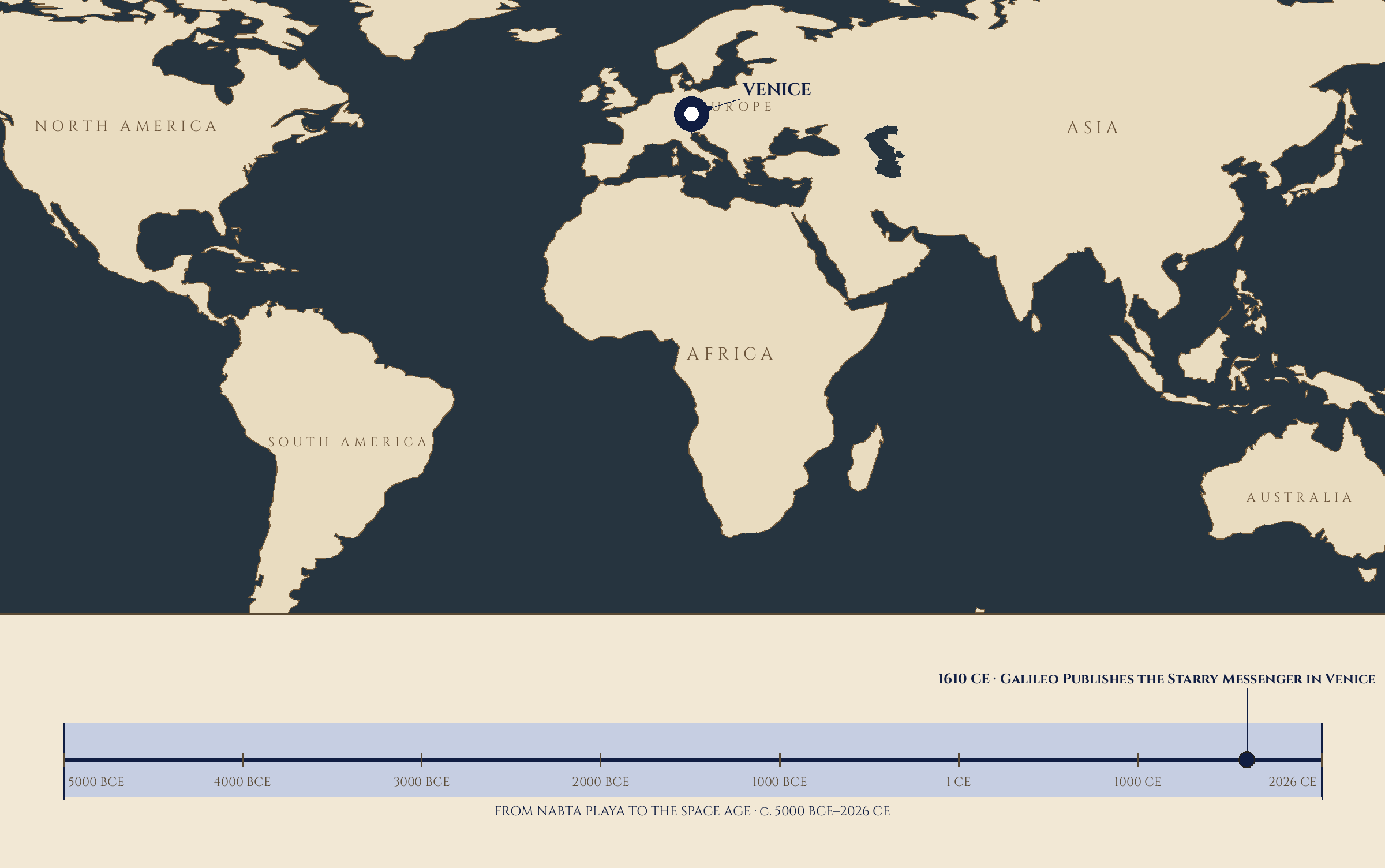
Where and when: VENICE, 1610 CE · Galileo Publishes the Starry Messenger in Venice (year 1610) — Deep Sky Wonders. The pin is this lesson. The line beneath the map is our road: every stop a moment when watching the sky changed, every lesson a pin upon it.
Lesson Objectives
By the end of this lesson, you will be able to:
- Explain what a galaxy, a nebula, and a star cluster each are, and how the three kinds of deep-sky objects differ from one another.
- Describe the Milky Way as a large barred spiral galaxy: its size, our sun's place in it, and why we see it as a band across the sky.
- Explain the dark rift in the Milky Way's band as lanes of interstellar dust, and explain how dust once misled astronomers about the galaxy's shape.
- Tell the story of Galileo's 1610 observations: what the telescope showed him about the moon, the Milky Way, and Jupiter, and why it mattered.
- Name the Milky Way as it is known in at least three cultures, and say what each name reveals about the people who gave it.
- Explain why the name "planetary nebula" is misleading, and what these objects actually are.
- Star-hop to the Andromeda Galaxy from Cassiopeia or the Great Square of Pegasus (Level Two), or trace the Milky Way's band and locate the galactic center region (Level One).
Reading this lesson: ★ marks the passages to remember. They return on the unit quiz and the class test. Check in questions ask the material back as you go; answer them in your workbook when you meet them.
Working this lesson: Your assignment packet is the first download on this page. Work in it as the lesson moves along, answering each exercise as its subject is taught — or read the lesson through for your notes and take the exercises as homework afterward. Both are proper ways to sit this class. Signposts in the reading tell you where each exercise belongs. Written answers are short answers in your own words; a few honest lines are worth more than a filled page.
Your Assignment Packet
This lesson's exercises live in its packet: the Lexicon Handout (every term, course terms marked ◆), Materials, Guided Practice, the Assignment Manual with its answer key for self-checking, the Reflection Questions, and the Workbook Checklist. Download the packet before you begin and keep it beside you as you read. The packet's exercises are Glimmerwick's own word for the work: Exercise I — The River of Stars Map ⚒, Exercise II — The Night's Hunt Log ◐, and Exercise III — Nursery and Retirement City ✎. The lesson's quiz is not printed in the packet; it pools to the Unit IV Quiz, where it will meet you again.
Safety Briefing
Night observing is always done with an adult present, in a familiar and safe location. Tell someone where you are going and when you expect to return. Dress warmly, even on mild evenings; standing still under an open sky cools the body faster than walking does. Bring a flashlight, and watch your footing in the dark. A dim red-filtered light, or the dimmest white light you can manage, preserves your night vision and keeps you safer than bright light does, because bright light both ruins your dark adaptation and blinds you to the ground at your feet.
Guard your dark adaptation. Your eyes need twenty to thirty minutes in darkness to reach their full sensitivity. One glance at a bright phone screen resets the clock. If you must check a chart, use the dimmest red light available, and keep the exposure brief.
This lesson uses the night sky only. Nothing in it looks at the sun, and nothing should. Never point binoculars or a telescope at or near the sun, even casually, even for a moment: the optics concentrate sunlight and can injure eyes instantly. If you observe in the evening while the sun is still up, point your instruments only at the night sky, well away from the sun's position, and wait until the sun has set before beginning. Children using binoculars or telescopes are supervised at all times.
Level Two observers: find your target with the naked eye or the widest, lowest-power view first, then increase magnification. Sweep slowly, hold the binoculars steady against something solid, and sit down if you feel dizzy. Treat borrowed or family instruments with care: caps on when not in use, and never touch the glass.
The Wonder
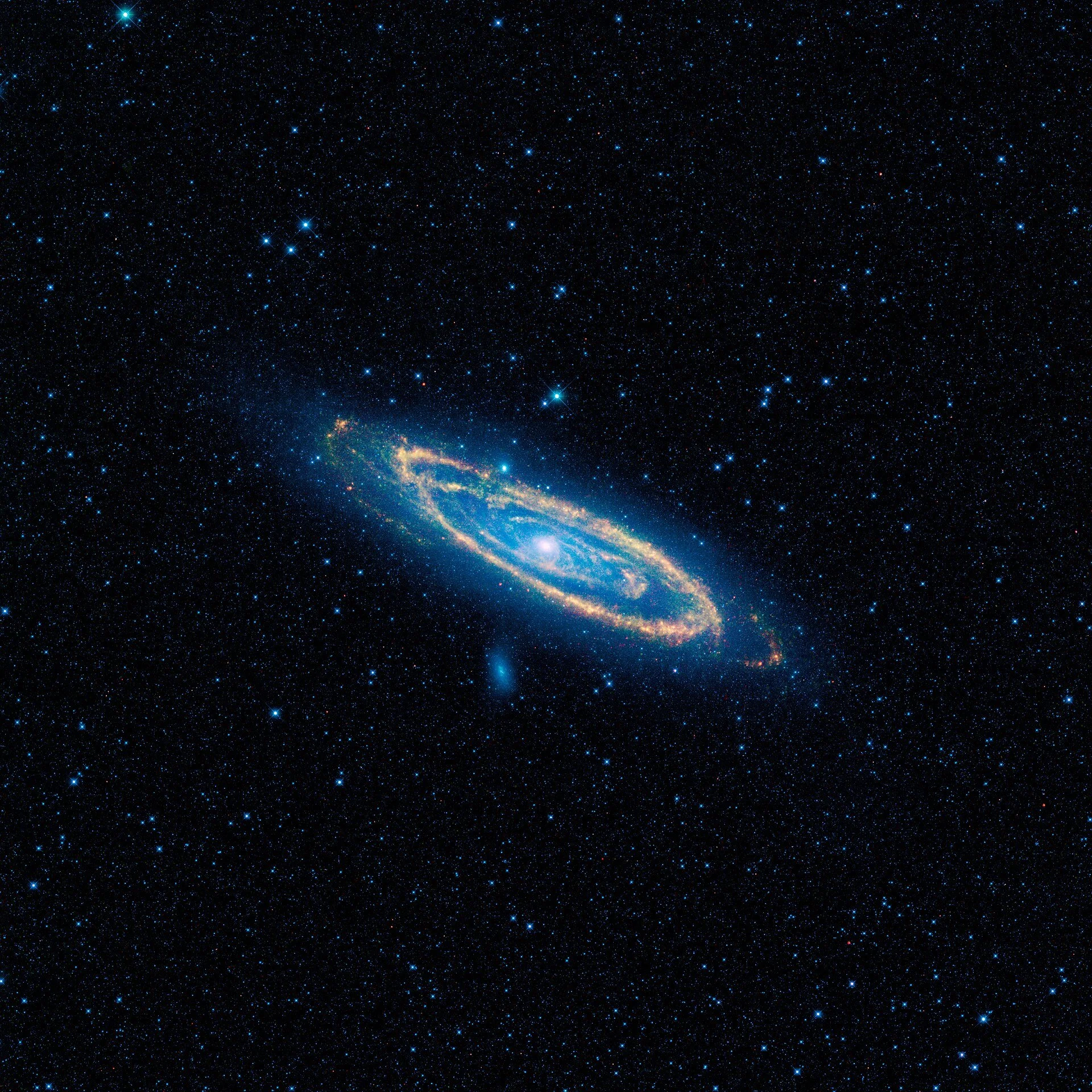
The Andromeda Galaxy, M31, in infrared light (NASA's WISE): mature stars in blue, dust heated by newborn stars in yellow and red. About two and a half million light-years away, holding perhaps a trillion stars — and, under dark skies, a faint smudge to the naked eye: the farthest thing the unaided eye can ordinarily see.
NASA / JPL-Caltech / UCLA (WISE).
Choose the darkest night you can, and the darkest place you can safely reach with an adult. Let your eyes adjust for a full half hour. Then look up.
If you have never seen it, the first sight of the Milky Way's band is startling. It is not bright. It is a pale, uneven river of light stretching from one horizon to the other, brighter in some stretches, split in places by a dark channel, prickled everywhere with stars that seem to sit inside it like foam on water. It looks less like an object and more like a stain on the sky, and yet it is the single largest thing you will ever see: the edge-on view of our own galaxy, hundreds of billions of stars, seen from the inside.
Now find a faint, fuzzy patch in the constellation Andromeda, about the size of your thumbnail held at arm's length, and consider this: that smudge is another galaxy. An entire island of stars, roughly a trillion of them, sitting two and a half million light-years away. The light entering your eyes left that galaxy before any human being walked the Earth. You are looking at the oldest light your eyes will ever see, and you are doing it with no instrument at all.
This is the deep sky: everything beyond the stars we name one by one. Galaxies, nebulae, and clusters, the furniture of the universe. For thousands of years they were smudges and mysteries. Then the telescope arrived, and the smudges began to talk.
❦ In your workbook: record the wonder in your own way — the pale river edge-on, the dark channel splitting it, and the thumbnail-sized smudge in Andromeda that is another galaxy — copy, sketch, or note what matters.
The Story
The river of stars
Long before anyone knew what the Milky Way was, every culture that could see it gave it a name, and the names are a map of what each culture valued.
The Greeks called it kyklos galaxias, the milky circle. Eratosthenes preserved the myth that it was the milk of the goddess Hera, spilled across the sky when she pushed the infant Heracles from her breast. The word "galaxy" itself comes from the Greek word for milk, gala: our word for these island universes is built from a spilled-milk myth.
The Chinese called it Tianhe, the River of Heaven, or the Silvery River. It runs through one of the most beloved stories in Chinese folklore: the weaver girl, symbolized by the bright star Vega, and the cowherd, symbolized by Altair, banished to opposite banks of the river, reunited for a single night each year when magpies form a bridge across it. That night is the Qixi festival, the seventh day of the seventh lunar month.
In India the Milky Way is akasha ganga, the Heavenly Ganges, the sky's own version of the sacred river. In medieval Arabic it was darb al-tabbana, the path of straws, picturing farmers dropping a trail of straw as they walked home from the fields. The Cherokee called it "Where the dog ran," from a tale of a dog who stole cornmeal and spilled it across the sky as it fled north. The Lakota call it Wanagi Thachanku, the Spirit Road, the path souls travel. In Finland it is Linnunrata, the Birds' Path, because migrating birds seem to follow its arc south for the winter. The Aranda people of central Australia see it as a river in the sky world, separating the camps of two peoples. And in Egypt, the sky goddess Nut, her star-covered body arched over the world, served as a ladder by which the spirits of the pharaohs climbed to the sky; some scholars see the Milky Way itself in her arched form.
Notice how many of these are rivers, roads, or paths. Land-bound peoples looked up and saw a way to travel: the sky's great road, going somewhere.
❦ In your workbook: record the river of stars in your own way — three of its culture-names, what each pictures the band as, and what each name reveals about the people who gave it — copy, sketch, or note what matters.
Guesses before glass
A few thinkers guessed the truth long before anyone could prove it. In the fifth century BCE, the Greek philosopher Democritus suggested the Milky Way might be a mass of faint, distant stars too crowded for the eye to separate. Nearly two thousand years later, the scholar al-Biruni, working in the Islamic Golden Age, reached the same conclusion: the Milky Way was a distant multitude of stars, not a glowing substance.
Guesses are not knowledge. Knowledge arrived in 1610.
❦ In your workbook: record the guesses in your own way — Democritus and al-Biruni reaching the same conclusion two thousand years apart, and why a guess is not yet knowledge — copy, sketch, or note what matters.
Galileo turns the telescope upward
Galileo Galilei did not invent the telescope; spectacle-makers in the Netherlands had built the first ones in 1608. But Galileo built better ones, grinding his own lenses, and in the winter of 1609 to 1610 he became the first person to publish what the telescope showed in the sky. In March 1610 he rushed his findings into a short book printed in Venice: Sidereus Nuncius, the Starry Messenger.
Three discoveries filled its pages. First, the moon was not the smooth, perfect sphere that philosophers had declared it. It had mountains and valleys, catching light and shadow like earthly landscapes. The heavens were not perfect, and everyone could now see the proof.
Second, Galileo turned his telescope on the Milky Way, and the milky band dissolved. It was not milk, not a glowing vapor, not a seam in the sky. It was stars: countless stars, packed too tightly for the naked eye to separate, "congeries" of them, as the Latin of the book puts it, a heap, a crowd. Democritus had been right, two thousand years early.
Third, in January 1610, Galileo watched Jupiter and found four small points of light that changed position from night to night, always staying near the planet. They were moons, orbiting Jupiter: Io, Europa, Ganymede, and Callisto, the moons we still call Galilean. Here were bodies plainly circling something other than the Earth, and the old claim that everything in the heavens circled the Earth could not survive them.
Here is a detail I love, because it keeps the story honest. Galileo observed and mapped the sword of Orion, the little chain of stars hanging from Orion's belt, and he never saw the great nebula sitting in the middle of it. His telescope magnified well enough, but its field of view was tiny, about a quarter of a degree, and the nebula slipped through it unseen. The French astronomer Peiresc spotted the Orion Nebula that same year, 1610, with his own instrument. Even the man who changed the universe could miss what was right in front of him, if his window was too narrow. Remember that the next time you are sure you have seen everything.
Check in: What did Galileo's telescope show him about the moon, about the Milky Way, and about Jupiter — and why did the man who changed the universe still miss the Orion Nebula?
❦ In your workbook: record Galileo in your own way — the Sidereus Nuncius of 1610, the band dissolved into stars, the four moons of Jupiter, and the nebula his narrow window missed — copy, sketch, or note what matters.
Mapping the river from the inside
Once the Milky Way was known to be stars, astronomers tried to map it. In the 1780s, William Herschel counted stars in hundreds of patches of sky in every direction, reasoning that where stars looked crowded, the galaxy must reach farther. His map came out as a flattened disk with the sun sitting near the middle.
He was wrong about our place, and the reason is one of the great lessons of this course. The space between the stars is not empty. It is threaded with dust, and dust blocks visible light. Herschel could only see as far as the dust let him, so his galaxy ended wherever the dust closed in, and the sun sat at the center of the little bubble he could see. It would take new kinds of light, infrared and radio, which pass through dust, to reveal the true shape. Never trust a map drawn only from what is easy to see. The dust is always part of the story.
❦ In your workbook: record Herschel's map in your own way — the flattened disk with the sun near the middle, and the dust that drew its edges for him — copy, sketch, or note what matters.
The comet hunter's list
In the 1700s, a French astronomer named Charles Messier had a problem. He hunted comets, and the sky kept offering him fuzzy patches that were not comets: they never moved, night after night, exactly where the comets he wanted would be. Tired of being fooled, he began in 1764 to catalog the impostors, with help from his colleague Pierre Mechain. The final catalog, published in 1781, held 103 objects: the Orion Nebula as M42, the Andromeda Galaxy as M31, the Pleiades as M45, the Ring Nebula as M57, and dozens more.
Messier meant his list as a warning: do not chase these. It became the opposite: the most beloved observing list in astronomy. Nearly every famous deep-sky object carries its Messier number like a nickname, and amateur astronomers still spend whole nights trying to spot all 110 objects of the expanded list in a single "Messier marathon." A list made to be ignored became the list everyone memorizes. The sky has a sense of humor.
Check in: Messier made his catalog so comet hunters would stop being fooled. What did the list become instead — and which four objects does this lesson name by their Messier numbers?
❦ In your workbook: record the comet hunter's list in your own way — the warning list of 103 impostors that became astronomy's most beloved observing list — copy, sketch, or note what matters.
A name that lies
In the 1780s, Herschel, the same star-counter, turned his telescopes on some of the small, round, planet-like disks in Messier's catalog. They looked like faint planets, so he called them planetary nebulae. The name stuck, and it is completely misleading: planetary nebulae have nothing to do with planets. They are the glowing shrouds of dying sun-like stars, as you will learn in the next section. Astronomy kept the wrong name for two hundred years because everyone knew what it meant. This happens in every science. Learn the story behind the name, and the wrongness becomes useful: it reminds you that names are history, not definitions.
❦ In your workbook: record the name that lies in your own way — Herschel's planet-like disks, and why a wrong name can stay useful once you know its story — copy, sketch, or note what matters.
Island universes
For a long time, astronomers argued about the spiral-shaped nebulae, Andromeda chief among them. Were they small clouds inside our galaxy, or were they entire galaxies far beyond it, "island universes" as the philosopher Kant had once guessed? In 1924, Edwin Hubble found a Cepheid variable star, a kind whose true brightness is known, inside the Andromeda Nebula. Its faintness told him its distance: far beyond the edge of the Milky Way. The smudge was a galaxy. The universe had gotten enormously bigger, overnight, and this lesson is the map of that bigger universe.
❦ In your workbook: record the island universes in your own way — Hubble's Cepheid in the Andromeda Nebula in 1924, and the universe getting enormously bigger overnight — copy, sketch, or note what matters.
The Mechanism
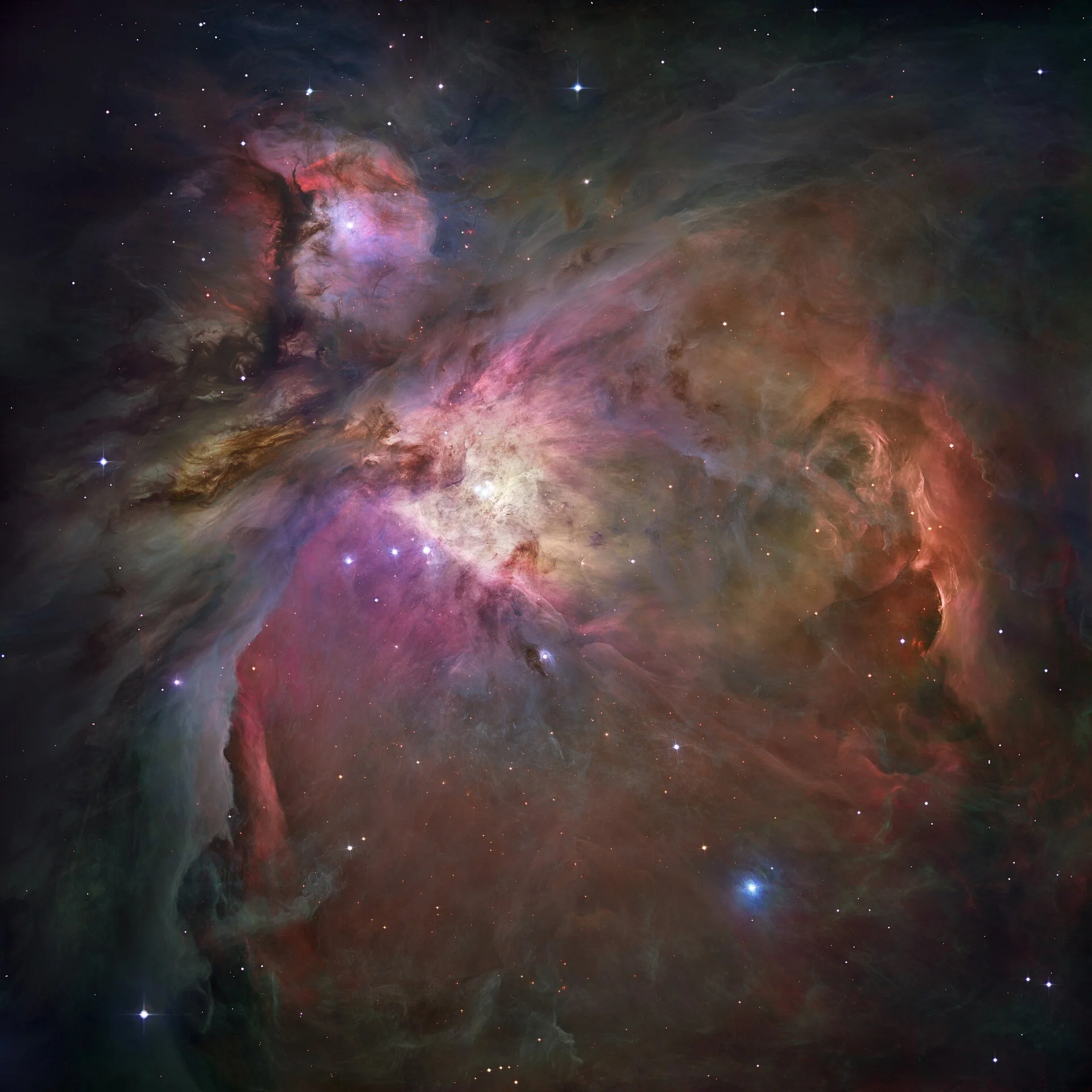
The Orion Nebula, M42 — the fuzzy middle "star" of Orion's sword, roughly 1,300 light-years away: the nearest major region where stars are being born. The young Trapezium stars at its heart flood the hydrogen with ultraviolet light, and the gas glows in reply. Galileo mapped this sword in 1610 and missed the nebula entirely.
NASA, ESA, M. Robberto (Space Telescope Science Institute/ESA) and the Hubble Space Telescope Orion Treasury Project Team.
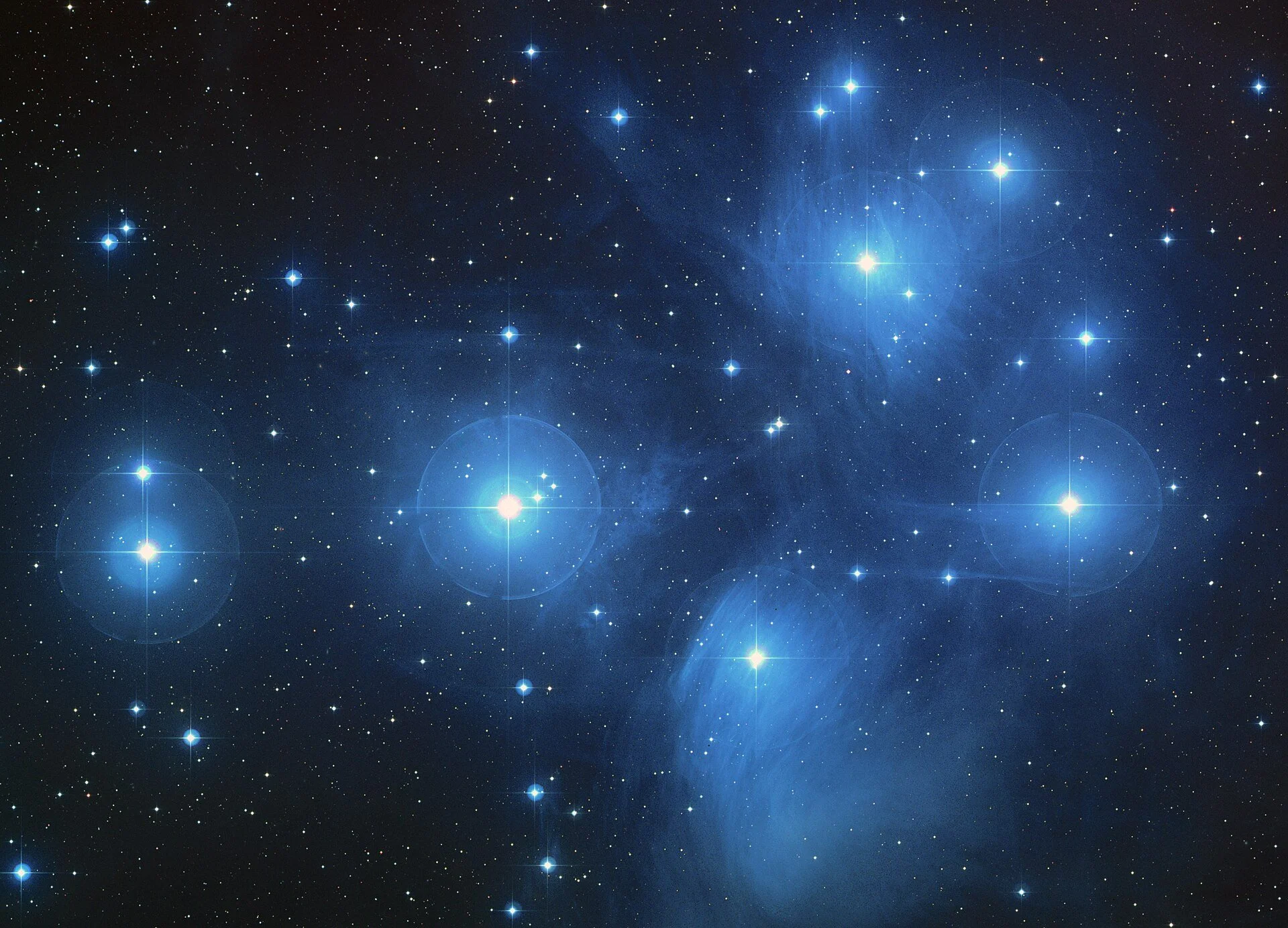
The Pleiades, M45, in Taurus: a loose, young open cluster — the Seven Sisters of Greek myth, Subaru in Japan. Most eyes count six stars unaided; optics reveal a whole glittering swarm, still wrapped in the blue dust its light reflects from.
NASA, ESA, AURA/Caltech, Palomar Observatory.
Galaxies: the island universes
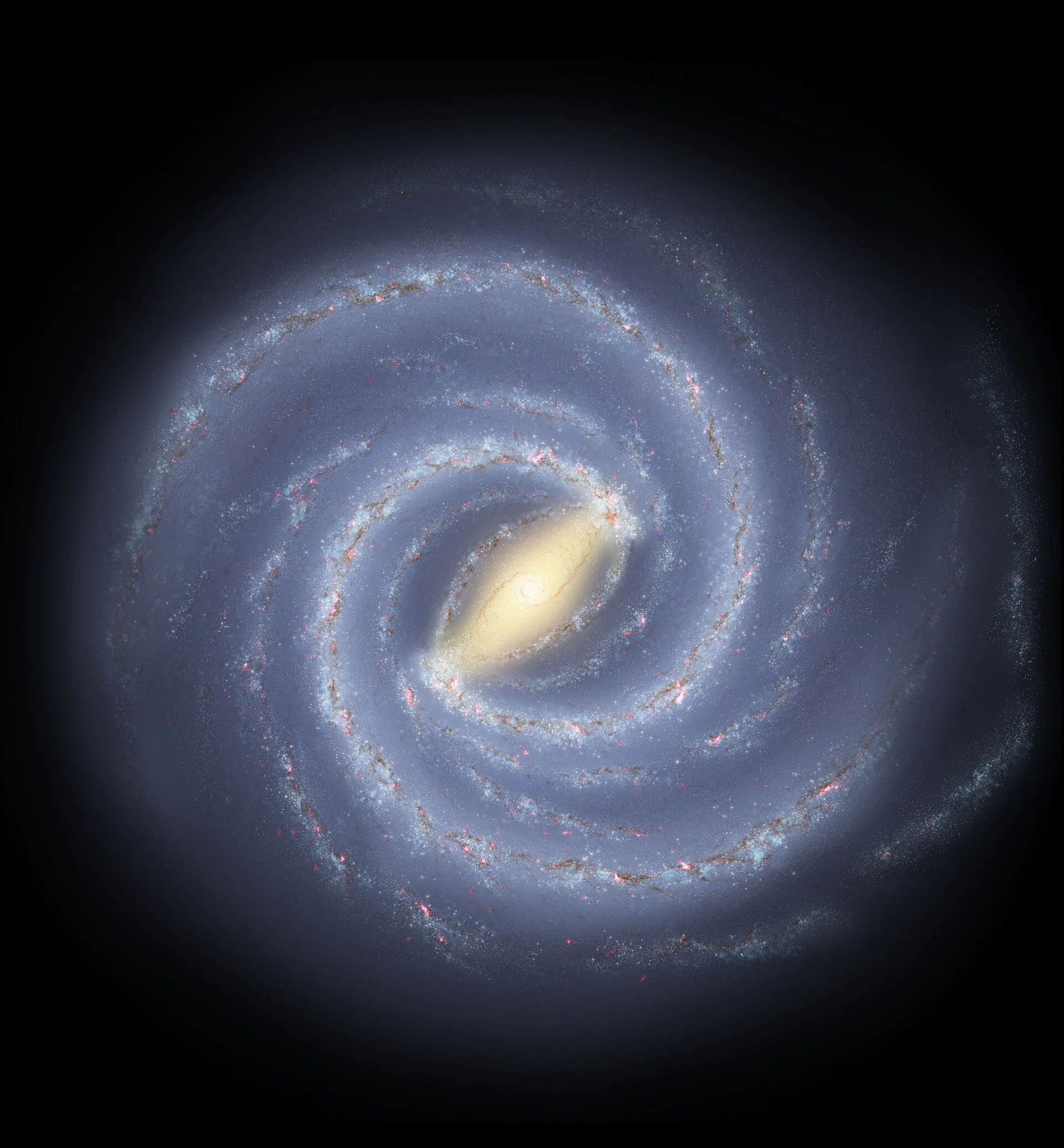
The Milky Way as astronomers reconstruct it — an artist's concept built from infrared (Spitzer) mapping, not a photograph: no one has ever left the galaxy to take one. A large barred spiral, roughly 100,000 light-years across; our sun sits about two-thirds of the way out, in the minor Orion Arm.
NASA / JPL-Caltech / R. Hurt (SSC/Caltech).
★ A galaxy is a vast system of stars, gas, and dust, all bound together by gravity. Galaxies come in a few grand shapes. Spiral galaxies are flattened disks with arms winding out from a bright center, like pinwheels. Barred spiral galaxies are spirals with a straight bar of stars across the center, the arms springing from the bar's ends. Elliptical galaxies are smooth, round or football-shaped swarms of older stars with little gas and no arms. Irregular galaxies are the ones that fit no pattern, often because some gravitational encounter pulled them out of shape.
★ Our galaxy, the Milky Way, is a large barred spiral, roughly 100,000 light-years from edge to edge. It holds somewhere between one hundred and four hundred billion stars. Our sun sits about two-thirds of the way out from the center, in a minor spur called the Orion Arm, roughly 26,000 light-years from the galactic middle. The sun circles the galactic center once every 250 million years. At the very center sits Sagittarius A*, a supermassive black hole with about four million times the mass of our sun.
We know the shape even though we have never left the galaxy to photograph it. The clues add up. The band of the Milky Way across the sky tells us the galaxy is flat, because we are seeing its disk edge-on from the inside. Astronomers map young, hot stars and glowing clouds of hydrogen, which mark the spiral arms in other galaxies, and find them arranged in arm-like patterns in ours. The dust, the colors of the light, and the way other barred spirals look all agree. It is detective work, and the detectives all point the same way.
★ The nearest large galaxy to us is the Andromeda Galaxy, called M31 in Messier's catalog: a spiral (with a modest bar of its own) about two and a half million light-years away, holding perhaps a trillion stars, wider than the Milky Way. It is the farthest thing the unaided human eye can ordinarily see. And it is coming closer: in about four billion years, Andromeda and the Milky Way will collide and merge. Galaxies do this. It is how they grow.
Check in: The Milky Way is what shape of galaxy, how wide is it, where does our sun sit in it — and how do astronomers know the shape of a galaxy they have never left?
❦ In your workbook: record the island universes in your own way — the four galaxy shapes, our barred spiral of 100,000 light-years, and the sun two-thirds of the way out in the Orion Arm — copy, sketch, or note what matters.
The band and the rift
Why does our galaxy look like a band? Because we live inside its flat disk, near its middle plane. Look along the plane and you see stars piled up in every direction, a crowded river of light. Look away from the plane, up or down out of the disk, and you see only the sparse stars of the halo. The band is the disk seen edge-on.
★ The dark channel that splits the band, called the Great Rift, is not empty space. It is dust: cold, dark lanes of interstellar dust lying in the disk between us and the farther stars, blocking their light. Where the rift runs, the river looks shallow and dim, not because there are fewer stars beyond it, but because the dust hangs like a curtain. This is the same dust that fooled Herschel. In visible light, the brightest part of the band, toward the constellation Sagittarius, is also the dustiest: the galactic center hides behind it, glowing brightly in infrared and radio light that our eyes cannot see.
Check in: Why does our galaxy look like a band from inside it — and what is the Great Rift, if it is not empty space?
❦ In your workbook: record the band and the rift in your own way — the disk seen edge-on, and the dust lanes hanging like a curtain between us and the farther stars — copy, sketch, or note what matters.
Nebulae: nurseries and shrouds
A nebula is a cloud of gas and dust in space. Some nebulae shine because they are lit from within; these are emission nebulae, and the great example is the Orion Nebula, M42, the fuzzy middle "star" of Orion's sword. It sits roughly 1,300 light-years away, making it the nearest major region where stars are being born right now. Inside it, a tight knot of young, massive stars called the Trapezium floods the surrounding hydrogen with ultraviolet light, and the gas glows in reply. New stars are condensing out of that cloud today, and their fierce light is already sculpting and shredding the cloud that made them. Some nebulae shine only by reflected starlight, and some are dark clouds seen in silhouette against brighter gas. All of them are weather: the weather of the galaxy.
★ Planetary nebulae are the other end of the story. When a star much like our sun exhausts its fuel, it swells into a red giant and then sheds its outer layers into space. The exposed hot core, on its way to becoming a white dwarf, floods the expanding shell with ultraviolet light, and the shell glows: a round, often colorful shroud, expanding and fading over a few tens of thousands of years. That is all a planetary nebula is: a dying star's cast-off atmosphere, lit from within. The Ring Nebula, M57, in the constellation Lyra, is the classic example, a smoke ring around a fading ember. Nothing about it involves planets. Herschel named them for their round, planet-like disks, and the name survived its own wrongness.
Check in: What is an emission nebula, what lights the Orion Nebula from within — and what is a planetary nebula actually the shroud of?
❦ In your workbook: record the nebulae in your own way — the Orion Nebula where stars are being born today, and the planetary nebula where a sun-like star has shed its layers — copy, sketch, or note what matters.
Star clusters: families and cities
★ Stars are often born together, in groups, and some groups stay together. An open cluster is a loose gathering of dozens to thousands of young stars, all born from the same cloud, drifting apart over hundreds of millions of years. The Pleiades, M45, in the constellation Taurus, are the most famous: a glittering dipper-shaped knot of young blue stars, the Seven Sisters of Greek myth, known as Subaru in Japan. (The car company's logo shows six of them, because only six are easily seen by most eyes.) Open clusters live in the galaxy's disk, where the star-forming gas is.
A globular cluster is the opposite: a tight, spherical swarm of hundreds of thousands to millions of ancient stars, orbiting in the galaxy's halo. Omega Centauri, the largest globular cluster in the Milky Way, packs millions of stars into a ball of light about 17,000 light-years away. Globular clusters are among the oldest structures in the galaxy, older than the disk itself in many cases. If open clusters are nurseries, globular clusters are retirement cities: crowded, ancient, and tightly bound.
Check in: An open cluster and a globular cluster are opposite in almost every way. Name three of those opposites — age, tightness, and where in the galaxy each kind lives.
❦ In your workbook: record the clusters in your own way — the Pleiades, young and loose in the disk, and Omega Centauri, ancient and tight in the halo — copy, sketch, or note what matters.
How to read the deep sky
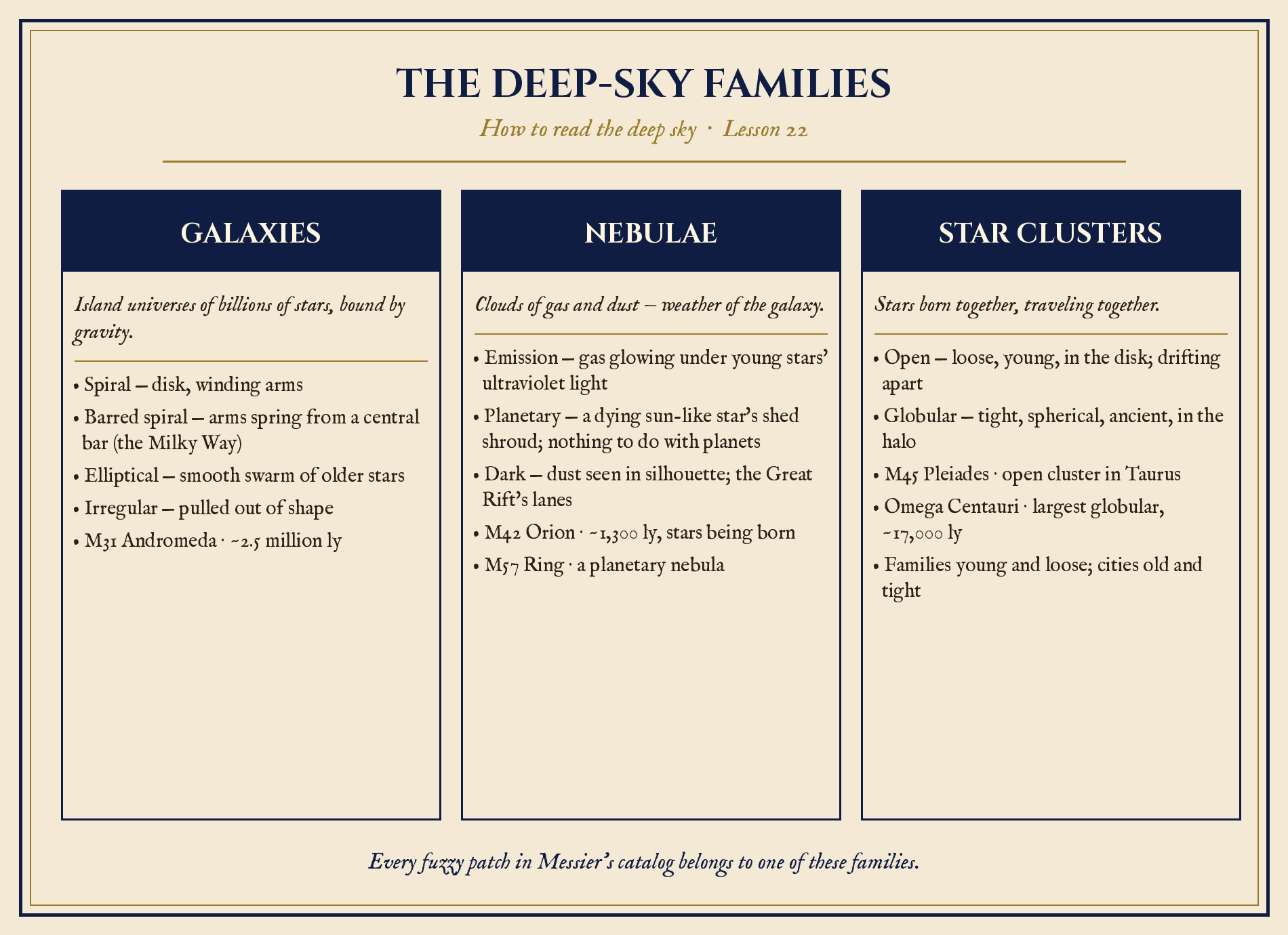
The Deep-Sky Families: galaxies are the island universes, nebulae are the clouds where stars are born and die, and star clusters are the gatherings — open and young, globular and ancient. Learn the families, and the smudges start to introduce themselves.
Built digitally for this overhaul (Python/PIL, typeset labels), from the mechanism taught in the lesson text.
Put it together and the deep sky has a grammar. Galaxies are the largest structures, island universes of billions of stars. Nebulae are the clouds: emission nebulae where stars are being born, dark nebulae where the dust hides the light, planetary nebulae where sun-like stars end. Star clusters are the gatherings: open clusters young and loose, globular clusters old and tight. Every fuzzy patch Messier cataloged belongs to one of these families. Learn the families, and the smudges start to introduce themselves.
❦ In your workbook: record the grammar of the deep sky in your own way — galaxies the largest structures, nebulae the clouds, clusters the gatherings, and every Messier smudge in one of the families — copy, sketch, or note what matters.
A Sealed Note on Narrow Windows
Scholars, I want to tell you my favorite sentence in this whole lesson, and it is not about a galaxy. It is this: Galileo mapped the sword of Orion and never saw the nebula.
He had the best instrument in the world. He had the curiosity. He had the sky. And his telescope showed him a circle of sky only a quarter of a degree wide, and the great Orion Nebula, one of the finest objects in all the heavens, sat outside that circle, unobserved, while he carefully drew the stars around it.
I think about this whenever I am tempted to be certain. My sonar is superb, my dears, genuinely superb, and it still only reaches so far. Every instrument, every method, every mind has a field of view, and the universe is always larger than the window. Herschel's window was stopped by dust. Galileo's was stopped by the width of his eyepiece. Yours will be stopped by something too, and mine by something else.
The remedy is not a bigger window, though bigger windows help. The remedy is remembering the window is there. Write down what your instrument cannot see, alongside what it can. Note the edge of the map. That is where the next discovery is waiting, and it has always been waiting exactly there.
❦ In your workbook: record the sealed note in your own way — Galileo's quarter-degree window, Herschel's dust, and the remedy of noting the edge of your own map — copy, sketch, or note what matters.
PROFESSOR VESPER GLIMMERWICK
Celestial Studies
Astronomer & Celestial Historian
Try It Tonight
You will need: dark-adapted eyes (twenty to thirty minutes), an adult, a familiar safe spot with the darkest sky you can reach, and this lesson's Sky Log page. Level Two adds binoculars or a small telescope and a red-filtered or dim flashlight.
Level One: Trace the River (dark skies, naked eye)
On a clear, moonless night, give your eyes the full half hour of darkness, then face the band of the Milky Way. In autumn evenings it arches overhead; in summer it runs from the southern horizon up through the zenith. Trace it slowly with your eyes from one horizon to the other. Find where it is brightest and widest: that bright stretch, running through the constellations Sagittarius and Scorpius, marks the direction of the galactic center. You are looking toward the middle of our galaxy, 26,000 light-years inward, through the dust.
Now find the Great Rift: the dark channel that splits the band lengthwise. It is most obvious in the summer Milky Way, running from Cygnus down through Aquila. Remember what you are seeing: not emptiness, but dust lanes between you and the far side of the disk. Sketch the band in your Sky Log as a long smudge, mark the brightest part, and draw the rift as a dark lane. Label what each part is.
City scholars: if light pollution hides the band entirely, that is itself data. Lesson 1 taught you why the sky glows. Record what you can see, note the limiting conditions honestly, and use the Level Two star-hop below on the next dark-sky trip, or study the band in the photographs linked in Further Reading until you can stand under it for yourself.
❦ In your workbook: record the river trace in your own way — the band's path, its brightest stretch toward Sagittarius, the Great Rift drawn as a dark lane, and the sky conditions, honestly noted — copy, sketch, or note what matters.
In your packet: Exercise I — The River of Stars Map ⚒ is drawn from this trace, and Exercise II — The Night's Hunt Log ◐ can be carried out on this Level One path. Work them now, or mark the place and take them as homework — your choice.
Level Two: The Andromeda Star-Hop (binoculars or small telescope)
The Andromeda Galaxy is the finest deep-sky target for a first hunt. It is magnitude 3.4, a dim smudge to the naked eye under dark skies, and it rewards patience.
Find it from Cassiopeia. Face north in autumn and find the W of Cassiopeia, high in the sky. Notice that one half of the W is more deeply notched than the other; that deeper V points like an arrow toward Andromeda. Follow the arrow's direction about three times the height of the W, and sweep slowly with binoculars. The galaxy appears as a small, elongated patch of haze, brighter toward the middle.
Or find it from the Great Square of Pegasus. Find the great square of four stars. Take the corner star nearest Cassiopeia, Alpheratz, and hop along the chain of stars to Mirach, the bright star in Andromeda's middle. From Mirach, turn a right angle and hop two fainter stars outward: the galaxy sits just beyond the second. Sweep the area gently. Once you catch the haze, try averted vision: look slightly to the side of it rather than straight at it. The dimmer parts of your eye are more sensitive to faint light, and the smudge will steady into view.
Log the night, the sky conditions, which route you used, and what the galaxy looked like: size, shape, brightness, whether the center looked brighter than the edges. Then consider writing one sentence about the light's age. Two and a half million years is worth a sentence.
❦ In your workbook: record the star-hop in your own way — the route you took, Cassiopeia or Pegasus, how long the hunt lasted, and whether averted vision steadied the smudge — copy, sketch, or note what matters.
In your packet: Exercise II — The Night's Hunt Log ◐ can be carried out on this Level Two path instead. Work it now, or mark the place and take it as homework — your choice.
Also tonight: the winter showpieces (seasonal)
When Orion rides high on winter evenings, find the three stars of Orion's belt, then drop below them to the fainter chain of the sword. The middle "star" of the sword is the Orion Nebula, M42. Naked eyes see a hazy star; binoculars show a puffy cloud; a small telescope at low power reveals the Trapezium's four bright stars embedded in glowing gas. Notice: you are looking at a stellar nursery 1,300 light-years away, with an instrument smaller than the one that missed it in 1610.
Above Orion, in Taurus, find the Pleiades, M45: a tiny dipper of blue-white stars, unmistakable once seen. Count how many you can separate with the naked eye; most people see six. Binoculars reveal dozens more, a whole glittering swarm.
Latitude notes. The Orion Nebula sits just south of the celestial equator, so it is visible from almost everywhere on Earth. The Pleiades and Andromeda are northern-hemisphere favorites, riding high for northern observers in autumn and winter; southern observers see them lower in the north. Omega Centauri belongs to southern skies: from most of the northern United States it never clears the horizon, so treat it as a reason to travel, or to admire in the photographs, until your latitude changes.
❦ In your workbook: record the showpieces in your own way — the Orion Nebula as naked eye, binoculars, and telescope each show it, and your own count of the Pleiades' stars — copy, sketch, or note what matters.
Sky Log Entry
Date and time: \_\_\_\_\_\_\_\_\_\_\_\_\_\_\_\_ Location: \_\_\_\_\_\_\_\_\_\_\_\_\_\_\_\_ Conditions (moon, clouds, light pollution): \_\_\_\_\_\_\_\_\_\_\_\_\_\_\_\_
Level and target: \_\_\_\_\_\_\_\_\_\_\_\_\_\_\_\_
Record the following in your Sky Log, in your own words:
- Describe the Milky Way's band as you saw it tonight: its path across the sky, where it was brightest, and whether you could trace the Great Rift. If the band was invisible, record the sky conditions and the brightest stars you could see instead.
- If you attempted the Andromeda star-hop: which route did you take, how long did the hunt last, and what did the galaxy look like? Note whether averted vision helped.
- If you observed the Orion Nebula or the Pleiades: describe each as seen with the naked eye, then with optics. How did the view change?
- One sentence on the oldest light you saw tonight, and where it came from.
❦ In your workbook: record the Sky Log entry in your own way — the band as you saw it, the hunt if you made it, the showpieces if you saw them, and your one sentence on the oldest light — copy, sketch, or note what matters.
A Sealed Note on the Longest Journey
My dearest scholars,
When I was a young bat, newly arrived in Mexico's caves and still learning the shape of the night, I believed the stars were all the same distance away, like lanterns hung on a single far wall. It took me longer than I care to admit to understand that some of those lanterns hang in the next room, and some hang in a house so far away that its light left before bats existed.
The Andromeda Galaxy's light is two and a half million years old. I want you to hold that number the way you would hold something fragile. When that light began its journey, no human being had ever looked up. The light traveled through the entire history of our species, through every story in this lesson, through every name ever given to the river of stars, and arrived tonight, in your eyes, on your street, while you stood next to an adult who loves you enough to stand in the dark.
That is the longest journey in this course, and it ends with you. Keep looking up. The sky has been waiting for someone to notice, and tonight that someone was you.
❦ In your workbook: record the longest journey in your own way — light two and a half million years old, traveling through the whole history of our species to arrive in your eyes tonight — copy, sketch, or note what matters.
PROFESSOR VESPER GLIMMERWICK
Celestial Studies
Astronomer & Celestial Historian
Guided Observation
This lesson's guided observation is Try It Tonight and the Sky Log Entry above, worked exactly as they are sourced there — nothing in this section replaces or shortens them.
Level One traces the Milky Way's band and locates the galactic center region, with a full half hour of dark adaptation, an adult beside you, and the darkest sky you can safely reach. Level Two star-hops to the Andromeda Galaxy from Cassiopeia or the Great Square of Pegasus. The seasonal showpieces — the Orion Nebula and the Pleiades — ride along when their season is up. Record the night in the Sky Log Entry: the band as you saw it, the route and the hunt if you made it, each showpiece as the naked eye and then optics showed it, and one sentence on the oldest light you saw.
Doability, carried exactly as sourced: the Level One path requires a dark-sky night as written. If light pollution hides the band entirely, the lesson's own instruction stands — that is itself data; record what you can see, note the limiting conditions honestly, and use the Level Two star-hop on the next dark-sky trip, or study the band in the photographs linked in Further Reading until you can stand under it for yourself. No substitute path is invented here.
Materials
Required (Level One — household items)
- Dark-adapted eyes: twenty to thirty minutes away from bright light before you begin.
- A familiar, safe observing spot with the darkest sky you can reach, and an adult beside you.
- Your Sky Log and a pencil for sketching the Milky Way's band.
- A dim red-filtered flashlight (or the dimmest white light you can manage) for charts and footing.
- Warm layers: standing still under an open sky cools the body faster than walking does.
Suggested (Level Two — historically closer)
- Binoculars or a small telescope for the Andromeda star-hop and the winter showpieces.
- A printed star chart or planisphere covering Cassiopeia, Pegasus, Orion, and Taurus.
- A clipboard for steady sketching and logging in the dark.
Reflection Questions
Answer in your workbook, in complete sentences.
- Galileo's telescope was weaker than a modern pair of child's binoculars, yet it changed the universe. What mattered more: the instrument, or the questions he pointed it at?
- Herschel mapped the galaxy with the sun near its center because interstellar dust hid the true extent of the disk. What does his mistake teach about the limits of evidence?
- So many cultures saw a river, a road, or a path in the Milky Way. Why do you think land-bound peoples kept picturing the sky as a way to travel?
- The light from the Andromeda Galaxy left before any human being existed to see it. What does it mean to you that your eyes can catch light that old?
- Astronomers kept the misleading name "planetary nebula" for more than two centuries because everyone knew what it meant. When is a wrong name worth keeping, and when should it be replaced?
Workbook Checklist — Lesson 22
In my workbook I have:
- ☐ traced the Milky Way's band (or recorded honestly why it was invisible), marked its brightest stretch, and drawn the Great Rift as a dust lane
- ☐ completed Exercise I's River of Stars Map, with the sun's place, Andromeda and its distance labeled, and the culture-names paragraph written
- ☐ logged the night's hunt formally — date, time, location, moon phase, and sky conditions, with an adult present
- ☐ written the surprise answer and the one-sentence reflection on the oldest light I saw
- ☐ completed Exercise III's two object records and the explanations of the nursery, the shroud, and the kept name
☐ Lesson completed Date: ___ Signature: ___
Cross-Class Connections
Runes · Unit I, Lesson 2 — The Uniliteral Sound-Signs
Tower scholars, the star names you met tonight — Betelgeuse, Rigel, and their kin — crossed from Arabic script into Latin letters before they reached your charts, and every crossing changed them a little. My classroom teaches the discipline underneath that journey: transliteration, the carrying of one writing system's signs into another system's letters, practiced sign by sign. Come and learn how signs travel, and you will never read a star name again without asking what it carried, and what it dropped, on the way.
PROFESSOR THISTLELOOM WEBBLETHORN
Runes & Ancient Writing

Herbology · Unit II, Lesson 15 — Seasonal Growing Cycles
Gently does it, scholars. Glimmerwick has shown you the farmer's clock itself — the Pleiades, whose setting and rising told Hesiod's farmers when to sow and when to harvest. In my greenhouse you will learn to read the calendars that clock still writes: how long a plant lives, how it sleeps through winter, and how a whole year of growing is planned around the turning seasons. The stars keep the appointments; here you learn to grow by them. Come down from the tower and plan your year.
PROFESSOR BERYL FERNFOOT
Herbology Greenhouse • Master Herbalist • Head of House Oriens

Creative Arts · Unit II, Lesson 10 — The Field & Observation Kit
Set up square, scholars — and this time, pack up. Deep-sky observing was a drawing art before it was a photographic one, and an honest sketch made in the dark wants the kit this lesson assembles: the journal riding protected, the chart riding flat, and the red-filter card that lets you read and log without spending the night vision you spent half an hour earning. Assemble it here, test-carry it on a real walk, and then take it up the tower: a clipboard, a red light, and an honest pencil are field equipment, and we build field equipment to last.
— Professor Cogbranch Timberclank, Creative Arts Workshop
Scrollwork — named in the lesson; no invitation written. Glimmerwick's text above names Galileo's engravings and the illuminated astronomical manuscripts, but no Scrollwork lesson teaches astronomical manuscripts or star charts as such: the class runs from the scriptorium desk through inks, nibs, scripts, and page craft to seals, archives, and ciphers, and no specific partner lesson verifies for this hook. The connection stands as the lesson's own prose mention above.
Potions — named in the lesson; no invitation written. Glimmerwick's text above names the old apothecary star-timing as belief-history and "planetary nebula" as a fossil word of the same older cosmos. No Potions lesson teaches apothecary star-timing or the naming history of planetary nebulae as its substance, so no destination lesson verifies for this hook. The mention stands as the lesson's own prose above, exactly as sourced — the Potions↔Celestial reciprocity is one-directional by earlier deliberate decision, and no Muddlenook invitation is invented here.
History of Magic — named in the lesson; a future class. The final names it as "(a future class)" that will study the Milky Way's road-of-souls traditions as history when it opens. There is no lesson to link and no professor to invite. The mention stands exactly as sourced.
Further Reading & Sources
- NASA Imagine the Universe: The Milky Way Galaxy: How we know the Milky Way is a barred spiral, why the band looks the way it does, and our sun's place in the suburbs. A clear NASA explainer written for students.
- EarthSky: Find the Andromeda Galaxy using Cassiopeia: The star-hop route from the W of Cassiopeia, with a sky chart, plus the galaxy's vital statistics.
- Astronomy magazine: Observe the Orion Nebula: Finding M42 in Orion's sword with the naked eye, binoculars, and telescope; includes the detail that Galileo mapped the sword but missed the nebula.
- Ian Ridpath's Star Tales: The Milky Way: The Greek, Roman, Arabic, and Chinese lore of the band, from kyklos galaxias to the Celestial River, by a historian of constellations.
- KVNF Western Slope Skies: What Kind of Planet is a Planetary Nebula?: Herschel's 1782 naming story and what planetary nebulae really are, in plain language.
Browse the Celestial Studies shelf in the school Library for readable editions of these works.
Submit Your Work
When your Lesson 22 work is complete, submit it through the Submit Your Work form at the foot of this page: your scholar's name, your house (Septentrio / Oriens / Meridies / Occidens / Not sorted yet), this lesson (Unit IV, Lesson 22 — Deep Sky Wonders), a photo of your work — your River of Stars Map, your Night's Hunt Log page, or your nursery-and-retirement-city records — and, if you wish, the permission-to-display checkbox so your work can appear in the school galleries.
Sealed in the Celestial Tower, in deep midnight blue, by Professor Vesper Glimmerwick.
Submit your work for this lesson using the form below.
CONTINUE IN THE CELESTIAL TOWER
← Previous · Lesson 21: Constellations & Their Stories Next · Lesson 23: Fireworks: Comets, Meteors & Supernovae →
Unit IV — The Fixed Stars Celestial Tower — All 33 Lessons
The rest of Unit IV: Lesson 18 · The Sun · Lesson 19 · What Stars Are · Lesson 20 · Star Names · Lesson 21 · Constellations · Lesson 23 · Fireworks