

CELESTIAL STUDIES
Unit IV · Lesson 20The Names of the Stars
Professor Vesper Glimmerwick
Astronomer & Celestial Historian
The Celestial Tower • School of Evershade
Professor's Introduction

The night is young, scholars,
I do most of my flying after dark, which means I spend a great deal of time underneath the stars with nothing to do but look at them and wonder who gave them all their names. It is a fine question for a bat, because the answer turns out to involve a great deal of flying of another kind: names that traveled from Greece to Baghdad to Spain, changing their spelling at every stop, until they landed in your sky exactly as you know them.
Tonight you will learn that many of the brightest stars carry Arabic names, and I do not mean that loosely. I mean that we are going to count them, with a stated sample and a real source, because this school does not deal in vague wonder. You will learn what Betelgeuse and Rigel and Aldebaran and Deneb actually mean, including one famous eight-hundred-year-old spelling mistake. You will learn why the brightest star in a constellation is not always called alpha, and what all those numbers after the names are for. And you will learn, with your consumer-protection spectacles firmly on, why no one can sell you a star.
The sky is free, my dears. Its names are an inheritance. Let us learn to read the labels on the inheritance properly.
PROFESSOR VESPER GLIMMERWICK
Celestial Studies
Astronomer & Celestial Historian
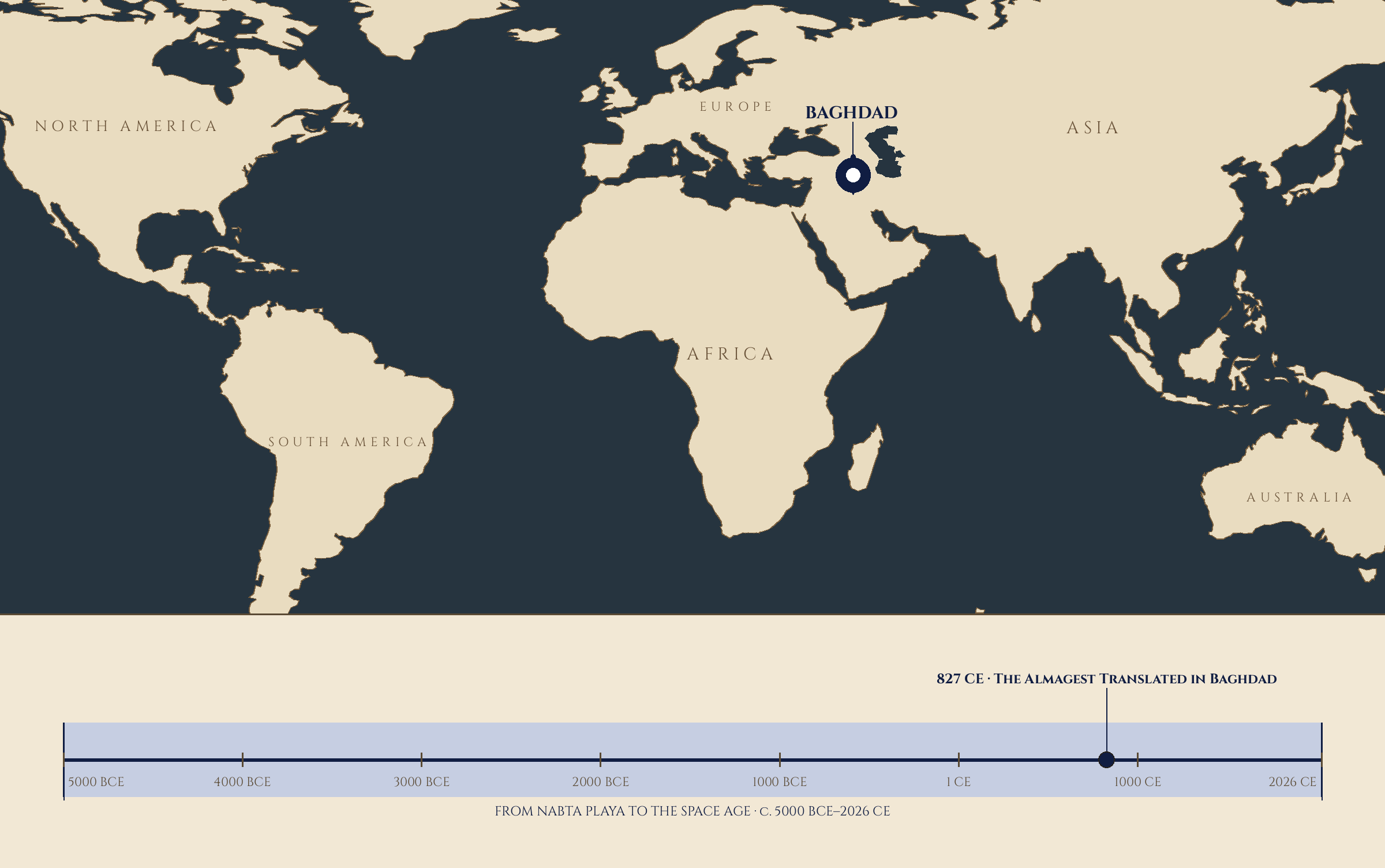
Where and when: BAGHDAD, 827 CE · The Almagest Translated in Baghdad (year 827) — The Names of the Stars. The pin is this lesson. The line beneath the map is our road: every stop a moment when watching the sky changed, every lesson a pin upon it.
Lesson Objectives
By the end of this lesson, you will be able to:
- Trace the transmission chain of Western star names: Greek star lore, Arabic translation and expansion during the Islamic Golden Age, Latin translation in medieval Spain, and Renaissance Latinization.
- Explain the defined, sourced sample behind this lesson's central claim: of the 30 brightest stars by apparent magnitude, 15 carry names the IAU's name list traces to Arabic.
- Decode the true meanings of Betelgeuse, Rigel, Aldebaran, and Deneb, including the famous medieval copyist's error inside Betelgeuse.
- Read Bayer designations, Flamsteed numbers, HD numbers, and HIP numbers, and explain what each system is for and why the brightest star is not always alpha.
- Evaluate commercial star-name registries as a consumer: what the certificate buys, what it does not buy, and who actually has the authority to name stars.
Reading this lesson: ★ marks the passages to remember. They return on the unit quiz and the class test. Check in questions ask the material back as you go; answer them in your workbook when you meet them.
Working this lesson: Your assignment packet is the first download on this page. Work in it as the lesson moves along, answering each exercise as its subject is taught — or read the lesson through for your notes and take the exercises as homework afterward. Both are proper ways to sit this class. Signposts in the reading tell you where each exercise belongs. Written answers are short answers in your own words; a few honest lines are worth more than a filled page.
Your Assignment Packet
This lesson's exercises live in its packet: the Lexicon Handout (every term, course terms marked ◆), Materials, Guided Practice, the Assignment Manual with its answer key for self-checking, the Reflection Questions, and the Workbook Checklist. Download the packet before you begin and keep it beside you as you read. The packet's exercises are Glimmerwick's own word for the work: Exercise I: The Name Detective ✎, Exercise II: The Designation Drill ✎, and Exercise III: The Registry Test ✎. The lesson's quiz is not printed in the packet; it pools to the Unit IV Quiz, where it will meet you again.
Safety Briefing
- All night observing for this lesson is done with an adult present, in a familiar and safe location. Tell someone where you are and when you expect to return.
- This lesson needs no solar viewing of any kind. If you observe near sunset, the same rule as always holds: never look directly at the sun, with or without instruments.
- Bring a dim red-filtered flashlight if you have one. It preserves everyone's night vision, including the bats'.
- Research safety: look up star names in real catalogs and the IAU's lists (linked in Further Reading), not in random name generators. And if any website offers to sell you a star, read the Mechanism section first. You are about to become immune to that particular pitch.
The Wonder
Go outside on a clear night and find Orion. You know the shape: the hourglass, the three belt stars in a row. Now say the names of its brightest stars out loud. Betelgeuse. Rigel. Alnilam. Alnitak. Mintaka. Saiph.
Every one of those is an Arabic word, or what is left of an Arabic word after a thousand years of being copied by people who did not speak Arabic. People say these names every clear night all over the world, most of them with no idea they are speaking Arabic. The sky over your head is, in large part, an Arabian sky.
★ This lesson makes that claim the honest way: with a defined sample and counted numbers. Take the 30 brightest stars in the night sky by apparent magnitude, ranks 1 through 30 on the standard List of brightest stars, which orders them by combined visual magnitude and uses the IAU's approved proper names. Then look up each name's origin in the IAU Working Group on Star Names' List of proper names of stars, which records where every official star name comes from. The result: 15 of the 30, exactly half, carry names that the IAU's own list traces to Arabic. One more, Miaplacidus, is tagged as an Arabic-Latin hybrid. The rest divide among Greek names (Sirius, Canopus, Arcturus, Procyon, Antares, Pollux, Castor), Latin names (Capella, Mimosa, Regulus, Bellatrix), modern coinages (Acrux, Gacrux), and one star with no proper name at all (Alpha Centauri, which is a description, not a name).
One footnote of honesty, because counting is an honest business. The IAU list tags Spica as Arabic on the strength of its alternate traditional name Azimech, from the Arabic as-simak al-a'zal. The everyday name Spica itself is Latin, for "ear of grain." So the count of 15 includes one name that is Arabic by its alternate, not by its face. Even with that footnote, the shape of the result stands: half the brightest sky speaks Arabic.
How did that happen? The answer is a thousand-year relay race, and it is one of the best stories in astronomy.
❦ In your workbook: record the wonder in your own way — Orion's Arabic names said out loud, the counted 15 of 30 with its stated sample, and the Spica footnote that keeps the count honest — copy, sketch, or note what matters.
The Story
Alexandria: the Greek beginning
Around 150 CE, in Alexandria, the astronomer Claudius Ptolemy wrote a great textbook of mathematical astronomy. He called it, modestly, the Mathematical Treatise. It summed up Greek knowledge of the heavens, including a catalog of more than a thousand stars based largely on the earlier work of Hipparchus. For centuries this book was the authority on the sky.
❦ In your workbook: record the Greek beginning in your own way — Ptolemy's Mathematical Treatise at Alexandria around 150 CE, its thousand-star catalog, and the centuries it ruled — copy, sketch, or note what matters.
Baghdad: the book becomes the Almagest
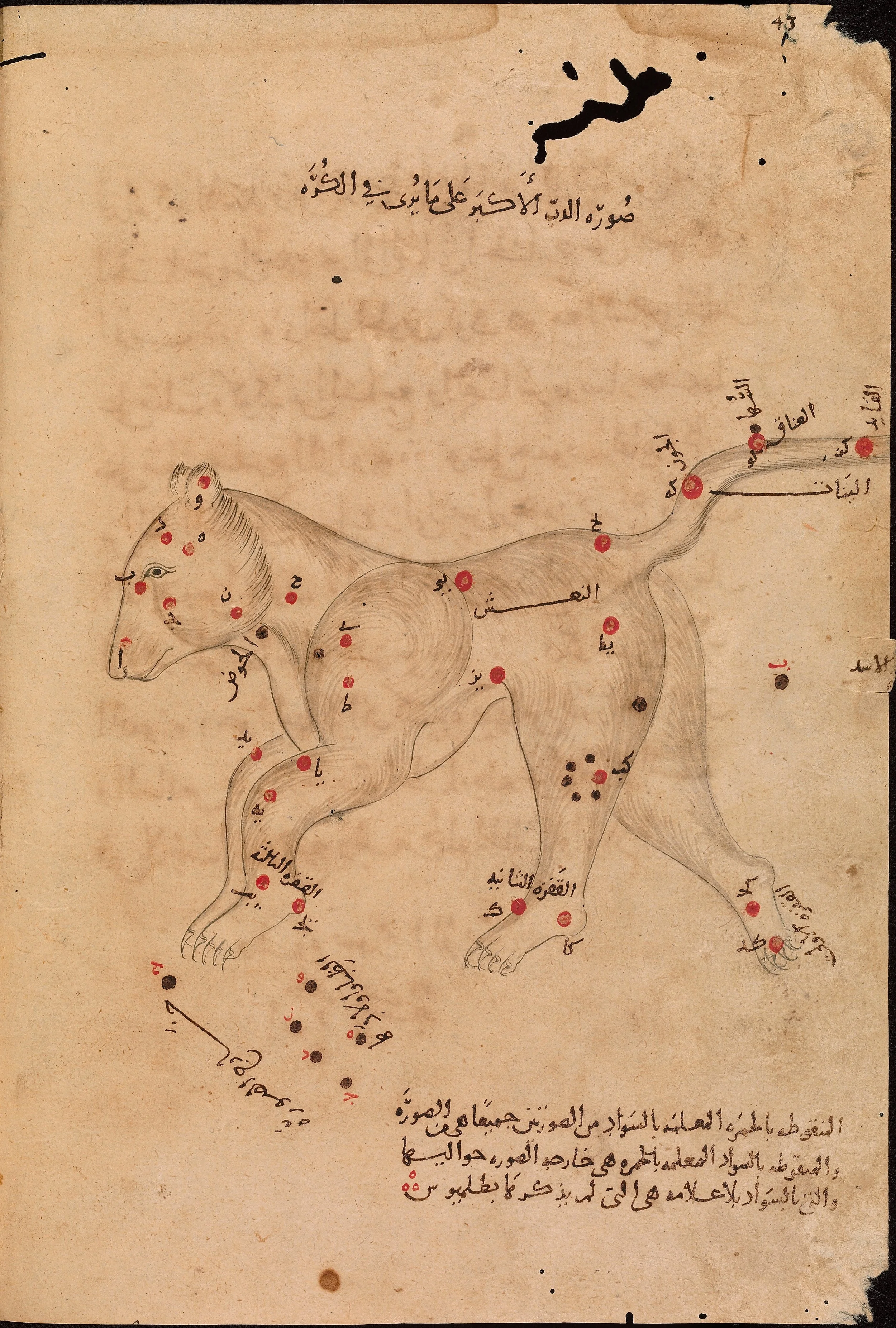
The Great Bear in al-Sufi's Book of Fixed Stars (964; this copy Bodleian MS Marsh 144): Ptolemy's constellation drawn with its stars dotted in red and labeled in Arabic. Al-Sufi matched the Greek stars against the traditional Arabic names of the desert sky and wrote both down together — the bridge between two skies.
Abd al-Rahman al-Sufi, Book of Fixed Stars, Bodleian Library MS Marsh 144 (via Wikimedia Commons).
★ In the 9th century, in Baghdad, the caliph al-Ma'mun made his capital a center of translation. At the House of Wisdom, scholars rendered Greek works into Arabic, and Ptolemy's great book was among the most prized. The first Arabic translations appeared around 827. The Arab astronomers called the book al-Majisti, from the Greek megiste, "the greatest," with the Arabic article al- in front. That is why, to this day, we call Ptolemy's book by its Arabic name: the Almagest.
This was not mere copying. The scholars of the Islamic Golden Age, which ran roughly from the 8th to the 13th centuries, measured, corrected, and extended what they translated. Astronomy mattered deeply to them: prayer five times a day facing Mecca demanded accurate timekeeping and direction-finding, which demanded careful observation of the sky.
★ The great figure for our story is the Persian astronomer Abd al-Rahman al-Sufi (903-986), working under Buyid patronage. Around 964 he published his Kitab suwar al-kawakib, the Book of Fixed Stars: the first full updating of Ptolemy's star catalog in eight hundred years. Al-Sufi kept Ptolemy's 48 constellations but did something new. He matched Ptolemy's Greek stars against the traditional Arabic star names of the desert sky, the old Bedouin names used by travelers and herders, and he wrote both down together. He corrected Ptolemy's brightness estimates with his own observations. His book, beautifully illustrated with each constellation drawn twice (once as on a globe, once as in the sky), became the standard star handbook for centuries.
Translating the Greek sky into Arabic had been genuinely hard, because the Greek and Arabic sky pictures had little to do with each other. The Greeks saw a hunter where the Arabs saw a central figure called al-Jawza. Al-Sufi's work was the bridge between two different skies.
Check in: We call Ptolemy's book by its Arabic name to this day — where does "Almagest" come from, word by word, and what did al-Sufi add to the book's tradition in 964 that mere copying would not have given it?
❦ In your workbook: record Baghdad in your own way — the House of Wisdom, al-Majisti becoming the Almagest, and al-Sufi's bridge between two different skies — copy, sketch, or note what matters.
Toledo: the road back west
By the 12th century, Western Europe wanted Ptolemy back and could not read him: no Latin translation of the Almagest existed. An Italian scholar named Gerard of Cremona heard that an Arabic copy could be found in Toledo, in Spain. He traveled there to learn Arabic for the express purpose of reading it, stayed for the rest of his life, and finished his Latin translation of the Almagest in 1175. He worked within what we now call the Toledo School of Translators, the great 12th and 13th century workshop that poured Arabic learning into Latin.

A Note from the Headmaster
A Headmaster's footnote to a lesson about journeys. Aldebaran and Betelgeuse reached your sky by the Arabic road into Spain — and a board game travelled the same road in the same centuries: alquerque, from the Arabic al-qirkat, written down in full at Alfonso's court in Seville. When you have finished counting Arabic star names, come and learn its leaps in the Games Room.
With the translations came the names. The Alfonsine Tables, compiled under Alfonso X of Castile in 1252, contain the first recorded use of the name Rigel. The Arabic star names were now traveling in Latin dress.
❦ In your workbook: record Toledo in your own way — Gerard learning Arabic to read one book, the 1175 translation, and Rigel's first recorded use in 1252 — copy, sketch, or note what matters.
The Renaissance: Latinized and misspelled
Renaissance scholars Latinized the Arabic names as they copied them, and copying introduced errors. The most famous is Betelgeuse, which you will meet properly in the Mechanism. Even al-Sufi himself was Latinized: on the moon, the crater named for him is called Azophi, the Latin form of al-Sufi. Every misspelling was preserved by the next copyist, until the corrupted forms became the official ones.
That is the relay: Greek star lore, carried east into Arabic, expanded with desert star names, carried west into Latin in Spain, and Latinized by Renaissance scholars. The names above your head tonight are the baton, still warm from all those hands.
❦ In your workbook: record the relay in your own way — Greece to Baghdad to Spain to the Renaissance, Azophi on the moon, and the baton still warm from all those hands — copy, sketch, or note what matters.
The Mechanism
Four names, honestly decoded
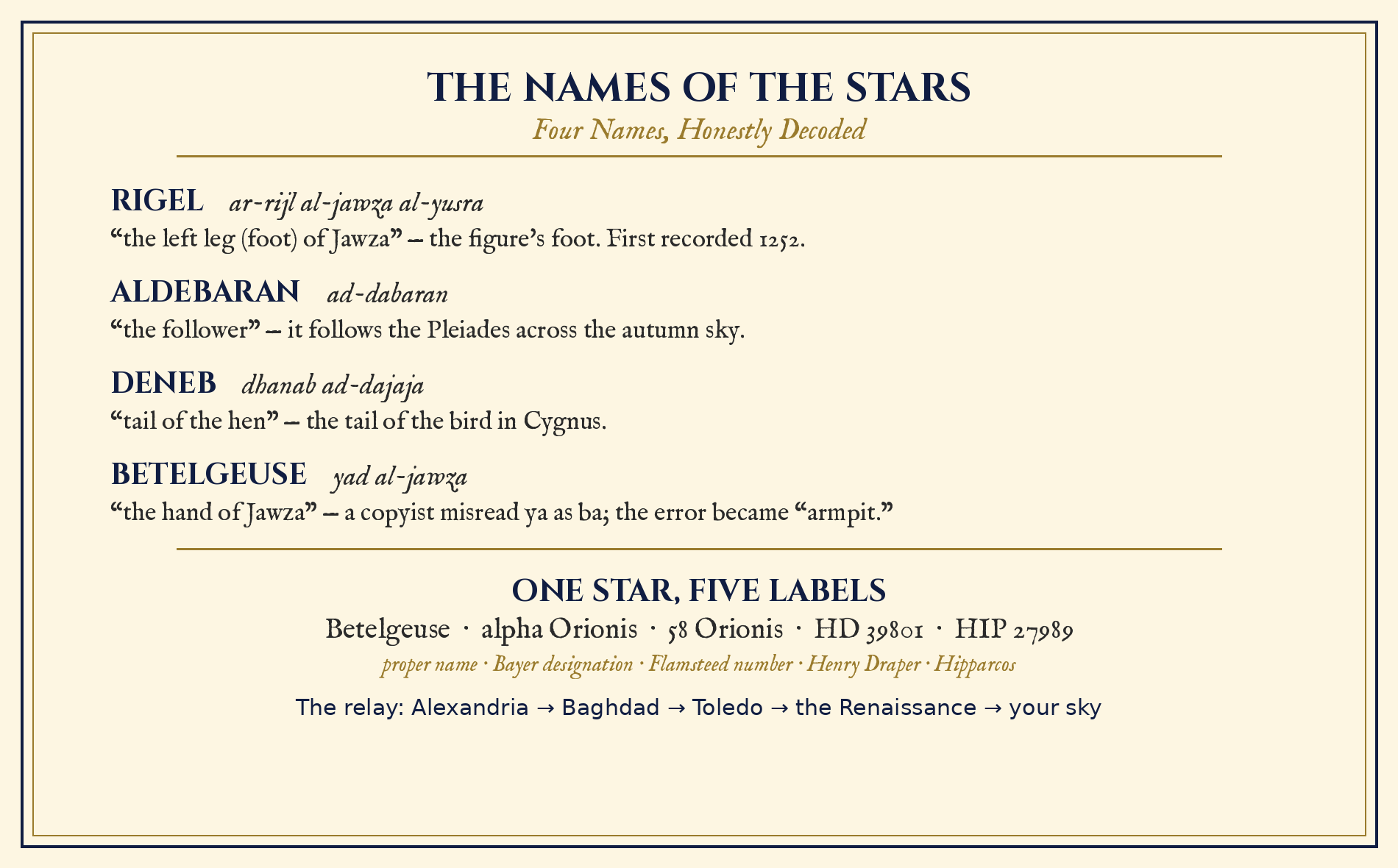
Four names, honestly decoded, and one star's five labels. The transliterations are typeset exactly as the lesson prints them; a name you can translate is a name you own in the way that matters.
Built digitally for this overhaul (Python/PIL, typeset labels), from the mechanism taught in the lesson text; plate builder at.
★ Rigel. From the Arabic ar-rijl al-jawza al-yusra: "the left leg (foot) of Jawza." Jawza is the Arabic figure in Orion's place, and rijl means leg or foot. Rigel marks the hunter's foot, or the figure's foot, depending on which sky picture you stand in. First recorded in the Alfonsine Tables of 1252.
★ Aldebaran. From ad-dabaran: "the follower." It follows the Pleiades across the autumn sky, rising after that glittering cluster and trailing it all night like a chaperone. The name is a description of behavior, not of shape.
Deneb. From dhanab ad-dajaja: "tail of the hen." The star sits at the tail of the bird in Cygnus. The Greek constellation there is the swan; the Arabic name remembers the bird as a hen. Either way, it is the tail.
★ Betelgeuse. Here is the famous mistake, and it is worth telling carefully because the mistake is the lesson. The Arabic original is yad al-jawza: "the hand of Jawza," the Orion figure. In the 13th century, a copyist misread the first letter of yad. In Arabic script, ya (with its dots below) and ba (with its dot below) differ only in their dotting, the i'jam, and in hasty handwriting they are easy to confuse. The misread form was then parsed by later readers as ibt, "armpit." So "armpit of the central one," the gloss you will find in many popular books, is the meaning of the corrupted reading, faithfully preserved for eight hundred years. The name underneath, the one al-Sufi's tradition intended, is "hand."
Hold that story next to your Runes lessons. A single misread letter in one script renamed one of the brightest stars in the sky, permanently. Writing systems are not neutral containers for names. They are part of how names survive, and how they change.
Check in: Betelgeuse's popular gloss says "armpit," but the name underneath says something else — what does yad al-jawza actually mean, which two letters did the 13th-century copyist confuse, and what does Rigel's name mean?
❦ In your workbook: record the four names in your own way — foot, follower, tail of the hen, and the hand that eight hundred years of copying turned into an armpit — copy, sketch, or note what matters.
In your packet: Exercise I — The Name Detective ✎ begins here — its three stars are decoded exactly this way, from the IAU's list. Work it now, or mark the place and take it as homework — your choice.
Bayer letters: the Greek alphabet goes to work
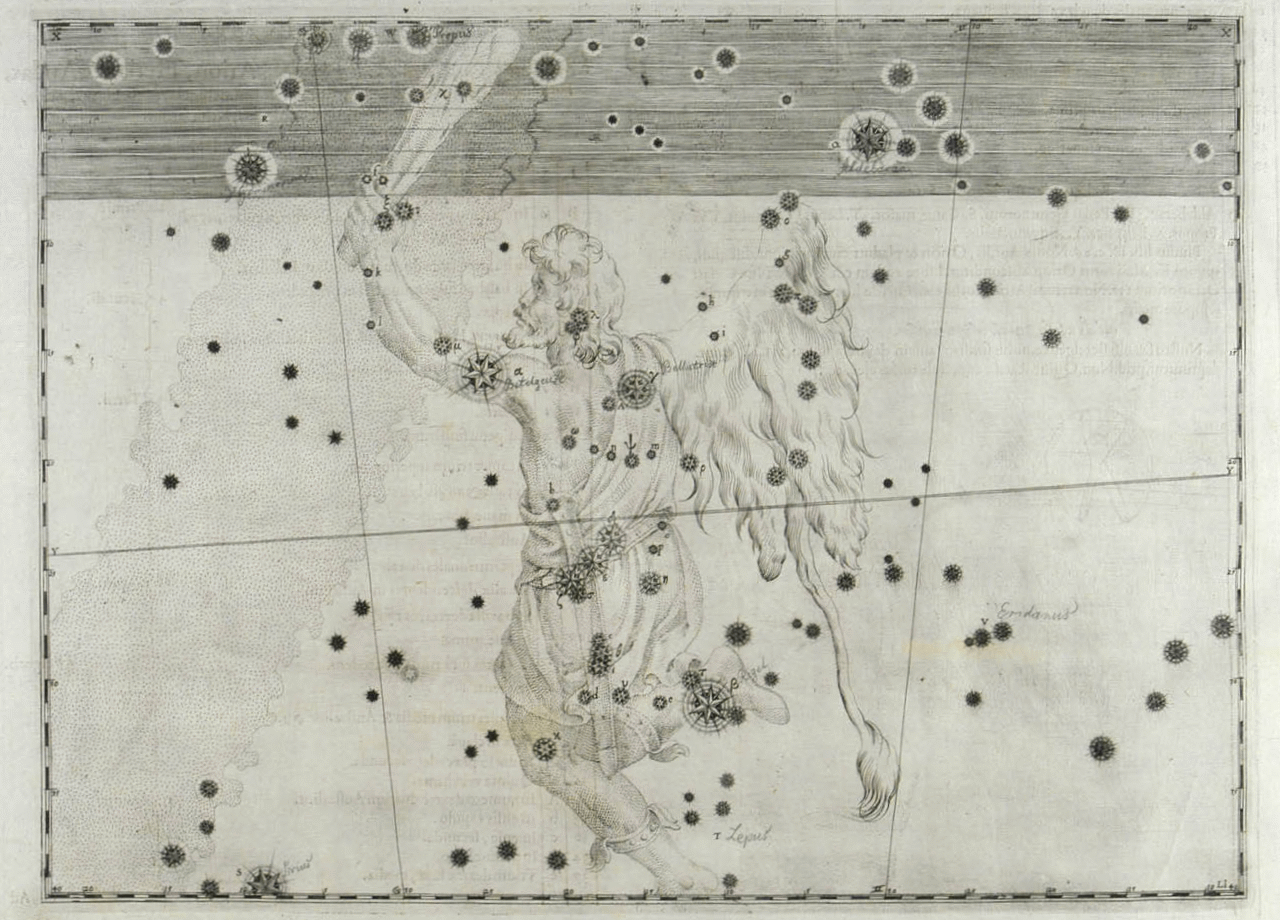
Orion in Bayer's Uranometria (Augsburg, 1603), the atlas that introduced the Greek-letter system: Betelgeuse is alpha Orionis, Rigel beta Orionis — though Rigel is usually the brighter star. The figure is shown from behind, the old globe convention, which is why some star names' "right" and "left" read backwards against the sky.
Johann Bayer, Uranometria (1603), via the Linda Hall Library / Wikimedia Commons.
By 1600, astronomers needed a system. Names were wonderful but unsystematic, and telescopes were about to reveal thousands of stars nobody had named at all.
In 1603, Johann Bayer of Augsburg published Uranometria, the first great star atlas: one chart for each of the 48 Ptolemaic constellations, using star positions from Ptolemy and from Tycho Brahe, plotting more than 1,700 stars. Bayer's lasting invention was the system now called Bayer designations: label the stars of each constellation with Greek letters, alpha through omega, followed by the genitive (possessive) form of the constellation's Latin name. Betelgeuse becomes alpha Orionis, "the alpha of Orion." Rigel is beta Orionis.
★ The common belief is that alpha always means the brightest star, then beta the next, and so on. It is only approximately true. In Bayer's day, brightness could not be measured precisely; stars were sorted into six magnitude classes, and Bayer generally assigned letters class by class, often ordering stars within a class by their position in the constellation figure rather than by exact brightness. The result is full of exceptions:
- In Orion, Betelgeuse is alpha Orionis, but Rigel (beta Orionis) is usually the brighter star. Betelgeuse is also variable, so at its brightest it can occasionally outshine Rigel, which may be part of why Bayer ordered them as he did.
- In Gemini, Castor is alpha Geminorum but Pollux (beta Geminorum) is notably brighter.
- In Orion again, Saiph is kappa Orionis, the tenth Greek letter, yet it is only the sixth brightest star in the constellation.
- Across the whole sky, in at least 30 of the 88 modern constellations, the alpha star is not the brightest.
So a Bayer designation tells you roughly how bright a star is and exactly which constellation it belongs to, but "alpha" is a historical label, not a brightness certificate. When Bayer ran out of Greek letters, he continued with Latin letters, and later astronomers extended the system to the southern sky.
Check in: A friend insists alpha must be the brightest star in every constellation. Correct them with two constellations from this lesson — and explain what Bayer was actually sorting by, class by class.
❦ In your workbook: record Bayer's letters in your own way — the 1603 atlas, letters by magnitude class, and why alpha is a historical label, not a brightness certificate — copy, sketch, or note what matters.
Flamsteed numbers: counting west to east
A century later, England's first Astronomer Royal, John Flamsteed, spent forty years measuring star positions at Greenwich with telescopic sights. His Historia Coelestis Britannica, the first major star catalog made with telescopic aid, listed nearly 3,000 stars. Its publication was dramatic: Isaac Newton and Edmond Halley printed a preliminary version in 1712 without Flamsteed's approval, and Flamsteed bought up three hundred copies and burned them. His own authorized version appeared posthumously in 1725, prepared by his widow Margaret.
★ The numbering system named for him works like Bayer's but with numbers instead of Greek letters: a number plus the constellation genitive, assigned in order of increasing right ascension — the sky's eastward coordinate, measured from the vernal equinox — within each constellation, which runs west to east. Because the Earth's axis slowly wobbles (precession), the numbers are slightly out of order in places today. The numbers in current use were actually assigned by the French astronomer Lalande for his 1783 almanac, working from Flamsteed's catalog.
Flamsteed numbers are used today mostly where no Bayer Greek-letter designation exists. Two famous examples: 51 Pegasi, the first sunlike star found with an orbiting exoplanet, and 61 Cygni, one of the first stars to have its distance measured. Note the pattern: Betelgeuse is alpha Orionis to Bayer but 58 Orionis to Flamsteed. Same star, different filing systems, and the Flamsteed number tells you nothing about brightness at all.
Check in: Flamsteed numbers increase with what quantity, running in which direction — and why are they slightly out of order in places today?
❦ In your workbook: record Flamsteed's numbers in your own way — forty years at Greenwich, the burned pirated edition of 1712, and numbers that count west to east and say nothing about brightness — copy, sketch, or note what matters.
HD and HIP numbers: the industrial age of catalogs

Annie Jump Cannon (left) with Henrietta Swan Leavitt at Harvard College Observatory, 1913. Cannon classified the spectra of 225,300 stars for the Henry Draper Catalogue (1918-1924), chiefly by eye from photographic plates — which is why Betelgeuse carries the number HD 39801.
Harvard College Observatory, 1913 (via Wikimedia Commons).
When photography and spectroscopy arrived, catalogs stopped being lists of thousands and became lists of hundreds of thousands.
★ The Henry Draper Catalogue, published in nine volumes between 1918 and 1924, classified the spectra of 225,300 stars. The work was done at Harvard College Observatory under Edward Pickering, chiefly by Annie Jump Cannon, who personally classified hundreds of thousands of stellar spectra by eye from photographic plates. It was named for Henry Draper, whose widow funded the work. HD numbers are still standard: Betelgeuse is HD 39801.
The Hipparcos catalogue, published in 1997 from the European Space Agency's Hipparcos satellite, gave precision positions, motions, and distances for about 118,000 stars. HIP numbers are the modern precision standard: Betelgeuse is HIP 27989.
So one star can be Betelgeuse (proper name), alpha Orionis (Bayer), 58 Orionis (Flamsteed), HD 39801 (Henry Draper), and HIP 27989 (Hipparcos), all at once. Astronomers pick the designation that suits the job: the proper name (a star's traditional individual name) for talking, the catalog number for computing.
❦ In your workbook: record the industrial catalogs in your own way — Cannon's 225,300 spectra, the satellite's 118,000 precision stars, and Betelgeuse wearing all five labels at once — copy, sketch, or note what matters.
In your packet: Exercise II — The Designation Drill ✎ begins here — its first task writes out exactly this five-label chain. Work it now, or mark the place and take it as homework — your choice.
Who gets to name a star
In 2016, the International Astronomical Union formed the Working Group on Star Names to catalog and standardize proper names for stars. The WGSN's first bulletins approved hundreds of traditional names, including Betelgeuse, and the approved list has since grown past six hundred. The IAU, founded in 1919, is the internationally recognized authority for naming celestial bodies. Its names are assigned on scientific grounds, by consensus, and they are never sold.
★ Which brings us to the registries. Companies such as the International Star Registry will, for a fee, sell you a handsome certificate "naming" a star after a loved one. Here is what the IAU says about such enterprises: the names have no formal or official validity whatsoever. The record of your purchase exists only in the company's own ledger. No observatory, no planetarium, no catalog, and no astronomer anywhere will ever use the name. The International Star Registry itself is candid about the limits: it says it does not own the star and cannot sell it, comparing the purchase to adopting a star symbolically.
This school teaches consumer protection alongside constellations, because scholars should not be parted from their money by fine printing. A bought star name is a novelty gift, and there is nothing wrong with novelty gifts as long as everyone understands what is being bought. If you want to honor someone with a star, here is the scholar's way, and it is free: choose a real star you can both find, learn its true name and what the name means, and go outside together and look at it. No one can sell you that, because it was never for sale.
A last story, to show that real star names do sometimes arrive by odd routes, just never by purchase. Two stars in the little constellation Delphinus are named Sualocin and Rotanev. The names first appeared in the Palermo Star Catalogue of 1814, published by Giuseppe Piazzi and his assistant Niccolo Cacciatore. For decades nobody knew what the names meant, until the English astronomer Thomas Webb reversed their letters in 1859 and revealed Nicolaus Venator, the Latinized form of Niccolo Cacciatore. Someone, probably Cacciatore himself, had smuggled his own name into the catalog backwards as a joke. It entered astronomy through a published scientific catalog, which is the legitimate door. The cash register is not a door at all.
Check in: State the IAU's position on purchased star names in one sentence — then say where the record of a registry purchase actually exists, and who will ever use the name.
❦ In your workbook: record who names the stars in your own way — the IAU's consensus names, never sold; the registry's ledger-only names; and the scholar's free alternative — copy, sketch, or note what matters.
In your packet: Exercise III — The Registry Test ✎ begins here. Work it now, or mark the place and take it as homework — your choice.
A Sealed Note on Names
Scholars, a word about pronunciation before you go outside tonight.
You will mispronounce these names. Everyone does, including professional astronomers, including me. Betelgeuse alone has half a dozen accepted pronunciations, and the only people who are certain about the right one are people who have not read this lesson. Say the names out loud anyway, badly and cheerfully, and then learn what they mean. A name you can translate is a name you own in the way that matters.
And when you say Rigel, remember that you are saying an Arabic word for "foot" that has been traveling for a thousand years: spoken by desert guides, written by Persian astronomers, copied by Spanish translators, misspelled by Renaissance printers, and now spoken by a bat's students on a tower terrace in Kansas. That is not a mispronunciation. That is an inheritance changing hands again.
Handle it with care. It has come a long way to reach you.
❦ In your workbook: record the sealed note in your own way — say the names badly and cheerfully, learn what they mean, and handle the inheritance with care — copy, sketch, or note what matters.
PROFESSOR VESPER GLIMMERWICK
Celestial Studies
Astronomer & Celestial Historian
Guided Observation
Try It Tonight
Level One: household eyes only
With an adult present, go outside after full dark and find the Summer Triangle: Vega, Altair, and Deneb, three bright stars high overhead on autumn evenings. All three names are Arabic. Vega comes from an-nasr al-waqi, "the swooping eagle"; Altair from an-nasr at-tair, "the flying eagle"; Deneb you already know, "tail of the hen." Find all three and say each meaning out loud.
Then find Orion rising in the east and identify Betelgeuse (the red shoulder star, alpha Orionis) and Rigel (the blue-white foot star, beta Orionis). Notice the Bayer puzzle with your own eyes: beta is brighter than alpha. You now know why that is allowed.
❦ In your workbook: record the Triangle in your own way — Vega, Altair, and Deneb found and their meanings said out loud, and the Bayer puzzle seen with your own eyes in Orion — copy, sketch, or note what matters.
Level Two: with catalogs
Look up the full designations of the four stars of the Mechanism: Bayer letter, Flamsteed number, HD number, and HIP number for each. (You have Betelgeuse's set as a worked example: alpha Orionis, 58 Orionis, HD 39801, HIP 27989.) Then choose one star and write its complete name chain in your workbook: the Arabic original and its meaning, the Latinized form, and the modern designations. One paragraph on how the name changed at each handoff.
❦ In your workbook: record the name chain in your own way — one star's Arabic original, its Latinized form, its four modern designations, and what changed at each handoff — copy, sketch, or note what matters.
Sky Log Entry
Copy these prompts into your Sky Log and complete them tonight.
- The Arabic-named bright stars I found tonight: _______________
- Each name with its meaning, in my own words: _______________
- The transmission chain in one sentence (Greece to Baghdad to Spain to us): _______________
- The 15-of-30 count, stated carefully with its sample: _______________
- One thing about star names I believed before this lesson that turned out to be wrong: _______________
❦ In your workbook: record the Sky Log entry in your own way — the stars you found, the chain in one sentence, the count stated carefully, and the belief this lesson corrected — copy, sketch, or note what matters.
Materials
Required (Level One — household items)
- Your workbook and a pencil for the Sky Log, the name detective work, and the designation drill.
- A star chart or planetarium app for finding the Summer Triangle and Orion.
- A dim red-filtered flashlight to preserve night vision while observing.
- An adult present for all night observing, in a familiar and safe location.
Suggested (Level Two — historically closer)
- Binoculars for splitting close pairs and seeing fainter named stars.
- Internet access for catalog lookups: the IAU name lists, SIMBAD, and the further-reading pages.
Reflection Questions
Answer in your workbook, in complete sentences.
- The lesson counts 15 Arabic-derived names among the 30 brightest stars, with a stated sample and a named source. Why does this lesson insist on the sample and the source instead of just saying "most bright stars have Arabic names"?
- Betelgeuse means "hand," but eight hundred years of books say "armpit of the central one." Which meaning should a scholar use, and why is the wrong one worth knowing too?
- Bayer's system labels stars with Greek letters in rough brightness order, yet alpha is not always the brightest. What does that imperfection tell you about how science actually gets made?
- A star can be Betelgeuse, alpha Orionis, 58 Orionis, HD 39801, and HIP 27989 all at once. Why is having five true labels better than having one?
- The IAU gives star names away for free through public campaigns and refuses to sell them, while registries sell names that no astronomer recognizes. What does each choice say about what a name is for?
Workbook Checklist — Lesson 20
In my workbook I have:
- ☐ found the Summer Triangle, said each Arabic name's meaning out loud, and seen the Bayer puzzle in Orion
- ☐ completed the Sky Log entry: stars found, the chain in one sentence, the 15-of-30 count stated with its sample
- ☐ decoded three Arabic-derived star names in Exercise I, with the journey of one name written out
- ☐ written Betelgeuse's five labels and corrected the "alpha is always brightest" claim in Exercise II
- ☐ written the Registry Test: the IAU's position, the $99 paragraph, and the fine-gift sentence
☐ Lesson completed Date: ___ Signature: ___
The Professor's Closing Note
And so the names settle over you like a blanket, scholars, every one of them with a history longer than any kingdom.
You came into this lesson thinking that stars were named by whoever got there first, and you leave knowing something stranger and truer: that the names were carried. Carried across deserts and across centuries, translated and mistranslated, corrected and miscopied, until a Persian astronomer's Arabic, a Spanish translator's Latin, and a German lawyer's Greek letters all ended up describing the same light.
Remember the consumer's lesson too, because it is the most practical thing in this chapter. The sky cannot be bought. Anyone who offers to sell it to you is selling paper, and you are scholars now, and scholars read the fine print.
Tomorrow night the same names will be there, spelled the same crooked way, waiting for you to say them correctly or incorrectly, it does not matter, as long as you know what they mean.
Fly safe, and look up.
PROFESSOR VESPER GLIMMERWICK
Celestial Studies
Astronomer & Celestial Historian
Cross-Class Connections

Runes · Unit I, Lesson 2 — The Uniliteral Sound-Signs
Come closer, scholars. Tonight's Tower lesson turns on a single letter misread — a ya read as a ba — and a bright star renamed for eight hundred years by the slip. My classroom teaches the discipline underneath that story: transliteration, the representation of one writing system's signs in another's letters, values recorded and appearances set aside. Learn it here with eight Egyptian sound-signs, and you will understand in your hands what Betelgeuse proves from the sky: that how a name crosses scripts decides what the name becomes. Professor Glimmerwick reads what the crossing carried. Here, we practice the crossing.
PROFESSOR THISTLELOOM WEBBLETHORN
Runes & Ancient Writing

Scrollwork · Unit I, Lesson 1 — The Scriptorium Desk
Eyes here, scholars. Every star name in tonight's lesson survived because a scribe copied it by hand — at a desk, by lamplight, letter by letter — and nearly every oddity in those names is a copyist's fingerprint left at such a desk. My library's first lesson is that desk: where the scribe sat, how the page was angled, where the light fell, and why those humble decisions decided what the copying hand could do. Come and arrange a scriptorium desk of your own, and you will feel in your shoulders how Betelgeuse's "hand" became an "armpit." Professor Glimmerwick reads the names. Here, we keep the desk they were copied at.
PROFESSOR QUILLBERRY NOCTURNE
Scrollwork Library
Further Reading & Sources
These are real destinations for further study, verified live at the time of writing. The IAU pages are the authorities this lesson leans on; Ian Ridpath's Star Tales is the finest popular history of the constellations and their names.
- IAU: Buying Star Names: the International Astronomical Union's official position: purchased names have no formal or official validity.
- IAU Working Group on Star Names: the group standardizing official star names since 2016.
- IAU List of Proper Names of Stars: the WGSN-approved list with each name's origin; the source for this lesson's 15-of-30 count.
- List of Brightest Stars: the ranked sample (ranks 1-30 by combined apparent magnitude) used for the count.
- Ian Ridpath's Star Tales: Star Maps: Bayer's Uranometria of 1603 and the invention of the Greek-letter system.
- Ian Ridpath's Star Tales: al-Sufi's Constellations: the 10th-century Persian astronomer who bridged the Greek and Arabic skies.
- Astronomy Magazine: "What's in a Name?": al-Sufi, the Golden Age of Islam, and the Arabian sky over Orion.
- Space.com: Can You Really Purchase and Name a Star?: Joe Rao on registries, the IAU's answer, and the Sualocin/Rotanev prank.
- Abd al-Rahman al-Sufi: the Persian astronomer (903-986) and his Book of Fixed Stars (964).
- Flamsteed Designation: the numbering system, the 1712 pirated edition, and Lalande's 1783 numbering.
- Betelgeuse: the star's catalog designations and the 13th-century ya/ba copyist's error behind its name.
- Gerard of Cremona: the translator who carried the Almagest from Arabic into Latin at Toledo (finished 1175).
Sealed in the Celestial Tower, in deep midnight blue, by Professor Vesper Glimmerwick.
Browse the Celestial Studies shelf in the school Library for readable editions of these works.
Submit your work for this lesson using the form below.
CONTINUE IN THE CELESTIAL TOWER
← Previous · Lesson 19: What Stars Are & How Far They Are Next · Lesson 21: Constellations & Their Stories →
Unit IV — The Fixed Stars Celestial Tower — All 33 Lessons
The rest of Unit IV: Lesson 18 · The Sun · Lesson 19 · What Stars Are · Lesson 21 · Constellations · Lesson 22 · Deep Sky Wonders · Lesson 23 · Fireworks