

THE BESTIARY
Unit II · Lesson 10The Manticore & the Spotted Beasts
Professor Sable Rookmere
Bestiary Keeper
The Bestiary Hall • School of Evershade
Professor's Introduction
We end this half of the unit where we began it: at a desk in Susa. Ctesias has been waiting for you — the physician of the unicorn lesson, the reporter Aristotle would not believe. His most famous beast is his reddest, and its name is an accident of copying, which makes it the patron of this entire class: a creature whose very identity is a transmission error, preserved by faithfulness. Read him the way you read the unicorn's file — wondering, at every feature, whose eyes the feature came through. His Indians saw something in the forests. By the time it reached Susa, it had teeth in three rows.
The Bestiary
Bestiary Keeper
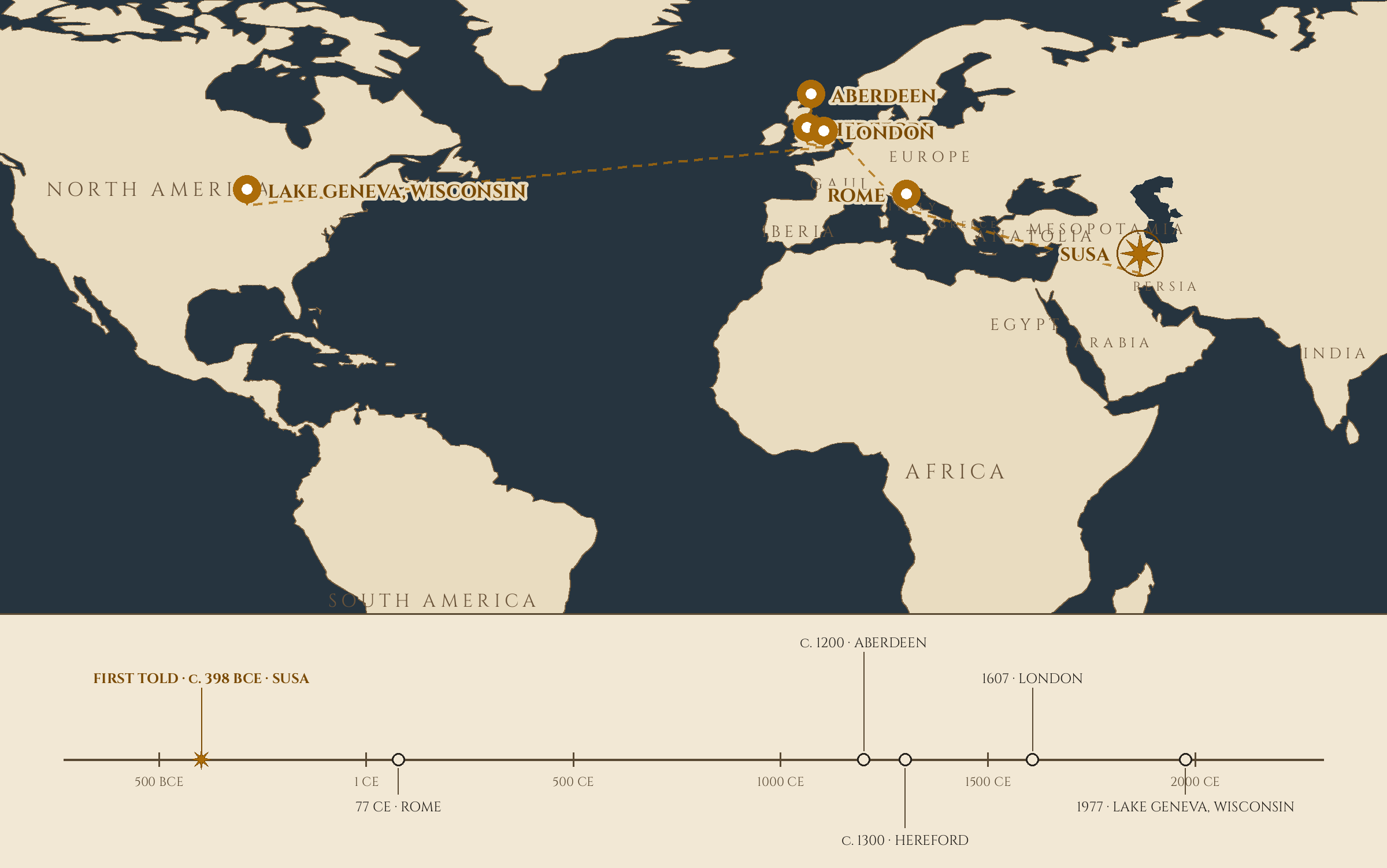
Where this lesson travels: Susa, where Ctesias writes the martichoras — man's face, lion's body, three rows of teeth; Rome, where Pliny repeats Ctesias for Rome; Aberdeen, whose bestiary draws its manticore; Hereford, where the manticore stalks the edge of the Mappa Mundi; London, where Topsell's Historie of Foure-Footed Beastes prints the manticore woodcut; and Lake Geneva, Wisconsin, where the manticore enters the Monster Manual — its modern gaming face. The starred pin is the first record; the dashed line is the telling, traveling.
Lesson Objectives
By the end of this lesson, you will be able to:
- Recite Ctesias's martichora feature by feature, as Photius preserves it.
- Explain the beast's name — Persian "man-eater," Greek martichora, and the copyist's slip that made it "manticore."
- Tell Pliny's two spotted beasts apart: which is the composite, which is the dog-wolf, and what each is said to do.
- Meet the wider company on the same pages of Book 8: the catoblepas that must not look up, the amphisbaena with a head at each end, and the yale whose horns move — and name the two who ride with them, the bonnacon and the Questing Beast.
- Repeat the file's own built-in doubts — Aristotle's caution and Pausanias's verdict — and file them correctly.
- Weigh the real roots: the tiger, the spotted hyena, and the name the hyena carries in science today.
Your Assignment Packet
This lesson's work lives in its packet: the Lexicon Handout (every term, the core terms marked with the keeper's diamond ◆), Materials, Guided Practice, the Assignment Manual written out whole, the Scholar's Entry Page, the Reflection Questions, the Workbook Checklist, and the Keeper's Notes, for whoever teaches the lesson. Download the packet before you begin and keep it beside you as you read. The packet's assignment is Rookmere's own word for the work: Entry No. 10 — The Manticore & the Spotted Beasts (both) ◐. The Unit II Quiz is not printed in the packet; it waits at the end of the unit, with Lesson 15.
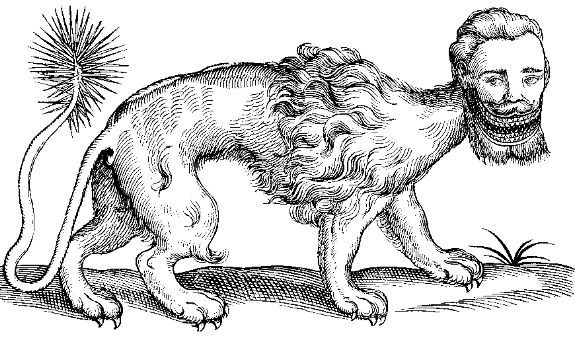
The manticore of Edward Topsell's Historie of Foure-Footed Beastes (1607) — the famous grinning, man-faced plate by which the modern world knows the beast. Public domain, via Wikimedia Commons.
The Creature
The manticore begins as a translation. The Persian words behind its name — martya-xvara, as scholars rebuild them — mean "man-eater." Ctesias, writing Greek at the Persian court, set the name down as martichora, and Greek added its own translation beside it: anthropophagos, man-eater. The name was the description. Then the copying did its quiet work: in a faulty manuscript of Aristotle, martichora was miscopied as mantichora, the slipped form passed into Latin as mantichoras, and English received the beast as manticore — a name that means nothing, kept for two thousand years because one copyist's hand shook. Even the beast's name, then, is a record of the road it traveled to reach us.
Ctesias does not travel alone in this lesson. Pliny's Book 8, which carried the manticore west, carried two more beasts in the same pages, and the census files them here as the manticore's company: the spotted beasts. The leucrocuta — the name also travels as leucrocota and leucrota — is a composite: an invented-looking animal assembled from a stag, a lion, and a badger, and reported to imitate the human voice. The crocotta — crocuta, corocotta — is a dog-wolf of Ethiopia and India, grave-robbing, man-hunting, and said to call men by name in the dark. Pliny keeps the two apart and gives each its own paragraph. Later centuries confounded them, as later centuries do. Your entry, like Pliny's book, will keep them apart.
The same stretch of Book 8 carries three more beasts in full. The catoblepas is a heavy-headed grazer of Ethiopia whose head hangs always to the ground — because, the record says, its eyes would kill anyone who met them. The amphisbaena is a serpent with a head at each end, that travels either way. The yale — Pliny calls it the eale — is an Ethiopian beast the size of a hippopotamus, with the jaws of a boar and horns it can move at will. Those three are told in full below, as the spotted beasts are. Two more ride with the company named only, a paragraph each in the Tales: the bonnacon, whose famous defense is not in its horns, and the Questing Beast of the Arthurian books, who reaches this company by a different road entirely — not Pliny's road at all.
The pictures are all copies of the words. The late-12th-century English bestiary page (British Library, Add MS 11283) draws the manticore from Ctesias's sentences; the Worksop Bestiary (about 1185) assembles Pliny's leucrota part by part; and Topsell's woodcut of 1607, at the head of this lesson, settles the manticore's portrait for the next four centuries. After 1607 the picture line goes quiet — later ages mostly reprinted Topsell — until game books of the 1900s drew the beast again, in pictures this class cannot use as plates. A depiction line with a three-hundred-year silence in it is worth noticing: the portrait was so completely fixed by print that nobody needed a new one. The company was pictured too. The Aberdeen Bestiary paints the bonnacon in Asia on the same folio as the crocotta (f. 12r), sets the yale at f. 16v, and files the amphisbaena among the serpents at f. 68v. And in Jacob van Maerlant's Der Naturen Bloeme, a Dutch book of beasts made about 1350, the painters drew the catoblepas, the amphisbaena, and the yale small and careful, out of the same sentences — three more portraits that are copies of words.
First Told
The starred pin stands at Susa, about 398 BCE — the same city, the same desk, and the same lost book as Lesson 7's unicorn. The map's dashed line for this lesson is the journey of a text, and the keeper should say so at the start: the manticore's whole record is paper. No treasury held its horn; no shrine labeled its egg. It lived in books, and it traveled when books traveled.
Here is the beast entire, as Photius's summary of the Indica preserves it. The martichora, Ctesias says, is an animal of India. It has a face like a man's, and ears and light-blue eyes like a man's. Its skin is red as cinnabar. It is as large as a lion, and it has three rows of teeth. Its tail is like the tail of a land scorpion, carrying a sting more than a cubit long; it has other stings along the sides of its tail, and one on the top of its head, and every wound it makes is fatal. Attacked from a distance, it raises its tail and discharges its stings as if from a bow; the stings fly a plethron — some thirty meters — and they grow again after they are spent. Its sting kills every animal except the elephant. The Indians hunt it from the backs of elephants, with spears and arrows, keeping out of range. And its Greek name is its character: anthropophagos, man-eater, "because, although it preys upon other animals, it kills and devours a greater number of human beings."
Aristotle, quoting the account a generation later, adds the one feature Photius's summary leaves out — the voice. The martichora's cry, he writes, "is like the sound of a shepherd's pipe and a war-trumpet at the same time," and it runs as fast as a deer. But watch Aristotle's hands as he passes the beast along: there is such a thing, he begins, if we must trust Ctesias — and elsewhere, on Ctesias's India generally, he is blunt: the man is "not worth believing." The second keeper of the manticore is its first doubter, in the same sentence. The pattern is now familiar to you from Herodotus and the griffins: the ancient record very often carries its own caution label, and the centuries that copied the beast most faithfully were the ones that stopped copying the label.
The Tales
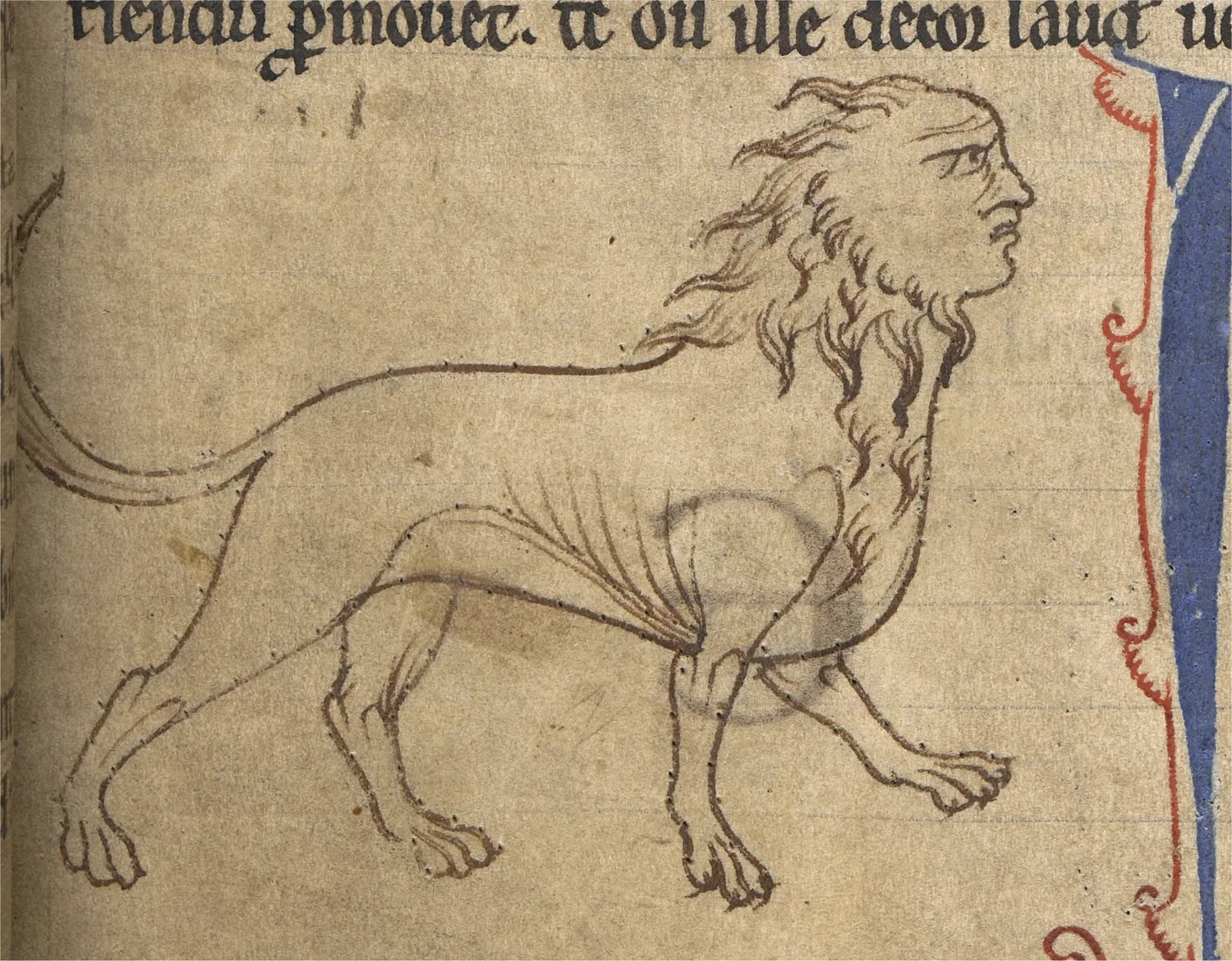
The manticora of a late-twelfth-century English bestiary (British Library, Add MS 11283): the same description drawn four and a half centuries before Topsell, by an artist who had seen neither his work nor the animal. Public domain, via Wikimedia Commons.
Pliny (77 CE — the map's Rome pin) takes the martichora from Ctesias into the Natural History, and in the same book files the spotted beasts, in two paragraphs a keeper must not merge.
The leucrocuta first. Pliny calls it the swiftest of all beasts: about the size of an ass, with a stag's haunches, a lion's neck, tail and breast, a badger's head, a cloven hoof, a mouth opening right back to its ears — and instead of rows of teeth, in each jaw, a single unbroken ridge of bone. "This animal," Pliny finishes, "is reported to imitate the voices of human beings." Everything about the leucrocuta is assembled: parts from three honest animals and one impossible jaw, finished with a voice it has no business having. It is the most bestiary-like beast in the lesson, and it is also, as the What It Actually Is will show, a portrait from life seen through three translations.
The crocotta second. Ctesias, in the fragments Photius preserves, sets a crocottas in Ethiopia: a dog-wolf of amazing strength, which "is said to imitate the human voice, to call men by name at night, and to devour those who approach it" — as brave as a lion, as swift as a horse, as strong as a bull, and not to be overcome by any weapon of steel. Pliny's crocotta, in his telling, is born of the Ethiopian lioness crossed with the hyena, and it "mimics the voices of men and cattle in a similar way," with the same continuous ridge of bone in each jaw instead of separate teeth. And it is Pliny's hyena — the crocotta's parent in his scheme — that he credits with the family's grimmest habit: of all animals, he says, the hyena alone digs up corpses. The geographer Strabo, earlier and crosser, had called the crocotta simply a cross between dog and wolf, and did not believe that either. Keep the attributions straight in your entry: the name-calling belongs to Ctesias's crocottas and to Pliny's hyena alike; the grave-robbing belongs to Pliny's hyena file and has clung to the crocotta ever since. The tangle is old, and it is part of the record.
The catoblepas comes next in the same pages, and it is the lesson's other beast that nobody could afford to look at. Pliny sets it in western Ethiopia, beside a spring called Nigris, "which most people have supposed to be the source of the Nile." The animal itself, he says, is "in other respects of moderate size and inactive with the rest of its limbs, only with a very heavy head which it carries with difficulty — it is always hanging down to the ground; otherwise it is deadly to the human race, as all who see its eyes expire immediately." The Greek name is the picture: katoblepas, the down-looker. The later writer Aelian gives the fuller portrait — a beast the size of a bull, grim, with high shaggy eyebrows over narrow bloodshot eyes that look only down, a mane like a horse's falling over its face, and a diet of poisonous roots — and Aelian quietly moves the weapon. What kills, in his telling, is not the gaze but the breath: the beast breathes out a poison so foul that the animals which inhale it lose their voices and die in convulsions — and Aelian adds that the catoblepas knows its own power. Topsell, retelling both accounts in 1607, argues the point and rules for Pliny: a killing breath, he writes, "is not competible to any other beasts in the world." The record disagrees with itself in the open, and a keeper files both versions under their own names: eyes in Pliny, breath in Aelian, the verdict in Topsell.
The amphisbaena is the company's serpent, and its name is older than its description. Aeschylus reaches for it as an image in the Agamemnon of 458 BCE — Cassandra, hunting for a word foul enough for Clytemnestra, asks what monster she should call her: an amphisbaena? The first surviving description of the animal itself comes from Nicander of Colophon, in the second century BCE: "less in bulk and slow of gait, two-headed, ever dull of eye," with a blunt chin at either end. Pliny's sentence is the one the centuries copied: "The Amphisbaena has a twin head, that is one at its tail-end as well, as though it were not enough for poison to be poured out of one mouth." Pliny adds that alone among serpents it stands the cold, and comes out first, before the cuckoo — and that its skin, on Nicander's authority, was carried as an amulet against the cold's diseases. Lucan gives the kind its origin: Perseus, flying over Libya with Medusa's severed head, drips blood upon the sand, and the desert serpents are bred from the drops, the amphisbaena among them. Aelian explains how the two heads work in practice: either end can lead, and the other serves as tail, so the serpent reverses without turning. That is the whole creature, and it is also its name — Greek amphi, both ways, and baino, to go: the one that goes both ways. Isidore, last of the ancients in this file, keeps the picture the bestiaries paint: the body trailing in a loop between its two heads, and eyes that glow like lamps.
The yale is Pliny's last gift to this lesson, and he gives it in a single sentence, entire. Ethiopia, he writes, produces many monstrosities, and among them "the animal called the Eale, the size of a hippopotamus, with an elephant's tail, of a black or tawny colour, with the jaws of a boar and movable horns more than a cubit in length which in a fight are erected alternately, and presented to the attack or sloped backward in turn as policy directs." A cubit is about a forearm's length: horns longer than your forearm, and the beast moves them as a fencer moves a blade. No writer in the ancient record claims to have seen one. Solinus copied the sentence, and the bestiaries copied Solinus: the Aberdeen Bestiary, about 1200, sets the yale at folio 16v, horse-sized and black, and repeats that its horns are long and mobile — one can fold backwards while the other fights. Jacques de Vitry, writing about 1220, sharpens the mechanism into tactics: the yale fights with one horn and holds the second in reserve, bringing it forward when the first grows dull. In the French bestiaries the same beast travels under another name, centicore. The horns are the whole beast — a description that is all weapon, filed under Ethiopia, waiting.
One beast rides with the company named, and his file begins earlier than Pliny. Aristotle, in the History of Animals, reports the bonasos of Paeonia, a beast the size of a bull and heavier, with a horse's mane and horns "crooked and bent together, of no use for defense." Useless horns, because the bonasos has another defense: it kicks, and it ejects its dung to a distance of four fathoms, and the dung is so caustic "as to burn the hair from dogs" — though only, Aristotle adds, when the creature is disturbed and alarmed. Pliny takes the beast into Book 8 and stretches the range: fleeing, the bonasus trails dung "as much as three furlongs," and contact with it "scorches pursuers like a sort of fire." Solinus moves the beast to Phrygia and calls it bonacus. The bestiaries finish the journey: at Aberdeen, about 1200, the beast stands in Asia, renamed the bonnacon, and the book gives the defense its famous sentence — "the protection which its forehead denies this monster is furnished by its bowels." Aberdeen paints it, as §1 said, on the same folio as the crocotta. And the animal under the whole file is a real one: Aristotle's bonasos is the European bison, the wisent, and science still keeps the old name in the animal's own — Bison bonasus. The defense grew in the copying. The name did not even need to.
The Middle Ages received all three beasts and drew them. The Aberdeen Bestiary's manticore, about 1200 — the map's Aberdeen pin — grins from its page with a man's face; the great world map at Hereford, about 1300, sets the manticore stalking the edge of the world, where such beasts belonged on a map; and in 1607 Edward Topsell's Historie of Foure-Footed Beastes printed the manticore in London in the woodcut at the head of this lesson — the famous portrait, man's face, spiky crest, scorpion tail, a grin full of those three rows' worth of teeth. Look at how the woodcutter handles the body while you are here: heavy, four-square, and covered in a rough, almost shaggy coat, with the tail curving up and over like a scorpion's, ready to strike forward over the beast's own back. He has never seen anything like it, and neither had his readers, so he makes the face do the talking. Print did for the manticore what it did for the unicorn in the end: it settled on one picture, and the picture became the beast.
One more beast joins this lesson from outside the Pliny road entirely, and she is named here, as the bonnacon is. The Questing Beast — in the French books the beste glatisant, the barking beast — belongs to the Arthurian romances, and she comes in two tellings that a keeper must keep apart, as with Pliny's pair. In Perlesvaus, written in the first decade of the thirteenth century, Perceval meets her in a glade: white as new-fallen snow, bigger than a hare but smaller than a fox, gentle, with emerald eyes — and twelve hounds questing in her belly. At a cross the young tear her apart, and King Pelles afterward expounds her as a figure of Christ, destroyed by the twelve tribes of Israel. The other telling, from the Suite du Merlin of about 1240, taken up by the Prose Tristan and by Malory's Le Morte d'Arthur (printed 1485), makes her the great composite of the romances: "a head like a serpent's head, and a body like a leopard, buttocks like a lion, and footed like an hart; and in his body there was such a noise as it had been the noise of thirty couple of hounds questing" — the noise falling silent only while she drinks. She appears to the young Arthur at a pool, and King Pellinore tells him that the hunt for her is his family's quest, laid upon his line. The same books have Merlin explain her birth — a princess's forbidden desire, and a devil who deceived her — and the lesson files that explanation where it belongs: as romance. After Pellinore the hunt passes to Sir Palomides, and in the Post-Vulgate telling he at last ends it during the Grail Quest, with Perceval and Galahad beside him, driving her into a lake. Her name is the last mark in the file: glatisant means barking, and the old word questen means both to bark and to hunt — the beast named for the noise in her belly, and for the men who follow it. No ancient files her, and no root animal waits under her. She is a description that was invented whole, and the lesson files her as such.
This lesson's beings have no hearth-tales, and the absence is itself a record. No household ever set out a bowl for the manticore; no court ever tried one of its eggs. What the manticore has instead of tales is its description, retold so exactly, for so long, that the retelling is the tradition: the red coat, the man's face, the three rows, the shooting stings, the trumpet-and-pipe voice — a checklist that scribes copied the way they copied the lion's natures in Lesson 1. When a being's whole life is a description, the description is its tale, and a keeper files it so.
The spotted beasts come nearer to a tale, and it is a night tale. Out past the homesteads, in the dark, the crocotta learns what it hears. Pliny's hyena — the family's voice again — is said to haunt the shepherds' folds until it picks up a man's name, and then to call him by it, out of doors, at night, and tear him to pieces when he comes. It is said to imitate a man being sick, to draw the dogs out to it. Ctesias's crocottas calls men by name and devours those who approach. This is the eeriest material in Unit II, and its power is plain: every herdsman who heard an animal cry in the dark with something like a voice in it had this file waiting for the sound. The tale does what the brownie's tale did in Lesson 4 — it tells you what people did with a noise they could not place. They gave it a name, a nature, and a warning: do not answer.
KEEPER'S CHECK-IN
Pliny keeps his two spotted beasts apart — which one is the composite assembled from stag, lion and badger, and which one is the dog-wolf said to call men by name in the dark?
Spotted
This section is short because the record is. No named eyewitness, in any century, claims to have met a manticore, a leucrocuta, a crocotta, a catoblepas, an amphisbaena, or a yale — not Ctesias, who had his beasts from travelers at Susa; not Pliny, who filed them from books; not any traveler after them.
What exists are reports about country: beasts placed in India, Ethiopia, and Libya by writers who had not been there, and one ancient verdict on them — Pausanias, who traveled and read, judging the martichora a tiger exaggerated in the telling. Those reports are filed S only in the weakest sense this class allows: a report exists, and the lesson says who made it and how far he stood from the animal. The name-calling in the dark, the one story-like report in the file, stands in the Tales above, where it belongs. A keeper records the empty shelf as carefully as a full one: these beasts were spotted on paper only.
KEEPER'S CHECK-IN
No named eyewitness in any century claims to have met a manticore or any of its company — so what does this lesson's Spotted section record instead, and how is Pausanias's verdict on the beast filed?
What People Watched For — an honest empty
There is no What People Watched For passage in this lesson, and the keeper will tell you why plainly: nobody watched for these beasts. They are book-beings and border-beings, met in forests at the end of a trade road by men who came home with stories. The customs in this class belong to beings who shared people's houses, tables, and churchyards. The manticore shared only their libraries. That, too, is a fact about a being, and it belongs in the entry: some beasts live in the world of work, and some live in the world of paper, and the record keeps the two addresses separate.
What It Actually Is
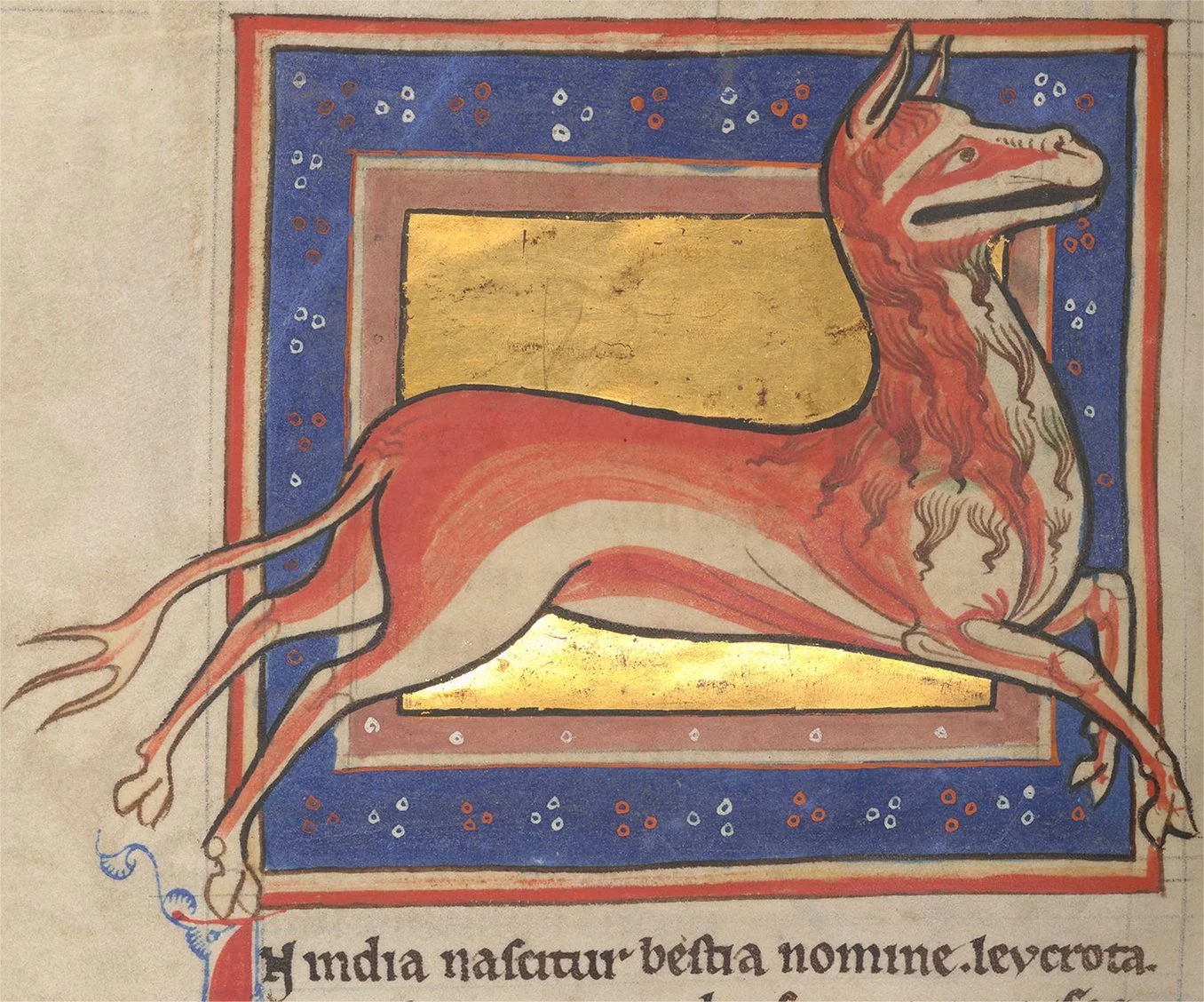
The leucrota of the Worksop Bestiary (c. 1185): the painter's composite, stag behind and lion before, assembled as faithfully as he could from Pliny's list of parts. Public domain, via Wikimedia Commons.
For the manticore, the root was named early and by name. Pausanias, the Greek travel-writer of the second century CE, read Ctesias's account and delivered the verdict this class still teaches: he judged the martichora an exaggerated account of the tiger. Consider the fit. India has a great cat, red-gold in its coat, a killer of men, feared above all animals by the people who live beside it. The tiger of India — the Bengal tiger, as zoologists name the kind — is about the size Ctesias gives his beast: a big male runs about 2.7 to 3 meters from nose to tail-tip and can weigh 200 kilograms and more, lion-sized or bigger. Its coat is a rich orange-red, darker than most people picture until they stand near one, striped black, with a pale face that, at a distance and in bad light, is the flattest and most face-like of any big cat's. Tigers mostly hunt alone and mostly at night, and in country where people and tigers have lived close together, individual tigers have sometimes turned to hunting people, which gave whole districts reason to tell stories about them. A report of such a beast, carried from Indian hunters to Persian courtiers to a Greek physician who never saw it, has a thousand miles in which to grow a man's face and a scorpion's tail. The three rows of teeth fit no animal that lives; neither do the shooting stings. The keeper files the tiger as Pausanias filed it — as a named ancient's judgment on the record, F as a fact about Pausanias, unproven as a fact about the beast — and notes, in the same breath, that Ctesias's court was exactly the kind of place where a tiger's reputation would arrive long before a tiger.
For the spotted beasts, the root swims into focus in Pliny's own pages: the hyena. Pliny knew the hyena was real — it is a true animal of Africa and the lands toward India — and still filed its family under wonders. Set the description against the animal. The spotted hyena has the most powerful jaws of any beast of its build, bone-crushing teeth set in a massive skull: the record's "single ridge of bone instead of teeth" is that jaw, magnified. The animal itself is about the size of a large dog, roughly a meter to a meter and a half in the body, with a sloping back — the front legs longer than the hind ones — a big head, rounded ears, and a spotted coat that roughens any outline at dusk. Spotted hyenas live in groups, sometimes very large ones, and they are hunters in their own right as well as scavengers. They do dig up and eat the dead where graves are shallow; they do come about homesteads at night; and their calls — whoops that carry for miles, groans, and the famous giggling "laugh," which is really a nervous, excited sound and not amusement — carry through the dark with something disquietingly like a voice in them. A herdsman culture that knew that animal at night, at distance, through three languages, would file exactly the crocotta. And the name, in the end, confessed everything: when modern science came to name the spotted hyena formally, it named it Crocuta crocuta — the crocotta, twice over, sitting in every zoology book in the world. The belief did not survive. The word did, promoted into the record itself.
The leucrocuta, assembled from stag and lion and badger, is most likely the same animal at one more remove — the hyena story after another journey, its parts loosened and re-sorted by the copying. The lesson files that as likelihood, not as proof. Some entries in a bestiary end with a name in a modern book. This one ends with two: tiger, as one ancient's verdict, and Crocuta, as science's own handwriting.
The catoblepas has a root offered for it, and the lesson files it the way Pausanias's tiger is filed — as a judgment, not a proof. The modern guess, proposed by the naturalist Georges Cuvier, is the gnu, the wildebeest of Africa: a heavy-headed grazer that carries its head low, dark-maned and bull-built, grazing the same Ethiopian country Pliny names. Read Aelian's portrait against a gnu seen at a distance and the fit is plain enough to file. Once, briefly, the old name nearly entered the record itself: in 1828 the naturalist Joshua Brookes described the black wildebeest as Catoblepas operculatus. The name did not hold — the animal is Connochaetes gnou now — but for one catalogue the down-looker stood in science, as the crocotta still does.
The amphisbaena carries its doubts inside its own file, earlier than most. Albertus Magnus, in the thirteenth century, refused it outright: no animal, he wrote, has two heads by nature — Solinus "was deceived," because the serpent's two ends are alike in size, and its ribs let it strike backward as readily as forward. Sir Thomas Browne, in 1646, would only say that "we must crave leave to doubt of this double-headed Serpent" until someone has the advantage of beholding one. What likely stands under the file is a blunt-tailed serpent or lizard whose tail passes for a second head — the lesson files that as likelihood. But the name did what the crocotta's name did, and more completely. Linnaeus took Amphisbaena as a genus name in 1758, and the worm lizards — legless, burrowing lizards whose blunt tails mimic their heads, and which can travel backward nearly as readily as forward — are filed in science today as the Amphisbaenia: more than two hundred living species. The ancients described the motion and invented the head. Science kept the name for the motion.
For the yale, this section has no root to give, and the keeper will not invent one. No single living animal fits Pliny's sentence — the movable horns fit nothing that breathes — and the modern suggestions stop at conflated travelers' reports of great antelopes: a likelihood without a candidate. The file is an honest blank, and it is worth having one in the lesson: not every description resolves. The yale's truth is not in a root. It is in what happened to the description next.
Still With Us
The manticore's modern face is the woodcut's. Topsell's grinning, man-faced beast of 1607 became the standard portrait, reprinted for four centuries until the grin is simply what a manticore looks like — a picture chosen by print, inherited by everyone since. The beast kept its shape because an image, unlike a text, is copied whole.
Its other modern face is the map's last pin, and it is the most bestiary-like object of the twentieth century: Lake Geneva, Wisconsin, 1977, where the Monster Manual — the first bestiary of the game Dungeons & Dragons — gave the manticore its entry. Name, picture, natures, in that order: a twentieth-century beast-book, compiled the way the bestiaries were compiled, from the old authorities, for readers who would meet the beast in an imagined country and need to know its marks. The manticore flies now in a hundred games and novels, stinging tail and all, more widely read than Pliny ever was. The copyists have changed their tools. They have not changed their method.
The spotted beasts stayed home, by comparison — no games keep the leucrocuta, and the crocotta survives mainly as a word in old books and in this lesson. Except once. In the zoology texts, in the field guides, in the Latin binomial spoken by scientists who have never heard of Ctesias, Crocuta crocuta carries the dog-wolf of Ethiopia into every account of the spotted hyena ever printed. Of all the beings in Unit II, the crocotta may be the most successful: it is the only one whose name is now a record — checked, measured, and true of a living animal — while its own story is filed as belief. The marks, in the end, sorted the beast into both columns at once. Keepers do not get many endings as tidy as that one, and this one happens to be true.
The catoblepas kept a literary life of its own. Leonardo da Vinci copied Pliny's beast into his notebooks nearly word for word — Ethiopia, the spring, the head carried with difficulty, the eyes that kill. And in 1874 Gustave Flaubert brought the beast on in The Temptation of Saint Antony, in the great procession of monsters — immediately behind the manticore, as if the two had been waiting together since Pliny bound them in one book. Flaubert's catoblepas speaks: "My skull is so heavy that it is impossible for me to carry it… No one, Antony, has ever seen my eyes, or those who have seen them are dead. If I but raised my eyelids — my eyelids red and swollen — that instant you would die." A black buffalo with a pig's head, grazing on poisonous herbs moistened with its own breath — Pliny's eyes and Aelian's breath in one portrait, eighteen centuries on.
The yale's afterlife is the strangest in the lesson, and the most solid: it is carved in stone. In the fifteenth century the heralds lifted Pliny's beast out of the bestiaries and set it to work as a supporter — one of the creatures that stand beside a shield and hold it up. The yale served John, Duke of Bedford, and the House of Beaufort; through Lady Margaret Beaufort, mother of Henry VII, it came to Cambridge, where yales still stand over the gatehouses of Christ's College and St John's College, the colleges she founded and endowed. The heraldic yale is white, spotted with gold, with a boar's tusks and those swivelling horns — of all Pliny's beasts, the one whose weapon faces outward, on guard. In 1953 the sculptor James Woodford carved the Yale of Beaufort again, as one of the ten Queen's Beasts made for the coronation of Elizabeth II, holding the crowned portcullis in its forelegs; the Royal Mint has since retold its story on coins. A supporter faces outward, and does not sleep. The bestiaries' most mechanical beast — horns that move "as policy directs" — turned out to be the one built for the job.
Then the beast crossed the Atlantic — and here the lesson must file a correction, because the famous story is wrong. Yale University is not named for the yale. The university's own history says so: in 1718 the Collegiate School became Yale College in honour of Elihu Yale, a Welsh merchant who had donated the proceeds of nine bales of goods, together with 417 books and a portrait of King George I. The beast came later, adopted for the shared spelling, and it is all over the campus once you look: two yales flank the high gable over the main gate of Davenport College — the college's own history calls them "fabulous heraldic beasts called yales" — yales support the shield carved on Timothy Dwight College's pediment, stand in two quadrants of the arms of the Faculty of Arts and Sciences, ride on the president's banner, and a yale's head caps the ceremonial mace carried at commencement. The university's mascot is a bulldog, Handsome Dan. The yale is its heraldic lodger, not its namesake — a beast that began as one sentence about Ethiopia, and ended holding up shields on two continents.
Guided Observation
Study Topsell's manticore at the head of this lesson (1607) — the plate by which the modern world knows the beast. Find Ctesias's features as the woodcutter received them: the man's face, wearing its famous grin; the crest; the lion's body; the tail armed for shooting. Then ask the woodcut the keeper's question: can it show the three rows of teeth? It cannot — a closed grin hides the rows, and the artist has drawn the idea of the teeth, a mouth too full of them. Write down one feature of this picture that comes from Ctesias, one that comes from the centuries between, and one that could only come from a man carving wood who needed the beast to look back at the reader.
Then the manuscript manticore: the late-twelfth-century English bestiary page (British Library, Add MS 11283), with the beast drawn from the same description four and a half centuries earlier. The two artists never saw each other's work, and neither saw the animal. Set their manticores side by side and list what agrees — that agreement is the text, traveling — and what differs — that difference is the artists, guessing.
Last, the Worksop Bestiary's leucrota (about 1185): the painter's composite, stag behind and lion before, drawn by a man who had read Pliny's list of parts and assembled them as faithfully as he could. Notice the mouth. He has drawn it opening wide, the way Pliny said — right back toward the ears — because that was the detail his text gave him to hold onto, and he was not going to waste it. Compare his beast with Topsell's: both are descriptions made visible. Write one sentence on what a picture can prove about a text — and what it can never prove about an animal.
Assignment Manual
✎ WRITTEN · ⚒ HANDS-ON · ◐ BOTH
◐ Both · Entry No. 10: The Manticore & the Spotted Beasts.
- Rule your entry page. Turn to the Scholar's Entry Page in this packet and rule the next page of your journal to match it, as you did for Entries No. 1–9.
- Write the entry, to the standard. First Told: for the manticore, Ctesias at Susa, about 398 BCE, in Photius's summary — the face, the color, the three rows, the stings, the voice Aristotle adds, and the name in both its forms, with the copyist's slip that connects them. For the spotted beasts, Pliny, Rome, 77 CE — one first for each, kept apart: the leucrocuta's assembled body, the crocotta's dog-wolf and its parentage in Pliny's scheme. How the Telling Grew: Aristotle's doubt; Pliny's Book 8; the bestiaries and the Hereford map; Topsell's woodcut. The Tales: the description itself, retold straight; and the name-calling in the dark, attributed to its proper files. What It Actually Is: the tiger, labeled as Pausanias's verdict; the hyena, with the jaw, the graves, and the voice; Crocuta crocuta. Still With Us: the woodcut's inheritance and the Monster Manual of 1977, a line or two each. Then run the wider company through the same five heads in miniature. First Told: Pliny first for the catoblepas and the yale; Nicander before Pliny for the amphisbaena. The Telling Grew: Aelian's breath against Pliny's eyes; Lucan's Medusa-blood; the heralds' reserve horn. What It Actually Is: the gnu as judgment, Amphisbaenia as fact, the yale's root as an honest blank. Still With Us: Flaubert's speaking catoblepas, and the yale in stone, from Cambridge to New Haven. The bonnacon and the Questing Beast are named, a paragraph each, their two tellings apiece kept apart. The Keeper's Line: your own judgment, in one or two lines.
- Draw it from the words. ⚒ Before you look again at any plate in this lesson, read Ctesias's description once more — the Photius passage in section 2 — and on a spare sheet draw the martichora from the words alone. Then open the plates: Topsell's, the manuscript manticore, and compare your drawing with theirs, feature by feature. Write in the margin of your sketch the three features where you and the old artists guessed alike, and one where you guessed differently. You have just repeated, in ten minutes, the whole history of bestiary art: everybody drawing the same sentences, nobody drawing the animal. Rule the sketch into your bestiary after the entry.
- Mark every line. Go back through your entry and mark every line in the margin, T for tale, S for a sighting-report, or F for fact, as always. This entry's testing lines are its verdicts: Pausanias judged the martichora a tiger is F about Pausanias; the martichora was a tiger is a claim your entry may report but may not assert; and the hyena's Latin name is F of the newest kind — a belief's word, filed by science itself, as fact.
Materials
· Your bestiary journal, with Entries No. 1–9 in it
· Pencils, and a pen you like
· A ruler, for ruling your entry pages
· A spare sheet of paper, for the drawing in Step 3
· This lesson's packet (the Scholar's Entry Page is in it)
Reflection
Lessons 7 and 10 begin at the same desk. What does it do to a record when one man writes so much of it — and what would this unit's file look like if Ctesias had kept a diary instead of a bestiary?
Aristotle doubted Ctesias in the sentence and copied him in the text. Which of those two acts preserved the manticore — and which preserved the truth about it?
The crocotta's name is now the hyena's scientific name: a belief's word filed as record. Is that a victory for the record or for the belief? Mark your answer T, S, or F, and defend the mark.
A Closing Note
Ten entries in, and the beasts of the land have one movement left, in three lessons: the giants, the horse-men, the wild men of the woods, and the wild man's modern heirs — and then a lesson that turns the whole method on the animals in your own fields, as the bestiaries themselves did. Next, the giants and the Cyclops, where the record stands ten feet tall and the real root may be lying in a Sicilian cave, in bone. Eat before you come. The Cyclops's hospitality is a lesson in itself.
The Bestiary
Bestiary Keeper
Further Reading & Sources
Ctesias, Indica, as summarized by Photius — the martichora entire, and the crocottas of Ethiopia; J. H. Freese's translation is free at Livius.org.
Aristotle, History of Animals, Book 2 — the martichora quoted with its caution attached: "if we must trust Ctesias."
Pliny the Elder, Natural History, Book 8 — the manticore, the leucrocuta, the crocotta, and the hyena, in the Bostock translation at Perseus.
Pausanias, Description of Greece, Book 9 — the ancient world's own verdict on the martichora: a tiger, exaggerated in the telling.
Edward Topsell, The Historie of Foure-Footed Beastes (1607) — the manticore in print; free at the Internet Archive.
Aelian, On the Nature of Animals, Books 7 and 9 — the catoblepas's breath, and the amphisbaena's two-way travel; Scholfield's translation.
Lucan, Pharsalia, Book 9 — Medusa's blood drips on Libya, and the desert serpents are bred from it.
Isidore of Seville, Etymologies, Book 12 — the amphisbaena as the bestiaries received it, eyes glowing like lamps.
The Aberdeen Bestiary (University Library MS 24) — the bonnacon at f. 12r, the yale at f. 16v, the amphisbaena at f. 68v; free on the University of Aberdeen's bestiary site.
Perlesvaus (The High History of the Holy Graal) and Malory's Le Morte d'Arthur — the Questing Beast's two tellings, kept apart.
The Royal Mint, "The Queen's Beasts: The Yale of Beaufort"; and Yale University, "Traditions & History" — the heraldic yale, and the namesake in the university's own words: Elihu Yale, 1718.
Submit your work for this lesson using the form below.
CONTINUE IN THE BESTIARY HALL
← Previous · Lesson 9: The Basilisk & the Cockatrice Next · Lesson 11: Giants & the Cyclops →
Unit II — Beasts of the Land The Bestiary Hall — All 41 Lessons
The rest of Unit II: Lesson 7 · The Unicorn · Lesson 8 · The Griffin · Lesson 9 · The Basilisk & the Cockatrice · Lesson 11 · Giants & the Cyclops · Lesson 12 · Centaurs & Satyrs · Lesson 13 · The Wild Men of the Woods · Lesson 14 · Bigfoot & the Yeti · Lesson 15 · Real Animals in the Bestiary