

THE BESTIARY
Unit II · Lesson 11Giants & the Cyclops
Professor Sable Rookmere
Bestiary Keeper
The Bestiary Hall • School of Evershade
Professor's Introduction
Unit II has given you beasts with too many teeth and beasts with too many stories. This lesson's beings are simpler: they are us, enlarged. Every tradition on the shelf keeps a drawer of men bigger than men, and the Cyclops — the one-eyed shepherd of the oldest poem in Europe — is the most argued-over giant of them all.
Bring your marks and bring a measuring eye. This is the lesson where the record starts coming out of the ground.
The Bestiary
Bestiary Keeper
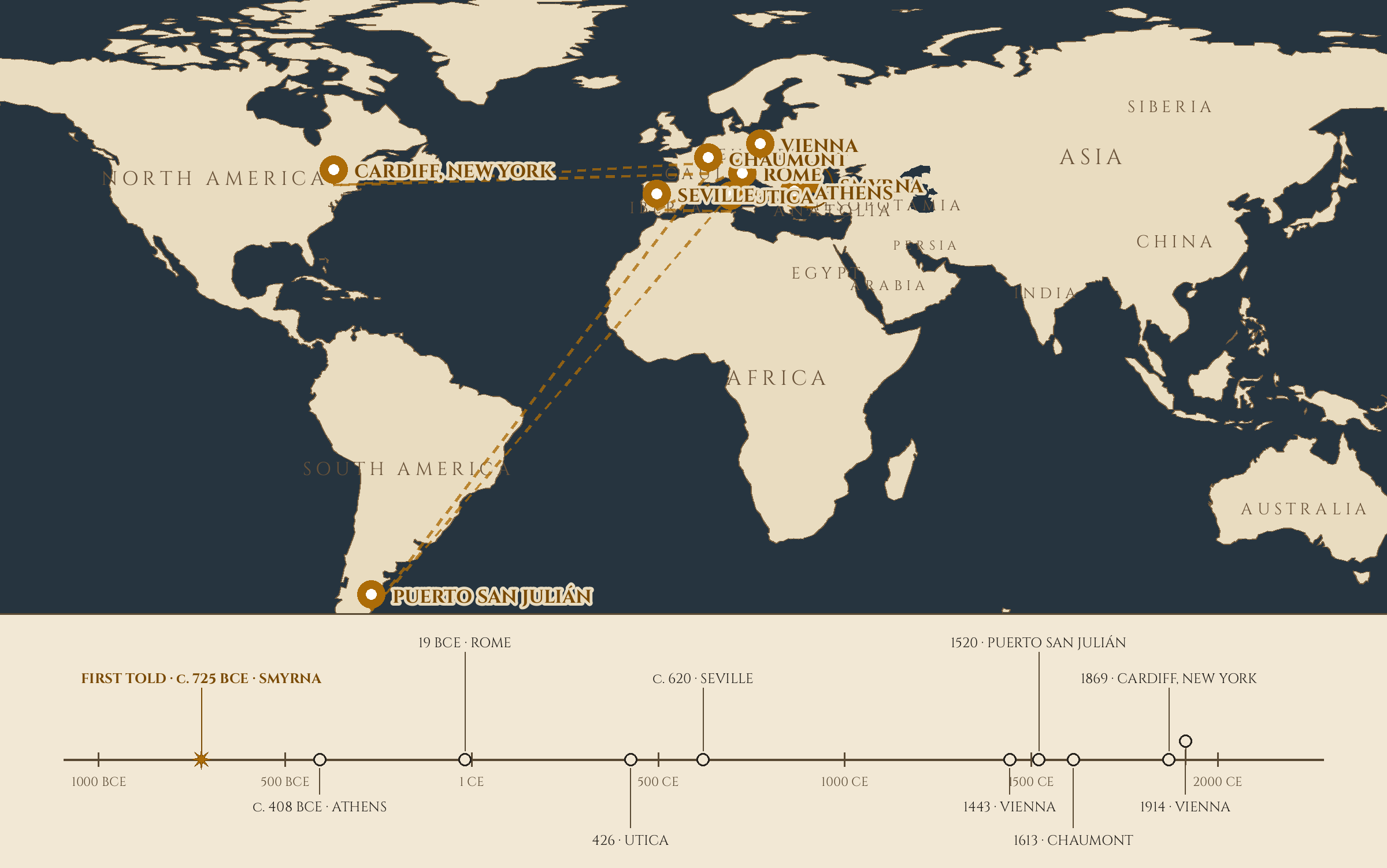
Where this lesson travels: Smyrna, where Homer's Odyssey was composed — Odysseus blinds Polyphemus (the city is Homer's by tradition); Athens, where Euripides' Cyclops, the only complete satyr play to survive, is staged; Rome, where Virgil retells the blinding in the Aeneid; Seville, where Isidore hands the Cyclopes to the medieval world; and Vienna, where Othenio Abel proposes that dwarf-elephant skulls — one great central socket — seeded the Cyclops: a hypothesis, and labeled as such. The starred pin is the first record; the dashed line is the telling, traveling.
Lesson Objectives
By the end of this lesson, you will be able to:
- Tell the Cyclops's two Greek files apart: Hesiod's smiths and Homer's shepherd, and say what each kind does.
- Walk this lesson's map — Homer, Euripides, Virgil, Isidore, and the one pin that is a hypothesis, not a record.
- Tell the giants' wider record: the giants of Greece, of the Bible, of the North, and of medieval romance.
- Give the giants' real root — the great bones — through Augustine's tooth and the bones of "King Teutobochus."
- State Othenio Abel's Cyclops hypothesis as what it is: a hypothesis, and say what evidence it explains.
- Give Cerberus's file: Hesiod's fifty-headed hound at the gate of Hades, and the twelfth labour as Apollodorus tells it — its condition, its wrestling, and its return.
- Give the Chimera's file: Homer's lion-goat-serpent, Hesiod's three heads, and Bellerophon's slaying — with Pegasus's part entered only where the record enters it.
Your Assignment Packet
This lesson's work lives in its packet: the Lexicon Handout (every term, the core terms marked with the keeper's diamond ◆), Materials, Guided Practice, the Assignment Manual written out whole, the Scholar's Entry Page, the Reflection Questions, the Workbook Checklist, and the Keeper's Notes, for whoever teaches the lesson. Download the packet before you begin and keep it beside you as you read. The packet's assignment is Rookmere's own word for the work: Entry No. 11 — The Giants and the Cyclops, the Paired Entry (written) ✎. The Unit II Quiz is not printed in the packet; it waits at the end of the unit, with Lesson 15.
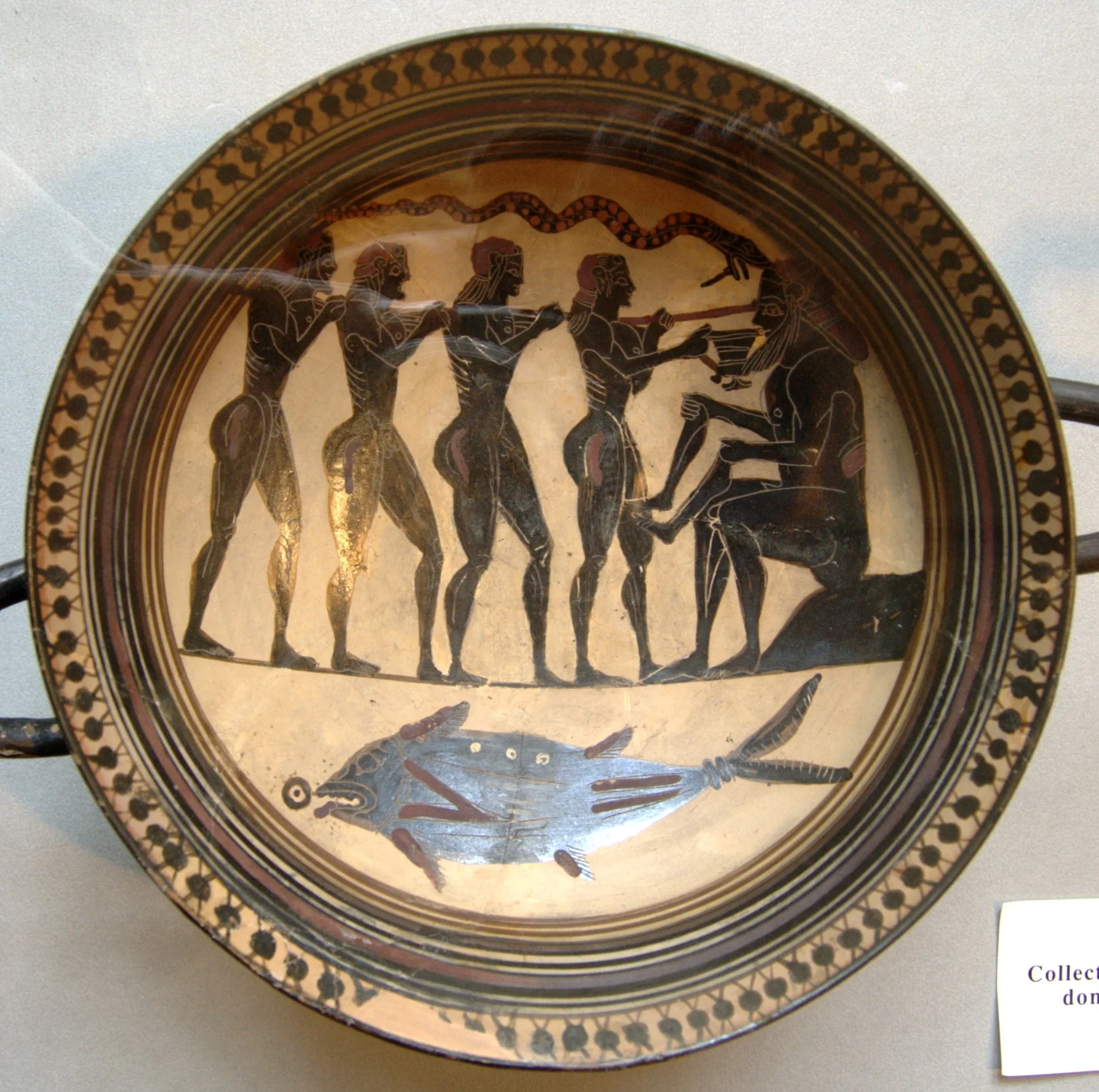
The blinding of Polyphemus on a Laconian black-figure cup (c. 565 BCE): the wine cup in the giant's hand, the stake at his eye, and the number of men it takes to drive it. Public domain, via Wikimedia Commons.
The Creature
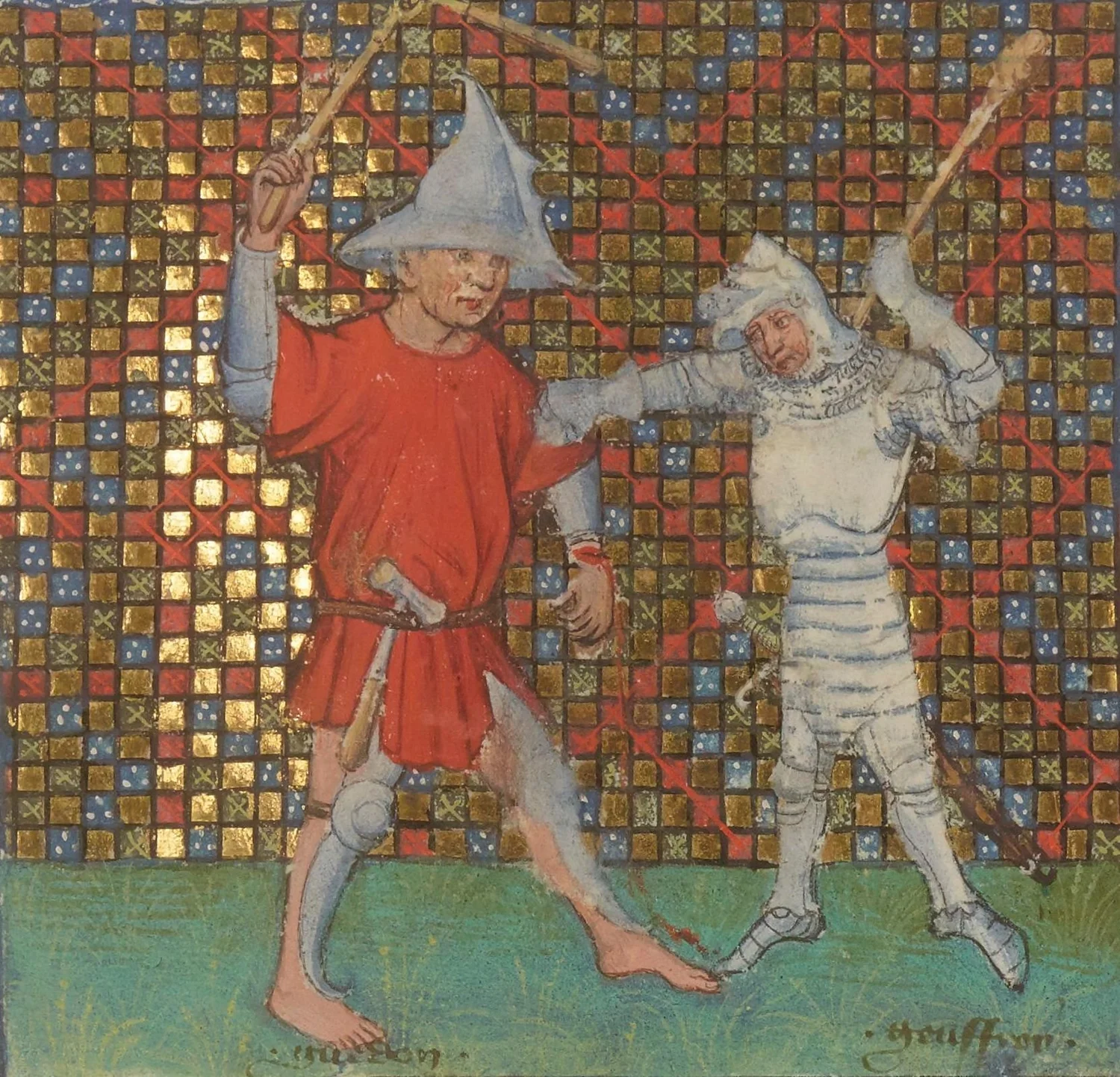
Geoffroy la Grand'Dent fights the giant Guédon de Guérande, in a miniature from Coudrette's Roman de Mélusine (15th century): the romance giant sized against architecture, as Polyphemus was sized by men. Public domain, via Wikimedia Commons.
The giant is the most widely kept being in this whole class. The Greeks had their gigantes, Earth-born fighters against the gods; the Hebrew scriptures their Nephilim and the sons of Anak; the Norse their jötnar, older than the gods themselves; the medieval romances their castle-holding ogres. The English word comes through Old French geant from the Latin gigas, and the Latin from the Greek — a word that traveled as far as the beings did. Unlike the unicorn or the manticore, the giant needs no single author. Every people that told stories told this one.
The Cyclops is narrower and stranger: a giant with one eye, set round in the middle of the forehead. Even the name is a description — Greek kyklops, "circle-eye." The Greeks kept two files on him, and they do not agree with each other at all. In one he is a craftsman, a smith of heaven. In the other he is a shepherd who eats his guests. A keeper files both, and this lesson is the story of both files — and of the bones that were dug up, for a thousand years, as proof of them.
Two single beings share this lesson's shelf, and both come out of Hesiod's other brood. Cerberus is a single, not a kind: one hound, with one post. In the Theogony he is the offspring of the monsters Echidna and Typhon — "Cerberus who eats raw flesh, the brazen-voiced hound of Hades, fifty-headed, relentless and strong." His post is the gate of Hades, and his orders run one way. Hesiod shows him at it: he fawns on everyone who enters, tail wagging and ears pricked — and will not let anyone go back out, and devours whoever he catches slipping through the gates. The count of his heads shrinks as the record travels: Apollodorus gives him three, with a dragon's tail and snakes' heads all over his back, and Greek art gives him two or three — never fifty, and sometimes only one. File the disagreement; it is part of his record.
The Chimera is likewise one being, in one country. Her name is simply Greek chimaira, "she-goat," and her country is Lycia, across the Aegean in Anatolia. Homer's description of her, in Book 6 of the Iliad, is among the oldest written creature records this class owns: "of divine stock, not of men, in the fore part a lion, in the hinder a serpent, and in the midst a goat, breathing forth in terrible wise the might of blazing fire." Hesiod files her a generation later in Echidna's brood — the hound's sister, in the poem's own filing — and counts her three heads, one for each of her beasts. She is a composition, not a kind: three real animals' parts in one body, and no second Chimera anywhere in the record.
The pictures argue about scale, and each age argues differently. The Laconian cup of about 565 BCE, this lesson's hero plate, sizes Polyphemus by the men beside him. The 15th-century Mélusine miniature sizes its giant against a castle door. Between those two plates the lesson's third image is not a depiction of a giant at all: it is a photograph of the dwarf-elephant skeleton that stands, as a hypothesis, behind the Cyclops — the root animal, not the being. Pictures of giants from the print centuries exist in plenty, but no further plate is in this lesson's stock, and the gap is recorded rather than papered over: the giant's busiest picture centuries are the ones this lesson reads in words.
First Told
The map at the head of this lesson follows the Cyclops — the Polyphemus line, as the map's own title says. Its starred pin stands at Smyrna, about 725 BCE, for Homer, whose city is given by tradition — keep the hedge; the poems are older than any address we can give their maker. In Book 9 of the Odyssey, Odysseus lands on the island of the Cyclopes and walks into the cave of Polyphemus, a giant shepherd, son of the sea god Poseidon, who keeps his flocks in the cave, eats two of the landing party at a meal, and is blinded for it — of which more in the Tales. Homer's Cyclopes are a whole rough people: lawless, without assemblies or ships or plowing, each ruling his own household on his own hilltop. Polyphemus is simply the one whose name we know.
Greek painters took to the cave story early, and this lesson's hero plate is one of their goes at it: a Laconian black-figure cup, made about 565 BCE, showing the blinding itself. Polyphemus holds the wine cup that undid him. Odysseus and his men lean their weight on the stake together, because the painter wants you to count them — it took a crew to do it. On a cup small enough to drink from, there is no room to draw a giant at giant size, so the painter makes his point the way vase painters usually did, by company: set ordinary men beside the fellow and let the difference in reach say how big he is. We will come back to that cup in the Guided Observation and take it apart properly.
The second Greek file is a generation younger and entirely different. Hesiod, in the Theogony (about 700 BCE), names three Cyclopes — Brontes (Thunder), Steropes (Lightning), and Arges (the Bright One) — sons of Earth and Sky, one-eyed like Homer's shepherd, but smiths: they forged the thunderbolt that Zeus still carries, the weapon that won the gods their war. Later mythographers add that the same forge turned out Poseidon's trident and the helmet of darkness worn by Hades. Same eye, same name, opposite trade. The record does not reconcile them, and neither should you: file them as the record gives them, side by side.
The two singles enter the record in the same two poems, a step behind. Homer knows the hound's errand before Hesiod gives him his name: in Book 11 of the Odyssey, the shade of Heracles tells Odysseus how Eurystheus sent him down to fetch the hound of Hades, with Hermes and Athena to help him. The errand is Homer's; the name, the parentage, and the fifty heads are Hesiod's, in the Theogony's catalogue of Echidna's brood (lines 306–312), where Cerberus stands in a family of monsters — Orthus, the hound of Geryon, before him, and the Hydra of Lerna after. No pin stands on this lesson's map for the hound, and none should: his address is a gate, and the gate is underground.
The Chimera's first record is the Iliad's (Book 6), told as a tale inside the tale: Glaucus, meeting Diomedes on the battlefield at Troy, recites his grandfather Bellerophon's story. Sent to Lycia carrying a folded tablet of baneful signs — a letter that ordered its bearer's death — Bellerophon was feasted nine days by the Lycian king before the tablet was read, and then given the Chimera as the first of his tasks. Homer gives her shape and her fire, and her slaying in a line — Bellerophon slew her, trusting in the signs of the gods — and that is all: no Pegasus, and no counted heads. Hesiod, a generation later, files her in Echidna's brood with her three heads named, and names her killers in the plural: "Pegasus and noble Bellerophon." Two files again, as with the Cyclops. File both.
Now walk the rest of the map, because it teaches how a being travels. From Smyrna the line goes to Athens, about 408 BCE, where Euripides' Cyclops — a rowdy stage version of Homer's cave story — survives as the only complete satyr play we have; you will meet its actors again in the next lesson. Then Rome, 19 BCE: Virgil retells the blinding in Book 3 of the Aeneid, giving the Latin world its Cyclops. Then Seville, about 620: Isidore of Seville files the Cyclopes in the Etymologiae, in his book of portents and transformed peoples, and so hands them to the medieval world — which is where the bestiaries and the church carvers received them.
The last pin stands at Vienna, 1914, and it is not like the others. It marks no book and no picture. It marks an idea — a paleontologist's proposal about where the one-eyed giant came from — and the map keeps it because a keeper's map records the record, including the record of our attempts to explain it. It is labeled a hypothesis on its face. Hold that thought until What It Actually Is.
The Tales
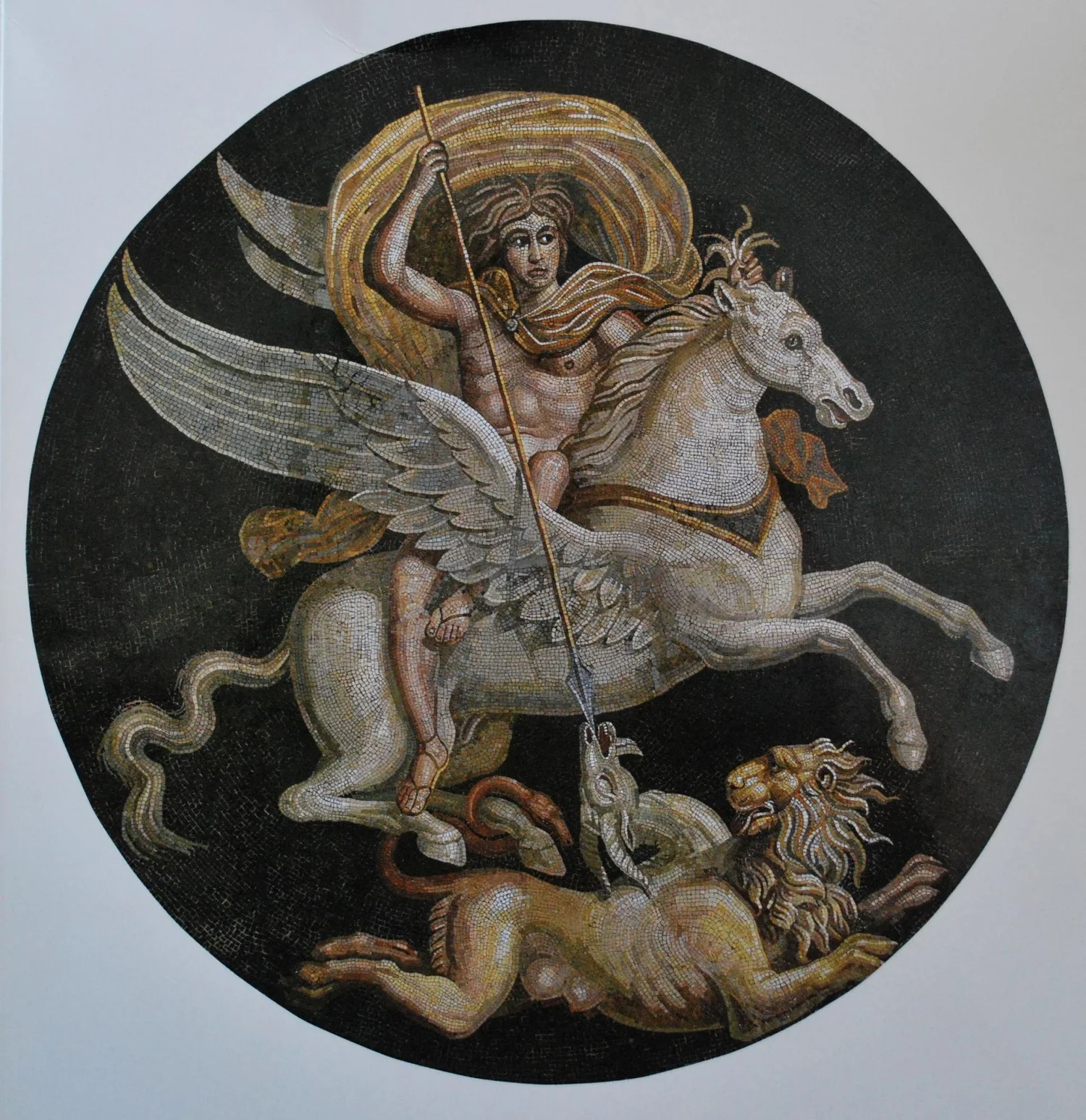
A Gallo-Roman mosaic medallion (2nd–3rd century CE, Musée Rolin, Autun): Bellerophon on the winged Pegasus drives his spear down into the Chimera — lion's head and body, goat's head rising from her back, serpent tail — the mounted kill become a floor's centrepiece. Public domain, via Wikimedia Commons.
The Cyclops stayed Greek, but the giant went everywhere. In Greece the giants proper — the gigantes — were born of Earth to war against Olympus, and their battle, the Gigantomachy, was carved wherever Greeks built in stone; to fight giants was what gods and heroes did to prove the world was ordered. In the Hebrew record the giants stand at the edge of the human story: the Nephilim of Genesis, "the mighty men that were of old," and later the giant Goliath of Gath, whose duel with David is the most retold giant story in the world. In the North, the jötnar are not a tribe at the edge of things but the raw material of things: the first of them, Ymir, was killed by the first gods, and the world was made out of his body — his flesh the earth, his skull the sky. A giant so large the world is his remains: keep the scale of that in mind when we reach the bones.
By the Middle Ages the giant had settled into two steady jobs. In the romances he is the opponent at the castle gate or the mountain pass — the miniature among this lesson's plates shows Geoffroy Big-Tooth fighting the giant Guédon de Guérande in the Roman de Mélusine (15th century), a giant with a name, a territory, and a grudge, which is the romance pattern exactly. Look at how the miniature sizes him: not against other men, the way the cup painter sized Polyphemus, but against the building behind him — measure Guédon against the castle door and you have his height in architecture. Romance painters reached for doors and towers the way the vase painters reached for companions. In Britain the giant was given the island itself: Geoffrey of Monmouth's history (12th century) tells how the Trojan Brutus's companion Corineus wrestled the giant Gogmagog and threw him off a cliff — giants as the land's first landlords, evicted by the founders. And all the while, in church and cloister, Isidore's Cyclopes sat in the book of portents, one-eyed and waiting.
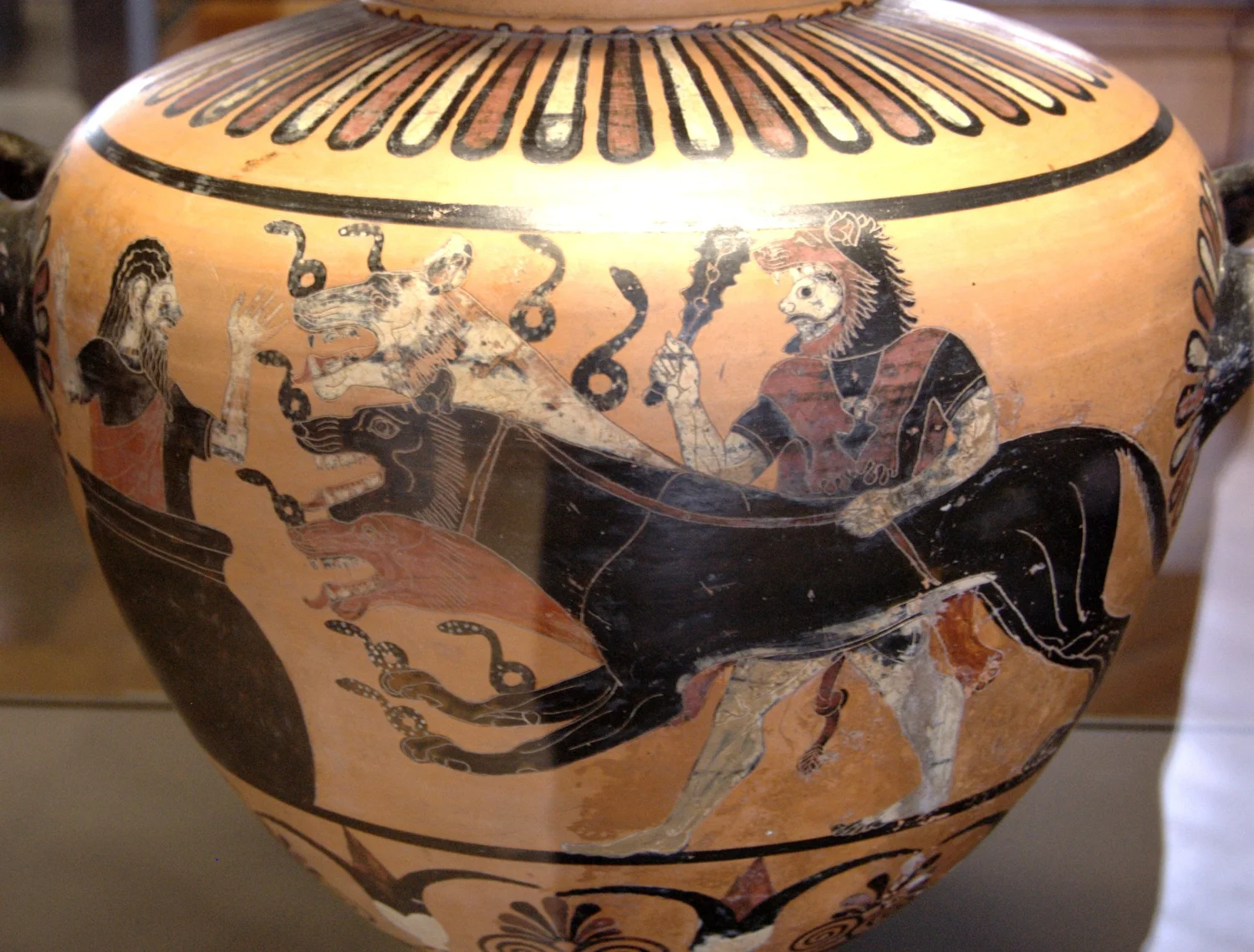
Heracles, in his lion skin and with his club, leads the three-headed Cerberus on a leash to Eurystheus, who shrinks behind his great storage jar: a Caeretan black-figure hydria (c. 530 BCE), Musée du Louvre, Paris. Public domain, via Wikimedia Commons.
The great Cyclops tale is Homer's, and it is a tale of manners. Polyphemus comes home at evening, rolls a stone across his cave mouth that twenty wagons could not move, milks his ewes — and finds the Greeks. He asks their business. Odysseus answers politely and claims the protection of Zeus, the god of guests. Polyphemus replies that Cyclopes care nothing for Zeus, seizes two men, and eats them. In the morning he eats two more, and rolls the stone back only for his flocks.
Odysseus's weapons are three: wine, a lie, and a sharpened olive stake, hardened in the fire. He gives the giant strong wine, unmixed, until Polyphemus asks his name — and gives the name that saves his life: Outis, "Nobody." When the giant sleeps, the men drive the heated stake into the single eye and twist. Polyphemus bellows for help, and the other Cyclopes call from their caves: who is hurting you? "Nobody!" he roars — and they go home, advising him to pray. In the morning the blinded giant sits in the doorway feeling the backs of his sheep as they pass; under the belly of the great ram, clinging to its fleece, goes Odysseus. But the tale has a price. Safe on his ship, Odysseus cannot resist shouting back his true name — and Polyphemus prays to his father Poseidon, who hears. The curse of the Cyclops drives the whole rest of the Odyssey.
Cerberus's tale is the last and strangest of Heracles's twelve labours, and Apollodorus files it in full (Library 2.5.12). Before descending, Heracles went to Eleusis and was initiated into the Mysteries; then he went down to Hades at Taenarum, in Laconia, where the mouth of the descent was. He found Theseus and Pirithous bound fast there, and raised Theseus up by the hand — but when he would have raised Pirithous too, the earth quaked, and he let go. He slaughtered one of the kine of Hades to give the shades blood, and broke the herdsman Menoetes' ribs in the wrestling that followed. Then he asked Pluto for Cerberus, and Pluto set the condition that gives the tale its shape: Heracles might take the hound only if he could master him without the weapons he carried. So, cased in his cuirass and covered by the lion's skin, Heracles found Cerberus at the gates of Acheron, flung his arms around the brute's head, and held on — though the dragon in the hound's tail bit him — and never relaxed his grip until the hound yielded. He carried Cerberus up into the daylight, showed him to Eurystheus, and then — the labour's keeper's detail — carried him back to Hades, and gave him back his gate.
Greek painters loved the showing, not the wrestling. This lesson's new plate, a Caeretan hydria of about 530 BCE (Louvre E701), shows Heracles in his lion skin, club in hand, leading the three-headed hound on a leash — snakes coiling from the hound's heads and paws — while Eurystheus, the king who set the labour, shrinks inside the great storage jar he has taken refuge in. The terror of Hades, delivered like a parcel, and the customer hiding inside the furniture: the painters filed the comedy with the labour. Rome gave the hound one quieter scene, a generation after Virgil retold the blinding above: in Book 6 of the Aeneid, Aeneas goes down living into Hades, and the Sibyl who guides him, seeing the snakes bristle on Cerberus's necks, throws him a sop made sleepy with honey and drugged grain. He opens his three throats, snatches it, and sprawls asleep across the whole cave — and the living walk past the gate the dead cannot leave. Keep the two passings together: the gate is forced once, by strength under a condition, and once by a cake. Nobody in the record simply walks out.
The Chimera's tale is Bellerophon's, and Homer tells its frame: the false accusation at Proetus's court, the folded tablet, the nine days' feasting, and then the impossible first task — kill the fire-breathing beast that was devastating Lycia and harrying its cattle, a single creature with the power of three beasts. How he killed her, the record grows. Homer says only that he slew her, trusting in the signs of the gods. Hesiod names a partner: Pegasus, the winged horse — who has his own fuller telling waiting in Lesson 28, and who works in this lesson only in his first employment. Apollodorus files the method the partnership made possible: Bellerophon mounted Pegasus, rose into the air, and shot the Chimera down from the height, out of reach of all three heads and the fire. A later commentator on Homer adds the finishing trick — a lump of lead fixed to the spear, which melted in her fiery breath and ran molten down her throat — and the keeper files that where it belongs: as a later addition, attached to the tale long after the Iliad, not in it.
Her picture record is as old as her text. Greek vase painters took her up early — a Laconian cup of about 570 BCE, attributed to the Boreads Painter and now in the Getty, shows Bellerophon and Pegasus already fighting her — and her most famous portrait is a sculpture: the Chimera of Arezzo, an Etruscan bronze of about 400 BCE, wounded and snarling, made as one figure of a group with the Bellerophon who is killing her. This lesson's plate is Roman and later: a Gallo-Roman mosaic medallion of the second or third century CE (Musée Rolin, Autun), where the mounted kill has become a floor's centrepiece — Bellerophon serene on the winged horse, his spear going down into the goat head's open mouth, the lion sprawled beneath. Text to vase to bronze to floor: eight centuries of one composition.
Set it beside Hesiod's tale-world and the difference is the lesson. Hesiod's Cyclopes never eat anyone. They are the arsenal of heaven: the thunderbolt, the trident, the helmet of darkness — the tools by which the gods rule. So the Greeks kept a one-eyed giant who would eat a guest in his cave, and one-eyed giants whose work kept the gods armed and the world running, and they seem to have been comfortable holding both at once. The giants' tales work at the larger scale in much the same way. Goliath falls to a shepherd's sling, a small man with a small weapon against all that bulk, and Ymir's body becomes the world because somebody had to be first, and the North made that somebody enormous. When a tradition wants to show what its heroes, or its gods, were up against, this is the drawer it opens.
KEEPER'S CHECK-IN
Pluto set Heracles one condition for taking Cerberus on the twelfth labour — what was the condition, and what did Heracles do with the hound after he had shown him to Eurystheus?
Spotted
The giants were spotted the way no other beings in this unit were: in the ground. This lesson's sighting file is a register of finds and encounters, each with a named reporter.
Augustine saw the great molar at Utica with his own eyes and reported it by 426; Vienna dug up its thigh bone in 1443 and hung it over the cathedral door — both told in full in this lesson, in What It Actually Is and the Watched-For box. The Chaumont bones of 1613 were a sighting by exhibition: dug up, displayed, shown to a king, and argued over in print, as What It Actually Is recounts.
In 1520 the report came from living men. Antonio Pigafetta, chronicler of Magellan's circumnavigation, wrote from Puerto San Julián, in what is now Argentina, of men of giant stature — "the tallest of us," he says, "only came up to his waist." The people were the Aónikenk, the southern Tehuelche, a genuinely tall people; the reports grew in the retelling for two centuries, until the corrected official account of Byron's voyage, published in 1773, measured the tallest at six feet six. Pigafetta's report is filed S, and the correction is filed with it: a real encounter, a real people, a height that doubled on paper.
The last report is the custom become an industry. On October 16, 1869, workers digging a well on William Newell's farm at Cardiff, New York, uncovered a ten-foot figure of a "petrified man." Crowds paid to see it; P. T. Barnum, refused the purchase, had a copy made and exhibited his own. The figure was gypsum, commissioned by George Hull and buried to be found, and the making was admitted within the year. File the uncovering and the exhibitions F — dates, crowds, and a confession are documented — and the petrified giant T: by 1869 the giant over the door had become the giant in the tent, and the record kept both.
The lesson's two singles add nothing to this register, and the absence belongs in the file. No named reporter, in any century, claims to have met the hound at his gate or the Chimera on a Lycian road; nobody dug them up, exhibited them, or swore to them before a magistrate. Their records are texts and pictures only — which is why, in a lesson built out of bones, they stay in the Tales and out of the Spotted file.
KEEPER'S CHECK-IN
Pigafetta reported in 1520 that the tallest of his own men came up only to the giant's waist, and the report grew for two centuries — what height did the corrected official account of 1773 actually measure the tallest man at?
What People Watched For — the Giant's Bone over the Door
What people watched for, in this lesson, was a bone. For centuries, digging anywhere in Europe might turn up something enormous — a thigh bone longer than a man's leg, a tooth like a fist — and the record of what people did with such finds is remarkably consistent: they kept them, and they put them where everyone could see them. Cathedral, town hall, and castle gate all over Europe displayed great bones as the bones of giants: proof, in the most literal sense, hung on the wall.
The best-documented case gives a famous door its name. In 1443, digging the foundations for the north tower of St. Stephen's Cathedral in Vienna, workmen unearthed a huge thigh bone. It was hung over the cathedral's main entrance, where it stayed for decades — and the door is the Riesentor, the Giant's Door, to this day. Keepers file the whole story, including the honest complication: the name may instead come from a Middle High German word, risen, "to sink or fall," for the funnel shape of the doorway. Both explanations are in the record; the bone is in the record too — it survives, inscribed with the year 1443, at the University of Vienna, where its label gives its true owner. It is a mammoth's.
So the custom was this: when the earth gave up a giant, you did not bury him again. You hung him over the door. The practice made every building site and gravel pit a place to watch — and it filled the churches of Europe with the evidence the next section is about.
What It Actually Is
✦ On the class test
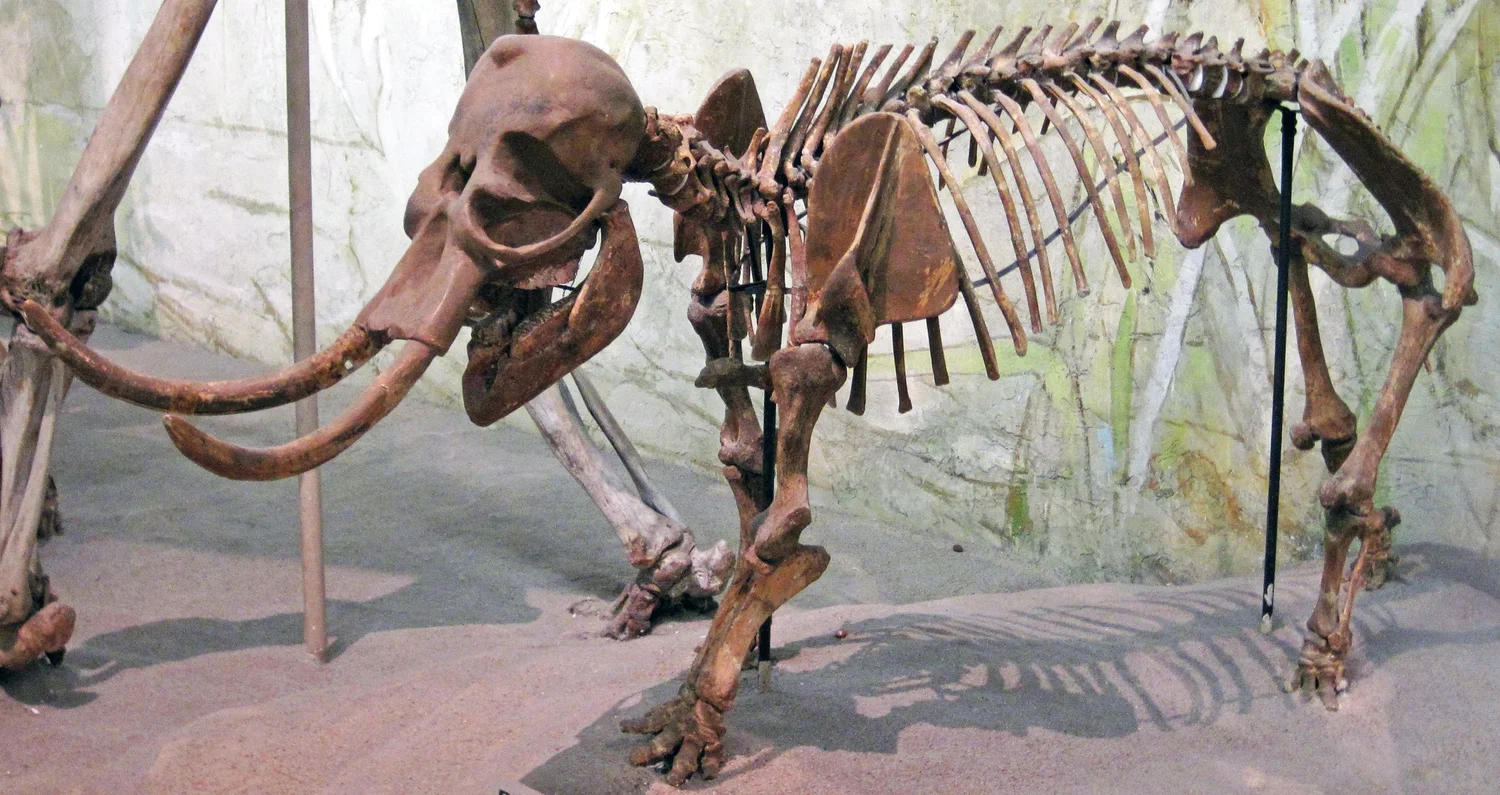
The mounted skeleton of Palaeoloxodon falconeri, the Sicilian dwarf elephant: two true eye sockets at the sides, and the great central opening where the trunk joined — the fossil root proposed for the Cyclops. Photograph by James St. John. CC BY 2.0, via Wikimedia Commons.
The giants' real root can be held in two hands. It is a tooth.
St. Augustine, in The City of God (Book XV; the work was completed by 426), reports it in his own person: "I myself, along with some others, saw on the shore at Utica a man's molar tooth of such a size, that if it were cut down into teeth such as we have, a hundred, I fancy, could have been made out of it. But that, I believe, belonged to some giant." Utica is in modern Tunisia. Augustine was not a fool and not a liar; he was a careful man describing a real object — a very large molar, found on a shore — with the only anatomy his world had for it. A molar big enough to cut into a hundred human teeth is an elephant's. An elephant's molar is a grinding block, its crown made of fused ridged plates, built for crushing coarse plant food all day long, and a big one dwarfs anything in a human jaw. Hold one and the giant is, for a moment, honestly tempting — which is rather the point of this lesson. In the 1630s, two centuries and more later, further giant teeth from that same shore reached the French scholar Peiresc — who did the new thing, and showed them to be an elephant's.
The fullest case file opened in January 1613, in a sandpit by the château de Chaumont in Dauphiné, France, where workmen dug up a quantity of great bones. A local surgeon acquired them, and the bones went on exhibition across France and Germany as the skeleton of Theutobochus, a giant king of the Teutons defeated by Rome — with a tidy story attached: a brick tomb thirty feet long, an inscription, coins of the Roman general Marius. Shown to Louis XIII, the bones split learned Paris. The surgeon Nicolas Habicot defended the giant in print (Gigantostéologie, 1613); the anatomist Jean Riolan answered that the bones were an elephant's, and the pamphlet war ran for years. Peiresc, investigating, concluded the tomb story was a fabrication and the bones an elephant's. The bones themselves outlasted everyone: in the 1830s de Blainville identified them as a mastodon's, and in 1984, working from a surviving cast, Léonard Ginsburg gave the final name — Deinotherium, a giant extinct relative of the elephants. A keeper files the case whole: F — the digging, the exhibition, the pamphlets, the identifications, all dated; T — the giant king, whose tomb existed mainly on paper.
The Cyclops's root was proposed at the map's last pin. In 1914, at Vienna, the paleontologist Othenio Abel argued that the one-eyed giant grew from the skulls of dwarf elephants — Palaeoloxodon falconeri and its kin, little elephants that once lived on Sicily, Malta, and other Mediterranean islands and died out leaving their bones in caves. An elephant's skull is a strange object: the eyes sit far apart at the sides, and in the center of the face yawns one great opening — the nasal cavity, where the trunk joined. Weather the flesh away, find that skull in a cave, never having seen a living elephant, and the face reads as a giant's with a single eye socket in the middle of its forehead. The lesson's third plate is the skeleton of just such a dwarf elephant; find the skull's central opening for yourself in the Guided Observation.
And do get the animal's real size into your head, because it helps Abel's idea along. Palaeoloxodon falconeri was an elephant shrunk by island life: a grown male stood only about a metre at the shoulder, a female less, and weighed at most a few hundred kilograms — the size of a modern elephant calf, descended from mainland straight-tusked elephants that stood up to about four metres. A small animal, then. But a skull is a skull, and an elephant's skull is big for the body that carries it, full of air spaces that lighten it. Weathered, trunkless, and found on its own in a cave, that skull is roughly the size a giant's head ought to be, and its one great central opening sits exactly where a story would want an eye. File Abel's idea exactly where the map files it: as a hypothesis — a good one, which explains the eye and the address (Sicily, the Cyclops's home island, is dwarf-elephant ground), but a hypothesis still, not a proven record. The distinction is this class's whole business.
The two singles have no bones at all, and a keeper should price that difference. Nobody ever hung a Chimera's tooth over a door. For Cerberus, the record's own first root-attempt is itself ancient: Hecataeus of Miletus, about 500 BCE, was already rationalizing the hound into a large poisonous snake at Taenarum — the earliest surviving attempt to give the being a real animal, filed here as what it is: a rationalization, not a root. For the Chimera, no root animal and no Abel was found to this class's standard, and the entry does not invent one: she files as composition — three real animals' parts, each part checkable against a living beast, the whole nowhere found. The giants came out of the ground. These two stayed in the poems, and their files are the cleaner for a keeper knowing why.
Still With Us
The giants did not vanish; they were re-identified. As comparative anatomy grew up in the 1700s and 1800s, the bones over the doors and in the cabinets came down and were measured against living animals — and one by one the giants of the record became mammoths, mastodons, and Deinotherium, which is why the Vienna bone now lies in a university collection with a mammoth's label. The record did not embarrass itself in the process. It did what records do when they are kept honestly: it corrected, in writing, with dates.
The story-giants never left at all. They hold their castles in children's books and films, they stride across foundation myths, and the word giant does daily work for anything too big to ignore. The Cyclops keeps his single eye in modern dress too — the lone watching lens, the camera-eyed monster of a hundred stories. And the scholarly face of the whole file is a book a keeper should know by name: Adrienne Mayor's The First Fossil Hunters (2000), which assembled the case that classical giant and monster lore grew, again and again, from real fossil bones honestly observed and understandably misread. It is a kind verdict, and the evidence in this lesson supports it. The people who hung those bones over doors and fought pamphlet wars over them were handling real fossils, measuring them against the animals they knew, and getting the answer wrong for want of one thing their world had not put in front of them: a living elephant, or a dead one complete, to compare the bones with.
The two singles keep their own modern faces. Cerberus settled at three heads — the painters' count won over Hesiod's fifty — and Rome kept him at his post into the Middle Ages: Dante set him in the third circle of the Inferno, over the gluttons, still snapping. Virgil's scene left a phrase behind in English: a sop to Cerberus, a small bribe thrown to quiet a dangerous guardian, named for the Sibyl's drugged honey cake. The Chimera's afterlife is an object: dug up at Arezzo in 1553, her bronze was claimed at once for the Medici in Florence, and she stands in that city's archaeological museum still — one of the oldest creature records in this lesson, keeping her appointment in a glass case, which is where most of this shelf's beings end up.
Guided Observation
Begin with the hero plate: a Laconian black-figure cup (about 565 BCE) showing the blinding of Polyphemus. Look for the story's three tools before you read any label: the wine cup in the giant's hand, the stake at his eye, and the number of men it takes to drive it. The painter wastes nothing — even the giant's cup is evidence, because the wine is what made the blinding possible. Then consider scale: on a small cup, how does the painter tell you the victim is a giant? (By the company he keeps: ordinary men reach only so high up him. Scale in art is always argued by comparison.)
Turn to the Mélusine miniature (15th century): Geoffroy fighting the giant Guédon. Here the giant is shown against architecture — measure him against the castle door. Romance giants are sized by buildings, as Polyphemus was sized by men.
Last, the dwarf elephant skeleton (photo: James St. John, CC BY 2.0). Find the skull. Find the two true eye positions at the sides, and then the great central opening where the trunk joined. Now perform Abel's thought experiment honestly: cover the side sockets with your thumbs. What face is left? Write down what you see, and then — this is the keeper's step — write down what would still have to be true for Abel to be right, not merely plausible. A hypothesis earns its place on the map by stating what could prove it wrong.
Finish with the two new plates, and read each against the texts it illustrates. On the Caeretan hydria (about 530 BCE), count the hound's heads, and then count his snakes: the painters gave Cerberus his third head but never his fiftieth, and spent the difference on serpents. Find Eurystheus, and say what the painter has done to the labour's dignity by putting him where he is. Then the Rolin mosaic: the kill is shown from the air, as Apollodorus files it — the spear descending from the horse's height into the goat head's open mouth, the lion beneath, the serpent tail coiling away. But Homer's Chimera fights her fight with no Pegasus in it at all. Write down, for each plate, which file — Homer's, Hesiod's, or Apollodorus's — the artist was working from, and what in the picture proves it. Pictures, in this class, are witnesses with dates, and they testify to the telling of their own century, not to the being.
Assignment Manual
✎ WRITTEN · ⚒ HANDS-ON · ◐ BOTH
✎ Written · Entry No. 11: The Giants and the Cyclops, the Paired Entry.
- Rule your entry page. Turn to the Scholar's Entry Page in this packet and rule the next page of your journal to match it. This lesson carries a pair, so rule the entry in two voices: the Cyclops first (he owns the map), the giants of the wider record after, each with its own First Told line. Leave room after the pair for the two singles who share this lesson's shelf — Cerberus and the Chimera — each in a short file of its own, after the giants.
- Write the entry, to the standard. First Told: for the Cyclops, Homer — the Odyssey, about 725 BCE by the map's dating, Smyrna by tradition, and what kind of account it is (a poem, not a report). Name Hesiod's second file and its difference. How the Telling Grew: Euripides, Virgil, Isidore, with dates; then the giants at large — one line each for Greece, the Hebrew record, the North, and the romances. The Tales: Polyphemus, told in your own words with the three weapons named; one line for the smiths' forge-work. What It Actually Is: Augustine's tooth; the Chaumont bones and their three identifications; Abel's hypothesis, labeled. Still With Us: the bones re-identified, Mayor's verdict, two or three lines. Then, under the head The Two Singles: Cerberus — Hesiod's fifty heads against the painters' three, the gate he keeps and which way it opens, and the twelfth labour told with its condition and its return journey; the Chimera — Homer's shape against Hesiod's three heads, Bellerophon's errand and its folded letter, and Pegasus entered only where the record enters him. The Keeper's Line: your judgment.
- One belief, three records. Take Augustine's sentence — "that, I believe, belonged to some giant" — and file it properly. Mark the sentence itself T. Then write three F lines that stand under it: what Augustine wrote and when; what Peiresc did with teeth from that shore in the 1630s; what the Utica tooth most plausibly was. This is the lesson in miniature: a belief is one line; the record under it is a file.
- Mark every line. T, S, or F, in the margin, as always. Watch the trap in this entry: sightings are not records of beings. "The bones were exhibited in Paris" is F. "The king stood twenty-five feet tall" is T — even though it was printed, sold, and shown to a king.
Materials
· Your bestiary journal, with Entries No. 1–10 in it
· Pencils, and a pen you like
· A ruler, for ruling your entry pages — and for the measuring this lesson invites
· This lesson's packet (the Scholar's Entry Page is in it)
Reflection
Augustine saw a real tooth and named a giant. Riolan saw real bones and named an elephant. What did Riolan have that Augustine did not — and was it knowledge, or was it company (other books, other bones)?
The Cyclops has two Greek files that contradict each other on everything but the eye. What does it do to a record when a being's oldest witnesses disagree — and why does this class keep both files anyway?
Abel's hypothesis is on the map but is not a first record. What is the difference between a map pin for a book and a map pin for an idea — and should ideas have pins at all?
Cerberus is fifty-headed in Hesiod and three-headed in every picture anyone painted, and the disagreement ran for centuries without breaking his file. Which count belongs in your entry's first line — the oldest text's, or the pictures'? Defend your choice from this lesson's own habits.
A Closing Note
Eleven entries in, and your bestiary has stood its first bones upright. Next lesson the shelf turns to the beings Greek art loved best — half horse, half man, and wholly argumentative — and to the question of what a natural historian does when an emperor is sent a centaur in a jar of honey. Bring your marks. Bring your skepticism about jars.
The Bestiary
Bestiary Keeper
Further Reading & Sources
Homer, Odyssey, Book 9 — the cave of Polyphemus, in any good translation; and Book 3 of Virgil's Aeneid for the Roman retelling.
Hesiod, Theogony — Brontes, Steropes, and Arges, the smith Cyclopes.
Augustine of Hippo, The City of God, Book XV, chapter 9 — the giant's tooth at Utica, in the author's own words.
Adrienne Mayor, The First Fossil Hunters: Paleontology in Greek and Roman Myth (Princeton University Press, 2000) — the modern assembly of the fossil case, Abel's hypothesis included.
Isidore of Seville, Etymologiae, Book XI — the Cyclopes filed among the portents.
Othenio Abel's dwarf-elephant proposal (Vienna, 1914), as discussed in Mayor (above) — a hypothesis, kept labeled.
Hesiod, Theogony, lines 306–332 and 769–773 — Echidna's brood: Cerberus named with his fifty heads, the Chimera with her three; and the hound at his gate, fawning on those who enter (Evelyn-White translation).
Homer, Iliad, Book 6 — Glaucus tells Bellerophon's story: the folded tablet, and the Chimera in the oldest description this class owns (Murray translation).
Apollodorus, Library, 2.5.12 and 2.3.1–2 — the twelfth labour in full, and the Chimera shot down from Pegasus's back (Frazer translation).
Virgil, Aeneid, Book 6 — Aeneas passes the hound: the Sibyl's sop of honey and drugged grain.
Submit your work for this lesson using the form below.
CONTINUE IN THE BESTIARY HALL
← Previous · Lesson 10: The Manticore & the Spotted Beasts Next · Lesson 12: Centaurs & Satyrs →
Unit II — Beasts of the Land The Bestiary Hall — All 41 Lessons
The rest of Unit II: Lesson 7 · The Unicorn · Lesson 8 · The Griffin · Lesson 9 · The Basilisk & the Cockatrice · Lesson 10 · The Manticore & the Spotted Beasts · Lesson 12 · Centaurs & Satyrs · Lesson 13 · The Wild Men of the Woods · Lesson 14 · Bigfoot & the Yeti · Lesson 15 · Real Animals in the Bestiary