

THE BESTIARY
Unit II · Lesson 13The Wild Men of the Woods
Professor Sable Rookmere
Bestiary Keeper
The Bestiary Hall • School of Evershade
Professor's Introduction
Every other being in this unit lives somewhere else — India, Thessaly, the far side of the sea. The wild man lives at the end of the lane. He is the being the village kept for itself: man-shaped, hair-covered, speechless, and strong, walking the woods that began where the fields gave out.
He frightened Europe for six hundred years, and Europe answered him in a way it answered no other being on this shelf. This lesson ends with that answer, and it is worth the walk.
The Bestiary
Bestiary Keeper
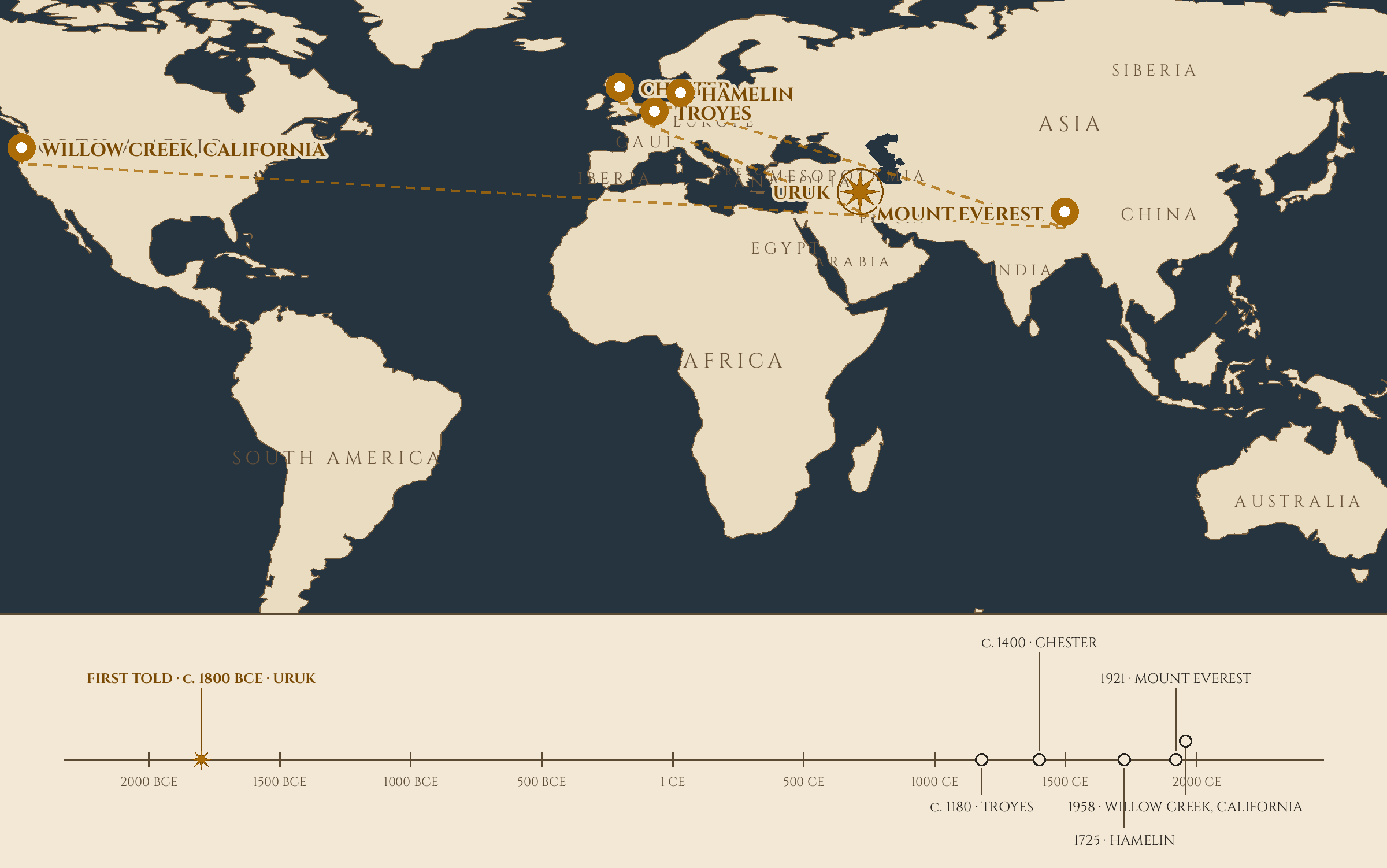
Where this lesson travels: Uruk, where Enkidu, the wild man of the Epic of Gilgamesh, runs with the beasts — the figure's ancestor; Troyes, where Chrétien's Yvain meets the giant wild herdsman in the forest; the north-west Midlands, for the wodwos of Sir Gawain and the Green Knight (the place is approximate, as the master states); Mount Everest, where the 1921 expedition's footprints bring the yeti to Western print; and Willow Creek, California, where Jerry Crew's footprint casts coin the name Bigfoot. The starred pin is the first record; the dashed line is the telling, traveling.
Lesson Objectives
By the end of this lesson, you will be able to:
- Say who the wodewose was — his look, his address, and his six hundred years in the European record.
- Walk this lesson's map from Enkidu's Uruk to the last two pins, and say why those two are named, not taught.
- Give Sasquatch its proper name-history: whose word sasq'ets was, what language it comes from, and who carried it into English print, and when.
- Tell how the wild man was used: carved on churches, borne on shields, written into romances, and worn at carnival.
- Give the wild man's real root — the real people and real costumes at the forest's edge.
- State the Schembart custom and its dates, and what it shows about how a feared being was handled.
- Name the Slavic leshy who is grouped in this lesson, say how he differs from the wodewose — a forest's master, not a man gone wild — and give the customs herdsmen, hunters, and travellers kept in his woods.
Your Assignment Packet
This lesson's work lives in its packet: the Lexicon Handout (every term, the core terms marked with the keeper's diamond ◆), Materials, Guided Practice, the Assignment Manual written out whole, the Scholar's Entry Page, the Reflection Questions, the Workbook Checklist, and the Keeper's Notes, for whoever teaches the lesson. Download the packet before you begin and keep it beside you as you read. The packet's assignment is Rookmere's own word for the work: Entry No. 13 — The Wild Man of the Woods (written and drawn) ◐. The Unit II Quiz is not printed in the packet; it waits at the end of the unit, with Lesson 15.
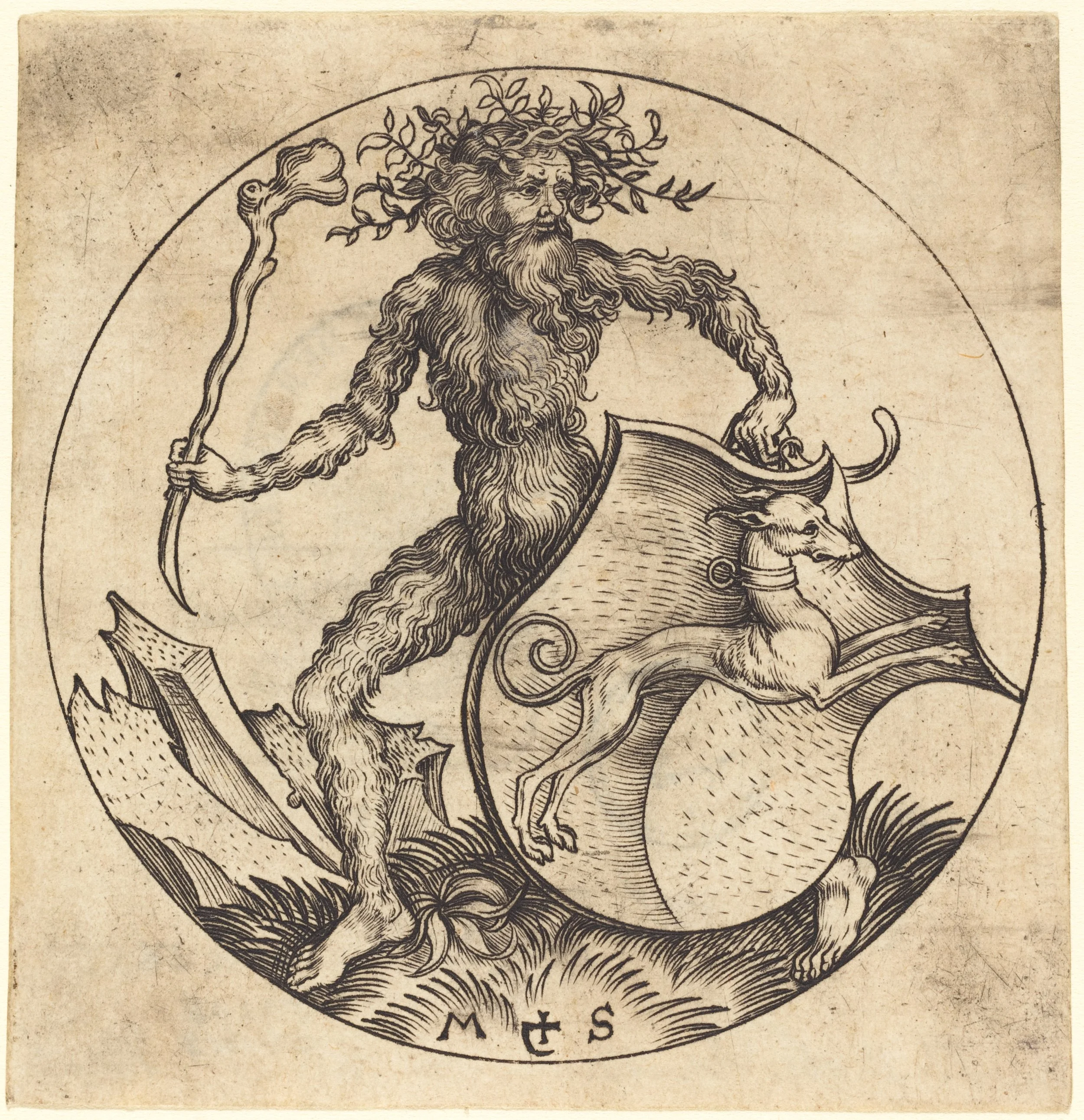
Martin Schongauer, Wild Man Holding a Shield with a Greyhound (c. 1480–1490): the wild man posed as heraldry poses its figures, upright and frontal — the wilderness employed as a guard. CC0, via Wikimedia Commons.
The Creature
The wild man's English name is the plainest in this class: wodewose, from the Old English wudu, wood, and wasa, a being — the wood-being. The German books call him the Waldmensch, the French the homme sauvage. Every language at Europe's forest edge kept the word, because every forest edge kept the figure.
His description is a checklist that holds steady for six hundred years. He is a man in shape — no tail, no hooves, none of the centaur's honest hybridity — but covered head to foot in hair, all but his face, his hands, and sometimes his feet and knees. He carries a club, a staff, or a whole uprooted tree. He does not speak, or speaks roughly. He lives in the woods, eats what the woods give, and is stronger than any villager and faster than any horse in the trees. He may be a brute who steals cattle and women, or a silent innocent who never touched the world's corruptions — the record keeps him in both tempers, and the two tempers, as with the centaur, are the point.
Mark the difference that makes this lesson necessary: the wild man is the only being in Unit II who is not a hybrid, a marvel, or a misread animal. He is a person, filed as a being. That has made him the most useful being on the shelf — and the one with the most real people inside his file.
East of those forests, the Slavic record keeps a second woods figure, and this lesson files him grouped, beside the wodewose, because the two records answer the same question from opposite sides. The leshy — also lesovik or leshak, in Ukrainian lisovyk — takes his whole name from les, the Slavic word for forest: he is the one from the forest. He is its master. The animals are his herd — the bear his favourite, in Jan Máchal's scholarly survey of 1918 — the game, the paths, and the travellers crossing them are under his hand, and there is usually one of him to a wood. He has no checklist of hair and club to hold steady. In Máchal's account he appears as an old man with long hair and beard, flashing green eyes, and a body covered with hair — some living alone in forest solitudes, others in dwellings in the woods with wives and children — but he is a shape-changer: an ordinary traveller, a friend's familiar face, a bear, a wolf, a hare. And his stature changes with his ground: tall as the trees inside the forest, no taller than the grass in the open field. Mark the distinction, because it is the teaching point of the grouping: the wodewose is a man gone wild; the leshy is the wood's own keeper. One record asks what a person becomes without the village. The other asks who the forest belongs to when the village is not there.
The pictures start where the record's other evidence starts: in the late Middle Ages. Nobody in antiquity drew Enkidu for us. Martin Schongauer's engraving (about 1480–1490), at the head of this lesson, renders the wild man as a heraldic supporter, his hair worked in long parallel strokes like a tailored coat, stopping at face, hands, and feet. The Nuremberg Schembart costume book (1449–1539) draws the same figure as what a citizen actually wore in the street — mossy, shagged, carrying a little tree. Emblem and costume: the wild man's whole picture line is those two answers to one checklist, and his later faces, in newsprint and plaster, left no pictures this class files as plates.
First Told
The starred pin on this lesson's map stands at Uruk, in modern Iraq, about 1800 BCE, among the Old Babylonian tablets of the Epic of Gilgamesh — with the map's own caution attached: the figure there is the wild man's ancestor, not yet the medieval wodewose, and the pin marks the pattern's first surviving telling. His name is Enkidu. The goddess Aruru pinches off clay and throws it into the wilderness, and Enkidu comes into the world with his whole body covered in hair, knowing nothing of people or cultivated land: he eats grass with the gazelles and drinks at the waterhole with the wild beasts, and the beasts accept him as one of their own. A hunter whose traps Enkidu keeps spoiling carries the problem to Uruk, and the city's answer is the pattern this whole lesson will keep meeting. They do not send soldiers. They send civilization: the temple woman Shamhat, and with her bread, beer, clothing, and speech. Enkidu eats, drinks, washes, and is anointed — and when he returns to the waterhole, the gazelles flee from him. He has lost the wild and gained the human, in one week, irreversibly, and the poem counts it as gain and loss in the same breath.
Walk the map forward now, because its jumps are the lesson. From Uruk the line crosses nearly three and a half thousand years to Troyes, about 1180, where Chrétien de Troyes, in his romance Yvain, sends a knight into the forest and has him find the wild man of the medieval woods — of whom more in the Tales. Then to the north-west Midlands of England, about 1400 (the place is approximate, as the map says), where the Sir Gawain and the Green Knight poet lists the wodwos among the dangers of the wilderness, in the same breath as wolves and bulls and bears. And then — the line leaps oceans and centuries to the map's last two pins, Everest in 1921 and Willow Creek, California, in 1958: the wild man's named modern faces, the yeti and Bigfoot, which this lesson names at the end, at their proper length and no longer. The record's shape is the teaching: a figure born in the first city story we have, native to every forest edge since, and still being reported in the age of the newspaper.
The leshy brings no pin of his own to this map, and a keeper should say why plainly. His record is the ethnographers' record — deep belief, late paper, the same shape this class met in the domovoi's file. No single first text names him. The full accounts arrive in the nineteenth century, when Aleksandr Afanasiev's Poetic Views of the Slavs on Nature (1865–1869) treated the old beliefs as a system, and W. R. S. Ralston carried the leshy — as the Lyeshy, the wood-demon — into English in The Songs of the Russian People (1872), citing Afanasiev throughout. Máchal's survey followed in 1918, and Linda Ivanits gathered the record again in Russian Folk Belief (1989). What the paper cannot do is date the belief's beginning, and this lesson does not invent a date for it.
The Tales
The medieval centuries did not merely tell the wild man; they used him, in more media than any being since the unicorn. He stands in the margins of manuscripts, peering around the decorated initials. He is carved in wood and stone inside the churches themselves — on misericords (the little ledges under choir seats), on roof bosses overhead, on bench ends — hundreds of him, club in hand, keeping a hairy watch over congregations. He walks into heraldry: families and cities set wild men as supporters, standing at either side of a shield to hold it up — Lesson 13's hero plate shows Martin Schongauer's engraving (about 1480–1490) of exactly that, a wild man in his hair holding a shield blazoned with a greyhound. To put the wild man on your arms was to claim the wilderness as your servant: strength without speech, guarding the house.
Stay with the Schongauer plate a moment longer, because it teaches you to read every wild man you will meet from here on. The engraver renders the hair in long, even, parallel strokes, worked as carefully as the folds of a courtier's sleeve — this is hair drawn by a man who was thinking about a coat, not about an animal's pelt. And it stops where the record's checklist says it stops: the face is bare, the hands are bare, the feet are bare, so the figure can hold a shield and be recognized as a person doing a job. Heraldry needed him respectable enough to stand at a family's side all day. The deep-woods version, in the romances and the carvings, is the same checklist with the manners left off.
Romance gave him his two great speaking parts. In Chrétien's Yvain (about 1180) he is the gatekeeper of the adventure — a herdsman of giant size, black and rough, standing among his bulls with a great club, who answers the lost knight's questions civilly enough and directs him to the magic fountain where the story begins. The wild man, in this telling, is not the danger; he is the doorkeeper of the dangerous place, and he knows more about the forest than the knight ever will. In Valentine and Orson — a romance printed in English in the early 1500s and read for centuries after — the wild man is the hero's own twin: Orson, stolen by a bear as a baby and raised in her den, comes to court hairy, speechless, and immensely strong, and must be tamed into his inheritance. Enkidu's week at the waterhole, retold as a whole life.
And the tellers argued about him the whole time. One reading made the wild man the Fall without the sermon: the human sunk to beast, punished or pitied. The opposite reading made him the innocent: the one human the court and the city had not managed to corrupt — freer, stronger, and honester than any knight. The same figure carried both charges because he was built to: he is the human with everything social subtracted, and every age filled the empty space with its own verdict on society.
The wild man's oldest tale is his first one, and it ends in grief. Enkidu, civilized, comes to Uruk and wrestles the king Gilgamesh in the street — and loses, and laughs, and becomes the king's friend and brother, the only being in the poem Gilgamesh loves as an equal. Together they go to the Cedar Forest and kill its guardian, and together they kill the Bull of Heaven; and for those killings the gods decree that one of the two must die, and the lot falls on Enkidu. His death — twelve days of it, dreamed and described — sends Gilgamesh out on the quest for eternal life that makes the epic. The first wild man in the record is also the first friend in the record, and the first death that a hero cannot accept. Being tamed gave Enkidu language, love, and a grave: the poem does not call that a bad bargain, but it prices it exactly.
The medieval tales run smaller and stranger. Yvain's herdsman stands in his clearing "like a Moor" in the poet's uncomfortable phrase — huge, black, rough-headed, with great ears and a face only a mother could read — and yet it is he, not the polished knight, who holds the map of the forest: ask him the way, and he tells it truly, and charges nothing. The church carvings tell their tales without words: the wodewose on the misericord wrestles a lion, or carries off a lady, or simply stands with his club among the foliage, halfway to becoming the Green Man of the later carvings. These carvings are small, most of them — a misericord is a ledge a tired singer leaned against, carved on the underside where only the choir would ever see it close. Somebody still took the trouble to give the wild man his full checklist at that size, hair, club, and all, in a place almost nobody was meant to look. And the carnival's tale is the city's: ninety years of wild men rampaging politely down the same streets, under the same ordinances, until a joke at a preacher's expense went too far and the council shut the whole run down. No other entry in this class ends that way — argued out of existence is common enough on this shelf, but voted out, by a city council, after ninety years of street theater, is his alone.
The leshy's tales are a traveller's tales, and they run on his office. He misleads. He removes boundary-stones and signposts, takes the shape of a wanderer's friend to talk him into thickets and swamps, and answers from the trees in borrowed sounds — the echo itself was filed as his work. He drives his animals like a herdsman: when squirrels migrated in troops in 1843, the peasants of the neighbouring districts said, in Ralston's telling, that a leshy in Vyatka had gambled away all his squirrels to a brother in Vologda, and the lost property was on its way to its new master. And the tales carry customs with them, kept by the people who worked in his country. Herdsmen conciliated him for the pasturing of the village cattle — in the Olonets country, Ralston records, a herdsman ought to give him a cow every summer — and hunters left him a piece of bread or a pancake sprinkled with salt on the stump of a tree, or the first game they took. In the forest itself, Máchal records, whistling and shouting were not allowed: the sounds of the woods were his to make. A traveller he had led astray had one recorded way back: turn your garments inside out, and put the right shoe on the left foot. A keeper files these customs where they were kept: in the woods, alone, at a stump — not cast once a year before a crowd.
KEEPER'S CHECK-IN
The leshy is grouped beside the wodewose in this lesson, and the two answer the same question from opposite sides — how does the lesson state the difference between them in one line each?
Spotted
The wild man's sightings are the strangest in the unit, because the being was, from time to time, demonstrably there — in a costume, or in a child.
The register runs: a boy of about twelve found in the woods near Hamelin in 1725 and kept at the court of George I as Peter the Wild Boy — a real person, reported as the wild man, and filed with care under What It Actually Is. Footprints found at about 21,000 feet on Everest in 1921 by Lieutenant-Colonel Howard-Bury's party, whose Sherpa guides named their maker metoh-kangmi — a report that reached English, mistranslated, as the Abominable Snowman. And plaster casts of footprints over sixteen inches long, made by Jerry Crew at Willow Creek, California, in 1958, which gave the maker his American name, Bigfoot. The two modern reports are told at their census length under Still With Us — where the maker's other and older name, Sasquatch, is also filed at its proper length, because a name with a documented history is a record, and this class files records whole. Enkidu and Chrétien's herdsman are not in this register: they are tales, and they stand in the Tales.
KEEPER'S CHECK-IN
This lesson's sighting register lists a boy found near Hamelin in 1725 alongside footprints on Everest and at Willow Creek — what kind of sighting was Peter the Wild Boy, and why does the lesson file him with care?
What People Watched For — the Wild Man in the Streets
Once a year, the people of one German city stopped watching for the wild man and watched him walk past — played by a neighbor. The Schembartlauf, Nuremberg's Shrovetide carnival, ran from 1449 to 1539: costumed runners, the Schembartläufer, went through the streets before the butchers' dance, in masks and in costumes that the city remembered so carefully that more than eighty illustrated costume books — Schembartbücher — survive, recording year by year what every runner wore. Among the demons, fools, and peasants stand the wild men, year after year: this lesson's second plate shows a Holtzmännlein, a "little wood man," from a Schembart book — mossy, shagged, with bare patches, carrying his tree.
The detail that tells you the custom was real is the city's paperwork. Nuremberg's council kept passing ordinances to control the carnival runners' behavior, and the wild men were among the worst offenders named — the being so lively in his borrowed skin that the law had to keep answering him. The carnival itself ended in 1539, after the runners turned their floats to satire against a preacher and the council banned the whole run for good.
File the custom for what it demonstrates. The wild man of the woods was feared; the wild man of the streets was cast. A community that cannot keep a being out of its woods can still bring him inside its walls once a year, inside a costume, under ordinances — and a keeper will note that the costume works both ways: it made the wild man safe, and it kept his shape in the public eye for ninety years longer than the romances alone could have. The Schembartbücher are now among the fullest records this lesson has. The custom became the archive.
What It Actually Is
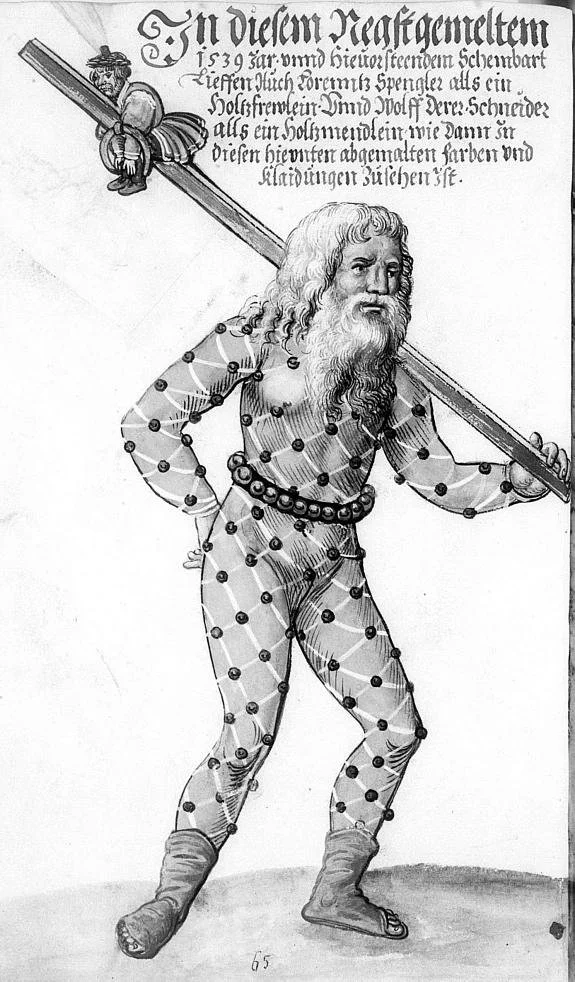
A Holtzmännlein — a “little wood man” — from the Nuremberg Schembart carnival book (1449–1539): the shag, the bare patches, the little tree for a club — the wild man as a costume a named citizen put on, on a recorded date, in a recorded street. Public domain, via Wikimedia Commons.
The wild man's root is people. Behind the figure stand the real inhabitants of the medieval forest edge: the hermits who went into the woods to pray and came out hairy to any visitor's eyes; the charcoal-burners, swineherds, and outlaws who lived rough in the trees for whole seasons, seen at a distance, at dusk, by villagers who knew exactly how the story would grow. And behind the figure stand, in the documented record, the lost children. In 1725 a boy of about twelve was found in the woods near Hamelin, in Hanover, walking on all fours, eating grass and bark, unable to speak a word. He was brought to London and kept at the court of George I as Peter the Wild Boy — examined by scholars, argued over by philosophers, and never, in a long life, master of more than a few words. Peter was a real child with a real misfortune — what lay behind it, the record does not say, and modern guesses remain guesses — but his keepers filed him in the only drawer they had: the wild man, caught at last. A keeper files Peter more carefully than his century did: the record of the boy is F; the being he was filed as is T; and the filing itself is the lesson.
The costume is the other half of the root. The wild man's hair was a thing a man could wear: moss, bark fiber, hides, and shaggy cloth, cut with bare patches at face and hands exactly as the plates show. Look again at the Schembart plate when you reach the Guided Observation and you can nearly see the tailoring: the shag hangs in tufts, heavier here, thinner there, the way gathered moss and fiber would hang on a body that had to run in it, and the little tree he carries is sized to a runner, not to the giant of the romances. A real man wore this, at a pace, through real streets, and the costume book's artist drew what the crowd saw. The being of the deep woods and the costume of the carnival are the same object seen from two sides — which is why the wild man, alone among this unit's beings, could walk out of the record and down a street, and why no one in Nuremberg needed to ask whether he was real. For one day a year, he demonstrably was.
Still With Us
The wild man's modern faces are named in this class, not taught — the census rule — and they are named here at the map's last two pins, briefly and exactly.
In 1921, Lieutenant-Colonel Charles Howard-Bury's Everest reconnaissance party found great footprints in the snow at some 21,000 feet. His Sherpa guides named the maker metoh-kangmi — the man-bear of the snows — and the word traveled down to Calcutta, where the journalist Henry Newman, interviewing the returning porters for The Statesman, rendered metoh as "abominable" and gave the being its English name: the Abominable Snowman, the yeti of a thousand book covers, born of a mistranslation in a newspaper office. In 1958, at Willow Creek, California, a road-building crew's Jerry Crew cast footprints over sixteen inches long in plaster, carried them into the local newspaper office, and the paper gave the maker its American name: Bigfoot.
The grouped kin's modern face is a literary one, and it stands on no pin. Lesya Ukrainka put the leshy on the stage as Lisovyk, the old lord of the wood, in The Forest Song (written 1911), her drama built from the folklore of the Volhynian forests. A century later the game record rebuilt him. Andrzej Sapkowski's Witcher books name the leszy only in passing and never bring him on stage, but CD Projekt Red's The Witcher 3: Wild Hunt (2015) made the leshen a tall, antlered, skull-headed forest spirit — a designed face the folk record never gave him, and a keeper files it as the game's, not the record's.
The maker had an older name than the newspaper's, and it deserves its proper filing here, because unlike "Bigfoot" it was not coined for a headline. Sasquatch is the English form of sasq'ets, a word of Halkomelem, the Salish language of the Lower Fraser country in what is now British Columbia — the word, in the form the anthropologist Wayne Suttles recorded in 1972, for a great, hairy, man-like being said to live in the mountains. It was the word of the Sts'ailes people — the Chehalis, as the records of the time call them — on the Harrison River, and the man who carried it into English print was J. W. Burns, for many years the teacher at the Chehalis Indian Reserve and a government Indian agent there. In the 1920s Burns published accounts of the hairy giants as the Sts'ailes told them to him, and his best-known piece reached a national audience in Maclean's magazine on April 1, 1929: "Introducing B.C.'s Hairy Giants" — subtitled, in Burns's own words, "a collection of strange tales about British Columbia's wild men, as told by those who say they have seen them." A keeper should not miss that subtitle. The newest medium of 1929 filed its being under this lesson's exact heading, thirty years before Willow Creek.
File the name with the care this class owes a living tradition. Suttles, who collected his material among the Coast Salish of southwestern British Columbia and northwestern Washington, is plain on two points a keeper must keep. First, sasq'ets is only one of a number of Coast Salish terms for such beings; Burns took one people's word and used it in his articles as the general name for a single kind of creature gathered out of many tellings, and that gathering was Burns's doing, not the word's. Second, the traditions the word belongs to are the Sts'ailes' and their neighbours' own. This lesson reports them only as the published record reports them — Burns's 1929 article and the anthropologists who followed him — in outline, and invents nothing and adds nothing of its own. What belongs to this lesson is narrower and provable: a Halkomelem word for a hairy man of the mountains, carried into English in the 1920s by a named schoolteacher's published accounts of Sts'ailes tellings, entered the language as the wild man's other modern name — the one that came out of the woods' own country, in the woods' own language, before it ever came out of a newspaper.
The next lesson takes up Bigfoot & the Yeti in full — both pins opened, the chronology dated, and the laboratory's answers filed.
A keeper reads the two pins as the record they are. The beings' own homelands hold long traditions that belong to other keepers and other classes; what belongs to this lesson is the pattern, and the pattern is exact: the wild man did not change in 1921 or 1958. The media did. Tablets, romances, carvings, carnival costumes, and finally newsprint and plaster casts — every age's wild man is filed in that age's newest medium, and the filing is the part a keeper can prove. The wodewose stands at the head of the file, six hundred years deep, to testify that the drawer was old before the newspapers opened it.
Guided Observation
Begin with the hero plate: Martin Schongauer's engraving, Wild Man Holding a Shield with a Greyhound (about 1480–1490). Read the engraving as a suit of hair cut by a tailor: note where the hair stops — face, hands, feet — and how the engraver renders it, in long parallel strokes, more like a garment than like fur. The wild man is posed as heraldry poses its figures, upright and frontal, the shield presented. Ask the plate's question: what is this wild man for? He is not attacking and not fleeing. He is on duty — the wilderness employed as a guard. Write down one sentence on what a family said about itself by putting him beside its arms.
Then the Schembart plate: the Holtzmännlein of the carnival costume book. Compare him, feature by feature, with Schongauer's supporter: the shag, the bare patches, the little tree for a club. One is the being as emblem, carved into a family's identity; the other is the being as a costume a named citizen put on, on a recorded date, in a recorded street. The distance between those two plates is the distance between belief and custom — and the custom, for a keeper, is the better evidence, because it left names, dates, and eighty books. Note, finally, what neither plate shows: a word. The wild man's speechlessness survives even his carnival. No Schembart book gives him a line.
Assignment Manual
✎ WRITTEN · ⚒ HANDS-ON · ◐ BOTH
◐ Both · Entry No. 13: The Wild Man of the Woods.
- Rule your entry page. Turn to the Scholar's Entry Page in this packet and rule the next page of your journal to match it.
- Write the wild man's entry, to the standard. First Told: Enkidu — the Epic of Gilgamesh in its Old Babylonian tablets, Uruk, about 1800 BCE, filed as the ancestor-figure, with the hedge stated. How the Telling Grew: Chrétien's herdsman; the Gawain poet's wodwos; the carvings and the heraldry; Valentine and Orson. The Tales: Enkidu's taming and death, in your own words; the herdsman's true directions; the misericord world in one line. The Grouped Kin: the leshy — his name from les, his changing stature, his stump offering and inside-out remedy, and the line that divides him from the wodewose. The What It Actually Is: the forest-edge people; Peter the Wild Boy, filed with care; the costume. Still With Us: the two named heirs and their two pins, at the lesson's length — a mistranslation in 1921, a plaster cast in 1958, Sasquatch's name filed properly (sasq'ets, the Sts'ailes' word, Burns's 1929 Maclean's article), and the keeper's verdict on the pattern. The Keeper's Line: your judgment.
- Draw the supporter. ⚒ Working from the Schongauer plate, draw your own wild man as a shield-supporter: the hair, the club, the frontal stance — and on his shield, a mark of your own choosing. Keep the drawing in your bestiary beside the entry. This is not decoration: heraldry is one of the records this lesson runs on, and your hand will learn things about the figure's checklist (where the hair stops, how the club is carried) that your eyes alone will skip.
- Mark every line. T, S, or F, as always. The standing trap of this entry: Peter the Wild Boy. His finding, his court, and his few words are F; the drawer he was filed in is T; and the line where you write why he was filed there is the most valuable line in the entry.
Materials
· Your bestiary journal, with Entries No. 1–12 in it
· Pencils, and a pen you like
· A ruler, for ruling your entry pages
· A drawing pencil you trust, for Step 3
· This lesson's packet (the Scholar's Entry Page is in it)
Reflection
Enkidu gained bread, beer, language, and a friend — and lost the gazelles. The poem prices both sides. Which side does your own century price higher, and what does that say about its wild men?
The wild man was carved inside churches, over the congregation's heads. What was he doing there — warning, joke, guard, or sermon? Pick the answer the misericords best support, and defend it.
Nuremberg's wild men were curbed by ordinances, not by disbelief, and ended by a satire, not by an argument. What does it mean that a being can be retired by a council vote?
A Closing Note
Thirteen entries in, and the beasts of the land have two lessons left. Next lesson opens both pins this lesson named — Bigfoot and the yeti, in full. And then comes the one I have been saving, because it changes the keeper's job itself: the shelf turns to animals you can go out and watch, a real goose, a real beaver, and the method turned loose on the living world with a red pencil. Finish the unit looking up. The quarry from here is real.
The Bestiary
Bestiary Keeper
Further Reading & Sources
The Epic of Gilgamesh — the Enkidu chapters, in Andrew George's translation (Penguin, 1999) or another complete edition.
Chrétien de Troyes, Yvain, or The Knight with the Lion (about 1180) — the herdsman at the forest's gate.
Sir Gawain and the Green Knight (about 1400) — the wodwos in the wilderness catalogue.
Richard Bernheimer, Wild Men in the Middle Ages: A Study in Art, Sentiment, and Demonology (Harvard University Press, 1952) — the standard study of the whole file.
Samuel L. Sumberg, The Nuremberg Schembart Carnival (Columbia University Press, 1941) — the carnival, its costumes, and its costume books.
J. W. Burns, "Introducing B.C.'s Hairy Giants," Maclean's, April 1, 1929 — Sasquatch carried into English print, in Burns's published reporting of Sts'ailes accounts; his subtitle calls them British Columbia's wild men.
Wayne Suttles, "On the Cultural Track of the Sasquatch" (1972) — the word's Halkomelem root, its place among the Coast Salish terms, and Burns's role, by an anthropologist who collected among the Coast Salish.
W. R. S. Ralston, The Songs of the Russian People (1872), "The Lyeshy, or Wood-demon" — the leshy carried into English from Afanasiev: his changing stature, the gambling squirrels of 1843, the herdsmen's cow, the hunter's salted bread on a stump, and the inside-out remedy.
Jan Máchal, "Slavic Mythology," in The Mythology of All Races, Vol. III (1918), Chapter VII, "Silvan Spirits" — the scholarly survey: the leshy's form, his guarding office, the bear his favourite, and the customs of his woods.
Linda J. Ivanits, Russian Folk Belief (M. E. Sharpe, 1989) — the leshy in the modern scholarly gathering of the Russian folk record, as with the domovoi in Lesson 4.
Submit your work for this lesson using the form below.
CONTINUE IN THE BESTIARY HALL
← Previous · Lesson 12: Centaurs & Satyrs Next · Lesson 14: Bigfoot & the Yeti →
Unit II — Beasts of the Land The Bestiary Hall — All 41 Lessons
The rest of Unit II: Lesson 7 · The Unicorn · Lesson 8 · The Griffin · Lesson 9 · The Basilisk & the Cockatrice · Lesson 10 · The Manticore & the Spotted Beasts · Lesson 11 · Giants & the Cyclops · Lesson 12 · Centaurs & Satyrs · Lesson 14 · Bigfoot & the Yeti · Lesson 15 · Real Animals in the Bestiary