

THE BESTIARY
Unit II · Lesson 8The Griffin
Professor Sable Rookmere
Bestiary Keeper
The Bestiary Hall • School of Evershade
Professor's Introduction
The unicorn's horn was a thing men could buy, and so its record is full of prices. The griffin's treasure could not be bought at all — it had to be stolen, from the beast itself, at the edge of the world. That makes this file a different kind of reading: nearly everything in it is somebody reporting somebody else. A lost poem, a historian who says he does not believe his own story, a playwright borrowing the beast for a warning. Keep hold of who is speaking at every step. In this lesson, the speakers are the record.
The Bestiary
Bestiary Keeper
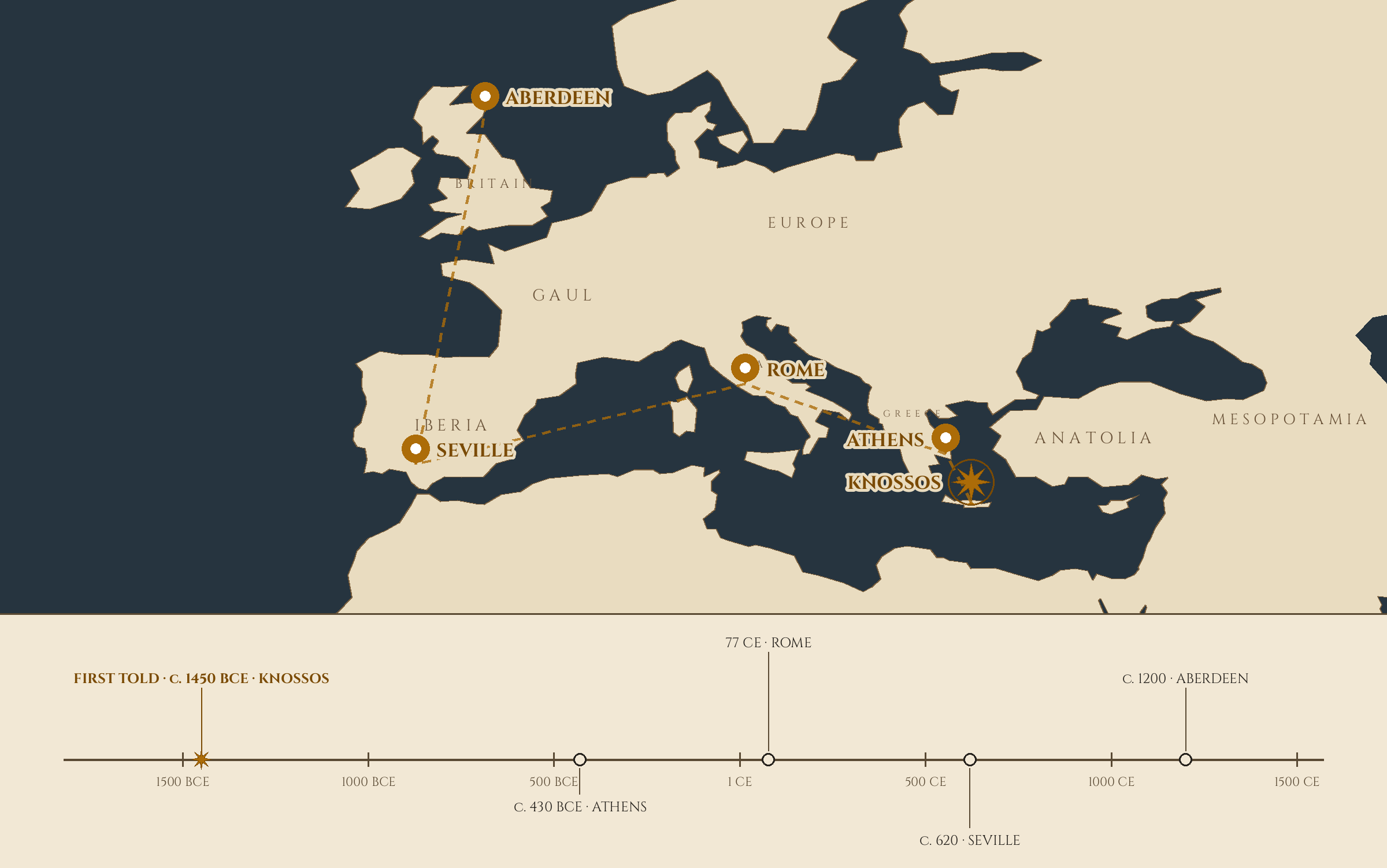
Where this lesson travels: Knossos, where griffins flank the throne in the palace frescoes — the being's grandest early portrait; Athens, where Herodotus reports the gold-guarding griffins of the far north; Rome, where Pliny gives the griffin wings and ears; Seville, where Isidore's Etymologiae fixes the griffin for the Middle Ages; and Aberdeen, whose bestiary carries its griffin entry. The starred pin is the first record; the dashed line is the telling, traveling.
Lesson Objectives
By the end of this lesson, you will be able to:
- Name the lost poem the whole griffin file descends from, and the two Athenians who preserve it.
- Retell the gold war between the griffins and the Arimaspians — with Herodotus's own disbelief attached.
- Follow the griffin from a painted throne room to the bestiaries, and say what Isidore added.
- Read a griffin's body across three plates and name which parts are eagle and which are lion.
- Weigh the real-root candidates honestly, with the fossil hypothesis filed as a hypothesis.
Your Assignment Packet
This lesson's work lives in its packet: the Lexicon Handout (every term, the core terms marked with the keeper's diamond ◆), Materials, Guided Practice, the Assignment Manual written out whole, the Scholar's Entry Page, the Reflection Questions, the Workbook Checklist, and the Keeper's Notes, for whoever teaches the lesson. Download the packet before you begin and keep it beside you as you read. The packet's assignment is Rookmere's own word for the work: Entry No. 8 — The Griffin (both) ◐. The Unit II Quiz is not printed in the packet; it waits at the end of the unit, with Lesson 15.
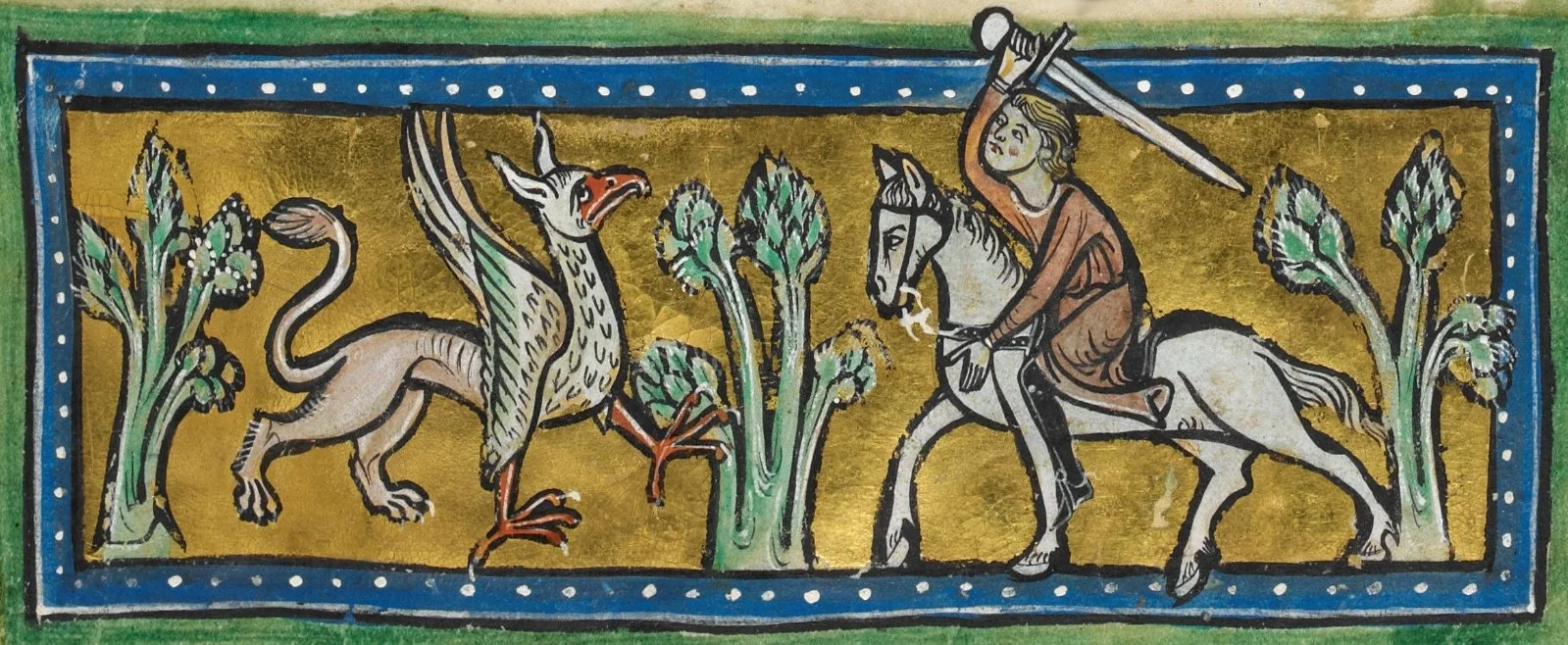
The griffin of the Rochester Bestiary (c. 1230): a reading of a text in paint — Pliny's ears, the wings, the beak's curve, the lion's body and tail. Public domain, via Wikimedia Commons.
The Creature
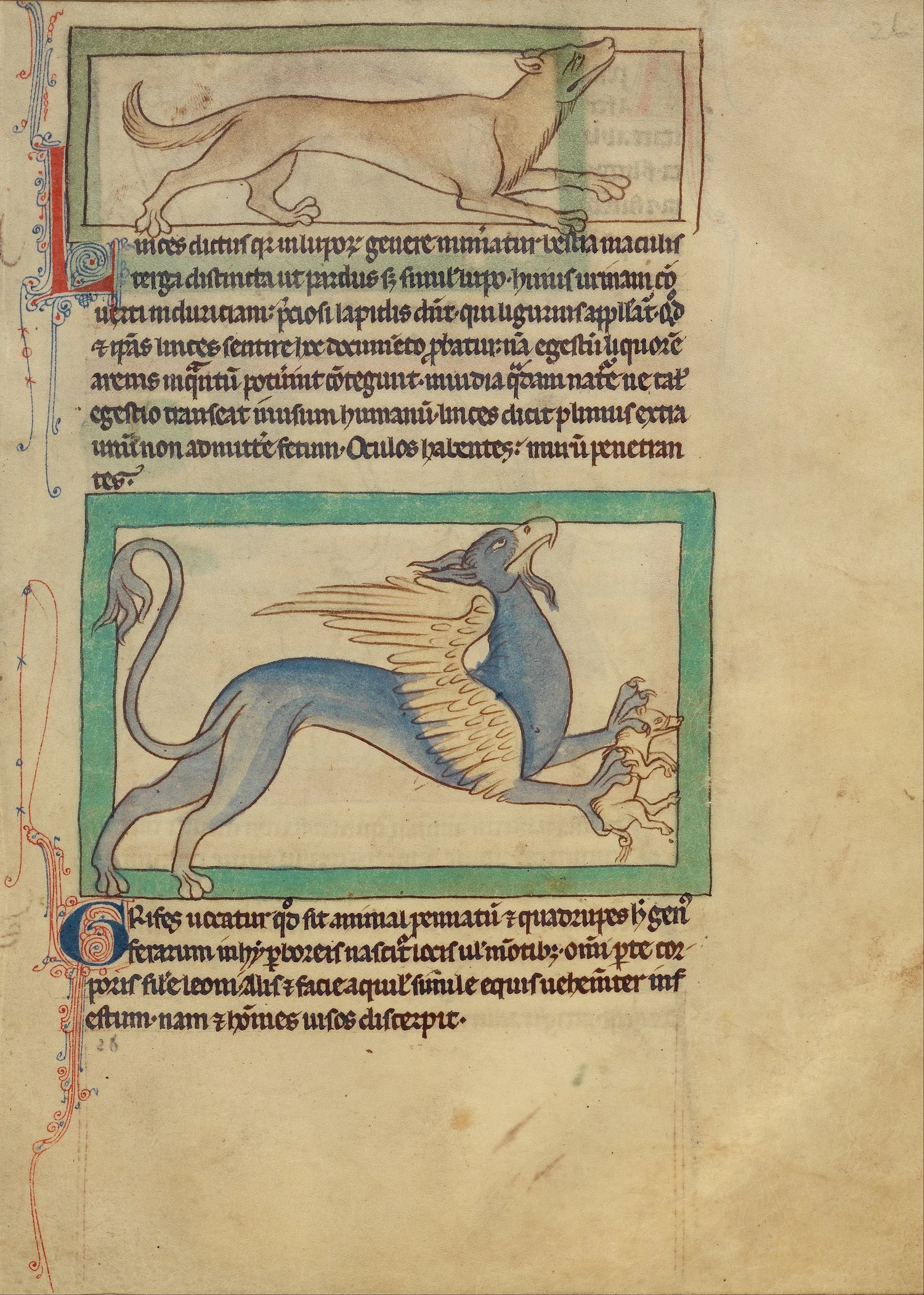
A bestiary folio that sets a lynx and a griffin on one leaf (medieval bestiary tradition): the griffin's picture line in the manuscript centuries, read in this lesson's first section and studied in the Guided Observation. Public domain, via Wikimedia Commons.
The griffin — Greek gryps, usually tied to grypos, "hook- beaked," for the eagle's curve of its beak — is the bestiary's great border creature: the head, beak, and wings of an eagle on the body and legs of a lion. Two kings of the animal world joined in one beast, the king of birds and the king of beasts, and set down together at the one address the griffin never leaves: the far edge of the known world, where the gold is.
That address matters more than the anatomy. In every early account, the griffin lives exactly one country past the last country the writer can check — beyond the Scythians in the northern waste, or in the gold mountains of India — and it is doing one job: guarding gold against the men who come for it. It stands where the writer's information runs out, facing back toward the people who told stories about it.
It helps to know the two real animals the body is made from, because both of them are impressive enough on their own. The eagle half is usually read as a big hunting eagle like the golden eagle, a bird with a wingspan of about two meters, a heavy hooked beak for tearing, and feathered legs ending in serious talons. The lion half needs less explaining, except to say that a male lion is about two meters in the body and can weigh 190 kilograms or more. Put those two together at full size and you have not invented a delicate creature. You have built the one animal nobody would want to meet guarding anything.
Notice, too, that the griffin arrives in the record by two doors at once. It is in pictures centuries before any Greek sentence about it survives, and it is in a poem that no one has been able to read for two thousand years, because the poem is lost. A keeper of this lesson must be comfortable with both kinds of evidence: the image that outlasts its caption, and the text that survives only in quotation.
The pictures begin long before the words. The griffin is cast in bronze in Archaic Greece — this lesson's second plate, a cauldron head with a long open beak and tall ears — and painted in the medieval bestiaries: the Rochester Bestiary's griffin of about 1230, at the head of this lesson, and a bestiary folio that sets a griffin beside a lynx on one leaf. The heraldic centuries that follow are read in the Tales below; the picture line resumes in 1865, when John Tenniel drew the Gryphon for Alice's Adventures in Wonderland — this lesson's fourth plate — and the gold-guard of the world's edge became a sleepy character in a children's book. One honest gap: the early printed griffins of the 1500s survive in books this class could not lawfully copy, so the line steps from manuscript to Tenniel in plates, though not in words.
First Told
✦ On the class test
The starred pin on this lesson's map stands at Knossos, on Crete, about 1450 BCE — and for once the star marks a painting, not a page. In the palace at Knossos, griffins flank the throne in the great frescoes of the throne room: crested, sharp-beaked, lion-bodied, drawn at the height of their dignity beside the seat of power. Look at them properly when you study the lesson's pictures. These early griffins have no wings. They lie down in an alert, sphinx-like pose, with tall crests on their heads and neat spirals worked over their necks and shoulders, more like decoration on a collar than any real animal's markings. The wings came later, as the telling moved and changed hands. What Knossos already has, complete, is the job: a pair of them, one on each side of the seat, watching the room. The date is approximate — frescoes do not sign themselves — but the meaning of the placement is plain enough: three and a half thousand years ago, the griffin was already the beast you set beside a throne to say this is guarded. Griffin shapes are older still in the art of Egypt and the Near East. The picture is older than any story we can read.
The written record begins with a book we do not have. In the seventh century BCE, a Greek traveler named Aristeas of Proconnesus journeyed far toward the rising sun, into the country beyond the Black Sea, and came home with a poem, the Arimaspea, about the peoples at the world's edge. The poem is lost — every line of it. What we know of it comes from the writers who quoted it, chiefly Herodotus, and what it said was this: past the Issedones live the Arimaspians, men born with one eye; and past the Arimaspians, the griffins, who guard the gold; and the Arimaspians ride out to steal it, and the two are at war forever.
Herodotus retells the whole chain about 430 BCE — the map's Athens pin — in Book 3 and Book 4 of his Histories, and a keeper should admire how he files it. He gives the story in full. He gives its source: Aristeas's poem. He explains the Arimaspians' name from the Scythian words arima, one, and spou, eye. And then he adds, in his own voice, one of the great sentences of this whole class: in the north of Europe there is by far the most gold — but I cannot say with assurance how the gold is produced, and as for the one-eyed men, I do not believe this. The first historian hands us the griffin and his own disbelief in the same paragraph. The record and the doubt were born twins; every keeper since has inherited both.
Athens heard the griffin on stage, too. In Aeschylus's Prometheus Bound, the chained Prometheus warns the wandering Io of the road ahead: "Beware of the sharp-beaked hounds of Zeus that do not bark, the griffins, and the one-eyed Arimaspian horde, mounted on horses, who dwell about the flood of Pluto's stream that flows with gold. Do not approach them." Hounds of Zeus — the griffin as heaven's guard dog, silent and sharp-beaked. It is a warning in a play, not a natural history, and the lesson files it as exactly that: evidence of what an Athenian audience was expected to recognize.
The Tales
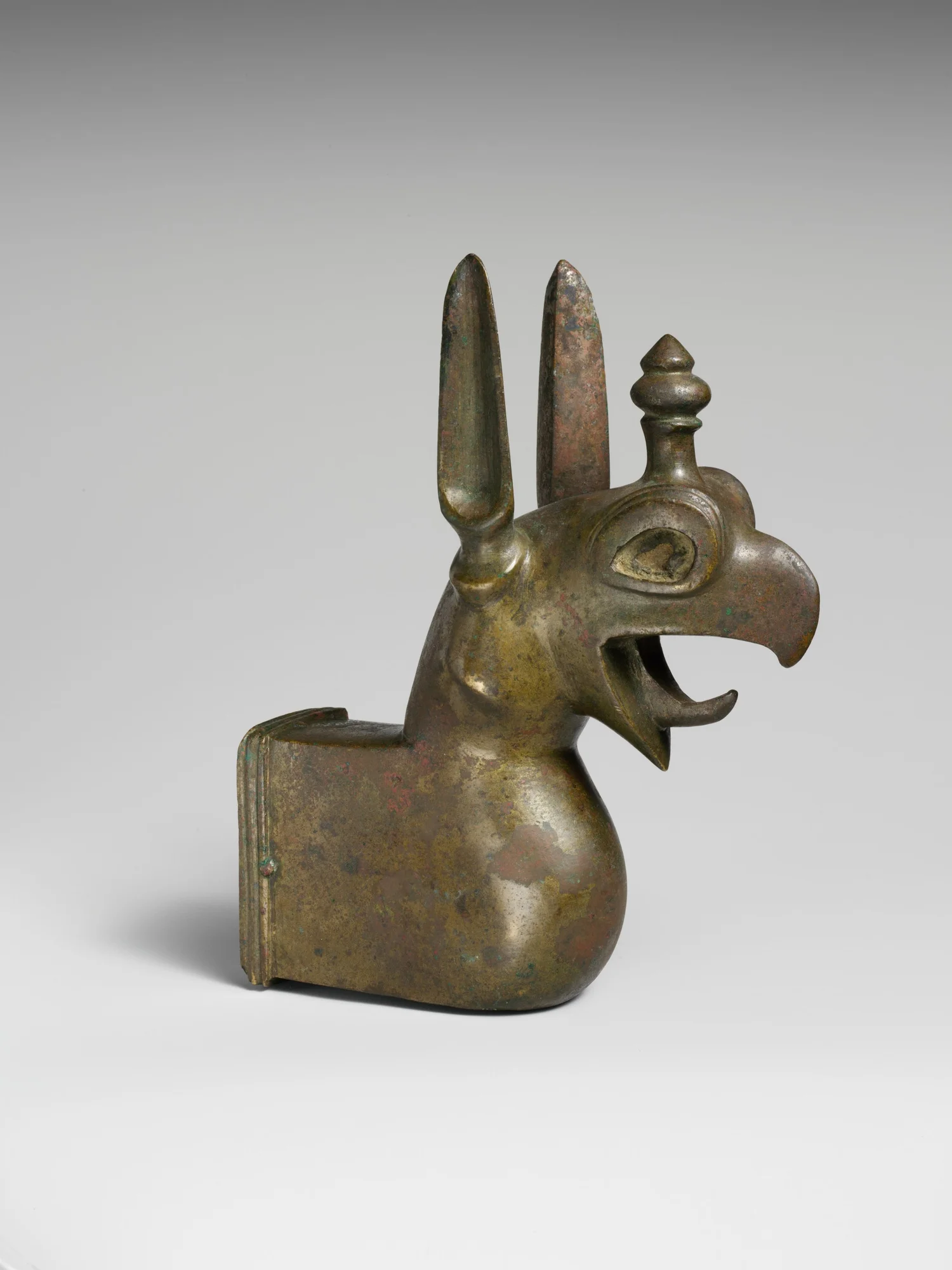
A griffin in real metalwork: a Greek bronze griffin head of the Archaic age, cast to rise from the rim of a great cauldron — a guardian with a job, made by craftsmen for a sanctuary. CC0, via Wikimedia Commons.
Rome took the file from Herodotus, as Rome took most things. Pliny's Natural History (77 CE — the map's Rome pin) reports that the Arimaspi "wage continual war with the griffins, a kind of wild beast with wings, as commonly reported, that digs gold out of mines, which the creatures guard and the Arimaspi try to take from them, both with remarkable covetousness." Pliny is also the first writer to state the anatomy in so many words: the griffins are winged, and long-eared — look for the ears in this lesson's plates, because generations of painters read that sentence. Meanwhile Lesson 7's physician had filed his own griffins: Ctesias puts them in the gold mountains of India, "four-footed birds" as large as a wolf, with a lion's legs and claws, red feathers on the breast and black on the body, where the gold is plentiful and hard to take because of them. Two frontiers, one beast: Herodotus's griffins face the Scythian north, Ctesias's face India, and the griffin sits wherever the gold runs out of the writer's knowledge. It is always posted on the far side of what the writer could check for himself.
Isidore of Seville (about 620 — the Seville pin) fixed the griffin for the Middle Ages in his Etymologiae: the eagle-lion, born in the Hyperborean mountains, and — his addition to the file — a great enemy of horses. Keepers can watch that hatred being born: the Arimaspians came on horseback, and a beast at war with horsemen became, in the copying, a beast at war with horses. The bestiaries received the griffin in that form. The Aberdeen Bestiary's griffin entry, about 1200, is the map's last pin, and the Rochester Bestiary's painted griffin — about 1230 — is the plate at the head of this lesson.
The Greeks had cast the griffin in metal long before they wrote it into bestiaries. The lesson's second plate is a Greek bronze griffin head of the Archaic age, made as an attachment for a great bronze cauldron: griffin heads rose around the rims of the mixing bowls dedicated in sanctuaries, guardians on guard duty at the feast. Get close to this one. The bronze-workers gave it a long, open beak with the tongue showing, a knob standing up on its forehead, and the tall ears Pliny would later put into words. Nothing about it is soft. It was made to rear up over the rim of a vessel at a feast and look like it meant business, and after more than two thousand years it still does. And in the fourteenth century the griffin took on one more office. In Dante's Purgatorio, a griffin draws the triumphal chariot of the Church through the Earthly Paradise — the two-natured beast, eagle and lion, read by Dante's world — in the one line of religious symbolism this lesson records, as depiction history — as a figure of Christ's two natures, divine and human, in one creature.
The griffin's tale is a single scene, repeated for a thousand years, and a keeper should notice how little it changes. There is gold in the ground at the edge of the world. The griffins are over it — in Pliny's version they dig it up themselves and guard the shining heaps. The Arimaspians come for it on horseback, one-eyed, riding in when they dare. The griffins fall on them. Neither side ever wins. The war is the tale.
Around that one scene, the details gather like burrs. The griffins lay their eggs in burrows in the gold-bearing ground. Their silence is famous — Zeus's hounds that do not bark, a guardian that gives no warning. Their enmity to horses outlives the horsemen who caused it. Dante gave the guardian a second frontier: the same beast draws the chariot in the Earthly Paradise, gazing at the sun with the eagle's eyes while standing on the earth with the lion's feet. A guardian at the border of the world, and a guardian at the border of heaven: the griffin's post never changed, only its frontier.
Set this beside Lesson 7 and notice the difference in kind. The unicorn had tales — stories with people in them, a virgin, a pool, a garden. The griffin mostly has the one scene, held in place. No one in the record talks to a griffin, tames one, or is saved by one. Men approach it and are driven off, or they carry its image home on a shield. What the griffin left behind, besides the scene, is objects — which brings us, as it brought the Middle Ages, to the treasury.
KEEPER'S CHECK-IN
The griffin's tale is a single scene repeated for a thousand years — what is that scene, who are its two sides, and why does neither side ever win?
Spotted
This section is honest about what it holds: the griffin has no eyewitness file. Nobody in any century files a plain account of meeting one, the way Polo filed his "unicorns" in the last lesson.
What stands here instead are reports of reports. Aristeas traveled toward the rising sun in the seventh century BCE and brought back a poem saying that griffins guarded gold past the Arimaspians; Herodotus repeated the report about 430 BCE and attached his own disbelief to it. An S mark on those lines means exactly that much: a sighting was reported, by a named man, at a named remove — Aristeas reporting what the Issedones told him, Herodotus reporting Aristeas.
The nearest thing to physical evidence was labeled objects: griffins' claws and eggs in church treasuries, recorded in inventories such as Durham's of 1383. The objects were real and the labels were wrong, and their full telling stands in the Watched-For box below.
KEEPER'S CHECK-IN
This lesson's Spotted file holds reports of reports, not eyewitness accounts — when Herodotus retold Aristeas's griffin story, what did he attach to it in his own voice?
What People Watched For — Griffins' Eggs and Claws
The griffin never came home alive, but its leavings did. Medieval treasuries and shrines kept objects labeled with the griffin's name, and the inventories — the driest, most trustworthy documents this class handles — record them plainly. The inventory of the shrine of St Cuthbert at Durham Cathedral, compiled in 1383, lists among the treasures two griffins' claws and griffins' eggs. A "griffin's claw" preserved from that world sits in the British Museum today: it is the horn of an ibex, an Alpine goat, in a later mount. Another claw was kept at Braunschweig Cathedral, said to have been brought from the Holy Land by Henry the Lion. The "eggs" were ostrich eggs — great, smooth, exotic shells arriving from the East — prized enough to be mounted in silver-gilt and kept as cups: the mounted ostrich-egg cups of the sixteenth century, like the Goodricke Cup of 1581, were still being called gryphon eggs in their own day.
So what people watched for was a wonder with a griffin's name on the label, arriving by ship or by pilgrim, to be given to a shrine or set in a lord's treasury as proof that the books were true. The custom the belief produced was a traffic in labeled wonders: ostrich eggs and goat horns, mounted in precious metal, displayed as evidence. The keeper's judgment on the whole arrangement is double, and should be written double: the labels were wrong, and the objects were real — an ostrich did lay that egg; an ibex did grow that horn — and the inventories that misname them are true records of what men treasured and why. F for the inventory. T for the griffin. The eggshell sits between them, and it is in a museum still.
What It Actually Is
No single animal stands behind the griffin the way the narwhal stands behind the horn, and this lesson says so. What stands behind it is a layer of things, and the keeper files them in order of strength.
First and firmest: gold, and the trade in it. The far north of Herodotus's world and the mountains of Ctesias's India were real gold country — the Scythian and Central Asian fields were worked and traded for centuries — and a story that set sharp-beaked guardians on the gold did useful work for everyone who repeated it: it explained why the gold was scarce, why it was dear, and why you should not go and see for yourself. A tale that guards its own source is a tale with a long life. File that as the keeper's reasoning about the record, not as a fact inside it.
Second, the pictures. The griffin's shape is older in art than in any text we can read — hawk-headed, lion-bodied guardians stand in Egyptian and Near Eastern art long before Aristeas, and Greek artists took the shape from the East the way they took the alphabet: as a going concern. The written griffin may simply be the Greek attempt to explain a picture everyone had already seen.
Second-and-a-half, if you like, is a real bird that has often been brought into this file, so you should meet it and know what it can and cannot explain. The lammergeier, or bearded vulture, is a huge mountain bird of Europe, Africa, and Asia, with a wingspan of about 2.3 to 2.8 meters, a wedge-shaped tail, and rusty-orange feathers on its front that it deepens by bathing in iron-rich dust and water. It lives on bone. It carries large bones high up and drops them onto flat rock to crack them open for the marrow, and it haunts exactly the kind of high, empty, gold-colored country the griffin stories come from. A bird that size, seen at a distance over a ridge, could feed a report. It cannot explain the lion's body, the ears, or the gold-guarding, and this lesson does not ask it to. Keep it where it belongs: a real animal that may stand somewhere in the background of the eagle half, no more proven than that.
Third, a modern hypothesis, and it must wear its label. In The First Fossil Hunters (2000), the scholar Adrienne Mayor proposed that Scythian prospectors in the gold country of Central Asia came upon the skeletons of Protoceratops — a beaked, four-legged dinosaur, lion-sized, its bones weathering out of the badlands by the thousand — and that the griffin is the report of those bones: the beak, the four lion-like legs, the eggs in the ground, even the gold, since fossils and goldfields share that desert. Protoceratops itself was a real and rather unglamorous animal — about 1.8 meters long, low to the ground, with a parrot-like beak, a bony frill at the back of its skull, and four sturdy legs. Its fossils turn up in the Gobi in large numbers, sometimes whole skeletons, sometimes in groups, which is part of why the idea caught on: this is not a rare bone that one traveler might have glimpsed once. It is a beautiful fit, and it is not proven. In 2024 two paleontologists answered that the fossil beds lie far from the ancient gold workings and that no ancient writer ever mentions bones. The class files Mayor's proposal exactly where it belongs: as a hypothesis — a T about the root, held by named scholars, argued in print, unresolved. Your entry will do the same, and will be the better for it.
Still With Us
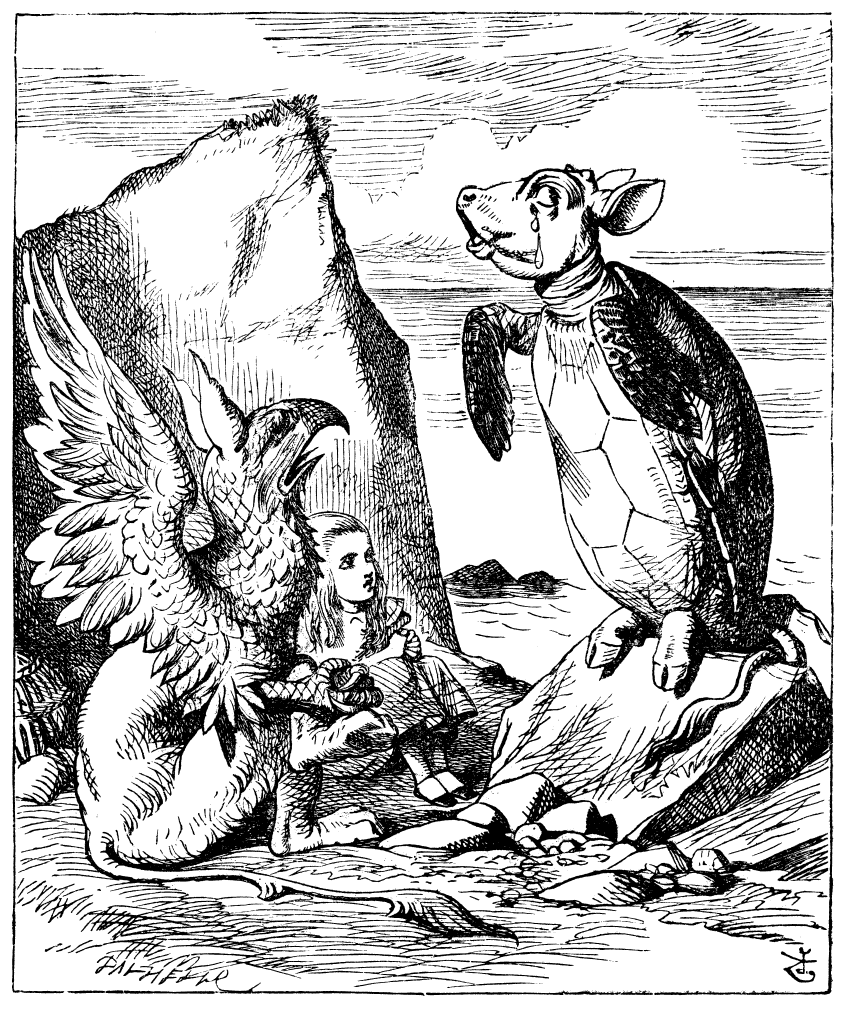
John Tenniel's Gryphon for Alice's Adventures in Wonderland (1865): Alice seated between the Gryphon and the Mock Turtle — the gold-guard of the world's edge become a sleepy character in a children's book, its ancient anatomy — beak, wings, ears, lion's body — unchanged. Public domain, via Wikimedia Commons.
The griffin's modern face was made by heraldry. A guardian beast, half king of birds and half king of beasts, was born to be painted on shields, and the griffin became one of the great heraldic animals — cresting arms, supporting shields, standing over the doors of banks and insurance houses, where its old job is the whole advertisement: what is inside is guarded. The eagle-lion on a modern badge is Pliny's beast with the paperwork done.
Dante's griffin never retired, either: every illustrated Purgatorio still harnesses the two-natured beast to the chariot, so the theological griffin rides on in the world's most-read poem while the heraldic griffin stands over the bank. And in the fantasy of our own century — games, novels, films — the griffin flies as a mount and a majesty, usually with its ancient temper restored: proud, dangerous, and not to be approached by thieves. Its oldest portrait is still worth the trip back to, though. At Knossos, where the file began, the throne-room griffins you see today were repainted by modern restorers working from fragments — the guardians themselves partly reconstructed, guarding a throne that is also reconstructed. Even the first record in this lesson comes with a keeper's problem attached, which is a fair note to end an entry on.
Tenniel's Gryphon of 1865 — this lesson's fourth plate — is the turn in person: the gold-guard sits in the sun, half asleep, answering a child's questions with riddles of its own. Herodotus's border beast had become safe company for the nursery, without losing a single part of its anatomy.
Guided Observation
Study the Rochester Bestiary's griffin at the head of this lesson (about 1230). The painter had read his authorities: find Pliny's ears — long, deliberate, impossible to miss once you know the sentence they come from. Find the wings, the beak's curve, the lion's body and tail. The picture is a reading of a text: nearly every mark on it answers to a sentence in this lesson. Write down which feature of the drawing you cannot trace to any sentence — every tradition has one, and finding it is a keeper's habit.
Then turn to the bronze: a Greek griffin head of the Archaic age, cast to rise from the rim of a great cauldron. This griffin is not in a book at all. It is equipment — a guardian with a job, made by craftsmen for a sanctuary. Compare its beak and crest with the Rochester painter's: the sculptors and the painters agree on the beak and the brow, across fifteen centuries. Where do they disagree? Write it down; disagreement between records is data.
Last, the folio: a bestiary leaf that carries a lynx and a griffin on one page. Two beasts, one parchment, no labels that a modern eye can use. How does the painter tell you which is which — what does he give the griffin that he denies the lynx? When you have answered, you will know exactly what the medieval world thought a griffin was: not the anatomy in general, but two or three marks, always the same.
Last, the fourth plate: Tenniel's Gryphon of 1865, drawn for Alice's Adventures in Wonderland. The anatomy is the ancient one — beak, wings, ears, lion's body — but the temper is new: the guardian is asleep in the sun. Write one sentence on what the picture proves about the griffin's 19th-century address: it had moved from the edge of the map to the nursery shelf.
Assignment Manual
✎ WRITTEN · ⚒ HANDS-ON · ◐ BOTH
◐ Both · Entry No. 8: The Griffin.
- Rule your entry page. Turn to the Scholar's Entry Page in this packet and rule the next page of your journal to match it, as you did for Entries No. 1–7.
- Write the griffin's entry, to the standard. First Told: both of them, honestly filed — the picture first (Knossos, about 1450 BCE, a star for an image) and the poem behind the text (Aristeas and the lost Arimaspea, seventh century BCE, surviving in Herodotus). How the Telling Grew: Herodotus and his disbelief; Aeschylus's hounds of Zeus; Pliny's wings, ears, and gold-digging; Ctesias's Indian griffins; Isidore's hatred of horses; the bestiaries. The Tales: the gold war, the one scene, told straight. What It Actually Is: the gold trade, the older pictures, and Mayor's fossil hypothesis — labeled a hypothesis, with its 2024 challenge in one line. Still With Us: heraldry, Dante, and the modern fantasy griffin, a line or two each. The Keeper's Line: your own judgment, in one or two lines.
- Sketch the joins. ⚒ On a spare sheet, draw the griffin from the Rochester plate, and as you draw, mark in the margin of your sketch every part eagle or lion as you come to it — beak, wings, ears, body, legs, tail. Then check your marks against Pliny's sentence and Herodotus's: "beasts like lions, but with the beak and wings of an eagle." If your sketch gives the griffin anything neither author gave it, name it in the margin: that extra is yours, or the painter's, and the entry should know it. Rule the finished sketch into your bestiary after the entry, or copy its marks into the entry's margin.
- Mark every line. Go back through your entry and mark every line in the margin, T for tale, S for a sighting-report, or F for fact, as always. The hard cases in this entry are the honest ones: Herodotus's disbelief is F — a fact about a man doubting; Mayor's fossil griffin is T — a tale about the root, held today, unproven; and the Durham inventory is F about an egg that was never a griffin's.
Materials
· Your bestiary journal, with Entries No. 1–7 in it
· Pencils, and a pen you like
· A ruler, for ruling your entry pages
· A spare sheet of paper, for the anatomy sketch in Step 3
· This lesson's packet (the Scholar's Entry Page is in it)
Reflection
Herodotus prints the griffin story in full, names its source, and says he does not believe the half of it — all in the same passage. What is a historian doing when he does that? Is his paragraph T, S, F, or a third thing your marks do not cover?
The griffin always lives one country past the last checkable one — beyond Scythia for Herodotus, in India for Ctesias. What happens to a border beast when the map fills in? Where do such beings live now?
Mayor's fossil griffin fits beautifully and is not proven. What is the difference between a beautiful fit and a proof — and which lines of your entry changed because you kept them separate?
A Closing Note
Two border beasts in, your bestiary has reached the size of a small treasury. Next lesson the shelf turns from gold to poison, and from the noblest anatomy in the book to the nastiest birth: the basilisk, Pliny's little king of serpents, and the cockatrice, his medieval heir, who was hatched — the record insists — from a rooster's egg. A rooster in Basel once paid for that story with his life, in court. Bring your marks; you will need them for a trial.
The Bestiary
Bestiary Keeper
Further Reading & Sources
Herodotus, Histories, Books 3 and 4 — the Arimaspians and the gold-guarding griffins, with the historian's own disbelief attached; the Godley translation is free at Perseus.
Aeschylus, Prometheus Bound — the griffins as the sharp-beaked hounds of Zeus, in Herbert Weir Smyth's translation at Perseus.
Pliny the Elder, Natural History, Book 7 and Book 10 — the Arimaspian war and the griffin's wings and ears, in the Bostock translation at Perseus.
Adrienne Mayor, The First Fossil Hunters (Princeton, 2000) — the Protoceratops hypothesis, stated by its author; read it as the hypothesis it is.
The Inventory of the Shrine of St Cuthbert (1383) — the griffins' claws and eggs at Durham, presented with the surviving claw (an ibex horn) at the British Museum's Treasures of Heaven pages.
Submit your work for this lesson using the form below.
CONTINUE IN THE BESTIARY HALL
← Previous · Lesson 7: The Unicorn Next · Lesson 9: The Basilisk & the Cockatrice →
Unit II — Beasts of the Land The Bestiary Hall — All 41 Lessons
The rest of Unit II: Lesson 7 · The Unicorn · Lesson 9 · The Basilisk & the Cockatrice · Lesson 10 · The Manticore & the Spotted Beasts · Lesson 11 · Giants & the Cyclops · Lesson 12 · Centaurs & Satyrs · Lesson 13 · The Wild Men of the Woods · Lesson 14 · Bigfoot & the Yeti · Lesson 15 · Real Animals in the Bestiary