

THE BESTIARY
Unit II · Lesson 9The Basilisk & the Cockatrice
Professor Sable Rookmere
Bestiary Keeper
The Bestiary Hall • School of Evershade
Professor's Introduction
This lesson holds a pair, and pairs are where keepers earn their keep. Two beasts, two names, two births — and a thousand years of writers cheerfully filing each one's papers in the other's folder. Your job is the unglamorous one: keep them apart. The basilisk is a Roman record, small and crowned and complete in Pliny. The cockatrice is a medieval birth, hatched from an egg no hen laid. Where the record merges them, say so; where it separates them, obey it. And when we reach Basel, read the trial the way you would read a bestiary entry — because that is what it became.
The Bestiary
Bestiary Keeper
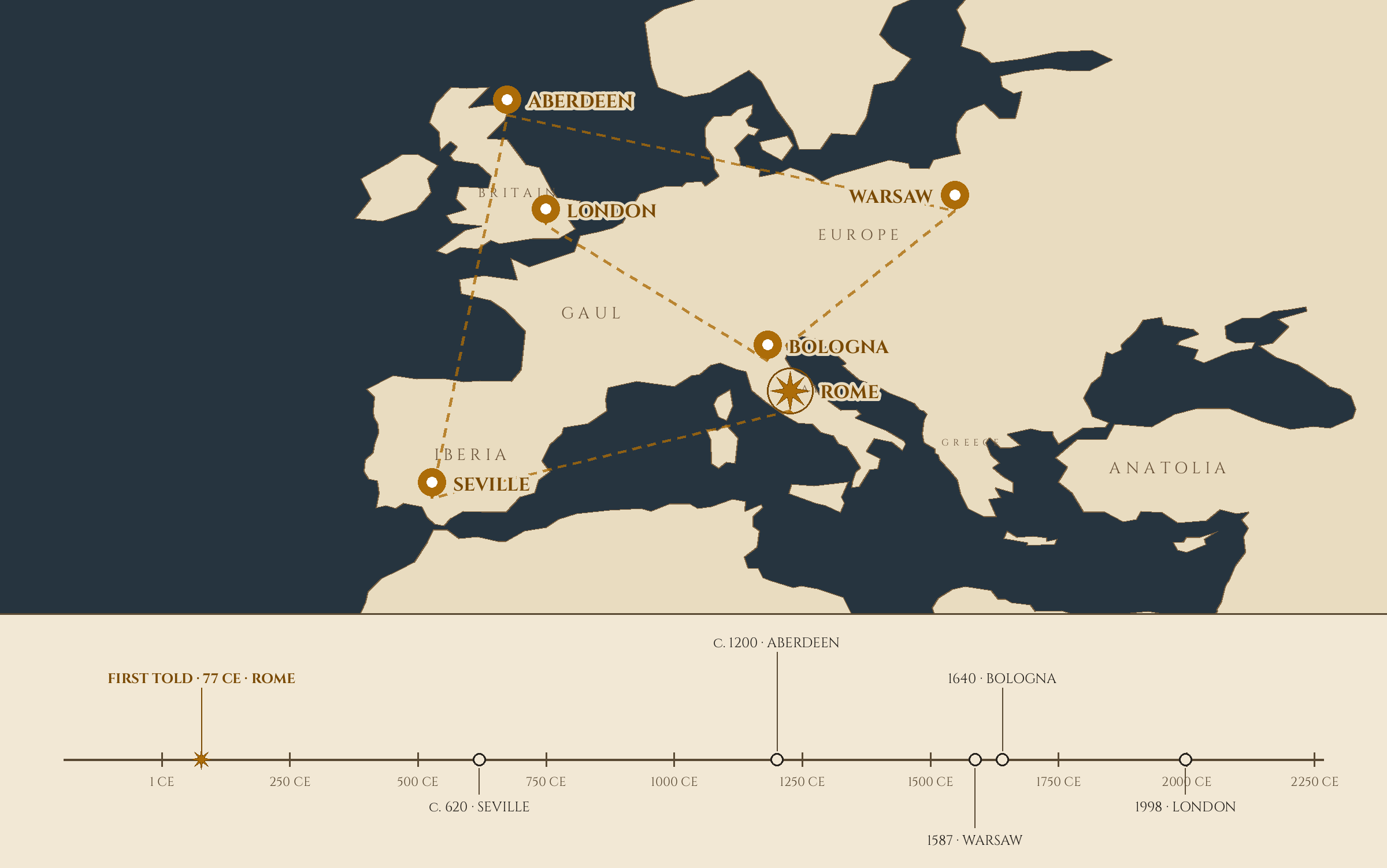
Where this lesson travels: Rome, where Pliny's Natural History gives the earliest full surviving account of the basilisk of Cyrenaica, whose breath and gaze kill; Seville, where Isidore crowns it king of serpents; Aberdeen, whose bestiary draws it crowned; Warsaw, where a basilisk was said to lair in an Old Town cellar; Bologna, where Aldrovandi prints the basilisk and cockatrice as natural history; and London, where Rowling's basilisk takes up residence in the Chamber of Secrets. The starred pin is the first record; the dashed line is the telling, traveling.
Lesson Objectives
By the end of this lesson, you will be able to:
- Give Pliny's basilisk as he gives it: its country, its size, its crown-mark, and the weasel that ends it.
- Explain the beast's name — little king — in both its Greek and Latin forms.
- Tell the cockatrice apart from the basilisk, and name the three stations where the second beast enters the record.
- Recount the Basel trial of 1474 as documented history, with the chronicler's flourish marked as one.
- Follow both beasts into print in 1640 and into the modern basilisk of 1998, and mark every line T, S, or F.
Your Assignment Packet
This lesson's work lives in its packet: the Lexicon Handout (every term, the core terms marked with the keeper's diamond ◆), Materials, Guided Practice, the Assignment Manual written out whole, the Scholar's Entry Page, the Reflection Questions, the Workbook Checklist, and the Keeper's Notes, for whoever teaches the lesson. Download the packet before you begin and keep it beside you as you read. The packet's assignment is Rookmere's own word for the work: Entry No. 9 — The Basilisk & the Cockatrice (written) ✎. The Unit II Quiz is not printed in the packet; it waits at the end of the unit, with Lesson 15.
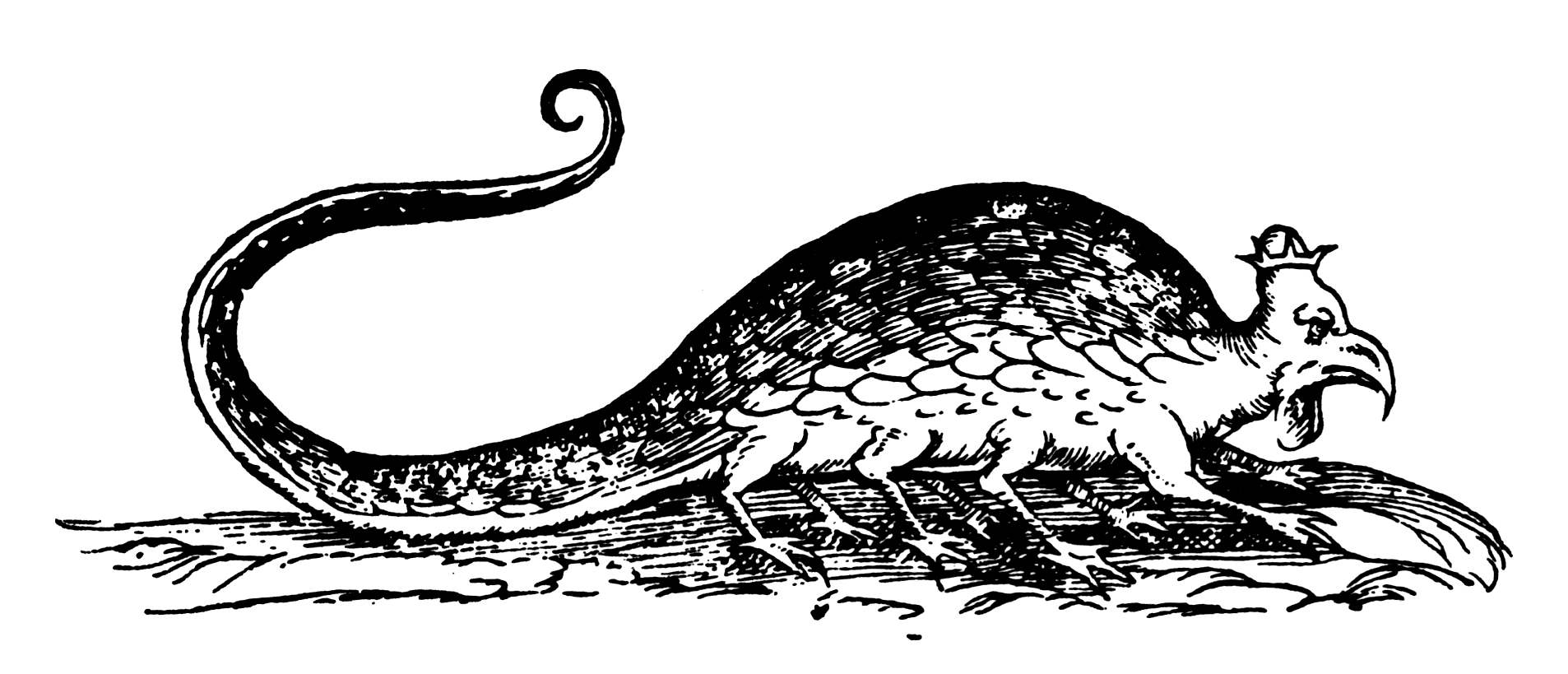
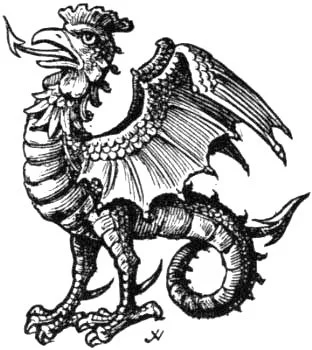
The basilisk of Ulisse Aldrovandi's Serpentum et Draconum Historiae (1640): every part of the animal is a sentence from the record — Pliny's crown and gaze, the Middle Ages' comb and birth, print's authority over the whole assembly. Public domain, via Wikimedia Commons.
The Creature
The basilisk carries its rank in its name. Greek basiliskos means "little king" — from basileus, a king — and the Latin name that runs beside it, regulus, means the same thing. The bestiaries say the name fits the beast twice over: it is king of the serpents, and it wears the reason on its head, a pale mark like a crown. Small as it is, everything in the serpent world flees before it, and its kingdom is wherever it has passed: grass withered, stones broken, the ground itself blasted.
The cockatrice is the basilisk's medieval heir, and it is a different animal. Where the basilisk is a small crowned serpent of the African desert, the cockatrice is a hybrid with a birth story: hatched from an egg laid by a rooster and brooded by a toad or a serpent, and pictured, once artists take it up, with a cock's head and comb, wings, and a serpent's tail. Its name is a tangle that a keeper should record as a tangle: it comes through Old French cocatris, and scholars have tied it both to the crocodile and to a Latin word for a tracker or hunter. The basilisk's name is a title. The cockatrice's name is a muddle, and the lesson will show you the histories tangling in much the same way.
A word on method before we open the file. Because the two were merged so early and so often — in the English Bible they are the same word — this lesson writes the pair as the census pairs them: each with its own record, its own dates, its own first appearance, filed in one lesson because the centuries filed them in one folder. Your entry will do the same: two firsts, two histories, one page, nothing borrowed across the line without a note saying so.
The pictures start a thousand years after the words — Pliny's basilisk was never drawn in antiquity — and that late start is itself a fact of the file. The Aberdeen Bestiary (about 1200) paints the basilisk as a small crowned serpent with the weasel at its heels. Aldrovandi's Serpentum et Draconum Historiae (1640) engraves the merged beast of the print age, crowned, combed, and winged. John Vinycomb's cockatrice of 1906, drawn for a book on symbolic creatures in art, tidies the same animal into a heraldic badge. Serpent, assembly, badge: three plates, three centuries' answers to the question of what the record's sentences add up to.
First Told
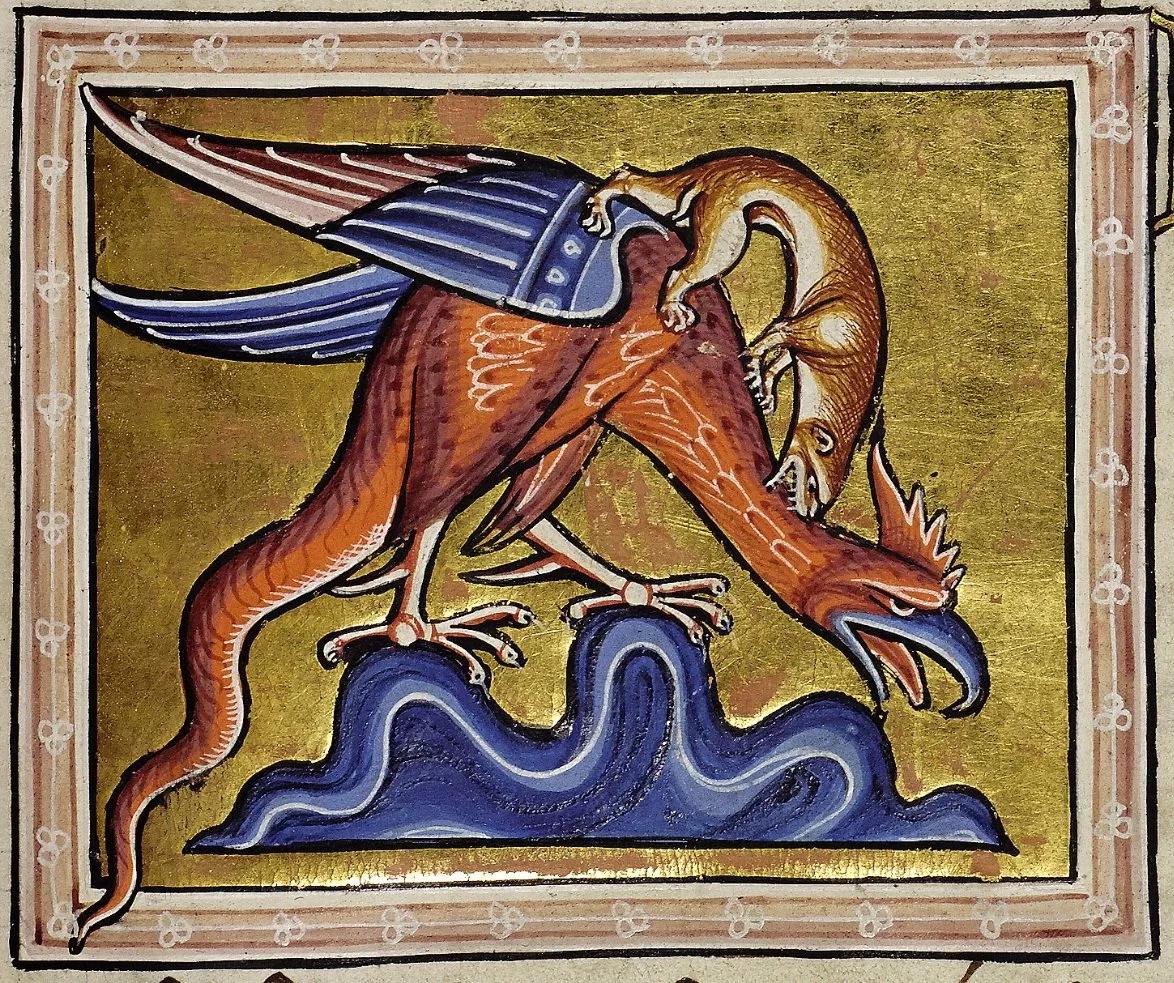
The Aberdeen Bestiary's basilisk (c. 1200): the crowned serpent-king, and at its heels the weasel, its one enemy, arriving on cue from Pliny's paragraph. Public domain, via Wikimedia Commons.
The starred pin stands at Rome, 77 CE, at Pliny's desk — the third lesson running whose star is a compiler, which should tell you something about where records come from. In Book 8 of the Natural History (8.33), Pliny gives the basilisk of Cyrenaica, the desert country of North Africa, in a paragraph a keeper can nearly memorize.
The basilisk is not more than twelve finger-breadths long — a span and a half; this king is a small animal. On its head is a white spot like a diadem, the crown the name promises. It routs all other serpents with its hiss alone. It does not crawl as other snakes do, with the body winding, but advances upright, with the forepart of its body raised — a king's posture. Its weapons are its breath and its gaze: it kills the shrubs it breathes on, withers the grass, and breaks stones by the power of its venom; a creature that looks on it dies. And it has exactly one enemy in the world. Men destroy it with weasels, thrown into its hole — a hole the wise can find by the blasted earth around it — and the weasel kills the basilisk by its very smell, and dies itself in the doing. King and weasel, poison and smell, both dead in the burrow: that is Pliny's whole account, and everything in this lesson is commentary on it.
Isidore of Seville, about 620 — the map's Seville pin — hands the basilisk to the Middle Ages with its title spelled out: basiliscus is regulus, king of serpents, because it kills before it bites; every serpent flees its hiss; and Isidore adds the rule of the gaze in its sharpest form — if the basilisk sees a man first, the man dies; if the man sees the basilisk first, the basilisk dies. The Aberdeen Bestiary, about 1200, paints the little king crowned, with the weasel at its heels — the second of this lesson's plates. Look at how small the painter has kept him. This is no dragon filling the page. It is a modest painted snake with a crown on its head and one determined-looking weasel coming up behind it, and the smallness is the point Pliny made: the most dangerous serpent in the book is about a span and a half long. Pliny's animal needed no birth story and no cock's feathers. For a thousand years, that was enough.
The Tales
The cockatrice enters the basilisk's file by three doors, and a keeper should be able to name all three.
The first door is a birth. About 1180, Alexander Neckam, an English scholar, wrote in his De naturis rerum the first full account of the idea that would remake the beast: the basilisk is born from an egg laid by a rooster, brooded in the warmth of a dunghill by a toad — in other tellings, by a serpent. A creature with such a birth could not stay a plain serpent. Through the thirteenth and fourteenth centuries it grows the cock's head, the comb, the wings; it acquires a second name; and the second name, in England, wins.
The second door is a translation. In 1382, John Wycliffe's English Bible used the word cockatrice for the first time in the language, to render the Hebrew words for venomous serpents in the book of Isaiah — following the Latin Vulgate, where the word had been basiliscus. The King James Bible kept Wycliffe's word — "out of the serpent's root shall come forth a cockatrice" — and so the medieval hybrid took up residence in scripture, standing over Hebrew sentences that meant a desert viper. As with the unicorn's re'em, the keeper files this as a record about translation; it is also the reason the cockatrice, a beast invented in twelfth-century Europe, could be believed in by people who believed they doubted fables.
The third door is another translation, and it is the marriage certificate of the pair. In 1397, John Trevisa, translating Bartholomeus Anglicus's great encyclopedia De proprietatibus rerum, came to the Latin basiliscus — Pliny's king, by way of Isidore — and rendered it into English as cockatrice. From that point the two names are synonyms in English, and the beasts share one file: the basilisk's killing gaze and crown, the cockatrice's egg and comb.
And in 1640, at Bologna, Ulisse Aldrovandi printed his Serpentum et Draconum Historiae, a serious history of serpents and dragons, with the basilisk and the cockatrice engraved as natural history — the plate at the head of this lesson. Print, which had made the unicorn beautiful, made the basilisk official: crowned, combed, and bound in a scholar's folio a century after Ole Worm had begun the great unmasking of Lesson 7.
The tales of this pair are working tales — instructions, almost, for living in a world where such things hatch.
First, the egg. When a rooster grows old — seven years or more, the record usually says — he may lay an egg: small, round, shell-less or thick-shelled, a wrong thing in the nest. If that egg is taken up and brooded by a toad, or by a serpent, in the warmth of a dunghill, what comes out of it is the cockatrice. The tale explains everything it needs: why the beast is rare (old roosters, watchful toads), why it is unnatural (a male birth, a foster-mother of another kind), and what must be done (find the egg first). Hold that last clause. The tale had a use, and the use had consequences, as the Watched-For passage will show.
Second, the counters. Against the basilisk's gaze, the record allows three defenses: see it first, as Isidore's rule runs; face it with a mirror, so the killing look returns on itself — the defense of the Warsaw tellings, and of the knight in mirrors in the English tales; and bring its one appointed enemy. The weasel needs no mirror. The bestiaries add that before the fight the weasel arms itself with rue, the bitter herb — the only animal in the book that takes its medicine before a battle. The real weasel is worth picturing here, because it helps the story rather than hurting it. A common weasel is a tiny, long-bodied hunter, only about 20 centimeters in the body, quick enough and bold enough to tackle prey bigger than itself — rabbits, for a start — and famous in farm country for slipping into burrows and hen runs. If you needed one small animal to send down a hole after a snake, a storyteller could do a lot worse than pick that one. Rue, for its part, is a real, strong-smelling, bitter herb. People carried it and planted it for its smell for centuries. And against the cockatrice the record sets one more sound than sight: the crowing of a rooster is death to it, the beast hatched from a cock's egg destroyed by a cock's voice. Keep that detail in your hand. It survives, unaltered, into 1998.
Third, the gaze itself must be filed carefully. In the old record, the gaze kills — outright, like the breath. It does not turn men to stone. The stone-turning gaze belongs to Medusa, and its marriage to the basilisk is a later accretion, completed by the games of our own century, whose basilisks and cockatrices petrify as a matter of game mechanics. A keeper who writes "its look turned him to stone" in an entry about Pliny's beast has filed a modern rule in an ancient folder. The old gaze was plainer and worse.
KEEPER'S CHECK-IN
The cockatrice enters the basilisk's file by three doors — can you name all three, and say which one married the two names in English for good?
Spotted
One sighting-report stands in this file, and the lesson keeps the caution its map keeps. In 1587, Warsaw filed its basilisk: a beast said to lair in a cellar of the Old Town, in a legend documented in the period. Later tellings send a man down against it armored in mirrors, to turn its gaze back on itself. File the cellar report S — a report was made, and that much is documented — and the mirror expedition T: it belongs to the tellings that grew around the report, not to any record of an attempt.
The Basel rooster of 1474 is not filed here. A trial is not a sighting; it stands in the Watched-For box below, where it belongs.
KEEPER'S CHECK-IN
Warsaw's 1587 cellar report and the mirror-armoured expedition of the later tellings are filed differently in this lesson — which mark does each one get, and why?
What People Watched For — the Cock on Trial
A belief that tells people what to watch for will eventually be watched for in earnest. The egg tale named a suspect: the old cock, past seven years, laying his small round egg. Households that knew the tale watched their aging roosters and feared the egg, for what the toad might hatch from it. And in 1474, at Basel in Switzerland, that watching came to law.
The record, as the legal historian E. P. Evans gathered it in The Criminal Prosecution and Capital Punishment of Animals (1906), runs so: a rooster that had laid an egg was put on trial in Basel, in solemn form. An advocate was appointed for the prisoner and argued the defense a keeper could respect: that no evil intent had been proved against the bird, that no injury to man or beast had resulted, and that the laying of an egg was an involuntary act and so no crime. The prosecution answered that the devil could enter brute creatures without any compact. The rooster was condemned and burned, with his egg, "for the heinous and unnatural crime of laying an egg."
The fear underneath the sentence is named in Evans's own pages: a cock's egg, hatched by a toad or serpent, was believed to produce a basilisk or cockatrice. Basel did not burn a bird for laying an egg. It burned a bird for what the egg might become. The scholar E. V. Walter, studying the case ("Nature on Trial," 1985), adds two keeper's details: the city chronicle reported that the executioner found three more eggs inside the bird — a flourish Evans himself refused to believe — and the same kind of prosecution was brought against another Swiss rooster as late as 1730. The custom the belief produced, then, was vigilance with the full machinery of a court behind it: the old cock watched, the egg feared and destroyed, and, at least twice in the record, a trial. File the trial as F — it happened, with dates, advocates, and a sentence. File the basilisk in the egg as T. The two filings are the whole lesson in one case.
What It Actually Is
No basilisk crawls in Cyrenaica, and no cockatrice has hatched anywhere; but the file has roots, and they are the usual two: an animal misdescribed, and an object misread.
The animal most often proposed behind Pliny's king is the Egyptian cobra of the North African deserts, and the fit is in the posture: a cobra rears the forepart of its body upright off the ground — Pliny's "basilisk" advances with the front of its body raised — and spreads a hood that carries markings a frightened report could crown. The Egyptian cobra is a substantial snake, commonly about a meter and a half long and sometimes over two meters, yellowish to dark brown, and it is genuinely dangerous; its venom attacks the nerves, and a bad bite can kill. That is still a good deal bigger than twelve finger-breadths, which is one reason to go carefully here. What the cobra gives the file is a real desert snake that rears up, faces you, and can kill you, in the right country, reported at third hand. The keeper files the cobra as the usual candidate, not as a proven identity, and notes that Pliny's measurements argue for a small snake seen at a great distance in every sense.
The object misread is the cock's egg itself, for such eggs are real. Hens sometimes lay small, round, yolkless eggs — "wind eggs," or cock's eggs in the old farmyard language. They turn up most often from young hens just coming into lay, or from older hens at the end of a laying stretch, when a bit of tissue instead of a yolk starts the shell forming. The result is a noticeably small, round egg, sometimes no bigger than a marble next to a normal one. In a farmyard without poultry science, a small wrong egg like that in the nest, found under an old rooster's regime, was filed under the rooster. Modern biology adds the Basel footnote: a hen whose ovary is damaged can take on a cock's plumage and crow and still lay eggs, which is the probable natural history of the prisoner of 1474. The egg was real. The rooster may have been a hen. The basilisk in the shell was the belief — and the belief, unlike the egg, hatched consequences.
Still With Us
The cockatrice drawn by John Vinycomb for Fictitious and Symbolic Creatures in Art (1906): a heraldic artist's beast, cock and dragon tidied into a badge. Public domain, via Wikimedia Commons.
Aldrovandi's engraving fixed the pair's portrait for the print age: one beast, crowned and combed, serpent and cock at once — the merger completed in a picture. Heraldry took the cockatrice for its own, wings and comb and serpent's tail, borne as the beast of families — the Langleys of Agecroft Hall in Lancashire carried it from the fourteenth century. The names stayed married in English Bibles into the modern era, until the Revised Version of the 1880s separated them again and gave Isaiah back his "basilisk," and newer translations still give him back his viper — the translation door swinging both ways across six centuries.
The modern face proper is the map's last pin: London, 1998, and J. K. Rowling's Harry Potter and the Chamber of Secrets. Her basilisk is Pliny's beast at full size and full power — a giant serpent, king of serpents, whose gaze kills outright, not into stone — and Rowling's school library states its birth in the medieval form: bred from a chicken's egg hatched beneath a toad. And the counter survives with it: the crowing of a rooster is fatal to her basilisk, and the villain of the book kills the castle's roosters to keep her weapon safe. A children's novel of 1998 holds, in one chapter, the Roman original, the medieval birth, and the medieval counter-charm — the whole file of this lesson, folded into a library page. It is the best modern portrait the pair will ever get, and it is accurate to the record in a way the record's own centuries often were not. It keeps the two names' histories wound together, the way history left them, without pretending they were ever really one beast.
Guided Observation
Study the basilisk at the head of this lesson — Aldrovandi's plate of 1640, drawn for a serious history of serpents. Look at what the engraver has assembled: the crown on the head, the cock's comb and beak, the wings, the serpent's body and tail. Notice, too, that he has put the creature up on legs and given it a strutting, barnyard confidence, as if it owned the ground it stands on. A plain serpent could not carry all the parts the record had piled onto this beast by 1640, so the engraver built an animal that could. Every part of this animal is a sentence from the record, and the sentences come from different millennia. Pliny gave the crown and the gaze; the Middle Ages gave the comb and the birth; print gave the whole assembly its authority. Write down which parts of the picture a reader of Pliny alone would not recognize, and which parts a reader of Neckam alone would miss.
Then the Aberdeen basilisk, about 1200: smaller, crowned, a painted serpent-king — and at its heels, the weasel, the only other animal in the story, arriving on cue from Pliny's paragraph. The painter has drawn the whole of Book 8.33 in one small scene: the king and his one enemy. Notice how much smaller the drama is than Aldrovandi's. The medieval picture is an illustration; the 1640 plate is a portrait.
Last, the cockatrice drawn by John Vinycomb for Fictitious and Symbolic Creatures in Art (1906) — the lesson's smallest plate and its most orderly: a heraldic artist's cockatrice, cock and dragon tidied into a badge. Three artists, three centuries apart in pairs: the painter who believed, the engraver who documented, the herald who tidied. Write one sentence on what each of them thought the beast was for.
Assignment Manual
✎ WRITTEN · ⚒ HANDS-ON · ◐ BOTH
✎ Written · Entry No. 9: The Basilisk & the Cockatrice.
- Rule your entry page. Turn to the Scholar's Entry Page in this packet and rule the next page of your journal to match it, as you did for Entries No. 1–8.
- Write the pair's entry, to the standard. First Told: two firsts in one field, each dated. For the basilisk: Pliny, Rome, 77 CE — the size, the diadem, the breath and gaze, the weasel. For the cockatrice: its entering wedge — Neckam's egg account, about 1180, and the name's first English appearance in Wycliffe's Bible, 1382. How the Telling Grew: Isidore's title and rule of the gaze; the egg birth spreading; Trevisa's translation of 1397 marrying the names; Warsaw 1587, with its caution; Aldrovandi's folio of 1640. The Tales: the old cock's egg; the three defenses (see it first, the mirror, the weasel with its rue); the cock's crow; and the gaze as the old record gives it — killing, not petrifying. What It Actually Is: the cobra as candidate, the yolkless egg as object, the Basel hen as footnote — each labeled as firmly as the lesson labels them. The Still With Us: Rowling's basilisk of 1998, with its birth and its counter-charm, in two or three lines. The Keeper's Line: your own judgment, in one or two lines.
- File the trial. Under your Keeper's Line, add two lines headed Basel, 1474: the trial in one sentence, marked F; the basilisk feared in the egg in one sentence, marked T. The pair's entry is not finished until the law report is filed with the beasts, because in this lesson the law report is part of the record.
- Mark every line. Go back through your entry and mark every line in the margin, T for tale, S for a sighting-report, or F for fact, as always. The discipline of this entry is the discipline of the pair: no line about the cockatrice may wear the basilisk's dates, and no line about Pliny's serpent may wear the cockatrice's comb.
Materials
· Your bestiary journal, with Entries No. 1–8 in it
· Pencils, and a pen you like
· A ruler, for ruling your entry pages
· This lesson's packet (the Scholar's Entry Page is in it)
· The lesson page, for the map and Aldrovandi's plate
Reflection
Pliny's basilisk needs no birth and no feathers; Neckam's needs an egg, a toad, and a dunghill. What does a beast gain, in the record, by acquiring a birth story? What does it lose?
The Basel court gave a rooster an advocate, a hearing, and a reasoned defense — and burned him anyway. Which part of that proceeding belongs in the bestiary, and which part belongs in a history of law? Can a keeper file it in both?
Wycliffe needed an English word for a Hebrew desert serpent and chose the most frightening serpent-word his century had made. What did his readers gain, and what did they come to believe that Isaiah never said?
A Closing Note
Nine entries in, and your bestiary has survived its first trial — the rooster's. Next lesson we return to Susa and to Ctesias, the physician of Lesson 7, for the beast he is most remembered by: the manticore, red as cinnabar, with a man's face and three rows of teeth. He brings company — two spotted beasts out of Pliny who call men by name in the dark. Mind how you answer, out there past the lamp-light.
The Bestiary
Bestiary Keeper
Further Reading & Sources
Pliny the Elder, Natural History, Book 8 (8.33) — the basilisk of Cyrenaica in a single paragraph; and Isidore, Etymologiae, Book 12, for its crown and title.
Alexander Neckam, De naturis rerum (about 1180) — the first full account of the basilisk hatched from a rooster's egg.
E. P. Evans, The Criminal Prosecution and Capital Punishment of Animals (1906) — the Basel trial of 1474 in the standard legal history of animal prosecutions.
E. V. Walter, "Nature on Trial: The Case of the Rooster That Laid an Egg," Comparative Civilizations Review (1985) — the Basel case studied closely, chronicler's flourish and all.
Ulisse Aldrovandi, Serpentum et Draconum Historiae (Bologna, 1640) — the basilisk and cockatrice as printed natural history; the plates are free at the Internet Archive.
Submit your work for this lesson using the form below.
CONTINUE IN THE BESTIARY HALL
← Previous · Lesson 8: The Griffin Next · Lesson 10: The Manticore & the Spotted Beasts →
Unit II — Beasts of the Land The Bestiary Hall — All 41 Lessons
The rest of Unit II: Lesson 7 · The Unicorn · Lesson 8 · The Griffin · Lesson 10 · The Manticore & the Spotted Beasts · Lesson 11 · Giants & the Cyclops · Lesson 12 · Centaurs & Satyrs · Lesson 13 · The Wild Men of the Woods · Lesson 14 · Bigfoot & the Yeti · Lesson 15 · Real Animals in the Bestiary