

THE BESTIARY
Unit II · Lesson 14Bigfoot & the Yeti
Professor Sable Rookmere
Bestiary Keeper
The Bestiary Hall • School of Evershade
Professor's Introduction

Lesson 13 ended at two pins on the map and two names in the newspapers, and I promised those names their proper length elsewhere. This is the elsewhere. The wild man has walked out of the romances and the carnival and into the age of the plaster cast, the expedition, and the DNA laboratory — and the file he gathered there is unlike any other on this shelf.
Two continents kept him, under two names, and for most of their histories the two records never met. Then, inside a single century, both were named in newspaper offices, searched for by expeditions, and carried into laboratories and tested, hair by hair and bone by bone. I have kept the two records apart inside every section, and joined them only where the record joined them. Mind the joinings. They are the lesson.
The Bestiary
Bestiary Keeper
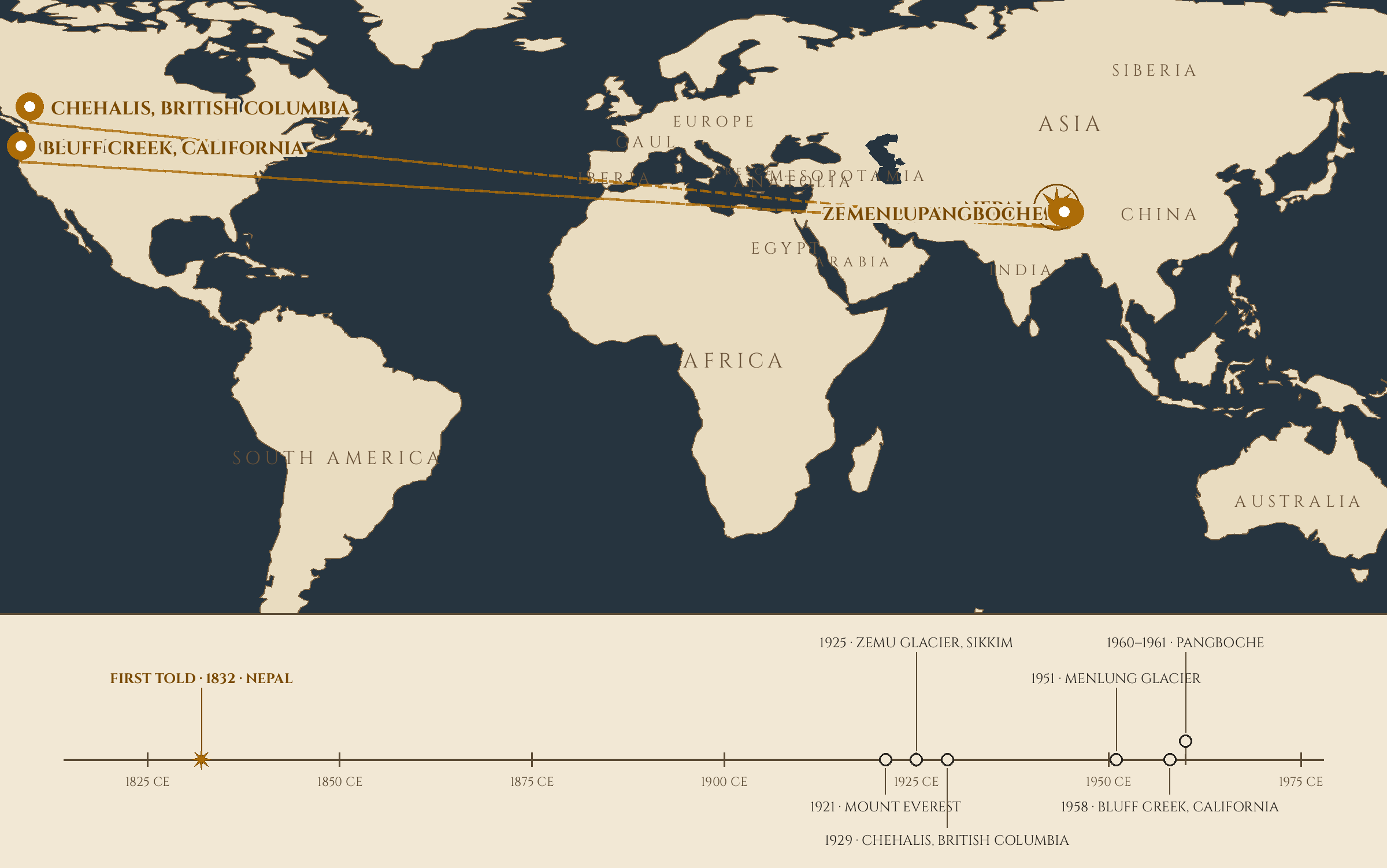
Where this lesson travels: northern Nepal, where Hodgson's 1832 report opens the Himalayan line; Everest, where the 1921 footprints brought the coinage Abominable Snowman; Sikkim, and Pangboche and Khumjung, where a hand and a scalp were kept as relics and later examined; the Harrison River, where the Sts'ailes word sasq'ets began and J. W. Burns carried it into English print in 1929; and Willow Creek and Bluff Creek, California, where Jerry Crew's 1958 casts coined the name Bigfoot and the 1967 film was made. The two geographies are joined on the page by a line no traveller in the file ever walked — the comparison a California columnist drew in print in September 1958. The meeting happened in a newspaper.
Lesson Objectives
By the end of this lesson, you will be able to:
- Give both beings' report profiles, and say why the yeti's refuses to settle into one figure.
- Tell both origin lines: the published record behind sasq'ets, and B. H. Hodgson's 1832 report from northern Nepal.
- Walk the dated chronology from 1832 to 2019, including the coinages of 1921 and 1958 and the Patterson–Gimlin film of 1967, filed as an event.
- State what customs the record actually documents for these beings, and what was searched for and not found.
- Give the laboratory's answers in full: Sykes 2014 with its 2015 corrections, Lan and colleagues in 2017, the Ketchum claim's failure, and Gigantopithecus against its own fossil record.
- Say why the belief persists — filing systems, television, town identity, and a picture every new witness has already seen.
Your Assignment Packet
This lesson's work lives in its packet: the Lexicon Handout (every term, the core terms marked with the keeper's diamond ◆), Materials, Guided Practice, the Assignment Manual written out whole, the Scholar's Entry Page, the Reflection Questions, the Workbook Checklist, and the Keeper's Notes, for whoever teaches the lesson. Download the packet before you begin and keep it beside you as you read. The packet's assignment is Rookmere's own word for the work: Entry No. 14 — Bigfoot & the Yeti (both) ◐. The Unit II Quiz is not printed in the packet; it waits at the end of the unit, with Lesson 15.
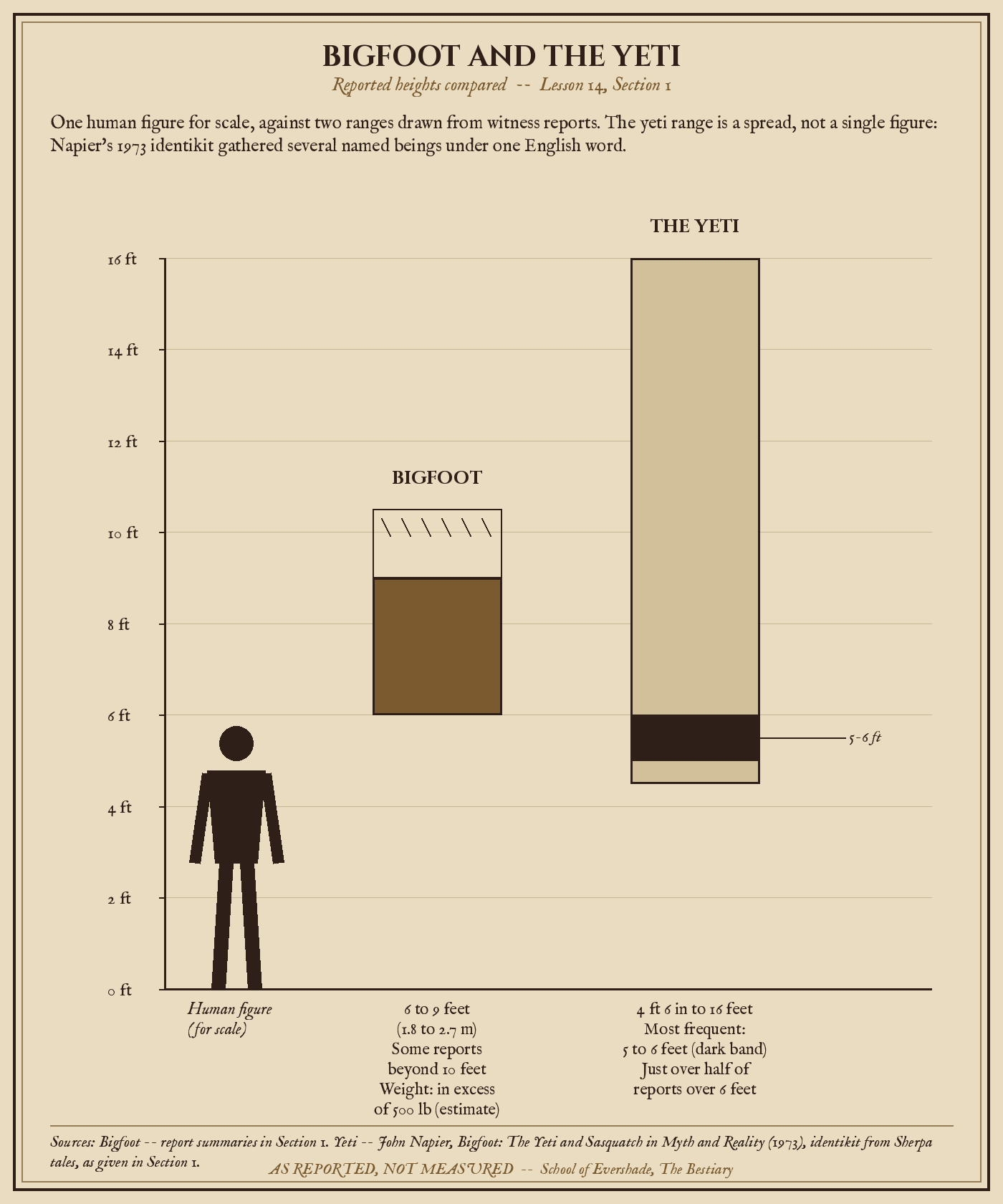
Comparative size diagram (typeset, school-made): a human silhouette set against two reported ranges — Bigfoot's reported 6 to 9 feet, ragged beyond 10, and the yeti's far wider spread, 4 feet 6 inches to 16 feet, darkened at 5 to 6 feet where Napier's reports cluster — labelled 'as reported, not measured'; drawn by the school from the written report ranges in this lesson, copied from no published chart.
The Creature
This lesson keeps two beings, and it keeps them apart. Bigfoot is the name given in 1958 to a large, hair-covered, upright-walking, ape-like figure reported from the forests of North America, most heavily from the Pacific Northwest and northern California. The yeti is an ape-like being reported from the Himalayan range in Asia, known in Western popular culture as the Abominable Snowman — a name coined in 1921 (§4). Popular culture treats the two as cousins, and has done since September 1958, when the columnist who publicised the founding Bigfoot tracks reached for "a relative of the Abominable Snowman of the Himalayas" as his comparison. The study of such reported beings outside the recognised animal record is called cryptozoology, and it has taught the two together ever since. This lesson does the same — but files their records separately inside each section, because the traditions did not merge themselves.
Bigfoot's description is a report profile — a summary of what witnesses have reported, not of an observed animal. Report summaries commonly give about 6 to 9 feet (1.8 to 2.7 metres) tall, some descriptions beyond 10 feet, and a weight "in excess of 500 pounds" — an estimate from track depth and witness impression, never from a weighed specimen, because no specimen exists. Hair black, dark brown, or dark reddish; build large and muscular; walk upright. The feet named him: tracks claimed in the general literature run as large as 24 inches (610 mm), and the founding 1958 cast was reported at about 16 inches (§4). Reports make him shy, elusive, often nocturnal — patterns in the reports, not observed behaviour. And the central absence stands in every responsible summary: no body, skeleton, bone, or tooth of a large unknown North American primate has ever been recovered and verified. The scientific consensus, as the standard reference entry summarises it, is that Bigfoot is a combination of folklore, misidentification, and hoax rather than a living animal.
The yeti's profile will not settle so neatly, because the Himalayan names in §2 do not all describe the same figure. The most careful published composite is John Napier's 1973 identikit — a description assembled from the reports on file — built from Sherpa tales in Bigfoot: The Yeti and Sasquatch in Myth and Reality. Napier is honest about the spread: heights from about 4 feet 6 inches to 16 feet; just over half the reports over 6 feet; the most frequent height 5 to 6 feet — "the size and build of a youth." Hair reddish-brown to dark brown or black, lighter on the chest; shoulders heavy and hunched; arms long; face partly naked, ape- or monkey-like. The famous conical head appears in only six of Napier's eighteen reports — file that count carefully. And the white yeti of the picture books is a Western invention: the coat is reported reddish-brown to black, "not typically white."
The pictures start late, and most are staged — a fact to be taught, not a gap to be papered over. There is no early picture tradition: no medieval illuminator drew Bigfoot, and no old Himalayan manuscript files the yeti the way the bestiaries file the unicorn. The visual record begins with nineteenth- and twentieth-century print and photography, and its famous items are not portraits of a creature — they are photographs of tracks and of relics, a newspaper photograph of a man holding a plaster cast, and, later, statues and costumes made after the fame. Temple paintings of the yeti do exist — photographed at Tengboche monastery in 1954 (§4) — describable in words, but not this school's to print. So this lesson's pictures are the school's own typeset work: a size diagram, a lesson map, and a timeline strip, specified in the Images block at the end.
First Told
✦ On the class test
Two origin lines, one for each continent — west first, because Lesson 13 has already done its heavy work there.
The Pacific Northwest line. The word that became Sasquatch begins with the Sts'ailes people of the Harrison River valley in what is now British Columbia — the Chehalis of the older records — and their Halq'eméylem (Upriver Halkomelem) word sasq'ets. Lesson 13 files this name-history at its proper length: the word, the language, Wayne Suttles's 1972 account, and J. W. Burns, the schoolteacher who carried it into English print in Maclean's on April 1, 1929. That filing is not repeated here. What this lesson adds is the weight alongside it. The glosses are not settled to one: sources give "hairy man" and "wild man," and Burns's own framing speaks of "a tribe of hairy people whom they claim have always lived in the mountains." Print the word, name the language and the nation, and give the glosses as glosses. And the figure in the Sts'ailes' own published accounts is not the magazines' cryptid: modern published statements describe sasq'ets as a caretaker and protector of the land — "not a cryptid at all… a caretaker who watches over the land" — with Sts'ailes member Kelsey Charlie quoted: "we were always told we were not to be scared of him." Modern published statements, filed at that weight: not ancient texts, and not a licence to elaborate. Burns compiled and wove his collected accounts into magazine articles (1929; The Wide World, January 1940); his mediation is part of the record, and his work has been criticised in print for presenting Indigenous stories under his own name. The traditions belong to the Sts'ailes and their neighbours; this lesson reports them only as the published record reports them.
The Himalayan line. The earliest Western print record verified for this lesson stands in 1832, three layers thick in one paragraph. B. H. Hodgson, in the Journal of the Asiatic Society of Bengal, reported that his shooters in northern Nepal had been alarmed by a "wild man" — it "moved, they said, erectly: was covered with long dark hair, and had no tail." His men took it for a rakshas — a demon, in their own country's religious categories — and fled. Hodgson doubted them and suggested an orangutan. A reported being, a local category applied by the witnesses, and a sceptical recorder: all three layers are the record. L. A. Waddell's Among the Himalayas (1899) continues the line — large footprints, the incident dated 1889 in most summaries, his guides' description of their maker — and Waddell concluded the prints were a bear's.
The word yeti is Tibetan: from g.ya' dred — g.ya', "rocky place," and dred, "bear" — roughly "bear of the rocky place"; the Sherpa form yeh-teh is the usual form given for its entry into mountaineering English. That is the standard reference derivation, presented as such. Around it stands a cluster of names — the real Himalayan record. Meh-teh (also mi-teh), "man-bear." Dzu-teh, "cattle bear," identified in the same sources with the Himalayan brown bear: Charles Stonor's 1955 account, as summarised in the scholarly literature, has Sherpa informants distinguishing the four-footed, livestock-killing dzu-teh from the two-legged mi-teh, which they insisted was not a bear. Migoi, "wild man." A smaller figure, teh-lma, appears in cryptozoological tabulations, thinly sourced outside that literature, and is named only as such. Altitude follows the name: classic snow-track reports were noted in 1961 as restricted to 16,000 feet and above; other figures belong to lower forests. The beings sit, as history, inside Buddhist and pre-Buddhist Himalayan religious life — H. Siiger's finding, as summarised in the reference literature, is that the yeti "was a part of the pre-Buddhist beliefs of several Himalayan people" — and monasteries kept objects as relics (§4). No rite is described here.
One neighbouring name is filed only to be kept apart: the yeren, "wild man," belongs to Shennongjia, central China, with its own record (1555; investigations from 1977) — geography, language, and tradition keep it apart, and so does this lesson.
The Tales
These beings have no ancient tale-cycle — no epic, no wedding fight — and a keeper files that absence honestly before filing what stands in its place: two sets of local tellings, and a modern print tradition.
The Himalayan tellings sort the being before they story him. Published accounts describe attitudes that are not one attitude: Sherpas as "almost ambivalent," in the reference summaries; Tibetans viewing the being as one to be dreaded, fierce in mural art; Nepalese stories of yetis coming down to feed on livestock and terrify people. Ang Rita Sherpa's published account distinguishes kinds by their deeds — a messenger of calamities; a kind preying on goats, sheep, and yaks; a kind attacking animals and sometimes men — and reports descriptions of about 6 to 8 feet, with the conical scalp. File all of that as published accounts describe: summaries of oral tradition by named writers, never a catechism of what Sherpas believe today. The sharpest telling is Stonor's informants' distinction of 1955: the dzu-teh that kills livestock is a bear, and is called one; the mi-teh is not a bear. The people closest to the being drew a line inside their own tradition, and a keeper does not erase it either way.
The Pacific Northwest tellings reached print through one man's magazine craft. Burns's 1929 article announced itself as "a collection of strange tales about British Columbia's wild men, as told by those who say they have seen them." His tales presented the hairy giants as a people of the mountains, living in tunnels and caves, and the magazine form gathered many tellings, from one people's word, into a single creature with a single English name. Suttles's caution is this section's too: sasq'ets is one of a number of Coast Salish terms, and the gathering was Burns's doing, not the word's. Against the magazine version stand the Sts'ailes' own published tellings — the caretaker who watches over the land; Sasq'ets Tel, "the place where the Sasquatch gather," published as the source-place of the word. Two tellings, two beings wearing one name: the magazine's giant and the nation's caretaker. The entry keeps both, labelled.
KEEPER'S CHECK-IN
Two tellings wear one name in the Pacific Northwest — how do Burns's magazine tales present the hairy giants, and how do the Sts'ailes' own published tellings present sasq'ets?
Spotted
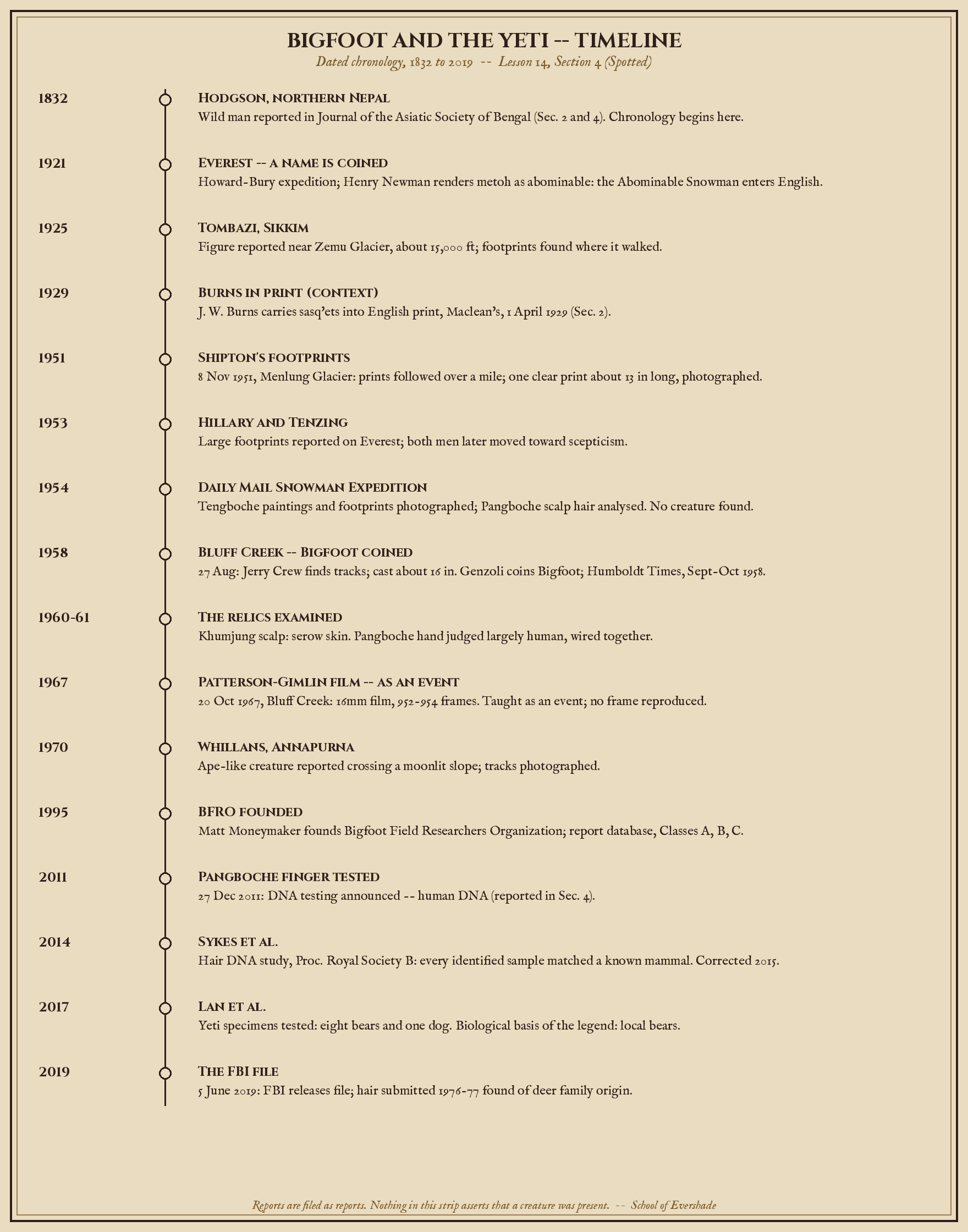
Timeline strip (typeset, school-made): the dated chronology 1832–2019 — Hodgson's 1832 report from northern Nepal, the coinages of 1921 (Abominable Snowman) and 1958 (Bigfoot), the Patterson–Gimlin film of 1967 filed as an event, and the laboratory answers: the relics examined 1960–61, the Pangboche finger's human DNA in 2011, Sykes 2014 with its 2015 corrections, Lan and colleagues in 2017, and the FBI file released in 2019.
This register is a register of reports. "Reported" means a named person or expedition reported the thing in a dated source. Nothing in this section asserts that a creature was present.
1832 — northern Nepal. Hodgson's report, filed in §2. The chronology begins here, not in 1921; 1921 is when the famous English name begins.
1921 — Everest, and a name is coined. Lieutenant-Colonel Charles Howard-Bury led the 1921 Everest reconnaissance (Mount Everest: The Reconnaissance, 1921). Crossing the Lhakpa La at 21,000 feet (6,400 m), his party found footprints he believed were a large "loping" grey wolf's double tracks, "rather like those of a barefooted man." His Sherpa guides, he wrote, volunteered that the tracks must be those of "The Wild Man of the Snows," named metoh-kangmi — metoh "man-bear," kang-mi "snowman." The word travelled to Calcutta, where Henry Newman of The Statesman, interviewing the returning porters at Darjeeling, rendered metoh as "abominable" — and the Abominable Snowman entered English. File the coinage in two lines. The chain — book, porters' term, Newman's 1921 coinage — is documented: F. The exact step to "abominable" is told as a mishearing of metoh as metch, "filthy," and the good sources hedge it ("perhaps out of artistic licence"). The coinage is record; the mechanism is retelling, taught with the hedge visible.
1925 — Tombazi, Sikkim. N. A. Tombazi, a Greek photographer and Fellow of the Royal Geographical Society, reported watching, near the Zemu Glacier at about 15,000 feet (4,600 m), a figure "exactly like a human being, walking upright," pausing to pull at dwarf rhododendron bushes, and finding footprints where it had walked. Tombazi presented himself as a sceptic; that is part of the account, not corroboration. The report is solid as a report.
1951 — Shipton's footprints, Menlung Glacier. On 8 November 1951, Eric Shipton, with Michael Ward and Sen Tensing, followed a line of prints for more than a mile and photographed them, an ice axe beside one clear print for scale. No casts were taken; the photographs are the whole record, published in The Times in December 1951. The print is described here in words, as this lesson's rule requires: a single clear print in snow, about 13 inches (about 33 cm) long. The picture itself is not in this lesson: the originals are held in the Royal Geographical Society's archives, London, and modern scholarly use prints it by the Society's permission. Until a licence is obtained and filed, it is rights-held, and a keeper describes it — date, place, dimensions — without reproducing it.
1953 — Hillary and Tenzing reported large footprints on Everest; both men's later positions moved toward scepticism — teach the change. 1954 — the Daily Mail Snowman Expedition photographed the Tengboche paintings and many footprints, and reported Pangboche scalp hair analysed by Frederic Wood Jones. It found no creature. Late 1950s — the Pangboche hand: expeditions funded by Texas oilman Tom Slick learned of a mummified hand kept at Pangboche as a relic, and Peter Byrne obtained a finger — the accounts disagree (a donation, in one version; fragments removed and replaced with human bones, in Byrne's own). Teach the disagreement, not the cleaner version. The finger reached primatologist W. C. Osman Hill, who first called it hominid, then, in 1960, "a closer match with a Neanderthal."
1958 — Bluff Creek, and a second name is coined. In late August 1958 — dated 27 August in Joshua Blu Buhs's account — Jerry Crew, a bulldozer operator on a logging road above Bluff Creek, Humboldt County, California, found large human-like footprints around his equipment. Taught casting by taxidermist Bob Titmus, he made a plaster cast reported as about 16 inches long. Coralie Bemis wrote to columnist Andrew Genzoli of the Humboldt Times; Genzoli printed the letter on 21 September 1958, with the line about "a relative of the Abominable Snowman of the Himalayas" that joined the two records in print, then met Crew — and on 6 October 1958 the paper ran Crew holding his cast on its front page. Genzoli coined the name: the workers' "Big Foot" closed into Bigfoot. The record's noise is filed, not hidden: a later Times-Standard retrospective gives the cast as 18 inches, where most accounts give 16 — print "about 16 inches, as most accounts give it." A posthumous family hoax claim attaches to these tracks — the Wallace wooden feet of 2002 — and is filed with its published objection in §5.
1960–61 — the relics examined. The Khumjung scalp, kept at Khumjung monastery as a yeti relic, was borrowed with a Sherpa escort, on agreement it would return within thirty days, and examined in Paris, Chicago, and London. Verdict: the skin of a serow, a Himalayan goat-antelope. At Pangboche, Hillary's party dismissed the hand as a construction — wired together, the wiring dating to Byrne's 1959 interference — and judged the bones largely human. Khumjung had asked in return for a school; Hillary built the Khumjung school in 1961. And the finger: a fragment bequeathed with Osman Hill's collection to the Hunterian Museum was rediscovered there, and DNA testing announced on 27 December 2011 by the Royal Zoological Society of Scotland found human DNA — Rob Ogden: "Human was what we were expecting and human is what we got." The Pangboche hand and scalp themselves were later stolen from the monastery, after television exposure in 1991 in several accounts, and are missing.
1967 — the Patterson–Gimlin film, as an event. On 20 October 1967, Roger Patterson and Robert "Bob" Gimlin, on horseback along Bluff Creek, about 25 miles northwest of Orleans, California, reported a large dark upright figure crossing a sandbar, and Patterson filmed it on 16mm colour film: some 952 to 954 frames, under a minute of subject footage, the famous look-back at Frame 352. Patterson — who had self-published Do Abominable Snowmen of America Really Exist? in 1966 — died in 1972 maintaining it was real; Gimlin has consistently denied any hoax. Bob Heironimus later claimed to have worn an ape costume: a claim, contested, never adjudicated. No peer-reviewed finding establishes the figure as animal or costume: undebunked, and unconfirmed. The film is taught here as an event, in words, because its rights are contested — still-frame rights specifically litigated — so no frame, and no tracing or redrawing of any frame, appears in this school's material. Its afterlife is the teachable fact: the most reproduced piece of Bigfoot evidence ever filed, fixing the modern idea of Bigfoot in one silhouette.
1970 — one line. Don Whillans reported an ape-like creature crossing a moonlit slope on Annapurna, and photographed tracks. 1995 — the reports organise. Matt Moneymaker founded the Bigfoot Field Researchers Organization — the BFRO — whose report database, classified Class A, B, or C, held more than 5,000 reports by a peer-reviewed count in 2017: a record of reports, used at exactly that weight in §5. 2019 — the file that says "deer." On 5 June 2019 the FBI released its Bigfoot file: hair Byrne submitted in 1976–77 was found "of deer family origin."
KEEPER'S CHECK-IN
The Khumjung scalp was lent for examination on agreed terms, and the examination reached a verdict — what were the terms, and what was the scalp found to be made of?
What People Watched For — Relics Kept, and a Warning at Bedtime
The honest answer first: this box is thin — thinner than for almost any other being in this class — and it is not padded.
On the Himalayan side, the documented custom is keeping. A hand was kept at Pangboche and a scalp at Khumjung as yeti relics — a relic being an object preserved and venerated for its connection to a revered being — shown to visitors, examined only by negotiation, and, for Khumjung, lent only against return within thirty days and a school built in exchange (§4). The Khumjung scalp is still displayed in modern visitor accounts, for a small donation toward the monastery's maintenance. The keeping is the custom; the materials are a separate question, answered in §4 and §5 — serow skin, human bone. Published Sherpa-side commentary makes the same distinction: Ang Rita Sherpa's history treats the scalp as the monastery's treasure regardless of zoology. The second documented custom is a use, not a rite: published accounts describe the yeti in Sherpa bedtime stories to keep children disciplined, and, in a modern synthesis, as a symbol of danger — probably a warning so people do not wander away. That is a published secondary summary, filed at that weight; no specific warnings are printed, because none were found in a checkable source. The earliest record carries its own watching-for: Hodgson's guides in 1832 fled what they took for a rakshas.
On the North American side, the sturdiest custom-evidence is a place-name: Sasq'ets Tel, "the place where the Sasquatch gather," published with a named Sts'ailes speaker. Willow Creek's festival and Harrison Hot Springs' museum are documented customs around the being — celebrations, not beliefs; nobody leaves offerings, they hold a parade — and they are filed in §6.
What was searched for and not found, and so is not printed as custom: protective charms or "never whistle" rules attached specifically to Bigfoot — such rules belong in folklore to other beings, and transferring them would be invention; any Himalayan ritual or festival to the yeti — none was found, and the Dumji festival in the Khumjung scalp's local history is a shared village festival, not a yeti festival; and any old "Bigfoot crossing" sign lore — the signs are modern tourist artefacts. A thin box, honestly labelled, beats a full one invented.
What It Actually Is
✦ On the class test
The scientists' own summary, at their own length: every physical sample attributed to either being that has been tested with published methods in a peer-reviewed venue has come back as a known animal — most often a bear, on both continents — a known domestic animal, or a human. No tested sample has come back as an unknown primate. That is a statement about samples tested; Sykes and his colleagues wrote the boundary themselves — their survey "cannot refute the existence of anomalous primates, neither has it found any evidence in support."
Sykes, 2014. Sykes (Oxford), with colleagues, solicited hair samples through Oxford and the Museum of Zoology, Lausanne: 57 received, 37 selected, DNA recovered from 30, identified by mitochondrial DNA sequencing — the small, maternally inherited DNA loop that identifies a species from a hair — published in the Proceedings of the Royal Society B in 2014. Every identified sample matched a known living mammal: the North American samples matched American black bear, raccoon, sheep, porcupine, wolf, coyote, dog, horse, cow, deer — and one human. The headline exception was Himalayan: two samples (no. 25025, Ladakh; no. 25191, Bhutan, from a migyhur nest) matched, over a 104-letter fragment, a sequence the paper described as an ancient polar bear over 40,000 years old, "but not to modern examples of the species." Then the corrections — a lesson printing the headline without them would teach a withdrawn impression. In 2015, Edwards and Barnett showed the claim was incorrect: the hairs match at 100% a modern polar bear sequence in the public GenBank archive (GU573490, Alaska); the ancient sequence differs by one letter-change, at a spot prone to decay damage; the sequences most likely belong to the Himalayan brown bear, Ursus arctos isabellinus. Gutiérrez and Pine, also 2015: a 104-letter fragment is "not sufficiently informative," and "there is no reason to believe that the two samples came from anything other than Brown Bears." Sykes and colleagues published a correction in 2015. Final standing: the "ancient polar bear" yeti was a corrected error. Headline, scrutiny, correction — the sequence is how science works.
Lan and colleagues, 2017. A fuller mitochondrial study from Charlotte Lindqvist's laboratory at the University at Buffalo, in the Proceedings of the Royal Society B: nine purported yeti specimens — bone, tooth, skin, hair, faecal samples, provided through a television production — analysed alongside 23 Asian bears. Eight were bears: one Asian black bear, one Himalayan brown bear, six Tibetan brown bears. The ninth was a dog. The paper: the analyses "strongly support… the biological basis of the yeti legend to be local, extant bears" — Lindqvist: "the biological underpinnings of the Yeti legend can be found in local bears." The study also produced the first complete mitochondrial genomes for the Himalayan brown and black bears. The legend carried the samples in; the samples taught the bears.
Ketchum, 2013 — the claim that failed scrutiny. Melba Ketchum and colleagues claimed, in a journal called De Novo, human mitochondrial DNA joined to novel nuclear sequences in submitted "sasquatch" samples — a human hybrid origin. The paper appeared in a journal Ketchum had acquired and renamed after mainstream journals declined it, bypassing normal peer review — independent specialist scrutiny before publication. Published criticism centred on contamination, and on the sequences never being deposited in GenBank, the public archive where such claims are checked; independent re-examination found the "unknown" signals consistent with known mammals, including opossum. Standing: an unreplicated claim, published outside normal peer review, not accepted by the genetics community — not a suppressed truth, and not a punchline.
Gigantopithecus, against its own record. The fossil animal most often proposed as the ancestor behind both beings is Gigantopithecus blacki, the largest known ape. Its record is narrower, and magnificent at its true size: known only from teeth — almost 2,000 isolated teeth — and four jawbones, no body bones at all; all remains from cave deposits in southern China; described by Ralph von Koenigswald in 1935 from teeth bought in a Hong Kong drugstore. A 2024 Nature study fixed its extinction at 295,000 to 215,000 years ago; its tooth proteins place it as an early orangutan relative. The three gaps: geography — no remains from the Himalaya proper, none from North America, where no large non-human primate appears in the fossil record at all; time — extinct roughly 250,000 years before the first report; posture — with no body bones, upright walking is unknown, so "it walked upright like Bigfoot" is not a fossil claim.
Bears, measured and tracked. Floe Foxon, in the Journal of Zoology (2024), measured BFRO reports against black bear populations, controlling for human population and forest area: the reports were statistically significantly associated with the bears, at about one reported sighting per 5,000 bears (2006 figures) — "it is likely that many supposed sasquatch are really misidentified known forms." Foxon's own care is filed with it: correlation is not proof of non-existence. For tracks, the standing published explanation of the classic snow prints is overlapping bear fore- and hind-prints, enlarged and softened by sun-melt — Howard-Bury himself proposed melt-distortion for his own tracks — and Daniel C. Taylor's Yeti: The Ecology of a Mystery (2017) extended the Asian black bear explanation to the Shipton print, filed as the leading natural explanation, attributed. The per-case roots complete the file: serow skin (Khumjung); human bone (Pangboche finger, 2011); serow hair (a Sykes sample); deer hair (the FBI finding). And hoax stands as a documented category, not a slur. Ray Wallace, a contractor connected to the Bluff Creek job, died in December 2002, aged 84, after which his family produced carved wooden feet and stated he had made the 1958 tracks as a prank — his son Michael told the Seattle Times, "Ray L. Wallace was Bigfoot… The reality is, Bigfoot just died." A family claim, made after the claimant's death; the counter-record is published too — anatomist Jeff Meldrum and others argue the feet do not match Crew's cast, and the claim cannot account for reports before 1958 or after. With the Heironimus claim (§4), and the agreement across the literature that many reports are hoaxes — Coleman and Stocking estimating 70 to 80 percent not real — the category is documented, dated, and named.
Still With Us
The beings did not fade when the laboratories answered. Why is a record about people, filing systems, and towns.
The filing system came first. The BFRO database, running since 1995, gives any witness a form, a classification, and a map; later mapping projects — one cited at more than 16,000 catalogued reports — turn private experiences into a public phenomenon. A report, once filed, is permanent and citable. Earlier beings on this shelf lived in books that could go out of print; these live in databases that only grow. Television normalised the search. Finding Bigfoot ran on Animal Planet from 29 May 2011 to its finale and hundredth episode on 27 May 2018, with one special in 2021 — Moneymaker, James "Bobo" Fay, Cliff Barackman, and the sceptical scientist Ranae Holland — never capturing conclusive evidence, and never treating that as failure. The yeti's parallel screen life included the production that supplied the very samples Lan and colleagues tested. Belief and its own testing now arrive through the same medium.
Towns took the beings in. Willow Creek brands itself the "Bigfoot Capital of the World": its Bigfoot Daze festival has run since the early 1960s — sources give 1960, 1962, and 1964 for its founding, and a keeper prints "early 1960s" — with a Bigfoot collection at the Willow Creek–China Flat Museum and large statues. Harrison Hot Springs opened a Sasquatch Museum in its visitor centre in 2017, developed with Sts'ailes input (Boyd Peters is named for the original acquisitions) — the being routed through the nation's own presentation of sasq'ets, a better model than a monster museum. In both towns belief is no longer required for participation; identity and tourism suffice. The Himalaya runs parallel: the Khumjung scalp still displayed for a donation, yeti imagery anchoring Himalayan tourism, and in April 2019 the Indian Army's official account publishing 32-inch prints reported near Makalu Base Camp.
The screen softened them. The yeti's line runs from Hammer's The Abominable Snowman (1957) through Tintin in Tibet (1960) to Smallfoot (2018) and Abominable (2019), yetis as sympathetic heroes. Bigfoot's gentler form arrived with Harry and the Hendersons (1987) — coexisting, on merchandise everywhere, with the silhouette from the 1967 film, described in §4 and not reproduced. The mechanism, stated plainly: each generation inherits the beings pre-illustrated — statues, films, festivals, one silhouette — so a new witness already knows what the thing in the trees "was." The record documents that inheritance loop in dates and names; it does not require any witness to be dishonest to complete it.
Lesson 13 closed by saying the wild man did not change in 1921 or 1958 — the media did. These beings are that sentence's proof: newsprint and plaster gave way to film, film to databases and laboratories, and at every change the figure was re-filed in the newest drawer. What changed was the answer the newest drawer could give. The laboratory drawer answers in species names — bear, serow, dog, deer, human — and it has answered every sample handed to it. The file stays open in the towns and the mountains. In the laboratory, keeper, the file is a bear file now. File it so.
Guided Observation
Begin with the size diagram — the school's own typeset plate, drawn because no lawful early picture exists. It sets one human silhouette against two ranges: Bigfoot's reported 6 to 9 feet, ragged beyond 10, and the yeti's far wider spread, 4 feet 6 inches to 16 feet, darkened at 5 to 6 feet where Napier's reports cluster. Read it as an argument, as the centaur vase was read in Lesson 12. One profile is narrow enough to draw as a single figure; the other can only be drawn as a spread. Ask why — the answer is §1's: one summarises reports of a single modern figure, the other, several named beings of several sizes and altitudes gathered under one English word. Then read the label letter by letter: "as reported, not measured."
Then the timeline strip, 1832 to 2019. Mark the entries that are names being made — 1921, Calcutta; 1958, California; 1967, no name but a silhouette fixed — and the entries that are samples being answered: 1960–61; 2011; 2014, and 2015 correcting. The coinages cluster in the newspaper decades, the answers in the laboratory decades, and neither cluster cancels the other. Finally the map: two geographies, joined on the page by a line no traveller in the file ever walked — the comparison a California columnist drew in print in September 1958. The meeting happened in a newspaper. Honestly read, the map shows exactly that.
Assignment Manual
✎ WRITTEN · ⚒ HANDS-ON · ◐ BOTH
◐ Both · Entry No. 14: Bigfoot & the Yeti.
- Rule your entry page. Turn to the Scholar's Entry Page in this packet and rule the next page of your journal to match it. This entry holds two beings on one page-pair: Bigfoot leads on the left, the yeti answers on the right, and the shared pattern is written across the foot of both, where the two records actually meet.
- Write the beings' entry, to the standard. First Told: both origin lines — sasq'ets and Burns 1929, cross-referred to Entry No. 13 and not retold at length; Hodgson's 1832 paragraph, all three layers. How the Telling Grew: the name-cluster, dzu-teh and mi-teh kept apart; Burns's gathering; the records joined in print in 1958. The Tales: the Sts'ailes caretaker against the magazine's giant. Spotted: the chronology in your own hand — 1921 in its two lines, Tombazi 1925, Shipton 1951 described, Bluff Creek 1958 with the press disagreement kept, the relics examined 1960–61, the 1967 film as an event, BFRO 1995, the FBI file 2019. What It Actually Is: Sykes 2014 with its 2015 corrections — an entry printing the headline without the corrections fails this standard; Lan 2017, eight bears and a dog; Ketchum filed as a claim that failed scrutiny, with the reason; Gigantopithecus with its three gaps. Still With Us: the database, the television run, the two towns, the inheritance loop. The Keeper's Line: your judgment.
- Draw the ranges. ⚒ From the lesson's size diagram, draw its argument in your own hand: one human figure, two reported ranges, the yeti's 5-to-6-foot band darkened, and beneath, in your best lettering, "as reported, not measured." Draw from the ranges only. Do not draw the 1967 film's figure, silhouette, or look-back pose, from memory or any copy: that image is excluded from this school's material, and a keeper's hand obeys the exclusion as strictly as a printer does.
- Mark every line. T, S, or F, as always. This entry's traps are three. A dated newspaper, a named expedition, and a laboratory result are F; a footprint, a figure on a sandbar, a thing in the snow are S — reports, however good the reporter. The beings as their homelands tell them are T — not a lesser mark, but the oldest: Hodgson's rakshas line is T inside an F paragraph inside an S report, and a keeper who can mark that sentence three ways has understood the lesson.
Materials
· Your bestiary journal, with Entries No. 1–13 in it
· Pencils, and a pen you like
· A ruler, for ruling your entry pages
· A drawing pencil you trust, for Step 3
· This lesson's packet (the Scholar's Entry Page is in it)
Reflection
Two continents produced the same figure at the forest's edge and the snowline, and never met until a columnist compared them in 1958. What does the sameness argue — about the beings, the witnesses, or the shape of the wild in the human filing system?
The 2014 "ancient polar bear" headline travelled the world; the 2015 corrections did not. Whose failure is that — the scientists', the journals', the newspapers', or the readers'? Be specific, from §5.
The Khumjung scalp is serow skin, and it is also, in Ang Rita Sherpa's published words, the monastery's treasure. Can both sentences stand in one entry? What does your answer do to the way a keeper writes about other people's relics?
A Closing Note
Fourteen entries, keeper, and the shelf now turns the way I promised it would two lessons back — to animals you can go out and watch. Next lesson the method practised on beings nobody could produce is turned loose, red pencil and all, on a real goose and a real beaver: creatures in plain sight, whose files the old books still managed to get backwards.
You are ready for them. A keeper who can file a headline beside its correction, a relic beside its material, and a claim beside its scrutiny, can be trusted with a living bird.
The Bestiary
Bestiary Keeper
Further Reading & Sources
B. H. Hodgson, report of the "wild man" of northern Nepal, Journal of the Asiatic Society of Bengal (1832).
Charles Howard-Bury, Mount Everest: The Reconnaissance, 1921 (Edward Arnold, 1922).
J. W. Burns, "Introducing B.C.'s Hairy Giants," Maclean's, April 1, 1929 — with Entry No. 13's sources, Suttles (1972) above all.
John Napier, Bigfoot: The Yeti and Sasquatch in Myth and Reality (1973) — the identikit, with the spread left in.
Joshua Blu Buhs, Bigfoot: The Life and Times of a Legend (University of Chicago Press, 2009) — Bluff Creek 1958 and the coinage.
Daniel C. Taylor, Yeti: The Ecology of a Mystery (Oxford University Press, 2017) — the bear-track explanation.
Bryan C. Sykes et al., "Genetic analysis of hair samples attributed to yeti, bigfoot and other anomalous primates," Proceedings of the Royal Society B 281 (2014) — read with Edwards & Barnett (2015) and Gutiérrez & Pine, ZooKeys 487 (2015).
Tianying Lan et al., "Evolutionary history of enigmatic bears in the Tibetan Plateau–Himalaya region and the identity of the yeti," Proceedings of the Royal Society B 284 (2017).
Floe Foxon, "If it's there, could it be a bear?", Journal of Zoology (2024).
Yingqi Zhang et al., "The demise of the giant ape Gigantopithecus blacki," Nature (2024).
### Images:
Comparative size diagram (typeset, school-made) — be-l13-bigfoot-size-diagram.png — Position: at the head of the lesson, as its lead plate, and again in the Guided Observation. A human silhouette against the reported height ranges of both beings, labelled "as reported, not measured"; drawn as the school's own typeset diagram from the written report ranges in §1, copied from no published chart.
Lesson map (typeset, built separately) — be-u2l14-map-timeline.png — Position: at the head of the lesson, with the size diagram. Two geographies — the high Himalaya (northern Nepal, Everest, Sikkim, Pangboche, Khumjung) and the Pacific Northwest (Harrison River, Willow Creek, Bluff Creek) — from public-domain base geography.
Timeline strip (typeset, school-made) — be-l13-bigfoot-timeline.png — Position: at the head of §4, and again in the Guided Observation. The dated chronology 1832–2019.
Reported-print schematic (typeset, school-made) — specified for the Guided Observation in words in this master: a generic diagram of a reported print, about 13 inches long, after the written description in §4. It does not copy the Shipton photograph's specific print or any published cast photograph.
Excluded, by ruling: the 1951 Shipton footprint photograph (Royal Geographical Society permission uncleared — described in words in §4, with date and dimensions); the Patterson–Gimlin film, every frame including Frame 352 (rights contested — taught as an event in §4; no frame reproduced, traced, or redrawn, and the Assignment's Step 3 drawing is from reported ranges only). No other photograph is used: the depictions audit found no lawful early pictures for either being.
Submit your work for this lesson using the form below.
CONTINUE IN THE BESTIARY HALL
← Previous · Lesson 13: The Wild Men of the Woods Next · Lesson 15: Real Animals in the Bestiary →
Unit II — Beasts of the Land The Bestiary Hall — All 41 Lessons
The rest of Unit II: Lesson 7 · The Unicorn · Lesson 8 · The Griffin · Lesson 9 · The Basilisk & the Cockatrice · Lesson 10 · The Manticore & the Spotted Beasts · Lesson 11 · Giants & the Cyclops · Lesson 12 · Centaurs & Satyrs · Lesson 13 · The Wild Men of the Woods · Lesson 15 · Real Animals in the Bestiary