

THE BESTIARY
Unit II · Lesson 12Centaurs & Satyrs
Professor Sable Rookmere
Bestiary Keeper
The Bestiary Hall • School of Evershade
Professor's Introduction

The giants of the last lesson were men enlarged. This lesson's beings are men divided — the human head and hands on the horse's body, the horse's ears and tail on the man. Greek art could not leave them alone, and Greek storytellers used them to argue about the oldest question on this shelf: what separates the citizen from the wild?
The record here is unusually rich, and unusually honest about its own contents. One of its prize exhibits arrived in a jar.
The Bestiary
Bestiary Keeper
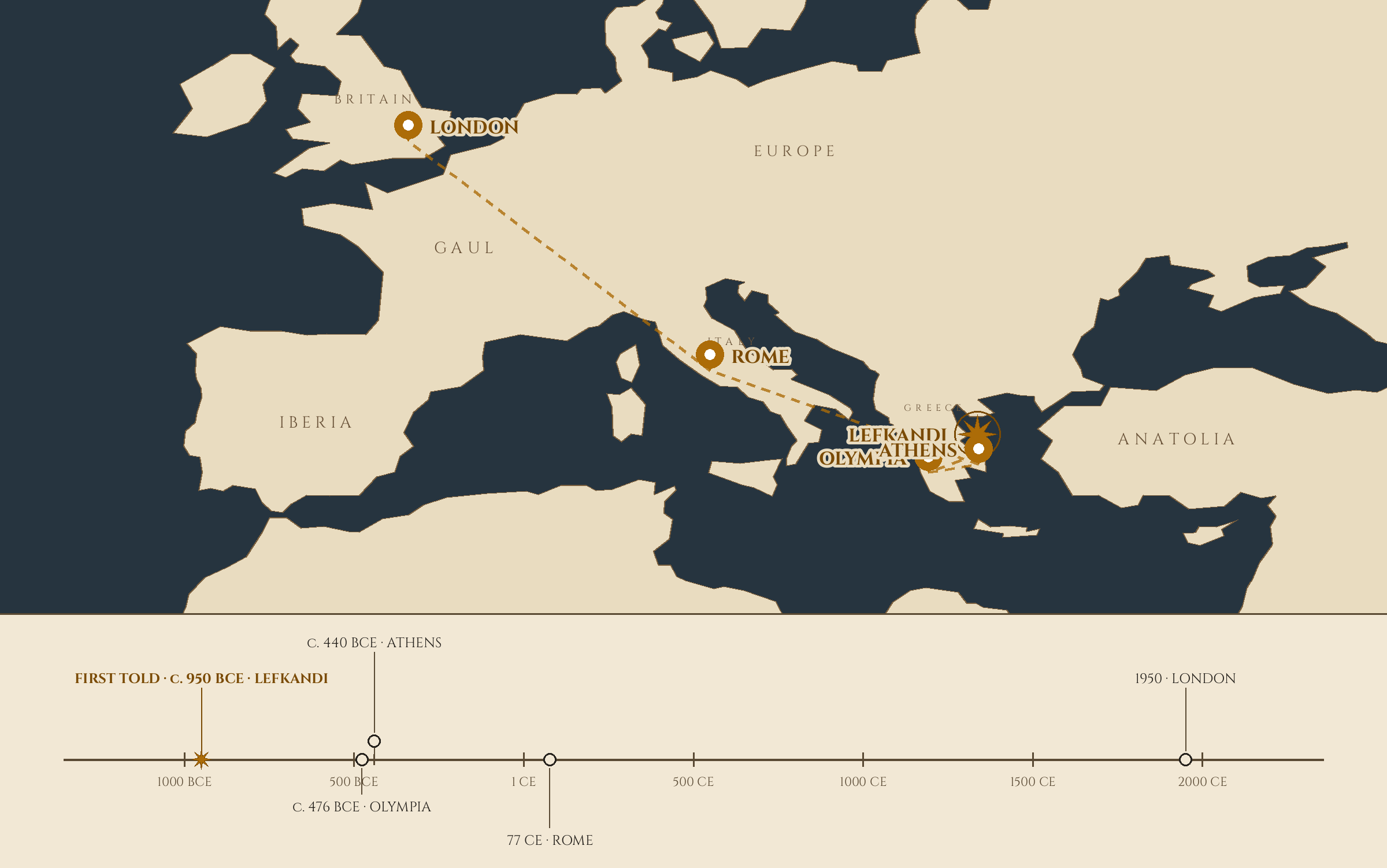
Where this lesson travels: Lefkandi, where a terracotta centaur was buried in two graves — the earliest known three-dimensional centaur in Greek art; Olympia, where the Centauromachy is carved on the Temple of Zeus; Athens, where the Parthenon's south metopes show centaurs battling Lapiths; Rome, where Pliny reports a hippocentaur preserved in honey, sent from Egypt to the emperor; and London, where C. S. Lewis's wise, star-reading centaurs take their places. The starred pin is the first record; the dashed line is the telling, traveling.
Lesson Objectives
By the end of this lesson, you will be able to:
- Walk this lesson's map — a clay centaur, two temple battles, a jar of honey, and a London children's book.
- Tell the two tribes of centaurs apart: the wild herd of Thessaly and Chiron the exception, and say why the record keeps both.
- Tell the Centauromachy — the wedding fight that Greek temples carved above their doors.
- Say what a satyr is, how he differs from a centaur, and where the satyr play fits in the Athenian theater.
- Say who the nymphs are — the Greek wild world's other company — how the record sorts them by their places, and why they stand in this lesson beside the centaurs and satyrs.
- Tell the Sphinx's two lines apart — the Greek Theban sphinx, female and winged, and the Egyptian androsphinx, a king's portrait-statue — and name the Assyrian lamassu without merging him into either line.
- Give Medusa's file: Hesiod's three Gorgon sisters with Medusa alone mortal, Perseus's errand and its gear, the gorgoneion's work on shields and temples, and Ovid's later tale filed as Ovid's.
- File Pliny's honey-preserved hippocentaur correctly: what is record in it, and what is belief.
Your Assignment Packet
This lesson's work lives in its packet: the Lexicon Handout (every term, the core terms marked with the keeper's diamond ◆), Materials, Guided Practice, the Assignment Manual written out whole, the Scholar's Entry Page, the Reflection Questions, the Workbook Checklist, and the Keeper's Notes, for whoever teaches the lesson. Download the packet before you begin and keep it beside you as you read. The packet's assignment is Rookmere's own word for the work: Entry No. 12 — Centaurs & Satyrs, with the Minotaur Named (written) ✎. The Unit II Quiz is not printed in the packet; it waits at the end of the unit, with Lesson 15.
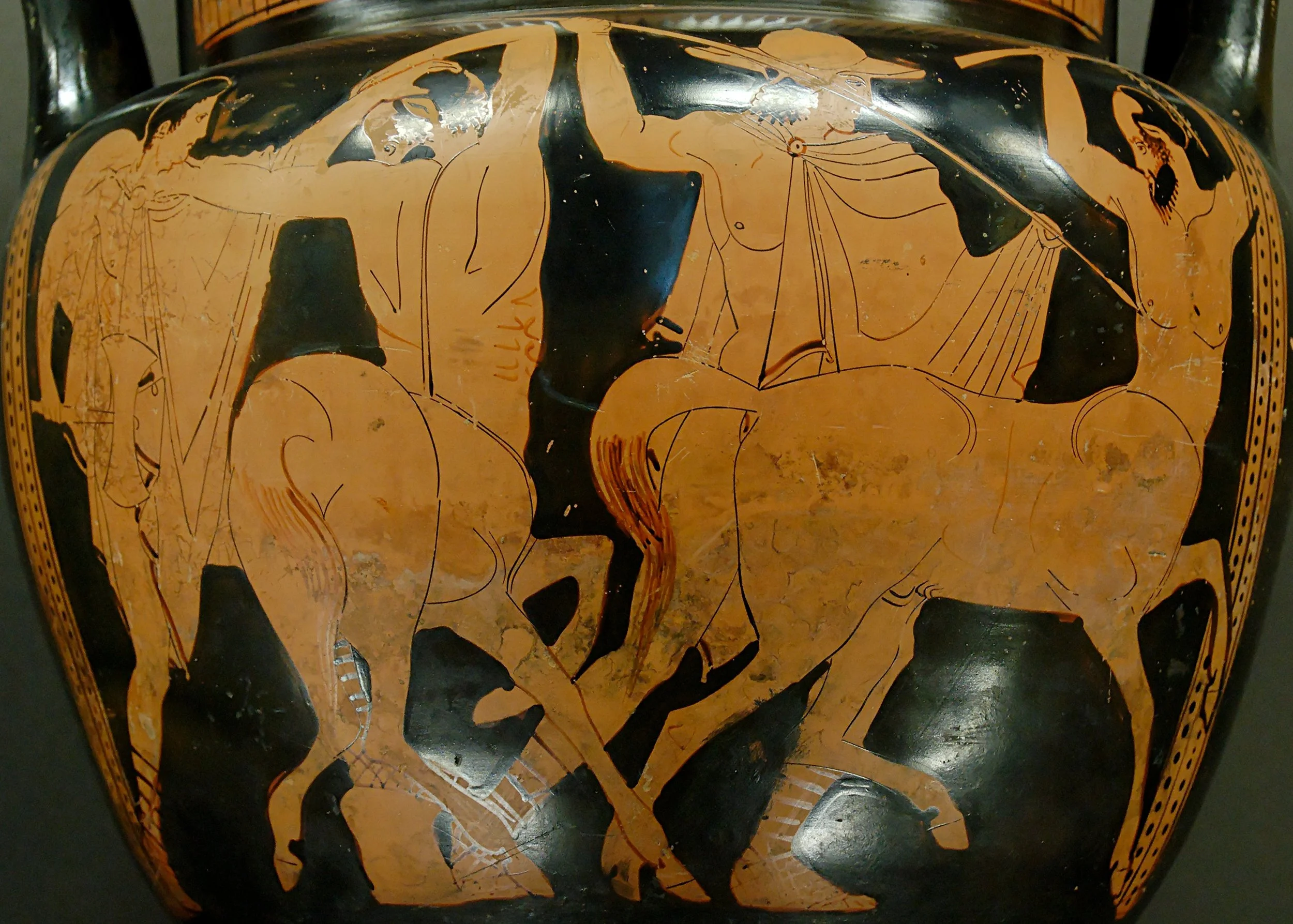
The Centauromachy on an Attic red-figure vase (Painter of the Louvre Centauromachy, c. 436 BCE): Lapiths fighting with the city's made weapons, centaurs with the forest's — uprooted trees, branches and boulders. Public domain, via Wikimedia Commons.
The Creature
A centaur — Greek kentauros, a word whose own origin nobody has settled — is a being with the upper body of a man and the body and legs of a horse. He belongs to Thessaly, the great horse country of northern Greece, and above all to Mount Pelion, whose forests and caves are his home address in story after story. In Greek art he appears earlier than almost any monster on this shelf, and he appears in two tempers: as a brawling drunk who wrecks weddings, and as the wisest teacher in the world. Both tempers are old. Both are his.
A satyr is the centaur's smaller, wilder companion in the Greek imagination: a man with a horse's ears and a horse's tail (in later art, increasingly, with goat's legs borrowed from the Roman faun), a follower of Dionysus, the god of wine, and a creature of the cup, the flute, and the chase. Where the centaur argues about strength and manners, the satyr argues about appetite. Athens built both of them into its public art — and built the satyr into its theater, as you will see.
The third company in this lesson's Greek wild world is not a hybrid at all. A nymph — Greek nymphē — is a female spirit of a place: a minor goddess of the forests, rivers, springs, meadows, mountains, and seas. Homer calls the nymphs daughters of Zeus, and the record keeps them at their places — dwelling in groves, on the summits of mountains, in rivers and streams and glens and grottoes, accompanying Artemis in the hunt, dancing with her, and weaving purple garments in their caves. Where the centaur and the satyr are each one shape, the nymphs are a whole population, and the Greek record sorts them by the place each one belongs to: dryads and hamadryads of the trees, naiads of the fresh waters — springs, rivers, lakes — nereids of the sea, and oreads of the mountains and their grottoes. The sorting is the record's own filing, not a set of sealed boxes: the ancient writers let the kinds overlap, and a nymph of a spring beneath a great tree could be counted by her water or by her tree. The neat lists are later tidying; the places are what is old.
One kind carries the sharpest filing in the whole nymph record. The hamadryad is born with her tree and bound to it: the Homeric Hymn to Aphrodite says that when these mountain nymphs are born, pines or high-topped oaks spring up with them on the earth, and when the fate of death draws near, the tree withers first — the bark wastes, the branches fall — and the nymph's soul leaves the light of the sun at the same moment. Neither fully goddess nor mortal woman, the hymn says: long-lived, eating ambrosial food, and dancing with the immortals — but a life with a tree's length, not a god's forever. The nymphs belong in this lesson because they are the company the other two beings move among: the satyrs chase them, the gods pursue them, the heroes lose companions to them, and no Greek telling of the wild is complete with the places left unpeopled.
It helps to have the real horse in mind before we go further, because the centaur's lower half is a working animal, not a decoration. A riding horse stands roughly a metre and a half to a metre and three-quarters at the withers — the ridge of the shoulders where a rider's eye-level reckoning starts — and weighs somewhere around half a tonne, give or take a good deal by breed. Put a man's torso where the horse's neck and head should rise, and you get a being taller than any man in the room, with four legs that can outrun him and a body that takes up a doorway. The Greeks who told these stories knew horses the way farmers know weather. The centaur's size and speed were not vague marvels to them. They were horse facts, with a man on top who could not be unseated because there was no join to strike at.
One famous half-bull stands at the edge of this lesson, and he is filed the way this class files him: by name only. The Minotaur of Crete — a man's body, a bull's head, a labyrinth built by Daedalus to hold him, and a tribute of Athenian youths ended by Theseus with Ariadne's thread to guide him out — is one being, in one story, not a kind. He gets his paragraph in the Tales, and no lesson of his own, and that is a ruling of this class, not an oversight.
Two single beings are gathered at the edge of this lesson, as the census gathers them, and the first stands in two lines. The Sphinx of the Greek record is a single: a female being with the face of a woman, the breast, feet, and tail of a lion, and the wings of a bird — Apollodorus's description — whom Hesiod names Phix and files in Echidna's brood, "the deadly Sphinx which destroyed the Cadmeans," the people of Thebes. She is no kind, and she founded no kind: there is one of her, at one city, with one riddle. But the same name covers a second, older being who is not her at all. The Egyptian sphinx is an androsphinx — a man, not a woman; wingless, where the Greek is winged; and not a creature of tale but a statue: a king's portrait given a lion's body, set to guard temples and tombs. Its greatest example, the Great Sphinx of Giza, was carved from the plateau's bedrock some two thousand years before Hesiod named Phix, and its head is generally identified as the Pharaoh Khafre's (about 2500 BCE). The Greeks, coming to Egypt in later centuries, gave the statue their monster's name. File the two lines apart, as this class files the centaur's two tribes: the name traveled; the being did not.
One more cousin is named here, as the census rules, and named only: the lamassu of Assyria — a human-headed, winged lion or bull, carved in colossal pairs to protect and support the great doorways of Assyrian palaces, as the Metropolitan Museum's example stood at Nimrud in the palace of Ashurnasirpal II (about 883–859 BCE). He is neither sphinx of either line — a Mesopotamian guardian with his own name, his own kings, and his own record — and he is named so that the family resemblance of the shape does not swallow him.
Medusa is a single inside a company of three. Hesiod's Theogony files her among the Gorgons — daughters of Phorcys and Ceto, dwelling beyond glorious Ocean, at the edge of the world toward Night: Stheno, Euryale, and Medusa. The whole of her tale is folded into Hesiod's one distinction: "she was mortal, but the two were undying and grew not old." Her sisters cannot be killed; she can — which is why a hero can be sent for her, and why her file, alone of the three, has an ending. The fuller record gives the sisters their kit: heads twined about with the scales of dragons, great tusks like swine's, brazen hands, golden wings, and a gaze that turns whoever beholds them to stone. But Medusa's lasting shape in the record is not her body. It is her severed face — the gorgoneion — which Greek hands set on shields, temples, and roof-edges for a thousand years, to do the guarding her gaze had done in the tale. She is this lesson's clearest case of a being whose depiction-record outweighs her story.
The plates are both ancient, and the gap after them is part of the record. The Louvre centauromachy vase (about 436 BCE), at the head of this lesson, shows Lapiths and centaurs fighting with the weapons that label them — swords against uprooted trees. The Met's Hellenistic terracotta bust shows the satyr at close range: horse's ears, beard, wreath. After antiquity the centaur thins out — a cousin, the onocentaur, in the bestiaries, carvings on capitals, figures on maps — and satyrs merge toward the Roman faun; the Renaissance took both beings up again in paint, but no plate from those centuries is in this lesson's stock. The picture line therefore jumps from Greek clay to the modern books the Tales describe, and the jump is stated, not hidden. The nymphs bring one later plate of their own into this lesson's stock: John William Waterhouse's Hylas and the Nymphs (1896), read under Still With Us, where their later life in paint belongs.
The two singles gathered at this lesson's edge bring two later plates of their own into the stock: Caravaggio's Medusa (about 1597), the severed head painted on an actual round shield — the gorgoneion back on its oldest furniture — and Gustave Moreau's Oedipus and the Sphinx (1864), where the Greek sphinx, winged and lion-bodied, clings to the man who answered her. Both are read in their strands and in the Guided Observation.
First Told
The map at the head of this lesson opens at Lefkandi, on the island of Euboea, about 1000–950 BCE, and its starred pin is not a book. It is a thing: a terracotta centaur, hand-modeled, about a foot long, found at the great cemetery of Toumba — found, in fact, in pieces, its parts laid in two different graves. The body went into one burial and the head into another, as if the being had been shared between the dead. It is the earliest known three-dimensional centaur in Greek art, older than any surviving Greek text that names his kind, and it sets this lesson's first record where the keeper likes records to be set: on an object you can point to, with a date you can argue about honestly. The telling was surely older. The record begins in clay.
The nymphs' first records are words, and they are as old as Greek words get. Homer's Iliad (Book 20) summons the nymphs of the lovely groves, the springs of rivers, and the grassy meadows to the assembly of the gods, and the Odyssey is nymph-haunted from end to end: Odysseus, hearing a girl's cry on a strange shore, wonders whether it came from the nymphs who live on the mountain-tops, in the river-springs, or in the meadows (Book 6); the cave at Ithaca's harbour, with its stone mixing-bowls, its ever-flowing springs, and its two doors — one for mortals, one for the gods — is sacred to the naiads (Book 13); and Calypso, who holds Odysseus on her island for seven years, is a goddess of that company. Hesiod's Theogony names them by the catalogue: the fifty Nereids, daughters of Nereus and Doris, listed name by name — Thetis and Amphitrite among them — and the Oceanids beside them. The Homeric Hymn to Aphrodite gives the mountain nymphs their fullest early portrait, as the beings who will rear the child Aeneas, and the hamadryads their tree-bound lives, as you read above. No pin stands on this lesson map for the nymphs, and none should: they are not one place. They are every place the map crosses.
The singles' first records are words, and one very large stone. For the Gorgons, Homer is first and strangest: before Hesiod names any sister, the Iliad already carries the Gorgon's head as a made thing — set on Athena's aegis in Book 5, amid Terror and Battle Strength, and blazoned on Agamemnon's shield in Book 11 — and the Odyssey (Book 11) has Odysseus hurry out of Hades for fear Persephone might send the Gorgon's head up after him. Hesiod, about 700 BCE, gives the head its family: the three sisters, their parents, their address beyond Ocean, Medusa's single mortality, and the soft meadow where Poseidon lay with her — and, in the same breath, her ending, for "when Perseus cut off her head, there sprang forth great Chrysaor and the horse Pegasus." The Theban Sphinx enters in the same poem, a few dozen lines later, as Echidna's daughter Phix. Her riddle and her death the record files much later, in Apollodorus's Library (1st–2nd century CE) — though Sophocles' Theban plays, centuries earlier, already trade on every Athenian knowing how she died.
The Egyptian line's first record is not a text at all. It is the Giza statue itself — carved about 2500 BCE, a king in lion form at the edge of his pyramid field, older than the Greek sphinx's first naming by some eighteen centuries. The Greek line is a story told about one being at one city; the Egyptian line is a monument that other peoples later renamed. No pin stands on this lesson map for either single, and none should: the Sphinx's two addresses are a Boeotian rock and a Giza quarry, and Medusa's is beyond Ocean, off the map's edge altogether — the record says so itself.
From Lefkandi the dashed line walks to the temples. At Olympia, about 476 BCE, the west pediment of the Temple of Zeus carried the Centauromachy — the battle of the Lapiths and centaurs — carved in marble over the heads of everyone who came to the games. At Athens, about 440 BCE, the Parthenon's south metopes carved the same battle for the city's own goddess. Two of the greatest buildings in Greece, one generation apart, chose the same subject: the wedding that became a war. That choice is itself a record — of what the fight meant to the people who paid for the marble. The Tales will tell it.
The fourth pin stands at Rome, 77 CE, and it is this lesson's famous jar. Pliny the Elder, in the Natural History, reports a hippocentaur — his Latin word for the centaur — preserved in honey, sent from Egypt to the emperor at Rome. Read that sentence the keeper's way: Pliny's report is a record. What was in the honey is another matter, and What It Actually Is will take it up.
The last pin stands at London, 1950, where the centaur changed his temper for good in the modern record: C. S. Lewis published The Lion, the Witch and the Wardrobe, and his centaurs are grave, wise star-readers, the most courteous beings in Narnia. Six pins' journey in one line: clay grave-goods, temple marble, an emperor's jar, a children's book. The being survived every medium his keepers invented.
The Tales
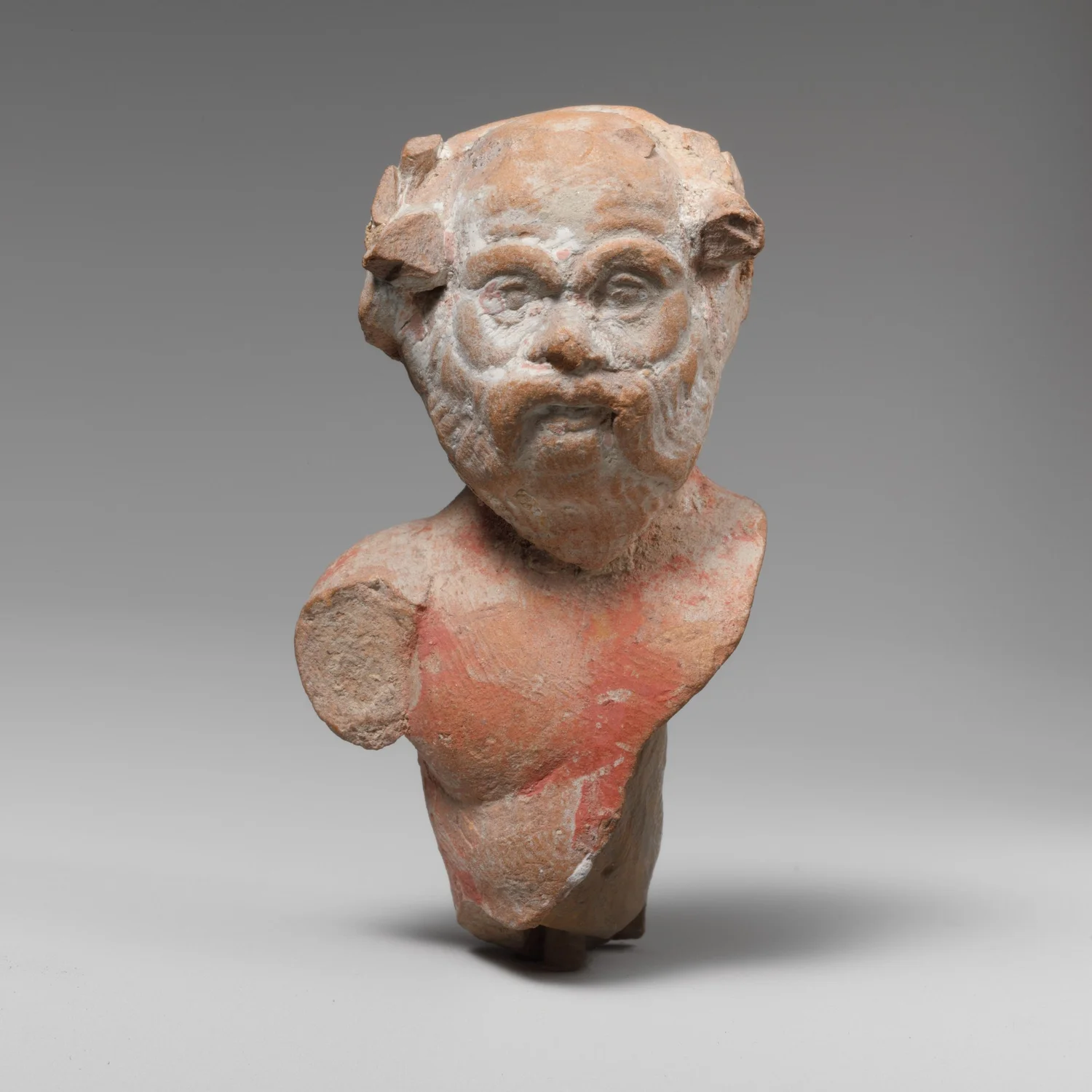
A Hellenistic terracotta bust of a satyr: the horse's ears, the beard, the wreath — the marks a keeper lists one by one, and most of them marks a costume could wear. CC0, via Wikimedia Commons.
The centaur's homeland in the stories is Thessaly, and the tellings split early into the two tribes this class keeps separate. The wild herd are Pelion's brawlers: they live rough, eat raw meat, drink unmixed wine when they can steal it, and measure their strength against heroes. The exception is Chiron, son of the Titan Cronus, who lived in a cave on Pelion and taught the heroes' children — Achilles above all, and Asclepius, who learned healing from him. Greek writers mark the difference on purpose: Chiron is set apart from the herd in parentage, in manners, and in fate, and a keeper who merges him into the herd has misread the record's own filing system.
The satyrs grew in the god's train. Dionysus traveled with a thiasos, a roving company of worshippers, and the satyrs are its wild wing: dancing, drinking, playing the double flute, chasing nymphs, and collapsing in heaps. This lesson's second plate, a Hellenistic terracotta bust now at the Met, shows you the standard kit at close range: pointed horse's ears pricked up through the hair, a full beard, a wreath riding on his head, and an expression caught somewhere between a grin and a leer. Work through those marks in the Guided Observation. Most of them, you will find, are things a man could put on — which is exactly how Athens got a chorus of satyrs onto its stage. Their oldest member, Silenus, fat, bald, and usually drunk, is also — the storytellers insist — the wisest of them all when he can be caught and held, which is how King Midas came to hear his gloomy wisdom. Athens gave the satyrs a stage of their own: after three tragedies, a tragedian's entry at the festival closed with a satyr play, a burlesque with a chorus of satyrs, performed by the same actors. Only one satyr play survives complete — Euripides' Cyclops, the fourth pin's rowdy cousin from the last lesson, where the chorus of satyrs serves the giant and helps blind him. Literature, theater, and temple were all keeping these beings at once; that is why their file is so thick.
The nymphs stand in tales of every size, and a keeper should know the four this lesson files. Thetis, first of the Nereids in fame, is a sea-nymph married to a mortal — and when her son Achilles grieves for Patroclus in Iliad Book 18, her cry gathers her sisters, the daughters of Nereus, up from the deep around her: the catalogue Hesiod names, answering as a family. Daphne, a river god's daughter, fled Apollo — and Ovid, in Book 1 of the Metamorphoses, gives her escape its famous form: she calls on her father Peneus, her hair turns to leaves, her arms to branches, her feet root in the earth, and she stands a laurel; Apollo takes the laurel for his own sacred tree, which is why the laurel in his worship is a nymph's story and not a decoration. Echo, an oread of the mountains, loved Narcissus — Ovid again, Book 3 — cursed to repeat the words of others and able to say nothing of her own first; rejected, she wastes until only her voice is left, answering still from the rocks and woods. And Hylas, Heracles's young companion on the Argo's voyage, went with a bronze pitcher to the spring the neighbours called Pegae — Apollonius of Rhodes tells it in Book 1 of the Argonautica — where the naiad of the spring saw him in the moonlight, caught his neck and elbow as he dipped the pitcher, and drew him down into the water; Heracles searched the woods calling his name, and the ship sailed without them both. Keep the four together — a mother, a fugitive, a voice, a taking — and the nymphs' range is the whole lesson's in miniature: they are not scenery in these tales. They are the places, acting.
Greek art kept them as steadily as Greek poetry did, and in the same numbers. On a black-figure dinos signed by the painter Sophilos (about 580–570 BCE, now in the British Museum), three nymphs walk in the procession of gods at the wedding of Peleus and Thetis — the sea-nymph's own wedding, attended by her kind. In stone, the record is a votive one: worshippers dedicated reliefs to the nymphs at their cave shrines, and one cave-shaped relief, of the end of the fourth century BCE and now in the National Archaeological Museum at Athens, shows three nymphs dancing around an altar inside the cave's mouth, holding each other's clothes, while Pan accompanies them on his pipes — the dance Homer gave them, carved by people who offered at such shrines. Three is the number the art keeps choosing for them, on vase and relief alike: a company, small enough to carve, large enough to be a kind and not a person.
The Roman centuries merged the satyr toward the faun — goat-legged, horned, a creature of the fields — and the medieval centuries thinned both beings out. The centaur keeps a foothold in the learned books: his cousin the onocentaur, half man and half ass, stands in some bestiaries among the portents, and Isidore's book of portents (Lesson 11's Seville pin) is the bridge by which the hybrid peoples crossed into the Middle Ages. But the great medieval centuries largely left the centaur to the sculptors of capitals and the painters of maps, and the satyr to the margins, until the Renaissance dug the temples up again.
The tale every Greek temple told is the Centauromachy. Pirithous, king of the Lapiths of Thessaly, married Hippodamia, and invited his neighbors the centaurs to the wedding — kin, after a fashion, and owed a place at the table. The centaurs, unaccustomed to wine, drank deep; and Eurytion the centaur, drunk, seized the bride and tried to carry her off. The Lapiths rose; Theseus of Athens, a guest, fought at the king's side; and the wedding hall became the battlefield that Greek art carved for three hundred years. Homer already treats the fight as famous — the Odyssey remembers how "wine did for the centaur Eurytion" at Pirithous's house, the first of his kind's ruinings. Ovid, in Book 12 of the Metamorphoses, gives the full gory catalogue, name by name and weapon by weapon. The meaning the carvers read in it is not hidden: wedding against brawl, table against forest, the city against the wild — with the uncomfortable footnote that the wild were invited in. The painters made the same argument without a word of text. On this lesson's hero plate, an Attic red-figure vase of about 436 BCE, the Lapiths fight with swords and spears, tools somebody made for the purpose, while the centaurs swing uprooted trees and boulders, whatever the forest had lying about. You can tell which side a figure is on by what is in his hands before you can make out his body. Hold that thought for the Guided Observation, where we read the vase properly.
Chiron's tale runs opposite. Wounded by accident — a poisoned arrow of Heracles, tipped in the Hydra's venom, struck his knee during a visit among the wild herd — the immortal centaur suffered a wound that could not heal and could not kill him. He gave up his immortality, the poets say, and was set among the stars: the wisest being in the record, pensioned by heaven. And the herd's darkest tale belongs to Nessus, the centaur who ferried travelers across the river Evenus. Carrying Heracles's wife Deianira, he tried to seize her mid-stream; Heracles shot him from the far bank. Dying, Nessus gave Deianira a lie as a gift — his blood, he said, would work as a charm to keep her husband's love — and years later she sent Heracles a shirt steeped in it, and it killed him. The centaur's revenge arrived by post, long after the centaur was ash. Keep the three tales together and you have the kind's whole range: the herd who wreck the wedding, the teacher who surrenders heaven, the ferryman whose kindness was a weapon.
The satyr's great tale is smaller and sadder. Marsyas, a satyr of Phrygia, found the double flute that the goddess Athena had invented and thrown away, learned it to mastery, and challenged Apollo himself to a contest — his flute against the god's lyre, the loser at the winner's mercy. Apollo won, on terms the storytellers argue about, and Marsyas was flayed alive for his presumption, and his skin hung in a cave where, travelers said, it still stirred when flute music played nearby. It is the satyr file's warning label: appetite and talent, ungoverned, meet the gods at their least merciful.
The Sphinx's tale is Thebes's. Hera sent her against the city, Apollodorus says, and she took her seat on Mount Phicium above it with a riddle she had learned from the Muses: "What is that which has one voice and yet becomes four-footed and two-footed and three-footed?" The Thebans met again and again to find the answer, for an oracle had promised they would be rid of her when the riddle was read; and whenever they failed, she snatched one of them and ate him. The answer came with a stranger. Oedipus, arriving at Thebes, declared that the riddle referred to man: as a babe he goes on four limbs, as an adult on two, and as an old man he takes besides a third support in a staff. "So the Sphinx threw herself from the citadel" — and Oedipus received the kingdom and the widowed queen, which is the tale's price, known to every keeper of the Theban file. Greek art set the confrontation at eye level, on a column: the marble sphinx the Naxians dedicated at Delphi (about 560 BCE) still perches on her tall Ionic column beside Apollo's temple, and the Oedipus Painter's cup (about 470 BCE, now in the Vatican) shows her on just such a column, facing the seated Oedipus — the riddle as a conversation, held face to face.
Medusa's tale is an errand, like the hound's in the last lesson, and Apollodorus files it in full (Library 2.4.2–3). Polydectes, king of Seriphus, collecting horses as a supposed wedding gift, held Perseus to a rash boast and ordered him to bring the Gorgon's head. Perseus went equipped by gods. Guided by Hermes and Athena, he first found the Graeae — Enyo, Pephredo, and Dino, the Gorgons' own sisters, old women from their birth, who shared one eye and one tooth between them, passing them hand to hand. He snatched the eye and the tooth, and gave them back only when the sisters showed him the road to the nymphs — who held the errand's tools: winged sandals, the kibisis, a wallet to carry the head in, and the cap of Hades, which makes its wearer unseen. Hermes added an adamantine sickle.
He flew to the edge of Ocean and found the Gorgons asleep. He stood over them as they slept, and — Athena guiding his hand — looked only at the Gorgon's image in his brazen shield, his gaze averted, and beheaded Medusa: the one sister who could die. From her severed neck sprang Pegasus and Chrysaor, her children by Poseidon. Perseus put the head in the wallet and fled; her sisters woke and pursued him, but the cap hid him, and they could not find him. The head kept its power in death, and at the errand's end Perseus gave it to Athena, who set it in the middle of her own shield — which is where the tale hands Medusa over to her second, longer career.
For the gorgoneion's career is the depiction-record itself, and it begins as early as any picture in this lesson. On the west pediment of the Temple of Artemis at Corfu (about 580 BCE) — one of the earliest stone temple pediments in Greece — Medusa runs at the centre of a pediment over three metres high at the middle, flanked by great cats, with Pegasus and Chrysaor at her sides: her own children, attending her at the size of gods. Homer's shields had already filed the face's job: set at the centre of the thing a man hides behind, glaring out. Scholars call such an image an apotropaion — a thing that turns harm away — and the Greeks set the Gorgon's face wherever turning-away was wanted: on shields and breastplates, on temple fronts and roof-edges, on coins and ships and ovens. The tale says her gaze turned men to stone. The record shows her face, copied for a thousand years, turned outward toward every stranger who approached — the warning itself, kept.
One later tale must be filed, and filed as what it is. Some seven centuries after Hesiod, the Roman poet Ovid, in Book 4 of the Metamorphoses (about 8 CE), gives Medusa a past: she was once a beautiful maiden, famed above all for her hair, until Neptune violated her in Minerva's temple, and Minerva — averting her own eyes behind her shield — punished the deed by changing the Gorgon's hair to foul snakes. Ovid puts the telling in Perseus's own mouth, at a feast after the killing, which is where it belongs in the file: it is the slayer's author's version, told some seven hundred years on, not the record's first word. Pindar had already praised Medusa's beauty centuries before Ovid, so the beauty itself is an old thread; but the temple, the violation, and the punishment are Ovid's telling, first told by him. Do not let it walk backward into Hesiod's file. In Hesiod, Medusa is not a woman punished into a monster. She is a Gorgon born, one of three sisters at the edge of the world — and the distance between those two Medusas is the distance this class exists to measure.
And the named one, briefly, as this class files him. The Minotaur was born to the house of Minos of Crete — a man's body and a bull's head — and Daedalus built the Labyrinth to be his house and his prison. Athens owed Crete a tribute of seven youths and seven maidens, sent into the maze to be his food, until Theseus went in with them, took Ariadne's ball of thread at the door, killed the Minotaur in the dark at the center, and followed the thread out. One being, one labyrinth, one story. The census gives him a paragraph wherever the half-human kinds are gathered, and this is it.
KEEPER'S CHECK-IN
On the hero plate the painter labels every figure by what is in his hands — what do the Lapiths fight with, what do the centaurs fight with, and what argument is the painter making without a word of text?
Spotted
One physical report stands in this file, and it arrived in a jar. Pliny, in 77 CE, reports a hippocentaur — a centaur — preserved in honey, sent from Egypt to the emperor at Rome. The report is examined in full under What It Actually Is; here it is filed as this lesson's S: a sighting-report at one remove, since Pliny reports the sending, and the jar itself is long gone.
Nothing else in the file is a sighting. The Lefkandi centaur is a made thing, a depiction; the temple battles are carvings of a tale; and Athens did put satyrs before the public every festival — actors in costume, in the satyr play — which is a community watching its neighbors play the being, not a report of the being itself. The distinction matters in this lesson more than most: a centaur anyone could point to was a centaur somebody had made.
The singles add no sightings. The Great Sphinx of Giza is a statue anyone can point to — a depiction at quarry scale, not a sighting — and no dated report in any century claims a meeting with the Theban Sphinx or a living Gorgon. Their files, like the centaur's, are texts, tales, and made things.
KEEPER'S CHECK-IN
Pliny's honey-preserved hippocentaur is filed in two lines that are not the same line — what does the S line claim, and what does the T line claim?
What People Watched For — an honest empty
There is no What People Watched For passage in this lesson: no superstition attached to the centaur or the satyr was found with a named, dated, checkable source, and the box is not padded. The keeper's marks cover what these beings did have — tales, one sighting-report, and facts.
What It Actually Is
No bones made the centaur, and a keeper should say so before reaching for the explanation writers reach for. There is no fossil file here, no Augustine's tooth. The root that scholarship offers is an event type rather than an object: the first sight of mounted men by a people who did not ride. A horseman at distance, moving as one creature — the rider's body rising from the horse's back, torso answering the animal's motion — reads, to eyes that have never separated the two, as a single being with the horse's body and a man's top half. The explanation is offered for centaurs in Greece's horse country, where Thessaly's riders were famous across the Greek world, and it has been offered again wherever horse peoples met foot peoples in later centuries. File it as the record files it: as a plausible account of the telling's seed, not as a dated event. No pin stands on it, and none should.
The satyr's root is nearer the ground: he is the wine country's personnel made visible — the goatherd's and vintner's world of the Greek hills, where the herdsman's rough dress, the goat at his side, and the god's gift in his cup blur, in story, into one hairy companion. And both beings share the deeper root that this unit keeps meeting: Greek art used the hybrid body as an instrument for thinking. Half-and-half beings mark borders — between house and forest, feast and wilderness, citizen and other — and the centaur, who can sit at the table and wreck it, is the sharpest border-marker they made.
The nymphs' root is the same instrument pointed at places instead of borders. The early Greek record personifies the powers of a landscape: a spring, a river, a grotto, a tree, a mountain seemed fraught with life, and the nymph is that life given a face, a sex, and a temper — beneficent where the spring is kind, dangerous where the place is. That is why their kinds are addresses. A naiad is what a spring does, told as a someone; a hamadryad is what a tree's life-span feels like, told as a life that ends when the tree's does. File them as the record files them: not sightings, and not symbols invented late, but the oldest Greek way of keeping a place's character in the census.
Then there is the jar. Pliny's honey-preserved hippocentaur, sent from Egypt to the emperor, is the centaur file's one claim to physical evidence, and a keeper's duty is to price it. Honey preserves — that much is kitchen fact — and the ancient world did receive composite curiosities from Egypt, some of them manufactured: the Feejee mermaid of Lesson 17's record is only the most famous of a long trade in stitched wonders, and Lesson 17 will price that trade in full. What stood in the emperor's jar, no one can now say; the jar is gone and the report is all we have. So the entry files it in two lines, and they are not the same line: S — Pliny reported, in 77 CE, that a hippocentaur preserved in honey was sent from Egypt to the emperor at Rome. T — that the thing in the honey was a centaur. The first line belongs to the history of books. The second belongs to the history of belief. The whole lesson is in keeping them apart.
The Sphinx's root is the lesson's neatest, because there are two of them and they are different kinds of thing. The Egyptian line's root is a building project: a bedrock outcrop at Giza carved into a king with a lion's body — an image of royal strength that needed no creature behind it at all. The Greek line's root is the hybrid instrument itself, pointed at a road instead of a table: a woman's face to ask the question, a lion's body to enforce it, wings to arrive from nowhere. What joined the two lines was not a creature but a word — the Greek name, carried to Egypt by travelers and settled on a statue some eighteen centuries older than the being it named. A name is the lightest thing in any record, and it travels the farthest.
Medusa's root is a use, not an animal. A face that frightens, set facing outward where fright is wanted, works whether it hangs on a temple pediment or a shield — and this face outlasted the tale that explained it, which is why her file is mostly pictures. File her as this record files her: not a sighting, and not a symbol invented late, but the oldest Greek proof in this class that a depiction can have a job.
Still With Us
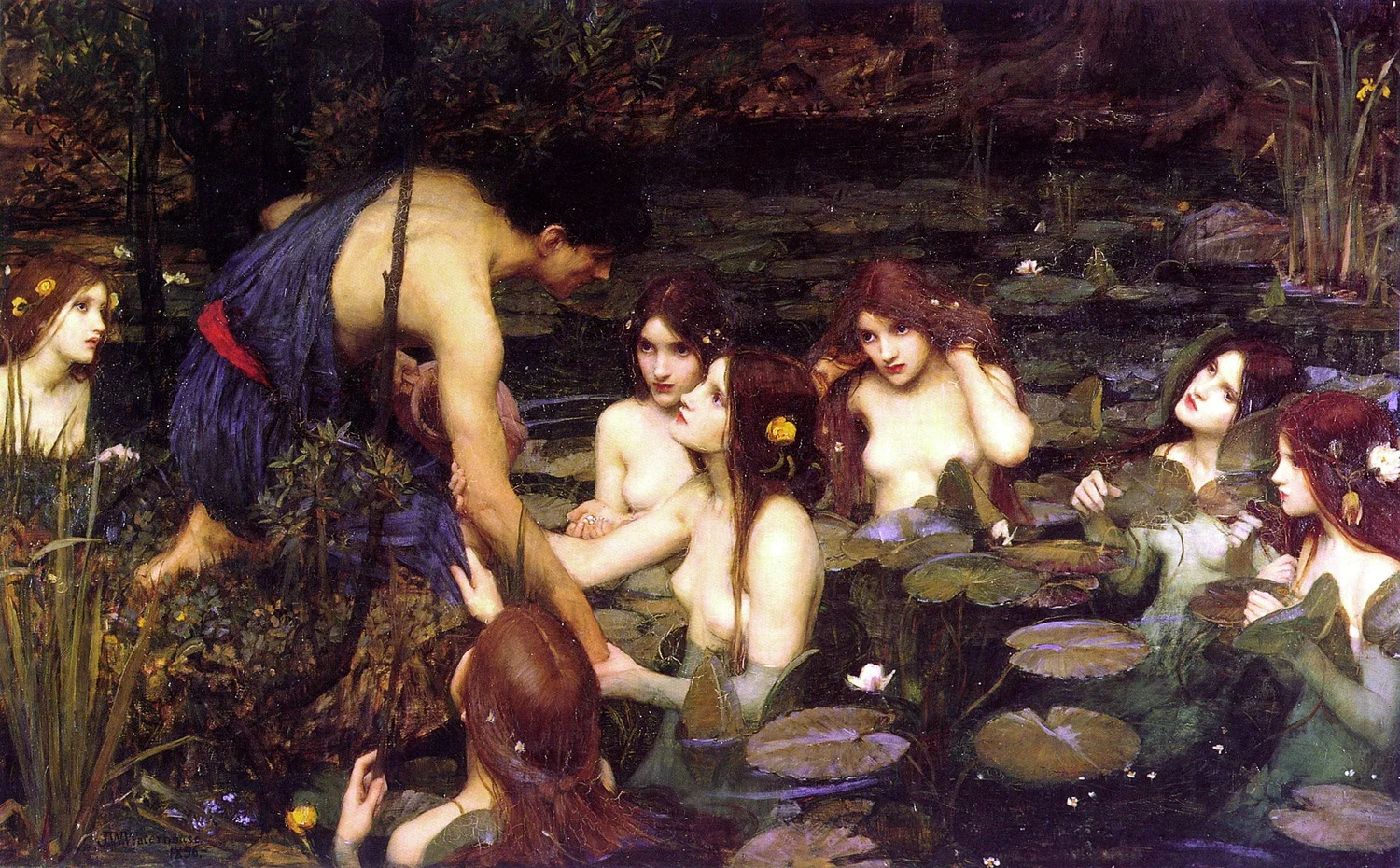
John William Waterhouse, Hylas and the Nymphs (1896, Manchester Art Gallery): Hylas kneeling at a dark pond with his pitcher while the naiads rise among the water-lilies and lay hands on his arm — Apollonius's taking at the spring of Pegae in nineteenth-century dress. Public domain, via Wikimedia Commons.
The modern centaur arrived, as the map's last pin says, in London in 1950, and he arrived wise. Lewis's centaurs in The Lion, the Witch and the Wardrobe and its sequels read the stars, prophesy from them, and carry themselves as Narnia's grave counselors — Chiron's line, victorious at last over the herd's. His satyr-kin came with him, softened in the Roman direction: Mr. Tumnus, the faun, who meets a lost child in a snowy wood carrying an umbrella and parcels, invites her to tea, and plays her a lullaby on his flute — Marsyas's instrument, in a drawing room, at last harmless. Between them the two books' worth of beings show the modern tellings' verdict: the wild border-creatures, tamed into wisdom and hospitality.
The nymphs' later life runs mostly through paint, and this lesson's third plate is its best-known portrait. John William Waterhouse's Hylas and the Nymphs (1896, Manchester Art Gallery) paints Apollonius's taking at the spring: Hylas kneeling at a dark pond with his pitcher, while the naiads rise among the water-lilies and lay hands on his arm — a company of them, where Apollonius gives the pull itself to the one nymph of the spring. It is the tale of Book 1 of the Argonautica wearing nineteenth-century dress, and it files the way Lewis files: T for the story it retells, F for the canvas, its painter, and its date. Between the Sophilos vase, the Athens relief, and Waterhouse's pond, the nymphs' picture line runs unbroken for something like twenty-four centuries — longer, a keeper may note, than the centaur's own.
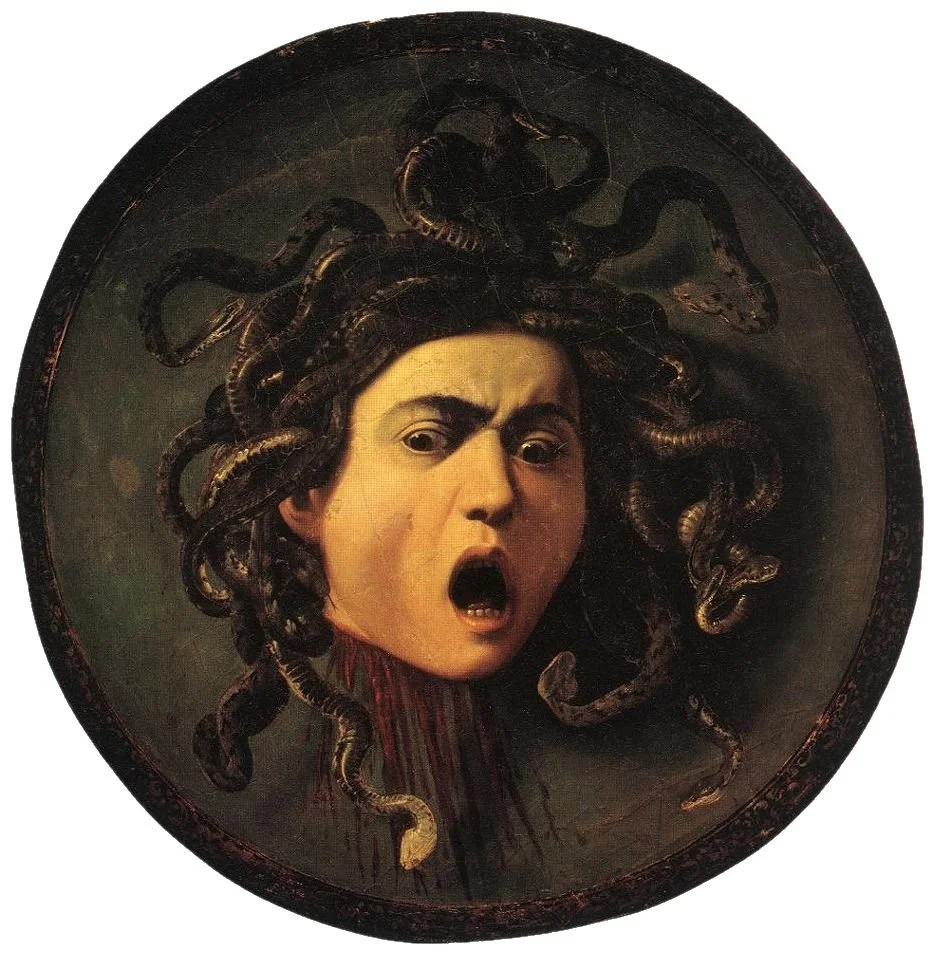
Caravaggio's Medusa (c. 1597), painted on a round ceremonial shield: the Gorgon's severed head, snakes for hair, mouth open — the gorgoneion given a suffering face. Galleria degli Uffizi, Florence. Public domain, via Wikimedia Commons.
Beyond Narnia the pair hold steady jobs in the modern imagination — centaurs in the fantasy bestiaries and games (Lesson 10's manticore keeps the same company), satyrs and fauns wherever a story needs the wild at the edge of the garden — and the temples keep the older verdict in marble above the doors at Olympia and Athens, free to any keeper who looks up. Both tempers are still there to be read, the brawler in the marble and the teacher in the children's books, and neither one has managed to crowd the other out of the file. After something like three thousand years of keeping, that is the record working as it should.
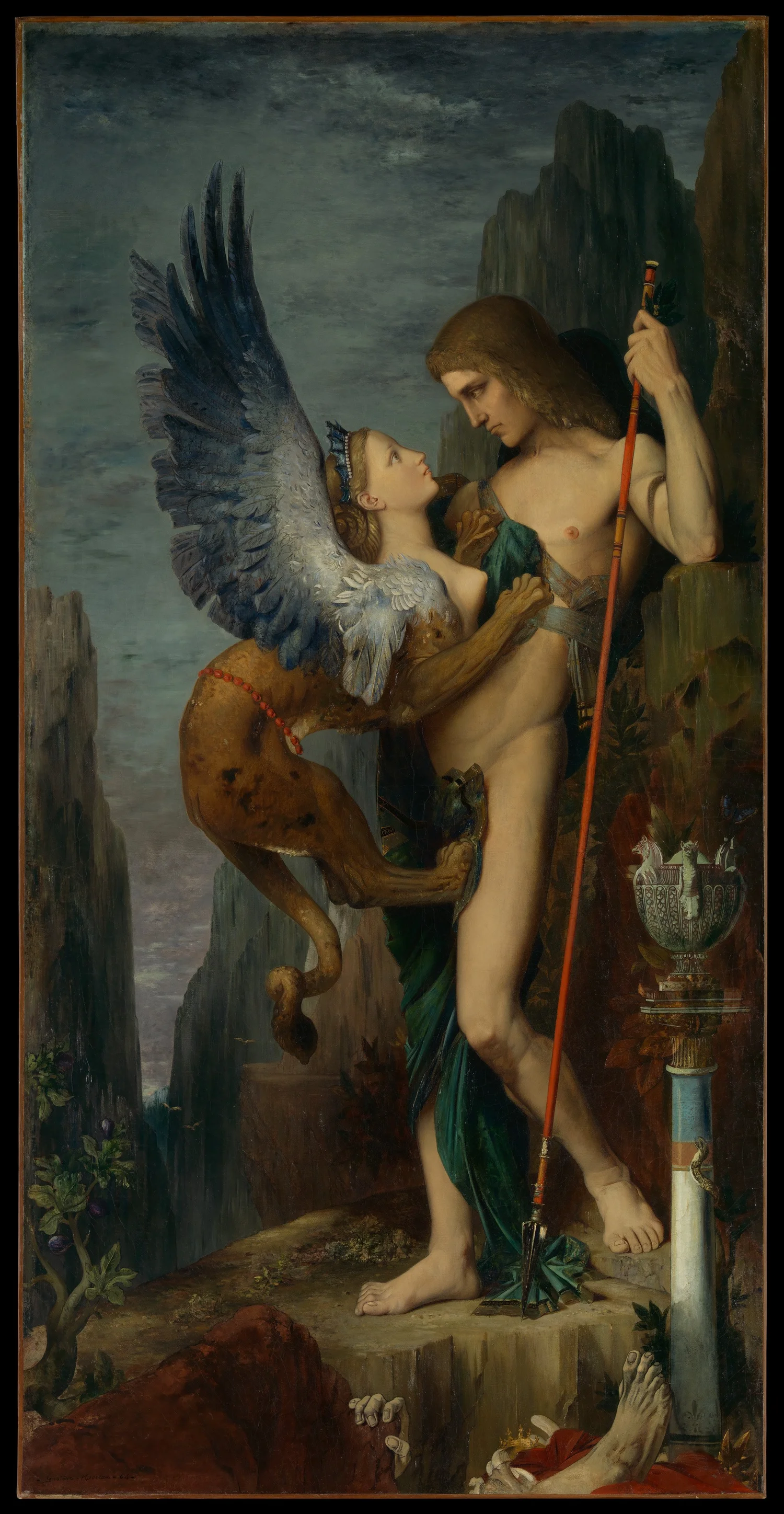
Gustave Moreau's Oedipus and the Sphinx (1864): the winged, lion-bodied, woman-faced sphinx of Thebes clinging to Oedipus on the rock, the remains of earlier travellers below. The Metropolitan Museum of Art, New York. CC0, via Wikimedia Commons.
The singles' later lives run through paint and stone, and this lesson's two new plates carry the painted half. Caravaggio, about 1597, painted Medusa's head at the moment of the cry — and painted it on a round ceremonial shield, so that the gorgoneion came home to the very furniture Homer first filed it on; the Uffizi keeps the shield still. Gustave Moreau, in 1864, brought the Theban Sphinx back to centre stage: his Oedipus and the Sphinx, now at the Met, sets her clinging to Oedipus on the rock, face to face, her forepaws on his chest, with the remains of the men who failed her question scattered at the cliff's foot. And the Egyptian line keeps its own still-with-us in the sun at Giza: weathered, wingless, and patient, the great statue goes on answering to a Greek name its carvers never heard — the two-lines lesson, standing where anyone can go and read it.
Guided Observation
Study the hero plate first: the Centauromachy on an Attic red-figure vase (Painter of the Louvre Centauromachy, about 436 BCE). Read it as a painter's argument. How do the Lapiths fight? With swords and spears — made weapons, the city's tools. How do the centaurs fight? With uprooted trees, branches, and boulders — the forest's tools, whatever came to hand. The painter has labeled every figure by his weapon, and the labels are the lesson of the scene: civilization is not the men but the equipment. Count the figures if the plate allows, and write down where the painter puts the single most violent moment — Greek vase painters usually center it, and the centering is a choice.
Then the support plate: a Hellenistic terracotta bust of a satyr (The Metropolitan Museum of Art, CC0). List his satyr-marks one by one — the horse's ears, the beard, the wreath, the expression — and then answer the plate's quiet question: which of those marks could a man in costume actually wear? Athens's satyr chorus wore most of them. The being on this shelf was, among other things, a suit of clothes with a mask, and a keeper who has listed the marks has understood something about how beings get onto stages. Compare your list with the centaur of the hero plate, whose marks no costume could carry — and say what the difference did to each being's career in the theater.
Then the singles' plates. Caravaggio's Medusa first: notice that you are looking at a shield — the round of it is the painting's edge — and that the face on it is not grinning, as the archaic gorgoneia grin with tongue and tusks, but caught mid-cry, the snakes still moving around it. The archaic face warns; Caravaggio's suffers. Write down what changed in the face's job across those two thousand years. Then Moreau's Sphinx. List her marks as you listed the satyr's — a woman's face and breast, a lion's body and paws, the great feathered wing — and file her: Greek line or Egyptian? Every mark that decides it is a mark the Giza statue does not have. At the cliff's foot, half out of the frame, lie the hands and feet of the travellers who could not answer. The painter has filed the riddle's price in the margin, the way this class files its traps.
Assignment Manual
✎ WRITTEN · ⚒ HANDS-ON · ◐ BOTH
✎ Written · Entry No. 12: Centaurs & Satyrs, with the Minotaur Named.
- Rule your entry page. Turn to the Scholar's Entry Page in this packet and rule the next page of your journal to match it. The centaur leads; the satyr is grouped beneath him, with his own First Told line; the nymphs are grouped with them as the wild world's other company, sorted by their kinds; the Minotaur is named in one short paragraph of his own, as the census rules. The Sphinx and Medusa are grouped after the companies as this lesson's two singles, each with a file of her own — and the lamassu is named in one line inside the Sphinx's file, no more, as the census rules for named kin.
- Write the entry, to the standard. First Told: the Lefkandi centaur — what it is, where it was found, roughly when, and the strange fact of its two graves. How the Telling Grew: Olympia and the Parthenon, with dates, and what their shared subject argues; the satyr play and its one survivor; Pliny's report; the thinning and the faun-merge. The Tales: the Centauromachy with the bride named and the first ruinous cup; Chiron's teaching and his wound; Nessus and the shirt; Marsyas, in three lines; the nymphs in their kinds, with one of their four filed tales told in full — Thetis, Daphne, Echo, or Hylas; the Minotaur, named, in one paragraph. The Sphinx: her two lines kept apart — Hesiod's Phix and Apollodorus's riddle, with Oedipus's answer; the Giza statue, its king, and its date, and the name that reached it late; the lamassu, named in his line and kept separate. Medusa: Hesiod's sisters and the one mortality; Perseus's gear, item by item, and the shield's reflection; the gorgoneion's posts, temple and shield; Ovid's tale, filed as Ovid's and dated against Hesiod's. What It Actually Is: the mounted-men account, filed as an account; the jar, filed in its two lines. Still With Us: Lewis's two beings, two or three lines. The Keeper's Line: your judgment.
- File the jar yourself. Write Pliny's sentence about the hippocentaur twice in your entry's margin: once as it should be marked S, once as T — rewording, where you must, so that each line says exactly what its mark claims. If you cannot make the T line without the words "Pliny says," you have found the lesson's point: the belief has no witness but the record of it.
- Mark every line. T, S, or F, as always. This entry holds a trap of its own: temple carvings are F as objects and dates; the battle they show is T as event. Mark the carving, not the wedding.
Materials
· Your bestiary journal, with Entries No. 1–11 in it
· Pencils, and a pen you like
· A ruler, for ruling your entry pages
· This lesson's packet (the Scholar's Entry Page is in it)
Reflection
The Greeks carved the Centauromachy over temple doors for generations. What was the carving for — decoration, warning, boast, or civic lesson? Defend your answer from the two buildings named in this lesson.
Chiron and the herd share a shape and nothing else. Why did the record keep one kind in two tempers instead of splitting them into two beings — and what does the keeper gain by the record's choice?
Pliny's hippocentaur had a better chain of custody than most beings on this shelf: an emperor, a jar, a named author. It is still filed as belief. What would have made it a record of a being instead?
The Great Sphinx carried no Greek name for some eighteen centuries, and has now carried one for over two thousand years. At what point, if any, does a borrowed name stop being an error and become the record? Defend your answer from the two lines.
Hesiod's Medusa is a Gorgon born; Ovid's is a maiden punished — and Ovid's is the version most modern retellings inherit. What does a keeper owe the older file when the younger tale is the famous one?
A Closing Note
Twelve entries, and the shelf has reached the edge of the fields. Next lesson stays at that edge — in the woods themselves, with the being every village kept just past its last fence: the wild man, who wore no shape but our own and frightened Europe for six hundred years without one word of a language anyone knew. Bring a stout stick. The record gets hairy.
The Bestiary
Bestiary Keeper
Further Reading & Sources
Homer, Odyssey, Book 21 — the fame of Eurytion and the wedding fight, in the poem's own memory of it.
Ovid, Metamorphoses, Book 12 — the Centauromachy told at full length, name by name.
Apollodorus, The Library — Chiron, Nessus, and the Minotaur in the mythographers' filing.
Pliny the Elder, Natural History, Book VII — the monstrous peoples and the hippocentaur in honey.
C. S. Lewis, The Lion, the Witch and the Wardrobe (1950) — the modern face: centaurs among the stars, a faun at tea.
Hesiod, Theogony, lines 240–264 — the fifty Nereids named, Thetis and Amphitrite among them.
Homeric Hymn to Aphrodite, lines 256–272 — the mountain nymphs who rear Aeneas, and the hamadryads born and dying with their trees.
Ovid, Metamorphoses, Book 1 and Book 3 — Daphne's laurel; Echo and Narcissus.
Apollonius of Rhodes, Argonautica, Book 1 — Hylas taken at the spring of Pegae.
National Archaeological Museum, Athens, inv. Γ1445 — the cave-shaped votive relief of three nymphs dancing, Pan piping, end of the 4th century BCE (the museum's own exhibit note).
Hesiod, Theogony, lines 270–286 and 326–327 — the Gorgon sisters, Medusa's mortality, and Pegasus springing from her neck; the Sphinx (Phix) in Echidna's brood (Evelyn-White translation).
Homer, Iliad, Books 5 and 11 — the Gorgon's head on Athena's aegis and on Agamemnon's shield: the face at work before it has a story.
Apollodorus, Library, 2.4.2–3 and 3.5.8 — Perseus's errand in full, gear by gear; the Sphinx, her riddle in the mythographer's own words, and Oedipus's answer (Frazer translation).
Ovid, Metamorphoses, Book 4 — Medusa's later tale, told as Perseus's own narration at the feast: beautiful hair, the temple, the snakes (Brookes More translation).
The Metropolitan Museum of Art, object 32.143.2 — the human-headed winged lion (lamassu) from Nimrud, palace of Ashurnasirpal II, ca. 883–859 BCE: the named cousin's own museum record.
Submit your work for this lesson using the form below.
CONTINUE IN THE BESTIARY HALL
← Previous · Lesson 11: Giants & the Cyclops Next · Lesson 13: The Wild Men of the Woods →
Unit II — Beasts of the Land The Bestiary Hall — All 41 Lessons
The rest of Unit II: Lesson 7 · The Unicorn · Lesson 8 · The Griffin · Lesson 9 · The Basilisk & the Cockatrice · Lesson 10 · The Manticore & the Spotted Beasts · Lesson 11 · Giants & the Cyclops · Lesson 13 · The Wild Men of the Woods · Lesson 14 · Bigfoot & the Yeti · Lesson 15 · Real Animals in the Bestiary