

THE BESTIARY
Unit II · Lesson 15Real Animals in the Bestiary
Professor Sable Rookmere
Bestiary Keeper
The Bestiary Hall • School of Evershade
Professor's Introduction

Every being in this unit so far has been, in the strict sense, absent — you could not go out and check the unicorn. The goose is a different problem entirely, because she is here: she winters on real coasts, in real thousands, and you could watch her this year with your own eyes.
The bestiarists watched her too — carefully, honestly — and still got her life exactly backwards. How that happens — to careful people — is the most important thing this class teaches, and it is why your assignment comes in two inks.
The Bestiary
Bestiary Keeper
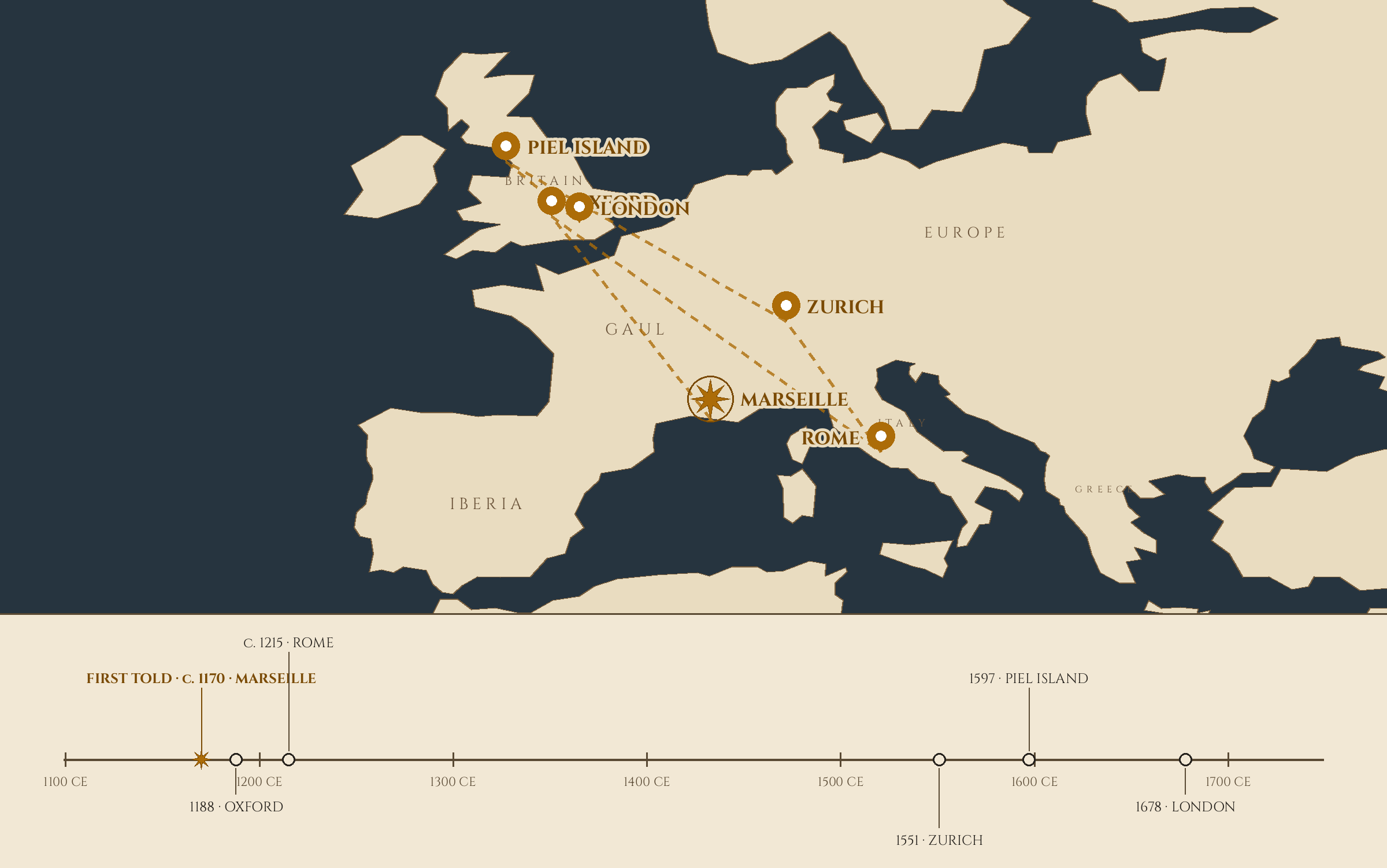
Where this lesson travels: Marseille, where Rabbi Tam's ruling on eating the barnacle goose is recorded — the earliest surviving written account; Oxford, where Gerald of Wales reads his Topographia Hibernica: geese hatching from barnacles on Irish timber; Rome, for the Lenten ban attributed to Innocent III at the Fourth Lateran Council — reported by Vincent of Beauvais, though the canons themselves do not preserve it; Zurich, where Gesner's Historia Avium prints the goose-tree as natural history; Piel Island, where Gerard's Herball claims the goose-bearing shells were seen on that coast; and London, where Sir Robert Moray's account goes to the Royal Society and the claim must survive experiment. The starred pin is the first record; the dashed line is the telling, traveling.
Lesson Objectives
By the end of this lesson, you will be able to:
- Tell the barnacle goose's whole file: the dietary ruling that opens its record, Gerald of Wales's account, and the goose-tree's career in print.
- State the fast-day custom the belief produced, and name the writer who protested against it in his own book.
- Give the real root twice over: what a goose barnacle actually is, and where the goose was spending its summers all along.
- Tell the beaver's tale and its correction — the record's most famous false anatomy — and the mandrake's, in brief.
- Tell the toad's file in the same form: what Pliny actually named, what the lapidaries built on the name, what the stones in the rings really are, and what the living toad actually carries.
- Perform the correction yourself: write an entry as a bestiarist would, then correct it line by line with a red pencil.
Your Assignment Packet
This lesson's work lives in its packet: the Lexicon Handout (every term, the core terms marked with the keeper's diamond ◆), Materials, Guided Practice, the Assignment Manual written out whole, the Scholar's Entry Page, the Reflection Questions, the Workbook Checklist, and the Keeper's Notes, for whoever teaches the lesson. Download the packet before you begin and keep it beside you as you read. The packet's assignment is Rookmere's own word for the work: Entry No. 15 — A Real Animal, Twice Written (written, in two inks) ◐. The Unit II Quiz is not printed in the packet; it closes the unit, and it stands at the end of this very lesson, below.
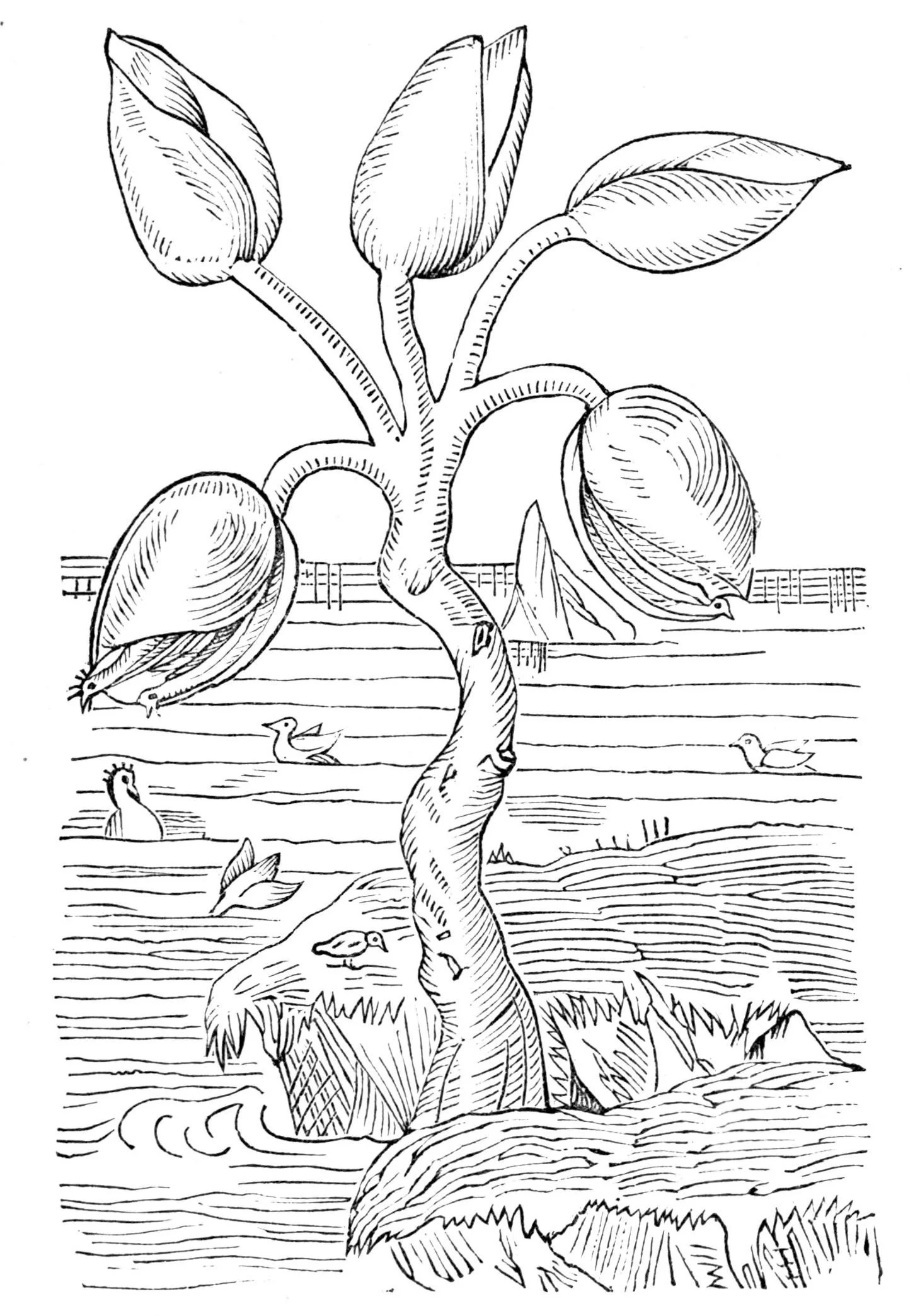
The goose tree, as the early illustrated herbals printed it: the tree whose shell-fruit opens into geese over the water — shells on stalks, shells opening, birds dropping toward the sea. Public domain, via Wikimedia Commons.
The Creature
This is the lesson Unit II has been walking toward. The barnacle goose — Branta leucopsis, a handsome black-and-white goose — is a real bird, alive and numerous. The bestiaries and herbals of six centuries filed her beside the unicorn in the same inks, because the life they recorded for her was impossible: she was not hatched from an egg like other birds, they said, but grew inside shells that hung from driftwood over the sea, and dropped into the water when ripe.
The keeper's question here is not "how could they believe that?" It is the harder one: what did they actually see? A bestiarist's error, examined closely, usually turns out to be a true observation carrying a false explanation. This lesson takes the goose's file apart layer by layer, then hands the method to you: your assignment is to write a bestiary entry yourself, and in red pencil do to your own entry what this lesson does to Gerald of Wales.
Three shorter files ride with the goose, as the census rules: the beaver, named here — the bestiary's most famous false anatomy, corrected by the record itself — the mandrake, the herbals' own marvel, the Guided Observation's worked example of a correction from words alone — and the toad, the lapidaries' jewel-bearer, whose tale stands with the mandrake's in the Tales and whose correction stands beside the beaver's in What It Actually Is.
Meet the goose herself first, at real size, because the whole file makes more sense once she is a bird and not an argument. She is a medium-sized goose, roughly 55 to 70 centimeters long, with a wingspan of about 130 to 145 centimeters and a weight of roughly one to two kilograms — a bird you could tuck under one arm. Her dress is unmistakable: a clean white face, a black head, neck, and upper breast, and a back barred in gray and white, as this lesson's photograph shows. Gerald called her kin "like marsh geese but smaller," and that is fair. Nothing about her, standing on a winter shore, suggests a tree. The marvel was never in the bird. It was in the missing half of her year.
The pictures run the lesson's whole argument in three frames. The Aberdeen Bestiary's beaver (about 1200) is drawn from a text, mid-bite, acting out the tale. The goose-tree woodcut of the Gesner and Gerard tradition shows shells opening into birds over the water — an interpretation drawn as if it were an observation. And the third plate is a photograph: a living barnacle goose, photographed in 2024, the only plate in Unit II that shows the being herself, alive, in her own feathers. Drawing from words, drawing from a story, photograph from life — the depiction line is the correction, visible. The mandrake, by contrast, has no plate in this lesson, by design: her correction is worked from words alone, in the Guided Observation.
First Told
The map at the head of this lesson stars Marseille, about 1170 — and the first record of the barnacle goose is not a poem, a carving, or a traveler's tale. It is a dietary ruling. In his legal work the Iṭṭur, Rabbi Isaac ben Abba Mari of Marseille set down the decision of Rabbi Tam — Jacob ben Meir, the greatest French rabbi of the age (d. 1171) — on the question his communities were asking: these geese that grow from shells on the sea-timber, may they be eaten, and if so, how? Rabbi Tam's ruling was that they must be slaughtered after the Jewish fashion, like fowl — the bird treated as a bird, and the question a kitchen question. The goose enters writing because somebody's dinner depended on her classification — first records are not always about wonder. Sometimes they are about lunch.
From Marseille the line runs north to Oxford, where in 1188 Gerald of Wales read his Topographia Hibernica — his account of Ireland — aloud to the university. Gerald gives the goose her first full natural history. The next pin is Rome, about 1215: a Lenten ban on eating barnacle geese, attributed to Pope Innocent III at the Fourth Lateran Council. File it exactly as the map files it — attributed: the ban is reported by Vincent of Beauvais; the council's surviving canons do not preserve it. A keeper writes the attribution down and moves on.
Then the print era opens the throttle. Zurich, 1551: Conrad Gesner's Historia Avium prints the goose-tree as fact — the hero plate of this lesson is that tradition's woodcut, shells opening into birds over the water. Piel Island, 1597: John Gerard's Herball claims the shells for the Lancashire coast as an eyewitness — a claim later readers have weighed against how much of his book leans on other men's herbals, and found wanting; file the claim and the doubt together. And London, 1678: Sir Robert Moray's account of barnacles goes to the Royal Society, in its Philosophical Transactions — after which the claim has a new kind of reader, one whose habit is to cut the specimen open.
The Tales
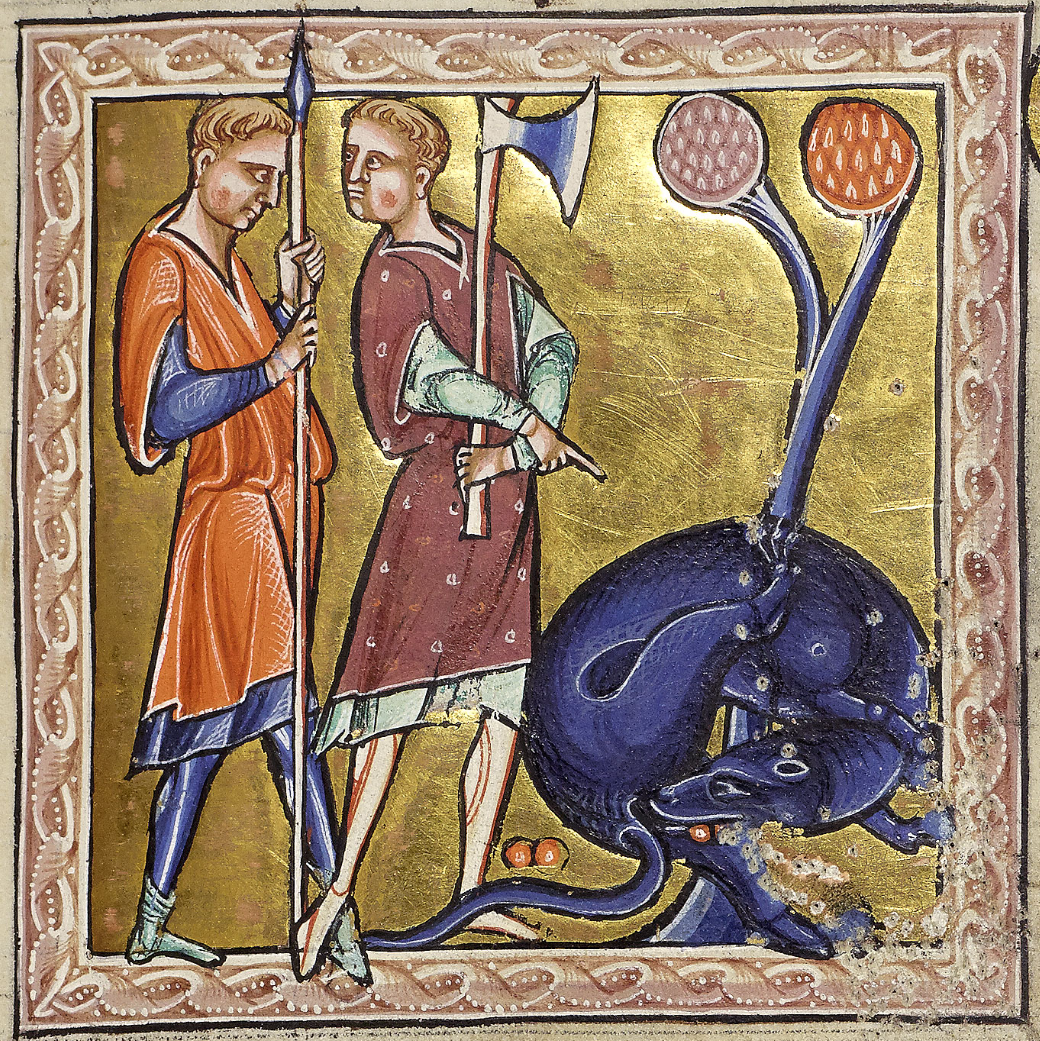
The beaver of the Aberdeen Bestiary (c. 1200): the medieval beaver of the famous false anatomy, biting free before the hunter. Public domain, via Wikimedia Commons.
Gerald of Wales is the telling's engine: he is no fool at the end of a copying chain. Gerald went to Ireland. His account runs: there are birds called bernacae, like marsh geese but smaller, produced from fir timber tossed about at sea. First a shell forms on the timber; the bird grows inside it, hanging by its beak; grown and feathered, it falls — into the sea, to swim away, or it flies free. And Gerald stakes himself on the part a keeper must weigh honestly: he saw them himself, he says, in great numbers, hanging from a single piece of timber on the Irish coast. There is no reason to call him a liar — only to ask what, exactly, was hanging from that timber. What It Actually Is will answer with a crustacean.
The tale grew because it answered a real hole in the record. Nobody in Ireland, France, or England had ever found a barnacle goose's nest, egg, or gosling — not one, ever, though the bird arrived in thousands every autumn, already grown, from over the northern sea. A bird that appears from the sea each year and is never seen to breed requires an explanation, and the goose-tree explained everything: the arrival from the sea, the missing nests, even the shells on the driftwood, which were there to be seen. The encyclopedias fed the herbals; Gesner printed it in 1551 with a picture, and a printed picture is hard to argue with. The story also acquired a second career at the dinner table — the Watched-For below.
But the correction does not arrive from outside the Middle Ages, like a rescuer. It grows inside the record, from the record's own best habits. The Emperor Frederick II, who wrote a treatise on falconry in the 1240s and trusted specimens over authorities, had barnacles brought and examined, and reported finding nothing bird-like in them. Albertus Magnus, the great Dominican naturalist of the same century, rejected the generation-from-timber outright. The goose's file thus contains its own argument from the 1200s onward: authorities copying the tale on one page, observers cutting shells open on the next. Print mostly followed the copiers for three more centuries. But the cutting never stopped.
Tell the goose's tale whole, as the record gives it, before you correct it — the assignment will ask you to. On wild coasts there stands a tree over the water — or the timber is wreck-wood adrift — and on it grow shells, like mussels but hanging downward on stalks. Inside each shell a bird is forming. In season the shells open, and the young bird hangs out by its beak, feathered and stirring; then it drops. If it falls on water, it lives and swims and flies in time. If it falls on land, it dies. Therefore, say the tellers, this goose has no nest and no egg, and comes out of the sea timber every autumn — a bird made by wood and water, not by flesh. It is a good tale: complete, consistent with every observation its tellers could make, and false in one place only, the place none of them could reach.
The beaver's tale is shorter and stands here in its named place. The beaver, the record says, carries in his body a precious substance, castor, for which hunters hunt him. When the hunter closes in, the beaver bites off the castor sacks and leaves them on the path, ransoming his life; and if a second hunter meets him later, the beaver stands upright and shows what is gone, and is passed over in peace. The Aberdeen Bestiary's plate — this lesson's second — draws the first act of that story: the beaver mid-bite, the hunter approaching. The bestiaries read the tale as a sermon on cutting away what endangers the soul — recorded here in one line, as depiction history. Its correction is in What It Actually Is, and it is the cleanest in this class.
The mandrake's neighbour in the herbals deserves her paragraph here, plate or none: the toad, and her jewel. The tale, as the lapidaries and the naturalists hand it down, is that an old toad carries in her head a precious stone — the toadstone, also called bufonite, from bufo, the Latin for a toad — which is the animal's own antidote. Set the toad on a piece of red cloth, the books say, and she will give the stone up; wear it against the skin and it will sweat and change colour in the presence of poison, and cure a venomous bite where it touches. Shakespeare expected his audience to know the stone in 1599, when Duke Senior, in As You Like It, finds adversity's sweetness in a creature "which, like the toad, ugly and venomous, wears yet a precious jewel in his head." Thomas Nicols's Lapidary of 1652 gives the working file entire in one chapter: the true stone no bigger than the nail of a hand, the red cloth, the sweating at poison. The toads of the record were weather-signs as well as jewel-boxes. The Frank C. Brown Collection of North Carolina Folklore (Vol. VII, 1964) records, from the eastern United States, that the croaking of frogs and toads signals the end of winter, and that seeing and hearing them in number is a sign of coming rain. The lore had a sound under it, as this lesson likes: a toad chorus is at its loudest in warm, wet breeding weather, when the rain is near or already falling. Her correction is in What It Actually Is, beside the beaver's.
And the mandrake, in brief, as the herbals tell her: a root in the shape of a little man, which screams when it is pulled from the ground — a scream that kills whoever hears it. So the method, as the herbals prescribe it: plug your ears with wax, tie the plant to a hungry dog, set meat just beyond the dog's reach, and stand well back. The dog lunges, the root tears free and screams, the dog falls dead — and the root is yours. Josephus, writing in the first century, tells the same method of a wonder-root near the Dead Sea, drawn by a dog that died in its master's place; the herbals fastened the method, and the scream, onto the mandrake, whose human shape had already marked her as more than a plant. The plant above ground is ordinary enough to walk past: a flat rosette of broad, wrinkled leaves lying close to the soil, bell-shaped flowers, and round berries that ripen yellow-orange. All the drama is underground, in that thick forked root — and in what the root and leaves carry, which is a genuine load of narcotic poison. Remember that there is no picture of her among this lesson's plates. Her file here is words, and words are what we will correct her with.
KEEPER'S CHECK-IN
Gerald's goose-tree tale explained everything its tellers could observe — the bird's arrival from the sea and her missing nests among them — so what was the third true observation the tale joined up wrong?
Spotted
This lesson's sightings are claims of seeing, and the lesson's whole method is to weigh them one by one.
Gerald of Wales stakes the largest claim: he saw them himself, he says — great numbers of the shell-birds hanging from a single piece of timber on the Irish coast. There is no reason to call him a liar, and What It Actually Is will show what was hanging on that timber. File the seeing S, and the reading of it separately.
John Gerard's Herball (1597) claims the goose-bearing shells for the Lancashire coast as an eyewitness; later readers have weighed the claim against how much of his book leans on other men's herbals, and found it wanting. Claim and doubt are filed together.
The register closes with an examination rather than a sighting: Sir Robert Moray's account of barnacles, laid before the Royal Society in 1677/78 — specimens brought, opened, and reported on, with nothing bird-like found inside. After Moray, the file's reports come from men with knives and notebooks, and the goose's missing summer, not her cradle, is the question that remains.
KEEPER'S CHECK-IN
Gerald claimed he saw the shell-birds himself, and Gerard claimed the shells for the Lancashire coast as an eyewitness — how is Gerald's seeing filed, and what is filed alongside Gerard's claim?
What People Watched For — the Goose on the Fast-Day Table
What people watched for, in this lesson, was a classification — and they watched it at the table: the fasting rules of the medieval Church forbade flesh on fast days and through Lent, but permitted fish. So what was a goose that grew from shells on sea-timber — born, as Gerald himself reports the argument, "not of flesh"? Gerald's Topographia protests, in so many words, that "bishops and religious men in some parts of Ireland do not scruple to dine off these birds at the time of fasting, because they are not flesh nor born of flesh" — and Gerald will have none of it: a creature that lives and feeds as a bird is meat, he argues, whatever its cradle — if a man ate the leg of Adam, not born of flesh either, he would not be innocent of eating flesh. The protest is dated, named, and printed in this lesson's first great source.
So the custom the belief produced was a goose on the fast-day table — served in Lent, under a legal argument about shells. The attributed papal ban of about 1215 (reported, not preserved, as the map says) is the custom's official answer, and the argument itself kept working for centuries wherever the bird wintered — her file in the kitchen stayed open long after the naturalists closed theirs. Rabbi Tam's ruling, at the map's first pin, is the same custom seen from the other table of the same century: two traditions, one bird, and the question — what is she, that we may know how to eat her? — asked in Marseille and in Ireland in the same lifetime. A documented practice, argued over by named men in datable books — whatever grew on the timber.
What It Actually Is
✦ On the class test
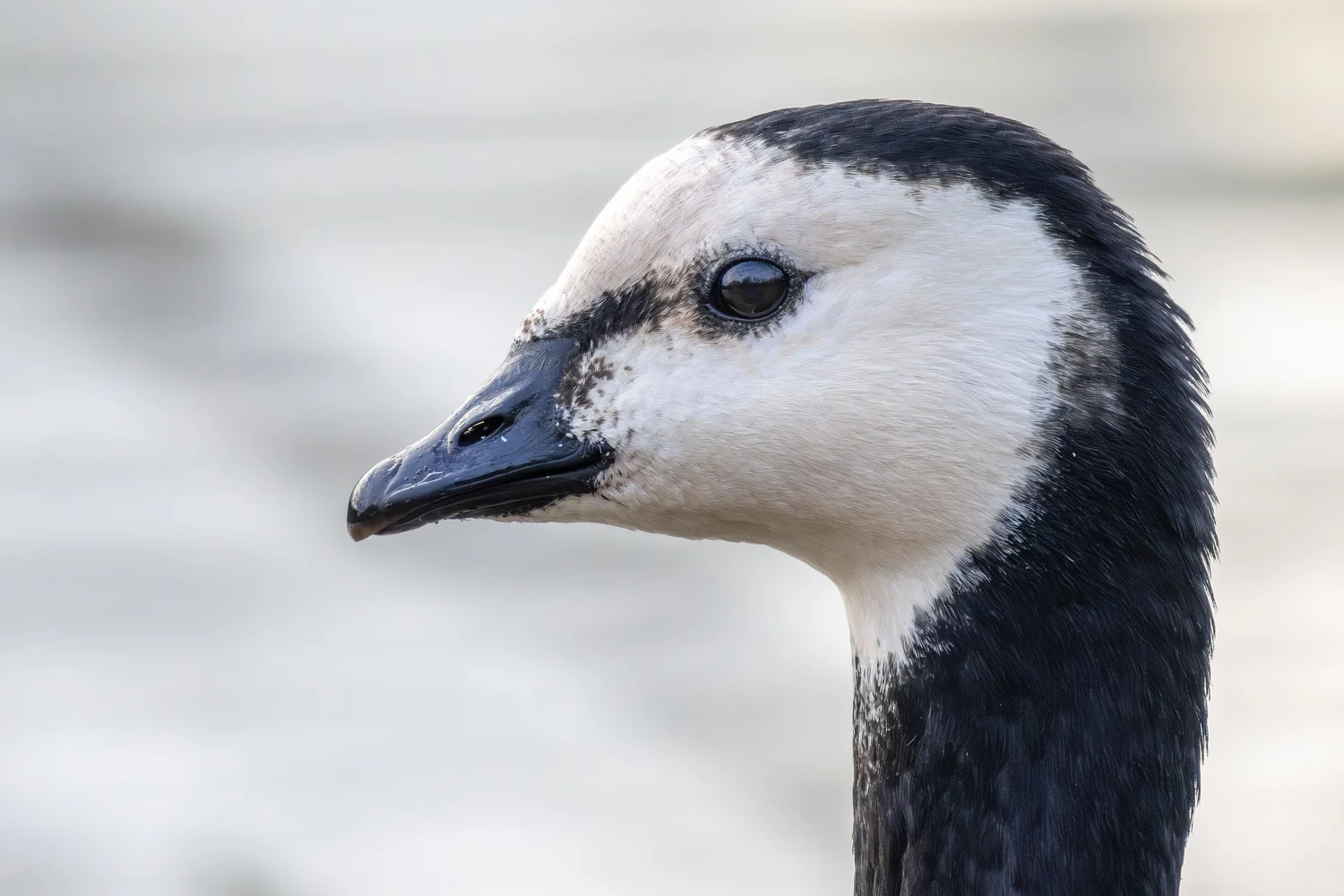
The correction: a living barnacle goose in her own feathers — an ordinary goose, kin to the birds on any winter pond, whose Arctic summer no watcher at home could see. Photograph by Alexis Lours (2024). CC BY 4.0, via Wikimedia Commons.
Open the shell. Inside the goose-tree's fruit is a real animal: the goose barnacle, Lepas anatifera, a stalked crustacean that fixes itself to driftwood, wreck timber, and ships' hulls and spends its life at the surface of the sea. Its shell is white and mussel-like; its stalk is dark and leathery; and when it feeds it unfurls its cirri — jointed feeding legs — which curl and wave like a tiny bunch of down feathers stirring. Get its scale, too: the shell — the capitulum, properly — is made of five smooth white plates and grows to only about five centimeters long, riding on a stalk that is usually a few centimeters but can run far longer. So picture a whole log of them honestly: dozens of little white shells, each no bigger than a thumbnail's stretch, nodding on their stalks in the wash, every one of them combing the water with those feathery legs. At arm's length it is a barnacle colony. Across a beach, in poor light, to a man who was already looking for the goose's cradle — well. Gerald's reading stops sounding foolish, and starts sounding like the mistake a good observer makes. Put the pieces in a row: a shell on a stalk like a neck, hanging from timber over the sea, and inside it something feathered that moves. Gerald saw what he said he saw — barnacles on driftwood, in great numbers — and read them as birds aborning. The observation was fact. The reading was tale.
The other half of the root is the half of the bird's life that nobody watching could see. The barnacle goose breeds in the high Arctic — on cliff ledges in Greenland, Svalbard, and the Russian north — where no Irish bishop, French rabbi, or English herbalist could ever stand in June. Her goslings hatch on the cliff face and, flightless, must leap from the ledge to reach the grazing below — and the tale's detail that the young must fall to live turns out to be true of the bird after all, only from a cliff and not a tree. The winter flocks arrive each autumn already grown, from over the sea, onto the same beaches as the driftwood and the barnacles: every observation available to the record said sea-born. The Arctic breeding grounds entered the written record only when northern exploration reached them, in the age of sail and steam — the goose's file waited five hundred years for its missing summer.
The toad's correction begins by reading her first author straight. Pliny's Natural History, Book 37 (first century), names a stone batrachites, the frog-stone, from Coptos in Egypt — and says of it only that one kind has the colour of a frog, a second is similar and veined, and a third is red mixed with black. Pliny does not say the stone grows in a toad's head, and he gives it no powers. The head, the antidote, and the jewel were the lapidaries' work, built over centuries on a name that meant, at the start, only a colour. The chelonitis that stands near it in Pliny's list is a different stone again — tortoise-patterned, and said by the magicians to calm storms; later writers shelved the two names together, and a keeper should not. The correction arrives, as this lesson's corrections do, from inside the record. Sir Thomas Browne, in Pseudodoxia Epidemica (1646), Book III, chapter 13 — "Of Frogs, Toads, and Toad-stone" — reports that the stones esteemed as toadstones were "taken not out of Toads heads, but out of a Fishes mouth." The modern identification finishes his sentence: the button-like stones set into rings from the Middle Ages into the eighteenth century — surviving examples sit in the Ashmolean Museum and the British Museum — are the fossil palatal teeth of Scheenstia, the ray-finned fish the older books call Lepidotes, from Jurassic and Cretaceous waters. And the living toad needs no jewel to earn her place in the file. The common toad, Bufo bufo, carries her defence in plain view: the swollen parotoid glands behind her eyes, and the glands of her dry, warty skin, secrete a bitter toxin — bufotoxin — that deters most predators that bite her; threatened, she inflates her body and stands high with her head lowered. The record had hold of something real: this animal is genuinely poisonous to eat. It set a jewel where the glands were.
The beaver's correction is one sentence long, and the record itself supplies it. Castoreum is real — a scented secretion valued for centuries in medicine and perfume — but it comes from the beaver's castor sacs, glands near the base of the tail, in beavers of both sexes. They are not what the tale said, and no beaver bites them off; they are inside, and cannot be. And here is the animal the tale was told about, for the record: the Eurasian beaver is a big, stocky rodent, roughly 75 to 90 centimeters in head and body, with a broad flat scaly tail of about another 30 centimeters behind that, webbed hind feet, and a weight that commonly runs from about 12 kilograms upward. Big enough to be worth a hunter's trouble, slow enough on land to be caught at it — the tale's economics, at least, were drawn from life. The error's seed is visible, as usual: the Latin name of the animal, castor, and the name of the substance were allowed to explain each other, exactly as Isidore taught his readers to trust, and the anatomy was arranged to fit the word. Gerald also reports clerics eating beaver tails in Lent, the scaly flat tail being fish-like — the same argument as the goose's, wearing a tail. And the mandrake's root is the root itself: mandrake roots fork into a little man's shape, and the plant is a true nightshade, loaded with narcotic poisons — the harvester's caution, however dressed in wax and dogs, had a real danger inside it. Observation, fact; explanation, tale; in all four files, in this whole lesson.
Still With Us
The goose today is a protected bird, counted by international surveys, wintering in managed reserves in Ireland and Scotland, her Arctic breeding mapped, her migration tracked. Nature films have carried her goslings' cliff-leap into millions of houses — the fall the old tale insisted on, on camera, from the rock. And the goose-tree has retired into the modern record's honorable rank: perhaps the most instructive error in zoology, told in every history of the science, because it was reasonable. The men who held it were working from true observations — shells on timber, feathers stirring inside them, a goose that arrived from the sea and was never once seen to nest — and they joined those observations up wrong. Correcting the join took centuries of other observers doing the same work more completely. There is no shame in the file, on either side of the correction, and keepers do well to remember that when they meet the next reasonable error, which will not announce itself as one.
The beaver, hunted nearly out of Europe for castor and fur, has come back river by river in our own century — the animal the bestiary drew wrongest is again at work in real water, engineering the stream. Unit II ends there, at the water's edge, which is where Unit III begins. The waters are next, and their records are stranger, colder, and wet all the way through.
Guided Observation
This lesson's Guided Observation is a working demonstration — the correction method itself, performed on the plates, before the assignment asks you to perform it yourself.
First, the goose-tree. Study the hero plate — the woodcut of the goose-tree as the Gesner and Gerard tradition printed it — shells over the water, shells opening, birds dropping toward the sea. Read it as a bestiarist read it, and list everything in the picture that is truly there in nature: shells on stalks, fixed to wood, over water; the shells opening; a feathery thing stirring inside. Three observations, all F. Then mark the picture's single act of interpretation — the moment a shell becomes a bird — and write it as T. You have now corrected a plate. Notice how little had to be thrown away.
Second, the beaver. The Aberdeen Bestiary's miniature draws the famous bite, hunter approaching, the old reading implied. Write the correction under the plate in the keeper's form: Tale-line: the beaver bites off the castor to ransom his life. Root-line: the castor sacs are glands by the tail, in both sexes, and cannot be bitten off. Verdict-line: the record kept the hunter, the price, and the substance; it misplaced the anatomy. Three lines, and the entry stands corrected.
Third, the photograph. The living barnacle goose (photographed 2024 by Alexis Lours, CC BY 4.0) — the only plate in this class's Unit II that is a photograph of the being itself, alive, in its own feathers. Write down three things the photograph can prove that no earlier plate in this lesson could: that the bird exists as drawn; what her true colors and proportions are; and that she is an ordinary goose, kin to the birds on any winter pond. Then note what the photograph cannot show: where she was in June. It took a journey, not a lens, to correct that.
Fourth, the mandrake — from words alone. This lesson's plates hold no mandrake, so her correction is an exercise in text: the method must work where no picture survives. From the Tales, write her three lines. Tale-line: the man-shaped root screams when pulled, and the scream kills; so it is drawn by a dog, which dies. Root-line: the root forks into a man-shape, and the plant is a narcotic nightshade whose handling deserves real caution. Verdict-line: the scream and the dog are T; the shape and the danger are F; and Josephus shows the dog-method is older than the mandrake's own file — a story that migrated from root to root. If you can correct a being you have never seen pictured, you can correct anything on this shelf — and the assignment now asks you to do it the other way round.
Assignment Manual
✎ WRITTEN · ⚒ HANDS-ON · ◐ BOTH
◐ Both · Entry No. 15: A Real Animal, Twice Written — the Unit's Signature Entry.
- Choose your animal, and watch it. Pick a real animal you can observe where you live: a squirrel, a pigeon, a robin, the house cat, a spider in her corner, the neighbor's dog — any creature you can watch at least three times over at least two days. Rule your entry page as always, but rule it for two entries: the bestiarist's, and the corrected one. Have your red pencil ready from the start.
- Part One: write as a bestiarist. ✎ Write your animal's entry as a medieval bestiarist would, in good faith and in his manner. Give its name, and an etymology for the name in Isidore's style — let the name explain the nature, as he taught. Give its natures: what it does, gathered from your watching and from what people say of it — bestiarists used authorities; yours are your household, your neighbors, and common report — let in the plausible marvels they suggest. Close with a moralization: what its nature teaches. Mean it — a parody teaches nothing; the exercise works only if your bestiarist is honest, as Gerald was honest.
- Part Two: correct it with the red pencil. ✎ Now, in red, go through your own entry line by line, as this lesson went through Gerald. For each line, one of three marks in red: stands — a true observation; falls — an error, with the modern fact written beside it from a reliable modern source (name your source in the margin); reasonable — an error, but one your evidence honestly suggested, with a note on what observation made it tempting. Your invented etymology and your moralization get corrected too: the etymology against the word's true history, the moralization examined for what it says about you, the writer — moralizations always describe their makers.
- Close the entry, and mark the whole. End Entry No. 15 with the standard fields — First Told (your first sighting, dated: your record starts with you), How the Telling Grew (what was said of your animal before you watched it), The Tales (your bestiarist's version, Part One), What It Actually Is (your corrections, Part Two), Still With Us (your animal today, in two lines), and The Keeper's Line. Then mark both versions, margin by margin, T, S, or F — and file the two together, unseparated. The pair is the entry: you have now stood in both chairs at the keeper's desk.
Materials
· Your bestiary journal, with Entries No. 1–14 in it
· Pencils, and a pen you like
· A red pencil — this lesson's essential tool; the correction must be visible as a correction
· A ruler, for ruling your entry pages
· A field guide, nature book, or encyclopedia entry for your chosen animal, for Part Two
· This lesson's packet (the Scholar's Entry Page is in it)
Reflection
Gerald wrote "I saw them with my own eyes," and he had. What is eyewitness testimony actually worth, after this lesson — and what else must stand beside it before a keeper files the claim?
Frederick II cut the barnacles open in the 1240s and the tale outprinted him for three more centuries. Why did the correction lose for so long — and what finally made corrections win?
In Part Two of your assignment, which was harder to correct: the line that was simply wrong, or the line that was reasonable? What does your answer predict about the errors in records being written today?
Cross-Class Connections

A word from the Herbology Greenhouse, keeper to keeper. This lesson teaches you to read a real animal the way the bestiarists wrote it — and then to correct the writing against the living thing. My class does the same work from the other side: we watch real plants where they grow, and then check what the old books said of them. The mandrake you met in this lesson's tales stands in my keeping too: she is one of the two hundred and two plants of the Materia Botanica, the archive the Greenhouse keeps with the Potions Laboratory, filed with her lessons, her keepings, and her cautions.
The archive is the Materia Botanica, the school's plant encyclopedia. Come and read her entry — and bring your red pencil.
Herbology
Master Herbalist
A Closing Note
Unit II closes with a living entry in your book and red pencil-marks in its margins. You have now kept beasts of pure record, beasts of bone, and beasts of your own backyard, and the marks held in all three weathers.
Next, the waters. The kraken is waiting, and his first record is a bishop's. Dry your journal, oil your boots, and keep the red pencil sharp — the sea reports will need it.
The Bestiary
Bestiary Keeper
Further Reading & Sources
Gerald of Wales, Topographia Hibernica (1188) — the barnacle goose and the beaver's tail, in the first full account; his protest against the fast-day goose is in the same chapters.
Conrad Gesner, Historia Avium (Zurich, 1551) — the goose-tree in the first great printed bird book.
John Gerard, The Herball, or Generall Historie of Plantes (1597) — the goose-bearing shells claimed for the Lancashire coast.
Edward Heron-Allen, Barnacles in Nature and in Myth (Oxford University Press, 1928) — the classic monograph on the whole file, rabbis, popes, and barnacles included.
Sir Robert Moray's account of barnacles, Philosophical Transactions of the Royal Society (1677/78) — the claim meets the experimental reader.
Pliny the Elder, Natural History, Book 37 (first century) — batrachites, the frog-coloured stone of Coptos, named for a colour and nothing more.
Sir Thomas Browne, Pseudodoxia Epidemica (1646), Book III, chapter 13 — the toadstone examined, and reported out of a fish's mouth.
Thomas Nicols, A Lapidary, or the History of Pretious Stones (1652), Part II, chapter 36 — the toadstone's whole working file: the red cloth, the fingernail size, the sweating at poison.
Frank C. Brown Collection of North Carolina Folklore, Vol. VII (Duke University Press, 1964) — frogs and toads in the recorded weather lore of the eastern United States.
The Unit II Quiz
The Unit II Quiz checks the whole of the unit — Lessons 7–15, from the unicorn to the real animals of the bestiary — and its answers and self-check stand at the back of the quiz packet, so you can mark your own work the keeper's way. Take it with your bestiary beside you, Entries No. 7–15 open: everything it asks for is work your own hand has already done.
Download the Unit II Quiz (PDF)
Submit your work for this lesson using the form below.
CONTINUE IN THE BESTIARY HALL
← Previous · Lesson 14: Bigfoot & the Yeti Next · Lesson 16: The Kraken →
Unit II — Beasts of the Land The Bestiary Hall — All 41 Lessons
The rest of Unit II: Lesson 7 · The Unicorn · Lesson 8 · The Griffin · Lesson 9 · The Basilisk & the Cockatrice · Lesson 10 · The Manticore & the Spotted Beasts · Lesson 11 · Giants & the Cyclops · Lesson 12 · Centaurs & Satyrs · Lesson 13 · The Wild Men of the Woods · Lesson 14 · Bigfoot & the Yeti