

THE BESTIARY
Unit III · Lesson 16The Kraken
Professor Sable Rookmere
Bestiary Keeper
The Bestiary Hall • School of Evershade
Professor's Introduction

Unit III goes to the waters, and it begins with the largest file in the unit: a being whose witnesses were fishermen, whose champion was a bishop, and whose portrait was drawn by men who had never seen it. The kraken is the class's best test of everything you have learned so far, because its record does not divide neatly into ignorant old sailors and clever modern science. The sailors were careful. The scientists, at least once, were credulous. The bishop hedged like a man defusing something.
Read it the keeper's way: who wrote this, when, and how could they have known? Keep your journal dry.
The Bestiary
Bestiary Keeper
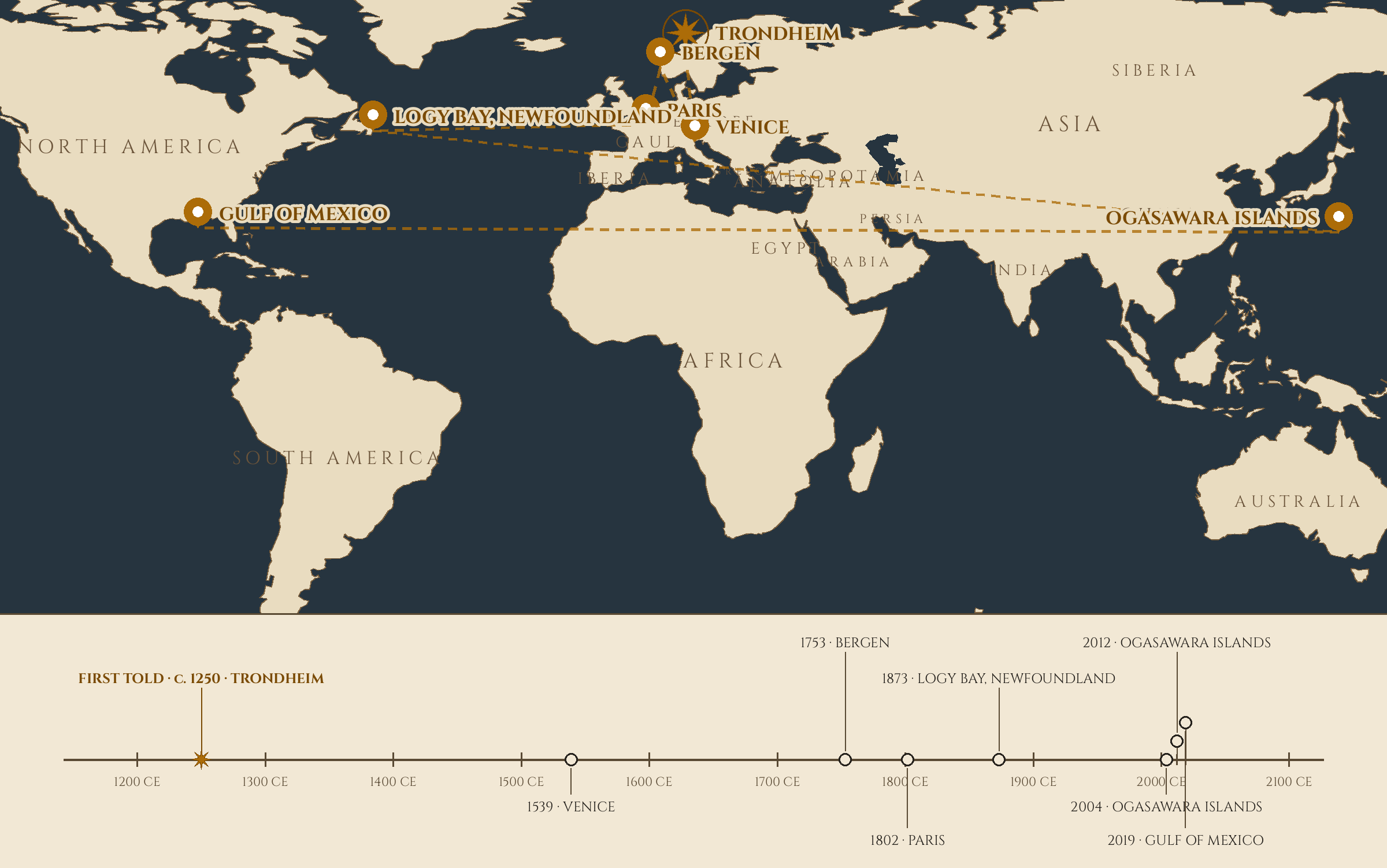
Where this lesson travels: Trondheim, where the Norwegian King's Mirror (c. 1250) described the hafgufa, the vast sea-thing later writers equated with the kraken — written at the Norwegian court, so the place is approximate; Venice, where Olaus Magnus's Carta Marina was printed in 1539 and pictured the sea-beasts of Norway for all Europe; Bergen, where Bishop Erik Pontoppidan's Natural History of Norway (1753) gave the kraken its full, famous account; Paris, where Pierre Denys de Montfort printed a giant octopus hauling down a ship in 1802; and Logy Bay, Newfoundland, where a giant squid came ashore in 1873 — the real animal behind the sailor's monster. The starred pin is the first record; the dashed line is the telling, traveling.
Lesson Objectives
By the end of this lesson, you will be able to:
- Describe the kraken as its record describes it, and read its plates in order — map, original picture, famous copy, photograph.
- Name the book that holds the kraken's first record, and say what sea-thing it describes there, and under what name.
- Tell the kraken's tales, and say why this being's folklore reads more like a logbook than a storybook.
- State the fishermen's sounding test as Pontoppidan recorded it, and the working custom it produced.
- Name the real animal behind the reports, the evidence that settled its existence, and the year it was finally photographed alive.
- Mark every line of the kraken's file T, S, or F — tale, sighting-report, or fact — including the lines written by scientists.
Your Assignment Packet
This lesson's work lives in its packet: the Lexicon Handout (every term, the core terms marked with the keeper's diamond ◆), Materials, Guided Practice, the Assignment Manual written out whole, the Scholar's Entry Page, the Reflection Questions, the Workbook Checklist, and the Keeper's Notes, for whoever teaches the lesson. Download the packet before you begin and keep it beside you as you read. The packet's assignment is Rookmere's own word for the work: Entry No. 16 — The Kraken (both) ◐. The Unit III Quiz is not printed in the packet; it waits at the end of the unit, with Lesson 22.
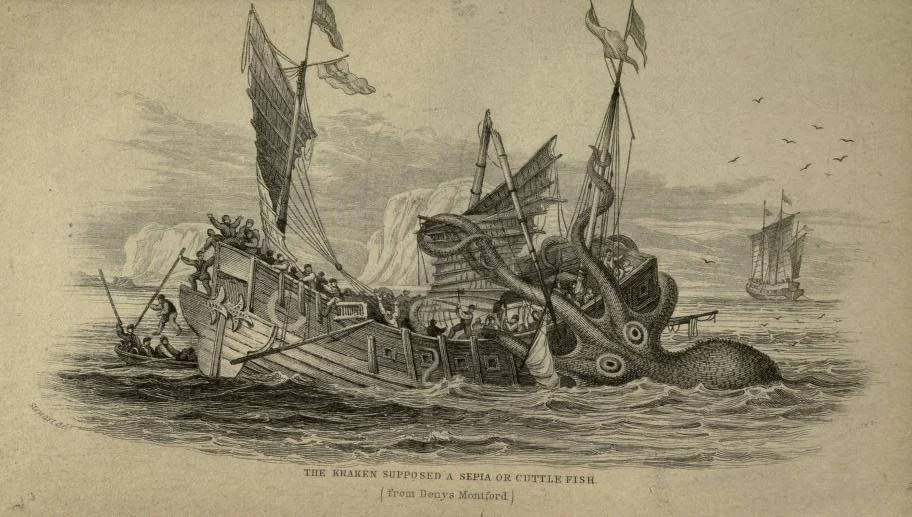
The kraken as the nineteenth century pictured it from Bishop Pontoppidan's account: W. H. Lizars's engraving in The Naturalist's Library (1839), adapted from Denys de Montfort — a vast many-armed sea monster rising beside a ship, its body broad as an island. Public domain, via Wikimedia Commons.
The Creature
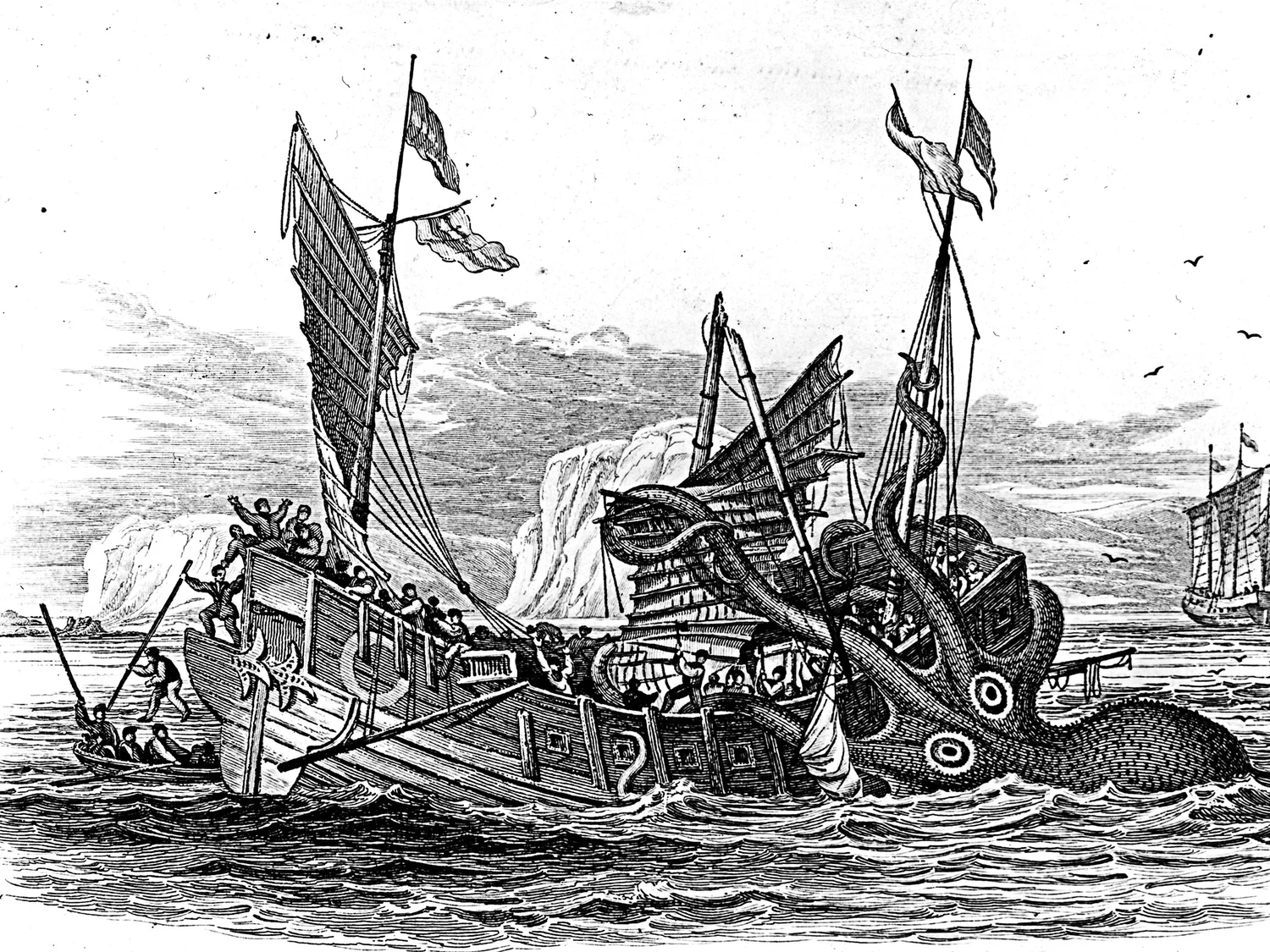
Pierre Denys de Montfort, Le Poulpe Colossal (1801), engraved by Étienne Claude Voysard for Histoire naturelle, générale et particulière des mollusques (1801–1802): the colossal octopus hauling down a sailing ship — the original plate the Lizars engraving of 1839 descends from, drawn from French sailors' reports of an attack on a vessel from Saint-Malo, off the coast of Angola. Public domain, via Wikimedia Commons.
The kraken is the vast sea monster of Norwegian report: a creature so large that sailors mistook its back for an island, with arms that rose beside a ship like masts. The word itself is Norwegian — kraken is simply "the krake," the definite form, the way English says the beast and means one beast in particular. What krake first meant before it named the monster is argued over; the word seems to have been used of crooked, gnarled, or sickly things. Keepers record the argument and move on.
Its size, as the record gives it, is the largest claim in this class. Bishop Erik Pontoppidan, whose full account you will meet in the next section, wrote that the back that rose above the water appeared to be "about an English mile and a half in circumference (some say more, but I chuse the least for greater certainty)." At first it looked like a number of small islands, with something like seaweed floating between them; then points or horns rose out of it, growing thicker as they climbed, some as high and large as the masts of middle-sized ships. Hold that measure in mind. Section 5 sets the real animal beside it.
Now read the creature's pictures in order, because this being's depiction line is short enough to hold whole. There is no medieval picture: the first record, a Norwegian book of about 1250, is a text with no illustrations, and the kraken's images begin with print. The first is not a portrait but a sea full of beasts — Olaus Magnus's Carta Marina of 1539, one of this lesson's plates, crowds the northern waters with great fish rearing beside ships along the Norwegian coast. The kraken's own portrait arrives in Paris in 1801–1802: Pierre Denys de Montfort's colossal octopus, a new plate in this lesson, hauling down a sailing ship, arms on the rigging — drawn from French sailors' reports of an attack on a vessel from Saint-Malo, off the coast of Angola. That picture, adapted and re-engraved, became the kraken the world knows: the Lizars engraving at this lesson's head (1839) descends from it. And the line ends, for now, in a photograph: the giant squid specimen at the end of this lesson's plates, hauled up off Louisiana and held by the researchers who recovered it — arms spread out on the deck, pale and thick as ropes, and one long tentacle lifted up for the camera. Nothing in the picture is rearing over a ship. That is rather the point.
Get the real animal's shape clear in your mind now, because the reports make more sense once you do. A giant squid carries eight arms and two much longer feeding tentacles, all of them lined with suckers, and at the center of the arms sits a hard beak, something like a parrot's. Most of the famous length is tentacle. The body itself — the mantle — runs to about seven feet in the largest females on record. The eyes are the wonder of the animal: up to about a foot across, the largest in the animal kingdom, built to catch faint light in deep water.
First Told
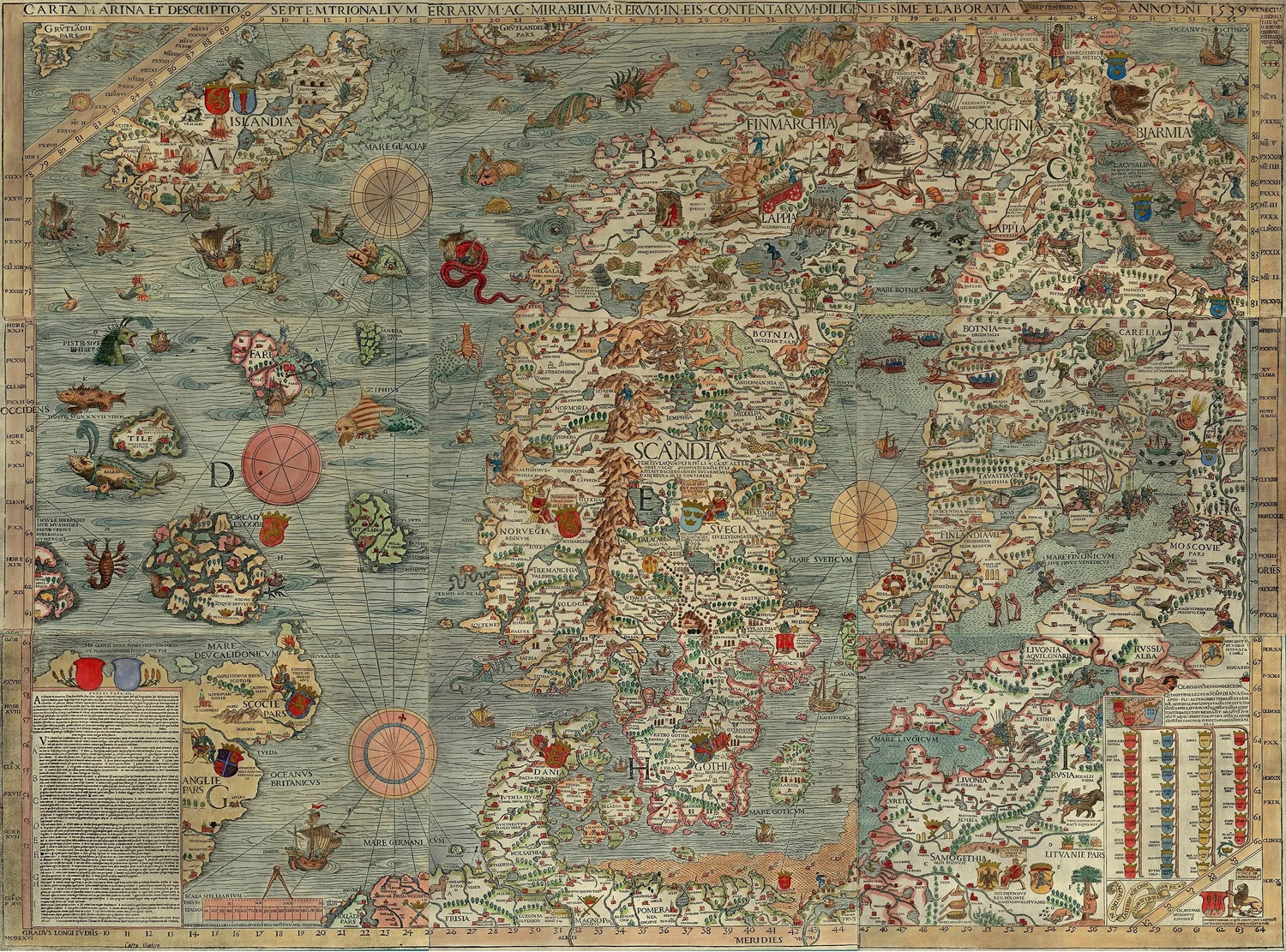
Olaus Magnus, Carta Marina (1539) — the full map of the North, crowded with the sea beasts of early modern report: the cartographic world the kraken reports came from. Public domain, via Wikimedia Commons.
The name is not in the first record. That is the first thing to understand about this file. The earliest surviving account stands in a Norwegian book of about 1250 called the King's Mirror — Konungs skuggsjá — a book of instruction written as a father-and-son conversation, covering kingship, trade, and the wonders of the northern seas. Among the sea wonders, the father describes the hafgufa, a name usually read as "sea-reek" or "sea-mist": a fish so great, the father says, that it seemed more like an island than a living thing. It was seldom seen, and always in the same two places. The author supposed there could be only two of them in the world, because if there were more, they would eat the seas bare.
The father also describes how the hafgufa feeds — a piece of observed behavior wearing a monster's size. The creature belches up food; fish of every kind crowd in to feed, gathering into its open mouth and belly; and when mouth and belly are full, it closes its jaws and devours them all together. Strip the scale away and that is a feeding method a modern naturalist can still recognize — food offered, fish crowding in to take it, and then the jaws closing. In 1250, nobody could strip the scale away. The size was the point of the wonder, and the size is what the record kept.
Later writers equated the hafgufa with the kraken, and the equation has stuck: when Laurence Larson translated the King's Mirror into English in 1917, he printed the word kraken in the passage itself. That is itself a record — F, a fact about a translation: a first record renamed by its own descendants. The book of 1250 says hafgufa. The kraken enters the file by being read back into it.
The map at the head of this lesson works as all our maps work. The starred pin is Trondheim, about 1250: the King's Mirror, written at the Norwegian court — the place is approximate, as the map itself notes, because a court is a household, not a printing house. From there the dashed line walks the record south and forward: Venice in 1539, where a printed map taught Europe the northern seas; Bergen in 1753, where a bishop gave the kraken its famous account; Paris in 1802, where the monster got its portrait; and Logy Bay, Newfoundland, in 1873, where the real animal came ashore. The telling is older than the star; the record begins where we can point.
Print carried the kraken further than any ship. Olaus Magnus's History of the Northern Peoples (1555) described the great fish of the Carta Marina in words as well. A map is an argument. Olaus Magnus's argument was that the northern seas were full of wonders, and generations of readers took their geography — and their zoology — from his coastlines. A reader of 1539 did not meet the kraken as a rumor in a footnote. He met it as geography, drawn in the same ink as Norway itself — and geography is much harder to argue with.
Then the kraken did something no fairy or brownie on our shelf ever managed: it was entered, formally, in the scientific record — and then struck out of it. In the first edition of Systema Naturae (1735), Carl Linnaeus, the Swedish naturalist who built the modern system of naming living things, classified the kraken as a cephalopod under the name Microcosmus marinus. In later editions he removed it. In his Fauna Suecica (1746) he still called it a unique monster said to inhabit the seas of Norway — and added, in Latin, the most honest clause in this whole lesson: but I have not seen this animal. A keeper could build a career on that clause. Linnaeus filed the kraken, doubted his own filing, and said so in print. Mark the entry F; mark the animal as he printed it S, a report he could not check; mark the honesty as the method working.
The full, famous account came from Bergen in 1753. Erik Pontoppidan, Bishop of Bergen, published his Natural History of Norway (Danish 1752–53; English translation 1755) — a serious work of natural history, covering the country's minerals, plants, and animals, in which the kraken receives a full chapter, footnoted. Pontoppidan had not seen the creature either. What he had was testimony: the reports of Norwegian fishermen, which he says agreed unanimously, and which he set down the way a careful man sets down evidence he cannot personally check. And the sinking, the bishop's informants said, was as dangerous as the rising: a great swell, and a whirlpool that could take a boat down. Note what Pontoppidan is doing. He chooses the least figure offered. He attributes every claim. He is not a fool with a monster; he is a scholar with witnesses.
Denys de Montfort, whose 1801 picture you read in section 1, then ruined his own record: he claimed that ten British warships lost in a single night in 1782 — among them the captured French ship of the line Ville de Paris — had been dragged down by giant octopuses. The ships had in fact been lost in a hurricane. The claim was checked, and it destroyed him; he died in poverty in Paris around 1820. His file is the mirror of Linnaeus's: one man removed his own doubtful entry, the other doubled his, and the record kept the score.
The Tales
The kraken has fewer tales than any being of its size, and a keeper should notice why. There is no kraken story with a hero, a bargain, a theft, or a marriage. What the record holds instead are encounters, told the way sailors file reports: a place, a weather, a thing seen. The kraken's folklore is a logbook, not a storybook.
Its central tale is the false island. An Icelandic saga, Örvar-Odds saga, tells of two great sea monsters in the northern ocean, the hafgufa and the lyngbakr — the "heather-back." The lyngbakr's back rose above the waves covered like an island's, and sailors who took it for land went ashore on it; when the beast sank, as beasts do, the men who had landed were drowned. The same episode — landfall on a living back, a fire lit, a sudden sinking — attaches itself to great fish and whales across the northern record. It is less a story about a monster than a story about a mistake: the sea offering you ground that is not ground. Sailors who worked among real islands, in fog, in waters where whales slept at the surface, did not need to invent the danger. They needed only to enlarge it.
The other tales are Pontoppidan's, and they are working tales: the boats that rowed out in the calm of summer and found the water shallowing under them where deep water ought to be; the horns rising like masts; the crews rowing for the true deep water and lying on their oars to watch the back go down. The practical heart of those tales stands in the box that follows: the fishermen did not merely tell them. They fished by them.
KEEPER'S CHECK-IN
Why does the kraken's file hold encounters and working reports rather than a hero's tale — and what mistake does the false-island tale of the lyngbakr warn sailors against?
What People Watched For — the Sounding Line
This lesson's custom is a working practice, recorded by the bishop from the men who kept it. In his Natural History of Norway (1753), Pontoppidan writes that the fishermen, rowing several miles out to sea in the hot summer days, knew their fishing grounds by landmarks: where they expected eighty or a hundred fathoms of water, they sometimes found only twenty or thirty, and at those places the fish were thickest — cod and ling especially — and every line came up full. "By this," he writes, "they judge that the Kraken is at the bottom." The kraken-ground was good fishing, and they fished it gladly. But if the water kept shallowing under the boat, the judgment changed: he was rising. Then they rowed off with the greatest expedition to the usual soundings, lay on their oars in the deep water, and watched him come up.
So what people watched for was a number on a line. A sounding is a depth measurement, taken with a weighted line dropped over the side; a fathom is six feet of it. The custom the belief produced was a rule of the Norwegian fishery, kept in real boats: read your soundings, fish the shallow place the monster makes, and be gone to the deep before he rises. Keepers record it as what it is — testimony about a practice, written down by a named man, in a dated book, from the mouths of the men who worked it. Whether anything lay under the boats, the rule was real, and it was followed.
Spotted
The kraken's sightings come in two kinds: the fishermen's encounters, which Pontoppidan filed as testimony in 1753 and which section 3 has already told, and the strandings — the occasions when the thing in the water came within reach of men's hands and could be measured. The strandings belong to Newfoundland, and to the 1870s.
On October 26, 1873, in Conception Bay, a giant squid fastened onto a fishing boat, and the fisherman Theophilus Picot hacked off a tentacle some nineteen feet long; the Reverend Moses Harvey bought it for ten dollars. Weeks later, in late November 1873, an intact giant squid came up in a herring net at Logy Bay, near St. John's — the last pin on this lesson's map. Harvey secured it, and the animal was photographed draped over his sponge bath: among the first photographs ever taken of an intact giant squid, and the moment the sailor's monster became a specimen. The strandings were documented by the Yale zoologist Addison Emery Verrill, and they made the case for the real animal beyond argument — what that animal is, and what it does and does not explain, is the next section's work. Mark the strandings F: dated events, named men, a kept tentacle, a photograph. Mark what the fishermen of Bergen believed lay under their boats S: reports, honestly filed, of something no instrument had yet measured.
KEEPER'S CHECK-IN
What made the Newfoundland strandings of 1873 different from the fishermen's encounters Pontoppidan filed in 1753 — what could be kept, measured, and photographed?
What It Actually Is
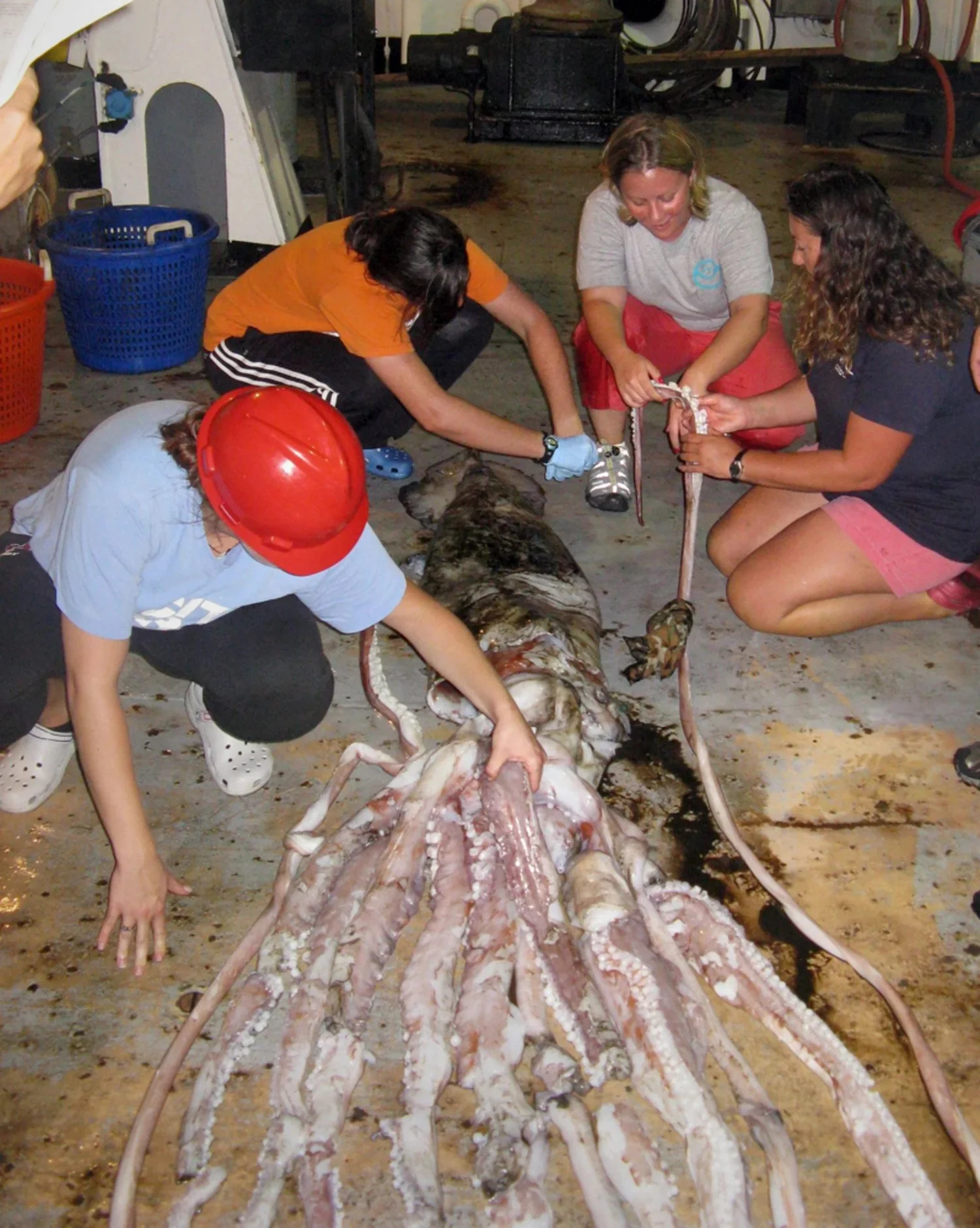
The real root: a giant squid (Architeuthis) specimen hauled up off Louisiana, photographed with the researchers who recovered it — the animal behind the kraken reports. Public domain, via Wikimedia Commons.
The kraken's real root is an animal, and unlike most roots on this shelf, it can be pointed at in a photograph: the giant squid, Architeuthis, a deep-sea squid with arms and two long feeding tentacles, eyes as wide as dinner plates, and a body that in the largest females reaches some forty feet from end to end. It is a real root with real limits: forty feet is not a mile and a half of back.
The animal was settled into the record by pieces. In 1857 the Danish zoologist Japetus Steenstrup described and named the genus Architeuthis from specimens that had washed ashore — beaks, arms, and carcasses, evidence that could be measured, kept, and re-examined. Then came the Newfoundland strandings of the 1870s, told in section 4, which put whole animals, and photographs of them, into the file.
Why did the identification take so long, if the animal was real? Because the squid lives its life in deep water, hunts there, dies there, and only rarely — sick, dead, or storm-driven — comes within reach of men. What sailors saw was almost never the whole animal: a back at the surface, arms beside a hull, a carcass rolling in the swell, judged for size across water, in weather, by men with no reference but their own boat. The record's errors are the errors of honest measurement under bad conditions. You can watch the size shrink, decade by decade, as the evidence improves. The bishop's mile and a half gives way to the zoologist's measured tentacle, and at last the animal stands at its true height.
The last chapter of the root is the proof of how deep the animal's privacy runs. The giant squid was described in 1857, photographed dead in 1873 — and not photographed alive in its own waters until September 30, 2004, when the Japanese researchers Tsunemi Kubodera and Kyoichi Mori lowered a baited camera to nine hundred meters off the Ogasawara Islands, south of Tokyo, and took more than five hundred photographs of a living squid attacking the bait. Film at the surface followed in 2006, of a squid brought up alive on a line — a living animal, but not yet an animal filmed at home. That film came in the next section.
Still With Us
The kraken's pictured face was fixed early, and by a poet. In 1830 the young Alfred Tennyson published "The Kraken" in his Poems, Chiefly Lyrical — an irregular sonnet of fifteen lines in which the creature does nothing at all: it sleeps, far beneath the thunders of the upper deep, "battening upon huge sea-worms in his sleep," and will rise only when the latter fire heats the deep at the end of the world. Tennyson had his kraken from the books — from Pontoppidan's account, carried into a poem by a man of twenty-one who had read the bishop carefully. The record had become literature, and literature kept the record's shape: vast, ancient, mostly submerged, and seen entire only at the end.
After Tennyson, the name outgrew the animal. Kraken is now the language's standing word for a sea monster of the largest size, lent to films, games, advertisements, and headlines; when a giant squid strands on a modern beach, the newspapers reach for kraken. Scientists resist the borrowing and use it anyway. The being on our shelf has, in the end, two bodies: the squid in the deep, measured and photographed and still mostly unknown, and the word on the surface, which belongs to everyone.
And the squid's own file is still being written by cameras. In July 2012 a team led by Kubodera, working with the Japanese broadcaster NHK and the Discovery Channel, filmed a living giant squid from a submersible off Chichijima in the Ogasawara Islands, at about 630 meters down, and followed it toward 900 meters — the first video of the animal in its natural habitat, announced in January 2013. In June 2019, biologists Nathan J. Robinson and Edith Widder, on NOAA's Journey into Midnight expedition, filmed a young giant squid at 759 meters in the Gulf of Mexico. That is why some people still half-believe in the kraken, and the honest form of the belief is worth stating plainly: the ocean demonstrably hid an animal of near-legendary size from science until 2004, and hid it on camera until 2012. The reports were wrong about the size and the sinking ships. They were not wrong that something was down there.
So the file closes where it opened, in northern water. A bishop chose the least figure his fishermen offered him, and was still too generous by miles. Under the boats there was something real all along — an animal that wanted nothing to do with the surface, waiting nine hundred meters down for a camera.
Guided Observation
Study the engraving at the head of this lesson: W. H. Lizars's kraken, from The Naturalist's Library (1839), adapted from Denys de Montfort's picture of the colossal octopus. Read it as evidence of its sources, not of the sea. What has the engraver taken from Pontoppidan — the vastness, the island-like body beside the ship? What has he taken from Denys de Montfort — the attack itself, the arms on the rigging, the ship in danger? Now set it beside Denys de Montfort's original plate of 1801, which hangs in this lesson too: what did the copy keep, and what did it change? Count the arms, and note what the picture needs the ship for: without a vessel of known size beside it, the monster has no scale. The picture's subject, in a keeper's sense, is measurement.
Then turn to the Carta Marina (1539): the whole North at once, crowded with beasts along the Norwegian coast. Find the waters where this lesson's record lives. This is the kraken's world as the sixteenth century filed it — not a picture of a creature but of a sea in which such creatures were part of the geography.
Last, the photograph: a giant squid specimen off Louisiana, with the researchers who recovered it. Set it beside the engraving. What survived the shrinking from monster to animal — the arms, the great eye, the length beside men? What did not survive — and at what point in the file, bishop, naturalist, or zoologist, was each piece lost?
Assignment Manual
✎ WRITTEN · ⚒ HANDS-ON · ◐ BOTH
◐ Both · Entry No. 16: The Kraken.
- Rule your entry page. Turn to the Scholar's Entry Page in this packet and rule the next page of your journal to match it, as you did for your earlier entries.
- Write the kraken's entry, to the standard. The Creature: the description as the record gives it, the reported size, and the depiction line in order — the Carta Marina's sea of beasts, Denys de Montfort's original plate of 1801, the Lizars copy of 1839, the photograph. First Told: the King's Mirror — where and roughly when it was written, what the hafgufa is, and the caution that the book never uses the word kraken; then Linnaeus's name, given in 1735 and later withdrawn; Pontoppidan's full account of 1753; Denys de Montfort's picture — and his ruin. The Tales: the false island of the lyngbakr; the fishermen's encounters as Pontoppidan recorded them; and one line on why this file holds reports rather than stories. Spotted: the Newfoundland strandings of 1873 — Picot's tentacle, the Logy Bay animal, Harvey's photograph. What It Actually Is: the giant squid — Steenstrup's naming, the true size set beside the bishop's, the living photographs of 2004. Still With Us: Tennyson's sleeping kraken, the word's second life, and the films of 2012 and 2019. The Keeper's Line: your own judgment, in one or two lines.
- Measure the monster. ◐ Pontoppidan's back was "about an English mile and a half in circumference." Work the measure out: a mile and a half around is roughly half a mile across. Find that distance where you live — pace it, or plot it on a map of your own streets — and write down what the kraken's back would cover: which buildings, which fields, which stretch of your own road. Then take a sounding of your own: drop a weighted, knotted string into the deepest safe water available to you — a pond's edge, a dock where you have leave, a filled tub — count the knots, and convert your depth into fathoms. Record both measures in your entry, as data: the fishermen's instrument and the bishop's figure, checked by your own hands.
- Mark every line. Go back through your entry and mark every line in the margin with the keeper's marks: T for tale, a story told as a story; S for sighting-report, a claim that someone saw the being, filed by the person or the book that carried it; F for fact, a dated, checkable thing — a book printed, a specimen kept, a measure taken. This entry holds the class's hardest case: Linnaeus's entry in Systema Naturae is F — it is a fact that he printed it. The kraken's place in nature, as he printed it, rested on reports he had not checked: mark those lines S, and keep the difference.
Materials
· Your bestiary journal, with your earlier entries in it
· Pencils, and a pen you like
· A ruler, for ruling your entry pages
· This lesson's packet (the Scholar's Entry Page is in it)
· For Step 3: a map of your neighborhood or a measured stretch of ground, string, small weights, and a marker for knots — and leave to use the water you sound
Reflection
Pontoppidan wrote that he chose "the least for greater certainty." What does that tell you about an eighteenth-century bishop handling a monster — and where else in this class have you watched a writer hedge? Did the hedge help the record, or hurt it?
Linnaeus filed the kraken, then removed it. This class does something different: it keeps doubtful entries and marks them. Which is the better keeping, and what does each choice cost?
The kraken turned out to be real, and smaller. Does a true real root make the old belief right? Take the question apart with your marks: which parts of it are F, and which are S?
A Closing Note
Sixteen entries in, and your bestiary has survived its largest tenant. Hold on to the kraken's lesson: a record can be careful, unanimous, footnoted — and still be wrong about the size of the thing in the water. Next lesson the file shrinks to a figure on a rock with a comb, and the paper trail gets longer than the kraken's arms. Keep your T, S, and F honest, and your soundings true.
The Bestiary
Bestiary Keeper
Further Reading & Sources
The King's Mirror (Speculum Regale), trans. Laurence M. Larson (1917) — the hafgufa passage in English; free at the Internet Archive.
Olaus Magnus, Carta Marina (Venice, 1539) — the map plate in this lesson, in full facsimile online.
Erik Pontoppidan, The Natural History of Norway, English translation (London, 1755) — the kraken chapter, with the fishermen's testimony and the sounding test.
Pierre Denys de Montfort, Histoire naturelle, générale et particulière des mollusques (1801–1802) — the colossal octopus and its famous plate.
Alfred Tennyson, "The Kraken," in Poems, Chiefly Lyrical (1830).
Rodrigo B. Salvador, "The Kraken: when myth encounters science," História, Ciências, Saúde — Manguinhos 21 (2014) — Linnaeus's Microcosmus marinus and the kraken's passage through early taxonomy.
Tsunemi Kubodera and Kyoichi Mori, "First-ever observations of a live giant squid in the wild," Proceedings of the Royal Society B 272 (2005) — the 2004 Ogasawara photographs.
NHK / Discovery Channel, Monster Squid: The Giant Is Real (2013) — the July 2012 Chichijima footage, the first video of a living giant squid in its natural habitat.
Submit your work for this lesson using the form below.
CONTINUE IN THE BESTIARY HALL
← Previous · Lesson 15: Real Animals in the Bestiary Next · Lesson 17: Mermaids →
Unit III — Creatures of the Waters The Bestiary Hall — All 41 Lessons
The rest of Unit III: Lesson 17 · Mermaids · Lesson 18 · Selkies · Lesson 19 · The Kelpie & the Each-Uisge · Lesson 20 · Sea Serpents · Lesson 21 · Lake Monsters · Lesson 22 · Kappa & Bunyip